Readers’ wildlife photos

February 21, 2026 • 8:35 am

We have yet another batch of photos, this time from reader Jan Malik. Jan’s captions and IDs are indented, and you can enlarge the photos by clicking on them.

During the recent bout of cold weather, I made a short trip to the New Jersey shore—Barnegat Light, a location known for wintering sea ducks. Most of the time it is a great place to see birds (and often harbor seals), but this time, with temperatures around 5°F and an exposed jetty blasted by incessant wind, animals were few and far between. Standing with the sun behind you—the usual orientation for decent photographs—meant exposing your face to the arctic wind, something tolerable only for a few seconds at a time. In these conditions I didn’t stay long, so what I have is a small set of photographs that could be titled: How birds survive bitterly cold weather.

American Herring Gulls (Larus smithsonianus). The sitting bird found a fish (in the lower right corner), but it was completely frozen, and even a perpetually hungry gull couldn’t swallow it. Instead, it was using it as “bait” to lure what I imagine is a female (judging by her slightly smaller size). Gulls normally defend their food aggressively, but they may share it with potential mates as the breeding season approaches. Note that the vocalizing gull is squatting to hide its bare feet and is facing into the wind—both strategies to minimize heat loss:

Barnegat Light lighthouse, built in 1859 and still functional. Note the frozen brackish water at the rock jetty, the result of prolonged low temperatures—a rare sight in New Jersey:

Distant Red‑breasted Merganser (Mergus serrator).  The second part of its scientific name refers to its serrated bill. This is a diving duck, so as long as some water remains open it should have access to food. The problem was that the channel was almost frozen solid near the jetty, where the shallow water normally suits these ducks best. In the center of the channel the water was full of drifting ice, and it was there—in deeper water, where catching fish is harder—that this bird had to feed:

A flock of ducks, probably Greater Scaup (Aythya marila).  Many birds in the flock were airborne, likely migrating locally in search of warmer weather and ice‑free water. None landed on the ice floes:

A Long‑tailed Duck (Clangula hyemalis) resting on a drifting ice floe and trying to limit heat loss by turning its body into the numbing wind.  This one is probably an immature male: it has extensive white plumage but has not yet developed the long tail feathers. Like mergansers and scaup, it is a diving duck that prefers relatively shallow water to the open ocean:

Wintering birds near the lighthouse, likely Yellow‑rumped Warblers (Setophaga coronata).  Despite the meaning of the first part of their scientific name (“insect eater”), they are unique among warblers in being able to survive harsh winters by feeding on berries. These birds were staying close to a pine–juniper thicket rich in waxy fruit. It is a small bird, as you can judge by the one perched on an average pinecone. They were puffing up their feathers to maximize insulation and staying low to the ground in sunny spots. This reduced wind exposure somewhat, but even so, with temperatures well below freezing, heat loss for such a small animal must have been substantial:

Another warbler, probably a female or a transitional male:

A large flock of American Robins (Turdus migratorius) near the parking lot. In New Jersey they are “migratorius” only in the sense that they vacate inland areas and winter closer to the barrier islands. This bird also puffs up its feathers considerably, appearing plumper than it really is:

All freshwater sources were frozen. Gulls could drink brackish water, but for songbirds it was a difficult time. A male robin began eating chunks of ice from a nearby snow pile. This is a last resort for birds—usually even in winter some freshwater is available, but not in this weather. Eating snow and ice carries an energy penalty because melting ice requires heat, which birds must then replace by finding more food:

Another wintering songbird, a common year‑round resident, the White‑throated Sparrow (Zonotrichia albicollis).  It was searching for anything edible in a snow‑and‑dirt pile left by a snowplow. After spending a little over an hour on the seashore, my face was numb and I retreated to my car. The birds stayed—they were far better prepared to brave the cold than a hairless ape:

Readers’ wildlife photos

February 17, 2026 • 8:15 am

As I am out of photos, and readers are withholding theirs, I once again steal the lovely photos of Australian Scott Ritchie from Cairns, whose Facebook page is here. Scott’s captions and IDs are indented, and you can enlarge his photos by clicking on them. .

I went to Melbourne during the middle of January to visit friends. Of course, birds are my feathered friends. This report cover a visit to the WTP, Western Treatment Plant, at Werribee, Victoria. These names pass mythically from the lips of Australian birders. I’ve been there before and really enjoyed it, but this past trip was wild. WTP is a series of quite large, secondary sewage treatment ponds, and lagoons. These abut along the great Southern Ocean and you get this wonderful interaction of freshwater and saltwater wetlands and associated birds. These are used, particularly in our summer, as overwintering sites for migratory shorebirds. But there’s a lot of resident waterfowl and waders there too. The WTP is so valued that you have to have a key to the gate for access to the site. Fortunately, my friend David was a key-carrying twitcher.

The weather was crazy, with 45 KPH winds. One of the first things I discovered was that strong winds can really mess with a telephoto lens. My lens was being buffeted by the gusty, easterly winds to the point where I had to remove the lens hood to stabilise the camera. But a few interesting things happen because of the wind. It was a great opportunity for BIF shots; birds in flight. Birds generally take-off and land into the wind, and because it was so strong, they were moving quite slowly. So I got nice shots of normally very fast birds such as terns and sandpipers as they came into land. Attached are some fun pics.

The next day I did a short walk through Banyule Flats Reserve, an urban Melbourne wetland. The highlight was to see the oh so cute Owlet Nightjar, as well as a family of Tawny Frogmouths. Shout out to Lyn Easton for leading the tour.

A Black Swan Beach. The high winds packed the east facing beach with seagrass. And the Black Swans [Cygnus stratus] made for the buffet:

A beach of Blacks Swans, necks writhing like snakes:

Amazing!

“Ahh, now that feels good.” An Australian Spotted Crake [Porzana fluminea] enjoys the breeze up its bum:

“Bugger off!” But is not happy with the hordes of shore flies:

An immature Black-shouldered Kite [Elanus axillaris] gives us the eye:

Whiskered Terns [Chlidonias hybrida] cruised flew slowly against the wind, providing good views for the camera:

. . . and another:

A Black Kite [Milvus migrans] swings down to pick up a dead little bird that have been by a car:

A large flock of Australian shelducks [Tadorna tadornoides] into the WTP. It was great to see large numbers of waterfowl darken the skies:

I had fun shooting small short birds, as they say, coming into land against the wind at adjacent pool. This is a Rednecked Stint [Calidris ruficollis]:

And here comes a Sharp-tailed Sandpiper [Calidris acuminata]:

A family of Tawny Frogmouths [Podargus strigoides] greet the day at Banyule Flats Reserve:

But he poses stoically, “You can’t see me!”  Frogmouths sit still, imitating dead branches and stumps:

A bit of a loose feather gives him away:


An Owlet-Nightjar [Aegotheles sp.] peaks out of his hole hollow. He stared at all the photographers down below. We must’ve started him because then he just disappeared. But we waited and waited:

“Come on, take your pictures!” He suddenly popped up, posing nicely:

Readers’ wildlife photos

February 16, 2026 • 8:15 am

Dean Graetz has come through with a set of images from the outback of Australia. His notes and IDs are indented, and you can enlarge his photos by clicking on them. Dean has added links to two videos, one of them his.

And send in your wildlife photos! Once again, this is the last batch I have.

Australian Landscape Images

Being geo-patriots, we frequently travelled and camped in the remote Australian Outback, aka ‘The Bush’, which is about 70% of the continental area.  Our interest was landscapes – their vista, and the living and fossil lifeforms they contained.  Here is a series of landscape photos chosen by their appeal summarised as one word.

Bliss

Dusk: Site chosen on extensive plain – see horizon.  A table set for two, one-saucepan meal on gas burner, and swags (bedroll) to be positioned and occupied last.  A near cloudless sky with dry airmass promises a dome of stars all night.  Bliss!:

Beginning

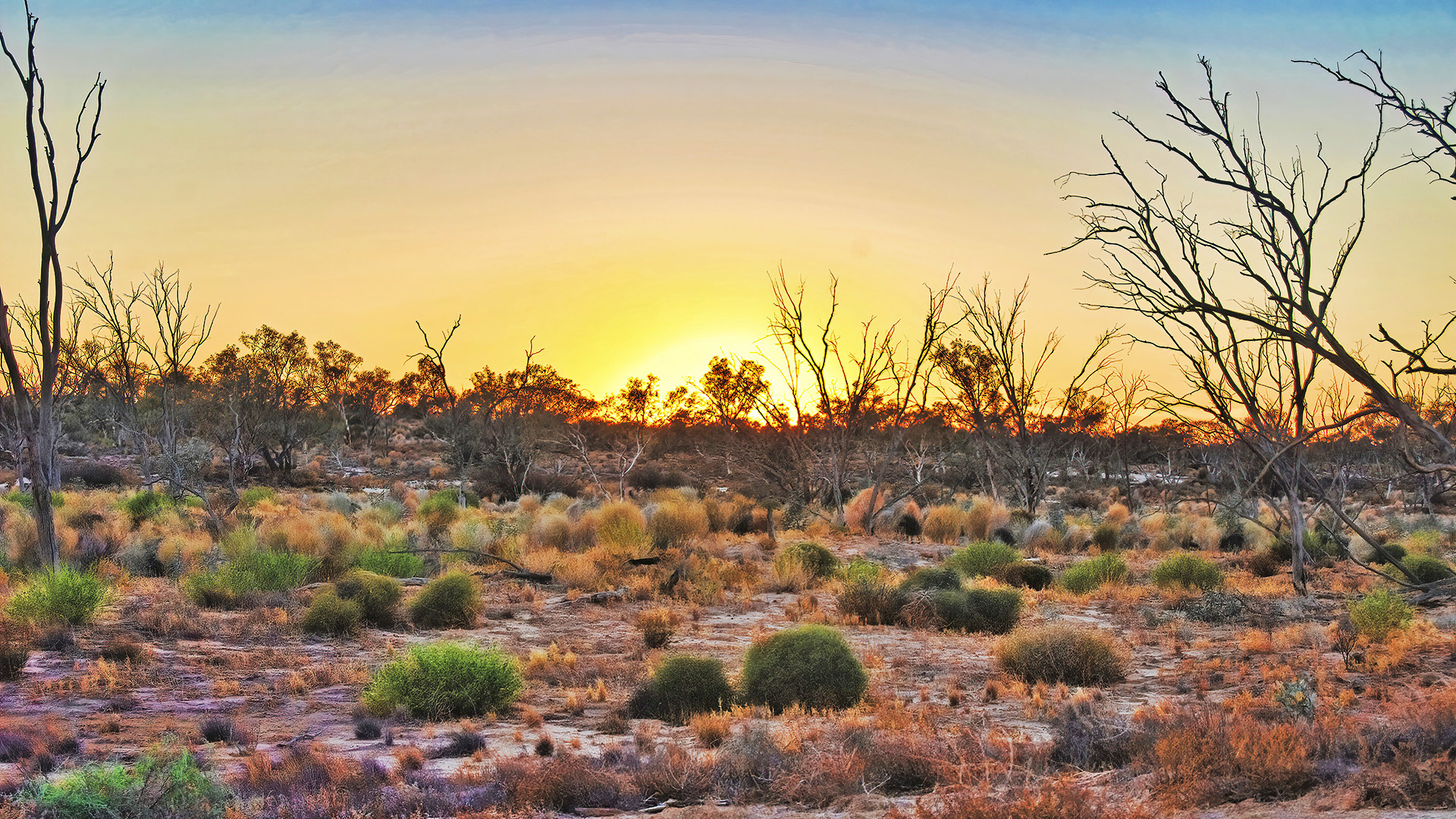
It is always entrancing to witness the silent illumination and transient colours of a landscape as our world turns to the Sun.  Always, you see detail and colours that you didn’t appreciate during the previous dusk.  This is a sandy bed of a large but ephemeral creek – a great campsite.  The stark, dead (Eucalypt) trees germinated with the 1974 floods only to be killed by a wildfire some 20 years later.  Such is life:

Reboot

A ‘Spinifex’ (actually Triodia) grassland wildfire: hot and lethal, reducing all in its path to ashes.  This hummock grassland type covers about 25% of the continent.  Ignited by lightning or people, such fires are frequent.  With the first rain post-fire, the Triodia regenerates from seed and roots, faster than competing woody plants.  So, repeated fires – burning your neighbours – is a sustainable way to persist:

Success

Heavy rains in 2009 triggered a massed pelican breeding.  Thousands of birds gathered at one location, mated and successfully bred.  More details are here.  Success in this time-dependent gamble is shown by the chicks (darker heads) are now as large as the parent birds.  All life is a Game: If you win , you stay in the Game:

Bugger

A feral camel (Dromedary [Camelus dromedarius] single hump) enjoying an uncommonly lush grassland.  Imported in the mid-1800s, camels facilitated the exploration and settlement of Outback Australia.  Displaced by motorized vehicles in the1920s, instead of a bullet, they were abandoned to die out.  But they didn’t.  Then a couple of hundred camels is now a large feral population of at least 600,000 damaging pests – a significant multi-million dollar problem.  In the Southern Hemisphere, a well-intentioned action resulting in a disastrous outcome is widely known as a Bugger, made famous by this Toyota video:

Mute

A rock engraving, a graphic message from a pre-literate time, meticulously pitted on a vertical rock face.  What can be inferred from it?  In order of certainty, it was done by a male, likely over a working period of 3-5 days, at least 10,000 years ago.  In spite of much speculation, we cannot ever really know the message or the audience, a realization that sometimes evokes a puzzling tinge of sadness:

Harsh

The Pilbara region is Australia’s harshest landscape.  It is hot –(recorded 160 consecutive days of above 100°F (38°C)), and essentially water- and treeless, and rendered unfriendly by the swarm of small spiny hummocks of Spinifex (Triodia).  Yet prospectors and geologists continue to search here for mineral riches.  After we found the rocks containing a fossil stromatolite, dated at 3.4 billion years, and then thinking about Deep Time, we forgot about the current temperature and Spinifex spines:

Serenity

Why do we find a slow-flowing river so timeless, relaxing and peaceful?  In 1925, two men, Jerome Kern and Oscar Hammerstein, wrote their explanation as the words of the song ‘Old Man River’.  A truly timeless contribution to our culture that you are probably silently singing right now:

Awe

This image captures a mind-stretching contrast in ages between the biological world and the geological world.  In the foreground are several species of ephemeral  plants – bright, colourful, with a life spans of months to a year or so.  In the background, the blood red rocks looking sharp edged and resistant, are dated at more than 2.5 billion years.  The smallest units of geological dating, millions of years, are beyond the reckoning of biologists, yet life was present on earth when those background rocks were being formed.  The Deep Time of Life is right up there with the Rocks:

Me

A densely painted gallery in Arnhem Land, northern Australia.  The gallery contains older figures – devil-devil figures (LHS), a python and several crocodiles (Middle) – all overpainted by numerous, modern (less than 100 years) ‘hands’.  The ‘hands’ are not stencils or imprints.  They are deliberate drawings infilled with colour.  The overall impression of the modern ‘hands’ layer is just exuberant happiness celebrating ‘Me’, ‘Look at Me’, by the many painters who contributed.  No deep cultural significance just an expression of the ‘joy of life’ in vivid colour.  The longer you scan this image, the more surely you will smile:

Renewal

It was a hurried camp selected in falling light with the best site option being a desert track in the sea of (flowering) Spinifex.  All that is forgotten now as you slowly wake in the golden light of a quiet and calm dawn, along with the smell of dew-dampened sand.  Life is good!:

Readers’ wildlife photos

February 15, 2026 • 8:15 am

Ecologist Susan Harrison has stepped up to the plate with some bird photos (and a herd of mammals), ensuring that we have wildlife photos today. But this is the last batch I have; will you help us tomorrow and thereafter?

Sisan’s text and IDs are indented, and you can enlarge her photos by clicking on them.

Some winter birds, and one herd of ungulates, in California and Oregon

It’s been a quiet winter for me aside from a previously WEIT-recorded trip to Belize, and so it’s taken a few months to accumulate a handful of photos that seemed at least a little bit striking – either because of the sheer beauty of the animal or because of the behavior it was displaying.

The first three photos are from an Ashland, Oregon streamside. It was especially intriguing to see a pair, or perhaps adult and offspring, of American Dippers (Cinclus mexicanus) eating very large tubular items that turned out to be nymphal October Caddisflies (Dicosmoecus gilvipes).   This insect is an key menu item for fish at a food-sparse time of year, and thus is well known to Western US anglers, but it was new to me.

American Dippers:

Near the Dippers were the showiest bird in town, the male Wood Duck (Aix sponsa), and the bird with the biggest voice despite its tiny size, the Pacific Wren (Troglodytes pacificus).

Wood Duck:

Pacific Wren:

The next three photos were from a winter raptor-watching trip to the Klamath Basin of southern Oregon and northeastern California.  Watch closely for the non-birds 😊

Ferruginous Hawk (Buteo regalis) in front of Mt. Shasta:

Pronghorn (Antilocapra americana) crossing a stretch of farmland:

Great Gray Owl (Strix nebulosa) lurking beside a meadow at dusk:

The following are birds foraging in the parks and neighborhoods around Ashland.

Cedar Waxwings (Bombycilla cedrorum):

Hermit Thrush (Catharus guttatus):

Acorn Woodpeckers (Melanerpes formicivorus):

Lesser Goldfinch (Spinus psaltria):

Spotted Towhee (Pipilio maculatus):

The last three shots are from the seaside or bayside in Northern California.

Black Oystercatcher (Haematopus bachmani) prying up barnacles:

American White Pelicans (Pelecanus erythrorhynchus):

Black Skimmers (Rhynchops niger).

Black Skimmers are most unusual birds that hunt in large flocks by dangling their huge lower mandible into the water while flying at high speed.  They mostly inhabit much warmer climes, and I was surprised to learn of this flock in the southern San Francisco Bay.   Per AllAboutBirds, they have been described as looking “unworldly… aerial beagles hot on the scent of aerial rabbits.”:

Readers’ wildlife photos

February 14, 2026 • 8:30 am

These are the last photos I have, and I’ve gathered singletons in a potpourri of photos. Please send me any good wildlife photos you have—otherwise there will be a LACUNA tomorrow. Captions are indented, and you can enlarge the photos by clicking on them.

From Pratyaydipta Rudra in Oklahoma.

This is a Pine Squirrel [Tamiascirus sp.], photographed in Rocky Mountain National Park, CO.

From Adrian:

Here’s a picture of a European Pine Marten (Martes martes) from the shores of Loch Duich, near the Isle of Skye, Scotland:

From Guy:

Taken in Lake Saint Clair Metropark in Michigan a few years back by my 12 year old son Nolan at a bird-banding station where we volunteer. I think it’s a Blackpoll Warbler (Setophaga striata) with the image taken in the fall (so I don’t really know if it’s male or female):

From Robert Lang, whose house and studio burned to the ground during the California fires last year; both are being rebuilt:

Our gardener found this California native tarantula (Aphonopelma sp.) while clearing some fire debris at my former studio and, knowing that my wife had a pet tarantula and was helping the Eaton Canyon Nature Center in its fire recovery, he left it for us at our temporary home in a little plastic bottle. (Umm…the tarantula was in a little plastic bottle. Not our home.) After we determined that ECNC didn’t have a place for one yet, we released it locally, but I took this picture before it wandered away.
When we got home from the release, there was another plastic bottle on the porch with another tarantula inside.

A Hummingbird Moth (species unknown) from Marty Riddle:

The Hawk Moths, aka Hummingbird Moth, love the nectar in resident maintained gardens at Brooksby Village Peabody, Massachusetts:

And a cat/bird encounter from Barry Lyons:

For years now, I’ve had mourning doves  [Zenaida macroura] alight on my air conditioner. Some of them are regulars, and what interests me is that they haven’t taken the next obvious step: pecking at the window.
What I mean is that a dove arrives and then stares into my apartment, sometimes moving its head back and forth: “Are you in there? Ah, there you are!” And then I get up from my chair and go feed them.
But when will a dove start pecking at the window to alert me that he’s there? Why hasn’t it figured out that it’s something it can do? And at no cost to his safety because he can still fly away.
And look at this photo. The dove seems to understand windows. Every time a cat goes to the window (I don’t own a cat; I cat-sit) it flares its wings instead of flying off, as if to say, “Ha ha, you can’t get me. I’m out here, you idiot.”

Readers’ wildlife photos

February 13, 2026 • 8:15 am

Well, this is the last batch of photos I have, and it’s very sad that the tank is empty. Please send some in if you have them. Don’t make me beg!

Today we have photos of ducks—or rather, one female duck— rom Aussie reader Keira McKenzie in Perth. Keira’s captions are indented, and you can enlarge her photos by clicking on them.

Here is a series of photos I took of a lone Pacific Black Duck [Anas superciliosis] from this afternoon [Feb. 11] at the park. Since the islands in the ponds have been completely cleared of all vegetation (the western island) and all the undergrowth cleared from the eastern island (this is because of the devastation throughout Perth’s trees from the polyphagous shothole borer), moat of the waterbirds have left for areas where they can roost & nest. 

The photos are taken in Hyde Park, Perth, Western Australia, on a hot humid afternoon.

I am very fond of them. I rescued one when it flew into the electric wires on the other side of the road one night. I carried it back across the road and into the park, putting it near the water’s edge. It was a pond-smelling little bundle, seemed uninjured and was very calm, and waddled off into the water and sailed into the night.

What a beautiful hen! It makes me eager for Duck Season to arrive at Botany Pond. Keira also sent a picture of her cat:

I shall sign off with a pic of my little Baba (currently zooming around the place for no apparent reason) slothing in the armchair in the heat with one of her favourite toys (the other is a wombat).

Readers’ wildlife photos

February 11, 2026 • 8:30 am

We have only one batch of photos remaining, a special batch for Darwin Day tomorrow, so again I’m stealing some e great photos by Scott Ritchie, who hails from Carirns, Australia. Scott’s captions and IDs are indented, and you can enlarge his photos by clicking on them. But please  send in your good wildlife photos. His bird today is itself a marvel of natural selection for cryptic coloration and behavior: the Papuan frogmouth.

FROGMOUTH FUNNIES

A Papuan Frogmouth chick [Podargus papuensis] sparked my interest in bird photography 7 years ago. This is a large bird that mimics a dead tree stump or broken branch. Grey and brown mottled camo, and sites still. Carefully watching you through its slit eye. In Nov. 2019, I was thrilled to see Papuan Frogmouths nest in a tree in my front yard. The chick was so cute! I followed it until it fledged a month later.

Ever since this time, I’ve wanted to recapture the magic that a young frogmouth chick brings to the viewer. Large, intense eyes on a fluffy white downy head. CUTE. And they never nested in our tree again.

This year I finally captured a frogmouth chick as it grew, and successfully fledged (i.e., left the nest) near the Cairns Botanic Gardens. Here are some pictures of the growing bird, and my silly stories. I hope you get a kick out of them, and wish them well

My first Papuan Frogmouth chick. Nov. 2019, my yard. The bird that sparked my passion. Max cuteness!:

Fast forward, Dec. 2025. A PFM nests near the Cairns Botanic Gardens.:

A few weeks later, the egg hatches. And a little chick is born. A bit scrawny now. Max cuteness in 1-2 weeks:

In late January, the mozzies [Australian for “mosquitoes”] are fierce. “Dad, there’s a mosquito trying to bite me. Do something!” Max cuteness!:

Dad laughs. “Get used to it. You’re in north Queensland son!”:

Come on Dad! Be a sport:

A week later, max cuteness is past. And a surely teenage frogmouth realises he has to put up with his home a bit longer:

But he’s good humoured about it. Can’t beat ’em, join him!:

And finally the time has come to leave the nest. Dad and son are now roosting in a nearby tree. He’s still a cute puffball. But has a lot to learn:

“Son, comb your bloody feathers! You’ll never convince anyone that you’re a tree stump with that ragtop!”: