Readers’ wildlife photos

October 14, 2025 • 8:15 am

Charles Dunlop sent some photos with a short intro.  His brief IDs (without species names) are below, and click to enlarge the photos. (I’ve linked to species when I can identify them, but readers can help in the comments.)

Attached are some photos that I took in Costa Rica in 2019. 

Black-bellied hummingbird:


Blue Morpho butterfly:

Big Cats, La Paz:

Jaguar, La Paz:

Frog, La Paz:

Resplendent Quetzal:

Millipede:

Bananaquit:

Crab:

Iguana sp.:

Crocodile:

Readers’ wildlife photos

October 2, 2025 • 8:30 am

I have two batches now and some singletons, but of course that won’t last a while, so please send in your wildlife photos. Thanks.

Today we’re featuring the insect and spider photos of reader Mark Sturtevant. Mark’s narrative and captions are indented and you can enlarge his photos by clicking on them.

After a longer than usual absence, I am back with more pictures of arthropods from my area in eastern Michigan. These are pictures from May of not this season, but the previous one. I am far behind in processing pictures as I have so many!

The pictures here will be mostly about moths, starting with a couple of caterpillars. Here is the larva of the Copper Underwing (Amphipyra pyramidoides). Underwing moths are cryptic, but they usually have flashy hind wings as shown in the linked picture to this species. This is a form of deception, since when an underwing moth is flying, a predator would see the bright colors. But after an erratic and hard-to-follow flight, they duck around and land on a vertical surface {usually a tree trunk), fold their wings, and they no longer look like they did.

The next caterpillar is an Eastern Tent Caterpillar (Malacosoma americana). The larvae are very gregarious and together they form a densely webbed bivouac where they shelter for their entire larval stage. They periodically arrive at a quorum for feeding en masse, and when that decision is made, they migrate out together to feed by following pheromone trails to the leaves and then back again to the bivouac. A mature caterpillar will wander on its own to make a cocoon, as I suppose this one was doing. This all seems very interesting to me now, so next summer I am resolved to pay more attention to the habits of these common caterpillars.

I have lately been keeping the porch lights on in order to attract insects I might photograph, and the numbers that are pulled in have been kicked up by a lot with a couple cheap black lights, as the UV from these attracts moderate swarms of insects. So here is a very early and small installment of pictures from the porch.

First is a Bilobed Looper mothMegalographa biloba, a widely distributed species throughout the Americas. There are several related species that also come to the porchlights and you will see those later.

Next is what is either a Grape Leafroller MothDesmia funeralis OR a Grape Leaffolder Moth D. maculalis. Identifying the difference requires a ventral view. The modified antennae identify this one as a male.

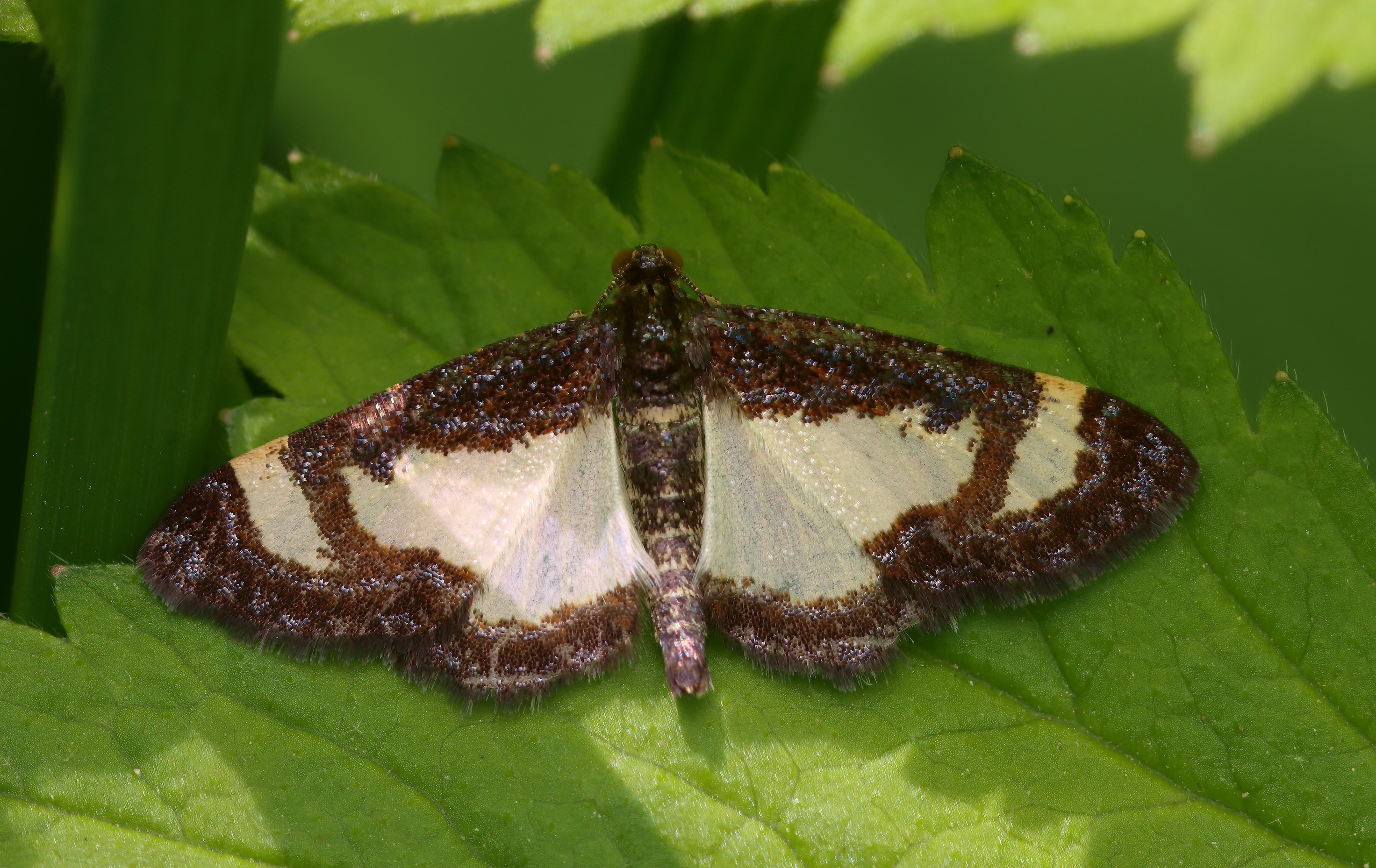
The moth in the next picture is the Common Spring MothHeliomata cycladata, followed by a lovely little moth called the Pale BeautyCampaea perlata.

The final moth here is the Baltimore Snout, Hypena baltimoralis.

Other common visitors to the porch lights are large Fishflies. As this was in the Spring, this will be the Spring Fishfly, Chauliodes sp. For scale, it wis about as long as your index finger.

Out in area parks now. Here is a mating pair of Crane FliesTipula sp.

One of the American Rose ChafersMacrodactylus sp. Despite the name, the larvae and adults are fairly broad in their herbivory.

Let’s close with some spiders. A common sight in the woods are these numerous but tiny spiders that use webbing to partially enclose themselves in curled leaves. This is one of the Mesh Web Weavers (Dictynidae). I don’t know how they hunt since I don’t see them with much of a web, but perhaps they go after whatever trips over their weblines in their leaf shelter. There is generally prey in there with them.

It’s always a good idea to inspect leaves, and a curled-up leaf, sewn tightly shut with webbing, is like an Amazon package for Mark. Here, I had opened a tightly enclosed leaf and found this very annoyed crab spider glaring at me inside. What I see here suggests it is a Bark Crab Spider in the genus Xysticus (given the placement of eyes, bristles on the first tibia, and so on)From the looks of her, she will be using this enclosure to protect her egg sac. So after some pictures, I put her and her leaf in a well sheltered area.

The final picture is a favorite species of ground spider, the Parson SpiderHerpyllus ecclesiasticus. These zippy critters commonly turn up in the house. The common name refers to the silvery markings on the abdomen that looks like an old timey minister cravat.


Readers’ wildlife photos

September 25, 2025 • 9:00 am

Scott Ritchie of Cairns, Australia, has once again posted a lovely set of pictures on his Facebook page. Scott’s captions are indented, and you can enlarge his photos by clicking on them.

About time I had an update on my WA [Western Australia] trip. Outside of Fremantle, the 1st town we stayed in, recommended by my friends Peter and Jnatte Manins, was Nannup. It had a great brewery, and killer birds! Amazingly, it had a huge population of Monarch Butterflies. I felt like I was a kid in Iowa, when I used to rear monarchs out for fun. It turns out that near Nannup the cottonweed exploded in number when a local pine planation was harvested. The monarchs love milkweeds, and they exploded too! Our B&B had a nice garden, full of Splendid Fairywrens and many other local birds.

For me, the real treat was to see two rare cockatoos. The Carnaby’s Black Cockatoo could be heard calling over our accommodation, and often did flyovers. I only got far away fetching shots. But when we travelled east towards Pemberton, we went through Karri and Jarrah forests. I spotted an emu in a paddock next to a caravan park. And suddenly heard the calls of incoming cockatoos. They landed almost overhead, feeding on gum flowers. They soon took off across the paddock into gumtree forest. I heard the incessant begging call of an immature bird demanding to be feed. I stealthily crept up and got some nice shots of the cockies. It was even better than I thought. When I looked at the images on my laptop, the birds had the characteristic long hooked beak used to dig out the fruit of big gum nuts. They were Baudin’s Black Cockatoo! Both the Carnaby’s and the Baudin’s are endangered, with only 5000 of the Baudin’s left. I felt privileged to see them!

And here are sone other birds from our Nannup stay. I hope you enjoy them!

Carnaby’s Black Cockatoo (Zanda latirostris).  He’s a sentinel, watching out for trouble for his family:

A Carnaby’s flies overhead:

A Baudin’s Black Cockatoo (Zanda baudinii) flies into the gum trees:

And pigs out on gum flowers. These might be Karri?:

Note the long, hooked upper beak of the Baudin:

Cuddling up:

And then in for a feed!

A third shows up:

Those Monarch butterflies (Danaus plexippus) were F’in everywhere!:

The lovely Red-eared Firetail (Stagonopleura oculata). What a cute finch!:

Common Bronzewing (Phaps chalcoptera) shows off his reflective wing panels. A lovely pigeon indeed!:

“Why go to Japan?” Spring is cherry blossom time in Nannup too. And the Silvereyes (Zosterops lateralis) add to view:

It’s not a bird, it’s a flower. Indeed it’s a Bearded Bird Orchid (Pterostylis turfosa). Orchids are a big deal in WA springtime:

A White-breasted Robin (Quoyornis georgianus) looking a lot like Cairns’s Mangrove Robin. Boy, he’s glad he doesn’t have to put up with sandflies!:

A Western Yellow Robin (Eopsaltria griseogularis) in full song:


And a Western Rosella (Platycercus icterotis) looking for a cheap feed.

Readers’ wildlife photos: The horrors of the human botfly

September 23, 2025 • 8:30 am

I have recounted previously how, when visiting Costa Rica as a graduate student, I got a human botfly larva (Dermtobia hominis) in my head, and, over the next two months, let it grow between my scalp and my skull until it emerged.

My story was the subject of a Science Friday segment on NPR that you can hear by clicking below. Press “listen”; my segment begins at 43:38 and lasts 12 minutes. I think they did a fantastic job, even interviewing my girlfriend at the time, who was present when the botfly larva emerged from my head.

And below is a great short video of the natural history of this fly produced by my Harvard colleague Piotr Naskrecki. It shows a botfly emerging from a human arm. Note how amazing this creature is: the fly larva not only produces an antibiotic to prevent it from being attacked by microbes while it’s gestating, but also a painkiller  that makes its exist painless (if a host felt it emerging, it might slap and kill the larva). Evolution is amazing!

h/t: Sally, Sarah

Tiger beetle video for the weekend

September 19, 2025 • 1:30 pm

This came from reader Erik:, who said it was a”Nice short video from KQED about tiger beetles. Unfortunately, the don’t include all ref’s like Ze Frank.”

It’s just 3½ minutes long and you’ll learn something. I’m upset a bit, though, about experiments in which they cut off the beetle’s antennae or somehow blind it.

Readers’ wildlife photos

September 14, 2025 • 8:45 am

We have a new batch of floral photographs (one has insects in it) by reader Tom Webber from Florida. Tom’s narrative and captions are indented, and you can enlarge the photos by clicking on them.

Here are a few of the many wildflowers I’ve found this spring and early summer in the several hundred acres of open tall-pine woods I visit regularly in Alachua County, at the north end of the Florida peninsula. In two previous installments I showed flowers that bloomed there during late summer and fall of last year. There was nearly complete turnover of the blooming species from the earlier period to the later; the only one flowering in both was the butterfly pea. Most of the plants in the present group, like the ones I’ve shown previously, grew in parts of the forest that had been burned within the last year. I think I’ve identified them all correctly to genus, and most to species, but I’ve put the qualifier “cf.” before some of the species epithets I’m less sure of. I invite corrections.

Carolina frostweed, Crocanthemum carolinianum. 2 cm.:

Lizard’s tail, Saururus cernuus. 10 cm long. This one grew with hundreds of others on the marshy fringe of a pond in a small cypress dome:

Myrtleleaf St. Johnswort, Hypericum myrtifolium. 1.5 cm. The other two species of Hypericum I’ve found here are scattered about sparsely through the woods, but these grow in only one patch occupying less than a quarter of an acre:

Shiny blueberry, Vaccinium myrsinites. 5 mm long. These are common in many parts of the forest and in some places form a major part of the understory. The berries aren’t much to eat; they’re small, grainy with seeds, and not very juicy:

Roseling, Callisia graminea. 2 cm.:

Dwarf huckleberry, Gaylussacia dumosa. 8 mm. I found only about ten of these plants, in one diffuse clump about 15 m in diameter. I haven’t tried the berries:

Dayflower, Commelina cf. erecta. 2.5 cm across. Flowers of this genus have three kinds of stamens, including some that don’t produce pollen. The sterile ones here are the upper trio, with the x-shaped anthers. These are thought to help attract pollinators by giving the appearance of a pollen bonanza without the expense of producing the real thing:

I happened upon these two while I looked over other dayflowers nearby. They are Poecilognathus punctipennis, a species of bee fly endemic to southern North America – most sources say Georgia and Florida only. They were jostling the anthers with their forelegs, concentrating on the two slender-stalked lower ones, scarcely touching the big central one, and neglecting the sterile ones. They didn’t seem to achieve anything at first, but then managed to break the pods a bit and knock loose some pollen grains. Even though their soda-straw snouts look highly specialized for sipping nectar, they succeeded in snorting up a few grains each; I couldn’t help wondering if they ever get clogged. It seemed like a lot of work for not much return, but they do manage to get a substantial part of their diet this way. I could have changed the camera controls to get more in focus and reduce the movement blur, but I was afraid the pause might cost me my chance to get an identifiable picture of the flies. A few days later I found some of them feeding on roselings as well:

Yellow jessamine, Gelsemium sempervirens. 4 cm.:

Elliott’s milkpea, Galactia elliottii. 1.5 cm. These grew thickly over a large wet depression and were all gone after about three weeks:

Mountain azalea, Rhododendron canescens. 4 cm long. One of our five native Florida species of Rhododendron:

Snow squarestem, Melanthera nivea. Entire flower head 2 cm. Snow squarestem is native to the Florida pine woods, but I haven’t found it in this forest. This one grows in a pot in my yard:

Purple thistle, Cirsium horridulum. 8 cm.:

Tread-softly, Cnidoscolus stimulosus. 1.5 cm. A nettle, which can stab you even through your pants. The sting lasts only about 15 minutes though. This is one of the most persistent spring flowers here:

Spurred butterfly pea, Centrosema virginianum. 3 cm across. An example of a white individual; the others I’ve seen here have been violet, and I have included one in a previous installment from late summer and spring: