Why Evolution is True is a blog written by Jerry Coyne, centered on evolution and biology but also dealing with diverse topics like politics, culture, and cats.
Welcome to the final CatSaturday of the month: Saturday, May 30, 2026, shabbos for Jewish cats, and National Mint Julep Day, an excellent drink when you use good bourbon and plenty of crushed mint. From Wikipedia (note the reference to Williamsburg, Virginia):
The mint julep originated in the southern United States, probably during the eighteenth century. The earliest known mentions come from 1770 and include a satirical play by Robert Munford, The Candidate (where a drunkard character “Mr. Julip” appears); and “A Short Poem on Hunting” (which describes julep as a concoction “Which doctors storm at, and which some adore”), published in the WilliamsburgVirginia Gazette. Further evidence of mint julep as a prescription drink can be found in 1784 Medical communications: “sickness at the stomach, with frequent retching, and, at times, difficulty of swallowing. I then prescribed her an emetic, some opening powders, and a mint julep.”
Here’s one with the caption, “A mint julep made with Henry Clay’s original recipe at the Round Robin Bar. According to bartender and historian Jim Hewes, the cocktail was originally served in a crystal glass because it represented a more upper-class beverage.”
Readers are welcome to mark notable events, births, or deaths on this day by consulting the May 30 Wikipedia page.
A faculty member ordered cookies for the undergraduates at their research symposium, and some of them were meant to display Botany Pond, which the undergrads apparently love. They saved one cookie for me, and here it is. I ate it this morning with coffee, but I hated to ingest such a work of art:
Da Nooz:
*Well, it looks as if the war with Iran isn’t over yet. The news yesterday was all abuzz that a deal had been reached, and Trump was set to approve it. But, as always, that was wrong. Nothing was announced. From the BBC:
US President Donald Trump had a meeting with top aides on Friday to make a “final determination” about a framework for extending the ceasefire with Iran, but it concluded without clarity on the next steps.
He said Iran must agree to never have a nuclear weapon or bomb, that the Strait of Hormuz be reopened for “unrestricted shipping traffic, in both directions”, and that any mines in the waterway are “destroyed”.
The meeting was held in the White House’s Situation Room, used for dealing with major crises. Iran earlier said it was not negotiating on its nuclear programme – which it insists is wholly for civilian purposes.
On Thursday, the two countries had agreed a framework of a deal – known as a memorandum of understanding – pending the approval of Trump and Iran’s leadership, according to US officials.
The deal would reportedly extend the ceasefire for 60 days and launch talks on the future of Iran’s nuclear programme.
“President Trump will only make a deal that is good for America and satisfies his red lines. Iran can never possess a nuclear weapon,” a White House official told CBS News, the BBC’s US news partner.
Since the ceasefire came into effect on 8 April, Trump has repeatedly suggested the US and Iran are close to a deal and negotiations are progressing, but so far there have been no substantive results.
In a social media post earlier on Friday, Trump said he was prepared to lift the US naval blockade of the Strait of Hormuz, allowing ships caught in the waterway to “start the process of ‘heading home!'”
He also insisted that Iran allow the US to remove and destroy its enriched uranium.
“No money will be exchanged, until further notice,” he said. “Other items, of far less importance, have been agreed to.”
Later, a White House official confirmed to the BBC that the meeting in the Situation Room had concluded. The official provided no further details.
Of course the “Iran will never possess a nuclear weapon” stipulation holds only for Trump’s presidency. And even now who can trust Iran to keep that pledge? Their whole history of evasion and cheating says otherwise.
Michigan Gov. Gretchen Whitmer (D), who has been widely viewed as a potential Democratic presidential candidate,said Thursday that she won’t be seeking her party’s nomination in 2028.
Hours later, she said otherwise.
Whitmer is term-limited next year after winning two gubernatorial elections in her key battleground state, and pundits have regularly identified her as part of Democrats’ crowded potential presidential field.
In an interview with Fox 2 Detroit on Thursday morning, she said: “There will be a robust group of people running for president. … I will not be one of them in 2028. I can tell you that.”
But later in the day, at an annual gathering of Michigan’s top civic and business leaders, she said she had spoken too soon.
“I never thought I would run for governor, so I guess I should know better,” she said during a panel discussion, later adding: “Never say never.”
Whitmer rose to the national spotlight during the coronavirus pandemic, when she pushed back on President Donald Trump’s efforts to antagonize her as “that woman from Michigan.”
She led a push to codify abortion rights in the state constitution in 2022, when Michigan Democrats won control of all three branches of state government and then used that “trifecta” to repeal a law that makes it harder for workers to unionize.
Whitmer drew some criticism for a 2025 speech in which she found some common ground with Trump but continued to stoke speculation that she could be preparing a run.
This year, she was one of several potential candidates who traveled to the Munich Security Conference, which does not typically attract U.S. governors, to lay out alternatives to Trump’s foreign policy.
I would vote for Whitmer in a heartbeat against any Republican candidate I know of, though I know some readers aren’t fond of her. But she’d be better than “progeressives” like Harris and Newsom, though these two are now are trying to “de-progressivize” themselves. I’m pretty sure that Harris won’t be the Democratic candidate because of both her election loss and her inability to speak coherently, but everything is still up for grabs.
The Supreme Court on Thursday threw out a Mississippi man’s conviction and death sentence. By a vote of 5-4, the court in Pitchford v. Cain agreed with Terry Pitchford that the judge at his 2006 trial had not properly analyzed whether the prosecutor in Pitchford’s case violated the Constitution’s ban on racial discrimination in jury selection.
Justice Brett Kavanaugh wrote for the majority, in a nine-page opinion joined by Chief Justice John Roberts and Justices Sonia Sotomayor, Elena Kagan, and Ketanji Brown Jackson. Quoting a 2019 opinion in which the court threw out the conviction of Mississippi inmate Curtis Flowers in a case that involved the same prosecutor, Kavanaugh acknowledged that “‘America’s trial judges operate at the front lines of American justice’ and ‘the job of enforcing’” the Supreme Court’s 1986 decision in Batson v. Kentucky, holding that the use of peremptory challenges (that is, challenges for any reason) to remove potential jurors based on race violates the Constitution, “‘rests first and foremost with trial judges.’” But in Pitchford’s case, Kavanaugh wrote, “the Mississippi trial court erroneously omitted” a key part of the Batson inquiry.
Justice Neil Gorsuch dissented, in a 10-page opinion joined by Justices Clarence Thomas, Samuel Alito, and Amy Coney Barrett. In his view, Kavanaugh’s “opinion errs on the law and the factual record alike.”
Pitchford, who was 18 at the time, was charged with murder for his role in the 2004 shooting death of a shopkeeper. A 16-year-old, Eric Bullins, fired the shots that actually killed Reuben Britt; he pleaded guilty and was sentenced to 20 years in prison.
Notice that two conservatives joined with the three liberal judges in this decision, which makes it unusual. But I think it’s a good decision because they are following the Constitution, which is their job. You can see the decision here. In the NYT, Yale Law School graduate Avital Fried agreed with the decision in an op-ed called, “College admissions are race blind. Jury selection is not.” Two bits (you won’t like the op-ed if you think affirmative action is essential to ensure “equity”):
The court recently ruled out the consideration of race in other contexts, like college admissions (as decided in Students for Fair Admissions v. Harvard) and voting rights (as decided in Louisiana v. Callais). The court has explained the shift toward a race-blind approach in those contexts as a way to reduce discrimination. To be sure, there are reasons to question this new approach in a racialized society like ours. But if that is the court’s stance, it should be applied to jury selection, too, where the stakes can be much higher and the consideration of race can be even more clearly linked to discrimination.
. . . The court’s decision on Thursday took a step in the right direction, upholding the current jury selection standard. But more needs to be done to align discrimination protections in this area with those in college admissions — both governed by the constitutional promise of equal protection under the law. The court has read that promise to protect high schoolers applying to elite colleges, and the very same promise serves as the bedrock of criminal trial rights. No one has a right to be admitted to Harvard, just as no one has a right to be seated on a jury. Still, every person has a right not to be denied a spot at Harvard or a seat on a jury because of his or her race.
If anything, the stakes are higher in a criminal trial than in college admissions. Discrimination in jury selection undermines people’s right to a fair trial when their life or liberty is on the line. Surely, high schoolers applying to elite universities should not get moreprotection than those facing the deprivation of life or liberty. Mr. Pitchford’s legal saga began when he was the same age as students around the country applying to college. Furthermore, racially biased strikes prevent members of the public from participating in an important civic duty. Just as the right to vote is carefully guarded, the right to be considered to serve on a jury is worthy of extra protection.
I have no beef with this decision, and am happy that two conservatives voted with three liberal.
*As always, I’ll steal a few items from Nellie Bowles weekly snark-and-humor column at the Free Press, called this week, “TGIF: The Donald Trump $250 bill.” Sadly, the real author is Nick Gillespie, a Free Press editor and libertarian.
Speaking of assisted dying:
→ Tim Hortons with a side of death: A Canadian doctor, James MacLean, approved medical aid in dying (MAID) for a 45-year-old man after briefly assessing him outside the popular coffee-and-donuts chain Tim Hortons, named for a beloved hockey player whose death in a car crash shocked fans. After determining that the man had inflammatory bowel disease and depression, Dr. MacLean then personally drove the man to a morgue where the MAID was administered in an industrial unit filled with other human cadavers. In another case, reports The National Post, “MacLean failed to administer one of three drugs used in assisted deaths—one that paralyzes the body’s muscles, including the muscles involved in breathing. The patient resumed spontaneously breathing again after initially being pronounced dead, and after MacLean had already left the home.”
Even—or especially—for supporters of MAID (I’m one), this sort of malpractice must be thoroughly investigated and punished.
If that’s the way MAID is actually practiced in Canada, it needs much more severe scrutiny, and the doctor needs his license pulled.
→ When you see only one set of footprints in the sand, that’s when Israel carried you:
→ Let’s check in on RFK Jr.: “Cheryl cheerleads the removal of a pair of Black Racers from Dr Oz’s patio.” Of course she does! I’m fond of saying we’re living in a Philip K. Dick novel as “shorthand for just how fucking weird our world is, and how much weirder it continues to get on a daily basis. What writer could have created Hunter Biden, or Lauren Boebert, or Elon Musk? The idea that Arnold [Schwarzenegger] would emerge as a major political player is strange—until you get to Trump.” Or RFK Jr.
Nobody but nobody is as good as Nellie at writing TGIF!
Like many on Thursday’s stage for theScripps National Spelling Bee finals, Shrey Parikh was a returning competitor. But his appearance this year wasn’t guaranteed.
He ranked 89th in 2022 and third in 2024. He seemed poised to take yet another flight from his hometown of Rancho Cucamonga, California,to the nation’s capital to contend for the Scripps Cup. Then he misspelled a word in his middle school’s bee last year. He was disqualified before nationals — or regionals — even began.
The word was calipers.
“Last year, I was really dejected and just very upset,” Shrey said. “It didn’t even sink in until the next day. I had a really tough time.”
Now, he’s got it down: “C-A-L-I-P-E-R-S,” he said for good measure on Thursday evening from the Scripps stage at DAR Constitution Hall after the competition ended.
In his last year of eligibility, the 14-year-old finally earned what he has coveted for years: the towering floral Scripps cup and a $50,000 cash prize. He beat out 246 other contenders. From the stage where he had just claimed his title as national champion, Shrey compared his feelings with his loss early last year.
“It’s like two ends of a spectrum,” he said. “Right now, I’m probably the happiest I’ve ever been.”
Shrey had a buzzworthy run in this year’s bee, which knocked out four of nine finalists in one round and ended in the competition’s third-ever spell-off tiebreaker. In several intense rounds of spelling during the finals, Shrey bested words like Bhubaneswar, Pluchea, hwyl, Metohija and Philepitta, before moving to the spell-off, where he spelled a record 32 words correctly in 90 seconds.
Shrey’s championship word — the last word he spelled correctly in the spell-off — was bromocriptine.
Ishaan Gupta, the runner up, spelled 25 words correctly.
*If you look at Wikipedia’s list of national spelling bee winners, you’ll see that Indians or Indian Americans have had a lock in the championship for about 18 years. (They do allow international competitors, so I can’t tell if the winners are citizens, but who cares?: it’s still amazing.) Shrey, who practices spelling for five hours a day, was in his last year of eligibility. His prize was a big trophy and $50,000.
Here’s a video of the competition and the winner (they can’t write down anything); note that it is mostly minority students of Asian origin who reached the top. The spelling part ends at 4:38, so you can stop there.
Here are the finalists in a screenshot from the video above:
You can take your own spelling bee quiz here (I haven’t yet done it).
Meanwhile in Dobrzyn, Editor Hili is keeping Andrzej in line:
Andrzej: What are we running in “Letters” tomorrow?
Hili: Something short, because yesterday the readers complained that you’re making them read too much.
In Polish:
Ja: Co dajemy jutro w „Listach”
Hili: Coś krótkiego, bo wczoraj czytelnicy narzekali, że każesz im za dużo czytać.
. . . and Andrzej posted this photo on his public FB page:
From Masih, who’s down on AOC for the Congresswoman’s apparent glorification of oppression:
“My body, my choice.” Except when a Muslim mayor says cover up. Then it’s “my body for votes.”
Since yesterday, when I criticized AOC, I have been under attack by her fellow feminists and colleagues calling me Islamophobic. Really? I have no fear of my beautiful mother, who… pic.twitter.com/Y4rC5PtsJP
Here’s the speech and appearance of AOC that Masih criticized. I have to say that here AOC makes me cringe. Donning a hijab, indeed! It’s either hypocrisy, pandering, or AOC is a covert Islamist.
Hello @AOC, while you smiled in a hijab at a New York event, I was in Federal Court facing the 4th hitman hired by the Islamic Republic to assassinate me, for campaigning for Iranian women to have the same freedom you performed for a photo op. Will you come to court with me in… pic.twitter.com/25mEGcdQ9d
One from my feed; the English translation of the Japanese is this: “A performance titled ‘Stairway to Success’… It steals your gaze without you realizing it.” Ah, life!
These three Dutch Jewish girls, with the youngest only three years old, were gassed as soon as they arrived in Auschwitz. Their mother was also gassed.
In the dim light of a late fly-out, to the tune of cicadas, Nayang’s wrinkle-lipped bats leave their cave…just as they have probably done every night for thousands of years…🦇#bats #Thailand #wildlife
I’m starting to get some new batches of wildlife photos, and I encourage readers to submit their good photos for consideration.
Today’s installment features the photos of UC Davis ecologist Susan Harrison, who recently went birding not too far from Chicago:
Birding in the Upper Midwest
Minnesota and Wisconsin may not be at the top of everyone’s list of nature travel destinations, but do they have darned nice birding? You betcha! On a late May work trip to Minneapolis, it was my good fortune to visit some of the Upper Midwest’s riparian forests, wetlands, and restored prairies during spring migration. Friendly people and well-tended parks and nature reserves helped make it delightful.
Rarer small birds that were new (a.k.a. “lifers”) for me….
Kirtland’s Warbler (Setophaga kirtlandii), a specialized inhabitant of young Jack Pine (Pinus banksiana) forests, only recently removed from the endangered species list:
Louisiana Waterthrush (Parkesia motacilla), a warbler that lives on the banks of crystal-clear headwater streams in forests:
LeConte’s Sparrow (Ammospiza leconteii), a secretive marsh dweller that sings in the dark and scurries around on the ground:
Henslow’s Sparrow (Centronyx henslowii), a stealthy bird of the region’s much-diminished grasslands (historical note: it was named by John James Audubon in honor of Darwin’s mentor John Stevens Henslow):
The week has flown by fast, like a migrating mallard, and June is nearly on us; today is Friday, May 29, 2026, and International Everest Day, celebrating the first confirmed ascent of the world’s highest peak (8,848.86 meters or 29,031.7 ft) on this day in 1953. The summiteers were, of course, Edmund Hillary and Tenzing Norgay. I have hiked to Everest twice, and have some lovely pictures of it, but they are 35mm Kodachrome slides that I can’t reproduce here. You’ll have to settle for a photo of the ice axe used by Hillary on the ascent, photographed by moi at the Auckland Memorial War Museum:
Many historians consider May 29, 1453, to be the date on which the Middle Ages ended. It was on this date that Constantinople, the capital of the Byzantine Empire, fell to the Ottoman Empire, after being under siege for almost two months. With the fall of the capital, the Byzantine Empire ended as well. Following the fall, Byzantine scholars left Constantinople and Greek culture began being studied outside of the area of the old empire. Learning based on classical Greek sources was revived and it helped bring on the Renaissance.
Here are what is reputed to be the best biscuits in Amerca (ergo in the world), part of a fantastic Southern breakfast I had at the Loveless Motel and Cafe outside Nashville, Tennessee (Martha Stewart, eating there, said it “was the best breakfast I ever had”). They were certainly the best biscuits I ever had, and, combined with eggs, grits, country ham, and red-eye gravy, I can’t think of a better breakfast, either. The jams in the plastic cups are homemade.
The biscuits come as soon as you sit down, so if you eat there don’t scarf them all up, as you won’t have appetite for the feast to come. And don’t worry, the biscuits keep coming. (There is a “biscuit lady” in the kitchen whose sole task is to make them).
Loveless Motel biscuits
Readers are welcome to mark notable events, births, or deaths on this day by consulting the May 29 Wikipedia page.
Da Nooz:
Breaking News, Ripped from the Headlines: Yesterday the NBC Evening News announced jubilantly that the U.S. and Iran are near a final deal on ending the war. Well, not so fast. What we have is “a draft plan on the table” (NYT) and “perhaps the makings of a deal” (WSJ). Here’s a rather lame proclamation from the WSJ:
The U.S. and Iran are within reach of an agreement to wind down the war, Treasury Secretary Scott Bessent told reporters Thursday, but President Trump has yet to sign off on it, and the White House wants a deal that satisfies several key conditions.
“We perhaps have the makings of a deal here,” Bessent said from the White House, noting both sides have been swapping proposals. “Everything depends on what the president wants to do, and President Trump is not going to make a bad deal.”
Bessent said Iran must agree to dispose of its highly enriched uranium, commit to never seek a nuclear weapon and fully reopen the Strait of Hormuz—elements U.S. officials previously said would be in the so-called memorandum of understanding.
The statement came after a U.S. official said the two countries were closing in on a 60-day agreement, including a mutual unwinding of blocks in the strait over the first 30 days. Axios reported earlier on the details.
Stay tuned (in two months). Any promises from Iran about never seeking nuclear weapons, should that be in the agreement, will be arrant lies.
The United States and Iran traded strikes overnight after President Donald Trump insisted he would not agree to a “crummy agreement” in the negotiations to end the three-month-old war.
The president used a Cabinet meeting Wednesday to insist he had maximum negotiating power with Iran and was not under pressure to make a deal.
“We’ve been doing this for a few months. Vietnam lasted 19 years. Korea lasted eight years. Afghanistan lasted many years,” Trump said when asked what the time frame is for the war ending.
Iran, he said was “negotiating on fumes” and had made a mistake by thinking “they were going to outwait me” because he would be under political pressure from this year’s midterm elections.
“I don’t care about the midterms.”
Iran’s Islamic Revolutionary Guard Corps said Thursday morning that it had retaliated against a U.S. attack outside the airport in Bandar Abbas, a city on the Strait of Hormuz, by targeting a U.S. base in Kuwait where the strike originated. Further U.S. attacks would receive a “more decisive” response, it said, according to state media. U.S. Central Command said Kuwaiti forces had successfully intercepted an Iranian ballistic missile.
Hours earlier, U.S. forces struck an Iranian launch site in Bandar Abbas, according to a U.S. official who spoke on the condition of anonymity to discuss military operations, after U.S. shot down five Iranian one-way attack drones that Centcom said “posed a clear threat in and near the Strait of Hormuz.”
The official described the U.S. action, first reported by Reuters, as “measured, purely defensive, and intended to maintain the ceasefire.” It follows similar strikes on Monday, during a ceasefire between the two sides that has looked increasingly shaky.
As readers suspected, this war is going to continue, and each exchange of attacks makes it harder to confect an agreement, despite the crowing from the Trump administration. My plan, which is mine: the U.S. needs to go harder after Iran, and stop dilly-dallying around striking missile sites. If they can’t get an agreement to completely ruin Iran’s ability to make nuclear weapons, and get the Strait of Hormuz open freely, then they should stop trying to get compromises on these issues. But I am no pundit!
Trump administration officials have pressed the office responsible for printing the nation’s money to design a $250 bill featuring the president’s portrait, according to four current and former employees, in what would be the first appearance of a living person on U.S. currency in more than 150 years.
Starting last year, two political appointees at the Treasury Department — U.S. Treasurer Brandon Beach and his senior adviser, Mike Brown — repeatedly urged staff at the agency’s Bureau of Engraving and Printing to prepare prototypes of the note, according to the employees, who said the move raised concerns because federal law currently allows only deceased people to appear on bills.
The employees spoke on the condition of anonymity for fear of retribution.
As part of the effort, Beach in August and September provided bureau staff with mock-up designs for the note, including one that shows President Donald Trump’s face in the center of the $250 bill between the signatures of the president and Treasury Secretary Scott Bessent, according to one of the employees and records reviewed by The Washington Post.
The artist who said he designed the mock-up told The Post that he had spoken with Trump about it.
British painter Iain Alexander said Trump endorsed changes to his original design, such as adding the colors of the American flag and a logo commemorating the 250th anniversary of the nation’s founding.
“He likes to call me his favorite British artist,” said Alexander, a former competitive swimmer and DJ who describes himself as a royal portrait artist of Queen Elizabeth II and others.
No living person has appeared on U.S. currency since 1866, when it was outlawed after the image of a mid-level Treasury bureaucrat showed up on a 5-cent note. Legislation that would allow Trump to appear on a $250 bill was introduced in Congress last year to commemorate the nation’s 250th anniversary but has languished.
In a statement, a Treasury Department spokesperson said the printing office “is conducting appropriate planning and due diligence” in response to the proposed legislation.
“Should this legislative mandate be signed into law, the BEP is moving proactively to produce a $250 commemorative note which will appropriately recognize the 250th Anniversary of our great nation,” the statement said.
The director of the printing bureau, Patricia “Patty” Solimene, and other staff repeatedly explained to Beach and Brown that there were legal and procedural obstacles to producing the note and that it would take years longer than they envisioned, the four employees said.
I wonder whether Congress will approve this bill about a bill (there’s of course no doubt that Trump would sign it). Right now a straight-up vote would pass it, assuming it’s a vote along party lines, but since it will take years to actually produce this infernal bill, it might be stopped after the midterms or when (fingers crossed) we get a reasonable President.
For Paul McCartney, songwriting isn’t only a job, a craft and an emotional outlet. It’s a compulsion and a craving.
“People say, ‘Well, why do you still write songs?’ And it’s just because I love it. I’m addicted,” he said in an interview at Boulevard Carroll, a warren of recording and rehearsal studios on Manhattan’s Far West Side, where McCartney, 83, had just wrapped up an afternoon of band practice for the season finale of “Saturday Night Live.” “Out of a black hole comes forth milk and honey. And it’s so great, the feeling.”
Prolific as he has been — through the Beatles, Wings and solo albums — McCartney doesn’t follow any songwriting discipline or routine. “I’ll just be somewhere, and with some time to spare, and my guitar will be there, or I’ll be near a piano. And the urge will take me,” he said. “Whenever I’ve hit something, it’s just like, ooh, wow. It’s a great feeling. You know, the whole creative thing is a great thing. I say it beats working.”
Even for a rehearsal, McCartney was nattily dressed. He sported a blue jacket, a black shirt with pink pin dots, black pants, white-soled shoes like karate slippers and socks with a psychedelic design of blue bubbles below a bright yellow stripe.
. . .In person, McCartney carries his six decades of fame with extraordinary grace. He’s genial and unpretentious, proud but not arrogant and still amazed and delighted at his life as a musician. “I wonder these days at how I ended up as a songwriter,” he mused. “Because, you know, I’m just some kid who went to school, went to the careers master who said to me, you know, ‘You haven’t got qualifications and, there’s not … I don’t see a great future for you.’
“So I had to take that and just sort of think, ‘Sod you — I’m gonna do something.’ And it made me work for success harder, because I wasn’t supposed to be successful. So writing songs was one of the great things about my growing up.”
. . .He added, “John had a much harder edge, which I liked a lot. When we were working together, it was very inspiring, very useful to have that kind of edge. And I think possibly it was good for him to have something less hard, something maybe a little bit more romantic. It’s just my way, you know. I’m that kind of person. I like certain things that some people might just sniff at and say, ‘Oh my God, that is so corny.’”
But at times, he has also felt misunderstood. “It’s funny how you get stereotyped,” he said. “Being called the cute one in the Beatles — that was like the worst insult you could give me. I really didn’t like that. It’s like, ‘No, no no, I’m more than that.’ But it also is true that if I’m writing a song, I do like it to have that sort of loving element. But to offset that, I often find that something a bit more realistic creeps in. I like the mix of the two.”
His melodic gift can hide his darker moments. When I asked which of his lesser-known songs he’s fond of, he cited “Daytime Nightime Suffering” and “Arrow Through Me,” two Wings songs from the 1970s that are not only full of musical twists, but also harbor troubled thoughts.
. . .McCartney is no longer concerned with making hits. “In attempting to be creative, it’s good if a lot of people like it,” he said. “But it’s not the be-all and end-all. It’s nowhere near as important to me as it is to some people. I like freedom. And if the freedom leads to a hit, great. If the freedom leads to just me enjoying it, probably even greater.”
What matters for him now is simply making music. “It’s a magical world, music,” McCartney said. “Scientifically, even, it is just a bunch of frequencies. So how can these frequencies affect your heart? I get it, if it’s got a lyric, sometimes you go, oh yeah. But if it’s just a melody — how can that make you cry? That’s magic. I love it.”
Here is his song “Days We Left Behind” that he sang on SNL. Yes, his voice is gone and he knows it. I didn’t like this song the first time I heard it, but I have to agree with the readers who said it was okay. It’s not a classic, and I’d like to hear the Beatles do it, but so be it. It reminds me of George Harrison’s Beatles remembrance song “When We Was Fab,” except this is about an old man pondering his past, not the Beatles.
The NGO at the centre of Kristof’s essay calls itself the Euro-Med Human Rights Monitor (Euro-Med or EMHRM), which Kristof blandly describes as “often critical of Israel.” Registered in Switzerland in 2015, this Palestinian NGO has a mailing address in Geneva and an unknown number of staffers paid with funds from undisclosed donors. The publication of a 69-page Euro-Med report on 12 April was the source of Kristof’s accusation that Israel “employs systematic sexual violence” that is “widely practiced as part of an organized state policy.” The report was accompanied by an extensive public-relations campaign, which included promotion in Turkish-government-controlled news platform TRT, Qatar-linked propaganda platform Middle East Eye, and many other outlets that routinely promote invented or tendentious stories about Israel.
The April Euro-Med report was also the source of the most sensational allegation in Kristof’s essay—that Israel trains police dogs to “rape prisoners and detainees.” Anti-Zionist influencers and officials seized on this charge and were already energetically circulating it before Kristof’s essay appeared last week.
. . . Euro-Med adopted this model [of NGOs having terrorist goals], and Israel has long considered the NGO to be a Hamas propaganda front. In 2012, the organisation’s founder and chairman Ramy Abdu was photographed posing with the late Hamas leader Ismail Haniyeh (killed by Israel in Tehran in July 2024). And at a 2013 event he organised in Gaza (“Hamas Movement Within the International Context”), Abdu was pictured next to Hamas’s international-relations officer Osama Hamdan. Abdu also created and led a series of propaganda frameworks, including the European Campaign to End the Siege on Gaza and the Council for European Palestinian Relations (CEPR). In 2013, Israel’s Ministry of Justice listed Abdu as one of Hamas’s “main operatives and institutions” in Europe. In November 2020, the Minister of Defence sanctioned him “in relation to his work with the designated terrorist organization ‘IPalestine—International Platform of NGOs Working for Palestine (aka ‘IPNGO’)’ that belongs to and acts on behalf of the designated terrorist organisation HAMAS.”
. . . Another important figure at Euro-Med is Muhammad Shehada, the organisation’s chief of programmes and communications, who posted a picture of himself with Ismail Haniyeh in November 2014 under the caption: “Talking a gently walk and a selfi with the ex-Prime Minister of#Gaza and the leader of #Hamas: #Ismail_Haniya.” Between February 2021 and August 2023, Shehada wrote twenty articles for Newsweek(which still describes him as a “writer and civil society activist from the Gaza Strip”),and from July 2017 to January 2024, he was a regular contributor to the Israeli left-wing newspaper, Haaretz. In addition to which, he has been quoted by the Washington Post and the New York Times, invited to address a Harvard human-rights centre (in February 2025), and been appointed as a visiting fellow at the European Council of Foreign Relations think tank.
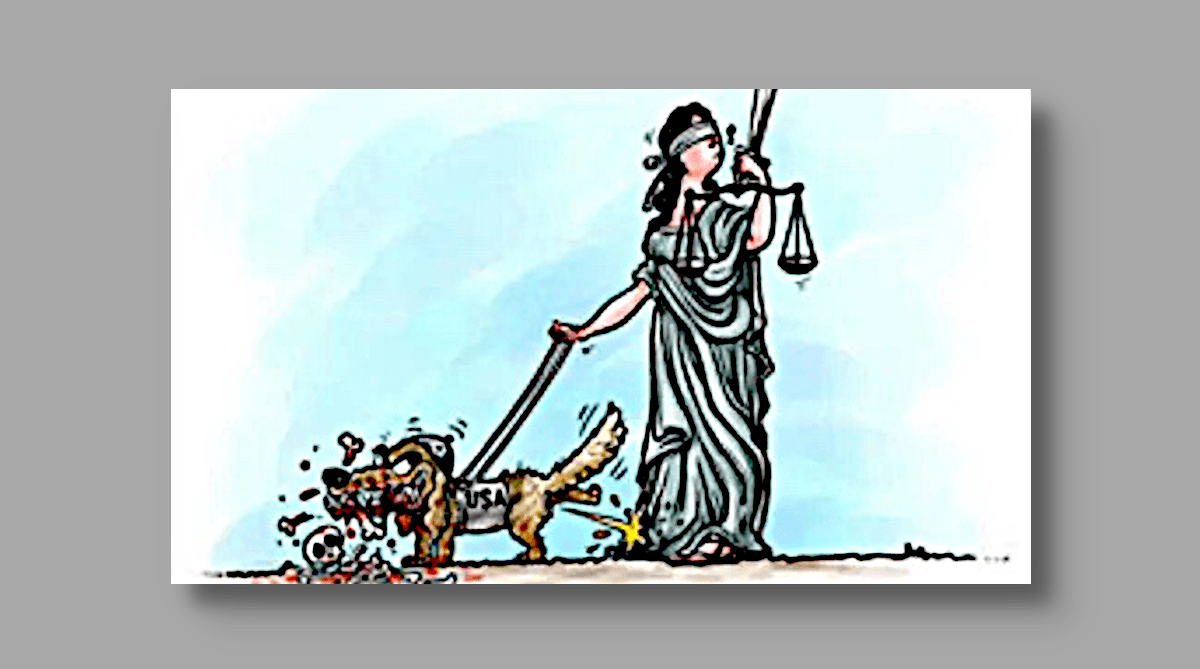
Richard Falk—a 9/11 conspiracy theorist and professor of international law at Princeton University—is chairman of Euro-Med’s Board of Trustees. In 2011, when Falk was serving as the Human Rights Council’s special rapporteur on Palestine (the position now held by Francesca Albanese), his crankery became so egregious that it was even condemned by the office of then-UN secretary general Ban Ki-moon. That same year, Falk published a cartoon on his personal blog that depicted an American dog in a kippa urinating on lady justice while it feasts on the skeletal remains of a small human corpse.
Here’s the cartoon published by Falk (from Quillette):
And of course, the dog-rape charge:
In this context, the chronology of events related to Euro-Med’s promotion of this story bears examination. On 19 June 2024, Dr. Muneer Al Barash, director general of the Hamas-run Ministry of Health in Gaza, was interviewed in Arabic by Al Jazeera. According to an unofficial English translation posted on X, Al Barash referred to “trained dogs used to perform vile [sexual] acts on detainees.” Eight days later, the Euro-Med story quoted Fadi Bakr, a Palestinian lawyer arrested after the 7 October atrocities, as the sole witness to the allegation of dog rape. “Throughout the entire ordeal I endured,” he told the NGO, “this was among the most awful things that I witnessed.” But four days earlier, Bakr had given an interview to the radical Israeli opposition NGO B’Tselem and made no mention of this incident, even though he detailed many other aspects of his ordeal. Bakr’s testimony is not included in Euro-Med’s April 2026 report either.
None of the MSM seems moved to let us know about Shehada’s background, or Abdu’s for that matter. Finally, Euro-Med certainly published antisemitic lies before:
Euro-Med’s dog-rape allegations and the wider claims of sexual violence are the most recent in a series of demonisation efforts engineered to elicit revulsion at alleged Israeli behaviour. In November 2023, the NGO published an article in which it alleged:
The Israeli army has been holding the bodies of dozens of Palestinians killed during its genocide in the Gaza Strip beginning on 7 October, and Euro-Med Human Rights Monitor has called for the creation of an independent international investigation committee into organ theft suspicions.
Yes, ladies and gentlemen, brothers and sisters, friends and comrades: this is the “NGO” on which Nicholas Kristof relied heavily. And the NYT is standing behind his allegations. He won’t get fired, and I doubt he was even reprimanded. It stinks.
*Finally, it’s become news (the AP’s odd news) when a tennis player has to take an unscheduled bathroom break during a major tournament. But he really had to go, and it was apparently not micturation!
Home player Arthur Gea ran off the court for an emergency bathroom break early in the first set of his French Open debut on Sunday.
“I need to go to the bathroom. I can’t move anymore. I’m going to (go) on the court,” Gea told the chair umpire in French before hastily running off Court Suzanne-Lenglen.
The 135th-ranked Gea was trailing 13th-seeded Karen Khachanov 4-2 when he made his move. Khachanov won 6-3, 7-6 (3), 6-0.
Usually, bathroom breaks are only permitted between sets.
Khachanov protested to the chair umpire as three minutes passed between games at a point in the match that was not a changeover when players change ends.
Gea said the umpire allowed him the break because of “medical circumstances” and that he was given some medicine to settle his stomach pain.
After the match, Gea said he had not felt ill the night before but started feeling unwell when he woke up in the morning.
Here’s a video of Gea begging to empty his bowels:
“I cannot wait… it’s not a joke” 🚽 A desperate Arthur Gea pleaded with the umpire for a toilet break during his first round match at Roland-Garros. #tennis#RolandGarros#FrenchOpen
Hili: What are you writing? Andrzej: A respectful letter to an idiot.
In Polish:
Hili: Co piszesz?
Ja: Uprzejmy list do idioty.
*******************
From TherionArms, another example of weird medieval calligraphy:
From Cats Doing Cat Stuff (the cat would also be content without a peach or a lemon):
From Stacy:
From Masih. The English translation of the print is below, but her words are captioned in English:
Today, I appeared in a U.S. federal court to face off, for the fourth time, with one of the individuals that the IRGC had hired to kill me.
Jonathan Lodeholt, the criminal, was sentenced to 10 years in prison.
Rivera, who was convicted and sentenced to 15 years in the previous trial, had hired Lodeholt, who was an American citizen. Both were operating under the orders of Farhad Shakari, an IRGC agent.
The Iranian regime had offered them $100,000 to kill me.
In court, in front of the judge, I said that I am a journalist. My only weapon is my voice, and my work is to be the voice of the people of Iran. But the Islamic Republic, even here, on American soil, is trying to kill its opponents.
Shakari is still taking refuge in Iran. He is still free. This case is not over.
As long as the Iranian regime is in power, none of us—whether inside or outside Iran—will have any security.
امروز در دادگاه فدرال آمريكا حضور پيدا كردم تا براى چهارمين بار با يكى از افرادى كه سپاه پاسداران براى كشتنم استخدام كرده بود، روبه رو شوم.
جاناتان لودهولت مجرم و به ١٠ سال زندان محكوم شد.
ريورا كه در دادگاه قبلى مجرم و به ۱۵ سال حبس محكوم شد، لودهولت كه یک شهروند آمريكايي بود را… pic.twitter.com/SxWoFkpdON
*Speaking of Nicholas Kristof, his second unsubstantiated accusation of sexual assault, this time on captured members of a flotilla, philosopher Maarten Boudry canceled his NYT subscriptsion. See his two tweets below (the other two sources from his first tweet are in a thread, and the articles to which he refers are here and here).
The @nytimes “dog rape” story was so grotesquely bad and irresponsible — and the response from @nytimes so obtuse and deflective — that I’ve decided to cancel my subscription. I have no interest in funding this kind of antisemitic drivel. If you read these three damning pieces,…
I wouldn’t have cancelled my subscription over one idiotic column. What clinched it was the fact that @NYTimes unequivocally “stands by” the story and considers its journalism as rigorous as any other news report. Fuck you, NYT.
From Luana: more violence inspired by Luigi Mangione. You can read more about the case here.
Palisades Fire ends up being one of the most destructive acts of left wing terrorism in modern history.
The arsonist Rinderknecht searched “free Luigi Mangione,” “let’s take down all the billionaires” and “let’s kill all the billionaires” before setting the Lachman Fire which… pic.twitter.com/laUfBmy8fm
And one from Dr. Cobb. He’s referring to “gasoline”, and the rest of the thread explains this post:
Yes, calling a liquid "gas" used to bug me no end. Then I discovered that it ought actually to be "caz," not "gas." It's based on a trade name.A thread… 1/6
Correction: Colin told me this: “One minor correction: Theory and Society isn’t a new journal. What’s new is the newly approved ‘Peer Review’ paper category they offer. We had been working with the Springer Nature people for close to 6 months back and forth, and finally they approved it and implemented it on the journal website’s backend so it appears in the drop-down menu when people submit articles.
Luana sent me this tweet, which I’d missed, announcing the founding of a new section of a scientific journal that exists to critique articles in other journals (with the original author given the right of reply). Click on the screenshot if you want to go to the original tweet:
To see the Wall Street Journal op-ed by Kevin McCaffree and Colin explaining the journal, click on the screenshot below—or you can find the article archived here.
Some excerpts:
We’re often told that science is “self-correcting.” But science isn’t like a thermostat regulating your home’s temperature. It’s a human institution run by fallible human beings. Scientists and scholars are susceptible to career incentives, moral fads, groupthink and fear. When those pressures capture journals or entire fields, peer review can become less a filter for error than a credentialing system for fashionable nonsense.
. . . Decades of studies on publication bias, replication failures and political bias in the social sciences have shown that peer-reviewed papers are often less reliable than the public assumes. John Ioannidis’s famous 2005 paper, “Why Most Published Research Findings Are False,” remains disturbing because its basic insight about the fallibility of medical research remains true. In fields that rely heavily on narrative or qualitative methods, or that touch on politicized topics (as much social science does), ideology influences which questions are asked and which conclusions are professionally acceptable.
The authors then mention the Sokal hoax as well as the “Grievance Studies affair” involving submission of bogus papers to social-science and humanities journals by Helen Pluckrose, James Lindsay, and Peter Boghassian. (There were no submissions to STEM journals in either “affair” unless you consider gender studies journals as being in STEM.
A bit more:
This problem is growing more serious. Across swaths of the humanities, social sciences, medicine and biology, some narratives have become taboo. Papers presenting contrary evidence or dissenting viewpoints are rejected without comment. Letters to the editor, which are supposed to provide a quick way to respond to flawed work, are ignored or unavailable. The result is an ideologically biased literature that’s presented as an expert consensus and cited by journalists, courts, school boards, medical associations, government agencies and lawmakers to justify policies that affect millions of people.
The most obvious answer is better peer review. But ideologically captured fields have little incentive to correct themselves. As a result, objections to progressive orthodoxy are relegated to social-media threads, blog posts and newspaper opinion sections.
This is where the myth of “self-correcting” science becomes a problem. People assume the system will fix itself, but first someone has to notice the problem and create a mechanism for correction.
That is what we have done. As an editor-in-chief and a member of the editorial advisory board of Theory and Society, an interdisciplinary journal published by Springer Nature, we are proud to announce a first-of-its-kind article type called “Peer Review.” The purpose is to avoid procedural traps that can prevent legitimate criticism from being published and to recover what peer review was supposed to be: serious, good-faith analysis by experts seeking clarity and truth.
As in postpublication peer review, a Peer Review article may address a paper from any scholarly journal so long as it raises concerns about methods, evidence, logic, definitions or theory. The focus must be on claims, arguments and scholarly standards, not the author’s character or motives.
Submissions, limited to 2,500 words, will undergo a simple merit review rather than endless rounds of gatekeeping. An editor or subject-matter expert will ask a straightforward question: Is this critique coherent, serious and reasonable enough to deserve scholarly attention? If so, it will be accepted.
This is a good idea, and I can easily see myself writing a short response to some pieces that I find deficient. (Some of my website critiques of “sex-is-a-spectrum” posts might have been appropriate.
The only problem is what to do with papers (not just critiques) that try to air subjects that are forbidden or inflammatory. Those might be suitable for The Journal of Controversial Ideas, but I’ve never seen a straight science/data paper there. (Granted, I haven’t looked at every issue.)
Anyway, pass this news along to those who might be interested.
Are people suffering from a persistent, debilitating, and apparently incurable psychiatric condition, such as incapacitating suicidal depression, entitled to physician and/or government assistance in dying? (This procedure is also called “physician-assisted suicide”, or “medical assistance in dying”: MAID). Of course anybody can kill themselves without the help of doctors or the government, but I’m talking about formal programs, often involving ingestion or injection of pentobarbital or secobarbital. This is available for those suffering from apparently incurable and suicidal mental illness in five countries: Belgium, the Netherlands, Switzerland, Luxembourg, and Spain (see details below the fold). All of these countries require, as is proper, a rigorous vetting program by mental-health professionals and doctors to see if all recourses have been tried and if the patient truly want to die and sees no point in living.
One alternative, legal everywhere and mentioned in the piece below, is voluntary stopping of eating and drinking (VSF), which, depending on what you do, will cause death within a week or two. Some countries, like the Netherlands, will give hospice care to mentally ill people who are not approved for MAID but choose VSF, helping those patients ease out of life when their bodies start to shut down.
While physician-assisted suicide is legal in many places, including 11 states in the U.S., as well as Washington D.C.—laws permitting it have recently passed in Illinois and New York, and will take effect this summer—these are all for people suffering from terminal medical conditions. The U.S. and all countries other than the five listed above do not allow physician-assisted suicide for other coniditons, whether or not the government assists or helps pay for it.
For a number of reasons I list below, MAID for psychiatric conditions has become quite controversial, While I tend to side with those who allow it, I also agree that stringent medical and psychological vetting is necessary before a doctor is allowed to help someone die who has such conditions. In the Free Press article below, author Rupa Subramanya first describes the death of Iris Dekker in the Netherlands, and then discusses the many issues around the procedure.
Click to read, though you’ll have to be a subscriber.
One gets the feeling from the posted article above, which is generally objective, that Subramanya really does oppose MAID for psychiatric conditions, and partly for religious reasons. In a new hourlong conversation with Coleman Hughes, however, Subramanya pulls no punches; she clearly doesn’t think MAID is ready for primetime. Coleman is a bit more in favor of it, but also has reservations.
First, a bit about Iris Dekker, who sought MAID in the Netherlands after over a decade of deep depression and suicidality. She in fact tried to kill herself twice, once by hanging and once by cutting, but her parents found her in both cases and aborted the attempt. She also had a physical condition that may have been related to her mental illness:
Depression was not new to the Dekkers. Omar [Iris’s father] has a history of it, as do other members of his family. But Iris’s was different. Her symptoms were psychological and physical—a condition called functional neurological disorder, associated with severe psychological distress and depression. It often presents with symptoms like paralysis, seizures, and chronic pain, and was once referred to in medical psychology as hysteria. Iris had spent more than two years in a wheelchair after a seizure left her unable to walk.
In the end, after she had tried everything, including electroconvulsive therapy and ketamine treatment, Iris asked for MAID. But she became worse while waiting for approval and so practiced VSF until she died, with her pain palliated by physicians, at age 19. Her parents didn’t want her to die, but in the end realized that there was no likelihood of a cure, and supported her. The end:
Watching her fade away, Omar felt the full weight of what was happening. He recalled the final night with his daughter as he held her in his arms and listened to her breathing. “In my heart, as a father—and also as a nurse—I was thinking, I have to do something,” he said. “And at the same time, I knew: No. This is what she wants.”
In her final moments, Iris could no longer speak or respond. When she took her last breath, Omar saw a smile on his daughter’s face.
“She looked so happy,” he said. “I couldn’t give her more love than letting her go.” Iris died on March 1, five days before her 20th birthday.
Letting go of those we love is very hard. We take it for granted that it’s humane when we’re dealing with pets who have terminal medical issues, but we cannot know when animals are undergoing unbearable mental suffering. But humans can tell us.
*********
It seems obvious, as I said, that Subramanya doesn’t like the idea of MAID, nor does she say how it could be implemented properly. Statements like these are what makes me feel that way:
The Dekkers agreed to talk to me in detail about their daughter’s decisions—and theirs. They also showed me medical records for Iris. I tried to understand how loving parents could be persuaded that the best decision for their daughter was an early death. What I found was a system that turns young people’s ambiguous wishes into a diagnosis of incurable depression. The process raises questions about the treatment not only of a few teens like Iris who choose to die by euthanasia, but countless others who are confronted with the idea that their psychological suffering is beyond help.
. . .With each failure, Iris and her parents heard the same conclusion from specialists: Her condition was “treatment resistant,” and doctors had exhausted their options. In fact, the conclusion that depression such as Iris’s can be incurable is itself controversial among psychiatrists. As one recent paper in Psychological Medicine noted, clinicians “cannot accurately predict long-term chances of recovery in a particular patient with treatment-resistant depression.”
In the podcast with Coleman, Rupa makes it clear that while she’s not opposed to assisted dying, she is pretty much opposed to the process when it’s applied to psychiatric illnesses or even, as is legal in Canada, to people who have incurable suffering from a medical condition, like going blind or having diabetes. I won’t counter her arguments, though I disagree with many of her claims. I just want to list below some of the reasons people oppose MAID for purely psychiatric conditions. All of these save the first are mentioned in either the article or in the podcast. I have made the list and give my reactions to it.
1.) Religious reason #1: only God can take a life or determine when someone should die, suicide is against religious dictates, etc. I will not deal with this because I don’t believe there are gods and thus don’t think these reasons are worth considering seriously. But they are of course worth countering and discussing. I simply won’t entertain the proposition that “God knows best.”
2.) You can never tell when depression might be alleviated; many people who tried to kill themselves because of depression have later recovered and think their suicidal ideation was mistaken. True, but for someone like Iris Dekker, who had tried everything, saying “you might get better” is letting someone suffer forever despite having made a gazillion attempts to find a reason to live. Note that Subramanya reports that psychiatric MAID is rare even where legal:
Even in countries that have been at the forefront of assisted dying, psychiatric euthanasia is still rare. The Netherlands had 174 cases of psychiatric euthanasia in 2025—about 1.7 percent of its euthanasia deaths and 0.1 percent of deaths overall. Of the 338 euthanasia applications received at the Euthanasia Expertise Center in 2025 from patients younger than 30 that involved psychiatric suffering, only 11 were approved. None were minors.
This worry can be alleviated by a process of rigorous vetting, which, given the statistics above, seems already in place. While it of course cannot guarantee that someone allowed MAID could some day recover from psychiatric illness, if they’ve tried many ways to get better and yet still remain suicidal after years, it seems cruel for someone else to say that we should let them live because we don’t know what would happen. It is in effect trying to control someone else’s existence.
3.) The slippery slope argument: MAID for mental illness will lead not only to expansion of the process to those who don’t really qualify, but also, as Rupa says, “people who were socially isolated, people who were homeless, people who were on disability and people who just felt a great sense of despair.”
Again, this can be alleviated by rigorous vetting, and by involving doctors and therapists who aren’t in the business of willy-nilly approving candidates for MAID, just as there should be procedures preventing doctors from prescribing opioids for no good reason. Of course no system is perfect, but when you see someone like Iris Dekker, who has suffered greatly for years and wants to die–and has tried to die by her own hand–slippery-slope arguments need to be contested. There’s no need to go all the way to the bottom of the slope once you step off the summit.
4.) Laws like Canada’s that allow MAID if you’re suffering not from terminal illnesses, but from other medical conditions, are not supportable because you can’t judge what is “intolerable suffering.”
Again, rigorous vetting is the best way to deal with this. Who better than (objective) mental-health professionals and doctors can judge whether suffering is “intolerable”. especially when multiple drug and/or psychiatric regimens ahve been tried?
5.) The social argument (from Rupa): suffering should be solved and endured collectively rather than by personal choice.
Here’s what Rupa says;
We’re fully rational actors making these decisions entirely on our own. But in reality, our choices are shaped by our relationships with people. It’s shaped by the environment that we’re in, and it’s shaped by economic conditions, whether we feel loved, supported, or abandoned. So his argument is that autonomy is never fully independent because we make decisions within this context. I think with Canada, and then you have a political class in a place like Canada that is more than happy to enable all of these things. And so I feel like all of these things have come together in Canada, in the Netherlands as well.
I don’t really understand this argument, but it figures in the example of Rupa’s father (see below). If someone is suffering and can’t be cured, why should this be a problem that can’t be solved by the individual? And of course the state does get involved when MAID is considered.
6.) Different doctors have different standards for “intolerable suffering.” Further, at least in Canada, some doctors, says Rupa, tend to get on oversight committees who are on board with MAID, so the procedure becomes easier to get. Rupa says this:
I think that some of the doctors I’ve spoken to think that they’re basically God. they feel powerful in making these decisions one doctor I spoke to she’s a prolific maid provider in British Columbia in Vancouver and she loves the limelight she loves talking about the patients she’s euthanized over the years and she started off I think she was a she went from delivering babies to now euthanizing people and she told me look and she said this elsewhere as well that I like to push the boundaries as much as I can when it comes to medical assistance anddying and that was pretty extraordinary to me. [JAC: remember, this is a transcript taken from the podcast, so there are infelicities of speech as well as outright errors in transcription.]
Again, choose well known and objective physicians; that is the best you can do. And of course usual more than just two or three doctors. Remember that MAID for mental illness is not yet legal in Canada.
7.) Hastening death is “the path of least resistance”, and in many cases may be less expensive and time-consuming than treatment for years and years. Here’s another quote from Rupa:
You do have cases where people can change their minds, but eventually the system decides that it should be the option. There was another case of a man with cancer who became delirious and very unresponsive in hospital. And according to this report, the doctors aroused him, shook his head and interpreted his blinks and the responses he was mouthing as consent and then proceeded to kill him that very same day. So basically, what all of this tells me is that. . . there’s a medical culture now which is hastening death. And, you know, as one ethicist put it to me, he said this is the path of least resistance now.
If the law is made with the input of ethicists, this should be prevented. Again, the solution seems to be rigorous vetting and oversight rather than letting people suffer forever. And of course you can give control over your medical treatment to others via “do no resuscitate” orders and the like (I have these).
8.) MAID “normalizes” euthanasia and suicide. Another quote from Rupa:
Hughes: Are you saying because of MADE, we’re entering this culture of normalization of suicide? And because of that, Some young people, they form that expectation that like, yeah, I have a right to die because of this culture. And then if they get rejected, they seek other means where like maybe in the past, without that culture of normalizing euthanasia and suicide, maybe they wouldn’t have even gone down the road. Is that sort of what you’re implying?
Subramanya: Yeah.
“Normalizing euthanasia” does not necessarily mean making it the go-to option. And we are talking about euthanasia, not “regular” suicide.
9.) Religious reason #2: One role of religion should be to keep people off the slippery slope. Here’s an exchange from the podcast:
Hughes: But if you don’t have a religious view that life is sacred and that suicide is a sin, then it’s possible to talk yourself into it and kind of reason your way into ending your life if you really are at a low point and you are suffering, right? Is that what this is?
Subramanya: Yes, I think religion is certainly one institution when you look at the fact that as I mentioned earlier We’ve become a very individualistic society where suffering is no longer done communally, it’s not experienced communally, but on your own, where previously, you know, you’d go to the church or to the temple or to the mosque or whatever religion you belong to. But now, you know, a lot of us live in isolation, especially young people, you know, who are, I think, we’re still seeing some of the effects of the pandemic rapidly. right now where young people have been struggling with loneliness and alienation and mental health issues and then where suicide is not treated as something that you prevent but increasingly something that you facilitate so religion for sure. If you’re talking about how institutions once played a very important role in making us feel connected, that’s changed quite a bit.
Subramanya seems to have forgotten that it is also religion that’s been the main obstacle to any form of MAID, even for terminal illness (Mother Teresa is one example of someone who thought Jesus will take people when he’s ready). Is Subramanya suggesting that we should try to foist religious solutions onto someone seeking MAID? Too late: religion is disappearing now, and you don’t go proselytizing someone who is suffering.
When Subramanya tells this story about her father, who found a reason to live, she seems to use it as an example of why anyone, however ill, can find a reason to live. But people differ in how they bear suffering:
. . . I learned that my father in India was diagnosed with primary central nervous system lymphoma. They found a cyst in his brain and he needed a very urgent brain biopsy. As I was writing about Keanu’s death, this 27-year-old young person with type 1 diabetes and blindness and that he had given up on life, I was watching my own father fight desperately to hold on to his. And five months later, my father can’t speak because the part of the brain on which they operated controls speech. He has undergone chemotherapy and radiation.
He’s doing really well. His cancer is in remission. But what strikes me most is Not just merely his resilience, it is his desire to live. I mean, despite the pain and exhaustion, the loss of speech, the humiliations that he’s experienced, that serious illness brings about in people. You mentioned your mother who had who died of cancer. He’s soldiering on. He still loves life. And he wants more time. He’s fighting for every single day. And he finds joy in ordinary moments.
So, you know, for me, you know, as someone who’s written quite extensively about death, I look at my father and I wonder like what Why is he so different from someone who is 73 years old here in Canada, perhaps given a similar diagnosis and chooses made? Or why does a 28-year-old give up on life? And I don’t think my father in India is an outlier in the sense that he wants to live as much as possible. I think in places like India, you still have strong cultural family ties. I think religion continues to be extremely important. And I think these are factors, these are things that are increasingly, they’re disappearing in the West.
Once again we see religion mentioned as a way to keep people off the slippery slope of MAID. But what if you are not religious and cannot force yourself to believe? Someone like me, for instance.
In the end, I see both the article and podcast (not Hughes) infected with religiously-tinged arguments. I’ve long viewed the Free Press, while ideologically appealing in several ways, as too soft on religion—too eager to see it as caulk for our “god-shaped” holes. This article may be one example.
Click on “continue reading” below to see descriptions of the five countries medical assistance in dying is legal for those with psychiatric issues:
Welcome to Thursday, May 28, 2026, and it’s National Hamburger Day. Here’s a bacon burger I had in Honolulu in January, 2019, and, like many Hawaiian plate lunches, it came with macaroni salad. It’s as if the Billy Goat Tavern were transported to Hawaii, and when you ordered a cheeseburger they’d yell, “No fries—macaroni salad!” But it was good.
It’s also National Brisket Day. It’s a thin day for commemorations, but brisket and hamburger are sufficient—if you’re a carnivore. Here I am downing Texas brisket (and sausages) at a BBQ joint in 2004, though I can’t remember the place. Beans, pickles, potato salad, and (of course) white bread are the sides.
Readers are welcome to mark notable events, births, or deaths on this day by consulting the May 28 Wikipedia page.
Iran said that it had retaliated on Thursday against the latest U.S. strikes in southern Iran by targeting the American military base from which they were launched, warning that its response to further U.S. attacks would be “more decisive.”
The statement from Iran’s Islamic Revolutionary Guards Corps did not say where the U.S. base was or how it had been targeted.
The Kuwaiti military said on Thursday morning that its air defenses were intercepting hostile drones and missiles, without specifying the origin or extent of the attack. The United States has five military bases in Kuwait.
On Wednesday, American forces conducted what a U.S. official said were self-defense strikes in southern Iran. The United States knocked down four one-way attack drones that the official said Iran had launched over the Strait of Hormuz.
The U.S. military then struck a drone ground-control station in the port city of Bandar Abbas before Iran could fire a fifth drone, said the U.S. official, who spoke on the condition of anonymity to discuss operational matters. The Revolutionary Guards said on Thursday that it was responding to U.S. strikes in Bandar Abbas.
The strikes add to the recent hostilities, which have threatened a fragile cease-fire and dimmed hopes that peace talks between Iran and the United States could quickly reopen the strait.
It looks like the “retaliation” was lame: a token effort by Iran to say “we won’t let you attack us without consequences.” In the meantime, Trump still says he’s negotiating and “doesn’t care about the midterms.” Perhaps a lot of Republicans are, but I don’t know how a protracted war with affect voters’ decisions.
*In theTexas Republican primary for a vacant Senate seat, candidate Ken Paxton wiped the floor with his fellow GOP candidate, incumbent Senator John Cornyn. This may be good news for Democrats given Paxton’s checkeredhistory, which means it’s bad news for Republicans. It’s good news for Trump, as he had endorsed Paxton over Cornyn, but Trump will be long gone when the victor sits out his term in the Senate.
President Trump and Democrats rarely find themselves in alignment. Yet both sides wanted the same outcome in Tuesday’s Texas Senate primary runoff election.
Ken Paxton’s trouncing of incumbent Sen. John Cornyn in the Republican runoff represents Trump’s latest triumph in maintaining his grip on his MAGA base after he similarly ousted rivals in Indiana, Louisiana and Kentucky. But to the delight of Democrats, the president’s decision to make an 11th-hour endorsement of Paxton could put the Senate seat in play for James Talarico after decades of Democratic futility in the Lone Star State.
Paxton’s primary showdown with Cornyn was the costliest Senate GOP primary on record, according to AdImpact, with Cornyn’s forces alone spending nearly $100 million in their attempt to defeat the Trump-endorsed state attorney general, who survived impeachment and scandal to win the runoff with nearly 64% of the vote.
Paxton’s wide margin of victory showed the power of the Trump endorsement and his ability to coalesce GOP support around his favored candidates. In the initial March primary, Cornyn narrowly edged Paxton, 42% to 40%, but no one cleared the required 50%, forcing a runoff.
“When everyone in Washington told him to abandon me and abandon the people of Texas, he didn’t listen. Instead, he gave his complete and total endorsement,” Paxton said of the president in a speech to supporters Tuesday night. “His endorsement…is the most powerful force in politics.” He called Talarico “a threat to everything we hold dear in this state and in this country.”
The risk for Republicans is that more moderate and independent voters in the general election will be turned off by Paxton, providing an opening for Talarico, the seminarian and state lawmaker who has become a fundraising force among national Democrats hungry for victory in Texas. Democrats haven’t won a statewide election in Texas since 1994.
The GOP has been painting Talarico as the Texas version of Kamala Harris, a progressive who takes bizarre positions. And the GOP is now issuing fake, AI-generated ads, like this one (I won’t show it) going after him. That has to be illegal or something, no? Talarico’s “progressive” tweets in the ads are real, I think, but can they really use fake video and an AI-generated voice?
*Every time Bret Stephens comes out with a new op-ed at the NYT I read it ASAP, knowing that what he says (especially about Jews and the Middle East) will likely be agreeable to me, but also sharpen my thinking. That’s the case in his latest piece, “Deal or no deal with Iran” (I believe you’ll find it archived here, but let me know). First he gives the powerful arguments for striking a deal with Iran, but then says that there are three risks to striking a deal.
First, an agreement that allows the regime to emerge from the war as the perceived victor instantly magnifies our overall geopolitical risks.
China will take note not only of our munitions shortage (which it could have learned of before the current war simply by reading The Times) but also of the fact that the president lost his appetite for war after just 39 days and 13 military fatalities. U.S. allies in the region will take similar note: Why would the Saudis or Pakistanis want to incur the domestic risks of recognizing Israel by joining the Abraham Accords, as Trump is now imploring them to do, if Israel and the United States look like the weak horses against Iran in the struggle for regional hegemony?
. . . Second, the adage, familiar to this administration, that the Iranian regime has never won a war or lost a negotiation happens to be true. That’s not just because the regime has a genius for bargaining, though it does. It has an equal genius for bending and breaking rules and agreements whenever it suits its needs. . . .
The closer we get to the midterms, the more political incentive Trump has to avoid conflict.
The Iranians know this, which is why they’ll play for time with a carefully balanced set of tantalizing promises and extraneous demands, whether about Hezbollah or the financial payoffs they’ll insist upon in exchange for easily reversible concessions.
Iran has done this for ages, yet every American President save Trump in his second term has ignored it.
. . . Finally, Trump will get no political relief in the midterms if his signature presidential act for 2026 is a failed war. Not many like paying more for gas, but many are also willing to swallow the cost for a worthy objective — such as removing a potent and rising menace to America’s security and our vital interests. But economic pain in pursuit of strategic futility is an unforgivable political blunder. Trump is on the cusp of it now.
Here’s Stephens’s solution:
So what should the administration do? Heed the words of Robert Frost: “The best way out is always through.”
Though it’s easy to miss, given the information blackout that (at least until this week) Iran imposed by shutting down the internet, the regime itself hangs by slender threads: a worthless currency, a mostly bankrupt state, a badly wounded military, all-but-undefended airspace, and a leadership whose final claim to legitimacy is that it has stood up to the Great and Little Satans and, so far, survived.
Trump can still deny them that claim. The United States struck some targets in Iran on Monday. Now Trump can announce that we will destroy a facility of military significance to the regime pending a material Iranian concession, and make good on the threat. The next day, two targets, and so on. If Iran opts to retaliate against our Gulf allies, then it’s past time they start behaving like cooperative allies, by either joining the fight or at least not obstructing it.
Trump need not be defeated in this war, but he’s close. Should he lose it, what remains of his presidency will go down with it.
Stephens doesn’t say anything about regime change or the sad plight of the Iranian people, so I wonder what he means by “winning this war”. Presumably it means opening the Strait of Hormuz to all traffic, sans tolls, and ensuring that Iran can no longer make nukes. Yes, those things need to be done, and Trump is cooked if he doesn’t do them, but what about the persistence of a regime that promulgates terror throughout the world?
*Nichola Kristof is at it again, tweeting unsupported allegations that I’m pretty sure are false. But does he care? He seems bent on demonizing Israel, as he did with the dog-rape accusation, which he justified by citing cases of men committing bestiality. Have a look at this:
Sumud flotilla activists — who come from Europe, the US and elsewhere — have released a statement that Israeli authorities subjected them to abuse, sexual violence and in multiple cases, rape. This hasn’t been confirmed. https://t.co/RyvDxDmvNVhttps://t.co/BDmQS85xM8pic.twitter.com/ws9AazrPer
Activists released from Israeli custody after being detained on a flotilla trying to bring aid to Gaza were subjected to abuse, organisers said on Friday, with several hospitalised with injuries and at least 15 reporting sexual assaults, including rape.
Israel’s prison service denied the allegations, and Reuters was not able to verify them independently.
Germany said some of its nationals had been injured and that some accusations were “serious”, without giving further details. A legal source in Italy said prosecutors there were investigating possible crimes including kidnapping and sexual assault.
“The allegations raised are false and entirely without factual basis,” an Israeli prison service spokesperson said in a statement.
“All prisoners and detainees are held in accordance with the law, with full regard for their basic rights and under the supervision of professional and trained prison staff,” it said.
“Medical care is provided according to professional medical judgment and in accordance with Ministry of Health guidelines.”
*Rebecca Winthrop, identified by the NYT as “the director of the Center for Universal Education at the Brookings Institution and led its global task force on A.I. and education” maintains in a NYT op-ed that AI is going to erode the writing abilities of students, something I’ve maintained for a while. How can it not? Your writing may look better to a third party, but you haven’t learned how to confect a cohesive and coherent piece of writing using your own brain.
But I’ve recently drawn a sharp line in the sand: no A.I. for writing. I’m not talking about expense reports or routine emails. I mean actual writing, and the creative brainstorming that precedes it to explore different perspectives or develop novel insights. Increasingly, many people I talk to — from students to teachers to peers — tell me that they think it’s OK to use A.I. chatbots for brainstorming as long as they do the “real work” of writing.
But this misunderstands something critical: Brainstorming is the work that’s fundamental to writing. As a researcher studying A.I.’s effects on education, I have concluded that these tools only superficially improve writing. The bigger and more alarming impact they have is to constrict our full range of thoughts and our ability to generate original and useful ideas — what we call creative thinking. This seems to be especially true for students. A.I.’s smooth sentences, elegant transitions and rich vocabulary give the illusion of expansive creativity and individuality. But the underlying ideas often converge into a few homogenized categories.
The erosion of creative thinking means young people will struggle to navigate uncertainty. Workers will strain to adapt to a shifting labor market. And society will miss out on the new ideas that can solve complex problems and enhance lives.
For the past eight years, the Georgetown University neuroscientist Adam Green has been leading a national research team tracking the range of novel ideas that college-bound high school students present in their application essays, before and after the introduction of ChatGPT. In one study, he and his team examined personal statements from more than 370,000 students, and found that after ChatGPT became available, their essays suddenly used diverse and colorful language, but lacked truly creative ideas. And the linguistic coverup worked; post-ChatGPT essays were rated as more “creative” by human judges, even if the substance of the essays trod familiar territory.
That is all ye need to know; it’s concise, clear, and buttressed with data. I can see no way that outsourcing your contemplation to a computer algorithm can help you be a better writer or a better thinker. And “writing abilities” goes not just for humanities, but also for science, for scientists too need to learn to write. We already find the literature full of stilted prose, passive voices, and generally unengaging writing. And that’s the literature: every scientist worth their salt should be able to write for the public, and for grant-giving bodies whose members aren’t all in the same field. There must be an article on how AI is useful and how it’s harmful in science, but I can’t be arsed to find one.
*Cass Sunstein is a polymathic legal scholar who taught at my university for many years, but now teaches at Harvard Law. Over at his Substack site, there are two essays on viewpoint diversity worth reading. The first, “Viewpont diversity” describes what it was like to be at the University of Chicago Law school in the Eighties, a time when viewpoint diversity was pervasive and constructive but, argues Sunstein, also largely independent of political leaning. A more recent essay, “A problem with thje debate over ‘Viewpoint Diversity,” uses his earlier piece along with the Chicago Principles of Free Expression to recommend the best way to form a university with diverse viewpoints.
The first piece is great, recounting the four-time-a-week lunches (yes, Saturday, too) involving a host of Big Brains at the law school. It was not about university business or chit-chat; it was about law, cases, and principles (the subtitle of the piece is “The University of Chicago Law School, 1980s: A love song”).
But I want to emphasize something else: the crackling energy and the sheer intensity of the place.
We had lunch together four times a week: Monday, Wednesday, Friday, and Saturday. The roundtable, as it was (and is) called, was usually full. Sometimes a latecomer couldn’t get a seat. I would often make a lame joke to the effect that some Greek had proved that you could always add a seat to a roundtable – and we would almost always add a seat.
At these lunches, the discussion was always substantive. Always. No one discussed sports or the law school as such, or their families, or other law schools, or even politics, unless there was something academic to say about it. If someone said something that wasn’t substantive (about students, for example, or the news, or gossip), they would get a puzzled, stern, disapproving stare; the norm would kick in, and someone would discuss an article they were thinking about writing.
Examples: Stone had a new idea, to the effect that “viewpoint discrimination” should be forbidden under the First Amendment. Or Epstein had a new idea, to the effect that the takings clause had been interpreted far too narrowly. Or Epstein had a new idea, to the effect that New York Times v. Sullivan was all wrong. (Epstein seemed to have a new idea every day.)
Or Posner had a new idea, which is that courts really should promote “wealth maximization.” Or Easterbrook had a new idea, a seemingly odd one, about “statute’s domains.”
Or McConnell had a new idea, to the effect that the courts had gotten the Establishment Clause all wrong. Or Scalia had a new idea, to the effect that courts could not readily enforce the nondelegation doctrine (and shouldn’t try). Or Strauss had a new idea, to the effect that constitutional law is really common law.
It goes on, but you can read it for yourself. What a time, and what a cast of characters! In the second piece, Sunstein uses the Chicago Principles—largely the “Shils Report”, on the criteria for hiring and promotion (see the full report here)—to make his point.
In an earlier essay on this platform, I said something like that, but also said that the debate over viewpoint diversity seems to me to have a clanging sound. To get at the problem, I described the University of Chicago Law School in the 1980s, which had plenty of viewpoint diversity, but whose amazingness could not be captured, or could be captured only in a thin, tinny, coarse, and lame way, by pointing to its “viewpoint diversity.” Chicago in the 1980s had that, to be sure, but that was hardly all that Chicago had, and it was not what made Chicago amazing.
My friend Tony Kronman, in a kind and generous note to me on that essay, wrote these words about viewpoint diversity:
“The phrase, I think, is a sad reflection of how habituated we’ve become to thinking of the life of the mind in political terms.”
Thanks Tony. That’s what I did not see clearly enough.
. . . When the University of Chicago Law School hired Michael McConnell as an assistant professor, people said that he was “the most brilliant Chicago student in a generation”; they did not say a word about his “viewpoint.” When the school hired the legal historian Richard Helmholz, they spoke of his pathbreaking work, not of his “viewpoint.” When David Strauss was tenured, his “viewpoint” was neither here nor there. (It was not mentioned.)
This is complicated, I know. Viewpoints have always mattered, at least in some sense; that is inevitable. It would be naive to deny that point. (There are plenty of issues to discuss there.)
Also: Those who seek greater viewpoint diversity are correct. They are responding (I think it fair to say) to people who have seen, and who see, academic life in political terms (sometimes consciously, sometimes unconsciously). They are meeting fire with fire.
Still, some of them are seeing academic life in intensely political terms, and thinking of academic life in intensely political terms. That is their focus. It’s right, sometimes, to focus on what they are focusing on, but consider the possibility that some of them are focusing on it too much (and living in it, kind of, and overexcited by it), and at the expense of other things on which they might focus.
And this is straight out of the Shils Report:
At the University of Chicago Law School in the 1980s, there were three criteria for hiring or promoting faculty members. The first was collegiality. Was the person a good colleague? Meaning: Was the person around a lot? (Every weekday would be good!) Did the person comment on papers? Did the person go to workshops and contribute? Collegiality was not the most important thing, but it was important. Richard Epstein, David Strauss, and Michael McConnell were regarded as exceptional colleagues.
The second was teaching. Was the person a good teacher? Did students think so? If students did not think so, were they wrong, in the sense that they learned a lot (but perhaps were not having a ton of fun)? A bad or not-good teacher would have a tough time getting appointed. David Currie and Walter Blum were regarded as exceptional teachers.
The third was scholarship, and that was the most important. Chicago was (and is) famous for productivity, and sheer quantity mattered. One good article, every three years, would be a problem. Five good articles, every year, would be a really strong plus. Of course quality mattered most. Richard Posner and Frank Easterbrook were regarded as exceptional scholars.
The only thing missing from this discussion is this: neither Kronman nor Sunstein mention that the life of the mind and the evaluation of ideas should also be viewed independently of ethnicity, sex, or gender.
Meanwhile in Dobrzyn, Hili is worried about Andrzej. But look at that great picture of her!
Hili: I’m worried about you. Andrzej: Why?
Hili: You’ve lost your sense of humor.
In Polish:
Hili: Martwię się o ciebie.
Ja: Dlaczego?
Hili: Straciłeś poczucie humoru.
Masih didn’t tweet yesterday, so here are some words of wisdom from the Number Ten Cat:
Not sure who’s sillier on this site, Elon Musk for claiming history’s most infamous far right dictator was a socialist, or the climate change sceptics for saying this temperature in May is fine because a few million years ago the surface of the planet was molten lava.
Rowling corrects a common misconception (or deliberate distortion) about biological sex:
Being biologically female means having a body that is observably organised to produce large gametes (eggs), as opposed to a body organised to produce small gametes (sperm). A woman is female whether her eggs have been fertilised or not. A man can never be female. pic.twitter.com/j0vTH2QTEt
One from my feed. This is not free speech because, as you’ll hear if you listen to the whole thing, waving flags at a ceremony like this violates University policy. He finally surrenders his flag because he wants his degree. (BTW, have you ever seen a graduate waving an Israeli flag? I haven’t.)
🇺🇸 Professors at Berkeley University REFUSED to award a degree to a student who appeared with a Palestinian flag pic.twitter.com/qqDSMnuKvB
This French Jewish girl was gassed as soon as she arrived at Auschwitz. She was nine years old, and would have turned 93 today had she lived. https://t.co/wcHKkHTz4j
Two from Dr. Cobb. I haven’t yet said anything about the stupid “cage fight” that Trump is putting on at the White House to celebrate America’s 250th anniversary. I can think of many ways to celebrate it, but a cage fight is not one.
This is what happens when a toddler takes over the white house
This is not only morphological camouflage, but behavioral camouflage. Fantastic! (I’m guessing that it tends to stay in the center.)
Look again!That's a common baron caterpillar (Euthalia aconthea) sitting on its favorite food source, a mango leaf.This little guy, native to India & Sri Lanka, has perfect camouflage so long as it stays perfectly centered on the leaf's midrib.(📷: SatyamRajput004)