Why Evolution is True is a blog written by Jerry Coyne, centered on evolution and biology but also dealing with diverse topics like politics, culture, and cats.
This morning I posted a photo showing animal tracks in the snow. Here it is again, along with a bonus photo:
Well, it’s not a d*g or cat or squirrel. Nope, it’s one of my friends whom I often see walking to work. Here’s a photo taken in 2012:
Yep, it’s an Eastern cottontail (Sylvilagus floridanus). Several of them live near the spot where I took the photos above, and there’s no doubt in my mind. If you want confirmation, check the photos from a Google search of “rabbit tracks in snow”. ]
Why the big prints followed by small ones? Backpack explains:
As it hops, an animal’s smaller front feet tend to land first, followed by the larger back feet, which plant ahead of the front feet. Picture a rabbit planting its front paws and swinging its back paws in front as it bounces through the snow. Clumps of four prints indicate that a hopper has passed through.
Well, it looks as though the front feet often land in the same small area, but there’s no doubt it’s a bunny. And, like me, Mr. Bun-Bun is bereft of food, for the grass he eats is covered with snow.
Well, winter is still two weeks away, but tell that to the clouds. Last night it snowed several inches in Chicago—and it’s still coming down. The streets seem impassable, putting the kibosh on my plans to do grocery shopping today, and I’m out of the essentials at work, including peanut butter and tuna.
But it’s still lovely. Here, for example, is Botany Pond. I hope the turtles are hibernating safely despite the pond’s gravel bottom.
My tracks on the way to work. Could you identify these as human tracks? It looks as if I was weaving drunkenly, but I was just avoiding certain spots.
But here are tracks of another creature. The quiz is, WHAT MADE THESE TRACKS? Answer at 11 a.m. Chicago time. Please don’t put your answers in the comments, but if you think you know, do say that.
And you’re lucky if you can get to the grocery store!
On July 12, while heading south towards Jan Mayen Island, we got off the ship to take a long Zodiac trip along one of the most amazing animal habitats I’ve seen: Alkevfjellt (“Mount Guillemot”). It is a geological feature that happens to have provided hundreds of narrow rock shelves for one species of bird to nest on. And nest they do, by the hundreds of thousands. From Wikipedia:
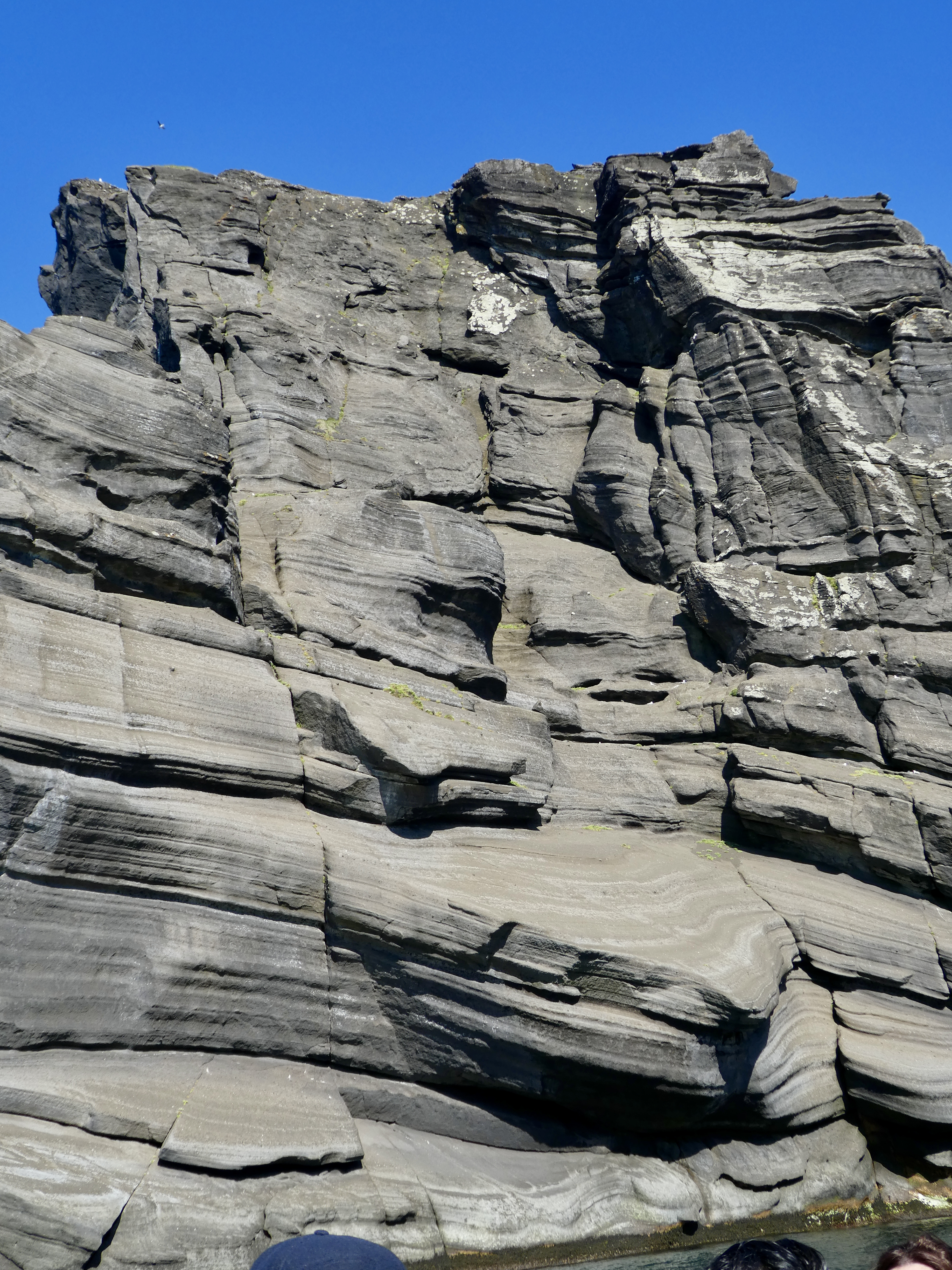
Alkefjellet (‘mount guillemot’) is the nesting location for over 60,000 breeding pairs of Brünnich’s guillemots. The cliffs are made of basalt columns up to100 m high, interspersed with a dark layer – a dolerite intrusion. The molten rock, as it intruded caused the limestone in the contact zone to re-crystalize and form marble.
Here’s the ship’s map of our trip again (in this post we’re at number 6), and then a map of the Hinlopen Strait where the cliffs are
You can see that Svalbard is not an island but an archipelago, and we’re in a strait separating two islands.
Wikimedia Commons
First the bird:
The thick-billed murre or Brünnich’s guillemot (Uria lomvia) is a bird in the aukfamily (Alcidae). This bird is named after the Danish zoologist Morten Thrane Brünnich. The very deeply black North PacificsubspeciesUria lomvia arra is also called Pallas’ murre after its describer.
This species was first described by Linnaeus. There are four subspecies, and the one on Svalbard is U. l. lomvia, Here’s a photo of some thick-billed murres in breeding plumage, which is the stage when we saw them:
We cruised along the base of the cliffs in the Zodiac; photography was a bit hard because the water was choppy and it’s hard to photograph birds on a cliff when the boat is rocking and focus changes. Plus there were so many birds (I would guess over 100,000) that it smelled TERRIBLE from guano. But you ignore the smell when there’s a site like this.
Further, we had to be constantly aware of them pooping on our heads. I mostly knelt in the bottom of the rubber boat, and once when I got up from the edge to kneel down, a juicy murre poop landed exactly where I was sitting one second after I left. I was lucky, though a woman next to me was not so lucky and got a good dose of murre excreta on her head.
The birds have only, it seems, about a foot to nest, and I think they incubate eggs right on the rock ledge, without a nest. Wikipedia says this:
Thick-billed murres form vast breeding colonies, sometimes composed of over a million breeding birds, on narrow ledges and steep cliffs which face the water. They have the smallest territory of any bird,[requiring less than one square foot per individual. A breeding pair will lay a single egg each year.[Despite this, they are one of the most abundant marine birds in the Northern Hemisphere.
Here they be:
The cliffs. There must have been more than a mile of breeding birds along the ledges. It’s impossible to estimate numbers; there might have been close to a million.
First, approaching the “bird cathedral,” you see a place without many ledges to give you an idea of the geology:
The birds:
These are nest sites! Look how crowded they are:
Less than a square foot per pair! They go out fishing, with one pair staying on the egg, so, as you cruise around, the air above is filled with thousands of wheeling, calling murres. See video below.
Two videos from the ride (filming was tough in a boat with nine other people, all trying to film or photograph):
Thousands wheeling above in the blue air:
This short video shows why I call it a “bird cathedral”. Truly a stunning site. A few days later we saw another murre cathedral on Jan Mayen Island.
We’re getting near the end again, and I ask you to think about a submission of good photos to keep the feature going (I can always make it sporadic). Today we have the last batch of Robert Lang‘s photos from the Brazilian Pantanal: birds. But we have one more post from him to come: eight videos of various creatures. Robert’s narrative and IDs are indented, and click on the photos to enlarge them.
Readers’ Wildlife Photos: The Pantanal, Part XII: Birds
Continuing our mid-2025 journey to the Pantanal in Brazil, by far the largest category of observation and photography was birds: we saw over 100 different species of birds (and this was not even a birding-specific trip, though the outfitter also organizes those for the truly hard core). Here is the final installment of the alphabetarium of common names of birds (though not quite the final installment from the Pantanal!).
And that wraps up the birds of the Pantanal! This was by far the best bird-sighting place I’ve ever traveled to (both for quantity of species and ease of photography; most photos were taken with a Canon 200–400 mm zoom lens on a Digital Rebel XTi body (both now sadly contributing to global warming—recommendations from experts for their replacements gratefully accepted). But not the last of my Pantanal imagery: one more installment coming, this time with the newfangled moving-type pictures.
If you have good wildlife photos, comparable in quality to those I’ve put up on this site, I’d be most grateful if you’d send them in. We’re running quite low (I have two in the tank, with one going up tomorrow), and I’d hate to make this feature a very sporadic one.
Here are the latest results from our twice-daily game drives at Manyeleti Game Reserve. I’ll put up photos of food, our facilities, and other such stuff later, but for me the important stuff is the animals and their behavior. This post covers the second game drive yesterday and the first one this morning.
Yesterday afternoon we came upon a breeding herd of African bush elephants (I won’t give links or species names henceforth for animals I’ve named previously). The one on the right is a female (angular head), there are two infants of indeterminate sex, and it’s unclear what sex the elephant on the left is.
Rosemary says that the elephant below is probably a male, but can’t be sure because it’s facing us and is also fairly young (ca. 10-12 years). But it is apparently both giving us an alert pose and sniffing the air to see what our vehicle is (elephants have poor eyesight):
This is definitely a female, as shown by the sharp angle of the forehead (adult males have rounder foreheads).
I asked Martim about this bird, and he said this:
I would say this is a Greater Blue-eared Starling,Lamprotornis chalybeus. Although the photo suggests a black belly (rather than blue), I guess this is an effect of the light angle.
A blue wildebeest (Connochaetes taurinus), formerly known as the brindled gnu, is a large antelope that’s common across southern Africa:
Another “lion wedding party,” as our guide Dan calls it. Same pair as yesterday (they can copulate up to 50 times a day over several days), and in the same spot. And, like yesterday, copulation took less than a minute and the mail roared halfway through (is that a lion orgasm?). He then swiped at and roared at a nearby juvenile male (“leave my wife alone!”), lit a cigarette, and then both lions rested:
Afterglow:
The female, perhaps pregnant by now:
A trio of giraffes (Giraffa sp.; they’ve named seven but I don’t believe that number). Several zebras were following them around; apparently other herbivores use giraffes, whose height allows them to see far away, as lookouts to give an alert to nearby predators.
Watch out for antelopes! A sign quickly photographed at high speed. You can see my reflection in the mirror.
Hippos (Hippopotamus amphibius) in a nearby “dam” (a big water pond). I think this is the closest we’ll get to them. There is only one species and usually you just get to see their eyes and nose. They are, I believe the closest terrestrial animal to whales. They are born and nurse underwater, and can swim before they can walk.
In the last half hour of our evening game drive, we stop, have drinks, and chat. On the house: wine, beer, soda, or gin and tonics (coffee, tea or cocoa in the morning). In the foreground is Dan, our knowledgeable and amiable driver (I’m glad I’ll have him the whole time). This ritual is known as a “sundowner”:
And. . . sundown by the lake, watching the hippos submerge and pop up again:
Last night I skipped dinner as I’ve been eating too much, and retired to my heated bed to read (The Razor’s Edge by Somerset Maugham). As I read, the lions made their “here I am calls”, which sound to me like a combination of snoring and growling. You can hear it below. They do this, apparently, to let other males in their group know where they are. Here’s a video that Rosemary found:
Reading while hearing the lions call nearby was as close to paradise as I can envision.
**********
Another day, another two drives. This covers one we had this m0rning. We started off by passing one of a gazillion termite mounds. Aardvarks use these as places to dig their dens and burrows:
Then onto one of the Two Big Events of the Day. We were clued into it by nearby trees full of vultures:
Martim identified this vulture:
White-backed vultureGyps africanus (from your photo, the diagnostic trait separating it from the less common Cape Vulture, G. coprotheres, is its black eye)
All the trees were full of vultures! Why? Because there was a dead elephant nearby, pungently rotting away but still recognizable as an African elephant. The corpse was apparently about a week old.
It may have died of old age, but Rosemary says that elephants may die from infectious diseases like “tuberculosis, haemorrhagic septicaemia, trypanosomiasis, pyroplasmosis, foot and mouth disease, pox, bacillary necrosis, salmonellosis, streptococcosis, babesiosis, helminthiasis and ectoparasitism”, as well as rabies and tetanus.
The rotting, stinking corpse was covered with vultures who were picking at it, as well as ripping off bits made available by several hyenas who were also gorging away at this pachyderm buffet.
Note that the elephant still has its tusks, which should be removed before poachers get them.
Note the hyena to the right:
Three hyenas to the left are devouring the corpse; one has its tongue hanging out. The smell, when the wind shifted, was digusting, but I’m sure the birds and hyenas find it delectable and tantalizing:
Spotted hyenas (Crocuta crocuta) come in just two sexes, like all mammals, despite the female having a penis-like organ containing the urethra and vagina. Note: female are NOT a “new” biological sex.
Spotted hyenas are social, live in clans, and are both hunters and scavengers. And they are strong! Wikipedia notes this:
The spotted hyena also has its carnassials situated behind its bone-crushing premolars, the position of which allows it to crush bone with its premolars without blunting the carnassials. Combined with large jaw muscles and a special vaulting to protect the skull against large forces, these characteristics give the spotted hyena a powerful bite which can exert a pressure of 80 kgf/cm2 (1140 lbf/in²), which is 40% more force than a leopard can generate. The jaws of the spotted hyena outmatch those of the brown bear in bone-crushing ability,and free ranging hyenas have been observed to crack open the long bones of giraffes measuring 7 cm in diameter.
According to Martim, the bird below is a “Juvenile Saddle-billed Stork,Ephippiorhynchus senegalensis.” He added, “I hope you get to see the adults!” Check the link above for the fantastic adult:
Our big spot of the day was a leopard (Panthera pardus), quickly surrounded by game vehicles as the drivers communicated with each other where it was. (I worry about this.) It is a rare sighting, and now I’ve seen four of the Big Five (all but the African buffalo).
But I’m not really ticking off a list, as I’d gladly see even the common animals over and over again. Their behavior is always changing and raises many behavioral and evolutionary questions (e.g. can anything take down a huge and alert giraffe? Answer: yes).
What a gorgeous cat! I was lucky to get a photo as they’re wary, skittish, rare, and there were vehicles nearly surrounding it, which clearly spooked it. But visitors also help conserve the parks, so there’s an upside, too.
Finally, a good sighting of a Burchell’s zebra (a subspecies of the Plains Zebra). They live in small groups, described by Wikipedia as “harem” or “bachelor” groups, with the former containing one male and a passel of females, and the latter comprising two to eight stallions looking for love.
And now it’s time for lunch and then another game drive. There’s no doubt that we’ll see something interesting. More when I have enough for another post.
Once Jerry is well-ensconced in South Africa, I’m sure he’ll have plenty of wildlife photos for us, including some warthogs. In the meantime here’s some wildlife I observed in Toledo, Ohio.
In Late June, I attended the annual meeting of the Society for the Study of Amphibians and Reptiles at the University of Michigan in Ann Arbor, and there was an optional field trip to the Toledo Zoo, which included a visit to a prairie restoration on the banks of the Maumee River near the Zoo grounds.
Matt Cross, Director of Vertebrate Conservation at the Toledo Zoo, directs visiting herpetologists onto the prairie. The “tent” in the background is a device for sampling invertebrates.
Toledo is at the far eastern edge of the “Prairie Peninsula“, where there were only a few scattered stands of prairie at he time of settlement, so this is less a restoration than a creation.The particular patch we went to is on formerly developed land, so many plants were brought in when this patch was established in 2013. This looks like a Black-eyed Susan (Rudbeckia hirta); note the bristly, lanceolate leaves, and 10-13 rays in the flowers pictured.
Rudbeckia hirta, Toledo, Ohio, 27 June 2024.
Although we tend to think of cactus as Southwestern, they occur in Midwestern prairies (and even further east on sandy soils) as well.
Eastern Prickly Pear, Opuntia humifusa, Toledo, Ohio, 27 June 2024.
The Zoo uses cover boards, a commonly used technique, to sample small vertebrates and arthropods.
Cover boards in a small (ca. 2/3 acre) restored prairie in Toledo, Ohio.
And under the cover boards were Northern Brown Snakes (Storeria dekayi).
Storeria dekayi, Toledo, Ohio, 27 June 2024.Storeria dekayi, Toledo, Ohio, 27 June 2024.
Lots of them! I think the one on the left is a gravid female.
Storeria dekayi, Toledo, Ohio, 27 June 2024.
And, they acted appropriately, engaging in volmerolfaction, sampling the air for chemicals with the tongue, to be sensed by the Jacobson’s organ in the roof of the mouth.
Storeria dekayi, Toledo, Ohio, 27 June 2024
A member of the Zoo staff turned a board in front of me, revealing a nice one. I instinctively grabbed it, quickly handing it to her because I wasn’t sure if handling by us visitors was allowed, but we were, in fact allowed to be herpetologists! Northern Browns are common in Illinois prairies I have visited, and persist in urban and suburban habitats in New York, so it’s not surprising to see them here in Toledo.
There were also invertebrates under the boards,
An ant nest; note the winged individuals. Toledo, Ohio, 27 June 2024
and birds above the boards. A Turkey Vulture (Cathartes aura) soars overhead.
Cathartes aura, Toledo, Ohio, 27 June 2024
A young Bald Eagle (Haliaeetus leucocephalus) perches in a tree on the banks of the Maumee.
Haliaeetus leucocephalus, Toledo, Ohio, 27 June 2024
And a Great Blue Heron (Ardea herodias) was striding around Clark Island, an island being terraformed and enlarged in the Maumee.
Ardea herodias, Toledo, Ohio, 27 June 2024
While walking back to the Zoo proper, we also got to see a Five-lined Skink (Eumeces fasciatus) on a boundary fence at the Zoo.
Eumeces fasciatus, Toledo, Ohio, 27 June 2024.
This was an especial treat for me, because, although I am a lizard specialist, I grew up in the Northeast and have lived for many years in the Midwest, and lizards are not especially diverse or abundant in either region, so it was nice seeing a live, wild lizard!





 The same bird, taking flight:


