Toledo Wildlife

August 6, 2024 • 8:00 am

by Greg Mayer

Once Jerry is well-ensconced in South Africa, I’m sure he’ll have plenty of wildlife photos for us, including some warthogs. In the meantime here’s some wildlife I observed in Toledo, Ohio.

In Late June, I attended the annual meeting of the Society for the Study of Amphibians and Reptiles at the University of Michigan in Ann Arbor, and there was an optional field trip to the Toledo Zoo, which included a visit to a prairie restoration on the banks of the Maumee River near the Zoo grounds.

Matt Cross, Director of Vertebrate Conservation at the Toledo Zoo, directs visiting herpetologists onto the prairie. The “tent” in the background is a device for sampling invertebrates.

Toledo is at the far eastern edge of the “Prairie Peninsula“, where there were only a few scattered stands of prairie at he time of settlement, so this is less a restoration than a creation.The particular patch we went to is on formerly developed land, so many plants were brought in when this patch was established in 2013. This looks like a Black-eyed Susan (Rudbeckia hirta); note the bristly, lanceolate leaves, and 10-13 rays in the flowers pictured.

Rudbeckia hirta, Toledo, Ohio, 27 June 2024.

Although we tend to think of cactus as Southwestern, they occur in Midwestern prairies (and even further east on sandy soils) as well.

Eastern Prickly Pear, Opuntia humifusa, Toledo, Ohio, 27 June 2024.

The Zoo uses cover boards, a commonly used technique, to sample small vertebrates and arthropods.

Cover boards in a small (ca. 2/3 acre) restored prairie in Toledo, Ohio.

And under the cover boards were Northern Brown Snakes (Storeria dekayi).

Storeria dekayi, Toledo, Ohio, 27 June 2024.

Lots of them! I think the one on the left is a gravid female.

Storeria dekayi, Toledo, Ohio, 27 June 2024.

And, they acted appropriately, engaging in volmerolfaction, sampling the air for chemicals with the tongue, to be sensed by the Jacobson’s organ in the roof of the mouth.

Storeria dekayi, Toledo, Ohio, 27 June 2024

A member of the Zoo staff turned a board in front of me, revealing a nice one. I instinctively grabbed it, quickly handing it to her because I wasn’t sure if handling by us visitors was allowed, but we were, in fact allowed to be herpetologists! Northern Browns are common in Illinois prairies I have visited, and persist in urban and suburban habitats in New York, so it’s not surprising to see them here in Toledo.

There were also invertebrates under the boards,

An ant nest; note the winged individuals. Toledo, Ohio, 27 June 2024

and birds above the boards. A Turkey Vulture (Cathartes aura) soars overhead.

Cathartes aura, Toledo, Ohio, 27 June 2024

A young Bald Eagle (Haliaeetus leucocephalus) perches in a tree on the banks of the Maumee.

Haliaeetus leucocephalus, Toledo, Ohio, 27 June 2024

And a Great Blue Heron (Ardea herodias) was striding around Clark Island, an island being terraformed and enlarged in the Maumee.

Ardea herodias, Toledo, Ohio, 27 June 2024

While walking back to the Zoo proper, we also got to see a Five-lined Skink (Eumeces fasciatus) on a boundary fence at the Zoo.

Eumeces fasciatus, Toledo, Ohio, 27 June 2024.

This was an especial treat for me, because, although I am a lizard specialist, I grew up in the Northeast and have lived for many years in the Midwest, and lizards are not especially diverse or abundant in either region, so it was nice seeing a live, wild lizard!
Readers’ wildlife photos

June 27, 2024 • 8:15 am

We have one small batch of photos left, folks, and. . . .

Today’s photos come from James Blilie and his son Jamie.  The captions and IDs are indented, and you can enlarge the photos by clicking on them.

This is a set of photos by me and my son, Jamie, taken on a local hike near The Dalles, Oregon.  We had a perfect day and the spring flowers were still in bloom near the top of the hike.  Jamie recently completed his first year at WSU in Pullman, Washington and did really well studying mechanical engineering.

First, my photos:

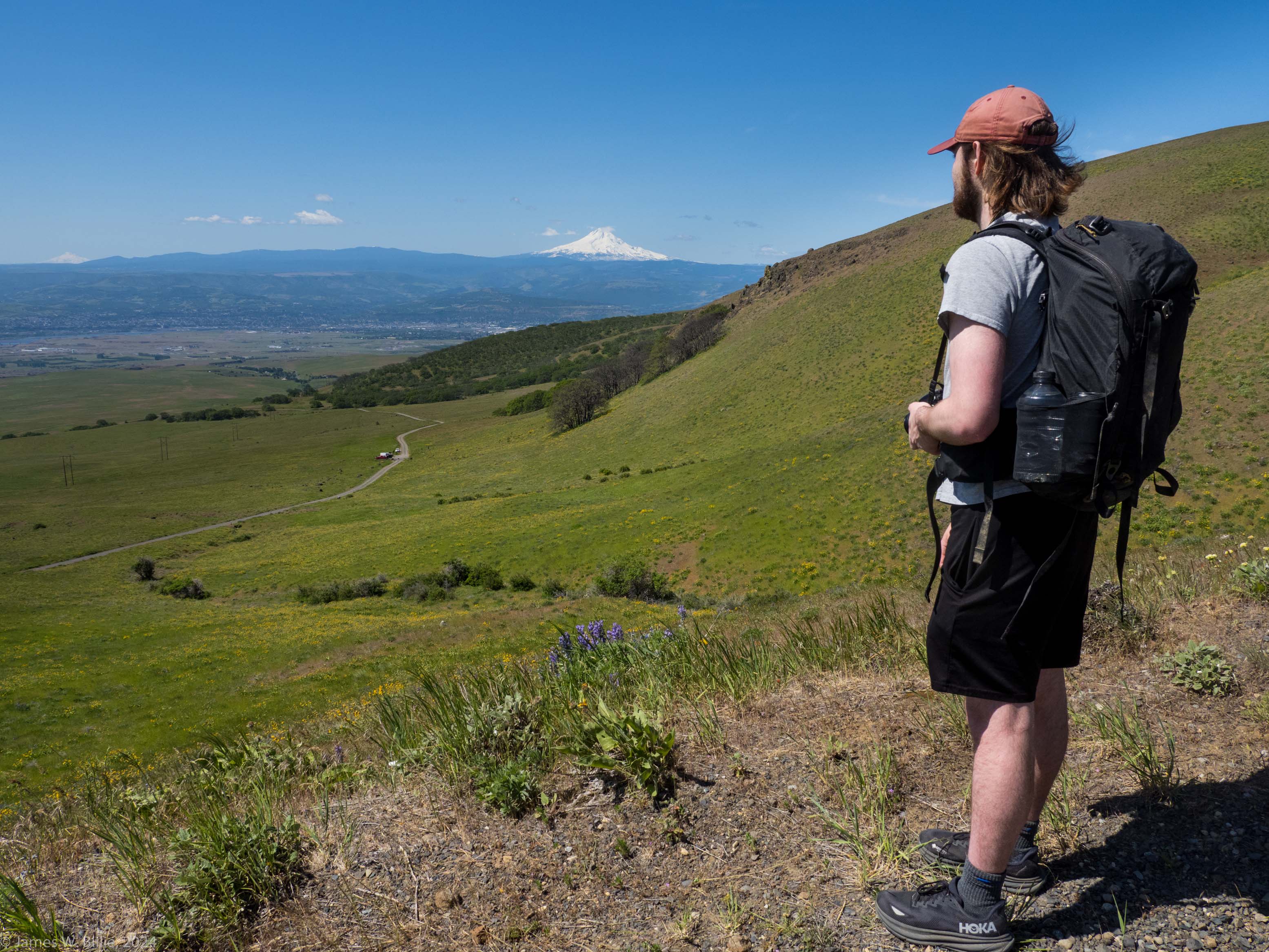
Jamie on the trail:

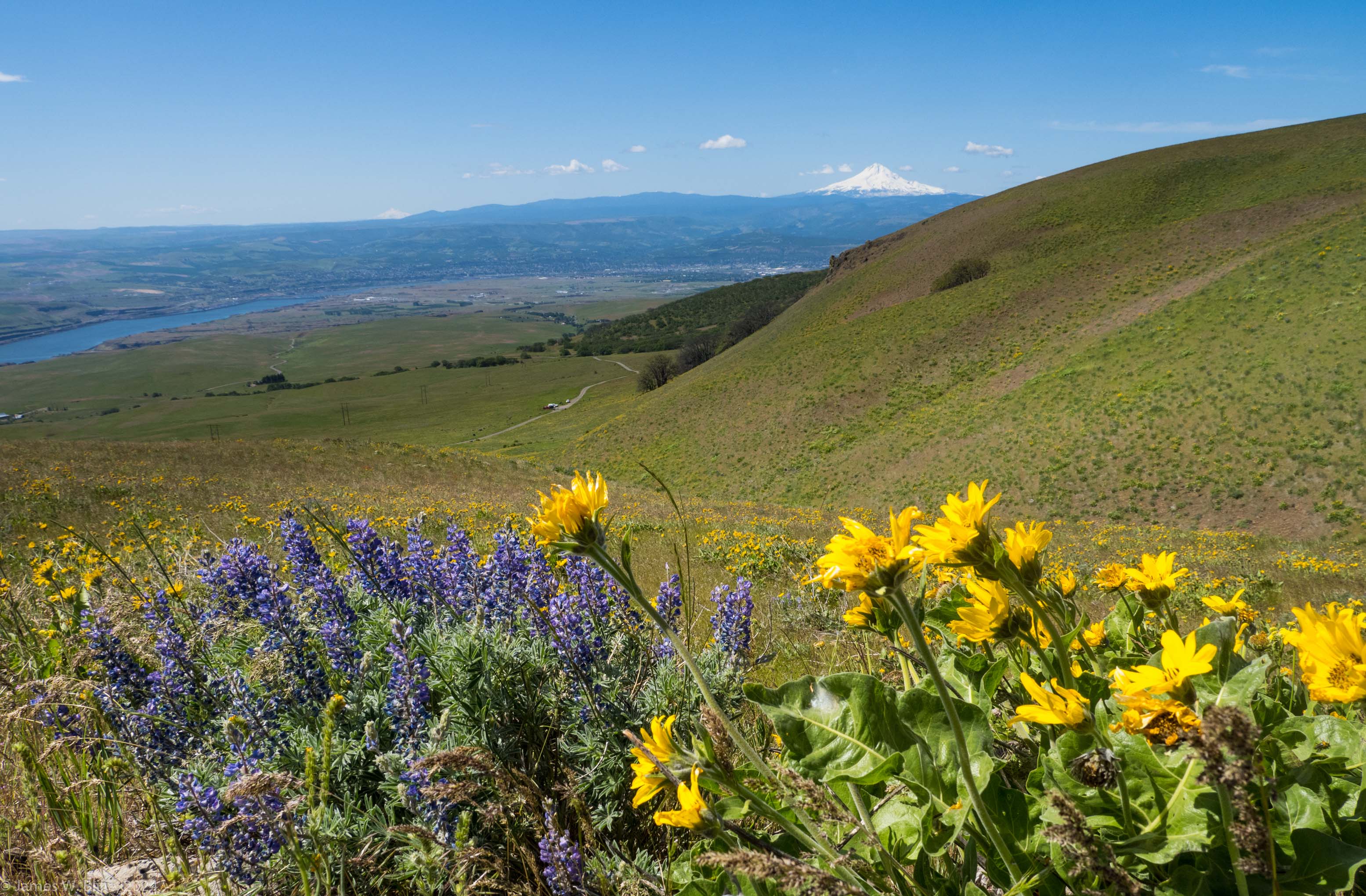
Mount Hood with lupine (Lupinus spp.) and Balsam Root (Balsamorhiza spp.) in the foreground:

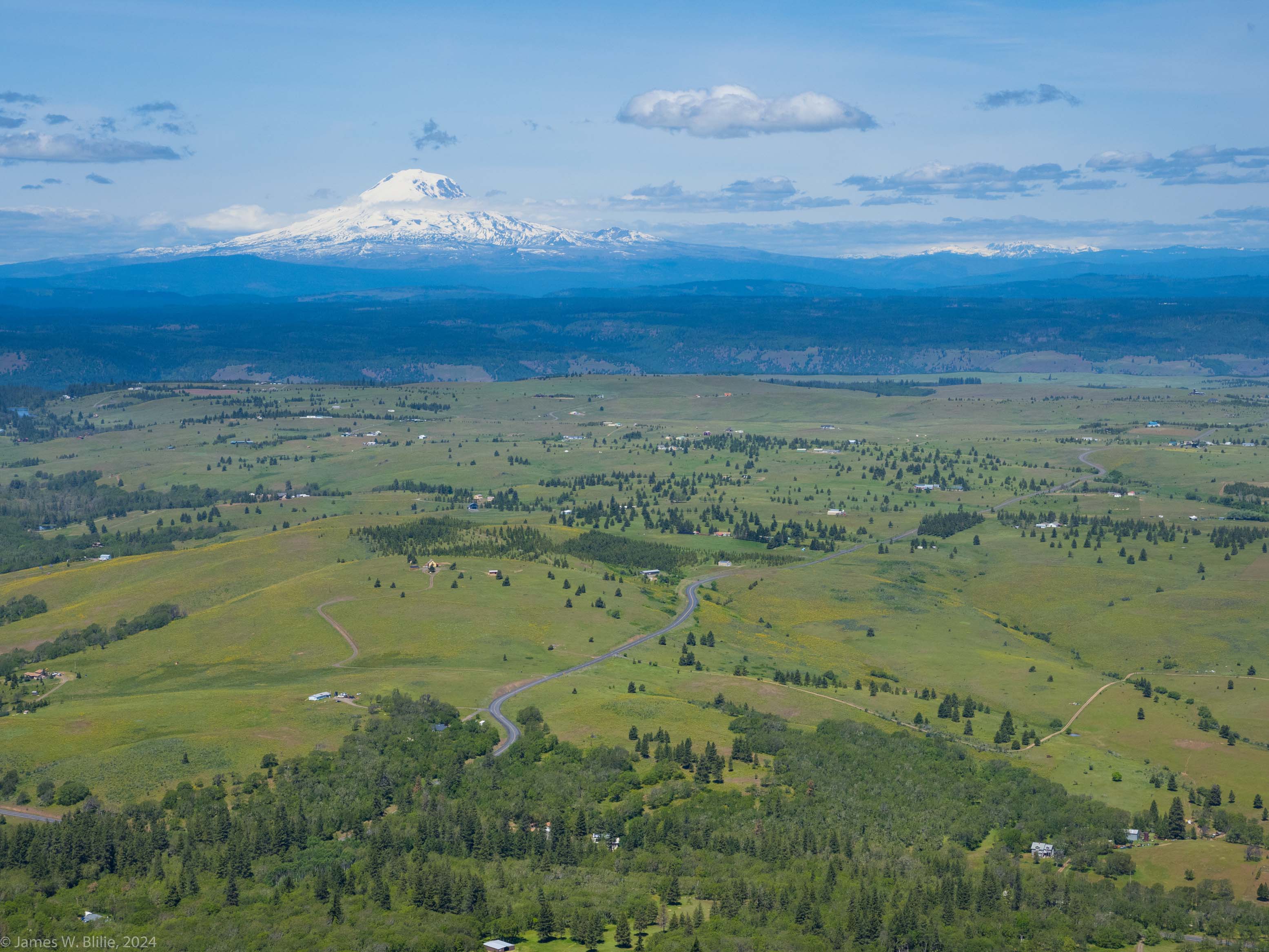
Mount Adams (Washington) and the Klickita River Gorge.  Looking north from the top of the ridge:

The gorge of Swale Creek from the top of the ridge:

Then Jamie’s photos:

A Western Meadowlark (Sturnella neglecta), caught making his lovely spring call:

A Western Fence Lizard (Sceloporus occidentalis), basking.  Jamie is MUCH better at spotting wildlife than I am!:

A female Horned Lark (Eremophila alpestris).  She thought she was hidden behind a grass tuft, and Jamie was able to approach very close:

Paintbrush (Castilleja spp.) in bloom:

Balsam Root:

A flower we did not identify, at around 3600 feet elevation.  (Taken with his Nikkor 105mm f/2.8 macro lens, a superb lens.)

Equipment:

Mine:

Olympus OM-D E-M5 camera (micro 4/3, crop factor = 2.0)
LUMIX G X Vario, 12-35MM, f/2.8 ASPH.  (24mm-70mm equivalent)
LUMIX 35-100mm  f/2.8 G Vario  (70-200mm equivalent

Jamie’s:

Nikon D5600 camera
Nikkor 105mm f/2.8 “Micro” (macro lens, 1:1)
Nikkor 18-55mm f/3.5-5.6 G VR lens
Sigma 150-600mm f/5.0-6.3 DG OS HSM Lens

Video: wildlife photographers interact with their subjects

March 29, 2024 • 2:00 pm

Here’s a lovely video showing wildlife photographers having unexpected and often delightful encounters with their subjects, ranging from peaceful meerkats to threatening lions.  No worries: no animals nor humans were injured (well, one human was head-butted in the testicles by a sheep) in the making of this video. I think the cheetah cubs are my favorite.

Happy (Good) Friday!

Readers’ wildlife photos

February 12, 2024 • 8:15 am

Today we finish off Athayde Tonhasca Júnior’s recent trip to Venice (the first part is here). His notes are indented and you can enlarge the photos by clicking on them.

One of the history’s delights is the opportunity to pull a thread of successive events that help us understand better today’s world. These fabulous bronze horses inside St Mark’s Basilica (the ones on the facade are replicas) were pilfered from Constantinople, the capital of the Byzantine Empire, when the city was sacked by Frank crusaders and Venetians in 1204. The Fourth Crusade was kicked off by Pope Innocent III – an ironic name if ever there was one – who had no idea of the shitstorm he was unleashing. Despite his angry threats of excommunication, the Crusaders, who were supposed to go to Jerusalem, stormed Constantinople and massacred their Christian brethren in an orgy of rape, disembowelments and decapitations. The city was razed to the ground and the Byzantine Empire never recovered, becoming easy pickings for the invading Ottomans in 1453. For a cut of the profits, the Venetians provided transport and gave all the logistical support to Innocent’s road trip from hell – so you could say they are largely responsible for Constantinople becoming Istanbul. Incidentally, the Venetians had the perfect leader for this rapacious adventure: the nonagenarian and blind Doge Enrico Dandolo (you can read the details in Roger Crowley’s City of Fortune, an excellent account of Venice’s history). To this day, the Fourth Crusade is a sore subject for Orthodox Christians:

Another souvenir pinched from Constantinople: The Four Tetrarchs, probably depicting the four rulers that took over the Roman Empire in 293 AD. The Byzantines considered themselves Greek-speaking Romans (Romaioi), so Rome’s past was their past. Notice the mismatched foot in one of the figures; the original bit broke off when the statue was hacked away. The heel of the missing foot was discovered in 1960, and it’s on display in the Istanbul Archaeology Museum:

Some armies would go to war with their dull and ugly artillery pieces. Not the dazzling Venetians, as attested by this 1643 culverin (an early type of cannon).

The End. These pens in the Naval Museum were used by Napoleon Bonaparte to sign the treaty of Campo Formio on 17 October 1797, thus ending five years of war between the French Republic and the First Coalition. France and Austria swapped several bits of territory, redrawing the map of Europe. In the process, Venice was swallowed by Austria. After 1,100 years, La Serenissima was no more:

Venice’s resident population dropped below 50,000 in 2022, down from 66,000 20 years ago and 175,000 in the 1950s. Locals are leaving, fed up with mass tourism and the cost of living. But there’s plenty of old Venice still left:

Rotund tourists may struggle in a calle stretta (a narrow alley; calle Varisco is 53 cm wide). These alleys branch out in every direction and don’t lead you to any specific place; they are used by residents to get home. Many of these thoroughfares are not on the maps and are beyond phone signal reach, so good luck finding your way. While you wander around baffled and disorientated, stay on good terms with the natives by keeping to the right and in a single queue:

A helpful but scarce street sign: ‘the whores’ gate’, where presumedly clients were serviced while standing up against the calle‘s walls:

Venice’s historic centre comprises 121 islands linked by 435 bridges. Shopping, public transport, ambulances, rubbish collection, home delivery, postal service and everything else depend on the canals network:

Having a go at describing our wine during a midday victualling: meandering, medium-bodied, bordering on the reckless at the quantum level. Hints of peach-pits, boysenberries and biodynamic hand-cultivated cacao from a coastal Tuscan villa; cleansing, metallic tannin waltzing with sweet-sour rosehip and balsamic vinegar; co-habiting with sumptuousness that does not bully a goat spleen escabeche. An approachable companion for self-medication any time of day (h/t many sources). Ok, I was a little off. Some wine people must have great fun composing these pretentious servings of tripe. In rural Italy, you can’t go wrong by ordering description-free vino della casa (house wine). It may come in a faceless bottle or jug but is invariably good. No respectable restaurant will risk its reputation with the locals – never mind tourists passing by – by offering plonk. That principle doesn’t apply to big cities:

  You can eat well and not be ripped off in Venice – or anywhere else. Stay clear of tourist hangouts, bypass the dreadful menù fisso (fixed price but little choice) and don’t trust reviews – most of them are written by people used to overcooked pasta and abominations such as pineapple pizzas and spaghetti Bolognese. Instead, follow the locals. We had two excellent meals in this unassuming osteria, which is patronised by neighbours and vaporetto (public waterbus) workers.

The superb Renaissance-kitsch Torre dell’Orologio (Clock Tower), built in 1496/1497. The two bronze figures on top are hinged at the waist to strike the bell on the hour. They are supposed to be shepherds, but are known colloquially and politically-incorrectly (Italians are not oversensitive about these matters) as ‘the Moors’ because of their dark patina. Below them is the winged lion of St. Mark, followed by Virgin Mary with her offspring flanked by two blue panels: the left shows the time in Roman numerals, while the right indicates 5-min intervals in Arabic numerals. Finally, the clock, displaying the time, the phase of the moon, and the dominant sign of the Zodiac. The clock’s mechanism beats any Casio: it has been working since 1753:

Wildlife at Escanaba Lake, Wisconsin

August 12, 2023 • 1:50 pm

by Greg Mayer

I’m going to try to post some of my own wildlife photos while Jerry is not in a position to post readers’ wildlife photos. (We can look forward to Jerry’s posts of Galapagos wildlife photos, which we eagerly await!) To start, here are some pictures from a field trip  I took to Vilas County, Wisconsin, last summer with colleagues from the University of Wisconsin Zoological Museum in Madison. These pictures are from our visit to Escanaba Lake, where the Wisconsin Department of Natural Resources has a small field office that conducts careful surveys of the fish in the Lake.

Escanaba Lake, Wisconsin, 23 July 2022.

We went out with DNR fisheries biologist Greg Sass, who showed us some of the research being carried out by the DNR. Greg got his PhD at Madison, where he is affiliated with the Center for Limnology.

Escanaba Lake, Wisconsin, 23 July 2022.

Part of the DNR’s research involves fyke net surveys:

Escanaba Lake, Wisconsin, 23 July 2022.

Here are some of the fish found in the Lake. My ichthyological expertise is minimal, so the IDs will be to family only; feel free to volunteer species IDs in the comments. [Added: see species IDs by Mark R in comment #2.] Centrarchidae:

Escanaba Lake, Wisconsin, 23 July 2022.

Ictaluridae:

Escanaba Lake, Wisconsin, 23 July 2022.

Esocidae:

Escanaba Lake, Wisconsin, 23 July 2022.

A large Bullfrog (Rana catesbeiana) tadpole also turned up:

Escanaba Lake, Wisconsin, 23 July 2022.

But the highlight for me was that Northern Water Snakes (Nerodia sipedon) were very common at the boat launch. There were little ones:

Escanaba Lake, Wisconsin, 23 July 2022.

And big ones:

Escanaba Lake, Wisconsin, 23 July 2022.

Measuring the big one– about 44 inches, total length:

Escanaba Lake, Wisconsin, 23 July 2022.

Sometimes, the big and little hung out together:

Escanaba Lake, Wisconsin, 23 July 2022.

The biggest ones were under and around an overturned boat:

Escanaba Lake, Wisconsin, 23 July 2022.

The snakes were so common, I told Greg it would be a great place for someone to do a thesis on their population biology and behavior. Some more water snake photos:

Escanaba Lake, Wisconsin, 23 July 2022.

This being Wisconsin and all, we had dinner the night before at a supper club, accompanied, for most of us, by brandy old fashioneds:

Brandy old fashioneds (mostly) at Marty’s Place North, now sadly closed.

Readers’ wildlife photos

September 14, 2022 • 8:00 am

Today we have some barred owl photos from Richard Kleinknecht. His captions are indented, and you can enlarge the photos by clicking on them.

These photos, taken by my neighbor, were shot in King County, WA, less than an hour from Seattle.  Barred Owls (Strix varia), as do many other owls, mate for life (~20 years) and the pair shown in the photo have been nesting in or near my neighbor’s back yard for several years now.

Barred Owls take good care of their young.  Owlets will walk out of their nest in about 30-40 days after hatching, perhaps two months before they reach adulthood and can fly from the nest.  They climb around on trees using legs, talons, beaks, and wings for balance as they climb, and their parents bring them food until they are able to fly and hunt on their own.

Ever on the lookout for lunch, a Barred Owl has become aware of a Barn Swallow nest under the eave of my neighbor’s house.

The Owl has captured a Barn Swallow nestling (Hirundo rustica) and is preparing to swallow it whole, headfirst.  The Owl was seen, but not photographed, taking all nestlings, one at a time, and giving at least one to another Owl.

Barred Owls have a diet consisting of small mammals, other birds, and invertebrates.  They have been seen eating earthworms and slugs from the forest floor and we have a picture of a forager doing just that.

JAC: I’ve added a short video in which you can hear the call of a barred owl:

Finalists: 2021 Comedy Wildlife Photography Awards

September 3, 2021 • 2:15 pm

I love wildlife photography contests, but am always surprised that the Comedy Wildlife Photography Awards is among the best of them. I’m not sure why, as animals aren’t usually doing funny stuff, but it may be a combination of humorous photographers and discerning judges.

At any rate, the finalists for the 2021 Awards have been announced, and you can see them online here, along with previous years’ winners as well. There are a LOT of good entries, and I’ll show you just a few of my favorites among the finalists. This seems an appropriate way to start the three-day weekend (Labor Day). Thanks to the several readers who sent me these links.

. . . and my favorite.  WHO’S a bad otter?