Readers’ wildlife photos

March 22, 2026 • 8:15 am

Today we have some travel and wildlife photos from reader Jan Malik.  Jan’s captions are indented, and you can enlarge the photos by clicking on them. (Don’t miss the Taiwan barbet!)

Here are a few pictures I took during my short stay in Taipei, Taiwan (Republic of China) in 2016. Business trips usually allow very little time for sightseeing — the familiar, morbid cycle of airport → hotel → conference room → hotel → airport — but on this occasion I had a few free hours in the afternoon. Naturally, I decided to explore the nearby Taipei Botanical Garden with a birding lens that mysteriously strayed into my suitcase:

On my way to the Botanical Garden, I visited the National Chiang Kai-shek Memorial Park and Hall, the latter built in the late 1970s after the President’s death. I include it here for documentary reasons — who knows how long it is going to survive, given the volatile political situation.

Inside stands a larger‑than‑life sculpture of the Generalissimo. Taiwan’s history is typical of right‑wing dictatorships which, like South Korea, Spain, or Portugal, began as oppressive authoritarian regimes and then evolved into genuine democracies. Conversely, left‑wing dictatorships typically resist fundamental change and persist until their eventual collapse:

Onward to wildlife. The entrance to the Mausoleum was guarded by a lion (Panthera leo var. lapideus):

Already in the Botanical Garden, I encountered a cat, doing what cats do best – contemplating:

In one of the alleys I came upon a sizable crowd — people were observing local celebrities, a pair of nesting Oriental magpie‑robins (Copsychus saularis). The birds seemed completely unfazed by the attention, the male singing and standing guard at the nest;

These birds are bold and well adapted to human habitats. The female does most of the feeding; here she brings an unidentified moth to her chicks in a rotted‑out branch stump:

At a nearby pond I spotted a duck. It was likely a domestic bird, possibly with a dash of wild Mallard  (Anas platyrhynchos) ancestry:

The pond was full of lotus plants, which provided excellent habitat for the Common moorhen (Gallinula chloropus). Like all rails, these birds have relatively small wings and strong feet, well suited to foraging on land as well as in water. They swim well despite lacking webbing between their toes. These traits help explain why, when rails successfully colonize remote predator‑free islands, they often evolve reduced flight or complete flightlessness;

Moving further along the park alleys, I spotted a Taiwan barbet (Psilopogon nuchalis) looking out of its nest cavity. As an endemic species, it was a special find for me. Barbets vary widely in sexual dimorphism — in the Taiwan barbet the sexes are practically indistinguishable, in others (like the Coppersmith barbet) the differences are subtle, and in still others (such as the Red‑and‑yellow barbet) they are striking. I wonder why, in this species, bright coloration in females is not maladaptive. Perhaps the fact that they are obligate cavity nesters shields incubating females from predators. The same logic applies to woodpeckers, whose sexes are also similar aside from modest red patches in males:

Shortly after the barbet, I hit another jackpot in my endemics count — the Taiwan blue magpie (Urocissa caerulea). Like other corvids, it is social and omnivorous, and like Taiwanese barbets, it is sexually monomorphic. Corvids also evolved cooperative breeding: fledglings often remain with their parents and help raise the next brood. This likely evolved through kin selection. Why does it work so well in corvids and not in most other birds? Perhaps in environments with limited resources, young birds have better reproductive success by helping relatives than by attempting to breed independently?:

Having spent some time observing the magpie, I moved on — my remaining time before the flight was getting short. Soon I saw another first for me, though a common sight in Southeast Asia: the light‑vented bulbul (Pycnonotus sinensis). An omnivorous bird, here it was about to snatch a ripe fig:

Moving on, I photographed a dragonfly, which I believe is a male Crimson Marsh Glider (Trithemis aurora). These insects are sexually dimorphic, with olive‑colored females. This male appears to be orienting its abdomen toward the sun to reduce the surface area exposed to solar radiation and prevent overheating — a behavior known as “obelisking”:

Near the Botanical Garden exit I saw the last animal in this series, the Eurasian tree sparrow (Passer montanus). They always bring a smile to my face. Unlike many other sparrows, the sexes are alike. In 1958 they were targeted during China’s “Four Pests” campaign, a fine example of how ideology can override basic biological understanding:

While driving toward the airport that evening, I saw a Buddhist temple by the roadside, adorned with a symbol that, in European cultural circles, evokes entirely non‑religious sentiments. It was adopted in the 1920s by the National‑Socialist German Workers’ Party, but in Asia it is an ancient religious emblem. It is not identical to the Hakenkreuz — it “rotates” counterclockwise — and its meaning here is entirely benign:


Readers’ wildlife photos

January 29, 2026 • 8:30 am

Reader EdwardM has sent us some travel photos from Sri Lanka.  His captions are indented, and you can click on the photos to enlarge them.

These photos are of statuary and frescoes in the Dambulla Cave Temples outside Kandy, Sri Lanka. Kandy, by the way, has a venerated shrine which holds one of Buddha’s teeth! The Dambulla Cave Temples date to the first century AD. The caves, which sit high on a bare rock escarpment, were used as a refuge for a king, called Valagamba, and his people during one of the many invasions of Sri Lanka. To commemorate their survival, Valagamba and heirs founded a monastery in the caves. Over the centuries images, frescoes, and statues of the Lord Buddha, the bodhisattvas, and various gods and goddesses were installed. Typically they were funded by wealthy Sri Lankans for their private redemptive purposes, much like many Christian sites were funded by the wealthy in hopes of favor or forgiveness. The caves are full of these wonderfully vibrant icons.

The caves themselves were welcoming, with soft light and wonderfully cool air; a respite from the brutal Sri Lankan midday heat. One note I’d like to add. Sri Lanka is a fabulously beautiful land, and I know it has had a complex past with much turmoil and violence. But I became endeared to the people; they are delightful and they get genuine pleasure from other people’s happiness. They aren’t faking it. I loved the country, the people, and I encourage anyone who can go; visit.

Here are a few of the shots from the complex. There are five caves but two of them we closed for work when we were there. First, a reclining Buddha with statues of minor gods and goddesses at his head and one of the bodhisattvas (I have no idea which) seated at left. The Buddha was carved out of the rock in the cave. There are several of these at Dambulla.

This image gives an idea of the size of this reclining Buddha. This one is not the largest in the complex. Amazing that this is carved from the rock itself:


Some more statuary. These are depictions of the bodhisattvas, the enlightened followers of Buddha. Unlike the reclining Buddhas, most of the statuary was NOT carved from the rock of the cave, but was instead carved outside the caves and installed within:

The monks (it’s an active monastery) place offerings to various gods and goddesses. Here they put these fabrics on statues of a couple of the Enlightened, but I don’t recall the significance:

More shots of statuary:

The walls and ceilings were covered in beautiful frescoes, some ancient. Here are a few shots:

Readers’ wildlife photos

January 12, 2026 • 8:15 am

Please send your photos, as I have only one set left!

Athayde Tonhasca Júnior is here with photos of a trip to a special place in Greece. Athayde’s captions are indented, and you can enlarge his photos by clicking on them.

Between Heaven and Earth

Meteora (Μετέωρα) is a majestic rock formation comprising countless peaks, caves, crevices and overhangs in the Thessaly region, northern Greece, a 3.5-hour or so drive from Thessaloniki:

These pillars were formed about 60 million years ago, when the seabed receded and exposed the rocks to winds and waves. Thanks to its remoteness and inaccessibility, Meteora for centuries has been a magnet for misanthropic characters seeking salvation in solitude or common folk escaping from marauders and assorted enemies:

Hermits and monks from all over the Byzantine Empire converged on the area to build proto-monastic communities, which with time grew into monasteries. Out of the 33 that were founded throughout the centuries, six are active today:

The word meteoron (pl. meteora) means ‘between earth and sky’, ‘lofty’ or ‘elevated’. Meteora was a bastion of Greek Christian orthodoxy during the 400-year Turkish occupation (for a gripping account of how the occupation ended, see The Greek revolution: 1821 and the making of modern Europe, by Mark Mazower):

The first monks climbed up Meteora’s peaks by using scaffolds propped up by joists that were wedged against holes in the rock. Later, rope ladders and nets were deployed until the first stairs were carved into rocks in the early 20th century:

Until the 1920s, many monasteries winched visitors tucked inside nets, a 370-m journey in one case. According to tradition, a wary visitor asked a monk whether the rope of his transporting basket was ever replaced. ‘Yes’, he answered; ‘when it breaks’. Bridges and stairs chiseled into the rocks have made ascent a lot easier, but supplies are still hauled up in some monasteries:

Here, a group of tourists (highlighted) cross a narrow bridge, the single access to a monastery:

Meteora comprises the most important group of Greek monasteries after Mount Athos. The six active ones (two are now nunneries), the massif and the village of Kastráki (in the distance) are a UNESCO World Heritage Site:

If you live on the narrow top of a mountain, you need to be resourceful and imaginative with your gardening…:

….and your booze supply. This 16th-century oak cask once stored up to 12,000 l of wine:

The monasteries’ churches, in typical Byzantine fashion, are packed with priceless frescoes, icons and mosaics depicting Christ, the Virgin Mary and assorted saints in a jumble of gold, colours and shapes. Alas, photos are not allowed inside the churches, so you will need to look up online to find out more. This photo was taken from the outside, so no sin was committed:

The monasteries are not for people with impaired mobility or couch potatoes. All but one require moderate to hard climbing – up to 300 steps. Too hard for many visitors, who stay put by the road and pass the time photographing the landscape:

Now the bad side of Meteora. If you are thinking about visiting the monasteries for peace and contemplation, forget it: they have been turned into mega-tourist attractions. The narrow access road through the mountains is lined with coach after coach disgorging hordes of tourists and rude pilgrims, there are long queues for the entrance fee (5 Euros, cash only) and the buildings are claustrophobically crowded. Having said that, Meteora retains its magnificence. If you go, pick a cold, rainy day outside the religious calendar, and get there early:

To the Arctic, part 7: A cliff packed with guillemots

October 4, 2025 • 10:15 am

On July 12, while heading south towards Jan Mayen Island, we got off the ship to take a long Zodiac trip along one of the most amazing animal habitats I’ve seen: Alkevfjellt (“Mount Guillemot”).  It is a geological feature that happens to have provided hundreds of narrow rock shelves for one species of bird to nest on. And nest they do, by the hundreds of thousands. From Wikipedia:

Alkefjellet is a cliff in Lomfjordhalvøya in Ny-Friesland at SpitsbergenSvalbard. Alkefjellet is a bird cliff facing towards Hinlopen Strait.

Alkefjellet (‘mount guillemot’) is the nesting location for over 60,000 breeding pairs of Brünnich’s guillemots. The cliffs are made of basalt columns up to100 m high, interspersed with a dark layer – a dolerite intrusion. The molten rock, as it intruded caused the limestone in the contact zone to re-crystalize and form marble.

Here’s the ship’s map of our trip again (in this post we’re at number 6), and then a map of the Hinlopen Strait where the cliffs are

You can see that Svalbard is not an island but an archipelago, and we’re in a strait separating two islands.

Wikimedia Commons

First the bird:

The thick-billed murre or Brünnich’s guillemot (Uria lomvia) is a bird in the auk family (Alcidae). This bird is named after the Danish zoologist Morten Thrane Brünnich. The very deeply black North Pacific subspecies Uria lomvia arra is also called Pallas’ murre after its describer.

This species was first described by Linnaeus. There are four subspecies, and the one on Svalbard is U. l. lomvia,  Here’s a photo of some thick-billed murres in breeding plumage, which is the stage when we saw them:

By USGS – USGS, Public Domain


. . . . and its range:

Cephas, CC BY-SA 4.0, via Wikimedia Commons


We cruised along the base of the cliffs in the Zodiac; photography was a bit hard because the water was choppy and it’s hard to photograph birds on a cliff when the boat is rocking and focus changes.  Plus there were so many birds (I would guess over 100,000) that it smelled TERRIBLE from guano. But you ignore the smell when there’s a site like this.

Further, we had to be constantly aware of them pooping on our heads.  I mostly knelt in the bottom of the rubber boat, and once when I got up from the edge to kneel down, a juicy murre poop landed exactly where I was sitting one second after I left. I was lucky, though a woman next to me was not so lucky and got a good dose of murre excreta on her head.

The birds have only, it seems, about a foot to nest, and I think they incubate eggs right on the rock ledge, without a nest. Wikipedia says this:

Thick-billed murres form vast breeding colonies, sometimes composed of over a million breeding birds, on narrow ledges and steep cliffs which face the water. They have the smallest territory of any bird,[requiring less than one square foot per individual. A breeding pair will lay a single egg each year.[Despite this, they are one of the most abundant marine birds in the Northern Hemisphere.

Here they be:

The cliffs. There must have been more than a mile of breeding birds along the ledges. It’s impossible to estimate numbers; there might have been close to a million.

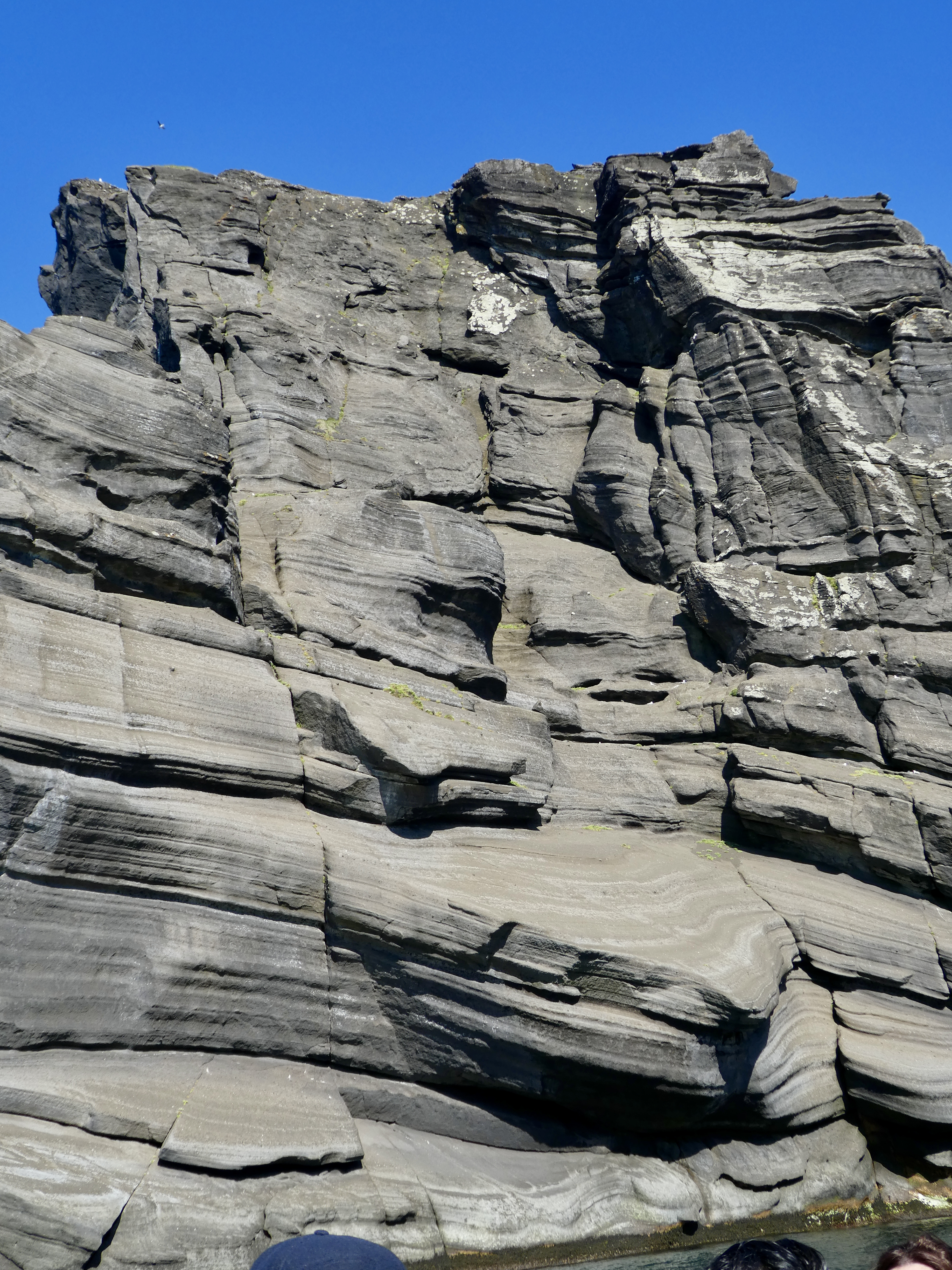
First, approaching the “bird cathedral,” you see a place without many ledges to give you an idea of the geology:

The birds:

These are nest sites! Look how crowded they are:

Less than a square foot per pair!  They go out fishing, with one pair staying on the egg, so, as you cruise around, the air above is filled with thousands of wheeling, calling murres. See video below.

Two videos from the ride (filming was tough in a boat with nine other people, all trying to film or photograph):

Thousands wheeling above in the blue air:

This short video shows why I call it a “bird cathedral”. Truly a stunning site.  A few days later we saw another murre cathedral on Jan Mayen Island.

Cambridge and Boston: more travel photos

September 29, 2025 • 10:06 am

Today is my last full day in Boston/Cambridge, and tomorrow evening I’ll be back in Chicago.

The other day my friends Andrew and Naomi took me to Oliveiros’s a Brazilian steakhouse in Somerville. If you haven’t been to one, they all work the same way. There’s a big salad bar with stuff you largely want to avoid so you can eat more meat, and then the servers bring skewers of freshly-cooked meats to your table, and you indicate which ones you want. It’s mostly beef (sirloin, flank steak, etc.), but also lamb and sausages. They slice a long, thin piece from the skewer and you grab it with your tongs. This can go on forever, or until you’re sated.  If you like meat, it’s a great experience, assuming you pick the right steakhouse—like this one.

Below: a famous pre-drink cocktail, the Brazililian caipirinha. It’s delicious, and here’s Wikipedia’s take:

Caipirinha (Portuguese pronunciation: [kajpiˈɾĩɲɐ]) is a Brazilian cocktail made with cachaça, sugar, lime, and ice.  The drink is prepared by mixing the fruit and the sugar together, then adding the liquor. Known and consumed nationally and internationally, caipirinha is one of the most famous components of Brazilian cuisine, being the most popular national recipe worldwide and often considered the best drink in the country[3] and one of the best cocktails/drinks in the world, having reached third place in 2024, according to the specialized website TasteAtlas.

Cachaça is distilled sugarcane liquor. It differs from rum by being made from freshly squeezed juice of sugarcane, while rum is made from fermented molasses. Cachaça also is not aged as long as is rum.

Doesn’t this look good? It was.

The buffet (aka “salad bar”). In the second photo, my friend Andrew is trying to rile me up by taking all the platanos, or fried ripe plantains. We both agree that that is the only item you should get at the salad bar (I also got a bit of potato salad).  I can eat many, many fried plantains.

Andrew trying to deprive me of platanos. Look at that evil expression!

Where’s the beef?  Here it is, and skewers of various meats keep coming:

A visit to Dorchester the next day, where my hosts Tim and Betsy used to live. (We all lived together on Beacon Street in Boston for my first two years in graduate school, inhabiting the tiny basement of the man who founded the New Balance Shoe company. I then moved to Cambridge and Tim and Betsy to Dorchester.)

Tim needed a pastry cutter to make real Southern biscuits, and we found a lovely, crowded kitchen store in Dorchester. It also sold cat clocks. I used to have one of these, black and looking like Felix the Cat. The tails wag back and forth with the seconds:

Lunch at the Steel and Rye Restaurant in Milton, right across the small Neponset river from Dorchester (Dorchester is formally part of Boston, while Milton is its own town). I had the Italian sandwich: “coppa, salami, mortadella, provolone, shredded lettuce, chili vinaigrette, ciabatta.” Quite tasty.

The restaurant was right by the Dorchester-Milton Lower Mills Industrial District, The old factory buildings remain, especially the one where they made the famous Baker’s Chocolate. They’re now apartment or office buildings, but are still lovely. The area as described in Wikipedia:

The Dorchester-Milton Lower Mills Industrial District is a historic district on both sides of the Neponset River in the Dorchester area of Boston and in the town of Milton, Massachusetts. It encompasses an industrial factory complex, most of which was historically associated with the Walter Baker & Company, the first major maker of chocolate products in the United States. The industrial buildings of the district were built between about 1868 and 1947. They were listed as part of the district on the National Register of Historic Places in 1980, with a slight enlargement in 2001. The buildings have been adapted for mixed industrial/retail/residential use.

Here’s one pair of buildings from 1905 with a nice metal bridge connecting the parts:

Back in Cambridge, you see this sign towering over Porter Square. I’ve not seen the likes of it before. It’s not far from Harvard.

My big doings yesterday consisted of going to the Japanese restaurant Yume Wo Katare in Porter Square. Although the link says “This is not a ramen shop,” it certainly is. (It’s the equivalent to Magritte’s “This is not a pipe.”) In fact, the only thing they serve is ramen.  You get a very large bowl in a delicious, rich, porky and garlicky broth with bean sprouts and pieces of pork (choose two or five big pieces). Your only other choice is whether you want extra garlic (you don’t need it; the broth is plenty garlicky) or a more spicy broth.  It’s delicious, with plenty of hand-pulled noodles and big pieces of juicy pork.  But the restaurant is also known for something else (see below, noting the “dream workshop” on the window):

The inside. I was heartened by the almost exclusively Japanese clientele, which testified to the quality of the ramen. There are no tables—only benches.

Below: my bowl. It was HUGE (I chose the five pieces of pork). I was able to finish everything except a cup or two of broth, but my stomach was absolutely distended: full of noodles sloshing around in broth. I had to take the bus home though it was only a 20-minute walk, simply because I was too full to walk. Needless to say, I had no dinner.

Each customer gets judge by the staff when they’ve finished, rated on how much food is left. I got a “good job!”, but I think everybody gets that.

My giant portion. This was the first time in my life I did not completely empty a bowl of ramen. But I ate all the solids!

The aspect of this restaurant that has made it especially well known is that customers are asked at some point in their meal to tell everyone in the restaurant their Big Dream. (They ask you if you want to recite one when you enter, and if you do they put a placard saying “Dreamer” at your place. ) Three people recited their dreams during my lunch: one woman wanted to visit all of America’s National Parks (there are 63), and a guy said his dream was to participate in an Ironman Triathlon, which includes a full marathon, a 2.4-mile swim, and a 112-mile bike ride. I can’t remember the other dream.

When they asked me as I entered the restaurant if I wanted to recite a dream, I said I was too old to have dreams, but of course that was not true. I still have them, but I am too shy to recite them.

Later today: a visit to Christina’s Homemade Ice Cream in Cambridge, the best place to get ice cream in America.

Random photos from Cambridge

September 26, 2025 • 8:15 am

It’s been raining here, so I haven’t got out much, but when I did I dined with old friends, and I won’t show those photos.  So far I have only a few pictures of Cambridge, MA, and here they are.

The city (once a town):

A panorama of Harvard Yard. Click twice to enlarge. The group of people in the middle are tourists (mostly Asian) waiting to get their photo taken with the statue of John Harvard.

The center of the picture above:

. . . and across the street from the Yard is the Coop, Harvard’s official bookstore.  In truth, they don’t have nearly as many books as they should, but a surfeit of Harvard memorabilia to fleece the tourists. I don’t have any Harvard tee-shirts (though I have over a hundred college tee shirts); I looked at one in the Coop, but it cost $35!

There was this book, though, and perhaps it bears reading:

Why Evolution is True has historically been on sale at the Coop since 2009, but now the biology section is PATHETIC, and my book is gone. But looking for it alphabetically by author in the tiny, tiny evolution/genetics section, I found Matthew’s last book on prominent display:

Out to lunch in Harvard Square, we passed the house of poet Henry Wadsworth Longfellow, a house also used as George Washington, headquarters:

This historic yellow mansion in Cambridge, Massachusetts, was home to one of the world’s foremost poets, scholars and educators. Henry Wadsworth Longfellow lived here from 1843 until his death in 1882 and produced many of his most famous poems and translations here. Geneneral George Washington also lived in the yellow house and used it as his headquarters during America’s Revolutionary War, planning the Siege of Boston here between July 1775 and April 1776.

Here it is on Brattle Street, which is flanked by many fancy and famous mansions. Longfellow must have made a good income from his poetry.

. . . and a statue of the poet in an adjacent park:

A nearby Quaker meeting house. I went here once in graduate school, as my adviser’s assistant was a Quaker, and she invited me to go. I went since I was curious about how the services went. They were very strange to me. The preacher (or whoever was in charge) asked us to introduce ourselves and explain why we were there. I was flummoxed as I hadn’t expected to speak, but I stammered a few words. Then there was a long period of silence until finally one member stood up and said what was on his mind. Then another person spoke, and so it continued. (You’re encouraged to say whatever you’re thinking.) This creates a sense of community without too much mishigass, so it was an enlightening experience.

However, as you see, the Quakers are “progressive”. This isn’t so bad but I’m told by one of them that they are also anti-Israel.

Finally, breakfast at my friends’ house, where I’m staying.  They eat healthy, as you can see. No, this is not my breakfast; I had two pieces of cold pizza and a mug of coffee:

As I brushed my teeth this morning, I noticed that the faucet looked like a face—not just the face, but the face of a Fat Bear:

To the Arctic, part 6: Ice day

September 20, 2025 • 9:45 am

On this day the captain and expedition leader decided, since we were in the area, that they’d take the ship as far north as it would go before encountering the Arctic sea ice that would prevent further progress. (The Ultramarine is a polar ship, but it can’t plow through thick sea ice).  We made for point #5 below where the ice stopped us. (This map was provided by the ship.)

The view from my cabin window when I woke up.

We’re approaching our northern limit.

As we headed north, I had a hearty breakfast in the main dining room.  Look at all that food (it’s buffet style, of course). I often had a made-to-order omelet, as I almost never eat breakfast, much less eggs, when I’m at home. I avoided the “Healthy Corner” except from fruit juice.

As we got closer to the edge, passengers went out on deck to watch our approach:

Ice everywhere (click to enlarge the panorama). And yes, it was that blue:

About as far north as we can go:


Floating sea ice, broken off the shelf, was everywhere:

Meanwhile, the bridge was active as the ship needed to stop dead before it hit the ice. Second from right is the captain.

Sarah, the expedition leader, is facing me. She was always upbeat: a great leader:

As we headed north, the ship stopped because a polar bear (Ursus maritimus) was sighted off the starboard bow. And, sure enough, there was one, and it was eating the carcass of what we were told was a sperm whale (Physeter macrocephalus). Who knows how that whale got onto the ice floe, but it was surely a bonanza for the bear, which was feasting on the best part: the whale’s blubber.

I had my Panasonic Lumix point-and-shoot camera cranked out to the highest magnification (30X) and the boat was rocking, so this is the best I could do. Still, it was a fantastic sight: my first polar bear sighting and my first sperm whale sighting (if that’s what the whale was). This, to me, was the highlight of the trip. What you see is the world’s largest living land predator eating the world’s largest living marine predator!

I took a lot of photos. In reality, the photos are better than what I could see because they’re zoomed it. I was kneeling on the deck propping my camera on a rail:

Elsie Holzworth, a neighbor, touched up the photo above using computer magic:


There were plenty of birds around hoping for a nosh:

The bear walked away for a while, but then returned. I suspect he wasn’t going to go far lest another bear find the carcass. It was a fantastic sight.

We still weren’t as far north as we could go, so I went to look at our position in the lounge, and then had lunch in the informal spot. At this point we were at 81°53.89′ N, not quite as far as we’d get (red rectangle is mine):

After a big breakfast and no hikes onshore, I had a light lunch: a bagel on which I put the equivalent of lox. Some salad for the requisite greens. And, of course, several desserts, one of which—rice pudding with cherry sauce—was fantastic:

Too many to eat them all!

I had a large portion of rice pudding, as it wasn’t a normal dessert onboard:

And then we stopped, as far north as we could go. I was the first person on the bow, so I got to hold the sign and have my photo taken:

82 degrees north latitude!  This was the farthest north the ship had ever been, the crew and captain had ever been, and of course the passengers had ever been.  An AI question says that at this point we were about 332 miles (534 km) from the North Pole.

There were celebrations with champagne, and some of the naturalists dressed up as Arctic animals:

We then turned around and headed south (see map at top). Little did I know that the next day was going to be absolutely spectacular, seeing hundreds of thousands of seabirds nesting on a precipitous cliff, and watching from Zodiacs below. That will be in the next installment.