
Reflections on papers past: Coyne and Orr 1989

March 12, 2024 • 9:30 am

Hari Sridhar, a Fellow of the Konrad Lorenz Institute, has, with others, launched a new site called Reflections on Papers Past.  Here’s the site’s aim (read more at the link):

Reflections on Papers Past is a collection of back-stories and recollections about famous scientific papers in ecology, evolution, behaviour and conservation.
The personal back-story of this project can be found here.

Allen Orr and I were honored to have one of our papers included in this pantheon (see below), which is on the site as a long interview I did with Hari a while back.

The site’s blurb and links on the front page are below:

Reflections on Papers Past is a collection of back-stories and recollections about famous scientific papers in Ecology, Evolution, Behaviour and Conservation based on interviews with their authors. To find out more about the project click here.

Full interviews with authors about the making of their papers and the papers’ fates after publication

INTERVIEWS

Thematic collections of quotes showcasing human stories behind scientific papers

QUOTES

Scientific papers annotated with author back-stories and reflections

ANNOTATED PAPERS

A library of photos and other visuals connected to the back-stories of scientific papers

VISUAL ARCHIVE

If you’re an organismal biologist, you might scan the list of papers (divided by field) and get the skinny on them.

I’d completely forgotten about my interview, as it took place over three years ago. It concerns what is probably my most-cited paper, Coyne and Orr 1989, which was called “Patterns of speciation in Drosophila“, appeared in Evolution, and can be found here (the pdf is here). It was an attempt, which met with some success, to figure out how species form in this genus of flies by looking at the reproductive barriers between pairs of species and correlating the strength of those barriers with the estimated divergence time taken from molecular differences.  (There was an update with new data in 1997.) This could give us an idea of how fast genetic barriers form between populations, and which barriers evolve fastest.

As I said, I believe this is my most-cited paper, but my most cited scientific publication is surely going to be the book Speciation, also written with my student Allen Orr, a terrific scion and great collaborator (he’s now a professor at the University of Rochester.)  I’m only guessing about citations here because I no longer check them.

At any rate, if you click below, you’ll see Hari’s interview with me. It’s long and may not be of interest to non-scientists.


A couple of pictures from yore of Allen and me.  The first one is when we enacted a mock squabble in Bellagio, Italy (2001), where we both received Rockefeller Foundation Fellowships to plan and start writing the book Speciation. But yes, there were disagreements, though not as violent as this.  The book came out in 2009 and I am prouder of it than any other piece of science I produced (I can’t speak for Allen).

Relaxing on Lake Como. Fellows stay at the Villa Serbelloni, a mansion now owned by the Rockefeller Foundation and open to tourists only for guided tours. (George Clooney’s mansion is nearby.)  The Foundation affords artists and scholars a month of freedom (and luxury) to work without interruption, save the lovely breakfasts and dinners and breaks for drinks. (You specify your lunch on a checklist filled out at breakfast, and they bring it to your door to enjoy while working or roaming the extensive and beautiful gardens.) Allen and I got a LOT done in that month. Our partners got to come to Italy, too, and we dedicated Speciation to them (they had projects to do as well.)

The Foundation also had two rowboats:
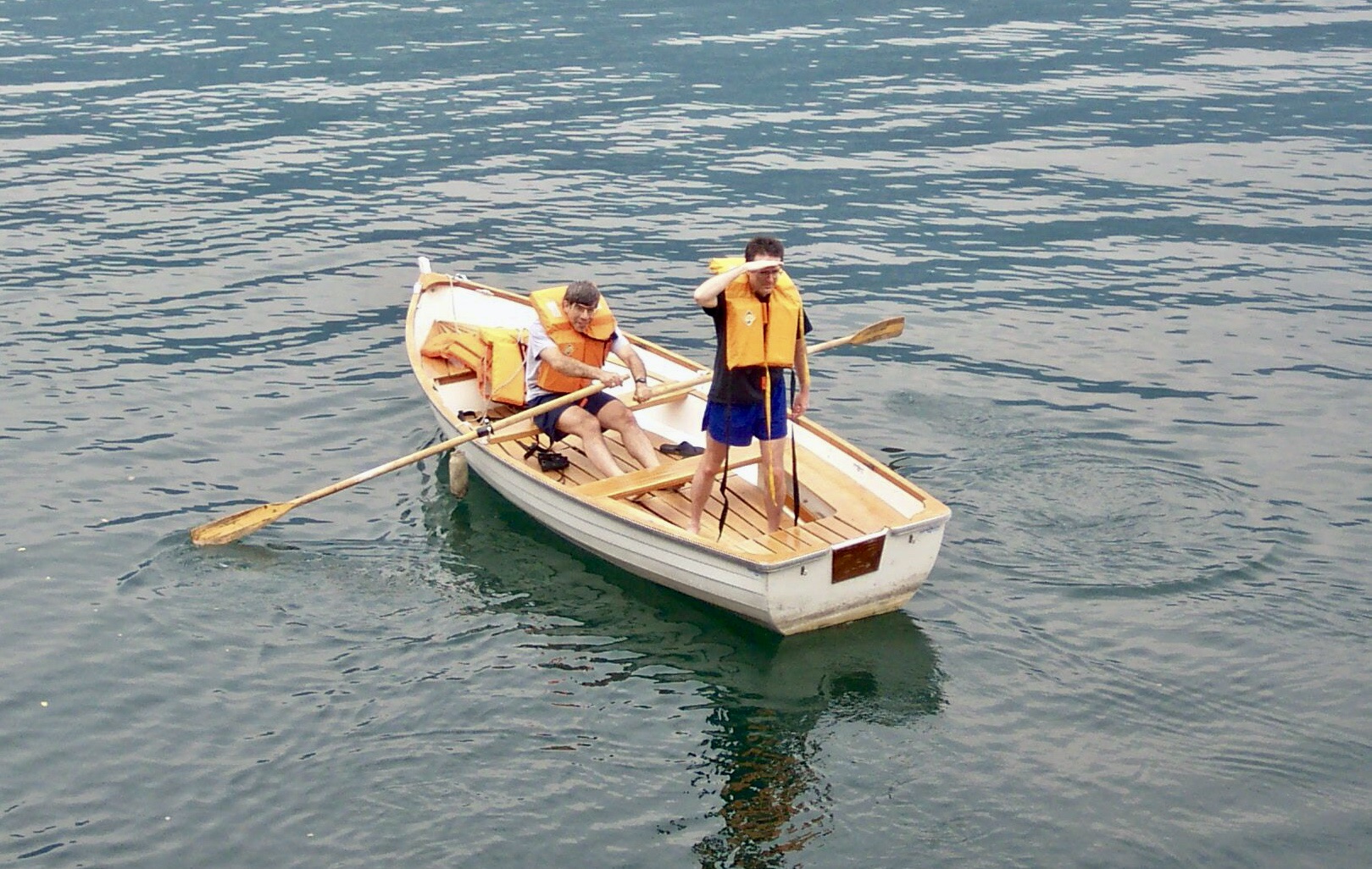
An aquatic jaunt during lunch. Allen shows the way, though of course he’s looking backwards

One more picture of Orr and me, taken at the Evolution meetings in Portland, Oregon in 2001. He was the outgoing President of the Society for the Study of Evolution, and I was the incoming President. This was before Portland became woke and went down the drain:

Again: the 1-3 sentence rule

February 23, 2024 • 10:45 am

I have a Rule of Life, which is mine, and it goes as follows. . . . here it comes (and I’ve probably said it before):

“When engaged in conversation, you are allowed to say only 1-3 sentences before you must allow the other person to say something.”

This derives from conversations I’ve had since the pandemic began, conversations in which people yammer on forever, seemingly oblivious to the fact that they’re engaged in a DIALOGUE.  This allows two or more people to actually have a conversation instead of a monologue.

Now there are of course exceptions: if someone is telling you a joke or a story, or giving a lecture, then one’s allowed to break the limit. There are other circumstances, too, as when someone is telling you their woes. But it would be salubrious if people abided in general by the rule above.

But I always wonder whether those people who speak forever are aware of their misbehavior. And I realized that you learn a lot more by listening than by speaking. As I grow older and less reserved, I try to gently nudge people to stop long monologuing by interrupting, which I don’t like to do, or, when I’m particularly splenetic, by saying, “Get to the point.”

Here are some other of my Rules for Life, of varying importance, that I’ve suggested over the years:

Button your shirt from the bottom up; that way you won’t mis-button it. (This comes from the movie “Cheaper by the Dozen,” about an efficiency expert.)

When running water for a bath, start with the cold water and then gradually turn on the hot tap. This way you won’t burn yourself.

If two people point out the same fault in your persona, they’re probably right. Fix it!

The amount of toothpaste you need to put on your brush is less than you think: about the volume of a pea. (This is from a dental hygienist.)

If a female is telling you of their troubles, they are often looking for a sympathetic ear rather than a solution. Males, on the other hand, are often looking for a tangible solution.  When I have troubles and am looking for someone to comfort me rather than get a solution, I turn more readily to my women friends rather than to men, who often become prescriptive immediately.  (This of course is a generalization based on sex-differential behavior, and is not universal—even among my own friends.)

Here is some real wisdom that I’ve learned, and it’s a shame it took me so long:  “If you are telling someone about a behavior they have that bothers you, do not be accusatory. Simply say how that behavior makes you feel. That way they are not put on the defensive, and friendships are less likely to rupture.”

Please add your own rule(s) for life below. But don’t monologue!


Faith versus Fact audiobook for 75% off: only $4.25

February 15, 2024 • 1:17 pm

My audiobook publisher is running a special deal until March 15: my audio book Faith versus Fact: The Incompatibility Between Science and Religion, for a pittance: $4.25. It’s not available on Amazon, so I’d say this is a good deal.  To get it, click on the icon below, and, if you don’t want to buy into a continuing deal, click the blue “get discount” button and then check out.  If you click the orange button, you’ll buy into a continuing series and will keep getting other books.

The blurb:

In his provocative new book, evolutionary biologist Jerry A. Coyne lays out in clear, dispassionate detail why the toolkit of science, based on reason and empirical study, is reliable, while that of religion-including faith, dogma, and revelation-leads to incorrect, untestable, or conflicting conclusions.

Coyne is responding to a national climate in which over half of Americans don’t believe in evolution (and congressmen deny global warming), and warns that religious prejudices and strictures in politics, education, medicine, and social policy are on the rise. Extending the bestselling works of Richard Dawkins, Daniel Dennett, and Christopher Hitchens, he demolishes the claims of religion to provide verifiable ‘truth’ by subjecting those claims to the same tests we use to establish truth in science.

Coyne irrefutably demonstrates the grave harm-to individuals and to our planet-in mistaking faith for fact in making the most important decisions about the world we live in.

Look at it this way: it’s cheaper than a Starbuck’s latte. And, as with all my books, if you send them to me with a postpaid return envelope, I’ll autograph them and even draw a cat inside.

Times Higher Ed on indigenous knowledge as science

October 25, 2023 • 1:00 pm

On October 1, I wrote about a big project in which the National Science Foundation was going to invest substantial dosh in integrating indigenous (Native American) knowledge into science.  But the “braiding” of modern science with indigenous “ways of knowing” worried me, especially when I’ve seen what it’s done to New Zealand. Here’s an excerpt of what I said in my post:

Here are two claims in the article that worry me. The first is a statement by Sonya Atalay, “an archaeologist of Anishinaabe-Ojibwe heritage at UMass Amherst and co-leader of the [Braiding] centre.”

“As Indigenous people, we have science, but we carry that science in stories,” Atalay says. “We need to think about how to do science in a different way and work differently with Indigenous communities.”

I’m not sure what it means to say “we carry that science in stories,” but stories can, like that Antarctica trope, be corrupted over years and centuries. Empirical claims in “stories” can’t be taken at face value, but have to be tested using the toolkit of modern science.  And what does it mean to say “we do science in a different say”.  Really? Even if you’re working with indigenous communities, don’t you want to ascertain truth the same way we do in modern science?

And there’s this:

Atalay is thinking about ways to measure success and communicate findings that go beyond publishing papers in peer-reviewed journals. In particular, she says, scientists will focus on finding ways to communicate their results with communities, including through the use of comic books, posters and theatre.

“You share what you’ve learned, and you do that through stories, through art, through any accessible means,” she says. “That is not a side note. It’s an integral part of the circle of doing science.”

Well, yes, if you need to tell the locals what you’ve found using comic books and plays, that’s fine. But if knowledge, whether coming from or derived from indigenous communities is to become part of modern science itself, it needs to be published, not in comic books but in peer-reviewed journals.

It’s statements like these that make me worry that the NSF is throwing piles of money (our money) at these endeavors primarily as a performative gesture showing that it cares about indigenous people.

A reporter for Times Higher Education somehow found this post and interviewed me about my views, writing about the project and giving some of my quotes from the interview in the article below (click to read, and make a judicious inquiry if you can’t access it). Forgive the self-aggrandizement, but I’m pleased that the problems with such a program are being given wider exposure.

Here’s an excerpt. Note the NSF’s response in bold. But they do say that some money will be allocated to training students, which is good.  The rest you can read at the site.

Already, there have been some early warnings that the outcome in the US could be similar. Indigenous knowledge certainly has useful applications in many fields of human activity, said Jerry Coyne, emeritus professor of ecology and evolution at the University of Chicago, but it does not contribute in significant ways to the modern scientific processes that have produced decades of major breakthroughs in critical fields such as medicine, physics and chemistry.

“The idea that indigenous knowledge is really going to push science forward seems dubious to me,” Professor Coyne said.

In their announcement of the new NSF centre, its organisers cited the example of clam gardens – rock walls built along shorelines to provide a welcoming habitat for molluscs – which indigenous people have been creating for thousands of years along the Pacific north-west coast of the US and Canada. The approach can double or quadruple clam production, according to Marco Hatch, an associate professor of marine ecology at Western Washington University who studies their use and who will receive some of the first allotment of funding from the new NSF centre.

That kind of work does seem beneficial, Professor Coyne acknowledged. But as similar cases in New Zealand have shown, the actual scientific content is thin, he said. “My response is: show me the results, show me what useful science has come out of this – and there’s very little,” he said. “It’s always in the nature of, well, we’ve learned to pick berries when this phase of the moon occurs at this time of year. Yeah, that’s useful practical knowledge, but it’s not really science in the sense that the NSF considers science.”

An NSF official insisted on the scientific value of bringing new “backgrounds and attitudes” to research work. “Scientists don’t always create good or optimal research questions and designs because they are sometimes missing critical information about culture or other aspects of human behaviour or the environment,” the official said.

A potentially more valuable outcome of such federal investment, Professor Coyne said, would be for the government to help more indigenous students become professional scientists, who could then use their ancestral backgrounds in ways that fit more directly into existing research channels. “If you want to help underserved people, bring them into modern science,” he said.

The NSF’s announcement of the new centre does indicate plans in that direction, saying that some funding would be spent on training students at school level all the way up to postdoctoral researchers and graduate research assistants, many at minority-serving institutions.

I wish, though, that the unnamed “NSF official” had given at least one example of a project that had gone forward or been improved by adding that “critical information about culture”. As I noted in the piece, those who push for the unification (and sometimes coequality) of science and “indigenous ways of knowing” often fall short when asked to give examples of how this will improve our understanding of nature.

A short Forbes magazine interview with Peter Singer

May 24, 2023 • 1:00 pm

I’m posting this clip for two reasons. First, it’s a Forbes Magazine interview with a philosopher I much admire: Peter Singer. He’s admirable because he deals with philosophy’s original purpose: to figure out how to live a good life; because he deals with tough questions (one of them here: the euthanasia of terminally suffering newborns, which he discusses at 6:45); because, even when attacked he defends his ideas with tenacity; because he walks the walk, giving a lot of his income to others; and because does a lot of charitable work. Despite calls to get him fired because of his views on infant euthanasia, he maintains his equanimity and simply proffers a defense of his stand that I, for one, find convincing. And, of course, he spends a lot of time dealing with animal welfare, which a biologist has to admire (sadly, I’m too hypocritical to give up eating meat, but Singer abjures it).

Second, because he’s one of the founders of The Journal of Controversial Ideas, I was chuffed to hear that he talks about our paper recently published there, “In defense of merit in science” (between 9:30 and 13:00). I’m not sure who the interviewer is, but she seems to push on our merit thesis because in some ways it opposes racial diversity. Singer, in response, seems dubious about the idea of equity trumping merit.

They begin by discussing Singer’s new book (an update, actually): Animal Liberation Now: The Definitive Classic Renewed, which came out on Tuesday. I read the original book  (Animal Liberation), which was when he first came to my consciousness. I also admire his book The Expanding Circle: Ethics, Evolution, and Moral Progress., which suggests how our evolved ethical system has been extended to all humanity.

p.s. Singer has compiled a list of charities where, he thinks, you can get the most relief of suffering for your dollar. I’ve used that list, which you can find here, to decide who will get my money when I die.

My WaPo review of Jon Losos’s new book on cats

May 3, 2023 • 9:00 am

My colleague Jon Losos, an evolutionary ecologist at Washington University who works on lizards but also has three cats, has written the kind of book I’d always wanted to write: an exploration of the evolutionary roots of the housecat and an evolution-based analysis of its behaviors.  Given Losos’s line of work, it’s also imbued with ecology. The book came out today, and you can order it on Amazon by clicking on the screenshot below:


Knowing of the book’s existence since it is published by Viking/Penguin (my own publisher), I asked the Washington Post if they wanted me to review it. They said “yes” and the link to my review below is taken from today’s newspaper. Click on the screenshot to see it, and, if it’s paywalled, perhaps judicious inquiry will yield a copy.

I’ll just give a short excerpt since you should read it on the site. (It will be in the paper edition of the Post on Sunday.)

The review is positive, so if you want to learn about cats, you should read the book. I couldn’t resist a dig at d*gs at the outset, just to liven things up:

My view, and that of many other die-hard cat lovers, is that the internet exists primarily to circulate pictures and videos of cats. Dogs, you may be surprised to learn, can also be found on the internet but curiously tend to remain stuck in remote corners of cyberspace. Cats fuel wildly viral memes; dogs seldom get beyond that family vacation picture on Facebook (with just three likes, all from elderly relatives). Both cats and dogs — especially the younger versions of both — have fuzzy, big-eyed appeal, but dogs apparently lack what it takes to snare a global audience. As the New York Times contended, cat pictures are “that essential building block of the Internet.”

One prominent theory to explain this cat/dog disparity suggests that it’s the residual wildness of cats that makes them so special. This accounts for their infinite capacity for aloofness. Cats were domesticated rather recently — about 10,000 years ago when humans were busy inventing agriculture. And DNA tells us that the ancestor of all house cats is the African wildcat Felis silvestris lybica, which looks much like a domestic tabby.

. . . It’s appropriate, then, that an evolutionary biologist should write the definitive book on the biology, ecology and evolution of the house cat. That would be Jonathan Losos, who, although best known for his studies of lizards, also owns three cats. Those cats, he found, were every bit as interesting as his lizards but had a marked advantage over the reptiles: Losos didn’t have to leave his home to carry out field work. The result, “The Cat’s Meow: How Cats Evolved from the Savanna to Your Sofa,” is a readable and informed exploration of the wildcat that lurks within Fluffy.

. . . Many mysteries remain. Did meows (emitted only by domestic cats) really evolve, as has been seriously suggested, to resemble the cries of a distressed infant, to convert a hardwired human response — “I must take care of an unhappy baby” — into an ingenious ploy to get tuna? What is the real difference in the average life span between a cat allowed to roam outdoors and one kept inside? The traditional answer is five vs. 17 years respectively, but as Losos notes, “I have not been able to find the basis for this claim, and the discrepancy seems extreme to me.”

And we remain abysmally ignorant about my two most pressing cat questions: why they wiggle their butts right before they pounce on prey, and why they “chatter” when they see birds. All they seem to be doing in each case is alerting their potential meal to its hazardous situation, surely not a good idea. One of the lessons of the book, in fact, is that mysteries abound in cat science. One of the largest is how many times cats were domesticated in the Middle East. Did house cats evolve in a single location, or in several places around the same time? We don’t know, and the genetic data is ambiguous.

Like all good scientists, Losos admits that are many questions that will keep cat research active for years to come. Writing as a confirmed, and long-standing, cat lover, I look forward to an ever-expanding understanding of catness and to luxuriating, in quiet moments, in the joys of an infinite supply of online images, memes and videos of that most charismatic and beguiling of all domestic animals.

Coyne’s Laws of Life

March 10, 2023 • 8:15 am

Once again I’m racked with insomnia, intensified, I suppose, by jet lag. The result is that I probably get about 1-2 hours of sleep at night and can’t even fall asleep when I attempt a midday nap. We all have our burdens, and this is mine.

As the night turtles by, I’m instructed not to worry about falling asleep, which causes anxiety, so I try to think of other things. Last night I compiled a mental list of “Coyne’s Laws,” a list of observations about life that I began as a teenager. There aren’t many of them, but I bet readers have their own Laws. As I can’t brain today, I’ll give my list; I may have mentioned some of these before.

LAWS ABOUT PRACTICAL BEHAVIOR

Always button your shirts from the bottom up; that way you will never mis-button them.

When running a bath or shower, always turn the cold water on first and then the hot; this ensures that you won’t get scalded.

If a man recounts a problem to you, he wants a practical solution. If a women recounts a problem to you, she wants an empathic hearing and, unless she asks for them, does NOT want solutions. Likewise, men faced with a friend’s problem, regardless of whether the friend is male or female, will immediately try to solve it by giving advice. Women, on the other hand, will be empathic and solicitous of your situation. That’s why some of my best friends are women, and why, when faced with another’s problem, I try to act in the female-like way. (This does not apply to problems like how to make a syllabus, which explicitly require a practical solution. Also, this is a generalization, not a law. I make no claims about whether this results from evolution or socialization.)

Be sure to floss once a day to save your teeth and gums. I highly recommend Listerine Reach UltraClean Dental Floss®, which my hygienist (who put me onto the stuff) says is no longer made. Immediately order tons of it from Amazon, as it’s still for sale there. The stuff is mint-flavored, unwaxed, thin, stretchy, and does a great job. I’ve never found better.  I now have several years’ worth.

LAWS ABOUT HUMAN BEHAVIOR

Coyne’s First Law: Everyone thinks that they have a good sense of humor. (Observation: Some people have no sense of humor. Conclusion: Many people are fooling themselves.)

Coyne’s Second Law: Everyone thinks that they’re a “little bit nuts”, but always in a nice way. That is, everyone thinks they have some amusing eccentricities. (Observation: While this belief is nearly ubiquitous, some people are nuts but not in a nice way.)

Coyne’s Third Law: Nobody thinks they’re a jerk. (Observation: quite a few people are big-time jerks. Conclusion: many people have no self-awareness.)

LAWS ABOUT FOOD

All snack foods that are meant to be healthy eventually evolve into forms of confectionary. Examples: granola bars, once solidified blocks of tasteless grains, are turning into candy bars, covered with chocolate and sometimes containing raisins or even chocolate chips; thanks to Starbucks, coffee has turned into the adult equivalent of ice cream sodas; and fizzy water (known to we Jews as “seltzer” or “two cents plain?”) has acquired flavors and now is getting bit of added sugar as it inevitably gets turned into soda pop.

All ice cream manufacturers eventually shrink the size of their largest container while maintaining the price. (There are a few exceptions to this: honest companies who proudly offer the full half gallon.) My post about this last June, “The ice cream scams“, was the third most popular post I ever put on this site, tapping into a hidden vein of resentment permeating the American public.  There’s also a corollary: “All ice creams eventually become ‘frozen dairy desserts’,” which are cheaper to make. Unless you look closely, you won’t even notice. Do not be fooled.

I have begun formulating a new set of laws, which are mine. Here is the first one:

LAWS ABOUT SOCIAL MEDIA

Any Facebook post that beings with “I am honored. . .” inevitably involves braggadocio: a description of some award or achievement that the poster wants either their friends or the whole world to know about. What “I am honored” really means is: “Look what I got!”

I’m sure you have your own rules that haven’t been codified into rules or laws, but if you have these kinds of personal generalizations, please put them into the comments.