Readers’ wildlife photos: Darwin Day edition

February 12, 2026 • 8:15 am

Today we have a Darwin-themed text-and-photo contribution by Athayde Tonhasca Júnior, and on his favorite topic: pollination (and my favorite topic, speciation). Athayde’s IDs and narrative are indented, and you can enlarge his photos by clicking on them.

Parting ways

As superlatives go, it would be difficult to beat the South African Platland Baobab [Adansonia digitata]. Its 10.6-m diameter trunk was large enough to accommodate a bar inside its hollow trunk. The massive tree, now deceased, was also old – it had been on this Earth for about a millennia.

There aren’t many places where you can order a pint inside a tree like the Platland or Sunland Baobab © South African Tourism, Wikimedia Commons:

Leaving aside its connection to thirsty pilgrims, the Platland Baobab was not exceptional: other specimens belonging to the same African baobab (Adansonia digitata) species are similarly big and old. The African baobab’s size, age and the somewhat bizarre shape (the ‘upside-down tree’) inspired many legends and superstitions. Beyond the mythical, baobabs have practical uses to some rural communities in parts of Africa: fruits and leaves are rich in vitamin C, the bark can be used for making rope, and tree hollows serve as water reservoirs. Wildlife also feed on baobab’s parts, sometimes in excess: elephants eat baobab bark during the dry season, resulting in significant tree mortality when elephant numbers are high.

One African titan squaring up to another © Ferdinand Reus, Wikimedia Commons:

Like the vast majority of flowering plants, the African baobab is a hermaphrodite:  its flowers have male and female reproductive organs. And like most hermaphrodite plants, baobab flowers are self-incompatible; they can’t fertilise themselves. Therefore, pollinators have to come to their reproductive aid. That’s particularly important for African baobabs, which often grow in isolation, with an average of 2 trees/ha.

When researchers started investigating baobab reproduction in West and East Africa in the 1930s and 40s, bats were soon singled out as their likely pollinating agents. It made sense: the white, large (up to 200 mm in diameter) pendulous flowers open at night and release a musty smell, all signs of chiropterophily, or pollination by bats. But things are a bit more complex. Flowers in west and east Africa are mostly visited by the straw-coloured fruit bat Eidolon helvum (Eidolon helvum) and the smaller Egyptian fruit bat (Rousettus aegyptiacus), respectively. However in southern Africa, baobab flowers have no appeal to bats, but do attract hawk-moths. These regional differences are linked to floral features such as shape, scent and nectar volume. In west Africa, flowers are larger, have longer peduncles, longer styles and more nectar than flowers in east and southern Africa. East African flowers are smaller and sturdier, with less nectar but enough to encourage visits by the Egyptian fruit bat. Flowers in southern Africa are smaller still and produce nectar in volumes just enough for moths (Venter et al., 2025).  And while baobabs flowers from the three regions release bat-attracting sulphur compounds, southern African flowers also produce β-caryophyllene, a chemical known to lure moths (Karimi et al., 2021).

Below:  A) A straw-coloured fruit bat in west Africa feeding on a baobab flower while a hawk-moth thieves, that is, it takes nectar but does not pollinate. B): an Egyptian fruit bat in east Africa landing briefly to lick nectar. C:) a long-tongued and a short-tongued hawk-moths feeding in southern Africa © Venter et al., 2025:

The African baobab is by no means unique; many other species comprise populations of diversified floral traits that suit particular pollinators and local environmental conditions. Ecologists refer to each of these populations as pollination ecotypes, species complexes, geographical races or ecological races. Pollination ecotypes have one possible outcome of exceptional importance: given enough time, they may drift further apart in their morphological and physiological traits to the point of becoming reproductively incompatible with each other.

Examples of pollination ecotypes. Long-spurred Platanthera bifolia pollinated by the hawk-moth Sphinx ligustri (a) and a shorter-spurred form pollinated by the hawk-moth Hyloicus pinastri (b); short-tubed Gladiolus longicollis pollinated by hawk-moths with short probosces (c) and a long-tubed form pollinated by hawk-moths with long probosces (d). © Johnson, 2025:

It’s worth emphasising the meaning of such an outcome. Different forms – or morphs – in each ecotype associated with their own pollinators will eventually become different species, a process that has become widely acknowledged (Johnson, 2025). Speciation via ecotypes supports Darwin’s view that species and infraspecies taxa (varieties, subspecies, forms, morphs, etc.) represent a continuum: In short, we shall have to treat species in the same manner as those naturalists treat genera, who admit that genera are merely artificial combinations made for convenience. This may not be a cheering prospect; but we shall at least be freed from the vain search for the undiscovered and undiscoverable essence of the term species (Darwin, 1859). Such a continuum implies that speciation is much more common and frequent than one may expect (Mallet, 2008).

The roles of insect pollinators as safeguards of biodiversity, crop production and human health are well known and celebrated. But the tale of African baobab pollination ecotypes reminds us of another fundamental aspect: pollinators greatly contribute to the radiation and diversification of angiosperms, the largest and most diverse group in the plant kingdom and largely responsible for the functioning of all terrestrial ecosystems. It’s a hefty responsibility upon tiny shoulders.

Accumulated diversification of insect families through time. Dotted lines indicate the Permian–Triassic (P–T), Triassic–Jurassic (T–J), and the Cretaceous–Paleogene (K–Pg) mass extinctions © Peris & Condamine, 2024:

References

Darwin, C.R. 1859. On the Origin of Species by Means of Natural Selection. John Murray.
Johnson, S.D. 2025. Pollination ecotypes and the origin of plant species. Proceedings of the Royal Society B 292: 20242787.
Karimi, N. et al. 2021. Evidence for hawkmoth pollination in the chiropterophilous African baobab (Adansonia digitata). Biotropica 54: 10.1111/btp.13033.
Mallet, J. 2008. Hybridization, ecological races and the nature of species: Empirical evidence for the ease of speciation. Philosophical Transactions of the Royal Society of London B 363: 2971-2986.
Peris, D. & Condamine, F.L. 2024. The angiosperm radiation played a dual role in the diversification of insects and insect pollinators. Nature Communications 15: 552.
Venter, S.M. et al. 2025. Regional flower visitor assemblages and divergence of floral traits of the baobab Adansonia digitata (Malvaceae) across Africa. Botanical Journal of the Linnean Society boaf085.

Readers’ wildlife photos

February 6, 2026 • 8:15 am

Today we have some flower photos from reader MichaelC.  His captions and IDs are indented, and you can enlarge the photos by clicking on them.

Sri Lanka Flora!


Recently I sent WEIT some photos from the Dambulla cave temples in Sri Lanka. My wife and I took a “pre-honeymoon” there (we took our honeymoon before the wedding; we’re olde so rules don’t apply to us!) and I have a large number of photos of Sri Lankan flora.  [Today we have the flora.]

I hope some of the ones I’ve selected are new to readers. I have tried to identify them, some I’m sure of, others not so much, and some I don’t know at all. The countryside in Sri Lanka is bursting with color; there are flowers everywhere. And birdsong! If you don’t like singing birds, Sri Lankan is not a place for you. Most of the flowers are probably familiar to people – I’ve seen many myself. These were mostly taken at the Royal Botanical Gardens or on the estate of the Dilmah Tea Plantation.

A Vanda orchid, possibly Vanda suksamran?

Black Bat flower (Tacca chantrieri). I know some Goth friends of my son who I bet would like this plant!:

Some type of rose. St. Nicholas’ Damask, maybe?:

Scarlet Sage (Salvia splendens):

Bachelor’s buttons (Centratherum punctatum or Centratherum intermedium?):

The familiar Hanging Lobster Claw (Heliconia rostrata):

There were a large variety of Angels trumpets (Brugmansia spp.) in parks, gardens, and jungles all over Sri Lanka. Here are a few;

Some kind of orchid (my notes say it’s a Dendrobium orchid):

Egyptian Starcluster (Pentas lanceolata):

Star of Bethlehem (Hippobroma longiflora):

Readers’ wildlife photos

February 3, 2026 • 8:15 am

This is my last batch of photos, so please help us (i.e., me) out and send your good wildlife photos.

Today’s photos of sunflowers come from Pratyaydipta Rudra, a statistics professor at Oklahoma State University. Pratyay’s captions and IDs are indented, and you can enlarge the photos by clicking on them. Pratyay and his wife Sreemala have a big bird-and-butterfly website called Wingmates.

I have shared some stories about our Maximilian Sunflowers before. This batch is a set of images of the sunflowers in bloom from the fall. They bloom for a relatively shorter time (a couple of weeks), but it creates a wonderful sunny vibe at that time and the pollinators, especially the migrating ones, definitely appreciate the buffet. Here are some insect photos on or near the sunflowers.

The Maximilian Sunflower (Helianthus maximiliani) plants bordering our property. They are not just low maintenance (no water required even during hot Oklahoma summers), but also kind of hard to kill if one wants that! We had them accidentally mowed down to the ground by a neighbor during the first year, and they grew back up just fine:

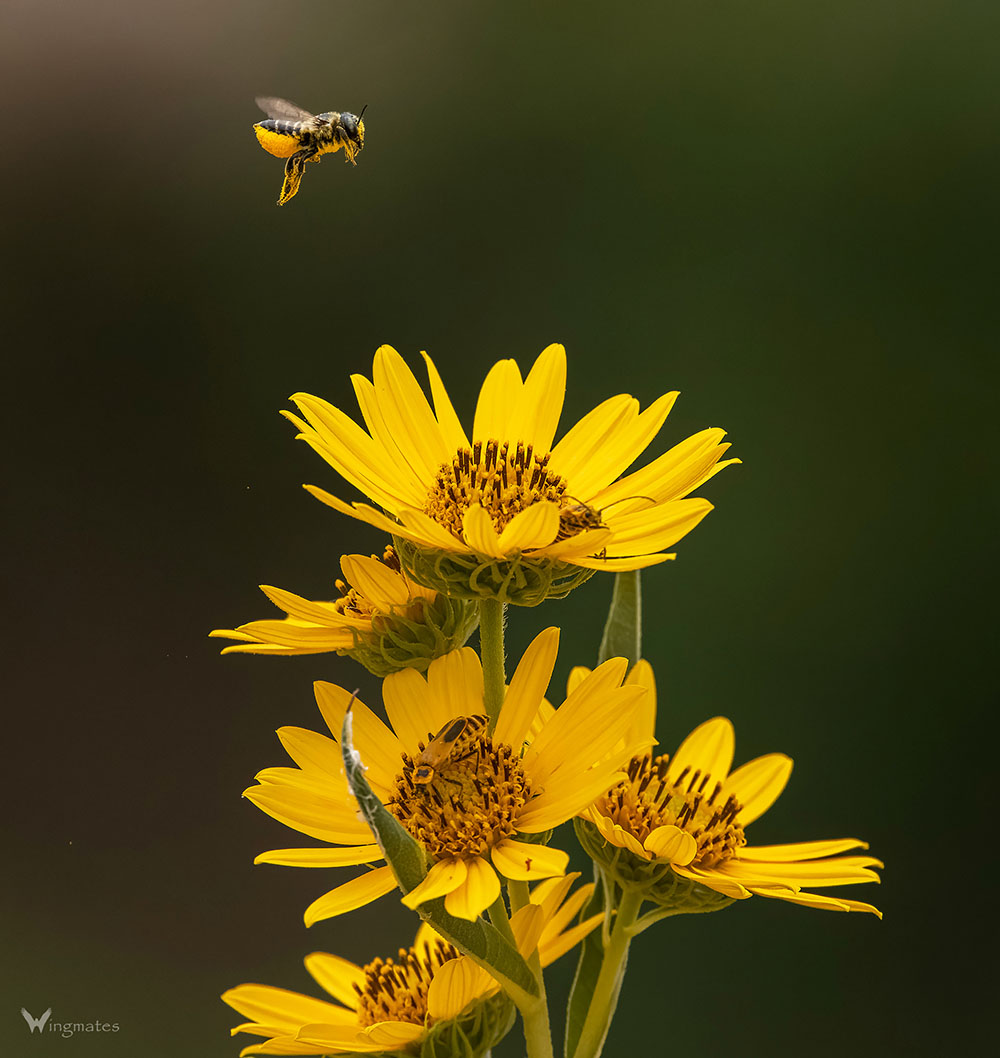
A leafcutter bee (Megachile, not sure about the exact species) flying over:

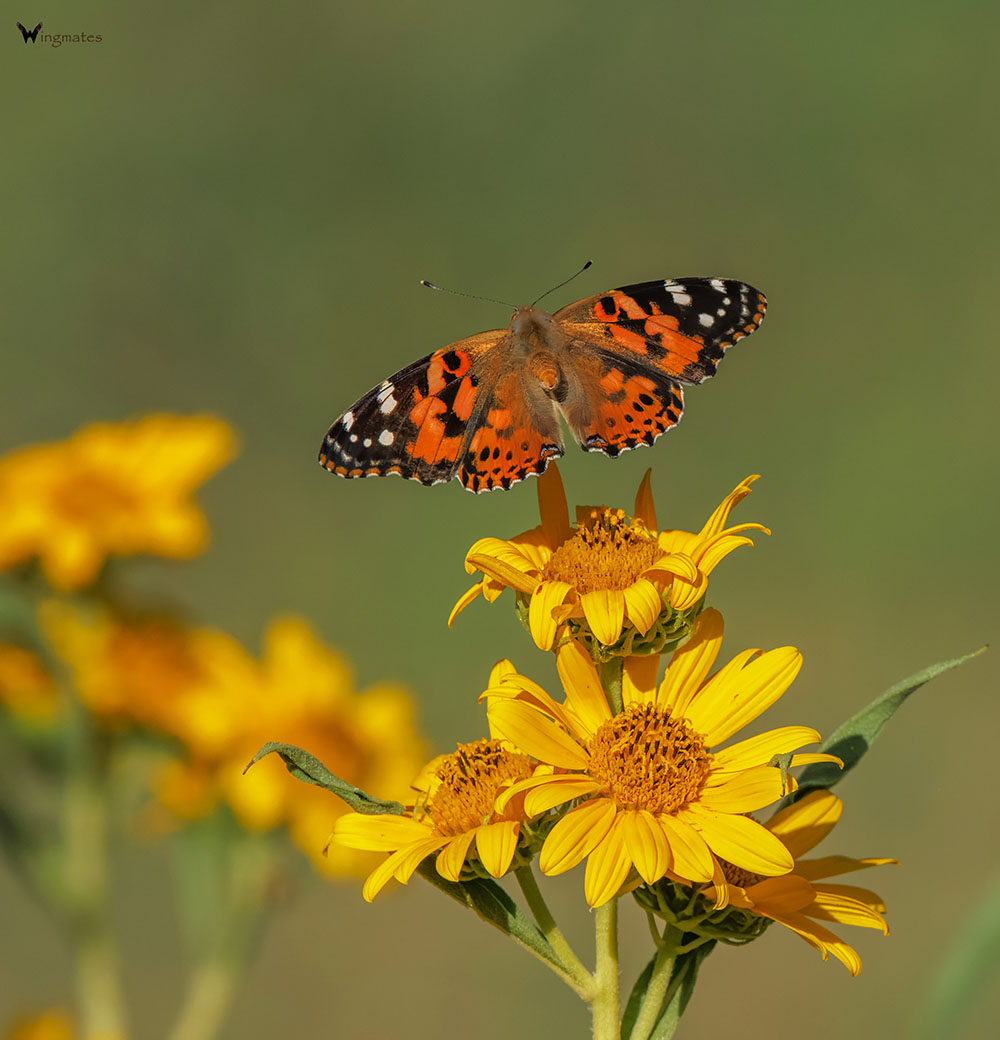
Painted lady (Vanessa cardui) butterfly taking off:

The bloom coincides with Monarch (Danaus plexippus) migration as we see plenty of Monarchs stopping by:

I called this image “The flame and the bee”. It’s the same leafcutter bee from the other image:

A close view of the bee nectaring on the sunflower:

A Spotted Cucumber Beetle (Diabrotica undecimpunctata). These are considered pests, but we see a good number of them every fall and they had never caused any trouble in our vegetable garden:

I think these are Goldenrod Soldier Beetles (Chauliognathus pensylvanicus), or something closely related to them:

Some kind of Meadow Katydid (Orchelimum). I love these with long antennae. They keep us entertained all fall and the garden suddenly sounds so quiet after the frost sets in:

Another Painted Lady. Note how it does not have the typical white spot of the American Ladies (Vanessa virginiensis) on the orange patch. The smaller one is likely a Fiery Skipper (Hylephila phyleus):

The skippers are often overlooked but they have a lot of character! I can spend hours watching them interact with each other. I find them quite hard to properly identify sometimes even with a field guide. This one is probably a Sachem (Atalopedes campestris):

The skippers are fast, but they can still fall prey to these efficient hunters: Goldenrod Crab Spider (Misumena vatia). These spiders can change their color (during molts) to match their surroundings. It’s not a surprise that this one was yellow, efficiently camouflaged among the sunflowers:

I like playing with the backlight through the leaves of these plants. I was happy to capture this little Eastern Amberwing (Perithemis tenera) dragonfly coming back to its favorite perch:

Another backlit image of a sunflower plant with some nice bokeh of out-of-focus mosquitoes/gnats:

Readers’ wildlife photos

January 25, 2026 • 9:00 am

Fortunately, some kind readers have come through with a few batches of photos. But the tank is still low.

Today’s photos of birds (and one flower) come from Pratyaydipta Rudra, a statistics professor at Oklahoma State University. Pratyay’s captions and IDs are indented, and you can enlarge the photos by clicking on them. Pratyay and his wife Sreemala have a big bird-and-butterfly website called Wingmates.

It’s bitter cold outside as the winter storm is here in Oklahoma. So, I decided to share some more photos from the warmer days – A series of backyard bird images from the fall. While we mostly have native plants on our property, most of the images here involve some non-natives that we already had around our property when we moved in. But they do show some nice colors in the fall. We have a raised deck in the backyard which results in some nice eye-level views of the birds.

Female Eastern Bluebird (Sialia sialis) and fall foliage.=:

Male Northern Cardinal (Cardinalis cardinalis):

Female Northern Cardinal working on some berries:

Yellow-rumped Warbler (Setophaga coronata) in light drizzle. It always makes me smile when these little guys show up every fall:

Another Yellow-rumped Warbler from the same day:

Tufted Titmouse (Baeolophus bicolor) on our pecan tree with some seed that it grabbed from the bird feeder. Titmice and Chickadees don’t spend too much time on the feeder. They like to grab a seed and take it to a nice perch on a tree where they can break it and enjoy it at its own pace:

Our yard has some larger birds too! This Red-shouldered Hawk (Buteo lineatus) has been a regular visitor for a while, and by now we kind of know some of its unique personalities:

Red-bellied Woodpecker (Melanerpes carolinus). At this time of the year, these woodpeckers are usually busy hiding seeds with the goal of storing them for the winter. I don’t know how many they actually find again:

This is not a bird image, but it has a connection with birds. These low maintenance native Maximilian Sunflowers (Helianthus maximiliani) put on an amazing show every fall, albeit for a short duration. However, during this time, they attract a huge number of pollinators including all kinds of butterflies, moths, and bees. We keep the dried plants after they are done blooming since the seed-loving birds have a feast on them:

House Finches (Haemorhous mexicanus) are one of them. Here is a male and a female House Finch on the dry sunflowers:

American Goldfinches (Spinus tristis) also enjoy the seeds. They are usually much duller by this time compared to their bright breeding plumage:

Couple of goldfinches from the same scene – a wider view:

One more goldfinch from a warm day:

A male Eastern Bluebird (Sialia sialis) on the sunflower stalks:

Readers’ wildlife photos

January 24, 2026 • 8:15 am

Today Friend of the Website Greg Mayer contributes some photos from Britain.

by Greg Mayer

Since we’re awaiting a recharge of the tank of Readers’ Wildlife Photos, I thought I’d add a few wildlife photos from a recent trip to England. I did not bring my good camera with a telephoto lens, since the visit was focused on museums in London, and the photos reflect this constraint.

The only mammal we saw in London was the introduced Gray Squirrel, but in Oxfordshire we saw molehills (made by the European Mole, Talpa europea) in and near the churchyard of St. Margaret of Antioch in Binsey. American moles most prominently make much less elevated runs or tracks, not distinct hillocks like these, so the phrase “making a mountain out of a molehill” makes more sense to me now.

Part of Oxford University, Wytham Woods (a famed area for ecological studies) had some Sheep (Ovis aries) in an enclosure. These are domesticated, and the species was brought to Britain thousands of years ago.

In London, we encountered two more corvids. The Carrion Crow (Corvus corone corone) is the most like what is, to an American, a “normal” crow. (During a brief stop in Copenhagen on the way to England, we also saw a Hooded Crow, Corvus corone cornix, which has a gray body, and has a long hybrid zone with the Carrion Crow, )

The other corvid was the Eurasian Magpie (Pica pica), which is much more “crow-y” looking than the jays in America (which are also corvids). We also saw Rooks (Corvus fragileus) on the trip, but got no photos.

Note the blue on the wings of this Magpie.

Like the Carrion Crow above, also on the Victoria Embankment was a Black-headed Gull (Chroicocephalus ribundus); this is an adult in winter plumage. We saw quite a few gulls all around London. Most were larger than this (Larus sp. or spp.), but we could not ID them.

On the way to Greenwich by boat on the Thames, we saw Mute Swans (Cygnus olor), which I include here to show the great tidal range of the Thames, ca. 7 m, evident from the algal growth on the bulkhead behind the pair of swans.

Also on the Thames we saw Great Cormorants (Phalacrocorax carbo), including a pale-bellied juvenile.

We were struck by how the apartments along the south bank of the Thames resembled scenes from movies, for example A Fish Called Wanda, and sure enough, the building at the left of the photo above is indeed where the Cleese-Curtis “canoodling” rendezvous took place!

The bird we saw more of than any other in England was the pigeon. Not the Common Wood Pigeon (Columba palumbus), like this one in Greenwich, which we saw a fair number of. . .

. . . but the Feral Pigeon or “rock dove” (Columba livia), which was everywhere, both city and country.  There were many of the highly variable domestic color forms, such as this one

. . . . and some of the “wild type”, which is the color pattern of the ancestral wild Rock Doves.

Wild Rock Doves persist in Scotland and western Ireland; all the pigeons we saw in London and Oxfordshire were feral.

Readers’ wildlife photos

January 19, 2026 • 8:15 am

Today we have a photo-and-text submission from Athayde Tonhasca Júnior on fly migration. It’s a subject dear to my heart as I used to work on it, publishing three papers on migration in Drosophila.  Athayde’s subject, though, is hoverflies, not fruit flies. His captions are indented, and you can enlarge his photos by clicking on them. Note: I changed Athayde’s words “hover flies” to the more common usage “hoverflies,” but Athayde notes that most entomologists use the two-word rather than one-word description.

On the road again, goin’ places that I’ve never been

Sometime between 1400 and 1200 BC, Yahweh (aka God) decided it was time to nudge the Egyptians to let their captive Israelites go. Yahweh could have tried diplomacy, but in his infinite wisdom he concluded that “The Egyptians shall know that I am the LORD”. And there was no better way to let the Pharaoh and his people know who the bigwig was around there than by punishing them with a series of plagues. Of the ten celestial disasters inflicted upon the Egyptians, two involved mosquitoes (or midges) and flies, which probably were also the agents behind another two plagues manifested as infectious diseases of people and livestock. Yahweh understood very well the efficacy of some flies (order Diptera) and pathogens to wreck revenge – after all, he created them.

Fig 1. The Third Plague of Egypt, by William de Brailes, circa 1250. Aaron strikes his rod on the ground, transforming dust into gnats (kinnim in Hebrew). In the King James version of the Bible, lice are the culprits, but today most scholars accept that kinnim should be translated as ‘gnats’ or ‘mosquitoes’ © Jan Luyken, 1712, Wikimedia Commons:

The tales of pestilent flies depicted in the book of Exodus could have been inspired by real events, as pest infestations and epidemics were recurrent in the ancient world. Fly outbreaks are facilitated by these insects’ capability to disperse for long distances and arrive at new locations suddenly and in massive numbers. There are no better examples of these efficient colonisers than hoverflies or syrphid flies (family Syrphidae) such as the marmalade (Episyrphus balteatus) and the migrant (Eupeodes corollae) hoverflies. Each autumn, they leave Britain and head south to spend the winter in southern Europe and the Mediterranean. Their offspring move northwards in the spring, lay eggs, and the new generation sets out on the cycle again. Researchers have estimated that up to four billion marmalade and migrant hoverflies cross the English Channel to and from Great Britain every year. This represents 80 tons of biomass. If you are impressed by these figures, you should know that hoverflies account for a fraction of insects’ latitudinal migrations known as ‘bioflows’: about 3.5 trillion insects, or 3200 tons of biomass, migrate into southern Britain annually (Wotton et al., 2019). Insect bioflows pour vast amounts of nutrients (particularly nitrogen and phosphorus) and countless prey, predators, parasites and herbivores into ecosystems, but we have only a vague understanding of their impact on food webs and local species.

Fig 2. A female marmalade hoverfly, a long distance frequent flier © Guido Gerding, Wikimedia Commons:

These hardy wanderers have another particularity of significant ecological importance: they transport pollen grains.

Most flies have no pollen-collecting structures and have few ‘hairs’ (setae), which are important pollen gatherers. These are negative marks for candidates to the pollinators’ club, but some flies compensate their shortcomings by their massive numbers. Each marmalade and migrant hoverfly carries an average of 10 pollen grains from up to three plant species on their journey into Britain. That’s paltry compared to a bee, but altogether, those flies bring in 3 to 8 billion pollen grains on each inward journey.

Pollen importation via flies is a recurrent phenomenon. In Cyprus, warm temperatures and favourable winds bring millions of insect migrants from the Middle East region, more than 100 km to the east. Flies make up nearly 90% of these bioflows, and many of them are loaded with pollen (Hawkes et al., 2022).

Fig 3. A common drone fly (Eristalis tenax) (A) and a blowfly (Calliphora sp.) (B) with orchid pollinia attached to their heads after a > 100-km sea crossing to Cyprus © Hawkes et al., 2022:

Pollen-loaded flies can turn up anywhere the wind takes them, even to specks of dry ground in the middle of nowhere. Over a two-month period, 121 marmaladehover flies reached a North Sea oil rig approximately 200 km from Aberdeen, UK. Over 90% of these flies had pollen attached to them, sometimes from eight plant species. Based on pollen barcoding and wind trajectory modelling, it was estimated that these flies traversed from 265 to 500 km of open water in a single journey, probably from the Netherlands, Germany and Denmark (Doyle et al., 2025).

Fig 4. (a) Location of an oil rig visited by hoverflies (b), and its aerial view © Doyle et al., 2025:

Flies’ long-distance pollen transfers may help connect isolated plant populations, such as in fragmented habitats, but we don’t know much about the ecological implications. However we do know that their contribution can be important. In continental Europe, wild carrot (Daucus carota) depends on a range of insects for pollinators, especially bees. But bees are absent from La Foradada, a 1,6 ha Mediterranean islet about 50 km off the Spanish coast. In this solitary spot of land, D. carota subsp. commutatus relies on the accidental arrival of common drone flies for its pollination (Pérez-Bañón et al., 2007).

Fi 5. La Foradada, devoid of bees and humans, is visited by pollinating drone flies © JavierValencia2005  Wikimedia Commons:

Butterflies, bumble bees, moths and dragonflies are known travellers, but we know much less about migrant flies, which may have significant roles in pollination ecology. We just have to pay more attention to these unpretentious pilgrims.

References

Doyle, T.D. et al. 2025. Long-range pollen transport across the North Sea: Insights from migratory hoverflies landing on a remote oil rig. Journal of Animal Ecology 94: 2267–2281.
Hawkes, W.S.L. et al. 2022. Huge spring migrations of insects from the Middle East to Europe: quantifying the migratory assemblage and ecosystem services. Ecography e06288.
Pérez-Bañón, C. et al., 2007. Pollination in small islands by occasional visitors: The case of Daucus carota subsp. commutatus (Apiaceae) in the Columbretes archipelago, Spain. Plant Ecology 192: 133-151.
Wotton, K.R. et al. 2019. Mass seasonal migrations of hoverflies provide extensive pollination and crop protection services. Current Biology 29: 2167–2173.

Readers’ wildlife photos

January 10, 2026 • 8:15 am

Reader Ruth Berger sent some butterfly photos taken last year in Germany.  Her captions and IDs are indented, and you can enlarge Ruth’s photos by clicking on them.

Here are some butterflies I snapped on my walks on mostly sandy soil near the Main and Nidda rivers in and around Frankfurt, Germany, last year. I’ll start with a good picture (some of the others aren’t that good) of the small copper, Lycaena phlaeas, a holarctic species, on ragwort.

The next not so brilliant photo is of the orange tip (Anthocharis cardamines), whose males are so busy chasing females and each other at borders between patches of woodland and grassland in spring. Only the males of the species have the eponymic orange tip, here visiting the species’ major caterpillar feeding plant, Cardamine pratensis.

Unlike the males, orange tip females look much like any typical white butterfly (Pierinae) from above. The underside of the females has greenish markings similar, but not identical, to the species you see in the next picture, Pontia edusa, here shown feeding on a Centaurea flower:

I saw several species of red-spotted burnet moths this year, all members of the West Palaearctic Zygaena family. These are wondrous creatures, dressed in what looks like a blue black fur coat with a red-spotted cape on top. The following two pictures are of the most frequent species here, the 6-spot burnet moth, Zygaena filipendulae:

The next picture shows a moment from a scene I watched for around ten minutes: a male Queen of Spain fritillary (Issoria lathonia), the biggie on the left, chasing and harassing a small skipper (Thymelicus cf. sylvestris). Should any of the insect lovers here know what might be behind this behavior, please tell me:

The caterpillars of Issoria lathonia feed off Viola flowers. Below, you can see a female getting nectar from a European field pansy (Viola arvensis) in spring, showing its underside that has
silvery-white spots with a mother-of-pearl-like appearance:

Next is one of the prettier pictures, a male common blue (Polyommatus icarus):

While the males have a beautiful upper side of shiny blue (in young animals, the color can become washed out with age), the females of the German subspecies tend to be plain brown with orange spots: 

Next is a female marbled white (Melanargia galathea) , a species of the Nymphalidae family that despite its English name has nothing to do with the Pieridae family that most “whites” belong to. The females have a beige/tan hue seen from the side:

The boys are more black and white: 

And this one, shown from above, is apparently a bird-attack survivor: