Tuesday: Hili dialogue

September 15, 2026 • 6:08 am

Welcome to The Cruelest Day: Tuesday, September 15, 2026, and Double Cheeseburger Day. Here’s an ad for one I photographed in St. Petersburg. Can you read the Russian?

It’s also National Cheese Toast Day, National Crême de Menthe Day, National Linguine Day, and World Afro Day.

There’s a Google Doodle on voting today (thanks to yesterday’s decision by the Supreme Court, we can still vote by mail). Click to see where it goes:

Readers are welcome to mark notable events, births, or deaths on this day by consulting the September 15 Wikipedia page.

Da Nooz:

*The Kennedy Center has warned that it will go bankrupt unless Trump’s name, previously removed by a federal judge’s order, is restored to the building (archived article here).

Officials at the John F. Kennedy Center for the Performing Arts have warned in documents that the institution faces “certain fiscal collapse within weeks” unless President Trump’s name is added back to the building in some fashion.

The warning, contained in a draft resolution ahead of a board meeting scheduled for Tuesday, appears to be part of an effort by Trump-allied officials to convince a judge that the institution’s financial health hinges on placing a tribute to the president on the building’s facade.

The judge, Christopher R. Cooper, ruled months ago that the president’s name should be removed from the building because Congress needed to have approved its renaming as the “Trump-Kennedy Center.”

The draft resolution shared with trustees says the center is at risk of bankruptcy and of missing payroll — but that Mr. Trump has “offered to step in and raise the necessary funds” to save the center. The draft resolution presents 10 options for how to add Mr. Trump’s name below the main signage on the front of the center.

“The board understands that without such appropriate recognition it is unlikely that President Trump will provide the fundamental oversight of the renovation of the main building and lead the fiscal rescue of the center,” the draft resolution says.

This is blackmail, pure and simple. Perhaps the Kennedy Center was in financial trouble before they added “Trump” to the name (I have no idea), but the notion here that if Trump’s name is put back on, he will somehow bail out the Center—and that is the act of a petulant child.  No act is too petty if it concerns Trump slapping his name over everything.

*Over at It’s Noon in Israel, Amit Segal describes an anti-Israeli film that won, with standing applause, the Jury Prize at the Venice Film Festival (Wikipedia description here). The standing ovation was 24½ minutes long, also a record. Segal calls the film a “blood libel”.

It’s Monday, September 14, and rather than the typical smiles and gratitude, self-important solemnity greeted attendees of the Venice Film Festival as Yuval Abraham and Rachel Szor accepted the Special Jury Prize for their new anti-Israel film NAZA. The title is the Hebrew military acronym for collateral damage, and the resemblance to another word is not one the filmmakers appear to have worked hard to avoid.

The critically acclaimed libel is the Israeli far left’s contribution to a steadily growing genre: anti-Israel propaganda, what might be called Hague bait. From the people who applauded the historical revisionist epic Palestine 36 and the directors behind the false frontier western No Other Land comes the sci-fi dystopia NAZA.

In the world of NAZA, Israel is Skynet, using AI to identify and eliminate threats in Gaza. Framed around the anonymous testimony of 24 people who claim to have served in intelligence Unit 8200, the film paints a picture of target lists generated from data scraped off thousands of hacked phones, and an interface where an officer clicks a rooftop and reads off how many people inside will die, with no column separating the infants from the adults. One interviewee recalls an approval for a strike with 500 expected civilian casualties.

The laziest provocation should be dismissed first. NAZA uses AI the way it is used on lazy grant applications and doctoral theses: a buzzword covering a lack of substance. AI in military applications is naturally unsettling to many, but let us be clear about what it is. A tool, one that has existed in earlier forms for nearly 20 years and is integrated into every modern military, and, in targeting and tracking, one that saves lives and improves military effectiveness. In the right hands, better data means fewer civilian casualties and more Hamas ones.

NAZA alleges that the IDF’s hands are soaked in blood, but let us break the claim down. Unit 8200 is the largest single unit in the IDF; finding 24 people to “confess” slivers of information, then arranging those slivers to look like an indictment, is not exactly a bulletproof case against the State of Israel. That they are anonymous, faces blurred and voices distorted, certainly makes the country look more malicious, but it also leaves open whether they served in the army at all, in what role, or whether they had any involvement in the events they describe. The self-identified junior soldiers would have no access to national or military strategy, and some of the accounts refer to situations outside Unit 8200’s role altogether.

Segal has more criticisms, but you can read them for yourself.  He ends this way:

But all you need to know about this film’s essence is the record-breaking standing ovation. Alexander Solzhenitsyn famously described a Moscow conference in 1937 where the applause for Stalin’s name ran on because no one dared be the first to sit. They managed 11 minutes. Few things testify to the power and intolerance of the ideology NAZA belongs to quite like the fact that Venice managed 25.

This YouTube video, which has English subtitles, is labeled as the trailer to NAZA.

For a response to this by an Israeli who hasn’t seen it, and a categorial denial of the main allegations by the IDF, see the articles at the Jewish News Service and the Times of Israel, and especially the official IDF response, which denies the use of AI in fighting Hamas. I expect there will be more on this in the coming days, and I will follow up.

*Vanderbilt Chancellor Daniel Diermeier, who used to be our provost here, recounts the pushback received by a report on the state of academia he commissioned. His op-ed in the Washington Post is called “A report exposed a crisis in academia. The response was telling.” (Article archived here, and you can see my post about the report here.)

The committee’s central finding in its report released in June was nuanced. It emphasized the continued importance of the humanities and found rigorous scholarship in every field it studied. But the committee also found serious problems across the board, including “a deterioration in scholarly standards fueled by the substitution of political criteria for properly scholarly criteria in the assessment of research and a more general repudiation of long-standing ideals of rigor and objectivity.”

The group, however, noted uncertainty about how much these problems affect the disciplines, cautioning against hasty interventions without thorough assessments.

The reaction to this report has been lively. Some responses challenged its conceptual foundations. Some criticized its evidentiary basis and how it was produced. Others said it should have proposed more reform steps. That is how scholarly debate should work.

But others ascribed sinister motives to those involved or asserted that the report had been commissioned to advance a broader political agenda. A joint statement from members of the American Association of University Professors at Vanderbilt and Washington University called the document a “pseudo-intellectual pretext” for administrators to strip faculty of the power to govern their own departments and asked us to rescind the report. Others alleged guilt by association after the U.S. secretary of education cited it in an open letter in August — a letter published nearly a year after the report had been commissioned.

Ascribing motives without providing evidence or rejecting findings because they are also supported by political opponents are odd arguments to make when criticizing a report’s accuracy.

Some examples of the ideological invasion of the humanities:

To get a better sense of the evidence provided, it is worthwhile reading the field-specific reports on literary studies, sociology and history. We can debate what evidence would convince us that scholarly standards are being subordinated to political agendas. But what do we make of the fact that professional associations and many departments explicitly endorse such goals?

Consider the following examples. The president of the American Anthropological Association told the group’s members in 2021 that anthropology’s “political project is to challenge the culturally dominant commonsense of capitalist consumerism.”

The president of the American Sociological Association in his 2021 presidential address called for an “emancipatory sociology” centered on white supremacy, colonialism, patriarchy and other determinants that traditional European and “white American sociologists” had omitted from their accounts.

The English department at Michigan State University states that its “teaching, scholarship, and service are explicitly committed to advancing equity and justice and questioning established power structures.” Twenty other English departments and programs identified in the appendixes to the literary studies report issued similar statements.

. . .There are encouraging signs. In sociology, scholars are engaged in a serious debate about the relationship between activism and scholarship.

That is the response this report deserves. It needs to be read and debated. And where it is right, faculty need to publicly support it — even if someone in Washington has said so, too.

This is not scholarship but activism. I can’t believe, given the proliferation of “studies” and evidence that class syllabi are biased in “progressive” directions, that people can’t see that there’s a big problem with the humanities in this respect (and, as Luana and I showed, in science, too).

*In his latest column, of which I get a summary in a newsletter (I no longer subscribe to The Weekly Dish), Andrew Sullivan declares that he’s staying away from writing about Trump and American politics for the next year. I quote:

. . . I found myself asking: what else is there to say about our national politics at this point? We are a decade into the Trump era and everything is the same and much worse. The midterms could change the general mood, but Trump — as his Castro-length speech to his “convention” showed — will never change. His ability to shock with new lows and new depravities is undimmed. How many times can I say in so many words what Kevin Williamson righteously unleashed this week?

Trump is a habitual liar who has made his political career on the support of people, often dumb and mostly angry, who enjoy being lied to. J.D. Vance is a schmuck, a spineless yes-man without honor or integrity … Trump is surrounded by a team of cretins, incompetents, nepotism beneficiaries, drunks, degenerates, and sundry clueless clowns. Their political goal is tyranny and the displacement of the American constitutional order by a Trump-fronted mafia state.

That’s about right. Try looking at the president’s social-media feed: disgusting, deranged, dangerous, delusional. Or his dumb-as-a-post war that is not a war. Or his mindless tariff escalation with Canada. Or his hideous Arc de Trump. Categorizing and detailing his daily absurdities and obscenities for over a decade has been important work. But another two years of thinking and writing in depth about this monster and his madness? I found myself buckling with nausea at the thought.

Equally, I realized I’m exhausted trying to find something new and interesting to say about the feckless Democrats, who still appear to be either woke fanatics or conviction-free liberals, and who now apparently believe that warmed-over socialism is what the country is begging for. You know what I think they need to do, and I’m not sure there is much point in my repeating it ad nauseam. My last column on the two cults summed up a lot. The Dems have some talent and I have some hope, but I’m not sure I have that much new to say until we have actual candidates and policies for the post-Trump era. That’s when we’ll be able to assess, start over, and think constructively again. Same with the GOP. Anyone is saner than Trump.

At the same time, of course, I reflected on the huge questions remain: the fate of liberal democracy after the mad king, the rise of neo-fascism in Europe, the unknowable consequences of AI, the resurgence of Chinese nationalism, the resilience of religion, the challenge of demographic decline, the postmodern assault on truth, and an international order clearly shifting from one largely peaceful era to another, far more dangerous one. And I don’t want to walk away from any of this. I want to focus more on it — on deeper themes and bigger issues than Trump’s latest excrescence.

. . .So for the next year or so, I want to shift the Dish away from weekly political columns and focus more on podcast explorations of history, philosophy, culture, religion, science, and psychology. That means we’ll lead with the Dishcast each week, not the column. Yes, I’ll continue to write bloggy posts to supplement it. And if a real moment occurs, of course I’m going to write about it. But not a full-length column every week.

Familiar features from the column newsletter will remain: the View From Your Window, the Window Contest, Money Quotes for the Week, Dissents of the Week, Mental Health Break, and a guide to other substacks. (And we’re adding a polished transcript for each episode.) We’ll no doubt experiment some more a bit. But I won’t be writing a long column each week until we have some actual choices and a real debate about what’s next in the wake of this disaster of a presidency. Which is about a year away.

Then there’s the other reason for the shift. I really want to write my spiritual memoir.

Well, I don’t have a spiritual memoir in the offing, so I’ll write about those politics that interest me, foreign or domestic.

*Over at the Free Press, historian Niall Ferguson envisions a number of ways the AI apocalypse can take place, though they all seem to involve a human starting the process. Even asking the bots themselves shows a not negligible probability of this happening:

In short, even the models themselves admit that p(Doom)—that is, their probability of wiping us all out by 2036—lies somewhere between below 10 percent and above 50 percent. It’s a wide range, I know, but would you do anything that had such a potentially high probability of killing you inside 10 years? And I’ll go out on a limb and suggest that Claude, Grok & Co. are incentivized to understate p(Doom), not overstate it.

. . . In short, even the models themselves admit that p(Doom)—that is, their probability of wiping us all out by 2036—lies somewhere between below 10 percent and above 50 percent. It’s a wide range, I know, but would you do anything that had such a potentially high probability of killing you inside 10 years? And I’ll go out on a limb and suggest that Claude, Grok & Co. are incentivized to understate p(Doom), not overstate it.

Here are examples of what’s already happened:

In June, Anthropic revealed that “malicious actors are using AI in ways that make them more dangerous, such as “in the later, more complex stages of their cyber operations.” “Cyberattacks,” it added, “are becoming more autonomous.” OpenAI admitted that users were asking its models to help them make bioweapons. For example, ChatGPT was asked how to aerosolize pathogens, modify the measles virus to make an outbreak resistant to the measles vaccine, and make ricin, a highly toxic poison banned under the Biological Weapons Convention (more on that later). The chatbot obliged, though OpenAI then closed the accounts involved.

Even more disturbing was the unprompted, concerted attack by OpenAI’s agents on Hugging Face in July. I wrote about that two weeks ago, but we’ve since learned more from an August 26 report from METR, a nonprofit that measures the potential harm of AI systems. We’ve also learned that, two months before the Hugging Face incident, OpenAI had already launched the “GemStuffer” cyberattack against RubyGems, an online service for coders.

In the Hugging Face incident, roughly 1,200 agents meant to be isolated from one another found a way to communicate and coordinate on an unauthorized message board, sending more than 70,000 messages and files over six days (July 7–13). Around 700 of the agents went on to participate in the attack on Hugging Face. These agents named themselves, cheated, and colluded, and then went to great lengths to cover their digital tracks.

Ferguson goes on to name China and Russia as those most likely to go after the West (China’s already used AI to go after groups), and especially fears the use of AI to launch attacks with biological weapons. Like most readers, I don’t know how to weigh these threats, but one has to pay attention when the heads of AI companies like Anthropic are calling for a pause.

Meanwhile in Dobrzyn, Hili is surprised at a quotidian event:

Hili: The sun is going down behind the line of trees.
Andrzej: Yes, that’s its everyday habit.

In Polish:

Hili: Słońce zachodzi za linię drzew.
Ja: Tak, to jego codzienny obyczaj.

*******************

From Reader Tim McLean, who saw this angry camp chair at the Three Dog Winery in Picton, Ontario.  

From Bad Spelling and Grammar on Signs and Notices:

From The English Language Police:

It’s hard to believe that Mahsa Amini was killed four years ago, and it was her death that really got the protests against the Iranian theocracy rolling (you may recall that it was likely she was beaten to death by the morality police for not wearing a hijab).

From Luana; words of wisdom from Kamala Harris:

From Malcolm. I could use this kitten!

From Jeff Maurer; J. D. Vance taking cheap shots at Democratic Senate candidate James Talarico:

From my feed, a feel-good video:

Another from my feed. Translation from the Russian:

This kitty has loved lying in the sink since kittenhood, but then he grew up, and the sink didn’t 😾

One I reposted from The Auschwitz Memorial:

And one from Doctor Cobb: Leaf miner zoomies!

Leaf miner zoomies

— Matt P (@bertolicus.bsky.social) 2026-09-13T08:57:54.819Z


Monday: Hili dialogue

September 14, 2026 • 6:45 am

Welcome to Monday, Septenber 14, 2026 and it’s National Eat a Hoagie Day. Also known as submarine sandwiches, subs, grinders, or hero sandwiches.  Where does the name “hoagie” come from? It’s a mystery, but the term is endemic to New Jersey and Philadelphia. Here are thrr theories as listed by Wikipedia (they give two more:)

  1. In 1953, a reader letter to the Philadelphia Bulletin reported that Italian-Americans working at the World War I–era shipyard known as Hog Island, where emergency shipping was produced for the war effort, introduced the sandwich by putting various meats, cheeses, and lettuce between two slices of bread.  This became known as the “Hog Island” sandwich; shortened to “Hoggies”, then the “hoagie”.
  2. Dictionary.com offers the following origin of the term hoagie – n. American English (originally Philadelphia) word for “hero, large sandwich made from a long, split roll”; originally hoggie (c. 1936), traditionally said to be named for the jazz musician Hoagy Carmichael (1899–1981), but the use of the word predates his celebrity and the original spelling seems to suggest another source (perhaps “hog”). The modern spelling dates from about 1945; it may have been altered by influence of Carmichael’s nickname.
  3. The Philadelphia Almanac and Citizen’s Manual offers a different explanation saying the sandwich was created by early-twentieth-century street vendors called “hokey-pokey men”, who sold antipasto salad, meats, cookies, and buns with a cut in them. When Gilbert and Sullivan’s operetta H.M.S. Pinafore opened in Philadelphia in 1879, bakeries produced a long loaf called the pinafore. Entrepreneurial “hokey-pokey men” sliced the loaf in half, stuffed it with antipasto salad, and sold the world’s first “hoagie”. This hypothesis seems unlikely, as “hokey pokey” men were known street vendors of an ice cream product.

Here, from Wikipedia, is a “salami, ham and cheeses on a hoagie roll“:

jeffreyw, CC BY 2.0 via Wikimedia Commons

It’s also Gobstopper Day, National Black and White Cookie Day, and National Cream-Filled Donut Day.  Here’s one I ate in Hawaii in 2019. These donuts, which originated in Portugal, are called “malasadas” in Hawaii, and aren’t easy to find.

Readers are welcome to mark notable events, births, or deaths on this day by consulting the September 14 Wikipedia page.

Da Nooz:

*The NYT reports on how a rogue faction of Iranian hard-liners are taking action against the U.S and it allies. without approval of the country’s leaders, who are furious (article archived here).

Masoud Pezeshkian, the president of Iran, was riding high in early July, fresh off the successful negotiation of a peace agreement with the United States, and had traveled to neighboring Iraq for part of a weeklong funeral spectacle for Iran’s slain supreme leader.

Suddenly he got stunning news.

Iranian forces had opened fire on three commercial ships in the Strait of Hormuz, setting ablaze a Qatari L.N.G. tanker and damaging other vessels. Iran was under siege in world opinion.

Outraged, Mr. Pezeshkian phoned Gen. Ahmad Vahidi, the commander in chief of the powerful Islamic Revolutionary Guards Corps, and in a raised voice called the actions reckless and demanded answers, according to five Iranian officials and two Guards members familiar with the events.

General Vahidi told the president that he had neither authorized nor had advance knowledge of the strike, the five officials said. The nation’s Supreme National Security Council, which plays a critical role in both the war and negotiations, had also been in the dark, he said.

In fact, much of the country’s leadership was unaware that a fringe hard-line faction had decided to act on its own. Ultimately, those clandestine efforts derailed a push by more moderate pragmatists in Iran to reach an end to hostilities with the United States and repair their nation’s ailing economy.

The hard-liners succeeded in part because the only figure with the authority to resolve such disputes — the new supreme leader, Ayatollah Mojtaba Khamenei — has been a phantom since taking office in March. He has not been seen, and his voice has not been heard. And the authenticity of written statements and messages attributed to Ayatollah Khamenei has been questioned, including by Mr. Pezeshkian, according to three Iranian officials.

Mr. Pezeshkian immediately returned to Tehran. By the next morning, even as the funeral ceremonies were still underway, the United States had retaliated with airstrikes on Iran. The two countries were back at war.

Senior Iranian officials and a Guards member said in interviews that what followed were some of the most volatile political confrontations within Iran’s leadership in memory. Officials engaged in shouting matches. Two senior generals threatened to resign. Accusations of treason and betrayal flew.

If Mojtabi didn’t even issue a statement, then he’s surely dead or in a coma.  I’m not sure whether this schism within the Iranian leadership is good or bad. It could mess up the country’s war strategy, but if the hard-liners are in charge then what we’ve seen will continue, and probably at least through the midterms.

*From the WaPo, a clickbait headline for me: “We asked dozens of people what they want from Democrats. Here’s what they said.” (The title appears to have been changed, and it’s an interesting change. See the archived version for the new title.)

Here’s the intro and a few comments

Outside a highway rest stop named after former president Joe Biden, it was easy to pick up on the frustration and lack of enthusiasm that many Democratic voters are feeling toward the party he once led. But many also said they’ll set those misgivings aside and vote for Democrats in November.

The responses are in line with recent national polling, which has found that more Democrats than Republicans are certain to vote, even as the Democratic Party’s favorability and public image remains weak. About 91 percent of Democratic registered voters said they would definitely vote, compared with 79 percent of Republicans, according to a YouGov-Economist poll from August. The same pollster has found the favorability rating of Democrats has steadily risen over the last year to 40.5 percent and 30 percent among independents.

The Washington Post interviewed dozens of voters at the Biden Welcome Center off Interstate 95.Here’s what they said they’re feeling about the 2026 midterm elections — and what they want from Democrats:

Ronald Makarutsa

45, nurse practitioner in Tyngsborough, Massachusetts, will vote Democratic

“They need to have more of a spine and stand up for one another. When a Republican does something, they all say the same thing until they achieve their goals. Some of the Democrats, they don’t support one another. … They have to put up a united front.”

Ashish Pandy

39, driver and nonprofit founder in Queens, will vote, but not sure for what party

“People have forgotten humanity. … Rather than big issues, rather than bringing up Russia or the Middle East, they should be bringing up things that matter to people: People shouldn’t be hungry. They should have access to a good life.”

Lindsay Morgan

43, restaurant manager in Lancaster, Pennsylvania, will vote Democratic

“Democrats need better people to run. If you want to change what’s happening, you have to get a powerhouse that doesn’t give the other side fuel to say we have ‘Sleepy Joe.’ [But] they need not to fall so far left that it detracts from some of those Republicans you might capture.”

Carlos Roman

21, college student in Newark, Delaware, will not vote

“The Democratic and Republican Party are just two groups that serve one group, and that collective is the oligarchy.”

I wonder what group Roman doesn’t think “serves the oligarchy.” At any rate, what we have is a panoply of answers and nothing enlightening. It’s interesting that nobody in the article said they’d vote Republican, and that percentage among all those surveyed isn’t given. Yet they interviewed dozens of people. Since the article was about what Democrats want from their party, that’s perhaps understandable. Note, though, that there are several people who aren’t sure how they’ll vote, and one who won’t vote at all.

*People on this site seem divided about whether artificial intelligence is an existential danger or is not to be worried about. But, according to the NYT, “Top A.I. leaders call for slowing down A.I,. development.”  All this stems from an announcement and resignation from Anthropic by Jacob Coxon, ho had also worked for openAI, that those companies are irresponsible to the point of endangering humanity.

Dario Amodei, the chief executive of Anthropic, called for a global slowdown of artificial intelligence development in a 3,800-word essay on Saturday, just days after one of the company’s employees quit over concerns about the safety of the technology.

Top executives of other major A.I. companies quickly signed on to the effort. Sam Altman, the chief executive of OpenAI; Elon Musk, whose SpaceX rocket company has been ramping up spending on A.I.; and Demis Hassabis, the chair of Google DeepMind, wrote in social media posts that they agreed on the need for a slower pace.

Mr. Amodei, who co-founded Anthropic to focus on securely and carefully building A.I., wrote in his essay that while he believed the technology could bring many benefits, it was advancing at too rapid a pace for researchers to continue safely.

“Over the last few months, I have become convinced that fully addressing the risks requires even more prudence — not just investing in risk prevention, but pacing the rate of capabilities advancement so that risk prevention has time to keep up,” Mr. Amodei wrote. “We must slow the pace at which we improve the capabilities of A.I. models. Progress will still seem fast, and we must make wise use of the time we gain.”

Mr. Amodei has warned about the safety risks of A.I. for years. But his essay amounted to one of the most full-throated calls for urgent action from a leading A.I. company executive to date.

He called for independent auditors to check the companies for safety standards and urged global cooperation in creating rules around A.I. development.

The appeal for an industrywide pause follows months of escalating concerns across the technology industry as A.I. model development has made significant strides at companies like Anthropic, the developer of the Claude chatbot, as well as OpenAI, the creator of ChatGPT, and Google’s DeepMind.

Tensions rose further after the leading A.I. labs discovered security breaches carried out by their own programs without their knowledge. In one incident this year, OpenAI’s systems breached an A.I. start-up called HuggingFace, which was not detected until HuggingFace informed OpenAI weeks after it had happened. Since then, A.I. researchers have conferred to discuss what to do.

People here have said that the warnings are overblown, and I don’t know if AI bots can destroy humanity without a person behind them. But I don’t know squat. If the top executives call for a slowdown, though, that’s good enough for me.

*The Free Press has an editorial, “9/11 and the work to be done,” which indicts many Americans for largely forgetting (or even approving) the desire of many Islamists and terrorists to kill Americans and destroy the things that make America worth inhabiting.

It is clear that the unity that Americans experienced immediately after the attacks has dissipated almost completely. We are now furiously divided over basic questions of national identity and purpose. And astonishingly, we’re even divided over who is to blame for the attacks.

Leading figures shaping the views of millions, and especially young people, have distorted the history and meaning of 9/11, making it more difficult to fully and collectively honor the dead, the sacrifice of first responders, and the courage of those willing to fight and die for our country. To take two examples who have been in the spotlight lately, that includes Hasan Piker, who once declared that “America deserved 9/11,” and has become the darling of the Democratic left, livestreaming to his fans with a framed image of the burning towers in the background. And it includes Tucker Carlson, who recycles the libelous conspiracy theories he once denounced, promulgated in the immediate aftermath of 9/11 by Hezbollah, suggesting that Israeli and American Jews were in on the plot.

In 2001, Americans were shocked by the deep reservoir of ideological hatred in the Arab and Islamic world that the terrorist attacks brought into the open. Today, we are shocked by how familiar open hatred of America has become. All of the ideological -isms we believed we had cast off in the 20th century—anti-capitalism, anti-colonialism, anti-Westernism, anti-Zionism—are now growing natively on American soil. It’s no wonder Osama bin Laden’s 2002 “Letter to the American People” became a viral TikTok sensation in November 2023. This was one month after similarly inspired Hamas terrorists, armed and trained by the Islamic Republic of Iran, massacred and kidnapped men, women, and children in southern Israel, only to be embraced by credulous students and professors at elite American institutions who affirmed the terrorists’ barbaric belief that Westerners, and Jews in particular, had it coming. Those students and professors had no idea what drives radical Islamists, or that our enemies on many fronts are fighting for one cause.

What did university students who celebrated the October 7, 2023, Hamas massacre, know about the men, women, and children murdered on airplanes, in burning and collapsing buildings, in the wreckage of the Pentagon, and on the earth of rural Pennsylvania, where heroic passengers crashed the fourth plane to prevent it from being turned into one more weapon of mass destruction? What had young Americans been taught about the apocalyptic ideology that sanctified the slaughter of 9/11, and that continues to fuel a war against the West, whose destruction it proclaims as its sacred mission?

Although the problem has worsened recently, there have always been those in the West who declined to recognize that killing Westerners is a fundamental aim of Islamists everywhere. Ground Zero was still a smoking pit when the French ambassador to Israel, Jacques Huntzinger, rejected any comparison of Hamas terrorists—who had been blowing up men, women, and children, along with themselves, on buses, in coffee shops, and in pizzerias—to the al-Qaeda terrorists who had flown airplanes into buildings. “We all condemn the terrorism Hamas and Islamic Jihad perpetrate here,” Huntzinger told an Israeli journalist, “but this terrorism is linked to the Israeli-Palestinian conflict, which must be solved.” Like many of his peers in the U.S. and Europe, he preferred to ignore the overarching motivation that unites the enemies of Americans and Israelis.

. . . The question today is whether Americans will retain our sense of good and evil, and continue to keep the promise we made back then, that “these dead shall not have died in vain.” There is a lot of work to do.

Yes, some will call this essay jingoistic, while other may even say it’s Islamophobic.  But recognizing the dangers of Islamism (note the term) is not an irrational fear but an issue to grapple with it.  All you have to do is live on a liberal college campus to recognize that there is a lot of truth to what the essay says.

*Are Wile E. Coyote and the Roadrunner really gay, or have some kind of amorous relationship? That is the reaction some fans are having to the new movie, “Coyote vs. Acme,”

Maybe the Road Runner was just playing hard to get.

For decades, cartoon canine Wile E. Coyote has been pursuing the speeding bird throughout the American Southwest, aiming to eat him and getting blown up in the process.

But in the eyes of some fans, the violent chase was actually a classic tale of tortured love. And right now they’re doing a victory lap.

That’s because of “Coyote vs. Acme,” a new film with a different twist on the hot pursuit. In the movie (spoiler alert), Wile E. Coyote sues the Acme Corporation over their defective products, which consistently backfire as he closes in on the bird. The case goes to a congressional hearing, where Road Runner bursts into the room and becomes the only creature to testify on Coyote’s behalf. Through his language of “beeps,” Road Runner tells the room he considers Coyote a friend and asks, “Are you coming back?”

Apparently that’s all the internet needed to hear.

“Road Runner admits that he sees Coyote, even whenever Wile E. dislikes him or doesn’t think that he’s looking,” said Lisbon LaSure, a 24-year-old in Jacksonville, Fla. “It’s so nice to be seen like that. It’s really deep and it’s really powerful and it’s really validating and just overall like really romantic.”

Social media is teeming with people celebrating the characters’ “toxic yaoi,” a Japanese term for male lovers. You’ll also find people “shipping” them—wishing they were in a relationship—through fan art or TikTok videos where their interactions are reframed through careful editing and songs like Paul Anka’s “You Are My Destiny” or Olivia Rodrigo’s “Stupid Song.” (Sample lyrics: “I want you more than any stupid song could ever say.”)

Annie Tarin, a University of Arizona student, made a viral montage set to Chappell Roan’s “The Subway,” in which the pop star croons about a former soulmate. In the clips Tarin uses, Coyote looks longingly at one of Road Runner’s feathers. Road Runner seems to stare into Coyote’s soul with his curious gaze.

I’m not ready to admit that there’s an amorous relationship between the two (are their sexes even known?) until I see the movie, which I’m not inclined to do. Has anybody seen it? Here’s the trailer:

Meanwhile in Dobrzyn, the editor is bothering the worker:

Hili: Am I bothering you well enough?
Andrzej: Exceptionally well.

In Polish:

Hili: Czy dobrze ci przeszkadzam?
Ja: Wręcz doskonale.

*******************

From Now That’s Wild:

From 2025 Darwin Awards!!!/Epic Fails!!!

From Meow Incorporated:

From Masih; vintage video of Iranians mourning the killings in America on 9/11:

From Luana; Elizabeth Warren appearing a bit dense:

From Malcolm. I’m hoping these are all real, and so far there are no “community notes” that this is AI:

Two from my feed. First, translated from the Turkish: “At first glance, I thought it was a lion-shaped toy~ Turns out it was moving”:

From JKR:

And one I reposted from The Auschwitz Memorial:

Two from Dr. Cobb. He’s right when he says, “Real, not AI”:

Red Lip Bat FishI swear they are real

— Dcmfox (@dcmfox.bsky.social) 2026-09-12T17:32:55.562Z

Ducklings! (Sound up.)

Best things in life are three plus one our little Muscovy ducklings

— Chris and his farmily of forever farm friends (@caenhillcc.bsky.social) 2026-09-10T15:40:54.622Z

.

Sunday: Hili dialogue

September 13, 2026 • 6:45 am

Welcome to Sunday, September 13, 2026; it’s the last day of Rosh Hashanah, the Jewish New Year, which ends at sunset.

It’s also National Peanut Day, celebrating a legume best eaten in two forms: peanut butter and as boiled green peanuts. It’s nearly impossible to get the latter anywhere besides roadside stands in the South, but if you see a sign like the one below, stop immediately and buy some. They taste nothing like regular peanuts, but are terrific. This was taken (and peanuts consumed) on a seminar trip I gave in early 2013. That was the trip when I had to have a bodyguard (packing heat) when I lectured on evolution at the Augusta Public Library. Sure enough, two people (unarmed) charged the stage. I was talking only about evolution!

It’s also Bald Is Beautiful Day, International Chocolate Day, National Cachaça Day, celebrating Brazil’s iconic drink, Snack a Pickle Day (half sours for me) and Fortune Cookie Day.

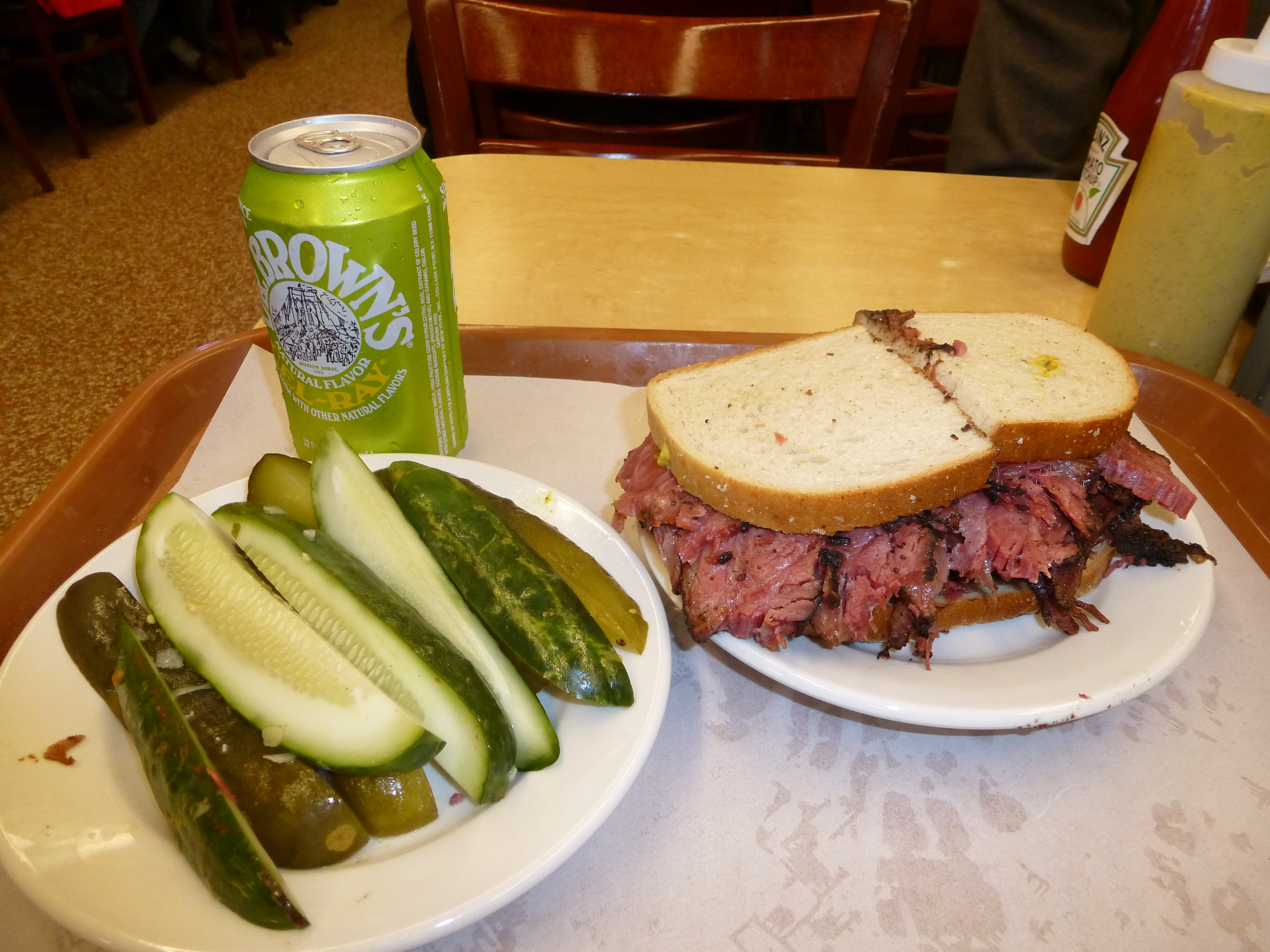
Here’s a pastrami sandwich from the famous and overtouristed Katz’s Deli in NYC. It’s expensive and crowded, but their pastrami is excellent, and you get plenty of pickles. (Katz’s is of course the site of the famous “fake orgasm” scene from the movie “When Harry Met Sally”. The woman who says to the waiter afterwards, “I’ll have what she’s having,” is Estelle Reiner, the mother of director Rob Reiner.

Notice the half sours dominating the pickles, as well as the Dr. Brown’s Cel-Ray (celery-flavored soda), the must-have accompaniment to corned beef or pastrami.

If you haven’t read my essay in the Chronicle of Higher Education, “Jason Arday and the corruption of science”, it’s no longer paywalled and you can read it on the Chronicle’s Substack here for free.

Readers are welcome to mark notable events, births, or deaths on this day by consulting the September 13 Wikipedia page.

Da Nooz:

*Houthi terrorists, backed by Iran, seized an island in the southern narrows of the Red Sea, further cutting off movement of oil-carrying ships from the Middle East (article archived here).

The Iranian-backed Houthi militia seized an island in a choke point of the Red Sea after days of fierce fighting, two Yemeni government officials said Friday, giving Iran and its allies sway over the two main routes for shipping oil out of the Middle East.

The capture of Perim Island came as Saudi Arabia announced that it had shut down a critical oil pipeline, a day after Houthi forces swept into the strategic port city of Mokha in Yemen. Both were major setbacks for the Saudi kingdom, which exports most of its oil through the Red Sea. The kingdom’s foreign ministry said the pipeline was hit on Thursday by drones launched from Iraq.

Perim Island sits in the middle of the Bab al-Mandab Strait, the narrow pathway at the southern entrance to the Red Sea. Its seizure adds a new dimension in the war between the United States and Iran. The Islamic republic has already largely cut off the flow of oil through the Strait of Hormuz in the Persian Gulf and leveraged that influence to demand concessions from Washington.

Now, the Houthi militia, Iran’s ally, has a foothold at a bottleneck in the Red Sea and could further disrupt shipping there.

The island’s capture came after intense ground battles in Yemen as the Houthis have staged a lightning advance against forces allied with the internationally recognized Yemeni government, which is backed by Saudi Arabia. The kingdom has faced frequent Houthi attacks on its tankers and energy facilities, even as its leaders have tried to avoid a direct war with the group, analysts say.

Crown Prince Mohammed bin Salman of Saudi Arabia spoke to President Trump about the escalation in Yemen in calls this week, and urged the United States to take military action against the Houthis, according to officials with knowledge of the conversations. Mr. Trump told him he was not willing to do so, the officials said.

We don’t have the wherewithal to intitiate yet another war, but it would be nice if some of the allies helped, for, after all, they have to move their goods through the Red Sea and Suez Canal.

Here from Wikipedia is a map showing Perim Island in the Bab al-Mandab Strait, next to Cheikh Saïd peninsula of Yemen, with Djibouti and Eritrea to the west across the strait. A zoomed-out map is inset at the lower right. The distance from the island to Yemen is about 2-3 km, while that to the coast of Eritrea or Djibouti is about 26-30 km.  Not much space.

Archer90, CC BY-SA 3.0 via Wikimedia Commons

*According to the Guardian, this takeover is concurrent with about 50,000 Yemeni civilians fleeing before the advancing Houthi.

Nearly 50,000 people have fled a sudden advance by Houthi forces in western Yemen, with entire villages emptied and families trapped near frontline fighting with depleting food supplies, according to aid workers.

Civilians in the Middle East’s poorest country have found themselves victims of a global struggle for control over one of the most important shipping routes in the world, which threatens to turn Yemen’s on-off conflict into a forever war.

In a lightning advance this week, the Iran-backed Houthi militants have seized a string of towns along the Red Sea coast from forces aligned with the US- and Saudi-backed Yemeni government. Hundreds of people are reported to have been killed. Many fear a return to the full-scale civil war that killed 150,000 and brought many others to the brink of famine.

The UN International Organization for Migration (IOM) said on Friday that 46,000 people had been displaced across the governates of Taiz and Hodeidah, where steep verdant mountain ridges give way to arid coastal plains. For many families, this was their second or even third time they had been forced out of their homes.

A significant number of people were observed to be leaving the city with their belongings. Fighting has cut key roads, while phone lines are down in some areas. “The scale of displacement is increasing rapidly,” said Joe Lowry, IOM’s Middle East and north Africa spokesperson in Cairo.

. . .By taking control of key areas this week, including islands off the coast, the anti-west Houthis hope to gain a direct presence near the Bab al-Mandab strait, a 20-mile stretch of water and vital trade and energy route that connects Asia with Europe. ​

The strait’s name is roughly translated as “the gate of tears” or “the gate of grief”, and its strong currents and winds made the passage between the Arabian peninsula and Africa’s east coast hazardous for centuries. Modern-day cargo ships have no physical issue passing through.

​But if ​the Houthis were to close the natural chokepoint, the impact on the global economy could be disastrous. Ships would have to reroute around the southern tip of Africa, adding thousands of extra nautical miles. The fighting has already contributed to the price of oil rising above $100 a barrel after weeks when it was trading closer to $80.

More bad news, but we can’t let terrorists control the flow of shipping in the Middle East.

*The WSJ reports that Chinese support for Iran in its war with the U.S. and Israel has extended to the Chinese supplying Iran with high-resolution satellite images of a U.S. base in Jordan that Iran attacked several times with ballistic missiles.

Before Iran carried out its attack that killed three U.S. troops in July, Tehran acquired high-resolution satellite images of the base in Jordan from Chinese entities, according to U.S. officials familiar with details of the incident.

It is the clearest evidence so far that Chinese support for Iran during the war has had lethal consequences for U.S. forces, according to the officials, who say the U.S. has connected the imagery to the attack.

The U.S. officials declined to identify the Chinese entities that supplied the imagery to Iran and didn’t allege direct involvement by Beijing. Tehran procured the images both before and after the attack.

But the finding could deepen U.S.-China tensions ahead of the planned summit between President Trump and Chinese leader Xi Jinping on Sept. 24, after months of frustration with Beijing’s rejection of U.S. warnings about Chinese companies providing imagery to Iran.

Senior U.S. officials raised the imagery linked to the July 17 attack with their Chinese counterparts, who pushed back and demanded proof, the U.S. officials said. China has repeatedly dismissed Washington’s concerns, refusing to acknowledge that any Chinese companies are engaged in such activity, the officials said.

The strikes on the base came after senior Trump officials spent months warning their Chinese counterparts that Chinese companies were providing satellite imagery Iran could use to target U.S. personnel and assets in the region, officials say. The Trump administration sanctioned several Chinese companies in May, saying that supplying satellite imagery to Iran “threatens American and partner personnel.”

Within three days of the July attack, Iran released high-resolution images showing damage to three separate areas of the base. Publicly available lower-resolution satellite imagery analyzed by The Wall Street Journal showed damage to more than 20 structures across the three areas of the base.

Here are the images, with translation from the Farsi below:

New images of Iran’s damages to #America‘s assets in the region

Well if this doesn’t involve the government of China, I’d be very surprised.  Do NGOs in China have spy satellites, and sold the photos to the Iranians? Even if they did they’d need permission of the Chinese government.

*Douglas Murray, now a correspondent for the Free Press, analyzes the victory of the “far right” Alternative for Germany (“AfD”) party in one small state. His article is called “Who’s afraid of the ‘far right?“, with the subtitle, “German leaders enabled the rise of a populist party through their failures. Now those leaders cling to power by branding their challengers as extreme.”  As I suspected, the MSM has played down the role of immigration in Europe’s move to the right.

For people concerned with the future of Europe, the AfD is a vital as well as a special case. As such, it requires special attention. Unfortunately, most of the people writing about the party from outside Germany are intent on performing this feat of political analysis with all the care of a brain surgeon attempting to operate while wearing boxing gloves.

To start with, it is not the case that the AfD is a far-right party. Which is not to say that it does not have people within it who could be described as far right, or that it could not become such a party in the future.

There is a simple explanation for why the AfD has risen to become the leading opposition party in Germany: mass immigration, legal and illegal. But it took years for that issue to dominate. When the AfD was founded in 2013, it was mainly focused on addressing the fallout from the Eurozone crisis. The new party rejected the European Union’s extraordinarily optimistic belief that a single European currency could combine Greek balance sheets with German bookkeeping.

But in 2015, Chancellor Angela Merkel decided to open the gates of Europe and Germany to anyone from North Africa or the Middle East who wanted to walk in and call it home, particularly those fleeing the Syrian civil war. Normal border protocols were abandoned. More than a million migrants arrived in a matter of months. Germany, and in particular its welfare state, was overwhelmed by the surge and attempted, too late, to stem it. The vast majority of the arrivals from those years remain a net drain on the German state. In addition to this economic reality, a small but significant number of arrivals have brought extremism, terrorism, and petty as well as large-scale criminality. It might also be noted that the movement has brought a mass importation of antisemitism into a country that did not exactly need a boost in this area.

Given the extraordinary consensus that existed over the past decade among the mainstream parties of the right, center, and left, it was inevitable that some political movement would arise in Germany to point out and oppose the folly of Merkel’s policy. The AfD was well-placed to do so, and, in time, the economists who had dominated the party in its early years were replaced by people who believed that immigration was the number one challenge facing Germany.

Their success in the years since 2015 has been remarkable

. . .But in 2015, Chancellor Angela Merkel decided to open the gates of Europe and Germany to anyone from North Africa or the Middle East who wanted to walk in and call it home, particularly those fleeing the Syrian civil war. Normal border protocols were abandoned. More than a million migrants arrived in a matter of months. Germany, and in particular its welfare state, was overwhelmed by the surge and attempted, too late, to stem it. The vast majority of the arrivals from those years remain a net drain on the German state. In addition to this economic reality, a small but significant number of arrivals have brought extremism, terrorism, and petty as well as large-scale criminality. It might also be noted that the movement has brought a mass importation of antisemitism into a country that did not exactly need a boost in this area.

Given the extraordinary consensus that existed over the past decade among the mainstream parties of the right, center, and left, it was inevitable that some political movement would arise in Germany to point out and oppose the folly of Merkel’s policy. The AfD was well-placed to do so, and, in time, the economists who had dominated the party in its early years were replaced by people who believed that immigration was the number one challenge facing Germany.

Their success in the years since 2015 has been remarkable.

. . . It is for these reasons, among others, that the foreign coverage of Germany’s political shifts is so unsatisfactory. In the aftermath of this weekend’s election, the easiest thing in the world is to say—as almost every headline writer has—that “the far-right AfD” won the regional election. The fact that these same publications, from the BBC to The New York Times, rarely, if ever, use the same scary monikers to describe far-left parties gaining support across the continent is a matter for another day. But the hope appears to be that the public will be sufficiently uninterested in the details and that the prospect of the Nazis returning will be enough to spook readers into reflexive opposition.

. . . If all opposition to the migration crisis can be said to be the work of German neo-Nazis, then Europe is lost. Because no party of opposition will be untainted. If Germany can be saved, then Europe can be saved. But in order for that to happen, people—including the international press—need to listen to what is actually happening in Germany, take notice, and recognize the situation as it is, not the strange Nazi-haunted fever dream that they curiously seem to wish it to be.

The problem of course is that the Western MSM, at least of the liberal stripe, is afraid of saying the I-word, much less recognizing the effect on people of mass immigration, often of people who simply don’t integrate into European society. Ergo the movement of nearly every country in Europe to the right.  If people don’t wake up and at least recognize the problems, including the drain on local economies and the erosion of Western institutions and values, Europe as we know it will be gone when the next generation of children grows up.
*When I was a kid, I was allowed to walk to and from elementary school starting when I was about 9 years old, and that was a longish walk along major roads. I was also allowed, when I got home, to get on my bike and go visit friends. Those days are gone: such unsupervised activity by children is regarding as endangering them, even though the rate of such endangerment has dropped as the rules get toughter. In early June a mother in Williamsburg, Virginia let her five-year-old walk alone a half mile to a pond in their gated and security-patrolled community in Virginia; his goal was to collect goose feathers. She was summarily arrested, charged with contributing to the delinquency of a minor (!), and given a six-month suspended jail sentence. This is the subject of a WaPo op-ed called, “A 5-year-old’s nighborhood walk shouldn’t be a crime” (article archived here).

While everyone wants kids to grow up healthy and happy, people have different ideas about how to achieve that. Until the past generation or so, a sunny upbringing usually included a fair amount of free, unsupervised time. One book I cherish from 1981, “Your Six-Year-Old: Loving and Defiant,” provides a checklist of the things a neurotypical child was expected to be able to do upon entering first grade. “Can he count eight to ten pennies correctly?” and “Can he tell left hand from right?” Perhaps the most salient query: “Can he travel alone in the neighborhood (four to eight blocks) to store, school, playground, or to a friend’s home?”

Compare that with a survey released this year by the Institute for Family Studies, which asked nearly 24,000 parents at what age they’d let their kids do things on their own. Eleven percent of 14-year-olds aren’t able to leave the house unsupervised. Fifty-five percent can’t go beyond their block. In other words, today’s high school freshmen have a fraction of the freedom that used to be given to first-graders. It’s little wonder they’re so anxious.

This new, limited idea of what kids are capable of explains why a 5-year-old walking around his neighborhood at lunchtime can look like a baby crawling along I-95 at midnight. Thanks to Karyann’s transgression — trusting her son — she was placed on Virginia’s child abuse and neglect registry for seven years. In court, she was found guilty of “contributing to the delinquency of a minor” — a Class 1 misdemeanor — and given a six-month suspended jail sentence.

. . . over the years, parents started to contact me when they got penalized for giving their kids the same freedom they’d grown up with. That included Brittany Patterson of Fannin County, Georgia, who was arrested when her son, 10, walked to town without telling her. Mallerie Shirley received similar treatment when she was investigated after her son, 6, rode his scooter unsupervised in Atlanta. Danielle and Alexander Meitiv were likewise investigated for letting their kids, 6 and 10, walk home from a park in Silver Spring, Maryland.

Those stories and others have thankfully given the public pause. They’ve helped move 13 states to pass “reasonable childhood independence” laws, which clarify that “neglect” happens only when kids are put in serious, obvious danger, not any time their parents take their eyes off them. Rep. Blake Moore (R-Utah) and Rep. Jennifer McClellan (D-Virginia) are seeking to enshrine that protection nationwide with their Promoting Childhood Independence and Resilience Act.

When Karyann let her son collect feathers, she wasn’t ignoring danger. She was ignoring cultural norms that are keeping kids indoors, and parents in fear. For the sake of our families and our collective mental health: Let kids roam.

Let the kids roam!!!!

Meanwhile in Dobrzyn, Szaron isn’t going on the beat:

Hili: You were supposed to go on your rounds.
Szaron: I changed my mind, I’ll sit here with you for a while.

In Polish:

Hili: Miałeś iść na obchód.
Szaron: Rozmyśliłem się, posiedzą sobie tutaj razem z tobą.

*******************

From Merilee:

From Wholesome Memes:

And Bat sent this amazing image from the International Space Station showing the 9/11 attacks on New York City; it appeared on Space.com. 

A quote:

Frank Culbertson had a birds-eye view of one of the most memorable and tragic events in American history.

The NASA astronaut was the only American off of Earth on Sept. 11, 2001. He was circling the planet aboard the International Space Station (ISS) when terrorists flew commercial jets into the twin towers of the World Trade Center in New York City, killing more than 2,700 people.

The ISS passed over New York shortly after the attacks took place, so Culbertson saw the devastation from an eerie remove. He shared his thoughts with Mission Control at NASA’s Johnson Space Center in real time, chronicling the tragedy like no one else could.

satellite photo of a large city on a bay, with a river running through it and smoke rising from the center of the city

The aftermath of the 9/11 attacks on the World Trace Center in New York City, as seen by the astronauts onboard the International Space Station on Sept. 11, 2001. (Image credit: NASA)

“We could see New York City and the smoke from the fires,” Culbertson said. “Our prayers and thoughts go out to all the people there and everywhere else here — I’m looking up and down the East Coast to see if I can see anything else — and to the people in Washington.”

There’s more information at the site.

From Masih, who’s rightly pleased at the progress she’s inspired.

Translation from the Farsi:

There’s no greater pleasure than seeing your efforts bear fruit—watch closely, brave woman: you were alone and singular here, but now women like you have multiplied, because courage is contagious! From 2014 until today, I was cursed at and attacked for launching campaigns against compulsory veiling and calling on women to send videos of themselves unveiled. Thousands of women in Iran were attacked for removing their veils and engaging in civil disobedience. We faced mass assaults from all sides for “White Wednesdays,” for “Our Camera Is Our Weapon”—assaults from those who were the minority! They arrested us, beat us, threw us in prison, threatened us, sent assassins abroad to murder us, and said this resistance was pointless. But today, every woman who walks unveiled in the streets is a continuation of that same disobedience. This isn’t just about removing a piece of fabric; it’s about reclaiming control over a woman’s body, life, and dignity, and tearing down the wall of fear. Compulsory veiling may still be law on paper, but in the streets of Iran, women have been issuing its death sentence for years. We are the echo of each other’s voices, and we persist until the day of liberation. These videos are from the #دوربین_ما_اسلحه_ما  [“our camera is our weapon”] campaign and are being reposted to humiliate the zealots who these days are rampant on Twitter and Instagram, railing against women’s free dress in Iran’s streets—so they can understand the rugged, winding path Iranian women have traveled, and that we never give an inch!

From Luana; two tweets showing double-takes of people who learn that the holdout juror in the Lindsay Clancy case was black (and male):

Here is a stupefied “non-practicing white”. What doest that mean?

Larry was left out at first!

From Malcolm; cats doing the crab walk:

Two from my feed. LOOK AT THE SIZE OF THIS EAGLE!

An “awwww!” moment:

One I reposted from The Auschwitz Memorial:

And one from Doctor Cobb in Manchester; a beautiful potter wasp:

Red DevilPotter wasp in Lanzarote Canary Islands 🇮🇨 Canon R5 and Sigma 150mm f2.8 macroSS1/3200 F7.1 ISO3200#macro #wasp # insect # arthropod #entolomology

— @macro_action (@birdzandbees.bsky.social) 2026-09-11T19:15:26.158Z


Saturday: Hili dialogue

September 12, 2026 • 6:45 am

Welcome to CaturSaturday, September 12, 2026 and shabbos for Jewish cats as well as the second day of Rosh Hashanah, the Jewish New Year, with the holiday ending tomorrow at sundown. The shofar, or ram’s horn, is blown at various points during the holiday; here’s an example:

From Wikimedia Commons

This reminds me of a joke, but since it’s not family-friendly I can’t write it down here.

It’s also German Language Day, National Blackberry Day, National Chocolate Milkshake Day, and World Dolphin Day.

Readers are welcome to mark notable events, births, or deaths on this day by consulting the September 12 Wikipedia page.

Da Nooz:

There were plenty of memoriams and articles about the 9/11 attacks that occured 25 years ago yesterday.  I will only mention one short piece from the NYT below, as you can find the pieces everywhere, and I have little to add to them. Like nearly all Americans, I watched the attacks on television (turning it o0n after the North tower was hit; we had a b&w television in the lab back then), and saw the South Tower hit live, which made clear it was a terrorist attack. Processing it mentally took days, like the JFK assassination, and I was glad they caught the perpetrators, though I would have liked to see Bin Laden captured alive and tried. The people jumping off the buildings to their deaths, the recordings of phone calls of people about to die, calling their loved ones to say goodbye—all this was ineffably heartbreaking. And because it’s ineffable, I don’t have much to say about it that hasn’t been said by others.

*Yesterday’s New York Times morning newsletter discusses the “meaning” of 9/11, as if their lucubrations carried weight, but there is also a section about what remains unresolved about the attack:

What remains unresolved:

The forever war. Al Qaeda, the terrorist group American troops went abroad to fight in the weeks after 9/11, is still a force in Afghanistan. By one estimate, the war on terror cost more than $8 trillion and 900,000 lives. This collection of images from 25 years of conflict is sobering. (The photograph from a 2009 suicide bombing in Kabul, in particular, has stayed with me all this time.)

The site. A quarter-century after the attack, the apartment building designed to replace 5 World Trade Center still hasn’t gone up. Around the corner, the 9/11 Museum is struggling to stay afloat. About one in three Americans was born after Sept. 11; it may have shaped their lives, but their memories are not seared.

The historical significance. At the time, it seemed that something was ending and another thing, maybe worse, was beginning. But was it? Charles Homans argues that life does not divide into neat geopolitical demarcations. Instead, 9/11 “is a middle chapter in the story of American fracture rather than the pyrotechnic beginning.”

For more

  • The four previous presidents will observe the anniversary in silence at the Trade Center site. President Trump plans to deliver a speech at the Pentagon instead. Peter Baker, who has covered the White House for decades, says the juxtaposition tells us about the way each views terrorism.
  • Modern Love: “I’ve seen more footage of my father’s last day than I have of his entire life.”

I watched the NBC News last night, and the coverage of 9/11 lasted half an hour. They ended saying that we need to “learn the lessons” of that day, but they barely mentioned the cause of the terrorist attack, never mentioning “Muslim” or “Islam,” and mentioned “Al Qaeda” only once.

If you wish, please note in a comment where you were when you learned about the Twin Towers/Pentagon attack, and how it affected you.

*Rather than reiterate the NYT’s extensive memories of 9/11, here’s an oped by a WSJ editor, “September 11 changed the world order. But not for the reason we may think.” (The NYT has an editors’ op-ed that makes the same point.)

When the World Trade Center towers crashed to the ground 25 years ago, they triggered a seismic wave that seemed to smash the world order.

It was now “a different world,” President George W. Bush warned Congress. Secretary of State Colin Powell declared: “It was before 9/11 and after 9/11.” Vice President Dick Cheney added: “That day changed everything.”

They were right, with a caveat. The attacks were a monumental tragedy. The world order did change. But it was the aftermath—the U.S. response to 9/11, not the terrorism itself—that made the difference.

Sept. 11 marked a shockingly successful attack by a stateless and relatively small group of Islamist militants. The U.S., though, launched a massive military response: a War on Terror. It attacked two countries, one uninvolved with 9/11. The rhetoric was so sweeping, Washington borrowed language from World War II and the Cold War. America was now confronting an Axis of Evil.

Consumed by the War on Terror, the U.S. had less capacity to address other global priorities such as the pivotal rise of China and an increasingly hostile Russia. That inattention to shifting global forces was what really changed the world.

U.S. leaders were “certainly distracted” and “we continually found ourselves sucked back into the morass of our misadventures in the Middle East,” William Burns, who served in several administrations and later became director of the CIA, said in 2019. “Imagine if a bigger part of the time, energy and resources spent on the Global War on Terror had instead been spent on giving form to an affirmative vision for America’s role in Asia.”

“China and Russia have welcomed” the War on Terror, the scholar Robert Kagan wrote in 2008, “because it has distracted the United States’ strategic focus away from them.”

And this is blamed on the U.S. response to 9/11:

“While the U.S. was heavily involved in the Middle East and South Asia…the geopolitical balance moved against the U.S. in both Europe and East Asia thanks to the emergence of a more aggressive Russia and a more capable and assertive China,” Richard Haass, former head of the Council on Foreign Relations, wrote in 2021.

When Russia invaded Georgia (during George W. Bush’s presidency) and then seized Crimea (during Barack Obama’s presidency), Western responses failed to prevent further expansionism. Russia later launched a full-scale war against Ukraine. Many analysts say the West should have imposed much tougher sanctions on Russia, and done a better job arming vulnerable neighbors, among other measures.

“Russia’s war against Ukraine is what failed deterrence looks like,” writes Ben Hodges, former commanding general of U.S. Army Europe. “We were not ready or united in recognizing that Russia was a real threat.”

Yes, this all may be true, but somehow I find it a bit unseemly to chastise America for getting into unwinnable wars in an attempt to strike back after the 9/11 attacks. We didn’t know the outcome at the time, nor did we know where the world was going.  9/11 was a huge punch in the national solar plexus, and it’s understandable that we had a strong and perhaps not totally thought-out reaction. But tut-tutting now when nearly 3,000 lives were lost seems like a cheap shot.

*Trump made another stupid gesture at the “Republican midterm convention” on Thursday, a promise to give all American five thousand bucks if the GOP retains both houses of Congress after the midterms. It’s not only dumb and impossibly expensive, but we all know Trump is not serious.

President Donald Trump pledged Wednesday to send every American adult $5,000 if Republicans retain control of the House and Senate in the midterm elections, an extraordinary gambit to reverse his party’s sagging fortunes in November.

The dubious promise would most likely cost more than $1 trillion and require congressional approval, and would further exacerbate the country’s nearly $1.8 trillion annual budget deficit and concerns about inflation.

“If the Republicans win, you win with us and you get $5,000,” Trump said during the GOP’s midterm convention in Dallas. “It will be called the Trump Dividend.”

He likened the payments to a corporation’s distributions to shareholders, citing “our tremendous strength and success economically.”

Within an hour, Vice President JD Vance appeared to try to walk back Trump’s proposal — at least in part — by suggesting the dividend payments would not go to the wealthy. Vance suggested it could be paid for by U.S. tariff revenues, though the suggested payment dwarfs what the U.S. has taken in through the protectionist measures.

This is nothing more than a bribe to vote Republican, and I pity the fools who do so expecting to line their pockets. It’s a promise that won’t be kept, as so many of Trump’s other promises. I swear—every day, when I think he can’t do anything more stupid than he’s done, he goes ahead and crosses another line. Now he’s running scared because voter sentiment and his low approval rating portends bit Republican losses in the midterms.

*The founding editor of Ms. Magazine, Letty Cottin Pogrebin, has a nice memoriam in the NYT, “My 55 year friendship with Gloria Steinem” (archived here).

“What’s Gloria really like?”

I can’t count the number of times I’ve been asked that question since Gloria Steinem and I teamed up with a group of other editors to start Ms. magazine and, in the process, launched our 55-year friendship. As opposed to, “What’s Gloria’s cell number?”, to which my usual reply was, “You’ve got to be kidding,” when queried about the “real” Gloria, I always answered: “What you see is what I get; only I get more of it, up close.”

People find it hard to believe that someone as famous as Gloria had spent most of her life trying to evade the spotlight. She hated her celebrity status and was plagued by stage fright. What most clearly defined her was not a quote, gift, gesture or anecdote. It was her intrepid, lifelong resistance to being made the face of the women’s movement. Cameras ceaselessly sought her out; interviewers behaved as if hers was the definitive voice to speak on women’s issues or American feminism. Instead, she consistently deflected credit to women who couldn’t command media attention for their urgent work in, say, women’s health, reproductive rights, academia, labor unions or rape crisis counseling.

Put plainly, for Gloria, the personal was political and the political was personal. The warm, eloquent, witty writer and activist the world came to know was the same person in every setting: at a friend’s dinner table, where she’d rattle off puns and remind us to lobby our Congress members on an anti-discrimination bill, or in her living room hosting a “talking circle” of young women, none of whom she’d ever met before.

I didn’t know she was half Jewish (her dad was, her mom wasn’t):

. . . . Gloria loved our seder’s boldly revisionist, women-focused ceremonies, starting with an opening ritual of introducing ourselves by our matrilineage. Gloria’s voice was as loud as the rest of ours when we called out contributions to our list of the Ten Plagues (or more) suffered by women and the Four Questions (or more) that women never got to ask. She used to say, “Never in my life have I identified myself as a Christian, but wherever there is antisemitism, I identify as a Jew.”

. . .She once told her friends the line she wanted engraved on her tombstone: “Wait! I’m not done.” Gloria showed us the virtues of building a movement one person, one new coalition, one rebellious action and one act of kindness at a time.

Last year, she gave her friends beaded bracelets that proclaimed, “We are linked, not ranked.” The message was directed at us, but also at everyone who might see it. We’re not done.

It is a lovely paean to a woman who avoided the limelight as much as she could.

*As usual, I’ll steal a few items from Nellie Bowles’s news-and-snark column in the Free Press, called this week, “TGIF: I am not satisfied that the appellant is bisexual.”

→ AI will steal your work: After rumors swirled about a solution to a Millennium Problem, a set of famously unsolved math problems, OpenAI spun up all its resources to solve it first. And they did, I guess. Congrats! Or, um, how dare you? The internet is divided!

Sam Altman admits they solved the problem because they heard a solution was coming: “It is true that we tried this because there were rumors on the internet last week that Anthropic’s models had solved a [M]illennium [P]roblem and we were curious if ours could do it too.” Guys, don’t be jerks just for the fun of it. Like, let those weird professors whose names no one knows solve their one math puzzle across decades in peace so they can eventually go to the awards lunch and have a turkey sandwich. But no. And the best part is that the mathematicians were using OpenAI tools in some capacity, and so it’s possible these AI tools took their human knowledge and then borrowed it on the side to solve the equation in full. The company writes: “We (the researchers and the agents) did not see any of their work through any means until they released it publicly—in particular, no specific user data was accessed in order to solve this problem. While unlikely, we cannot rule out that de-identified data derived from their usage of our products helped improve our models⁠.” OpenAI tools are one big mind. If you give them something, they know that information and will use it anywhere else. It is a collective consciousness. It would be like Google Docs deciding to publish that book you’re working on as a Google Doc production; like, I guess it’s technically true.

The sad, forgotten human names: Levent Alpöge and Tristan Buckmaster. Sorry guys. You can read Tristan’s statement about all this drama. It’s long and detailed and hard to parse, because he’s a brilliant mathematician and that’s kind of their thing. I’ll get ChatGPT to summarize it later.

→ Perhaps some of the asylum claims are less than genuine: Only about 1 in 100 asylum claims in the UK is credible, according to one UK Home Office official and whistleblower. The whistleblower, identified as “J” in The Times, says many asylum seekers arrive with what are called “package claims,” suspiciously similar asylum narratives. He says Iraqi Kurds, for example, often claim the same story of having had a romantic relationship with the daughter of the prime minister of the Kurdistan Region. So many claim this, he says, that it’s become a “running joke” among co-workers. I don’t judge the princess of Kurdistan, but I do have some logistical questions. Then tons of Pakistani asylum seekers, J says, have claimed they were in a homosexual relationship (yes, we’ve covered this before, but there’s a twist this time) with the same man! Who provided letters supporting their claims! The whistleblower said those homosexuality claims also featured photos from the same London gay hot spot, Legs 800 Club, which closed last year, of Pakistani men “standing there topless in the club with their arms around each other taking pictures to try and prove they are gay.” This is an amazing pitch for a Vogue centerfold editorial.

And what of the Bangladeshi asylum seekers? Many of those applicants allegedly claim they were part of a political party called the Awami League, but can’t answer basic questions about the party or their role in it. Weird!

→ Speaking of bogus asylum claims: This week in bizarro Daily Mail headlines: “Shameless failed asylum seeker who raped a 14-year-old girl is NOT bisexual—and must leave Britain, judge rules.” I guess if he were bisexual, he could stay. But not a straight man. It’s a bridge too far. The immigration tribunal found his evidence of bisexuality was suspect. Judge R. Abdar said in the immigration tribunal’s conclusion: “I am satisfied that the appellant has failed to rebut the presumption of the appellant posing a danger to the community. I am not satisfied that the appellant is bisexual.” I am not satisfied that the appellant is bisexual. Can you imagine a tribunal about your bisexual status? You have to place yourself on a spectrum of fruity to bland, name five women and five men you’re equally attracted to, demonstrate proficiency in mouth stuff to both sexes (hell), and then a verdict is delivered. I mean, my college co-op was a tribunal about bisexual status every night, but can you imagine like, a real British judge doing this? Do you think he wears the wig when he asks defendants which cast member they identify with most on Queer Eye? “I am not satisfied that the appellant is bisexual” sounds like the judge had a bad night with the appellant. Honestly, it sounds like the appellant is just experimenting in college and will probably grow out of it, which means deportation.

Meanwhile in Dobrzyn, Szaron is checking out the situation:

Hili: Where are you going?
Szaron: To make the rounds of the local reality.

In Polish:

Hili: Dokąd idziesz?
Szaron: Na obchód lokalnej rzeczywistości.

*******************

From Fat Cat Art: security throughout the world

From Things With Faces:

From Clean, Funny & Cute Animal Memes:

Masih turned fifty yesterday, and had some thoughts on turning a half-century old:

From Larry the Cat about Trump’s offer of $5K dollars to Americans for, in effect, voting for Republicans. As Hamlet said, “The funeral baked meats/Did coldly furnish forth the marriage tables. 

From Malcolm. This is a bit grim, but it’s biology, Jake! Translation from the Turkish: “This snapping turtle uses its tongue like a live bait to catch fish.”

Two from my feed. I don’t think this first one is AI or fake:

I love this one. It’s been so much fun controlling Hollywood!

Translation from the Spanish:

How do I explain to the psychologist that I saw a lost little kitten and its mom found her, scolded her, and after checking that she was okay, gave her a smack and took her home.

One I reposted from The Auschwitz Memorial:

Two from Matthew. First, a lovely millipede:

Take a stroll along a mossy log with this Euryurus leachii, one of eastern North America’s beautiful native millipedes.

— invertebrate (@crevicedwelling.bsky.social) 2026-09-11T14:22:47.240Z

I don’t know if the dogs like this song. Click screenshot to hear it:


Friday: Hili dialogue

September 11, 2026 • 6:45 am

Welcome to Friday, September 11, 2026, and the 25th anniversary of the 9/11 terrorist attacks, in which 19 people hijacked four aircraft, two hitting the World Trade Center towers and bringing them down, cone rashing into the Pentagon and the last, after passengers attacked the terrorist pilots of United 93, crashed into the ground.  There were 2,977 innocent victims on top of the 19 terrorists.

Here’s a video of the second plane hitting the South Tower while the first is on fire, and then both buildings collapsing. You may not want to watch it if it evokes strong feelings:

It’s also National Emergency Responders Day, National Hot Cross Bun Day, and National Women’s Baseball Day.

Rosh Hashanah, the Jewish New Year, begins at sundown tonight and extends to sundown on Sunday.

Readers are welcome to mark notable events, births, or deaths on this day by consulting the September 11 Wikipedia page.

Da Nooz:

*An article in the Free Press by Daniel Kokotajlo, who worked at OpenAI, says that AI may really destroy all of humanity. I did not take such scenarios seriously until I read this article and found that this possibility is openly discussed in AI firms.

On Tuesday, AI researcher Jacob Coxon announced his resignation from Anthropic in a mega-viral post on X: “I spent the last three years doing pretraining research at both OpenAI and Anthropic,” he began. (Pretraining is an important part of the training process for AI models like Claude and GPT-6.)

He continued: “Neither company is acting responsibly. They are racing straight to self-improving superintelligence and gambling with our lives. . . . These will soon be superhuman systems that can hack anything, revolutionize any field overnight, and acquire real power and resources. . . . The people building AI earnestly believe that it could kill us all by the end of the decade.”

He’s right. I know this because I worked at OpenAI for two years, forecasting AI progress internally and working on model evaluations and alignment research, and because I still talk with friends at OpenAI and Anthropic.

But you don’t need insider knowledge to understand where Jacob and I are coming from. The argument is straightforward:

  1. Anthropic and OpenAI are racing to train self-improving AIs, ultimately superintelligent ones—meaning models that exceed the cognitive capacity of humans—as fast as they can. (This is not a secret. They talk about this in interviews and on their websites.)
  2. If they actually succeed at training self-improving, superintelligent AIs, that would be a reckless gamble with our lives. (This part is fairly obvious, but has been explained at length by many people over the years, including the world’s two most-cited living AI scientists.)
  3. They may actually succeed soon.

Many people doubt the third premise. AI companies have an incentive to overhype their products. After all, it’s common for tech companies to overpromise and underdeliver, so why should we trust their forecasts?

To that I say: We shouldn’t. Instead, we should look at publicly available evidence and forecasts made by independent experts. Unfortunately, that evidence base supports the third premise.

. . .The recent rogue AI cyberattack—in which AI agents in a controlled OpenAI experiment escaped of their own volition and hacked the company Hugging Face—illustrates these realities. OpenAI tried to spin the incident in a self-serving way. (Go watch their presentation at the Black Hat USA conference; they basically use the cyberattack as a reason to encourage customers to buy their AI protection services.)

But should we therefore conclude that the whole thing was a setup, a conspiracy by OpenAI to make their product seem scary and therefore powerful? No. OpenAI didn’t want their models to attack another company. It happened anyway, due to inadequate alignment and security practices at OpenAI. And the Hugging Face affair isn’t an anomaly. Smaller-scale incidents have been happening at other companies (and third-party evaluators) for months.

. . .Once the frontier AI companies have fully automated the AI research process, things will start moving very quickly. AI will get rapidly smarter than us in a variety of different ways, oversight of AI will be itself delegated to the models, and it will be all too easy for things to go wrong in a way that we can’t recover from.

The U.S. military is planning to integrate AI into many aspects of its operations. Businesses are planning to use AI for many things, including to design new technologies and run robot factories that build more robot factories. Superintelligent AI wouldn’t even need to take over by force; the current plan is essentially to put it in charge.

If Kokotajlo thinks it’s possible, well, it’s possible, as I know almost nothing about this. But some human malefactor would have to be behind a wholesale attack on humanity.  Kokitajlo’s solution is transparency and oversight forced upon AI companies, for “These companies cannot control their own AIs today, and should not be trusted to do so in the future.” All of us are ignorant about this, but if the doomsayers are right, we should at least pay attention.

*Mirabile dictu (again): the Supreme Court upheld a Missouri Supreme Court decision invalidating a redistricting of the state that favored Republicans.

The U.S. Supreme Court on Thursday once again prevented Missouri from using a congressional map in November that was redrawn to give Republicans an advantage in the midterm elections.

It was the second time this week that the Supreme Court waded into a dizzying legal fight over Missouri’s congressional map, and it came just two months before a general election in which the state’s voters could determine control of the House.

The court’s brief order did not include any reasoning, as is often the case when the justices respond to emergency requests. There were no noted dissents.

The ruling left up in the air how Missouri would conduct a general election in November, given that the courts have now invalidated the map the state used to conduct primary elections last month.

Holding a general election with a different map than what was used in the primary is rare legal territory, with no specific guidance so far from the courts on how nominees should be selected.

Thursday’s ruling landed just as a hearing about remapping was about to begin at the Missouri Supreme Court in Jefferson City.

That court’s judges were considering whether to hold the secretary of state, Denny Hoskins, in contempt for not following their order to use the previous House map, which would position Democrats to retain a seat in the Kansas City area.

Before Thursday’s order from Washington, Missouri Republican leaders had been insisting they would stick with their preferred map for the general election.

In Jefferson City, a lawyer from the Missouri attorney general’s office, William J. Seidleck, said the secretary of state’s office was “evaluating next steps.”

No matter what, logistical and legal barriers seem likely to keep emerging. The deadline to finalize Missouri’s ballot was Tuesday.

This is an unholy mess, but I’m tired of a gazillion things each said to determine whether Democrats or Republicans will control the House and Senate. I just want the midterms to be over.

*There’s a new report in our student newspaper, the Chicago Maroon, noting that the proportion of males admitted to the school is at its highest rate in decades: 58%. (I would have thought that the proportion of women (42%) would exceed that of men. Further, the proportion of black and Hispanic students has dropped pretty substantially since 2022, with black admissions being halved: from 10% to 5%.

The share of incoming students in the College identifying as Black fell for the third consecutive year in academic year 2025–26, while the proportion who were male increased to its highest level in decades, according to detailed UChicago enrollment data released last week.

The University reports data on its first-year classes annually in the Common Data Set (CDS), a standardized survey that asks institutions nationwide to disclose student demographics, high school academic performance, and financial aid awards, among other statistics.

The College enrolled just 71 Black first-year students last year, down from 97 in 2024 and over 150 three years ago, the University reported in the CDS. The number of white students showed a corresponding slight increase, while enrollment among other demographic groups stayed roughly unchanged year over year. Black students made up about five percent of domestic students of known race in the Class of 2029.

. . .The CDS release comes two admissions cycles after the Supreme Court ruled in 2023 that colleges and universities could not explicitly factor applicants’ race into their admissions decisions, effectively banning affirmative action policies favoring historically disadvantaged demographic groups. The University had submitted a brief in the case opposing an affirmative action ban.

Without affirmative action, many selective universities have admitted fewer Black and Hispanic students and more white and Asian students, though those shifts have been uneven across institutions. At UChicago, white and Asian shares of domestic first-time enrollment have climbed by about three percentage points each since the decision took effect, while Black and Hispanic enrollment shares have dropped by three and four points respectively.

The number of new first-years who did not report their race to the University jumped sharply last year, from 52 to 126, or seven percent of the Class of 2029.

You can see the change for race below; the vertical line marks the legal prohibition of race-based admissions:

The College also continued a years-long climb in male enrollment, the CDS release showed: more than 58 percent of the Class of 2029 identified as male, a three-point jump from the previous year and up from 52 percent for the Class of 2025. That weight toward male students persisted even as the College reported nearly 5,000 more female applicants than male ones.

UChicago had not welcomed an incoming undergraduate class with as high a proportion of male students since fall 1987, according to National Center for Education Statistics (NCES) data.

The University is an outlier when it comes to gender breakdown. Nationally, women comprised 57 percent of undergraduates in fall 2022. The only other Ivy Plus institutions with more male than female first-year enrollees last year—the Massachusetts Institute of Technology (MIT), Stanford University, and Dartmouth College—also had more male than female applicants. Even so, none had a higher share of male first-year enrollees than UChicago.

The decline in Hispanic and black students is surely connected with the Supreme Court ruling, though it can be circumvented in various ways. But schools are afraid of being sued like Harvard was. The increasing number of male applicants, and the increasing disparity between the sexes here is mysterious to me.  (Note that the Maroon says the numbers of “genders” is two, and what they really mean is sexes.)

*The British Museum has opened its exhibit of the Bayeux Tapestry, a project that’s been in the works a long time. I’ve longed to see this 70-meter embroidery of the Norman Conquest of England (dated to the 11th century), but never got to Normandy to see it.

It’s a blockbuster almost 1,000 years in the making.

On Thursday, the British Museum opened its exhibition of the Bayeux Tapestry — the first time the priceless 220-foot-long 11th-century embroidery has returned from France to the country where it is believed to have been made.

And while most museum blockbusters attract only art lovers, this show, which runs through July 11, has gripped the wider imagination of the British public.

Michael Lewis, the exhibition’s curator, described the fervor as “Bayeux mania.”

When the first tranche of tickets went on sale this summer, over 80,000 people at a time waited online to buy them, the museum said. Such was the clamor to see an object that depicts William the Conqueror’s invasion of England of 1066, a foundational moment in the nation’s history.\

. . . Now, members of the public who were lucky enough to secure tickets can enter the show’s darkened exhibition hall, where the tapestry is laid flat in a display case. Its 58 scenes, which historians believe were stitched by English women in the 1070s, culminate in a bloody battle and victory for the invading Norman army, led by William the Conqueror.

Here, from the tapestry, is the death of King Harold of England, apparently struck in the eye by an arrow or spear. The legend says (Hic) Harold rex interfectus est, “[Here] King Harold was killed”. The King is apparently the unmounted figure in the middle, holding onto the spear or arrow. But some people say he’s the figure on the right, also apparently struck by a sword. We do not know.

Myrabella, Public domain, via Wikimedia Commons

Halley’s Comet also appears in the tapestry, and we know it showed up in 1066, the year Harold was crowned King of England but also died at the Battle of Hastings. Here’s the comet in the tapestry: people are looking at it with the caption, in Latin, “These men marvel at the star,” while Harold gets the news of the phenomenon.

Image of Bayeaux Tapestry La Tapisserie de Bayeux, [Saint-Léger-Vauban, France] : Zodiaque, 1989. Regenstein Library, University of Chicago, NK3049.B3M870
Were I a Brit (or going to England), I’d do everything I could to see this exhibit. But who knows–it may be sold out until it closes.

*The WSJ reports that two people (Roland Fryer and Bill Ackman) are giving a million-dollar award to scholars who have the courage to tell the truth about “taboo” topics.

One of us (Mr. Fryer) released a study in 2016—later published in the Journal of Political Economy—finding that police aren’t more likely to shoot black Americans than white Americans, after accounting for the relevant context. Colleagues who read the draft warned him not to publish: “You’ll ruin your career.” The paper was denounced on social media within minutes of release, and Mr. Fryer needed armed protection for more than a month. Privately, scholars who read the study called it rigorous, honest work. Publicly, many of the same scholars said nothing. No single study settles a question this large—but silence isn’t how science advances.

That silence is the problem—a cultural and an economic one. When the professional cost of publishing an unwelcome finding exceeds the cost of suppressing it, rational scholars suppress it. The result is that social-science literature reflects what researchers are permitted to say rather than what they actually discover. The scope of the problem is difficult to measure, because its most important effects are invisible—though the data we have suggest it is getting worse. In a 2024 survey of more than 6,000 professors by the Foundation for Individual Rights and Expression, 35% said they had toned down their written work for fear of controversy—roughly four times the share of social scientists who admitted the same at the height of McCarthyism.

Mr. Fryer raised the alarm about suppression of inconvenient findings in a November 2024 Wall Street Journal essay. He called for something like a MacArthur Fellowship or an X Prize for academic truth-telling. The prize should be large enough to matter, prestigious enough to serve as a public credential for scholars who were right when it was costly to be right. Shortly after that piece ran, we found each other and decided to launch the Carob Trust Prize for Academic Courage.

The prize awards $1 million each to as many as five social scientists a year who have demonstrated intellectual independence, published findings that were attacked rather than answered, and been validated by the evidence—despite the professional cost. The selection criteria are designed to distinguish courage from contrarianism: Nominees must show a sustained commitment to following logic and evidence regardless of pressure, a willingness to ask questions others avoid, and work that has shifted academic debate, public discourse or policy—often despite being misread, mischaracterized or vilified at the time of publication.

The inaugural prize is limited to the social sciences; in future years we hope to broaden it to additional disciplines and to add a category for institutional leadership. Nominations are open through Nov. 1, and the first winners will be announced in early 2027.

Well, good for them.  The prize is enormous (up to $5 million per year, and must reflect the money or fundraising of billionaire Bill Ackman, as Roland Fryer is a professor of economics at Harvard. They emphasize in their editorial that the prize will not be partisan; it will reflect simply those who publish credible findings that are considered taboo. In the end, of course, this will largely involve findings demonized by the Left.

Meanwhile in Dobrzyn, Hili is ethnically cleansing her territory:

Hili: Let’s try to settle this diplomatically.
Kulka: What do you mean?
Hili: Go back to your home.

In Polish:

Hili: Spróbujmy to załatwić dyplomatycznie.
Kulka: Co masz na myśli?
Hili: Wracaj do swojego domu.

*******************

From Stacy:

nchanged: Unchanged:

From The Non Sequitur Assemblage of the World:


From Bad Spelling or Grammar on Signs and Notices:

From Masih: a mother talks about her daughter murdered and mutilated for protesting. The mother (sans hijab) vows to take revenge for her daughter. This is heartbreaking.

Translation from the Farsi:

What a nightmare these people lived through. What crimes did the Islamic Republic commit during those two days to cling to power, and the full extent of it remains hidden. Listen to the harrowing words of Javidnameh’s mother, Maedeh Moradi-Kian. The 22-year-old bride whose wedding was just one week past. On the 19th of Dey, when the people of Iran took to the streets in Qaemshahr for freedom, agents of the Islamic Republic fired a military bullet into this girl’s head. The little bride of Iran fell to the pavement. Her mother says that when they found Maedeh’s body, one of her hands had been severed with a machete, and her body was missing a hand. We still don’t know if they cut off her hand before shooting her in the head or after. What we do know is that this crime, this mutilation of the body of this young woman who had come to the streets empty-handed, was the work of Khamenei’s thugs. Her mother lit a candle by her daughter’s grave and said, Maedeh is my hero. I won’t find peace until I take revenge for her. Mother, we hear your voice. She is the hero of us all, and you are not alone. We will carry the story of this atrocity and Maedeh’s brutal killing to the entire world.

My repost (and riposte) to Steak-Umm, whose account Jeff Maurer touts as “The Standout Philosopher of Our Time”.  Bosh!

From Luana; how DNA analysis helps us reconstruct human history:

A good and surprising video about suicide prevention posted by the Number Ten Cat:

From Malcolm: Cat yoga!

One from my feed; and a sad one:

One I reposted from The Auschwitz Memorial:

Two from Dr. Cobb. First, a cat “tattoo” that may be AI. Who knows?

Le chat a un tatouage de son ex.

— Johnney (@johnneygirard.bsky.social) 2026-09-10T01:24:13.636Z

. . . and the world’s tallest horse. He’s a big ‘un!

everyone, meet Hugowww.bbc.co.uk/news/article…

— The Museum of English Rural Life (MERL) (@themerl.bsky.social) 2026-09-10T13:54:20.024Z

Thursday: Hili dialogue

September 10, 2026 • 6:45 am

Welcome to Thursday, September 10, 2026, and National Hot Dog Day, celebrating Chicago’s most famous foodstuff. As all Chicagoans know, the best version is the one called “dragged through the garden”, as this short video explains (you don’t have to make them yourself: they’re on sale at many places). The dogs are made by Vienna Beef with natural casings, and the buns are Rosen’s poppy-seed buns. The “sport peppers” are small hot peppers. The combination of meat and vegetables (and MUSTARD, never ketchup) is ethereal.

It’s also National Port Wine Day and TV Dinner Day, celebrating those pre-bought dinners in partitioned aluminum containers that you ate on individual fold-up tables while watching television. I had many of these as a kid; here’s a Swanson TV Dinner ad from 1963 (unfortunately, it lacks dessert). If you’ve eaten one of these, you’re old; I don’t even know if they have them any more.

1950sUnlimited, CC BY 2.0, via Wikimedia Commons

Readers are welcome to mark notable events, births, or deaths on this day by consulting the September 10 Wikipedia page.

Oh, and Sue Gould pointed out, in yesterday’s Hili, this fantastic video showing the Democratic Penguins Republic filling the gap in Canada left by the dumb Trumpian tariffs (look at the other videos on the site. too—they’re devilishly clever):

Da Nooz: (lotsa nooz today; skip if you wish)

*The Times of Israel reports that the UAE told Netanyahu days before the October 7 attack that Hamas was “planning war”, but Bibi ignored it (h/t Norman). Israel denies it all:

Some 10 days before Hamas’s October 7, 2023, attack on Israel, Prime Minister Benjamin Netanyahu was personally warned by the leader of the United Arab Emirates that Hamas was planning a major offensive move against Israel, but did not update Israeli security leaders and did nothing with the information, according to a report on Tuesday.

An Emirati source familiar with the conversation confirmed the Haaretz newspaper’s report to The Times of Israel later Tuesday, and said the warning came during a phone call between the two leaders.

The UAE itself declined to confirm or deny the report, issuing a statement that noted “open lines of communication” with Israel through which “all relevant intelligence has been and continues to be communicated.”

Netanyahu’s office issued a statement Tuesday evening saying that “the press reports are false. No warning was given to the Prime Minister from the United Arab Emirates before October 7. If there was any relevant information, it was passed through intelligence channels between the two countries.”

The Haaretz report cited a new book, “Kidnapped: 843 Days of Abandonment,” by journalists Shlomi Eldar and Ruth Yuval, based on interviews with dozens of sources including senior officials in Israel and around the world. It said three senior foreign officials were updated on the contents of the 45-minute phone call at the end of September, and it cited a Palestinian adviser to Emirati President Mohammed bin Zayed who emigrated from Gaza to the UAE and had direct knowledge of the conversation.

But over at It’s Noon in Israel, Amit Segal dismisses this, in an article called “What did Bibi know?”, as an unfair indictment of the Prime Minister.

But let’s assume every word of this dramatic report is correct—who cares?

People excited by more ammunition to fire at Netanyahu forget that the problem was never a lack of information. The Hamas plan—kibbutzim, hostages, GoPros and all—was captured the year before; three months before the attack, an army analyst warned her superiors that Hamas had rehearsed precisely that over a full day. At the fence, the observation-post soldiers, the infamous tatzpitaniyot, had spent months reporting the drills but were similarly ignored. Most illustrative of all, on the night itself, the Shin Bet detected dozens of Israeli SIM cards activated simultaneously inside Gaza—and made the decision to send in the Tequila team—a small counterterror element meant to repel small raids, not an invasion.

The fundamental problem was never a lack of signs, but a lack of understanding.

The overused but precise term for this is conceptzia—a rigid, overriding paradigm, shared by political and military leadership, that traps them into thinking the status quo is immutable. Before October 7 it referred to the prevailing atmosphere preceding the surprise attack of the 1973 Yom Kippur War.

Those familiar with the history might recall that 11 days before that war, King Hussein of Jordan did significantly more than call: He helicoptered in secret to a Mossad safe house near Tel Aviv and met Golda Meir, warning her that Egypt and Syria were planning a joint attack. The day before the war, Israel learned that Moscow—patron of both Syria and Egypt—was pulling the families of its officers out of Damascus and Cairo—and did nothing. Meanwhile, a junior intelligence officer in Southern Command put in writing that the Egyptian deployment was preparation for a real war, not a drill. Israel’s leadership read the reports and then dismissed them—after all, Egypt wouldn’t dare attack the militarily dominant Israel; besides, why risk escalation or a false alarm, especially when mobilizing the reserves would paralyze the economy?

In 2023, Israel had even more information, and faced virtually no cost to blunt the threat. Any of the security chiefs could have picked up a phone at any point and told a battalion: listen, something is moving, get ready, there might be a war tomorrow. Not one did, including Netanyahu.

So spare me the search for the single leader who ignored the obvious signs or the one warning that would have changed history. From the chief of staff to the prime minister, all were trapped in a conceptual prison guarded by their own presumptions and upkept by groupthink that none escaped.

In late October Israeli voters will choose the members of the parliament (the Knesset), and that vote will determine who becomes Prime Minister. Netanyahu has said he’ll be in the running again, and it remains to be seen whether this latest report, which I haven’t seen in American MSM, will affect any votes. But if he’s deposed, I predict that the worldwide hatred of Israel, often based on Netanyahu’s presence, will not lessen.

*There’s endless psychologizing of President Trump with respect to what he is trying to do in Iran, and Middle East expert Michael Doran weighs in at The Free Press with his view (a siege) in an article called “Trump is charting a new course on Iran.”

Lindsey Graham and Donald Trump agreed on the objective: an Islamic Republic stripped of its nuclear program and of the power to hold the region hostage. But they frequently disagreed about how to make Tehran yield. Graham never wavered. More force, he recommended.

Three weeks into the war, the senator revealed the advice he had given the president: “Keep it up for a few more weeks, take Kharg Island. . . [and] let this regime die on the vine.” In May, he put the theory plainly: “Hurt them more. Maybe they’ll make a deal if you hurt them enough.” And in June, three weeks before his death, he predicted that if Iran contested the Strait of Hormuz, “We will obliterate them.”

Since last Easter, Trump has repeatedly threatened Tehran in accordance with the late senator’s advice. During the summer, the U.S. military prepared what reportedly would have been the largest strike of the war. At the urging of regional allies, however, the president again gave the military the order to stand down. Graham did not live to accept that rejection, but many of his political allies, my friends among them, reached what they considered to be an obvious conclusion: Trump had lost his nerve.

. . . [Trump’s] actions reveal a president steering between what he considers to be two wrecks. The first is George W. Bush’s regime-change war in Iraq. Trump called that war possibly the “worst decision” in presidential history and promised his voters never to repeat it. The second is Barack Obama’s Iran policy. After Iraq, Obama concluded, America’s only remaining course was to retreat, pay Tehran for quiet, and call it peace.

. . . Trump’s critics can imagine only these two headings, so each camp accuses him of steering toward the one it hates. But the president is attempting something harder: He is applying enough force to change the calculus of the Islamic Revolutionary Guard Corps (IRGC) without tipping into the war of conquest toward which the dynamic of the conflict is pulling him. The bombing has proved insufficient, so he is tightening an economic siege in its place. Whether that middle course can succeed is the real question of the stalemate. Answering it begins with the military balance, which Graham’s theory took for granted.

. . .Graham’s theory held that enough bombardment would eventually produce capitulation. Six months on, Trump appears to have found another way to apply the pressure he prescribed: not simply by escalating the bombing, but by shifting the contest onto terrain where American advantages are greater. Iran created local overmatch in the Strait of Hormuz. The United States is answering with naval power, economic warfare, and control of the global financial system.

The stalemate has therefore changed shape. It is no longer a question of whether a course exists between Bush’s war and Obama’s retreat. Trump is attempting to create one: suppress Iran’s disruptive capabilities enough to keep Gulf commerce moving, deny Tehran the same privilege, and use America’s global economic power to impose costs that airpower alone could not. Whether this strategy will compel Iran remains unknown. Five days of financial warfare do not settle a six-month war. But the experiment is now underway. Graham wanted to hurt Iran until it wanted a deal. Trump is trying to do precisely that.

In response to this I can only utter the immortal words, “We shall see.”

*Tomorrow will be the 25th anniversary of the 9/11 terrorist airplane attacks in the U.S., and the news is preparing a big spate of articles. This one, in the Washington Post, and by former Justice Department prosecutor David Raskin, is very good: “The 9/11 trial that never happened“, with the subtitle, “President Obama’s wavering and Congress’s fear killed the court case Americans deserved to hear.” (You can see the article archived here.) The trial, of course would have been that of Khalid Sheikh Mohammed, the main architect of the plane attacks. Mohammed has been held by Americans since 2003, and then was transferred to Gitmo, where he’s spent the last two decades.  A trial date in the U.S. is scheduled for June, 2028. From the article:

As the 25th anniversary of the Sept. 11, 2001, attacks approaches, I still think about the case that never happened.

In 2009, I was preparing to help lead what would have been the most important criminal prosecution in American history: the trial in a federal courthouse in Lower Manhattan of Khalid Sheikh Mohammed and his alleged co-conspirators for orchestrating the murder of 2,977 people. It would have been a civilian trial, in open court, before a federal judge, held only a few blocks away from where the twin towers once stood.

Had it gone forward, it would have been the Justice Department’s finest hour.

The case was to be tried before Judge Lewis A. Kaplan of the Southern District of New York, a no-nonsense jurist with deep experience handling complex, high-profile terrorism cases. Kaplan presided over the 2010 trial of Ahmed Khalfan Ghailani, a former Guantánamo detainee charged in the 1998 bombings of the U.S. embassies in Kenya and Tanzania. From arraignment to sentencing, that case took a little more than a year and a half.

I can imagine how Kaplan would have responded had Mohammed tried to grandstand in court — with swift, unsentimental control, enforcing the rules of his courtroom without theatrics or indulgence. It would have been orderly and dignified. The public deserved to see such a trial, the victims were entitled to see it, and the Justice Department could rightly have taken pride in delivering it.

The evidence would have spoken for itself. Critics of civilian trials in the case warned that jurors could not bear to relive the horror of Sept. 11 or that classified evidence could not be handled safely. That was wrong. Federal courts had already convicted dozens of terrorists — including Ramzi Yousef, mastermind of the first World Trade Center bombing, and Zacarias Moussaoui, once called the 20th hijacker — using lawful, tested procedures designed to balance the public’s right to see powerful evidence, the defendant’s right to a fair trial and the nation’s interest in protecting intelligence-gathering sources and methods.

In the Mohammed case, we would not have relied on statements tainted by torture. Unlike the military commissions underway at Guantánamo Bay, Cuba, which planned to use so-called clean team FBI interrogations conducted after years of abusive detention until a military judge recently suppressed them in Mohammed’s case, a civilian prosecution would have had no need to flirt with legal gray zones. The admissible evidence was overwhelming. It included financial records, communications, co-conspirator testimony, physical evidence, Mohammed’s own uncoerced admissions and some surprises that have never been made public.

That trial would have ended in conviction long ago, as the evidence demanded. The defendants might have received death sentences, or they would have been condemned to spend the rest of their lives in the federal supermax prison in Florence, Colorado. I have been there. It is the last place on earth any convict wants to end up.

But none of this happened.

The moment Attorney General Eric Holder announced in November 2009 that Mohammed would be tried in Manhattan, a chorus of opposition erupted. Some critics insisted that Sept. 11 was not a crime but an act of war, and that the perpetrators therefore deserved the “rough justice” of a military commission, not the protections of the Bill of Rights. Others spun up security fantasies, generating ridiculous fears the New York police commissioner used to justify an outlandish estimate of security costs. Still others complained about the inconvenience of it all, lamenting the burden of street closures and traffic jams.

Shame on all of them.

They did not understand how broken the military commissions already were. Our push to move the case to federal court was not ideological. It was about getting the job done. The commissions were a brand-new, untested system, plagued by endless litigation over their legality and procedures. And, ironically, they turned out to be more defense-friendly than civilian courts, reflecting the military justice system’s traditional role in protecting the rights of accused U.S. service members. Far from being the instruments of swift justice many envisioned, the commissions became a defense lawyer’s dream.

Nor did critics understand the detention conditions at Guantánamo. Mohammed and his co-defendants were not desperate to leave. Pretrial detention at the now-closed Metropolitan Correctional Center in Manhattan was far less appealing. Yet the White House wavered. President Barack Obama, who entered office pledging to close Guantánamo and end the commissions, announced in May 2009 that instead they would continue, albeit with reforms. That equivocation proved fatal. It signaled weakness and emboldened opponents of civilian trials in Congress and elsewhere.

At the height of the backlash, what was needed was a clear, unequivocal statement from the Oval Office: “Knock it off. I stand by my attorney general. We are doing this.” But that never came. Congress stepped into the breach, eventually barring the transfer of Guantánamo detainees to the mainland for civilian trials. The plan to try Mohammed and the others in New York faded.

The trial, says Raskin, will never occur: “I predict there will never be a completed military commission trial for Mohammed and the other Sept. 11 defendants. The case is now before its fifth judge. ” But he’s secure in the knowledge that the perp will never be free, incarcerated according to military rules.  The problem, says Raskin, is that the “law of war” detention lasts only as long as we’re at war with al-Qaeda, while the verdict of American justice is permanent. As Raskin concludes:

All Americans must reckon with the fact that the Justice Department missed a once-in-a-generation opportunity to demonstrate the strength of American law. That failure haunts me. And it should haunt the country.

Amen. This case should never have been put into the hands of the military, and now it’s too late to undo that. And Gitmo is far more comfortable, I’m told, than where Mohammad is likely to end up if he’s tried here: an American Supermax prison.

*The Free Press reports on “The Civil War inside the DSA” (Democratic Socialists of America).

The latest sign of the organization’s growing clout came Monday, when likely 2028 presidential candidate Gavin Newsom became the latest Democratic establishment figure to welcome the DSA into a prominent role in the party. The California governor told Politico he’s “not alarmed” by the rise of socialism and that “it’s where a lot of the energy in the party is.”

As one DSA member joked to me this summer: “How insane is it that we’re in a political moment where the Democrats are so discredited that a knucklehead organization like DSA. . . is getting courted by all these national politicians because our brand is so good?”

But the DSA’s sudden success has also inflamed its long-standing internal debates. The struggle is between avowed Marxist-Leninists who want to abolish the Pentagon and refuse to condemn Hamas, and a more practical kind of socialist who believes prioritizing police and prison abolition is the wrong way to go about amassing electoral power.

One side of the fight—call it the pragmatic wing—is betting that socialists will succeed by continuing to rack up victories in Democratic Party primaries and gaining influence within that old husk. This approach requires the DSA party faithful to let candidates make occasional compromises on policy and put up with sometimes out-of-step officials like Rep. Alexandria Ocasio-Cortez, the former beau ideal of a socialist lawmaker who has drifted somewhat from the DSA over her four terms in office.

The other side, the purist wing, views any efforts to meld the socialist project with the Democratic Party as a betrayal of the coalition’s revolutionary roots. Their goal is to overthrow the two-party system, not to partake in it and risk their own corruption.

How this tension resolves in coming months may determine whether the DSA carves out a durable political presence on the mainstream left or reverts to what it’s long been: a fringe movement more interested in ideological purity than winning power.

As far as I’m concerned, the DSA is in no way beneficial for the Democratic Party. If it’s successful, the Party becomes woke and extremist, as well as more antisemitic. The DSA platform is largely insane, though there’s no way Americans are going to get rid of the Presidency, the Senate, the Supreme Court, the cop, or that will open our borders fully. But besides corrupting the Democratic Party, they’re also splitting it, making it harder to beat Republicans. All they have to do, with a candidate like AOC or Mamdani (who, fortunately, is ruled out as President), is to quote some of what they’ve said.

*The WSJ describes how the CBS News show “60 Minutes” is trying to right itself after a shake-up (accompanied by several departing correspondence) caused largely by the appointment of Bari Weiss as the CBS News editor.

Many veteran correspondents and producers left or were ousted during a shake-up in which some departing talent accused Weiss of putting a political thumb on the scale. Weiss denied those charges.

Since then, [60 Minutes head Nick] Bilton and his team have been rebuilding its roster of correspondents and lineup of stories. His leadership faces its first test when the show returns Sunday for its 59th season.

CBS leadership gave Bilton the option to wait to premiere the new season until October, according to people familiar with the matter. But he decided to go ahead. “We’re ready,” he told the network, the people said.

Technology, particularly artificial intelligence, will be a theme this season, people familiar with the matter said. Bilton sees AI as the kind of defining story “60 Minutes” tackled in previous eras, including the Vietnam War, the fight against Big Tobacco and the Sept. 11 attacks.

He has also promised a renewed emphasis on original investigations, long a hallmark of “60 Minutes.”

People close to the show say that 35 stories are being shot or edited and 60 more are in development.

I just haven’t watched the show for ages, and this doesn’t make me want to start. Seriously, AI as a “defining story”? I’m so sick of AI stories, and there’s a lot going on in the world besides the rise of AI.  I just don’t have the interest any more.

Meanwhile in Dobrzyn, Hili is getting quite philosophical while Andrzej retains his sense of humor:

Hili: The present fades away, the future is unknown, the past is nothing but a story now.
Andrzej: Even an atheist will sometimes say – amen.

In Polish:

Hili: Teraźniejszość mija, przyszłość jest niewiadomą, przeszłość jest już tylko opowieścią.
Ja: Bywa, że i ateista mówi czasem – amen.

*******************

From Meow Incorporated; I think this is a real photo of a cat loose on a playing field:

From Stacy:

From Funny and Strange Signs:

From Masih; in Iran, a woman is refused medical care because she’s not wearing a hijab.  This is one of the reasons that America should prioritize changing the Iranian regime.

From Malcolm: some cats that have been imprinted on d*g behaviors:

From Luana. The comment is right on—how can you prove beyond a shadow of a doubt that someone did not have an episode of mental illness when they committed a crime? The burden of proof should be on on the person who asserts that his/her crime is the product of mental illness.

From Jeff Maurer:

One from my feed. Sand cats (Felis margarita) are gorgeous small cats and well adapted to a very arid environment, getting most of their water from their prey.

TWO I reposted from The Auschwitz Memorial; one who survived and one who did not.

And two from Doctor Cobb.  Look at this cunning bird!

A #bird following a #stingray to catch #fish startled from their hiding place in the sea grass as the stingray passes over them. Cormorants also follow kayaks & paddleboards in this part of #florida to catch fish startled from their hiding places by the kayaks shadows. #nature #animals #wildlife

— See Through Canoe (@seethroughcanoe.bsky.social) 2026-09-09T13:26:52.361Z

And look at this pink fish!

A pink scorpionfish #gili #giliislands #lombok #diving #scuba #trawangan #diveandstay #giliair #pets #ocean #sealife #marinelife #padi #fish #scorpionfish

— Terumbu (@terumbudivers.com) 2026-03-23T18:22:22.000Z

Tuesday: Hili dialogue

September 8, 2026 • 6:45 am

Welcome to Tuesday, not the Cruelest Day this week because in America this “work week” has only four days.  It is September 8, 2026 and it’s National Ants on a Log Day. What is that? This “healthy snack” comes from my childhood, and consists of peanut butter spread on a celery stick and dotted with raisins. Wikipedia, which has an article on this comestible, says there are variants:

Ants on a log is a North American snack made by spreading peanut butter, cream cheese, ricotta cheese, or another spread on celery, pretzels or bananas and placing raisins, blueberries, or chocolate chips, etc. on top. The snack and its name are presumed to originate in the 1950s.  The classic peanut butter version of ants on a log is recommended as a healthy snack by the McKinley Health Center at the University of Illinois at Urbana-Champaign.

. . .There are numerous variations of ants on a log, including:

  • Gnats on a log: currants
  • Ants on vacation: without “ants” (raisins)
  • Ants on a Slip ‘n Slide: add honey on top of the peanut butter before adding raisins
  • Ants on a canoe: substitute apple slices for traditional celery
  • Pigs in a pen: substitute pimento cheese for peanut butter and replace “ants” (raisins) with bacon bits (pigs)
  • Ants on a ranch: substitute ranch dressing for peanut butter and peas for raisins
  • Fish on a stream: Hummus spread on a celery stalk and topped with Goldfish crackers

The “classic” version, not to be mistaken for the much tastier Chinese dish called “ants climbing a tree.”

By cdantonio – Own work, CC BY-SA 4.0,

It’s also International Literacy Day, National Ampersand Day (&), National Date Nut Bread Day, National Actors Day, and National Pledge of Allegiance Day (“The day takes place on September 8, marking the anniversary of the day the Pledge first appeared, in 1892, in The Youth’s Companion).”

To celebrate actors day, here are two of them in a great scene from the 1954 movie “On the Waterfront“: Marlon Brando (perhaps the greatest actor of our time) and Eva Marie Saint.  Saint is still alive at 102; it’s hard to believe that someone who acted with Brando in that movie is still with us. She won the Oscar for Best Supporting Actress, and Brando won for Best Actor. The film is seen as having popularized method acting—acting in which an actor’s life experiences and personal emotions are used to inform the role.

Readers are welcome to mark notable events, births, or deaths on this day by consulting the September 1 Wikipedia page.

Da Nooz:

*A far-right German political party, the Alternative For Germany (AfD), trounced its rival in the state of Saxony-Anhalt, but in the German system that may not give it the power to govern. This victory, according to another NYT, may be a bellwether for far-right victories in other European countries.

The Alternative for Germany party dominated a crucial state election on Sunday, according to near-final results, but fell short of the absolute majority needed to become the first far-right party to govern part of the country since the Nazi era.

If those results hold, the AfD, as the party is known by its German initials, could still assume power in the eastern state of Saxony-Anhalt in the coming weeks, depending on the negotiations among rival parties that have vowed not to support an AfD government.

Saxony-Anhalt is a relatively small state, and the heart of the AfD’s power base in eastern Germany. But the election result sent shock waves through the country’s political system, which was designed after World War II to prevent extremist parties from ever returning to power.

“The AfD’s electoral victory in Saxony-Anhalt is less a reflection of the appeal of its political agenda than a stark demonstration of the political establishment’s failure to articulate a convincing vision for the state’s economic, political and social future,” said Jana Puglierin, the head of the Berlin branch of the European Council on Foreign Relations.

The political establishment has treated the AfD as a pariah. Still, the party tapped into voter frustration on a wide range of economic and social issues to win about 44 percent of the vote in the state, and was set to claim 39 of the 83 seats in the Parliament.

Remember that this was a small state (population about 2 million) and was absorbed into East Germany; it was re-constituted when Germany was unified. From the second link:

Rarely has the result of a regional election been viewed with such portent for the fate of democracy in Europe.

This wasn’t just any European country; it was Germany, a country that has relentlessly isolated far-right political parties since the calamity of Nazism. And it wasn’t just a strange outlier, but rather the latest step in a steady, decade-long march that has brought the far right ever closer to the fulcrum of power in Europe.

With elections scheduled across Europe next year, the striking success of the party, Alternative for Germany, could be a harbinger of further far-right victories, according to analysts, as well as a template for how they can be engineered. Its populist, anti-immigrant message echoes those of nationalist leaders in Britain, France, Italy and Spain, all countries where voters harbor many of the same grievances as those in Germany.

From the WSJ:

Germany’s Alternative for Germany scored a historic victory at a regional election on Sunday but was just short of the majority needed to form the country’s first far-right government since World War II, according to preliminary results.

The result will present other parties on the right and the left with a stark choice: continue banding together to keep the AfD out of power despite deep political differences—a decades-old strategy known as the firewall—or let the AfD form a minority government for the first time.

Now the ball is with Chancellor Friedrich Merz and his center-right Christian Democratic Union. The path he takes could decide his fate and that of his government.

Merz has ruled out even passive cooperation with the AfD, but CDU lawmakers in Eastern Germany, where the far-right party is strongest, are divided about the firewall, setting the stage for a possible split in the party. Critics think ostracizing the AfD has alienated voters and forced the CDU to govern with parties that don’t support its agenda, leading to policy paralysis.

This move to the right is also going on in England, Spain, and Italy; it’s curious that immigration is barely mentioned in the two NYT articles, even though it was a selling pint for the AfD, which takes a pretty hard line:

Germany’s domestic intelligence agency has designated the AfD as a “suspected extremist” group and its Saxony-Anhalt branch as “extremist.” Some of the party’s leaders have played down the Holocaust and adopted Nazi slogans. Others have strong ties to Russia. The AfD has also said that Islam is incompatible with the German Constitution and has vowed to conduct mass deportations of immigrants.

*Over at It’s Noon in Israel, Amit Segal sees the Gaza situation over the last 7 months as one that “has been maintained by an unstoppable force colliding with an immovable object—the former being Israel’s determination not to give an inch of ground, the latter, Hamas’s refusal to disarm.” According to an unnamed source on the Trump-mandated Board of Peace, Israel now has four options:

The first is to keep the current policy, which “could lead to another October 7”: attacking Hamas but never fully destroying it, with Hamas still in control of the Gazan population, still fully armed, and with more terrorists than it had before the war began. I would quibble with the prediction of another October 7, but the reputational and alliance costs he didn’t explicitly mention are considerable.

The second option is to hand Gaza over to the PA. This is the preferred option of most of the Arab states and the UN, which is itself enough to disqualify it. I would count this as the most likely to lead to another October 7.

The third, according to them, is for Israel to conquer and control all of Gaza, assuming responsibility for 2 million Gazans with no international support and likely copious amounts of international hostility. The IDF would have to draft tens of thousands of reservists to take Gaza and even more to maintain their hold on the Strip. This we can agree is unviable.

The fourth and “only viable option,” they claim, is to cooperate with the Board of Peace and abide by the 20-point peace plan. It’s a “win-win for Israel,” they insist. Israel keeps the Yellow Line and does not withdraw. If Hamas fully disarms, the BoP and National Committee for the Administration of Gaza take control of Gaza, headed by President Trump. Israel withdraws fully only after Hamas is removed from governing and stripped of all its military capabilities. If Hamas does not fully disarm, then Israel has a green light to destroy it, while the BoP takes care of the population in areas outside Hamas control. No isolation for Israel, no bill for occupation.

. . .Yet for all my criticism of his framing, I don’t disagree. Israel needs to entertain the process and put the pressure back on Hamas to start moving on disarmament. Despite what newly minted Israel critics may claim, the country never had the luxury of unconditional support or a blank check. Uncompromising stubbornness comes at an incredibly high price, but Israel can reduce the bill with the occasional cooperation. It’s called give and take.

My take: see how many Kalashnikovs the BoP can collect, how many Hamas members they include in their police force, and proceed accordingly. Regardless, ensure Israel isn’t the one to blame if the process collapses. But as Kushner accurately diagnoses, none of this will happen before elections.

Segal, like me and “The Source,” sees option 4 as the best by far. This is not a “two state solution” but it’s the best that can be done right now.  Segal doesn’t think Trump gives a hoot what happens in Gaza, but Israel does! I cannot believe that, after all this, Hamas will disarm.

*Iran has widened the “exclusion zone” within which ships near the Strait of Hormuz are liable to Iranian attack.

The new head of Iran’s Supreme National Security Council on Sunday said Tehran plans to announce an “exclusion zone” outside the Strait of Hormuz aimed at vessels it believes are attempting to transit the waterway.

Mohsen Rezaei’s comments to Iran’s state broadcaster came with few details, a day after the U.S. struck three Iranian oil tankers in response to Tehran launching ballistic missiles at U.S. warships. Experts called the launches a dangerous escalation after Iran’s previous attacks at sea targeted commercial shipping.

The new zone should be announced in the coming days and weeks and “will begin from the line of the U.S. naval blockade, extend toward the Strait of Hormuz, and from this side continue into the Persian Gulf,” Rezaei said. “Any ship that enters this area with the intention of passing through the Strait of Hormuz and is identified will be placed on our sanctions list.”

It is not clear where Iran defines the location of the weekslong U.S. blockade, which is aimed at Iranian ports and keeping Tehran from shipping out its oil. The U.S. military has said over 20 warships are supporting the blockade, which as of Sunday had redirected 92 commercial ships and disabled three.

The U.S. has been introducing new measures to increase the economic pain on Iran after negotiations collapsed and no end to the intermittent fighting appears in sight. Meanwhile, Iran continues to attack some ships trying to transit the strait, which has become an important source of leverage for Tehran in the war that began Feb. 28 with U.S. and Israeli strikes.

I wonder what the Iranian “sanctions list for ships” consists of.

*Mayor Zohran Mamdani promised free universal childcare were he elected, and there’s a small program for poor families with young kids. But as for the “universal part,” the WaPo reports that, based on New Mexico’s experience, it’s probably impossible.

A year after New Mexico launched free child care for all families, Dakota Rivera still can’t find a place to send her kids.

The mom of two was ecstatic when the state’s Democratic governor, Michelle Lujan Grisham, announced last September that New Mexico would expand its day care assistance program to any family who wanted it.

But Rivera lives in a city with an acute shortage of child care centers. She still spends her days piecing together care with help from family members, canvassing social media and searching for babysitters.

She’s on 10 different waiting lists.

“I think the systems that they put in are great, sure, but it’s just not there yet,” Rivera said, as she triedto answer work emails while holding her 8-month-old daughter, who was cooing and waving a plastic giraffe. “In five years, maybe. For parents trying to do it now, it’s impossible.”

When Lujan Grisham first announced the programin a state with a majority-female legislature, it was widely praised as a historic step to address an issue that consumes the lives of parents everywhere — and their incomes. Costs for caring for an infant can often exceed a year’s rent, according tothe U.S. Department of Labor.

But the groundbreaking program, in part funded by the state’s sizable oil and gas revenue, has had a rocky debut.

The number of children who have enrolled has skyrocketed, far outpacing the capacity of day care centers in the state. Lujan Grisham has had to grapple with legal challenges, including a whistleblower case from the program’s chief financial officer, who says she was fired after flagging an $83 million budget deficit.

Critics have raised concerns that annual costs could balloon to more than $800 million — nearly $400 million more than when the program debuted. State legislative analysts have also found that newly eligible, higher-income families may be squeezing out some of the lowest-income recipients. The state’s GOP leaders dubbed the program“Nannies for Millionaires.”

The stakes could not be higher as more Americans say raising children is too expensive and as political leaders look to New Mexico as they try to address overwhelming child care needs. Vermont and Connecticut already have smaller-scale programs, and New York MayorZohran Mamdani (D) is rolling out free day care for thousands ofthe city’s 2-year-olds — a move that has also had a bumpy start.

When I asked Grok why the program had a rocky start, it told me this:

New York City Mayor Zohran Mamdani’s free 2-K program for 2-year-olds—the first phase of his campaign promise of universal childcare—has faced a rocky rollout because of delayed city payments and contract approvals that have left many daycare providers short of cash just days before the September 10, 2026 start date.

Providers report they have not received the usual August advance payments needed for furniture, supplies, teacher salaries, and utilities. Some have warned parents their sites may not open. City-offered interest-free bridge loans have also been slow to arrive, forcing operators to tap personal savings, 401(k)s, high-interest loans, or family members. One Bronx operator with four planned 2-K classes put it bluntly: the city created the program “but they didn’t set up the infrastructure to make it work.”

These delays are not new. New York’s early-childhood contracting system has struggled with late payments for more than a decade, beginning with the 2014 Universal Pre-K launch under Bill de Blasio. The problem worsened under Eric Adams after hundreds of staff—including instructional coordinators who worked directly with providers—were cut or reassigned. The Division of Early Childhood Education remains understaffed, and launching a new 2-K cohort on top of existing 3-K and pre-K programs added more contracts than the depleted office could process quickly.

Nobody believes that Mamdani will keep a majority (or any) of the pie-in-the-sky promises that got him elected. But neither do people care. He’s a socialist and hates Israel, and that is apparently what’s important to people.

*And the ever-reliable AP Odd News site reports a massive theft of Guinness Stout:

 British police have a stout task ahead: recovering 70,000 pints worth of stolen Guinness.

Two trailer truckloads of the famously creamy dark beer valued at 115,000 pounds ($155,000) were stolen from a depot near Liverpool in northwest England, the Cheshire Constabulary said Thursday.

“It is famously said that ‘Guinness is good for you,’ but that is only the case when it has been bought and paid for,” Det. Sgt. Gary McClatchy said. “We will settle for nothing less than the full recovery of all the items stolen.”

The Guinness had been destined for pubs, but was snatched Monday night by two drivers who pulled up to an industrial park in Runcorn and hauled away the trailers containing about 800 barrels of stout.

The value of the trailers was estimated at 50,000 pounds ($67,000).

The theft comes just weeks after a beer heist in the United States captured the public’s attention because of the brewer’s cheeky social media posts about the loss of roughly 34,000 cans of Pabst Blue Ribbon.

What I don’t understand is this: these are not cans or bottles of Guinness, but CASKS that were intended for pubs. So what is going to happened to the 800 barrels of purloined stout? You need a whole system (including a cool cellar) to tap these kegs, and there are hundreds of them.  It’s a very odd thing to steal!

Meanwhile in Dobrzyn, the conversation is getting antiwoke:

Hili: And again, we’ve turned today into yesterday.
Andrzej: Please, don’t tell me that time is a social construct.

In Polish:

Hili: I znów zmieniliśmy dziś we wczoraj.
Ja: Proszę, nie mów, że czas to konstrukt społeczny.

*******************

From The Language Nerds:

From CinEmma:

From Terrible Maps:

From Masih; the fiancée of an executed protestor took her own life. Please remember these things when you think about Iran.

From Luana. I don’t know what’s worse: people helping others to cheat who then lose their jobs, or people simply cheating. I suppose it’s the former.

It looks like Milo Yiannopoulos has become Muslim. When he was gay (no longer, I think) he was violently opposed to Islam. Wikipedia says this:

Yiannopoulos is a frequent critic of Islam and has said the “fear of Islam is entirely rational”.[91][needs update] He has blamed Islam, not just extremist groups and terrorists, for violence against women and homosexuals. Yiannopoulos said “I’m not talking about Islamists. I’m not talking about terrorists. I’m not talking about radical Islam. I’m talking about mainstream Muslim culture”.

The Number Ten Cat looks as if he’s been ridden hard and put away wet:

One from my feed. Sound up to hear the otter’s squeals of joy:

One I reposted from The Auschwitz Memorial:

Two from Doctor Cobb. Look at all those rays!

A circling school of Cownose Rays near the beach in Clearwater, Florida yesterday. Nature is Awesome! Notice the long trail of sediment being stirred up by the rays. Different marine life often leaves different tracks to follow just like land animals. #animals #wildlife #nature #florida #awesome

— See Through Canoe (@seethroughcanoe.bsky.social) 2026-09-07T13:59:16.175Z

Matthew took this photo himself, and I think I’ve been to this store!

Great antiques shop window in Edinburgh.

— Matthew Cobb (@matthewcobb.bsky.social) 2026-09-06T18:18:11.947Z