
Welcome to Sunday, September 13, 2026; it’s the last day of Rosh Hashanah, the Jewish New Year, which ends at sunset.
It’s also National Peanut Day, celebrating a legume best eaten in two forms: peanut butter and as boiled green peanuts. It’s nearly impossible to get the latter anywhere besides roadside stands in the South, but if you see a sign like the one below, stop immediately and buy some. They taste nothing like regular peanuts, but are terrific. This was taken (and peanuts consumed) on a seminar trip I gave in early 2013. That was the trip when I had to have a bodyguard (packing heat) when I lectured on evolution at the Augusta Public Library. Sure enough, two people (unarmed) charged the stage. I was talking only about evolution!

It’s also Bald Is Beautiful Day, International Chocolate Day, National Cachaça Day, celebrating Brazil’s iconic drink, Snack a Pickle Day (half sours for me) and Fortune Cookie Day.
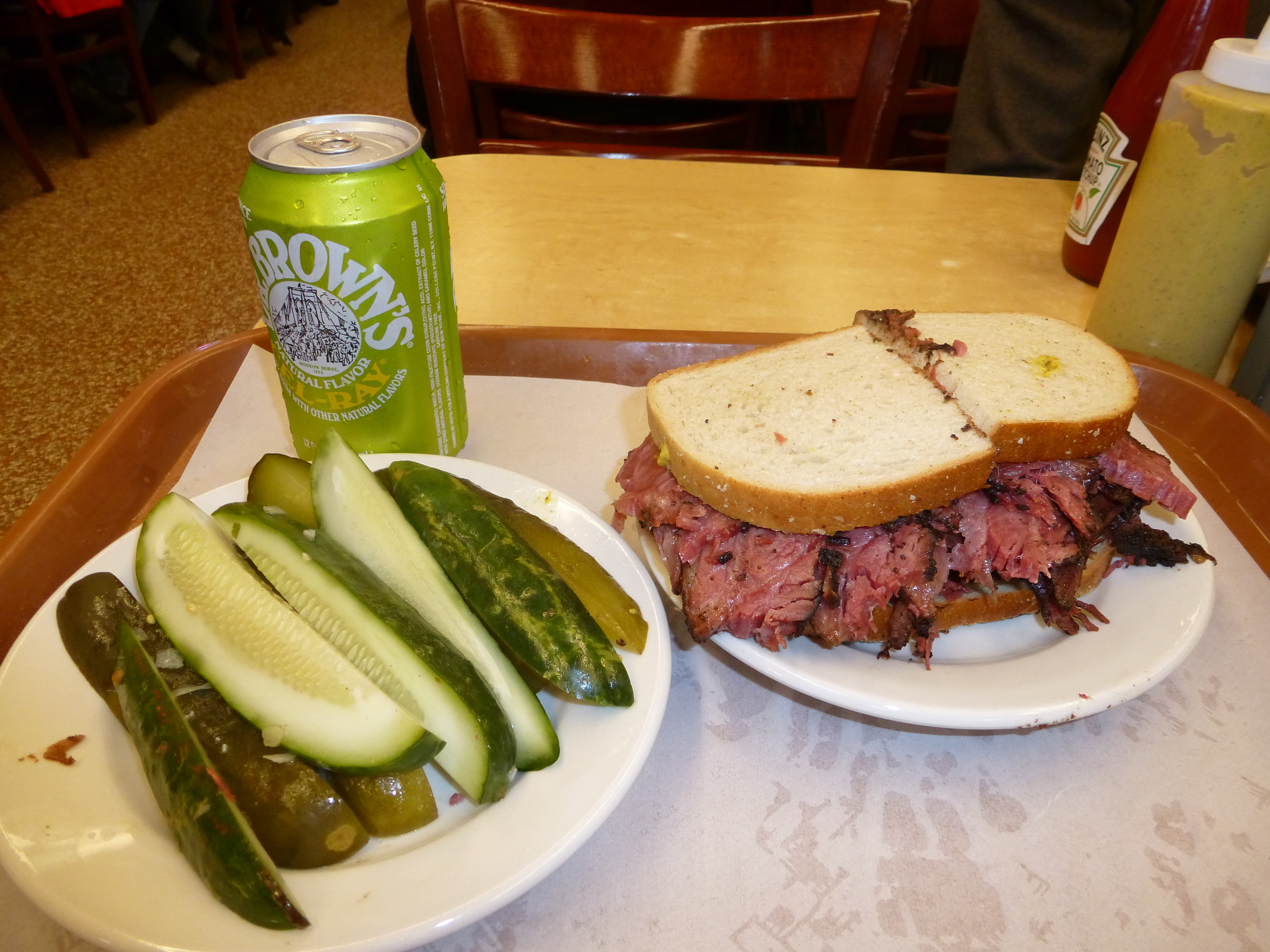
Here’s a pastrami sandwich from the famous and overtouristed Katz’s Deli in NYC. It’s expensive and crowded, but their pastrami is excellent, and you get plenty of pickles. (Katz’s is of course the site of the famous “fake orgasm” scene from the movie “When Harry Met Sally”. The woman who says to the waiter afterwards, “I’ll have what she’s having,” is Estelle Reiner, the mother of director Rob Reiner.
Notice the half sours dominating the pickles, as well as the Dr. Brown’s Cel-Ray (celery-flavored soda), the must-have accompaniment to corned beef or pastrami.
If you haven’t read my essay in the Chronicle of Higher Education, “Jason Arday and the corruption of science”, it’s no longer paywalled and you can read it on the Chronicle’s Substack here for free.
Readers are welcome to mark notable events, births, or deaths on this day by consulting the September 13 Wikipedia page.
Da Nooz:
*Houthi terrorists, backed by Iran, seized an island in the southern narrows of the Red Sea, further cutting off movement of oil-carrying ships from the Middle East (article archived here).
The Iranian-backed Houthi militia seized an island in a choke point of the Red Sea after days of fierce fighting, two Yemeni government officials said Friday, giving Iran and its allies sway over the two main routes for shipping oil out of the Middle East.
The capture of Perim Island came as Saudi Arabia announced that it had shut down a critical oil pipeline, a day after Houthi forces swept into the strategic port city of Mokha in Yemen. Both were major setbacks for the Saudi kingdom, which exports most of its oil through the Red Sea. The kingdom’s foreign ministry said the pipeline was hit on Thursday by drones launched from Iraq.
Perim Island sits in the middle of the Bab al-Mandab Strait, the narrow pathway at the southern entrance to the Red Sea. Its seizure adds a new dimension in the war between the United States and Iran. The Islamic republic has already largely cut off the flow of oil through the Strait of Hormuz in the Persian Gulf and leveraged that influence to demand concessions from Washington.
Now, the Houthi militia, Iran’s ally, has a foothold at a bottleneck in the Red Sea and could further disrupt shipping there.
The island’s capture came after intense ground battles in Yemen as the Houthis have staged a lightning advance against forces allied with the internationally recognized Yemeni government, which is backed by Saudi Arabia. The kingdom has faced frequent Houthi attacks on its tankers and energy facilities, even as its leaders have tried to avoid a direct war with the group, analysts say.
Crown Prince Mohammed bin Salman of Saudi Arabia spoke to President Trump about the escalation in Yemen in calls this week, and urged the United States to take military action against the Houthis, according to officials with knowledge of the conversations. Mr. Trump told him he was not willing to do so, the officials said.
We don’t have the wherewithal to intitiate yet another war, but it would be nice if some of the allies helped, for, after all, they have to move their goods through the Red Sea and Suez Canal.
Here from Wikipedia is a map showing Perim Island in the Bab al-Mandab Strait, next to Cheikh Saïd peninsula of Yemen, with Djibouti and Eritrea to the west across the strait. A zoomed-out map is inset at the lower right. The distance from the island to Yemen is about 2-3 km, while that to the coast of Eritrea or Djibouti is about 26-30 km. Not much space.

*According to the Guardian, this takeover is concurrent with about 50,000 Yemeni civilians fleeing before the advancing Houthi.
Nearly 50,000 people have fled a sudden advance by Houthi forces in western Yemen, with entire villages emptied and families trapped near frontline fighting with depleting food supplies, according to aid workers.
Civilians in the Middle East’s poorest country have found themselves victims of a global struggle for control over one of the most important shipping routes in the world, which threatens to turn Yemen’s on-off conflict into a forever war.
In a lightning advance this week, the Iran-backed Houthi militants have seized a string of towns along the Red Sea coast from forces aligned with the US- and Saudi-backed Yemeni government. Hundreds of people are reported to have been killed. Many fear a return to the full-scale civil war that killed 150,000 and brought many others to the brink of famine.
The UN International Organization for Migration (IOM) said on Friday that 46,000 people had been displaced across the governates of Taiz and Hodeidah, where steep verdant mountain ridges give way to arid coastal plains. For many families, this was their second or even third time they had been forced out of their homes.
A significant number of people were observed to be leaving the city with their belongings. Fighting has cut key roads, while phone lines are down in some areas. “The scale of displacement is increasing rapidly,” said Joe Lowry, IOM’s Middle East and north Africa spokesperson in Cairo.
. . .By taking control of key areas this week, including islands off the coast, the anti-west Houthis hope to gain a direct presence near the Bab al-Mandab strait, a 20-mile stretch of water and vital trade and energy route that connects Asia with Europe.
The strait’s name is roughly translated as “the gate of tears” or “the gate of grief”, and its strong currents and winds made the passage between the Arabian peninsula and Africa’s east coast hazardous for centuries. Modern-day cargo ships have no physical issue passing through.
But if the Houthis were to close the natural chokepoint, the impact on the global economy could be disastrous. Ships would have to reroute around the southern tip of Africa, adding thousands of extra nautical miles. The fighting has already contributed to the price of oil rising above $100 a barrel after weeks when it was trading closer to $80.
More bad news, but we can’t let terrorists control the flow of shipping in the Middle East.
*The WSJ reports that Chinese support for Iran in its war with the U.S. and Israel has extended to the Chinese supplying Iran with high-resolution satellite images of a U.S. base in Jordan that Iran attacked several times with ballistic missiles.
Before Iran carried out its attack that killed three U.S. troops in July, Tehran acquired high-resolution satellite images of the base in Jordan from Chinese entities, according to U.S. officials familiar with details of the incident.
It is the clearest evidence so far that Chinese support for Iran during the war has had lethal consequences for U.S. forces, according to the officials, who say the U.S. has connected the imagery to the attack.
The U.S. officials declined to identify the Chinese entities that supplied the imagery to Iran and didn’t allege direct involvement by Beijing. Tehran procured the images both before and after the attack.
But the finding could deepen U.S.-China tensions ahead of the planned summit between President Trump and Chinese leader Xi Jinping on Sept. 24, after months of frustration with Beijing’s rejection of U.S. warnings about Chinese companies providing imagery to Iran.
Senior U.S. officials raised the imagery linked to the July 17 attack with their Chinese counterparts, who pushed back and demanded proof, the U.S. officials said. China has repeatedly dismissed Washington’s concerns, refusing to acknowledge that any Chinese companies are engaged in such activity, the officials said.
The strikes on the base came after senior Trump officials spent months warning their Chinese counterparts that Chinese companies were providing satellite imagery Iran could use to target U.S. personnel and assets in the region, officials say. The Trump administration sanctioned several Chinese companies in May, saying that supplying satellite imagery to Iran “threatens American and partner personnel.”
Within three days of the July attack, Iran released high-resolution images showing damage to three separate areas of the base. Publicly available lower-resolution satellite imagery analyzed by The Wall Street Journal showed damage to more than 20 structures across the three areas of the base.
Here are the images, with translation from the Farsi below:
New images of Iran’s damages to #America‘s assets in the region
تصاویر جدید از خسارات ایران به داراییهای #آمریکا در منطقه pic.twitter.com/Z8FmluCT2j
— کامران شیرازی (@kamranshirazii) July 20, 2026
Well if this doesn’t involve the government of China, I’d be very surprised. Do NGOs in China have spy satellites, and sold the photos to the Iranians? Even if they did they’d need permission of the Chinese government.
*Douglas Murray, now a correspondent for the Free Press, analyzes the victory of the “far right” Alternative for Germany (“AfD”) party in one small state. His article is called “Who’s afraid of the ‘far right?“, with the subtitle, “German leaders enabled the rise of a populist party through their failures. Now those leaders cling to power by branding their challengers as extreme.” As I suspected, the MSM has played down the role of immigration in Europe’s move to the right.
For people concerned with the future of Europe, the AfD is a vital as well as a special case. As such, it requires special attention. Unfortunately, most of the people writing about the party from outside Germany are intent on performing this feat of political analysis with all the care of a brain surgeon attempting to operate while wearing boxing gloves.
To start with, it is not the case that the AfD is a far-right party. Which is not to say that it does not have people within it who could be described as far right, or that it could not become such a party in the future.
There is a simple explanation for why the AfD has risen to become the leading opposition party in Germany: mass immigration, legal and illegal. But it took years for that issue to dominate. When the AfD was founded in 2013, it was mainly focused on addressing the fallout from the Eurozone crisis. The new party rejected the European Union’s extraordinarily optimistic belief that a single European currency could combine Greek balance sheets with German bookkeeping.
But in 2015, Chancellor Angela Merkel decided to open the gates of Europe and Germany to anyone from North Africa or the Middle East who wanted to walk in and call it home, particularly those fleeing the Syrian civil war. Normal border protocols were abandoned. More than a million migrants arrived in a matter of months. Germany, and in particular its welfare state, was overwhelmed by the surge and attempted, too late, to stem it. The vast majority of the arrivals from those years remain a net drain on the German state. In addition to this economic reality, a small but significant number of arrivals have brought extremism, terrorism, and petty as well as large-scale criminality. It might also be noted that the movement has brought a mass importation of antisemitism into a country that did not exactly need a boost in this area.
Given the extraordinary consensus that existed over the past decade among the mainstream parties of the right, center, and left, it was inevitable that some political movement would arise in Germany to point out and oppose the folly of Merkel’s policy. The AfD was well-placed to do so, and, in time, the economists who had dominated the party in its early years were replaced by people who believed that immigration was the number one challenge facing Germany.
Their success in the years since 2015 has been remarkable
. . .But in 2015, Chancellor Angela Merkel decided to open the gates of Europe and Germany to anyone from North Africa or the Middle East who wanted to walk in and call it home, particularly those fleeing the Syrian civil war. Normal border protocols were abandoned. More than a million migrants arrived in a matter of months. Germany, and in particular its welfare state, was overwhelmed by the surge and attempted, too late, to stem it. The vast majority of the arrivals from those years remain a net drain on the German state. In addition to this economic reality, a small but significant number of arrivals have brought extremism, terrorism, and petty as well as large-scale criminality. It might also be noted that the movement has brought a mass importation of antisemitism into a country that did not exactly need a boost in this area.
Given the extraordinary consensus that existed over the past decade among the mainstream parties of the right, center, and left, it was inevitable that some political movement would arise in Germany to point out and oppose the folly of Merkel’s policy. The AfD was well-placed to do so, and, in time, the economists who had dominated the party in its early years were replaced by people who believed that immigration was the number one challenge facing Germany.
Their success in the years since 2015 has been remarkable.
. . . It is for these reasons, among others, that the foreign coverage of Germany’s political shifts is so unsatisfactory. In the aftermath of this weekend’s election, the easiest thing in the world is to say—as almost every headline writer has—that “the far-right AfD” won the regional election. The fact that these same publications, from the BBC to The New York Times, rarely, if ever, use the same scary monikers to describe far-left parties gaining support across the continent is a matter for another day. But the hope appears to be that the public will be sufficiently uninterested in the details and that the prospect of the Nazis returning will be enough to spook readers into reflexive opposition.
. . . If all opposition to the migration crisis can be said to be the work of German neo-Nazis, then Europe is lost. Because no party of opposition will be untainted. If Germany can be saved, then Europe can be saved. But in order for that to happen, people—including the international press—need to listen to what is actually happening in Germany, take notice, and recognize the situation as it is, not the strange Nazi-haunted fever dream that they curiously seem to wish it to be.
The problem of course is that the Western MSM, at least of the liberal stripe, is afraid of saying the I-word, much less recognizing the effect on people of mass immigration, often of people who simply don’t integrate into European society. Ergo the movement of nearly every country in Europe to the right. If people don’t wake up and at least recognize the problems, including the drain on local economies and the erosion of Western institutions and values, Europe as we know it will be gone when the next generation of children grows up.
*When I was a kid, I was allowed to walk to and from elementary school starting when I was about 9 years old, and that was a longish walk along major roads. I was also allowed, when I got home, to get on my bike and go visit friends. Those days are gone: such unsupervised activity by children is regarding as endangering them, even though the rate of such endangerment has dropped as the rules get toughter. In early June a mother in Williamsburg, Virginia let her five-year-old walk alone a half mile to a pond in their gated and security-patrolled community in Virginia; his goal was to collect goose feathers. She was summarily arrested, charged with contributing to the delinquency of a minor (!), and given a six-month suspended jail sentence. This is the subject of a WaPo op-ed called, “A 5-year-old’s nighborhood walk shouldn’t be a crime” (article archived here).
While everyone wants kids to grow up healthy and happy, people have different ideas about how to achieve that. Until the past generation or so, a sunny upbringing usually included a fair amount of free, unsupervised time. One book I cherish from 1981, “Your Six-Year-Old: Loving and Defiant,” provides a checklist of the things a neurotypical child was expected to be able to do upon entering first grade. “Can he count eight to ten pennies correctly?” and “Can he tell left hand from right?” Perhaps the most salient query: “Can he travel alone in the neighborhood (four to eight blocks) to store, school, playground, or to a friend’s home?”
Compare that with a survey released this year by the Institute for Family Studies, which asked nearly 24,000 parents at what age they’d let their kids do things on their own. Eleven percent of 14-year-olds aren’t able to leave the house unsupervised. Fifty-five percent can’t go beyond their block. In other words, today’s high school freshmen have a fraction of the freedom that used to be given to first-graders. It’s little wonder they’re so anxious.
This new, limited idea of what kids are capable of explains why a 5-year-old walking around his neighborhood at lunchtime can look like a baby crawling along I-95 at midnight. Thanks to Karyann’s transgression — trusting her son — she was placed on Virginia’s child abuse and neglect registry for seven years. In court, she was found guilty of “contributing to the delinquency of a minor” — a Class 1 misdemeanor — and given a six-month suspended jail sentence.
. . . over the years, parents started to contact me when they got penalized for giving their kids the same freedom they’d grown up with. That included Brittany Patterson of Fannin County, Georgia, who was arrested when her son, 10, walked to town without telling her. Mallerie Shirley received similar treatment when she was investigated after her son, 6, rode his scooter unsupervised in Atlanta. Danielle and Alexander Meitiv were likewise investigated for letting their kids, 6 and 10, walk home from a park in Silver Spring, Maryland.
Those stories and others have thankfully given the public pause. They’ve helped move 13 states to pass “reasonable childhood independence” laws, which clarify that “neglect” happens only when kids are put in serious, obvious danger, not any time their parents take their eyes off them. Rep. Blake Moore (R-Utah) and Rep. Jennifer McClellan (D-Virginia) are seeking to enshrine that protection nationwide with their Promoting Childhood Independence and Resilience Act.
When Karyann let her son collect feathers, she wasn’t ignoring danger. She was ignoring cultural norms that are keeping kids indoors, and parents in fear. For the sake of our families and our collective mental health: Let kids roam.
Meanwhile in Dobrzyn, Szaron isn’t going on the beat:
Hili: You were supposed to go on your rounds.
Szaron: I changed my mind, I’ll sit here with you for a while.

In Polish:
Hili: Miałeś iść na obchód.
Szaron: Rozmyśliłem się, posiedzą sobie tutaj razem z tobą.
*******************
From Merilee:

From Wholesome Memes:

And Bat sent this amazing image from the International Space Station showing the 9/11 attacks on New York City; it appeared on Space.com.
A quote:
Frank Culbertson had a birds-eye view of one of the most memorable and tragic events in American history.
The NASA astronaut was the only American off of Earth on Sept. 11, 2001. He was circling the planet aboard the International Space Station (ISS) when terrorists flew commercial jets into the twin towers of the World Trade Center in New York City, killing more than 2,700 people.
The ISS passed over New York shortly after the attacks took place, so Culbertson saw the devastation from an eerie remove. He shared his thoughts with Mission Control at NASA’s Johnson Space Center in real time, chronicling the tragedy like no one else could.

“We could see New York City and the smoke from the fires,” Culbertson said. “Our prayers and thoughts go out to all the people there and everywhere else here — I’m looking up and down the East Coast to see if I can see anything else — and to the people in Washington.”
There’s more information at the site.
From Masih, who’s rightly pleased at the progress she’s inspired.
Translation from the Farsi:
There’s no greater pleasure than seeing your efforts bear fruit—watch closely, brave woman: you were alone and singular here, but now women like you have multiplied, because courage is contagious! From 2014 until today, I was cursed at and attacked for launching campaigns against compulsory veiling and calling on women to send videos of themselves unveiled. Thousands of women in Iran were attacked for removing their veils and engaging in civil disobedience. We faced mass assaults from all sides for “White Wednesdays,” for “Our Camera Is Our Weapon”—assaults from those who were the minority! They arrested us, beat us, threw us in prison, threatened us, sent assassins abroad to murder us, and said this resistance was pointless. But today, every woman who walks unveiled in the streets is a continuation of that same disobedience. This isn’t just about removing a piece of fabric; it’s about reclaiming control over a woman’s body, life, and dignity, and tearing down the wall of fear. Compulsory veiling may still be law on paper, but in the streets of Iran, women have been issuing its death sentence for years. We are the echo of each other’s voices, and we persist until the day of liberation. These videos are from the #دوربین_ما_اسلحه_ما [“our camera is our weapon”] campaign and are being reposted to humiliate the zealots who these days are rampant on Twitter and Instagram, railing against women’s free dress in Iran’s streets—so they can understand the rugged, winding path Iranian women have traveled, and that we never give an inch!
هیچ لذتی بالاتر از نتیجه دادن تلاشهایت نیست، خوب تماشا کن زن شجاع، اینجا یکه و تنها بودی ولی حالا زنانی مثل تو تکثیر شدند، چون شجاعت مسریه!
از سال ۲۰۱۴ تا امروز، من به خاطر راه اندازی کمپینهای ضد حجاب اجباری و دعوت از زنان برای ارسال ویدیوهای بیحجاب فحش خوردم ومورد حمله… pic.twitter.com/6T0GgLwkN6
— Masih Alinejad (@AlinejadMasih) September 12, 2026
From Luana; two tweets showing double-takes of people who learn that the holdout juror in the Lindsay Clancy case was black (and male):
🚨 Stunning revelation: Lindsay Clancy juror Paula Devlin says the lone holdout who blocked an 11-1 insanity acquittal was the jury’s only Black member. The other 11 jurors were white.
Gayle’s reaction is something else! pic.twitter.com/aWEkaSdc7E
— Brandon Tatum (@TheOfficerTatum) September 11, 2026
Here is a stupefied “non-practicing white”. What doest that mean?
Lindsay Clancy fan discovering that the lone juror is black might be the greatest video in history pic.twitter.com/jIAjIvMcU5
— End Wokeness (@EndWokeness) September 11, 2026
Larry was left out at first!
Fixed it. pic.twitter.com/qGo6MerFVS
— Larry the Cat (@Number10cat) September 9, 2026
From Malcolm; cats doing the crab walk:
— cute cat 😺 (@CartoonCraze37) September 9, 2026
Two from my feed. LOOK AT THE SIZE OF THIS EAGLE!
👀 WOW… This Is A Female, Full Grown Harpy Eagle
She Is Beautiful❣️🤍 pic.twitter.com/Mf7Yik8HgY— ✨ Bee ✨ 🐝🌿 (@BeeAwake1) September 11, 2026
An “awwww!” moment:
A mother cat reassuring her kittens that the golden retriever is harmless pic.twitter.com/cFjncgx9KW
— Massimo (@Rainmaker1973) September 11, 2026
One I reposted from The Auschwitz Memorial:
A must-watch from Bill Maher. He dismantles the Gaza “genocide” canard in 9 minutes, holding it reponsible for the antisemitism sweeping the West—as well as the erosion through cowardice of the credibility of the Democratic party. https://t.co/W3j5Zc7IvQ
— Jerry Coyne (@Evolutionistrue) September 12, 2026
And one from Doctor Cobb in Manchester; a beautiful potter wasp:
Red DevilPotter wasp in Lanzarote Canary Islands 🇮🇨 Canon R5 and Sigma 150mm f2.8 macroSS1/3200 F7.1 ISO3200#macro #wasp # insect # arthropod #entolomology
— @macro_action (@birdzandbees.bsky.social) 2026-09-11T19:15:26.158Z
Jerry – The scene in Katz’s was directed by Rob Reiner, not Carl.
Being “white” means having all the wrong attitudes. Thus a “non-practising white” is a woke white person who has the right attitudes and deplors being white.
The problem with the holdout jury member is that woke white women think he was wrong, so obviously he had to be white, didn’t he? One doesn’t criticise black people, who are, by definition, in the right.
PS: I walked to school unaccompanied every day from age 5.
PPS: Merkel’s unilateral decision to open the borders to a couple of million poorer-country migrants was a big contributor to the Brexit vote.
Brexit voters wanted the UK to control its own borders, and not have to accept immigration policy over which British voters had little say.
[The party that delivered Brexit, the Conservatives, then betrayed Brexit by doing the exact opposite of what the voters wanted, issuing 7 million visas to poorer-country migrants; that’s why they slumped from 44% of the vote to 23% in the last election. But that just let in Labour, who also favour mass immigration from poorer countries.]
Being white, according to the woke gospels, means having an indelible stain on your soul because white people (and only white people) have throughout history oppressed and subjugated all others. Don’t say that you yourself had nothing to do with such atrocities, this is a form of original sin passed down through the generations.
First I’ve heard of this hall pass for being “non-practicing” though. How exactly does that work, is it sort of like being a “non-practicing Catholic” only in reverse? Does deploring being white (hating yourself?), thereby proving yourself a true believer, lessen the stain? Is it a form of atonement? I thought whiteness was a sin for which no expiation is possible.
Just when I thought things couldn’t get any sillier.
I don’t understand the significance of the holdout juror being a black man, why the two women were taken aback by learning that. A man wouldn’t understand motherhood, I guess, so shouldn’t (can’t) judge the situation. And being black is significant why? Is it that white men are well known to be impossible oafs and more is expected from a minority (who should know something about oppression)?
The identity-obsessed progressives believe that all “marginalized communities” share a common grievance and are therefore united in one great omnicause against the privileged and the powerful. So they assume that all black persons agree with all progressive and woke causes. Proclaiming the innocence of Lindsay Clancy has become a woke cause, for reasons complex and somewhat unfathomable. Thus, a black man is expected to fall in line and support her.
The quote in the Space.com article on observing the aftermath of the 9/11 terrorist attack that really struck me was in the vein of Sam Harris’ “The War on the West” as well as the continuing Islamist attacks on Israel: Culbertson added. “The dichotomy of being on a spacecraft dedicated to improving life on the Earth and watching life being destroyed by such willful, terrible acts is jolting to the psyche, no matter who you are.”
Regarding Karry Ann and her treatment for allowing her son to walk to the pond in their fully secured swanky upscale neighborhood, I can only say ‘what bullshit’. I continue to believe that even after talking with a senior (ie retired) state court of appeals judge yesterday about it. He did not hesitate to say he was glad she was found guilty and when I pressed him on what age is appropriate to allow such independence, he admitted that it really depended on maturity and he could not remember from his days in the early 80’s as juvenile court judge if there be any age certain. Talk about government over reach…jeebus.
Jim there are so many new images of 9/11 I’d never seen before which is suprizing and makes me wonder if they’re all real?
The NASA one I think I remember.
D.A.
NYC
From my days as a mom in the 80’s and 90’s, I remember when several high profile cases of child abductions created a kind of panic which spread through my friend groups, with women vying with each other to be the most sensitive and thus proactive in protecting their child. The statistics they believed in were wildly exaggerated. Coupled with the growing concern to validate your choice to work outside the home or not by spending the most “quality time” with your kid, safetyism thus spread throughout the land.
As an old codger, I was puzzled by the explosion of safetyism in multiple arenas, from that under discussion to the academic instances noted by Haidt and Lukianoff. Sastra, your brilliant final sentence explains it: an unexpected, largely subconscious indirect effect of women’s lib in the employment world. I wonder how many other cultural aspects of the last 20-30 years could be traced to consequences of what psychologists call family dynamics.
Whoops…my freudian slip was showing this morning: of course “War on the West” is Douglas Murray, not Sam Harris. Sorry all….jim
I read everybody’s comments on 9/11 yesterday here last night.
They were interesting. There’s a conceptual telescoping of reality depending on where we view an event. And when.
It was a weird week last week here – especially for me personally (usually it isn’t).. but not for half the (young or recently foreign) population I think.
Thanks for your memories of our Big Day.
D.A.
NYC
Presumably Trump could have at least renamed Bab al-Mandab strait, but there is already a Straight of America so that option is not available.
Yes, the statement “non-practicing white” is absurd.
My first thought was that it means you don’t put mayonnaise on Wonder Bread while listening to Pat Boone.
Though I suppose that image is out of date. Maybe a “non-practicing white” isn’t logical or punctual, per the Smithsonian.
Had I been aware of the identity of “non-practicing white” before my retirement I think I might well have included it in my signature block as a pre-emptive excuse for joining Teams meetings late.
I kind of want a t-shirt with ‘Non-Practicing White’ emblazoned across the front.
Or maybe even ‘Non-Practicing Oppressor’. It would go down a treat, here, in New Zealand.
Well, I identify as a non-practicing short homely dude, which of course makes me a lanky, sexy stud muffin.
The Institute for the Study of War has an excellent update on the situation in Yemen, along with great maps: https://understandingwar.org/research/middle-east/iran-update-september-11-2026/. It’s risky to draw analogies—and an analogy might confuse more than edify—but the Houthi takeover of Yemen reminds me of Hezbollah’s stronghold on Lebanon: weak governments at the mercy of Iranian proxies.
That Girl Scout has learned the first rule of business: Location! Location! Location!
Douglas Murray contends that “it is not the case that the AfD is a far-right party.”
I have several friends in Germany, including a retired librarian who is 96 and remembers the Nazi regime well, as it affected her entire early life in Leipzig. Two others were born not long after the war, but both their fathers were conscripted, with one serving in Finland and the other in Russia. All of them and my other friends absolutely consider the AfD a far-right party. They are all basically centrists who are mixed on the immigration issue, while acknowledging the problems. It is not so much the position of the AfD on paper that is the problem – it is the clearly prejudiced attitudes and how the majority in that party want to go about solving it that are the problem. My friends are absolutely disgusted by the tactics used in this country, like shipping migrants from Spanish-speaking countries to Africa, and do not want similar tactics used in their own country, given that they are still dealing with the after-effects of the Nazi era.
I have very mixed feelings about free range kids. On the one hand, I was raised free range and I loved it. I can still mentally map the territory I ‘ranged’ as a child: behind our house to the right there was a forest and, in the middle, a dilapidated old mansion. And behind the house to the left there was a very large overgrown field, then a strip of houses, then a large church parking lot that was entirely deserted 6 days a week, and finally a small Xmas tree farm. It was idyllic.
But, on the other hand, there was that parking lot. When my sister was only 5 years old, and already free ranging, she and her friend went to the parking lot to skip ropes. When they came back home, my mother noticed that they were eating candy and asked them where they got it. They excitedly told her that a man in a car had given them the candy in exchange for doing him a favor. Though they didn’t even know the words, my mother figured out pretty quickly that the favor had involved touching the man’s exposed penis and called the police.
To this day, I get a chill down my spine thinking about how easily those two little girls could have been abducted from that deserted parking lot, never to be seen again. It’s one reason I was a lot less free range when I became a parent than my parents were.
But my parents’ generation wasn’t bombarded by stories of heinous sexual crimes against children—even though they had to have been happening—so they didn’t imagine the worst. Nor did the police (I can only imagine how the police would have treated my mother today). They only warned us kids not to play in the parking lot alone, and we were as free as before.
Terrible story, thankfully rare. I was told as a child never to get into a car with anyone or to accept anything from a stranger. That was sufficient—and I was never accosted or threatened—but on rare occasions it’s not enough. This is a sad story. I hope your sister and her friend recovered from this horrific incident.
Absolutely. I was born in 1951 and was fairly free ranging, but with caveats. My mother warned us carefully about talking to strangers or accepting candy from them. She didn’t say why but her warning worked.
Also we didn’t go public swimming pools for fear of polio.
When I was a kid, everyone walked to school starting at age 5. No one walked with their parents or were dropped off, un less they were on crutches. However, there must have been some recognition of danger, because there was the project called “The Helping Hand”. Volunteer parents would tap a sign on the front door or window, considering of a white outspread hand on a black background. If a kid felt that he or she was in trouble, he or she could run to the house with the sign, and the print will let him/her in and help. Somehow, I doubt that that would work today, because who is to say that the hand parent isn’t luring the kid inside for nefarious purposes, like the witches used to do with gingerbread houses? Or worse, what if it is the White Hand of Saruman, who will then turn the kids into Orcs?
Needless to say, my wife and I were for some time protective of our wonderful Down Syndrome son Aaron. After a while, though, we got sort-of used to his custom of getting on a bus at (or right after) school, and just staying on it to explore the city, turning up much later than scheduled, with a broad grin in his face.
Some of this exploration tropism continued into his adulthood. I used to
bring him into my lab to play computer games, and one time he went off to
explore the corridors of the medical school; I couldn’t find him. Security staff finally located him several floors away, visiting the officially restricted domain of a lab that had various proprietary secrets. Fortunately, Aaron was not taking any photos in the secret lab, and he was grinning from ear to ear when brought back to my lab. I of course denied that he was working for me, but volunteered to take him into my own group as a consultant.
HA! That’s a cute story. People who have kids have more adventures than dog owners I think. More complicated adventures! 🙂
Again Jon, my condolences mate.
D.A.
NYC
Thanks, David. Back in the 1990s, good friends of mine followed a trajectory opposite to yours. They emigrated from the US to New Zealand: to a place called Nelson, which, by many contemporary accounts, resembled Heaven.
Pretty sure the harpy eagle is AI. They are not as large as is shown here and proportions of the feet are off. Yes feet are huge but again, this is disproportionate. I see more and more of this AI generated stuff and wonder why—nature is awesome without the AI BS.
“…but it would be nice if some of the allies helped…”
Yes but Trump has thoroughly alienated our allies insisting that we don’t need them for much of anything while they need us for a great deal. For a man who considers himself the greatest deal maker of all time he argues his positions with all the nuance of a cave man swinging a club.
“Let the kids roam!!!!”
I absolutely agree that we have become overprotective of our kids. I grew up in a very small town and we were totally free reign. Ridiculous though it sounds my mom claimed, and loved to tell the story of how, I left home at two. The story was that when she was being driven to the hospital to deliver my younger sister who is 22 months younger than I am, she saw me standing by the road about a block from home and rolled the window down to say “Mars I’m going to the hospital, Janet is around if you need anything before I get back”. I have no recollection of this but she was adamant that it was true.
My daughter is now 23. When she was young almost all activities with children her age were organized and thoroughly watched over by parents. But I would push her to do things on her own. When she was maybe 4 or 5 I got her to walk around the block on her own. She was nervous but did it. I waited in front of the house and when she came around the last corner she was thrilled. I think doing things like that greatly helped her self confidence. It is certainly a risk to underprotect kids but there is also great risk in overprotecting them.
Does America have allies or just ex allies who are insulted by Trump but show some common sense by trying to keep quiet?
Trump has destroyed much international goodwill by incredible hubris.
“If people don’t wake up and at least recognize the problems, including the drain on local economies and the erosion of Western institutions and values, Europe as we know it will be gone when the next generation of children grows up.”
One can wake up and recognize the problems—and still do nothing other than watch the buildings burn.
I suspect much of the highly educated left is in a state of denial and long ago put their political choices on autopilot. Most of them are not activists who support mass immigration from illiberal cultures, who tossed structured study of Western civilization out of the colleges, who scoff at the white working-class people who lament the rapid multicultural change in their small communities, who insist that Jews are guilty of genocide.
I suspect that most of the highly educated left do not believe that boys can be girls, that indigenous “ways of knowing” are akin to science, that one’s perspective is more important than one’s facts, and that dissent must be silenced as “misinformation” or “harm.” The particular pathologies vary a bit among Germany, France, and the Anglophone countries, but they share a common lineage—the Enlightenment it is not.
No, I don’t believe most on the highly educated left support these things. But they keep voting for—or refuse to vote against—those who do. They leave in charge of our schools those who do. In the United States, they mostly resist attempts to curb the power of those who advance illiberalism through federal bureaucracies, the courts, statehouses, universities, and NGOs. Rightly wary of overreach, many of them brand as fascists and Nazis those who would, in sometimes ham-fisted ways, curb such abuses. Yet they remain mostly silent on effective ways to stop the spreading illiberalism and irrationalism that long ago emerged from their own side. It’s always easier to oppose such pathologies when they are from the “other” tribe. It’s much more difficult when they bring you face to face with colleagues, neighbors, family, and friends.
So, let the buildings burn. We long ago grew bored with them anyway, didn’t we?
Interestingly (Harpy Eagle) this dinosaur’s main food consists of puppies from New York City when they visit Connecticut.
Fun fact.
D.A.
NYC
In other news, the coronavirus lab-leak proponents now have experimental results (from Rockefeller) to deal with, that show that occurrence of a furin site is not so statistically improbable. The lead author, Paul Bieinasz was the guest on this week’s TWiV (#1357) that posted last night.
A virally-encoded nuclease is key to the findings. Other keys include remembering what happens when something confers an advantage, that if it doesn’t confer an advantage, it disappears, and that the furin site only requires RXXR (I didn’t realize this – I thought it had to be RRG/AR), plus that there are six codons for Arginine. There’s also a link to the preprint at this link.
Also, boiled peanuts are available canned. I have one but haven’t tried them yet and I’ve never had fresh-boiled ones so I won’t be able to compare.
I didn’t have a chance to post my 9/11 story. The day it happened, I flew out of Logan airport in Boston on my way to a small conference in Germany. When I landed, no one told me anything, nor did the driver of the car they sent for me to take me from Zurich to Freiburg. I walked into the lobby of the small hotel in Freiburg, where my colleagues were sitting at the bar, and was met by cheers and hugs. I thought “wow! I must give a way better talk than I thought!” I mean, these are my friends, but they are mostly German, and not given to loud greetings. Then I noticed that they are looking at me strangely, and I asked—-what is going on? They told me just to go up to my room, and turn on English CNN, because I would not believe them if they told me. I could not get back to the US for some time—luckily, I have lots of friends in that area who refused to let me take a hotel room. There was a long waiting list of people who were stranded. Ordinarily, I would have been happy to wait: I was not suffering. But I was worried as there was an experimental medical procedure that required my presence (as consultant, not patient) back in the US. Luckily, my hospital wrote a letter stating that, and it allowed me to jump the line (something I hate doing under ordinary circumstances.
And all my American friends told me: “now we know how you (Israeli) feel.” I remember how people felt: rage and disgust at the terror attacks. Fast forward 25 years, and you have people justifying the attacks all across the US and Europe (and Europe has seen its own share of terrorist attacks). the mainstream media will not use the word “terrorist” to describe the perpetrators of such attacks. It is one thing for stupid, ignoran 20 years-olds to support such people, but it seems that Western countries have universities full of professors that do so, and we see politicians from major parties supporting groups that perpetrate similar acts. And some of those politicians get elected.
Western civilization—the Enlightenment—is in danger of crumbling from within. Yes, there are outside sources pushing for the demise of our civilization, but it is the people within who will bring it down if it happens.
My four children were not “free range” children — they were children, who could camp out overnight, with no adults, and go to and from their ballet lesson in the evening, unaccompanied. My grandchildren, run around the neighborhood, play in the park until dark, and like all elementary school children, ride the subways, alone. In Tokyo. A city of 40 million. Japan.