
Welcome to a Hump Day (“Puckeldagen” in Swedish), Wednesday, September 9, 2026 and it’s National Teddy Bear Day. Here is my teddy bear, whose name you should know if you’ve read this site for a while (put it below if you remember0. The first person to send a photo of their teddy along with a few words of description will have it posted below. I got this bear when I was born, and here he is nearly eight decades later, battered, head sewed back on, new eyes, and nearly devoid of fur. That makes two of us (save for the head part).

Reader Normansent a stuffed doggy, but it’s close enough to Toasty that I’ll post it. His comments:
Not a bear, so this may not count, but this is Sooty. My cousin Michael, exactly 15 years to the day older than me, gave this to me when I was born. I’ve had it ever since and now have it in a display case. Its eyes are gone. Its stuffing is gone. But it’s still Sooty to me.

It’s also National “I Love Food” Day (why the quotation marks? are we only supposed to pretend we love food?), National Steak Au Poivre Day, International Buy a Priest a Beer Day, and National Wiener Schnitzel Day. Here’s a schnitzel mit Kartoffel I had in Israel of all places—in an Austrian restaurant where I was taken.

Readers are welcome to mark notable events, births, or deaths on this day by consulting the September 9 Wikipedia page.
Again I note that posting will be light for a while. Not only do I have a writing assignment, but my insomnia has returned big time. And I’m still anxious about the ducklings, though I think they’ll be all right.
Da Nooz:
*Canada began putting new tariffs on American goods, and there’s no end in sight to this trade war (article archived here):
New Canadian tariffs targeting roughly $20 billion in U.S. imports officially snapped into place on Tuesday, the latest escalation in an increasingly costly trade war that has ensnarled two longtime allies.
The duties apply to a variety of U.S. goods, including clothing, cheese, metal parts and wood products. The approach is meant to mimic the taxes that President Trump imposed on Canada after trade talks between the two neighbors collapsed in acrimony last month.
For now, the economic effects of the tit-for-tat may be limited because the tariffs encompass only a small portion of the annual trade between the United States and Canada. The more pressing concern is a potential cycle of retaliation, one that results in even higher and more exhaustive duties that harm families and businesses on both sides of the border.
In Canada, Prime Minister Mark Carney has sought to position himself as a bulwark against Mr. Trump’s trade aggression, describing his nation as “at war.” Canadian officials generally have pledged to respond “dollar for dollar” to any U.S. duties.
In Washington, the president and his aides have repeatedly mocked their Canadian counterparts and the size of their ally’s economy and military. Mr. Trump has already threatened additional tariffs on auto imports from Canada, and on Friday, he even suggested he could try to halt bilateral trade outright.
Then, hours before Canada’s new tariffs took effect, Mr. Trump took to social media to continue his attack. He singled out Bombardier, a Canadian plane manufacturer, claiming there would be “NO MORE SELLING BOMBARDIER IN THE UNITED STATES!”
Bombardier said in a statement that aerospace products are a top American export and that the company makes crucial components like wings in California and Texas. “Bombardier is a strong contributor to the sector, creating tens of thousands of jobs across the United States,” it said.
The White House did not respond to a request for comment.
The spat with Canada offered the latest evidence that Mr. Trump remains as committed as ever to his disruptive strategy of trade brinkmanship. Despite nearly two years of blistering court defeats, vicious international disputes and mounting domestic blowback, tariffs remain the president’s preferred tool to try to boost domestic manufacturing and broker better trade deals.
Trump is not only dead wrong about tariffs, but is also alienating our friendly neighbor to the north. It galls me that Canadians may think that most Americans are anti-Canadian, but in reality most Americans have taken a dim view of Trump’s tariff rampage. This is not going to be good for Trump or the Republicans in the midterm elections.
*There’s a new documentary about Elizabeth Holmes, the now jailed creator of the blood-testing company Theranos. The documentary, called “You Can See Everything”, is are somewhat secret as even the NYT doesn’t want to give away the spoilers, the film doesn’t open until October, and the trailer, below, is just over one minute long. (In 2023 Holmes was sentenced to 11 years and 3 months in the federal pen.) An excerpt from the NYT piece, which is archived here.
Thirty-four days before Elizabeth Holmes, the founder of the medical testing company Theranos, reported to prison to begin her 11-year sentence for defrauding investors, she invited a camera crew into her rented home in Southern California in an effort to clear her name. Yet the two people she chose to chronicle her life were Nathan Fielder, the absurdist comedian behind “Nathan for You,” and the documentary director Lance Oppenheim.
That decision turned into a three-year odyssey for the filmmakers and a three-hour documentary called “You Can See Everything” that may upend the documentary genre itself. The film had its world premiere at the Telluride Film Festival in a secret screening on Sunday night that was not revealed until audience members took their seats. It will make its theatrical debut, courtesy of A24, on Oct. 16.
The movie features long, intense conversations between Fielder and Holmes with extreme close-ups. It also reveals that while Holmes serves her time at the Federal Prison Camp in Bryan, Texas, she and her partner, Billy Evans, are making plans “to launch a new and improved Theranos,” the company that collapsed after its deceptive claims about blood-testing technology were exposed in The Wall Street Journal in 2015.
What can’t be featured in on-camera interviews is depicted in innovative recreations. Two weeks before she leaves for prison, Fielder moves into the home and is there for moments many would consider off limits. There’s also a surprise plot point that shouldn’t be spoiled.
“I don’t know why I’m there,” Fielder said in a post-screening question-and-answer session at Telluride. Throughout the film he gives the couple many opportunities to turn off the cameras, he noted. “I’m really struggling to this day to understand what I experienced,” he added. “I’m excited for this movie to come out and for people to help me with what I experienced.”
That’s a plenty weird documentary, and the trailer, below, is equally weird. I don’t believe for a minute she’s telling the truth; what she has to gain is burnishing her image:
As for “launching a new and improved Theranos, Holmes should forget about it. I think she may be forbidden to do that kind of stuff for a while, and who, in view of her deception and crimes, would invest in it?
*Here are the results of yesterday’s poll on Lindsay Clancy. There were some good comments, too. The votes weren’t numerous—another sign of the dying of this site—but to my surprise the most votes went to “guilty” with “not criminally responsible” in second place (as you can see from the yellow bar, I voted “no opinion or unsure” as I wasn’t on the jury and really don’t have an opinion). As I note below, I think the jury was going to render a verdict like “not guilty by reason of mental illness,” which still would have put Clancy in jail for a long time.
As the NYT revealed, three of the jurors spoke and demonized the one holdout man who wouldn’t vote “not guilty” (article archived here):
It had looked like the end of deliberations in the murder trial of Lindsay Clancy.
Eleven of twelve jurors had agreed not to convict Ms. Clancy. Then the one holdout “admitted he had reasonable doubt,” the jury’s forewoman, Roni Carlson, said in an interview with the television station NBC10 in Boston on Tuesday.
According to the judge’s instructions, if jurors had considered all the evidence but still had reasonable doubt about the charges against Ms. Clancy, they had to acquit her.
So Ms. Carlson, a retired teacher, started to fill out the three verdict forms, she said in the interview. She got as far as writing her signature on each sheet. But then, Ms. Carlson recalled, the holdout juror said, “I’m still not going to say that she’s not guilty by reason of insanity.”
In the first public statements by jurors since the monthlong trial, Ms. Carlson and two other jurors opened up about the grueling week of deliberations in which the jury of nine women and three men were deadlocked, prompting Judge William Sullivan to declare a mistrial
Now I’m not sure whether “not guilty by reason of insanity” equates to “not criminally responsible for murder,” but I

Apropos, over at the City Journal Christina Buttons describes the effect that housing criminal defendants has had on psychiatric facilities (a lot more violence and assaults on staff). She favors a hybrid jail/treatment option:
States should take a different approach. Manhattan Institute senior fellow Stephen Eide argues that they should invest in psychiatric care inside jails rather than continually moving offenders into state hospitals. Jails already have legal obligations to provide health care, and competency restoration often consists of psychiatric stabilization along with teaching defendants enough about the legal process to participate in their cases. States can fund specialized restoration programs within secure correctional settings while reserving hospital transfer for defendants whose conditions actually require hospital-level treatment. The ACLU has opposed this approach, calling jail-based competency treatment “inhumane” and arguing that defendants should instead receive restoration in a therapeutic setting.
Eide’s proposal recognizes that treatment and criminal accountability can coexist. A defendant can suffer from serious mental illness and still belong within the criminal-justice system. Improving psychiatric care in jails would allow states to provide treatment without turning ordinary psychiatric hospitals into de facto correctional facilities. It would also preserve scarce civil beds and reduce the burden on staff and patients when hospitals are asked to manage forensic populations they were not designed to house.
The debate over Lindsay Clancy reflects the same tendency to treat compassion for the offender as incompatible with criminal accountability. Much of the public response has centered on her suffering rather than on the three children she killed. The same priorities appear in policy when the needs of offenders take precedence over crime victims, hospital workers, and psychiatric patients who committed no crime.
*The head of the Smithsonian Institution is stepping down, though he denies that Trump’s efforts to reshape the Institution’s message had anything to do with the premature retirement:
Bunch plans to depart by the end of the year, the Smithsonian said in a statement.
Bunch’s resignation comes at one of the most politically fraught moments in the Smithsonian’s 180-year history. Since March 2025, Trump has sought to purge what he calls “improper ideology” from its museums, while his administration has threatened the institution’s federal funding, tried to fire a museum director and challenged its authority over personnel and exhibitions.
But the president does not choose the Smithsonian secretary. That power belongs to its governing body, the Board of Regents, which is made up of high-level government officials, members of Congress and citizens appointed by Congress. As vice president, JD Vance sits on that 17-member board, which currently includes two vacant seats.Bunch said in an interview with The Washington Post on Monday that the administration’s pressure played no role in his decision and that he was still ready to do battle to protect the Smithsonian’s autonomy.
“We’re at a time when people are challenging that independence,” he said, “but I feel very strongly that it is as independent as we were before, and that I will continue to fight — for as long as I’m in this chair — for the independence of the Smithsonian.”
Bunch said he had been contemplating retirement for about a year and settled on leaving after spending several weeks this summer with his children and grandchildren. He originally planned to serve five years as secretary but eventually decided to stay into the nation’s 250th anniversary year and through the approaching 10th anniversary of the African American history museum.
Well, I’m not sure whether Bunch’s statement that he’s fighting for the Smithsonian’s independence has nothing to do with Trump. Who else is threatening that independence?
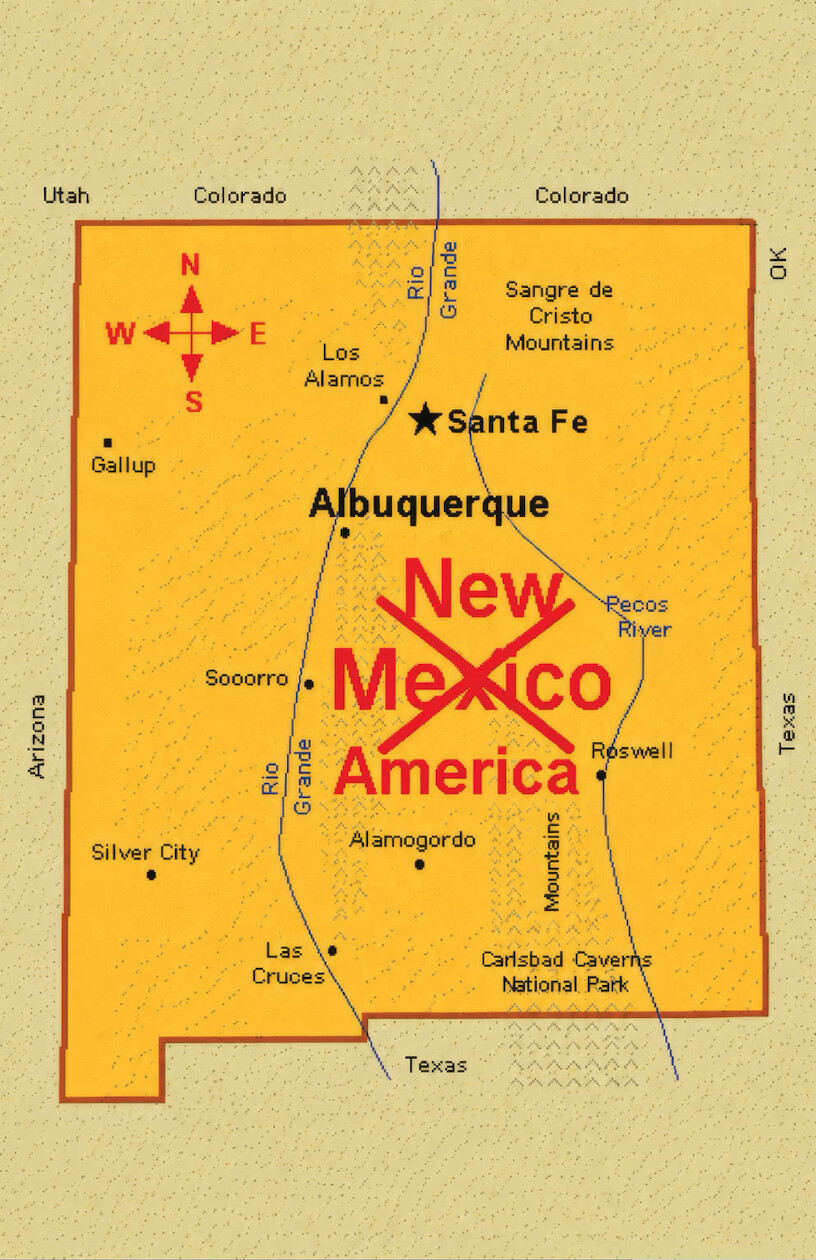
*More renaming insanity from the President: Trump has now posted a map suggesting that the state of New Mexico be renamed “New America.”
President Trump appeared to suggest on Sunday that New Mexico should be renamed “New America,” prompting swift backlash from the state’s Democratic leaders over his latest effort to put an American stamp on geographic names.
On social media, Mr. Trump shared an image of a map of New Mexico with the word “Mexico” crossed out with a red X and replaced with “America.” The White House re-shared the image shortly after on its official X account.
The president posted again several hours later, with what appeared to be an A.I. video of him placing a label with the word “America” over “Mexico” on a “Welcome to New Mexico” road sign.
Mr. Trump has no legal authority to rename any state, which in New Mexico’s case is written into its Constitution. Any proposed change would have to originate within the state, a prospect that New Mexico’s Democratic leaders rejected forcefully on Sunday.
“New Mexico’s name isn’t up for debate — it’s been ours since before the United States existed,” Gov. Michelle Lujan Grisham wrote on social media.
Representative Melanie Stansbury was more blunt: “Oh hell no!” she wrote on X, adding, “Our state’s name carries generations of history, culture, and family — and it belongs to us.”
Here’s the map Trump posted, though the El Paso Times notes that it originated at a parody account:
The “New America” map was previously posted on Sept. 1 on the parody account Daily Noud, which posted a fake image falsely claiming Trump had signed an executive order renaming New Mexico. Daily Noud account on X states, “These are fake stories.”
And the AI video showing Trump posting the new name. Are we taxpayers funding someone in the White House to make these videos?
Meanwhile in Dobrzyn, Hili demands attention.
Hili: Did you really forget I was here?
Andrzej: Sometimes, when I’m reading, I even forget about you.

In Polish:
Hili: Naprawdę zapomniałeś, że tu jestem?
Ja: Czasem, czytając zapominam nawet o tobie.
*******************
From Stacy:
From Give Me a Sign:


From Masih: a rapper was hanged for doing nothing besides peacefully protesting—the same old story in the odious theocracy of Iran:
Heartbreaking 💔
They killed a 21-year-old rapper in prison. No one knows how.
Erfan Mirzaei, a 21-year-old rapper arrested during Iran’s January protests.
His “crime”? A video on his phone showing that he had attended protests.
The regime used that video to accuse him of… https://t.co/c9aAYrM52P pic.twitter.com/BFqN2nwTwT
— Masih Alinejad (@AlinejadMasih) September 8, 2026
From Bryan, two views of Chicago from space (“LED vs sodium vapor”) showing our famous grid street design:
Chicago, USA 2024 vs 2003
The grid street layout of Chicago is immediately recognizable from orbit, and characteristic of many North American cities, and emphasize the change in color intensity. pic.twitter.com/JO1uRZBUyq
— Don Pettit (@astro_Pettit) September 7, 2026
From Luana, three minutes of academic insanity, this time involving “body fascism”:
🚨 Da’Shaun L. Harrison at Socialism 2026 argues that the policing of “Black fat flesh” is foundational to broader “entire systems of governance.”
“Without a population to discipline, there would be no BMI, no obesity epidemic, and no medical or scientific institutions organized… pic.twitter.com/GP4foaTgUJ
— Stu Smith (@thestustustudio) September 5, 2026
Two from my feed. I probably posted this one before but, if so, here it is again. I love the sign!
In parts of Japan, drivers are warned to watch for cats that may suddenly run into the road
The signs are real, and I love how something so simple got such a memorable design pic.twitter.com/8L3LXsus2g
— Nature is Amazing ☘️ (@AMAZlNGNATURE) September 7, 2026
Only in Japan:
A DEVELOPER IN JAPAN CREATED AN APP WHERE A FAT CAT POPS UP ON YOUR SCREEN AND MAKES YOU TAKE A BREAK. pic.twitter.com/Tsrig5i8yJ
— Antidepressant Content (@depressionlesss) September 7, 2026
One I reposted from The Auschwitz Memorial:
This Hungarian Jewish girl was gassed to death as soon as she arrived in Auschwitz. She was about six years old, and would be 88 today had she lived. https://t.co/WGOn13jthS
— Jerry Coyne (@Evolutionistrue) September 9, 2026
Two posts from Dr. Cobb. First, the most important job at 10 Downing Street:
Welcome to the most important job you'll ever have @andyburnham.bsky.social Cartoon brilliance by @bjennings90.bsky.social for @theguardian.com
— Larry the Cat (@number10cat.bsky.social) 2026-07-17T12:21:20.263Z
Matthew’s just published a brief biography of J. D. Watson in an Indian journal aimed at schoolchildren:
I just published a brief account of Jim Watson’s life, aimed at students. It leans heavily on the insights of @nccomfort.bsky.social, whose biography of Watson will be out next year. Free link here: rdcu.be/M91CnnE3N4wa
— Matthew Cobb (@matthewcobb.bsky.social) 2026-09-07T08:33:32.981Z
I appreciate PCC(E)’s and the WEIT readers’ here treatment of the Clancy trial.
I saw a meme where all of Canada had been named “Dontario.” People should recognize when Trump is just trolling. It’s not within the power of the President to rename a State.
Trump doesn’t recognize any limits on his power. Indeed, he genuinely believes he has the power to create and/or alter reality.
If Andy Burnham annoys Trump will there be a renaming of English inspired locations such as New England, Boston, New Hampshire. New Trumpshire trips of the tongue.
The South Park creators have apparently trolled the Orange One by renaming the series South America. Brilliant, as usual.
We know Trump is trolling. (So what?) Canada answers with marvelously clever videos on You Tube, done by Democratic Penguins Republic – Trade Partner (Official Music Video), all featuring the cooperation of Canada’s geese, beavers, moose and bears.
Canadian pushback satire is better than anything Trump and his minions could ever come up with. No contest, Canada is winning this war.
No well informed Canadian hates all, or even most, Americans. We know you can’t do anything about the madness – anyway not immediately. The bigger question is how to get your governing elite to see the world as more than the American backyard. And to stop bullying everyone who has other ideas. That would make sense in the 1950s when the US was truly the strongest player. It’s high time to learn how to work with other countries for common good, and keep this g-ddamned biosphere hospitable to humans.
When I complain about Donald Trump his supporters always counter with “oh, he’s just trolling the libtards,” or “he’s not serious; he’s just yanking the chain of the Dumbocrats.” In my view he insulting us while he displays his dictatorial inclinations.
Trump also posted a map that renamed every state in the country on the “America” theme. It’s silly. It’s beneath his office. But nobody requires me to say “Lake America” or “Gulf of America,” and I can freely criticize this language idiocy without fear of repercussion.
But consider: The Gulf of America is a bridge too far and supposedly evidence of dictatorial ambitions, but “people with vaginas,” “birthing persons,” and coerced pronoun usage are simply what? Excessive exuberance? Well-meaning folly? We could extend the list of made-up and changed language over the last decade to hundreds of words, terms, phrases, and places. These language changes, far from being silly games, were imposed by governments, professions, and peers—all of whom held those few who publicly objected to serious risk of professional and social penalty.
Yes, Trump is trolling. He is trolling those who so readily accede to the politicized language demands of their peers and professions yet get incensed when a lake many of them have never seen gets rebranded. The next blue Administration will reverse some of his silliness—and then it will again issue “guidelines” to the health professions (and others) that will become de facto requirements for grants, publishing, courtrooms, government contracts, higher education, professional advancement, and the maintenance of one’s social reputation.
I’ll wait for the media outrage.
And prior to it happening it wasn’t within Federal power to mandate lower speed limits on state highways. “Nice highways youse got here. Be a shame if something happened to most of your funding.”
The craziest thing I learned from the Clancy trial is the way insanity pleas work in Massachusetts. I always assumed it was pretty much universal that such a plea was an affirmative defense that the defense then had to establish, but in MA, once such a plea is made, it is the prosecutions responsibility to disprove it.
While I tend to prefer putting as much responsibility on the State as possible, I think this goes beyond what is reasonable. In such a situation, unless the prosecution has a smoking gun that the defendant is lying, I don’t see how you can ever pass a reasonable doubt standard in such a case. How do you disprove someone had a psychotic break!?
While I voted guilty in the poll, I’m not actually that sure what I would have done as an actual juror on this case. I can agree that in the context of MA law, there was reasonable doubt. But I don’t think that reasonable doubt is…. reasonable. If the defense can’t establish to my satisfaction that she was mentally incompetent when she killed those kids, I would have a hard to time justifying to myself handing down a not guilty verdict, even though MA law says that isn’t the defense’s job, and I therefore should.
I wonder if the hold-out jury member was arguing something similar?
My sympathy is with the murdered children. How were there final moments? She’d have to kill the oldest one first, carefully, as the oldest child might have had a chance, possibly, to fight, to escape, to alert the others, if he could sense her intent. Did she dispatch them… peaceably, so they drifted off…? Or did she come at them with controlled fury? Just her word against the murdered kids now, an inconvenient footnote. (NOTE: in adult/advanced Jujitsu classes, we practice choking both ways, with the defender in control at all times.)
Yes, her crime was horrendous. I can’t stand even reading much about the trial.
Still, the law says the juror must have no doubts for a guilty verdict. There are definite doubts about her state of mind. She was possibly hearing voices that were telling her she must kill them. I would put her in the insane category.
Yes, probably insane… Jury trials now seem so much more complicated than those in the past. Or maybe it’s the increased social media fanning the flames.
I don’t know how one disproves that someone had a psychotic break, but that burden of proof may rest on the view that its more important for a guilty person to go free than for an innocent person to be convicted.
I do recall the famous case of how a veteran from the Iraq war, and his friend, were both shot by an acquaintance who had severe ptsd. The veteran was the portrayed in the movie American Sniper. The case was tried in Texas (where laws are different, I am sure), but the jury found the defendant not insane and therefore guilty of murder since he tried to cover up his actions later. I don’t know if that means sanity at the time when he was triggered by the presence of guns in a well-meaning exercise, but our jury system is strange in that perfectly ordinary people are given the task of deciding these things.
Toasty!
That Elizabeth Holmes trailer is one of the creepiest trailers I’ve ever seen.
“Trust me; I’m a professional sociopath.”
Here on Turtle Island we don’t think most Americans are anti-Canadian. We love you guys! But we do feel like we got the short end of the stick on both trade and politics.
We were on track to elect a Conservative government in the October 2025 federal election. The federal Liberals were in crisis, Justine Trudeau had resigned as prime minister in disgrace, and the Cons had double-digit poll leads. Trump signed his first tariff order in March a few days after his inauguration (and has been unrelenting on trade and tariffs with Canada ever since). The new Liberal leader Mark Carney saw his chance, called a snap election for April 2025, campaigned on the trade war, and won.
Americans (including those I know and love) have to put up with all of Trump’s awful policies, for which I’m sorry. But you at least get to see a couple of silver linings like the rolling back of some Biden-era woke craziness (e.g., Sam Brinton is no longer Undersecretary for Crossdressing in Women’s Clothing Stolen From Airport Luggage, and the Smithsonian is no longer warning us about “Aspects & Assumptions of Whiteness & White Culture”).
And you’ll hardly feel the effects of Canadian counter-tariffs. Who will notice the absence of Ontario ice wine on your shelves?
On this side of the border Canadians have to deal with crippling tariffs that could put our auto industry out of business. And we still have a Liberal government full of woke nonsense on race, decolonization, indigenous ways of knowing, and genderism (Carney himself has a child who was a patient at the infamous Tavistock clinic), with maple-flavoured elbows-up faux patriotism in which ministers will say in the morning that they are defending Canadian sovereignty (vs. American tariffs) and in the afternoon that Canada has no sovereignty (vs. indigenous land claims).
So yeah some of us are a little raw over all that. But we still love you guys.
Thank you for the Carney insights. From the American side of the border he looks so sane, compared to what we’ve got.
I am so sorry about what our Potus is doing with you guys up there! But I have heard that your counter-tariffs are aimed especially at doing economic damage in states that are toss-ups in the mid-term elections. including my state of Michigan. I think that is brilliant. Ouch! But still brilliant.
Thanks! It’s Michigan and Wisconsin that are driving a lot of the tariffs. Canada has pure protectionism (what we call “supply management”) for dairy and some other agricultural products: farmers are paid by a quango (the Dairy Board of Canada) that manages production, supply, and imports; the quango sets prices and production quotas; the farmers do well and their farms are sheltered from market economics that might sometimes put them out of business (e.g., cheap Wisconsin cheese); Canada ensures we always have these farms for our food production (which is good); but consumer prices for those products are always artificially high (which is bad). At the Walmart in my Vancouver suburb a litre of 2% milk is CDN$2.94; across the border at the Walmart in Bellingham WA it’s US$1.16, but Washington dairy farmers can’t export their milk to British Columbia. Some folks here think Trump sort of has a point about supply management, and we’d like our prices to come down, but nobody wants all this tariff craziness 🙁
Yes, Canada has what appears to be irrational rules on dairy. The industry is protected.
But the Americans have steep tariffs on softwood lumber (it has been excluded from all free trade agreements) so it cuts both ways.
It isn’t just US dairy that is excluded – all non-Canadian dairy was excluded and New Zealand challenged this in 2022 only winning some access in 2025……
Maybe if the US had joined the TPP?
https://www.mfat.govt.nz/en/trade/trade-law-and-dispute-settlement/current-wto-disputes
https://www.ruralnewsgroup.co.nz/rural-news/rural-world-news/nz-canada-dairy-trade-dispute-settlement
How are the automakers and suppliers up there in the Mitten responding?
I know there was a 25% tariff imposed by Canada last year for US-built vehicles (and only US built vehicles) that weren’t already covered by USMCA, as well as an overall quota limiting the importation of US-built vehicles into Canada (but not for vehicles from other countries). Friends working on the automotive supplier side were complaining about this, as they’re trying to navigate to figure out how to remain profitable with decreased sales overall. Point is that Canada wasn’t blameless before this latest round of tariffs, so it would be interesting to know if the car companies are going to shift more production back to the states or move more to Canada.
The higher tariffs on Canadian goods coming to the US result in higher prices on those goods, harming the US consumer. Canada responds by putting higher tariffs on US goods, resulting in higher prices on those goods, harming the Canadian consumer. It’s madness. Tariffs are a tax paid by the importer, not a penalty paid by the exporter to gain market access.
Smith, Ricardo, Mill, George, Sowell, Bhagwati, and especially Friedman have all coherently argued both on behalf of free trade as well as about the stupidity of reciprocal and retaliatory tariffs.
One could make an argument for restrictions related to national security, such as limiting certain computer chips used in military applications, but other than that I can’t see why we’re doing this on either side of the border.
At least that is what I’ve been taught and have seen to be true in my experience. I used to have to argue these points with my Democratic, union-backing friends. Now I have to argue this with MAGA types (though my Democrat union acquaintances on the factory floor do like the idea of tariffs to protect their jobs, but mainly hate Trump so they bad-mouth what he’s doing).
As I can’t change any of this, I’m viewing it as an economic experiment. Maybe this will result in a stronger US manufacturing base resulting in a long term reduction of market prices for US consumers as Trump’s industrial policy advisors seem to think; if so, I’ll stand corrected.
Yes, tariffs aren’t a left / right thing. And there’s no guarantee that a future Democratic administration would remove them. The protected industries like them.
Similar experiments have been done, with impressive results. E.g. Smoot-Hawley.
Here’s a Rule of Life: Mucking around with a large complex system often produces unexpected unwanted results; so be very careful out there.
I don’t understand the US/Canada conflict. There is no reason for it; it is manufactured by a US president who believes that everything is a zero sum game. That does not work for international relations. The US and Canada are natural allies, believing in the same enlightened Western values and principles (if we can disregard the current woke feces, which we can hope is temporary).
Any trade problems could be settled in a single morning over coffee, without need for tarriffs. Hopefully, once countries are led by saner politicians who do not rush to conflict with heir best and most natural allies, things will settle down, and American and Canadians can revert to their natural state of making fun of each other.
What Trump does not seem to realize, or realizes and ignores because it doesn’t fit his worldview, is that beating up on Canada is almost certainly a negative-sum game for the US; because Canada, being economically rational, will say and is already saying: “It’s been wonderful having the US as an ally and trading partner right next door, but since we can no longer trust it, we will find allies and trading partners elsewhere” (such as Europe, Asia – including China, Mexico, Australasia, South America, … ). This will make Canada less dependent on US trade, so it will find it ever easier to say no to irrational US demands.
Yes, Canada will suffer short-term, while Trump is still making US economic policy, but it will become more economically robust in the long term.
But bullying one’s current friends is so much safer than bullying one’s enemies.
There have been speculations that Canada could join the EU. You ask: How is that supposed to work? Canada is not in Europe.
Well, the EU rules are not that clear and leave a loophole open. Article 49 of the EU Treaty does not define what a European state is. “Any European state that respects the values set forth in Article 2 and is committed to promoting them may apply to become a member of the Union,” it states.
According to an older position paper by the European Parliament, this sentence could be “interpreted geographically, culturally, or politically.” Reference is made to Turkey: Although part of the country belongs geographically to Asia, the EU has affirmed in the past that Turkey is eligible for accession. The example makes it clear that “the term ‘European state’ is not interpreted in a narrow geographical sense,” but rather “is subject to a political assessment,” the paper continues.
Thank you for posting Sooty! He would be thrilled to learn about his newfound fame.
If Andy Burnham annoys Trump will there be a renaming of English inspired locations such as New England, Boston, New Hampshire. New Trumpshire trips of the tongue.