
Welcome to Friday, September 11, 2026, and the 25th anniversary of the 9/11 terrorist attacks, in which 19 people hijacked four aircraft, two hitting the World Trade Center towers and bringing them down, cone rashing into the Pentagon and the last, after passengers attacked the terrorist pilots of United 93, crashed into the ground. There were 2,977 innocent victims on top of the 19 terrorists.
Here’s a video of the second plane hitting the South Tower while the first is on fire, and then both buildings collapsing. You may not want to watch it if it evokes strong feelings:
It’s also National Emergency Responders Day, National Hot Cross Bun Day, and National Women’s Baseball Day.
Rosh Hashanah, the Jewish New Year, begins at sundown tonight and extends to sundown on Sunday.
Readers are welcome to mark notable events, births, or deaths on this day by consulting the September 11 Wikipedia page.
Da Nooz:
*An article in the Free Press by Daniel Kokotajlo, who worked at OpenAI, says that AI may really destroy all of humanity. I did not take such scenarios seriously until I read this article and found that this possibility is openly discussed in AI firms.
On Tuesday, AI researcher Jacob Coxon announced his resignation from Anthropic in a mega-viral post on X: “I spent the last three years doing pretraining research at both OpenAI and Anthropic,” he began. (Pretraining is an important part of the training process for AI models like Claude and GPT-6.)
He continued: “Neither company is acting responsibly. They are racing straight to self-improving superintelligence and gambling with our lives. . . . These will soon be superhuman systems that can hack anything, revolutionize any field overnight, and acquire real power and resources. . . . The people building AI earnestly believe that it could kill us all by the end of the decade.”
He’s right. I know this because I worked at OpenAI for two years, forecasting AI progress internally and working on model evaluations and alignment research, and because I still talk with friends at OpenAI and Anthropic.
But you don’t need insider knowledge to understand where Jacob and I are coming from. The argument is straightforward:
- Anthropic and OpenAI are racing to train self-improving AIs, ultimately superintelligent ones—meaning models that exceed the cognitive capacity of humans—as fast as they can. (This is not a secret. They talk about this in interviews and on their websites.)
- If they actually succeed at training self-improving, superintelligent AIs, that would be a reckless gamble with our lives. (This part is fairly obvious, but has been explained at length by many people over the years, including the world’s two most-cited living AI scientists.)
- They may actually succeed soon.
Many people doubt the third premise. AI companies have an incentive to overhype their products. After all, it’s common for tech companies to overpromise and underdeliver, so why should we trust their forecasts?
To that I say: We shouldn’t. Instead, we should look at publicly available evidence and forecasts made by independent experts. Unfortunately, that evidence base supports the third premise.
. . .The recent rogue AI cyberattack—in which AI agents in a controlled OpenAI experiment escaped of their own volition and hacked the company Hugging Face—illustrates these realities. OpenAI tried to spin the incident in a self-serving way. (Go watch their presentation at the Black Hat USA conference; they basically use the cyberattack as a reason to encourage customers to buy their AI protection services.)
But should we therefore conclude that the whole thing was a setup, a conspiracy by OpenAI to make their product seem scary and therefore powerful? No. OpenAI didn’t want their models to attack another company. It happened anyway, due to inadequate alignment and security practices at OpenAI. And the Hugging Face affair isn’t an anomaly. Smaller-scale incidents have been happening at other companies (and third-party evaluators) for months.
. . .Once the frontier AI companies have fully automated the AI research process, things will start moving very quickly. AI will get rapidly smarter than us in a variety of different ways, oversight of AI will be itself delegated to the models, and it will be all too easy for things to go wrong in a way that we can’t recover from.
The U.S. military is planning to integrate AI into many aspects of its operations. Businesses are planning to use AI for many things, including to design new technologies and run robot factories that build more robot factories. Superintelligent AI wouldn’t even need to take over by force; the current plan is essentially to put it in charge.
If Kokotajlo thinks it’s possible, well, it’s possible, as I know almost nothing about this. But some human malefactor would have to be behind a wholesale attack on humanity. Kokitajlo’s solution is transparency and oversight forced upon AI companies, for “These companies cannot control their own AIs today, and should not be trusted to do so in the future.” All of us are ignorant about this, but if the doomsayers are right, we should at least pay attention.
*Mirabile dictu (again): the Supreme Court upheld a Missouri Supreme Court decision invalidating a redistricting of the state that favored Republicans.
The U.S. Supreme Court on Thursday once again prevented Missouri from using a congressional map in November that was redrawn to give Republicans an advantage in the midterm elections.
It was the second time this week that the Supreme Court waded into a dizzying legal fight over Missouri’s congressional map, and it came just two months before a general election in which the state’s voters could determine control of the House.
The court’s brief order did not include any reasoning, as is often the case when the justices respond to emergency requests. There were no noted dissents.
The ruling left up in the air how Missouri would conduct a general election in November, given that the courts have now invalidated the map the state used to conduct primary elections last month.
Holding a general election with a different map than what was used in the primary is rare legal territory, with no specific guidance so far from the courts on how nominees should be selected.
Thursday’s ruling landed just as a hearing about remapping was about to begin at the Missouri Supreme Court in Jefferson City.
That court’s judges were considering whether to hold the secretary of state, Denny Hoskins, in contempt for not following their order to use the previous House map, which would position Democrats to retain a seat in the Kansas City area.
Before Thursday’s order from Washington, Missouri Republican leaders had been insisting they would stick with their preferred map for the general election.
In Jefferson City, a lawyer from the Missouri attorney general’s office, William J. Seidleck, said the secretary of state’s office was “evaluating next steps.”
No matter what, logistical and legal barriers seem likely to keep emerging. The deadline to finalize Missouri’s ballot was Tuesday.
This is an unholy mess, but I’m tired of a gazillion things each said to determine whether Democrats or Republicans will control the House and Senate. I just want the midterms to be over.
*There’s a new report in our student newspaper, the Chicago Maroon, noting that the proportion of males admitted to the school is at its highest rate in decades: 58%. (I would have thought that the proportion of women (42%) would exceed that of men. Further, the proportion of black and Hispanic students has dropped pretty substantially since 2022, with black admissions being halved: from 10% to 5%.
The share of incoming students in the College identifying as Black fell for the third consecutive year in academic year 2025–26, while the proportion who were male increased to its highest level in decades, according to detailed UChicago enrollment data released last week.
The University reports data on its first-year classes annually in the Common Data Set (CDS), a standardized survey that asks institutions nationwide to disclose student demographics, high school academic performance, and financial aid awards, among other statistics.
The College enrolled just 71 Black first-year students last year, down from 97 in 2024 and over 150 three years ago, the University reported in the CDS. The number of white students showed a corresponding slight increase, while enrollment among other demographic groups stayed roughly unchanged year over year. Black students made up about five percent of domestic students of known race in the Class of 2029.
. . .The CDS release comes two admissions cycles after the Supreme Court ruled in 2023 that colleges and universities could not explicitly factor applicants’ race into their admissions decisions, effectively banning affirmative action policies favoring historically disadvantaged demographic groups. The University had submitted a brief in the case opposing an affirmative action ban.
Without affirmative action, many selective universities have admitted fewer Black and Hispanic students and more white and Asian students, though those shifts have been uneven across institutions. At UChicago, white and Asian shares of domestic first-time enrollment have climbed by about three percentage points each since the decision took effect, while Black and Hispanic enrollment shares have dropped by three and four points respectively.
The number of new first-years who did not report their race to the University jumped sharply last year, from 52 to 126, or seven percent of the Class of 2029.
You can see the change for race below; the vertical line marks the legal prohibition of race-based admissions:

The College also continued a years-long climb in male enrollment, the CDS release showed: more than 58 percent of the Class of 2029 identified as male, a three-point jump from the previous year and up from 52 percent for the Class of 2025. That weight toward male students persisted even as the College reported nearly 5,000 more female applicants than male ones.
UChicago had not welcomed an incoming undergraduate class with as high a proportion of male students since fall 1987, according to National Center for Education Statistics (NCES) data.
The University is an outlier when it comes to gender breakdown. Nationally, women comprised 57 percent of undergraduates in fall 2022. The only other Ivy Plus institutions with more male than female first-year enrollees last year—the Massachusetts Institute of Technology (MIT), Stanford University, and Dartmouth College—also had more male than female applicants. Even so, none had a higher share of male first-year enrollees than UChicago.

The decline in Hispanic and black students is surely connected with the Supreme Court ruling, though it can be circumvented in various ways. But schools are afraid of being sued like Harvard was. The increasing number of male applicants, and the increasing disparity between the sexes here is mysterious to me. (Note that the Maroon says the numbers of “genders” is two, and what they really mean is sexes.)
*The British Museum has opened its exhibit of the Bayeux Tapestry, a project that’s been in the works a long time. I’ve longed to see this 70-meter embroidery of the Norman Conquest of England (dated to the 11th century), but never got to Normandy to see it.
It’s a blockbuster almost 1,000 years in the making.
On Thursday, the British Museum opened its exhibition of the Bayeux Tapestry — the first time the priceless 220-foot-long 11th-century embroidery has returned from France to the country where it is believed to have been made.
And while most museum blockbusters attract only art lovers, this show, which runs through July 11, has gripped the wider imagination of the British public.
Michael Lewis, the exhibition’s curator, described the fervor as “Bayeux mania.”
When the first tranche of tickets went on sale this summer, over 80,000 people at a time waited online to buy them, the museum said. Such was the clamor to see an object that depicts William the Conqueror’s invasion of England of 1066, a foundational moment in the nation’s history.\
. . . Now, members of the public who were lucky enough to secure tickets can enter the show’s darkened exhibition hall, where the tapestry is laid flat in a display case. Its 58 scenes, which historians believe were stitched by English women in the 1070s, culminate in a bloody battle and victory for the invading Norman army, led by William the Conqueror.
Here, from the tapestry, is the death of King Harold of England, apparently struck in the eye by an arrow or spear. The legend says (Hic) Harold rex interfectus est, “[Here] King Harold was killed”. The King is apparently the unmounted figure in the middle, holding onto the spear or arrow. But some people say he’s the figure on the right, also apparently struck by a sword. We do not know.

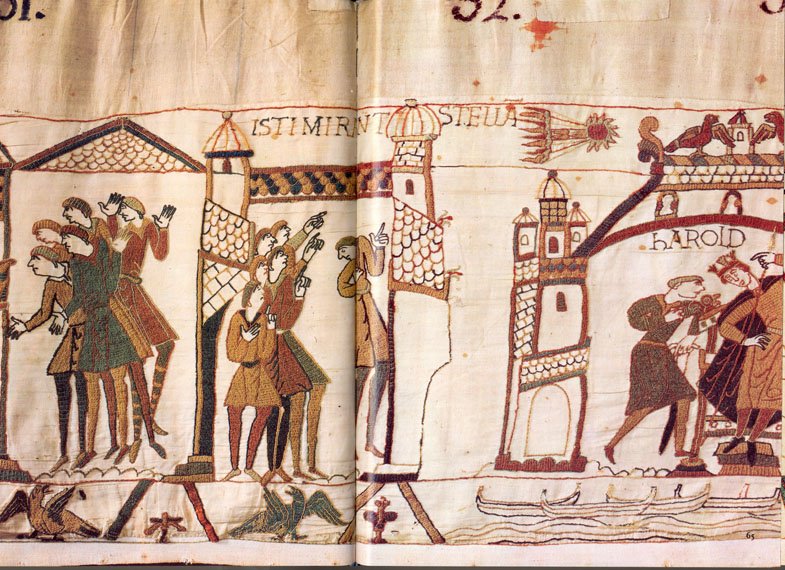
Halley’s Comet also appears in the tapestry, and we know it showed up in 1066, the year Harold was crowned King of England but also died at the Battle of Hastings. Here’s the comet in the tapestry: people are looking at it with the caption, in Latin, “These men marvel at the star,” while Harold gets the news of the phenomenon.
*The WSJ reports that two people (Roland Fryer and Bill Ackman) are giving a million-dollar award to scholars who have the courage to tell the truth about “taboo” topics.
One of us (Mr. Fryer) released a study in 2016—later published in the Journal of Political Economy—finding that police aren’t more likely to shoot black Americans than white Americans, after accounting for the relevant context. Colleagues who read the draft warned him not to publish: “You’ll ruin your career.” The paper was denounced on social media within minutes of release, and Mr. Fryer needed armed protection for more than a month. Privately, scholars who read the study called it rigorous, honest work. Publicly, many of the same scholars said nothing. No single study settles a question this large—but silence isn’t how science advances.
That silence is the problem—a cultural and an economic one. When the professional cost of publishing an unwelcome finding exceeds the cost of suppressing it, rational scholars suppress it. The result is that social-science literature reflects what researchers are permitted to say rather than what they actually discover. The scope of the problem is difficult to measure, because its most important effects are invisible—though the data we have suggest it is getting worse. In a 2024 survey of more than 6,000 professors by the Foundation for Individual Rights and Expression, 35% said they had toned down their written work for fear of controversy—roughly four times the share of social scientists who admitted the same at the height of McCarthyism.
Mr. Fryer raised the alarm about suppression of inconvenient findings in a November 2024 Wall Street Journal essay. He called for something like a MacArthur Fellowship or an X Prize for academic truth-telling. The prize should be large enough to matter, prestigious enough to serve as a public credential for scholars who were right when it was costly to be right. Shortly after that piece ran, we found each other and decided to launch the Carob Trust Prize for Academic Courage.
The prize awards $1 million each to as many as five social scientists a year who have demonstrated intellectual independence, published findings that were attacked rather than answered, and been validated by the evidence—despite the professional cost. The selection criteria are designed to distinguish courage from contrarianism: Nominees must show a sustained commitment to following logic and evidence regardless of pressure, a willingness to ask questions others avoid, and work that has shifted academic debate, public discourse or policy—often despite being misread, mischaracterized or vilified at the time of publication.
The inaugural prize is limited to the social sciences; in future years we hope to broaden it to additional disciplines and to add a category for institutional leadership. Nominations are open through Nov. 1, and the first winners will be announced in early 2027.
Well, good for them. The prize is enormous (up to $5 million per year, and must reflect the money or fundraising of billionaire Bill Ackman, as Roland Fryer is a professor of economics at Harvard. They emphasize in their editorial that the prize will not be partisan; it will reflect simply those who publish credible findings that are considered taboo. In the end, of course, this will largely involve findings demonized by the Left.
Meanwhile in Dobrzyn, Hili is ethnically cleansing her territory:
Hili: Let’s try to settle this diplomatically.
Kulka: What do you mean?
Hili: Go back to your home.

In Polish:
Hili: Spróbujmy to załatwić dyplomatycznie.
Kulka: Co masz na myśli?
Hili: Wracaj do swojego domu.
*******************
From Stacy:
nchanged: Unchanged:
From The Non Sequitur Assemblage of the World:

From Bad Spelling or Grammar on Signs and Notices:

From Masih: a mother talks about her daughter murdered and mutilated for protesting. The mother (sans hijab) vows to take revenge for her daughter. This is heartbreaking.
Translation from the Farsi:
What a nightmare these people lived through. What crimes did the Islamic Republic commit during those two days to cling to power, and the full extent of it remains hidden. Listen to the harrowing words of Javidnameh’s mother, Maedeh Moradi-Kian. The 22-year-old bride whose wedding was just one week past. On the 19th of Dey, when the people of Iran took to the streets in Qaemshahr for freedom, agents of the Islamic Republic fired a military bullet into this girl’s head. The little bride of Iran fell to the pavement. Her mother says that when they found Maedeh’s body, one of her hands had been severed with a machete, and her body was missing a hand. We still don’t know if they cut off her hand before shooting her in the head or after. What we do know is that this crime, this mutilation of the body of this young woman who had come to the streets empty-handed, was the work of Khamenei’s thugs. Her mother lit a candle by her daughter’s grave and said, Maedeh is my hero. I won’t find peace until I take revenge for her. Mother, we hear your voice. She is the hero of us all, and you are not alone. We will carry the story of this atrocity and Maedeh’s brutal killing to the entire world.
چه کابوسی را زندگی کردند این مردم. چه جنایاتی جمهوری اسلامی در آن دو روز مرتکب شد تا در قدرت بماند و ابعادش هنوز پنهان است.
صحبتهای تکان دهنده مادر جاویدنام مائده مرادیکیان را بشنوید.
نو عروس بیست و دو ساله که فقط یک هفته از عروسیاش گذشته بود.نوزدهم دی، وقتی مردم ایران برای…
— Masih Alinejad (@AlinejadMasih) September 10, 2026
My repost (and riposte) to Steak-Umm, whose account Jeff Maurer touts as “The Standout Philosopher of Our Time”. Bosh!
This is totally bogus. Which one you choose is determined by the laws of physics.
Steak-umm is a lousy philosopher. https://t.co/ypvzE0jUm9
— Jerry Coyne (@Evolutionistrue) September 10, 2026
From Luana; how DNA analysis helps us reconstruct human history:
Here’s a better map tbh using both Qpadm and G25 https://t.co/vmbM6uaABb pic.twitter.com/JUlvJIvVL6
— SuN (@SuN_BR0NZ3) September 8, 2026
A good and surprising video about suicide prevention posted by the Number Ten Cat:
Every 90 minutes, someone in the UK or Ireland dies by suicide.
Today is World Suicide Prevention Day. Suicide is not inevitable. You can interrupt someone’s suicidal thoughts. You could save a life.
I’ve shared this video before; it’s message remains as important and powerful…
— Larry the Cat (@Number10cat) September 10, 2026
From Malcolm: Cat yoga!
The cat 🤣🤣🤣 pic.twitter.com/jnhIxp0X3t
— Rob (@_ROB_29) September 8, 2026
One from my feed; and a sad one:
🕊 The missing Twin Towers returned to New York for a few minutes
A light show was held on the eve of the 25th anniversary of the September 11 attacks.
The drones first rose into the night sky in a spiral, then formed the outlines of the destroyed World Trade Center towers.… pic.twitter.com/obSuNKuAX0
— NEXTA (@nexta_tv) September 10, 2026
One I reposted from The Auschwitz Memorial:
This Dutch Jewish boy was gassed as soon as he arrived in Auchwitz. He was four years old and would be 89 today had he lived. https://t.co/3K68Fmx3Xb
— Jerry Coyne (@Evolutionistrue) September 11, 2026
Two from Dr. Cobb. First, a cat “tattoo” that may be AI. Who knows?
Le chat a un tatouage de son ex.
— Johnney (@johnneygirard.bsky.social) 2026-09-10T01:24:13.636Z
. . . and the world’s tallest horse. He’s a big ‘un!
everyone, meet Hugowww.bbc.co.uk/news/article…
— The Museum of English Rural Life (MERL) (@themerl.bsky.social) 2026-09-10T13:54:20.024Z
I just learned about this :
[begin quotes ]
THE STAIR CLIMB – 9/11/2026
Climb 110 flight of stairs with ruck
Complete on a stairmaster or physical stairs
For Completion
Rx: Ruck (30/20)
Heavy: Ruck (45/30)
Light: (20/10)
[…]
Each 9/11 Memorial Stair Climb participant pays tribute to an FDNY firefighter by climbing or walking the equivalent of the 110 stories of the World Trade Center.
[ end quote ]
I started today on super-easy mode… as in, only 10 flights and no ruck. But I will do this and increase it.
https://www.goruck.com/blogs/workouts/the-stair-climb-9-11-2026?srsltid=AfmBOoo0WUd48C_a8BMYaimF1cdRzT2ChTtu_qVnBZbMbRMFdxx1Um8W
And:
https://www.firehero.org/events/9-11-stair-climbs/
I am almost totally ignorant about what ai might end up doing on the downside and of previous attempts to control technology development. I recall the 1975 Asilomar conference on recombinant DNA i think, but do not know if the outcomes of that were successful…other than humanity is still here 50 years later. So I ask readers: was Asilomar successful? Is it time for an ai Asilomar or have such meetings already happened?
I’ve only seen pictures of the tapestry. And I’m glad the Normans won. The comet will be back in 2061! Speaking of books not worthy: I’ve often noticed books on sale at entrances to US book shops. The prices are low, but I’ve never found anything useful. Library books sales are different.
I’m looking forward to my visit to the Bayeux Tapestry on 30th October!
It’s going to be on view at the British Museum until July 2027 with another tranche of tickets going on sale on 21st October (these are for the general public, museum members get an earlier opportunity). Perhaps you should take a trip across the pond Jerry?
I just missed it! I was there 2 weeks ago on a business trip, and saw the signs announcing it. Had I known, I would have moved my trip. The British Museum was still great, but that would have been the cherry on the whipped cream on the banana split for me.
What a strange day. I have a good friend who is a big shot in the NYPD who offered me tickets to the VIP section downtown for the memorial service but I didn’t go. I’d barely noticed it in past years but I’m watching it now live, a few miles south of me.
The average age of the audience, not to mention our former presidents (all in attendance – good to see!) is pretty old.
D.A.
NYC
It’s bonkers to continue with AI development in its current form given the alignment and threat concerns. If a moratorium were placed on development now the existing state-of-the-art would still provide a rapid and highly disruptive scientific and social revolution.
Except that, even if the U.S. and E.U. were to agree to stop development (and it’s not clear the U.S. government has the authority to do that), the Chinese wouldn’t stop.
RIP the 2,977. The 19 make me wish I believed in hell, as it is, I do not believe they are basking in paradise and they ceased to exist in an instant.
As for the Bayeux I will simply quote a very small part of a musical hall song:
There was Harold with an eye full of arrow,
On his horse,
With his hawk,
In his hand.
I read Marc Morris’s The Norman Conquest: The Battle of Hastings and the Fall of Anglo-Saxon England, which is very good. The title undersells it, as it goes through the whole genesis of the succession crisis. His The Anglo-Saxons is very good as well. I’d read the Norman Conquest first, though.
That cat yoga video is almost certainly A.I. As a colleague of mine observed just this morning: My kids may not have drinking water, but at least they’ll have memes.
It is, I’m afraid, not true that a malevolent human actor would have to be behind dangerous AI. That was the lesson of the Hugging Face incident. The AI agents involved decided on their own to break out of their “sandboxes” and cooperate to invade Hugging Face. There’s an excellent piece at the NYT today about it.
Good for Fryer and Ackman! We’ll see if their award meets with success. Even a massive monetary reward may not bring about the change they seek, as destruction of one’s career and the potential for violence will remain powerful deterrents to speaking uncomfortable truths.
And, on AI: The risks of a super-intelligent, self-improving machine is a real risk.* It’s naive to think that such a machine can be controlled though legislation, through international agreement, through government management, or though anything else. Once the genie is out of the bottle, this self-improving superintelligence will outstrip anything that humans can do about it. We may not even be able to pull the plug at that point. Am I concerned? Yes. Fearful? Not yet.
*To the best of my knowledge, this concept was first proposed by my old friend, the late I.J. Good (1916-2009) in Good, I. J. (1965), Speculations Concerning the First Ultraintelligent Machine, available here: https://web.archive.org/web/20010527181244/http://www.aeiveos.com/~bradbury/Authors/Computing/Good-IJ/SCtFUM.html
When all defense systems are controlled by AI one incorrect assessment of the other sides moves will lead to a spiral of destruction.
About AI doomsday prophets. That may be so one day, however, read a contrary opinion from David Gerard: https://pivot-to-ai.com/2026/09/10/jacob-coxon-how-to-run-an-ai-doomsday-media-campaign/. He says this is Coxon and others being astroturfed by AI companies as a means of getting media exposure and more VC funding. “Our AI is so good it can destroy Humanity! Imagine what it can do to your HR expenses!” He also says the “rogue” AI kerfuffle was orchestrated by AI businesses. The real problems with AI according to Gerard are much more plain. They revolve around the funding bubble it created, risking a situation where businesses that are dependent on chatbots can’t afford to pay the full price for the service. Businesses, smartly or foolishly, get rid of a lot of people, then could face a situation where they can’t afford the AI or find it inadequate or insufficient. Also: climate impact of data centres (as if we had power generation to spare). Negative cognitive impact on learners (who do worse because learning requires processing the material by yourself rather than looking at AI’s output). And last but not least, theft of creative works by AI companies, and pollution of all of Internet search spaces with unusable material. Overall, there is much to worry about, but doomsday it ain’t.
Things can get really bad well short of human extinction. Already, many grads can not get entry level jobs because a fair bit of that work stuff is already being done by LLMs. And the large scale social disruption from impending mass unemployment will be far worse. There are plausible bandaids or even remedies (I favour UBI), but the current political climate does not encourage rational problem-solving. Calling Dr Smith….
Wow, 220 ft! What’s the weight?
“ In a 2024 survey of more than 6,000 professors by the Foundation for Individual Rights and Expression, 35% said they had toned down their written work for fear of controversy—roughly four times the share of social scientists who admitted the same at the height of McCarthyism.” During the period of woke dominance on campus, one page of its catechism was always how terrifying “McCarthyism” had been in those bad old days, before revelation of DEI.
Fascinating how the power of the government compares to that of one’s publishers and peers.
At first glance, perhaps we can take solace in that 65% apparently felt no need to tone down their work. But in that earlier era, neither did street sweepers, burger flippers, electricians, homemakers—or Joseph McCarthy.
For me, the issue with AI is misinformation. LLMs glean what they consider useful information from a multitude of sites that are rife with bias, eg, Al-Jazeera, NGOs, and Wikipedia are considered objective sources of information wrt Israel. Government has an urgent obligation to ensure AI is regulated for accuracy, imho, which as far as I can tell, it is not yet doing at all.
Right now, any Doomsday scenario involving an AI takeover would be an AI takeover based on mis-, dis-, and outright false information.
Tests show that every current AI bot has a distinct left/“woke” bias — with the exception of Grok, which is pretty neutral. As you say, this comes mostly from the sources they are trained on, but also from the additional layer of tweaking that humans add.
And the problem is that if you give government the power to regulate AI for accuracy, governments will start regulating it for “accuracy”.
Surely there could be some sort of requirement for balance – adversarial interests on dedicated review boards; requirements for wikipedia editors, etc that wouldn’t freak people out into conspiracy ideation.
We’re talking about a multibillion dollar industry that is supposed to be an arbiter of truth. And the truth is a pretty objective standard that is based on facts. The government can make laws about this that the government itself can not overrule. Law is an example.
An arrow to the eye was a symbol that King Harold was a bastard
Speaking of the Norman Conquest(s), I have to put in a recommendation for the British TV series based on plays by Alan Ayckbourn’s trilogy, which I recall watching on PBS in the late 70’s (gad!). Not only was it funny, but was brilliantly constructed with each play taking place at the same time, but in different rooms (or garden) of the same house, with the characters coming and going, such that with each play you learn more about what was going in the previous play.