Why Evolution is True is a blog written by Jerry Coyne, centered on evolution and biology but also dealing with diverse topics like politics, culture, and cats.
Welcome to The Cruelest Day: September 22, 2026 and the day of my cataract surgery (I am iatrophobic). As you read this, I will be having the lens of my right eye emulsified and sucked out, then replaced with an artificial lens. I have to admit to some apprehension.
NOTE: Because I have to go home and rest after the surgery, I won’t have time this afternoon to prepare a Hili for tomorrow, and because tomorrow I must go downtown to have the eye patch removed, there will likely be no Hili on Thursday, either. Bear with me; I do my best.
In the Northern Hemisphere it’s also the first day of fall, known as The Autumnal Equinox. which begins at 6:05 p.m. Eastern time in the U.S.
The autumn equinox is one of two days when all points on Earth except the polar regions see the sunrise and set at due east and due west. With few exceptions, all latitudes see almost precisely 12 hours of daylight and 12 of darkness.
President Donald Trump said in a Truth Social post Sunday that he would convert plans for a Washington, D.C.-area “Triumphal Arch” to those for “a top grade Military Complex/Triumphal Arch” at the request of the U.S. military, citing “national security.”
The new plan, he said, is to “house, store, and have the rapid ability to use large numbers of drones, plus Snipers, on both the roof and plaza areas, and additionally have and hold large quantities of sniper ammunition in storage.”
Reached for comment, a Pentagon spokesperson said the department has “nothing additional to provide beyond the post.” The White House declined to provide additional information.
His post marked a significant change in plans that had already been in progress, as the Trump administration had announced earlier this month that it was preparing to break ground in the coming weeks.
The proposed 250-foot arch project, which would sit in a roundabout between the Lincoln Memorial and Arlington National Cemetery, has faced legal challenges from veterans and historians. The project area sits on the Potomac, across from Washington.
The arch proposal has already passed key hurdles, though it’s unclear how Trump’s announcement could affect the prior approvals. In April, the project obtained approval from the Commission of Fine Arts, which is now composed of the president’s allies after he fired previous members. In July, the National Capital Planning Commission, which is led by Trump appointees, approved the preliminary site and building plans. The arch, which would sit a few miles from Reagan airport, also passed the Federal Aviation Administration’s air safety standards last week, with the administration announcing that it “would not pose a hazard to aircraft.”
Rep. Don Beyer, D-Va., whose district includes Arlington National Cemetery and is adjacent to the proposed site, slammed Trump’s plan in a post to X.
Here’s the tweet:
Putting a drone launching site directly in the landing path for DCA is a stupid, dangerous, and unworkable idea.
Trump clearly expects to lose a lawsuit and therefore wants to set up a pretext to argue that the arch is tied to national security. Which is obviously idiotic. https://t.co/YIMlIm65TR
The project appeared poised to move forward imminently. Interior Secretary Doug Burgum announced on Sept. 3 that the administration was preparing to start excavation work “over the next two-week period.” U.S. District Judge Tanya Chutkan ordered the Trump administration to provide 48 hours’ notice before it starts “any activity” on the arch, other than work to determine whether there are archaeological resources on the proposed site.
What can one say but “0y vey” (if you’re Jewish)? Why turn a decorative arch into a weapons site, also making it a target for terrorists? Only if you want to justify the arch (like Trump justified the White House ballroom) as being of crucial importance to National Security.
*As expected, CNN, Politico, and MS NOW are suing Trump, who excluded the venues from the White House and deep-sixed them from its press pool. But the t.v. networks struck back, banding together to black out all television coverage from the White House:
The decision marks an escalation of tensions between the press and the Trump administration after the president announced last week that he would ban CNN, MS NOW and Politico from the White House.
The three news outlets said earlier Monday that they were suing the Trump administration over the ban.
In a joint statement early Monday, the outlets said they were filing the suit to “protect our First Amendment rights and defend the principle that the government does not decide what the press reports or publishes.”
Theodore J. Boutrous Jr., a lawyer representing CNN, MS NOW and Politico, called the ban “a direct assault on the First Amendment and a blatant violation of due process.”
. . . Major television networks agreed on Monday to suspend a rotation of broadcast journalists who cover President Trump after the White House removed CNN from a planned assignment covering the president’s trip to New York.
“Effective today, the TV pool will not be covering events designated as pool coverage of the President,” Bryan Boughton, the Washington bureau chief at Fox News wrote in an email to pool members. “This follows the White House’s position preventing CNN from fulfilling its assigned pool duties.”
The White House press pool is a rotation of reporters, videographers, photographers and technicians who cover the president when he travels or when he conducts events in spaces that are too small for the entire press corps. Monday’s decision suspends—for now—the television press pool, which distributes video footage and reporting about the president to TV networks and other broadcast outlets.
“The public has a vital interest in receiving accurate, independent information about its government,” White House television pool members Fox News, ABC News, CBS News, CNN and NBC News said in a statement. “No administration should restrict a news organization because it objects to its reporting.”
I don’t know whether other media, like print and/or radio, are part of the pool, and whether they’re still participating. This will take some of the wind out of Trump’s sails as he delights in getting attention. Now he’s not getting it from television networks, at least in the pool coverage.
The Senate prediction is 3 states favoring Democrats, 2 favoring Republicans, and 7 states being tossups.
It’s a critical couple of weeks for Representative Mike Collins, the Republican nominee in Georgia, and Michael Whatley, the Republican nominee in North Carolina.
Both have consistently trailed in polls, and Republican strategists are actively discussing whether to cut bait, especially on Collins, as The Times reported last week.
At a donor meeting earlier this month in Dallas, Collins was notably missing from a slide presentation of the party’s top
“quality” recruits this cycle — though he was in the room as the presentation was made.
Republicans haven’t given up on Georgia or North Carolina. President Trump campaigned for Whatley last week in North Carolina. Vice President JD Vance will be there on Monday. And Senator John Thune of South Dakota, the Republican majority leader, is headed to Atlanta on Thursday to headline a fund-raiser for Collins.
But as Thune said last week, Republicans “obviously make decisions when it comes to resources” on a stretched map.
Translation: Improve soon in the polls — or else.
For the House, 9 districts are leaning Democratic, 7 leaning Republican, and there are 21 tossups.
Republicans are seeing the same polls that the public is. The Times measured a nearly 9-percentage-point edge for Democrats on the congressional ballot last week — akin to the margin in the 2018 Democratic wave.
But Republicans are openly hoping those numbers are understating G.O.P. support.
“None of us should put any stock in polls anymore because they are wildly inaccurate; we all know that,” Speaker Mike Johnson said last week at the Capitol. “We know this is going to be a tight race. It is going to be decided by about 20 jump-ball swing districts around the country.”
His math is not wrong. The Cook Political Report currently rates 206 seats as leaning Democratic and 208 as leaning Republican. Democrats will need to win a majority of the 21 tossup seats to win.
I’m no pundit so I’ll refrain from predicting anything. But clearly the Republicans are going to lose quite a bit of Congress this time. If the Senate goes 50/50, it will effectively be Republican since VP Vance will be the tiebreaker.
*The WaPo has joined the chorus of media that recognize the value of standardized test in an editorial board op-ed called “A multifront war against educational accountability” with the subtitle, “New York drops Regents exam as a graduation requirement and conceals AP test results” (article archived here).
If teachers unions put as much effort into improving test scores as dodging accountability, students in New York’s public schools would have markedly better chances for success in life.
The New York State United Teachers union rallied again last week to pressure Gov. Kathy Hochul (D) to reverse her decision to opt into a federal tax-credit scholarship program that would benefit students. Union bosses fear it would boost enrollment in private and religious schools, where it’s harder for unions to collect dues.
No wonder NYSUT feels threatened by more competition: Only 48 percent of New York public school students in grades three through eight can read proficiently, according to preliminary assessments released last month by the state. Bad scores aren’t for lack of investment: New York spends more per pupil than any other state.
Instead of rising to the challenge, NYSUT would prefer the state water down standards. “More teaching, less testing” is the union’s mantra. Manhattan Institute fellow Jennifer Weber told us, “They don’t want the tests because they don’t want to be held to the data and the outcomes.”
Last week, the unions won a big battle in their crusade against accountability when the New York State Board of Regents voted to end the use of the Regents exam as a high school graduation requirement. Though students will continue to take the test, the board says it will develop a different set of graduation requirements, such as being a “critical thinker” and “effective communicator.” But how will those skills be measured?
. . .New York’s Education Department has joined the anti-transparency brigades by blocking U.S. News & World Report from gaining access to the state’s Advanced Placement scores. New York claims it’s protecting student data from being used for a “commercial product.” In reality, suppressing aggregate data on AP scores covers up the shortcomings of public schools while handicapping higher performing alternatives, such as the charter network Success Academy.
One of the network’s high schools was ranked 11th in the state last year when U.S. News factored in AP scores. This year, without the AP scores available, the school fell to 196th. Success Academy is suing the state and deserves to win.
I’ve come to realize that teachers unions are among the biggest opponents of merit as a metric for advancement in schools, but New York’s Education Department? And they block AP scores so the shortcomings of the states’ schools aren’t evident (the “commerical product” argument doesn’t wash). Oy again!
While that commission of inquiry may never come, a new book offers the most extensive analysis to date of the war, and the behind-the-scenes decisions and debates that shaped its trajectory. In the War Room, released this month, is a riveting—and at times infuriating—look inside the deliberations that drove Israel’s multifront war against the Iranian Axis from 2023 to 2025. Co-authored by Israeli journalist Yonah Jeremy Bob of The Jerusalem Post and American journalist Elliot Kaufman of The Wall Street Journal, the book takes readers inside the conversations—both within Israel and between the U.S. and Israel—that produced the war’s greatest achievements and failures.
. . .As the book progresses, a pattern becomes obvious: Litanies of stunning Israeli military successes are repeatedly offset by colossal mistakes and miscalculations, egotistical infighting, and a jaw-dropping failure to reassess assumptions about Hamas. Indeed, this is the first time it’s been reported that Netanyahu did not speak to the head of the IDF until four hours into the Hamas invasion.
The authors make it clear that the failures that led to October 7, and the disastrous mistakes made that day, belong to all involved. “Israel’s prime minister, cabinet, military, intelligence agencies, and opposition all wore the same blinders,” write Bob and Kaufman, referring to the belief that Hamas was incapable of a mass invasion of Israel and that it favored quiet over confrontation. Still, they add, “the buck must stop with the prime minister. On some level, he knows that.”
. . .According to documents retrieved by the IDF in Gaza, former Hamas leader Yahya Sinwar planned the October 7 attacks with two overarching goals. The first was to thwart the Saudi-Israeli normalization agreement that the Biden administration was close to securing. The second was to lead Israel into a long and grinding invasion of Gaza that Hamas had long prepared for and Israel had not, and that Hamas knew would result in the deaths of many thousands of Palestinian civilians. The ensuing humanitarian crisis, Sinwar predicted, would turn Israel into an international pariah.
It is hard to argue with the fact that both of Sinwar’s goals were achieved. Israel’s international standing has seldom been worse, and Israel is now a bitterly divisive topic on both sides of the aisle in the United States. It is an open question whether the next American president—representing either party—will sever ties with the Jewish state. The prospect of normalization with Saudi Arabia, briefly revived by the Biden administration, was laid to rest by Netanyahu’s rejection of the conditions that agreement required. Today, relations between the U.S. and Saudi Arabia are frayed, with the U.S. rejecting Saudi requests for aid as the kingdom faces renewed attacks from the Houthis. Prospects for normalization are muddled at best.
As for the military successes achieved in this war, many have failed to stick. As the book explains, the same Hezbollah that was supposedly decimated in the 2024 pager attack rose from the ashes to terrorize Israelis in 2026, emptying northern Israeli towns and killing dozens of soldiers. Meanwhile, the Iranian regime—the benefactor of Hezbollah and Hamas—survived the unprecedented American-Israeli attacks, leaving its ballistic missiles and nuclear program largely intact.
There’s a lot more, and you can read it if you subscribe. Schwartz seems to think that the solution to the whole problem was to somehow replace Hamas with the Palestinian Authority. That is dumb for two reasons: Palestinians in both the West Bank and Gaza prefer Hamas to the Palestinian Authority and the Palestinian authority is still committed to terrorism.
The book (click the link to go to the distributor’s page):
Meanwhile in Dobrzyn, Hili sees the despised Kulka outside:
Hili: Our neighbor pretends she doesn’t see me. Andrzej: Use the same method of coexistence.
In Polish:
Hili: Nasza sąsiadka udaje, że mnie nie widzi.
Ja: Zastosuj tę samą metodę kohabitacji.
From Masih, a heartbreaking voice message from an Iranian woman who may be about to be executed:
Hello everyone, this is a message from inside prison, from a young Iranian woman who is about to be executed. Please help me to amplify her voice before they hang her. 💔
«Remember my name, maybe I will not be able to speak again.»
And one I reposted from The Auschwitz Memorial. This brother was selected to work in the camp, but decided to stay with his ten-year-old sister. Both, Jews from Czechoslovakia, were then put to death in the gas chamber.
22 September 1932 | Czech Jewish girl, Vera Taglicht was born. As a refugee she went to Norway.
She was deported to #Auschwitz with his brother Tibor in March 1943. Tibor was selected as able to work. He asked to stay with his sister. They were both murdered in a gas chamber.… pic.twitter.com/Bfu0oJ9Lcv
Two from Dr. Cobb. First, listen to the coyote chorus:
Sunrise song. You'll want the volume up for this one, but not too high. Every coyote within a half kilometre radius decided to make themselves known this morning while I was enjoying the sunrise from the kayak. A truly magical moment. #mammals 🌿
Welcome to Monday, September 21, 2026: the last full day of summer and the second and final day of Yom Kippur, the holiest day in the Jewish calendar. Yom Kippur ends at sundown, and observant Jews who have fasted and refrained from drinking can start ingesting then.
It’s also National Chai Day. I’ve been drinking the stuff for decades, since I first went to India, but now it’s become very popular (in various forms, like lattes) in America. Here’s how the really good stuff is made in a street stall; note the high pouring from vessel to vessel (6:05) that cools the tea and foams the milk. The chaiwallas pride themselves on the height of their pour.
A nice cup of chai I had ten years ago in Bangalore (Bengaluru):
Posting will be light tomorrow, and perhaps for several days thereafter, as I have to have the lens in my right eye pulverized, sucked out, and replaced with an artificial one. Such are the ravages of age.
CNN, MS NOW and Politico said their journalists were denied access to the White House grounds early Saturday and that their press passes were confiscated, a day after President Donald Trump said he would ban them — and that other media organizations would follow.
Numerous press freedom organizations said the president’s attempt to ban journalists from reporting at the White House was an unconstitutional attack on Americans’ free speech and right to know what’s happening in government.
“The First Amendment extends to White House grounds as strongly if not more than pretty much anywhere,” said Seth Stern, chief of advocacy at Freedom of the Press Foundation. “It’s the people’s house; it’s the center of government.”
The media organizations all said they would fight the restrictions and continue reporting on the president. CNN and MS NOW journalists began reporting across the street from the White House on Saturday.
“The White House belongs to the American people and the decisions made inside are funded by our tax dollars,” MS NOW said in a statement. “MS NOW intends to take any and all steps necessary to defend our First Amendment rights and the essential role of independent journalism in our democracy.”
Akayla Gardner, a White House reporter for MS NOW, described on air how she tried to scan her badge to enter the White House grounds but was told it was “disabled.” An MS NOW producer who was with her was able to enter, but a photographer “had their badge taken this morning,” she added.
It’s clear now that what Trump means by “fake news” is “news I don’t like”, even if that news is true. But this decision will not stand, for it’s a clear violation of the First Amendment and, if it stood, would allow any President to exercise censorship over news he didn’t like. Obama said yesterday, with a chuckle, something like “Imagine if I decided to ban Fox News from my press conferences.”
*In an article in the NYT Magazine (archived here), Nikole Hannah-Jones of “1619” infamy sent her daughter Najya to a so-so public school in Washington, D.C.: an attempt to improve the substandard system by participating in it. It failed; her daughter got a poor education up to middle school:
In an interview in the paper’s morning newsletter yesterday, Jones said this:
I asked her permission to report it in the first place, and then I asked if she wanted to be photographed for the story. She’s angry about the choices that my husband and I made, and she wanted to have her say. Did she really want people to know she had failed algebra after middle school? Her answer impressed me: “Well, it’s true.” But when I showed her a draft, she didn’t feel I was hard enough on myself. So I tried to capture the conflict. In the years since my original essay, I’ve moved through the world with the unearned valor of people commending me for the strength of my choice. Now I felt I owed it to her to tell the truth.
I could feel her looking at me. Her body slung in adolescent impertinence against the front passenger seat door, shoulders turned so she could face me fully. Usually when I picked up my daughter, Najya, from middle school, she’d tumble into the car and bombard me with the day’s escapades, chattering nonstop about her friend group or complaints about an annoying teacher or her wonder at the test she’d aced despite thinking she’d failed it. But not this day.
“Did you know my school was bad like this when you decided to put me here?” she asked.
My hands tightened on the steering wheel as I worked to keep my face neutral, buying a few moments to gather my thoughts.
As they neared the end of her seventh–grade year, Najya and her closest girlfriends were thinking about their futures. Honors students, they searched the nation’s top colleges, and that led to a curiosity about New York City’s highest ranked public high schools.
Wondering about their chances of getting in, they decided to Google their own school and its ratings. And in doing so, Najya and her tight trio of Black girl nerds confronted not only the reality of the city’s deeply segregated educational landscape but also that the Brooklyn school they all attended existed firmly on the wrong side of the divide.
By dismissal time, Najya’s shock had turned to boiling, and the seatbelt had barely clicked before she was confronting me.
. . . So, like the generations of Black parents who came before us, Faraji and I felt an obligation to make educational decisions based on the collective good and not just our individual advantage. New York is considered one of this nation’s most liberal cities, while operating a school system that is among the most racially segregated. This segregation exists because policymakers and affluent parents — even those who profess a belief in integration and equality — shed their advocacy at the schoolhouse door and refuse to take or support any substantial action to integrate the city’s schools. Faraji and I decided that our role in this struggle meant upending the status quo and sending our child not to a wealthy white school but to a poor Black one.
. . .We thought by sending Najya to a mostly low-income and Black school, we could help improve it for all the children there. From my past reporting, I knew that P.T.A.s at poor schools often can raise only a few thousand dollars, but Faraji and I could write checks that exceeded the annual P.T.A. budget. I witnessed how dismissive school officials could be to lower-income parents who lodged complaints or made demands for resources and how deferential they were to wealthy ones. I believed Faraji and I could bring some of that power with us. We had connections and time and status that should not matter, but that we all know do. And more than that, we believed strongly that if families like ours went into schools like this one, it would challenge other families with similar values to do the same.
After much internal debate in our household, in 2015, we enrolled Najya in pre-K at Public School 307, a segregated, high-poverty school across from the Farragut housing projects in Brooklyn.
. . .“So you had money to send me to one of the best schools, and you chose not to?” she said, hurling her words. “Because other kids are disadvantaged, you didn’t want to put me in a great school?”
Najya was asking what I’d accomplished by not choosing the “best” school for her. And the honest answer is, I don’t know. When it comes to the choices my husband and I have made about public education, these days I feel that I failed both my values and my child.
Luana has pointed out to me, though, that the school where Hannah-Jones sent her daughter was actually quite well endowed. Here’s a tweet from Wilfred Reilly.
This is the profile of a failing school.
A taboo but obvious truth is that the #1 thing that determines how a school performs is the students entering it. pic.twitter.com/GLQlItsUzi
But in the end, it remains a sad story. Ultimately Najya got to choose her own high school—a selective public school that was mostly white, but she was floundering (even in math, her favorite subject) because of a substandard education in lower grades. And Hannah-Jones is clearly overcome with regret. What it goes to show is that you shouldn’t force your own values on your children, especially if it could hurt their welfare. Jones ends with an indictment of racism and the “riches” of white people.
*The WSJ reports on “The twin sisters facing the wrath of Iran’s crackdown” (subtitle: “Romina and Taraneh Rahimi were detained in January after a wave of protests. One was sentenced to decades behind bars; the other condemned to death”).
Taraneh Rahimi was staying with friends on the night of Jan. 24 when masked, armed men barged into the house, put a bag over her head and took her away. They later came for her twin sister, Romina.
For months after that, their loved ones didn’t know where they were, or whether they were even alive. Their mother searched for her 20-year-old daughters everywhere, begging staff at hospitals, in courts and outside prisons for information about them, to no avail.
In April, she received an anonymous call, a family member said. “Your daughters are at Dowlatabad Prison. You can book an appointment to see them,” the caller told her.
When she finally saw the twins again, in Isfahan’s female prison, their mother could hardly recognize them. Their faces were puffy and there were bald patches where their hair had been ripped out. They recounted harrowing tales from their time in detention, where they were tortured and sexually assaulted, according to information obtained by relatives and lawyers who reviewed their case.
An Iranian government spokesman didn’t respond to a request for comment.
Their crime? Peaceful political protest, of course, and now one of them may die but both will be in a dire prison for a long time—for protesting, for crying out loud.
The Rahimi sisters were among 16 defendants detained over their alleged role in the unrest around Shohada Square in Isfahan earlier this year. The central Iranian city, known for its blue-tiled Islamic architecture, has emerged as a focal point of the continuing judicial crackdown.
. . . The twins spent the first three months in a detention center run by the intelligence arm of the Islamic Revolutionary Guard Corps, where they were tortured and sexually assaulted.
A lot of the torture was psychological, according to information obtained by relatives and human-rights lawyers familiar with the case. The sisters were held separately in isolation, but they could hear each other screaming and crying from a distance. They were made to watch male prisoners being tortured. Taraneh suffered severe physical injuries when she was repeatedly beaten with a baton on her leg, knee, hand and arm, according to the lawyers and relatives.
. . . . The twins turned 21 in prison. At the end of August, Taraneh, along with nine others, was sentenced to death. Romina received a 25-year prison sentence. The convictions could be appealed, but rights groups worry the executions could be fast-tracked.
Taraneh’s relatives fear she could soon be the first woman to be executed in Iran in connection to the protests. “Every night we fear it could happen,” said Masoud Nourmohammadi, a cousin of the twins who is based in the U.S. “It could be any time.”
Here’s a photo of the twins supplied to the WSJ by their family; the caption’s from the paper. They’ve already been beaten and sexually assaulted; this is what Masih keeps writing about in her twitter feed (see below).
Taraneh, wearing red, and Romina Rahimi, pictured a few months before they were taken away. Family of Taraneh and Romina Rahimi
*Over at the Times of Israel, Amit Segal describes “How Hamas stopped and started the presses,” showing how the terror group controlled all the news coming out of Gaza.
It’s Sunday, September 20, and the most revealing sentence spoken from Gaza’s press corps this year came on a podcast from one of its greatest stars. “If someone says something like this, many journalists lower the camera.”
That is Motaz Azaiza—one of TIME’s 100 most influential people of 2024, GQ Middle East’s man of the year—explaining how, when faced with dissent, the Gaza media complex fixes the narrative on Hamas’s behalf.
Speaking on the Palestinian podcast Taqarob, Azaiza described a WhatsApp group that “all the Gaza journalists are in.” For anyone picturing a professional association: its icon is a Hamas flag, and its administrator, he said, is the media director of the Rafah crossing.
Azaiza is no friend of Israel. TIME’s honoree celebrated October 7 and filmed hostages being beaten in a Gaza street, but then promptly buried the footage. When Yahya Sinwar was killed, he told mourners that anyone who had not answered Sinwar’s call to go out and engage the enemy had “no right to mourn and boast about the manner of his death.” Sinwar, he wrote, “wanted you in the field.”
That Gaza is an authoritarian hellscape is hardly worth stopping the presses for. Anyone thinking critically assumed Hamas controlled the narrative from the very beginning. Azaiza’s testimony is less an indictment of Hamas than of the media complex that lapped up its releases.
The Committee to Protect Journalists ran a feature in May of last year in which the head of the Palestinian Journalists’ Syndicate listed Hamas’s methods—summonses, interrogations, threats, beatings, arrests, publication bans, interference with content, surveillance—and his deputy conceded that most journalists in Gaza now censor themselves. One photographer, beaten unconscious by plainclothes police beside Nasser Hospital, told CPJ that when colleagues tried to intervene, they were informed that “the spy and the journalist are one and the same.” CPJ noted the violations were vastly underreported, because the victims were too frightened to say so.
. . .The foreign press has omitted Hamas control since 2008, when Hamas stopped the West Bank dailies at the crossing and told their editors, according to the head of the Palestinian Journalists’ Syndicate, that they could enter Gaza once they signed an undertaking not to criticize Hamas. It broke cover once again in 2014, when, in a rare moment of lucidity, the Foreign Press Association condemned the “blatant, incessant, forceful and unorthodox methods” used against its members in Gaza. A Hamas information official then confirmed it on Lebanese television: the security services, she explained, “would give them some time to change their message.”
When the war began, Hamas already had years of evidence that the foreign press would take what it was served. That is how a single group chat, with no foreign members, set a global narrative.
This is one reason why I trust the IDF more than the press coming out of Gaza. Israeli journlists (many, like those at Haaretz, opposed to their government) don’t have to take an oath not to criticize Israel.
Something different and far more optimistic is emerging at the University of Chicago, including a new, AI-adapted core curriculum. Campuswide work on this topic commenced in the fall of 2024, with the creation of an interdisciplinary group of faculty to consider reforms. The report of this working group provides a simple, principled framework that will guide our changes in curriculum and classrooms. The first goal is that our students should learn during their time with us to be ethical, skeptical and ambitious about the role of AI in their education and their lives. The second is that all students at UChicago should learn to think both with and without machines.
Here, we hold fast to our belief that a core curriculum is the foundation for a college education that supports a life enriched by a love of learning and ideas. In the past, anyone proposing a change in our core curriculum would have to be steeled for a decadelong debate. Yet the urgency of this moment is prompting beneficial changes in tandem at a pace commensurate with the technological transformation.
Our core curriculum—which students largely complete within their first two years—consists of humanities and social science, as well as the study of mathematics and biological and physical sciences, and the study of civilization and the arts. Soon all undergraduates will be required to take a class in writing, without the aid of any machine, and engage in the true struggle. Real writing. Blank page. Tough comments from instructor and peers. The humanities and social-science cores will also exclude technology from the classroom.
In line with the principle that it is important for students to learn how to think with machines, there is broad internal support for the notion that to be an educated person today and in the future, one must be able to use computational tools and concepts within one’s domain, and to reason critically about how computation, data and algorithms shape what can be known and built. Likely, this will result in a new core curriculum requirement for coursework in computational thinking within the next year.
The idea that learning to use AI should be an integral part of learning how to think increasingly cuts across the whole of the university. Earlier this summer, our law school declared that first-year students will be required to learn to write and reason without technology in the classroom or the use of AI. This will be followed by deliberate and thoughtful integration of AI tools and methods in years two and three.
I heartily applaud the course in writing, though I’m not so keen on a course about how to use AI. I suppose they need to know how to use it, but it’s dead easy to learn on their own. I still consider writing skills essential for reasons I’ve stated before.
Meanwhile in Dobrzyn, Hili’s knowledge of art prompts a question:
Hili: Did Rousseau have a cat?
Andrzej: I don’t know, why do you ask?
Hili: I’m wondering where he got the idea of the noble savage from.
In Polish:
Hili: Czy Rousseau miał kota?
Ja: Nie wiem, dlaczego pytasz?
Hili: Zastanawiam się, skąd mu się wzięła koncepcja szlachetnego dzikusa.
From Masih, who argues that the Iranian government is not giving any “freedom” to its people. Au contraire: they are training more authorities to oppress people.
Nobody gave Iranian women their freedom. They took it back. So that is why the regime hired these undercover police to crack down on women!
Matthew posted this himself and says that I MUST see “Amadeus”:
Re-re-re-re-watched AMADEUS. Even better than I remembered. The editing – film and sound – is extraordinary and Abraham deserved his Oscar. A really fabulous, opulent production. As to truth? It’s a fantasy, very harsh on Salieri, but rightly shows Mozart as the voice of God. One of the great films.
Welcome to Sunday, September 20. Yom Kippur, the Day of Atonement and the holiest day on the Jewish calendar, begins at sundown tonight. If you’re an observant Jew, you can’t drink or eat (not even water), nor can you ykiss your wife. And if you’re really observant, you can’t brush your teeth, either, as you might accidentally swallow water. Below you can see a painting of the holiday, labeled “Jews Praying in the Synagogue on Yom Kippur (1878) by Maurycy Gottlieb”.
Wikipedia says this about the painting:
The artist Maurycy Gottlieb appears in the painting three different times, depicted in different stages of his life. In one self-portrait, he is an adult, in another he is a young child, and in the third self-portrait he is depicted as an adolescent. Ezra Mendelsohn writes, “Maurycy himself stands, in a colorful, exotic-looking talith, with head in hand. On the left, we have the artist as a small boy, wearing a medallion with his initials written in Hebrew. On the extreme right is a young male figure, perhaps again Maurycy, reading from the prayer book alongside a man who might well be his father. Malinowski assumes that this is the case when he says that the painting presents ‘an account of [the artist’s] whole life’.”
It has been suggested that the artist placed his fiancée Laura [see below] among the female worshippers, at the right of the column, whispering to another woman (perhaps her mother), and to the left of the column, holding a prayerbook in hand. In the painting, many of the figures are people who are close to Gottlieb or people he knew at the time. As said by the Tel Aviv Museum of Art, Maurycy Gottlieb created this work of art at the young age of 22 years old; a year later, Gottlieb was dead.
The painting was exhibited in Lviv in 1877, and in 1878 at Zachęta in Warsaw and widely acclaimed. Gottlieb based Jessica’s face on that of Laura Rosenfeld, to whom he had proposed marriage. However, Laura rejected his proposal and wed a Berlin banker. According to one biographer, when he heard about Rosenfeld’s marriage, he purposely exposed himself to the elements and died of complications from a respiratory illness. Others cite different reasons for his death, including suicide.
Anthony Bourdain hated brunch, and he explains his aversion to this meal in the last bit of this short video (it will replay, so stop if after listening). It’s also only two days until a guy cuts into my right eye, sucks out the clouded lens, and replaces it. Oy!
An airborne attack targeted jet-fuel storage at the airport in Saudi Arabia’s capital Saturday, marking the first direct assault on Riyadh in months as Yemen’s Houthi rebels squeeze the kingdom’s Red Sea route for its oil exports.
Black smoke could be seen at King Khalid International Airport, in the latest escalation in the attacks targeting the kingdom.
The strike hit jet fuel facilities at the airfield, three officials with knowledge of the incident said. It wasn’t immediately clear if a drone or a missile caused the damage. The Saudi government didn’t respond to a request for comment.
No one immediately claimed the assault, but Iran and its allies have been looking for ways to slow Saudi Arabia’s exports to increase the pain on the U.S. and the world’s economy. Saudi Arabia has been targeted over the last weeks in attacks launched from both Iraq, where Iranian-backed Shiite militias operate, and Yemen, home to the Houthis.
The Houthis didn’t immediately claim the attack. However, there had been a series of alerts sent early Saturday morning by authorities over likely incoming fire, including in Riyadh.
The Houthis have targeted Riyadh’s airport in the past. In 2017, the Houthis launched a ballistic missile at the airfield that Saudi Arabia said it intercepted. They also targeted the airport in 2018 in an attack that killed an Egyptian, as well as in 2020.
In recent years, a tentative ceasefire had held as Saudi Arabia paid the salaries of Yemeni government officials, including those in San’a. That came as the Houthis attacked Israel and struck ships in the Red Sea during the Israel-Hamas war in the Gaza Strip.
. . . U.S. Navy Adm. Brad Cooper, the head of the American military’s Mideast-based Central Command, said in a video statement Saturday that more than 1 billion barrels of crude oil from American allies had made it out of the Strait of Hormuz despite Iranian attacks.
Cooper didn’t provide specifics behind the 1 billion-barrel figure, and the number is difficult to compare directly with outside estimates.
Although Saudi Arabia is a repressive theocracy, it’s not as bad as Iran, and in this war, despite the Saudi assassination of dissidents in other countries, we should take all the allyship we can get in the Middle East so long as we don’t compromise American values (well, with Trump that’s inevitable). Iran has decided to go after other Middle Eastern countries, and in the end I don’t see that it does them any good; in fact, it does them bad.
Trump in a social media post announcing the deal said the emerging agreement “gives the United States permanent control over security, and all other needs, in Greenland, completely addressing ALL of our many U.S. concerns.”
He added that with the agreement his administration would “immediately” begin the process of developing a larger military presence on the mineral-rich Danish territory.
The deal came after officials from U.S., Greenland and Denmark quietly negotiated for months behind the scenes, searching for solutions to address some of Trump’s security concerns about a territory of roughly 56,000 residents.
AD
For Trump, the Greenland issue had largely been put on the back burner as he launched a military operation to oust former Venezuelan President Nicolás Maduro from power and joined with Israel to start a war against Iran.
With the announcement of the pact, Trump is able to tout a foreign policy achievement ahead of the midterm elections. The six-month-old Iran conflict has reshaped the race, undermining Trump’s campaign pledge to steer clear of foreign conflicts and challenging Republicans as they cling to narrow majorities in Congress.
This is not an achievement that will outweigh the mishigas that has devastated Trump’s approval ratings so much in the last year, for hardly any Americans care about who’s in Greenland. Greenland is allowing this because it’s worried that Russia and China may be moving in on Greenland (granted, with ships and submarines), but with Denmark being a member of NATO, this buttresses an alliance and avoids the rift that would have occurred had Trump continued to demand that the U.S. own Greenland completely.
*In the Washington Post‘s “Awakenings” column, its weekly paean to the virtues of faith (the NYT has one, too, a cloying column called “Believing“), Byron R. Johnson and Thomas S. Kidd tell us that despite the increase in “nones” (people who don’t identify with a given faith), “Believe it or not, religion isn’t declining.”
One of the most persistent news stories about religion in recent years has been the decline of Christianity and the rise of the “nones,” or people who have no religion in particular. The nones narrative suggests that American Christianity is in free fall. One headline in recent weeks announced that even young Latinos, part of what is often regarded as one of the most religious ethnic groups, are “abandoning churches to be ‘nones.’”
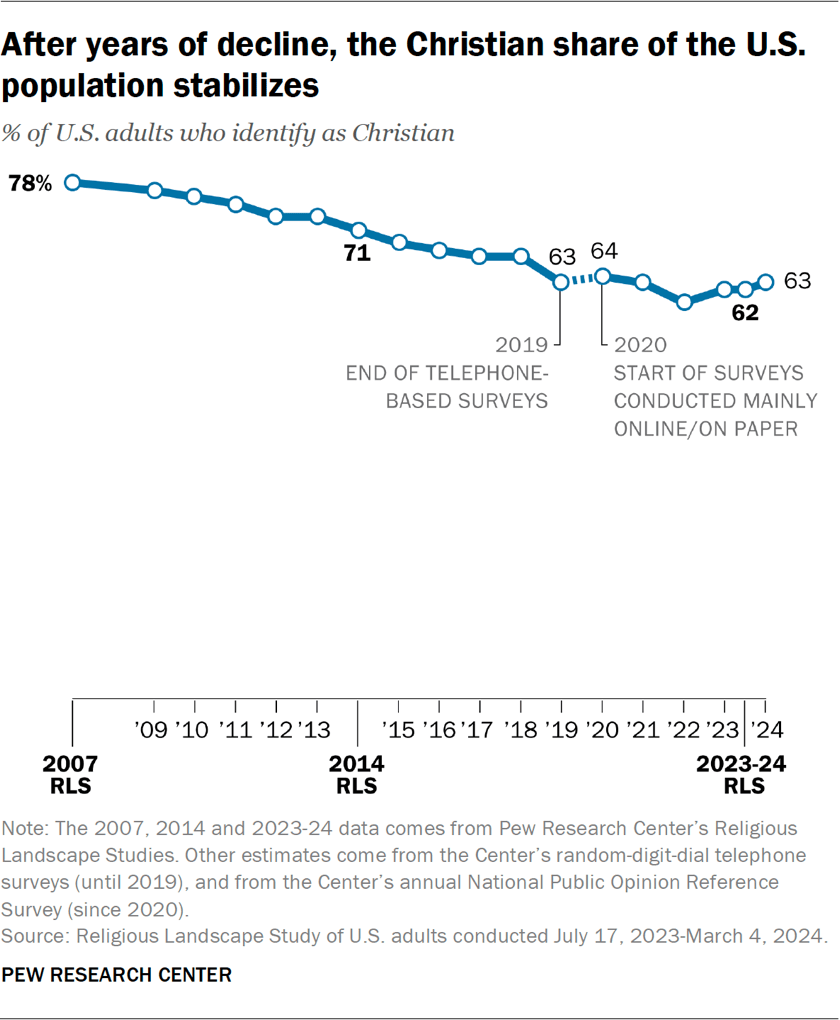
Look closer, however, and you can find data suggesting that Christianity is flourishing. Some signs indicate that young American men are attending church more than they did in previous generations. High-profile intellectuals such as Ayaan Hirsi Ali, who was one of the leading figures of the New Atheist movement, have publicly announced their conversion to Christianity. And even the Pew Research Center, a chief promoter of the nones story, has admitted that the nones have plateaued at less than 30 percent of respondents.
Here’s the plateau from the Pew page. But “stabilizing” assumes what’s going to happen in the future, and the plateau has occurred only since the pandemic began, while the decline starts 13 year for that. And if you look at the longer term (graph below that), it’s hard to see anything but a long-term decrease in religion:
The summary of a longer-term survey shown on the Calvin College website, summarizing data from all over America. The only thing that’s shot up is the “nones”, and “mainlines” (Protestants, I presume) are a third of what they were in 1970!
(from the site): Graphic by Jacob Baylor
Back to the Panglossians:
What is really happening? Rather than experiencing simple growth or decline, American religion is in a state of churn. Some sectors are falling fast, while others show phenomenal growth.
Throughout history, Americans have routinely misinterpreted religious change as decline. Headlines about the demise of faith may be attention-grabbing, but they conceal a more complicated and interesting reality.
What are the key factors behind the confusion about religious change? One is an overreaction to the rise of the nones. Today, more Americans claim adherence to no religion than did in the late 20th century. A generation ago, more adults would have said they were Christians even if they had no connection to a church.
Today, people are more candid about their religious identities. Outside of the Bible Belt, there is little shame in telling a pollster that you simply aren’t religious.
This does not mean that the nones are atheists or agnostics, though they are often labeled as such. Treating atheists, agnostics and nones as a unit allows observers to tout the blockbuster headline that “religious ‘nones’ are now the largest single group in the U.S.” This strained math obscures the fact that the number of self-identified Christians today remains more than twice the combined total of nones, atheists and agnostics.
This is the kind of nonsense that heartens the faithful but misleads everyone else. The fact is that fewer people go to church than ever before, the “nones’ have shot up (granted, there is a six-year plateau), and “mainline” Christianity has dropped like a rock in the last fifty years. It’s telling that faithheads like the authors here are so eager to seize on the “plateau” as a sign that religion isn’t going away. I have news for them: if they look over the last half-century, or even more over the last 150 years, religion has largely vanished. In another century, it will be a mere shadow of itself—and a good thing, too. Sadly, you don’t see any mainstream news outlet having a column called “Nonbelieving”.
*I’m getting plenty tired of AI-composed prose masquerading as something written by a human being. One of my ideological heroes, Rawan Osman, an ex-Muslim Syrian who is strongly pro-Israel and a self-described Arab Zionist who’s becoming Jewish, turns out to have written quite a few Twitter posts, Facebook posts, and posts on her blog at the Times of Israel that, according to the reliable AI-detection program Pangram, are wholly or substantially written by AI (example here). I am so put off that I no longer read her, and when I pointed it out, fellow Jews and Israel sympathizers piled on me, saying “It doesn’t matter.” But it does.
Another example. Maarten Boudry wrote me: “A literary First Prize has been awarded to a short story that is 100%. AI. Do you know Moth Magazine? Never heard of them, but they have 12K followers on X and have a Wikipedia page, so it’s not completely fringe.” Maarten’s tweet gives the story, “The Shoulder,” by Jeffrey-Michael Kane, and it’s still up. When I told the magazine (and another one) that Kane was using AI to write his fiction, I was blown off (the reply was “Although we avoid publishing AI-generated work, ultimately the responsibility for this rests with our authors, who we trust to submit original work.”) Maarten is also peeved that his own rector at Ghent University gave an AI-generated speech as her inaugural address, with three out of the four quotes in it purely fabricated by AI.
Over at Maarten’s Substack site, he’s reprinted a Quillette article about his own disaffection with AI: “Show us the prompts” x
The good news for anyone recruiting an AI ghostwriter is that the odds of public mortification are falling. Fabricated quotes and references are just about the only way to catch a lazy author out, since there is virtually no innocent explanation for them. But as Large Language Models have improved, hallucinations like these have grown rarer. And without those dead giveaways, we are left with AI detection tools, which are irreducibly probabilistic. The best of them is Pangram, which boasts a false-positive rate of one in 10,000, given a long enough chunk of text and some reasonable assumptions. Writers accused of AI plagiarism routinely deny it, and there is no way to prove the charge conclusively.
Writing in the Free Press, Tyler Cowen predicts that before long hardly anyone will care whether or not a text was written by a human. Cowen describes the humbling experience of being impressed by an author’s knowledge and scholarly chops, only to discover that there was no author at all. After he was burned a few times, he got better at spotting the signs. In a recent essay, Richard Hanania goes a step further. Suppose we are impressed by the writings of some brilliant young thinker and then discover that every word was machine-generated. “It shouldn’t really matter,” Hanania contends, “and we should hope that this person continues to do the same kind of work.” With the possible exception of memoirs, which are inherently personal, he does not care one way or the other.
But something bugs me about all this. As a writer and non-native speaker of English, I am grateful for Claude’s proofreading help when I am drafting an essay. And as a reader, I have come across AI-generated poems, short stories, and jokes that I have really enjoyed— sometimes I knew their provenance from the start, sometimes I discovered it only later. Far from diminishing my enjoyment, this realisation often heightens it, out of sheer fascination with the technology. But argumentative non-fiction feels different. For some reason, I resent belatedly discovering that an essay that tries to persuade me of something was machine-written, and I lose interest at once. [This is what happened with me and Osman’s writings.] Why is this?
I don’t mind if people use AI to proof, revise, or polish an essay, or even to flesh out a paragraph. But if you let AI compose the piece from beginning to end, there is no author taking responsibility for the views it develops. There is nobody there with whom to have a conversation, nobody who holds the beliefs and attitudes on display. Ask Claude for an eloquent rebuttal of the “Death of France” essay and the result might look every bit as compelling from the other side of that culture war. Perhaps that would go viral, too.
The solution? “Show us the prompts”; that is, disclose what you did and what you fed into AI to let it write. That still doesn’t satisfy me:
There is nothing wrong with using AI to generate text per se, and I do it myself if I am drafting a reference letter, writing a legal defence, or answering a long email. The prompt is usually based on a short list of bullet points and instructions, or on things I have written before. LLMs are extremely good at catching your drift, especially when they have been trained on your earlier writing. It is fine, too, wherever the pleasure is in the artefact rather than the argument: jokes, poetry, perhaps some kinds of fiction.
But if you ask AI to compose an entire argument, then sign it with your name and send it to the Guardian, it behoves you to disclose it and leave your readers to decide whether or not they are still interested. That hardly any writer does this, unlike many creators of AI images and video, suggests a degree of guilty conscience. These people want to preserve the illusion that an actual person produced the text, because they rightly suspect that we would stop reading if we knew the truth.
And, indeed, I’ve stopped reading Osman. As an exercise, you can enter some suspect prose into Pangram (here; you get three tries per day for free), and see what you get. Try, for example, putting in some fiction or poetry by Jeffrey-Michael Kane.
*The NYT reports that the heirs of a woman who, as a prisoner in Auschwitz, did paintings of “Death Doctor” Josef Mengele’s subjects, are suing to get the paintings back (article archived here).
When Dina Gottliebova Babbitt was a prisoner at the Auschwitz-Birkenau concentration camp in the 1940s, she stayed alive by painting watercolors on a rickety easel for Josef Mengele, the Nazi physician known as the “Angel of Death.”
Throughout her life, Babbitt tried to retrieve seven of those works from the Auschwitz-Birkenau State Museum in Poland. “I want to hold them in my hand,” Babbitt said in a 2009 video just months before she died at 86. “I want them here. I need them.”
But the museum refused to turn them over, asserting that the historical and educational value of the paintings superseded her right of ownership.
Now, Babbitt’s two daughters — Michele Babbitt Kane and Karin Wendy Babbitt — are suing the museum for the return of the watercolor portraits that their mother created while struggling to survive as a Jew in a Nazi death camp.
“Dr. Mengele then took the completed portraits from her,” says the complaint, filed on Monday in United States District Court for the Central District of California. “Dina Gottliebova Babbitt never voluntarily sold, assigned, transferred or relinquished the Watercolors. Yet more than 80 years later, all seven of the Watercolors remain in the possession of the Museum, which claims that it — not Dina Gottliebova Babbitt’s heirs — owns them.”
The Auschwitz-Birkenau Museum, at the former death camp in Poland, defended its decision to hold on to the paintings, describing them as important records of Nazi persecution.
The NYT article shows several of Dina Babbitt‘s paintings (she lived from 1923 to 2009), and here’s a photo from Wikipedia showing her holding a copy of one of her portraits.
This seems to be a no-brainer. The work is that of Babbitt herself and so would seem to belong to her heirs—her daughters. If they want to donate the paintings to a museum, that’s fine, but the work is theirs to have, regardless of its historic interest. The paintings are very good, but I think that reproductions are sufficient to show at Auschwitz. Or do you think otherwise?
Meanwhile in Dobrzyn, Hili is asking Andrzej increasingly difficult questions. I asked Andrzej what this was about, and he replied, “Chimera – an illusion or fabrication of the mind. Idea separated from reality, which is often pushing (or dragging) people into calamity.”
Hili: Is it possible for a chimera to be a draft animal?
Andrzej: In politics, unfortunately, yes.
In Polish:
Hili: Czy chimera może być zwierzęciem pociągowym?
Ja: W polityce, niestety, tak.
From Luana: Justice in Canada for a man with 43 prior convictions:
And the final update to this saga:
I was just at his sentencing. The prosecution had asked for 15 months in prison because of the randomness and aggression in his assault on me and his extremely long history of violent crime (43 prior convictions).
I’m with the Number Ten Cat on this one. Trump simply cannot ban from the White House those news outlets he doesn’t like. The courts will back up Larry and me!
Can’t wait for their next lecture on the importance of freedom of speech https://t.co/LDs9FQSsLZ
Two from my feed. First, “journalists” at Al Jazeera were fired en masse:
A few key revelations related to Gaza coverage in last few days:
– Almost all of the media in Gaza were in a Hamas-run WhatsApp group that dictated and coordinated coverage. Including contributors to major western news organizations.
Yes, my friends, it is that time of year: the leaves begin to change colors, the temperature cools, and the time-honored tradition of rooting for your favorite chonky bears at Katmai National Park & Preserve begins.
I comb my cat every Saturday morning. And then he always feels the need to wash me back. I’m sure he thinks I’m a cat too. Cute but gross 😂 So always comb him pre my morning shower. #caturday
Welcome to shabbos for Jewish cats, Saturday, September 19, 2026, with Yom Kippur beginning at sunset tomorrow and lasting 24 hours. It is the Day of Atonement—the holiest day in the Jewish calendar. You cannot have any food or water during the entire period, or even brush your teeth (you might ingest water!). And you’re not allowed to touch or kiss your wife/husband, and must sleep in separate beds. You can see the other rules here, though most Jews aren’t that observant and won’t follow them.
It’s also National Gymnastics Day, and in honor of that I present the first perfect 10 score in gymnastics, Romanian Nadia Comǎneci on the uneven bars in the 1976 Montreal Olympics. Wikipedia also has a list of “perfect 10 gymnastics” performances for both men and women. Here are the top five performances on the parallel bars in Montreal, with Comǎneci’s performance last, starting at 2:31:
Representative Alexandria Ocasio-Cortez plans to campaign across New York in the weeks before the midterm elections, and she has donated $300,000 to help boost the Democratic ticket in her home state as speculation has swirled over whether she will run for Senate or president in 2028.
In an interview, Ms. Ocasio-Cortez said she would be “traveling across the state to boost turnout in many different areas,” including planned stops in Buffalo, Syracuse and Ithaca in the coming weeks.
“New York,” she said, “has become increasingly relevant to whether we have a majority or not in the House of Representatives.”
Ms. Ocasio-Cortez will donate the funds to a pool of money for Democrats statewide that is being overseen by Gov. Kathy Hochul, who is seeking re-election this year. Ms. Ocasio-Cortez has earmarked the funds for voter organizing rather than advertising, with a specific proviso that half of the money be devoted to Spanish-language outreach.
“This investment is really not just about throwing money around and putting points on the board,” she said. “This is actually about transforming the way Democrats go about building a coalition.”
Sarafina Chitika, a spokeswoman for Ms. Hochul, said that the statewide effort, known as a coordinated campaign because it helps candidates for various offices, would be “prioritizing communities that are too often overlooked and written off.”
The sum is more symbolic than financially significant in a state as expansive and expensive as New York. It is also more money, though, than any other member of the New York delegation has contributed, according to two people familiar with the donation. Ms. Hochul had asked Ms. Ocasio-Cortez for the contribution, which had been under discussion for several weeks.
Ms. Ocasio-Cortez is one of the Democratic Party’s top fund-raisers nationwide and has raised more than $32 million since the start of 2025. She entered the summer with $15 million in the bank.
Ms. Ocasio-Cortez, whose district includes parts of the Bronx and Queens, suggested that there should not be much reading of tea leaves into her announcement as she weighs a political future with at least three options: re-election, a New York Senate race or a presidential run in 2028.
“I’ve been pretty open about the fact that I’m going to be weighing this decision, but I’m going to be weighing it after the midterm elections,” she said.
The fact that Ms. Ocasio-Cortez previously clashed with Jay Jacobs, the state party chairman, appears to at least partly explain why she chose to direct the money to the Hochul operation.
I’d be willing to bet that AOC, who has ambitions as big as her record is thin, will run for Senator, given that (I think) her chances to win the Presidency is small. But even as a Senator she’d have more power than she deserves, as she’s accomplished little in the House save promote herself. Yes, she’s good at that, and she’s a Democratic Socialist, so the kids like her, but as a politician, she’s a disaster for someone of my stripe.
*Reader Peter N. called my attention to a piece on slime molds in the Guardian, a piece that makes you question the notion of intelligence, and whether it can be seen in amoeba-like organisms that have no neurons: “‘This is dangerous: slime molds and the bitter debate over the nature of intelligence.” Because I’ll give a few quotes at length, I am giving only four news sources today.
Forty years ago, as an undergraduate in Hokkaido, Toshiyuki Nakagaki came upon a lemon-yellow stain in a petri dish. That encounter turned him into a doyen of slime mould research – and fed a storm of biological and philosophical debate about the meanings of life and intelligence that persists to this day. Before, no one would have called a slime mould “intelligent”; the popular adjective, in fact, was “simple”. “A simple mass of protoplasm,” one 1895 description ran; “among the most simple of organisms”, said another. And it was hard to argue otherwise. A slime mould can appear to be just a small cell, capable only of feeding and reproducing. Simple is as simple does.
Of that first meeting, Nakagaki said: “I was just impressed with how fast it moved.” Physarum polycephalum, the slime mould species in that petri dish, has a top speed of 1cm an hour. For amoebic organisms, that’s gold-medal standard. At first glance, Physarum seems to spread as irregularly as ink on blotting paper, but in fact it senses its meals of bacteria or other microbes and reaches for them with a long, thin finger of protoplasm – which not only digests its food but then forages further or pulls back into the rest of the mould. It’s impossible to watch a slime mould over many days without sensing some deliberation at play.
. . . .In 2000, his astonishing research began to surface in the media. “Slime mould solves maze puzzle,” one headline ran, summarising an experiment in which Nakagaki induced a Physarum to find the shortest route through a maze in search of food. (In labs, slime moulds are reared on oat flakes, a convenient diet that can double as a researcher’s breakfast.) In 2010, the New York Times wrote about Nakagaki’s most famous experiment – the canonical study that scientists offhandedly call “the Tokyo railway one”. Nakagaki placed oat flakes to resemble the map of Tokyo and 35 of its satellite towns. Then he let the Physarum loose from the centre of “Tokyo”. From that one metropolitan oat, the mould spread outwards seeking the others, stretching towards them with its tubules. Then, putting out more branches, it linked up with itself, from one suburban oat flake to the next.
In doing all this, the mould displayed such a verve for efficiency – no wasted motion, an optimal pursuit of its food – that it ended up nearly retracing the route map of the greater Tokyo area’s railway system. Nearly, Nakagaki said – because, in fact, free of human bias or politicking, Physarum may have improved the design of the network. Later, when Nakagaki twice won the Ig Nobel – the prize for research that is both amusing and thought-provoking – the first award cited his maze paper in the field of “cognitive science”, but the second, cheekily, hailed the Tokyo railway study as a breakthrough in “transportation planning”.
. . . For more than a century, scientists were sure that cognition and intelligence required neurons, the cells that make up brains and nervous systems. These neurons form and reform connections between themselves to create pathways for thought and memory. This understanding of intelligence was an implicit argument that animals occupy a special place within the living kingdom – separate to plants and microbes – and that humans are most special of all.
But since the 1980s, more and more scientists have argued that traits such as cognition are intrinsic not just to animals but to all life – a stance that Pamela Lyon, a philosopher at Adelaide University, calls “biogenic”.
. . . . Given that the mould has no brain, slime is evolution’s way of “storing” memories of spaces. One of Reid’s experiments suggests Physarum uses its slime as an aide-memoire to recognise the paths it has travelled and those it hasn’t. The yellow slime, sticky but more watery than human mucus, is a soup of sugars and proteins. Its presence, Reid believes, tells a mould that it has already foraged in these parts and consumed any food there was to be had. When Reid’s team harvested slime from a mould, coated one route in a maze with it, and introduced the mould into this set-up, it nearly always chose to traverse the dry, un-slimed areas. More impressively, the Physarumcan distinguish between its own slime and that discharged by of other species – as if Hansel could tell his breadcrumb trail apart from Gretel’s.
Over the past three decades, as the study of intelligence has broadened beyond humans, slime-mould research has gathered speed. We know now that Physarum is made up of thousands of tiny oscillators that sense their environment. If they pick up the chemical markers of a meal, these units oscillate faster, in turn causing the cell’s protoplasm to flow more thickly towards that area. This is how the mould moves.
But how these oscillators, so minuscule and seemingly so rudimentary, manage to sense so much – proteins, salts, acidity, light, heat, humidity, perhaps even gravitational and magnetic fields, and masses looming at a distance – is still unclear. In 2008, Nakagaki and his colleagues subjected a Physarum to cold, dry air streamed at regular hourly intervals, prompting it to slow its locomotion. After three such gusts, the mould spontaneously slowed on the top of the fourth hour – even when the mistral didn’t blow. No one can figure out how the slime mould keeps time.
. . .The truths are rooted in semantics. Unlike, say, the word “haemoglobin”, terms such as “cognition” have been around for so long that they’ve been coded into colloquial use in phrases such as “cognitive decline” and “cognitive bias”. To freely stretch the word beyond its wider connotation of the workings of a brain – to apply it to brainless beings such as slime moulds – “misleads the public”, Alex Kacelnik, a zoologist at the University of Oxford told me. “It hollows out the word itself.”
Kacelnik, who has studied the New Caledonian crow’s nimble use of tools, pointed out that “even an oak tree ‘decides’ – in inverted commas – how many acorns it will produce, what size each acorn is going to be, and when it will shed them. But when people say they’re going to cognitive therapy, they mean something different from what the oak is doing, right?” Misusing the word, he said, is counterproductive. By likening the tree’s function to cognition, “you haven’t solved the problem of how the oak does what it does – you’ve just trivialised it, or defined it out of existence”. He uses the term “cognition” in his own writing only when he can show that it involves “some kind of internal algorithm, with some kind of concept formation, in some kind of ‘language’ – in inverted commas”.
IU agree with Kacelnik in that we’re projecting when we ascribe “intelligence” to a creature like a slime mold, regardless of how highly evolved it is to do cool stuff. It doesn’t use neurons, but chemical cues, and to ascribe “cognition” to it—something I think is key to “intelligence”—is misguided. In fact, to argue whether it is “intelligent” or not seems to me the wrong path to take. What we can do is marvel at, and figure out, how this protist can do all this stuff, and even do experiments to see how it evolved. Even tiny organisms like these are the products of millions of years of evolution, and can show adaptations that boggle the mind (think of all the amazing things ants do with a brain the size of a dot made by a pencil).
There’s a lot more to this article, and a lot of word-parsing and philosophizing. In the end, I think the problem is semantic, but I’d prefer to think of “intelligence” as requiring cognition—an ability to reason.
Here’s ZeFrank’s segment on slime molds:
*The NYT reports that the new Merriam-Webster dictionary is “Wordsmaxxing with 1400 new definitions” (article archived here). As you know, you have to be au courant with language, so here are some new words:
Merriam-Webster, the venerable dictionary that traces its roots to a time before looksmaxxing and yacht rock, has added those words along with chili crisp, shapewear and cuffing season, to its comprehensive accounting of the English language.
The company, based in Springfield, Mass., announced on Tuesday that it had added those five terms and 1,395 other new definitions to its online dictionary, Merriam-Webster.com. Many will also be added to upcoming editions of the print dictionary.
Merriam-Webster is the oldest dictionary publisher in America. It traces its start to 1843, when the brothers George and Charles Merriam bought the rights to the 1841 edition of Noah Webster’s dictionary. The company emphasizes that the dictionary is not a static catalog, but a reflection of the many different ways words are used by real people.
That includes food-related words that have become more commonly used in the United States like superfood, “a food (such as salmon, broccoli, or blueberries) that is rich in nutrients,” and shishito, “a slender usually mild chili pepper of East Asia.” On the sweeter side, the dictionary added cake pop, “a compressed ball of cake crumbs and icing that is dipped in a usually chocolate or sugary coating,” for the uninitiated.
Anyone who dreads going to work or school might be familiar with the Sunday scaries, the “feelings of anxiety or sadness that arise on Sunday from the knowledge that the weekend is almost over.” And people who know Braden Peters, the proudly vain social media influencer known as Clavicular, might be familiar, for better or worse, with looksmaxxing. Merriam-Webster calls it “the practice of taking one or more sometimes extreme or dangerous measures intended to increase one’s physical attractiveness.”
Yes, we discussed that odious word last week. But wait! There’s more!
. . . .Fans of Christopher Cross, Kenny Loggins and Michael McDonald might be pleased to see that yacht rock made the cut. Merriam-Webster defines it as “a style of soft rock music originating in the 1970s and 1980s.”
Also clearing the bar was cuffing season, “a time of the year when people who are not married or in a relationship begin looking for a short-term romantic partner to spend the colder months of the year with.”
Merriam-Webster also added parasocial, “a one-sided emotional connection with someone (especially a celebrity or fictional character) whom one does not know personally,” and Rickroll, “to trick (someone) into hearing the song ‘Never Gonna Give You Up’ by English singer Rick Astley.”
The only one I know of these, save “looksmaxxing”, is Rickroll, and I like that one.
*As always, I’m stealing a few items from Nellie Bowles’s weekly news-and-snark column at The Free Press, called this week, “TGIF: Experts fear worse ahead.”
→ Ed Sheeran debacle: Ed Sheeran decided to have Macklemore as his tour opening act, and the rapper took the stage to give a “Free Palestine” speech, like he was kicking off a course at Columbia or something. In the long debate about whether anti-Zionism is antisemitism, Macklemore leaves little doubt, in that he once performed wearing a fake beard and an oversized prosthetic nose in what was widely seen as a Jewish caricature. Anyway, New England Patriots owner Robert Kraft then pressured Ed Sheeran’s promoters to drop Macklemore, and Macklemore was dropped. You can imagine what happened next. Macklemore has become even more of a hero, gaining hundreds of thousands of followers, bringing more attention to the cause. All of Ed Sheeran’s other opening acts backed out of the tour, as did his own backing band. For a sense of the public tone, comedian Mike Recine posted: “Robert Kraft is a pedophile and someone should kill him.” So it’s all going really well, temperature’s nice and low out here. Recine deleted his initial, um, joke? and posted: “Hey everyone I’d like to apologize for the post I made last night when I said ’Children deserve to have legs.’ I didn’t realize that statement was offensive to the Jewish community and I will choose my words better moving forward.”
The idea here being, I guess, that Jews love to kill children, or at least blast their legs off, so telling people to assassinate Robert Kraft is the same as saying you want to save children. So, by extension, then, being pro–Robert Kraft’s life equals wanting to remove Palestinian children’s legs.
All the former pro–cancel culture people are suddenly screaming “free speech,” which is always just so funny, and they point out the same hypocrisy in the anti–cancel culture people, who are suddenly saying deplatforming is a private company’s decision. Fair critique of both sides. But it’s all word games. The fact is, antisemitism is popular right now, and the Bob Krafts of the world cannot win. You either host the man who hates you and wants you in a work camp—or you make him even more of a star. Those are your options, Bob. Choose wisely, and if I were you, I’d probably stay away from your own venue for fear of the mobs.
→ Quote of the week: Here’s the latest scandal from Hasan Piker, the top political influencer on the left and a frequent campaign buddy for Dems.
Because I’m in the United States of America, the most dogshit country on the fucking planet, the absolute worst country on the planet, straight up, bar none. A capitalist shithole. The absolute worst fuckin’ place on the planet, just a horrific, monstrous, awful, dogshit country that I fucking despise. The absolute fuckin’ worst country that has the most—the most—wealth throughout history, throughout time, the wealthiest nation on the planet, and we don’t have a fraction of the dedicated broadband speed that you can get in a fucking village on the countryside of France. Okay? I just—the worst fucking infrastructure, the absolute biggest shithole on the planet, I fucking despise this nation. I despise this country with my entire fuckin’ heart. Okay?”
Okay! That’s right, while livestreaming from his gorgeous West Hollywood home, the Wi-Fi got a little wobbly, and so Hasan went nuclear. America is his mom, and she’s being a total bitch. This is what young people love shooting directly into their veins. “Dogshit country that I fucking despise.” Get this guy a swear jar and he might end up as poor as the people he pretends to advocate for!
In late-breaking news, Piker also sat down with Alex Thompson of Axios: “Do you think America then is worse than al-Qaeda?” Piker: “Pound for pound as far as the number of deaths, yes.” Perfect.
→ Testing, testing: New York State’s Regents exams are three-hour tests on subjects like English, math, and science. Students need a score of 65 on multiple exams to pass and get a high school diploma. But now New York’s planning on dropping the requirement. Here’s New York Board of Regents member Felicia Thomas-Williams on the change: “Maybe you’ve seen the cartoon where you have a fish climb a tree? You don’t assess a fish on climbing a tree because fish can’t climb trees.” If the Regents exam asked students to breathe underwater, then Felicia’s argument might track. But the exam asks students to read, write, and solve math problems—skills that are standard for most educated human beings. Or should be? Of course this test was dropped as a requirement for vaguely anti-racist reasons that no one bothered to really explain. But now: What will New York high school students have to prove in order to graduate? Will they just fill out a feelings wheel? Are they going to play Go Fish for 40 minutes and call it a day? That’s insane for the public school system. Playing games at school costs at least $50,000 at a private school in Santa Monica.
Meanwhile in Dobrzyn, Hili is being bribed with beef:
Hili: Sometimes even a cat has had enough of everything.
Andrzej: Do you want a piece of beef?
Hili: That’s psychological manipulation.
Carl Friedrich Gauss, often called the “Prince of Mathematicians,” famously described mathematics as the “queen of the sciences” and number theory as the “queen of mathematics.”
I think prime numbers are the oxygen of number theory. They are the fundamental building blocks of… pic.twitter.com/F0WLsEyaMS
Tw0 from my feed. I think the Democrats are finally realizing that Hasan Piker is a liability. What a dumb party we are! Here’s Rahm Emanuel:
Now that he won’t stop talking, the folks who told us Hasan Piker is a serious voice who should be listened to ought to let us know which of these positions we’re supposed to take seriously:
1. That “pound for pound,” America is worse than al-Qaeda – a ridiculous statement on a…
And one from Herr Dr. Professor Cobb, which he calls, “Nearly a caracal”:
It's amazing that perhaps the world's best place to see an awesome wild cat – the caracal – is right on the edge of a big city. Climbed #TableMountain today from #CapeTown with a tiny hope of seeing one, & was delighted to find some poo. Half the joy of #MammalWatching is just knowing they're there
Welcome to Friday, September 18, 2026, and National Ice Cream Cone Day. There are two types of people: cone people and cup people. I like to eat the cone, though sometimes it gets drippy, but I’ll take the cup if a place gives you more ice cream in a cup. The history of the cone as a container for ice cream is murky. Wikipedia says this:
The earliest certain evidence of ice cream cones come from Mrs A. B. Marshall’s Book of Cookery (1888), written by the English cook Agnes B. Marshall.]Her recipe for “Cornet with Cream” said that “the cornets were made with almonds and baked in the oven, not pressed between irons”. Marshall is consequently often regarded to have been the inventor of the modern ice cream cone.
Iran vowed to respond to a U.S. blockade by pushing more trade overland. On the ground, it isn’t going according to plan.
Hundreds of Iranian truck drivers are currently stuck at Iran’s border with Pakistan, unable to send their goods into Tehran’s neighbor. They say they are facing worsening bureaucratic hurdles and costs, many caused by their own government. The same thing is happening at Iran’s land borders with Turkey, Turkmenistan and Afghanistan, dealing Tehran a self-inflicted blow and throttling trade through its few remaining economic release valves.
Tons of stranded apricots have been spoiled because of the delays. Lucrative cargoes of iron ore, cement and bottled gas are stuck at entry points to the Pakistani and Afghan borders, truckers say.
“Neither Iran is taking responsibility for the situation, nor is Pakistan allowing us to unload our cargo,” one driver says in a video posted by the Union of Truckers and Drivers Organizations Across Iran over the weekend.
The economic war in the Persian Gulf is dictated as much by how much the countries in the region can move their exports over land rather than through the Strait of Hormuz. Some have found workarounds. Saudi Arabia is moving more of its oil west across the Arabian Peninsula. The U.S. Navy is helping some of the Gulf nations shift their oil through the strait.
Iran’s attempts are faltering. The U.S. is isolating its economy with new sanctions and launching strikes on Iranian tankers in reprisal for Tehran’s attacks on its Navy, collapsing seaborne exports.
In another setback for Iran’s plans to bypass Hormuz, the country’s Mahan Air, which is sanctioned by the U.S., said Wednesday that it was suspending flights to Oman and Turkey, state-affiliated media in Tehran said. Last week, the U.S. Treasury imposed new sanctions on companies it said were supporting Mahan, which operates cargo and passenger services.
The U.S. blockade has also hurt Iran’s imports of basic goods, 70% of which normally go through the blockaded ports. Though humanitarian goods and food are ostensibly exempt, the reality is that shippers are reluctant to service Iran.
Videos posted on social media last week show cranes at the Port of Shahid Rajaee, Iran’s largest commercial container port, at a standstill. Thousands of containers are stranded in ports in Pakistan, the United Arab Emirates and Saudi Arabia, transportation professionals in Tehran last month told the Mehr News Agency, which is affiliated with Iranian security services.
Even Iraq is blockading Iranian goods:
But in a sign of how vulnerable the alternative routes are, Iraq over the weekend temporarily closed cargo terminals at the Iran border after alleging Iran had used its territory to attack Saudi Arabia. On Sunday, trucks carrying Iranian onions bound for Iraq were forced to turn back as a result, according to Tehran’s Central Fruit and Vegetable Market.
The rising costs are now adding to Iran’s worsening inflation problem.
. . . Much of these costs are being passed on to consumers, with unpredictable results for the Iranian leadership. Food inflation rose to 128% in August, according to Iran’s official statistics office.
Is it too much to hope for the people to rise up and depose the government? Yes, I suppose it is, but this article is heartening news despite a drumbeat of bad news proclaimed by the NYT, Washington Post, and other “progressive” media that are hoping that the U.S. loses the war.
*I said I’d report back on reactions to the new anti-Israel movie “NAZA,” which accuses of Israel of deliberately killing civilians in a way not according to their strategy (“the military gains must outweight the civilian losses”, or something like that). There’s one in the Free Press by their Middle East analyst Haviv Rettig Gur, “Hold your applause for the new Gaza documentary“, with the subtitle “There may yet be hard truths in ‘NAZA,’ including evidence of Israel’s systemic failures. But the reporting around it treats flimsy claims as proof of criminality.” (Note: like nearly everyone weighing in, Gur hasn’t seen the movie).
The title is an Israeli military acronym derived from nezek agavi, Hebrew for collateral damage. It refers to the filmmakers’ conviction that the systems Israel used to select targets and authorize strikes in Gaza enabled immoral and unlawfully high rates of civilian casualties. Their allegation goes beyond excessive tolerance of civilian casualties: They reportedly contend that the killing was intentional.
I haven’t seen the film. This means I cannot confidently assess its editing, corroboration, or the full testimony it presents. I would love to live in a world in which I could wait, watch the movie, and have a sober debate about its claims. Unfortunately, the discourse online is not so patient. That’s why it’s necessary to examine the argument its makers have published, the reporting on which it builds, and the standards by which its allegations should be judged. The film falls short on every dimension.
Start with the question of civilian casualties. The online conversation about the film—as distinct from the film’s own claims—is replete with shock and horror at the finding that the IDF calculated the estimated number of civilian deaths before each strike. According to the usual Israel critics, this shows that the resulting deaths amounted to deliberate murder.
It’s almost impossible to overstate how clownishly (and intentionally) wrong this claim is. International humanitarian law requires those planning an attack to assess foreseeable civilian harm and take feasible precautions to avoid or minimize it. You can’t assess proportionality in relation to the expected military advantage of a strike—as required by law—without that calculation. Indeed, an attack that isn’t preceded by an assessment of potential civilian deaths is an immoral attack. This point isn’t against the film itself, but it says something important about how skewed and shallow and preordained the debate around it was always going to be.
So what does the film itself claim? In their published accounts, the filmmakers describe interviews with 24 former IDF soldiers, most of them intelligence officers. They claim that civilian losses were authorized for targets of little military value, and that in some cases, the intended target was not present. According to the soldiers, these were features of the system, not departures from its protocols.
Those are substantive claims. But I have seen nothing to suggest that they are proven in the film itself. What I do know is that neither the filmmakers nor their production or research teams presented any of the findings to the IDF for a response. In fact, the IDF has publicly asked the filmmakers to screen the documentary for military officials so it can produce a detailed response; so far it’s not clear they have responded.
So, when we Israelis do finally see the film, we will ask the most basic journalistic questions: How are its claims established? What did each witness—all of them anonymous—actually observe, and what was their role and level of access? Does an officer describing one phase of the targeting process know what happened during the rest? Are any of these claims corroborated in any independent way? When someone says a target had little military value, what information is that judgment based on?
Nobody has to prove a system-wide policy for the unjustified killing of a particular individual or family to be wrong, and deserving of an investigation. But the film’s claim isn’t about a single strike, or even a number of them. It is that the IDF’s collateral-damage mitigation system is used to systematically and purposefully target civilians. That this was the purpose of the military campaign.
One of the few Israelis who’s had the chance to watch the film—and who is sympathetic to director Yuval Avraham—came away deeply disappointed. In a Monday op-ed in Haaretz, a left-wing Israeli outlet most likely to resonate with the film’s claims, Raviv Drucker wrote that he couldn’t help but feel the film was trying to create an “impression” of the “context in which these terrible things were done”—juxtaposing military claims about suffering in Gaza with images of people dining in Tel Aviv. He simultaneously vouches for Avraham’s integrity while complaining that the film fails to prove or contextualize its claims. According to Avraham, NAZA doesn’t say anything meaningful about the broader military context (which is necessary to prove that strikes had no military need), compare how other armies fight terrorist organizations embedded in civilian populations, or even acknowledge the problem of Hamas’s systematic use of civilian infrastructure. Drucker’s conclusion is written in a tone of sadness and disappointment, not anger. He wishes, he writes, that the film had been “truer to reality.”
Gur also shows that director Yuval Abraham deliberately distorted the number of Palestinian civilian dead in a previous publication, and that the targeting restrictions changed over the course of the war for military reasons. In the end, Gur doesn’t say Israel is exculpated, but does say this:
All this said, legitimate findings of the film should be taken seriously. Dramatically changed military circumstances do not suspend rules of proportionality or offer blanket justification for whatever followed. And even if the film turns out to be as dishonest, the civilian toll in Gaza requires examination.
But these questions do at least set a standard that a film must meet to show the immorality it claims. Will it? Did the filmmakers even try?
We’re going to have to wait, though it’s hard for me to believe that the IDF deliberately wanted to kill civilians without adequate military justification. I’m not quite sure why this film is not being shown to everybody who wants to see it, including the IDF. That alone makes me suspicious.
In the fall of 2025, I received an invitation to give a lecture on nature conservation in June 2026 at the “Friends of the Botanical Garden” association at Heinrich Heine University Düsseldorf (HHU). I have a long-standing connection to this association and have given several lectures there in previous years. I know the chairman personally and have met with him on numerous occasions for private discussions. My lecture, scheduled for June 2026, required extensive preparation and was to be recorded on video for YouTube. People from other universities were planning to attend. Just two days before the lecture, I had preparatory discussions with the chairman.
And then it happened. Less than 24 hours before the lecture was due to begin, late in the evening, I received an email from the chairman informing me that the lecture had to be canceled. The letter stated, among other things: “We are aware of several previous statements made by you, which have already been discussed in the past and have led to corresponding decisions by the university… After thorough examination and discussions with the relevant departments of HHU, we have come to the conclusion that these statements are incompatible with the principles that HHU and the Friends Association, as organizers, stand for…”
The source of the controversy remains unnamed.
What had I done wrong? The “responsible departments of HHU” never identified themselves to me, and nothing was ever “discussed in the past.” I don’t know who was discussing this. The rejection letter from the “Friends of the Botanical Garden” only mentions an “equal opportunities organization.”
My assumption stems from the module “Fundamentals of Biodiversity and Evolution” that I taught in 2024. A key part of this module’s content involved explaining the biological concept of a species. The species concept can only be explained by comparing the characteristics that distinguish two species with those that differentiate the two sexes. This was therefore also part of the curriculum.
Several students complained vehemently about my statements regarding gender differences during the subsequent evaluation of the course and even filed a complaint against me. My statements were reinterpreted as an alleged verbatim statement that “women cannot think.” I never made such a statement and never would, because it would be utterly absurd. The lawyers of the “Network for Academic Freedom” describe the whole affair as an “outrageous incident” and have already stated in an “Open Letter to the Executive Board of HHU” that this is based on a statement that was never made, the assertion of which constitutes the criminal offense of defamation under Section 187 of the German Criminal Code.
Removal from office without debate
The equal opportunities officer of the Faculty of Mathematics and Natural Sciences, who also chairs the Biology Research Unit, accepted this statement as true and immediately relieved me of all my teaching duties (including supervising bachelor’s theses) without verifying the students’ alleged statements and without granting me the right to a discussion and defense. The examination board and the second supervisors of my bachelor’s students’ theses were not consulted. Yet, my ethical conduct could easily have been verified on my website. The majority of my bachelor’s, diploma, and doctoral students, as well as most of the co-authors of my publications, were women. I was powerless to challenge my immediate dismissal from all my teaching positions, which I had continued to hold without pay after my retirement, because I no longer had any legal right to teach.
It was apparently these events, which took place almost two years ago, that forced the chairman of the “Friends of the Botanical Garden” to cancel my aforementioned lecture at short notice, with the words: “We have become aware of several previous statements made by you, which have already been discussed in the past and have led to corresponding decisions by the university…”
Again we see a professor penalized after ridiculous student accusations. Species, like sexes, are not “defined” but “recognized”. Yes of course there are cases where species are not absolutely distinguished, though those (particularly when allopatric) are much more frequent than individuals who are neither male nor female (about 1/5600 or less). But in both cases we are dealing are biological realities that exist independent of definition (e.g., H. sapiens doesn’t blur into any other species, nor do Pallas cats or platypuses). Just as nature is lumpy with respect to types of animals and plants, so is nature lumpy with respect to the kinds of animals that produce gametes (in that case there are two lumps). They really should apologize to professor Kunz.
The last vestiges of warmth drained out of a Tyrannosaurus rex’s body around 66 million years ago, but scientists just used chemistry to take the long-extinct dinosaur’s temperature: 97 degrees, give or take a few.
The new finding securely situates the king of the dinosaurs among the warm-blooded animals, confirming previous years of research.
T. rex ran hot, but not too hot, according to the study, published Wednesday in Science Advances. Instead, the reading places it somewhere on the body-temperature spectrum near large mammals like Indian elephants (97 degrees) or humans (98 degrees) or flightless birds like ostriches (101 to 103 degrees) — but nowhere near the heat of a chicken, say (105 to 107 degrees).
“That is absolutely spectacular,” said Jasmina Wiemann, a molecular paleobiologist at Johns Hopkins, who was not involved in the study.
So how did they do it?
To take the body temperature of a long extinct, school-bus-size predator, scientists at the University of California, Los Angeles, used a clever geochemistry technique on fossilized teeth, including two from “Thomas,” a famous T. rex in the collection of the National History Museum of Los Angeles County.
The team first used a dental drill to sample the tough outer enamel from the teeth, and then took advantage of a remarkable fact: The chemical bonds within minerals can tell their own stories.
“Basically, at the point a mineral forms there are elements of its chemistry that are kind of frozen in time,” said Robert Eagle, a geobiologist and one of the leaders of the study.
. . . Dr. Eagle and his colleagues analyzed the bonds between two isotopes; heavier versions of both carbon and oxygen. Those bonds acted like a thermometer: The more bonds present, the lower the body temperature.
For a gut check, they also compared the T. rex teeth to those of ancient crocodilians excavated from the same site Hell Creek Formation in Montana. T. rex measured 97 degrees; the crocodilians ran much cooler at, on average, 88 degrees.
Being warm-blooded is associated with a more active lifestyle and means the “tyrant lizard” could live in a broad range of environments. The researchers calculated that, at least from a temperature tolerance point of view, T. rex could have roamed over most of the North American continent, from Alaska to Mexico.
. . .Stephen Brusatte, a paleontologist at the University of Edinburgh, pointed out in an email that the body temperature reading opens up a whole new set of questions about how this celebrity dinosaur operated.
One possibility is that T. rex was warm-blooded the way humans are, with a constant and hot body temperature regulated by an internal furnace, Dr. Brusatte said. Another possibility is that T. rex was more like a giant, terrifying insulated coffee cup that takes forever to cool down.
The way to answer that question, at least tentatively, is to look at the chemical bonds in relatives of T. rex that were not so big, and so would cool down quickly. If they also showed evidence of warm-bloodedness, particularly in very small dinos, that would suggest that homeothermy was an ancestral trait.
Here’s a figure from the paper comparing the isotopically-calculated body temperatures from various groups, along with the environmentally calcualted temperature (see the paper for free here to read more):
(From paper): Fig. 1. Comparison of calculated Δ47 temperatures for T. rex, crocodilians, and bivalves from the HCF along with body temperature ranges of modern birds, mammals, and reptiles. (A) Symbols indicate sample averages for individual tooth specimens, with error bars indicating 1 SE. For T. rex, circles indicate samples from LACM 150167 teeth, and the triangle indicates the single LACM 151468 tooth. Vertical dashed lines indicate taxon averages, and shaded regions under data points indicate 95% confidence interval (CI). Bivalve and modern animal bars indicate the full range of temperatures reported in their respective studies: The upper light gray bars indicate model results and show yearly temperature range at 3× CO2 concentration, while the lower dark gray bar shows 6× CO2 concentration. Both bars show the full range of monthly temperatures with a dark vertical line to indicate mean annual temperature. 1Tobin et al. (37), 2Clarke and Rotherty (38), 3Eagle et al. (11). All silhouettes are licensed under Creative Commons license CC0 1.0 (https://creativecommons.org/publicdomain/zero/1.0/). Artist credits: Manuel Brea Lueiro (T. rex), Guillaume Dera (crocodilian), Pablo Amador Crespo (bivalve).
Dolly Parton ’s megawatt smile and big wavy locks are gracing fields across the U.S. and Canada this fall.
Twenty farms have carved out large corn mazes to honor the late country music icon, actor and philanthropist and raise money for her Imagination Library, which provides free books to children.
The “Jolene” crooner’s death due to cancer on Aug. 25 in Nashville at age 80 brought an outpouring of tributes. They ranged from a drive to rename the country music capital’s airport in Parton’s honor to a surge in online streams of “9 to 5,” “Islands in the Stream” and her many other hit songs.
Now she is being immortalized in corn, with the mazes located in about a dozen states and two provinces, from Alabama to California and Ohio to Texas. Most also feature a Parton-themed trivia game, photo ops and other offerings.
Brett Herbst, founder of The Maize Inc., the Utah-based consulting company that designed the mazes, called Parton a “true American treasure.”
The company said the mazes were in the works months before Parton died and are part of its annual campaign honoring country music’s brightest stars. Previous honorees included Reba McEntire in 2023, Luke Bryan in 2024 and Lainey Wilson in 2025.
Parton, who famously grew up poor in rural Tennessee, thanked organizers for supporting her charity before to her death. In a statement provided by The Maize Inc., she encouraged people to “get lost in this year’s country music corn maze for a little fun, laughter and a real good reason to get lost.”
Here’s a video:
Meanwhile in Dobrzyn, Hili is becoming quite philosophical:
Hili: I look and wonder?
Andrzej: What about?
Hili: Where does time disappear to?
In Polish:
Hili: patrzę i zastanawiam się?
Ja: Nad czym?
Hili: Gdzie ucieka czas?
From Luana, and not a surprise: “inclusive excellence”:
I thought the tweet below must be omitting some critical context or paraphrasing the text ungenerously.
But no, the NYT actually published an op-ed that claims the University of California hasn’t sacrificed excellence even though it admits students who struggle with basic math. https://t.co/fTZjZnIG3Ipic.twitter.com/hAitGCNqb1
Also from Luana (click to go to page as I can’t embed this by itself):
Two from my feed. First, a new species of cat discovered, and not just a subspecies, either. See the article here. It’s called the tilcayo tiger cat.
New cat alert! A call from a wildlife sanctuary about a “weird cat” has led to the first new cat species discovered in over 100 years in Bolivia’s Yungas forest ecoregion. Learn more about this feline surprise: https://t.co/crffXvPqH4pic.twitter.com/USo7rI3Y5q
This Dutch Jewish girl was gassed to death as soon as she arrived in Auschwitz. She was two years old and would be 86 today had she lived. https://t.co/sFswTlMyB9
Welcome to Thursday, September 17, 2026 and National Monte Cristo Day. No, it’s not honoring the small Italian island or its fictional count, but rather the bizarre Monte Cristo sandwich, a ham-and-cheese sandwich dipped in egg and fried—sometimes topped with jam and powdered sugar. I’ve never had one, though I’d try it. Here’s a specimen from Wikipedia; look at all the sugar!:
Here’s the first page of the Constitution, which you can see at the National Archives in Washington, D.C. The caption is, “Page one of Jacob Shallus‘ officially engrossed copy of the Constitution signed in Philadelphia by delegates of the Constitutional Convention in 1787″
Wikimedia Commons
Posting will be light as I prepare for my cataract surgery (one eye next week, the next two weeks after). Wish me luck!
Locked in a trade war with President Donald Trump and pivoting away from the United States, Canada is seeking stronger ties in Europe and Asia as a shield against Washington’s volatility.
On Wednesday, sitting as a guest of honor inside the European Parliament, Canadian Prime Minister Mark Carney received an unprecedented offer: European Commission President Ursula von der Leyen said she wants to make Canada the first “associate member” of the 27-nation bloc.
“We want to bring the relationship with Canada to the highest level possible,” she said in her annual State of the Union address.
The declaration at the Parliament in Strasbourg, France, received a standing ovation from European lawmakers and from Carney.
The offer, which would see two longtime U.S. partners expand their alliance from trade to security, highlights the extent to which Trump is redefining alliances.
The president’s foreign policy gyrations, including threats to take Greenland from NATO ally Denmark, have triggered a reckoning among Washington’s traditional friends about their relationship with the United States.
Amid the standoff with Trump on tariffs, Canada has pursued a thaw in ties with China including new trade deals. Beijing has praised Ottawa for walking away from talks rather than caving to Trump’s demands, and this month, China and Canada revived a dialogue on military issues after an eight-year break.
Ahead of his trip to Europe this week, Carney said he wanted a “unique alliance” with the E.U., including on energy and critical minerals, to help safeguard Canada against economic coercion. “The world’s more dangerous and divided, and friends need to stick together in these times,” he said.
Trump’s stupidity not only alienates our friends directly, but also weakens the U.S. as a superpower by forcing our erstwhile friends to ally with others, and even strengthen ties with America’s biggest nemesis: China. It will take a long time, if ever, to repair the damage Trump has done.
The Trump administration has approved a $2.8 billion sale of heavy bombs to Israel, according to a U.S. official, in what would be among the largest deliveries of U.S. munitions there even as American public support for the country declines.
The proposed sale would include 40,000 one-ton bombs whose use by Israel in Gaza and Lebanon has drawn international anger because of the civilian harm caused by their wide blast radius.
Human rights groups and some foreign governments have condemned Israel for dropping the giant munitions in densely populated areas, sometimes killing dozens of civilians in strikes targeting just one individual.
The package would include 20,000 each of America’s 2,000-pound MK-84 and BLU-117 bombs. It would also provide Israel with 20,000 bunker-busting I-2000 penetrator warheads, which explode on delay after smashing through an outer surface like soil, rock or concrete. The plan was reported earlier by The Washington Post.
The blast from a 2,000-pound bomb can be lethal at more than 1,000 feet and leave a crater as deep as 50 feet. Israel provoked a fierce outcry after it dropped hundreds of the heavy bombs on Gaza.
The State Department recently sent the proposed deal to two congressional committees to get informal approval, the U.S. official said.
Production and delivery of the munitions usually takes months or years, but there are ways to expedite the process.
In mid-2024, the Biden administration paused a shipment of 2,000-pound bombs to Israel because of concern about their use in crowded civilian areas. President Trump allowed the shipment to proceed days after taking office last January.
Then in February, the Trump administration agreed to sell roughly $2.7 billion in munitions to Israel, a package that included 35,000 of the one-ton MK-84 and BLU-117 bombs.
While congressional leaders can tell the Trump administration that they oppose the deal, Secretary of State Marco Rubio can exercise emergency powers to proceed with the sale regardless, as he has done repeatedly, or just say he is moving forward with it. The administration would then bypass getting informal approval from Congress and formally announce the sale is happening.
I can’t say that I oppose this sale, especially because the bombs are more likely to be used in Iran, where they can be used against large military facilities, nuclear sites, and so on. I largely trust the IDF’s decision, but not entirely, nor am I party to how the IDF makes its decisions weighing military advantange against civilian casualties. Given this, I will not say this is a deal that shouldn’t be done, though you can be sure that most Democrats will say no, and every “progressive” will say no.
*I have always opposed capital punishment, and, in a Free Press article, Douglas Murray generally agrees/. But he finds an exception in a piece called “The death penalty is cruel. Hamas terrorists deserve it.” And just the other day I hit on the same reason he did for changing his mind, a reason based on the Israeli psyche.
Israelis must soon make serious decisions about the issue. Though Israel prohibits the death penalty for most offenses, the Knesset voted unanimously in May to allow it for terrorists who participated in the October 7, 2023, attacks. Now the Israeli justice system must determine whether capital punishment will go forward, and exactly who it will be allowed to ensnare.
Since this is a question of conscience, perhaps it is worth outlining my own moral views from the outset. I have always been deeply opposed to the death penalty. Rather than explain every reason I have for opposing it, I’ll just say that I agree with the argument Albert Camus makes in his 1957 essay “Reflections on the Guillotine.” The problem is not only the possibility of wrongful convictions, and not just the taking of a life, but something perhaps even more cruel: putting a human mind in the position of knowing the place and time of its ending. A change comes upon a society when it permits this ultimate sanction.
. . .Yet despite my deep, instinctive opposition to the practice, I still believe that there are times when it may be legitimate. Few people would deny that the Allies had the right after World War II not just to try and convict but also to hang the Nazi war criminals at Nuremberg. The world needed to demonstrate this ultimate expression of revulsion for the crimes of the Nazi high command. And the new world that was to follow, which was being built by Allied victors and Holocaust survivors, could not afford to remain haunted by living Nazi leaders, who would have sustained a glimmer of faith in their movement despite living in captivity.
The same justification may rightly stand in the case of the only hanging to have taken place in the State of Israel since its reestablishment. That is the hanging in 1962—after capture, trial, and judgment—of the architect of the Shoah, Adolf Eichmann.
The same principle may well be applied to the several hundred terrorists belonging to Hamas’s most gruesome fighting unit, the Nukhba Force, who were captured alive after breaking into Israel on the morning of October 7, 2023. Each of these men invaded Israel in order to murder, rape, torture, and kidnap. They represent a special type of evil.
To me these aren’t valid reasons for the state engaging in killing. Better life without the possibility of parole (I’ve discussed my reasons before). The problem is that the way Israel deals with terrorist prisoners means that “life without parole” may not be an irrevocable sentence, and there’s the rub:
But there is an additional justification for the execution of these terrorists which too few people outside of Israel appreciate. It is the fact that Israel will someday face the temptation to use the several hundred terrorists currently held in its maximum-security prisons as bargaining chips.
The architect of October 7, Yahya Sinwar, was himself a terrorist detained in Israeli prisons. He was released early from his sentence and returned to Gaza in 2011, along with more than 1,000 other terrorists, in exchange for a single Israeli soldier who had been captured by Hamas and held in Gaza. Sinwar himself once said that the best news that a Palestinian prisoner could receive in jail was the news that an Israeli had been kidnapped. That is because the prisoners then knew that a thousand-to-one prisoner swap might be in the offing, and they had a good chance of being spared even from a life sentence.
Despite my deep, instinctive opposition to the practice, I still believe that there are times when it may be legitimate.
In recent decades, including the years since October 7, thousands of terrorists who should have spent the rest of their lives in prison have been released in exchange for Israeli hostages. It is the best leverage that Hamas and other Palestinian terrorist groups have. This has led to some of the most painful scenes imaginable in which, for instance, people convicted of murdering Israelis have been released from prison after serving just a few years and receive a hero’s welcome from enraptured crowds in Gaza. It is a wretched, appalling system, which Hamas and others exploit well.
It is because Israel values life so highly, particularly the life of a kidnapped soldier or POW, that this problem comes up. Despite that, Murray says that the incentive to kidnap Israelis has to be broken. The problem is that even prisoners scheduled for execution, or get life without parole, could still get money for their families via the Palestinian Authority’s “pay for slay” program, so there’s still an incentive to take Israelis hostage. And Murray mentions the criticism that would come down on Israel were it to engage in mass executions. That would be unfair he says, but he’s still in favor of mass executions of some terrorists. As for me, I am undecided, but am still leaning towards the banning of capital punishment.
*I always thought that airline pilots made decent salaries, but not as much as the Wall Street Journal describes in a new article, “The volatile finances of airline pilots, America’s unpredictable millionaires” (subtitle, “They can earn fortunes in a single month, but are often dependent on one airline for their entire careers.”
Jeff Barath never had a need for a financial adviser. Then he retired last year at 65, and it threatened to unleash a tidal wave of taxable income.
Like many of his fellow airline pilots, Barath spent much of his career bound by a rigid seniority structure that came with similarly rigid compensation and retirement benefits. When he left United Airlines after 35 years, he was inundated by more financial decisions than he ever expected upon entering the profession.
He has a partial pension, a brokerage account and a $3.5 million 401(k). Once he starts taking his required minimum distributions, his income will be well over $300,000 a year, including Social Security, which is more than he earned most years while working. He needed to know how much to take out, where to pull from first and how the decision would affect his taxes and his Medicare premium.
“It’s a high-class problem,” Barath said.
. . . Many pilots leave the workforce as millionaires thanks to generous pay and 401(k) contributions from their employers. But they face lots of pitfalls, too. They typically work for the same carrier their entire careers, and in a volatile industry, working for the wrong airline at the wrong time can take a major toll on earnings.
Pilots with seniority can make as much as $100,000 in a month if they live near a hub, fly the biggest planes and can pick up a lot of flights that pay overtime rates due to weather-related events, according to Timothy Pope of wealth manager 360 Aviation Advisors.
. . .Barath, who is still single and now lives in Bronxville, N.Y., has remained conservative with his investments. On the advice of a financial-services executive, he avoided high-cost mutual funds with a spotty performance history. Instead, he put about 75% of his plan into an S&P 500 index fund. The remainder he spread across a value fund, a small-cap fund and a money-market account.
He left it there until a couple years before retirement, when he moved more into the money-market account. A Charles Schwab adviser who took over managing his money a few months after his retirement helped Barath create a budget to determine how much he would need each month. The upside is that he has plenty to live on. The downside is that almost all of it will be taxable.
Barath’s adviser recommended he put 60% in stocks and 40% in fixed-income investments.
This is pretty much what I did, and relied entirely on Vanguard funds. My allocation is still 60% equities andf 40% stocks, but I’m set for life, and will give the vast majority of my savings to charity when I did. As for the pilots, they have a very important job, flying hundreds of people at least once a day, and they can’t afford to make a mistake. I don’t begrudge them their high salaries at all.
Early in the fall semester of the 2025-26 academic year, Lisa Belkin, an adjunct professor at Columbia University’s journalism school, realized that one of her students, Jamie Beaton, had yet to show up for class.
Belkin, who avoids combing the internet for information about her students, knew nothing about Beaton. She was curious about his absence, though, so she reached out to a dean, who sent an email.
Beaton was apologetic in his reply, saying he had mixed up his schedule. He was in New Zealand, teaching a course in entrepreneurship at the University of Auckland, but would be back in New York the next week.
That was when Belkin decided to break her rule. Who was this guy?
Beaton, she learned, had graduated magna cum laude from Harvard in 2016, picking up a master’s degree in applied mathematics along the way. He had gone on to collect an M.B.A. from Stanford. Then a law degree from Yale. That was followed by a doctor of philosophy in public policy from Oxford, where he was a Rhodes scholar — all before age 28.
Attending classes remotely and in person, he earned additional master’s degrees from — deep breath — the University of Pennsylvania (education entrepreneurship), Stanford (education technology), Princeton (finance), Cornell (health care policy and economics), Dartmouth (implementation science), King’s College London (war studies) and Tsinghua University in Beijing (global affairs).
Still, there was more: Beaton, who was born and raised in New Zealand, was a founder and the chief executive of Crimson Education, a college admissions counseling service that has been valued at more than $600 million.
. . . If he continues collecting advanced degrees at such a swift pace, he will surpass Benjamin B. Bolger, who has racked up 16 at age 50. He might even beat Michael Nicholson, an octogenarian forever scholar with more than 30 degrees to his name.
Away from his studies, Beaton, 31, has become a player in the field of college admissions counseling. His clients pay between $30,000 and $200,000 for a multiyear program designed to enhance their children’s chances of getting into top universities.
Why is Belkin doing it? Well, he clearly likes to both learn and to work hard—to the extent that he abjures vacations. Will he get more degrees? His friends say he might go into politics, though they’re just guessing. But one thing’s clear: this guy is wickedly diligent and also extremely rich.
Meanwhile in Dobrzyn, Szaron wants out:
Szaron: Could I go out too? Hili: What for?
In Polish:
Szaron: Czy ja też mógłbym wyjść z domu?
Hili: A po co?
Reza Rashedpour, do you remember that teenage girl you humiliated just because she wasn’t wearing a hijab? Now your own daughter produces content without a hijab! That means she’s enjoying a freedom that Iranian women were beaten for, arrested for, and humiliated for—so, keep your hands off Iranian women and girls. The morality police inside you is still running rampant!
رضا رشیدپور، این دختر نوجوانی را که فقط بهخاطر نداشتن حجاب تحقیرش کردی یادت هست؟
حالا دختر خودت بدون حجاب تولید محتوا میکند! یعنی از آزادیای بهره میبرد که زنان ایران برایش کتک خوردند، بازداشت شدند و تحقیر شدند، پس، دست از سر زنان و دختران ایران بردار. گشت ارشاد درونت هنوز… pic.twitter.com/fdOaHCSfeI
The 179 mins of HR training I’m forcing myself thru in 5 min increments casually denigrates physicians thus:
“Sex Assigned at Birth: Typically, health professionals label infants as male or female after a cursory examination of their external physical characteristics.”
From Malcolm; six minutes of information from the BBC about an unusual job: a steeplejack. This guy is taking down the entire chimney singlehanded! Why not wear safety gear?
“I’ve never fell off a big chimney. You only fall off one of them once.”#OnThisDay 1979: Extraordinary steeplejack Fred Dibnah was introduced to the nation. pic.twitter.com/07PPc6um4D
“I find the idea of a national conversation on AI regulation inherently funny. A national conversation? With this nation, whose current conversations include: 1) Whether the Jews snuck letters into math, and 2) Whether Sydney Sweeney’s side-boob means we’re living in The… pic.twitter.com/wHwxoWIz6w
One from my feed. Remember this? (You can see an alternate version here.)
I know this is real. I know this is part of the world in which we all live. And yet I remain in a state of cognitive dissonance in which I can’t integrate this fact that I know to be true into my picture of the world. I know that 1.) this was a video that had to be made to… pic.twitter.com/Lp9Ell3YLx
And two from Doc Cobb. This first one is plenty weird, and I’ve printed it out to read:
The soul is real and can be tied with a rope according to this graphical abstract. The paper is even weirder!"Quantum evidence of nonlocal consciousness during clinical death" http://www.cell.com/the-innovati… This is a Cell Press journal…via @pubpeer.com @forbetterscience.bsky.social