
Welcome to Sunday, September 20. Yom Kippur, the Day of Atonement and the holiest day on the Jewish calendar, begins at sundown tonight. If you’re an observant Jew, you can’t drink or eat (not even water), nor can you ykiss your wife. And if you’re really observant, you can’t brush your teeth, either, as you might accidentally swallow water. Below you can see a painting of the holiday, labeled “Jews Praying in the Synagogue on Yom Kippur (1878) by Maurycy Gottlieb”.
Wikipedia says this about the painting:
The artist Maurycy Gottlieb appears in the painting three different times, depicted in different stages of his life. In one self-portrait, he is an adult, in another he is a young child, and in the third self-portrait he is depicted as an adolescent. Ezra Mendelsohn writes, “Maurycy himself stands, in a colorful, exotic-looking talith, with head in hand. On the left, we have the artist as a small boy, wearing a medallion with his initials written in Hebrew. On the extreme right is a young male figure, perhaps again Maurycy, reading from the prayer book alongside a man who might well be his father. Malinowski assumes that this is the case when he says that the painting presents ‘an account of [the artist’s] whole life’.”
It has been suggested that the artist placed his fiancée Laura [see below] among the female worshippers, at the right of the column, whispering to another woman (perhaps her mother), and to the left of the column, holding a prayerbook in hand. In the painting, many of the figures are people who are close to Gottlieb or people he knew at the time. As said by the Tel Aviv Museum of Art, Maurycy Gottlieb created this work of art at the young age of 22 years old; a year later, Gottlieb was dead.
How did he die at only 22? Wikipedia says it was a respiratory illness or suicide, but one scenario they give is reminiscent of the last scene in James Joyce’s short story The Dead:
The painting was exhibited in Lviv in 1877, and in 1878 at Zachęta in Warsaw and widely acclaimed. Gottlieb based Jessica’s face on that of Laura Rosenfeld, to whom he had proposed marriage. However, Laura rejected his proposal and wed a Berlin banker. According to one biographer, when he heard about Rosenfeld’s marriage, he purposely exposed himself to the elements and died of complications from a respiratory illness. Others cite different reasons for his death, including suicide.

Readers are welcome to mark notable events, births, or deaths on this day by consulting the September 20 Wikipedia page.
Da Nooz:
*The main airport in Riyadh, the capital of Saudi Arabia, was attacked, and the Houthis have taken responsibility.
An airborne attack targeted jet-fuel storage at the airport in Saudi Arabia’s capital Saturday, marking the first direct assault on Riyadh in months as Yemen’s Houthi rebels squeeze the kingdom’s Red Sea route for its oil exports.
Black smoke could be seen at King Khalid International Airport, in the latest escalation in the attacks targeting the kingdom.
The strike hit jet fuel facilities at the airfield, three officials with knowledge of the incident said. It wasn’t immediately clear if a drone or a missile caused the damage. The Saudi government didn’t respond to a request for comment.
No one immediately claimed the assault, but Iran and its allies have been looking for ways to slow Saudi Arabia’s exports to increase the pain on the U.S. and the world’s economy. Saudi Arabia has been targeted over the last weeks in attacks launched from both Iraq, where Iranian-backed Shiite militias operate, and Yemen, home to the Houthis.
The Houthis didn’t immediately claim the attack. However, there had been a series of alerts sent early Saturday morning by authorities over likely incoming fire, including in Riyadh.
The Houthis have targeted Riyadh’s airport in the past. In 2017, the Houthis launched a ballistic missile at the airfield that Saudi Arabia said it intercepted. They also targeted the airport in 2018 in an attack that killed an Egyptian, as well as in 2020.
In recent years, a tentative ceasefire had held as Saudi Arabia paid the salaries of Yemeni government officials, including those in San’a. That came as the Houthis attacked Israel and struck ships in the Red Sea during the Israel-Hamas war in the Gaza Strip.
. . . U.S. Navy Adm. Brad Cooper, the head of the American military’s Mideast-based Central Command, said in a video statement Saturday that more than 1 billion barrels of crude oil from American allies had made it out of the Strait of Hormuz despite Iranian attacks.
Cooper didn’t provide specifics behind the 1 billion-barrel figure, and the number is difficult to compare directly with outside estimates.
Although Saudi Arabia is a repressive theocracy, it’s not as bad as Iran, and in this war, despite the Saudi assassination of dissidents in other countries, we should take all the allyship we can get in the Middle East so long as we don’t compromise American values (well, with Trump that’s inevitable). Iran has decided to go after other Middle Eastern countries, and in the end I don’t see that it does them any good; in fact, it does them bad.
*Well, Trump’s takeover of Greenland has begun, though the Danes and Greenlanders seem not to realize it. Trump has made a deal with Denmark to take over military control of the island, and the Danes are “cautiously optimistic” about it.
President Donald Trump announced Friday he has a deal with Denmark to bolster the U.S. military presence in Greenland after months of threatening to take the island by force from the NATO ally — an agreement that also keeps the Arctic territory in Denmark’s hands.
Trump in a social media post announcing the deal said the emerging agreement “gives the United States permanent control over security, and all other needs, in Greenland, completely addressing ALL of our many U.S. concerns.”
He added that with the agreement his administration would “immediately” begin the process of developing a larger military presence on the mineral-rich Danish territory.
The deal came after officials from U.S., Greenland and Denmark quietly negotiated for months behind the scenes, searching for solutions to address some of Trump’s security concerns about a territory of roughly 56,000 residents.
ADFor Trump, the Greenland issue had largely been put on the back burner as he launched a military operation to oust former Venezuelan President Nicolás Maduro from power and joined with Israel to start a war against Iran.
With the announcement of the pact, Trump is able to tout a foreign policy achievement ahead of the midterm elections. The six-month-old Iran conflict has reshaped the race, undermining Trump’s campaign pledge to steer clear of foreign conflicts and challenging Republicans as they cling to narrow majorities in Congress.
This is not an achievement that will outweigh the mishigas that has devastated Trump’s approval ratings so much in the last year, for hardly any Americans care about who’s in Greenland. Greenland is allowing this because it’s worried that Russia and China may be moving in on Greenland (granted, with ships and submarines), but with Denmark being a member of NATO, this buttresses an alliance and avoids the rift that would have occurred had Trump continued to demand that the U.S. own Greenland completely.
*In the Washington Post‘s “Awakenings” column, its weekly paean to the virtues of faith (the NYT has one, too, a cloying column called “Believing“), Byron R. Johnson and Thomas S. Kidd tell us that despite the increase in “nones” (people who don’t identify with a given faith), “Believe it or not, religion isn’t declining.”
Look closer, however, and you can find data suggesting that Christianity is flourishing. Some signs indicate that young American men are attending church more than they did in previous generations. High-profile intellectuals such as Ayaan Hirsi Ali, who was one of the leading figures of the New Atheist movement, have publicly announced their conversion to Christianity. And even the Pew Research Center, a chief promoter of the nones story, has admitted that the nones have plateaued at less than 30 percent of respondents.
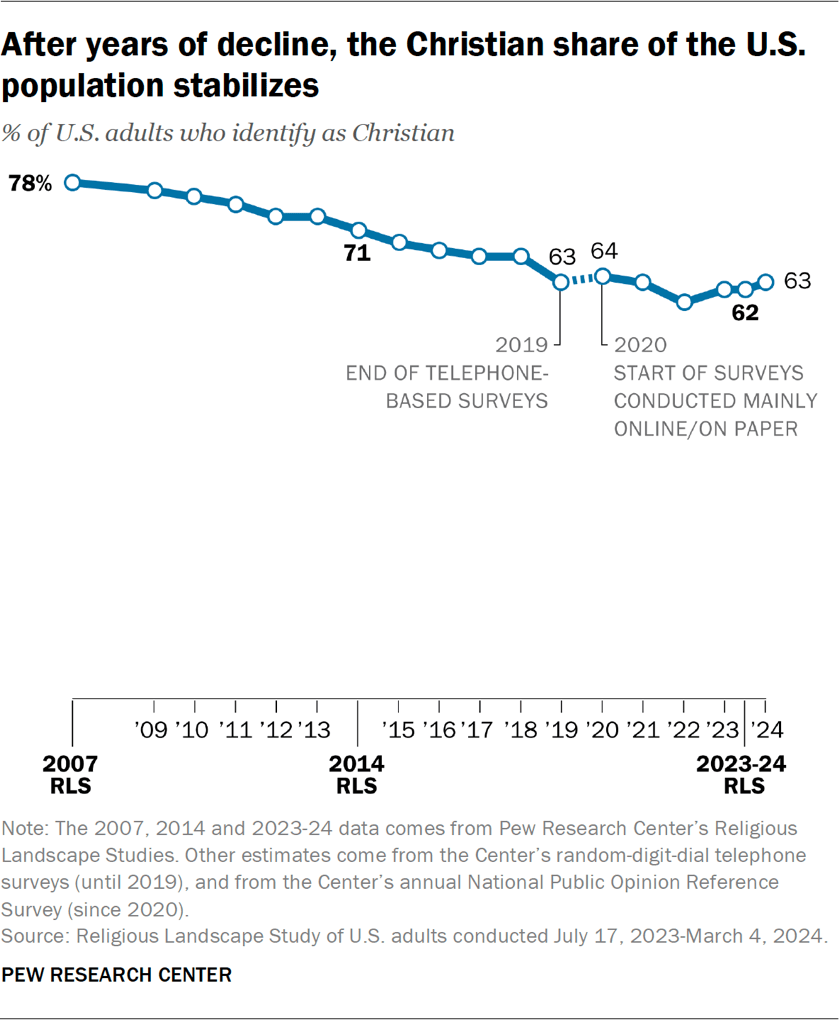
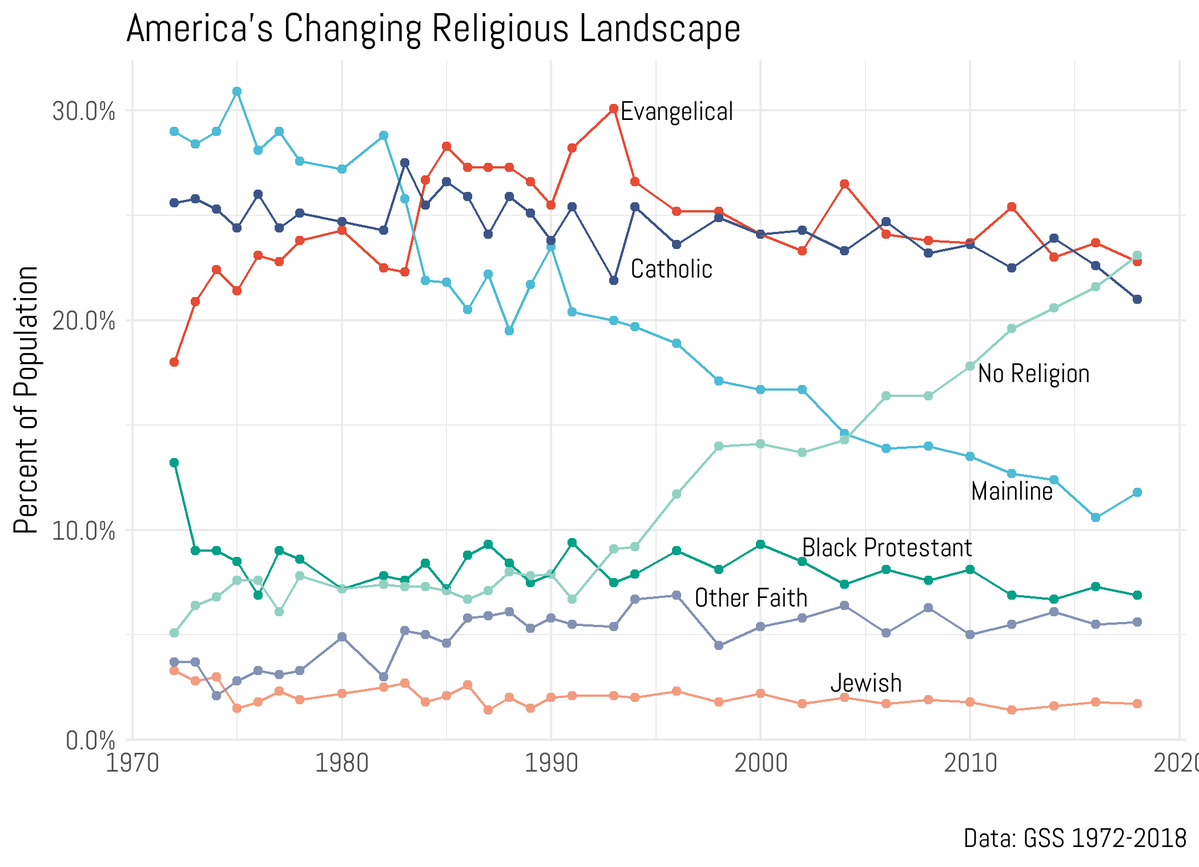
Here’s the plateau from the Pew page. But “stabilizing” assumes what’s going to happen in the future, and the plateau has occurred only since the pandemic began, while the decline starts 13 year for that. And if you look at the longer term (graph below that), it’s hard to see anything but a long-term decrease in religion:
The summary of a longer-term survey shown on the Calvin College website, summarizing data from all over America. The only thing that’s shot up is the “nones”, and “mainlines” (Protestants, I presume) are a third of what they were in 1970!
Back to the Panglossians:
What is really happening? Rather than experiencing simple growth or decline, American religion is in a state of churn. Some sectors are falling fast, while others show phenomenal growth.
Throughout history, Americans have routinely misinterpreted religious change as decline. Headlines about the demise of faith may be attention-grabbing, but they conceal a more complicated and interesting reality.
What are the key factors behind the confusion about religious change? One is an overreaction to the rise of the nones. Today, more Americans claim adherence to no religion than did in the late 20th century. A generation ago, more adults would have said they were Christians even if they had no connection to a church.
Today, people are more candid about their religious identities. Outside of the Bible Belt, there is little shame in telling a pollster that you simply aren’t religious.
This does not mean that the nones are atheists or agnostics, though they are often labeled as such. Treating atheists, agnostics and nones as a unit allows observers to tout the blockbuster headline that “religious ‘nones’ are now the largest single group in the U.S.” This strained math obscures the fact that the number of self-identified Christians today remains more than twice the combined total of nones, atheists and agnostics.
This is the kind of nonsense that heartens the faithful but misleads everyone else. The fact is that fewer people go to church than ever before, the “nones’ have shot up (granted, there is a six-year plateau), and “mainline” Christianity has dropped like a rock in the last fifty years. It’s telling that faithheads like the authors here are so eager to seize on the “plateau” as a sign that religion isn’t going away. I have news for them: if they look over the last half-century, or even more over the last 150 years, religion has largely vanished. In another century, it will be a mere shadow of itself—and a good thing, too. Sadly, you don’t see any mainstream news outlet having a column called “Nonbelieving”.
*I’m getting plenty tired of AI-composed prose masquerading as something written by a human being. One of my ideological heroes, Rawan Osman, an ex-Muslim Syrian who is strongly pro-Israel and a self-described Arab Zionist who’s becoming Jewish, turns out to have written quite a few Twitter posts, Facebook posts, and posts on her blog at the Times of Israel that, according to the reliable AI-detection program Pangram, are wholly or substantially written by AI (example here). I am so put off that I no longer read her, and when I pointed it out, fellow Jews and Israel sympathizers piled on me, saying “It doesn’t matter.” But it does.
Another example. Maarten Boudry wrote me: “A literary First Prize has been awarded to a short story that is 100%. AI. Do you know Moth Magazine? Never heard of them, but they have 12K followers on X and have a Wikipedia page, so it’s not completely fringe.” Maarten’s tweet gives the story, “The Shoulder,” by Jeffrey-Michael Kane, and it’s still up. When I told the magazine (and another one) that Kane was using AI to write his fiction, I was blown off (the reply was “Although we avoid publishing AI-generated work, ultimately the responsibility for this rests with our authors, who we trust to submit original work.”) Maarten is also peeved that his own rector at Ghent University gave an AI-generated speech as her inaugural address, with three out of the four quotes in it purely fabricated by AI.
Over at Maarten’s Substack site, he’s reprinted a Quillette article about his own disaffection with AI: “Show us the prompts” x
The good news for anyone recruiting an AI ghostwriter is that the odds of public mortification are falling. Fabricated quotes and references are just about the only way to catch a lazy author out, since there is virtually no innocent explanation for them. But as Large Language Models have improved, hallucinations like these have grown rarer. And without those dead giveaways, we are left with AI detection tools, which are irreducibly probabilistic. The best of them is Pangram, which boasts a false-positive rate of one in 10,000, given a long enough chunk of text and some reasonable assumptions. Writers accused of AI plagiarism routinely deny it, and there is no way to prove the charge conclusively.
Writing in the Free Press, Tyler Cowen predicts that before long hardly anyone will care whether or not a text was written by a human. Cowen describes the humbling experience of being impressed by an author’s knowledge and scholarly chops, only to discover that there was no author at all. After he was burned a few times, he got better at spotting the signs. In a recent essay, Richard Hanania goes a step further. Suppose we are impressed by the writings of some brilliant young thinker and then discover that every word was machine-generated. “It shouldn’t really matter,” Hanania contends, “and we should hope that this person continues to do the same kind of work.” With the possible exception of memoirs, which are inherently personal, he does not care one way or the other.
But something bugs me about all this. As a writer and non-native speaker of English, I am grateful for Claude’s proofreading help when I am drafting an essay. And as a reader, I have come across AI-generated poems, short stories, and jokes that I have really enjoyed— sometimes I knew their provenance from the start, sometimes I discovered it only later. Far from diminishing my enjoyment, this realisation often heightens it, out of sheer fascination with the technology. But argumentative non-fiction feels different. For some reason, I resent belatedly discovering that an essay that tries to persuade me of something was machine-written, and I lose interest at once. [This is what happened with me and Osman’s writings.] Why is this?
I don’t mind if people use AI to proof, revise, or polish an essay, or even to flesh out a paragraph. But if you let AI compose the piece from beginning to end, there is no author taking responsibility for the views it develops. There is nobody there with whom to have a conversation, nobody who holds the beliefs and attitudes on display. Ask Claude for an eloquent rebuttal of the “Death of France” essay and the result might look every bit as compelling from the other side of that culture war. Perhaps that would go viral, too.
The solution? “Show us the prompts”; that is, disclose what you did and what you fed into AI to let it write. That still doesn’t satisfy me:
There is nothing wrong with using AI to generate text per se, and I do it myself if I am drafting a reference letter, writing a legal defence, or answering a long email. The prompt is usually based on a short list of bullet points and instructions, or on things I have written before. LLMs are extremely good at catching your drift, especially when they have been trained on your earlier writing. It is fine, too, wherever the pleasure is in the artefact rather than the argument: jokes, poetry, perhaps some kinds of fiction.
But if you ask AI to compose an entire argument, then sign it with your name and send it to the Guardian, it behoves you to disclose it and leave your readers to decide whether or not they are still interested. That hardly any writer does this, unlike many creators of AI images and video, suggests a degree of guilty conscience. These people want to preserve the illusion that an actual person produced the text, because they rightly suspect that we would stop reading if we knew the truth.
And, indeed, I’ve stopped reading Osman. As an exercise, you can enter some suspect prose into Pangram (here; you get three tries per day for free), and see what you get. Try, for example, putting in some fiction or poetry by Jeffrey-Michael Kane.
*The NYT reports that the heirs of a woman who, as a prisoner in Auschwitz, did paintings of “Death Doctor” Josef Mengele’s subjects, are suing to get the paintings back (article archived here).
When Dina Gottliebova Babbitt was a prisoner at the Auschwitz-Birkenau concentration camp in the 1940s, she stayed alive by painting watercolors on a rickety easel for Josef Mengele, the Nazi physician known as the “Angel of Death.”
Throughout her life, Babbitt tried to retrieve seven of those works from the Auschwitz-Birkenau State Museum in Poland. “I want to hold them in my hand,” Babbitt said in a 2009 video just months before she died at 86. “I want them here. I need them.”
But the museum refused to turn them over, asserting that the historical and educational value of the paintings superseded her right of ownership.
Now, Babbitt’s two daughters — Michele Babbitt Kane and Karin Wendy Babbitt — are suing the museum for the return of the watercolor portraits that their mother created while struggling to survive as a Jew in a Nazi death camp.
“Dr. Mengele then took the completed portraits from her,” says the complaint, filed on Monday in United States District Court for the Central District of California. “Dina Gottliebova Babbitt never voluntarily sold, assigned, transferred or relinquished the Watercolors. Yet more than 80 years later, all seven of the Watercolors remain in the possession of the Museum, which claims that it — not Dina Gottliebova Babbitt’s heirs — owns them.”
The Auschwitz-Birkenau Museum, at the former death camp in Poland, defended its decision to hold on to the paintings, describing them as important records of Nazi persecution.
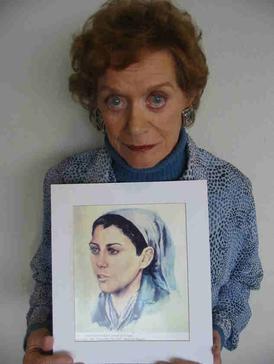
The NYT article shows several of Dina Babbitt‘s paintings (she lived from 1923 to 2009), and here’s a photo from Wikipedia showing her holding a copy of one of her portraits.
This seems to be a no-brainer. The work is that of Babbitt herself and so would seem to belong to her heirs—her daughters. If they want to donate the paintings to a museum, that’s fine, but the work is theirs to have, regardless of its historic interest. The paintings are very good, but I think that reproductions are sufficient to show at Auschwitz. Or do you think otherwise?
Meanwhile in Dobrzyn, Hili is asking Andrzej increasingly difficult questions. I asked Andrzej what this was about, and he replied, “Chimera – an illusion or fabrication of the mind. Idea separated from reality, which is often pushing (or dragging) people into calamity.”
Hili: Is it possible for a chimera to be a draft animal?
Andrzej: In politics, unfortunately, yes.

In Polish:
Hili: Czy chimera może być zwierzęciem pociągowym?
Ja: W polityce, niestety, tak.
*******************
From Stacy:

From Cats Doing Cat Stuff:

From Terrible Maps: “The most common way to say ‘toe’ across European languages”:

The Islamic Republic just executed Hossein Padaran for “spying for Israel.”
No lawyer. No public indictment. No announced execution date. His family never heard a word.
From arrest to the gallows, no one heard from this human being.
This regime doesn’t execute spies. It… pic.twitter.com/eBtVUUVlGs
— Masih Alinejad (@AlinejadMasih) September 19, 2026
From Luana: Justice in Canada for a man with 43 prior convictions:
And the final update to this saga:
I was just at his sentencing. The prosecution had asked for 15 months in prison because of the randomness and aggression in his assault on me and his extremely long history of violent crime (43 prior convictions).
The defense asked for no… https://t.co/VAIMLgeS8i
— pagliacci the hated 🌝 (@Slatzism) September 18, 2026
I’m with the Number Ten Cat on this one. Trump simply cannot ban from the White House those news outlets he doesn’t like. The courts will back up Larry and me!
Can’t wait for their next lecture on the importance of freedom of speech https://t.co/LDs9FQSsLZ
— Larry the Cat (@Number10cat) September 18, 2026
Two from my feed. First, “journalists” at Al Jazeera were fired en masse:
A few key revelations related to Gaza coverage in last few days:
– Almost all of the media in Gaza were in a Hamas-run WhatsApp group that dictated and coordinated coverage. Including contributors to major western news organizations.
– Al Jazeera fired 24 of their media members… pic.twitter.com/Lpwl2wbqpN
— AG (@AGHamilton29) September 19, 2026
FAT BEAR WEEK IS STARTING!
Yes, my friends, it is that time of year: the leaves begin to change colors, the temperature cools, and the time-honored tradition of rooting for your favorite chonky bears at Katmai National Park & Preserve begins.
Fat Bear Week starts Tuesday: https://t.co/hHhBXv3T0L pic.twitter.com/ISSNe50nGT
— U.S. Department of the Interior (@Interior) September 19, 2026
One I reposted from The Auschwitz Memorial:
These two Dutch Jewish children were gassed to death as soon as they arrived in Auschwitz. The boy was three years old. https://t.co/hHLKI9UaG5
— Jerry Coyne (@Evolutionistrue) September 20, 2026
And two from Doctor Cobb, both involving kitties:
I comb my cat every Saturday morning. And then he always feels the need to wash me back. I’m sure he thinks I’m a cat too. Cute but gross 😂 So always comb him pre my morning shower. #caturday
— Steve Portugal (@sjportugal.bsky.social) 2026-09-19T16:20:03.785Z
There’s a big argument about whether this is an AI-generated photo. I don’t care; I like the sign. Click on the post to go to the original:

Babbitt’s heirs should get the paintings back and should have control over whether or not reproductions are permitted. Yes, a no brainer.
My first thought is that surely the original paintings themselves should have gone to the artist and now to her children…amazing that she survived and had children, their existence apparently enabled by these portraits that she continually produced. The “educational and historical record” (essentially a story after all) at the museum can be more than adequately served by reproductions which, especially these days, are of very high quality.
The judge is a member of an association of Black lawyers. It is hard to dismiss the suspicion that she is more of an activist than a judge.
She certainly does not seem to care about justice for, or safety of, law-abiding citizens. One does wonder what the ruling would have been if the skin colors of the criminal and victim were reversed.
I agree with our host about the ownership of those paintings.
Regarding the Gottlieb painting of Yom Kippur servings, two things stand out to me. The guy with his hand on his head always struck me as an accurate representation of someone exhausted during the afternoon service, after a long morning service while fasting.
Second, the wall separating men and women. Today, with Orthodox Judaism becoming more extreme about the separation of men and women, that partition would not be acceptable an an orthodox congregation. It would be higher, so the men would not be able to see the women. By the way, we do know that partitions such as the one in the picture did exist in the past—the painting is an example of religious practise becoming more extreme.
I would like to take the opportunity to wish all the participants on this site a good Yom Kippur, whether or not you look at it as a religious holiday. A day of self-reflection is, in my opinion, a good thing for anyone. And if you don’t believe me, look at Hili and other cats. They engage in self-reflection every day of the year.
Jerry, please allow me to once again wish you success in your eye surgery.
Yes, I was about to add to my earlier comment (to avoid over-commenting and violating da roolz) that in my memory of our orthodox shul from childhood, the curtain that we see behind the women, should be in front of them…which of course would make for a pretty boring image. The guy with his hand on his head simply reminds me of any Jewish boy’s angst when studying anything.
So, absent his support acts and backing band, Ed Sheeran gave a concert pretty much just himself and his guitar. Here is a link to his remarks afterwards.. The woke will hate him for it. How dare he refuse to be canceled!
Another musician who has been vilified for sticking up for Jews is Boy George. I wasn’t a particular fan of his before, but I am now.
Intersting to compare him to Martina Navratilova, another outspoken celebrity. Boy George supports the Jews while Martina goes for the genocide-in-Gaza absurdity. On the other hand, Martina is a “gender-critical” realist with regard to biological sex and Boy George is a typical trans-rights advocate. Both are unusual in that there is a strong correlation between being pro-Palestine and believing that trans is real. (Of course, the typical queer for Palestine would probably survive less than a day in that region.)
Thanks for sharing this. I don’t listen to Mr. Sheeran’s music, but I admire him for making a courageous stand.
I’d never heard of him, or the other guy.
A report from Ed. He asked a fellow musician to help out because some of the tunes in the show needed accompaniments to work. She said yes (violinist) and bought a drummer, basses, forget who else, with her. Not such a lonely boy anymore.
“If you’re an observant Jew, you can’t drink or eat (not even water), nor can you kiss your wife.”
What if you have a husband? Are there no observant Jewish women?
Just the same as in the 10 Commandments not coveting your neighbour’s wife. It says nothing about your neighbour’s husband. So, feel free.
Don’t forget the one about thy neighbour’s ass.
There is a mistake on the toe map:
The Dutch language has a word for “toes”, “tenen”. We do not call them “fingers of the feet”.
Meanwhile Hungarian, while colored as having a separate word, does call them fingers of the feet and do not actually have a separate word. It just that it is not a phrase with separate words, but a compound word.
finger = ujj
leg/feet = láb
toe = lábujj
And I am pretty sure a lot of nuance is lost elsewhere too. There is apparently not much deep research behind this map.
I don’t think those maps are supposed to reflect deep research. They’re for fun, and, in your case, their take seems to be pretty correct.
I had no high expectations for the research behind the map, I just kind of stated the obvious. I already met this map elsewhere, and multiple errors were pointed out. But yes, it is still interesting.
On it being correct about Hungarian: You got me with this. You are right that by the phrasing of the legend it is correct. It does not say “independent word” after all, it was just my interpretation. I set a bar that is not present in the map itself. I am too eager to nitpick sometimes.
Yes, they are supposed to be fun, but if they are wrong then the humour has gone. At least in common speech, French has the same word for fingers and toes.
I also wonder about France. Though a native English speaker (the son of English-born parents), I grew up in French-speaking Quebec and was educated in French. We definitely used the word “orteil” but my impression was that “doigt de pied” (finger of the foot) was used more commonly in France. An actual French person would know of course. Perhaps it differs regionally?
By the way, my Spanish-speaking wife caused some hilarity when she was learning English by talking about “foot fingers”.
Selma Hayak mentioned on a talk show that she asked for a blow job after getting her hair washed at a hairdresser’s. Sitting next to her, and without missing a beat, Elton John said “well, I’ve done that”.
Re show us the prompts: I run a forum for people with CLL. Keeping bots and spammers out is an ongoing problem. A new members first post has to be approved by me. One the other day was this:
The actual genius posted his prompt rather than the answer!
There is reason to criticize Trump’s banning of CNN and the other, but Larry the Cat should stay out of this one, giving what’s going on with speech in the UK. (Also, no one remembers that Biden banned Fox and yanked the press credentials of several hundred reporters, in addition to his hermit act with the press.)
A somewhat different accounting:
“New rules required annual renewal of the credentials. 439 didn’t apply for renewal. Most of those had not used their credentials in more than a year. The one that did apply and was denied renewal, was allowed to re-apply once he verified he worked for a legitimate news organization. Until then, he was still allowed access using a daily pass.”
Cataract? My wife had both eyes done the year before last. Went perfectly and she was thrilled to be able to see better than she ever had. Good luck.
The Maurycy Gottlieb with head in hand—the one who can’t wait for the interminable service to end—could have been me. I was dragged to a Yom Kippur service once as a child. Neither I nor my parents ever went again. Such an ordeal! I suppose that atonement is an ordeal, so maybe the service makes symbolic sense to those who think that atonement requires suffering.
Religion will continue to decline because the conditions favoring decline—progress of science, secular education and workplace, the thinning out of religiosity in communities, the decline of the relevance of “belief” in daily life, etc.—remain in place. True, there are blips of religious re-emergence, but the long-term trend remains clear. In essence, religion has lost its relevance.
Yes. The paintings should be returned to the Babbitt family. The Auschwitz-Birkenau Museum of all places, given the history of theft of Jewish art, should lead the charge to return any and all artifacts that survivor families might want to repatriate. Many of the descendants will choose to donate the art to museums to keep the memories of their loved ones alive even after they, themselves, are gone. Museums will not run out of material for display.
G’mar chatima tovah.
“Although Saudi Arabia is a repressive theocracy, it’s not as bad as Iran”
I must disagree with that statement. Iran is certainly more of a threat to other countries. But in terms of oppressing its own citizens, I think SA is significantly worse.
SA is more hyper diligent than Iran when it comes to floggings for trivial misdeeds, amputations for thieves, and other examples of “Islamic justice” doled out by the courts. Surely for women it is far less inconvenient to be required to wear a head covering than the full veil required in SA (the burqua in Afghanistan must be far worse still). In Saudi Arabia, by law a woman, even if properly veiled, is not allowed to go out in public unless accompanied by a male relative (which by a silly legalism may be a young male child). Iranian women can drive, in SA it is forbidden. Iranian women are represented in medicine and various other professions, though they are typically paid much less than men. In Saudi Arabia there are almost no professional women, other than a few foreigners.
I see a difference here. It would be a miserable choice, but I would rather live in Iran than SA. Even more would I have that preference if I was a woman.
The Saudis are also one of the heavy investors in AI. This particular report I’ve read suggests for abuse in surveillance and control of the population. Speculative sure, but no outside the realms of the Kingdom. After all they had a critic, one Jamal Ahmad Hamza Khashoggi, dismembered and put in a suitcase by Saudi agents for removal from Turkey.
Google:
“Saudi Arabia has committed massive capital—including a reported $100 billion initiative—to build out national AI capabilities, data centers, and semiconductor supplies.”
In the past seven years or so, some of the restrictions on women in Saudi Arabia have been lifted. Women there can now drive, travel abroad, open their own business without male permission, retain custody of their children after divorce, and go about in public without a male guardian.
I have occasionally had disputes on X with what I suspect are people using AI. I don’t particularly care because 1) the posters are anonymous and not familiar anyway 2) the argument is steel-manned and 3) they stick to topic and don’t engage in personal insults or speculation. That last one is particularly noted and appreciated.
Jerry, I wish you the best of outcomes on your cataract surgery. Mine a few years ago (a sequel to vitrectomy) went without a hitch, as do almost everybody’s, though I do miss my old (weakened) powers of accomodation.
I’m only a perennial lurker on this site, saddened at your perception that it’s moribund. It does bring me joy and is an important part of each morning. If I ever get around to getting my old slides digitized I might even submit a wildlife photo or two
One more thing about Gottlieb’s painting: I notice that the men are praying independently and that the women are carrying out separate conversations (some not paying attention at all). This is not what we expect in a modern synagogue, where a spiritual leader—Rabbi or Cantor—leads the service, while everyone else sits at attention in seating that faces the Bima, chanting, rising, and again being seated in unison at the leader’s direction. From what I understand, the latter is a fairly recent development. In the old days (or “olden” days) prayer in the synagogue was a much more chaotic affair.
Others reading this probably know more than I do about this.
Jerry, I hope your cataract surgery goes well. After the operation you will be amazed how clearly you will see. I had cataract surgery and now I can see like an eagle, the replacement lens are better than the original lens. Another plus I no longer need to wear glasses. Good luck.
My cataract surgery went very well. I had corrective lenses put in and my glasses are much thinner now. I really appreciated the difference between the 2 eyes after 1 was completed. No more vision through a yellowish tint after the replacement.
I hope your surgery goes very well.
Good luck with your surgery, Jerry!
I want to inform everyone that the “Don’t Get Attached to the Chimps” paperback book cover is the creation of Cris Shapan, a graphic designer for movies and television (he’s worked with Weird Al Yankovic, among many others.) His parody book covers, album covers, and retro ads can be found all over the internet, too often without attribution. Many of his creations are products of the imaginary “Deluxe Fuxley” corporation.
I follow him on Facebook. His stuff helps keep me sane.
The battle of the charts and the advocacy spin that surround the strength (or decline) of religion in America have long amused me. There are few disinterested observers, or so it seems. One may as well ask “Cubs” or “Cardinals” of a Midwest baseball fan and expect an objective answer.
I think the most substantive claim one can make is that Christianity is no longer the operative public grammar of the United States—neither in its devout nor nominal forms. Its practice has been fractured, not only among regions, but among generations, classes, and ethnicities. Some lament this, others welcome it, but the collapse of a significant pillar of a nation’s cultural heritage is unlikely to pass without complication. That this shift is accompanied by a widespread neglect of, ignorance about, and declining commitment to our nonreligious civic and cultural inheritance will only ramify the effects.
I don’t have a crystal ball, but I don’t find credible the common claims that, at least for the United States, “The Nordic countries are our blessed future.” While those countries demonstrate that a shared religion is not an essential social glue, in its absence, there must be other factors that bind a people. Nonbelief is not sufficient. Set aside whether their examples can scale. Longstanding nonreligious cultural and civic practices, along with ethnic homogeneity, can provide that cohesion—factors increasingly lacking in the much larger and more culturally diverse United States. And these factors are increasingly under strain even in some of those exemplar nations.
I suspect our vitriolic political discord owes more to a loss of widely shared assumptions (both sacred and secular) than to amplifiers of discord like social media, particular personalities, or similar factors. Whether some new unifying structure emerges (or reemerges) to strengthen national identity remains to be seen. Whether it is even desired is part of the casus belli of our ongoing culture war.
“I suspect our vitriolic political discord owes more to a loss of widely shared assumptions (both sacred and secular) than to amplifiers of discord like social media, particular personalities, or similar factors.”
I suspect the same. I don’t know if one strand of discord accounts for more discord than the other, but I do suspect it is a feedback loop.
Unfortunately, a proven “unifying structure” is war. And the bigger the war the bigger the unification. Doesn’t always work, of course. Trump bet on that in Iran and lost. It’s best to be attacked first for that one to work. One thing is for sure, and has been the truth for many a year: American’s are done with wars based on future hypotheticals.
My recent brushes with AI. I use Yahoo as my entry into the intenet and it uses Gemini AI to answer all queries. I have found it useful but have the following comments, it is sycophantic and sickeningly saccharine when it is shown to be wrong. It does not appear to be able to fact check its information. It has given me incorrect information and when shown that it was wrong, mainly because it tries to apply solutions, which apply to one particular program, to a different program without checking if it will work, it tells me how fantastic I am and I am entirely correct. It even makes basic mathematical errors when using brackets in equations. I do not need to be told my solution is much more elegant, when it actually means that it was incorrect and its solution did not work.
The significance of these documents is inseparable from Dina Gottliebova-Babbitt’s fate as a prisoner forced to work on the orders of Josef Mengele. But they also preserve the faces of individual Roma victims subjected to his experiments. They therefore document several histories at once: Dina’s coercion, the suffering of those portrayed, the practices of criminal SS medicine, and the wider persecution and annihilation of Roma and Sinti by Nazi Germany.
Dina’s authorship is not in question. But authorship alone does not resolve the status of the original physical documents. They were not created freely and later taken from her. Historical research shows that Mengele controlled the process: he provided the materials, selected the Roma prisoners to be portrayed, and determined how the representations were to be made. Their origin, purpose and historical function are inseparable from the criminal system in which they were created.
This is why the argument that, because Dina created them, the originals necessarily belong to her heirs does not exhaust the issue. Other dimensions must also be considered: coercion, provenance, the identity of the people portrayed, the documents’ evidentiary character, and their place within the surviving documentation of Auschwitz.
At the Memorial, the originals remain in dialogue with the authentic site, surviving camp records, survivor testimonies and other material evidence. A reproduction can preserve the image, but it cannot reproduce the historical status, provenance or material authenticity of an original document physically created in Auschwitz. That authenticity connects Dina, the Roma victims she was forced to portray, and the crimes themselves. The documents are also presented within the exhibition devoted to the persecution and tragedy of Roma and Sinti, created by representatives of the Roma community. They preserve individual faces while also bearing witness to the fate of an entire persecuted group.
The Memorial’s responsibility is therefore not simply to possess these documents, but to preserve the integrity of authentic evidence and the multiple memories it carries. We believe the originals should remain, as documents, in the Museum’s collection and continue to be accessible at the authentic site.
I disagree with the Museum’s decision but I have permitted them to make their case. They feel that reproductions are not sufficient because they are not “authentic evidence”. I disagree, but in the end the courts will decide this.
Which question would help reveal a mistaken assumption early in the process?