Readers’ wildlife photos

March 12, 2026 • 8:15 am

And we have more photos. Today’s come from Jan Malik, documenting the birds of Barnegut Inlet in New Jersey. Jan’s captions and IDs are indented, and you can enlarge the photos by clicking on them.

My previous batch from the Barnegat Inlet covered geese and ducks. It’s time for some of the other coastal birds now.

Immature Double-crested Cormorant (Nannopterum auritum). In contrast to diving ducks, these birds have no buoyancy problem and submerge easily.

Common Loon (Gavia immer). Judging by the slightly pinkish gape at the base of its bill and the fuzzy transition between black and white, this is an immature bird that stays on coastal bay waters before maturing and returning to quiet inland lakes to breed:

Another loon, this one with a mangled crustacean that I suspect is an Atlantic blue crab (Callinectes sapidus). I wonder if a diving loon preferentially picks a freshly molted crab the way we select ripe fruit:

Not a great loon picture, but we can see enough of the prey’s fins to identify the fish as an Oyster Toadfish (Opsanus tau), a species in which males provide parental care to eggs and young. The fish was big and bony, so the loon struggled a bit to swallow it. That fish would be a terrible choice for performing the Fish Slapping Dance. For the loon, it would be preferable to swallow its catch underwater, because at the surface it may be stolen by gulls, who know where a bird has dived and circle above waiting for it to reappear:

A couple of Savannah Sparrows were hopping on the rocks. I suspect that this pale bird with very little yellow in its brow is an Ipswich Sparrow, a subspecies (Passerculus sandwichensis princeps) that breeds on the sand spit of Sable Island off Nova Scotia:

Three species of shorebirds are common in winter at the Barnegat Inlet, all quite similar at first glance in size and plumage, but each occupying a different ecological niche. First, the Ruddy Turnstones (Arenaria interpres), here trying to sleep—probably using only one half of their brain to watch for predators, in unihemispheric slow-wave sleep. Their bills are short, stubby, and slightly upturned, adapted for—just as their name suggests—turning over beach debris to search for invertebrates hiding underneath:

Next, the Dunlins (Calidris alpina). They feed, roost, and migrate in large flocks. Unlike Turnstones, their bills are long, slender, and sensitive, used for probing tidal mudflats for worms and crustaceans:

Last, there are the Purple Sandpipers (Calidris maritima). Their bills are more “general purpose” than those of the other two species. Their covert feathers do show a purple sheen in the right light:

Purple Sandpipers and Dunlins are not very afraid of people on their wintering grounds; they may rest a few meters from a quiet observer. But the slightest hint of danger can trigger the whole flock to take flight in an instant—only to land nearby a moment later:

Purple Sandpipers are adapted to rocky coasts, where they feed on mussels exposed during low tides and on other invertebrates. The undersides of their feet must have a texture that allows them to walk sure‑footed on slime‑covered, slippery rocks:

 They have also evolved Silly Walks:

A distant Harbor Seal (Phoca vitulina), a frequent sight in the Inlet, always seems to look at the jetty with disappointment when it notices that this prime haul‑out spot is occupied by people:

As I was about to leave, the colors of the sunset behind a distant house caught my attention, so I took a picture, thinking little of it. Only back home—rather like the character in Antonioni’s Blowup—did I realize that the picture hides a predator the sleeping shorebirds must be on guard against. To be honest, I can’t be sure this was a flesh‑and‑blood predator and not one made of polystyrene, but the impression remains:

Readers’ wildlife photos

March 11, 2026 • 8:30 am

Hooray! Two more groups of photos came in this morning and so we’re good through Friday (I have one in reserve and can cobble together a few others).

The regulars are pulling their weight, and here we have an informative text-and-photo educational post by regular Athayde Tonhasca Júnior. The subject is one of his favorites: bee behavior. You can enlarge Athayde’s photos by clicking on them, and his text is indented.

Witty impostors

On its release in 1956, Invasion of the Body Snatchers did not impress the critics. A spiel about alien plant spores growing into sociopathic duplicates of human beings was considered too outlandish. While the intelligentsia trashed the film, the producers laughed all the way to the bank because it was a commercial hit: the public loved it. One of the reasons for the film’s success was its ‘aliens among us’ theme. The idea of ill-intentioned beings circulating freely and unsuspectedly in the mist of our society is disturbing and gripping – especially during the McCarthy era, when Americans were inspecting their closets for hidden communists. ‘Enemies within’ inspired and inspires countless tales about spies, infiltrated assassins, covert extra-terrestrials, psycho cyborgs and zombified humans.

Fig 1. Invasion of the Body Snatchers received numerous accolades and is today considered a science-fiction/horror classic © Allied Artists, Wikimedia Commons:

Despite what assorted internet sages tell us, tales of aliens’ secret forays into world domination are entertaining fibs. But the natural world provides many real body snatching thrills such as parasitic flies that zombify their victims or induce them to dig their own graves, or wasps that make their hosts work for them. These cases involve species we may already suspect to be mischievous. That some bumble bees could play similar tricks may surprise many.

Superficially, cuckoo bumble bees, Bombus species of the subgenus Psithyrus, look like any of their social (non-parasitic) relatives. But a close inspection of a female’s hind leg shows no pollen basket (corbicula), which is a shallow cavity surrounded by a fringe of long hairs, a structure used to store pollen to be carried away.

Fig 2. Hind legs of a vestal cuckoo bumble bee (B. vestalis) on left, and a buff-tailed bumble bee (B. terrestris) © Alvesgaspar, Wikimedia Commons. [JAC: the buff-tailed bee has a pollen basket.]

She has no corbiculae because she gathers no pollen; cuckoo bumble bees do not found their own nests nor produce a worker caste: there are only male and female reproductive forms. Instead, a female invades the nest of a social bumble bee, lays her own eggs, which are cared for by her unsuspecting hosts. Raising the young at another species’ expenses is known as brood parasitism, a behaviour displayed by some cuckoo birds (order Cuculiformes) – hence Psithyrus bees’ common name.

Fig 3. A  common reed warbler (Acrocephalus scirpaceus) feeding a European cuckoo (Cuculus canorus) who has dispatched rival offspring by pushing them out of the nest © Per Harald Olsen, Wikimedia Commons:

Cuckoo bumble bees go beyond brood parasitism; they don’t just lay their eggs in a host’s nest and leave them to themselves like cuckoo birds do. These bees take over the victim’s colony, a form of exploitation known as social parasitism. Among insects, this strategy is employed mostly by bees, wasps and ants – of which slave-making ants are notorious – but also by other taxa such as the large blue butterfly (Phengaris arion). Once inside the host’s nest, the female cuckoo and her young live off pollen and nectar pilfered from their hosts, so they are also kleptoparasites – animals that steal food or prey from another animal.

We should pause to appreciate the challenges a cuckoo bumble bee faces. First, she has to locate the nest of a suitable host. She must then get in through a narrow entrance protected by a mob armed with poisonous stings and sharp mandibles. Once these defences have been overwhelmed, she must be able to usurp the colony from the host queen, lay her own eggs and induce the host workers to feed her and her developing brood. A tall order for any brood, social and klepto- parasite.

Fig 4. Cuckoo bumble bees coveting this tree bumble bee (B. hypnorum) nest must pass its sentries © Orangeaurochs, Wikimedia Commons:

Finding a nest is reasonably straightforward: like most social insects, cuckoo bumble bees rely on chemical signals from cuticular hydrocarbons to recognise nestmates, co-specific competitors and potential hosts. But locating a nest is just the start. It must be of suitable size: if too big, the defenders are likely to overwhelm and kill the trespasser; if too small, there will not be enough workers to care for her larvae. As an example, there’s a 100% survival for vestal cuckoo bumble bees invading buff-tailed bumble bee nests with five workers; survival drops to nil for colonies with fifty workers (Sramkova & Ayasse, 2009). To avoid disaster, the female cuckoo bumble bee assesses the size of the host colony possibly by their chemical signals and workers’ traffic (Lhomme & Hines, 2018).

After picking an appropriate target, the female cuckoo bumble bee must confront the residents, who understandably are not obliging. But the nest defenders face a formidable enemy: a cuckoo bumble bee is sturdier and better armed than her social counterparts. She has larger and stronger mandibles, more powerful sting muscles, an enlarged venom gland, and her ventral underside, a particularly vulnerable spot, is protected by thicker exoskeleton plates (sternites) (Richards, 1928). So, some cuckoo species use brute force: they bite, push and sting their way in.

Fig 5. Armed for breaking and entering: the variable cuckoo bumble bee (B. variabilis), a critically endangered North American species © USGS Bee Inventory and Monitoring Lab:

But violence is not always necessary. Some species are let in because they mimic their host’s chemical signs. Others have no chemical signatures and display no aggressive behaviours; the host bees are not aware an enemy has sneaked in. The cuckoo will hide in a corner of the nest for a few days, long enough to acquire the scents of her host and blend in (Dronnet et al., 2005).

Once inside, our intruder has to deal with the queen, the only egg-laying member of the colony and thus the mother of all other bees, whose activities are controlled by their mum’s pheromones. Most cuckoo bumble bees don’t beat about the bush; they kill the queen and eat her eggs. Some species spare the deposed monarch, who loses control of her colony for reasons not completely understood: probably the usurper’s pheromones and physical aggression assure her dominance over the queen.

Fig 6. A brown-belted bumble bee queen (B. griseocollis) is strong, but no match for a cuckoo bumble bee © USGS Bee Inventory and Monitoring Lab:

After sorting out the queen problem, the cuckoo bumble bee is free to lay her own eggs and induce the host workers to feed her and her developing young, although how this is done is largely unknown. The resulting male and female cuckoo bees will leave the nest by late summer and look for mating partners. Like most other bees, the male dies soon after intercourse, while the female will search for a safe spot underground to overwinter, just like her hosts. She will emerge from her slumber late, giving sufficient time for her hosts to establish their nests. The female cuckoo bee spends some time hopping from flower to flower, sipping nectar while her ovaries mature, so that she will be ready to find and conquer a bumble bee nest.

Of the 250 or so Bombus species, roughly 30 have evolved into parasitism. We have a poor grasp of cuckoo species’ biology and ecology, partly because they fly about for a relatively short time and their numbers are naturally low, since they don’t have a worker caste. Thus they are difficult to find and study. But the lack of information comes largely from prejudice. Parasites in general are not viewed sympathetically, especially those that target ‘cute and lovable’ victims such as bumble bees. As a result, cuckoo bumble bees are often absent from local species lists and conservation plans. But that’s a misguided view. Parasites and predators are integral components of ecosystems, preventing over-dominance of some species in favour of rarer ones (Frainer et al., 2018). Cuckoo species should be admired and valued for their physiological, morphological and behavioural adaptations that allow them to overcome the defences of highly organised colonies. These bees of ill-repute are in fact evolutionary marvels.

Fig 7. A female red-tailed cuckoo bumble bee (B. rupestris), a widespread European species and a parasite of the equally abundant red-tailed bumble bee (B. lapidarius) © Ivar Leidus, Wikimedia Commons:

References

Dronnet, S. et al. 2005. Bumblebee inquilinism in Bombus (Fernaldaepsithyrus) sylvestris (Hymenoptera, Apidae): behavioural and chemical analyses of host-parasite interactions. Apidologie 36: 59–70.

Frainer, A. et al. 2018. Parasitism and the biodiversity-functioning relationship. Trends in Ecology and Evolution 33: 260–268.

Lhomme, P. & Hines, H. 2018. Ecology and evolution of cuckoo bumble bees. Annals of the Entomological Society of America 112: 122–140.

Richards, O.W. 1928. A revision of the European bees allied to Psithyrus quadricolor Lepeletier (Hymenoptera, Bombidae). Transactions of the Entomological Society of London 76: 345–365.

Sramkova, A. & Ayasse, M. 2009. Chemical ecology involved in invasion success of the cuckoo bumblebee Psithyrus vestalis and in survival of workers of its host Bombus terrestris. Chemoecology 19: 55–62.

Readers’ wildlife photos

March 9, 2026 • 8:15 am

I have a few batches now, so I’m complacent (never happy!). Today’s photos of Costa Rica come from reader Rachel Sperling.  Her captions and IDs are indented, and you can enlarge the photos by clicking on them.

In January I took my first (of many, I hope) trip to Costa Rica. We spent about a week in Manuel Antonio, on the Pacific Ocean side. We took a couple of nature walks in and around Manuel Antonio National Park, and we saw plenty of wildlife. One of these days I’m going to treat myself to a really good camera, but these were all taken with either my mirrorless Olympus or my iPhone camera, which are light and easy to stash in a backpack. I did see a couple of sloths – both three-toed (Bradypus variegatus) and Hoffman’s two-toed (Choloepus hoffmanni), but they were high up in the trees, so I wasn’t able to get a good photo of them.  These are the photos I was able to capture:

On the drive from San Jose to Manuel Antonio, we stopped at a creek to view some American crocodiles (Crocodylus acutus):

We saw a number of Central American Squirrel monkeys (Saimiri oerstedii), which were incredibly cute:

Then there were these little beasts: the Costa Rican mafia, aka the Panamanian/Central American White-faced capuchin (Cebus imitator). According to our guide, these monkeys can be pretty vicious with animals their own size, and they’ll just riffle through your backpack if you’re not watchful. Someone had to be on guard whenever we went to the beach.

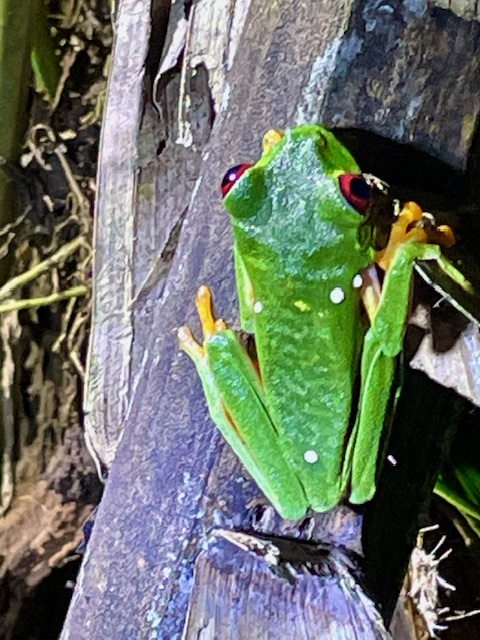
We went on a nature walk in the rainforest at night (with a guide), which gave us the opportunity to see a lot of nocturnal animals. Among them was the Red-eyed tree frog (Agalychnis callidryas):

Masked tree frog/New Granada cross-banded tree frog (Smilisca phaeota) in Manuel Antonio National Park. I’m sorry I’m not better at identifying plants, to the disappointment of my botany-teacher father:

Black iguana (Ctenosaura similis), at the beach at Manuel Antonio:

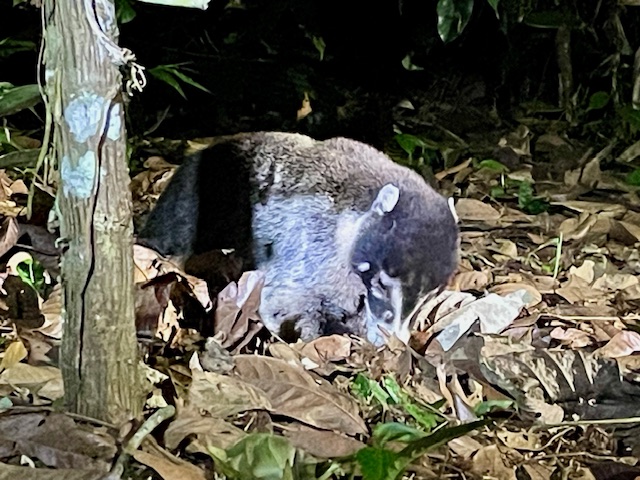
We also saw a coati (Nasua narica), which Wikipedia tells me are diurnal, but it was definitely after sunset and that is definitely a coati. They’re relatives of the raccoon, and our guide told us that a mature one can hold its own against a jaguar. This one wasn’t afraid of us, anyhow:

Back at our b&b, this Black-hooded antshrike (Thamnophilus bridgesi) came to visit me as I read on the veranda a few times. I think it’s a female, though the sexual dimorphism of this species doesn’t seem terribly dramatic. I did see her building a nest:

On my last day in Costa Rica, I heard a tremendous ruckus in the trees outside my hotel in San Jose. I looked and discovered that the trees (American oil palmsElaeis oleifera —I think) were full of Crimson-fronted parakeets (Psittacara finschi). They were LOUD and they were going to town on those trees. There were too many to count. Fortunately, they quieted down after sunset:

Manuel Antonio National Park from the water. These little islands are bird sanctuaries that tourists are not allowed to visit:

Sunset over the Pacific, near Manuel Antonio National Park:

Nauyaca Waterfalls, near Dominicalito, where we swam:

Finally, I thought you’d like these because they’re jaguar-inspired. We spent an afternoon at a village belonging to the Boruca, an indigenous tribe. They cooked us a delicious lunch, and showed us how they made dyes from local plants, and carved and painted balsa wood masks. The masks were first used to frighten the Conquistadores. Now you can buy them just about everywhere:

Readers’ wildlife photos

March 6, 2026 • 8:15 am

Reader Todd Martin sent some photos from the Yucatán (don’t miss the Ocellated Turkey!).  Todd’s captions are indented and you can enlarge the photos by clicking on them.

WEIT Yucatán

Here are some photos from a trip in November to the Yucatán in Mexico. The original purpose of the trip was to see Mayan ruins, but the natural beauty of the area turned out to be equally remarkable.

The first few pictures were taken during a boat tour of the mangroves in the Ría Lagartos Biosphere Reserve along the northern coast of the Yucatan Peninsula. The tour began at dawn and we were greeted by the rising sun and a welcoming committee of Monohelea maya, a species of predaceous midge discovered with some fanfare by scientists in 2000 (and with somewhat less fanfare on this very morning by myself):

The reserve is home to many species of birds, the most famous of which is the American flamingo (Phoenicopterus ruber), which can be observed trawling for brine-shrimp in the brackish water:

This is a Magnificent Frigatebird (Fregata magnificens). The male is easily recognized by the bright red throat pouch which looks like a life vest when inflated but actually serves to attract females. The females can be recognized by their frequent calls of ‘Well, if you’re so magnificent why can’t you take out the trash’:

The largest avian species we saw was this haughtily regal Brown pelican (Pelecanus occidentalis):

This is a Neotropic Cormorant (Nannopterum brasilianum) a diving bird sometimes used by the indigenous people of Bolivia and Peru to catch fish:

Hopefully this Wood Stork (Mycteria americana) has a good personality because it is (as my grandmother might have quipped) ‘not conventionally attractive’. It is, however, the only native stork in North America:

The Osprey (Pandion Haliaetus) is sometimes known as a fish hawk because fish make up the majority of its diet (not unlike Kevin Bacon or the singer Meatloaf):

Some birds are naturally elegant like this Great Egret (Ardea alba).In case you want to know how to avoid confusing it with a Snowy Egret … a Great Egret has a yellow bill and black feet, while the smaller Snowy Egret has a black bill and yellow feet:

Green Heron (Butorides virescens). Here’s a fun fact I cribbed from Wiki: “Green herons are one of the few species of bird known to use tools. In particular, they commonly use bread crusts, insects, or other items as bait. The bait is dropped onto the surface of a body of water to lure fish. When a fish takes the bait, the green heron then grabs and eats the fish”:

This American White Ibis (Eudocimus albus) was quite accustomed to people, which allowed me to get a pretty good close-up:

Morelet’s crocodile (Crocodylus moreletii). They look somewhat fearsome, but our one-armed tour boat operator said this one was ‘practically domesticated’”

Yucatan Jay (Cyanocorax yucatanicus) Jays are the noisy, argumentative neighbors of the animal kingdom. They are often described as ‘gregarious’ which I take to mean that they’ll take food from your plate without asking:

Those who frequented Glamour Shots in the 1980’s might confuse this photo with others of the genre, but it’s an Ocellated Turkey (Meleagris ocellata). The bird was the original inspiration for the marketing tag-line ‘taste the rainbow’. Unfortunately the bird is considered ‘Near Threatened’ by the International Union for Conservation of Nature (IUCN) with numbers that are sadly on the decline:

Whoever named the Black Spiny-tailed Iguana (Ctenosaura similis) wasn’t particularly creative, but I’m inclined to give them a pass because … that spiny tail!:

Finally – we stopped by Florida before returning home and my wife couldn’t resist adopting one of those hairless sphynx cats from the local shelter (Alligator mississippiensis). We love him very much, though he does have the unusual habit of sleeping in his water dish:

Readers’ wildlife photos

March 5, 2026 • 8:15 am

Send in your good wildlife photos, as I’m out save for singletons and doubletons.

Today’s photos come from reader Jan Malik from New Jersey and are geese and DUCKS. The captions and ID’s are indented, and you can enlarge the photos by clicking on them.

Here are some Barnegat Inlet ducks (and other visitors) from the last day of this February.

Canada Goose (Branta canadensis) and Brant (Branta bernicla) in flight.  Same genus, similar body form, and a fairly recent common ancestor—only about 1–2 MYA in Pleistocene North America. Anne Elk’s (Mrs.) theory about brontosauruses could be adapted to geese: they are thin at one end, much, much thicker in the middle, and thin again at the far end. My new theory is that these two species split when the Laurentide Ice Sheet separated the American coast from the inland regions. The Brant specialized in coastal habitats and feeding on seaweeds, while the Canada Goose evolved inland, feeding mostly on herbs and grasses. Perhaps this theory is not new. Or not mine.

Arguably the biggest stars of the winter Barnegat Inlet are the Harlequin Ducks (Histrionicus histrionicus). The drakes’ plumage is so dramatic—and their calls so comical (resembling a bath rubber ducky)—that many people come to Barnegat Light just to see them. The hens’ coloration is more subdued but still lovely.

JAC: You can hear their calls on the Cornell page for this species. Just below is a hen:

Every year I see them bobbing along the jetty, sometimes tossed around by heavy seas but always masterfully avoiding the rocks. They seem attracted to heavy surf and avoid the open sea. They stay mostly in a loose flock, which in recent years appears to have declined from 20–30 ducks in 2010 to just 10–15 in the last couple of years.

Drake:

They can preen while in the water, but they do catch a breather by climbing onto slippery rocks. Their feet are set a bit farther back, like in other diving ducks, but they can walk on land—although a bit awkwardly. By late February most of them are gone, heading back north to their nesting grounds on Labrador’s whitewater rivers and streams:

Like other diving ducks, they dip their heads before diving for fish. My other theory—Theory Number Two—is that by doing so they defeat the air–water interface diffraction and better locate prey:

They are exceptionally buoyant, which makes sense given their rocky surf habitat, but it also means they must put extra effort into diving. They have to jump slightly into the air before the dive to gain momentum, then use their wings as paddles to become submerged:

I once heard that the difference between geese and ducks is that ducks can launch themselves directly into the air from a resting position, while geese need to run for a while, either on water or land. This is probably true for dabbling ducks (like Mallards), but a Harlequin—with its feet set back a bit—must run some distance to become airborne:

Another common winter visitor: the Red-breasted Merganser (Mergus serrator), drake. Their bill serration is more pronounced than in other diving ducks, helping them catch fish:

Merganser hen. These are the most sea-loving mergansers. The other two I’m familiar with—Common and Hooded Mergansers—rarely appear in coastal waters. They are said to be very active underwater predators pursuing fish, but I’ve never seen that myself:

Common Eider (Somateria mollissima), probably an immature drake in transitional plumage. They are quite large and plump, which—together with the proverbial “eider down”—makes them well adapted to nesting in the Arctic. Reportedly, hens with ducklings may form crèches on their nesting grounds (a defense against polar foxes and skuas perhaps?) One day I must see that:

Readers’ wildlife photos

March 4, 2026 • 8:15 am

We have a few more batches in the queue now, but it’s never enough.

And today we’re featuring lovely bird photos from Ephraim Heller. I had no idea this gorgeous creature existed! Ephraim’s ID and captions are indented, and, as usual, you can enlarge the photos by clicking on them.

I never had a favorite bird. Oh, sure, I’ve seen plenty of bewitching bee-eaters, mesmerizing manakins and motmots and macaws, plummy pigeons, parrots and pheasants, and tangy toucans and tanagers, but they never held my attention.

In Trinidad I first met a tufted coquette (Lophornis ornatus):

My coquette is 6.6 centimeters (2.6 in) long and weighs just 2.3 grams (0.081 oz) – much smaller than my thumb! My coquette doesn’t eat at hummingbird feeders with the big boys – its bill is too short:

Its food is nectar, taken from a variety of flowers, and some small invertebrates. Across hummingbirds, specialization often involves bill length and curvature for particular flowers; my coquette is relatively unspecialized in bill morphology. My coquette often must sneak nectar from the territories of other hummingbirds. With its small size and steady flight, my coquette resembles a large bee as it moves from flower to flower:

Many hummingbird genera have territorial males, but the combination of extreme ornamentation, very small body size, and intense aggression is a hallmark of Lophornis.

There are 11 species in the genus Lophornis, all as beautiful as my coquette. The name Lophornis combines Greek for “crest” (lophos) and “bird” (ornis), calling out a shared trait of all the birds in this genus:

Per the Merriam-Webster dictionary, a coquette is “a woman who endeavors without sincere affection to gain the attention and admiration of men.” But I forgive my coquette. The females are more subdued than the males, but still marvelous:

In French my coquette is called “Coquette huppe-col,” which literally translates to “tufted collar coquette.” That sounds lovely in French. In German it is called “Schmuckelfe,” which combines the literal terms “jewelry or ornament” and “elf or fairy.” To my ear, “jeweled fairy” sounds more pleasant and less insulting than “schmuckelfe”:

Readers’ wildlife photos

March 3, 2026 • 8:30 am

Today we have some singletons, doubletons, and tripletons from readers: that is, miscellaneous photos. The IDs and captions are indented, and you can click on the photos to enlarge them.

From reader Jay, a photo from St. Augustine beach, Florida:

This photo shows two terns (possibly Royal Terns, Thalasseus maximus), in front of four Black Skimmers (Rynchops niger).

From Keira McKenzie:

These photos were taken on a warm afternoon in Hyde Park [Sydney, Australia], sitting beneath the plane trees at the eastern end of the park.

Here you have Australian White Ibis (Threskiornis molucca,  commonly referred to as bin chickens here—which is a bit rude. In the second picture it’s with an Australian wood duck (Threskiornis molucca; there is quite the family here in all their regimental delight), both birds roosting on the island in the eastern pond in the park. While most of the undergrowth was cleared, these birds still manage to find somewhere to roost. The ibis lost their favourite tree in the clearing process, but they have found others. The wood ducks seem happy as well and I love watching the family being marshalled for the march up to the lawns to either graze or look for beetles or whatever. When they come back to the ponds, they fly in a ragged formation careless of persons what might be sitting there chatting and drinking coffee!

And the egret: it’s a Great Egret, either Ardea alba (the western Australian one) or the equally common Ardea modesta: the Eastern Great Egret (subspecies modesta) . The reason I can’t decide is their are supposed to have black legs, but my photos all have them having yellowish legs which doesn’t come up in any descriptions.

I’ve added a pic of the little Baba Yaga in her outside tiger pen just to make you smile (she is currently yelling at me to come to bed!)

And Daniel Baleckaitis, who works for both our department and Organismal Biology and Anatomy, sent three mallard pictures (Anas platyrhynchos)—taken in Botany Pond! I don’t know the ducks but the pictures are great (and clearly taken a few years back when the pond was full of vegetation):

Ducks in action: