Glasgow archaeology students told to skip lectures if they’re triggered by the sight of bones

December 7, 2016 • 11:30 am

We all know about academic “trigger warnings”: advance advice to students that they may encounter things in a lecture or course that disturb them. I’m not opposed to such warnings in toto (I’d tell students, for example, if I were going to show gruesome photos or videos in class), but I don’t think that these warnings should allow students to avoid necessary course material, for exposure to a distressing but common situations is the way to get over it. Proper warnings allow students to prepare for things that they find disturbing.

Now, though, those triggering issues are said to include “bones”. As the Oct. 25 issue of The Times (UK) reports:

You may think that it comes with the territory, but archaeology students have been given permission to walk out of lectures if they feel they may be traumatised by the sight of skeletons.

Tony Pollard, a professor of conflict history at the University of Glasgow who co-presents the BBC TV series Two Men in a Trench, said that he issues “trigger warnings” before displaying images of human remains in lectures.

He dismissed suggestions that students were being mollycoddled and insisted that it would be irresponsible not to give individuals the chance to opt out of seeing graphic images.

. . . Writing in The Conversation journal, Professor Pollard said: “Some of the material I refer to in my classes is disturbing, with images of the dead appearing regularly.

“Students are a diverse group and some of them might have suffered domestic abuse, violent attack or trauma in war. In these cases, such exposure might trigger flashbacks or aggravate recently suppressed trauma.

“It is only common sense to provide these individuals, and those who just can’t stomach images of dead bodies in shallow graves, with the option to walk out of the classroom.”

Professor Pollard added that as a student he had been disturbed by graphic images from the First World War. “I think back to the mass graves of Australian soldiers buried by the Germans at Fromelles in 1916. Although the remains were skeletal they were still upsetting, with many of them exhibiting the trauma caused by a machinegun burst or grenade blast,” he said.

“This doesn’t make me or my students a wuss or mean they need to man up. It makes me a human being and one sensitive enough to deal with the remains of the dead in a professional and respectful manner.”

It looks as if the Times’ assertion that it’s the “sight of skeletons” that is the stimulus may not be correct, for the images from World War I may include dead bodies, not just bones (see the Times’s headline below).  And I agree with Professor Pollard on one count: it’s fine to give advance warnings that bodies (although perhaps not bones) will be shown. I dissent, however, on issues like “eating and drinking”, as “triggering” subjects have expanded to include nearly everything. And I disagree that students should be allowed to walk out. If they’re warned in advance, and have an aversion to the sight, they should be given independent counseling to deal with the issue. But on no account should they be able to walk out of an entire lecture that includes the disturbing images. If that’s the case, they should be told in the first class so they can drop the course.

screen-shot-2016-12-07-at-10-47-19-am
A misleading headline? It may be more than bones that is worrying students.

h/t: Gregory

Oldest cat pawprint ever: two millennia

July 14, 2016 • 2:30 pm

UPDATE: I thought this looked familiar; Matthew published the same story a year ago. Oh well, maybe people have forgotten, or we have new readers.

__________

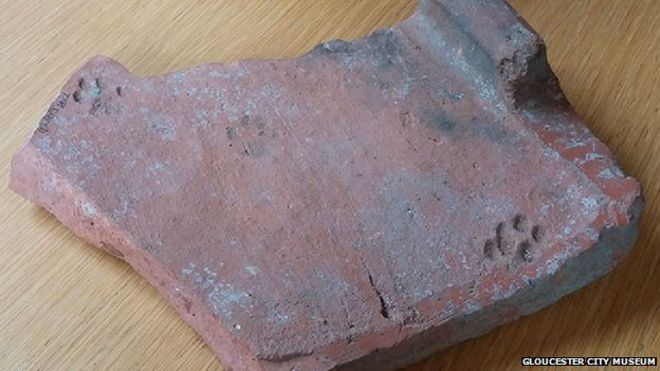
From the BBC and Mental Floss via reader Don B. we have the new discovery of a cat’s pawprints on a Roman roof tile in Gloucester. Here’s the photo:

_84523557_84523550

The BBC reports:

It was dug up in Berkeley Street in 1969 but the footprint has only just been discovered.

The print was found by an archaeologist at Gloucester City Museum who was examining thousands of fragments of Roman roof tile.

The cat is thought to have snuck across the wet tiles which were drying in the sun in about AD100.

The tile, a type called tegula, was used on the roof of a building in what became the Berkeley Street area of modern Gloucester, a spokesman said.

Councillor Lise Noakes, from Gloucester City Council, said it was a “fascinating discovery”.

“Dog paw prints, people’s boot prints and even a piglet’s trotter print have all been found on tiles from Roman Gloucester, but cat prints are very rare,” she said.

Jesus’s house? The abysmal state of “Biblical archaeology”

December 17, 2015 • 10:45 am

I was aware that the field of Biblical archaeology was vaguely dubious, at least insofar as it was devoted to finding archaeological evidence of things said in the Bible. Well, we know that much of the “history” claimed in the Bible is dubious (there was, for instance, no Exodus), so that part of the field is tendentious. But clearly scientifically motivated excavations can be of great value in illuminating the era in which Biblical events are thought to have taken place, or about when and how the Bible was composed (e.g., the Dead Sea Scrolls). But, sadly, at least some of the field is devoted to buttressing an ancient book of fiction.

And that appears to be the case for the “discovery” of a first-century home in Nazareth, Israel that has been widely touted as being the likely residence of young Jesus. That this house was the domicile of carpenter Joseph, his virgin wife Mary, and young Jesus is about as likely as the “Biblical anthropology” study of three random and ancient skulls from Israel tells us what Jesus looked like. In other words, both are exercises in confirmation bias.

The article in question, “Has Jesus’ Nazareth House been found?” is by Ken Dark, director of the Research Centre for Late Antiquity and Byzantine Studies at the University of Reading, and appeared in last year’s Biblical Archaeology Review, the online organ of the Biblical Archaeology Society (reference below, no free link, but there’s a short summary here and a longer one at LiveScience). The finding was touted widely (just like the new reconstruction of Jesus’s appearance), even showing up at LiveScience.com, where it got this headline:

Screen shot 2015-12-17 at 9.38.02 AM

Yeah, and all the air molecules in this room may, by chance, move to one side of the room.

The whole enterprise, both the original paper and the LiveScience piece, conflates possibility with probability: witness the headline above and the title of Dark’s paper. Both ignore the possibility, for instance, that the Jesus-person is pure fiction, and even if he did live as some messianic rabbi, never lived in Nazareth and wasn’t the son of Joseph and Mary.  Remember that Mary is said to have gone from Nazareth to Bethlehem (the Birthplace) and then back to Nazareth, where Jesus grew up—but given the confusing Biblical narrative, even that is contested by some. Nevertheless, the fact that there was a real Jesus, and if he lived he grew up in Nazareth, are things assumed to be true in both articles.

Dark’s piece rests on historical examination of documents, of accounts by pilgrims to the Holy Land, and on his own examination of an excavation site below a convent. That Nazareth site revealed the following:

  • There was a Byzantine church with mosaic floors and other fancy trappings built during the “Crusader period,” as well as two early Roman-era tombs and two rectilinear “courtyard houses” dated by the pottery they contained to the first century A.D. Here’s one of the houses, whose structure was preserved when the churches were built.

OLYMPUS DIGITAL CAMERA

  • The pottery in the houses contained limestone vessels like the one below. Dark notes that limestone was considered a “pure” container under Jewish law, and “were popular in Jewish communities at this time.” He doesn’t say whether such vessels were also used by Romans or other “gentiles.”
BSBA410206303L
(From paper): Israel Museum, Jerusalem STAYING PURE. Limestone vessels were common in first-century Israel because they were not subject to impurity according to Jewish law; thus a stone cup like the one pictured here could be continually reused rather than destroyed, unlike vessels of pottery that had contracted impurity.
  • From this evidence Dark and others conclude that the houses were part of a small Roman-Jewish town served by between three and seven springs.
  • Excavation of the nearby area of Sepphoris revealed a more Roman panoply of pottery and other artifacts. From this the authors conclude—and I suppose this is reasonable, though it’s above my pay grade—that Nazareth was a largely Jewish town near a Roman town, and there was no “close connection” between the settlements.

So far so good. But why—even assuming that Jesus was real and grew up in Nazaret—would he have lived in one of these two houses? Here’s what Dark says (my emphasis):

The first-century evidence that we do have from Sepphoris suggests an urban center with an administrative function, domestic occupation and public buildings. It may have been relatively cosmopolitan, in the sense that it was open to Roman provincial culture, but it remained a Jewish community.

By contrast, Nazareth was a local center without the trappings of Roman culture, perhaps analogous to nearby Capernaum or Chorazin in its facilities and scale, rather than to Sepphoris (which, incidentally, is not mentioned in the New Testament). The description in the Gospels of the Nazareth synagogue (Mark 6:1–6; Matthew 13:54–58; Luke 4:16–30) is exactly the sort of building we would expect in an Early Roman provincial “small town.” Such a small town was also exactly the sort of place where one might expect to find a rural craftsman—a tekton (Mark 6:3;Matthew 13:55)—like Joseph.

This evidence suggests that Jesus’ boyhood was spent in a conservative Jewish community that had little contact with Hellenistic or Roman culture. (It is extremely unlikely to be the sort of place where, as some have argued, one would have encountered “cynic” philosophy.)

Then Dark admits that “none of this, of course, has any explicit connection with Jesus.” But he finds his evidence not from the archaeology itself, but from the fact travelers seven centuries later regarded the site as Jesus’s boyhood home (my emphasis):

A seventh-century pilgrim account known as De Locus Sanctis, written by Adomnán of Iona, describes two large churches in the center of Nazareth. One is identifiable as the Church of the Annunciation, located just across the modern street from the Sisters of Nazareth Convent. The other stood nearby and was built over vaults that also contained a spring and the remains of two tombs,tumuli in Adomnán’s “Insular Latin.” Between these two tombs, Adomnán tells us, was the house in which Jesus was raised. From this is derived the more recent name for the church that Adomnán describes: the Church of the Nutrition, that is, “the church of the upbringing of Christ,” the location of which has been lost.

At the Sisters of Nazareth Convent there was evidence of a large Byzantine church with a spring and two tombs in its crypt. The first-century house described at the beginning of this article, probably a courtyard house, stands between the two tombs. Both the tombs and the house were decorated with mosaics in the Byzantine period, suggesting that they were of special importance, and possibly venerated. Only here have we evidence for all the characteristics that De Locus Sanctis ascribes to the Church of the Nutrition, including the house.

And in the final paragraph Dark makes a special plea for this to be Jesus’s house, because a). “there’s no good reason to dismiss it out of hand” and b). Because people believed it was Jesus’s home:
Was this the house where Jesus grew up? It is impossible to say on archaeological grounds. On the other hand, there is no good archaeological reason why such an identification should be discounted. What we can say is that this building was probably where the Byzantine church builders believed Jesus had spent his childhood in Nazareth.

Well, if everything that people believed was taken as truth, the shroud of Our Lady of Guadalupe would indeed have been miraculously found on a hilltop in Mexico, and The Dome of the Rock was where Mohamed landed on his reputed Night Journey.

I don’t doubt that the excavation described by Dark is interesting, and may even denote a Jewish settlement separated by culture and faith from a nearby Roman one. What I do doubt is whether it was Jesus’s home. And I question a mindset that desperately needs to shoehorn this discovery into the narrative of the New Testament.

__________

Dark, K. 2015. Has Jesus’ Nazareth house been found? Biblical Archaeol. Rev. 41:02.

A night on the tiles – a Roman cat paw print

July 30, 2015 • 8:30 am

by Matthew Cobb

A piece of Roman tile, dating back 2000 years, was dug up in the English city of Gloucester in 1969. It lay unremarked in the Gloucester City Museum until an archeologist noticed that when the clay was drying a cat walked across it, leaving its trace…

http://ichef.bbci.co.uk/news/660/cpsprodpb/1270C/production/_84523557_84523550.jpg

According to the BBC website:

The tile, a type called tegula, was used on the roof of a building in what became the Berkeley Street area of modern Gloucester, a spokesman said.

Councillor Lise Noakes, from Gloucester City Council, said it was a “fascinating discovery”.

“Dog paw prints, people’s boot prints and even a piglet’s trotter print have all been found on tiles from Roman Gloucester, but cat prints are very rare,” she said.

Remains of Richard III identified: oldest forensic ID yet

December 5, 2014 • 7:56 am

You remember these famous words from Shakespeare:

Now is the winter of our discontent
Made glorious summer by this sun of York;
And all the clouds that lour’d upon our house
In the deep bosom of the ocean buried.

They are of course the opening lines of “Richard III,” and are spoken by the nefarious and hunchbacked king. Although he’s called “Gloucester” in the play’s text, he was a real person—King Richard III—and he was deformed, having scoiliosis (Richard’s deformity is confirmed by historical records, including descriptions by Thomas More).

I could simply rehash the history of this short-lived king (1452-1485), but I’ll let the authors of a new paper in Nature Communications (reference and link at bottom; free download) give you the backstory. For these are the scientists who identified his body, found underneath a carpark in Leicester two years ago; and they published what seems to be a definitive ID based on skeletal, dating, and DNA-based evidence. The genetic evidence is way cool, for besides identifying him, they could also get a good idea of what his hair and eye colors were, and check those against the historical record. King et al. say this about Richard:

Richard III is one of the most famous and controversial English kings. His ascension to the throne in 1483, following the death of his brother, Edward IV, has been seen as contentious, involving, as it did, discrediting the legitimacy of Edward’s marriage and therefore the claim of both of Edward’s sons to the throne. Later, as yet unproven accusations arose that Richard had his two nephews murdered to solidify his own claim. Richard’s death two years later on August 22nd 1485 at the Battle of Bosworth marked the end of the Plantagenet dynasty, which had ruled for over 300 years, and the beginning of the Tudor period. Richard III was the last English king to be killed in battle, he became one of Shakespeare’s most notorious villains, and is one of the few English monarchs whose precise resting place was lost: the mystery surrounding the fate of his remains persisting to the present day.

Historical records report that after Richard III was killed on the battlefield, age 32, his remains were brought back to Leicester and buried in the medieval church of the Grey Friars. The friary was dissolved in 1538 under the orders of King Henry VIII, with most of the buildings being torn down in the following years. Approximately 125 years later, a rumour arose that Richard III’s remains had been disinterred during the dissolution of the monasteries and thrown into the river Soar in Leicester. However, it had long been thought that this rumour was unsubstantiated and it was therefore expected that the grave of Richard III should still lie within any remains of the Grey Friars church. While historical records and the subsequent analysis thereof have long indicated the approximate location of the Grey Friars friary, and its likely situation in relation to the modern urban landscape of Leicester, the exact site of Richard III’s grave had been lost in the 527 years since his death.

Although Richard III reigned for only a little over two years, substantial historical information about various features of his life and death exists. These include aspects of his physical appearance such as having a slim build, one shoulder higher than the other and that he suffered battle injuries, which resulted in his death. In September 2012, a skeleton (Skeleton 1) was excavated at the presumed site of the Grey Friars friary in Leicester, the last-known resting place of Richard III.

How can you ID bones from remains that are over four centuries old? Well, first you see if the skeleton looks like someone who could be Richard III. And indeed it did:

Male skeleton, aged 30-34.  Check.
Slim build, scoliosis (one shoulder higher than the other). Check.
Carbon dating consistent with historical data. Check: dated from 1456-1530 with 95.4% probability.
Skeletal injuries consistent with death in battle. Check.

That’s pretty good, for there can’t be many swaybacked people who died in battle at the right time, and of the right age, buried where Richard is rumored to have been buried. But to clinch the case, the authors did DNA analysis, extracting the genetic material from the skeleton’s teeth and bones. They used three types of DNA, sequencing them and then seeing if they matched with the known descendants of Richard (yes, there are some, for British royal genealogies were kept scrupulously).

Here, if you’re interested, are the genealogies of the several relatives of Richard whose DNA was matched to that of his putative remains (click to enlarge):

Screen Shot 2014-12-05 at 7.33.02 AM

They used three types of DNA, and I’ll give the results separately.

1. Mitochondrial DNA (mtDNA).  This is the DNA in the mitochondrion, a cellular organelle that produces energy and has its own DNA molecule distinct from the “regular” DNA in the nucleus. Since it’s in the cell’s “cytoplasm” (the contents of the cell), mtDNA is passed on solely from mother to offspring, as all the cytoplasm in a fertilized egg comes from the mother. The father’s mitochondrial DNA is not inserted into the egg that is fertilized by his sperm, so that part of his DNA isn’t present in his kids.

Thus, if you’re matching mtDNA of the putative Richard III with his descendants, you need to find an unbroken lineage of female descendants that come from either Richard’s mother or his sister.  And, fortunately, that existed. If you look at the right-hand side of the figure above, you can see that Richard’s oldest sister, Anne of York, has an unbroken lineage of female descendants giving rise to two living people, Michael Ibsen (a male) and Wendy Duldig (a female), who are now 14th cousins of each other. Since Anne of York and Richard III had the same mother, they would also have had the same mitochondrial DNA, and that would have been passed down to both Ibsen and Duldig.

And indeed, the mtDNA of these two living people matched nearly perfectly with that of the mtDNA from the skeleton. They sequenced the entire mtDNA (once a very hard task), and one of the relatives matched absolutely perfectly, base for base among about 16,500 bases. The other modern relative differed in only a single base—very likely a mutation that occurred in the intervening four centuries. The probability of finding such a perfect match between the skeletal sequence and a random modern British person (calculated from a British mtDNA database) was conservatively calculated at 2 in 1832. Of course this probability decreases if you allow for that one mutational difference in the other descendant. For all practical purposes, this is very strong evidence that Richard III was an ancestor of the two living descendants shown on the right above.

2. Y chromosome DNA. Y chromosomes are passed only from father to son, so to match the putative Richard III’s Y DNA with that from living people, you need an unbroken string of male descendants of Richard. We have that, too, and it’s shown on the left side of the figure above. In fact, they found five descendants (not named). What they found here, though was that they did not match Richard’s skeletal DNA!! Now you could say that this means that Richard was not their ancestor at all, but another hypothesis (more likely given the forensic skeletal and mtDNA matches) is that there was what evolutionist John Maynard Smith called some “sneaky fucking” in the British royal family that mixed some non-royal DNA with the royal DNA.

That is, somewhere fairly far back in the lineage (for four of the living male relatives had the same DNA), some male who was supposedly a descendant of Richard III was actually fathered by someone outside the lineage. In other words, a British royal female had a bit of a fling.  Those liaisons are harder to detect when you use mtDNA (which makes the mtDNA more reliable for forensics like those in this survey), for while you always know who the mother of a child is (after all, she gave birth to it), you aren’t always sure about the father. (This is called, of course, “paternity uncertainty”.) But Y chromosomal DNA is good for determining in modern cases whether a male really did father a child.

The authors note that paternity uncertainty for a given child is about 1-2%, and calculate that in the many generations between Richard III and modern descendants, the probability that some sneaky fucking occurred in that lineage would be around 16%. It could of course be higher or lower depending on the frequency of royal flings.

The implications of this, given the genealogy of Brits, are potentially large, for they could mean that a big swath of historical British royalty was genealogically bogus! As the authors note (read this carefully, my emphasis):

One can speculate that a false-paternity event (or events) at some point(s) in this genealogy could be of key historical significance, particularly if it occurred in the five generations between John of Gaunt (1340–1399) and Richard III (see Supplementary Fig. 2). A false-paternity between Edward III (1312–1377) and John would mean that John’s son, Henry IV (1367–1413), and Henry’s direct descendants (Henry V and Henry VI) would have had no legitimate claim to the crown. This would also hold true, indirectly, for the entire Tudor dynasty (Henry VII, Henry VIII, Edward VI, Mary I and Elizabeth I) since their claim to the crown also rested, in part, on their descent from John of Gaunt. The claim of the Tudor dynasty would also be brought into question if the false paternity occurred between John of Gaunt and his son, John Beaufort, Earl of Somerset. If the false paternity occurred in either of the three generations between Edward III and Richard, Duke of York, the father of Edward IV and Richard III, then neither of their claims to the crown would have been legitimate.

But since we don’t know when or where the surreptitious insemination occurred, we can’t say for sure that the House of Tudor was indeed genealogically bogus.

And, of course, this doesn’t affect the genealogy of the present British family tree, which are Windsors, for the Tudor family tree died out and was replaced by the Stuarts, Hanovers, and then the present Windsors (formerly the House of Saxe-Coburg and Gotha; the name was changed in 1917 to prevent the Brits from sounding German). So, to my chagrin (I don’t like British royalty), Elizabeth and her offspring and her offspring’s offspring can still claim royalty.

3. Autosomal DNA.  Most of our DNA is carried on the autosomes, or the set of 44 chromosomes (22 pairs) that doesn’t determine sex (that’s the other pair, either XX or XY).  And we know from sequencing the human genome and from “association mapping” which regions of the autosomal genome play major roles in determining hair and eye color. If you sequence those parts of the autosomal DNA, then, you can get a good idea about a person’s hair and eye color even without seeing it.

And they did this for those parts of the autosomal DNA of the putative Richard III skeleton. Although there are no contemporary portraits of Richard III, one painting in the 1510s (the “SAL painting”) was made about 25 years after his death, and it’s shown below. It shows the king with blue eyes and brownish hair.

DNA typing from the autosomes shows that Richard had blue eyes with a probability of 96% and blond hair with a probability of 77%. However, those same genotypes can produce a variety of hair colors, including blond darkening to brown with age, as shown in the top part of the figure below. (All of these living individuals have the same forms of genes for hair and eye color found in the Richard III skeleton). Of all the existing paintings of Richard III, the one that most closely matches these traits is also the earliest one and the one deemed most authentic, the SAL painting.

Screen Shot 2014-12-05 at 7.35.13 AM

The upshot: The authors combined all the probabilities: genetic (including the mismatch of the Y chromosomes but also the possibility of false paternity), skeletal, and dating, to calculate a likelihood that the skeleton really was that of Richard III. To do this they had to incorporate a priori estimates that the skeleton was his, and used two: a “skeptical” probability (2.5%) and a more liberal one (50%). Combining all these, they get a probability between 99.9994% and 99.99999% that the skeleton found was in fact that of Richard III. These are conservative probabilities, so for our purposes we can in fact be dead certain that the skeleton found was that of Richard III. 

Envoi

Finally, according to a BBC story from yesterday, Richard’s remains will be reburied in the Leicester Cathedral on March 26 of next year, in this tomb:

_76794610_75554318

They also provide a photo of Richard’s skull next to another painting of him, a reminder of our mortality (as if we needed it!):

_77616455_richardcomp

UPDATE: A reader below points to a University of Leicester post showing a model of what Richard III would have looked like, based on the skull. They get the hair and eye colors wrong, for that information wasn’t known when the model was made. And it doesn’t look a lot like the painting. But what I really like on the site is a reconstruction of what Richard’s speech might have sounded like, based on his writing and  on reconstruction of pronounced English of that time. It is very different from modern English!

___________
King, T. E. et al. 2014.  Identification of the remains of King Richard III. Nature Communications, published online Dec. 2; DOI: 10.1038/ncomms6631

The world’s oldest graffiti: by Homo erectus! (maybe)

December 4, 2014 • 11:47 am

Look at the shell below, which has been dated to 500,000 years ago. See the scratches? Those represent the oldest human etchings, or graffiti, ever found, preceding the next oldest by 300,000 years! Some anthropologists dissent, but more on that at the end of this post.

sn-clamshellH
Photo by: WIM LUSTENHOUWER/VU UNIVERSITY AMSTERDAM

As Science reports, this shell was found by a graduate student Stephen Monro on Java in 2007, and now, 7 years later (yes, they studied it intensively), he and his colleagues have concluded not only that this was a human production—perhaps made by Homo erectus, who lived on Java at that time—but that they also used the shells as tools.

The full paper is in Nature, with the link and reference below (I believe it’s free). I’ll summarize what’s in the paper, and then go back to the Science report for a dissent by scientists.

The shell was part of an apparent cache of fossil mussel shells excavated in 1890 in Trinil, Java, which happens to be the type locality for Homo erectus, discovered by Eugène Dubois in 1891-1892 and originally called “Java Man“.  (We’re not quite sure what happened to H. erectus: it could have interbred with expanding Homo sapiens populations coming from Africa beginning about 60,000 years ago, or it could have gone extinct without leaving descendants.) The dating of the shells from sediments enclosed in them gives an age of about 540,000 ± 10,000 years. Only H. erectus was in Java then.

The shells, too, were collected by Dubois, and, based on their uniform large size and the holes in them (see below), as well as other suggestive human modifications, were probably a midden of sorts left by H. erectus individuals who had eaten the mussels.

Now, the shells show three signs of modification by humans, including the “graffiti” above.

  • They have holes drilled in them, likely by a human using a shark tooth. They are consistent in location and size, near the rear adductor muscle, and aren’t consistent with holes made by other predators like marine snails or otters.  The authors found that you can make these holes with a shark tooth, and if it’s driven into just that spot in the rear, the mussel can’t use its muscle to keep the shell closed and opens, presenting its contents for food. Here’s a photo of the shell holes, presumably made by hominins (all species in our clade after we diverged from the lineage that produced modern chimps). The figure and caption are from the original paper. Similar holes were made by the native (pre-European) inhabitants of the Caribbean to open gastropods.

Screen Shot 2014-12-04 at 12.23.44 PM

  •  Some of the shells appear to have been modified for use as cutting or scraping tools. Their outer layer was scraped off down to the nacreous (“pearl-like”) inner layer, making them sharp. These shells show wear patterns consistent with them having been used as tools.
  • Most interesting, of course, is the graffiti: a poignant remnant of an early human (and yes, they suggest it was a single “person”). The journal’s description of this follows, along with another photo:

“One of the Pseudodon shells, specimen DUB1006-fL, displays a geometric pattern of grooves on the central part of the left valve (Fig. 2). The pattern consists, from posterior to anterior, of a zigzag line with three sharp turns producing an ‘M’ shape, a set of more superficial parallel lines, and a zigzag with two turns producing a mirrored ‘N’ shape. Our study of the morphology of the zigzags, internal morphology of the grooves, and differential roughness of the surrounding shell area demonstrates that the grooves were deliberately engraved and pre-date shell burial and weathering (Extended Data Fig. 5). Comparison with experimentally made grooves on a fossil Pseudodon fragment reveals that the Trinil grooves are most similar to the experimental grooves made with a shark tooth; these experimental grooves also feature an asymmetrical cross- section with one ridge and no striations inside the groove. We conclude that the grooves in DUB1006-fL were made with a pointed hard object, such as a fossil or a fresh shark tooth, present in the Trinil palaeoenvironment. The engraving was probably made on a fresh shell specimen still retaining its brown periostracum, which would have produced a striking pattern of white lines on a dark ‘canvas’. Experimental engraving of a fresh unionid shell revealed that considerable force is needed to penetrate the periostracum and the underlying prismatic aragonite layers. If the engraving of DUB1006-fL only superficially affected the aragonite layers, lines may easily have disappeared through weathering after loss of the outer organic layer. In addition, substantial manual control is required to produce straight deep lines and sharp turns as on DUB1006-fL. There are no gaps between the lines at the turning points, suggesting that attention was paid to make a con- sistent pattern. Together with the morphological similarity of all grooves, this indicates that a single individual made the whole pattern in a single session with the same tool.”

Here’s another figure showing this great specimen, along with its caption:

nature13962-f2
Figure 2 | The geometric pattern on Pseudodon DUB1006-fL. a, Overview. b, Schematic representation. c, Detail of main engraving area. d, Detail of posterior engravings. Scale bars, 1 cm in a and c; 1 mm in d. See also Extended Data Figs 5 and 6.

And finally, the paper’s conclusion, adding that the authors see this as the earliest use of a natural material to make tools.

The combined evidence for high-dexterity opening of shells, use of shell as a raw material to make tools, and engraving of an abstract pattern on a shell with a minimum age of 0.43 ± 0.05 Myr indicates that H. erectus was the agent responsible for the exploitation of freshwater mussels at Trinil described here. The inclusion of mussels in the diet of H. erectus is not surprising, as predation on aquatic molluscs is observed for many terrestrial mammals, including primates. The reported use of shells as raw material for tool production is the earliest known in the history of hominin technology. It may explain the absence of unambiguous stone artefacts in the Early and Middle Pleistocene of Java, possibly the result of poor local availability of lithic raw material, as also suggested for the much younger (about 110,000 years old) Neanderthal shell tools from Italy and Greece. Our discovery of an engraving on shell substrate is unexpected, because the earliest previously known undisputable engravings are at least 300,000 years younger.

Leaving aside the question of whether these “graffiti” are anything other than a hominin fooling around, or have a more symbolic meaning, there’s at least one anthropologist who takes issue with the claim that these patterns were made by H. erectus. As the Science report notes, the dating could be off, and the scratches made by more recent individuals of H. sapiens:

Yet even if ancient humans engraved the shell, says Russell Ciochon, a paleoanthropologist at the University of Iowa in Iowa City, the team has not shown that H. erectus did it. Ciochon, who has spent many years working at sites in Java, agrees with criticisms that the shells have been taken out of context, because Trinil was not an occupation site where early humans actually lived. Rather, Ciochon argues, the human fossils found there (which include a skullcap widely agreed to be H. erectus and a thigh bone that could belong to either H. erectus or H. sapiens,a matter of sharp debate) were washed into the site by a powerful flood, and nothing found with them—including the shells—can be assumed to have been associated with them originally. Although the team dated four of the shells in the collection, including the engraved shell, to about 500,000 years ago using two different techniques on sediments of sand and clay found inside them, Ciochon says that those sediments could have entered the shells during the earlier flood event that created the site, and that H. sapiens still could have come along much later and performed the etching.

I don’t have the expertise to judge how powerful this criticism is, but if it’s accurate, then the whole story goes out the window pending further study and excavation. But I like the H. erectus story, for, as Jake says to Brett in the last line of The Sun Also Rises, “Isn’t it pretty to think so?”


h/t: Gravelinspector

____________
J. C. A. Joordens et al. 2014. Homo erectus at Trinil on Java used shells for tool production and engraving. Nature, published online, doi:10.1038/nature13962

Ice age art

February 28, 2013 • 5:08 am

Perusing the latest stuff from the journal Nature, I found this lovely video of a new exhibit at the British Museum featuring some of the oldest artwork known—including pieces made 40,000 years ago. That’s not too long after the “out of Africa” event that spread modern Homo sapiens through the world! Take a look at the “lion man” in the first clip

Here are the movie notes. If you’re in England, go see this, though it costs ten pounds to enter (note, though, that the rest of the British Museum is free).

A new exhibition at the British Museum in London features sculptures made up to 40,000 years ago. Dr. Alice Roberts meets curator Jill Cook to discuss three artefacts in the collection; the Lion Man, a group of female figurines from Siberia, and the oldest known musical instrument. Despite being made thousands of years ago, the objects show that the minds of their creators – our ancestors – were incredibly similar to our own.

When the flute shown in the video was first discovered the finding was published in NatureNew flutes document the earliest musical tradition in southwestern Germany.
‘Ice Age art: arrival of the modern mind’ runs at the British Museum until 26 May 2013. http://www.britishmuseum.org/whats_on…

Here are some pieces from the BM’s website on the exhibit; they (and the video above) show that there were already accomplished artists tens of thousands of years ago.

The oldest known portrait of a woman sculpted from mammoth ivory found at Dolní Vestonice, Moravia, Czech Republic. approximately 26,000 years old
The oldest known portrait of a woman; sculpted from mammoth ivory found at Dolní Vestonice, Moravia, Czech Republic. approximately 26,000 years old
Spear thrower made from reindeer antler, sculpted as a mammoth. Found in the rock shelter of Montastruc, France. Approximately 13,000–14,000 years old
Tip of a mammoth tusk carved as two reindeer depicted one behind the other. Approximately 13,000 years old, from Montastruc, France