
Today we have mostly videos of the ducks (I’m waiting for my photos to transfer to a new computer, and changing computers is always a horror). Photos will be coming. But in many ways the videos (about 1 minute each) give you a better idea of what the ducklings are like.
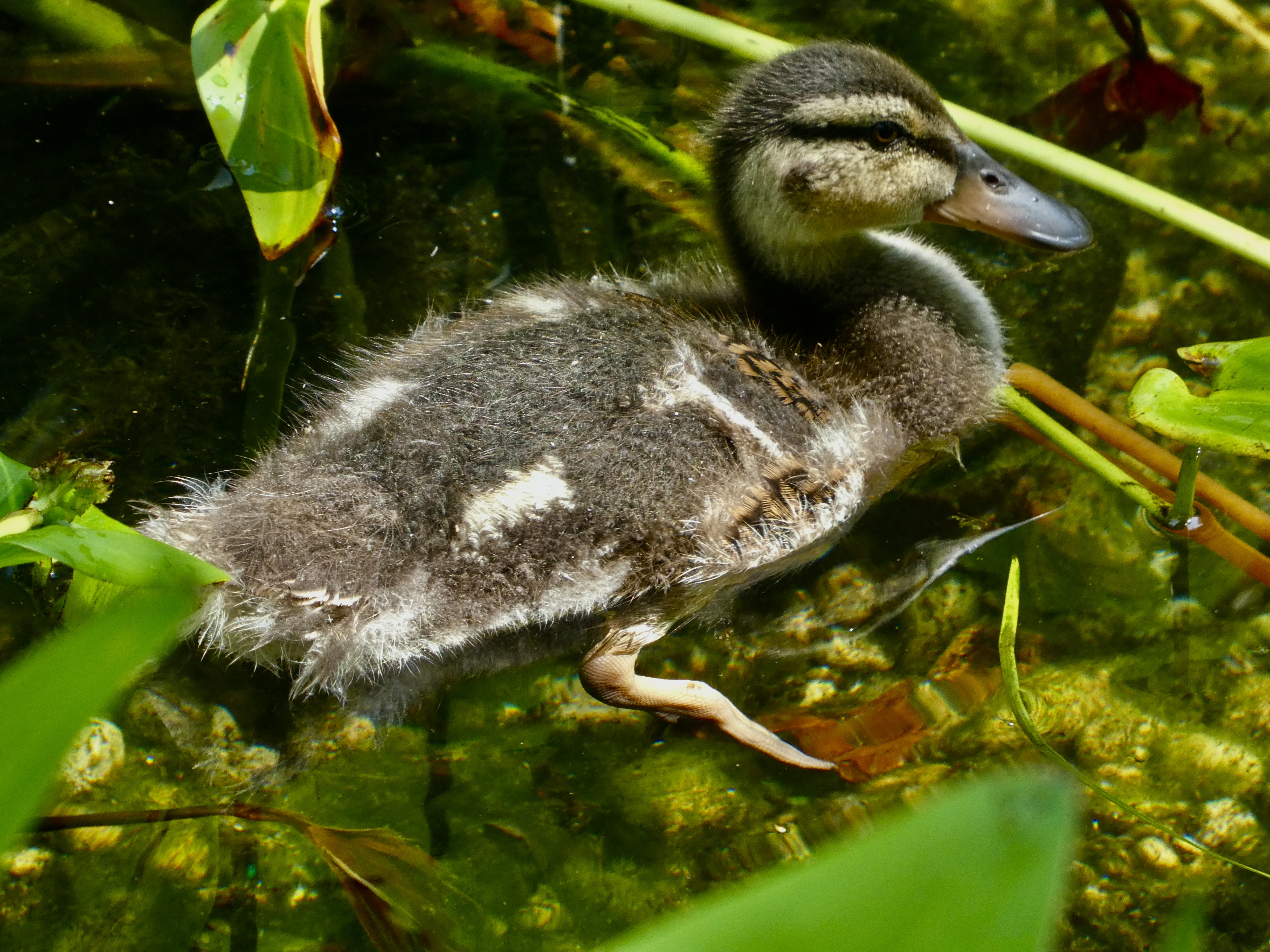
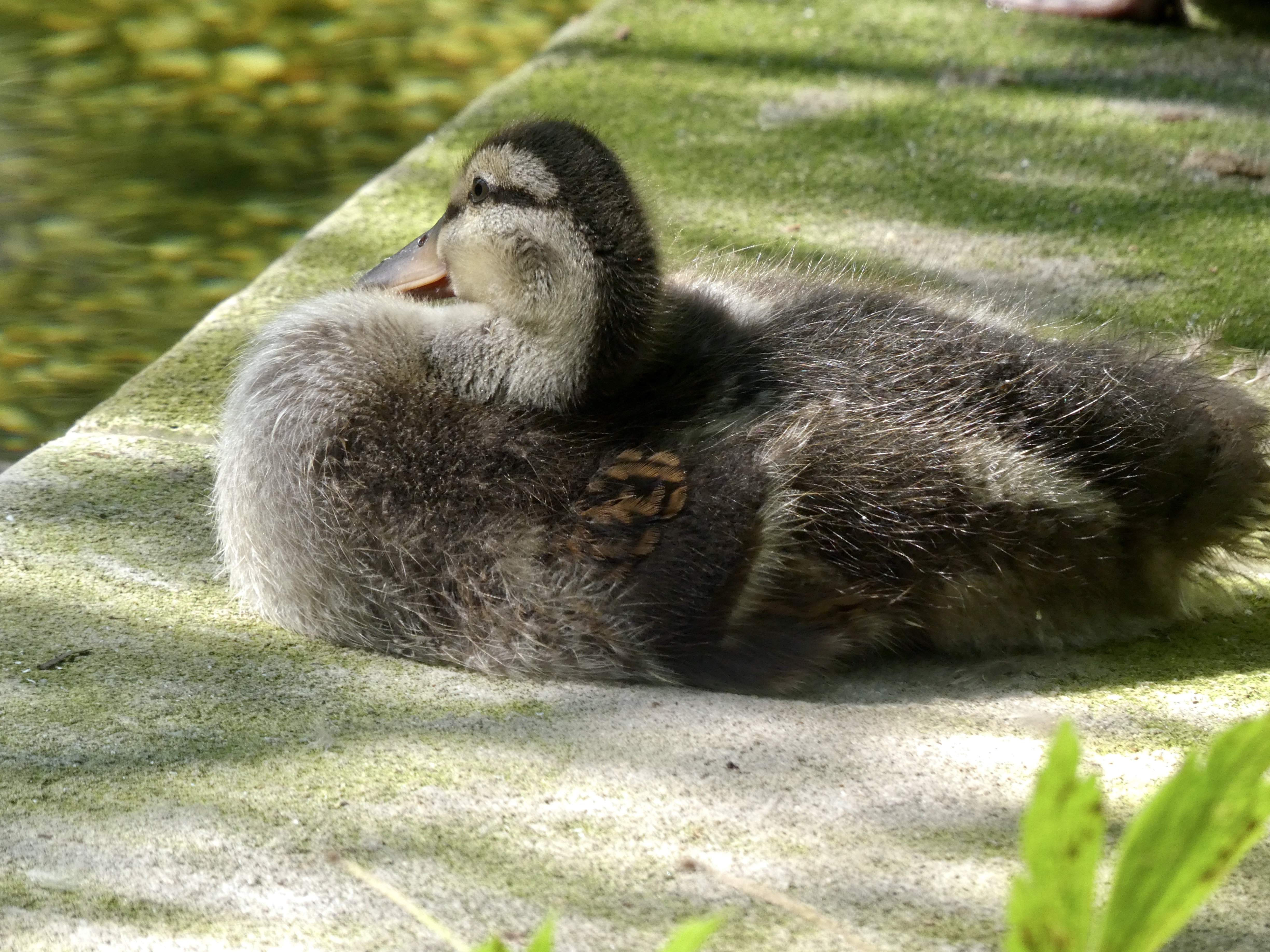
In short, the four ducklings are peachy, and growing very fast! You’ll see from the videos and two photos below that they have just started growing feathers on their tails, on their little stubby wings, and on their sides. In about ten days they’ll be in their awkward, scruffy teenage stage: half duckling, half adult. But I love them all. They are fat, happy (I think), and lively, and Miss Duck is taking great care of them. But look for yourself:
The caption of this video tells the tail; it’s the end of their mealtime when they get freeze-dried mealworms as dessert. That is their favorite nosh. Miss Duck looks on, supervising but also eating on her own. When ducklings are around, she always ensures that they eat before she does. She’s a great mom.
After a meal the family often repairs to what I call the Sacred Rocks, a place where they can nap and preen in the shade. Miss Duck is always watching over the brood, usually from above:
Sometimes they repair to another rock: a flat one at the north end of Botany Pond. This is quite close to a pair of benches where people sit to watch them (as well as the turtles, who occupy the rocks when the ducks are absent).
The caption:
Look at this fat little duckling, crop distended with food! (I feed them well.) His/her little black foot is sticking out, like duckling yoga. In the past two or three days, their feet have changed color from black to the adult orange. Botany Pond, the University of Chicago, August 6, 2026
Here’s the caption I gave this video. Be sure to listen for Miss Duck’s soft quacks meaning “Go away, turtle.”
Miss Duck does not like turtles, though they are harmless to her and her brood. My guess is that she has an instinct to avoid them, as in the wild some turtles, like snappers, can hurt or kill ducklings. You can hear her quack from time to time as a response to the red-eared slider sharing this rock. (The brood pays turtles no mind.) Botany Pond, The University of Chicago, August 6, 2026.
The caption:
The ducklings love to dabble (root around) in the dirt, especially in the plant pots whose contents have died. (The ducks do not eat the plants.) Here you can see their feathers developing, mostly on their stubby little wings, as patches of brown. Their tails are getting feathers, too, and resemble little paintbrushes. Botany Pond, the University of Chicago, August 7, 2026.
Here’s one shot showing the incipient feathers. It’s so exciting: they’re not even three weeks old. I think they’re past the vulnerable stage now, which makes me happy. Can you see the tiny brown feathers on their wings and on their sides? Notice also the orange feet.
Finally, I noticed that when I was feeding the brood from the bridge, a sparrow was picking up little duck food pellets and broken mealworms, feeding them to her importuning baby. Life is burgeoning at the pond.
Thanks for duck update. I was getting worried.
It’s so funny that Miss Duck doesn’t like turtles. She could nudge that turtle off the rock pretty easily. If she did so successfully, would she overcome her fear? I wish we could convince her to conduct that experiment. We’d learn something about how ducks learn—or at least we’d learn about Miss Duck learns.
After the heartbreak of early summer, it is wonderful to see these ducklings progressing so well and to know they are probably out of danger. I hope you have good shots of mom’s bill–in the hope that she will return next year. She must have the knowledge of your caring for them imprinted in her brain, so she would probably recognize you either by sight or by your secret calls.
I’ve also wondered why Miss Duck doesn’t like turtles since most ducks seem to ignore them. Maybe a bad experience with one in the past? Or more likely, she sees them as a potential threat to the ducklings.
I have the bill photos, so don’t worry. And I have no idea why she alone, among all the hens I’ve tended, is afraid of turtles. Bad experience is one guess, but if it’s threat to the ducklings, why does she alone show that fear compared to other hens with broods?
Is there any continuity in the appearance of a duckling’s bill and how it will appear when it’s an adult? What I’m getting at is whether it’s ever possible to tell if an adult duck was a member of a duckling brood from an earlier year.
The answer is no as far as my experience tells. The bill markings aren’t there when the ducks fly away; they develop only later. If they were there, we’d be able to tell the ducklings apart at some point, but we can’t.
I take a peek at the duck cam almost every day, but the first time I’ve ever caught sight of the brood was just a few minutes ago. They were swimming in a perfect square formation, with Mom behind instead of leading. So they’re getting independent. And big! From above, Miss Duck doesn’t look that much larger than her chicks.
They’re growing like crazy. Great that they’ve survived.
Love seeing how big they’re growing! Miss Duck has been a great mom. Glad they’re out of their vulnerable phase. I was so worried for a bit!
What fat and happy ducklings! There’s something about the way they shake their little tails which looks like happy excitement, as if they just can’t contain themselves. I feel the same way when I watch the fawns in my yard. There’s probably a more prosaic explanation, but I prefer to anthropomorphize them. As long as I still give precedence to biology, why not?
I notice that the water plants appear to be in little containers. Do they take them in during the winter or do they stay outside? I’m curious because I have a koi pond which also has a pebble bottom and if I don’t have to drag foliage into the house I might try something similar.