It was a hungry squirrel. . .

November 24, 2025 • 10:50 am

Trigger warning: blood!

Yesterday I posted this photo of an injury I sustained, and asked readers to guess what caused it:

Given what readers know of me, the most common answers were “bit by a duck” and “bit by a squiirrel.”  It turns out that the latter answer (first suggested by Robert Wooley) is correct.  Ducks can’t really bite, at least not hard enough to break the skin, and when I’ve fed them out of my hand, they simply hoover up duck pellets from my open palm. No duck has ever caused me pain (I’m ignoring swimmer’s itch from parasites in the pond as well as the injury I sustained as I ran to rescue a baby duck being attacked by a mallard hen, slicing open my ear as it was caught on a thorny tree).

The most accurate answer came from Johan Kleynhaus:

Our host posted photos some time ago of him feeding the squirrels. My best guess is an over-excited squirrel, at the prospect of scoring a fat nut, who jumped up and the boss’s thumb got in the way.

Yes, ladies and gentlemen, brothers and sisters, and comrades, that’s the answer.

I have been feeding squirrels in two places: around Botany Pond and in the Regenstein Library courtyard across the street, for winter is coming on and the fluffy rodents need to lay in their food.

Now the squirrels around Botany Pond know me, and run to me when I whistle. Several of them will even crawl up my leg to retrieve a nut from my hand, and, since they know me, they are not aggressive.  But the squirrels at Regenstein are not yet used to me. I’m training them by throwing them nuts and making my characteristic whistle, just as I did at Botany Pond.  They now know to come to my whistle, but they’re still wary of me.

One of the great pleasures of feeding squirrels is seeing them encounter big nuts for the first time, and not knowing what to do with them. (They learn quickly.) I’ve been giving them hazelnuts in the shell, as well as pecans in the shell. They particularly love pecans, and can handle them well as one end is pointed, making it easy to grab with their mouths, after which they run off and bury the nuts. (They store most of what I give them for the winter, which raises the question of whether they remember where their nuts are buried.)

The local store ran out of pecans, but I found that good walnuts in the shell are available at a reasonable price ($4/pound) on Amazon, and I bought several pounds. I put about five nuts in my pocket as I walk home each day, dispensing them to whoever comes to my whistle. Yesterday, though, the rodents were ravenous, and I ran out of walnuts before I got to the library.  But I was still approached by a hungry squirrel who ran up to me.  I had a few hazelnuts left: small ones. It’s not wise to give a small hazelnut to a squirrel who doesn’t trust you, as they’re inclined to simply go for your hand to get the nut, and that means the possibility of being bitten. Which I was.  The little fellow didn’t intend to hurt me, but simply wanted that nut come hell or high water. And, grabbing it, it bit me by accident.

Squirrel bites are nasty, for their sharp incisors go through flesh like butter, leaving a deep slice like a knife. And that’s what happened yesterday. I will no longer feed hazelnuts to unfamiliar squirrels. But the wound isn’t dangerous, for squirrels almost never carry rabies, and this one acted normally. I went home, cleaned off the cut, soaked it in very hot water for a while, and then doused it with isopropyl alcohol. Here’s what it looks like today. There is no pain. (Sorry for the blurry photo; I don’t know how to take closeups with my iPhone). Note that the slice is small, but produced a lot of blood because it was deep. (I also have superglue on my thumb, as I got it on my hands while trying to glue together a plastic key fob. I am a schlemiel.)

This wasn’t the first time I got chomped by a squirrel. I was badly bitten during my first job at the University of Maryland. As I walked home one day, I saw a student playing with a baby squirrel in a tree outside my building. It was small and adorable, and the student held it and petted it. I couldn’t resist. “Can I hold it, too?”, I asked foolishly.  “Yes, of course,” she said.  “Will it bite me?” I asked. “No, she said,” “it doesn’t bite.”  I picked up the squirrel, whereupon it put its front legs around my thumb (the same one!) and chomped deeply into the pad of flesh and fat at the base of my thumb. It wouldn’t let go, and I shook my hand to dislodge the attacking rodent. “Don’t hurt it!” she cried, oblivious to my own pain. It was one of the most painful injuries I ever sustained.

And the cut was deep. It immediately began spewing blood—a lot more than in the first photo above.  And within a few minutes the base of my thumb swelled up to the size of a ping-pong ball.  I thought I’d better go to the doctor, but it was hard to locate one, as it was Sunday. I finally managed to find one after a few hours, and the doctor took a look and pronounced it “a nasty bite.” He told me that I wouldn’t get rabies, but since the bite occurred a few hours before, he thought they may have to open up my hand and do something to prevent infection (an operation?). At any rate, the doctor didn’t do that, but used some device to open up the cut, and then made me sit in his office for half an hour soaking my hand in the disinfectant betadyne.

Yes, I am foolish, but I’m not going to stop feeding squirrels. I will just be more careful, and will feed unfamiliar squirrel just by dropping the nut in front of them.

That is my story. I have another tale about being bitten through my nostril by an albino baby skunk, but that’s for another day. . .

Readers’ wildlife photos

October 27, 2025 • 8:15 am

It’s been a long time since evolutionary ecologist Bruce Lyon, now retired from UC Santa Cruz but still working, has sent us photos. But today he’s back with some great bird shots: an interaction between an owl and a thieving hawk. Bruce’s captions are indented and you can enlarge his photos by clicking on them.

My office on the Coastal Campus of the University of California in Santa Cruz is set in lovely coastal chaparral habitat and is loaded with birds. A former student recently told the she was frequently seeing one or two American barn owls (Tyto alba) hunting the Coastal Campus around sunset so I went out that evening to look for an owl.

I got lucky. A couple of minutes after I arrived, a barn owl started patrolling an open meadow in front of me with its typical slow moth-like flight. It suddenly plummeted to the ground and stayed on the ground for a minute. Eventually it took off with a vole or some similar rodent in its talons. Some species of owls kill their vole victims by repeatedly lacerating them on the ground with their talons—perhaps this is why the owl spent a minute on the ground before taking off.

Alternatively, perhaps before taking off the owl was scanning for other predators or scavengers that might steal its prey (kleptoparasitism). If this were the case, however, the barn owl did not look carefully enough because as soon as it took off a red-tailed hawk (Buteo jamaicensis) gave chase. After 100 meters (yards) the hawk caught up to the owl, grabbed it by the talons and tried to steal the vole. The owl held on tight and flew away from the encounter with its vole. Hunter 1, Kleptoparasite 0!

As I was writing these notes, I first wrote ‘barn owl’ instead of ‘American barn owl’. I had forgotten that what was formerly considered a single species (the barn owl) was recently split into three species: American, eastern and western barn owls.

The owl takes off with its vole:

The red-tailed hawk just as it caught up with the owl:

The hawk grabbed the owl’s talons in an attempt to steal the vole:

The owl escaped and the red-tail continued pursuit:

My favorite of the photos. I love the mood and the way the light picks up the hawk’s tail and the owl’s wings and tail:

Eventually the owl outmaneuvered the hawk and the hawk gave up:

Readers’ wildlife video

October 7, 2025 • 8:30 am

Today we have a 3-minute video taken by ecologist Adam Greer and showing fascinating and complex zooplankton.  The video is below, and I asked Adam to provide some additional information on this animal. Adam’s explanations are indented.

I am a zooplankton ecologist at University of Georgia. A major part of my research involves using camera systems to study the distribution and behavior of zooplankton. One zooplankton type we study is the appendicularians, which use mucous houses to feed on ocean microbes. They build and discard these houses several times per day, which can be a mechanism for moving carbon into the deep ocean. I recently put together a short video of this process, with the hope that it could help people see and appreciate that it is happening all over the world’s oceans. Appendicularians are quite fragile, and their houses are very difficult to see unless you use specialized optical techniques (the one we used in the video is called “shadowgraph imaging”).
I thought maybe this could be a variation on the wildlife photos, but obviously you may want to just show actual photos. Still, I think some of your readers might think it is interesting. I did my best to explain what is going on and use kind of informal language so everyone can understand.

The animal builds the (surprisingly intricate) house from a small mucous bubble then uses its tail to draw a current through the house. The water passes through a filter and then the particles get concentrated before being consumed (after going through the buccal tube). This diagram from Bochdansky and Deibel 1999 (below) is pretty helpful. The prey is very small relative to the size of the appendicularian – similar to the predator-prey size ratio of blue whales feeding on krill.

https://ars.els-cdn.com/content/image/1-s2.0-S0022098198001099-gr2.gif

The video does not go into these mechanics since you cannot really see that amount of detail, but I simply say in the video that they create a current through the house to capture their food. Then it shows the various stages of house building.

And Adam’s video (with music), which is indeed mesmerizing and clearly explained. Stuff like this is going on all the time, but we (or at least I) didn’t know about it.

Readers’ wildlife photos: The horrors of the human botfly

September 23, 2025 • 8:30 am

I have recounted previously how, when visiting Costa Rica as a graduate student, I got a human botfly larva (Dermtobia hominis) in my head, and, over the next two months, let it grow between my scalp and my skull until it emerged.

My story was the subject of a Science Friday segment on NPR that you can hear by clicking below. Press “listen”; my segment begins at 43:38 and lasts 12 minutes. I think they did a fantastic job, even interviewing my girlfriend at the time, who was present when the botfly larva emerged from my head.

And below is a great short video of the natural history of this fly produced by my Harvard colleague Piotr Naskrecki. It shows a botfly emerging from a human arm. Note how amazing this creature is: the fly larva not only produces an antibiotic to prevent it from being attacked by microbes while it’s gestating, but also a painkiller  that makes its exist painless (if a host felt it emerging, it might slap and kill the larva). Evolution is amazing!

h/t: Sally, Sarah

Fat Bear Week is here!

September 21, 2025 • 8:30 am

NPR reports on one of my favorite weeks of the year: Fat Bear Week, which extends from September 23-30. (see Wikipedia article here). As you may know, the bears at issue are those in Katmai National Park, and Wikipedia tells us how the ursids qualify:

In order to qualify for Fat Bear Week, brown bears of the Katmai National Park must have been spotted catching sockeye salmon at the Brooks River.  A 1.5-mile (2.4 km) section of the river, which has webcams, is used to choose eligible bears. Bears must be seen not just in the fall but also in the summer season as well.[27]

The subjective contest is a single-elimination tournament. Each day, two bears are presented in a match-up, identified by numbers. The bear with the most votes advances to the next round. In order to evaluate which bears have gained the most weight in preparation for hibernation, the public is able to view before and after photos of specific bears, watch them on livestream feeds, and read their biographies. The biographies include information on their feeding habits, personality traits, and physical features. The winner of the final match-up is named the tournament champion.

The contest was started in 2014, and Otis has won three times, while Grazer won twice.  (Otis wasn’t there last year and he may have crossed the Rainbow Bridge.

The bears are brown bears (Ursus arctos), sometimes known as grizzly bears or “grizzlies”: a subspecies from further south.  The only larger land predator is a close relative, the polar bear, which you saw in the last post.

Click below to read more about the contest:

An excerpt:

Fat Bear Week, when people get to pick their favorite Alaskan brown bear bulking up for hibernation, is coming early this year. The annual online competition that normally starts in early October will instead start on Sept. 23. Katmai National Park and Preserve officials say the bears are magnificently plump ahead of the tournament.

The bracket for Fat Bear Week 2025 will be revealed on Sept. 22, when fans will see where familiar names of past champions, such as 128 Grazer, 480 Otis and 747— aka Bear Force One, estimated to weigh a whopping 1,400 pounds — stack up against new challengers. The single-elimination tournament starts on Sept. 23 and runs through Sept. 30, when a new champion will emerge. Fat Bear Junior, for bear cubs, started on Thursday.

Organizers expect votes to come from across the planet.

“Over one million votes were cast for the bears in 2024 from one hundred countries,” the park said as it announced this year’s dates.

The brown bears of Katmai occupy the rarest strata of celebrity: captivating and oblivious, thanks to the “bearcams” that beam their activities in the scenic Brooks Falls and other areas to online viewers around the world.

. . .The abundance of salmon in Katmai National Park and Bristol Bay in southern Alaska is contributing to a drop in conflict among the bears this year compared to the 2024 competition, which was delayed when one large bear killed another. Voters then propelled Grazer to a landslide win over the massive 32 Chunk, a bear that, months earlier, had killed one of Grazer’s cubs.

“This year there was less congregating at Brooks Falls, less fighting, and — astonishingly — noticeably more playtime with each other,” Johnson said.

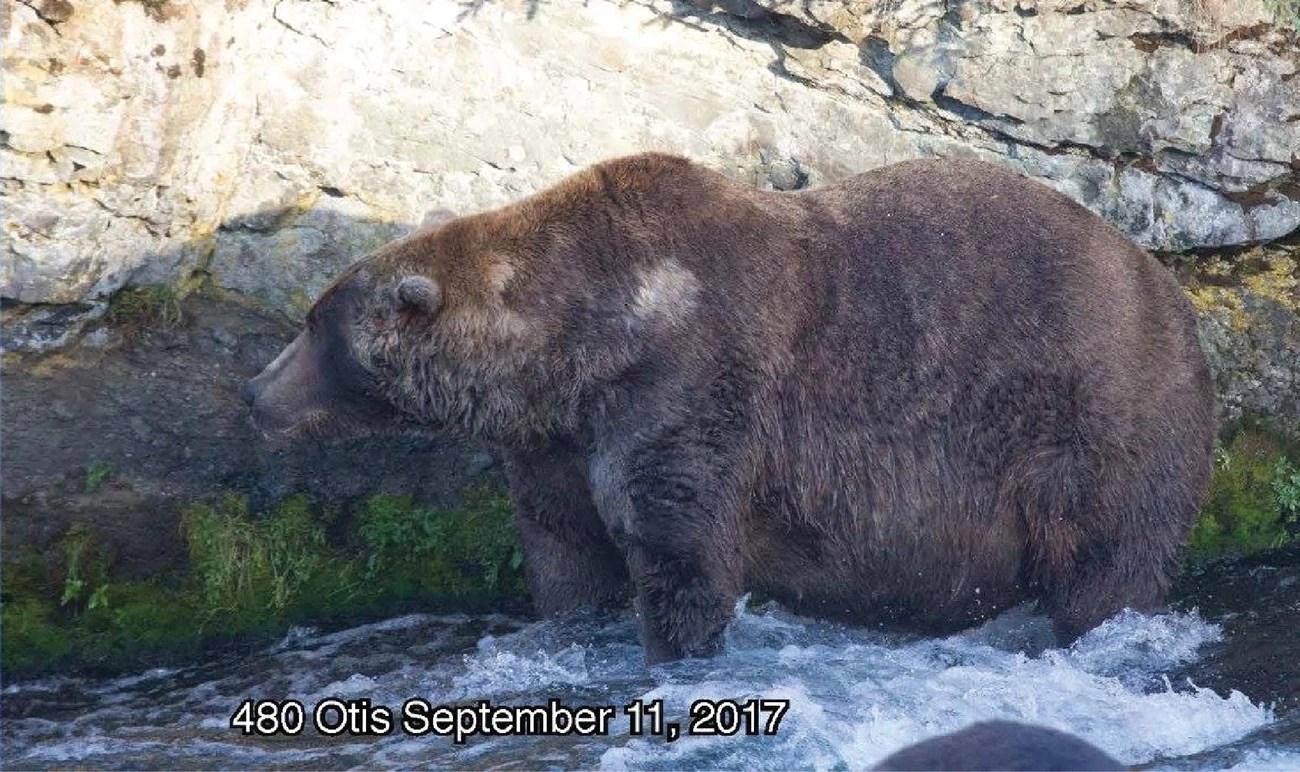
Here’s a photo of Otis, four-time winner for gaining the most weight. Photo from the National Park Service:

And the Explore Live livecam of the bears fishing. Right now they’re showing highlights, which are awesome enough by alone, but wait until it goes live!

I suggest that when September 23 rolls around, you go to the Fat Bear site below (click on icon) to see the contestants and cast your vote. (There’s already been a fat cub contest, in which yearlings compete for weight gain. The winner is unnamed.)  Here are Da Roolz for Bearz:

Matchups are open for voting September 23-30 between 12 – 9  p.m. Eastern / 9 a.m. – 6 p.m. Pacific.

This is a single elimination tournament. For each match-up, vote for the bear you believe best exemplifies fatness and success in brown bears. The bear with the most votes advances to the next round. Only one will be crowned Fat Bear Week champion. Meet the bears, fill out your bracket, predict your fat bear winner, and campaign for your candidate.

The contestants aren’t up yet, so have a look on September 23 between noon and 9 p.m. Eastern U.S. time. It’s enormous fun to vote, and of course the fatter bears have a better chance to make it through the winter.

I hope Otis shows up this year: he was a fatty, but may not have made it through the year.

To the Arctic, part 6: Ice day

September 20, 2025 • 9:45 am

On this day the captain and expedition leader decided, since we were in the area, that they’d take the ship as far north as it would go before encountering the Arctic sea ice that would prevent further progress. (The Ultramarine is a polar ship, but it can’t plow through thick sea ice).  We made for point #5 below where the ice stopped us. (This map was provided by the ship.)

The view from my cabin window when I woke up.

We’re approaching our northern limit.

As we headed north, I had a hearty breakfast in the main dining room.  Look at all that food (it’s buffet style, of course). I often had a made-to-order omelet, as I almost never eat breakfast, much less eggs, when I’m at home. I avoided the “Healthy Corner” except from fruit juice.

As we got closer to the edge, passengers went out on deck to watch our approach:

Ice everywhere (click to enlarge the panorama). And yes, it was that blue:

About as far north as we can go:


Floating sea ice, broken off the shelf, was everywhere:

Meanwhile, the bridge was active as the ship needed to stop dead before it hit the ice. Second from right is the captain.

Sarah, the expedition leader, is facing me. She was always upbeat: a great leader:

As we headed north, the ship stopped because a polar bear (Ursus maritimus) was sighted off the starboard bow. And, sure enough, there was one, and it was eating the carcass of what we were told was a sperm whale (Physeter macrocephalus). Who knows how that whale got onto the ice floe, but it was surely a bonanza for the bear, which was feasting on the best part: the whale’s blubber.

I had my Panasonic Lumix point-and-shoot camera cranked out to the highest magnification (30X) and the boat was rocking, so this is the best I could do. Still, it was a fantastic sight: my first polar bear sighting and my first sperm whale sighting (if that’s what the whale was). This, to me, was the highlight of the trip. What you see is the world’s largest living land predator eating the world’s largest living marine predator!

I took a lot of photos. In reality, the photos are better than what I could see because they’re zoomed it. I was kneeling on the deck propping my camera on a rail:

Elsie Holzworth, a neighbor, touched up the photo above using computer magic:


There were plenty of birds around hoping for a nosh:

The bear walked away for a while, but then returned. I suspect he wasn’t going to go far lest another bear find the carcass. It was a fantastic sight.

We still weren’t as far north as we could go, so I went to look at our position in the lounge, and then had lunch in the informal spot. At this point we were at 81°53.89′ N, not quite as far as we’d get (red rectangle is mine):

After a big breakfast and no hikes onshore, I had a light lunch: a bagel on which I put the equivalent of lox. Some salad for the requisite greens. And, of course, several desserts, one of which—rice pudding with cherry sauce—was fantastic:

Too many to eat them all!

I had a large portion of rice pudding, as it wasn’t a normal dessert onboard:

And then we stopped, as far north as we could go. I was the first person on the bow, so I got to hold the sign and have my photo taken:

82 degrees north latitude!  This was the farthest north the ship had ever been, the crew and captain had ever been, and of course the passengers had ever been.  An AI question says that at this point we were about 332 miles (534 km) from the North Pole.

There were celebrations with champagne, and some of the naturalists dressed up as Arctic animals:

We then turned around and headed south (see map at top). Little did I know that the next day was going to be absolutely spectacular, seeing hundreds of thousands of seabirds nesting on a precipitous cliff, and watching from Zodiacs below. That will be in the next installment.

Tiger beetle video for the weekend

September 19, 2025 • 1:30 pm

This came from reader Erik:, who said it was a”Nice short video from KQED about tiger beetles. Unfortunately, the don’t include all ref’s like Ze Frank.”

It’s just 3½ minutes long and you’ll learn something. I’m upset a bit, though, about experiments in which they cut off the beetle’s antennae or somehow blind it.