Why Evolution is True is a blog written by Jerry Coyne, centered on evolution and biology but also dealing with diverse topics like politics, culture, and cats.
Today we have some lovely bird photos from Scott Ritchie of Cairns, Australia. Scott’s captions are indented and you can enlarge the photos by clicking on them. Scott’s Facebook page, full of great photos, is here. (Photos used with permission.)
Social media, including Facebook, gets quite a bit of negative press these days. I get that. But one of the great values of social media is that it can put you in contact with people who can really help you out. In Sept. 2025, I started posting bird photos from my Western Australia trip. I was contacted by John Edmond, who lives in Perth. Last year, I met John in Cairns on our regular Tuesday AM bird walk, and then showed him some local birds along the Cairns Esplanade. John loves a twitch, and was especially happy to see Nordy, Nordmann’s Greenshank.
So John reached out on FB and offered to take me for a day’s birding in Perth. We had a great time and I particularly liked touring around Herdsman Lake. Here are some of my favourite images from that day’s birding.
The Pink-eared Duck [Malacorhynchus membranaceus] is one of my favourite birds. I was lucky to get nice close images of this bird. If you’re wondering about the name, look carefully at the head. You can just see a little bit of pink behind his eye. Personally, I’d name it the Zebra-breasted Duck.
And another. The flaps along the bill are used to help funnel microbe-rich water into their mouth.
The Great Crested Grebe [Podiceps cristatus] is another amazing bird. I just love the hairdo and the neck feathers during breeding season. Interestingly, this bird is found in wetlands from Asia Europe, Africa, and Australia. This is one of the grebes that does a upright mating dance that you may have seen on TV:
So am I gonna get lucky tonight? Let me think about it:
JAC: Here’s a YouTube video I found of the mating dance of this species. Don’t miss any of it!
I love the raking light on this stunning bird:
The Australian Shelduck [Tadorna tadornoides] during breeding season. The female is the one with the spectacles. It’s obvious she’s the only one with a good sense to wear glasses:
I like these this couple out for an evening promenade in the quiet water:
Herdman Lake like has more than water birds. This pair of Tawny Frogmouths [Podargus strigoides] are a bit of an institution there. People come around looking for these interesting, well camouflaged birds. See me if you can:
Australian Reed Warbler [Acrocephalus australis] was regularly heard singing in the rushes. Lovely calls—the sound of the Aussie wetlands:
At an earlier stop, I was happy to see the Western Spinebill [Acanthorhynchus superciliosus]. It’s not the world’s best shot, but it’s still beautiful bird and I hope to get better views of it in the future:
And finally, I’ll leave off this WA tour with a robin, a male Scarlet Robin [Petroica boodang]. Robins are so cute and they sit nicely for the camera, not jumping around like some crazy caffeinated gym rat like so many birds do. Speaking which I’m off for a coffee and a workout to work off some of the pounds I put on this trip:
We have a bunch of kangaroo photos from Scott Ritchie of Cairns, Australia. Scott’s captions are indented, and you can enlarge the photos by clicking on them. (His Facebook page is here.)
My last report from my Melbourne to Sydney trip. From Depot Beach New South Wales. It was epic. We stayed in a national park cabin that looked out over the ocean. And at 5 o’clock our front lawn became the bar for Eastern Grey Kangaroos [Macropus giganteus]. And in the morning, you could take pictures of the kangaroos watching the sunrise. What could be better for a boy from Iowa?
We had a ringside seat for roos. Would have been over a dozen here, not including joeys in the pouch:
The boys like a bit of rough and tumble:
They are smart to avoid those claws:
..just barely:
Squaring off:
I missed the kick shot. A sudden loud thump. Then the fight was over. One kick!:
This eclectic ZeFrank video was sent to me via reader Keith, who notes that ZeFrank is also on an “educational channel” containing videos that have been bowdlerized for educational use. But this one isn’t on it, and I think we’re all adults here. (“Jerry”, referred to several times, must be the producer.)
The first bit is about nematodes (“roundworms”), which inhabit a variety of environments and have a variety of lifestyles, including gross but fascinating parasites. The discussion of how parasitic nematodes infect insects, using electrostatic charge, is amazing, and the same method is used by ticks and mites. (There’s an ad between 4:22 and 5:38 but it’s for Planet Wild, which has a good mission.)
We then learn that electrostatic fields promote the pollination of flowers by bees. We also see again how bees use thoracic vibration to gather pollen, something that Athayde Tonhasca Júnior wrote about the other day. Finally, we get a lesson on the physics of how hatchling spiders disperse by spinning threads that they release into the atmosphere to drag them away from the hatch site: this is a way of finding a new and possibly better habitat.
As usual, the video is terrific and the science accurate.
Today we have some lovely parrot photos by Scott Ritchie from Cairns in Oz (his Facebook page is here). Scott’s captions are indented, and you can enlarge his photos by clicking on them.
And on to New South Wales. First stop, Eden. This is at the southeaster-most point where Australia turns north. The first night we drove down to the end of the beach along an elevated ridge. There, I heard the unmistakable almost cat-like call, but softer, of the Yellow tailed Black Cockatoo [Zanda funerea]. Here are some images I got of this small group that was feeding in Banksia seeds along the road. I particularly like the yellow cheek and the nice soft masklike feathers around their beak. There’s a story to tell here that will be given in the photos below.
Yellow-tailed Black Cockatoos (YTBC), love Banksia seeds:
Indeed, they become single-minded in their pursuit of these seeds. Taste pretty good:
But while they’re chewing away, there could be danger about. Raptors could suddenly appear from the sky and clean them up. Have them for dinner, literally:
These are smart group, smart birds that travel in small parties—perhaps a family group. And they usually have a sentinel bird. This bird perches high in a tree, eyes peeled for signs of trouble. He called out my presence straight away. He’s often calling by chirping away to his mates. Everything’s fine. Enjoy your meal. I particularly like the cute little mask that they wear over the bill. Reminds me of the Covid mask, the P95:
Anyway, the Cockeys continue to feed:
And they are loving it!:
All of a sudden the sentinel urgently calls. You can see his mask, pulled up even higher, with urgent calls “Warning, warning. Incoming. Take flight now.”:
And sudden suddenly off they go, flying as one right over my head!:
And who should fly by, who may have had his eyes on the cockies, but a White-bellied Sea-eagle [Icthyophaga leucogaster]. He passes behind and flies down the beach:
And is chased by a Masked Lapwing [Vanellus miles] screaming “stay away stay away!” The YTBC warning system worked!:
We’ve known for a long time that sexual selection—ultimately caused by differences in gamete size—can produce marked differences in the appearance and behavior of males versus females within a species. Often males are more ornamented than females, with bright colors and long feathers or ornaments on the head. We also know that colors and ornamentation of males puts them at a disadvantage in certain respects, as they are more easily detected by predators than are the females, or have difficulty flying because of exaggerated feather displays. This disadvantage also applies to sexually-selected “weapons” like deer horns and moose antlers, which are shed and have to be regrown, at great metabolic expense, each year.
Perhaps the most famous of these features is the tail of the peacock, in which males have long, decorated, and spreadable tails that females lack. We are pretty sure that this difference is due to sexual selection because experiments show that the “eyespots” on the male tails attract females: the more eyespots you have, the higher chance you have of reproducing. Thus the genes for exaggerated tails accumulate via sexual selection by females.
Of course female preference plays a key role here, as that preference has to exist to give more elaborate males a reproductive advantage. We don’t fully understand, however, exactly why females prefer many exaggerated male traits. In some cases, like the orange-red color of the male house finch, we have an answer. As I said, there are also costs of sexually-selected male traits like big bodies (elephant seals) or antlers (moose), who use them to directly fight for access to females. (Darwin called this the “law of combat”.)
But in most cases we don’t understand why females prefer certain bright colors or long tails, though we have theories that are largely untested. This difference in patterning and color was called “the law of beauty” by Darwin, who was the first person to suggest the idea of sexual selection (1871).
Both forms of sexual selection show that this type of selection—really a subset of natural selection—involves tradeoffs. Males sacrifice flight ability, become more obvious to predators, and have to re-grow antlers and horns each year, which are considerable disadvantages. But those have to be more than compensated for by either the success in combat or the increased attractiveness to females of males with those traits—otherwise the exaggerated traits would not have evolved.
A new paper in Biology Letters (click title screenshot below) shows a novel form of tradeoff in pheasants, and the first such tradeoff known in any animal. In two species of pheasants, males have evolved “capes” around their neck that, when expanded, occlude the male’s visual field (but not the female’s), as well as head feathers that also appear to block the male’s vision. These are sexually selected traits. Noticing them, the five authors hypothesized the tradeoff: in the two species of pheasant with head and neck ornamentation (the Golden and Lady Amherst pheasant), they tested whether the male’s head feathers blocked part of his visual field compared to females in the same species. As a control, they used two pheasant species (Silver pheasants and Green pheasants), in which males don’t have head ornamentation that would block the visual field.
The authors then measured the visual field of males and females of all four species, and, lo and behold, males of the Golden and Lady Amherst’s pheasants did have a considerable blockage of the vertical field of vision compared to conspecific females, while there was little or no difference between the sexes in the two control species.
Click the title below to read the original paper for free, or find the pdf here. There is also a brief précis piece in Science if you want the abridged version. The quotes and figures below come from the original paper, while the six full-bodied photos of the pheasants come from Wikipedia (credits shown).
Bjørn Christian Tørrissen, CC BY-SA 3.0, via Wikimedia Commons
. . . and a female Golden pheasant. The sexual dimorphism is bloody obvious.
Photo produced by David Castor (user:dcastor)
The heads of males (l) vs. females (r) of the Golden Pheasant, taken from the paper itself. You can see how the male’s head feathers could occlude its vision.
The one other “experimental” species with male vision-occluding feathers.
And one of the two control species, the Green Pheasant, (Phasianus versicolor). First, a male, with vision not impeded by a crown. (The other control species, the Silver pheasant, Lophura nycthemera, isn’t shown.) Both of the control species show sexual dimorphism of color and plumage in the expected direction, but there are no feathers on the male’s head that could block his vision.
Alpsdake, Alpsdake, CC BY-SA 3.0, via Wikimedia Commons, via Wikimedia Commons
How did they measure the visual field of males and females? They simply put the pheasants in a padded box and fixed their heads firmly so that they could not move. (No pheasants were harmed in this study, which is excellent.) Then, to measure whether an eye could see at a certain angle, they shined a light on the eye. If there was a reflection from the retina at the back of the eye, that meant the bird could see the light from that angle. By performing many tests at various angles around the head, the researchers were able to judge the field of vision of each bird. They could also do this in pheasants whose heads were tilted up or down (see below).
The differences were most pronounced in the vertical line of sight. For example, as shown below, when the head is horizontal or looking down, the male of the Golden pheasant sees 30° less above his head than does the female. This would be a problem because, as the authors say, “Sexually selected traits such as feather ornamentation of male birds can act as an impediment to movement and predator detection.” When you’re a male pheasant busily foraging on the ground, which is how they eat, you may not see an approaching predator. That is the cost of the sexual selection that produced head and neck feathers. (The figure says this is a Lady Amherst’s pheasant but it is apparently a Golden pheasant.)
From the paper (Fig 1). Panels (C) and (D) show vertical cross-sections through the binocular fields in the mid-sagittal plane of the head. The head drawings represent typical resting postures for each species, based on photographs of birds observed in aviaries.Panels (I) and (J) display vertical sections of binocular fields when the birds focus on prey items on the ground during foraging
Here are all four species. The Lady Amherst’s pheasant has an even more severe impediment of vision in the male: he can see vertically a full 40° less than do conspecific females. In contrast, the sex difference in the control species is much less: a mere 5° reduction in males in the Silver pheasant and no difference in the green pheasant.
(From Fig. 2 of paper): Figure 2. Vertical sections through the binocular fields in the median sagittal plane of the head of four pheasant species. The line drawings of the heads of the birds show them in the approximate orientations typically adopted by the species when at rest, as determined from photographs of birds held in the hand in their aviaries. The left panel shows males and right panel females of (A,B) golden (Chrysolophus pictus), (C,D) Lady Amherst’s (C. amherstiae), (E,F) silver pheasants (Lophura nycthemera) and (G, H) green pheasants (Phasianus versicolor)
The figure below in the paper gives a three-dimensional depiction of a bird’s view, with males on the left and females on the right. You can see that the males are effectively blind (black area) over a much larger space than are the females, and that space is mostly above the bird’s head. Since pheasants are ground foragers, blacking-out of “down” vision would be a very serious impediment, making males unable to locate food. Blocking “up” vision would surely have a smaller cost.
(From paper, Fig. 1): Panels (K) and (L) provide perspective projections of retinal field boundaries from the bird’s own viewpoint, with blind sectors highlighted in black.
The upshot is that the authors’ hypothesis is supported: males but not females in the pheasants having feathers around their eyes appear to have occluded vision, mostly above their heads. Now we don’t know whether this occluded vision translates into a loss of fitness at all, much less a loss that is outweighed by the gain in fitness caused by the head and neck ornamentation. Trying to answer questions about fitness is nearly impossible, as you’d have to measure survival and offspring production of males who have bigger and smaller feathers within a species (would you have to give the birds a haircut?). But there is a period of moulting in which males lose their head and neck feathers, and at least researchers could measure the field of vision, and perhaps foraging efficiency, during that period. Nevertheless, I do suspect that occluded vision reduces fitness, and that the head ornamentation more than compensates for it.
Besides these results, the paper does show how natural selection and adaptation involves tradeoffs. There are usually no mutations that are “universally” adaptive in that they convey a benefit without any cost. As I said, natural selection will favor the increase in frequency of mutations that produce net reproductive benefits to the individual that outweigh the costs.
Here’s a lovely 52-minute PBS nature documentary that aired in 2011 (h/t Debi). Instead of thinking of turkeys as comestibles today, this will show you how they live real lives in the wild. It’s a wonderful video of a naturalist who, raising a passel of wild turkeys from eggs to adult, is allowed a fantastic and informative glimpse into the lives of birds that nobody thinks about.
After a local farmer left a bowl of eggs on Joe Hutto’s front porch, his life was forever changed. Hutto, possessing a broad background in the natural sciences and an interest in imprinting young animals, incubated the eggs and waited for them to hatch. As the chicks emerged from their shells, they locked eyes with an unusual but dedicated mother.
Deep in the wilds of Florida’s Flatlands, Hutto spent each day living as a turkey mother, taking on the full-time job of raising sixteen turkey chicks. Hutto dutifully cared for his family around the clock, roosting with them, taking them foraging, and immersing himself in their world. In the process, they revealed their charming curiosity and surprising intellect. There was little he could teach them that they did not already know, but he showed them the lay of the land and protected them from the dangers of the forest as best he could. In return, they taught him how to see the world through their eyes.
Based on his true story, My Life as a Turkey chronicles Hutto’s remarkable and moving experience of raising a group of wild turkey hatchlings to adulthood.
YouTube notes that “My Life as a Turkey” premiered on November 16, 2011. There’s more information on this page, inbcluding a Q&A with Joe Hutto.
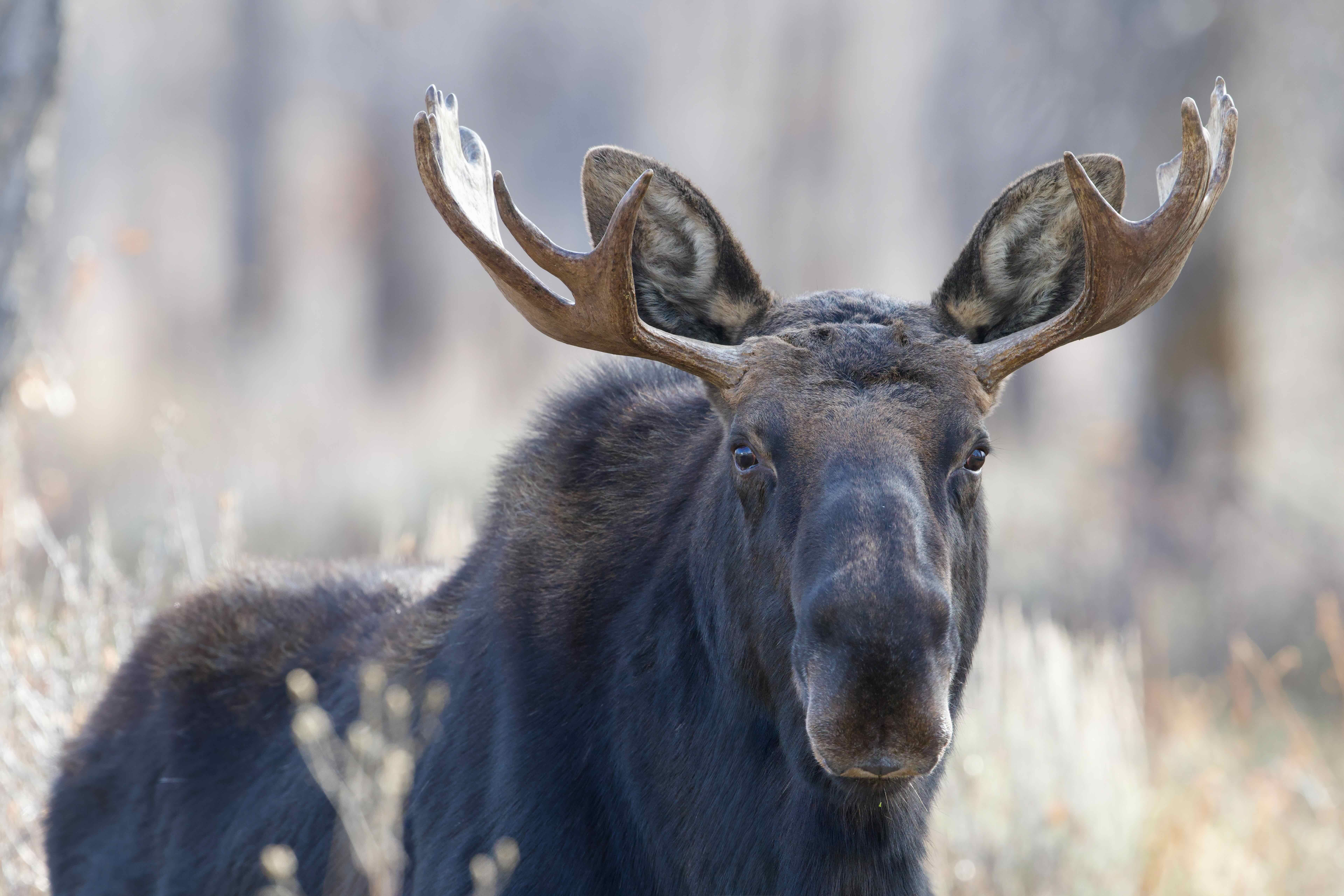
Today on Thanksgiving, we have pictures of MOOSE from Ephraim Heller. Ephraim’s captions are indented, and you can enlarge the photos by clicking on them.
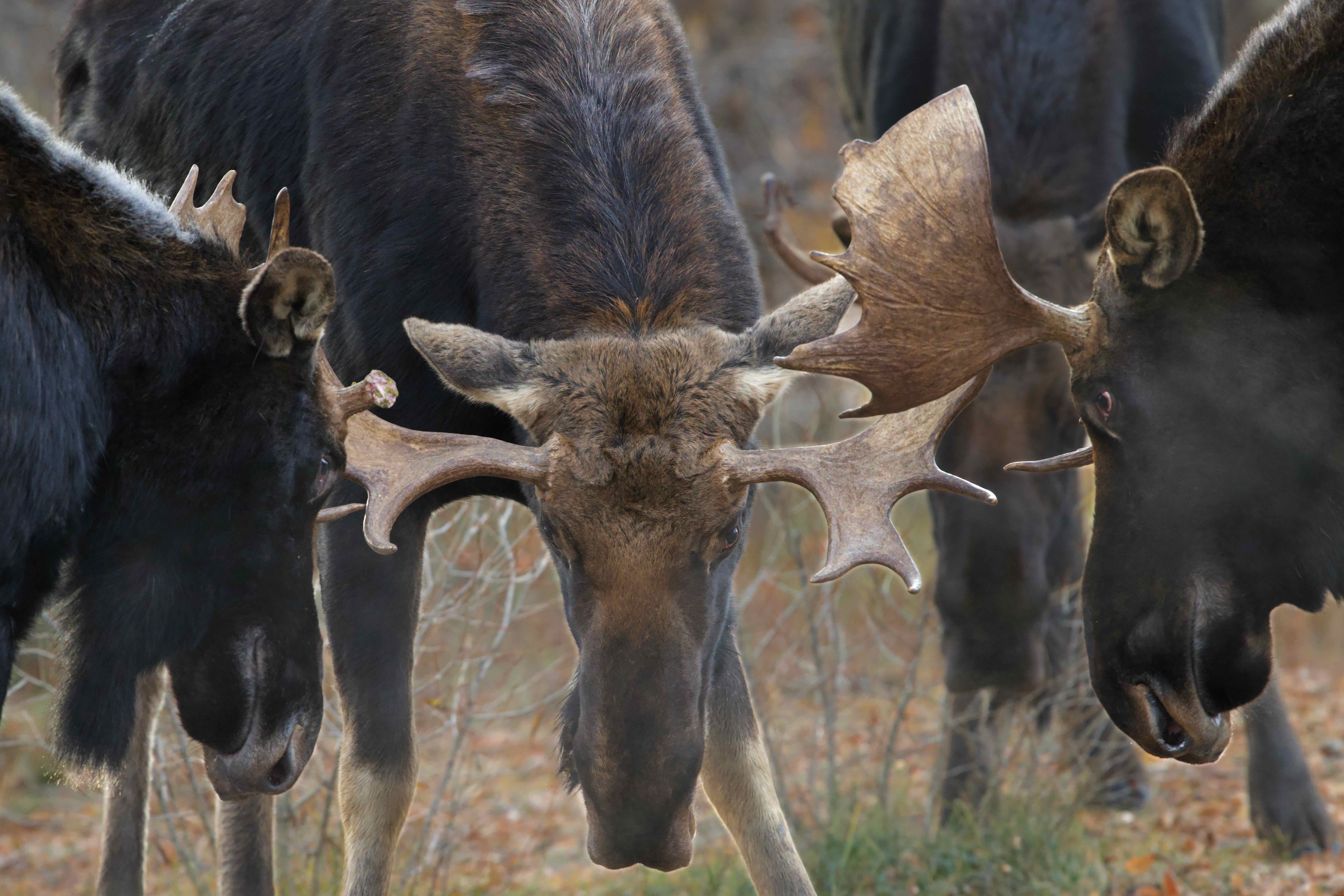
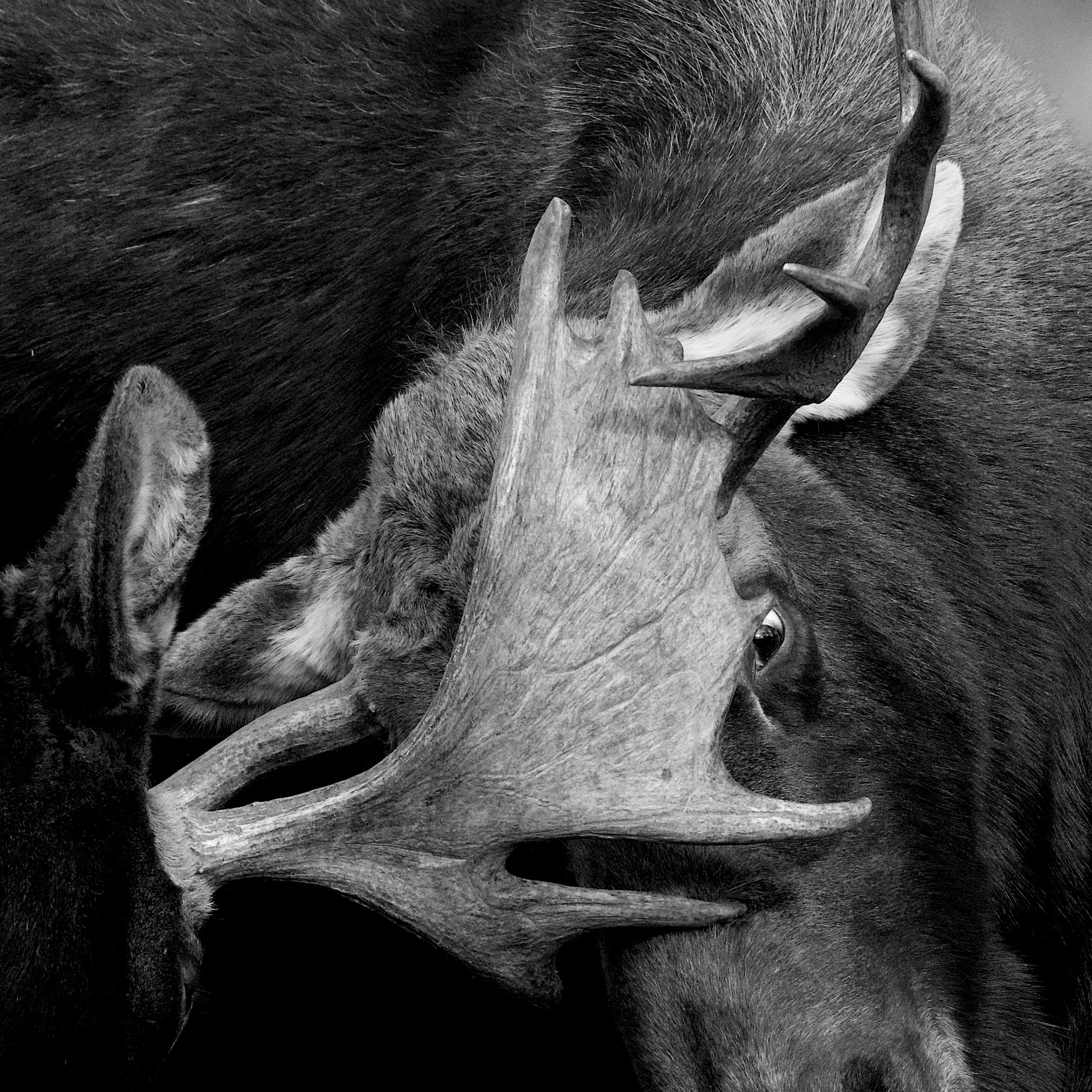
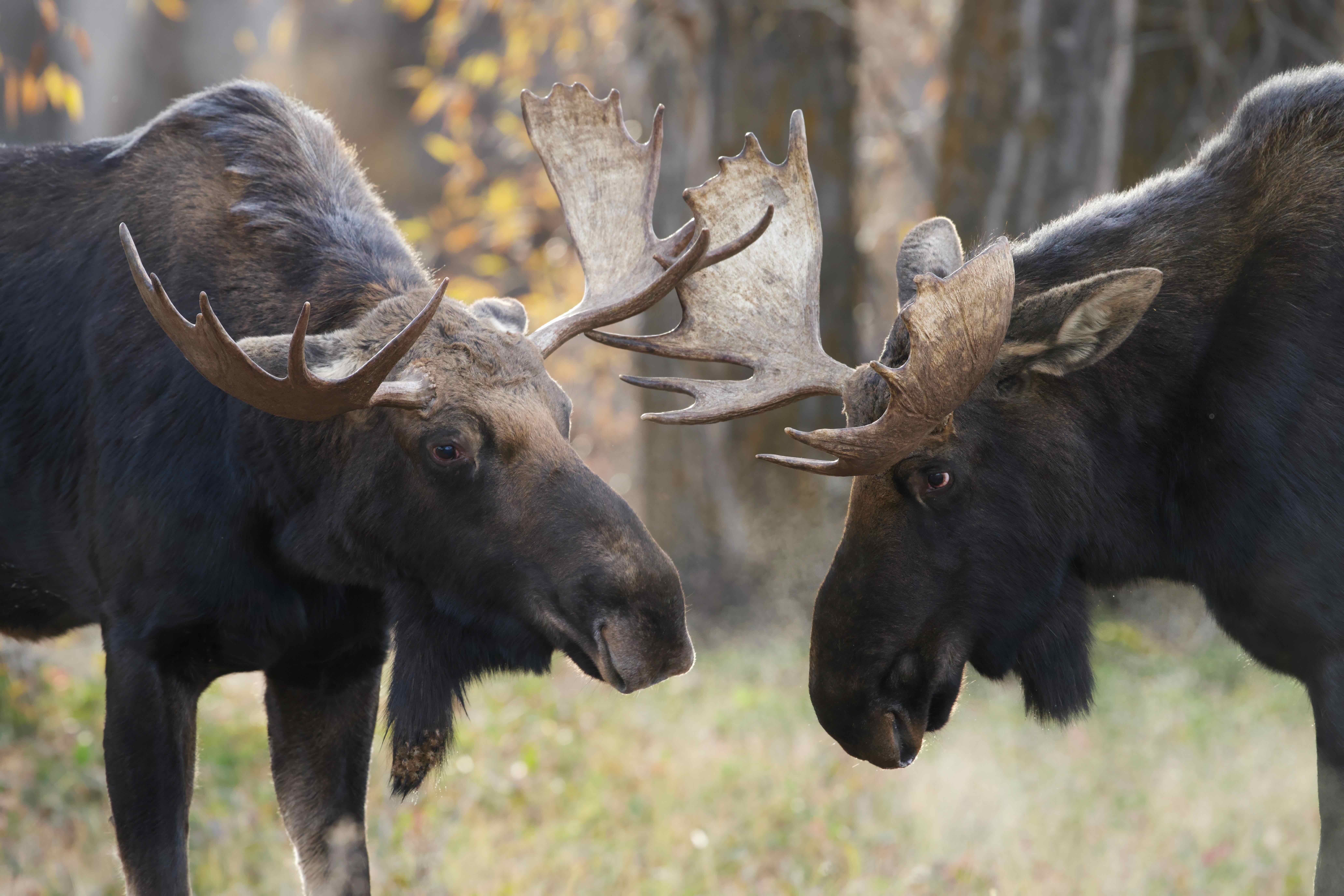
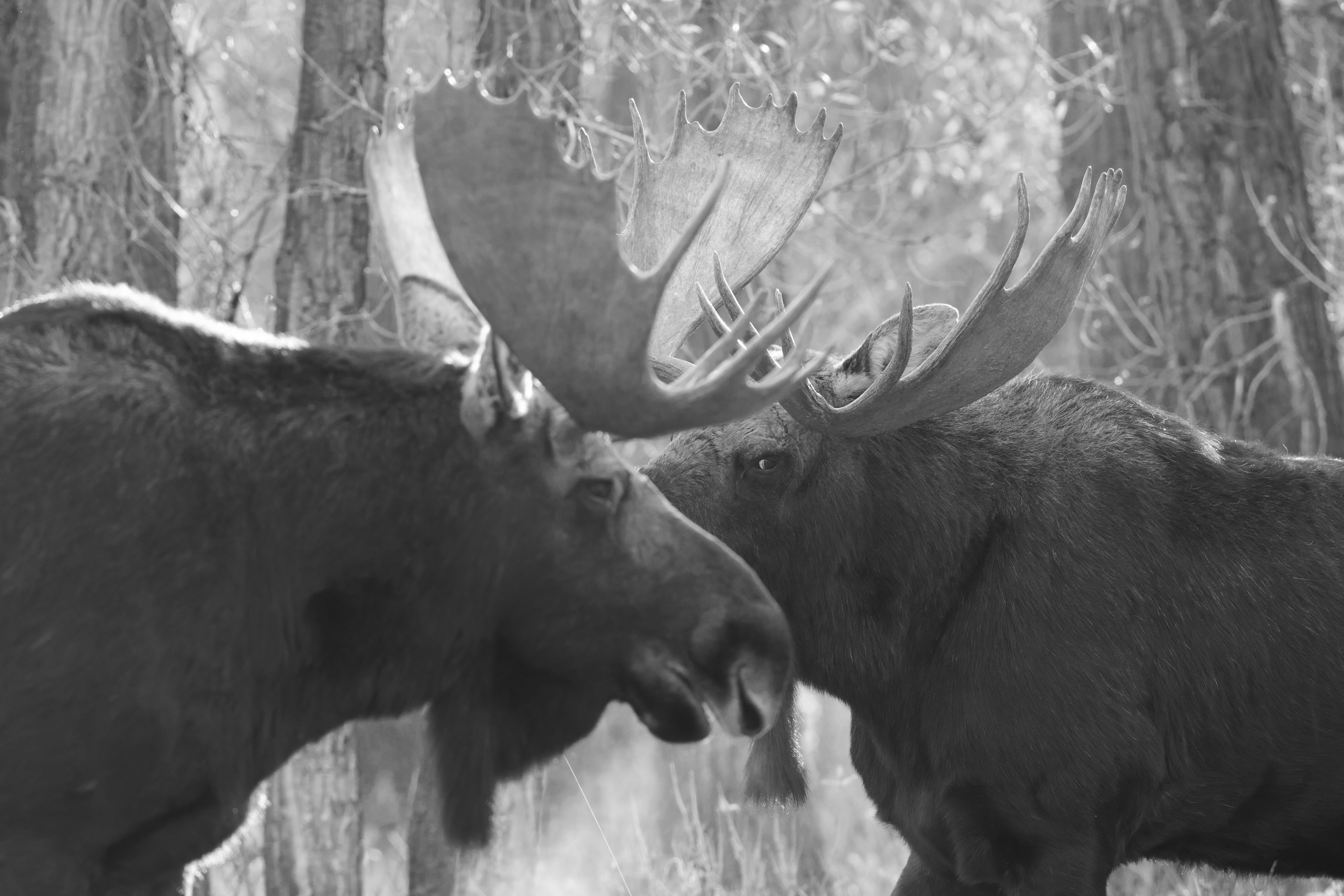
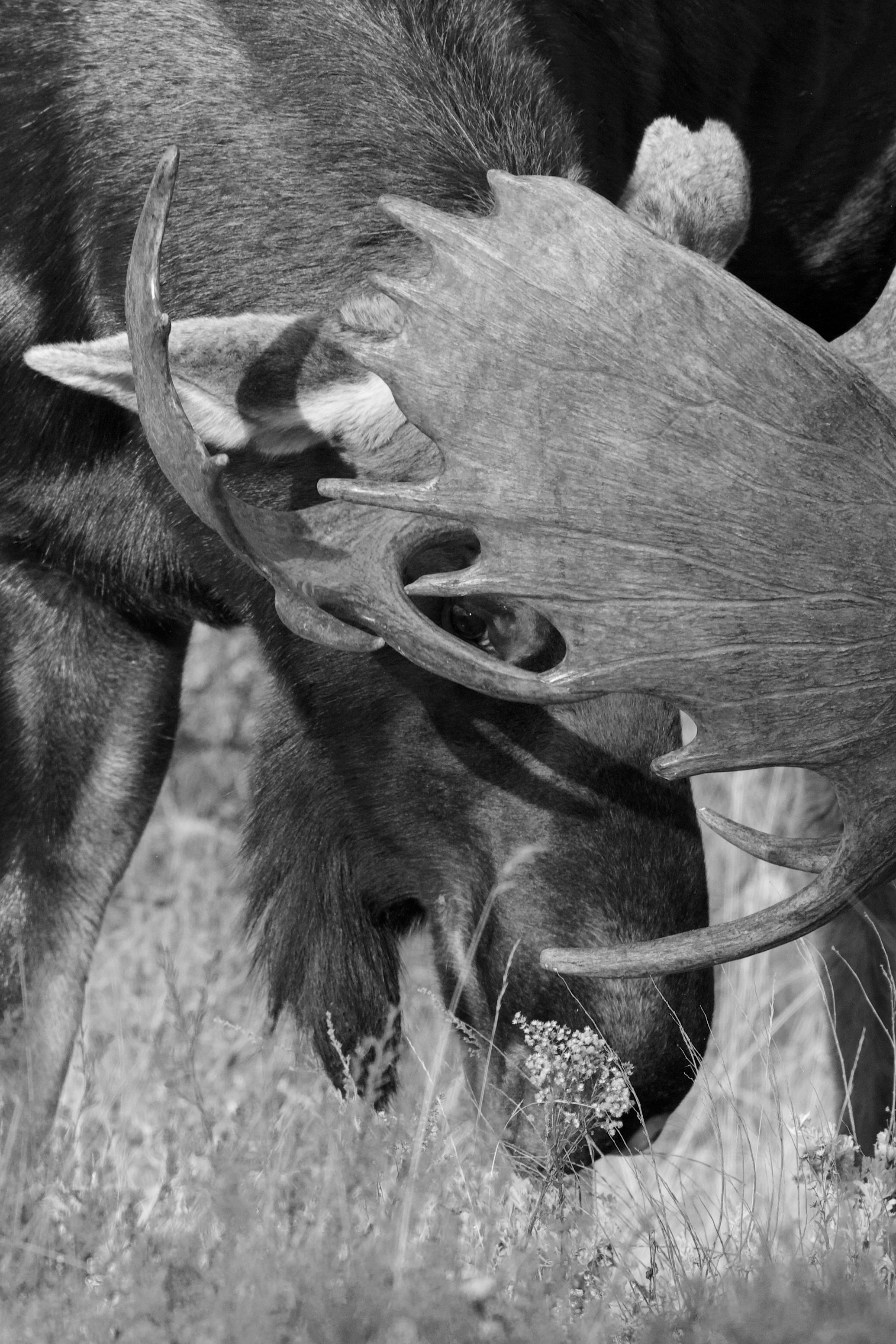
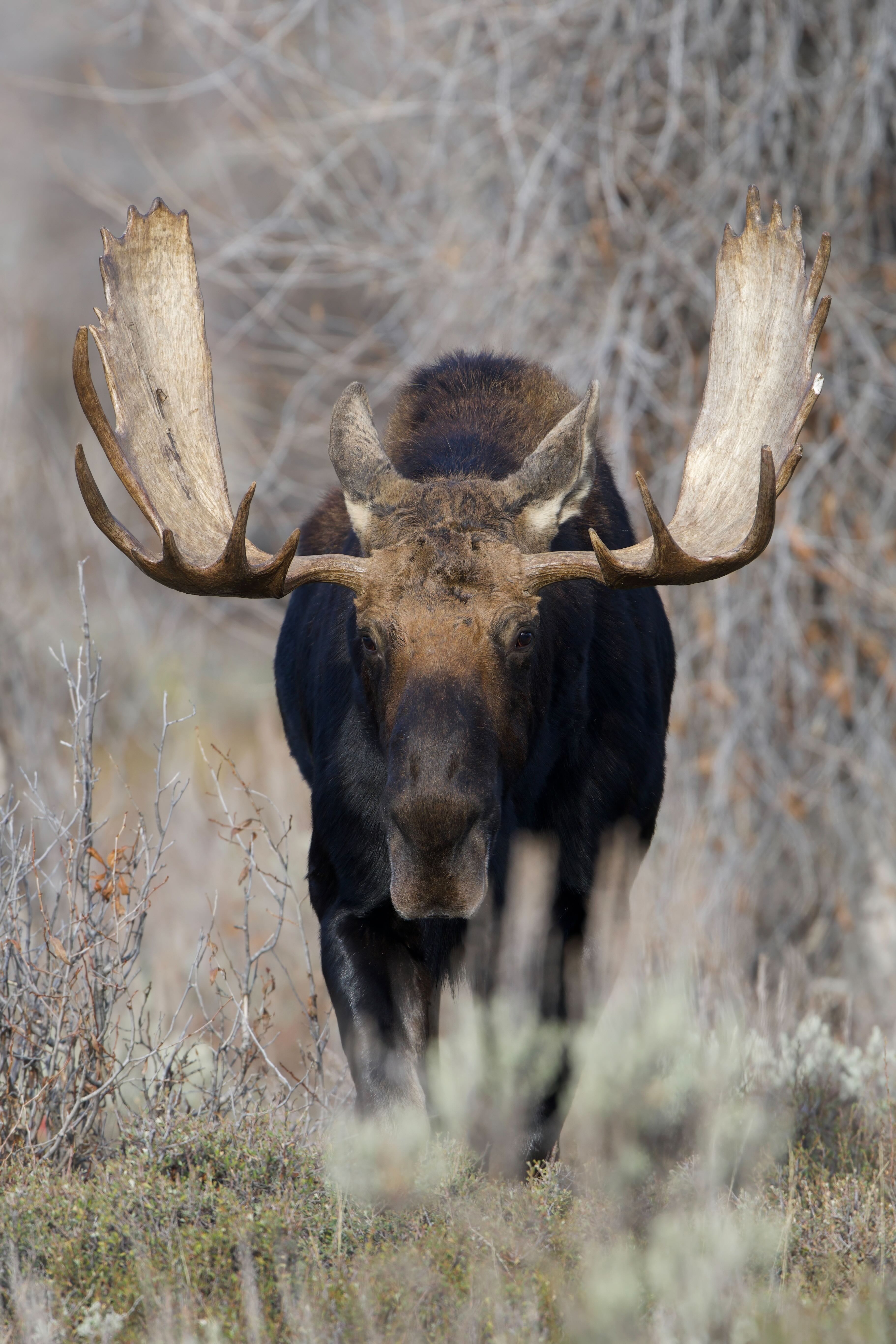
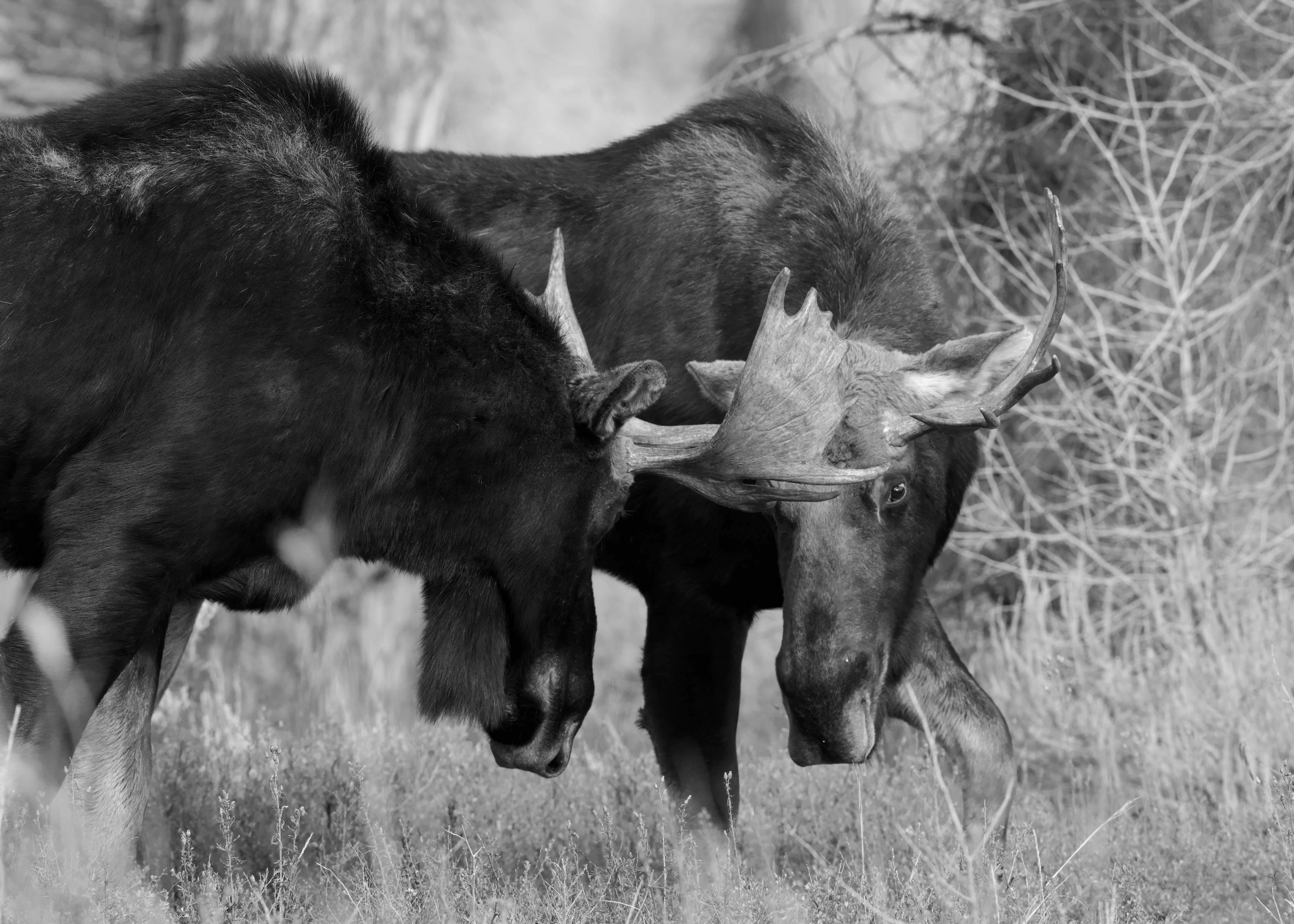
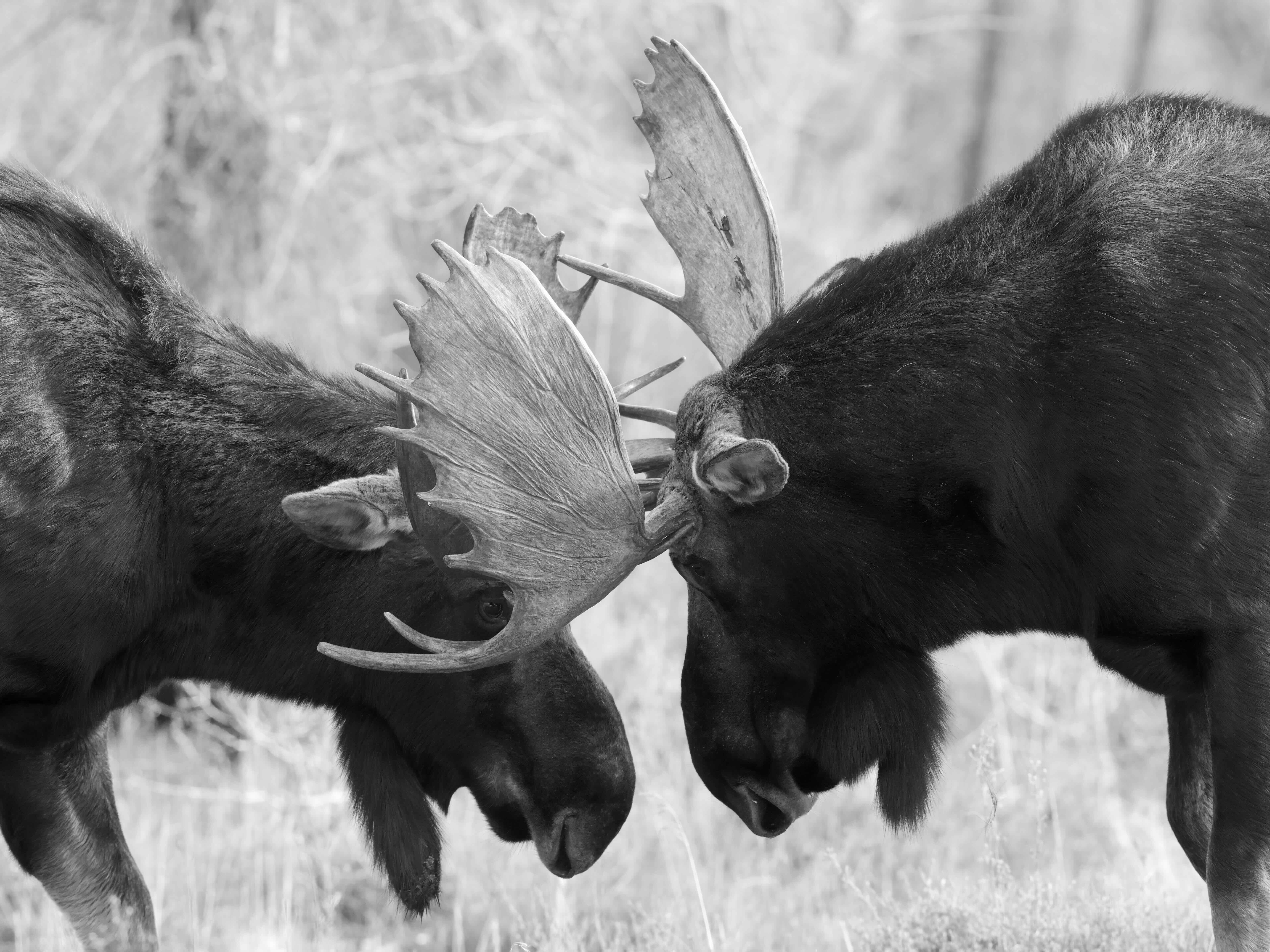
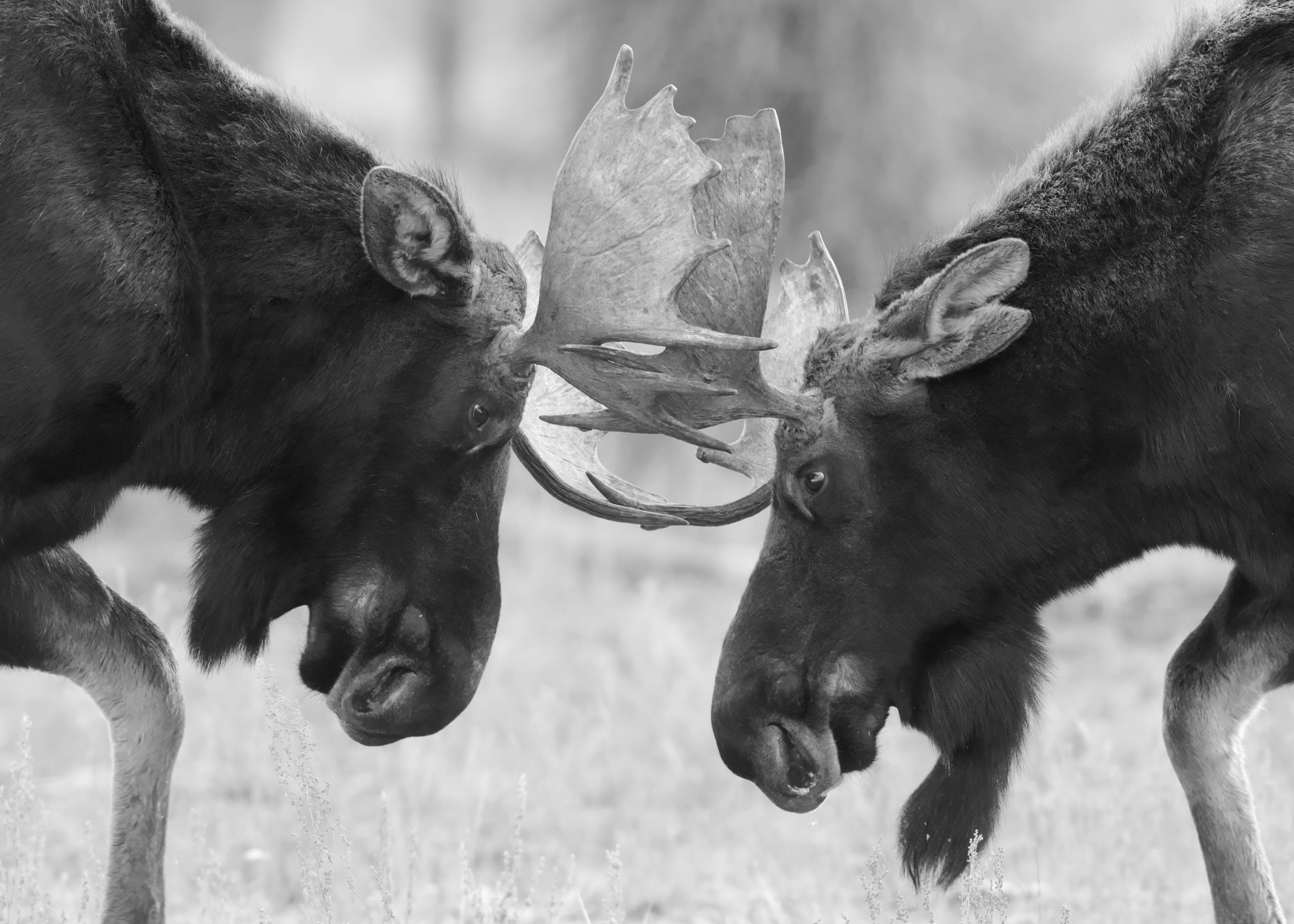
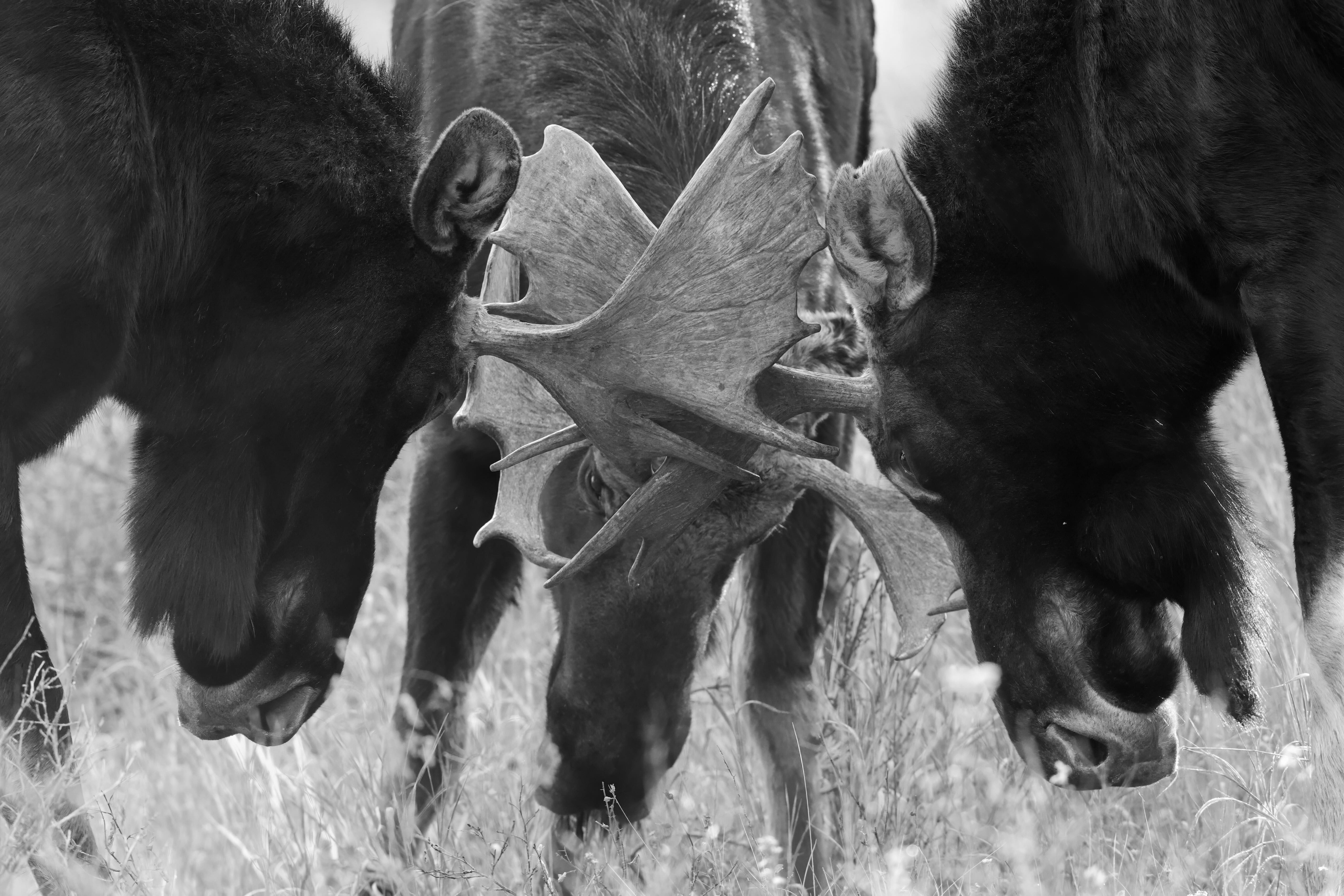
On a chilly early morning in late October I came across a group of seven bull moose [Alces alces] in Grand Teton National Park, not far from my home. It was late in the rut and they were busy sparring with each other while I watched.
Most often two individuals would bang heads, but sometimes they decided that three is the right number. Note that the individual on the left has a broken right antler, but that didn’t deter him.
The Shiras moose (Alces alces shirasi), also known as the Wyoming or Yellowstone moose, is the smallest of North America’s moose subspecies.
The moose rut in Wyoming occurs in September and October. The rut is triggered by photoperiod — the ratio of daylight to darkness. As day length decreases the pineal gland responds by releasing increasing amounts of melatonin, which stimulates testosterone production in bulls and triggers estrous cycling in cows. This hormonal cascade is so precise that the rut rarely deviates more than a few days from year to year in any given location.
Female moose are seasonal polyestrous mammals, with the estrous cycle averaging 24 days and ranging from 22–28 days. The period of standing estrus—when a cow will accept a bull—is brief, lasting only 1 to 36 hours. If not successfully bred, cows may experience up to six recurrent estrous cycles, though approximately 83% of conceptions occur during the first estrus.
The rut induces a spike of up to twentyfold in bull testosterone levels. Neck muscles expand to approximately twice their normal size. Bulls may enter the rut having gained up to 250 pounds of fat and muscle during summer foraging, then largely cease eating during the breeding period, surviving entirely on stored reserves.
By late August, bull moose shed the velvet covering from their antlers revealing hard bone that darkens from white to chocolate brown within days. These antlers serve multiple functions: impressing females, intimidating rivals, and as weapons during combat.
Unlike elk, which assemble harems, moose do not collect groups of females or form large social aggregations during breeding. Instead, bulls travel widely to locate receptive females, typically staying with a single cow for several days to approximately one week before moving on to seek additional mates. Large, highest-ranking bulls perform approximately 88% of all copulations.
Bulls emit bellows, roars, and grunts—with grunts audible up to 500 meters away. Cows attract mates using long, drawn-out moaning calls. These acoustic signals are particularly important because moose have poor vision but excellent hearing.
Other than sparring, scent-marking is the most impressive element of moose courtship. Bulls dig shallow depressions called rutting pits or wallows—typically 1.5 to 3.5 feet long and 3 to 6 inches deep—into which they urinate before wallowing to anoint themselves with their musky odor. Naturally, this “perfuming” behavior attracts cows, who may compete with other females for access to a preferred male’s wallow. Both sexes also scent-mark by rubbing their heads against trees.
Bull moose engage in two distinct forms of physical competition: sparring and fighting. Sparring occurs primarily early in the rut as a mechanism for males to assess relative strength without risking injury. Fighting, by contrast, is violent and can result in injuries ranging from minor wounds to fatalities. Most fights occur between mature bulls of approximately equal size; when size disparities are obvious, smaller bulls typically withdraw before combat ensues, bowing out through displays rather than physical confrontation. If the bulls’ antlers become interlocked during combat then both animals will die.