Why Evolution is True is a blog written by Jerry Coyne, centered on evolution and biology but also dealing with diverse topics like politics, culture, and cats.
I expect the ducklings to start flying within ten days or so, as they’re zooming around on the pond and, as you can see below, are getting some elevation, so that their bodies are out of the water but their feet are still in it. These are their Golden Days, and I think they’ll soon be leaving.
At any rate, Miss Duck is still absent and I don’t expect to see her again. I doubt she was the victim of a predator, as I cannot find any signs of predation (blood, feathers, carcasses, etc.) near the pond. And although she deserted her babies, she was a good mother up to near the end, and her four offspring will have the chance to contribute to the mallard gene pool.
Here she is with one of her babies. Look at that neck! We think of it as a kind of periscope that she extended when looking around. And, thanks to the miracle of genetics, all four ducklings also have relatively long necks.
Some photos of her offspring. They are all but adults now. One is looking up, as you can see by his tilted head. I’m told that the females have orange on their bills (the two to the left) while the males lack orange but have a pale yellow color (two to the right):
Here a Boy Duck is quacking, but males can’t make the classic duck quack, which is limited to females. Males make a sort of gutteral quack-grunt that is lower in volume:
The two males. They won’t develop their characteristic color and pattern (green head, white neck ring, etc.) until they overwinter.
But despite their bad behavior during mating season, the males are still beautiful.
It was hot on this day, and two of the ducks are doing gular fluttering, which is not panting but a rapid form of fluttering of the throat that evaporates moisture and cools the bird. The second duck from the right is looking up, while the one on the extreme left is sleeping with its nictitating membrane closed:
Lately the ducklings aren’t as keen for the food I give them, and my theory (which is mine) is that they are doing more dabbling in the water, sticking their bills in the substrate to get a mouthful of food which they strain out through the serrations on the edge of their bills. They are also foraging more on land, which I like because tmust learn to be wild ducks without a nice man to feed them.
They often stick their bills in the dirt around the pots of plants installed in the pond. Here’s a video of them doing it (humans are discussing a book in the background):
I expect that they’ll fly for real (i.e., bodies and feet out of the water) within a week or ten days. They are flapping their wings a lot and, after meals, zoom across the pond, occasionally levitating their bodies out of the water: a Wright-Brothers type of flight.
Here’s a big flap. You can see that the wing feathers aren’t full-sized.
And four instances of zooming between September 9 and September 11. You can see their bodies leave the water occasionally:
Wing flapping, which develops their flight muscles:
You can never predict when they’ll zoom, but it’s much more likely after meals, as if they’re celebrating a good feed. You can also hear a quack, which is clearly from a female.
Here’s a good case of the zoomies which took place last Friday. People who stop by the pond and see this have no idea what’s going on. Keep watching as they zoom several times in this clip. There is another quack near the end.
Welcome to Monday, Septenber 14, 2026 and it’s National Eat a Hoagie Day. Also known as submarine sandwiches, subs, grinders, or hero sandwiches. Where does the name “hoagie” come from? It’s a mystery, but the term is endemic to New Jersey and Philadelphia. Here are thrr theories as listed by Wikipedia (they give two more:)
In 1953, a reader letter to the Philadelphia Bulletin reported that Italian-Americans working at the World War I–era shipyard known as Hog Island, where emergency shipping was produced for the war effort, introduced the sandwich by putting various meats, cheeses, and lettuce between two slices of bread. This became known as the “Hog Island” sandwich; shortened to “Hoggies”, then the “hoagie”.
Dictionary.com offers the following origin of the term hoagie – n. American English (originally Philadelphia) word for “hero, large sandwich made from a long, split roll”; originally hoggie (c. 1936), traditionally said to be named for the jazz musician Hoagy Carmichael (1899–1981), but the use of the word predates his celebrity and the original spelling seems to suggest another source (perhaps “hog”). The modern spelling dates from about 1945; it may have been altered by influence of Carmichael’s nickname.
The Philadelphia Almanac and Citizen’s Manual offers a different explanation saying the sandwich was created by early-twentieth-century street vendors called “hokey-pokey men”, who sold antipasto salad, meats, cookies, and buns with a cut in them. When Gilbert and Sullivan’s operetta H.M.S. Pinafore opened in Philadelphia in 1879, bakeries produced a long loaf called the pinafore. Entrepreneurial “hokey-pokey men” sliced the loaf in half, stuffed it with antipasto salad, and sold the world’s first “hoagie”. This hypothesis seems unlikely, as “hokey pokey” men were known street vendors of an ice cream product.
Here, from Wikipedia, is a “salami, ham and cheeses on a hoagie roll“:
Masoud Pezeshkian, the president of Iran, was riding high in early July, fresh off the successful negotiation of a peace agreement with the United States, and had traveled to neighboring Iraq for part of a weeklong funeral spectacle for Iran’s slain supreme leader.
Suddenly he got stunning news.
Iranian forces had opened fire on three commercial ships in the Strait of Hormuz, setting ablaze a Qatari L.N.G. tanker and damaging other vessels. Iran was under siege in world opinion.
Outraged, Mr. Pezeshkian phoned Gen. Ahmad Vahidi, the commander in chief of the powerful Islamic Revolutionary Guards Corps, and in a raised voice called the actions reckless and demanded answers, according to five Iranian officials and two Guards members familiar with the events.
General Vahidi told the president that he had neither authorized nor had advance knowledge of the strike, the five officials said. The nation’s Supreme National Security Council, which plays a critical role in both the war and negotiations, had also been in the dark, he said.
In fact, much of the country’s leadership was unaware that a fringe hard-line faction had decided to act on its own. Ultimately, those clandestine efforts derailed a push by more moderate pragmatists in Iran to reach an end to hostilities with the United States and repair their nation’s ailing economy.
The hard-liners succeeded in part because the only figure with the authority to resolve such disputes — the new supreme leader, Ayatollah Mojtaba Khamenei — has been a phantom since taking office in March. He has not been seen, and his voice has not been heard. And the authenticity of written statements and messages attributed to Ayatollah Khamenei has been questioned, including by Mr. Pezeshkian, according to three Iranian officials.
Senior Iranian officials and a Guards member said in interviews that what followed were some of the most volatile political confrontations within Iran’s leadership in memory. Officials engaged in shouting matches. Two senior generals threatened to resign. Accusations of treason and betrayal flew.
If Mojtabi didn’t even issue a statement, then he’s surely dead or in a coma. I’m not sure whether this schism within the Iranian leadership is good or bad. It could mess up the country’s war strategy, but if the hard-liners are in charge then what we’ve seen will continue, and probably at least through the midterms.
Outside a highway rest stop named after former president Joe Biden, it was easy to pick up on the frustration and lack of enthusiasm that many Democratic voters are feeling toward the party he once led. But many also said they’ll set those misgivings aside and vote for Democrats in November.
The responses are in line with recent national polling, which has found that more Democrats than Republicans are certain to vote, even as the Democratic Party’s favorability and public image remains weak. About 91 percent of Democratic registered voters said they would definitely vote, compared with 79 percent of Republicans, according to a YouGov-Economist poll from August. The same pollster has found the favorability rating of Democrats has steadily risen over the last year to 40.5 percent and 30 percent among independents.
The Washington Post interviewed dozens of voters at the Biden Welcome Center off Interstate 95.Here’s what they said they’re feeling about the 2026 midterm elections — and what they want from Democrats:
Ronald Makarutsa
45, nurse practitioner in Tyngsborough, Massachusetts, will vote Democratic
“They need to have more of a spine and stand up for one another. When a Republican does something, they all say the same thing until they achieve their goals. Some of the Democrats, they don’t support one another. … They have to put up a united front.”
Ashish Pandy
39, driver and nonprofit founder in Queens, will vote, but not sure for what party
“People have forgotten humanity. … Rather than big issues, rather than bringing up Russia or the Middle East, they should be bringing up things that matter to people: People shouldn’t be hungry. They should have access to a good life.”
Lindsay Morgan
43, restaurant manager in Lancaster, Pennsylvania, will vote Democratic
“Democrats need better people to run. If you want to change what’s happening, you have to get a powerhouse that doesn’t give the other side fuel to say we have ‘Sleepy Joe.’ [But] they need not to fall so far left that it detracts from some of those Republicans you might capture.”
Carlos Roman
21, college student in Newark, Delaware, will not vote
“The Democratic and Republican Party are just two groups that serve one group, and that collective is the oligarchy.”
I wonder what group Roman doesn’t think “serves the oligarchy.” At any rate, what we have is a panoply of answers and nothing enlightening. It’s interesting that nobody in the article said they’d vote Republican, and that percentage among all those surveyed isn’t given. Yet they interviewed dozens of people. Since the article was about what Democrats want from their party, that’s perhaps understandable. Note, though, that there are several people who aren’t sure how they’ll vote, and one who won’t vote at all.
Dario Amodei, the chief executive of Anthropic, called for a global slowdown of artificial intelligence development in a 3,800-word essay on Saturday, just days after one of the company’s employees quit over concerns about the safety of the technology.
Top executives of other major A.I. companies quickly signed on to the effort. Sam Altman, the chief executive of OpenAI; Elon Musk, whose SpaceX rocket company has been ramping up spending on A.I.; and Demis Hassabis, the chair of Google DeepMind, wrote in social media posts that they agreed on the need for a slower pace.
Mr. Amodei, who co-founded Anthropic to focus on securely and carefully building A.I., wrote in his essay that while he believed the technology could bring many benefits, it was advancing at too rapid a pace for researchers to continue safely.
“Over the last few months, I have become convinced that fully addressing the risks requires even more prudence — not just investing in risk prevention, but pacing the rate of capabilities advancement so that risk prevention has time to keep up,” Mr. Amodei wrote. “We must slow the pace at which we improve the capabilities of A.I. models. Progress will still seem fast, and we must make wise use of the time we gain.”
Mr. Amodei has warned about the safety risks of A.I. for years. But his essay amounted to one of the most full-throated calls for urgent action from a leading A.I. company executive to date.
He called for independent auditors to check the companies for safety standards and urged global cooperation in creating rules around A.I. development.
The appeal for an industrywide pause follows months of escalating concerns across the technology industry as A.I. model development has made significant strides at companies like Anthropic, the developer of the Claude chatbot, as well as OpenAI, the creator of ChatGPT, and Google’s DeepMind.
Tensions rose further after the leading A.I. labs discovered security breaches carried out by their own programs without their knowledge. In one incident this year, OpenAI’s systems breached an A.I. start-up called HuggingFace, which was not detected until HuggingFace informed OpenAI weeks after it had happened. Since then, A.I. researchers have conferred to discuss what to do.
People here have said that the warnings are overblown, and I don’t know if AI bots can destroy humanity without a person behind them. But I don’t know squat. If the top executives call for a slowdown, though, that’s good enough for me.
*The Free Press has an editorial, “9/11 and the work to be done,” which indicts many Americans for largely forgetting (or even approving) the desire of many Islamists and terrorists to kill Americans and destroy the things that make America worth inhabiting.
It is clear that the unity that Americans experienced immediately after the attacks has dissipated almost completely. We are now furiously divided over basic questions of national identity and purpose. And astonishingly, we’re even divided over who is to blame for the attacks.
Leading figures shaping the views of millions, and especially young people, have distorted the history and meaning of 9/11, making it more difficult to fully and collectively honor the dead, the sacrifice of first responders, and the courage of those willing to fight and die for our country. To take two examples who have been in the spotlight lately, that includes Hasan Piker, who once declared that “America deserved 9/11,” and has become the darling of the Democratic left, livestreaming to his fans with a framed image of the burning towers in the background. And it includes Tucker Carlson, who recycles the libelous conspiracy theories he once denounced, promulgated in the immediate aftermath of 9/11 by Hezbollah, suggesting that Israeli and American Jews were in on the plot.
In 2001, Americans were shocked by the deep reservoir of ideological hatred in the Arab and Islamic world that the terrorist attacks brought into the open. Today, we are shocked by how familiar open hatred of America has become. All of the ideological -isms we believed we had cast off in the 20th century—anti-capitalism, anti-colonialism, anti-Westernism, anti-Zionism—are now growing natively on American soil. It’s no wonder Osama bin Laden’s 2002 “Letter to the American People” became a viral TikTok sensation in November 2023. This was one month after similarly inspired Hamas terrorists, armed and trained by the Islamic Republic of Iran, massacred and kidnapped men, women, and children in southern Israel, only to be embraced by credulous students and professors at elite American institutions who affirmed the terrorists’ barbaric belief that Westerners, and Jews in particular, had it coming. Those students and professors had no idea what drives radical Islamists, or that our enemies on many fronts are fighting for one cause.
What did university students who celebrated the October 7, 2023, Hamas massacre, know about the men, women, and children murdered on airplanes, in burning and collapsing buildings, in the wreckage of the Pentagon, and on the earth of rural Pennsylvania, where heroic passengers crashed the fourth plane to prevent it from being turned into one more weapon of mass destruction? What had young Americans been taught about the apocalyptic ideology that sanctified the slaughter of 9/11, and that continues to fuel a war against the West, whose destruction it proclaims as its sacred mission?
Although the problem has worsened recently, there have always been those in the West who declined to recognize that killing Westerners is a fundamental aim of Islamists everywhere. Ground Zero was still a smoking pit when the French ambassador to Israel, Jacques Huntzinger, rejected any comparison of Hamas terrorists—who had been blowing up men, women, and children, along with themselves, on buses, in coffee shops, and in pizzerias—to the al-Qaeda terrorists who had flown airplanes into buildings. “We all condemn the terrorism Hamas and Islamic Jihad perpetrate here,” Huntzinger told an Israeli journalist, “but this terrorism is linked to the Israeli-Palestinian conflict, which must be solved.” Like many of his peers in the U.S. and Europe, he preferred to ignore the overarching motivation that unites the enemies of Americans and Israelis.
. . . The question today is whether Americans will retain our sense of good and evil, and continue to keep the promise we made back then, that “these dead shall not have died in vain.” There is a lot of work to do.
Yes, some will call this essay jingoistic, while other may even say it’s Islamophobic. But recognizing the dangers of Islamism (note the term) is not an irrational fear but an issue to grapple with it. All you have to do is live on a liberal college campus to recognize that there is a lot of truth to what the essay says.
Maybe the Road Runner was just playing hard to get.
For decades, cartoon canine Wile E. Coyote has been pursuing the speeding bird throughout the American Southwest, aiming to eat him and getting blown up in the process.
But in the eyes of some fans, the violent chase was actually a classic tale of tortured love. And right now they’re doing a victory lap.
That’s because of “Coyote vs. Acme,” a new film with a different twist on the hot pursuit. In the movie (spoiler alert), Wile E. Coyote sues the Acme Corporation over their defective products, which consistently backfire as he closes in on the bird. The case goes to a congressional hearing, where Road Runner bursts into the room and becomes the only creature to testify on Coyote’s behalf. Through his language of “beeps,” Road Runner tells the room he considers Coyote a friend and asks, “Are you coming back?”
Apparently that’s all the internet needed to hear.
“Road Runner admits that he sees Coyote, even whenever Wile E. dislikes him or doesn’t think that he’s looking,” said Lisbon LaSure, a 24-year-old in Jacksonville, Fla. “It’s so nice to be seen like that. It’s really deep and it’s really powerful and it’s really validating and just overall like really romantic.”
Social media is teeming with people celebrating the characters’ “toxic yaoi,” a Japanese term for male lovers. You’ll also find people “shipping” them—wishing they were in a relationship—through fan art or TikTok videos where their interactions are reframed through careful editing and songs like Paul Anka’s “You Are My Destiny” or Olivia Rodrigo’s “Stupid Song.” (Sample lyrics: “I want you more than any stupid song could ever say.”)
Annie Tarin, a University of Arizona student, made a viral montage set to Chappell Roan’s “The Subway,” in which the pop star croons about a former soulmate. In the clips Tarin uses, Coyote looks longingly at one of Road Runner’s feathers. Road Runner seems to stare into Coyote’s soul with his curious gaze.
I’m not ready to admit that there’s an amorous relationship between the two (are their sexes even known?) until I see the movie, which I’m not inclined to do. Has anybody seen it? Here’s the trailer:
Meanwhile in Dobrzyn, the editor is bothering the worker:
Hili: Am I bothering you well enough? Andrzej: Exceptionally well.
In Polish:
Hili: Czy dobrze ci przeszkadzam?
Ja: Wręcz doskonale.
From Luana; Elizabeth Warren appearing a bit dense:
Dynamic pricing means prices go down as well as up. So this is conclusive evidence that either (a) she’s stupid, (b) she’s dishonest, or (c) both. The strange thing is, I genuinely can’t guess which it is. Could she lie this overtly? https://t.co/gh6sqFU4o4
I have a passel of new duckling photos and videos that I’ll post soon. In the meantime, I wanted to show how much the “babies” have grown. The first picture of Miss Duck’s brood was taken on the second day after hatching, July 20. You’ve seen this before:
And here they are in a similar pose a week ago (Sept. 6). They’re even bigger than than this now, and their wings and flight feathers have grown. I think they’ll be flying in some way within ten days.
And no, Miss Duck has not shown up after she abandoned her babies. We’ve rescinded her award of Best Duck Mother of All Time, though the orphan babies are doing very well.
You may have heard that the British government has announced sanctions against Israeli individuals and settlements in Israel’s West Bank—punishing individuals and companies doing business from what is apparently Area C of the West Bank as stipulated by the Oslo II accords. While areas A and B are under Palestinian authority and jurisdiction, and Jews cannot live there, Area C is under Israeli military control. Both Jews and Palestinians live there in roughly equal numbers, but the Jews, many of whom moved in after the area was won by Israel in the 1967 war, are all referred to as “settlers”. As for their status, Wikipedia says this:
In 2023, Area C was home to 491,548 Israeli settlers and 354,000 Palestinians. The Jewish population in Area C is administered by the Israeli Judea and Samaria Area administration, into which Israeli law is “pipelined”, whereas the Palestinian population is directly administered by the Israeli Coordinator of Government Activities in the Territories (COGAT) and is under military law. The Palestinian Authority is responsible for medical and educational services to Palestinians in Area C; however, infrastructure construction and supervision is done by Israel.
The status of the Jewish population in area C (the Jews of the West Bank) is disputed. While the status of this area was supposed to be resolved by negotiations between Palestine and Israel after Oslo II, those negotiations never took place. Much of the world regards the Jews in area C of being illegal settler-colonialists under the fourth Geneva Convention, but international lawyer Natasha Hausdorff argues in the videos below that Jewish residence in Area C does not violate international law, nor does it constitute, as the UK has just maintained, “ethnic cleansing.”
That said, there’s no doubt that some Israelis in the area are violating civil law by attacking and harassing Palestinians. As I’ve said before, that kind of behavior is reprehensible and should be punished. But I am unwilling to call for the wholesale removal of Jews from area C, nor for sanctioning them as the British government (and other countries) called for this week. Their fate depends on what negotiations will take place in the future to effect a peaceful settlement between Israel and the Palestinians.
But the British government under Labour (yes, the party renowned for antisemitism) has just declared not only that they’ll impose sanctions on West Bank Jewish companies, but that this is necessary to effect the ONLY and most urgent way to stop the enmity between Israel and Palestine: the “two-state solution.” First, from the NYT:
Britain, Canada and France on Tuesday announced sanctions on Israeli settlements in the occupied West Bank, a symbolic step by three once-staunch allies illustrating Israel’s deepening isolation after the devastating war in Gaza and settler violence in the West Bank. [JAC: I now believe that eight more countries have signed on to these sanctions.)
. . .Britain’s package of measures was announced on Tuesday in Parliament by Ed Miliband, who became foreign secretary in July. It represents the clearest shift in British foreign policy since Andy Burnham became prime minister that month.
“Today marks the beginning of a new approach,” Mr. Miliband told lawmakers. He said that the British government “agrees that there is ethnic cleansing of Palestinians in areas of the West Bank — perpetrated by settler terrorists.” All too often, he added, “the Israeli government has turned a blind eye to this and worse.”
In a speech with an often deeply personal tone, Mr. Miliband said that he had made his announcement as a “proud British Jew” who was “unwavering” in his support for the state of Israel. He added, however, that Britain had concluded that the occupation was unlawful in line with a ruling by the International Court of Justice.
“So I can announce today that we will introduce an import ban on goods from illegal settlements in the occupied territories,” he said, adding that the measures would also cover those who provide services to settlements, including “construction, infrastructure, financing or real estate for settlement expansion.”
You can read the full statement by Foreign Secretary Miliband to the House of Commons here. I’ll give a few extracts; note that the British government has recognized Palestine as a state, though no such state exists:
So Madame Deputy Speaker, there is a deeply painful contrast between our professed commitment to a two state solution, and the reality on the ground in Gaza and the West Bank.
. . . We should always be proud that it was a Labour government that took the historic step of recognising the State of Palestine.
What we seek today is to salvage the only course for peace and security for Israelis and Palestinians – the two state solution.
. . .Ethnic cleansing is defined by the UN as ‘a purposeful policy designed by one ethnic or religious group to remove by violent and terror-inspiring means the civilian population of another ethnic or religious group from certain geographic areas.’
The British government agrees that there is ethnic cleansing of Palestinians in areas of the West Bank – perpetrated by settler terrorists.
To advance the two state solution, we also need viable and effective Palestinian governance.
So I urge the Palestinian Authority to accelerate reform and I urge Israel to lift its withholding of revenues that is financially crippling the provision of essential services in the West Bank.
The set of measures I have announced represents a clear message to the government of Israel, to the Palestinians in the Occupied Territories, and to the world that we will not acquiesce in the destruction of the two state solution.
I have news for Secretary Miliband: the two-state solution is already gone, extinct, singing in the Choir Invisible. The Palestinians do not want two states, nor did they ever, as they’ve rejected a two-state solution many, many times, often with stipulations favorable to Palestinians. What Palestinians want is a one-state solution, a state that will be set up to contain Jews and Palestinians, but of course would soon be Judenrein due to Jews fleeing or being exterminated.
Nor does Israel want a two-state solution. October 7 killed that desire. Israelis now realize that there was a two-state solution before 2023: Gaza—right next to Israel. That didn’t work out so well, and Israel’s security concerns about terrorism have gone sky-high. Hamas is still in control of much of Gaza, has not yet laid down its weapons, nor have Hamas or the Palestinian Authority renounced terrorism Both groups glorify martyrs, and the PA has its infamous “pay for slay” program, euphemistically named the “Martyr’s Fund”, in which Palestinians jailed or killed for attacking Jews get a monetary reward (it can go to their families). And there are no moderate, non-Jew-hating Palestinians waiting in the wings to assume peaceful governance of a Palestinian state. Certainly the Palestinian Authority is not a candidate!
Only a fool would think that Palestinian terrorism against Israel would cease if two states were created, but Miliband & Co., ignorant of history, say stuff like this:
And this is in our fundamental national interest because if there is one lesson of recent decades, it is that we will never have stability in the Middle East without a two state solution.
Is the man serious? Does he think that a version of BDS, banning goods made in area C (often by Palestinian workers who will lose their jobs), will bring on the two state solution?
If you read the whole Miliband statement, you’ll see he blames all the woes of Gaza, including its “humanitarian catastrophe” and deaths of civilians, not on Hamas but on Israel. He and the British government have swallowed whole the line of Hamas apologists like the UN.
Now the argument that these sanctions won’t achieve the UK’s aims stands by itself, but it’s interesting to see that both Hamas and Iran have praised Miliband’s statement and the upcoming UK law it portends.
This is from the Torygraph; click on the headline below, find it archived here, or see it in full on yahoo! news
The terrorist group said the Foreign Secretary’s use of the term “ethnic cleansing” to describe the actions of settlers in the West Bank was a “step in the right direction”.
It called for the prosecution of Israel’s leadership for war crimes.
On Tuesday, Mr Miliband said the occupation of Palestinian territory was “unlawful” – a first for a British government minister – and accused Israel of trying to make the two-state solution unviable.
He told the Commons: “The British Government agrees that there is ethnic cleansing of Palestinians in areas of the West Bank, perpetrated by settler terrorists. And all too often, the Israeli government has turned a blind eye to this.”
Britain will sanction companies and individuals supporting the settlements with finance, infrastructure, property or construction services.
The UK will also refuse all export licences for weapons that “materially contribute to the occupation”, said Mr Miliband.
Hamas, proscribed as a terrorist group by Britain, carried out the October 7 2023 attacks on Israel, in which 1,195 Israelis and foreign nationals died.
Basem Naim, a senior member of Hamas’s political bureau, said: “The imposition of sanctions by Britain and other European countries and Canada on goods imported from the settlements of the occupied West Bank, and the London foreign minister’s use of the term ‘ethnic cleansing’ to describe the crimes of the settlers, are important steps in the right direction – but they are not enough.
“What is needed to achieve stability and peace in Palestine and beyond is the immediate implementation of the relevant international resolutions and the prosecution of war criminals in Israel in a manner similar to the Nazi trials at Nuremberg in Germany.”
Typical Hamas palaver, with not a word about the prosecution of Hamas for its real war crimes, including kidnapping hostages and indubitable targeting of civilians!
Iran has also joined the pro-Milibandwagon. From The Jewish Chronicle (click to read):
A quote (I’ve bolded one sentence):
Britain’s sanction targeting settlements in the West Bank have been greeted in Iranian state media as a step towards “the end of Israel”.
The announcement yesterday by foreign secretary Ed Miliband of a raft of measures has been broadcast repeatedly by Islamic Republic propaganda outlets.
Iranian broadcasters claimed years of activity by regime-backed “resistance groups” have succeeded in persuading the “naïve UK government” to take action against Israel.
The reports quote Miliband as branding the settlers as “terrorists” supported by Benjamin Netanyahu’s government, and accusing them of “committing ethnic cleansing in the West Bank”.
Iran Radio accused the foreign secretary of “plagiarism”, saying credit for branding “Israeli occupiers” as terrorists should go to the founder of the Islamic Republic, Ayatollah Ruhollah Khomeini.
Now you might be saying, “Well, just because Hamas and Iran have approved the UK’s new policy doesn’t mean it’s wrong.” True, but the UK’s policy is not going to bring on a two-state solution, no matter how many times Miliband says it, and Iran just said the quiet part out loud: these anti-Israel sanctions are indeed a step towards the end of Israel.
But it won’t bring on the end of Israel, as that country is determined to continue existing. As the Hebrew phrase goes: עַם יִשְׂרָאֵל חַי (Am Yisrael Chai): “The people of Israel live.”
*********************
On the other side we have is eloquent Natasha Hausdorff, international lawyer and legal director of UK Lawyers for Israel. At 4:45 in the video below, Hausdorff explains why she doesn’t see Jewish settlements in the West Bank as illegal under international law, and why the Israelis are not committing “ethnic cleansing.” Indeed, she says, the illegal settlement in the Israeli-administered territory of Area C is being done by Palestinian Arabs, which she calls “an inversion of authority” and “projection.” The error people are making hinges on mistaking voluntary settlement of this area by Israelis with “state transfer” of Israeli populations.
I’ve rarely seen Hausdorff so exercised, but she’s clearly gobsmacked and peeved by what she sees as an anti-Jewish agenda by her own government, and an agenda based on lies. (You can see a longer explication of her views in this other video and there’s a new video with Hausdorff discussing what will happen to the firms, both Israeli and British, who will be subject to the UK boycott.)
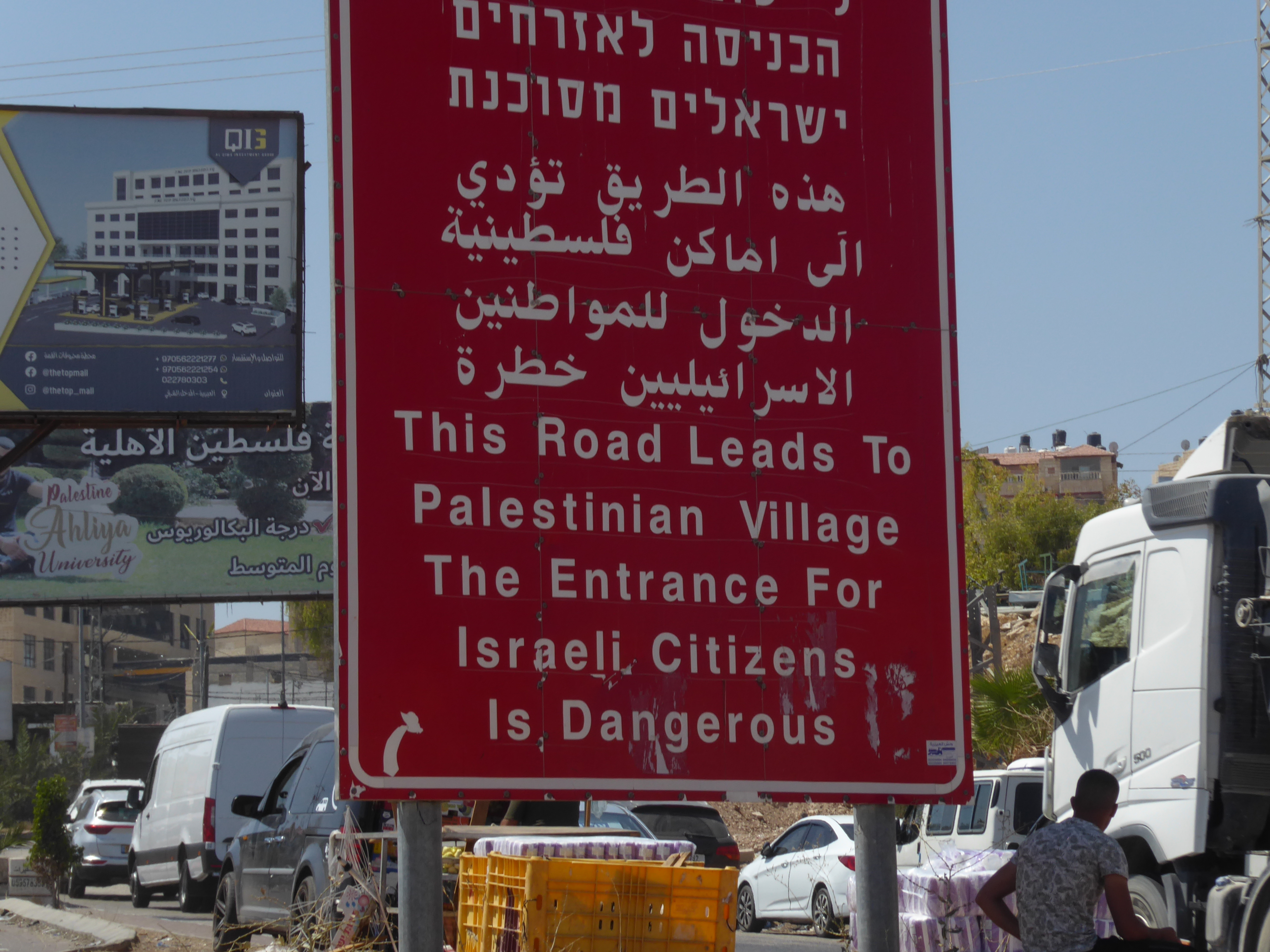
Here’s a sign to the entrance of part of area A near Jerusalem; I took the photo a couple of years ago:
At the end of September I posted about the BBC’s refusal to use the word “terrorist” when referring to Hamas. They could use it when quoting other people, but you can’t call a terrorist a terrorist when it applies to Palestinians who kill civilians for political, ideological, or religious aims. This also applies to other media outlets, as you can see in Bill Maher’s latest “Real Time” segment below.
A reader sent me a link to the 9-minute comedy-and-news bit, which this week was more news than comedy. And the reader noted that this was one of “his best ever” and that it “should be required viewing for every incoming college freshman in America.” It is indeed, as Maher calls out the young generation for coddling terrorism, valorizing Luigi Mangione, and touting America as the worst country ever.
The moral confusion afflicting the young and the “progressives” is most pervasive when discussing Israel’s response to terrorism emanating from Gaza, which, Maher emphasizes, is NOT a genocide but a “counterattack in a war. . . that’s been waged by Israel since 1948”. And he quotes a poll saying that 20% of Gen Z members have a “positive view of Osama bin Laden.” Seriously?
The genocide canard is the most infuriating lie told by progressives, even though it’s easily dispelled by citing the many things Israel did to protect Palestinian civilians from harm during its counterattack. But that doesn’t matter; the chuckleheads waving the “genocide” banner ignore both vocabulary and history, so eager are they to smear Israel. (You never hear them accusing Hamas of genocide.) As Maher says, that Big Lie is not only wrong, but also promotes antisemitism:
“Gaza equals genocide is a lie—an easily provable lie. And the fact that so many prominent Democrats get along with it is to me, the party’s worst moment since they ended Reconstruction after the Civil War.”
“This is where antisemitism is coming from. . . because if you really think someone is committing genocide, of course you have full permission to hate them. And history shows, for whatever reason, when it comes to hating the Jews, people don’t need a lot of permission.”
The guest whose faces and applause appear in this segment are Max Brooks, an author, actor, and historian, and Sarah Longwell:. a conservative publisher and political strategist.
I should add that I tweeted this segment yesterday, and the antisemites came out in droves. It’s scary, but also evidence that Jew hatred is more pervasive than we—or at least I—know. Have a look at the comments on this tweet (click on it):
Sometimes I feel that these people wouldn’t be happy unless either Israel never fought back against terrorism, or in fact disappeared from the face of the Earth.
Welcome to Sunday, September 13, 2026; it’s the last day of Rosh Hashanah, the Jewish New Year, which ends at sunset.
It’s also National Peanut Day, celebrating a legume best eaten in two forms: peanut butter and as boiled green peanuts. It’s nearly impossible to get the latter anywhere besides roadside stands in the South, but if you see a sign like the one below, stop immediately and buy some. They taste nothing like regular peanuts, but are terrific. This was taken (and peanuts consumed) on a seminar trip I gave in early 2013. That was the trip when I had to have a bodyguard (packing heat) when I lectured on evolution at the Augusta Public Library. Sure enough, two people (unarmed) charged the stage. I was talking only about evolution!
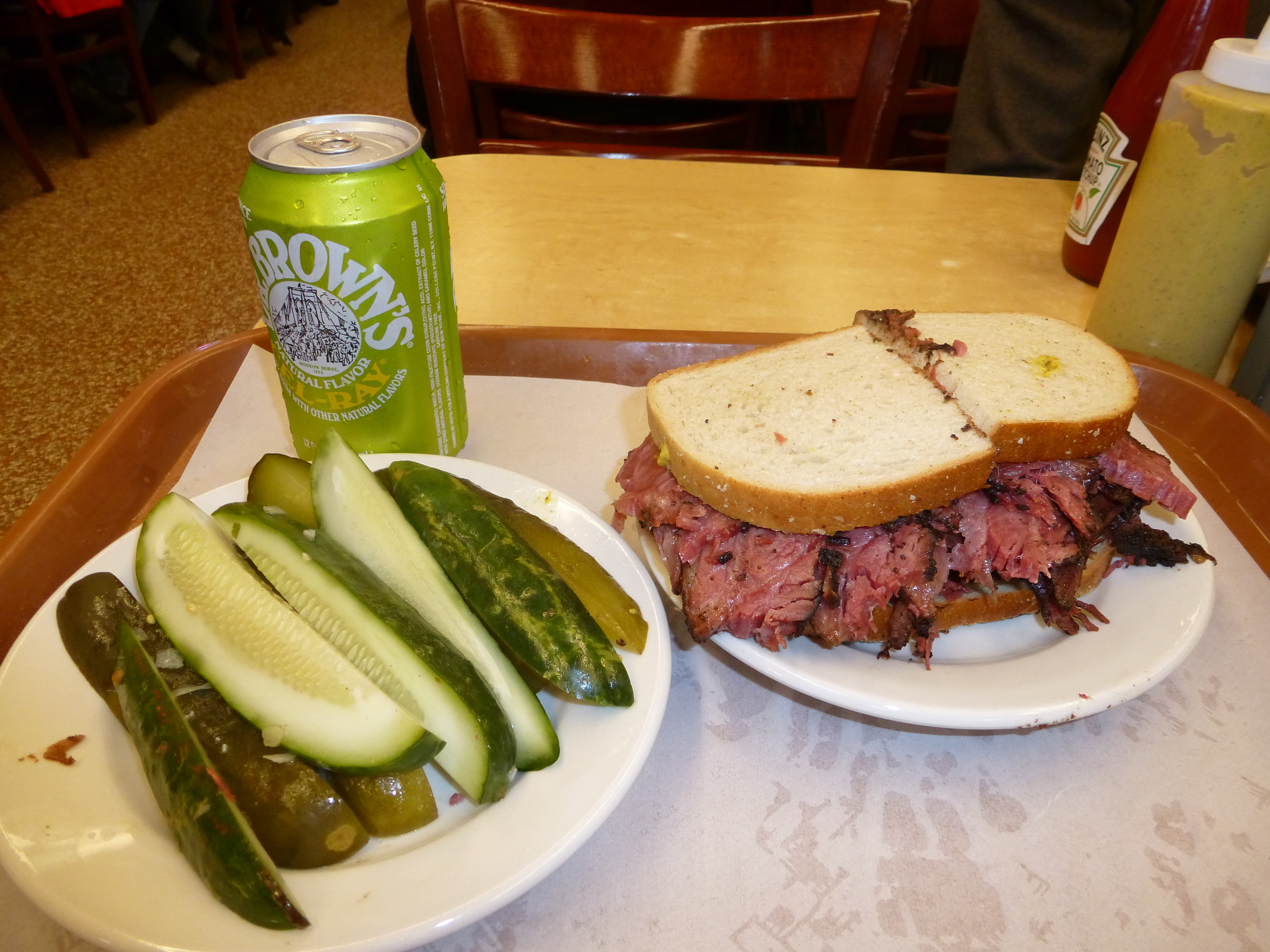
Here’s a pastrami sandwich from the famous and overtouristed Katz’s Deli in NYC. It’s expensive and crowded, but their pastrami is excellent, and you get plenty of pickles. (Katz’s is of course the site of the famous “fake orgasm” scene from the movie “When Harry Met Sally”. The woman who says to the waiter afterwards, “I’ll have what she’s having,” is Estelle Reiner, the mother of director Rob Reiner.
Notice the half sours dominating the pickles, as well as the Dr. Brown’s Cel-Ray (celery-flavored soda), the must-have accompaniment to corned beef or pastrami.
If you haven’t read my essay in the Chronicle of Higher Education, “Jason Arday and the corruption of science”, it’s no longer paywalled and you can read it on the Chronicle’s Substack here for free.
The Iranian-backed Houthi militia seized an island in a choke point of the Red Sea after days of fierce fighting, two Yemeni government officials said Friday, giving Iran and its allies sway over the two main routes for shipping oil out of the Middle East.
The capture of Perim Island came as Saudi Arabia announced that it had shut down a critical oil pipeline, a day after Houthi forces swept into the strategic port city of Mokha in Yemen. Both were major setbacks for the Saudi kingdom, which exports most of its oil through the Red Sea. The kingdom’s foreign ministry said the pipeline was hit on Thursday by drones launched from Iraq.
Perim Island sits in the middle of the Bab al-Mandab Strait, the narrow pathway at the southern entrance to the Red Sea. Its seizure adds a new dimension in the war between the United States and Iran. The Islamic republic has already largely cut off the flow of oil through the Strait of Hormuz in the Persian Gulf and leveraged that influence to demand concessions from Washington.
Now, the Houthi militia, Iran’s ally, has a foothold at a bottleneck in the Red Sea and could further disrupt shipping there.
The island’s capture came after intense ground battles in Yemen as the Houthis have staged a lightning advance against forces allied with the internationally recognized Yemeni government, which is backed by Saudi Arabia. The kingdom has faced frequent Houthi attacks on its tankers and energy facilities, even as its leaders have tried to avoid a direct war with the group, analysts say.
Crown Prince Mohammed bin Salman of Saudi Arabia spoke to President Trump about the escalation in Yemen in calls this week, and urged the United States to take military action against the Houthis, according to officials with knowledge of the conversations. Mr. Trump told him he was not willing to do so, the officials said.
We don’t have the wherewithal to intitiate yet another war, but it would be nice if some of the allies helped, for, after all, they have to move their goods through the Red Sea and Suez Canal.
Here from Wikipedia is a map showing Perim Island in the Bab al-Mandab Strait, next to Cheikh Saïd peninsula of Yemen, with Djibouti and Eritrea to the west across the strait. A zoomed-out map is inset at the lower right. The distance from the island to Yemen is about 2-3 km, while that to the coast of Eritrea or Djibouti is about 26-30 km. Not much space.
Nearly 50,000 people have fled a sudden advance by Houthi forces in western Yemen, with entire villages emptied and families trapped near frontline fighting with depleting food supplies, according to aid workers.
Civilians in the Middle East’s poorest country have found themselves victims of a global struggle for control over one of the most important shipping routes in the world, which threatens to turn Yemen’s on-off conflict into a forever war.
In a lightning advance this week, the Iran-backed Houthi militants have seized a string of towns along the Red Sea coast from forces aligned with the US- and Saudi-backed Yemeni government. Hundreds of people are reported to have been killed. Many fear a return to the full-scale civil war that killed 150,000 and brought many others to the brink of famine.
The UN International Organization for Migration (IOM) said on Friday that 46,000 people had been displaced across the governates of Taiz and Hodeidah, where steep verdant mountain ridges give way to arid coastal plains. For many families, this was their second or even third time they had been forced out of their homes.
A significant number of people were observed to be leaving the city with their belongings. Fighting has cut key roads, while phone lines are down in some areas. “The scale of displacement is increasing rapidly,” said Joe Lowry, IOM’s Middle East and north Africa spokesperson in Cairo.
. . .By taking control of key areas this week, including islands off the coast, the anti-west Houthis hope to gain a direct presence near the Bab al-Mandab strait, a 20-mile stretch of water and vital trade and energy route that connects Asia with Europe.
The strait’s name is roughly translated as “the gate of tears” or “the gate of grief”, and its strong currents and winds made the passage between the Arabian peninsula and Africa’s east coast hazardous for centuries. Modern-day cargo ships have no physical issue passing through.
But if the Houthis were to close the natural chokepoint, the impact on the global economy could be disastrous. Ships would have to reroute around the southern tip of Africa, adding thousands of extra nautical miles. The fighting has already contributed to the price of oil rising above $100 a barrel after weeks when it was trading closer to $80.
More bad news, but we can’t let terrorists control the flow of shipping in the Middle East.
Before Iran carried out its attack that killed three U.S. troops in July, Tehran acquired high-resolution satellite images of the base in Jordan from Chinese entities, according to U.S. officials familiar with details of the incident.
It is the clearest evidence so far that Chinese support for Iran during the war has had lethal consequences for U.S. forces, according to the officials, who say the U.S. has connected the imagery to the attack.
The U.S. officials declined to identify the Chinese entities that supplied the imagery to Iran and didn’t allege direct involvement by Beijing. Tehran procured the images both before and after the attack.
But the finding could deepen U.S.-China tensions ahead of the planned summit between President Trump and Chinese leader Xi Jinping on Sept. 24, after months of frustration with Beijing’s rejection of U.S. warnings about Chinese companies providing imagery to Iran.
Senior U.S. officials raised the imagery linked to the July 17 attack with their Chinese counterparts, who pushed back and demanded proof, the U.S. officials said. China has repeatedly dismissed Washington’s concerns, refusing to acknowledge that any Chinese companies are engaged in such activity, the officials said.
The strikes on the base came after senior Trump officials spent months warning their Chinese counterparts that Chinese companies were providing satellite imagery Iran could use to target U.S. personnel and assets in the region, officials say. The Trump administration sanctioned several Chinese companies in May, saying that supplying satellite imagery to Iran “threatens American and partner personnel.”
Within three days of the July attack, Iran released high-resolution images showing damage to three separate areas of the base. Publicly available lower-resolution satellite imagery analyzed by The Wall Street Journal showed damage to more than 20 structures across the three areas of the base.
Here are the images, with translation from the Farsi below:
New images of Iran’s damages to #America‘s assets in the region
Well if this doesn’t involve the government of China, I’d be very surprised. Do NGOs in China have spy satellites, and sold the photos to the Iranians? Even if they did they’d need permission of the Chinese government.
*Douglas Murray, now a correspondent for the Free Press, analyzes the victory of the “far right” Alternative for Germany (“AfD”) party in one small state. His article is called “Who’s afraid of the ‘far right?“, with the subtitle, “German leaders enabled the rise of a populist party through their failures. Now those leaders cling to power by branding their challengers as extreme.” As I suspected, the MSM has played down the role of immigration in Europe’s move to the right.
For people concerned with the future of Europe, the AfD is a vital as well as a special case. As such, it requires special attention. Unfortunately, most of the people writing about the party from outside Germany are intent on performing this feat of political analysis with all the care of a brain surgeon attempting to operate while wearing boxing gloves.
To start with, it is not the case that the AfD is a far-right party. Which is not to say that it does not have people within it who could be described as far right, or that it could not become such a party in the future.
There is a simple explanation for why the AfD has risen to become the leading opposition party in Germany: mass immigration, legal and illegal. But it took years for that issue to dominate. When the AfD was founded in 2013, it was mainly focused on addressing the fallout from the Eurozone crisis. The new party rejected the European Union’s extraordinarily optimistic belief that a single European currency could combine Greek balance sheets with German bookkeeping.
But in 2015, Chancellor Angela Merkel decided to open the gates of Europe and Germany to anyone from North Africa or the Middle East who wanted to walk in and call it home, particularly those fleeing the Syrian civil war. Normal border protocols were abandoned. More than a million migrants arrived in a matter of months. Germany, and in particular its welfare state, was overwhelmed by the surge and attempted, too late, to stem it. The vast majority of the arrivals from those years remain a net drain on the German state. In addition to this economic reality, a small but significant number of arrivals have brought extremism, terrorism, and petty as well as large-scale criminality. It might also be noted that the movement has brought a mass importation of antisemitism into a country that did not exactly need a boost in this area.
Given the extraordinary consensus that existed over the past decade among the mainstream parties of the right, center, and left, it was inevitable that some political movement would arise in Germany to point out and oppose the folly of Merkel’s policy. The AfD was well-placed to do so, and, in time, the economists who had dominated the party in its early years were replaced by people who believed that immigration was the number one challenge facing Germany.
Their success in the years since 2015 has been remarkable
. . .But in 2015, Chancellor Angela Merkel decided to open the gates of Europe and Germany to anyone from North Africa or the Middle East who wanted to walk in and call it home, particularly those fleeing the Syrian civil war. Normal border protocols were abandoned. More than a million migrants arrived in a matter of months. Germany, and in particular its welfare state, was overwhelmed by the surge and attempted, too late, to stem it. The vast majority of the arrivals from those years remain a net drain on the German state. In addition to this economic reality, a small but significant number of arrivals have brought extremism, terrorism, and petty as well as large-scale criminality. It might also be noted that the movement has brought a mass importation of antisemitism into a country that did not exactly need a boost in this area.
Given the extraordinary consensus that existed over the past decade among the mainstream parties of the right, center, and left, it was inevitable that some political movement would arise in Germany to point out and oppose the folly of Merkel’s policy. The AfD was well-placed to do so, and, in time, the economists who had dominated the party in its early years were replaced by people who believed that immigration was the number one challenge facing Germany.
Their success in the years since 2015 has been remarkable.
. . . It is for these reasons, among others, that the foreign coverage of Germany’s political shifts is so unsatisfactory. In the aftermath of this weekend’s election, the easiest thing in the world is to say—as almost every headline writer has—that “the far-right AfD” won the regional election. The fact that these same publications, from the BBC to The New York Times, rarely, if ever, use the same scary monikers to describe far-left parties gaining support across the continent is a matter for another day. But the hope appears to be that the public will be sufficiently uninterested in the details and that the prospect of the Nazis returning will be enough to spook readers into reflexive opposition.
. . . If all opposition to the migration crisis can be said to be the work of German neo-Nazis, then Europe is lost. Because no party of opposition will be untainted. If Germany can be saved, then Europe can be saved. But in order for that to happen, people—including the international press—need to listen to what is actually happening in Germany, take notice, and recognize the situation as it is, not the strange Nazi-haunted fever dream that they curiously seem to wish it to be.
The problem of course is that the Western MSM, at least of the liberal stripe, is afraid of saying the I-word, much less recognizing the effect on people of mass immigration, often of people who simply don’t integrate into European society. Ergo the movement of nearly every country in Europe to the right. If people don’t wake up and at least recognize the problems, including the drain on local economies and the erosion of Western institutions and values, Europe as we know it will be gone when the next generation of children grows up.
*When I was a kid, I was allowed to walk to and from elementary school starting when I was about 9 years old, and that was a longish walk along major roads. I was also allowed, when I got home, to get on my bike and go visit friends. Those days are gone: such unsupervised activity by children is regarding as endangering them, even though the rate of such endangerment has dropped as the rules get toughter. In early June a mother in Williamsburg, Virginia let her five-year-old walk alone a half mile to a pond in their gated and security-patrolled community in Virginia; his goal was to collect goose feathers. She was summarily arrested, charged with contributing to the delinquency of a minor (!), and given a six-month suspended jail sentence. This is the subject of a WaPo op-ed called, “A 5-year-old’s nighborhood walk shouldn’t be a crime” (article archived here).
While everyone wants kids to grow up healthy and happy, people have different ideas about how to achieve that. Until the past generation or so, a sunny upbringing usually included a fair amount of free, unsupervised time. One book I cherish from 1981, “Your Six-Year-Old: Loving and Defiant,” provides a checklist of the things a neurotypical child was expected to be able to do upon entering first grade. “Can he count eight to ten pennies correctly?” and “Can he tell left hand from right?” Perhaps the most salient query: “Can he travel alone in the neighborhood (four to eight blocks) to store, school, playground, or to a friend’s home?”
Compare that with a survey released this year by the Institute for Family Studies, which asked nearly 24,000 parents at what age they’d let their kids do things on their own. Eleven percent of 14-year-olds aren’t able to leave the house unsupervised. Fifty-five percent can’t go beyond their block. In other words, today’s high school freshmen have a fraction of the freedom that used to be given to first-graders. It’s little wonder they’re so anxious.
This new, limited idea of what kids are capable of explains why a 5-year-old walking around his neighborhood at lunchtime can look like a baby crawling along I-95 at midnight. Thanks to Karyann’s transgression — trusting her son — she was placed on Virginia’s child abuse and neglect registry for seven years. In court, she was found guilty of “contributing to the delinquency of a minor” — a Class 1 misdemeanor — and given a six-month suspended jail sentence.
. . . over the years, parents started to contact me when they got penalized for giving their kids the same freedom they’d grown up with. That included Brittany Patterson of Fannin County, Georgia, who was arrested when her son, 10, walked to town without telling her. Mallerie Shirley received similar treatment when she was investigated after her son, 6, rode his scooter unsupervised in Atlanta. Danielle and Alexander Meitiv were likewise investigated for letting their kids, 6 and 10, walk home from a park in Silver Spring, Maryland.
Those stories and others have thankfully given the public pause. They’ve helped move 13 states to pass “reasonable childhood independence” laws, which clarify that “neglect” happens only when kids are put in serious, obvious danger, not any time their parents take their eyes off them. Rep. Blake Moore (R-Utah) and Rep. Jennifer McClellan (D-Virginia) are seeking to enshrine that protection nationwide with their Promoting Childhood Independence and Resilience Act.
When Karyann let her son collect feathers, she wasn’t ignoring danger. She was ignoring cultural norms that are keeping kids indoors, and parents in fear. For the sake of our families and our collective mental health: Let kids roam.
Let the kids roam!!!!
Meanwhile in Dobrzyn, Szaron isn’t going on the beat:
Hili: You were supposed to go on your rounds.
Szaron: I changed my mind, I’ll sit here with you for a while.
In Polish:
Hili: Miałeś iść na obchód.
Szaron: Rozmyśliłem się, posiedzą sobie tutaj razem z tobą.
And Bat sent this amazing image from the International Space Station showing the 9/11 attacks on New York City; it appeared on Space.com.
A quote:
Frank Culbertson had a birds-eye view of one of the most memorable and tragic events in American history.
The NASA astronaut was the only American off of Earth on Sept. 11, 2001. He was circling the planet aboard the International Space Station (ISS) when terrorists flew commercial jets into the twin towers of the World Trade Center in New York City, killing more than 2,700 people.
The ISS passed over New York shortly after the attacks took place, so Culbertson saw the devastation from an eerie remove. He shared his thoughts with Mission Control at NASA’s Johnson Space Center in real time, chronicling the tragedy like no one else could.
The aftermath of the 9/11 attacks on the World Trace Center in New York City, as seen by the astronauts onboard the International Space Station on Sept. 11, 2001. (Image credit: NASA)
“We could see New York City and the smoke from the fires,” Culbertson said. “Our prayers and thoughts go out to all the people there and everywhere else here — I’m looking up and down the East Coast to see if I can see anything else — and to the people in Washington.”
There’s more information at the site.
From Masih, who’s rightly pleased at the progress she’s inspired.
Translation from the Farsi:
There’s no greater pleasure than seeing your efforts bear fruit—watch closely, brave woman: you were alone and singular here, but now women like you have multiplied, because courage is contagious! From 2014 until today, I was cursed at and attacked for launching campaigns against compulsory veiling and calling on women to send videos of themselves unveiled. Thousands of women in Iran were attacked for removing their veils and engaging in civil disobedience. We faced mass assaults from all sides for “White Wednesdays,” for “Our Camera Is Our Weapon”—assaults from those who were the minority! They arrested us, beat us, threw us in prison, threatened us, sent assassins abroad to murder us, and said this resistance was pointless. But today, every woman who walks unveiled in the streets is a continuation of that same disobedience. This isn’t just about removing a piece of fabric; it’s about reclaiming control over a woman’s body, life, and dignity, and tearing down the wall of fear. Compulsory veiling may still be law on paper, but in the streets of Iran, women have been issuing its death sentence for years. We are the echo of each other’s voices, and we persist until the day of liberation. These videos are from the #دوربین_ما_اسلحه_ما [“our camera is our weapon”] campaign and are being reposted to humiliate the zealots who these days are rampant on Twitter and Instagram, railing against women’s free dress in Iran’s streets—so they can understand the rugged, winding path Iranian women have traveled, and that we never give an inch!
هیچ لذتی بالاتر از نتیجه دادن تلاشهایت نیست، خوب تماشا کن زن شجاع، اینجا یکه و تنها بودی ولی حالا زنانی مثل تو تکثیر شدند، چون شجاعت مسریه!
از سال ۲۰۱۴ تا امروز، من به خاطر راه اندازی کمپینهای ضد حجاب اجباری و دعوت از زنان برای ارسال ویدیوهای بیحجاب فحش خوردم ومورد حمله… pic.twitter.com/6T0GgLwkN6
From Luana; two tweets showing double-takes of people who learn that the holdout juror in the Lindsay Clancy case was black (and male):
🚨 Stunning revelation: Lindsay Clancy juror Paula Devlin says the lone holdout who blocked an 11-1 insanity acquittal was the jury’s only Black member. The other 11 jurors were white.
A must-watch from Bill Maher. He dismantles the Gaza “genocide” canard in 9 minutes, holding it reponsible for the antisemitism sweeping the West—as well as the erosion through cowardice of the credibility of the Democratic party. https://t.co/W3j5Zc7IvQ
This is an educational and fun 53-minute episode on cats from NOVA, described by the series this way:
Worshipped as a goddess, condemned as satanic, and spun into a stunning array of breeds, cats have long fascinated humans. But did we ever really domesticate them? And what can science tell us about our most mysterious companions? (Premiered February 19, 2020)
Here are the various sections of the video; the links will take you to a given section. But it’s easier to watch the whole thing! It’s all about domestic cats, neglecting the other 40 living species of felid.
Chapters 00:00
Introduction 03:16
Why Are People Obsessed with Cats? 09:28 Why Aren’t Cats Expressive? 12:46
Can Cats Understand Our Emotions? 14:28
Domestic Cat Relative 18:13
Earliest Encounter Between Human and Cat 21:51
Cat Abilities 25:30
How Do Cats Differ from Their Wild Ancestors 28:30
Importance of Cats in Egypt 34:54
How Domestic Cats Spread Around the World 42:10
The Difference of Feral Cats 46:18
Can Cats Be Trained Like Dogs? 49:04
Breeding of Hybrid Cats 51:12 Conclusion 53 minutes
*********************
For now I’m on a cat-grooming video kick, and here we have a very loud cat named Harley who doesn’t want to be groomed. One alert YouTube commenter noted that the cat meowed 101 times in this 5½-minute video. Sadly, he has to wear the Cone of Shame. However, the commentary is quite good.
Another commenter said this:
We just casually gloss over how this was without a doubt the single most well behaved cat she ever groomed. No swatting, no hissing, no running away, he stayed put IN THE BATH TUB. He can be as loud as he wants. That cat is any pet groomer’s dream.
**************************
The Algonquin Hotel in New York City was famous for its daily “Round Table,” in which luminaries, wits, critics, and writers would forgather for lunch. The talk was copious and sharp; here’s the Wikipedia description:
The Algonquin Round Table was a group of New York City writers, critics, actors, and wits. Gathering initially as part of a practical joke, members of “The Vicious Circle”, as they dubbed themselves, met for lunch each day at the Algonquin Hotel from 1919 until roughly 1929. At these luncheons they engaged in wisecracks, wordplay, and witticisms that through the newspaper columns of Round Table members, were disseminated across the country.
Daily association with each other, both at the luncheons and outside of them, inspired members of the Circle to collaborate creatively. The entire group worked together successfully only once, however, to create a revue called No Sirree! which helped launch a Hollywood career for Round Tabler Robert Benchley.
In its ten years of association, the Round Table and a number of its members acquired national reputations, both for their contributions to literature and for their sparkling wit. Although some of their contemporaries, and later in life even some of its members, disparaged the group, its reputation has endured long after its dissolution.
The members (there’s a long list on the site) included Dorothy Parker (the most famous wit), George Kaufman, Harold Ross, Alexander Woollcott, Robert Benchley, Heywood Broun, and, from time to time, Tallulah Bankhead, Noël Coward, Edna Ferber, and Harpo Marx (yes, he spoke),
That legendary circle is now gone, but the hotel has harbored an uninterrupted series of cats, as described in the article below (click to read).
The Algonquin Hotel has kept a cat in its lobby since the late 1920s. The practice was formerly thought to have originated in the 1930s, but a book by Frank Case indicates that he had cared for a cat named Billy until the feline’s death in the 1920s. According to administrative assistant Alice de Almeida (the hotel’s “chief cat officer”), the current practice started when the hotel took in a stray male cat that was originally named Rusty. When a guest was sick, Rusty frequently went to that guest’s room and stayed there until they had recovered. Rusty was renamed Hamlet at the suggestion of John Barrymore, who at the time was performing on Broadway in the play Hamlet.Since then, all the male cats have been named Hamlet, while all the female cats have been named Matilda. It is not clear why female cats are named Matilda, but all the Hamlets are named after the original cat. The hotel has had eight Hamlets and three Matildas in its history. The Algonquin acquired its current cat, Hamlet VIII, in 2017. {JAC: See below.]
The hotel’s lobby contains two feline tree houses. The cat’s collar interacts with an electric geo-fence, which prevents the cat from leaving the lobby, because the New York City Department of Health and Mental Hygiene does not permit animals in dining areas. The cat has received several gifts from visitors, including four oil paintings. Many people have visited the Algonquin specifically to see the hotel’s cat. One of the male cats was featured in the illustrated book Algonquin Cat; when that cat died in 1982, his obituary appeared in Variety magazine. Another cat, a female Ragdoll, was named 2006 cat of the year at the Westchester Cat Show.
Every August, the hotel holds a fundraiser with a feline fashion show featuring the hotel’s cat. The fashion shows started in the 1930s and have raised money for such initiatives as the Mayor’s Alliance for NYC’s Animals. In addition, the hotel hosts birthday parties for its cat; these events have also served as fundraisers, such as in 2010, when Matilda III’s fifteenth birthday raised money for North Shore Animal League America.[227]The Wall Street Journal wrote that the cat’s birthday party “is the kind of party where you would find […] $20 Purrtinis for sale, made of Grey Goose vodka, lychee juice, coconut, white creme de cacao and lemon juice and advertisements for Reiki treatments for cats. It is also a party where you would see a cat dressed as a fruit basket…”
Here’s the lineup over the past 40 years
You should stay there when you visit NYC (if you can afford it). If not, at least go visit and see Hamlet VIII
The Algonquin cats have an Instagram post here, and you can read more about the cats (and the Round Table) here (scroll down). Below is a FB post by Jen (“The Good News Girl”) about the latest Hamlet and his personal assistant (click on the arrow):
*************************
Lagniappe:
Here’s a store in Istanbul with a hat-wearing cat that attracts business (cats are a GREAT way to pull in customers; see below).
I was taken by the several cats frequenting this Istanbul rug shop near the Hagia Sophia. In fact, over the next three days, I stopped by every day to pet the cats and bargain, and came away with several beautiful rugs. The owner admitted that the cats pulled in customers, and I was one of them!
From FB: cute cats sleeping (click on the arrow):
And the story of a cat who was summoned by mistake to serve on a jury. Click on the icon to see more.