The Supreme Court, free speech, and therapy: a big screwup by the Supremes

April 1, 2026 • 10:15 am

Yesterday, by a rare vote of 8-1, the Supreme Court struck down Colorado’s ban on “conversion therapy” for minors (we’re talking about a ban on speech, not medical procedures).  Judge Ketanji Brown Jackson dissented, breaking from her two liberal colleagues.

The background: in 2019, Colorado passed a bill banning “conversion therapy for a minor” (HB19-1129), which you can see here.  it defined “conversion therapy” this way:

(5.5) (a) “CONVERSION THERAPY” MEANS ANY PRACTICE OR TREATMENT BY A LICENSED PHYSICIAN SPECIALIZING IN THE PRACTICE OF PSYCHIATRY THAT ATTEMPTS OR PURPORTS TO CHANGE AN INDIVIDUAL’S SEXUAL ORIENTATION OR GENDER IDENTITY, INCLUDING EFFORTS TO CHANGE BEHAVIORS OR GENDER EXPRESSIONS OR TO ELIMINATE OR REDUCE SEXUAL OR ROMANTIC ATTRACTION OR FEELINGS TOWARD INDIVIDUALS OF THE SAME SEX.

(b) “CONVERSION THERAPY” DOES NOT INCLUDE PRACTICES OR TREATMENTS THAT PROVIDE:

(I) ACCEPTANCE, SUPPORT, AND UNDERSTANDING FOR THE FACILITATION OF AN INDIVIDUAL’S COPING, SOCIAL SUPPORT, AND IDENTITY EXPLORATION AND DEVELOPMENT, INCLUDING SEXUAL ORIENTATION-NEUTRAL INTERVENTIONS TO PREVENT OR ADDRESS UNLAWFUL CONDUCT OR UNSAFE SEXUAL PRACTICES, AS LONG AS THE COUNSELING DOES NOT SEEK TO CHANGE SEXUAL ORIENTATION OR GENDER IDENTITY; OR

(II) ASSISTANCE TO A PERSON UNDERGOING GENDER TRANSITION.

This is aimed only at minors—people under 18.  Conversion therapy was not characterized as a criminal offense, but as a violation of professional discipline—a form of “unprofessional conduct” that could be punished by licensing boards, including suspension of licenses and fines.

Note that although we hear a lot about the law banning “affirmative therapy,” most of us see that as a kind of therapy that urges children who are gender dysphoric to alter their gender or their sex. But the law as written also bans “gay conversion therapy”: attempts, once in vogue when homosexuality was seen as a mental illness, to prevent people from being gay—to keep them “straight.” There are laws in 27 states and the District of Colombia, as shown in the map below from the Measurement Advancement Project, prohibiting this kind of therapy.

As the SCOTUS blog reports (as does the Supreme Court’s decision, linked below), the ban was challenged by a therapist who wanted to help her clients transition the way they wanted:

The Supreme Court on Tuesday sent a challenge to Colorado’s ban on “conversion therapy” – treatment intended to change a client’s sexual orientation or gender identity – for young people back to the lower courts for them to apply a new standard. By a vote of 8-1, the justices agreed with Kaley Chiles, the licensed counselor challenging the law, that the ban discriminates against her based on the views that she expresses in her talk therapy. A federal appeals court, Justice Neil Gorsuch wrote for the majority, should have applied a more stringent standard of review, known as strict scrutiny, to determine whether the law violates the First Amendment as applied to Chiles.

But the Supreme Court also strongly hinted that the ban would fail that test. In his 23-page opinion, Gorsuch stressed that in cases like Chiles’, Colorado’s ban “censors speech based on viewpoint.” Because the First Amendment “reflects … a judgment that every American possesses an inalienable right to think and speak freely, and a faith in the free marketplace of ideas as the best means for discovering truth,” Gorsuch continued, “any law that suppresses speech based on viewpoint represents an ‘egregious’ assault on both of those commitments.”

Justice Ketanji Brown Jackson was the lone dissenter. She argued that the majority’s opinion “could be ushering in an era of unprofessional and unsafe medical care administered by effectively unsupervised healthcare providers.”

Chiles went to federal court in Colorado to challenge the constitutionality of the 2019 law and block Colorado from enforcing it against her. She contended that she did not attempt to “convert” her clients. Instead, she said, she merely tried to help them “with their stated desires and objectives in counseling, which sometimes includes clients seeking to reduce or eliminate unwanted sexual attractions, change sexual behaviors, or grow in the experience of harmony with one’s physical body.”

A divided panel of the U.S. Court of Appeals for the 10th Circuit allowed the state to continue to enforce the law. The majority concluded that the conversion therapy ban simply regulated conduct – a licensed mental health professional’s treatment of a client – that also happened to involve speech. Therefore, the court of appeals concluded, it would review the ban using the least stringent test for constitutional challenges, known as the “rational basis” test – a relatively low bar, the court of appeals said, that the ban passed.

Chiles came to the Supreme Court in 2024, asking the justices to weigh in. On Tuesday, they reversed the 10th Circuit’s ruling and sent the case back to the lower courts for another look.

Curiously, Chiles apparently wasn’t trying to force her clients to adopt one course of action over another, but to achieve the course of action they wanted:

[Chiles] contended that she did not attempt to “convert” her clients. Instead, she said, she merely tried to help them “with their stated desires and objectives in counseling, which sometimes includes clients seeking to reduce or eliminate unwanted sexual attractions, change sexual behaviors, or grow in the experience of harmony with one’s physical body.”

The issue here is that it’s still “affirmative” in that Chiles went along with what their (minor) patients wanted rather than examining what they wanted.

The grounds for the decision were narrow: banning conversion therapy violated the First Amendment’s provision for freedom of speech (my bold below):

Gorsuch characterized the question before the justices as “a narrow one”: whether Colorado’s ban on conversion therapy violates the First Amendment as applied to the talk therapy that Chiles provides, and in particular whether the 10th Circuit was correct in applying “rational basis review” to the ban.

The Supreme Court, Gorsuch observed, “has long held that laws regulating speech based on its subject matter or ‘communicative content’ are ‘presumptively unconstitutional’” and therefore trigger strict scrutiny, which requires the government to show that a restriction on speech is narrowly tailored to serve a compelling government interest. “Under that test,” Gorsuch added, “it is ‘“rare that a regulation . . . will ever be permissible.”’”

The court has also acknowledged, Gorsuch continued, “the even greater dangers associated with regulations that discriminate based on the speaker’s point of view. When the government seeks not just to restrict speech based on its subject matter, but also seeks to dictate what particular ‘opinion or perspective’ individuals may express on that subject, ‘the violation of the First Amendment is all the more blatant,’” Gorsuch stressed. “’Viewpoint discrimination,’” Gorsuch said, “represents ‘an egregious form’ of content regulation, and governments in this country must nearly always ‘abstain’ from it.”

“Applying these principles,” Gorsuch continued, “we conclude that the courts below failed to apply sufficiently rigorous First Amendment scrutiny in this case.” First and foremost, Gorsuch wrote, although “the First Amendment protects many and varied forms of expression, the spoken word is perhaps the quintessential form of protected speech. And that is exactly the kind of expression in which Ms. Chiles seeks to engage.”

. . . The majority rejected the state’s contention that the conversion therapy ban targets conduct or medical treatments, rather than speech, and therefore should be subject to a more deferential standard of review. Although the ban “may address conduct—such as aversive physical interventions” – Gorsuch wrote, Chiles “seeks to engage only in speech, and as applied to her the law regulates what she may say,” as well as “what views she may and may not express.” “Colorado,” Gorsuch concluded, “does not regulate speech incident to conduct; it regulates ‘speech as speech.’”

Note as well that Colorado’s ban wasn’t fully negated, nor were similar bans throughout the U.S.. Rather, the case was sent back to the lower courts for reevaluation on these grounds (from Grok, with sources); the applicable appellate courts must:

  • Apply strict scrutiny (the most demanding level of First Amendment review) to the law as it applies to Chiles’s talk therapy. Under this standard, Colorado bears the burden of proving that the restriction on Chiles’s speech is narrowly tailored to serve compelling state interests.
  • Reconsider the case in light of the Court’s determination that the law engages in viewpoint discrimination (banning one set of views on sexual orientation/gender identity while expressly permitting the opposing “affirmative” views, such as acceptance, support, identity exploration, or assistance with gender transition).

The Court’s opinion, concurrences, and Justice Jackson’s dissent can be found by clicking on the screenshot below:

I’ll be brief here (I hope): the Court screwed up big time here, failing to recognize, as Justice Jackson said in her 35-page dissent (which she read from the bench in toto), that in the case of therapy, medical or psychological, talk is more than just speech, it’s treatment. From her dissent:

No one directly disputes that Colorado has the power to regulate the medical treatments that state-licensed professionals provide to patients. Nor is it asserted that, when doing so, a State always runs afoul of the Constitution. So, in my view, it cannot also be the case that Colorado’s decision to restrict a dangerous therapy modality that, incidentally, involves provider speech is presumptively unconstitutional. In concluding otherwise, the Court’s opinion misreads our precedents, is unprincipled and unworkable, and will eventually prove untenable for those who rely upon the long-recognized responsibility of States to regulate the medical profession for the protection of public health.

Remember that medical therapy uses speech as well. Any doctor who simply told a patient to go home and drink vinegar with herbs to treat their cancer would be guilty of professional misconduct. Note that here the doctor doesn’t do anything, but could still be punished for malpractice.  The doctor must adhere to reasonable and accepted forms of treatment, and that includes treatments suggested only through speech.

Brown notes that conversion therapy is “dangerous,” and nearly everyone would agree with that vis-à-vis gay conversion therapy. It’s long been recognized by therapists and their organizations that trying to force someone out of becoming gay, instead of simply talking over the issue, is acting unethically and, insofar as this causes stress and may change someone’s life in a negative way, i.e. causing harm.

We’re beginning to recognize that the same holds for “affirmative therapy” as well.  If it works, affirmative therapy puts young people on a one-way treadmill leading to to puberty blockers, then to adult hormones, and perhaps to surgery.  Britain’s Cass Review, as well as studies in Scandinavian countries, have already recognized that “affirmative therapy” that leads to blockers and hormones is of unproven efficacy and could be dangerous over the long term. Insofar as talk therapy promotes these actions, then, it too is dangerous—much like telling someone they should take vinegar for cancer. It seems only rational that when a minor has a psychological problem around gender or sexuality, the therapist should be giving objective treatment—helping the patient sort out their feelings—and not imposing some outside ideology on the therapy. For outside ideology is exactly what is polluting “conversion therapy”: you shouldn’t be gay on the one hand, and on the other your gender dysphoria should be roundly affirmed (e.g., you feel like a girl inhabiting a boy’s body, and thus should go that route) rather than examined.

Perhaps when this case is remanded to lower courts, they will clarify these issues, notably that talk therapy is equivalent to action.  But surely the Supreme Court could have said that, and, as far as I can see, they messed up big time. I’m especially disappointed that the other two liberal justices, Kagan and Sotomayor, deemed the Colorado law a case of “viewpoint discrimination.” It may have been that way for legislators, but the law as written doesn’t deal with motivations. It is trying to prevent harm to minors.

I disagree strongly with the Court’s decision, while at the same time remembering that the law it banned is aimed at minors, not adults.

In a 6-3 vote, Supreme Court tanks Trump tariffs

February 20, 2026 • 4:57 pm

Lordy be, now we have Trump attacking the conservative Supreme Court because it struck down the tariffs he imposed on nearly every country. I am delighted for two reasons. First, because I always said that if anybody is going to stop Trump, it wound have to be the courts, who have now demonstrated some rare unanimity against his nonsense.  It heartens me that the Court, right-wing as it is, can still be rational.  Second, I have also argued (along with all rational economists) that tariffs are never good, and in the end it is the consumers who suffer.

The 3 dissenters in the vote were Kavanaugh, Alito, and Thomas, with the last two predictable.

So now Trump is frothing at the mouth at the court he though he could count on. And it is the Court of Last Resort. Though he swears he will find a way to circumvent this ruling, I do not think he will. Click below to read, or find the article archived here.

At last, some happy political news. An excerpt, and note that the Chief Justice wrote the opinion, as he can reserve that right for himself:

A Supreme Court decision on Friday striking down President Trump’s sweeping global tariffs dealt a major blow to his economic agenda and brought new uncertainty to global markets struggling to adapt to his whipsawing trade policies.

The court, in a 6-3 decision written by Chief Justice John G. Roberts Jr., ruled that Mr. Trump had exceeded his authority when he imposed tariffs on nearly every U.S. trading partner last year. The ruling prompted a defiant response from the president: In a news conference at the White House, he vowed to restore tariffs using other authority and excoriated the justices who had ruled against him as “fools and lap dogs.”

The ruling threw into doubt a series of trade deals with countries around the world that the administration struck in recent months, and left unclear whether U.S. companies or consumers would be able to reclaim some of the more than $200 billion in fees the federal government has collected since the start of last year. Justice Brett M. Kavanaugh warned in a dissent that any refund process could be a substantial “mess.”

Mr. Trump was the first president to claim that the 1977 emergency statute, which does not mention the word “tariffs,” allowed him to unilaterally impose the duties without congressional approval. Writing for the majority, Chief Justice Roberts said that statute did not. The court’s ruling, backed by justices from across the ideological spectrum, was a rare and significant example of the Supreme Court pushing back on Mr. Trump’s agenda.

A small but vocal group of Republicans in Congress joined Democrats in celebrating the court’s ruling, reflecting frustration that their branch of government has ceded its authority over trade matters to the White House. Senator Mitch McConnell, the Kentucky Republican and former longtime party leader, said the ruling left “no room for doubt” that Mr. Trump’s circumventing of Congress was “illegal.”

Trump learned the bad news at a meeting in the White House, when an aide passed him a note as he was answering questions:

The ruling, Mr. Trump said, was a “disgrace.” Speaking to a crowd of governors, cabinet officials and White House aides, the president lashed out at the court but insisted that he had a contingency plan.

He took one more question from Gov. Josh Stein of North Carolina, a Democrat, about hurricane assistance, but then ended the meeting early. He wanted to work on his response to the ruling, he said.

For Mr. Trump, the Supreme Court decision was not just a political setback, but a personal one. He has promoted tariffs for decades, and has claimed that his sweeping levies resuscitated the economy and revived American manufacturing.

“Tariff is my favorite word in the whole dictionary,” he said Thursday at an event in Rome, Ga.

Data released on Thursday showed Mr. Trump’s tariffs were not having the effect he had promised they would. U.S. imports grew last year, and the trade deficit in goods hit a record high. U.S. manufacturers have also cut more than 80,000 jobs in the past year.

From the WSJ:

The administration does have other laws it can rely on to try to re-enact the tariffs, but those laws have procedural constraints and might not allow tariffs as expansive as those struck down by the court.

The emergency-economic law invoked by Trump “was designed to address national security concerns and so was designed for flexibility and speed,” said Everett Eissenstat, deputy director of the National Economic Council in Trump’s first term. “Other statutory authorities are not as flexible.”

The president could also seek explicit authorization from Congress to reimpose the sweeping tariffs, though that route appears politically unlikely.

Where is he gonna go now?


What about Minnesota? Another discussion.

January 14, 2026 • 10:52 am

I’m still afflicted with Weltschmerz, but also heartened that readers had a lot to say in yesterday’s discussion, so I’m glad that when I’m low, my presence isn’t needed on every post (I did read all the comments).

Today I want to kick-start another discussion if I can, this time about what’s going on in Minnesota. I’m referring not to the welfare-fraud scandal that brought down governor Tim Walz, but the big fight between ICE agents and local residents, spurred not just by Trump sending more lawmen into the state, but by the killing of Renée Good by an ICE agent.  This has led to big and ongoing protests in which Minnesotans gather in big crowds whenever ICE shows up, trying to prevent them from apprehending suspects.  These are not peaceful on either side: ICE agents fire pepper spray and tear gas, while some demonstrators physically assault lawmen and block the cars of ICE agents. (To see how well the citizens are organized, read Olivia Reingold’s piece “I joined ICE watch” at the Free Press.)

Since I am not and haven’t been there, I’m not sure whether the protestors are trying to incite violence as part of their protests, hoping, as did Martin Luther King, Jr. did in the Sixties, that brutality on the party of the law will promote one’s cause.  The difference is that King’s cause was to get rights for black people, while the cause of the protestors seems to be to keep Trump from using heavyhanded tactics to deport undocumented immigrants.  This difference is why, I think, we don’t see many black people speaking out about the demonstrations.

I have still not decided whether Good’s killing was illegal: a deliberate act of manslaughter or even murder.  Because someone was killed, though, and there is some question that bullets were fired gratuitously, I think there needs to be an investigation of the officer and, if things look illegal, a trial. We need to preserve our system of law and accountability. But I am not willing to pronounce the officer guilty, as so many are doing (my Facebook page is full of those pronouncements). That would take a trial. All I can say is that, since we haven’t yet had a trial or an investigation the incident looks like an unfortunate concatenation of a woman who should not have been doing what she did (blocking ICE access with her car, and refuse refusing orders to exit her car), and an ICE officer who may have been overly retributive because he had been through a similar experience (dragged by a car for many yards) in recent weeks.

So, please discuss this issue. What do you think should be done about the officer who killed Good? Does Good herself bear any responsibility for what happened? Are the protestors completely peaceful, or are they hoping to provoke violence? Are they trying to keep officers from enforcing the law? (My view is that all undocumented immigrants deserve a hearing before an immigration judge before they are deported, but also that that ICE is being heavy-handed in law enforcement. Further, in the end there should be a procedure to expel people who entered the country illegally, giving priority to those with a criminal record.) Sometimes it seems to me that the protestors all want open borders and no deportations, which is not in line with what most Americans want.

I have written too much already, and am still rethinking the events in Minnesota, but I thank Ceiling Cat that I don’t have to adjudicate them.

By the way, the Minnesota state legislature has just brought up Tim Walz on four articles of impeachment, all involving the corruption scandal in his state. He’s already said he won’t be running again.

Rare video of the Scopes “Monkey Trial”

August 6, 2025 • 11:30 am

This year marks the 100th anniversary of the Scopes “Monkey Trial” in Dayton, Tennessee. (It lasted from July 10-21). John Scopes, a substitute teacher, was accused (with his cooperation) of teaching human evolution in high school, thus violating the state’s Butler Act, which forbade the teaching of human evolution (note: teaching nonhuman evolution was okay). He was convicted, as he surely had violated the law, but his conviction was overturned because the judge rather than the jury levied the $100 fine (judges couldn’t levy fines above $50).  Scopes’s conviction was thus set aside, and the verdict could not then be appealed to a higher court.

The Butler act was repealed only in 1967: 42 years later!  But nobody was convicted during that period, and today no court in the land dares convict anybody or any school board for teaching evolution, while it’s illegal almost everywhere to teach creationism or its gussied-up cousin Intelligent Design.

But I digress; I just discovered that there’s some video footage of the trial. It lacks sound, of course, since “talkies” didn’t arise until 1927, but it’s great to see the principals and the scene. So watch this 2½ minute video to see Dayton during the trial:

U. S. Supreme Court affirms Tennessee’s ban on medical “gender-affirming care”

June 19, 2025 • 9:35 am

In 2023, Tennessee passed a bill to restrict access of minors to “affirmative care”, though only minors who wanted blockers or hormones to assume the identity of his/her non-natal sex or to relieve gender dysphoria. Tennessee is now one of 15 states that has passed laws restricting affirmative care.  Note, though, that hormones and blockers may, under that law, be used to treat other disorders (also called “differences”) of sex determination {DSDs).

Click title to read the bill. In it, “minor” refers to “an individual under 18 years of age”

From the bill:

The legislature determines that medical procedures that alter a minor’s hormonal balance, remove a minor’s sex organs, or otherwise change a minor’s physical appearance are harmful to a minor when these medical procedures are performed for the purpose of enabling a minor to identify with, or live as, a purported identity inconsistent with the minor’s sex or treating purported discomfort or distress from a discordance between the minor’s sex and asserted identity. These procedures can lead to the minor becoming irreversibly sterile, having increased risk of disease and illness, or suffering from adverse and sometimes fatal psychological consequences. Moreover, the legislature finds it likely that not all harmful effects associated with these types of medical procedures when performed on a minor are yet fully known, as many of these procedures, when performed on a minor for such purposes, are experimental in nature and not supported by high-quality, long-term medical studies.

The bill does not ban that aspect of “affirmative care” that involves psychological affirmation of a minor’s desires; what is banned is solely medical treatment given to minors. (I do think that good psychological treatment doesn’t have an aim at the outset, though, so “affirmative psychology” seems counterproductive).

But when you turn 18 in Tennessee, you can have all the hormones you want, though puberty blockers are by that point superfluous.

Yesterday,  the U.S. Supreme Court upheld the law by a vote of 6-3—the ideological vote that we liberals are used to.  There are long concurrences by Judges Alito (22 pages), Barrett (11 pages) and Thomas (23 pages), and dissents by Sotomayor (31 pages) and Kagan (2 pages). Click to see the decision:

And the end of the decision:

The Supreme Court decision reprised the Tennesse law:

In 2023, Tennessee joined the growing number of States restricting sex transition treatments for minors by enacting the Prohibition on Medical Procedures Performed on Minors Related to Sexual Identity, Senate Bill 1 (SB1). SB1 prohibits healthcare providers from prescribing, administering, or dispensing puberty blockers or hormones to any minor for the purpose of (1) enabling the minor to identify with, or live as, a purported identity inconsistent with the minor’s biological sex, or (2) treating purported discomfort or distress from a discordance between the minor’s biological sex and asserted identity. At the same time, SB1 permits a healthcare provider to administer puberty blockers or hormones to treat a minor’s congenital defect, precocious puberty, disease, or physical injury.

The National Law Review summarizes the decision and discusses its basis and what it did not address (click to read):

An excerpt:

In a 6-3 opinion authored by Chief Justice John Roberts, the Court in Skrmetti affirmed the U.S. Court of Appeals for the Sixth Circuit,[1] which held in September 2023 that (1) the Tennessee law does not discriminate on the basis of sex for purposes of equal protection, and (2) that it was subject only to rational basis review.

“SB1 does not classify on any bases that warrant heightened review,” the Supreme Court wrote. It concluded that the Tennessee law incorporates only two classifications: (1) age (allowing certain medical treatments for adults but not minors), and (2) medical use (allowing puberty blockers for minors for some conditions but not others). These two classifications warranted only rational basis review, the Court said.

And the Court dodged the question of whether transgender status should be considered a protected class equivalent to race or gender. “This case, in any event, does not raise that question because SB1 does not classify on transgender status.”

That’s a serious issue, for if transgender status is a protected class, the whole game changes. That doesn’t mean, though, that gender-dyphoric minors will immediately be allowed medical “affirmative care.” It goes on:

. . . The decision marks the first time the Supreme Court considered the application of the Equal Protection Clause to transgender youth, despite the decision skirting the question of whether transgender status should be considered a protected class.

The decision has broad implications, although many legal issues in this area remain unresolved.

Those unresolved issues are said to involve the right to privacy, parents’ rights, statutory discrimination analysis, impact of state constitutional arguments, and tension with state laws on gender identity.  The upshot, it seems to me, is that the Court decided that the Tennessee law, because it didn’t discriminate on the basis of sex (both male and females with gender dysphoria are equally subject to Tennessee’s ban), was constitutional on those grounds. But that still leaves the issue of whether “transgender status” or “having gender dysphoria” counts as being a member of a protected class. If that proves to be the case in further legal wrangling, then affirmative medical care may be permitted.

I am not sure how this affects the 25 other states that do not have laws against medical affirmative care; those states have not passed bills banning it (or, presumably, allowing it) that can be adjudicated at the nation’s highest court. (I may be wrong here, so readers who know are welcome to correct me.)

Some of the mainstream media are couching this as a “setback for transgender rights”, but some of us would argue that there is not a “right” for minor who wishes to have surgery and/or hormone treatments aimed at making them resemble members of their non-natal sex should be able to freely get such treatments.

Here are two articles explicitly endorsing such a “right”:

From the Associated Press:

There was an NPR article called “Battle over rights of trans children is up at the Supreme Court,” but it has now changed the title (!). It does still assert the “rights” in one paragraph:

Front and center at the Supreme Court on Wednesday is the battle over the rights of transgender children. At issue is a state law in Tennessee that blocks minors from accessing gender-affirming care in the state.

I don’t want to scour all the news for similar statements, though, because I don’t believe there’s any “right” of minors to affirmative medical care beyond psychological treatment; there’s certainly no right in the Constitution or—in my view—ethics to have parts of your body cut off or hormones injected into you, particularly when the vast majority of minors experiencing gender dysphoria will resolve as being gay children who don’t need this kind of medical care (especially unproven blockers, who are banned for minors in some European countries).

Emily Yoffe, whose writings I’ve always found pretty sensible, agrees with me, and published the article below in the Free Press (archived here):

Some excerpts from Yoffe’s piece (bolding is mine):

The Court’s ruling is narrow; it says that a state has the right to regulate the practice. States, mostly blue, that still allow youth gender transition aren’t affected. But the decision will likely lend weight to the arguments of people who want to end the practice nationwide. And it will likely help the legal efforts by “detransitioners”—that is, young people who say they were pressured into life-altering treatments they now regret—to get compensation. Surely more such lawsuits will now be filed. Gender transition clinics will likely be under far more scrutiny: This Free Press story describes the cases of two such young women who were given prescriptions for testosterone after about a 30-minute appointment at Planned Parenthood.

Children who express gender distress often suffer from a host of other medical and psychological issues, such as autism, ADHD, depression, or anxiety, or have experienced various traumas. But to the gender doctors in their lucrative new clinics, there was only one answer to such childhood troubles: gender transition. This usually meant medically blocking a child’s normal puberty, then putting that patient on opposite-sex hormones: testosterone for girls, estrogen for boys. Sometimes complicated and painful surgeries were undertaken to try to create new genitals. Thousands of teenage girls, and some not even teenagers, have received double mastectomies, known euphemistically as “top surgery”—a surgical intervention normally reserved to treat breast cancer.

In the U.S., gender-distressed children and their parents were told that without the swift intervention of these radical treatments, the children were likely to commit suicide. It became a cliché for the reluctant parents of girls seeking to transition to be asked by the gender provider, “Would you rather have a live son or a dead daughter?” (And vice versa for parents of boys.)

The clinicians assured parents there was robust evidence underlying their interventions, but this was false. During the oral argument in the case, Chase Strangio, the lawyer for the ACLU, arguing to overturn Tennessee’s ban, was forced to acknowledge to Justice Samuel Alito that “completed suicide, thankfully and admittedly, is rare.”

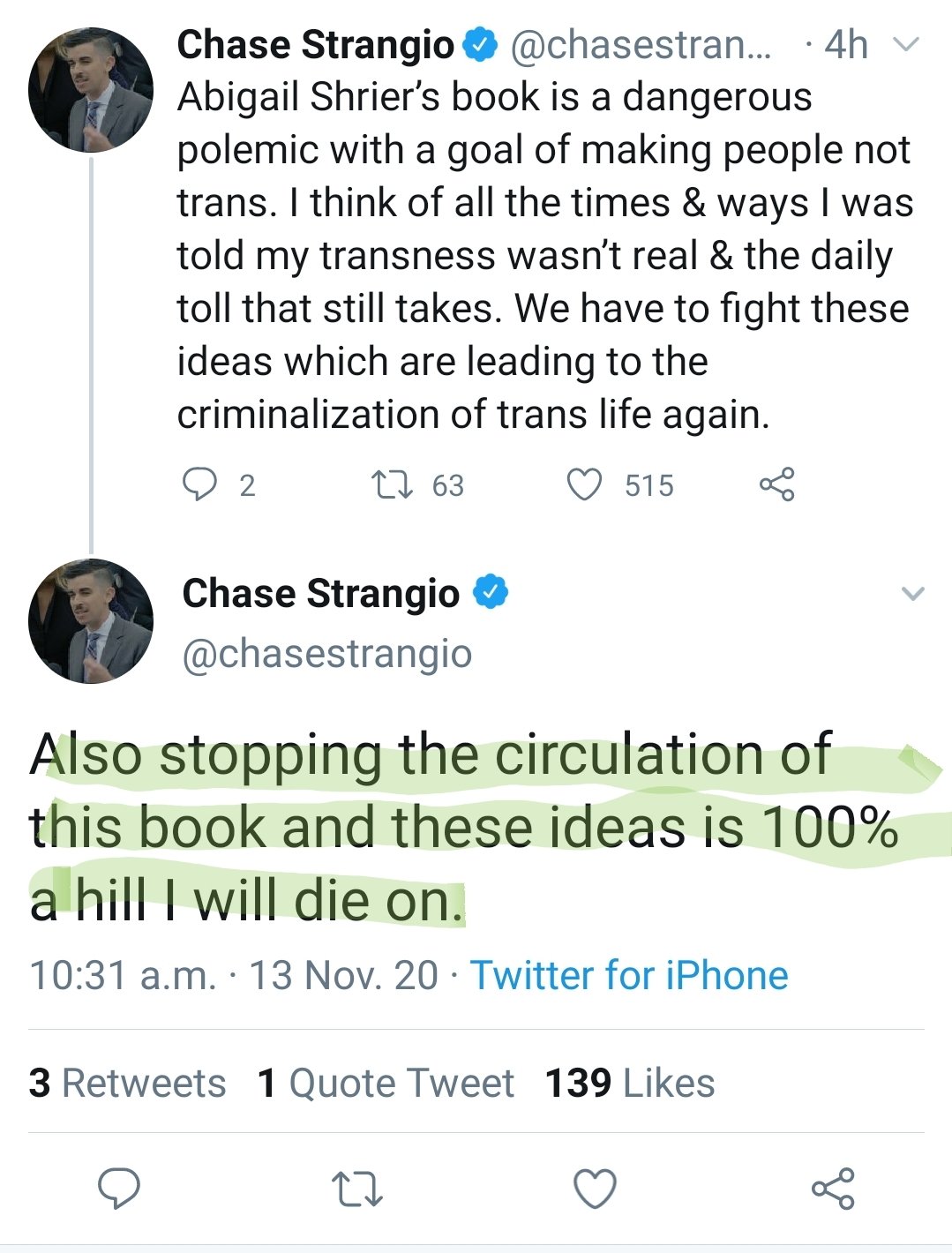
I would have guessed that Strangio would be in there argue for surgery and hormones; he was, after all, the ACLU lawyer who argued for banning Abigail Shrier’s book on rapid-onset gender dyphoria, often triggered by social pressure. (Strangio is also a trans-identified female.) In the end, Shrier was right. Shame on Strangio and the ACLU:

More from Yoffe:

. . . . The Court’s ruling notwithstanding, the U.S. medical establishment remains firmly behind the practice. Compare that to England, where a rigorous and independent report, the Cass Reviewconcluded that the evidence for pediatric transition is “remarkably weak.” FinlandNorway, and Sweden are among the other Western nations that have joined the UK in moving away from this treatment.

It is widely observed that the vast majority of young people with gender dysphoria—even those whose distress is “consistent, insistent, and persistent”—when allowed to go through normal puberty, come to accept their biological sex. (And there is no way to identify the very small number of children who will go on to experience lifelong gender distress.) Many of these children turn out to be gay, which is why a rising number of gay adults and gay-rights advocates have become alarmed that the transgender movement is medically transitioning gay kids. They argue that this movement has, intentionally or not, reified homophobic tropes.

I especially agree with the last paragraph below. In the future, I think medical gender-affirmative cafe will, along with our poor treatment of farm animals, be seen as practicers that were immoral in their time, but widely practiced:

Critics of the Supreme Court decision will argue that our major medical associations, from the American Academy of Pediatrics, to the American Medical Association, to the Endocrine Society, have all given support to this new branch of medicine. This is true. It is also true that these organizations or similar ones once supported lobotomies and eugenics. Just as that is a source of shame today, it is to be hoped that their vehement support of medically transitioning vulnerable young people will be a source of shame in the future. These medical societies have failed in their most basic duty of care to their patients by embracing a model that has so little evidence and such profound lifetime consequences.

When the history of this era is written, historians will have to explain how transgender activists so quickly took over institutions, and were able to so successfully threaten the social and work lives of those who objected. We are confident that historians will also remember those courageous individuals who, at the risk of professional and personal ruin, did so anyway.

But over at the Freedom From Religion Foundation, which now comprises a group of Chase Strangio clones, they’re proclaiming first that affirmative care is in general a salubrious way to address gender dysphoria, but also that affirmative care is “religious dogma.”  That characterization is palpably ridiculous, meant as a way for the FFRF to pretend that its “progressive” politics are fully in line with its mission to keep church and state separate. But many atheists like me object to affirmative care. It is the FFRF’s deliberate conflation of progressive politics with church-state separation that I objected to, and this ultimately wound up with my resigning (along with Richard Dawkins and Steve Pinker) from the FFRF’s honorary board.  Click below to read:

Note that the FFRF again speaks of transgender minors’ “rights”:

The Freedom From Religion Foundation lambastes today’s U.S. Supreme Court ruling upholding Tennessee’s cruel and unconstitutional ban on gender-affirming care for minors. This decision is a major blow to science-based medicine and the rights of parents and transgender youth.

, , , , Despite the hostile narrative surrounding transgender health care that the Supreme Court is furthering in its decision, the gender-affirming-care model is safe, effective and supported by every major medical organization, including the American Medical Association, the American Psychiatric Association, the American Psychological Association, the American Academy of Pediatrics and the American Academy of Child and Adolescent Psychiatry. These secular scientific organizations prioritize the safety and health of patients, not religious dogma.

The Freedom From Religion Foundation stands firmly with the transgender community, with parents, and with the medical professionals who follow science and ethics — not narrow sectarian belief — in providing care. FFRF will continue to educate about the harm these theocratic assaults are doing to civil liberties, bodily autonomy and the wall of separation between religion and government.

When the FFRF proclaims gender-affirming “model” as “safe, effective, and supported by every major medical association,” they of course neglect the fact that gender-affirming care is not seen that way in Europe, where it’s either banned or considered as experimental.  And of course most gender-dysphoric minors who go through normal puberty don’t really need this care, as most turn out to be gay. No hormones or excising of body parts required.  Affirmative treatment, as you may know, usually sterilizes its recipients, and, further, many of them will never have an orgasm after transitioning.

People like those in the FFRF are acting like this is the end of gender-affirmative care in America. I wish it were, and that treatment for dysphoria was limited to those over 18 (on same days I think 21). But in half of our states, hormones and surgery are still allowed, and there are no bans to be overturned.  I think that such states are making a mistake treating youths who haven’t attained maturity as having the ability to make their full medical decisions, like catering to a minor who doesn’t like their left leg and wants it cut off. The “right” to make such decisions should not be given to minors, or even their parents or doctors—not until youths come of age.

This viewpoint may be seen as transphobic, but I firmly reject that adjective. After all, it’s not seen as transphobic in the UK, Sweden, Finland, or Denmark, which have severe restrictions on affirmative care. And in the future, those who defend this rush to cut and inject hormones will, I think, be seen as misguided or even barbaric.

Natasha Hausdorff stands up to a hostile M. P. panel of British inquisitors

April 25, 2025 • 11:20 am

This is one of the most amazing performances of someone under fire I’ve ever seen, and even though the video was long for me (45 minutes), I watched the whole thing, mesmerized as well as stunned by how well the “victim” answered questions coolly and eloquently.

In one corner: Natasha Hausdorff, British barrister (lawyer) with an expertise in international law. She’s also Jewish and the legal director of UK Lawyers for Israel. Her credentials are impeccable:

A graduate of Oxford University and Tel Aviv University, Hausdorff practised with the law firm Skadden, Arps, Slate, Meagher & Flom, and clerked for the chief justice of the Israeli Supreme Court. She was a former fellow at Columbia Law School in the National Security Law Program. She is also the legal director of the NGO UKLFI Charitable Trust.

In all the other corners (it’s a hendecagon, with 11 corners) are the hostile opponents: the members of the UK House of Commons Foreign Affairs Committee, chaired by Dame Emily Thornberry.  This interview grilling was part of the Committee “conducting an inquiry into the Israeli-Palestinian conflict, asking ‘how the UK and its allies can help to achieve a ceasefire and lasting end to the war in Gaza and Lebanon’.”

Remember that the UK government, though nominally supporting Israel, refused to sell arms to the Jewish state. But here, its members are basically asking Hausdorff to defend every action of Israel. And she basically does.  The hostility of the committee towards Israel seems ubiquitous (Hausdorff was one of several experts, including Palestinians, but I was unable to find any YouTube videos of Palestinians testifying at this hearing.)  What is amazing about Hausdorff is that she not only doesn’t lose her cool despite the clearly anti-Israel inquisitors, but always has the facts at her fingertips. And when she doesn’t know something, she says so.

I highly recommend that you watch this video, if for no other reason that to see a stupendous performance. But you will also hear how someone who’s pro-Israel deals with canards and misconceptions about the war. Or listen to just fifteen minutes.

After watching this, Malgorzata (who called it to my attention) said, “Natasha Hausdorff is a force of nature and a world class treasure.” I agree; Hausdorff is one of my rare heroes.

UK Supreme Court rules that “woman” refers only to a biological woman

April 16, 2025 • 9:30 am

This is really breaking news, and apparently settles a roiling controversy in the UK that was most intense in Scotland. Today the UK’s Supreme Court, overturning rulings in Scotland, said that, in law, a “woman” is “a biological woman;” and a trans woman, even with a “gender reassignment certificate” does not legally qualify as a “woman”. Below are three real-time news summaries. Excerpts are indented below the headlines.

First, a Scottish law apparently kicked off the controversy. From Reuters:

Wednesday’s British judgment followed legal action by a campaign group, For Women Scotland (FWS), against guidance issued by the devolved Scottish government that accompanied a 2018 law designed to increase the proportion of women on public sector boards.

The guidance said a trans woman with a gender recognition certificate was legally a woman. FWS, which was backed by lesbian rights groups, had lost its case in the Scottish courts, but the Supreme Court ruled in its favour.

And from the official Supreme Court press summary (h/t Athayde):

This appeal arose in response to the definition of the term “woman” in the Gender Representation on Public Boards (Scotland) Act 2018 (“ASP 2018”) and associated statutory guidance. This legislation created gender representation targets to increase the proportion of women on public boards in Scotland. The ASP 2018 and the original statutory guidance defined “woman” as including people: (i) with the protected characteristic of gender reassignment; (ii) living as a woman; and (iii) proposing to undergo / undergoing / who have undergone a gender reassignment process. In 2020, the Appellant, a feminist voluntary organisation that campaigns to strengthen women’s rights in Scotland, challenged this guidance. The Inner House found that this statutory definition was unlawful as it involved an area of law reserved to the UK Parliament (equal opportunities) and therefore fell outside the legislative competence of the Scottish Parliament (“FWS1”).

In all the stuff I was able to read this morning, I was unable to find the definition of a “biological woman”, save that it refers to one’s natal sex, though they don’t mention gametes. The ruling does refer to the binary nature of sex (see below). And the ruling implies as well that the word “man” can mean in law only a “biological man” (see below).

The Guardian:

Bolding is theirs

  • The UK supreme court has ruled that the terms “woman” and “sex” in the Equality Act refer to a biological woman and biological sex, in a victory for gender critical campaigners.

  • Five judges from the UK supreme court ruled unanimously that the legal definition of a woman in the Equality Act 2010 did not include transgender women who hold gender recognition certificates (GRCs). In a significant defeat for the Scottish government, their decision will mean that transgender women can no longer sit on public boards in places set aside for women.

  • It could have far wider ramifications by leading to much greater restrictions on the rights of transgender women to use services and spaces reserved for women, and spark calls for the UK’s laws on gender recognition to be rewritten.

  • Lord Hodge told the court the Equality Act (EA) was very clear that its provisions dealt with biological sex at birth, and not with a person’s acquired gender, regardless of whether they held a gender recognition certificate. That affected policy-making on gender in sports and the armed services, hospitals, as well as women-only charities, and access to changing rooms and women-only spaces, he said.

  • Hodge urged people not to see the decision “as a triumph of one or more groups in our society at the expense of another”. He said all transgender people had clear legal protections under the 2010 act against discrimination and harassment.

  • Gender critical campaign group For Women Scotland, which is backed financially by JK Rowling, celebrated outside the supreme court in London, alongside other campaigners, after the ruling was announced.

BBC:

  • The UK Supreme Court rules that the legal definition of a woman is based on biological sex

  • Judges say the “concept of sex is binary” while cautioning that the landmark ruling should not be seen as victory of one side over another

  • Transgender people still have legal protection from discrimination, the court adds – read the full 88-page judgement here

  • The Scottish government had argued that transgender people with a gender recognition certificate (GRC) are entitled to sex-based protections, while For Women Scotland argued they only apply to people that are born female

  • For Women Scotland says it’s grateful for the decision after a “long road” of legal battles, while charity Scottish Trans urges people “not to panic”

  • The Scottish government says it acted “in good faith” and will work with Westminster to understand the full implications of the ruling

Times of London:

“The terms woman and sex in the Equality Act 2010 refer to a biological woman and biological sex.”

In fewer than 20 words, Lord Hodge settled a legal debate that has raged in British society for years. It also drove a stake through the heart of a central tenet of the trans lobby: that trans women are women.

The 88-page ruling will be pored over by lawyers. The implications for Westminster and beyond will be vast.

. . .Scotland’s first minister has said the Scottish government “accepts” the ruling of the UK Supreme Court on biological sex, and added that “protecting the rights of all” will inform its response.

In a post on X, John Swinney said: “The Scottish government accepts today’s Supreme Court judgment.

“The ruling gives clarity between two relevant pieces of legislation passed at Westminster. We will now engage on the implications of the ruling. Protecting the rights of all will underpin our actions.”

. . .The certificated sex interpretation would have “rendered meaningless” a section of the 2010 Equalities Act dealing with protection from discrimination on the grounds of sexual orientation, according to the ruling.

This interpretation would mean “a trans woman (a biological male) with a GRC (Gender Recognition Certificate) who remains sexually oriented to other females would become a same-sex attracted female, in other words, a lesbian” and would lead to an “inevitable loss of autonomy and dignity for lesbians” as well as impacting lesbian clubs and associations.

The judgment continues: “Read fairly, references to sex in this provision can only mean biological sex. People are not sexually oriented towards those in possession of a certificate.

. . .Kemi Badenoch has said the “era of Keir Starmer telling us women can have penises has come to an end”.

The Conservative leader said: “Saying ‘trans women are women’ was never true in fact, and now isn’t true in law either.

“This is a victory for all of the women who faced personal abuse or lost their jobs for stating the obvious. Women are women and men are men: you cannot change your biological sex.

“Well done to For Women Scotland!”

The full judgement is here (you can also click on the title page below to see the 88-page ruling), and although I haven’t read it carefully, I’ve quoted four bits that seem relevant.

First, the court emphasizes binary nature of sex, but unfortunately doesn’t give a definition of sex, though it claims that it does (my bolding).  The court holds to the “ordinary” meaning of “those plain and unambiguous words”, a meaning that corresponds to the biological characteristics that create a binary. One can interpret that, as I would, as the gametic definition of sex, which is the only definition that creates a dichotomy that, with a few hundredths of a percent of exceptions, conforms to a binary:

171. The definition of sex in the EA 2010 makes clear that the concept of sex is binary, a person is either a woman or a man. Persons who share that protected characteristic for the purposes of the group-based rights and protections are persons of the same sex and provisions that refer to protection for women necessarily exclude men. Although the word “biological” does not appear in this definition, the ordinary meaning of those plain and unambiguous words corresponds with the biological characteristics that make an individual a man or a woman. These are assumed to be self-explanatory and to require no further explanation. Men and women are on the face of the definition only differentiated as a grouping by the biology they share with their group

I Interpret this next part to mean that it’s legal to prohibit trans-identified men (“transwomen”) from competing against biological males.  They don’t talk about trans-identified women, but this presumably holds for them, too.  If so, that means a strict separation of athletic competition by sex, but perhaps sports in which the sexes perform equally on average could be an exception. The fate of trans-identified women in sports is not really discussed or spelled out, at least not that I can see, but if one holds to a biological definition of sex, the legal fate of trans-identified women would be the same as that of trans-identified men.

236. On the other hand, a biological definition of sex would mean that a women’s boxing competition organiser could refuse to admit all men, including trans women regardless of their GRC status. This would be covered by the sex discrimination exception in section 195(1). But if, in addition, the providers of the boxing competition were concerned that fair competition or safety necessitates the exclusion of trans men (biological females living in the male gender, irrespective of GRC status) who have taken testosterone to give them more masculine attributes, their exclusion would amount to gender reassignment discrimination, not sex discrimination, but would be permitted by section 195(2). It is here that the gender reassignment exception would be available to ensure that the exclusion is not unlawful, whether as direct or indirect gender reassignment discrimination.

The part below implies that the ruling also holds for the word “man”, which has to mean “biological man” rather than a biological woman who has a GRC or identifies as a man.

264. For all these reasons, this examination of the language of the EA 2010, its context and purpose, demonstrate that the words “sex”, “woman” and “man” in sections 11 and 212(1) mean (and were always intended to mean) biological sex, biological woman and biological man. These and the other provisions to which we have referred cannot properly be interpreted as also extending to include certificated sex without rendering them incoherent and unworkable.

Finally, this last part disposes of the Scottish government’s regarding one’s sex as being that given on a Gender Recognition Certificate (GRC).  That means that, in Scotland and all over the UK, a transwoman is not identical to a biological woman, nor a transman to a biological man.  The mantras “a transwoman is a woman” and a “transman is a man” now hold no legal meaning.

. . . 266. For all these reasons, we conclude that the Guidance issued by the Scottish Government is incorrect. A person with a GRC in the female gender does not come within the definition of “woman” for the purposes of sex discrimination in section 11 of the EA 2010. That in turn means that the definition of “woman” in section 2 of the 2018 Act, which Scottish Ministers accept must bear the same meaning as the term “woman” in section 11 and section 212 of the EA 2010, is limited to biological women and does not include trans women with a GRC. Because it is so limited, the 2018 Act does not stray beyond the exception permitted in section L2 of Schedule 5 to the Scotland Act into reserved matters. Therefore, construed in the way that we have held it is to be construed, the 2018 Act is within the competence of the Scottish Parliament and can operate to encourage the participation of women in senior positions in public life.

In toto, the ruling seems fair to me, as I never thought that, say, a “transwoman is a woman” and the same for transmen, as I’ve always adhered to the biological sex definition, which gives an almost 100% binary based on one’s evolved system for either producing large, immobile gametes (women) or small mobile gametes (men). This binary holds for all species, but the terms “woman” and “man” have been reserved for humans.  It does not “erase” trans people, giving them the same rights as everyone—with the exception of a person of one sex inhabiting spaces that properly belong to people of the other sex (sports, jails, locker rooms, etc.)  And as I’ve said endlessly, in all situations where you don’t need sex-specific spaces, trans people should have all the rights of everyone else, and should be treated like everyone else.

h/t: Pyers, Geoff