
Why is this feature like lox and a schmear? A: Because it’s on a roll. (Sort of.) I now have a total of four sets of photos in the queue, one of which I’ll post today. But please send your good photos, and a warm handshake to those who have done so. I hope people realize that readers who send in good add a unique feature for this website: high-quality and delightful pictures of nature. Do compliment the photographer if you like their photos.
Today we have pictures from Ephraim Heller, documenting his recent trip to Namibia. (More will be coming.) Ephraim’s captions are indented, and you can enlarge his photos by clicking on them.
Today I begin a series on a May-June 2026 visit to Namibia. I’m organizing the posts by habitat, in the order of our visits, so that you get a sense of the ecosystems.
The Namib Desert is the oldest desert on earth, with conditions that have persisted for 55 – 80 million years. At ~80,950 square km (31,250 sq mi), it is far and away the largest desert I have visited. It stretches ~2,000 km (1,200 mi) along southwest Africa’s Atlantic coast, including the entire length of Namibia. There is essentially no rain at all near the coast (2 mm/year average), but in places there is coastal fog that is the primary source of water for the desert plants. The stable climate over millions of years has resulted in high endemism. Of the ~3,500 documented species in the Namib, more than 1,000 are endemics.1-2. On the drive from the capital, Windhoek, visitors pass through Solitaire. It consists of a fuel station, a bakery and café, a general store, a small lodge, and a yard decorated with old vehicles. The nearest real town is hundreds of kilometers distant. When vehicles broke down, cars and trucks were simply left. Some of the collection includes American classics from the mid-twentieth century:
While having lunch at a picnic table in Solitaire, I observed several yellow mongooses (Cynictis penicillata) playing. Technically, Solitaire is semi-desert, so there are a few shrubs for the mongoose. They often share burrow systems with the local ground squirrels (Xerus inauris), which confused me as I tried to decide if I was seeing mongooses or ground squirrels. This is a mongoose:


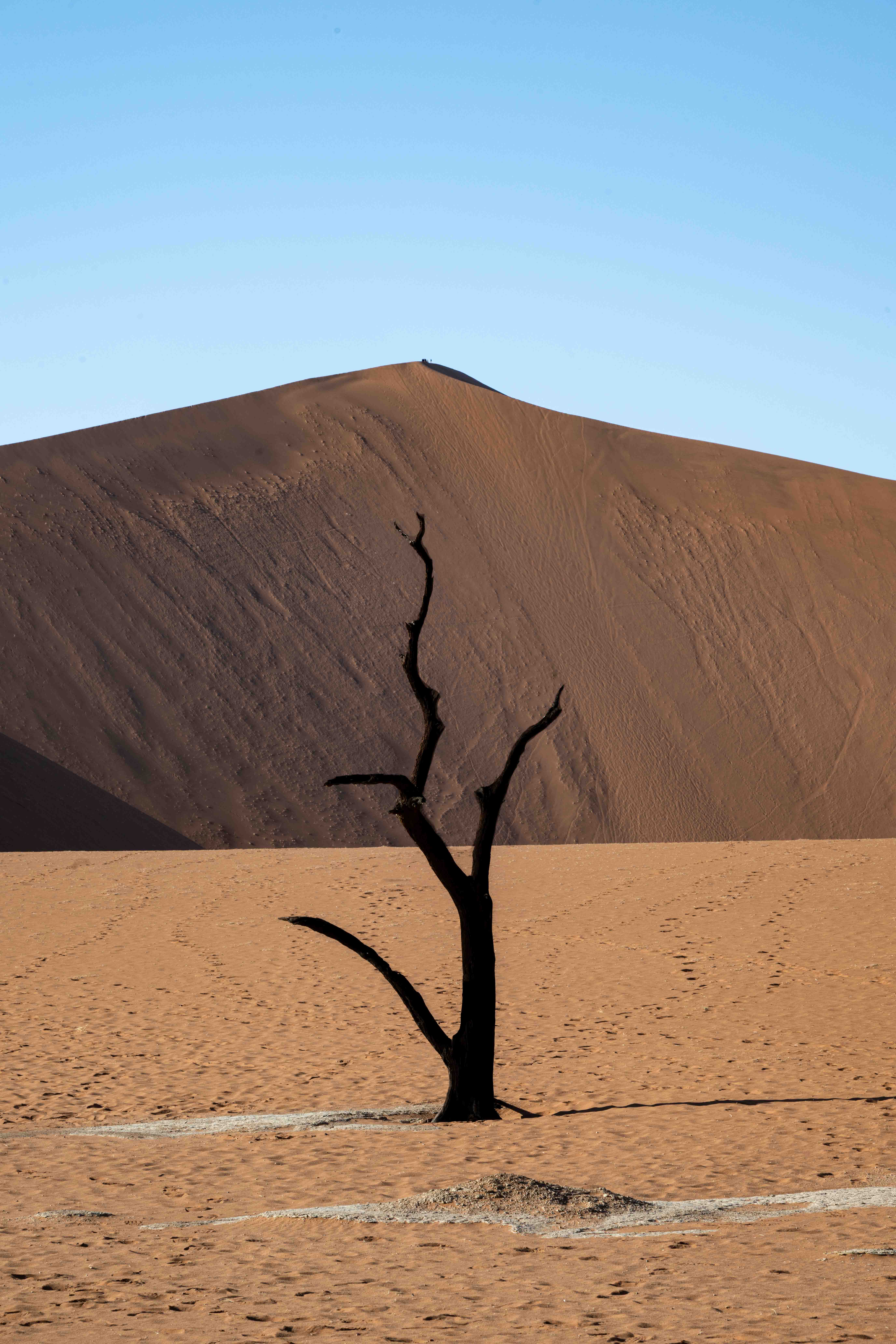
Our destination in the Namib desert was Sossusvlei, where the sand dunes are among the highest in the world. “Dune 7” dune, the tallest, is 388 m (1,273 ft) in height. Vlei is the Afrikaans word for “marsh,” while sossus is Nama for “no return” or “dead end”. The area is the drainage basin for the ephemeral Tsauchab river. The Namib Sand Sea, of which the Sossusvlei dune field is a part, is a UNESCO World Heritage Site. The dunes began forming around five million years ago. Sand from the Orange River was carried west into the Atlantic, swept north by the Benguela Current, then driven back inland by the prevailing south-southwest winds. Over millions of years the sand accumulated into a dune field ~32,000 sq km (12,400 sq mi) in extent. The sand is iron-oxide coated quartz, and younger sand near the base of dunes is paler while older sand higher up is a deeper reddish-orange, due to greater oxidation. The colors in these photos are real, and not simply me going wild with the saturation slider in my photo editing software. For scale, note the full-grown trees at the base of the dune in the first photo.


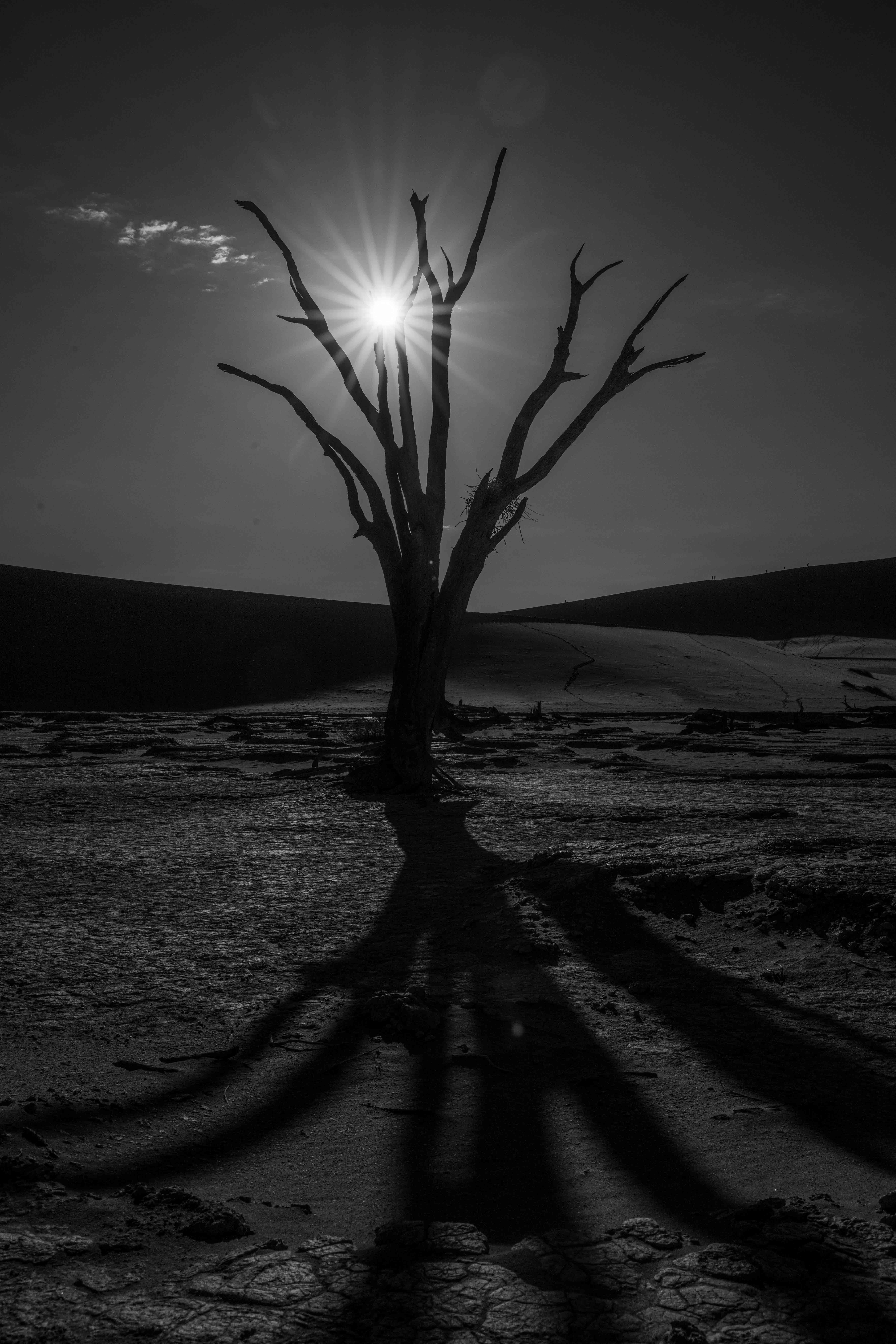
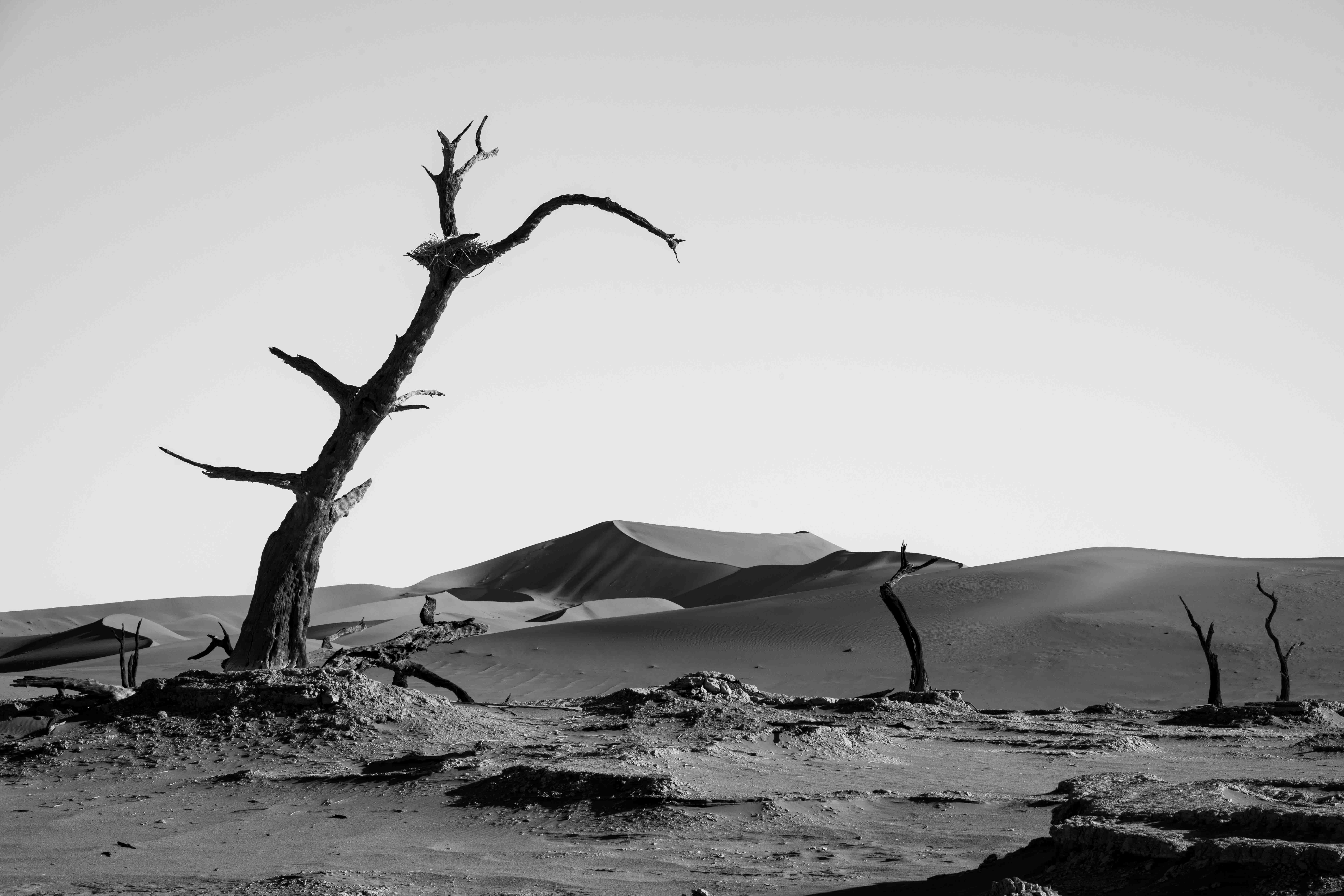
About a kilometer walk across the sand lies a small clay pan named Deadvlei (meaning “dead marsh”) where reside camelthorn trees (Vachellia erioloba) that have been dead for 600 – 900 years. There has been no water here since the fourteenth century! The combination of extreme dryness and intense heat inhibits microbial activity so thoroughly that the wood is preserved.
Gemsbok (Oryx gazella) and springbok (Antidorcas marsupialis) antelope are the primary large mammals of the Namib. Gemsbok can survive for extended periods without drinking free-standing water, meeting their requirements through vegetation. Here is a gemsbok in its habitat:


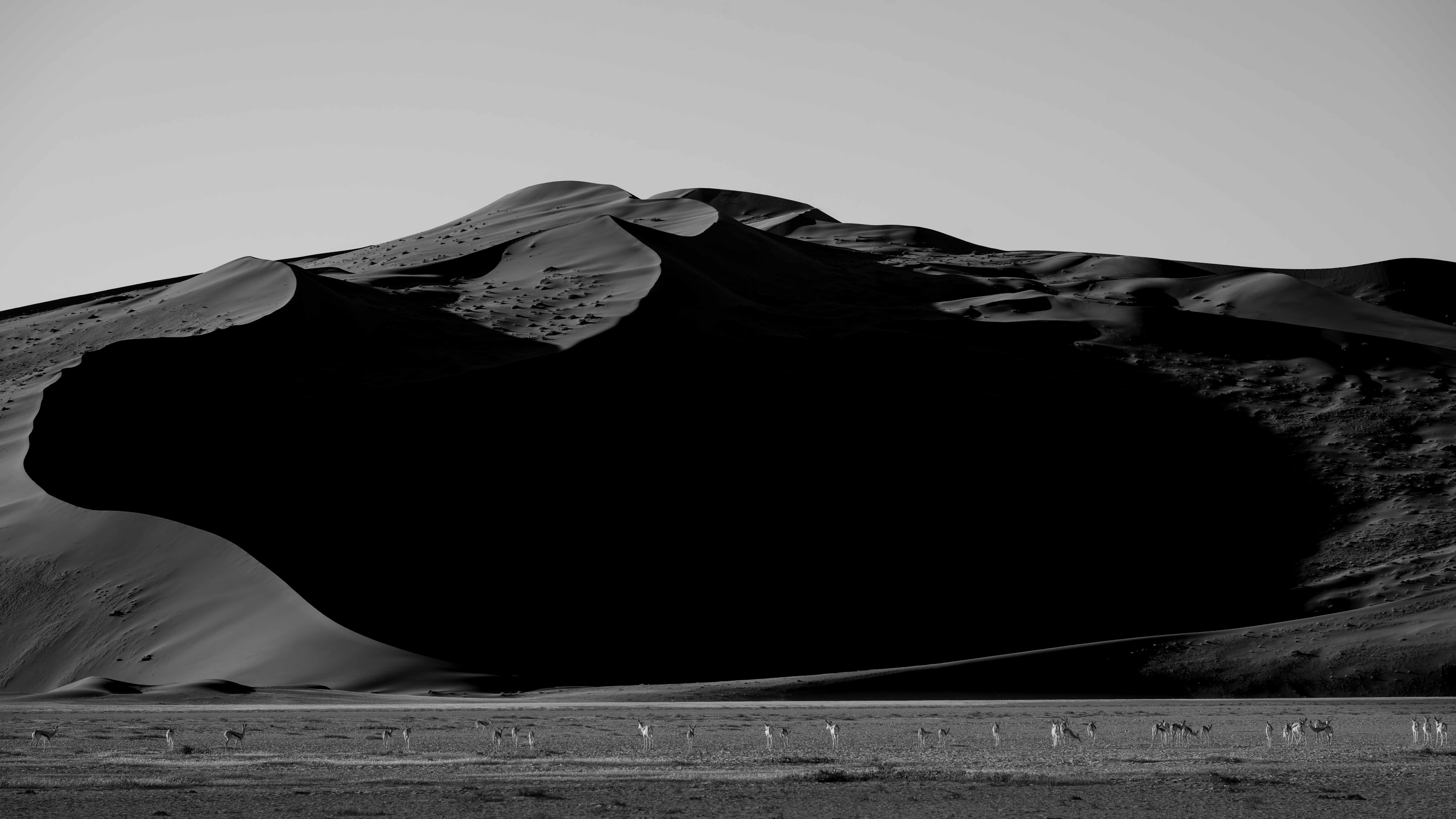
Here is a herd of springbok in their environment:
Toktokkie beetles (Onymacris unguicularis) are a group of darkling beetles with over 200 species in Namibia, and 20 in the Namib desert. We saw them throughout Namibia. I don’t know the species of this individual, but some species engage in fog-harvesting: when Atlantic fog rolls in, beetles climb to the crests of dunes and orient head-downward, body inclined away from the wind. Water condenses on the elytra, runs along ridges on the beetle’s back, and reaches the mouthparts. A beetle can take in water equivalent to ~40% of its body mass from a single fog event.

The garden locust or tree locust (Acanthacris ruficornis), is widespread across sub-Saharan Africa. Tt is technically a grasshopper:

Namaqua doves (Oena capensis) are ubiquitous, but I think they are pretty. They are the smallest doves on the African continent:

The Kalahari tree skink (Trachylepis spilogaster). I had no idea that some skinks are arboreal:

The extreme dryness and very low population density of Namibia make it one of the prime sites for astronomical observatories and night sky photographers:

Lucky you for visiting such an amazing place, and lucky us for seeing your pics. Thanks.
Thank you for the kind comment!
Magnificent! Thank you for sharing.
You are very kind.
Thank you for reminding me of Sossusvlei, a magic place I visited more than 30 years ago. We followed all kind of Tenebrionidae walking like on stilts on the scalding sand dunes, waiting for the night with incredibile skies dominated by the Southern Cross, Alpha Centauri and the Milky Way.
I always like Asia more than Africa, but Namibia really is a remarkable place
Not that the place is overwhelmed with tourists these days, but I would have like to have been there when you visited >30 years ago when there were very few tourists and little tourist infrastructure.
Eerie and beautiful and interesting!
Some fantastic ‘beached car’ photos there. Sort of looks like they’re being reclaimed by the earth.
Fascinating photos of such a rare environment.
Those are some really outstanding photos (I really love desert photography).
Here‘s a 360° drone view of Solitaire and here are the car wrecks.
Thanks for the links. I love the 360° panorama shots. It feels very real.
“Fog-harvesting”. Fascinating. And those beetles are gorgeous.
Thanks for the great quality pictures of a place very few of us will ever see with our own eyes.
Wonderful, as always!
Thank you!
It almost feels like I was there along with you! Very nice collection and commentary.
Thank you, Norm. I always appreciate your commentary.
Thank you for these photos. They seem to really show the lovely stillness of this area. Each shot has a wonderfully quiet feel.
Wonderful area, and great photography!
Thank you, I appreciate it!
Really enjoyable! That was something special. I like the striped eyes on the locust (grasshopper), as that seems a bit unusual.
Yes, I’d never seen (noticed?) those striped eyes before.
I had no idea the Namib Desert had been around for so long. I wonder what it is that makes it persist and other deserts come and go.
Rain!
Ba-dum-cha. Thank you, folks. I’ll be here all night.
Those dunes and camelthorn trees!
Perfect material for a slow-moving film scene. Stunning!
Thank you so much for these wonderful photos of a fascinating place I will never visit. I’m looking forward to future posts–hoping for lots of succulents and maybe some bloom?!
Also looking forward to more night photography.
Beautiful, thank you.
First truck = ’51/2 Ford, second is ’55/6 Ford.
All stunning, but the third dune picture is epic.
I feel bowled over by the vastness and unrelenting dryness. Wonderful photography.
Just got to your post this morning, but wanted to thank you, Ehphraim. Very informative text and amazing photos. Thanks!
I appreciate the feedback, thank you!