
Today’s photos come from Miriam Meyerhoff, who responded to my call for readers to send it photo. (That call, by the way, still exists!). Miram’s captions are indented and you can enlarge her photos by clicking on them.
In June we spent a week in Orkney (Mainland and Westray) to see neolithic sites and some wildlife. I’m not good at photographing birds (and I just have an iPhone) so I have photos of puffins, some fulmars and lots of plants.
On the Mainland of Orkney, we visited Skara Brae and various stone circles. Skara Brae was first inhabited about 3100 BCE. The homes had built-in furniture (kind of like Frank Lloyd Wright did with his houses) with a dresser of shelves opposite the door and beds built into the walls on the right and left walls:

On Westray, we walked for about an hour with a local guide, Megan of Wild Orkney Walks. Megan was extremely knowledgeable about plants and wildlife and is deeply concerned about the impact of over-fishing on the Orkney sea birds.
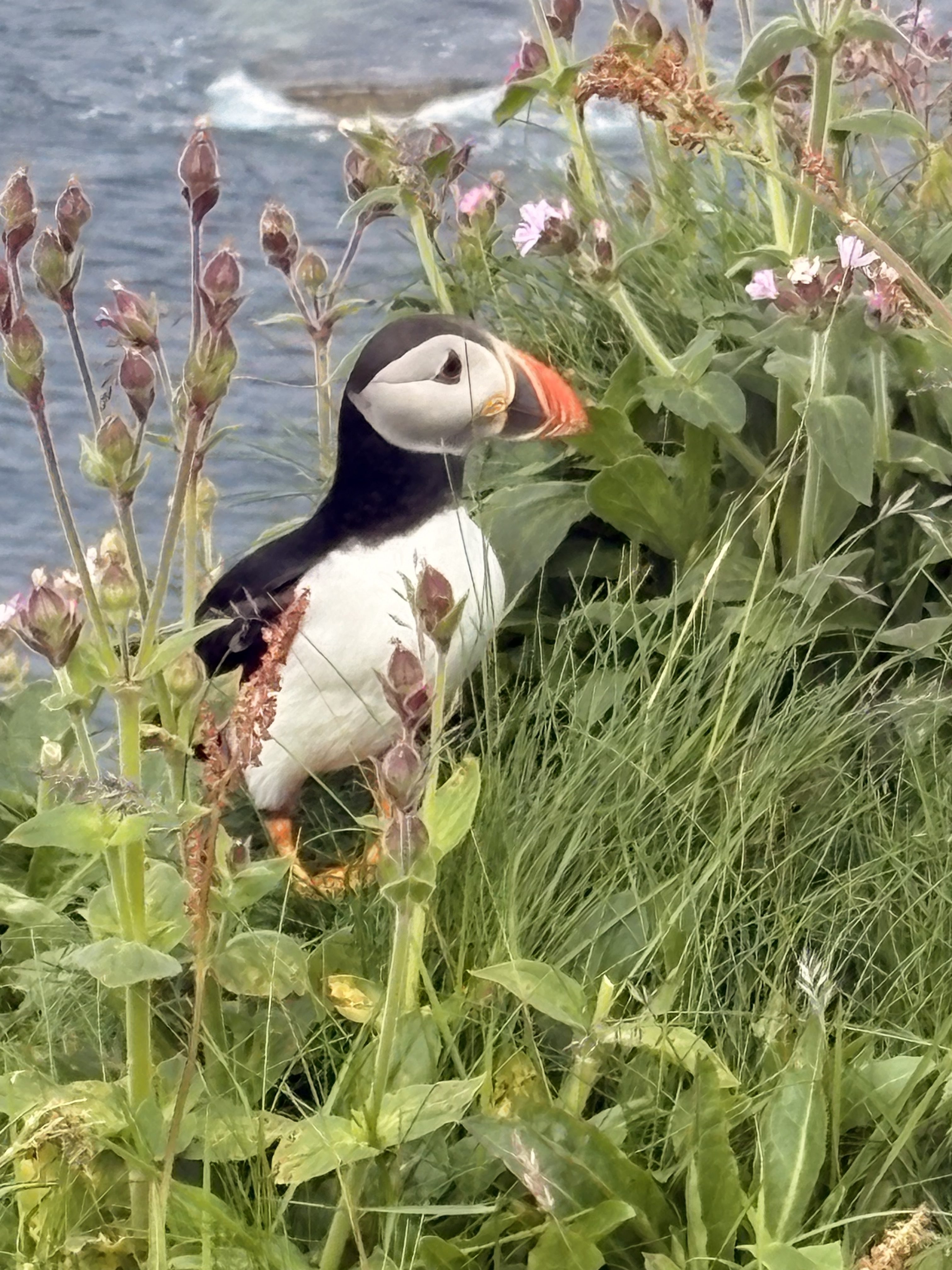
It turns out puffins (Fratercula sp.) are not at all scared of people and will let you come very close:
They nested alongside fulmars on the cliffs. Fulmars (Fulmaris sp.) are not gulls, they are in the same family as albatrosses and petrels. Apparently, fulmars can defend themselves by spewing up a foul smelling oily mess and spitting it at you. The first syllable ful- is cognate with the word foul on account of this habit:

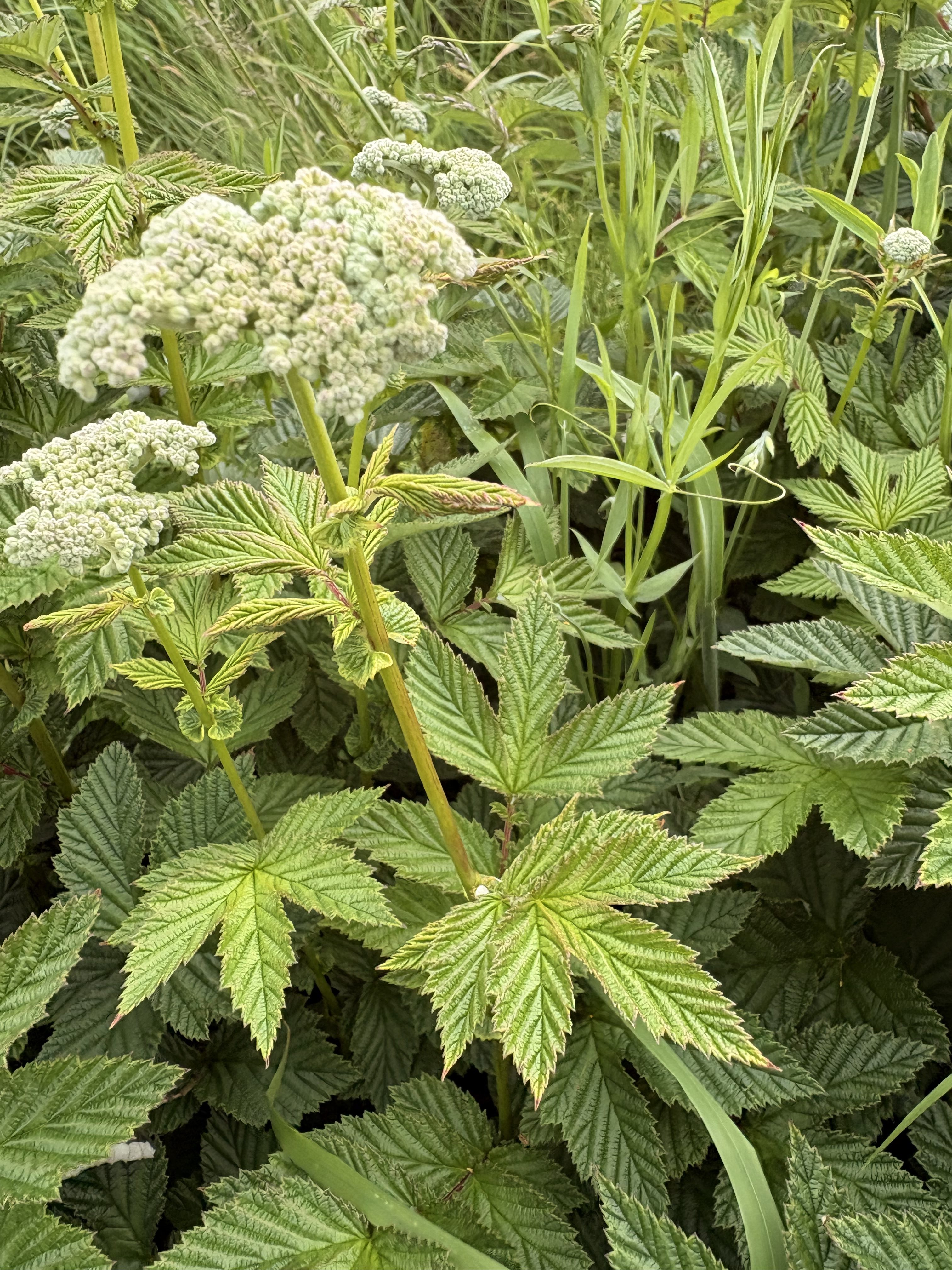
The clifftops we walked along had many plants that were new to me. Sea thrift (Armeria maritima, aka sea pinks) and red campion and sea campion as well as meadowsweet [flowers in order]:


There was also an impressive selection of different thistles. I think this was a cruel thistle (Cersium ferox):

Along the roadside there were masses of marsh orchids, hogweed, and yellow flags were still in bloom (flowers in order):


Wild roses (Rosa rugosa) were also in bloom. I didn’t know you can eat the petals. They taste a bit like glycerin to me:

Back on the mainland, the oddest plant I saw was Cottonweed. The seed heads do produce something very like cotton wool:

But the most beautiful (to me) was the smallest flower on a clifftop near Yesnaby, sea milkwort. I gather it is quite common in the northern hemisphere, but I didn’t grow up here. I loved how simultaneously tough and dainty it manages be.

Very nice photos! Thanks!
Thank you for the interesting post, Miriam.
The photo of Skara Brae is fascinating. It’s interesting how creative these people were in making their homes in such a remote place.
The Puffins are one of my favorite birds, I had no idea they would allow you to approach so close.
The photos are wonderful. I’m really amazed by the first one with the beautiful stone walls. So many elements do look like a Frank Lloyd Wright house or an Andrew Goldsworthy sculpture in the landscape. I’d love to know the mind of the designer from so long ago.
Nice photos. I love the flowers. That thistle looks very cruel indeed!
Thank you so much for the wonderful photos! So often people think of our ancestors–particularly those from that long ago–as simplistic and ignorant, but the design of the houses in Skara Brae show they were anything but. The photos of birds and flowers are gorgeous. I also didn’t know puffins were that unafraid of people. Among the flowers, the marsh orchid and sea milkwort are my favorites. I would love to see more photos from your trip if you have more to share.
Very nice! I enjoyed that. One should try to be fond of thistles. Right now I am secretly cultivating a small stand of very large and very cantankerous Bull Thistles in the yard that the wife does not know about. There are interesting insects that gather on them.
Great photos. Thank you.
Did you also visit the circles of standing stones? The people who built these and Skara Brae fascinate me; they were quite sophisticated.
@Amy: yes, we did. Some of them are astonishingly large stones, very very impressive. We were told the current thinking is that the builders floated them into place, and that’s one reason some circles are surrounded by a ditch (it would have been the waterway). I had to wonder whether the ditches also served as latrines when they had big gatherings at the stone circles. (They could have opened them up to ‘flush’ clean with the tide.)
The sea milkwort is impressive and lovely. Looks like a succulent.
Beautiful, thanks!
I agree about the sea milkwort.