
I haven’t displayed a pair of cowboy boots here in a long time, but that’s because I’ve stopped buying them. I must now have over a hundred pair: one symptom of my addiction to buying certain items (viz. wine and cigars); but I’ve stopped. I do take credit for getting Steve Pinker to recognize the merits of cowboy boots, which I consider the only attractive item of male footwear. Women have a gazillion kinds of attractive shoes, but men do not. Except for cowboy boots, I find men’s shoes either plain or downright ugly.
During my boot-buying phase, I got most of my boots on eBay, where you could get some terrific bargains, sometimes nearly new boots at about 15% the retail price. I’ve published photos in the past, but most have been removed in the Big Photo Wipe when I had to take down every photo over more than a decade because of copyright claims (I can’t selectively removed photos).
One kind of boot I stayed away from, though, are those made from endangered species. The most prominent of these are boots made from sea turtle leather (they use the flipper). These were made in the U.S. and Mexico decades ago (they may still be making them in Mexico), but, as Grok tells us, selling anything made from sea turtle is now illegal in the U.S. Here’s a question I asked Grok, and its answer (along with references)
Is it illegal to sell anything made from sea turtle?
Yes, in the United States and most countries, it is generally illegal to sell products made from sea turtles (or their parts, such as shells, leather, or “tortoiseshell”).fws.gov
All seven living sea turtle species are protected. In the U.S., the six species found in U.S. waters (green, hawksbill, Kemp’s ridley, leatherback, loggerhead, and olive ridley) are listed as endangered or threatened under the Endangered Species Act (ESA). This makes it unlawful to sell or offer them for sale in interstate or foreign commerce, and the prohibitions extend to parts and products.They are also listed on CITES Appendix I, which largely bans commercial international trade in the animals, their parts, or products. Import or export requires permits and is allowed only in exceptional (usually non-commercial) cases.
Key U.S. details from the U.S. Fish and Wildlife Service
- Sea turtle shell and leather products (e.g., jewelry, combs, boots, belts, handbags, inlays) generally cannot be sold in interstate or international commerce. Limited exceptions may exist; contact the Service. Permits are required for import/export.
- Sale within a single state may be allowed in some circumstances unless restricted by state law or CITES “use after import” rules. Many states prohibit it, and online sales frequently cross state lines (making them interstate).
Enforcement is active—people have been charged for selling sea turtle skin boots or listing shells for sale online.
But I still get notices from eBay, as I’ve asked to be notified when “sea turtle boots” appear for sale. As a boot collector and a biologist who is conservation-minded, it steams me up when I see these things, and will report them if I see that they’re genuine turtle.
Sellers have learned that eBay doesn’t permit selling anything made with sea turtle, so they disguise the descriptions when they’re selling the real thing. Here’s an item I saw this morning, which looks like genuine sea turtle but whose identity is confirmed two ways. First, by the way they describe the item, with “print’ in quotes and a drawing of a turtle:

The “pre-ban” refers to this stipulation from CITES (Convention on International Trade in Engandered Species of Wild Fauna and Flora) about what endangered-species items can be sold:
Antiques: Items that are at least 100 years old, composed in whole or part of an ESA-listed species, not repaired or modified with such material after December 27, 1973, and meeting other criteria (including documentation of age/provenance) may qualify for an ESA antiques exemption. These can sometimes be sold in interstate/foreign commerce (CITES paperwork may still apply). Proving qualification is strict.
fws.gov
But of course if the boots advertised are really “prints,” you don’t need to refer to the ban. Further, no “pre-ban” boots are exceptions unless they’re over 100 years old.
This is what real sea turtle looks like (a photo from the listing). Note the cracks between the scales and the irregularity of pattern between boots: a clue to their authenticity.
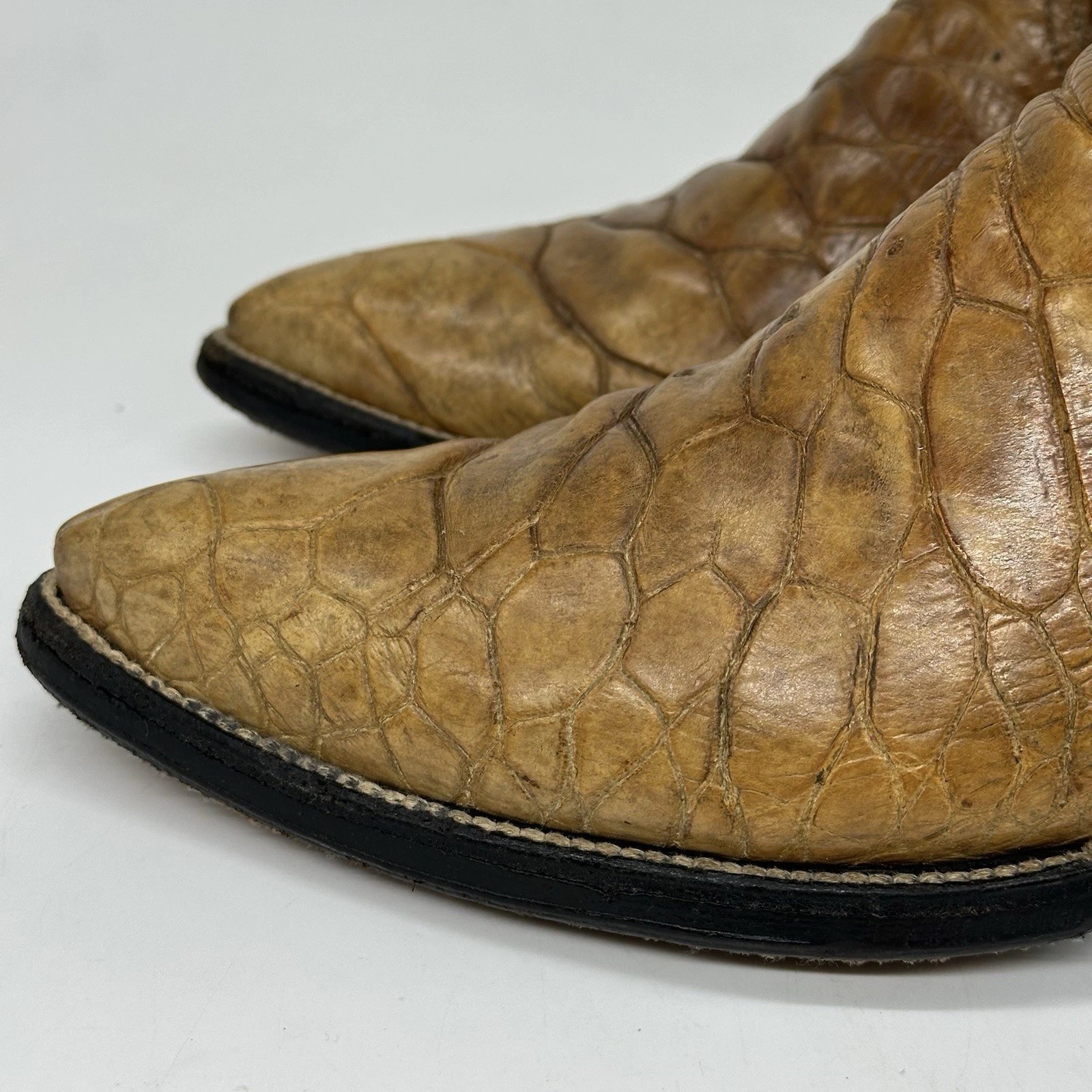
So we have eBay illegally selling boots made of protected species. What can one do to stop it? Well, I could just say that I know sea turtle and these are sea turtle, but eBay doesn’t usually take my word for it (after all these years, though, they should). So to prove their illegality, I write to the seller and simply ask what they are. Are they prints, as advertised, or real turtle? The seller will often admit to me that yes, they are real, but he/she has to disguise them because they know that they are listing illegal boots. Here’s my correspondence from this morning in which the seller admits that they’re real turtle:

That’s an arrant admission that they’re real turtle.
Armed with this correspondence, I reported the to eBay (there’s a small question mark at the bottom right of each eBay item where you can report items for various reasons). I asked eBay to take the item off sale. And I enclosed a copy of the incriminating correspondence.
You’d think that, seeing this, eBay would remove the item, as I asked in my report. But nooooo; they “reviewed” my report and, as they often do, they rejected it:

Did I give up? Of course not! But contacting eBay by phone is hard; using their phone number doesn’t work, so you have to go through the AI “assistant,” and eventually demand that they call you.
eBay farms out complaints to an Indian call center, and once you reach them you know that you’re in for at least twenty minutes of being put on hold and explaining the problem several times over. Sometimes it takes an hour, and I’ll put my phone on speaker while working away. Today the agent told me that they’ll kick my appeal upstairs and I’ll be informed of its disposition.
Really, eBay, if you’re reading this, I hope you start enforcing your policies about endangered species, especially when the seller admits flogging an endangered-species item. The U.S. Fish & Wildlife Service is useless. They are responsible for enforcing the law, but my attempts to get them to do this with eBay have been futile.
Sad to read that eBay doesn’t do the right thing. Could this be a case where a social media campaign would work? Is there a conservationist with a large following or an outlet that would pick this up?
I doubt it. I just keep reporting them one by one.
PCC(E) : I’m unsure of your “had to take down photos 10 years+ b/c of copyright claims”
I’m not an IP lawyer but served as one as various publications/editors who publish my articles got in trouble for copyright infringements. Their outfits are for profit though, even if usually not paywalled.
A few strikes nearly bankrupted two of the five who publish me.
I was under the impression that since you publish WEIT for the love of the game, as it were, no advertising or subs, you should be in the clear?
Have I gotten this wrong?
best,
D.A.
NYC
yep
Thank you PPC for fighting the good fight. And for everything you do!
How many readers do you have hear? What if we all reported these illegal and immoral sea turtle items?
That will not work as readers are not going to report stuff to ebay.
And I thought my biggest issues with eBay were their shocking international P&P system. Two items by different sellers, same price, one costs 3 times more to post than the other!
And that is just the funny one.
I own cowboy boots. They are quite legal (at least I think so). They are made from cows.
Thanks for your effort on this!