Friday: Hili dialogue

October 24, 2025 • 6:45 am

Welcome to Friday, October 24, 2025, and we’ll soon be in November. It’s also National Bologna Day. Here’s how they make the sausage (maybe you don’t want to know), and yes, bologna is a sausage. Note that they pronounce the word as “ball-own-ya”. That’s wrong! But note too that one of the ingredients is often myrtle berry.

It’s also Black Thursday (the day in 1929 when the stock market crashed), Food Day, Global Champagne Day, National Good & Plenty Day, and National Tripe Day (I tried it once in France, and that was the last time for me).

Readers are welcome to mark notable events, births, or deaths on this day by consulting the October 24 Wikipedia page.

Da Nooz:

*Putin is rattling his sabers again after Trump imposed severe sanctions on two Russian oil companies. The sanctions are the good news. The bad news is that Trump won’t give Tomahawk missiles to Ukraine.

A day after President Trump’s first major punitive action against Russia over its war in Ukraine, President Vladimir V. Putin on Thursday called new U.S. oil sanctions “an unfriendly act” and warned of an overwhelming response if Kyiv gets the powerful missiles it seeks.

Speaking with journalists in Moscow, Mr. Putin said that the sanctions against the two biggest Russian oil giants would hurt the country’s economy, but that Moscow would never make any concessions under pressure.

“This is an unfriendly act toward Russia, and it doesn’t strengthen relations between Russia and the United States that only began to get restored,” Mr. Putin said. “But no self-respecting country and no self-respecting people ever decide anything under pressure.”

Asked about Ukraine’s push to get long-range Tomahawk missiles from the United States or other Western states, a request that Mr. Trump has publicly entertained but so far not approved, Mr. Putin warned that “this is an attempt at escalation.”

“If a strike is made on Russian territory with such a weapon, the response will be very serious, if not staggering,” he said. “Let them think about that.”

Mr. Putin’s comments signaled that the Kremlin was not willing to soften its maximalist demands to end the war in Ukraine. Russia has continued to strike Ukraine daily with drones and missiles, and its troops are still pushing to occupy more Ukrainian territory, even as the Trump administration has demanded that Moscow agree to a cease-fire along the current battle lines.

It’s not that Tomahawk missiles are nuclear or anything; it’s the fact that they would come from the U.S. that’s bothering Putin. And it’s not that the U.S. has not previously funneled arms (sometimes indirectly) to Ukraine. Putin just wants land.  Another NYT article notes that these sanctions could cause a rupture between Russia and one of its biggest oil customers, India:

Business concerns could end an impasse between United States and India over Russian oil, and whether India ought to feel free to buy it.

President Trump has said several times that India was on the verge of ending its purchases, which have saved India billions of dollars while generating billions in revenue for Russia in the years since it invaded Ukraine.

That has not happened.

But on Wednesday, the U.S. Treasury announced a new raft of sanctions aimed at Russia’s two biggest oil firms, Rosneft and Lukoil. The move could convince India’s private businesses and government-owned oil companies that it is time to quit buying oil from Russia, in a way that threats and tariffs did not.

*Two top officials in America’s Anglican Church are in big trouble: one accused of sexual misconduct, the other of allowing men with histories of sexual misconduct or violence to have meaningful roles in the Church. (Article archived here.)

The Anglican Church in North America — forged from the headline-grabbing conservative revolt against the Episcopal Church’s first openly gay bishop — is now confronting allegations by clergy and parishioners against two of its top leaders: One is accused of sexual misconduct, while the other allegedly abused his power by allowing men with troubling histories into the church

The denomination’s senior-most official, Archbishop Stephen Wood, 62, has been accused by a former children’s ministry director of putting his hand against the back of her head and trying to kiss her in his office in April 2024. The incident allegedly occurred two months before he was elected to the helm, according to a new church presentment, which The Washington Post obtained in advance of its Monday submission.

The woman, who gave an interview to The Post, also accused Wood of giving her thousands of dollars in unexpected payments from church coffers before the alleged advance. Wood, a married father of four sons, remains the rector of St. Andrew’s Church in the Charleston, South Carolina, area, and a bishop overseeing a diocese of more than 40 churches across the South.

If the presentment triggers an ecclesiastical trial, Wood could be defrocked and forced to step down. He is the first archbishop in the Anglican Church in North America to face a presentment, a denomination spokeswoman said.

. . . . Beyond confronting the allegation of making an unwanted advance on his employee, Wood also faces complaints from priests that he plagiarized sermons and bullied and disparaged church staffers in the years before he became archbishop. The presentment accuses Wood of violating his ordination vows, committing sexual immorality and bringing “scandal and offense” upon his office.

And the other guy:

The presentment — a report that chronicles formal allegations of canonical offenses — is unfolding amid a protracted ecclesiastical trial against another leader, Stewart Ruch III, an Anglican bishop who oversees a diocese of 18 churches in the Midwest. Parishioners and clergy have accused Ruch, 58, of allowing men with histories of violence or sexual misconduct to worship or hold staff or leadership roles in his diocese.

Testimony in Ruch’s trial, which was conducted privately on Zoom, wrapped up in mid-October. A verdict from the court’s seven-member panel of judges — a group of bishops, priests and parishioners — is expected to arrive later this year. Ruch declined to comment through a diocese spokeswoman, who cited a court directive prohibiting him from media interviews during the trial.

This is one of the problems of religion: it not only has authority figures, but ones that children may think have the power to send them to heaven or hell. And who would believe accusations against a “holy man.” Well, as Christopher Hitchens said after the death of Jerry Falwell, “The empty life of this ugly little charlatan proves only one thing.  That you can get away with the most extraordinary offences to morality and to truth in this country, if you’ll just yourself called ‘reverend’.”

*The science column Trilobites in the NYT (author: Gennaro Tomma) describes the survival of three-legged “pirate” lizards in the wild.

Scientists have long thought that a lizard losing a leg should be a death sentence. New evidence seems to overturn this assumption, showing that some lizards can not only survive, but even thrive after losing one or more limbs.

James Stroud, an evolutionary biologist at the Georgia Institute of Technology, has spent years catching lizards in the wild to study how they evolve. He and his colleagues long thought that even the smallest difference in the length of a lizard’s leg could affect its ability to run from predators and chase their prey. Losing an entire limb seemed much more severe.

However, every now and then he and his colleagues would observe something odd. “We’ll find a lizard completely missing its leg, and it seems fine,” Dr. Stroud said. He casually calls them “three-legged pirate lizards.”

Speaking with other researchers, he would hear similar stories.

To further investigate, he and his colleagues contacted a long list of lizard biologists, asking them whether they had ever seen a lizard with three legs. “Most have never thought about it and just had a random picture on their phone, just like: ‘Huh, this is odd’,” Dr. Stroud said.

The team received images that documented 122 individuals on four continents, with 58 species included, from geckos to iguanas to chameleons. Some had lost only one foot, others even two legs.

This allowed Dr. Stroud’s team to establish that surviving the loss of a limb is widespread among lizard species. They reported their finding last week in the journal The American Naturalist, adding that usually less than 1 percent of individuals in a population are missing a leg.

The original paper in The American Naturalist, with many authors, can be found here. Click to read:

Here’s the summary:

Variation in limb length among lizards is a paradigmatic example of evolutionary adaptation. Given the established adaptive significance of limb length, reasonable hypotheses about the effect of limb loss might include that it reduces the survival, health, and welfare of lizards, perhaps by reducing their locomotor performance. Taken at face value, the case studies that we have assembled indicate that the consequences of limb loss may sometimes be less severe than hypothesized, even for lizards that lose an entire limb. For example, many of the lizards in our dataset do not appear to have incurred a high foraging cost, appearing healthy and well nourished (figs. 12). In cases where quantitative data were available, the body condition of limb-deficient lizards, corrected for body size, was often comparable or superior to that of uninjured lizards (table 1), and some limb-impaired lizards were reproductively active. Longitudinal data, when available, revealed mixed results. Some limb-deficient lizards survived longer than most fully limbed individuals, while others were not observed to survive spans of 6 months or less between sampling periods (although low survival of all lizards in these populations means that limb damage may not be the cause of the quick demise of limb-deficient lizards).

Of course the authors realize (and point out) that there’s an ascertainment bias here, as lizards who lose a limb and don’t survive wouldn’t be part of the study set. Plus the fact that the lizards appear to be doing well now doesn’t mean they do well (at least in terms of reproduction) over their whole lifetime.  Many papers are said to have shown an adaptive difference among species in limb length, and that may still be the case, for what this paper shows is just that losing a limb doesn’t mean that you become a pirate lizard who does very poorly compared to lizards with the normal four limbs. It does not show that there no adaptive cost to losing a leg.

Here, from the paper, is a figure showing lizards with more than one leg damaged, apparently doing okay:

(From paper): Figure 2. Examples of damage to more than one limb. A, Brown basilisk (Basiliscus vittatus [Corytophanidae], table S1, ID 61) missing almost all of its forelimb and partially missing contralateral hindlimb (B. Hillen). B, Jamaican opal-bellied anole (Anolis opalinus [Anolidae], ID 20) missing most of a forelimb and lower contralateral hindlimb (D. Calder/L. Johnson/I. Maayan). C, Jamaican stripe-footed anole (Anolis lineatopus [Anolidae], ID 16) missing both forelimbs (A. Walker).
*I didn’t realize the extent to which free speech was suppressed in Switzerland until reader Bill called my attention to an article on Jonathan Turley’s site which is pretty horrific.  The issue it reports, in fact, has gotten very little publicity: a man was jailed for simplky questioning the claim that you cannot tell sex from human skeletons. It’s well known, however, that you can tell biological sex with high accuracy by combining a number of features. Here’s from a 2005 paper in Forensic Science International (my bolding):

Examination of the sample by an individual with training in physical anthropology, but no case experience, suggests that experience is likely to contribute moderately to the accuracy of the sex determination. Namely, the inexperienced anthropologist accurately assessed the sex of the sample 95.04% of the time; 4.06% less accurate than the experienced anthropologist. The two anthropologists showed the least agreement in scoring the ventral arc and composite arc on the pelvic bones.

Switzerland was famous (or infamous) for staying neutral in World War II. It simply would not take a side between the Nazis and the rest of the world. However, when it comes to free speech, Switzerland has declared war on anyone who challenges certain orthodox positions, including gender policies. Just ask Emanuel Brünisholz.

Brünisholz is reportedly about to start a 10-day prison stint due to his voicing skepticism about claims that skeletons are transgender.

Note that transgender usually means that individuals do have a biological sex, as do transsexuals, but adopt certain non-skeletal characteristics of the other sex (or have a gender of their own devising), and unless there is radical hormone-mediated changes in the skeleton, or surgery on bones, then the claim that a skeleton was transgender (especially before hormones were used) is quite dubious. But Turley continues:

There is very little coverage of this story. Free speech cases are often downplayed by European media. So, we have only limited information coming from conservative sites.

In 2022, he responded to a Facebook post by Swiss National Council member Andreas Glarner on the controversy. Some, including academics in the United States, are now claiming that you really cannot gauge the sex of individuals from their skeletons.

The wind-instrument repairman thought that such claims were unfounded and posted a comment that said, “If you dig up LGBTQI people after 200 years, you’ll only find men and women based on their skeletons. Everything else is a mental illness promoted through the curriculum.”

Brünisholz then received a knock on his door from the Burgdorf police and then a prosecution letter for engaging in “hate speech”  and “publicly belittling” comments based on sexual orientation under the Swiss Criminal Code. He was convicted and fined 500 Swiss Francs.

If true, this sounds like just another absurd use of a criminal charge to silence those with opposing views. However, a court actually convicted him and then another court upheld the conviction. He was ordered to pay a fine or go to jail. He is now going to jail for simply expressing his view, a view supported by many scientists and citizens.

The court adopted an exceptionally broad definition of the protected class under Swiss law:

“LGBTQI means lesbian, gay, bi, transgender, queer and intersex, and denotes therefore different sexual orientations. It’s a loose group of people who consider themselves a part of the aforementioned sexual orientations. Therefore, LGBTQI is a group of people with specific sexual orientations.”

The case is only the latest example of how free speech is in a free fall in Europe. I spoke in Berlin at the World Forum, where European leaders gathered in one of the most strikingly anti-free speech conferences I have attended. This year’s forum embraced the slogan “A New World Order with European Values.” That “new world order” is based on an aggressive anti-free speech platform that has been enforced for years by the European Union.

The forensic science paper quoted at the top was done blind, without knowledge of what the biological sex of the skeletons was.  Brünsholz is right. To be jailed for being right, just because you’re ideologically “impure”, is reprehensible. Shame on the Swiss authorities.

*The Times of Israel reports what my Jewish friend Peggy Mason called “They hate us—take gazillion and one.” A professor in London was threatened by students because he was in the equivalent of the IDF. But nearly all Israelis, save the ultra-Orthodox, Israeli Arabs, and a few others, have to serve in the IDF. And that includes women, who must serve two years.

Masked demonstrators stormed the classroom of an Israeli-born economics professor at City University of London Wednesday.

The professor, Michael Ben-Gad, said they threatened to behead him and shouting accusations that he was a “war criminal” and a “Nazi.”

“They came right up to me and screamed in my face,” Ben-Gad told Sky News. “One of them made a threat about having my head chopped off.”

Video footage shared on social media showed masked protesters taking over the classroom and yelling that Ben-Gad “is part of the genocide in Gaza.”

The video shows a handful of enraged masked students charging that Ben-Gad served in the “IOF” — an acronym for Israeli Occupation Forces, a term used by some anti-Israel activists to refer to the IDF — and chanting pro-Palestine slogans as security personnel attempted to guide them out of the room.

Ben-Gad, who served in the IDF in the 1980s and has ties to Israeli universities and the Bank of Israel, said he has been targeted by an anti-Israel group called City Action for Palestine demanding his dismissal.

A week earlier, the group had distributed flyers around campus branding Ben-Gad a “terrorist” and calling for his dismissal because his compulsory army service, from 1982 to 1985, coincided with the Sabra and Shatila massacre in Beirut during the Lebanese Civil War.

Ben-Gad responded that his “only crime” was being a Jew who has lived in the Middle East.

“If the objective of the demonstration was to frighten or intimidate me, frankly they will have to try a lot harder than printing up a flyer, launching an Instagram campaign or a small demonstration,” Ben-Gad told the Daily Mail.

Ben-Gad responded that his “only crime” was being a Jew who has lived in the Middle East.

“If the objective of the demonstration was to frighten or intimidate me, frankly they will have to try a lot harder than printing up a flyer, launching an Instagram campaign or a small demonstration,” Ben-Gad told the Daily Mail.

“I lectured this week as usual while all this was beginning, and plan to do so next week as well,” he said. “I am indeed, as they claim, an IDF veteran, and I plan to act like one — these modern brownshirts are not going to send me into hiding.”

Here’s a tweet showing the disruption. Look at the cowards hiding their identity by wearing masks. Fortunately, his University is supporting him, as it should.

Meanwhile in Dobrzyn, Andrzej is being a Luddite:

Hili: Why is it that you never text?
Andrzej:  I’m not quite at the point of perfect succinctness.

In Polish:

Hili: Dlaczego nigdy nie piszesz SMS-sów?
Ja: Jeszcze nie osiągnąłem doskonałej zwięzłości.

*******************

From a Facebook site I can’t remember:

From Laugh Until the Tears Run Down Your Eyes:

From The Onion:

From Masih, who will proudly be in court when one of the men Iran sent to kill her will be sentenced. Here’s a video showing an Iranian saying she’d gladly kill the American hostages from 1979:

From Iona, David Attenborough introduces us to the remarkable mimicry of the lyrebird. I’ve posted on this befgore

Ricky Gervais is selling vodka, though I don’t know why because he’s rich. At any rate, not all of his suggested ads have been approved by the London underground:

Had this one rejected too. Back to the drawing board.

Ricky Gervais (@mrrickygervais.bsky.social) 2025-10-23T10:23:01.042Z

From Luana; Canadian indigenous people are trying to take back land that descendants of “settlers” have bought and built on:

From Malcolm; cat gets returned after doorbell is run. Sound up!

One I retweeted from The Auschwitz Memorial:

24 October 1936 | A Dutch Jewish boy, Max Slager, was born in Enschede.In September 1944 he was deported to #Auschwitz and murdered in a gas chamber after the selection. —A short video about gas chambers and crematoria of the Auschwitz camp: https://youtu.be/-A05i25j9Ck

Auschwitz Memorial (@auschwitzmemorial.bsky.social) 2025-10-24T05:00:08.910773842Z

Two posts from Dr. Cobb. First, a newborn runner duck that has grown up:

Four years ago a little runner duck hatched out and was named Mo by my grandson Casey. Happy birthday Mo we know we love you more ❤️

Chris and his farmily of forever friends (@caenhillcc.bsky.social) 2025-10-23T05:10:17.086Z

. . . and cops rescue a kitten (click screenshot to go to the original). The thread says the kitten has been adopted, too.


Menopause in gorillas: a new study

October 23, 2025 • 10:45 am

If you think about it, you might realize that after an animal finishes reproducing, it should die, because genes that make you live on after you can no longer reproduce have no selective advantage: they are no better than genes that kill you off when you’ve had your last child. In principle, natural selection should keep you pumping out gametes and children until you die.  But in some species, namely ours, some of our ape relatives, and, curiously, some toothed whales like killer whales, females continue to live for considerable periods after their reproduction ends. We call that end “menopause”.  This leads to three questions:

a. Why do animals cease reproducing? That is, why don’t they continue to reproduce until they die?

b. Why in some cases do animals continue to live even after they cease reproducing?

c. Why don’t males undergo “manopause” in our species?

This new paper from PNAS (click title below to read, or find the pdf here) deals with the first two questions, but not with the third; and I’ll leave readers to ponder that one. The paper in fact, simply shows that in one population of mountain gorillas in Uganda, many females do show a form of menopause, living on for nearly a quarter of their adult lives as nonreproductives. While this phenomenon has been demonstrated in chimps, other studies of gorillas have not shown it. The authors posit that there may be different results in different wild populations of gorillas, though that’s hard to understand if you think the phenomenon involves natural selection. Why should such selection differ among populations of the same species? The hypotheses below don’t predict interpopulation variation.

Read on:

The first question above can be answered by realizing that menopause may be partly a cultural phenomenon. For the vast majority of our evolutionary history, humans probably died before the females stopped reproducing: probably between ages twenty and forty. There may have been no menopause in our species because nobody lived long enough to show it. And that may be one clue for why we show it now: any genes that cause women, at least, to lose reproductive ability when older were simply not expressed, and thus not selected against. This may also be the reason why earlier studies of chimps showed menopause: they were taken care of in zoos or reserves in a way that allowed them to live longer than they did during most of their evolutionary history.

Further, this population of gorillas, though living in a reserve, were not given special food or treatment (some were given vet care, but those were omitted from the study), and still showed not only menopause, but long lives after menopause. The “evolutionary history” phenomenon can’t easily explain that.  Nor can it explain postreproductive life in toothed whales—unless that was seen only in aquaria where they lived longer than they would have during much of their evolution, including now when living in the open ocean. (One would have to look at the studies to determine that.)

But regardless of the cause, one can say that one population of mountain gorillas under natural conditions—probably similar to those that obtained during most of their evolution—often show not only a cessation of reproduction but also considerable years of life beyond that. And the behavior of gorillas makes some of the evolutionary hypotheses for menopause seem unlikely.

Results.  This will be short. The authors studied 25 adult female mountain gorillas (Gorilla beringei beringei, one of two subspecies of the Eastern Gorilla) in Bwindi Impenetrable National Park in Uganda.  The females came from four groups, and their life histories were known, presumably through intense observation.  (Mountain gorillas hsve indeed been studied intensively, most famously by George Schaller and later by Dian Fossey (who was murdered during her studies.) The study populations are fairly easily habituated to human presence, which allows this study.

Here’s how they define “post-reproductive females” and how many of them showed menopause:

 According to a commonly used definition, “postreproductive females” are those who live past the age of their last reproduction for longer than the mean plus two SD of successful interbirth intervals (2). We calculated this value as 7.7 y [5.1  (2  1.3)] in our study population, suggesting that seven out of the 25 study females qualified as postreproductive. Six of these seven females have been conservatively estimated (based on the ages of genetically identified offspring, body condition and hair loss) to be older than 35 y old, which is the maximum age of observed reproduction (Figs. 1 and 2). All the seven postreproductive females exhibited a postreproductive lifespan of at least 10 y (Fig. 1), minimizing the possibility to be “mistakenly” classified as postreproductive. These females were not observed mating for an average of 7.4  5.8 y before they exit the study

And a summary:

Our study shows that wild Bwindi mountain gorillas can exhibit long postreproductive lifespans. Given that female gorillas rarely reach 50 y of age in the wild (6), the 10 postreproductive years lived by one third of the study females represents at least 25% of their adult lifespan (adults: 10 y old). More generally, the standardized population measure of PrR suggested that females spend 10% of their adult lifespan as postreproductive. Importantly, neither of the two methods we used to derive postreproductive lifespan can distinguish menopause from other causes of sterility, such as an increased fetal loss probability in old females. Nevertheless, the extensive duration of postreproductive lifespan, the reduced or lack of mating activity, and previous endocrine analyses of old females (89) suggest that menopause is a highly plausible cause for the reproductive patterns we observed. The selective pressure(s) which might have favored the evolution of this trait in gorillas remain unclear.

Indeed; menopause remains a mystery in all species that show it. We have hypotheses but no substantive answers.

So the question arises of what, if any, selective pressures could have promoted female longevity beyond reproduction.  This assumes—which we don’t know—that postreproductive survival was an adaptation. If it was, and not just a “spandral” here are a few hypotheses. The bold headings are mine, and indented text is from the paper:

a. Reproductive conflict:

The “reproductive conflict hypothesis,” posits that old females cease reproduction to avoid competition for limited reproductive opportunities with young (related) individuals (12); e.g., their daughters or the mates of their sons]. Female gorillas disperse from their natal groups and often disperse again from groups where they have reproduced (13), meaning that they have low relatedness to their groupmates. Hence, the benefits of reproduction for female gorillas at an old age may be greater than that for chimpanzees or humans, where female local relatedness increases with age and females reproduce simultaneously with their offspring (1214).

Avoiding conflict with individuals is advantageous only if they’re related, for this would be a form of “kin selection”. Since gorillas’ dispersal take them away from their kin, that makes this hypothesis less likely but not completely unlikely.

b. Intergenerational help, one form of which is the “grandmother hypothesis”. 

Another relevant set of hypotheses, also relatively unlikely to apply to gorillas, posit that intergenerational help, and its positive influence in grandoffspring fitness, may drive the evolution of postreproductive lifespan through two not mutually exclusive evolutionary pathways [see also “grandmother hypothesis”; (1)]: by selecting for longer female lifespan to allow females overlap with grandoffspring and help them increase their fitness (e.g., by offering their ecological knowledge, or by defending them). . .

. . . The associated “mother hypothesis” (15) might have greater predictive power in gorillas. This hypothesis posits that old females cease reproduction to minimize energy expenditure or other reproductive costs, and maximize investment to existing offspring and their fitness. Consistent with this hypothesis, maternal presence, care, and support is critical even for adults in gorillas and other hominids (16).

This too is a form of kin selection (as is parental care), for genes that help you take care of your grand-apes, or your offspring when you’re old, will still be helping copies of those genes in their still-reproductive descendants.  This is feasible for taking care of offspring, but given the dispersal of female gorillas, the “grand-ape” hypothesis is less likely.

And here’s a nonadaptive hypothesis, but one that is popular:

c. Menopause is a nonadaptive byproduct of gorillas’ life history. 

A final hypothesis posits that postreproductive lifespan is a nonadaptive by-product of life-history patterns. Given that many wild animals die from predation, disease, or starvation, genes whose deleterious effects appear only in advanced ages, may not be purged (15). When “favorable” conditions allow individuals to survive at these ages, deleterious effects that prevent reproduction may appear (411). Accordingly, greater food abundance and potentially lower predation pressure in comparison to the evolutionary history of chimpanzees, may allow Ngogo chimpanzees to live longer and exhibit menopause (4). Similarly, Bwindi gorillas currently do not face any predation risk from leopards, their main potential nonhuman predators,

A version of this hypothesis is that some genes have the effect of promoting reproduction early in life, but at the price of inhibiting reproduction later in life. Under many conditions, such “early reproducing genes” will be more adaptive than genes promoting later reproduction, because the former leave more copies of themselves earlier. (Those genes, for example, would be heavily favored in a growing population.). Thus senescence and menopause could simply be the result of the accumulation of adaptive “early-reproducing genes.”

Which, if any, of these hypotheses are right? We don’t really know for primates or toothed whales, and though there may be evidence for “senescing” genes in some laboratory species, I’m not aware of it.

The question remains why don’t male chimps, gorillas, and humans show “manopause”.  Some human males, for example, can father offspring even at the age of 80, but you’ll never find a woman reproducing at that age And we have no data from chimps or gorillas on males, at least as far as I know.

So, as always, “more work needs to be done”. But at least we now know that gorillas and chimps have menopause in females, which might make you a big hit if you bring it up at a cocktail party. And don’t forget to mention those toothed whales!

Bill Maher’s latest “New Rules” (plus bonus video on “The War on Science” anthology)

October 23, 2025 • 9:30 am

In Bill Maher’s latest comedy/politics bit on Real Time —called“F with your algorithm—he calls out people for assuming that because he criticizes the left, he must be a right-winger. This criticism hits home for me, as I’ve been accused of the same thing.  As Maher notes, he’s been criticized for being a right-winger by people who deliberately ignore his criticisms of the right—even though he does that as well, and often.  People don’t like to call attention to things that make them uncomfortable.

One example is our joint anthology, The War on Science, which was attacked for criticizing the left’s erosion of science when in fact many of its authors are liberals. The slant of the book apparently angered some “progressives,” who argued (many without having read the book), that it should have been aimed instead at the right (which also damages science).  My response to these critics is pretty much the same as Maher’s, but this is a family-oriented site so I will simply echo what Maher says at 1:07.

As Maher says, “If you think your job is to tell people what you want to hear, you’re not a journalist—you’re a wedding D.J.”  He gives examples of his own demonization for being a right-winger when, in his piece, he had in fact he’d criticized both right and left. Much of the reportage on Maher’s so-called conservatism (he’s a classical liberal) involves deliberately distorting or truncating his views. Maher may seem a bit defensive, but he deserves to be!

(The guests appear to be Mark Cuban and Andrew Ross Sorkin.)

At the end he analogizes this journalistic tactic  to how websites and devices also type their users, developing algorithms that, as we all know, aim their ad at users who, they think, will bite. His solution? Mess with those computer algorithms by clicking on things that you don’t like or want. That has a side benefit.  You’re a liberal like most of us, start reading conservative sites: that will do you good anyway.

Apropos of Maher’s monologue, we have a new video (below) about The War on Science book, or rather about its thesis. Lawrence Krauss, author of the anthology, says this about the  100-minute video (I haven’t yet watched it):

We’re closing our campaign of interviews and discussions for the book with something special: the official broadcast video of the War on Science Panel Discussion. This was a remarkable event put on as a collaboration between The Origins Project Foundation and the Free Speech Union, their largest ever event in fact, celebrating the book’s launch.

You can now watch the full video, where I was joined by several eminent contributors including Richard Dawkins, Alice Sullivan, John Armstrong, Alan Sokal, and Amy Wax. We debated the causes of, and solutions to, the ideological and political capture we’re witnessing in mathematics, the natural sciences, theoretical physics, medicine, and even government statistics. It was a good-natured but feisty exchange of ideas across political divides, driven by a panel of speakers who care passionately about truth and reason, all chaired by FSU founder Lord Toby Young.

This discussion really captures the core of the entire project: a candid exchange about the very real problems facing science and academia, and a necessary defense of free inquiry and objective truth.

Reader Bat recommended this video in an email:

I am finding it very engaging. I have read the full book of essays and maybe that helps me appreciate the authors’ verbalizing, but in any case I find it to be surprisingly fresh and engaging.  It is nice to have both of the two mathematicians on the panel, and for two reasons: 1. It forewarns people that even math is under serious woke attack; and 2. Both guys give very nice talks of what hogwash the attacks are.

Readers’ wildlife photos

October 23, 2025 • 8:15 am

This is the last batch of photos I have.  If you don’t want this feature to go extinct, and have some good wildlife photo, please send ’em in. Thanks!

Here we have a batch of beach photos from reader Taryn Overton. There is one introductory caption and two captions about birds, both indented below, and you can enlarge the photos by clicking on them:

This set of photos is from the same beach in Naples, Florida spanning 2022-2025.  All were around the time of sunset – nature’s color palette never disappoints!

Snowy Egret (Egretta thula) wading in the shallows:

Great White Egret (Ardea alba) silhouette:

Thursday: Hili dialogue

October 23, 2025 • 6:45 am

Welcome to Thursday, October 23, 2025, and National Boston Cream Pie Day. This is not a pie but a cake, and was supposedly invented in Boston by a chef at the Parker House (a hotel that was also home of the Parker House roll).  Here’s a luscious picture of that cream-filled cake:

cara fealy choate, CC BY 2.0, via Wikimedia Commons

It’s also National Canning Day, National Croc Day (the ugly shoe, not the reptile), and National Mole Day (the chemical term), the last one described this way: “It takes place on October 23 each year, between 6:02 a.m. and 6:02 p.m., to commemorate Avogadro’s number, which is roughly equivalent to (6.022 x 10²³).”

Readers are welcome to mark notable events, births, or deaths on this day by consulting the October 23 Wikipedia page.

Da Nooz:

*The AP reports that over 400 “anti-science bills” (most of them health measures) are being considered by state legislatures.  Whoopee: we’re all gonna die!

More than 420 anti-science bills attacking longstanding public health protections – vaccines, milk safety and fluoride – have been introduced in statehouses across the U.S. this year, part of an organized, politically savvy campaign to enshrine a conspiracy theory-driven agenda into law.

An Associated Press investigation found that the wave of legislation has cropped up in most states, pushed by people with close ties to Health and Human Services Secretary Robert F. Kennedy Jr. The effort would strip away protections that have been built over a century and are integral to American lives and society. Around 30 bills have been enacted or adopted in 12 states.

. . .Trump administration officials are directing activists to push anti-science legislation in the states – where public health authority rests – with the ultimate goal of changing laws and minds nationally.

The effort normalizes ideas fueled by the anti-vaccine movement that Kennedy has helped lead for years. His Make America Healthy Again agenda masks anti-science ideas while promoting goals such as making food more natural or reducing chemicals. Meanwhile, vaccination rates continue to fall, allowing the infectious diseases measles and whooping cough to make comebacks as Kennedy has sought to broadly remake federal policies on public health matters including fluoride and vaccines.

The Dahlbergs and others are fighting a strong anti-science movement that stresses “health freedom” but disputes proven health measures. Experts say global vaccine efforts have saved more than 150 million lives since 1974, cavities have declined dramatically since community water fluoridation began in 1945, and milk pasteurization has saved millions from foodborne illness.

Despite those successes, activists spread false conspiracy theories, some dating back decades, that safe vaccines injure or kill large numbers of people, that fluoride is used to poison the population, or that pasteurization makes milk less nutritious and primarily benefits the dairy industry.

In its analysis of legislation, AP focused on these three public health policies, which have clear medical evidence behind them and are targets of the Make America Healthy Again movement. AP searched 2025 legislation in all 50 states, analyzing more than 1,000 bills collected by the National Conference of State Legislatures and the bill-tracking software Plural for whether they undermined science-based protections for human health.

Anti-vaccine bills – 350 of them – were by far the most common. They come at the issue from various angles: barring discrimination against unvaccinated people, creating the criminal offense of vaccine harm, requiring blood banks to test for evidence of vaccinations and instituting a 48-hour vaccine waiting period.

Legislators acknowledge they sometimes draw inspiration from other states: Bills in numerous places target mRNA vaccines, which were credited with saving millions of lives during the COVID-19 pandemic. Two bills in Minnesota falsely designate them as “weapons of mass destruction.”

Here’s where the bills come from (the SE U.S. and middle-South U.S. are of course the hot spots. From the AP article:

How do you fight “false facts” like this. You can throw all the statistics about vaccinations at people you want, and show them that the benefits outweigh the risks, but they’re always going to concentrate on the risks.  When I think that people can’t be so dumb, I remember that 71% of Americans still think that gods had a hand in human evolution (37% creationists and 34% people who think god tweaked evolution), while only 24% of Americans have a naturalistic view of human evolution. (And remember: we have plenty of fossils!)

*Despite Trump’s promises, nearly all of the East Wing of the White House has now been demolished to make way for his huge 1000-seat ballroom.

A demolition job that began Monday with the disappearance of the White House’s eastern entrance advanced Tuesday with the destruction of much of the East Wing, according to a photograph obtained by The Washington Post and two people who spoke on the condition of anonymity to describe the scene.

Photos of construction teams knocking down parts of the East Wing, first revealed by The Washington Post on Monday, shocked preservationists, raised questions about White House overreach and lack of transparency, and sparked complaints from Democrats that President Donald Trump was damaging “the People’s House” to pursue a personal priority.

“They’re wrecking it,” said Martha Joynt Kumar, a political scientist and professor emeritus at Towson University in Maryland. “And these are changes that can’t be undone. They’re destroying that history forever.”

A White House spokesman said that the “entirety” of the East Wing would eventually be “modernized and rebuilt.”

The National Trust for Historic Preservation, a nonprofit created by Congress to help preserve historic buildings, sent a letter Tuesday to administration officials, warning that the planned 90,000-square-foot ballroom “will overwhelm the White House itself,” which is about 55,000 square feet.

“We respectfully urge the Administration and the National Park Service to pause demolition until plans for the proposed ballroom go through the legally required public review processes,” Carol Quillen, National Trust’s CEO, said in a statement, citing two federal commissions that have traditionally reviewed White House additions.

A tweet sent in by reader Simon:

Who would have thought that Trump would try to wreck the White House as well as the country? Did he vet the plans with the American public, or even the agencies responsible? Nope; see the video below:

Here’s a new video of the wreckage and a historing mourning the destruction:

*Over at the NYT, Bret Stephens explains “Why Mamdani frightens Jews like me.” (Article archived here.) Stephens says that Mamdani isn’t an antisemite but then suggests that he is.

Readers of this column, particularly those inclined to vote for Mamdani, should at least pause to consider the reasons.

A good place to start is to concede that nothing in the public record suggests Mamdani is antisemitic — taking the narrowest view of what the word implies. He has spoken of the “crisis of antisemitism” in New York as “something that we have to tackle.” He has condemned the hate crimes this year in Washington and in Boulder, Colo. And he’s reached out to Jewish communities of various stripes, promising that Zionists would be welcome in his administration.

But Mamdani is also a longtime anti-Zionist of a peculiarly obsessed sort. Three lesser-known points of his biography stand out.

I still think that nearly everyone who calls themselves an “anti-Zionist” is at bottom an anti-Semite. Israel exists and has since 1948. Suggesting it should be expunged (presumably by displacing its residents or making them live-cheek-by-jowl with terrorists, is antisemitic.) But let’s proceed:

First, as an undergraduate at Bowdoin College, where [Mamdani] helped found the campus chapter of Students for Justice in Palestine, he broke off collaboration with the student arm of the left-wing Jewish group J Street, which supports Palestinian statehood, opposes Israeli settlements, and is roundly critical of the Israeli government.

Why? Because J Street supports Israel as “a democratic homeland for the Jewish people.” This was too much for Mamdani and his comrades in S.J.P., for whom working with J Street was a form of normalization. Mamdani, who to this day does not support Israel’s right to exist as a Jewish state, also called for a boycott of Israeli academic institutions. Bowdoin’s president rightly dismissed that notion for “stifling discussion and the free exchange of ideas.”

The second was a rap song Mamdani wrote in 2017, called “Salaam.” “My love to the Holy Land Five, you better look ’em up,” he crooned.

His critics did: The Holy Land Foundation was an ostensible charity convicted in 2008 of funneling $12 million to Hamas; the five defendants in the case received prison sentences of 15 to 65 years for crimes including money laundering, tax fraud and support of terrorism.

Finally, a few months before the Oct. 7 attacks by Hamas, Mamdani introduced a bill in the State Assembly that could have jeopardized the tax-exempt status of virtually every pro-Israel charity. The bill, noted Alex Bores, a fellow assemblyman and a Democrat, “is not aimed at improving regulations of nonprofits broadly, or even applying standards which would apply across the board.” Rather, it “singularly applies to organizations providing aid to a specific country and its people. This is immediately suspicious.”

What stands out about this list is the affinity for extremists, the double standards, and the monomania. Especially the monomania.

. . . .What does it mean for Jewish New Yorkers that a mayoral candidate who pledges to fight antisemitism also proudly avows the very ideology that is the source of so much of the hatred Jews now face? Why, right after Oct. 7, could he do no better than to issue a mealy-mouthed acknowledgment that Jews had died the day before? Why couldn’t he even denounce the perpetrators

Now if that’s not anti-Semitism (granted, one that’s well disguised), I don’t know what is.  I’m just glad I don’t have to vote in this election, and am worried that the eagerness with which even many Jews embrace this “anti-Zionist” candidate shows something about the Zeitgeist.  It also shows that if you’re a “charming” Democrat, you’ve got it made.

*Jared Kushner, who did a lot to get the Gaza ceasefire going, now has a new plan for what’s going to happen next.

The U.S. and Israel are considering a plan that would divide Gaza into separate zones controlled by Israel and Hamas, with reconstruction only taking place on the Israeli side as a stopgap until the militant group can be disarmed and removed from power.

Vice President JD Vance and President Trump’s son-in-law Jared Kushner summarized the thinking in a news conference Tuesday in Israel, where they had arrived to press both sides to abide by the current cease-fire, under which Israel pulled back its troops so that it now controls about 53% of the enclave.

Vance said there are two regions in Gaza, one relatively safe and the other incredibly dangerous, and that the goal is to geographically expand the area that is safe. Until then, Kushner said, no funds for reconstruction would go to areas that remain under Hamas’s control, and the focus would be on building up the safe side.

“There are considerations happening now in the area that the IDF controls, as long as that can be secured, to start the construction as a new Gaza in order to give the Palestinians living in Gaza a place to go, a place to get jobs, a place to live,” Kushner said, referring to Israel’s military by its initials.

Arab mediators are alarmed by the plan which, they said, the U.S. and Israel have brought up in peace talks. Arab governments strongly oppose the idea of dividing Gaza, arguing it could lead to a zone of permanent Israeli control inside the enclave. They are unlikely to commit troops to police the enclave on those terms.

A senior administration official said it is a preliminary idea and updates would be given in the coming days.

I doubt this plan will fly, though it’s clever to allot funds for reconstruction of only the Israel-controlled part of Gaza. But I doubt that the Palestinians will agree to this plan, and Israel has demanded that Hamas lay down its arms now.  The new plan, on other words, abrogates the old one as it leaves Hamas in power in some areas, and do you doubt that Hamas won’t get money from places like Qatar or European countries to help with “reconstruction” of the southern part of Gaza? But of course no interim plan seems feasible right now, and this is as good as any. Eventually, though, Hamas will have to surrender, or the war will never end.

*You’ve probably heard that 28-year-old U.S. chess grandmaster Daniel Naroditsky just died, and while the cause of death hasn’t been formally released, it seems likely that he killed himself after being hounded on social media and attacked by a former world chess champion for “online cheating”. The BBC reports:

The world chess federation (Fide) has said it is examining public attacks former world champion

made against Daniel Naroditsky before the US grandmaster’s death.

Fide CEO Emil Sutovsky told the Reuters news agency it was “looking into” the Russian’s previous comments accusing Naroditsky, who died this week aged 29, of online cheating.

Before his death, Naroditsky denied any wrongdoing and indicated the controversy had taken its toll on him in his final Twitch broadcast.

Kramnik told Reuters he did not want to comment on Sutovsky’s statement, saying that he would “rather tell the story in whole”.

Naroditsky’s family announced his “unexpected” death in a statement released by his club, the Charlotte Chess Centre, on Monday. No cause of death was given.

Kramnik also indicated on X he was planning to take legal action against “all those falsely blaming me”. He described Naroditsky’s death as a “tragedy” that the police should investigate, adding: “I am ready to provide all information required.”

. . . . Naroditsky was a popular player, teacher and commentator. He was a leading figure in online chess with hundreds of thousands of followers – who knew him as Danya – across Twitch and YouTube.

Some prominent figures in the chess community – including world number two Hikaru Nakamura, former world champion Magnus Carlsen and Indian grandmaster Nihal Sarin – have condemned Kramnik’s conduct.

Carlsen described the way Naroditsky was treated as “horrible”, while Sarin said on X that Kramnik “needs to pay for what he’s doing,” adding that the late Naroditsky had been under “immense pressure” from his rival’s accusations.

Here’s a video in which two grieving friends remember Naroditsky (the video really ends at 2:53).  If suicide was the cause, it’s horrible to think how destructive the online campaign was to his psyche. By all accounts, Naroditsky was a great guy.

Meanwhile in Dobrzyn, Andrzej is pondering his existence:

Hili: What are you doing?
Andrzej: Just trying to refurnish my world.

In Polish:

Hili: Co ty robisz?
Ja: Próbuję przemeblować mój świat.

*******************

From Jesus of the Day:

From Cat Memes, a lovely moggy (don’t tell me it’s AI!):

From Give Me a Sign:

From Maish: A woman blinded in one eye by the Iranian regime got married (do read the whole text of the first tweet):

From Luana, who says the AAUP grows “ever more pathetic.” Remember that their site recently had an article arguing against viewpoint diversity. Here they equate conservatives with fascists:

From Malcolm: Man helps fawn in distress, and fawn becomes his pal.

Two from my feed. First, an encounter of the otter kind:

Another deer rescue. I can’t believe these things really happened!

One I reposted from The Auschwitz Memorial:

This Dutch Jewish woman was gassed to death upon arrival at Auschwitz. She was 46.

Jerry Coyne (@evolutionistrue.bsky.social) 2025-10-23T10:07:35.263Z

Two from Dr. Cobb, who’s coming back to where he belongs in Manchester. First, the Chief Mouser to the Cabinet Office wants his picture up:

Hang it in the Louvre; I hear there's room…(Photo @aaronscott_dp)

Larry the Cat (@number10cat.bsky.social) 2025-10-20T08:02:12.851Z

I think this is one of the “No kings” demonstrations:

#nokings Portland frog brigade

Frettie Fingers (@frettie.bsky.social) 2025-10-18T20:40:34.460Z

Mātauranga Māori strikes again

October 22, 2025 • 10:45 am

This article from the New Zealand Herald shows what we already know: that “indigenous ways of knowing” in New Zealand, or Mātauranga Māori (henceforth “MM”) are loudy touted as making substantial contributions to scientific knowledge—in this case to predictions of volcanic eruptions.  And while it’s possible that MM can make some contributions to predictions of the damage that could result from eruption, even those predictions are nebulous. As usual, the mixture of empirical knowledge, legend, superstition, ideology, and proper behavior that constitute MM are said to be crucial for an empirical endeavor, but no specifics are ever given. In the end, it seems again that MM is tacked on to science to pretend that it’s coequal in its value, but that no evidence is given to support coequality.

You can see an archived link by clicking the headline below.

The issue is how to predict when a now-dormant volcano, Mount Taranaki on New Zealand’s North Island, will erupt again. The article summarizes a five-year study of how to predict not just that but also how to assess the damage from an eruption. The researchers apparently used real science to get the dates of eruptions (radiometric dating for dates of past eruptions, which go back to 200,000 BCE, with the most recent being 1854), and research from Massey University to calculate possible damage. That damage could be severe because Mount Taranaki can have damaging eruptions involving collapse of the volcanic cone plus dangerous mudflows. The hazards are summarized by Wikipedia:

Much of the region is at risk from lahars [mudflows], which have reached the eastern coast.[25]: 466  A volcanic event is not necessary for a lahar: even earthquakes combined with heavy rain or snow could dislodge vast quantities of unstable layers resting on steep slopes. Many farmers live in the paths of such possible destructive events.

Although volcanic eruptions are notoriously chaotic in their frequency, some scientists warn that a large eruption is “overdue”. Research from Massey University indicates that significant seismic activity from the local faults is likely again in the next 50 years and such might be permissive to an eruption. What ever in the next 50 years, the probability of at least one eruption is between 33% and 42%.[25]: 473  Prevailing winds would probably blow ash east, covering much of the North Island, and disrupting air routes, power transmission lines and local water supplies.[35]

None of the references given in the Herald piece, including this one and this one—papers and articles that discuss the volcano’s geological history and possible damage—even mention MM, but it’s still touted as helping contribute to this five-year project. Some quotes from the NZ Herald article (I’ve put my translations of the Māori, taken from the Māori Dictionary, in brackets):

A Mt Taranaki eruption could bring the region to a standstill, knock out regional infrastructure and cause up to $16 billion worth of damage, a new study has found.

Researchers across New Zealand undertook a five-year study weaving together volcanic science, dynamic risk modelling, economic analysis and mātauranga ā iwi [knowledge from the tribes] to project what would happen if the volcano erupted.

University of Auckland Professor Shane Cronin said the programme began because researchers knew there was a 30-50% chance that Taranaki could erupt in the next 50 years.

“Our job was to listen to the mounga [mountain], study its past behaviour, and start to understand what signs it might give before erupting again.”

The rest of the article discuses the dates of previous eruptions (determined by direct observation by “Westerners” or via radiometric dating), as well as the possible damage that could occur, including this:

The research revealed how a disruption to the electricity system could cascade through the oil and gas industries, transport networks, and water systems, causing widespread impacts across the= region and nation.

“The risk modelling suggests a Taranaki eruption is a potential regional disaster, it’s a national energy security challenge, and a potential future economic crisis,” Wilson said.

“The ripple effects of an eruption go far beyond ash and lahars.

“Volcanic ash can short-circuit power lines, block roads, contaminate water sources, and clog water treatment plants, causing critical infrastructure systems to fail at the exact time they’re needed most.

“Lahars could also destroy bridges and cut off lifeline services, disrupting transport and access to basic needs like food and water, as well as limiting access to some communities.”

Economic modelling predicts losses from a future eruption of Taranaki mounga could be between $12b and $16b, depending on the type, scale, and duration of the event.

This appears to have come from empirical observation, with no explicit contribution from MM.  But then they put in the indigenous “ways of knowing” stuff, heavily larded with Māori words.

Weaving m ātauranga Māori and risk science.

The programme worked in partnership with Uri to weave together  [Note the reference to “Western science”, which should be “modern science”.]

Bilingual resources, interactive StoryMaps, and wānanga [tribal or traditional knowledge; could also mean an “indigenous sage”] created spaces for kōrero [conversations] about the mounga’s past and future.

“You can’t understand volcanic risk in Taranaki without understanding the whakapapa [genealogy or history] of the mountain, whenua [land] and awa [rivers], the kōrero tuku iho [oral tradition] and mātauranga [knowledge] held by whānau [family groups], hapū [kinship groups or tribes] and iwi [tribes] who hold ancestral connections to the mounga [mountain] and have done so for generations,” said Acushla Dee Sciascia of Mapuna Consultants.

This research provided a platform for Māori researchers to contribute their voices, leading to richer outputs including monographs, visual exhibitions, and new ways of telling the mounga’s story.

“Taranaki mounga [tribal groups near the mountain] provides us with so many learnings from its past and how our tūpuna [ancestors] navigated previous volcanic events, and it’s up to us now to prepare our whānau [land] for the future,” Sciascia said.

“This programme has laid a foundation. But the real mahi [effort] is in how we carry this forward, and how we embed mātauranga Māori into everyday planning, science, and response.”

What is missing here is how mātauranga Māori really is woven together with Western science in a productive way. Conspicuously absent is any mention about how MM really does help us assess volcanic risk, and mentioning “StoryMaps”, visual exhibitions, traditional knowledge, and so on doesn’t give us any insight about the two main aspects of the article: predicting future eruptions and assessing potential damage. Nor does seeing how earlier inhabitants coped with the damage give us much help in figuring out how to cope with the damage now. In the end, it seems that straight empirical observation and empirical-based prediction is what is needed here, and I can’t for the life of me find out how MM can help with that.

Nevertheless, I’ve tried to understand how it could, and, to be fair, it’s possible that Māori could contribute to the risk assessment by describing the ways that they would deal with an eruption, and what are their strengths and weaknesses in doing so.  Also—and this is PR more than science—mixing MM in with science could prompt the Maori to take the risks of living near the volcano more seriously. But this doesn’t show how mixing MM with “Western science” gives us any idea of when Mount Taranaki is going to blow (that will be from pure science) or how to deal with possible damage (which depends on the seriousness of the eruption, something we don’t know).  Once again we find that “traditional ways of knowing” don’t seem to help with understanding the real world, though catering to its proponents may create more amity between indigenous peoples and the descendants of Western colonists.

Here’s Mount Taranaki from the Wikipedia article. I think I saw it when I visited NZ, and it’s impressive.

Public domain

And a photo I took in April, 2017. It’s not labeled, but it sure looks like Mt. Taranaki! I would ask Heather Hastie, but she is no more.

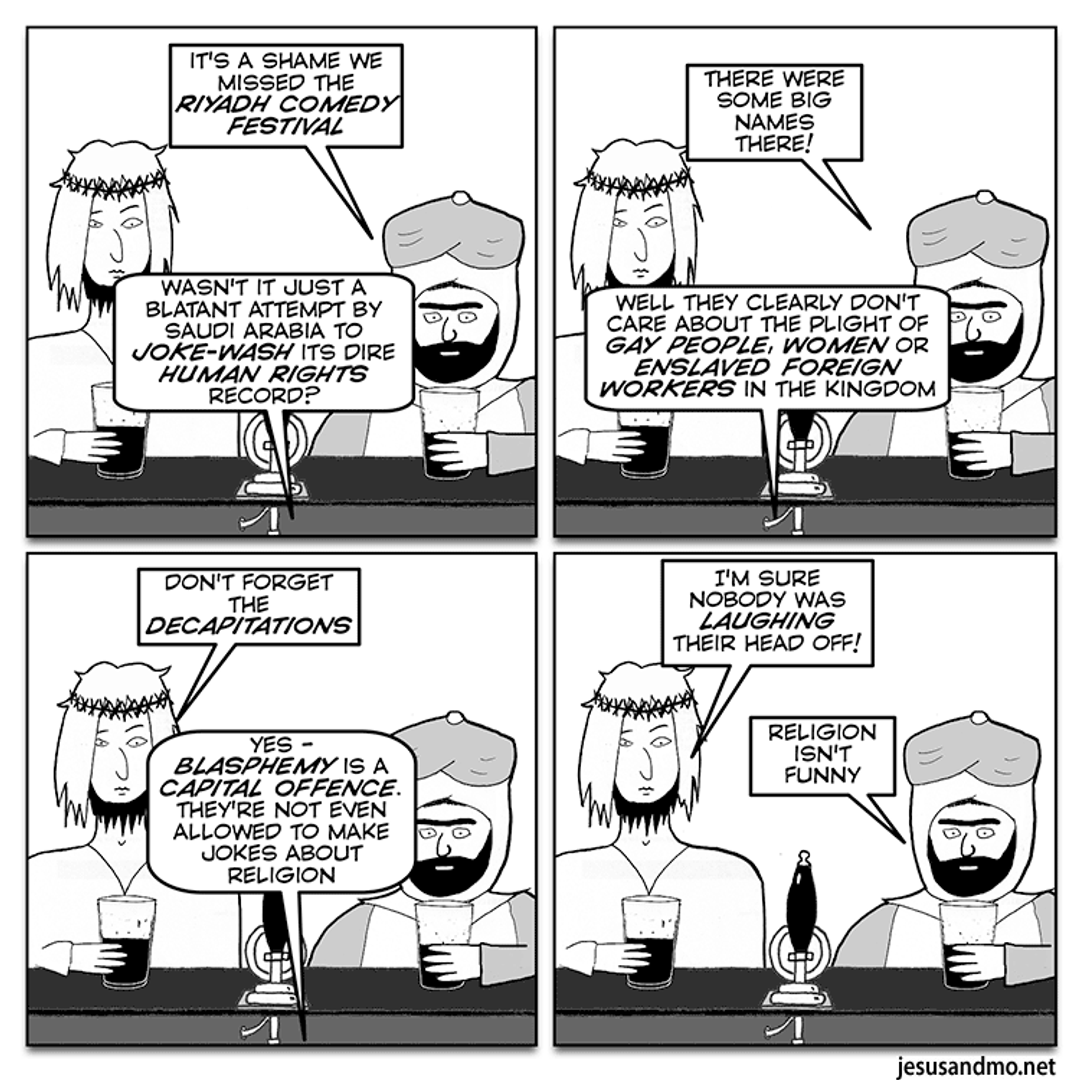
Jesus ‘n’ Mo ‘n’ humor (?)

October 22, 2025 • 8:45 am

The latest Jesus and Mo strip, called “dire,” comes with the caption, “It really isn’t. Here’s an article about the Riyadh Comedy Fest.”

An excerpt from the BBC article about the comedy gala in Saudi Arabia:

“There were sex jokes, and wife jokes. It’s really unusual to see this kind of comedy here in Saudi Arabia.”

That’s how one ex-pat summed up the performances she’s seen, at the first ever Riyadh Comedy Festival.

“The response was amazing, I’ve never seen such enthusiasm,” she said, after sets by American stars Dave Chappelle and Bill Burr.

The woman – whom we’re calling Sara – said the comedians avoided discussing Saudi Arabia’s controversial human rights record. But that didn’t particularly bother her.

“People here don’t care about those topics,” she said. “If they did, they wouldn’t live here.”

Outside Saudi Arabia, there are very different perspectives.

Famous comedians such as Jimmy Carr, Jack Whitehall, Kevin Hart, Russell Peters and Omid Djalili have been intensely criticised by fellow artists for agreeing to perform at the festival. Others say they turned down invitations.

On Friday, one of the few female comedians on the bill, lesbian stand-up Jessica Kirson, apologised for taking part in the event, telling The Hollywood Reporter she would be donating her fee to a human rights organisation.

But some argued it’s a more nuanced picture. While human rights groups have a host of concerns about Saudi Arabia, the country has attempted to transform its image in recent years.

Yes, there’s a double entendre there, but I believe the artist is quite serious. It’s telling that “ex-pat Sara” won’t let them use her real name in her comment, which seems innocuous.