Big study shows lack of diversity in teaching and little opposition to “progressive” views

October 29, 2025 • 10:30 am

The first article below, in Persuasion, is a précis of a much longer one by the same authors that I read recently; it’s not yet published it but you can access it below; click on the second shot to see the bigger piece.

The upshot is that the authors examined 27 million syllabi from colleges around the world by “scraping” them from websites. The object was to take three contentious topics: race discrimination, the Israel-Palestine conflict, and the ethics of abortion, and answer these questions for each:

  1. For each topic, how often was a “progressive” paper or book assigned if it was assigned by itself? (The three areas and views are those promoting the ubiquity and strength of race discrimination, works favoring Palestine as an oppressed territory, and works favoring choice inb abortion.)
  2. Ditto for “anti-progressive” papers or books (works critical of others that claimed to bigotry, especially in the criminal justice system, works favoring Israel or critical of pro-Palestinian works, and works taking a “pro-life” view.
  3. For those courses in which “progressive” works were assigned, how often were works critical of the progressive readings assigned as opposed to  readings supportive of the progressive readings?
  4. Ditto for courses assigning “anti-progressive” works: how often were works critical of those assigned as well works supporting the anti-progressive views.

The object was to see how often faculty were exposing students to both sides of an argument. That would have been the result if “progressive” works were often assigned with works that were critical of them as opposed to works that simply buttressed them.

The upshot is what you might expect: “anti-progressive” (or “conservative”) works were assigned with progressive ones far less often than were works that buttressed the progressive point of view. Conclusion: liberal academia is not exposing students to credible alternative points of view (and yes, the authors took care to examine cite only works that academically credible).

Classic “progressive” works used in their analysis include the following; you won’t know the critical views so much but you can see them in the paper. I’d recommend reading the big unpublished paper if you have time as it has a lot more data.

  1.  The classic progressive views of racism in the criminal-justice system:  Michelle Alexander’s book The New Jim Crow and Ta-Nehisi Coates’s book Between the World and Me
  2.  The classic progressive view of the Israel/Palestine conflict (and oppression of Arabs in general): Edward Said’s book Orientalism
  3.  The classic progressive “pro-choice” paper: Judith Jarvis Thomson’s paper “A Defense of Abortion

What to read. Here’s the précis:

and the longer paper from which the above is drawn (click to read):

Now both of these papers lay out possible problems with the results. Still, the results they got are pretty much what you’d expect given the pervasive liberalism of college professors.  Progressive texts are assigned by themselves much more often than are conservative papers on the same ideas; but, more important, when progressive papers are assigned, they are assigned much more often along with papers that support them than with papers that are critical of them. This is not what we’d expect if professors are supposed to stimulate students by teaching them scholarly controversies about divisive issues.  Instead, we get what looks like propagandizing.  Again, I may not be giving a good summary of what the papers found, but I would recommend reading either the Persuasion paper or, preferably, the unpublished one.

Here’s a summary of data from syllabi containing works about race. This comes from the Persuasion paper:

Across each issue we found that the academic norm is to shield students from some of our most important disagreements.

Consider, for example, Michelle Alexander’s important 2010 book, The New Jim Crow. Alexander argued that mass incarceration emerged after the collapse of the Jim Crow system in the South, largely as a way to reestablish the subjugation of black Americans. It would be hard to overstate its influence. Ibram X. Kendi called it “the spark that would eventually light the fire of Black Lives Matter.” And on college campuses, it became the assigned reading. On the topic of race and the criminal justice system, no other work is more popular in the syllabi database; it appears in more than four thousand syllabi in U.S. universities and colleges.

As soon as it was published, The New Jim Crow stirred contention within academia. The most prominent critic was James Forman, Jr., a professor at Yale Law School. In a seminal working paper, Forman challenged Alexander’s thesis. Among other shortcomings, Forman wrote that The New Jim Crow “fails to consider black attitudes toward crime and punishment, ignores violent crimes while focusing almost exclusively on drug crimes, obscures class distinctions within the African American community, and overlooks the effects of mass incarceration on other racial groups.” Forman’s work culminated in a book titled Locking Up Our Own, a well-regarded work that won the Pulitzer Prize.

How often is Forman’s book assigned along with Alexander’s? Less than four percent of the time. Other prominent critics—like Michael Fortner, John Pfaff, and Patrick Sharkey—are assigned even less often. Fortner’s important book The Black Silent Majority, for example, is assigned with The New Jim Crow less than two percent of the time.

So what is assigned with The New Jim Crow? Mostly books that are broadly aligned with it. The three most commonly co-assigned texts include Angela Davis’s Are Prisons Obsolete?, Ta-Nehisi Coates’s Between the World and Me, and Michel Foucault’s Discipline and Punish. We estimate that less than 10 percent of professors assigning Alexander’s book actually teach the controversy surrounding it.

That’s pretty depressing. All three issues fit the same pattern, though the issue of abortion is more balanced. In general, important progressive texts are assigned with texts that support them, not texts that criticize them. A summary of the other issues from Persuasion:

Orientalism is among the most popular books assigned in the United States, showing up in nearly four thousand courses in the syllabus database. But although it was a major source of controversy, both then and now, it is rarely assigned with any of the critics [Edward Said] sparred with, like Bernard Lewis, Ian Buruma, or Samuel Huntington. Instead, it’s most often taught with books by fellow luminaries of the postmodern left, such as Frantz Fanon, Judith Butler, and Michel Foucault.

What about the ethics of abortion? This question is taught in a more even-handed way, at least compared to the other issues we studied. More than a third of syllabi that assign Judith Jarvis Thomson’s classic defense of abortion rights, for example, pair it with a pro-life voice. Yet even in this case, we observe the same pattern: Most professors shield their students from scholarly controversy.

The authors’ conclusion in their big paper is that America’s waning trust of academia can be restored by teaching disagreements, not just one side of an issue. They emphasize that they are not saying to simply assign more conservative intellectual works, but simply to assign works that are critical of popular works like Alexander, Said, and Thomson.  (I have read two of these and found both Alexander and Thomson very persuasive. Yet I didn’t even know about the credible scholarly works critical of what I read.) Yes, some of the critics are conservative, but not all of them. The point is to teach the controversies about live scholarly debates—though not with settled issues like evolution.  Ideology here is less important than presenting students with the clash of ideas and getting them to think and debate.

I found one more bit of the Persuasion paper pretty horrifying:

Perhaps the most troubling objection to our project, and the most emphatic complaint we’ve heard since posting our paper, is that now is not the time to be raising these concerns. In the face of Trump’s blunderbuss war on the universities, we shouldn’t air our profession’s dirty laundry. One colleague, whose work we deeply respect, told us that it could be used “as a pretext” to do even more damage to the institutions that we love.

But we are convinced that there are other dangers to ignoring a real problem—dangers that are every bit as existential as Trump’s war on the universities. If we professors suspend our critical inquiries in the face of this emergency, then Trump has truly destroyed higher education.

This is precisely the criticism that some miscreants have leveled at the recent anthology compiled by Lawrence Krauss: The War on Science, a compendium of chapters in which over thirty authors mostly take the left to task for its inimical and ideological effects on science.  We were told exactly what Shields et al. were: “now is not the time to show how the left is hurting science because Trump is hurting it much more.” That itself is a debatable point, of course, especially in view of the different ways the “hurt” is occurring. Regardless, telling critics of “progressivism” to shut up because we need to unite in criticizing Trump is badly misguided. It goes against everything that academia is supposed to promote, including freedom of speech and academic freedom. It is the combination of these two freedoms that is supposed to yield truth, not a one-sided view that leans toward the left.

I am a leftist, but also an academic, and I think that the big Shields et al. paper is important not only to buttress what we’re supposed to be doing, but also to stem the ongoing decline in the reputation of American universities. .
 

Jesus ‘n’ Mo ‘n’ the god-shaped hole

October 29, 2025 • 9:15 am

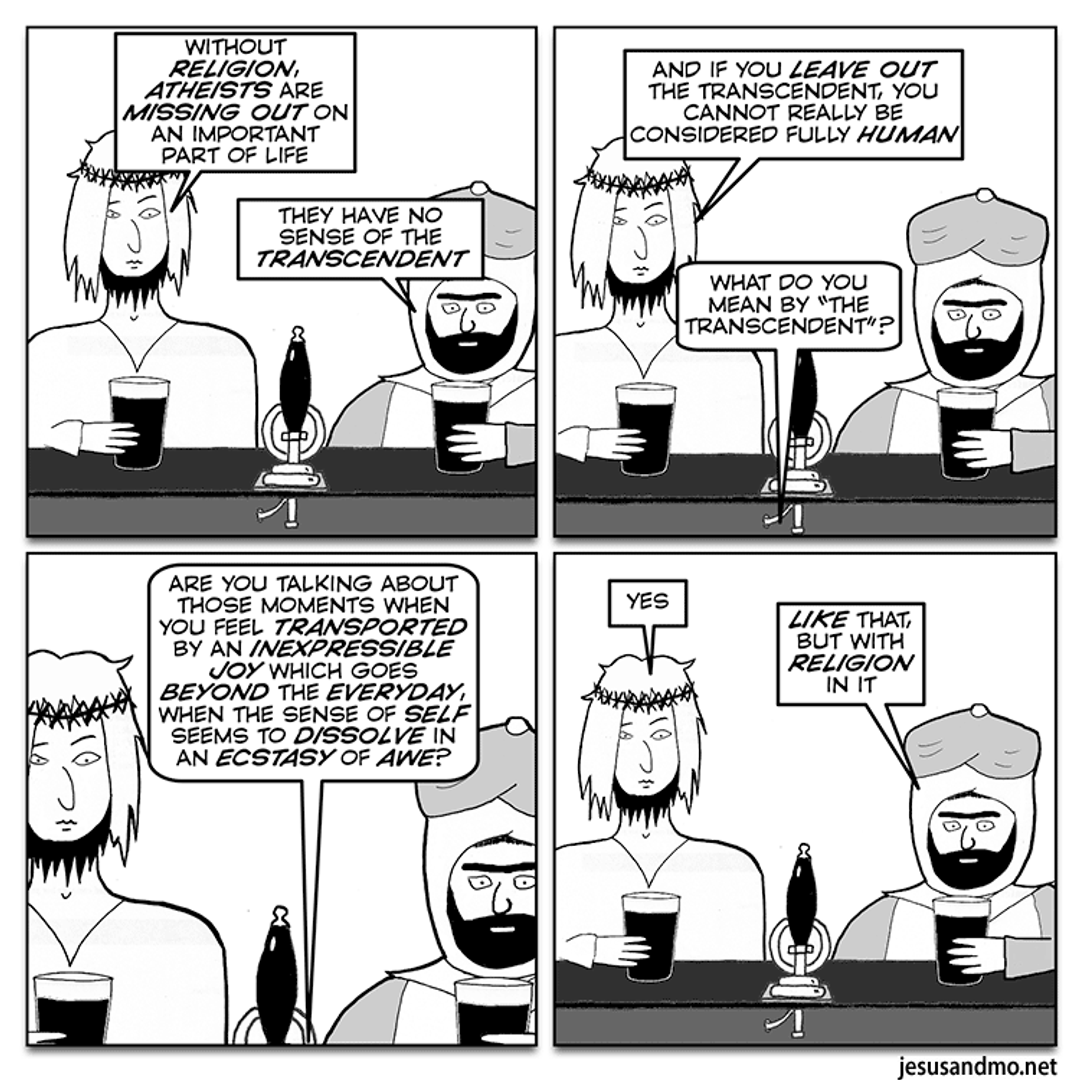
Today’s Jesus and Mo strip, called “joy2,” is a “resurrection from 2009.”  Mo, quaffing his usual Guinness, clarifies what the “god-shaped” hole really is:

I also discovered that there is a Jesus and Mo entry in Wikipedia, and this year is its twentieth anniversary! From the entry:

Jesus and Mo share a flat (and a bed), and occasionally venture outside, principally to a public house, The Cock and Bull, where they drink Guinness and engage in conversation and debate with an atheist female bartender known simply as Barmaid, who is never drawn but is characterised only as an out-of-frame speech bubble. The barmaid functions as the voice of reason when criticising the Abrahamic religions or religion in general. Other times, Jesus or Mo may act as the voice of reason depending on which religion a particular comic aims to criticise. Jesus will act as the author’s mouthpiece if the comic aims to criticise Islam while the character Mo will be used to criticise Christianity. They also converse with each other on a park bench.

Wednesday: Hili dialogue

October 29, 2025 • 6:45 am

Welcome to a Hump Day (“Горб хүнү” in Tuvan): Wednesday, October 29, 2025, and National Cat Day. The first reader who sends me a good photo of their cat, along with a few words about it, will get the moggy’s photo put right in the space below. Hurry up!

. . . . .aaaand, we have a winner:  Bob Woolley of Asheville, NC and his boss Lucy:

This is Lucy, on my bed a few days ago, aglow in morning light from my east window. She is 14 and the sweetest, funniest cat I’ve ever known. I recently had to get a set of pet stairs for her to use to get onto the bed, because with age she is losing her ability to jump. But she still acts as my alarm clock when she determines that it’s time for her breakfast, and insists that I get out of bed every night just after I’ve gotten in, because that’s her preferred play time.’

It’s also National Oatmeal Day and International Internet Day, explained here:

It was on today’s date in 1969 that the first electronic message was sent from one computer to another. ARPANET, the Advanced Research Projects Agency Network, was the precursor to the internet. Funded by the US Department of Defense, the network used packet switching to connect four terminals: UCLA, Stanford, University of California-Santa Barbara, and the University of Utah. Charley Kline, a student programmer at UCLA, under the supervision of Professor Leonard Kleinrock, transmitted a message from the SDS Sigma 7 Host computer in UCLA’s computer science department to the SDS 940 Host computer, manned by Bill Duvall, at Stanford. Kline attempted to send the word “login,” but the connection crashed after the first two letters, and only “L” and “O” were sent. These letters became the first data sent over the first long-distance computer network.

Here’s a very fancy bowl of oatmeal I was served at an inn at the Kent Presents meetings in August, 2018.  Newswoman Leslie Stahl was sitting at the next table, planning her onstage interview with Henry Kissinger later that day. Fruits (including fresh figs), nuts, maple syrup, and heavy cream—ow that’s what I call oatmeal!

Readers are welcome to mark notable events, births, or deaths on this day by consulting the October 29 Wikipedia page.

Posting will be light today and tomorrow as I am in the midst of a fierce bout of insomnia. I didn’t get a wink of sleep last night, and average 3-4 hours per night otherwise. If you sleep well, be grateful.

Da Nooz:

*The Toronto Blue Jays tied the World Series at two games each with a 6-2 victory over the Dodgers, even with Ohtani as the starting pitcher.

*At this moment Hurricane Melissa is striking Jamaica with violence; look at these wind speeds! It’s the strongest hurricane on record to strike the country, and nearly a record for the Atlantic Ocean.  I hope America kicks in substantial money to help Jamaicans recover, as it’s not a rich country and the damage will be severe. From the NYT:

The northern edge of Hurricane Melissa’s eye wall, bringing some of its most violent winds, produced flash flooding and storm surges as its pushed onto Jamaica’s southern coast on Tuesday morning. The hurricane neared landfall as a Category 5 storm, with 185 m.p.h. winds, just short of the most intense Atlantic hurricane on record.

The storm’s intensification — with sustained winds stronger than those of Hurricane Katrina at its peak — came with dire warnings from officials. “Jamaica, this is not the time to be brave,” said Desmond McKenzie, the minister coordinating disaster response. “Don’t bet against Melissa. It is a bet we can’t win.”

Forecasters for the U.S. National Weather Service made a similar warning to people in the hurricane’s path, saying that this was the “last chance to protect your life.”

More intense than the Category 5 strength of Katrina, which pummeled New Orleans in 2005, Melissa is now the fifth-strongest hurricane on record in the Atlantic Ocean.

The National Hurricane Center in Miami predicted Melissa would make landfall — the moment the center of its eye reaches land — in the next few hours. But long before that, rain and wind were lashing building and soaking hillsides, raising the threat of deadly floods and devastating landslides.

Forecasters were predicting rains measured in feet, not inches, for Jamaica and other Caribbean nations this week. Despite their warnings about destructive winds, rain and floods, officials in Jamaica were worried that not enough people were heeding evacuation orders.

The winds in Melissa’s eye wall were so strong that they could cause “total structural failure” and widespread power and communication outages, the hurricane center said on Monday. At least three people have died in connection to preparations for the storm, and thirteen others were injured, officials said.

Here’s  video of a U.S. Air Force flight into the eye of Melissa. Look at the walls around the eye! Click on “Watch on YouTube” if there’s no preview:

The storm struck Cuba this morning, still powerful.  Many people were evacuated.

Hurricane Melissa made landfall in Cuba early Wednesday after leaving a swath of destruction in Jamaica, where most people were cut off from the internet and major airports remained closed.

Melissa hit Jamaica on Tuesday as one of the strongest Category 5 storms on record, at one stage packing 185 m.p.h. winds. It knocked out communications and power for large swaths of the island, making it difficult for the authorities to get reliable assessments of the damage. Photos and videos posted on social media showed damaged cars and debris from roofs blown off by the storm.

President Miguel Díaz-Canel of Cuba had warned late Tuesday that it would be a “very difficult night” for the island, as the authorities there evacuated close to 750,000 people ahead of the storm’s arrival. The U.S. Navy has ordered personnel into shelters at its base at Guantánamo Bay. Those headed to shelters there were told to bring their own bedding and a three-day supply of ready-to-eat food and water.

Eastern Cuba could receive up to 20 inches of rain through Wednesday, with 25 inches expected in mountainous areas, forecasters said, warning of potentially catastrophic floods.

*Some (but not all) Israelis are peeved because Trump is calling a lot of the shots now that there’s a ceasefire.

The Trump administration’s aggressive efforts to promote the success of the Gaza ceasefire deal have some Israelis bristling at what they see as an overly intrusive approach that limits Israel’s freedom of action and concedes too much to Hamas.

Over the past 10 days, a parade of top U.S. officials have passed through Israel, in part to make sure that Prime Minister Benjamin Netanyahu adheres to the terms of the ceasefire agreement as defined by its prime sponsor, President Donald Trump. The administration has also taken the exceptional step of deploying 200 U.S. troops to a coordination center in southern Israel, where they will help oversee the implementation of the deal and potentially constrain the Israeli military’s operations in Gaza.

“The Americans aren’t just involved. They’re leading it. Israel is merely participating,” said Brig. Gen. Ran Kochav, a former air and missile defense commander in the Israeli military. “Anywhere in the world where the Americans deploy a joint task force, they push everyone else aside and take command, control and leadership of the operational activity. … No one is comfortable with it,” he said, referring to discontent in the Israeli military.

Longtime Israeli military correspondent Amos Harel, writing in the Haaretz newspaper, said Israeli “defense officials have the impression that American scrutiny of Israel has reached a point that usurps Israel’s military and diplomatic power.”

. . . The U.S. troops are playing a role in overseeing the urgently needed provision of humanitarian assistance to Palestinians in Gaza and the search for bodies of deceased Israeli hostages there. That role could expand as the ceasefire agreement moves to the next phase, which calls for the disarmament of Hamas, the further pullback of Israeli forces in Gaza, and the establishment of a transitional government and stabilization force in the enclave.

“For the first time, America has placed troops in Israel, to monitor the ceasefire,” said Michael Oren, former Israeli ambassador to the United States. He added, “They’re monitoring us, and they’re restricting our movements.”

I can understand why some Israelis are frustrated, unable to conduct the war the way they want. On the other hand, they can’t do it because they need to keep amity with America, which means means weapons and U.S. support.  The really tough part will come when Hamas has to disarm, which I still don’t think it will do; nor do I imagine the U.S. can help with that. After that, there needs to be an international peacekeeping force, and I can’t imagine who that will be, either.  Finally, of course, there’s the Palestinian government to be set up, which seems nearly impossible at this time—at least a government that won’t promote terrorism against Israel.

*On the other hand, and this is breaking as I write this on Tuesday afternoon, Netanyahu has ordered new airstrikes on Gaza, and this would not have been done without U.S. approval.

Tension and fear spread across Gaza on Tuesday evening after Israeli Prime Minister Benjamin Netanyahu ordered the military to launch immediate strikes on the enclave.

Witnesses in several areas of Gaza City and Khan Younis said people hurried home as news of the order circulated.

“The streets emptied as soon as they heard the Israeli threats,” Alaa Saleh, a teacher who is now working a taxi driver, told the BBC. “Everyone wanted to reach his tent or house before the planes arrived.”

Most shops closed their doors before nightfall, and the normally crowded markets fell silent. Local residents said armed Hamas fighters who had been manning checkpoints on several main roads were seen withdrawing shortly before sunset.

The renewed tension comes amid growing uncertainty surrounding the fragile truce and ongoing efforts to recover the bodies of Israeli captives believed to remain under the rubble or in tunnels.

Residents in Gaza described a mix of anxiety and exhaustion after months of sporadic violence and repeated Israeli warnings of renewed operations

The explanation comes from the Times of Israel:

The strikes come after Israeli officials vowed to respond to an attack on troops in south Gaza today and Hamas’s failure to return the bodies of hostages still held in the Strip.

. . .Defense Minister Israel Katz says Hamas will pay a “heavy price” for attacking IDF soldiers earlier today in southern Gaza’s Rafah and for the terror group’s violations of the deal under which it was supposed to return the bodies of remaining dead hostages held in the Strip.

“The attack on IDF soldiers in Gaza today by the Hamas terror organization crosses a glaring red line to which the IDF will respond with great force,” Katz says in a statement.

“Hamas will pay many times over for attacking the soldiers and for violating the agreement to return the fallen hostages,” he adds.

One gets the impression that Hamas does indeed have the bodies of the missing hostages, but is slow to turn them over.  This time, however, they have no leverage  to bargain with Israel, as Hamas promised earlier to turn them all over.

*The Dodgers beat the Blue Jays on Monday 6-5, in what was a tie for the longest game in World Series history: 17 innings and more than 6½ hours! And Ohtani once again put on a stellar exhibition—so much so that the Blue Jays had to give him four intentional walks.  The Dodgers now won two games to Toronto’s one (for non-Americans, the first team to reach four wins takes the championship).

About 40% of the way through the marathon that tied the record for the longest game in World Series history, Toronto Blue Jays manager John Schneider reached a decision.

The greatest baseball player on the planet would not be the reason his team lost on Monday night.

It didn’t matter how many outs there were or how many runners the Los Angeles Dodgers had on base. Under no circumstance would the Blue Jays allow Shohei Ohtani to deliver the decisive blow. He had already tormented them for two doubles and two homers. From that point on, Schneider decided, Ohtani would not see another strike—period.

Five times in a row, from the ninth inning to the 17th, the Blue Jays walked Ohtani. The first four were intentional, including three with the bags empty. The last one wasn’t, but might as well have been, with Ohtani seeing four straight balls well out of the strike zone.

By the time the contest ended six hours and 39 minutes after it began, he had reached base on each of the nine occasions he stepped up to bat—the latest of Ohtani’s achievements that sounds utterly impossible but actually happened. Before this, the previous postseason high was six.

In the end, the Dodgers did win. Freddie Freeman slammed a walk-off homer to lead off the bottom of the 18th, putting the finishing touch on one of the weirdest, wackiest, most mind-numbing contests ever staged in the Fall Classic. The Dodgers are now two victories away from claiming their second consecutive championship.

For that to happen, they will have to rely on somebody beside Ohtani. He might not get another pitch in the same ZIP Code as home plate.

Oh, and if that’s not enough, there’s this: Ohtani is set to be on the mound for Tuesday’s Game 4.

“Another one in the history books for Shohei,” shortstop Mookie Betts said afterward.

Here are six minutes of highlights. I tell you, this is one exciting Series. It doesn’t show the four intentional walks given Ohtani, though. I’m rooting for the Dodgers because with two fantastic Japanese imports on the team, it is more of a “world” series than ever before.

. . . and some stats from the AP’s story:

*And just in time for Halloween, the Oregon Zoo once again allowed its giant elephants to smash giant pumpkins (a tradition):

Some of the world’s largest land animals demolished some of the area’s largest pumpkins this morning during the Oregon Zoo’s 24th annual Squishing of the Squash.

“We gave our elephant family some extra-large pumpkins to stomp on and chomp on,” said Steve Lefave, who oversees the zoo’s Asian elephant area. “First they destroyed them, then they enjoyed them.”

The event is a lead-in to the zoo’s annual Howloween celebration, presented by The Oregonian/Here Is Oregon, which takes place later this month. Kids can show off their costumes and learn about wildlife in a fun and safe setting, Oct. 22­–​23 and Oct. 28­–31.

The tradition dates back to 1999, when Hoffman’s Dairy Garden of Canby dropped off a prize-winning 828-pound pumpkin for the elephant family. Farmers often offered their overstock pumpkins for use in the zoo’s groundbreaking animal enrichment efforts — enhancing animals’ well-being with stimulating and challenging environments, objects and activities.

This year’s pumpkins — provided by Pacific Giant Vegetable Growers Club member Larry Nelson and his daughter, Amanda Gilmour — ranged from about 300 to 800 pounds

And from the AP:

To break open the gargantuan gourds, zookeepers present them to Tula-Tu’s adult relatives like her brother and father who weigh slightly over 10,000 pounds (4,500 kilograms). In a video from the zoo, they appear to delicately place one foot at the top, and gently press down. The pumpkins crack with a loud pop, sending rind and seeds flying.

Past years’ videos have shown midsized, young elephants putting both feet on top of the pumpkins but being too light — or lacking technique — so the giant vegetables don’t burst.

This year the adults elephants smashed the massive pumpkins in front of a cheering crowd of zoo visitors, and then the family of elephants ate the many tons of squash fragments.

Asian elephants like Tula-Tu and her family are considered highly endangered, according to Oregon Zoo officials. There is a fragmented population of around 40,000 to 50,000 such elephants in the wild in places ranging from India to Borneo, a Southeast Asian island straddling Indonesia, Malaysia and Brunei. But there have been successful conservation milestones in recent years, including in Cambodia.

Of course you will want to see a video, so here you go (the elephants smash ’em because they like to eat ’em). I wonder if the pachyderms get as much pleasure from this as we do popping the bubbles in plastic bubble wrap:

Meanwhile in Dobrzyn, Andrzej tries to keep Hili from killing birds:

Hili: Hunger awakens a murderous urge in me.
Andrzej: Come home, I’ve got rabbit pâté.

In Polish:

Hili: Głód budzi we mnie chęć mordu.
Ja: Chodź do domu, mam pasztet z królika.

*******************

From Jesus of the Day:

From The Language Nerds:

From Cats That Have Had Enough of Your Shit:

Masih is happy because tomorrow she’ll be in court as her would-be assassins are sentenced.  A delightful woman!

From Luana: a pamphlet with recipes for Democratic victories.  You can find the document here, and at least look at the figures.

Riley Gaines is, sadly, a Republican, but AOC seems pretty mean-spirited here (Gaines finished fifth in the women’s 200-yard freestyle final at the N.C.A.A. Division I competition in 2022).

From Malcolm; does somebody want to fill me in here? Who is it and how did it change basketball?

Larry Summers (former Harvard President) calls out Harvard’s hypocrisy, but a present Harvard Dean tries to stop him from finishing his remarks. Oy!

One I posted on The Auschwitz Memorial:

This Dutch Jewish girl was gassed to death immediately upon arriving at Auschwitz. She was seven years old. Had she lived, she would have turned 91 yesterday.

Jerry Coyne (@evolutionistrue.bsky.social) 2025-10-29T10:47:55.856Z

Two from Dr. Cobb.  I found the exact information on the game for him–my contribution to the Crick bio! (Box scores are forever.) Matthew added, “Ppl on Bsky v excited by last night’s match that went on forever, so I was obliged to post about Crick’s experience and your explanation.”  He hasn’t learned that Americans don’t call baseball games “matches.”

For all the baseball fiends out there, in June 1954 Crick went to a baseball match, as described in my forthcoming biography (apologies, you can expect a lot more of this kind of thing in the next few weeks…)

Matthew Cobb (@matthewcobb.bsky.social) 2025-10-28T08:47:39.745Z

I missed the anniversary yesterday, but Matthew and I are huge fans of Krazy Kat (click if you want to go to the original post):

The erosion of medical journals

October 28, 2025 • 11:30 am

Of all the papers in the special issue of the Journal of Controversial Ideas on censorship in science, the one below is perhaps the most important, as the censorship being imposed can cause permanent damage to humans. I’ve described this censorship before: it involves papers on or critiques of extreme claims of gender ideologues, especially those touting the benefits of what’s called “affirmative care” (adolescent dysphoria—> doctor on board prescribes puberty blockers almost immediately—> hormones, surgery, and gender transition). The recent history of the field, documented in the first paper below, involves repeated attempts to allow questionable claims to stand in the literature. Two examples of this are the unsupported claim that affirmative care prevents suicide, and the release of the paper by Johanna Olson-Kennedy et al, which was held back because the results (puberty blockers did not improve mental health) were not in line with what author thought gender activists wanted to see.  The paper by Cohn below (click to read), summarizes many of these forms of censorship or distortion.

Here’s the abstract:

The integrity of the gender medicine research literature has been compromised, not only by censorship of correct articles, but also by censorship of critiques of articles with unsupported (for instance exaggerated), misleading or erroneous statements. Many such statements concern the evidence base, which can be evaluated rigorously using a key component of evidence-based medicine, systematic reviews of the evidence. These reviews currently find there is limited to very little confidence that estimates of benefit from (and sometimes harm from) medical gender intervention, that is, puberty blockers, hormones and/or surgeries, are likely to match true outcomes. Several medical societies and articles in medical journals have been claiming otherwise, misrepresenting the evidence base as a whole and/or relying upon unsupported or non-representative individual study findings or conclusions. For example, high likelihood of benefit and low risk of adverse outcomes from medical gender interventions are often claimed, while less invasive alternative treatment options are either omitted or mischaracterized. Other unsupported, erroneous or misleading statements occur when studies minimize or omit mention of significant limitations, or report findings or conclusions not supported by their own data; these are then sometimes quoted by others as well. In addition, correctly reported studies are sometimes misrepresented. Critiques which attempt to rectify such statements are frequently rejected. Some examples are presented here. Such rejections have stifled scientific debate, interfering with the continual scrutiny and cross checks needed to maintain accuracy in the research literature. Currently, erroneous and unsupported statements circulate and repeat between journals and medical society guidelines and statements, misinforming researchers, clinicians, patients and the general public.

If you want a three-page summary of the paper above, which you really should read in toto if you’re interested in gender medicine, read the article below (click headline to read) gives a terse summary.

I can’t summarize the first paper in detail, and you really should read it for yourself. I can, however, give a few quotes from Linehan’s summary on his Substack, which is a bit choppy (quotes indented below). Linehan begins by citing the paper above:

‘Censorship of Essential Debate in Gender Medicine Research’ has the dullest possible title for what it reveals. In yet another example of trans ideology destroying everything it touches, the most prestigious journals in medicine are refusing to publish corrections to papers that contain demonstrably false claims about gender medicine.

The author, J. Cohn, didn’t set out to write about censorship. She tried to correct errors in published papers. When that didn’t work, she described what happened. She found that multiple systematic reviews (the gold standard in evidence-based medicine) have found low or very low-certainty evidence for the benefits of medical gender interventions. This includes puberty blockers, hormones, and surgery. ‘Low certainty’ means there’s limited confidence the estimated effects will match what actually happens to patients.

The Cass Review, published in 2024, found the evidence for paediatric interventions “remarkably weak.” Several other systematic reviews found the same for patients under 21 and under 26.

None have found that these interventions reduce suicide risk.

Meanwhile, major medical journals keep publishing papers claiming the opposite.

Papers in JAMA, the New England Journal of Medicine, and Pediatrics have variously claimed that gender-affirming medical interventions are:

  • “Widely recognised as essential, evidence based, and often lifesaving”
  • Known to “clearly improve health outcomes”
  • Associated with “demonstrated health and well-being benefits”
  • Linked to regret rates “less than 1%” or “exceedingly rare”

The regret claim is particularly bold given that the studies cited have major flaws. The often-quoted Bustos review included 27 studies, of which 23 had moderate-to-high risk of bias. All included studies suffered from premature follow-up, significant loss to follow-up, or both.

And one more bit:

Medical guidelines are supposed to work like this: researchers conduct systematic reviews of all available evidence, assess its quality, and make recommendations that match the strength of that evidence. Strong evidence gets strong recommendations. Weak evidence gets weak recommendations or no recommendation at all.

That’s not what happened here.

The American Academy of Pediatrics policy statement recommending gender-affirming care wasn’t based on systematic reviews. A subsequent analysis found its cited references “repeatedly said the very opposite of what AAP attributed to them.”

The Endocrine Society guidelines make strong recommendations based on evidence they themselves rate as low or very low certainty. They don’t explain why.

WPATH commissioned systematic reviews, then interfered with them. After publication, they dropped all but one minimum age recommendation (for phalloplasty) under pressure from the Biden administration and the AAP.

This whole field is rife with a form of advocacy so extreme that researchers not only hesitate to publish results that go against the preferred ideological narrative, but also repeatedly distort studies that criticize affirmative care.

This is not the way science is supposed to be done, but it’s what happens when ideology begins to erode the norms of science. This of course is not new: it’s what happened with the Lysenko affair in Soviet Russia (documented in our paper, Jussim et al.), when ideological distortion (and outright cheating) ultimately killed millions of people.  Nobody’s claiming that kind of toll for gender medicine, but there is still a palpable human cost to sloppy research.

h/t: Joolz

A new issue of J. Controversial Ideas on censorship in the sciences

October 28, 2025 • 9:30 am

For several years a group of us have been working on a paper on censorship in the sciences, and it’s finally come out in the Journal of Controversial Ideas (go here to access all the papers ever published). This “heterodox” journal founded in November 2018 by moral philosophers Francesca Minerva, Jeff McMahan, and Peter Singer. It’s peer-reviewed and open access, but believe me, the reviews are every bit as stringent as those for a science “journal of noncontroversial ideas.”

At any rate, our paper came out, but I didn’t realize that it was part of a special issue on censorship in the sciences until Heterodox at USC posted an announcement. Here’s part of it:

A special issue of the Journal of Controversial Ideas published today explores the serious problem of censorship plaguing the sciences, from the classroom to the research lab to scientific journals. The special issue contains 9 peer-reviewed papers including:

●     From Worriers to Warriors: The Cultural Rise of Women by Cory Clark, Executive Director of the Adversarial Project at the University of Pennsylvania

●     Fire the Censors! It’s the Only Way to Restore Free Inquiry by Robert Maranto, 21st Century Chair in Leadership at the Department of Education Reform at the University of Arkansas

●     Silencing Science at MIT: MIT Shows that Cancel Culture Causes Self-Censorship at STEM Universities by Wayne Stargardt, President of the MIT Free Speech Alliance

●     With Friends Like These: On the Role of Presupposition in Pseudo-Defenses of Free Speech on Campus by Mike Veber, Associate Professor of Philosophy at East Carolina University

The collection expands upon subjects discussed at the Censorship in the Sciences conference held at the University of Southern California in January 2025. Over 100 academics gathered for three days to discuss what constitutes censorship, how this problem impacts scientific research and teaching, and how to combat its spread.

The collection also includes an introduction highlighting the themes discussed at the conference.

Contrary to the popular belief that censorship emanates mostly from authoritarian governments or religious mandates, this conference and follow-up publications, including this special issue, revealed that self-censorship and censorship attempts led by academics against their peers form the majority of “cancellations” occurring within the academy today.

Moreover, such censoring of science originates largely from the progressive left. This is unsurprising, given that the academy is now overwhelmingly dominated by faculty who self-identify as liberal or progressive.

Such intra-academic censorship is a serious problem, as the introduction to the special issue makes clear: “Academic jobs and promotions require letters of recommendation from colleagues. Grants necessitate approval from other academics, as do publications. Thus, control over the careers of scientists from within academia influences what subjects are researched and what scientific information is disseminated. In short, it is academics who are the gatekeepers of knowledge production and dissemination. They have the means to block publication, funding, and even employment of their peers.”


You can peruse the contents, and choose which papers you want to read, if any, by clicking on the screenshot below.  You can get our paper, which puts present instances of censorship in historical context (including censorship in Soviet Russia), by clicking below.

And the abstract:

The 20th century witnessed unimaginable atrocities perpetrated in the name of ideologies that stifled dissent in favour of political narratives, with numerous examples of resulting long-term societal harm. Despite clear historical precedents, calls to deal with dissent through censorship have risen dramatically. Most alarmingly, politically motivated censorship has risen in the academic community, where pluralism is most needed to seek truth and generate knowledge. Recent calls for censorship have come under the name of “consequences culture”, a culture structured around the inclusion of those sharing a particular narrative while imposing adverse consequences on those who dissent. Here, we place “consequences culture” in the historical context of totalitarian societies, focusing on the fate suffered by academics in those societies. We support our arguments with extensive references, many of which are not widely known in the West. We invite the broader scientific community to consider yet again what are timeless subjects: the importance of freely exchanging views and ideas; the freedom to do so without fear of intimidation; the folly of undermining such exchanges with distortions; and the peril of attempting to eliminate exchanges by purging published documents from the official record. We conclude with suggestions on where to go from here.

It’s a cry in the wilderness. . . ,.

Readers’ wildlife photos

October 28, 2025 • 8:15 am

Send in your photos if you have good ones!

Today we continue with the eighth installment from Ephraim Heller’s trip to Brazil’s pantenal.  Ephraim’s test and IDs are indented, and you can enlarge the photos by clicking on them.

These photos are from my July 2025 trip to Brazil’s Pantanal, the world’s largest tropical wetland area and the world’s largest flooded grasslands. Today I focus on five species of kingfishers and one species of jacamar. Kingfishers (Alcedinidae) are one of my favorite bird families. Jacamars (Galbulidae) are unrelated to kingfishers, but the individuals I saw were in exactly the same locations as the kingfishers.

I was once on a photo safari with a good friend at home in Wyoming and asked whether all kingfishers eat fish. She laughed at me and told me that they are called “fishers” for a reason. But I had the last laugh, because, in fact, of the 118 species of kingfishers the large majority are insectivores. “I told you so” are my favorite four words. Jacamars are also insectivores.

Kingfishers and jacamars are both highly adapted to aerial predation by diving and sallying. Kingfishers are capable of adjusting for light refraction when diving for fish, have reinforced skulls to withstand diving impacts, specialized bill shapes for different prey types, and exceptional visual acuity for tracking fast-moving targets. Their hunting success rates exceed those of most other insectivorous birds, demonstrating the effectiveness of their sit-and-wait predation strategies.

Amazon Kingfisher (Chloroceryle amazona) – Hunts small fish and aquatic invertebrates. Both sexes participate in excavating tunnel nests in riverbank soil:

American Pygmy Kingfisher (Chloroceryle aenea) – The smallest kingfisher in the Americas, specializing in catching tiny fish and aquatic insects from low perches over small streams and ponds. It also constructs small tunnel nests in soft earth banks:

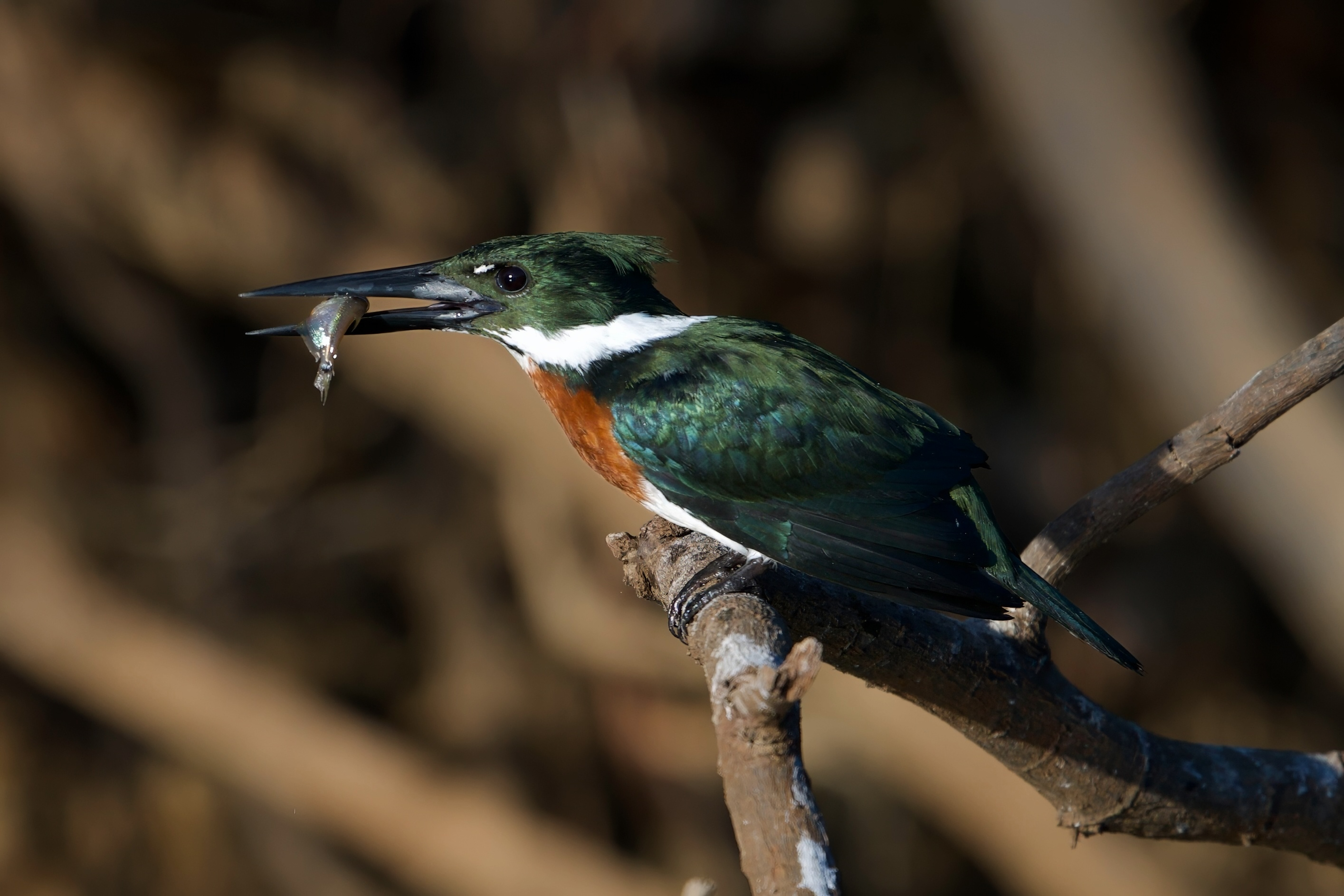
Green Kingfisher (Chloroceryle americana) – A small, common kingfisher. Males and females show distinct plumage differences, with males displaying rusty chest bands. Unfortunately, I only got a good photo of a female:

Green-and-rufous Kingfisher (Chloroceryle inda) – A big, beautiful kingfisher that hunts larger fish from rivers and lakes. This species requires clear water for successful hunting and serves as an indicator of aquatic ecosystem health. Its powerful dive and large bill allow capture of fish up to several inches in length:

Ringed Kingfisher (Megaceryle torquata) – The largest kingfisher in the Americas, capable of catching fish using dives exceeding 20 feet in height:

Rufous-tailed Jacamar (Galbula ruficauda) – A brilliantly colored sit-and-wait predator that sallies from exposed perches to catch flying insects with high precision, returning to the same perch to consume prey. This patient and maneuverable species specializes in capturing butterflies, dragonflies, and other large flying insects. I love its iridescent plumage: