
Colossal claims that dodo “de-extinction” is right around the corner (5-7 years). But at best they’ll get a “faux-doh”

September 18, 2025 • 10:45 am

(Matthew Cobb, who helped me with this post, gets full credit for coining the name of the animal Colossal aims to produce: a “faux-doh”.)

Well, after having given us a trio of genetically modified and robust, light-colored gray wolves (Canis lupus), proclaiming and pretending that they were really “de-extincted” dire wolves (Aenocyon dirus), Colossal  Laboratories and Biosciences is reaching up its sleeve to produce their next trick: a “de-extincted” dodo.  Except that they’re not going to produce a genuine dodo, or anything close to it. Colossal is going to make a few changes in the genome of a dodo relative (the closest living relative: the Nicobar pigeon), and then produce something that looks superficially like a dodo. They then plan to put a bunch of these faux dodos back on the island of Mauritius, where they went extinct at the end of the 17th century.

But this endeavor faces even more problems than the does “woolly mammoth de-extinction”, said to take place within a decade or so. (Colossal says we’ll have dodos in 5-7 years.) Most pressing is that we lack public information on the dodo genome (Colossal won’t publish the sequence and won’t tell us how much they have), and they will almost surely be unable to change anything more than the superficial appearance of a Nicobar pigeon, which was much smaller than the flightless dodo. Further, it’s very unlikely that Colossal will edit the pigeon genome to reproduce genes for behavior, ecology, and physiology of the dodo: the stuff that kept them alive on the island of Mauritius. So once again we get a “de-extincted” species lacking vital elements of the extinct species’ genome that would enable it to survive in the wild today.  Further, we don’t yet have the technology to edit a bird egg and then put it in a surrogate mother who will ultimately lay the egg from which the faux dodo/pigeon will hatch.  Finally, Mauritius is still inhabited by the animals introduced by humans that drove the bird to extinction (e.g., goats, rats, and pigs), and so these hybrids, whatever they are—but they will have to be big and flightless if they’re going to get any attention—will themselves go extinct if they’re put back where they evolved–and that is Colossal’s aim.

First, though, a bit about the dodo from Wikipedia.

The dodo (Raphus cucullatus) is an extinct flightless bird that was endemic to the island of Mauritius, which is east of Madagascar in the Indian Ocean. The dodo’s closest relative was the also-extinct and flightless Rodrigues solitaire. The two formed the subtribe Raphina, a clade of extinct flightless birds that are a part of the group that includes pigeons and doves (the family Columbidae). The closest living relative of the dodo is the Nicobar pigeon. A white dodo was once thought to have existed on the nearby island of Réunion, but it is now believed that this assumption was merely confusion based on the also-extinct Réunion ibis and paintings of white dodos.

Subfossil remains show the dodo measured about 62.6–75 centimetres (2.05–2.46 ft) in height and may have weighed 10.6–17.5 kg (23–39 lb) in the wild. The dodo’s appearance in life is evidenced only by drawings, paintings, and written accounts from the 17th century. Since these portraits vary considerably, and since only some of the illustrations are known to have been drawn from live specimens, the dodos’ exact appearance in life remains unresolved, and little is known about its behaviour. It has been depicted with brownish-grey plumage, yellow feet, a tuft of tail feathers, a grey, naked head, and a black, yellow, and green beak. It used gizzard stones to help digest its food, which is thought to have included fruits, and its main habitat is believed to have been the woods in the drier coastal areas of Mauritius. One account states its clutch consisted of a single egg. It is presumed that the dodo became flightless because of the ready availability of abundant food sources and a relative absence of predators on Mauritius. Though the dodo has historically been portrayed as being fat and clumsy, it is now thought to have been well-adapted for its ecosystem.

The first recorded mention of the dodo was by Dutch sailors in 1598. In the following years, the bird was hunted by sailors and invasive species, while its habitat was being destroyed. The last widely accepted sighting of a dodo was in 1662.

From Wikipedia, a skeleton and a reconstruction:
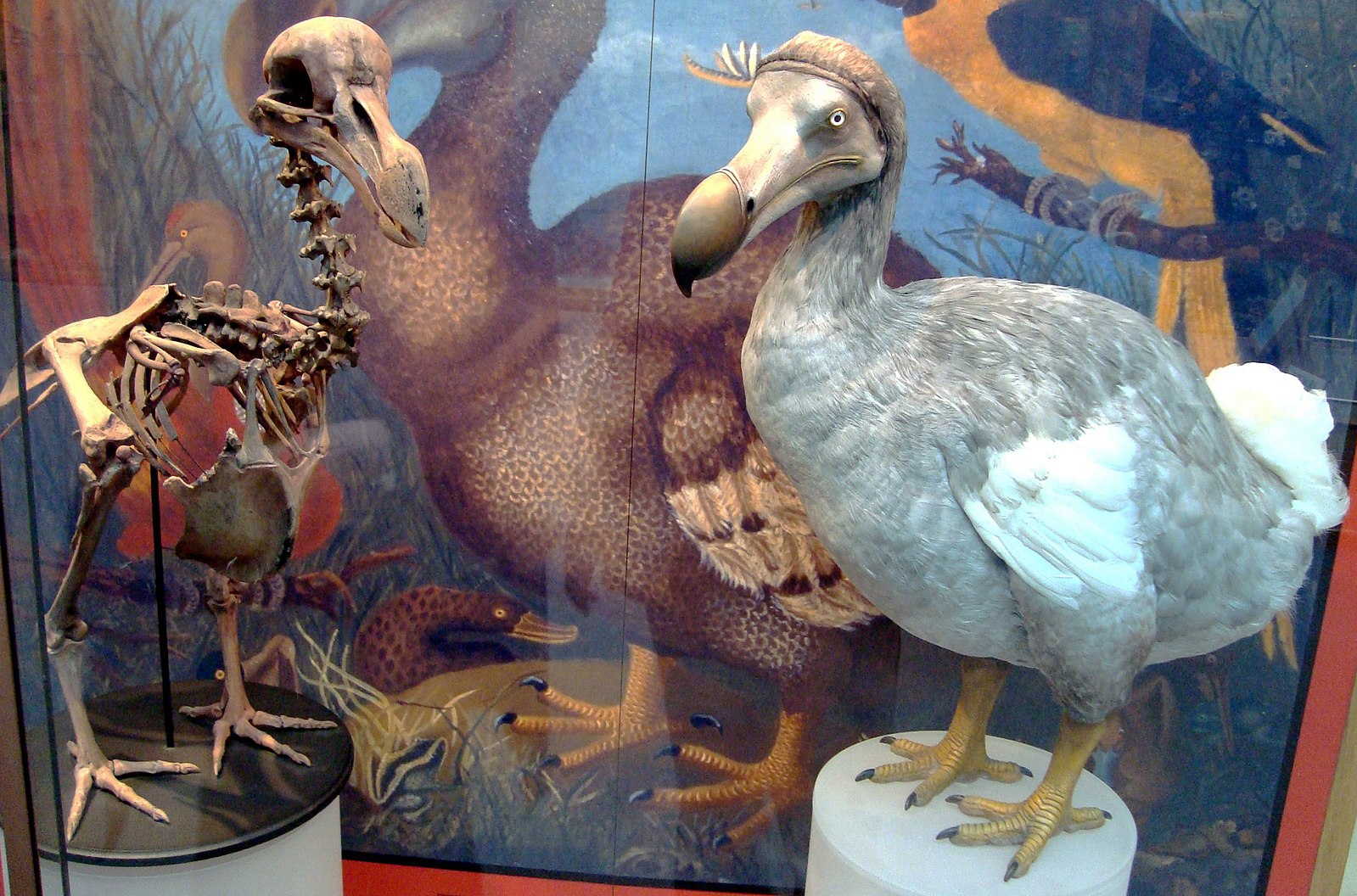
From Wikipedia: “Skeleton cast and model of dodo at the Oxford University Museum of Natural History, made in 1998 based on modern research” BazzaDaRambler, CC BY 2.0, via Wikimedia Commons

Note that the dodo weighed on average over 10 kg (20-odd pounds), which, along with its tiny wings, is why it couldn’t fly. (Birds on oceanic islands lacking predators often evolve flightlessness, which saves vital energy.)  In contrast, the Nicobar pigeon, a flying species, weighs about one pound. These two species shared a common ancestor about 20 million years ago, though there’s some variation in estimates because of the paucity of dodo DNA.

Their ecologies are also different: the pigeon is a flocking forest species (BTW, it’s endangered), nests in trees, and eats mostly seeds, fruit, and buds, and sometimes insects.. We don’t know whether dodos flocked but they certainly didn’t nest in trees! And, being larger, their diet likely consisted of bigger stuff. As Wikipedia notes, “In addition to fallen fruits, the dodo probably subsisted on nuts, seeds, bulbs, and roots.  It has also been suggested that the dodo might have eaten crabs and shellfish, like their relatives the crowned pigeons.”  So the tastes, digestion, and physiology of the dodo probably differed profoundly from that of the Nicobar pigeon.  Is Colossal going to genetically engineer its faux dodos to have these features so it eats the right stuff? That’s important if they are to preserve, as they insist, the ecology of the “de-extincted dodo.”  I won’t even mention how the mating preferences and behavior of the dodo have to be engineered into a pigeon.

This news piece from Nature (click to read) describes not only Colossal’s method (see the Colossal dodo site here), but also describes the problems they face in creating a faux dodo (see the subtitle):

Nature gives a handy précis of the method:

Colossal’s plan starts with the dodo’s closest living relative, the iridescent-feathered Nicobar pigeon (Caloenas nicobarica). The company plans to isolate and culture specialized primordial germ cells (PGCs) — which make sperm and egg-producing cells — from developing Nicobars. Colossal’s scientists would edit DNA sequences in the PGCs to match those of dodos using tools such as CRISPR. These gene-edited PGCs would then be inserted into embryos from a surrogate bird species to generate chimeric animals — those with DNA from both species — that make dodo-like eggs and sperm. These could potentially produce something resembling a dodo (Raphus cucullatus).

Colossal now says that the edited genome will be that of the Nicobar pigeon, and the surrogate will be a chicken. It’s not clear whether they’ll use chimeras and selection to get dodo-like birds, for that would take many years.

You can already spot the problems with this endeavor. I’ll list just a few that strike me:

  1. They have to sequence the whole dodo genome. It’s not clear that it’s been done; certainly nothing has been published, but I’m sure some stuff has been sequenced.  Colossal claims “50X coverage” of sequences so far, which means that each DNA base that they have was sequenced 50 times independently, but that says little about how much of the whole dodo genome (obtained from specimens in museums) has been sequenced.
  2. Related to that, dodo DNA is certainly fragmentary and degraded. Even if they can get all the bases, they have to be assembled in the right order into an entire genome, which is not an easy task.
  3. They have to know what the genes do, which is not at all obvious from the DNA sequence itself.  And they have to decide how many dodo genes they want to engineer into the pigeon genome so that the engineered pigeon at least superficially resembles a dodo. That means they need genes for big size, diet, dodo nesting and mating behavior, winglessness, and so on. Doing that alone is a herculean effort even if they have the whole genome.
  4.  We lack the technology to put a genetically engineered bird embryo into a surrogate species of bird. It’s much easier with mammals, which don’t lay eggs.
  5.  Something that looks like a dodo has to have the brains of a dodo (no, they weren’t dumb!), so that they’ll behave like dodos and have a taste for dodo comestibles. They have to be able to seek out and survive in a dodo habitat if they’re to be returned to Mauritius.
  6. The habitat of Mauritius has changed a lot in the last 300-odd years, and so any inserted dodo genes would be interacting with an environment very different from the one in which they evolved.
  7. They have to make a LOT of dodos: at least a male and female to start out with. As the Guardian article just below notes (click to read), Colossal says they could put thousands of dodos in natural habitats within a decade, for repopulating the original habitat is the aim:”‘Rough ballpark, we think it’s still five to seven years out, but it’s not 20 years out,’ Ben Lamm, Colossal’s chief executive, said about the timeline for the dodo’s return. Colossal is working with wildlife groups to identify safe, rat-free sites in Mauritius where the species could once again roam. ‘Our goal [says Lamm] is to make enough dodos with enough genetic diversity engineered into them that we can put them back into the wild where they can truly thrive,’ he said. ‘So we’re not looking to make two dodos, we’re looking to make thousands’.”
  8. Beyond the technological problems, which seem insuperable, especially given the need to identify the genes to turn a pigeon into a faux dodo and figure out how to hatch a large very large faux dodo chick from an egg laid by a chicken, there are the ethical problems of genetically engineering many members of the endangered Nicobar pigeon.  People also note how much effort this takes to rescue a single faux species, while real living species with their genomes intact are going extinct like gangbusters.  As for the money, well, it comes mostly from private saps donors:From the Guardian:

“Colossal’s ongoing ascent, though, was underlined on Wednesday when it announced it extended its funding round by $120m, with the company now valued at $10.2bn. Celebrity investors, such as Tom Brady, Paris Hilton and Tiger Woods, have flocked to the business.”

Peter Jackson, the Lord of the Rings director and another investor, appeared in a recent Colossal video to promote its effort to de-extinct the moa, an enormous flightless bird once found in Jackson’s native New Zealand.

Peter Jackson was taken in? OY! I thought he was smart.

Here’s that piece from the Guardian; click to read:

Now the Guardian and Nature articles give quotes from several scientists who have doubts about the faux-dodo-“deextinction” effort. I’ll give just two:

From Nature:

Tom Gilbert, an evolutionary biologist at the University of Copenhagen who also advises Colossal, expects the dodo genome to be of high quality — it comes from a museum sample he provided to Shapiro. But he says that finding all the DNA differences between the two birds is not possible. Ancient genomes are cobbled together from short sequences of degraded DNA, and so are filled with unavoidable gaps and errors. And research he published last year comparing the genome of the extinct Christmas Island rat (Rattus macleari) with that of the Norwegian brown rat (Rattus norvegicus)2 suggests that gaps in the dodo genome could lie in the very DNA regions that have changed the most since its lineage split from that of Nicobar pigeons.

Even if researchers could identify every genetic difference, introducing the thousands of changes to PGCs would not be simple. “I’m not sure it’s feasible in the near future,” says Jensen, whose team is encountering difficulties making a single genetic change to the genomes of quail.

Focusing on only a subset of DNA changes, such as those that alter protein sequences, could slash the number of edits needed. But it’s still not clear that this would yield anything resembling a wild dodo, says Gilbert. “My worry is that Paris Hilton thinks she’s going to get a dodo that looks like a dodo,” he says.

I hope Paris Hilton enjoys how her money is used! And from the Guardian:

While Colossal claims that its technology can aid endangered species rather than just resurrect lost relics, some experts claim its work diverts attention from threats to the natural world.

Rich Grenyer, a biologist at the University of Oxford, said de-extinction is a “dangerous” distraction and that gene-edited animals are “at best a sort of simulation, rather like those unnerving animated AI portraits of dead relatives sometimes see people create”.

“By labelling genetically engineered modern species as extinct ones brought back from the dead, if it takes off, it’s a huge moral hazard; a massive enabler for the activities that causes species to go extinct in the first place – habitat destruction, mass killing and anthropogenic climate change,” he said.

I’ll close with two posts from our own Matthew Cobb, who, like me, is wary of Colossal’s efforts and repelled by its hype. Ben Lamm is apparently Colossal’s Official Hypester (Beth Shapiro, their chief scientific officer, sometimes chimes in), and Matthew uses a Lamm quote from the Guardian which is arrogant and patronizing. Lamm says that you can call the faux dodo whatever you want, but it just gins up controversy that increases “my numbers”. I’m not sure if he means clicks or dollars, but either way these are the words not of a scientist but a publicity-seeking, scientific P. T. Barnum.

I’m not going to link to the article, or to engage with the claims, because that is part of their schtick, as they admit here:

Matthew Cobb (@matthewcobb.bsky.social) 2025-09-17T15:14:37.801Z

Indeed. Keep quiet – they go unchallenged. Object – they get the clicks and the $$$. Either way they laugh all the way to the bank. You'd have thought that a reputed news outlet would notice that they were being played from those final quotes, and spiked the story, but they want the clicks too…

Matthew Cobb (@matthewcobb.bsky.social) 2025-09-17T16:01:54.273Z

Click to go to Colossal’s dodo hype-site.

Readers’ wildlife photos

September 11, 2025 • 8:15 am

Thank Ceiling Cat we have a few new batches of photos. (I’m always amazed that they do come in!) Today’s contribution are tidepool invertebrates from UC Davis math professor and Hero of Intellectual Freedom Abby Thompson. Abby’s captions are indented, and you can enlarge her photos by clicking on them.

Some final tidepool pictures from the summer.   Excellent low tides will start up again in November.    Thanks as usual to experts on inaturalist for some of the IDs.

The first three pictures illustrate, somewhat graphically, the sex life of mussels (who knew).   Something triggers the simultaneous release of sperm (the white stuff, picture 1) and eggs (the orange stuff, picture 2) into the water (picture 3).    Water temperature is one of the triggers.

Google AI assures me that this event does *not* usually happen at a low tide, but, you know, here we are.    Low tide seems like a not-bad moment to me, since the eggs and sperm can find each other in a small pool, but apparently mostly they are released into open water to meet up as best they can.

Hermissenda opalescens (nudibranch):

Rostanga pulchra (nudibranch):

Superfamily Paguroidea- hermit crab. I’m not sure of the species.    Most hermit crabs move into an empty shell; this one seems to be living in an abandoned worm tube.    There aren’t too many types that can straighten out enough for a tube like this:

Ophiolis aculeata (tentative ID – daisy brittle star). A small-but-lively creature, about an inch across:

Ancula pacifica (nudibranch):

The next three are through a microscope, starting with the favorite food of Ancula pacifica, the nudibranch above, who was munching on it:

Phylum Entoprocta. Each stalk-plus-cup is a separate animal:

Paradialychone ecaudata. A tiny tube worm, very common, but tricky to get a good picture of:

Phylum Bryozoa. Every “flower” is a separate animal. This kind appears as a small patch of white crust on a piece of seaweed:

The beach at around 5:30 in the morning (in July):

Nate Silver on “Blueskyism”

September 10, 2025 • 10:40 am

I always wondered about the politics of pollster and statistician Nate Silver, whose prognostications have been heavily relied on (he was a bit off in the last election, giving Harris and Trump about equal chances to win).  But I always read between the lines at Five-Thirty-Eight (which is now owned by ABC) and felt a kindred spirit in Silver, as if he wanted the Democrats to win. Well, as Wikipedia notes, I was pretty much on. Silver even dislikes progressives for becoming too left and jettisoning liberal values, which is the way I feel.  From Wikipedia:

In a 2012 interview with Charlie Rose, Silver said, “I’d say I’m somewhere in between being a libertarian and a liberal. So if I were to vote, it would be kind of a Gary Johnson versus Mitt Romney decision, I suppose.”  In a 2023 newsletter, Silver said that he misspoke during that interview and meant to say that he would have chosen between Johnson and Barack Obama. He added that he has voted for the Democratic candidate in every presidential election he has participated in, though he voted for John Kasich in the 2016 New York Republican presidential primary as he believed “the difference between a Kasich-led GOP and a Trump-led GOP would make a big difference to the future of the country”.

Silver has also criticized “the progressive political class”, believing that it has become “more left and less liberal“.  In 2024, he said that he voted for Kathy Hochul in the 2022 New York gubernatorial election and Kamala Harris in the 2024 presidential election, but has also criticized some of the Democratic Party’s actions and political positions.

Silver, then, seems like a man after my own heart.  This sentiment was strengthened by his new post on his website the Silver Bulletin, a post in which he analyzes the competition between Twitter (now X) and Bluesky. He generally favors the former but has critical words for both.

Since I don’t follow anyone on Twitter, my own views are conditioned by the tweets (or “skeets”) that readers send me.  I thus spend most of my time looking at X (I’ll call it “Twitter” in this post). And in general I like the rough-and-tumble of Twitter more than the superficial geniality and virtue-flaunting that I feel on Bluesky.

But I hasten to add that I have nothing against those friends (and I have several) who have left Twitter because they couldn’t take the pro-Trumpism they see there (I ignore it) and seek a more genial and politically congenial atmosphere on Bluesky.  In my view, though, the same vitriol is on Bluesky as was on Twitter—it’s just that it seems aimed mostly at conservatives, Republicans, and those who don’t adhere to “progressive” Leftism.  One has to be wary of any site that piles on Jessie Singal for publishing scientific facts as he sees them, facts that tend to go against the acceptive ideology of gender activism.  I do put up posts from both sites, but I find myself more often on Twitter, where I have 37 times more followers than on Bluesky. Further, on Bluesky I seem to be on a number of lists that are blocked en masse—probably because of my views on Israel and gender activism.

But I digress. Let’s see what liberal/libertarian Nate Silver has to say. Click the headline to read:

Since Silver’s a statistician, he first gives some plots suggesting that Twitter has declined a bit, but far less than Bluesky has declined (both peaked around last year’s election and then went down):

Twitter/X has slowly declined in influence, according to external evidence — Elon Musk’s occasional claims to the contrary notwithstanding.1 And yet, despite some extremely problematic characteristics that we’ve documented at Silver Bulletin, X remains relatively sticky, partially because it’s been a slow glide down from a high peak following earlier years of exponential growth.

Alternatives like Meta’s Threads, Trump’s Truth Social and the independent Mastodon have failed to gain traction. And we’re at a point where it’s probably safe to assume that Bluesky won’t displace Twitter either.

Let’s take a look at Google searches related to each platform

You can look at those plots for yourself; they show pretty much what I said above.  He then goes on to analyze the dynamics of the two sites, concentrating on the newer one of Bluesky.  As I’m not familiar with its history and only a little more with its contents, I can’t say whether I agree or disagree with what’s just below. Other readers will know much more:

Blueskyism predates Bluesky

Although many people, myself included, find Twitter/X addicting — or not-so-secretly enjoy its drama — the most essential reason to stay there if you were some sort of professional journalist used to be to promote your work elsewhere at places where you might actually make a living from it. Under Elon’s leadership, that use case has been undermined as he’s made the platform more of a walled garden that throttles traffic to other places. (Substack in particular: The share of Silver Bulletin pageviews that originate from Twitter/X has steadily declined to around 2 percent.)

But if the benefit of tweeting all the time is less than it once was, so is the cost — at least for someone like me. That’s because some of the most annoying people on the platform have exited for Bluesky.

He then discusses “shooting the messenger”, the tendency on social media to go after people not only because of what they say, but sometimes simply because the demonizers don’t like what the person is posting about:

And that’s because this behavior — I guess you could call it harassment but I’m a big boy and I can take it — consistently came from a relatively narrow group of power users, birds of a feather who flocked together, people who could demonstrate their fidelity to the group by picking on the main character. On Bluesky, exactly the same people — and I do mean exactly6 — attack exactly the same perpetual enemies, but to roughly 1/60th7 the size of the audience.

So I feel freer using Twitter these days for jokes, memes, and tongue-in-cheek ideas that aren’t meant to be taken entirely seriously, intended to be read as though they’re written in comic sans. Sometimes, the goal is to test the waters for potential newsletter topics, to see what sparks a reaction. But there’s usually some deeper thought behind them. This from the other day was one such example:

This tweet sparked a reaction; the term “Blueskyism” got picked up quite a bit.8 Everybody seemed to have some sense for what Blueskyism meant — except for the high priests of Blueskyism like this person, the podcaster and former Huffington Post reporter Michael Hobbes:

A screenshot of a social media post from X. Michael Hobbes is mentioned with the handle @michaelhobbes.bsky.social. Nate Silver is mentioned with the handle @NateSilver538. Text includes "I am genuinely curious about what he means by \"Blueskyism\"" and a quote from Nate Silver about Democrats and Blueskyism.

So what is “Blueskyism” that, claims Silver, loses elections for Democrats? Before he lists its characteristics, he says why it’s inimical to Democratic victories.

I think the preponderance of evidence suggests that moderation wins more often than not, but it’s complicated, and there can be exceptions. What really matters in elections is simply being popular and winning over new converts. Blueskyism, with its intolerance for dissent, is the opposite of that.

Because, yes, while this is personal for me, annoyingness matters in politics. Zohran Mamdani has deemphasized hot-button cultural issues for the cost of living and taken a more personable approach — scavenger hunts rather than struggle sessions — and he’s probably about to become the next mayor of New York.

Well, I give Silver a black mark for touting Mamdani, even if he’s right about Mamdani’s popularity.  Mamdani may be “personable,” but his policies are unworkable, and I don’t like his “antiZionism,” or whatever you call it.

Now, onto the three characteristics of “Blueskyism” as listed by Silver. There’s a lot of prose I’m leaving out, so read for yourself. Bolding is Silver’s:

The first essential characteristic: Smalltentism

Aggressive policing of dissent, particularly of people “just outside the circle” who might have broader credibility on the center-left. Censoriousness, often taking the form of moral micropanics that designate a rotating cast of opponents as the main characters of the day. Self-reinforcing belief in the righteousness of the clique, and conflation of its values with broader public sentiment among “the base”.

A healthy political movement, you’d think, would welcome people who agree with them on 70 percent of issues, particularly if it sees Trump as an existential threat to democracy and wants a broad coalition against him. Blueskyists do literally almost the exact opposite: their biggest enemies are people on the center-left like me and Yglesias and Ezra Klein. Or center-left media institutions like the New York Times, which are often viewed as more problematic than Fox News.

This aggressive policing of boundaries might at least have been tactically smart during the miraculous Blue Period when Twitter was afflicted with Blueskyism. Yglesias, say, is followed by a lot more Democratic staffers than Ben Shapiro or some actual conservative is.

But now that Blueskyism is losing the battle of ideas, it just draws the tent narrower and ensures that it will remain obscure. There’s nothing more Blueskyist than this, literally creating a “list of shame”11 of Bluesky posters who remain active on Twitter.

And yes, there is such a list, created by one Tony Yates (see Silver’s piece). But we most move on:

The second essential characteristic: Credentialism

Appeals to authority, particularly academic authority. Centering of the suitability of the speaker based on his or her credentials and/or identity characteristics (standpoint epistemology) as opposed to the strength of his or her arguments, accompanied by the implicit presumption to claim to be speaking on behalf of the entire identity group.

Although Blueskyism is small, its practitioners mostly consist of people within the professional-managerial class: (over)educated blue-state liberals, perhaps people who have drawn the short straw of elite overproduction. You can see that in the demographic data, or in the attitude site management takes: the platform literally just banned people from Mississippi because of a dispute over age verification.

And Bluesky has become relatively popular among academics, which I regard as a problem on various levels. The Democratic Party has already forgotten how to talk to large groups of voters like young men, who have become considerably less likely to complete college than young women. Meanwhile, the experts have made a lot of mistakes, and sometimes the reason is because they’ve become self-serving in pursuit of social media validation or blinded by political partisanship. Increasingly often, I’ll see academics engage in incredibly sloppy argumentation and this seems to be correlated with recent exposure to Bluesky. Because Bluesky is so small, it has a highly specific signature. It’s like if you have some toxic persona on the periphery of your friend group; someone starts speaking in a particular way that you just know they recently hung out with George or Gina.

Finally,

The third essential characteristic: Catastrophism

Humorless, scoldy neuroticism, often rationalized by the view that one must be on “war footing” because the world is self-evidently in crisis. Sublimation of personal anxiety as a substitute for political activism or material solutions to the crisis, with expressions of weariness and pessimism signaling virtue and/or savviness.

Although the first two characteristics already limit the appeal of Blueskyism, this makes it worse. Even people who might otherwise be sympathetic to Bluesky have noticed how impossible it is to get away with a joke on the platform, one of the things that X sometimes13 still has going for it. The Bernie-era, Chapo Trap House strain of left-wing discourse also at least had a caustic if sometimes juvenile humor streak. Blueskyism does not.

Instead, the prevailing Blueskyist attitude is often something like this — that we’re in the midst of a “late stage capitalist hellscape” and that you have to be “delusional” to have any amount of hope or optimism”:14

Most people outside of Bluesky don’t think like this. Although literally almost zero Democrats are happy with the state of the country, overwhelming majorities of Americans are happy with how their personal lives are going and are able to compartmentalize politics away or recognize that other things matter in life, too.

This gloom-and-doomism, which I don’t share (and have been excoriated for saying that), is one reason why so many “progressives” hate Steve Pinker, who, they say, touts a narrative of constant progress, even though Steve says that it’s not constant but still bends upward. And I think he’s right. Those who say, for example, that minorities have fewer civil rights today than in the 1950s seem positively insane to me.  Of course there’s still bigotry, but there is less bigotry in people and almost no bigotry that is “structural”: embedded in laws and rules.

Silver ends with this:

Still, I don’t expect the decline in usage of [Bluesky] to continue indefinitely. Bluesky will probably settle into a small but sustainable steady state as the equivalent of a niche hobbyist subreddit: a peculiar online neighborhood that someone wouldn’t encounter unless she takes a wrong turn, its facades gradually decaying into disrepair as its residents leer at passersby from their lawn chairs.

I’m not going to predict anything, but being of the same political persuasion as Silver (except for the libertarianism), I tend to agree with him about how the atmosphere of the two sites appears to me. (Again, I am speaking only for myself.)  Twitter has more pushback against my own views, but Bluesky has pushback against views that I consider prima facie sensible, like there being a sex binary.  I have been banned far more often on Bluesky (or “bluelisted”) than on Twitter. I rarely put up selections from my Bluesky feed at thee end of the morning posts, for I find what is suggested for me is overly pious and humorless, even though I follow no people on X and 17 on Bluesky.

Now I know that readers have their own feelings about these sites, so feel free to express them. But do not call me names!

A schism between secular organizations

September 6, 2025 • 12:00 pm

You may recall that Richard Dawkins, Steve Pinker, and I resigned from the Honorary Board of the Freedom from Religion Foundation (FFRF) because they canceled a post I wrote for the FFRF—a statement they first vetted, approved, and published but then removed—without telling me or answering my email inquiries. (My canceled piece is archived here, and was written in response to a FFRF intern’s piece that’s still there, asserting that “A woman is whoever she says she is.”).

What happened to that Honorary Board? Well, there were a fair number of people on it, but the Religion News Service (RNS) reported that the entire board was dissolved. I verified that by talking to the reporter, who assured me that the Presidents of the FFRF had indeed told her the board was gone, an ex-Board singing to the Choir Invisible. From the RNS:

The nation’s largest freethought organization has dissolved its honorary board after three of its prominent members resigned in an ideological battle over transgender issues.

The resignations from the Freedom From Religion Foundation, a group that fights for church and state separation, included well-known evolutionary biologists Richard Dawkins and Jerry Coyne and psychologist and linguist Steven Pinker.

The three resigned after the foundation published, and then removed, an article by Coyne in which he argued that sex is mostly binary (either male or female) and that transgender women are more likely to be sexual predators than other women.

The post, which drew intense backlash, was taken down on Dec. 28, one day after it was published, prompting Coyne, Dawkins and Pinker to resign from the foundation. That led the foundation to dissolve the 14- member honorary board.

. . . In an interview with RNS, Annie Laurie Gaylor, the co-president of the Freedom From Religion Foundation, took responsibility for publishing and then removing Coyne’s article.

The reporter told me that Annie Laurie herself noted the Board’s dissolution. I suspect the FFRF did this so that Honorary Board members wouldn’t be able to do what I did (criticdize the FFRF’s position on its website), or perhaps because the FFRF didn’t want any more resignations.

But the board is still listed as existing! You can see the 15 members listed on this FFRF site with quite a few people you’ll have heard of.

I am curious about this, but I’m not going to write the FFRF because they don’t answer my emails, and clearly think I’m lower than a snake’s belly.  But they really should tell the public the truth, not to mention all those 15 members who seem to be in Honorary Purgatory.  My view is this: although the FFRF has done good work, and is still doing so, they are going down a dangerous road: conflating opposition to their “progressive” political stands with “white Christian nationalism.”

They are conflating these issues because the FFRF, along with many other secular and humanist organizations (see below) are politically progressive (i.e., extreme Left), but the FFRF, at least, wants to maintain the fiction that its mission is unchanged:  to keep church and state separate and educate the public abut the First Amendment.  If they want to engage in ideological mission creep yet still pretend they’re only upholding the First Amendment, the FFRF and other allies must tar their opponents with the label of “White Christian Nationalist” or just “Christian Nationalist” so that they can still appear to be keeping religion out of politics.

The problem with this is that neither Steve, Richard, nor I are Christian Nationalists, though we’re white.  Our opposition to extreme gender politics and its assertion that you are whatever sex you claim to be is not based on Christianity or nationalism.  Richard is of course a Brit, Steve and I are both secular Jews,  and none of us are “nationalists”.  And many agree with us who are nonbelievers as well.

I guess it’s okay if the FFRF pushes this kind of gender activism. After all, they can take whatever stand they want, even if it’s badly misguided. (“You’re a woman if you say you’re one.”)  But it becomes doubly misguided when they engage in the rhetorical duplicity of saying that this is merely fighting Christian nationalism.  There are plenty of people who oppose the excesses of gender activism who are neither white nor Christian nor atheists.

Finally, it looks as if almost every other humanist/atheist/skeptical organization in the West has signed on to the pretense that opposing extreme gender activism equates to espousing Christian nationalism. Have a look at the statement below (click on headline), signed in January by sixteen different freethought groups:

An excerpt (bolding is mine):

As the 119th Congress and state legislative sessions begin across the nation — and the incoming Trump-Vance administration prepares to take office — the extreme White Christian nationalist movement and their politician enablers have made it clear that LGBTQ-plus Americans, particularly trans people, will be singled out for discrimination, exclusion and attacks in 2025. Indeed, this dangerous movement has made anti-LGBTQ rhetoric and policies a cornerstone of their agenda.

As organizations committed to protecting the separation of government and religion, as well as universal human and civil rights threatened by the White Christian nationalist ideology, the undersigned organizations reaffirm our commitment to forcefully advocate for the rights of LGBTQ-plus Americans, create inclusive and welcoming communities, represent the interests of our diverse constituents, and act in accordance with our values.

. . . We will not permit religious extremists to foment a moral panic, encourage harassment or violence, and enact dangerous policies that seek to force LGBTQ-plus Americans generally — and trans Americans in particular — out of public life and out of existence. Nor will we sit silently or ignore when the talking points, misinformation and outright fabrications of anti-LGBTQ-plus extremists are laundered and given a veneer of legitimacy or acceptability by those who hold themselves out as voices of reason or science.

. . . we stand with our trans members, supporters, and constituents. We will continue to advocate for policies that protect the civil and human rights of every community that comes under threat from the White Christian nationalist ideology. And we will ensure that the inherent dignity and worth of all people is respected within our community and beyond.

Well, those opposing extreme gender ideology may be fomenting things, but it’s not because we’re white, religious, or nationalistic. And have these organizations ever considered that there may be many black people or Hispanics who also oppose gender activism? One might even say that blaming all this stuff on white people is a form of racism.

At any rate, this pinning the blame on White Christian Nationalism is very fishy (note that one signer, the head of the American Atheists, is named Nick Fish, while another, our friend who heads the American Humanist Association, is named Fish Stark). It’s not only knowingly misleading, but evades the substance of our concerns by simply blaming them on “White Christian ideology”.  These organizations are supposed to deal in honest argumentation and truth, not in smearing all their  opponents with misleading labels.

As I mentioned a few days ago, only one humanist/skeptical/atheist organization of note has refused to endorse this conflation: the Center for Inquiry (CFI).  Three days after the sixteen organizations published their screed, CFI put up this post, signed by President Robyn Blumner, who is also Executive Director of the Richard Dawkins Foundation for Reason & Science (click to read):

An excerpt (bolding is again mine):

For instance, if there is a medical clinical trial for women to determine if a medication has a different impact on women than men, should transgender women participate? If transgender women are to be considered the same as natal women, the answer is “yes” they should participate. However, science suggests otherwise, because they are not biologically the same.

Saying as much doesn’t make you a tool of Christian nationalism.

There are other places where the biology of sex has a significant role to play. In sports, for instance. Once male puberty has occurred, it is no longer fair physiologically for whoever has benefited from it to compete in almost any category of women’s sports. At least that is what the science and evidence demonstrate.

One of the most contested areas involves transitioning minors before they reach the age of majority. In light of the latest research and actions by several European countries that have stepped back from such medical interventions, the way “gender-affirming care” is practiced in the United States is no longer universally accepted as the most beneficial approach. There are increasing numbers of detransitioners, whether transgender activists want to believe it or not, and those stories can be just as heartbreaking as the stories of transgender-identifying children seeking medical intervention.

To elide past these complex issues and claim that only one side involves civil and human rights is simply wrong. Natal women athletes have civil rights as well. Children have human rights that include not having permanent disabling surgeries before they truly understand the consequences.

Those who think these and other areas are open to rational, scientific, evidence-based debate are not laundering the fabrications of Christian nationalists as has been charged. They are recognizing that these are not simple matters of right and wrong and that the full panoply of interests at stake should be considered.

But if the conversation is over before it even begins, if any crack of daylight between one’s point of view and that of the most extreme transgender activist is considered hateful bigotry and shall not be uttered without fear of cancellation, then that is a place where reason and science have disappeared and all that remains is vitriol, anger, and self-righteousness.

That won’t happen at CFI.

CFI will continue to promote the separation of church and state, the rights of nonbelievers here and around the world, and the end of pseudoscience wherever it arises. And we strongly disagree with people or groups who think discussion is dangerous, biology is bigotry, and science is Christian nationalism in disguise.

So we have sixteen secular groups tarring opponents of extreme gender activism as “White Christian nationalists,” and one group saying that not all of us are of that persuasion, and that we need to discuss the issues that those thirteen groups consider verboten.

But CFI is right, and that’s why I throw my hat into their ring.

Caturday felid trifecta: Why cats get the zoomies after pooping; a real Ceiling Cat; woman dyes cat’s fur for Pride Month; and lagniappe

September 6, 2025 • 10:00 am

We’re still on with the Caturdays, so send me any good cat-related items.

First, from the BBC’s “Science Focus”, we learn why many cats go wild after they poop in their box, running about willy-nilly with the “zoomies”.  Click on the headline below to learn why:

The (non) answer:

Ah, the zoomies. There’s nothing quite like watching your cat pinging off the walls like a pinball. One minute they’re flying across the sofa, the next, they’re launching themselves at the lampshade. They’re here, there and everywhere, all at once. Then they fall asleep.

Most cats get the zoomies, also known as ‘frenetic random activity periods’ or ‘FRAPs’, at some point. Cats are crepuscular, so the behaviour is more common at the start and end of the day, and occurs more frequently in kittens and younger cats.

It also happens after pooping (hence the terms ‘poophoria’ and ‘crapnfrap’) and various reasons have been put forward for this.

Some people think it’s a reaction to a dirty litter box. Cats are clean animals, so they want to get away from their faeces as quickly as possible.

Some think it could be a sign of a gastrointestinal infection or other digestive problems.

Another theory is that the behaviour harks back to the animal’s wild past. Faeces smells and can attract predators, so scarpering quickly after the deed is done can help to avoid unwelcome attention.

Meanwhile, gastroenterologist and author Dr Anish Sheth (who coined the term poophoria) has suggested that passing a big stool can stimulate the vagus nerve, which links the brain with key organs in the abdomen.

According to the theory, this leads to a drop in heart rate and blood pressure, which reduces blood flow to the brain and can trigger a feeling of light-headedness. This results in the moment of frantic feline folly that is the zoomies.

It’s an interesting theory, but rather than making an animal more active, vagal activity is classically thought to make animals more, rather than less, relaxed. So, for the time being, the jury is out.

The dirty litter box theory is of course testable: just compare the rate of zooming of various cats using their clean vs. dirty litter boxes (I envision a two-factor chi-square with the factors being “clean vs dirty” and “zoomies vs. no zoomies”).  The wild cat theory can be tested by looking at whether indivuidals of Felis silvestris in nature get the zoomies in the wild after pooping (I don’t believe this theory).  The “I feel good” theory is the one I find most appealing, although I attribute it to feeling light-bodied-ness rather than light-headedness. It feels good afterwards!

As always, we don’t know the answer for cats.  For humans, I have asked all my philosophical friends this answer: “Is the relief you feel after having voided your bowels when they’re very full a form of pleasure or simply the relief of pain (or both)”? Answers vary. I wonder if humans would get the post-poop zoomies if it were socially acceptable.

Here’s a video which recounts the phenomenon and accept the vagus-nerve theory.  I bet there is no solid scientific evidence supporting it!

Note that cats do NOT get the zoomies when they’re high on ‘nip.

********************

AND WE HAVE A CEILING CAT!

Reader Bill found a genuine Ceiling Cat outside outside Datca, Turkey. When I asked for more information, he said this:

It’s one of about a zillion well fed cats that wander the very quiet streets of Eski Datca. They climb over everything and this one was inside a cafe, presumably having climbed through a hole in the netting. She was bathing herself up there when we arrived and then went to sleep. My two-year-old is fascinated by them, so it was something of a cat tour through the old city. We left it happily snoozing up there when we departed.

Voilà!:

Note that the iconic Ceiling Cat (photo below), is orange like the one above. Ceiling Cat above must be resting on the Seventh Day of Creation.

*********************

From the daily dot we read about a cat dyed in rainbow colors. I think this is taking Price Month too far.  Click below to read the tail:

x

An excerpt:

A black cat transformed into a rainbow for Pride Month has garnered millions of views on TikTok—and sparked a heated debate about whether the colorful makeover was safe or ethical.

In June, user @cattledoggdallas posted a clip of their freshly dyed pet, showing off streaks of pink, blue, purple, orange, and yellow.

“Haters will say it’s fake,” the creator joked in the caption, before adding: “Is it REALLY Pride Month without a rainbow? The answer is NOPE. Stay tuned for more creative grooms from me.”

As of Tuesday, the content creator’s initial video had garnered over 1.9 million views. While some commenters were amazed by the cat’s transformation, its new coat also brought questions, including from some who wondered whether the colors would last.

Here’s that video:

@cattledoggdallas

Is it REALLY pride month without a rainbow 🐈‍⬛!!! The answer is NOPE. 🌈🌈🌈🌈🌈🌈🌈🌈 Stay tuned for more creative grooms from me or the one and only @Bridgit’s Barking Bow-tique 🤩 • #foryoupage #viral #trending #cat #pridemonth #pride

♬ son original – ACCOUNT FOR SALE.

More:

Earlier this week, @cattledoggdallas answered that query with a follow-up clip. Two months on, the colors had faded but were still visible.

“The color held so well, and I’m still extremely happy with it,” they wrote in the caption, showing off the still-multicolored feline in a second clip.

and the followup clip:

@cattledoggdallas

Replying to @juliannasta57 A little faded? Sure! But she’s definitely still rainbow🤣 The color held so well, and I’m still extremely happy with it! • #fyp #viral #trending #cat #pride

♬ Goodies (feat. Petey Pablo) – Ciara

But you are surely wondering, “Is this bad for the cat?”  The article gives the details:

Many of the comments on both TikTok videos share concern for the cat’s well-being, with some questioning the safety of dye on pet hair.

Advertisement

A veterinarian told DailyMail that dyeing a pet’s fur is a controversial move, and whether it’s okay depends on several factors.

Rover reports that natural or pet-safe dyes can sometimes be used without immediate harm, but added that any decision to dye a pet should put the animal’s well-being first and weigh the potential downsides carefully.

After all, some pets have sensitive skin and can develop irritation or allergic reactions to dyes. The process itself can also be stressful for animals that are not used to being handled for extended periods. And, unfortunately, even with pet-safe dyes, there’s a risk of accidental ingestion or skin or coat issues.

Because of these risks, many have argued that forcing an animal through this process solely for human aesthetic purposes is unnecessary, or even unethical.

That said, if you decide to move forward with dyeing your pet, TheVets recommends consulting a veterinarian or an experienced groomer first to ensure the product is safe for your pet. If you insist on doing it yourself, they advised using dyes specifically formulated for animals and testing a small patch of skin before coloring the entire coat.

There are also safer alternatives to completely dying your pet. TheVets suggested using chalk or non-toxic food coloring, which they said can create the effect without the risks. Pet owners can also try accessories like bows or bandanas, which add flair without affecting the fur.

. . .Some viewers commenting on @cattledoggdallas’s video similarly questioned whether it was ethical to dye her cat’s fur.

Advertisement

“Poor kitty,” one wrote. “Cats are not toys,” another added.

“Using your cat as a toy is horrendous,” added a third.

Others defended the cat owner, noting the detailed patterns suggested the cat didn’t mind and was well taken care of.

“I can’t believe you would do this,” one woman quipped. “Now your cat is gonna think it’s a rainbow and fly into the sky.”

*********************

Lagniappe, from Ancient Archaeology and Aliens:  I suspect the cat photo might have been inserted, but the cat door is for real. Text from the BBC  (their bolding):

 A hole in a door at a cathedral is thought to be the world’s oldest cat flap.

The door at Exeter Cathedral dates back more than 400 years, records have shown. The hole leads to a cavity behind a large clock.

The hole was cut as part of a refurbishment attempt in the 16th Century to keep rodents under control.

Diane Walker, cathedral historian and author, said the bishop cut the hole to allow his cat to “catch rats and mice”.

She said: “This door has lots of legends associated with it, but there are facts that we also know, and there is a hole at the bottom of this door.

“We have a record that says there was a payment of eight pence for the carpenters to cut a hole in this door for Bishop Cotton, and Bishop Cotton came here in 1598.”

Records found the space was excavated in 1376 in order for the clock to be installed, and that rodents were attracted to the cathedral by the animal fat used to lubricate the clock.

Other records showed that cats were on the payroll of the cathedral.

Ms Walker said: “Back in the 14th and 15th Centuries we have records in the cathedral of payments of 13 pence a quarter for the cat and occasionally 26 pence a quarter for the cat.

“We don’t know if that was double rations because they had been doing a good job or whether there were actually two cats.”

More on the American Humanist Association’s stand on gender

September 5, 2025 • 10:00 am

Yesterday I posted a critique of a column by Kavita Narayan in The Humanist, published by the American Humanist Association. The column basically took the stand that all kids who want to transition should be free to do so at any age, receiving full “affirmative care”, with surgery and hormones if they so desire. It was full of omissions and misconceptions, and you might have a look at it again (yes, it’s a bit long).  The column was brought to my attention by a reader who wishes to remain unnamed for obvious reasons, and I mistakenly said he/she was a member of the AHA, which he/she is not. But it doesn’t matter, as you don’t have to be an AHA member to see the problems with Narayan’s piece.

I asked for permission to publish the reader’s letter to AHA, which I got. It was sent to the AHA’s Executive Director (Fish Stark) and President (Candace Gorham), and here it is (bolding is the author’s)

From: NAME REDACTED
Sent: Tuesday, September 2, 2025 11:19 AM
To: Fish Stark <fstark@americanhumanist.org>; Candace Gorham <cgorham@americanhumanist.org>
Subject: Beyond the Binary

Attn: Candace Gorham, Fish Stark

I do not believe in any gods but I do believe in human duty to not harm others.

That’s why I find the claim that your organization supports science is hollow, in the light of what you published today in The Humanist. In particular, the article “Beyond the Binary: Humanism, Gender, and the Fight for Inclusive Healthcare” supports the approach to Trans health care where science and compassion take a back seat to ideology and propaganda.

It would be OK if there were no harm in it, but removing genitals of youngsters, who at some point in their youthful explorations expressed a transitory dissatisfaction with their biological sex, is NOT harmless. It leaves them scarred for life and unable to have sexual satisfaction ever. It is unbecoming of a humanist to promote a treatment that disables for life, even if meaningful consent could be obtained, which it cannot be due to the age of the victim.

A safe approach to transition would be possible if medical professionals (and not activists or medical profiteers) were involved in finding out if there is an actual gender dysphoria that does not go away with maturity. But that’s the problem is it not? Psychiatrists have for a long time refused to treat young people because so many aberrations happen in the mental life of teenagers. But that was not good enough for Trans activists, so they replaced professional judgment with a cavalier approach of transitioning every kid that would be amenable to it.

I am eagerly awaiting the coming of lawsuits by de-transitioners, who were approached as kids by trans activists, but now begin to understand the irreversible nature of the treatment and what it took away from them, permanently.

Regards,

NAME REDACTED

Granted, Narayan’s column didn’t represent the official position of the AHA on gender transitions, but President Fish Stark, in a comment on my post, said this:

Hi Jerry,

This is Fish Stark, Executive Director of the AHA.

You of all people should know very well that an opinion piece that’s published in an organization’s magazine is not the same thing as an official statement from that organization.

You don’t have to guess at what we think about these issues. We wrote it down here:
https://americanhumanist.org/featured/statement-from-american-atheist-humanist-freethought-and-secular-groups-affirming-commitment-to-protecting-lgbtq-rights/

We have only received one complaint about the piece, which I personally responded to. To be very clear – since I hear you like facts – this person is not a member of the AHA, nor have they ever been, so I hope you’ll correct this.

Regardless, I encourage you to publish my response in full; I stand by it. [Note: his response to my reader ‘s letter to the AHA is below.]

Best,
Fish

Have a look at the link he offers, and you’ll understand why I responded to Fish’s comment like this:

Well, in fact the statement you mention by the AHA says exactly NOTHING about these issues, so no, the statement does not enlighten me at all. The statement is simply supporting LGBTQ+ rights, something I already said I supported. And, in fact, in this comment you say nothing about the issues I discuss in my piece.

And if the AHA disagrees with what Narayan said, which is very important given the potential harm of affirmative care, I think you should enlighten us all by telling us that IN THE MAGAZINE.

I stand corrected on whether the person who wrote you was a member of the AHA, but that is largely irrelevant. What is relevant is that your organization published what is in effect an op-ed that puts its imprimatur on affirmative care of the most aggressive sort. And you should have at least done some fact-checking of your op-ed pieces. That piece was unforgivably sloppy and left out a bunch of relevant material (i.e., most non-treated GD people actually come out as gay, there is no good evidence for elevated suicide rates, etc) that a decent editor would have caught. I think you should be ashamed of what you published because it could potentially cause harm.

Every decent newspaper vets its op-eds rigorously: I ought to know because I have written enough of them. The AHA apparently does not, and so I was forced to take issue with it.

At any rate, Fish encouraged me to publish his response that he emailed to my correspondent. I wasn’t going to publish it without permission, but now I have that. The reader told me that, “I think you can safely say that in their reply, AHA affirmed the safety of current practices regarding transition.”  And that’s absolutely right.

So, ladies and gentlemen, brothers and sisters, and those who don’t hold with such nouns, here is Fish Stark’s reply to my correspondent’s letter to AHA.

If what we published in The Humanist never offended anyone, we wouldn’t be doing our jobs, so thanks, I suppose, for the affirmation.
I’m all for rational discussions of the best way to navigate the complex question of how our healthcare system can best serve young transgender people, but it’s hard to have a rational discussion in the face of sweeping and incorrect claims like the one that all people who undergo sex change surgeries are “unable to have sexual satisfaction ever.”
In any event, I’m not understanding the source of your disagreement, because the article affirms the need for medical professionals to be “involved in finding out if there is an actual gender dysphoria that does not go away with maturity” in any situation that involves children. It sounds like we agree that medical transitioning is an appropriate response to non-transitory dysphoria and that comprehensive assessments by medical professionals are necessary to determine whether medical intervention is the correct course of action for youth. The great news is that this is already standard practice, backed up by peer-reviewed research that indicates regret rates for gender-affirming surgeries are among the lowest for any surgical procedures performed in this country.
There, as elsewhere, the author links to peer-reviewed research to support their argument. You’re welcome to contest the science itself or their interpretation of it, but our editorial requirement that authors ground their claims about the human body and the natural world and scientific research was enforced here and will continue to be.

It is indeed our job as humanists to prevent harm to others. The question is whether the harm done by a more restrictive approach, which would limit people from transitioning who need it, is worse than any harms that may occur in the current system. This author believed so and wrote, in my opinion, a compelling case for their argument backed up by clear evidence. We’d consider other points of view as well, but they’d have to bring more to the table than vague and dubious claims that trans activists are approaching children and trying to “convert” them.

Warmly,
Fish

I’ll give my own response to Fish’s words here.  First, it largely neglects what I said in my column. While it sounds good, and proffers humanistic sentiments to trans people, it doesn’t really answer a number of questions that are raised by my piece.  I’ll just number the questions below; these are addressed to Fish:

1.)  What does the AHA construe as “transitory” dysphoria? If a thirteen-year-old girl feels she’s a boy, does the AHA recommend a five-year waiting period until hormones and/or surgery are given? Or does any child or adolescent have, as Narayan said, “This is where humanism can make a unique impact. Unlike traditional religions that may treat gender diversity as a moral debate, humanism begins from a different premise: that every individual has inherent worth, and that self-determination is not a privilege, but a right.”  But if any individual of any age has a “right” to “self-determination,” why did your get your knickers in a twist when Dawkins suggested, as a thought experiment, that Rachel Dolezal might conceivably have a “right” to identify as black if she were white.  You may remember that this is one reason the AHA revoked Dawkins’s 2006 “Humanist of the Year Award.”

2.)  You say this:

“comprehensive assessments by medical professionals are necessary to determine whether medical intervention is the correct course of action for youth. The great news is that this is already standard practice

That is not true. It is a practice, but it is not standard practice in the medical/psychiatric community, and I think you know that. At least in blue states, any kid who wants to get affirmative care, including hormones and surgery, will find it fairly easy to do, even if they are way below eighteen years old. The standard practice for several years has been to “believe the kid”; and if you do, it’s not long until someone gets a prescription for hormones and, if wanted, permission for surgery.

3.) Narayan’s article does not link to all the relevant peer-reviewed research in the area, as I pointed out.  It doesn’t mention, for instance, that if affirmative care is not given, most children with gender dysphoria (GD) come out as gay. That is important, and belies your view that kids with persistent gender dysphoria should indeed be injected with hormones and sometimes given surgery.  The fact that most people who transition say they’re happy with it may be true, but given the “buyer’s remorse” phenomenon, I am not willing to believe that nearly all of them are.  Many become life-long patients with problems such as sterility and other issues that come with hormone replacement. Further, the article distorts the issue of suicidality, which in the best study known (neglected by you and Narayan), gender dysphoria, whether or not it is addressed medically, has no effect on suicidality or suicide rates because of the conflation of GD with other psychiatric issues that are connected with suicide

4.) Puberty blockers, the essential first step in giving children time to see if their dysphoria is more than “transitory,” are not known to be reversible or safe over one’s lifetime.  There is sufficient lack of evidence for their safety that several countries have made their use only clinical or experimental. It will be a while until we know their long-term effects. Neglecting to mention this is of course dangerous.  And since virtually everyone has finished puberty by age 18, there is really no need to give puberty blockers at all.  Does the AHA agree? You don’t say and we don’t know.

In the end, you make a lot of nice noises but avoid speaking about the hard issues of transitioning: the ubiquity of problems with “affirmative care”, the cavalier response to lower age limits for such care or of parental consent, the potential dangers of puberty blockers, and, above all, the inability of children of adolescents to weigh the pros and cons of medical intervention—intervention that may affect a young person’s life forever.

If the AHA is serious about what you say, they should add these caveats to its published statement about protecting LGBTQ+ rights, which does not address these issues. Nor does it address certain trans “rights” that are deeply controversial, like the “right” of trans-identified males to compete in women’s athletics, the “right” of trans-identified males to serve as rape counselors or officials in battered women’s shelter’s if biological women don’t want them, the “right” of trans-identified males to display their penises in women’s locker rooms, and the “right” of trans-identified males to be put in women’s prisons. After all, you seem to agree with Narayan’s view that everybody has the “right” to be recognized as whatever they think they are. Surely you are not obtuse enough to know the problems this would cause.

Which brings us back to your shameful penalizing of Dawkins for simply raising that issue as a thought question. I know the AHA is too cowardly to give him back the award, which he deserved, but I can say that many of us pulled away from the AHA when you did that, for it was simply an instance of virtue signaling.