Evolution meetings include an ideologically-based symposium on “teaching sex and gender”. It’s a spectrum, Jake!

June 20, 2025 • 11:00 am

A while back, the Presidents of the Society for the Study of Evolution (SSE), the American Society of Naturalists (ASN) and the Society of Systematic Biologists (SSB) posted this letter on the SSE website (click title to see archived version):

The letter was a response to Trump’s Executive order on sex, which gave the biological definition of sex: a binary based on the physiological apparatus for producing gametes of different size, of which there are two forms.  This is how the “Tri-Societies Letter” (henceforth “TSL”) started:

As scientists, we write to express our concerns about the Executive Order “Defending Women From Gender Ideology Extremism And Restoring Biological Truth To The Federal Government”. That Order states first, that “there are two sexes…[which] are not changeable”. The Order goes on to state that sex is determined at conception and is based on the size of the gamete that the resulting individual will produce. These statements are contradicted by extensive scientific evidence.

The TSL, posted on the SSE webpage, asserts that sex is a multivariate trait, is not binary but a spectrum, and that this spectrum occurs in all biological species. It adds this (bolding is mine):

Scientific consensus defines sex in humans as a biological construct that relies on a combination of chromosomes, hormonal balances, and the resulting expression of gonads, external genitalia and secondary sex characteristics. There is variation in all these biological attributes that make up sex. Accordingly, sex (and gendered expression) is not a binary trait. While some aspects of sex are bimodal, variation along the continuum of male to female is well documented in humans through hundreds of scientific articles. Such variation is observed at both the genetic level and at the individual level (including hormone levels, secondary sexual characteristics, as well as genital morphology). Beyond the incorrect claim that science backs up a simple binary definition of sex, the lived experience of people clearly demonstrates that the genetic composition at conception does not define one’s identity. Rather, sex and gender result from the interplay of genetics and environment. Such diversity is a hallmark of biological species, including humans.

Note that it gives no way to determine whether an organism, including a human, is male or female! And how many sexes are there? This gives us no clue.

The letter went on to imply that all the members of the society, or at least nearly all of them, agreed with the Presidents’ views in the TSL:

Our three scientific societies represent over 3500 scientists, many of whom are experts on the variability that is found in sexual expression throughout the plant and animal kingdoms. More information explaining why sex lies along a continuum can be found here. If you wish to speak to one of our scientists, please contact any of the societies listed below.

It turned out that this was a distortion: the Societies had never polled their membership to see how many people agreed with their letter.

The result was considerable pushback against the TSL from scientists, 125 of whom wrote a letter to the Societies saying they didn’t agree with the TSL’s characterization of sex. Luana Maroja was the driving force behind this pushback, and the letter included this (I signed it, of course):

However, we do not see sex as a “construct” and we do not see other mentioned human-specific characteristics, such as “lived experiences” or “[phenotypic] variation along the continuum of male to female”, as having anything to do with the biological definition of sex. While we humans might be unique in having gender identities and certain types of sexual dimorphism, sex applies to us just as it applies to dragonflies, butterflies, or fish – there is no human exceptionalism.   Yes, there are developmental pathologies that cause sterility and there are variations in phenotypic traits related to sexual dimorphism. However, the existence of this variation does not make sex any less binary or more complex, because what defines sex is not a combination of chromosomes or hormonal balances or external genitalia and secondary sex characteristics. The universal biological definition of sex is gamete size.

You can see my other posts about this kerfuffle here.

The response from the Societies can’t be posted as we were refused permission to do so, but I characterized it this way:

. . . . this time we asked for a response and got one, signed by all three Presidents.  I can’t reprint it because we didn’t ask for permission [we later did but were refused], but some of its gist is in the response below from Luana [Maroja]. I will say that they admitted that they think they’re in close agreement with us (I am not so sure!), that their letter wasn’t properly phrased, that some of our differences come from different semantic interpretations of words like “binary” and “continuum”(nope), and that they didn’t send the letter anyway because a federal judge changed the Executive Order on sex (this didn’t affect our criticisms). At any rate, the tri-societies letter is on hold because the organizations are now concerned with more serious threats from the Trump Administration, like science funding.

The upshot was that the Societies eventually decided to remove the letter from the SSE website. What remains on the the original page is this, “This letter was originally posted on February 5th. A revised version is in progress and will be posted shortly.”

We are still waiting. I’m betting that no revision will ever appear. And it shouldn’t, for it’s not good for the premier evolution societies to pretend that biologists see sex as a spectrum.

What I’m leading up to is that, at the SSE’s annual conference taking place this month, the Society is sponsoring a three-hour symposium with four lecturers, a symposium that seems designed to reiterate the premises of the now-vanished letter. You can see the summary of this symposium by clicking on the link below to see synopses of the four lectures; then click on the bottom symposium, which looks like this:

If you go through the written summaries of the talks, you will see two themes reiterated:

1.) Biological sex is not binary but multifaceted, a “complex suite of traits across multiple organizational levels”.  No definition of biological sex appears to be given.

2.) Teaching that sex is binary harms those people who feel they’re not part of the binary, presumably nonbinary people, genderfluid people, some trans people, and the like. An important goal of teaching about sex and gender is to avoid harming people, and this form of teaching must be designed to avoid that harm.

The first point simply reiterates what was in the now-disappeared letter.  It makes the argument that many “progressive” biologists make: sex involves a combination of different traits.  This of course neglects the universality of the gametic definition, for no other definition holds for all animals and vascular plants. That’s why the definition (really a post facto observation) is used. In fact, many of those who hold to the “multifactoral” definition never even give a definition of sex, so I don’t know how they can tell that, say, a rabbit is male or female.

The second point turns biology teaching into a form of social engineering or propaganda: we must teach about sex in a way that does not harm people (i.e., offend them). I see this as distortion of biological truth in the interests of social justice, something that Luana and I discussed in our paper “The Ideological Subversion of Biology.” In fact, of course, teaching that biological sex is binary should not make anybody feel worthless or demeaned, for the dignity and rights of people depend not on biology but on morality, which is a social construct.  I have made this point endlessly and won’t repeat it here; see the end of the paper linked just above.

Some quotes from the summary and the abstracts:

Symposium summary at the beginning:

This symposium will explore the current science behind sex and gender, explore how educators can move their instruction beyond simple binary XX/XY paradigms, and provide educational materials for teaching this nuanced and difficult subject.

The non-binary nature of sex:

However, “biological sex” can describe a complex suite of traits across multiple organizational levels, including chromosomal inheritance, physiology, morphology, behavior, etc. To capture the full range of sex variability and diversity, we must critically assess our research approaches for studying sex associated traits. In this talk, I will provide practical guidance for conceptual frameworks, experimental designs, and analytical methods for studying and teaching the biology of sex. I invite fellow scientists and educators to conscientiously apply these inclusive approaches, to advance our biological understanding of sex and to encourage academically and socially responsible outcomes of our research.

. . . . Biology is the study of the diversity of life, which includes diversity in sex, gender, sexual behavior, and sexual and romantic orientations. However, the few existing studies of biology textbooks and classrooms suggest that many textbook authors and classroom instructors represent only a narrow swath of this diversity which can lead to an over emphasis on binary sex, conflation of sex and gender, and reinforcement of essentialisms.

Biological sex is a complex and highly variable trait; however, overly simplistic explanations are common in undergraduate biology classrooms. Here we test the impact of an accurate approach to teaching about the diversity of biological sex in organismal biology (‘treatment’ lecture) and compare this approach to a ‘traditional’ lecture section of the same introductory biology course.

The harm of teaching sex “wrongly”.

Although science is thought to be objective and free of emotion, many people are uncomfortable talking about the biology of sex. That discomfort and fear leaves room for hostile attacks on the science of sex to easily propagate through political and social channels. This creates unique challenges for educators in this area. In this presentation, I will discuss the biological basis of sex and sexual diversity from the perspective of a developmental biologist. The hierarchical nature of development connects genetics to phenotypes. Development dictates how sexual diversity emerges within species. The evolution of development dictates how sexual diversity arises among species. I will use development to demonstrate how biologists can distill complexity down into understandable chunks to address the most pervasive misconceptions about sex, especially those actively being used to take away
people’s rights.

. . . To more fully characterize the current range of narratives about sex, gender, sexual behavior, and orientation (SGBO narratives) present in undergraduate biology courses, we interviewed a national sample of 53 biology majors whose genders do not align with the sex they were assigned at birth (i.e., trans-spectrum students) about the SGBO narratives they encountered in biology courses.

We analyzed interviews using reflexive thematic analysis with the goal of identifying SGBO narrative in biology content and how these narratives supported or harmed these students’ sense of belonging in biology classrooms.  We found five SGBO narratives that harmed trans-spectrum students’ sense of belonging.  We also found three narratives that supported trans-spectrum students’ belonging.  These narratives could manifest in the classroom in multiple ways ranging from short disclaimers to elaborate case studies. The ways the narratives manifested influenced their impact on at least some students. These narratives and how they manifest provide potential teaching suggestions to both support trans-spectrum in STEM classrooms and more accurately teach the diversity of biology of sex, gender, sexual behavior, and orientation.

(Continuing the last quote in the section just above):

. . . We show that (1) the treatment lecture has a positive impact on feelings of inclusion for LGBTQIA+ students, (2) the treatment lecture had a positive impact on LGBTQIA+ and TGNC (transgender and gender nonconforming) student experiences in the course compared to other students. . .

This is not a huge deal, but I don’t think that one should distort the most widely accepted definition of sex to avoid offending people who don’t think they adhere to it.  I can’t see any other reason for this symposium. And yes, sex is binary, and that’s universal: there are only two types of gametes, and this holds across all animals and vascular plants. It’s not only universal but useful, for the binary enables us to understand one of the most important phenomena in biology: sexual selection, a form of selection that leads to differences between males and females. Of course teachers should be sensitive to their audience and not denigrate those who feel non-binary, but they should also teach the conventional wisdom about sex, which is apparently not going to happen at this symposium.

U. S. Supreme Court affirms Tennessee’s ban on medical “gender-affirming care”

June 19, 2025 • 9:35 am

In 2023, Tennessee passed a bill to restrict access of minors to “affirmative care”, though only minors who wanted blockers or hormones to assume the identity of his/her non-natal sex or to relieve gender dysphoria. Tennessee is now one of 15 states that has passed laws restricting affirmative care.  Note, though, that hormones and blockers may, under that law, be used to treat other disorders (also called “differences”) of sex determination {DSDs).

Click title to read the bill. In it, “minor” refers to “an individual under 18 years of age”

From the bill:

The legislature determines that medical procedures that alter a minor’s hormonal balance, remove a minor’s sex organs, or otherwise change a minor’s physical appearance are harmful to a minor when these medical procedures are performed for the purpose of enabling a minor to identify with, or live as, a purported identity inconsistent with the minor’s sex or treating purported discomfort or distress from a discordance between the minor’s sex and asserted identity. These procedures can lead to the minor becoming irreversibly sterile, having increased risk of disease and illness, or suffering from adverse and sometimes fatal psychological consequences. Moreover, the legislature finds it likely that not all harmful effects associated with these types of medical procedures when performed on a minor are yet fully known, as many of these procedures, when performed on a minor for such purposes, are experimental in nature and not supported by high-quality, long-term medical studies.

The bill does not ban that aspect of “affirmative care” that involves psychological affirmation of a minor’s desires; what is banned is solely medical treatment given to minors. (I do think that good psychological treatment doesn’t have an aim at the outset, though, so “affirmative psychology” seems counterproductive).

But when you turn 18 in Tennessee, you can have all the hormones you want, though puberty blockers are by that point superfluous.

Yesterday,  the U.S. Supreme Court upheld the law by a vote of 6-3—the ideological vote that we liberals are used to.  There are long concurrences by Judges Alito (22 pages), Barrett (11 pages) and Thomas (23 pages), and dissents by Sotomayor (31 pages) and Kagan (2 pages). Click to see the decision:

And the end of the decision:

The Supreme Court decision reprised the Tennesse law:

In 2023, Tennessee joined the growing number of States restricting sex transition treatments for minors by enacting the Prohibition on Medical Procedures Performed on Minors Related to Sexual Identity, Senate Bill 1 (SB1). SB1 prohibits healthcare providers from prescribing, administering, or dispensing puberty blockers or hormones to any minor for the purpose of (1) enabling the minor to identify with, or live as, a purported identity inconsistent with the minor’s biological sex, or (2) treating purported discomfort or distress from a discordance between the minor’s biological sex and asserted identity. At the same time, SB1 permits a healthcare provider to administer puberty blockers or hormones to treat a minor’s congenital defect, precocious puberty, disease, or physical injury.

The National Law Review summarizes the decision and discusses its basis and what it did not address (click to read):

An excerpt:

In a 6-3 opinion authored by Chief Justice John Roberts, the Court in Skrmetti affirmed the U.S. Court of Appeals for the Sixth Circuit,[1] which held in September 2023 that (1) the Tennessee law does not discriminate on the basis of sex for purposes of equal protection, and (2) that it was subject only to rational basis review.

“SB1 does not classify on any bases that warrant heightened review,” the Supreme Court wrote. It concluded that the Tennessee law incorporates only two classifications: (1) age (allowing certain medical treatments for adults but not minors), and (2) medical use (allowing puberty blockers for minors for some conditions but not others). These two classifications warranted only rational basis review, the Court said.

And the Court dodged the question of whether transgender status should be considered a protected class equivalent to race or gender. “This case, in any event, does not raise that question because SB1 does not classify on transgender status.”

That’s a serious issue, for if transgender status is a protected class, the whole game changes. That doesn’t mean, though, that gender-dyphoric minors will immediately be allowed medical “affirmative care.” It goes on:

. . . The decision marks the first time the Supreme Court considered the application of the Equal Protection Clause to transgender youth, despite the decision skirting the question of whether transgender status should be considered a protected class.

The decision has broad implications, although many legal issues in this area remain unresolved.

Those unresolved issues are said to involve the right to privacy, parents’ rights, statutory discrimination analysis, impact of state constitutional arguments, and tension with state laws on gender identity.  The upshot, it seems to me, is that the Court decided that the Tennessee law, because it didn’t discriminate on the basis of sex (both male and females with gender dysphoria are equally subject to Tennessee’s ban), was constitutional on those grounds. But that still leaves the issue of whether “transgender status” or “having gender dysphoria” counts as being a member of a protected class. If that proves to be the case in further legal wrangling, then affirmative medical care may be permitted.

I am not sure how this affects the 25 other states that do not have laws against medical affirmative care; those states have not passed bills banning it (or, presumably, allowing it) that can be adjudicated at the nation’s highest court. (I may be wrong here, so readers who know are welcome to correct me.)

Some of the mainstream media are couching this as a “setback for transgender rights”, but some of us would argue that there is not a “right” for minor who wishes to have surgery and/or hormone treatments aimed at making them resemble members of their non-natal sex should be able to freely get such treatments.

Here are two articles explicitly endorsing such a “right”:

From the Associated Press:

There was an NPR article called “Battle over rights of trans children is up at the Supreme Court,” but it has now changed the title (!). It does still assert the “rights” in one paragraph:

Front and center at the Supreme Court on Wednesday is the battle over the rights of transgender children. At issue is a state law in Tennessee that blocks minors from accessing gender-affirming care in the state.

I don’t want to scour all the news for similar statements, though, because I don’t believe there’s any “right” of minors to affirmative medical care beyond psychological treatment; there’s certainly no right in the Constitution or—in my view—ethics to have parts of your body cut off or hormones injected into you, particularly when the vast majority of minors experiencing gender dysphoria will resolve as being gay children who don’t need this kind of medical care (especially unproven blockers, who are banned for minors in some European countries).

Emily Yoffe, whose writings I’ve always found pretty sensible, agrees with me, and published the article below in the Free Press (archived here):

Some excerpts from Yoffe’s piece (bolding is mine):

The Court’s ruling is narrow; it says that a state has the right to regulate the practice. States, mostly blue, that still allow youth gender transition aren’t affected. But the decision will likely lend weight to the arguments of people who want to end the practice nationwide. And it will likely help the legal efforts by “detransitioners”—that is, young people who say they were pressured into life-altering treatments they now regret—to get compensation. Surely more such lawsuits will now be filed. Gender transition clinics will likely be under far more scrutiny: This Free Press story describes the cases of two such young women who were given prescriptions for testosterone after about a 30-minute appointment at Planned Parenthood.

Children who express gender distress often suffer from a host of other medical and psychological issues, such as autism, ADHD, depression, or anxiety, or have experienced various traumas. But to the gender doctors in their lucrative new clinics, there was only one answer to such childhood troubles: gender transition. This usually meant medically blocking a child’s normal puberty, then putting that patient on opposite-sex hormones: testosterone for girls, estrogen for boys. Sometimes complicated and painful surgeries were undertaken to try to create new genitals. Thousands of teenage girls, and some not even teenagers, have received double mastectomies, known euphemistically as “top surgery”—a surgical intervention normally reserved to treat breast cancer.

In the U.S., gender-distressed children and their parents were told that without the swift intervention of these radical treatments, the children were likely to commit suicide. It became a cliché for the reluctant parents of girls seeking to transition to be asked by the gender provider, “Would you rather have a live son or a dead daughter?” (And vice versa for parents of boys.)

The clinicians assured parents there was robust evidence underlying their interventions, but this was false. During the oral argument in the case, Chase Strangio, the lawyer for the ACLU, arguing to overturn Tennessee’s ban, was forced to acknowledge to Justice Samuel Alito that “completed suicide, thankfully and admittedly, is rare.”

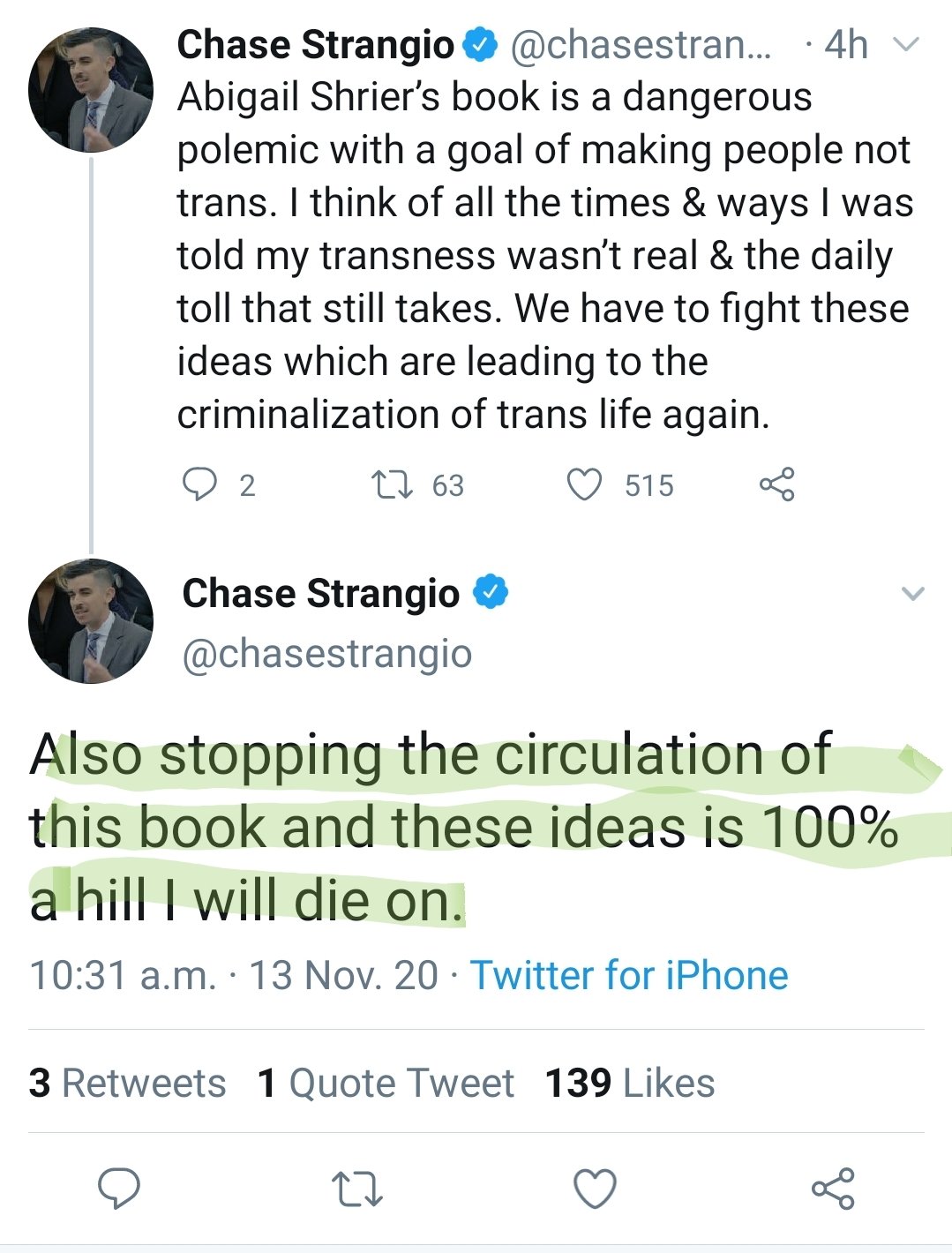
I would have guessed that Strangio would be in there argue for surgery and hormones; he was, after all, the ACLU lawyer who argued for banning Abigail Shrier’s book on rapid-onset gender dyphoria, often triggered by social pressure. (Strangio is also a trans-identified female.) In the end, Shrier was right. Shame on Strangio and the ACLU:

More from Yoffe:

. . . . The Court’s ruling notwithstanding, the U.S. medical establishment remains firmly behind the practice. Compare that to England, where a rigorous and independent report, the Cass Reviewconcluded that the evidence for pediatric transition is “remarkably weak.” FinlandNorway, and Sweden are among the other Western nations that have joined the UK in moving away from this treatment.

It is widely observed that the vast majority of young people with gender dysphoria—even those whose distress is “consistent, insistent, and persistent”—when allowed to go through normal puberty, come to accept their biological sex. (And there is no way to identify the very small number of children who will go on to experience lifelong gender distress.) Many of these children turn out to be gay, which is why a rising number of gay adults and gay-rights advocates have become alarmed that the transgender movement is medically transitioning gay kids. They argue that this movement has, intentionally or not, reified homophobic tropes.

I especially agree with the last paragraph below. In the future, I think medical gender-affirmative cafe will, along with our poor treatment of farm animals, be seen as practicers that were immoral in their time, but widely practiced:

Critics of the Supreme Court decision will argue that our major medical associations, from the American Academy of Pediatrics, to the American Medical Association, to the Endocrine Society, have all given support to this new branch of medicine. This is true. It is also true that these organizations or similar ones once supported lobotomies and eugenics. Just as that is a source of shame today, it is to be hoped that their vehement support of medically transitioning vulnerable young people will be a source of shame in the future. These medical societies have failed in their most basic duty of care to their patients by embracing a model that has so little evidence and such profound lifetime consequences.

When the history of this era is written, historians will have to explain how transgender activists so quickly took over institutions, and were able to so successfully threaten the social and work lives of those who objected. We are confident that historians will also remember those courageous individuals who, at the risk of professional and personal ruin, did so anyway.

But over at the Freedom From Religion Foundation, which now comprises a group of Chase Strangio clones, they’re proclaiming first that affirmative care is in general a salubrious way to address gender dysphoria, but also that affirmative care is “religious dogma.”  That characterization is palpably ridiculous, meant as a way for the FFRF to pretend that its “progressive” politics are fully in line with its mission to keep church and state separate. But many atheists like me object to affirmative care. It is the FFRF’s deliberate conflation of progressive politics with church-state separation that I objected to, and this ultimately wound up with my resigning (along with Richard Dawkins and Steve Pinker) from the FFRF’s honorary board.  Click below to read:

Note that the FFRF again speaks of transgender minors’ “rights”:

The Freedom From Religion Foundation lambastes today’s U.S. Supreme Court ruling upholding Tennessee’s cruel and unconstitutional ban on gender-affirming care for minors. This decision is a major blow to science-based medicine and the rights of parents and transgender youth.

, , , , Despite the hostile narrative surrounding transgender health care that the Supreme Court is furthering in its decision, the gender-affirming-care model is safe, effective and supported by every major medical organization, including the American Medical Association, the American Psychiatric Association, the American Psychological Association, the American Academy of Pediatrics and the American Academy of Child and Adolescent Psychiatry. These secular scientific organizations prioritize the safety and health of patients, not religious dogma.

The Freedom From Religion Foundation stands firmly with the transgender community, with parents, and with the medical professionals who follow science and ethics — not narrow sectarian belief — in providing care. FFRF will continue to educate about the harm these theocratic assaults are doing to civil liberties, bodily autonomy and the wall of separation between religion and government.

When the FFRF proclaims gender-affirming “model” as “safe, effective, and supported by every major medical association,” they of course neglect the fact that gender-affirming care is not seen that way in Europe, where it’s either banned or considered as experimental.  And of course most gender-dysphoric minors who go through normal puberty don’t really need this care, as most turn out to be gay. No hormones or excising of body parts required.  Affirmative treatment, as you may know, usually sterilizes its recipients, and, further, many of them will never have an orgasm after transitioning.

People like those in the FFRF are acting like this is the end of gender-affirmative care in America. I wish it were, and that treatment for dysphoria was limited to those over 18 (on same days I think 21). But in half of our states, hormones and surgery are still allowed, and there are no bans to be overturned.  I think that such states are making a mistake treating youths who haven’t attained maturity as having the ability to make their full medical decisions, like catering to a minor who doesn’t like their left leg and wants it cut off. The “right” to make such decisions should not be given to minors, or even their parents or doctors—not until youths come of age.

This viewpoint may be seen as transphobic, but I firmly reject that adjective. After all, it’s not seen as transphobic in the UK, Sweden, Finland, or Denmark, which have severe restrictions on affirmative care. And in the future, those who defend this rush to cut and inject hormones will, I think, be seen as misguided or even barbaric.

Now the editors of Natural History back the non-binary nature of sex, showing their scientific ignorance

May 3, 2025 • 11:30 am

Yesterday when I criticized Agustín Fuentes’s article in Natural History trying (and failing) to show that sex isn’t binary, I gave the magazine a break. After all, it hasn’t been nearly as bad as Scientific American, and I gave it a break because it published a gazillion essays by Steve Gould (yes, some of them were misguided, touting punctuated equilibrium, but they were all entertaining).

But now I’ve changed my mind, for I’ve learned that the editors actually published a justification in the magazine for publishing Fuentes’s piece. I guess they knew it would be controversial, and it is. It’s just flat wrong, but also misleading in a very annoying way: making points about variation within the sexes that have nothing to do with his thesis (and the title of his book from which the article was taken): “Sex is a Spectrum: Why the Nonbinary View is Problematic.”  His presentation shows that some (but not all) aspects of sexual behavior, sexual dimorphism, and so on are more continuous that the discontinuous existence of the sexes themselves. In all animals there are two reproductive systems, male and females, with exceptions ranging in proportion from 0.00005 to 0.00017.  And that, ladies and gentlemen, friends and comrades, is in all relevant respects a binary.

Fuentes, in other words, was attacking an argument that nobody had made, since we all realize there’s variation in sex-related traits, but his thesis was not about that. It’s about whether there is variation in the types of gametes in plants and animals (especially humans) that are the basis for defining sex (actually it’s really a “recognition” of a binary, not an a priori definition designed to impose a false binary on nature). And Fuentes uses many of the bogus tropes employed to “prove” that sex is nonbinary, even showing a photo of a bluehead wrasse, a fish that forms polygynous groups. When the alpha male dies, one female gets rid of her ovaries and develops testes, taking over the top job.  But there are still only two sexes!  I have to say that you have to be either ignorant or tendentious to use this animal as an argument against the sex binary, and Fuentes isn’t ignorant.

At any rate, the editors’ apologia–or rather “explanation”—is below. What burns my onions about this is their contention that “the science behind Fuentes’s thesis. . . is solid.”  The claim that “the number of mating types (often called “sexes”) has been variable over hundreds of millions of years, ranging from two and sometimes three in most animals, to as many as seven in single-celled animals. . ” is wholly misleading.  Well, Dear Editors, all animals and vascular plants have just two sexes (which ones have three?), though single-celled organisms, algae and fungi can have more “mating type”, which I’m okay with calling “sexes”if you want. But Fuentes and the editors, are defending the thesis that animals, including our own species, have nonbinary sex. This is not true.

Note as well that the editors have been taken in by the claim that the variability of “sexual behavior” and of “sexual activity” within and among species show that there is variability in the number of sexes beyond two.  This is a false argument, as anybody who knows biology and isn’t warped by ideology should know.

What bothers me most about this editorial is the editors’ sanctimonious claim that they are acting “in the public interest” by recognizing the “science” in this debate, but the bogus-ness of that science is all on Fuentes’s side. Shame on you, editors of Natural History? Have you actually followed this debate? How can it be that the Supreme Court of the UK has apprehended and resolved this debate better than do editors of a science magazine.

This is what happens when scientists’ work is distorted by their ideology, and by now I shouldn’t have to tell you what the distorting ideology is.

Here is the editors’ preface:

h/t: Robert

Natural History magazine: Agustín Fuentes rejects the sex binary on ideological grounds, but pretends otherwise

May 2, 2025 • 11:00 am

It looks like Natural History magazine has given an implicit endorsement—or at least a platform—to Princeton anthropology professor Agustín Fuentes.  We’ve met him before, and not under pleasant circumstances, as the man is wont to distort science and mislead his readers in the cause of progressive ideology. To see all the pieces I’ve written about him, go here (and especially these pieces here, here, and here.  And for critiques of Fuentes’s misguided accusations that Darwin was a racist who justified and promoted genocide, go here and here, and also see here for one I published in Science with a bunch of evolutionists. Some of these articles show Fuentes deliberately purveying misleading statements to buttress an ideological position. For that seems to be his modus operandi.

Now Fuentes has put his view that sex is not a binary into a new book, an excerpt of which was published in the latest Natural History, a magazine I always liked. This single bad article won’t change my mind about it (as the multiple bad articles in Scientific American did about that rag), but it makes me question the editors’ judgment. Do they know ANY biology? The reason I ask is that the excerpt is so tedious, dreadful, tendentious, misleading, and convoluted that it wouldn’t pass muster in a real scientific journal, and even a scientifically ignorant editor could see the problem with the arguments (and also correct the bad writing).

You can’t go to the article by clicking on the headline; and I don’t have a link, either. I was sent a pdf by a disaffected reader, and that’s what I’ll quote from. Perhaps you can find a copy if you dig around.

The overweening problem with this article is that it doesn’t show that the binary view is wrong, or that biological sex is really a spectrum. What Fuentes does (and he doesn’t really define biological sex) is to show that within the two constructs he takes to represent sex, there is a lot of variation in various traits.  Men don’t all behave in a way that differs from the way all women behave, development of sex is complicated, people of different sex have different “lived experiences” (yes, he says that), the structure of families vary among cultures, and so on.

But of course all of this variation, and the multidimensional definition of sex, neglects the big problem: is biological sex binary?  Yes it is: males have reproductive systems that evolved to produce small mobile gametes (sperm) and females have systems evolved to produce larger immobile gametes (eggs). There are only two types of gametes—no more. Biologists have arrived at this definition for two reasons: it’s universal in all animals and plants, and also because of its utility: the different investment in gametes usually leads to differential investment in offspring,  which explains not only sex differences in behavior, but sexual selection itself, which produces sexual dimorphism in appearance and sexual behavior. The exceptions to a strict binary defined (really “recognized”) this way range from about 1/5600 individuals to 1/20,000, and that’s as close to a binary you can get in biology.

What Fuentes does is throw a lot of sand in the reader’s eyes, showing variation within sexes and across cultures, hoping that at the end the reader will say, “Hey, maybe sex isn’t a binary after all.” But that variation does not touch the thesis he’s trying to depose. The man doesn’t know how to debate, so, like a true ideologue, he changes the ground of argumentation.

First (probably in the nonquoted parts of his book), he defines the sexes in an introductory note as “3Gfemales” and “3Gmales”, referring to “typical biological patterns of association between genetics-gonads-genitals in human bodies.” I presume he means that members of each have has the typical chromosomal constitutions of its type (e.g. XX in females) as well as gonads (that presumably means testes vs. ovaries) and genital morphology. Fuentes adds that “while useful as general categories, not all people fit into the 3G classifications.” So that is his definition, and of course since it involves more than gametes, will naturally be less binary than the biological definition. A male with a tiny penis, for example, perhaps because of a disorder of sex determination, would be called a biological male if he has testes, but is something else according to Fuentes. But Fuentes doesn’t say what such an individual is. How many sexes are there? An infinite number? And is that true of raccoons, Drosophila, and robins?

Okay, here comes the sand, so cover your eyes. I’ll have to use screenshots since I can’t copy and paste from this pdf:

Variation in sexual behavior:

But it is not “human sexuality” that is the binary, but the definition of sex.  Surely Fuentes recognizes that he is deviating from the main issue his book (and this article) is about: the binary nature of defined sex, as seen in every species of animal and plant. That doesn’t mean that sexuality and its expression is binary.  I’m not sure whether there’s a name for this kind of argumentation, but what he’s doing is clear.

He drags in variation in family structure, too:

Again, all this does is refute a binary of families, not of sexes. Why is it in there? What is the sweating professor trying to say?

Fuentes dwells at length on how sex is basically irrelevant in medicine because sexes show variation in their responses to drugs and get diseases at different rates, implying that the binary is all but useless for doctors. I read to my doctor several paragraphs of Fuentes’s screed, and I won’t give his reaction save to say that it was “not positive.” For example, can you even understand this?:

Stable? “Perceived instability”? What is he banging on about? He doesn’t say.

And females are too complicated to deal with in biology, medicine, and health? What is he talking about?  When a patient goes to see a doctor, it’s essential for the doctor to know the patient’s biological sex. Not only are some diseases specific to sexes (prostate cancer, ovarian or uterine cancer) as are some conditions (menopause), but a good doctor will realize that heart disease (and other diseases) can present differently in the sexes, and will investigate further based on that. Females with heart disease, for example, present more often with indigestion-like symptoms than do males. Now of course there are factors other than sex involved in treating a patient (do they drink, smoke, or eat too much?), but saying that sex is pretty much useless when treating patients is simply dumb. It can even be harmful (though he doesn’t say how):

Again, does any doctor pay attention only to sex? I don’t know of one. To be sure, Fuentes grudgingly admits that there are “two sets of reproductive physiologies” that are relevant to medicine, but minimizes the importance of sex. And to be sure, some diseases are recognized and treated identically in males and females, but to ignore biological sex as a doctor is sheer incompetence.

In another example, Fuentes notes that Ambien doesn’t work the way you’d predict in women if you just reduces the male dosage based on a smaller weight of females.  Why doesn’t this work? Because the drug clears from women “3G females” (did the doctors check all the “G”s?) more slowly than from “3G males.”   He uses this difference to attack the sex binary, by saying that we don’t understand why this average difference occurs, saying “asking about the actual physiological response, rather than assuming 3G males and 3G females are different kinds of humans, is a better approach.”

But again, this is irrelevant to the sex binary; it is about the mechanism of a difference between (Fuentes’s) biological sexes.  And, interestingly, one of the mechanisms he suggests is “attention should be focused on the varying levels of acting testosterone in attenuating the effectiveness of [Ambien].”

Testosterone! Well at least that has some connection with biological sex, no? Fuentes then tries to efface the difference in hormone levels by saying this:  “Testosterone is not characterizable as a male or female hormone, but rather by variation in circulating levels among humans, with 3G males usually having much higher levels than 3G males.”

In reality, we’ve long known that both testes and ovaries produce testosterone, but the distribution of salivary testosterone in the sexes is indeed variable in each sex, and there is hardly any overlap between the sexes: Since testosterone prompts the development of secondary sex traits, including behavior, it’s the binary nature of sex that produce an almost nonoverlapping distribution of hormones. But one should not imply, as Fuentes does, that variation of hormone levels in each sex means that the sexes themselves are non-binary.

(From paper): Figure 1. Shown is a depiction of the bimodal distribution of raw, baseline salivary testosterone values (in pg/mL) when including both men (N = 360) and women (N = 407). All saliva samples were collected and assayed by the present author using radioimmunoassay (Schultheiss and Stanton, 2009). The displayed testosterone data were aggregated from several past studies by the author, and for graphical purposes only, exclude eight male participants with testosterone levels between 150 and 230 pg/mL.

I don’t want to go on much longer, but I’ll add that Fuentes conflates sex and gender several times, and uses familiar tropes to dispel the binary, like the existence of hermaphroditic earthworms, which of course produce only two types of gametes, but in one body. He even shows a photo of a bluehead wrasse, which, like the clownfish (but in the other direction), changes sex in social groups (the head of a group of females is male, but if he dies a female changes sex and becomes the alpha-fish).  And like the clownfish, this doesn’t dispel the sex binary because again, there are only two forms, one producing sperm and one producing eggs. Nobody ever claimed that a biological female can gametically transform into a biological male or vice versa. As always, there are only two reproductive systems, classified by their type of gamete. Neither of these animals produces a third type of gamete.

At the end, Fuentes reprises his error of saying that variation within sexes dispels any notion of a sex binary, and even lapses into philosophisizing:

I love the “why and how humans are in the world.” It’s totally meaningless!  But wait! There’s more:

Of course there is intra- and inter-sex diversity in levels of hormones, behavior, sexual behavior, family structure, and so on.  But there is no diversity within a sex about the type of gamete it is set up to produce, either sperm or eggs (or both in the case of hermaphrodites, which Fuentes calls “intersex”).  And that IS a universal truth about being male or female, a truth that was recognized a long time before social justice ideology arose, and a reognition that had nothing to do with that ideology. Now it does, for even a dolt can see that Fuentes’s real aim to to dispel the binary definition of sex in any way he can, for he considers that definition to be harmful to people who don’t identify as either male or female. It isn’t. If the facts get in the way of ideology for people like Fuentes, they either ignore or misrepresent the facts. Here the entire article is a form of misrepresentation.
******************
At my own ending I’ll quote, with permission, part of the email that the reader who sent me this pdf wrote, just because I liked the email:


. . . last night, I was flabbergasted to read in the table of contents of the latest issue of Natural History, ‘Sex is a Spectrum: Why the binary view is problematic.”

That rumbling you just heard was SJG [Stephen Jay Gould] and his biologist forebears from this magazine spinning in their graves. Or so I infer.

OK, I am not a biologist and wouldn’t even try to play one on TV, and so wouldn’t claim the credentials or background to properly critique this. But I do have to wonder at the author’s writing in pretzel knots to avoid, for example, using the term “women” (preferred: “Humans with uteri” [p. 23]), or writing things I find hard to swallow (“the number of mating types (often called “sexes”) per kind of species…[is] two and sometimes three in most animals…”). I’d really like to know the animals that have three sexes (and what the third kind is called, and who it mates with).

h/t: Alex, Robert

Misguided branch of British Medical Association rejects UK’s Supreme Court decision that “woman” is defined by biological sex

April 30, 2025 • 10:00 am

As I reported two weeks ago, the Supreme Court of the United Kingdom voted unanimously to affirm that the term “woman” under the legal Equality Act refers only to biological women and not trans-identified men. That means that a biological male holding a gender reassignment certificate would not have the same legal status as a biological women.  I added this:

In all the stuff I was able to read this morning, I was unable to find the definition of a “biological woman”, save that it refers to one’s natal sex, though they don’t mention gametes. The ruling does refer to the binary nature of sex (see below). And the ruling implies as well that the word “man” can mean in law only a “biological man”

That would seem to settle things, at least as far as the Equality Act is concerned, and the ruling was celebrated by those who favor the existence of “women’s spaces,” including sports competition, locker rooms, and jails.

But some members of the British Medical Association (BMA), as reported by the Times of London and other venues, have taken issue with the Supreme Court’s decision, implying that rrans-identified men are also women.  The subgroup of the BMA that voted against the Supreme Court Decision was the group of “resident doctors,” previously known as “junior doctors,” and so represent younger physicians. Note that the BMA is a registered trade union and does not regulate doctors; that role is given to the General Medical Council.

Click below to see an archive of the Times report:

A précis:

Doctors at the British Medical Association have voted to condemn the Supreme Court ruling on biological sex as “scientifically illiterate” and “biologically nonsensical”.

The union’s wing of resident doctors — formerly known as junior doctors — passed a motion at a conference on Saturday criticising the ruling that a woman is defined by biological sex.

The doctors claimed that a binary divide between sex and gender “has no basis in science or medicine while being actively harmful to transgender and gender-diverse people”.

The branch of the British Medical Association (BMA) — representing about 50,000 younger doctors — said it “condemns scientifically illiterate rulings from the Supreme Court, made without consulting relevant experts and stakeholders, that will cause real-world harm to the trans, non-binary and intersex communities in this country”.

The BMA’s stance is likely to raise concerns that the medical profession may seek to obstruct attempts at implementing new NHS guidance on trans patients, being drawn up after the Supreme Court ruling. It follows the union’s decision last summer to lobby against the Cass Review and to call for an end to the ban on puberty blockers for children identifying as transgender.

Lobbying against the Cass Review—a sensible report that banned the use of puberty blockers on individuals under 18 and dismantled the dysfunctional Tavistock Clinic that hustled gender-dysphoric children into “affirmative therapy”—shows where the ideology of this group lies. Although the Cass Review was widely applauded by doctors, these “resident doctors” are clearly infected with the mantra that anyone can claim to be any sex they want. As the yahoo! article below notes, “Last year, the BMA became the only medical organisation in the UK to reject the findings of the Cass Review into the provision of gender identity services for young people.”

And their ideology is clear:

The BMA motion, responding to the ruling, said: “This meeting condemns the Supreme Court ruling defining the term ‘woman’ with respect to the Equality Act as being based on ‘biological sex’, which they refer to as a person who was at birth of the female sex, as reductive, trans and intersex-exclusionary and biologically nonsensical.

“We recognise as doctors that sex and gender are complex and multifaceted aspects of the human condition and attempting to impose a rigid binary has no basis in science or medicine while being actively harmful to transgender and gender diverse people.”

It added that the BMA is committed to “affirming the rights of transgender and non-binary individuals to live their lives with dignity, having their identity respected”.

Of course we all respect the rights of transgender individuals–as transgender individuals. But those rights clearly clashed with the rights of other groups, most notably biological women, and the court adjudicated that clash in its definition of “woman”. Nobody of good will wants “erasure” of trans people, but we have to recognize that the claim that “trans women are women” leads to a clash of rights whose solution was taken up by the UK Court.

Note the “sex and gender are complex” assertion often used by ideologues or the benighted to claim that sex is not binary. (Yes, there are a very, very few exceptions., as I mention below, but for all practical purposes biological sex is binary.)  And, of course, it is binary in nearly all transsexual individuals, who even recognize the binary by wanting to adopt the role of their non-natal sex.

A bit more:

Sex Matters, the campaign group, accused the doctors of being an “embarrassment to their profession” and said it is “terrifying” that people who have undergone years of medical training can claim there is “no basis” for biological sex.

Indeed; for the doctors are redefining sex (and gender) as some multifactorial, “multifaceted aspect of the human condition”.  Perhaps gender roles fit that definition, but the Supreme Court was defining sex, not gender, and stayed away from gender, which is not part of the Equality Act.  This clearly shows the ideological nature of the resident doctors’ efforts and their unwarranted conflation of sex and gender.  Sex is a biological issue; gender a social one, also mixed to some degree with biology.  Don’t these doctors know that? Yes, of course they do, but pretend otherwise. If they’re not pretending, they are witless and don’t deserve to be doctors.

Yahoo News! (click below) gives the text of the resident doctors’ resolution:

Here’s the text of the resolution:

“This meeting condemns the Supreme Court ruling defining the term ‘woman’ with respect to the Equality Act as being based on ‘biological sex’, which they refer to as a person who ‘was at birth of the female sex’, as reductive, trans and intersex-exclusionary and biologically nonsensical.

“We recognize as doctors that sex and gender are complex and multifaceted aspects of the human condition and attempting to impose a rigid binary has no basis in science or medicine while being actively harmful to transgender and gender diverse people. As such this meeting:

“i: Reiterates the BMA’s position on affirming the rights of transgender and non-binary individuals to live their lives with dignity, having their identity respected.

“ii. Reminds the Supreme Court of the existence of intersex people and reaffirms their right to exist in the gender identity that matches their sense of self, regardless of whether this matches any identity assigned to them at birth.

“iii. Condemns scientifically illiterate rulings from the Supreme Court, made without consulting relevant experts and stakeholders, that will cause real-world harm to the trans, non-binary and intersex communities in this country.

“iv. Commits to strive for better access to necessary health services for trans, non-binary and gender-diverse people.”

The deeming of the Supreme Court’s ruling as “trans and intersex-exclusionary” is confusing.  Most trans people do indeed fit into the Court’s categorization of “man” or “woman.” The exception, the “true” intersex people, range in frequency from 1/5600 to 1/20,000, and so are very rare, making biological sex as binary as you can get. (In contrast, the frequency of people born with extra fingers or toes is about 1/2500 to 1/800, and yet we refer to humans as having “ten fingers and toes”.) It’s clear that this controversy is really not about the rare “true intersex” individuals, but about individuals who fit the biological definition of “man” or “woman” but identify otherwise—as either “nonbinary” or “transsexual”.

h/t: cesar, nick

Same-sex sexual behavior documented in many mammals: does it mean that similar behavior in humans is “natural”?

April 29, 2025 • 9:45 am

The Naturalistic Fallacy, which most of you surely know, it the erroneous equation of what does exist with what should exist.  Discussed extensively by Hume, it is the false equation of “is” with “ought”. In biology, it takes the form of observing some behavior in animals that is similar to a behavior in humans, and then justifying or saying the human behavior “natural”  or “good” because we see it in other species.

But this is a bad argument, for it cuts both ways. After all, animals show a lot of behavior that would be considered reprehensible or even immoral in humans.  In fact, Joan Roughgarden wrote a book, Evolution’s Rainbow, which describes sex and gender diversity in nature as an explicit way of justifying similar behaviors in humans as good—because they are natural. I reviewed the book for TLS and wrote this bit (review no longer online but I can send a copy).

Coyne, J. A.  2004.  Charm schools. (Review of Evolution’s Rainbow, by Joan Roughgarden). Times Literary Supplement, London. July 30, 2004 (No. 5287), p. 5.

But regardless of the truth of Darwin’s theory, should we consult nature to determine which of our behaviours are to be considered normal or moral? Homosexuality may indeed occur in species other than our own, but so do infanticide, robbery and extra-pair copulation.  If the gay cause is somehow boosted by parallels from nature, then so are the causes of child-killers, thieves and adulterers. And given the cultural milieu in which human sexuality and gender are expressed, how closely can we compare ourselves to other species? In what sense does a fish who changes sex resemble a transgendered person? The fish presumably experiences neither distressing feelings about inhabiting the wrong body, nor ostracism by other fish. In some baboons, the only males who show homosexual behaviour are those denied access to females by more dominant males. How can this possibly be equated to human homosexuality?

The step from “natural” to “ethical” is even riskier. As the philosopher G. E. Moore argued, identifying what is good or right by using any natural property is committing the “naturalistic fallacy”: there is no valid way to deduce “ought” from “is”. If no animals showed homosexual behaviour, would discrimination against gay humans be more justified? Certainly not. Roughgarden’s philosophical strategy is as problematic as her biological one.

Now a 2022 paper in Nature Communications had the potential to demonstrate the same fallacy, but fortunately the authors went to great lengths to avoid that  The same, however, is not true of a new take on this paper in a new article in ZME Science, which gave a précis of the paper and stepped on the Fallacy’s tail.

First the Nature paper itself, which you can access by clicking on the article below, or by reading the pdf here.

It’s a good paper on the evolution and phylogeny of “same-sex sexual behavior” in mammals, which they define as “transient courtship or mating interactions between members of the same sex“.  

Note that it’s “transient,” which explicitly excludes homosexuality, most notably in humans, which is a persistent sexual attraction to members of one’s own biological sex.  This form of transient sexual interaction is surprisingly common—a conservative estimate is 4% of all animal species, and, as the authors say, [includes] “all main groups from invertebrates such as insects, spiders, echinoderms, and nematodes, to vertebrates such as fish, amphibians, reptiles, birds, and mammals.”

Now there are two ways to explain a behavior that seems on its face maladaptive. Why would you engage in sexual behavior that doesn’t involve passing on your genes? One hypothesis is that it’s just a nonadaptive byproduct of other behaviors: a general drive to mate when the appropriate mates aren’t available, or simply mistaken identity.  But the authors investigate two hypotheses that it is adaptive, and give some tentative evidence for that.

First, the results:

  • The authors did a comprehensive survey of same-sex behavior (defined above) in 2546 species of mammals, and superimposed species with and without such behavior on their phylogenetic tree. The object was to see how many times the behavior evolved independently, and whether it was present in the common ancestor of a group (and thus could be passed along to its descendants). Here’s one of those phylogenies with the caption. (You needn’t worry about the details or summary, as I’ll give it below).
(from paper) Phylogenetic distribution of the presence of same-sex sexual behaviour in males and females in the subset III (see methods). The state of the mammalian ancestral nodes was assessed using maximum likelihood estimation (black: same-sex sexual behaviour displayed by females; yellow: same-sex sexual behaviour displayed by males; purple: same-sex sexual behaviour displayed by both sexes). The silhouettes of representative mammals (downloaded from http://www.phylopic.org) illustrate the main mammalian clades. They have a Public Domain license without copyright (http://creativecommons.org/licenses/by/3.0).

A summary:

  •  The behavior was reported in 261 mammalian species
  • Same-sex sexual behavior appears to be equally common in males and females, and the behavior in both sexes tends to be correlated across groups. That is, male and female same-sex behavior is more likely to both appear in the same species than if it either were distributed randomly among groups.
  • It was not possible tell, using phylogenetic analysis, whether same-sex behavior was likely to be a trait in the ancestor of all mammals, but was NOT likely to be a trait in the ancestor of all placental mammals.
  • The behavior seems to have evolved independently in many lineages, so same-sex sexual behavior seems to be a case of “convergent evolution.”
  • The behavior is correlated with whether or not a species is social. If it is social, there’s a significantly higher probability of same-sex sexual behavior. (Remember that this is a correlation and doesn’t imply that sociality prompts the evolution of such behavior. The behavior could simply result from iondividuals in social species being closer to other individuals than those in non-social species.)
  • The common ancestor of all primates does seem to have possessed same-sex sexual behavior.

The association of same-sex sexual behavior with sociality leads the authors to conclude that the behavior evolved by natural selection as a way to enforce inter-individual harmony required by sociality. They mention two such advantages:

1.) Same-sex sexual behavior is a way of creating and maintaining social bonds between individuals in a group; it’s a bonding mechanism.
2.) The behavior could also help prevent or resolve conflicts between members of a group, allowing a hierarchy to develop without injury of death to group members.

The authors mention that these effects have been demonstrated in some species like bottlenose dolphins and American bison, but I’m not familiar with this work, and such conclusions seem to me to be extraordinarily difficult to arrive at. However, I’ll take the authors’ word for it.

The authors are, to be sure, careful in their conclusions. First, they note that nonadaptive hypotheses, like “mistaken identity” could also contribute to the behavior.

Second, and the big one, they note that the behavior they studied is not the same as homosexual behavior like we find in humans.  They do add, however, that it humans do show same-sex sexual behavior in humans (I presume they’re referring to “bisexual” people who have sex with both males and females). From the paper:

However, same-sex sexual behaviour is operationally defined here as any temporary sexual contact between members of the same sex2. This behaviour should be distinguished from homosexuality as a more permanent same sex preference, as found in humans. For this reason, our findings cannot be used to infer the evolution of sexual orientation, identity, and preference or the prevalence of homosexuality as categories of sexual beings Nevertheless, even taking into account this cautionary note, by using phylogenetic inference, our study may provide a potential explanation on the evolutionary history of the occurrence of same-sex sexual behaviour in humans.

They may be right, but I think they should have added that even if same-sex sexual behavior was rare or nonexistent in mammals, its existence in humans is not made “ethical” or “natural” in our species. That would be an example of the naturalistic fallacy, and I emphasize that they do not commit it.  I’d would also emphasize, as I did above, that any sexual behavior between consenting human adults is not for us to judge, regardless of whether or not other species show it, and that such behaviors are fine so long as they’re legal. We don’t need to justify same-sex sexual behavior in humans by seeing it elsewhere in nature. But perhaps this stuff doesn’t belong in a scientific paper. But I want to emphasize it here, as I did in my review of Roughgarden’s book.

As I said, the authors don’t commit the naturalistic fallacy, but the new ZME Science paper below comes close to it. Click headline to read:

Up until the end, this article is okay, but then it can’t resist diving into our own species (bolding is mine).

However, the researchers distinguish between SSSB and sexual orientation. While SSSB involves occasional same-sex interactions, sexual orientation encompasses consistent patterns of attraction and identity, particularly prominent in humans.

While SSSB in animals supports the naturalness of such behaviors, human experiences of sexuality include layers of identity, culture, and personal meaning that go beyond biological explanations. Homosexuality in humans often involves stable sexual orientations and relationships, distinct from the transient or context-dependent SSSB observed in some animal species.

Ultimately, the widespread occurrence of SSSB in mammals, especially primates, strongly suggests that such behaviors are natural and adaptive. Normalizing same-sex behavior as a part of this spectrum aligns with both biological evidence and a broader understanding of human social and emotional complexity.

The last paragraph explicitly says that the results show that homosexuality (one of “such behaviors”) is “natural and adaptive”, as are all “same-sex behaviors” in humans.  The Nature paper says nothing of the sort.  The authors of the Nature paper explicitly exclude homosexuality as not a behavior they studied, but ZME Science lumps it in with other same-sex sexual behaviors, dwspite homosexuality being very different from SSSB.

Again, you do NOT need to justify same-sex sexual behavior, whether it be transient or permanent, by finding examples in the natural world. If we didn’t find any other species with homosexual behavior, would that make it wrong or bad in humans? Of course not! “Is” does not equal “ought,” and I’ll add the corollary that “not is” does not equal “not ought”. The Nature paper is valuable it looking at the evolution of a behavior and testing hypotheses about its adaptiveness, but of course adaptiveness or evolution has nothing to do with the ethics of behaviors between consenting human adults.

Three ecology and evolution societies finally remove their “sex definition statement” from the web

April 28, 2025 • 11:30 am

On February 6 of this year, the Presidents of three evolution/ecology societies (the Society for the Study of Evolution [SSE], the American Society of Naturalists [ASN], and the Society of Systematic Biologists [SSB]) put a letter on the SSE website. It was a reaction to a Trump executive order about the definition of sex, and the “tri-societies” statement asserted that sex is not binary (in ANY species), but was a multidimensional multifactoral “biological construct”.  I archived the letter here because I had a feeling that it would cause trouble.

It did. But first, read it below.  It was written, of course, as a kind of virtue-flaunting exercise to placate those who don’t feel that they are either “male” or “female” (“nonbinary” people). But in so doing, the three Societies promulgated a gross distortion of what many (I won’t say “most”, since I don’t know) biologists conceive of as the definition of sex, which is based on gamete size and is close to being binary as it comes. I’ve bolded bits of it below, bits that conflate sex and gender, throw in “lived experience” to add to the confusion, and claim that the nonbimodality of sex “is a hallmark of biological species,” implying that in all animals and plants the definition of sex is far more than bimodal.

Note that the members of these three societies were not polled about the so-called “scientific consensus” they assert; this is a diktat from the Presidents. Voilà: the original “tri-societies” letter:

President Donald J Trump
Washington, DC
Members of the US Congress Washington, DC
February 5, 2025

RE: Scientific Understanding of Sex and GenderDear President Trump and Members of the US Congress,

As scientists, we write to express our concerns about the Executive Order “Defending Women From Gender Ideology Extremism And Restoring Biological Truth To The Federal Government”. That Order states first, that “there are two sexes…[which] are not changeable”. The Order goes on to state that sex is determined at conception and is based on the size of the gamete that the resulting individual will produce. These statements are contradicted by extensive scientific evidence.

Scientific consensus defines sex in humans as a biological construct that relies on a combination of chromosomes, hormonal balances, and the resulting expression of gonads, external genitalia and secondary sex characteristics. There is variation in all these biological attributes that make up sex. Accordingly, sex (and gendered expression) is not a binary trait. While some aspects of sex are bimodal, variation along the continuum of male to female is well documented in humans through hundreds of scientific articles. Such variation is observed at both the genetic level and at the individual level (including hormone levels, secondary sexual characteristics, as well as genital morphology). Beyond the incorrect claim that science backs up a simple binary definition of sex, the lived experience of people clearly demonstrates that the genetic composition at conception does not define one’s identity. Rather, sex and gender result from the interplay of genetics and environment. Such diversity is a hallmark of biological species, including humans.

We note that you state that “Basing Federal policy on truth is critical to scientific inquiry, public safety, morale and trust in the government itself”. We agree with this statement. However, the claim that the definition of sex and the exclusion of gender identity is based on the best available science is false. Our three scientific societies represent over 3500 scientists, many of whom are experts on the variability that is found in sexual expression throughout the plant and animal kingdoms. More information explaining why sex lies along a continuum can be found here. If you wish to speak to one of our scientists, please contact any of the societies listed below.

Carol Boggs, PhD
President
Society for the Study of Evolution
president@evolutionsociety.org

Daniel Bolnick, PhD
President
American Society of Naturalists

Jessica Ware, PhD
President
Society of Systematic Biologists
president@systematicbiologists.org

You can see all my posts about the resulting kerfuffle here.  In short, intiially about twenty of us wrote to the three societies objecting to the letter’s scientific contentions. Eventually 125 people connected with evolution appended their names to the letter and were willing to make their objections public (see here). Richard Dawkins also got into the fray, and both he and I discovered independently that the three Presidents who signed the letter actually act as if sex were binary in their own published research. Further, two former Presidents of the SSE also publicly disagreed with the characterization of biological sex given above.

Finally, our letter signed by 125 people asked for an answer, and although we got one from the societies, we were also told we couldn’t make it public. So be it, but I did characterize the answer here, and the societies largely conceded our points. As I wrote:

. . . . this time we asked for a response and got one, signed by all three Presidents.  I can’t reprint it because we didn’t ask for permission [we later did but were refused], but some of its gist is in the response below from Luana [Maroja]. I will say that they admitted that they think they’re in close agreement with us (I am not so sure!), that their letter wasn’t properly phrased, that some of our differences come from different semantic interpretations of words like “binary” and “continuum”(nope), and that they didn’t send the letter anyway because a federal judge changed the Executive Order on sex (this didn’t affect our criticisms). At any rate, the tri-societies letter is on hold because the organizations are now concerned with more serious threats from the Trump Administration, like science funding.

It’s still on hold, but now they’ve taken it down (see below).

I closed my post this way:

I end by saying that scientific societies need not be “institutionally neutral” when they are dealing with issues that affect the mission of the societies, as the definition of sex surely does. But what’s not okay is for the societies to distort “scientific consensus” in the interest of ideology. I have no idea if the Presidents of these societies really believe what they said (as Dawkins has pointed out, all three Presidents use a binary notion of sex in their own biological work), but something is deeply wrong when you use one notion of sex in your own science and yet deny that notion when you’re telling politicians what scientists “really believe.”

It’s just wrong when three evolution societies give the public a distorted view of how biologists define “sex”, and even more wrong when they do so because they are motivated not by the search for truth but to cater to a certain ideology.

As this sad drama draws to an end, I was just informed that, after several months, the three societies have taken down their misguided diktat.  Go to this SSE website and you’ll see this note:

As they say, “a revised version is in progress and will be posted shortly.”  I look forward to the revised definition of sex!  I also note that, as far as I know, no members of the three Societies have been informed that the letter was removed (they were told that the letter was posted, but only several weeks after it went up).

I’m posting this simply as a public service, to inform members of the Societies, and others following kerfuffles about the definition of sex, that the letter was finally taken down and will be replaced. The silver lining is that although I found the original letter embarrassing to science–and just another reason for people not to trust science–the Societies are rethinking what they say about sex.  However, I doubt that the replacement letter is going to emphasize the bimodality of sex as it is defined by many biologists.  After all, the Societies have to be ideologically correct, don’t they?

h/t: Luana Maroja (who did nearly all the heavy lifting of writing responses, gathering signatures, and so on.