Readers’ wildlife photos

March 9, 2026 • 8:15 am

I have a few batches now, so I’m complacent (never happy!). Today’s photos of Costa Rica come from reader Rachel Sperling.  Her captions and IDs are indented, and you can enlarge the photos by clicking on them.

In January I took my first (of many, I hope) trip to Costa Rica. We spent about a week in Manuel Antonio, on the Pacific Ocean side. We took a couple of nature walks in and around Manuel Antonio National Park, and we saw plenty of wildlife. One of these days I’m going to treat myself to a really good camera, but these were all taken with either my mirrorless Olympus or my iPhone camera, which are light and easy to stash in a backpack. I did see a couple of sloths – both three-toed (Bradypus variegatus) and Hoffman’s two-toed (Choloepus hoffmanni), but they were high up in the trees, so I wasn’t able to get a good photo of them.  These are the photos I was able to capture:

On the drive from San Jose to Manuel Antonio, we stopped at a creek to view some American crocodiles (Crocodylus acutus):

We saw a number of Central American Squirrel monkeys (Saimiri oerstedii), which were incredibly cute:

Then there were these little beasts: the Costa Rican mafia, aka the Panamanian/Central American White-faced capuchin (Cebus imitator). According to our guide, these monkeys can be pretty vicious with animals their own size, and they’ll just riffle through your backpack if you’re not watchful. Someone had to be on guard whenever we went to the beach.

We went on a nature walk in the rainforest at night (with a guide), which gave us the opportunity to see a lot of nocturnal animals. Among them was the Red-eyed tree frog (Agalychnis callidryas):
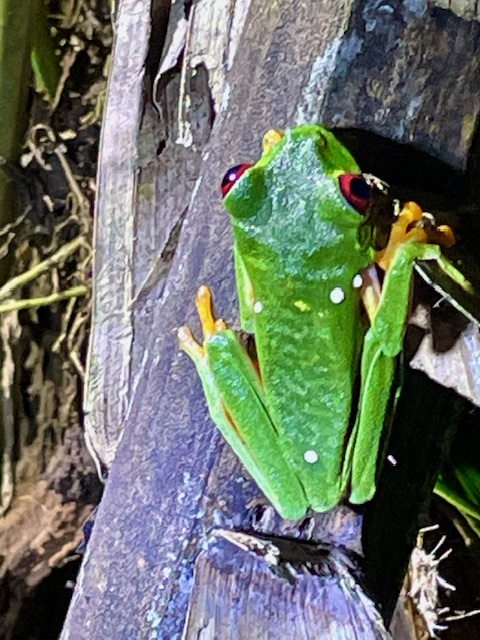
Masked tree frog/New Granada cross-banded tree frog (Smilisca phaeota) in Manuel Antonio National Park. I’m sorry I’m not better at identifying plants, to the disappointment of my botany-teacher father:

Black iguana (Ctenosaura similis), at the beach at Manuel Antonio:

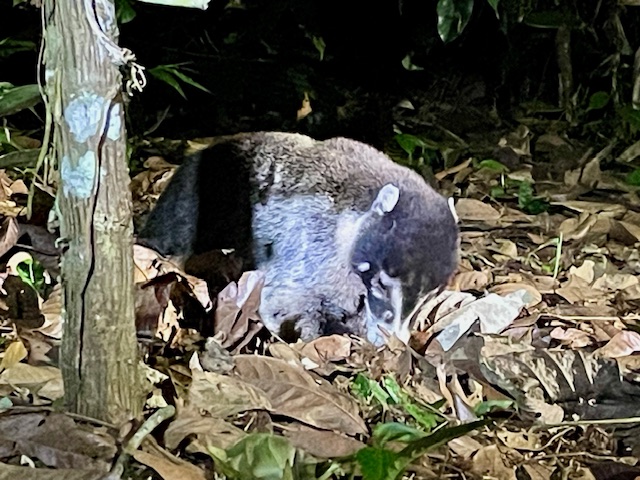
We also saw a coati (Nasua narica), which Wikipedia tells me are diurnal, but it was definitely after sunset and that is definitely a coati. They’re relatives of the raccoon, and our guide told us that a mature one can hold its own against a jaguar. This one wasn’t afraid of us, anyhow:
Back at our b&b, this Black-hooded antshrike (Thamnophilus bridgesi) came to visit me as I read on the veranda a few times. I think it’s a female, though the sexual dimorphism of this species doesn’t seem terribly dramatic. I did see her building a nest:

On my last day in Costa Rica, I heard a tremendous ruckus in the trees outside my hotel in San Jose. I looked and discovered that the trees (American oil palmsElaeis oleifera —I think) were full of Crimson-fronted parakeets (Psittacara finschi). They were LOUD and they were going to town on those trees. There were too many to count. Fortunately, they quieted down after sunset:

Manuel Antonio National Park from the water. These little islands are bird sanctuaries that tourists are not allowed to visit:

Sunset over the Pacific, near Manuel Antonio National Park:

Nauyaca Waterfalls, near Dominicalito, where we swam:

Finally, I thought you’d like these because they’re jaguar-inspired. We spent an afternoon at a village belonging to the Boruca, an indigenous tribe. They cooked us a delicious lunch, and showed us how they made dyes from local plants, and carved and painted balsa wood masks. The masks were first used to frighten the Conquistadores. Now you can buy them just about everywhere:

Readers’ wildlife photos

March 6, 2026 • 8:15 am

Reader Todd Martin sent some photos from the Yucatán (don’t miss the Ocellated Turkey!).  Todd’s captions are indented and you can enlarge the photos by clicking on them.

WEIT Yucatán

Here are some photos from a trip in November to the Yucatán in Mexico. The original purpose of the trip was to see Mayan ruins, but the natural beauty of the area turned out to be equally remarkable.

The first few pictures were taken during a boat tour of the mangroves in the Ría Lagartos Biosphere Reserve along the northern coast of the Yucatan Peninsula. The tour began at dawn and we were greeted by the rising sun and a welcoming committee of Monohelea maya, a species of predaceous midge discovered with some fanfare by scientists in 2000 (and with somewhat less fanfare on this very morning by myself):

The reserve is home to many species of birds, the most famous of which is the American flamingo (Phoenicopterus ruber), which can be observed trawling for brine-shrimp in the brackish water:

This is a Magnificent Frigatebird (Fregata magnificens). The male is easily recognized by the bright red throat pouch which looks like a life vest when inflated but actually serves to attract females. The females can be recognized by their frequent calls of ‘Well, if you’re so magnificent why can’t you take out the trash’:

The largest avian species we saw was this haughtily regal Brown pelican (Pelecanus occidentalis):

This is a Neotropic Cormorant (Nannopterum brasilianum) a diving bird sometimes used by the indigenous people of Bolivia and Peru to catch fish:

Hopefully this Wood Stork (Mycteria americana) has a good personality because it is (as my grandmother might have quipped) ‘not conventionally attractive’. It is, however, the only native stork in North America:

The Osprey (Pandion Haliaetus) is sometimes known as a fish hawk because fish make up the majority of its diet (not unlike Kevin Bacon or the singer Meatloaf):

Some birds are naturally elegant like this Great Egret (Ardea alba).In case you want to know how to avoid confusing it with a Snowy Egret … a Great Egret has a yellow bill and black feet, while the smaller Snowy Egret has a black bill and yellow feet:

Green Heron (Butorides virescens). Here’s a fun fact I cribbed from Wiki: “Green herons are one of the few species of bird known to use tools. In particular, they commonly use bread crusts, insects, or other items as bait. The bait is dropped onto the surface of a body of water to lure fish. When a fish takes the bait, the green heron then grabs and eats the fish”:

This American White Ibis (Eudocimus albus) was quite accustomed to people, which allowed me to get a pretty good close-up:

Morelet’s crocodile (Crocodylus moreletii). They look somewhat fearsome, but our one-armed tour boat operator said this one was ‘practically domesticated’”

Yucatan Jay (Cyanocorax yucatanicus) Jays are the noisy, argumentative neighbors of the animal kingdom. They are often described as ‘gregarious’ which I take to mean that they’ll take food from your plate without asking:

Those who frequented Glamour Shots in the 1980’s might confuse this photo with others of the genre, but it’s an Ocellated Turkey (Meleagris ocellata). The bird was the original inspiration for the marketing tag-line ‘taste the rainbow’. Unfortunately the bird is considered ‘Near Threatened’ by the International Union for Conservation of Nature (IUCN) with numbers that are sadly on the decline:

Whoever named the Black Spiny-tailed Iguana (Ctenosaura similis) wasn’t particularly creative, but I’m inclined to give them a pass because … that spiny tail!:

Finally – we stopped by Florida before returning home and my wife couldn’t resist adopting one of those hairless sphynx cats from the local shelter (Alligator mississippiensis). We love him very much, though he does have the unusual habit of sleeping in his water dish:

Readers’ wildlife photos

March 5, 2026 • 8:15 am

Send in your good wildlife photos, as I’m out save for singletons and doubletons.

Today’s photos come from reader Jan Malik from New Jersey and are geese and DUCKS. The captions and ID’s are indented, and you can enlarge the photos by clicking on them.

Here are some Barnegat Inlet ducks (and other visitors) from the last day of this February.

Canada Goose (Branta canadensis) and Brant (Branta bernicla) in flight.  Same genus, similar body form, and a fairly recent common ancestor—only about 1–2 MYA in Pleistocene North America. Anne Elk’s (Mrs.) theory about brontosauruses could be adapted to geese: they are thin at one end, much, much thicker in the middle, and thin again at the far end. My new theory is that these two species split when the Laurentide Ice Sheet separated the American coast from the inland regions. The Brant specialized in coastal habitats and feeding on seaweeds, while the Canada Goose evolved inland, feeding mostly on herbs and grasses. Perhaps this theory is not new. Or not mine.

Arguably the biggest stars of the winter Barnegat Inlet are the Harlequin Ducks (Histrionicus histrionicus). The drakes’ plumage is so dramatic—and their calls so comical (resembling a bath rubber ducky)—that many people come to Barnegat Light just to see them. The hens’ coloration is more subdued but still lovely.

JAC: You can hear their calls on the Cornell page for this species. Just below is a hen:

Every year I see them bobbing along the jetty, sometimes tossed around by heavy seas but always masterfully avoiding the rocks. They seem attracted to heavy surf and avoid the open sea. They stay mostly in a loose flock, which in recent years appears to have declined from 20–30 ducks in 2010 to just 10–15 in the last couple of years.

Drake:

They can preen while in the water, but they do catch a breather by climbing onto slippery rocks. Their feet are set a bit farther back, like in other diving ducks, but they can walk on land—although a bit awkwardly. By late February most of them are gone, heading back north to their nesting grounds on Labrador’s whitewater rivers and streams:

Like other diving ducks, they dip their heads before diving for fish. My other theory—Theory Number Two—is that by doing so they defeat the air–water interface diffraction and better locate prey:

They are exceptionally buoyant, which makes sense given their rocky surf habitat, but it also means they must put extra effort into diving. They have to jump slightly into the air before the dive to gain momentum, then use their wings as paddles to become submerged:

I once heard that the difference between geese and ducks is that ducks can launch themselves directly into the air from a resting position, while geese need to run for a while, either on water or land. This is probably true for dabbling ducks (like Mallards), but a Harlequin—with its feet set back a bit—must run some distance to become airborne:

Another common winter visitor: the Red-breasted Merganser (Mergus serrator), drake. Their bill serration is more pronounced than in other diving ducks, helping them catch fish:

Merganser hen. These are the most sea-loving mergansers. The other two I’m familiar with—Common and Hooded Mergansers—rarely appear in coastal waters. They are said to be very active underwater predators pursuing fish, but I’ve never seen that myself:

Common Eider (Somateria mollissima), probably an immature drake in transitional plumage. They are quite large and plump, which—together with the proverbial “eider down”—makes them well adapted to nesting in the Arctic. Reportedly, hens with ducklings may form crèches on their nesting grounds (a defense against polar foxes and skuas perhaps?) One day I must see that:

Readers’ wildlife photos

March 4, 2026 • 8:15 am

We have a few more batches in the queue now, but it’s never enough.

And today we’re featuring lovely bird photos from Ephraim Heller. I had no idea this gorgeous creature existed! Ephraim’s ID and captions are indented, and, as usual, you can enlarge the photos by clicking on them.

I never had a favorite bird. Oh, sure, I’ve seen plenty of bewitching bee-eaters, mesmerizing manakins and motmots and macaws, plummy pigeons, parrots and pheasants, and tangy toucans and tanagers, but they never held my attention.

In Trinidad I first met a tufted coquette (Lophornis ornatus):

My coquette is 6.6 centimeters (2.6 in) long and weighs just 2.3 grams (0.081 oz) – much smaller than my thumb! My coquette doesn’t eat at hummingbird feeders with the big boys – its bill is too short:

Its food is nectar, taken from a variety of flowers, and some small invertebrates. Across hummingbirds, specialization often involves bill length and curvature for particular flowers; my coquette is relatively unspecialized in bill morphology. My coquette often must sneak nectar from the territories of other hummingbirds. With its small size and steady flight, my coquette resembles a large bee as it moves from flower to flower:

Many hummingbird genera have territorial males, but the combination of extreme ornamentation, very small body size, and intense aggression is a hallmark of Lophornis.

There are 11 species in the genus Lophornis, all as beautiful as my coquette. The name Lophornis combines Greek for “crest” (lophos) and “bird” (ornis), calling out a shared trait of all the birds in this genus:

Per the Merriam-Webster dictionary, a coquette is “a woman who endeavors without sincere affection to gain the attention and admiration of men.” But I forgive my coquette. The females are more subdued than the males, but still marvelous:

In French my coquette is called “Coquette huppe-col,” which literally translates to “tufted collar coquette.” That sounds lovely in French. In German it is called “Schmuckelfe,” which combines the literal terms “jewelry or ornament” and “elf or fairy.” To my ear, “jeweled fairy” sounds more pleasant and less insulting than “schmuckelfe”:

Readers’ wildlife photos

March 3, 2026 • 8:30 am

Today we have some singletons, doubletons, and tripletons from readers: that is, miscellaneous photos. The IDs and captions are indented, and you can click on the photos to enlarge them.

From reader Jay, a photo from St. Augustine beach, Florida:

This photo shows two terns (possibly Royal Terns, Thalasseus maximus), in front of four Black Skimmers (Rynchops niger).

From Keira McKenzie:

These photos were taken on a warm afternoon in Hyde Park [Sydney, Australia], sitting beneath the plane trees at the eastern end of the park.

Here you have Australian White Ibis (Threskiornis molucca,  commonly referred to as bin chickens here—which is a bit rude. In the second picture it’s with an Australian wood duck (Threskiornis molucca; there is quite the family here in all their regimental delight), both birds roosting on the island in the eastern pond in the park. While most of the undergrowth was cleared, these birds still manage to find somewhere to roost. The ibis lost their favourite tree in the clearing process, but they have found others. The wood ducks seem happy as well and I love watching the family being marshalled for the march up to the lawns to either graze or look for beetles or whatever. When they come back to the ponds, they fly in a ragged formation careless of persons what might be sitting there chatting and drinking coffee!

And the egret: it’s a Great Egret, either Ardea alba (the western Australian one) or the equally common Ardea modesta: the Eastern Great Egret (subspecies modesta) . The reason I can’t decide is their are supposed to have black legs, but my photos all have them having yellowish legs which doesn’t come up in any descriptions.

I’ve added a pic of the little Baba Yaga in her outside tiger pen just to make you smile (she is currently yelling at me to come to bed!)

And Daniel Baleckaitis, who works for both our department and Organismal Biology and Anatomy, sent three mallard pictures (Anas platyrhynchos)—taken in Botany Pond! I don’t know the ducks but the pictures are great (and clearly taken a few years back when the pond was full of vegetation):

Ducks in action:

Readers’ wildlife photos

March 1, 2026 • 9:30 am

We’re back again with readers’ photos, but this is only one of two batches I have left. Please send ’em if you got good photos.

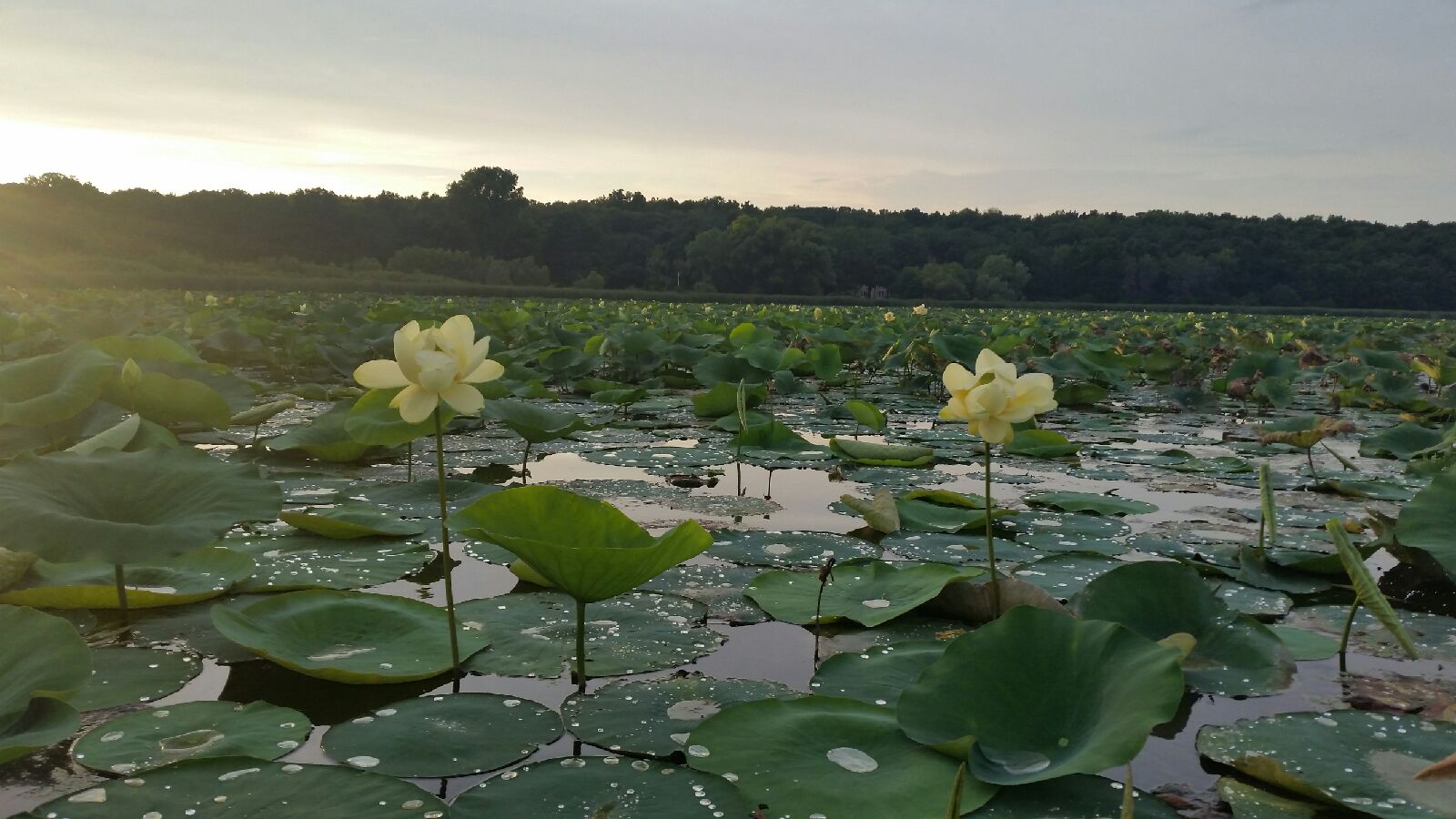
Today we have plants (and one video of flamingos), and different views of one species of plant from reader Eric Cabot. Eric’s captions are indented, and you can enlarge the photos by clicking on them. Following Wallace Stevens, I’d call this “Eleven Ways of Looking at a Lotus.”

Here is a series of photographs featuring the American Lotus (Nelumbo lutea), taken at a roadside pond in Middleton, Wisconsin,  in mid-August, 2018    There are few things as comforting as a quiet boardwalk-stroll through a flotilla of this beautiful plant towards the end of a fine day.

I was unsure of the plants’ identity until I found this statement on an informative website (https://www.wisconsinwetlands.org/):  Lotus leaves are circular but do not have a notch/sinus—they are continuous all the way around.

Unfortunately, the pond and the paths and boardwalks associated it were completely washed away by a deadly flash flood the following spring.  The pond has since been rebuilt, but not the boardwalk.  I haven’t gone back to see if the site has any lotuses. For now the images will have to do.

Here a video of pink flamingos the I recorded in “Cabo” a few years ago. [JAC: Keep watching for the displays and weird cries.]


Camera: NIKON S9300

Readers’ wildlife photos

February 24, 2026 • 8:15 am

We have a timely contribution, and a bit of duck-related drama in New Jersey, from Jan Malik, whose captions and story are indented below. (The duck was, in the end, unharmed.) You can enlarge the photos by clicking on them.

Here is a short series of pictures from Barnegat Light that I took about twelve years ago. I was sitting on the rock jetty one February day, scanning for any passing seabirds, when something in the corner of my eye caught my attention: a commotion farther out in the inlet channel. A duck was being attacked by a large gull.

Trigger warning and spoiler alert: the gull went hungry— the duck escaped that morning.

The prey: Long‑tailed Duck (Clangula hyemalis)

This isn’t the actual bird that was attacked; I think I photographed this one later that day. But like the victim, it was probably an immature male. Long‑tailed Ducks form large flocks outside the breeding season, wintering offshore from the Arctic Ocean, Norway, Greenland, and Canada, and reaching New Jersey when the weather turns especially cold. Unfortunately, their IUCN status is Vulnerable, and based on my very unscientific observations over twenty years of winter trips to the Jersey shore, their numbers seem to be declining.

The drama begins: the duck is caught by a Great Black‑backed Gull (Larus marinus).

These gulls—the largest species in the family Laridae—are powerful scavengers and opportunistic predators. I don’t see them often at Barnegat Light or other exposed coastal areas; they seem to prefer city dumps and places with more edible refuse than the clean, wind‑swept inlet.

Each bird pulls in a different direction.  The duck tries to dive, while the gull attempts to lift its prey and carry it to land, where it can kill it properly by violent shaking.

Given the size difference, the duck can’t fight back All it can do is try to slip free:

A second gull arrives The possibility of a meal attracts another gull, which immediately tries to steal the catch. This actually helps the duck—when raptors (if we can stretch the term to include gulls) quarrel over prey, they often drop it:

The gull’s grip is weak.  Here it’s clear that not all is lost for the duck. The gull’s smooth, non‑serrated bill has only a tenuous hold on the duck’s feathers, and it’s far from securing a proper grip:

The gull’s feet offer no help. Like other gulls, Great Black‑backed Gulls have webbed feet built for paddling, not grasping. Their only real weapon is the bill, and in this case it wasn’t placed well enough to subdue the duck:

The hunt ends unsuccessfully.  The duck breaks free and immediately dives. Long‑tailed Ducks can dive 100–200 feet (30–60 m) and swim underwater using both their feet and wings, much like penguins:

Another Long‑tailed Duck in flight.  I include this photo to show why the species is called “long‑tailed,” although this individual doesn’t have the longest tail I’ve seen. These ducks were once called “Oldsquaw” in the United States and “Old Wife” in parts of England, but in the early 2000s the name was changed because it was considered offensive. I agree with the change, though I sometimes wonder whether it marked the beginning of the slippery slope that later led to Audubon being “canceled” and many other biological names being flagged as candidates for revision.

JAC:  All’s well that ends well.