Why Evolution is True is a blog written by Jerry Coyne, centered on evolution and biology but also dealing with diverse topics like politics, culture, and cats.
I’m feeling grotty today, probably because of dysthymia compounded by lack of sleep. I hope to be okay tomorrow, but in the meantime we have show and tell. The show and tell today involves the Alpine Ibex (Capra ibex), the subject of a nice seven-minute video. It concentrates on their remarkable ability to climb on ledges that look unclimbable, something the many goat species can do as well. The videos mentions that young goats must “overcome their fear,” but I wonder if they really feel fear.
Note the morphological traits that have evolved in concert with this behavior, including body shape. Surely the ability to climb (a behavioral trait) preceded the evolution of things like those split hooves with soft pads, supporting Ernst Mayr’s claim that many key adaptations begin not as changes in morphology, but changes in behavior that give a premium to later morphological evolution. I just opened a book that was perhaps the most influential volume of my career, Mayr’s 1963 Animal Species and Evolution. I found this sentence on p. 604:
“A shift into a new niche or adaptive zone is, almost without exception, initiated by a change in behavior.”
Mayr was a smart guy, and was probably right. The important question, though, is, though, “do those changes in behavior have a genetic basis“? It’s hard to see, for example, how a goat with a greater propensity to climb, but not one based on genetic differences from other individuals, could possibly kick off a bout of evolutionary change, for there would be no increase of climbing behavior unless it came with an adaptive advantage that could be passed on via genes. If the first climbers did have genetic differences from non-climbers, and climbing resulted in more of your genes being passed on, you would get an increase in the behavior over time since it conferred a reproductive advantage. (This didn’t start with some individuals climbing sheer cliffs, of course!). After that, any mutations changing the hoof or body shape would be subject to natural selection. In this case, simple behavioral variation not based on genes wouldn’t, I think, kick off behaviors and morphologies like those shown below.
I can think of one exception: the famous case of cultural evolution of milk-drinking in British birds, first noted by Fisher and Hinde in 1949 (they studied blue and great tits). This was apparently a case of cultural evolution, which started with one or a few individuals prying the tops off milk bottles left on doorsteps and drinking the cream. This spread rapidly throughout the UK, so rapidly that it must have been a spread via imitation—that is, cultural evolution, not genetic evolution. Of course that would be followed by natural selection leading to things like prying the caps off better (beak changes?), locating milk bottles more readily, and digesting the milk. I don’t think anybody has studied any subsequent evolution in the birds (for one thing, milk isn’t delivered on doorsteps any more!); but this is one case in which a potential change in an “adaptive zone”—however you describe it—began with a simple behavioral change not based on genetic differences.
Sorry, I was just thinking on paper. Watch the video, which is amazing and instructive:
This is the third and last of a series of posts on the misguided concept of “agency and purpose in biology,” which one can take as the statement that “organisms have goals, and guide their own development and evolution towards those goals”.
Science of purpose. We are looking for experimental and theoretical research projects that will provide insight into the purposive, goal-directed, or agential behaviors that characterize organisms and various components of living systems. Researchers who have familiarity with our ongoing work in this area are especially encouraged to apply.
If you know the JTF, you’ll understand why they keep replenishing a trough full of grant money for such studies, for John Templeton (a mutual-fund billionaire and a believer) funded his Foundation with the intent of showing that science itself gave evidence for “spiritual reality”, aka a god or gods. Although some of the investigators supping at the trough deny that they’re engaged in teleology, much less giving evidence for divinity, all of their work feeds into the JTF’s mission, and the authors of an article just published online at the Journal of Evolutionary Biology (JEB) agree: the idea of teleology sneaks into many of these papers.
In my second post, on December 26, I analyzed one of the JTF-funded papers often cited to support the idea of agency and purpose in organisms, a paper in BioEssays by Sonia E. Sultan et al. I found it vacuous and intellectually confusing, mistaking “purpose” and “agency” for the results of natural selection and, in the end, making the ID-friendly argument that neo-Darwinism cannot explain the origins of “novel, complex traits”. That assertion alone discredits the paper, for the one paper that actually tried, using conservative assumptions, to mathematically model the origin of a complex trait (the camera eye), did so very successfully. No problems encountered! The purpose-and-agency folks’ view is that “since we don’t fully understand how an eye/wing/brain evolved, there must have been something beyond natural selection involved.” I suspect you know the fallacy of this argument.
Here are two concepts of agency advanced by Sultan et al and quoted in the paper below:
● “Biological agency—the capacity of living systems […] to participate in their own development, maintenance, and function” (Sultan et al 2022, p. 1);
● “Organisms themselves actively shape their own structure and function” (Sultan et al 2022, p. 4);
Now, a paper by James DiFrisco and Richard Gawne, published in JEB, takes apart the whole misguided notion and program of “agency and purpose” in evolution, and cites a lot of papers that tried to advance misguided ideas similar to those of Sultan et al. The title of the new paper is below, but if you click on it you will go to a truncated version of the article. However, you can read the entire paper as a pdf file available for free here.
Here are what I take as the paper’s important points:
A.) The idea that organisms direct their own development and evolution through some nebulous, non-neo-Darwinian process is incorrect. Everything touted as “purposeful” and “the results of agency” can be explained by natural selection molding organisms’ responses to a changing environment, both within one lifetime or across generations. As DiFrisco and Gawne say, goal-directedness “is an adaptation due to natural selection.” In my own example, cats and other mammals often grow longer fur during cold seasons because natural selection has favored genes that give organisms the capacity to put out more fur when their bodies detect cold weather. This is simple natural selection, and there is no “purpose” or “agency” involved.
B.) Some of the papers on purpose and agency aim to “rescucitate the Aristotelian view of biological purpose and teleology as real rather than merely apparent”, so some authors really do have a teleological bent, one that you can find in some works of the “Extended Evolutionary Synthesis.”
C.) The agency and purpose trope is, in the end, a metaphor that does no explanatory work nor promotes further research. Only the framework of neo-Darwinism can help us understand the origin of adaptations.
D.) The only “true” purpose and agency we see in biology is that which we see in the cognition of organisms capable of responding to environmental challenges by thinking rather than by a mechanical response. But even the p&a authors are the first to aver that this is not the sense in which they use these terms. In truth, as a hard determinist I see even cognition as a mechanical process and not something different in principle from a bacterium moving towards food, but this is not so important in this debate since the “cognition” view of purpose isn’t the subject of scientific work by the Templeton-funded authors.
I’ll quote the authors’ own conception of their aims as given in the JEB paper:
Box 1: The central claims of this paper.
1. An organism’s capacity for goal-directed behavior does not itself explain any biological phenomena. Apparently goal-directed behaviors are, instead, something to be explained as an evolved characteristic of biological systems.
2. The capacity for goal-directed behavior (outside of human cognition, which can set arbitrary, novel goals) is explained by Darwinian natural selection acting in populations of individuals.
3. Notions such as self-determination, or the idea that the whole organism is a cause of its own developmental or physiological processes, are either empirically untestable, or restatements of ordinary questions about which causal mechanisms at which scales influence events.
4. Downward causation and context-dependence are “mechanistic” in the sense relevant to experimental biology. They are not mysterious processes that require adopting the teleological form of investigation provided by an agency perspective.
5. Rejection of molecular reductionism or determinism does not necessitate a commitment to the idea of biological agency. Researchers need not embrace the agency perspective in order to acknowledge the importance of multi-level complexity, emergence, and downward causation.
6. The idea that biological goal-directedness is a product of natural selection rather than the inherent agency of organisms does not require commitment to the idea that all traits are adaptations. It is compatible with genetic drift, mutation, and developmental constraints playing an important role in evolution.
7. Agency is a psychological concept with origins in heuristic ascriptions of intentionality. Accordingly, it is applicable only where psychological explanations are useful—i.e., when explaining the behavior of humans and possibly other neurologically complex organisms such as primates.
8. Agency is not an empirically meaningful property, and incorporating the agency concept into experimental practices will not contribute to progress in biology.
And a few quotes that underline their contentions (indented). First, the important of natural selection in explaining adaptations:
It is important to recognize that the attribution of non-fitness-related goals to an organism can only be empirically grounded in the psychological case, where investigators can ask another human being to report on their internal cognitive states. For systems that lack the capacity to report on such states, the attribution of goals is empirically unmoored and arbitrary (see Fig 1). Is it the goal of a given stem cell to differentiate? (Manicka and Levin 2019; Levin 2021; 2022) Or, if the stem cell fails to differentiate and dies, was that really its goal? In order for goal-attributions to explain anything, goals would need to be linked to some empirically detectable feature of the system other than the actual outcomes of its behavior. Otherwise, these explanations would be circular and uninformative. It is not clear that this can be done without reference to natural selection.
The intellectual and biological vacuity of adding “purpose” to already-existing explanations:
Even if one allows explanations based on agency, it is difficult to see how such explanations could be useful for understanding an ordinary biological process—e.g., wound healing. To explain why a wound heals following injury, the statement that it is because the system possesses agency and pursues the goal of healing wounds is not useful from a scientific point of view. This is because agency is not an experimentally meaningful property that can be subjected to tests as to whether its presence or absence influences wound-healing. The “goal” of wound-healing is not something that can be detected or measured, but would have to be inferred and attributed ex post facto based on the system’s actual behavior (see above, “Agency and goal-directedness”). This procedure cannot predict that wound-healing fails in pathological cases (e.g., tumorigenesis), nor can it explain why such malfunctions do or do not happen. In the context of modern biological research, wound-healing is understood to be explainable in terms of complex positive and negative feedback mechanisms in which a wide array of signaling molecules mediate the progression through cell- and tissue-level processes, from wound detection to hemostasis, inflammation, cell proliferation, re-epithelialization, and tissue remodeling (Singh et al 2017; Rodrigues et al 2019). These feedback mechanisms are tuned to parameter values conducive to survival and reproduction because of natural selection.
Between mechanistic explanations and adaptive ones (Tinbergen 1963; Stearns 1982), there is no obvious role for a distinct form of explanation based on agency.
How could you investigate how wounds heal by even considering the idea of “purpose and agency”? As the authors note, there is no real “goal” here, but merely the sorting-out of genes that have different effects on wounds, with the genes that contribute to healing leaving more copies (their bearers survive and/or reproduce better). That’s simply natural selection. Ergo, there is no scientific benefit of JTF giving lots of dollars to study agency and purpose. They could give money for studying neo-Darwinian explanations, which we know are often the way to go, but doing so would simply justify scientific materialism, something anathema to JTF, as it leaves out god.
Finally, one more quote, as you can read the paper yourself (it’s written very clearly and should be accessible to those with a smidgen of biology knowledge):
An initial difficulty with the notion of self-determination centers on the self. It is not clear how to interpret expressions such as “the capacity of living systems […] to participate in their own development.” Development is the process of an organism going through the stages of its life cycle. It is not something separate from the organism. So how can an organism fail to participate in its development? If we suppose that the development of a given organism is fully determined by a set of underlying molecular factors, it is still the development of that particular organism rather than of another entity. It is also difficult to interpret the statement that “typical descriptions […] treat organisms [as] separate from and passive to the conditions under which they develop and evolve” (Nadolski and Moczek 2023, p. 3). If this refers to environmental conditions, it is an ordinary question of the relative causal importance of internal versus external factors. If it refers to internal conditions, however, the statement veers into obscurity. How can an organism be or separate from, or passive to, a process of development of itself?
This quote—and indeed, the whole paper—shows that the “purpose-and-agency” school is either engaged in a semantic rather than a biological argument, they are simply unable to grasp evolution, or they wish to make a name by couching neo-Darwinian mechanisms in “I-have-a-new-paradigm” language. . Indeed, epigenetics (at least some forms) were not part of the modern synthesis, but neither do they play into notions of agency and purpose. Epigenetic modifications can be evolved features of organisms that are ultimately coded in the genome, or they can be environmentally-induced modifications of DNA that are rarely adaptive and, at any rate, usually disappear in two or three generations at most, making them useless to explain the evolution of adaptations.
The lesson is twofold. Beware when you see biologists banging on about agency and purpose, and think about natural selection instead. Second, the JTF is throwing away its money on misguided projects. I’d like to ask them to give money to fund real biology, as they have over a billion dollars in endowment, but funding real biology would not advance the JTF’s purpose of finding the numinous using science.
On December 23rd, I called attention to the huge amount of money that the John Templeton Foundation (JTF) was throwing at biology projects giving evidence of “purpose and agency” in organisms. For example, one grant given to a group of investigators, titled “Agency, directionality, and foundations for a science of purpose,” handed out more than $14.6 million! And one of the few areas in biology they’re funding again next year is, yes, projects on the “science of purpose”, to wit:
Science of purpose. We are looking for experimental and theoretical research projects that will provide insight into the purposive, goal-directed, or agential behaviors that characterize organisms and various components of living systems. Researchers who have familiarity with our ongoing work in this area are especially encouraged to apply.
Now you can easily see how this fits into the JTF’s original aim, which was to find evidence for divinity and spirituality in science. And indeed, I’m sure that’s why they’re funding this area. But I’ve already argued that the only kind of “purpose” found in organismal behavior is that involved in conscious cogitation, which is present in only a few organisms. Yes, some behaviors look “purposeful,” as when a bacterium moves toward or away from light, but that’s a purely mechanical response—not the kind that, say, humans have when they decide, “I’m going out for pizza.” And of course there is no goal-directedness or purpose in evolution, which simply sorts out genetic variation based on whether genes leave more or fewer copies of themselves, often leaving more when they adapt their carrier better to the environment.
However, the biologists who get funded for work on “agency” and “purpose” will be the first to tell you that they are not really imputing to organisms the kind of mental “purpose” that some organisms have, nor are they looking for anything numinous or supernatural. Rather, they seem to be whipping up a bunch of word salad that makes it seem that they are overthrowing the neo-Darwinian view that adaptations arise from genetic variants sorted out by their relative contribution to the genes of descendants. Such researchers pretend that they are making profound new statements about biology and evolution, but when you look at the papers carefully, as I did with one of the influential papers (below) that Templeton funded in its “purpose and agency” program, you find nothing new. In this case, a whole paper touting “purpose” is merely re-describing something known for a long time: organisms can evolve “norms”of reaction”. These are simply the plastic developmental programs that organisms evolve to respond to environmental changes, so that behavior, physiology, and appearance can change when conditions change. That superficially may look like “agency”, but there’s no “will” involved, and nothing beyond genes responding to environments.
The evolution of norms of reaction is not hard to understand. Take one familiar plastic response: mammals like cats that grow longer fur in the winter. This is due simply to natural selection acting on the DNA to respond to cold temperature by growing thicker fur. And, of course, as we know from all the varieties of dogs and cats with more or less fur, artificial selection can do that, too. We needn’t think about “purpose” or “agency” when we see this, nor need we say, “one purpose of this trait is to keep the cat warm” or “the cat has agency to grow longer fur to keep in warm in winter.” That kind of talk about “purpose” is only confusing, hiding what really happened during evolution: natural selection for flexible forms of development.
And there are gazillions of traits that you could say look as if organisms have such agency or purpose, but they are all the result of natural selection. If a goat loses its front legs in an accident, it may well eventually walk on its hind legs. To do that, a number of their bones, tendons, and muscles have to be reconfigured to allow adaptive locomotion. But this, too, is a result of evolved plasticity: in the past, injuries may have been common, and those individuals with genes that allowed their development to compensate for those injuries, thus allowing the sufferer to survive and reproduce, outcompeted individuals lacking genes giving their bodies the ability to cope with injuries.
This is nothing new in evolution; people have talked about plasticity and “norms of reaction” (how organisms change to cope with changes in the environment”) for ages, and there are even experiments showing that such coping is due to natural selection. But authors like those of the paper below, funded by the JTF, gussy up an old concept by calling it “biological agency”, enabling them to get a ton of cash from the JTF.
I see the effort as intellectually confusing and, indeed, hubristic, because surely the authors know what they’re doing. In the next and final installment of this “agency” mishigass, I’ll highlight a paper that calls this kind of effort to task, showing that it really doesn’t show anything new. Yes, I get excited when new concepts and findings appear in biology and especially evolution, but this ain’t one of them.
Click on the headline below to read the paper, which is free (there’s a pdf here):
The Sultan et al. paper is poorly written, full of big words that are supposed to constitute their idea of agency. But let’s see first how they define agency. Excerpts from the paper are indented.
What is agency? Sultan et al. assure us that it isn’t anything supernatural, but what it really is comes down to “self-regulation” that, in the end, simply amounts to the norms of reaction of an organism.
Living systems have evolved to be robust, responsive, flexible, self-synthesizing and self-regulating. This dynamic flexibility is manifest across diverse levels of biological organization, from cells, to tissues, to entire organisms, to reproductive lineages, to social colonies, and throughout a variety of organismal activities—from molecular signaling pathways to morphogenetic, metabolic, immune, endocrine, and behavioral systems. We use the term biological agency to refer to this suite of robust processes that is constitutive of living systems (See Box 1). Biological agency, in this sense, is the capacity of a system to participate in its own persistence, maintenance, and function by regulating its own structures and activities in response to the conditions it encounters.[69] Attributing agency to a biological system is based on natural, empirically determined processes and connotes neither consciousness nor deliberate intention.
or
Agency is a dynamical property of a system.[162] It consists in the system’s capacity to transduce, configure, and respond to the conditions it encounters. Crucially, agential systems are capable of maintaining functional stability in response to conditions that would otherwise compromise their viability.
Try as I might, I cannot see a distinction between this farrago of fancy words and good old “norms of reaction”. “Self regulation” is simply the end result of natural selection acting on organisms so that when the environment changes, they respond through their evolved developmental systems in an adaptive way. Note that the authors explicitly rule out “purpose” of “deliberate intention” in the “consciousness” sense here. Ergo, “maintaining functional stability in response to conditions that would otherwise compromise their viability” is just like a cat growing longer fur in the winter, but it sure is a fancy way of saying it.
Here some examples the authors adduce for “agency”:
Polypterus fish reared in a terrestrialized environment in which fish are forced to walk on their pectoral fins rather than swim, adjust—within a lifetime—not just their behavior, gait and posture but also their skeletal features, in ways that parallel the fossil record of tetrapods’ ascendance onto land.[136] Tadpoles exemplifying the ancestral detrivorous life style and associated gut morphology will adjust the latter if forced to consume a carnivorous diet, in ways that partly parallel evolved changes in specialized carnivorous lineages.[137] Examples such as these suggest that interactions between developmental systems and environmental circumstance may bias the production of phenotypic variation in the face of novel or stressful environments toward functional, integrated, and possibly adaptive variants.
No, the phenotypic direction isn’t “biased” by anything but natural selection. Polypterus fish live in shallow water and have lungs, and it’s possible that their ancestors evolved to walk on their fins to get around in that shallow water or even to leave the water for brief periods of time if their ponds are drying up and they need to get to another pool of water. Or, it’s even possible that this norm of reaction isn’t evolved at all, but simply the result of an organism struggling to move when that’s the only alternative it has. Here’s what it looks like:
Try that with a goldfish! Why do Polypterus show “agency” in this way but not goldfish? Probably because of the evolutionary background of this species, which is sometimes regarded as an example of the kind of fish that evolved into terrestrial teterapods. But what “agency” are they showing? Likewise, it’s easy to see how tadpoles could occasionally encounter a situation in which there is more “meat” (other organisms or their remains) to eat than there is non-animal detritus. In that case, tadpoles able to evolve a way to change their digestion in such a circumstance would leave more offspring than those that couldn’t. Of course for this system to work, the environment would occasionally have to change in a way that would give organisms like this an advantage (it doesn’t have ot change every generation). If organisms evolved a developmental system to adapt to environmental changes that couldn’t conceivably have occurred, then we’d have something to talk about! But I know of no such cases.
To justify their “new” approach, the authors give examples of three phenomena that, they say, can’t be explained by conventional neo-Darwinism:
1). Genome-wide association studies (GWAS), in which genes for traits are identified by looking at which genetic variation in an entire genome is correlated with variation in a trait, often reveal “too few genes”. For example:
In the case of body weight, for example—a biomedically critical trait in the context of obesity, insulin resistance and type 2 diabetes—115 genetic loci that showed significant statistical association with body mass index (BMI) collectively explained less than 3% of the variation among adults,[8] and a meta-analysis based on an enormous sample of 700,000 individuals (conferring great statistical power) still explained only 6% of BMI variation[9] despite using a high-dimensional correlation matrix that is known to inflate these estimates.[10] While such extremely large studies may incrementally add to the variance explained by identifying additional loci of small effect through sheer statistical force, over 90% of (a) phenotypic variation for BMI and (b) risk of type 2 diabetes remains unaccounted for,[11, 12] pointing to a more fundamental issue.
And yet heritability studies, involving simple correlation of BMI between relatives is measured, show that between 40% and 70% of the variation of that trait among individuals is due to variation in genes. We can find only 6% of those genes, so where are the rest? One explanation is that there are many genes affecting BMI whose effects are too small to be measured by GWAS, which requires pretty big effects to find a genetic region affecting a trait. Further, GWAS analyses rely entirely on SNPs (single nucleotide polymorphisms in DNA sequence), and are unable to detect duplications and deletions, which we know make a contribution to human trait variation (see references here, here, and here). Finally, GWAS is unable, except in vary large samples, to detect rare genes, and yet given the size of the genome, everyone has quite a few “rare” genes. When you use large samples, as they have done for human height, the missing heritability diminishes to almost zero: the genetic variation detected by GWAS gives predictions that are almost the same as that based on standard heritability studies.
The authors add this:
Biomedical researchers concerned about the limits of the GWAS approach are therefore increasingly calling for conceptually broader studies directly addressing processing pathways that modulate gene function and hence phenotypic outcomes in individuals via complex gene-environment interactions,[18] environmentally-mediated epigenetic modifications,[19, 20] and physiological and developmental feedback systems such as microbiome composition, which changes dynamically in response to the individual’s diet, behavior, and social environment.[21]
Yes, perhaps there are some differences in microbiomes that are responsible here, but there are many traits where there are “missing genes” that cannot be imputed to microbiome inheritance. As for epigenetic modifications and the like beyond bacteria in the gut, those would also show up in GWAS studies, and so can’t constitute “missing genes” (an epigenetic modification occurs at a given site in the DNA, involves a modified base, and is supposedly inherited over at least one generation).
But much of the above is simply gobbledygook: how can “dynamic changes in response to diet, behavior, and social environment” account for missing genetic variation that shows up in heritability studies but not GWAS studies? This could occur only in species in which cultural, nongenetic factors are inherited, like the tendency to eat fatty foods. But these factors are usually ruled out in most heritability (e,g., in flies) and those studies still show a substantial genetic contribution to variation in a phenotype. What the authors consider “agency” here is not clear, but they are doing a service by highlighting a problem that has yet to be solved: “dark heritability.” We don’t know the answer yet, but we have some clues, and time will tell.
2). The authors drag in epigenetics to explain the missing heritability. This second problem is really the same as the first: we have a mismatch between results revealed by GWAS analysis and simple studies of heritability via correlation between relatives. But this doesn’t solve the problem: it compounds it for two reasons. First, epigenetic modifications of DNA will show up in GWAS and heritability studies, and so don’t constitute “dark genetic variation”. Further, non-coding RNAs, which the authors further use to explain missing variation, are also inherited. Finally, and most important, epigenetic modifications of DNA resulting solely from the environment (and not coded for themselves in the genome) almost never persist for more than two or three generations, and thus can’t explain a persistent appearance of “adaptive change” over evolution. Nor are epigenetic modifications usually adaptive, and they can be maladaptive (as in the “Dutch famine trauma”), because they are not evolved but simply the effect of the environment on a genome not adapted to changes in that environment.
Here is one example the authors use to show agency via purported epigenetic change:
An experimental example using isogenic plants points to part of what may be missing. In one series of experiments with the common herb Polygonum, parent plants of the same genetic line were either drought-stressed or given ample water. When their offspring were grown in identical, dry, conditions, they developed differently: the offspring of drought-stressed parents produced significantly larger and more rapidly-extending root systems than those of the moist-grown parents, an inherited phenotypic effect that resulted not from a genetic difference but in response to parental conditions.
“Isogenic” means that all the plants were genetically identical. And yes, it’s hard to imagine that offspring have a way of genetically “knowing” whether their parents experienced drought, though there could be cytoplasmic effects. So this looks like agency, and may be due to adaptive epigenetic modification. But this is the exception, rather than the rule.
3.) This is the kicker: neo-Darwinism cannot, say the authors, explain the origins of “novel, complex traits”. Here we have one of the assertions of intelligent design, but although there’s no designer, the authors’ claim about the impotence of neo-Darwinism in producing complex adaptations is simply wrong (they are implying, I think, that organisms are somehow using their AGENCY to develop those complex traits. Here’s the assertion:
The origin of novel complex traits constitutes a central yet largely unresolved challenge in evolutionary biology.[61] Ever since the founding of evolutionary biology one of the discipline’s core motivations has been to understand such elaborate innovations as the vertebrate eye, the insect wing, or the mammalian placenta, traits whose origins transformed the diversity of life on earth. Yet conventional approaches to understanding evolutionary change have provided few opportunities to make significant headway.[62] Of the four evolutionary processes conventionally recognized—natural selection, genetic drift, migration, and mutation, the first three can only sort among existing variants and their distribution within and among populations, but by themselves cannot bring about novel features.[63] This privilege is instead restricted to mutation, yet all attempts to explain the evolution of novel complex traits solely via the coincident origin, spread, and fixation of one beneficial mutation at a time have failed.
Sorry, but this resembles what comes out of the south end of a cow looking north. There is no conceptual reason that sorting out existing and new genetic variants via conventional natural selection is impotent to produce complex traits. The problem is that we simply weren’t there when many complex traits evolved, and so don’t know the genes involved, the selection pressures involved, or even the developmental pathways involved in producing the traits.
I know of only one attempt to get at this problem, and that involved the evolution of the camera eye. This was the work of Nilsson and Pelger summarized in a delightful summary by Richard Dawkins called “The eye in a twinkling“. Using conservative (“pessimistic”) assumptions about mutation rates, heritabilities, and the number of developmental steps required to transform a light-sensitive spot into a complex “camera eye” with a lens, retina, and cornea (viz., what we and some cephalopoods have), Nilsson and Pelger found out that the evolution of this assuredly complex trait took around 400,000 generations. As Dawkins noted:
Assuming typical generation times of one year for small animals, the time needed for the evolution of the eye, far from stretching credulity with its vastness, turns out to be too short for geologists to measure. It is a geological blink.
And so it might be with other traits, like wings or placentas. The problem is making an appropriate model, and that is hard or impossible without knowing how the trait evolved (we have some idea with the eye, as Dawkins notes, hearkening back to Darwin, who first raised the “eye problem”.) But without such models, it’s almost deceitful to say that we need a new paradigm to explain the evolution of complex traits. (In fact, we can see the evolution of complex traits—like whales evolving from land ungulates in a mere 10,000 years. And that is surely due to selection, though we can’t say with assuredness that conventional neo-Darwinism was involved. But our ignorance does not justify us trying to depose a well-established paradigm, and one that works very quickly in the case of artificial selection (genetic analysis of adaptations invariably shows that changes in the DNA are involved). Are dog breeds all due to epigenetic modifications of DNA or “agency” in the ancestral wolf? I don’t think so!)
I’ve already gone on too long, but if this paper is typical of the kind of research the JTF is funding as evidence for agency and purpose, it’s throwing its money down the toilet,.
Oh, and one last beef. When I saw this claim in the Sultan et al. paper, I was astonished:
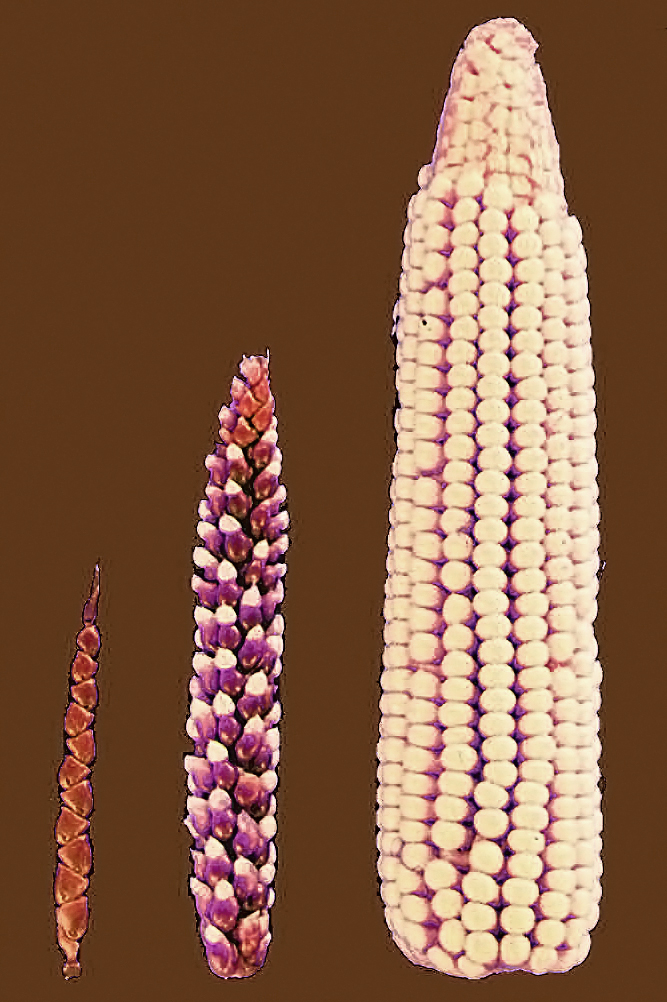
In Maize, for instance, the “profound” architectural and reproductive changes that distinguish cultivated Maize from its wild progenitor, Teosinte, resulted not from novel mutants but from the response of a complex epistatic network to the atmospheric CO2 and crowded planting conditions encountered during the species’ early cultivation.[155]
What? This change, from the grass teosinte on the left to modern corn on the right (hybrid is in the middle) has nothing to do with novel mutations?
For example, genetic research shows that once-emphasized conventional assumptions about morphological change—e.g., that the change was driven mainly by human selection for rare mutants of a few single genes that were deleterious in wild plants and favorable in field environments or by selection for new, advantageous mutations that appeared postcultivation—have, for some major traits, been supplanted by different and/or more complex processes. These processes include (i) regulatory changes that targeted diverse developmental pathways and led to changes in gene expression (e.g., how, when, and to what degree existing genes are expressed through changes in the amount of mRNA during transcription); (ii) extensive rewiring of transcriptomic and coexpression networks; (iii) in an increasing number of wild progenitors, the presence and availability to the first cultivators of preexisting, nondeleterious genetic components for major domestication traits (known as “cryptic genetic variation”) that induce trait variation only under specific environmental or genetic conditions; and (iv) deviations from simple Mendelian expectations.
Every change mentioned involves mutations, whether they be structural, regulatory, or “cryptic” (genes showing their effects only under limited conditions). There is nothing new here, merely an explication of how artificial selection on teosinte involved a variety genetic changes. There is NO AGENCY in teosinte, not even construed as broadly as Sultan et al. do.
In the end, the paper seems to be much ado about nothing, which, in the last chapter (maybe tomorrow) another author will analyze critically, showing that there’s no “there” there.
I know many people won’t be interested in this analysis, but I wanted to get it on the record because so many people are hearing that not only is neo-Darwinism a pretty useless paradigm for understanding adaptation, but now are hearing as well that some nebulous “purpose” and “agency” are involved. As usual, Templeton’s money has only muddied the water.
Over at sapiens.org, an anthropology magazine, author Elaine Guevara (a lecturer in evolutionary anthropology at Duke) takes modern genetics education to task. Making a number of assertions about what students from high school to college learn in their genetics courses, Guevara claims that this type of education imparts “zombie ideas”: outdated but perpetually revived notions that prop up biological racism. Her main topic is race, and she does offer some insights that modern genetics has given us about differences between geographic populations (I prefer to use “populations” rather than “races”), but these insights have been known for a long time. By failing to tell us that the errors earlier biologists have made about race have been refined and, to a large degree, dispelled, Guevara is herself deficient in describing the state of modern genetics.
Click the screenshot to read:
Guevara makes several accusations that, I think, are misleading. I’ll group her misleading conclusions under bold headings (the wording of those is mine). Quotes from her paper, or my paper with Luana Maroja, are indented and identified
1.) Human populations are not as different as we think, and the concept of “race” is incorrect: classical “races” are not genetically distinguishable. Guevara first cites a famous 1972 paper by my Ph.D. advisor, Richard Lewontin, “The Apportionment of Human Diversity“. The paper looked at genetic variation of 17 proteins detected by gel electrophoresis, apportioning the worldwide variation of proteins among individuals within a population, among populations within a classical “race”, and then between seven “races”. He found that of the total genetic variation seen worldwide, 85% occurred among individuals within one geographic population, 8% among populations within a race, and only 6% was found among races.
Thus races were not as genetically different as some people assumed. Lewontin concluded this (bolding is mine):
It is clear that our perception of relatively large differences between human races and subgroups [JAC: note that Lewontin’s “subgroups” correspond to what I would call “populations’], as compared to the variation within these groups, is indeed a biased perception and that, based on randonly chosen genetic differences, human races and populations are remarkably similar to each other, with the largest part by far of human variation being accounted for by the differences between individuals.
Human racial classification is of no social value and is positively destructive of social and human relations. Since such racial classification is now seen to be of virtually no genetic or taxonomic significance either, no justification can be offered for its continuance.
The first paragraph is correct. Later studies using better methods (DNA) have shown that yes, the apportionment of human diversity shows most of it within populations and only a fraction among populations or among “races”. The classical view that races like “Caucasion”, “Asian” or “Black” showed large and diagnostic genetic differences at single genes was wrong
But the second paragraph is wrong, too, because Lewontin did not raise the possibility (as I’m sure he realized) that small differences among populations (or the groups of populations that constitute classical “races”) can, taken across many, many genes, add up to significant statistical and biological differences. The failure to recognize the power of using genetic data from many genes (we have three billion DNA nucleotides in our genome) is called “Lewontin’s fallacy.” This fallacy was pointed out in 2003 by A.W.F. Edwards and has its own Wikipedia page.
The power of using many genes instead of just an unweighted average of data from individual genes is shown by several things, as Luana Maroja and I pointed out in our paper published in Skeptical Inquirer last year. For one thing, if there were no meaningful genetic differences between populations, you couldn’t use genetic differences to diagnose someone’s ancestry. Yet you can, and with remarkable accuracy, as anyone knows who is aware of their family history and has taken a genetic test like those offered by 23andMe. My test showed that I have complete Eastern European ancestry, with 98% of it from Ashkenazi Jews, which comports with what I know of my family history. (I also have a small percentage of genes from Neanderthals.)
Now this tells you the area of the world—the population—from which your ancestors probably came. It doesn’t deal with “races” as classically defined. Yet a multiple-gene analysis using four races that Americans themselves use in self-identification (African-American, white, east Asian, or Hispanic) can indeed be diagnosed with remarkable accuracy. As Luana and I said in our paper (I’ve bolded the money quote):
Even the old and outmoded view of race is not devoid of biological meaning. A group of researchers compared a broad sample of genes in over 3,600 individuals who self-identified as either African American, white, East Asian, or Hispanic. DNA analysis showed that these groups fell into genetic clusters, and there was a 99.84 percent match between which cluster someone fell into and their self-designated racial classification. This surely shows that even the old concept of race is not “without biological meaning.” But that’s not surprising because, given restricted movement in the past, human populations evolved largely in geographic isolation from one another—apart from “Hispanic,” a recently admixed population never considered a race. As any evolutionary biologist knows, geographically isolated populations become genetically differentiated over time, and this is why we can use genes to make good guesses about where populations come from.
And this:
More recent work, taking advantage of our ability to easily sequence whole genomes, confirms a high concordance between self-identified race and genetic groupings. One study of twenty-three ethnic groups found that they fell into seven broad “race/ethnicity” clusters, each associated with a different area of the world. On a finer scale, genetic analysis of Europeans show that, remarkably, a map of their genetic constitutions coincides almost perfectly with the map of Europe itself. In fact, the DNA of most Europeans can narrow down their birthplace to within roughly 500 miles. [See below for the European data.]
You can also identify the “classical” races used in self-identification using some morphological traits. As we wrote:
But you don’t even need DNA sequences to predict ethnicities quite accurately. Physical traits can sometimes do the job: AI programs can, for instance, predict self-reported race quite accurately from just X-ray scans of the chest.
Population differences summed across genes can tell us more, too:
On a broader scale, genetic analysis of worldwide populations has allowed us to not only trace the history of human expansions out of Africa (there were several), but to assign dates to when H. sapiens colonized different areas of the world. This has been made easier with recent techniques for sequencing human “fossil DNA.” On top of that, we have fossil DNA from groups such as Denisovans and Neanderthals, which, in conjunction with modern data, tells us these now-extinct groups bred in the past with the ancestors of “modern” Homo sapiens, producing at least some fertile offspring (most of us have some Neanderthal DNA in our genomes). Although archaeology and carbon dating have helped reconstruct the history of our species, these have largely been supplanted by sequencing the DNA of living and ancient humans.
Finally, there are nearly diagnostic differences between populations in genes that evolved in an adaptive way, like known genes for resistance to low oxygen, short stature or skin pigmentation. Here’s a figure from a 2015 Science paper by Sarah Tishkoff:
None of this would be possible if there were not significant genetic and biological differences between populations. We did not maintain that there are always diagnostic differences between populations at single genes that can group them into races, but that there are statistical differences in frequencies of variable genes among populations that are biologically meaningful. Nor did we claim that the classically-defined races are absolutely geographically distinct with little intermixing, or have nearly fixed differences in frequencies of variable genes. That’s not true, and all geneticists realize this now. (But note that even the classically defined “races” generally differ in gene frequencies and in some biological traits to an extent that they can be diagnosed.)
The reality is that we should be dealing with populations, and populations—roughly defined as geographically different groups of people that largely breed among themselves—show diagnostic genetic and morphological differences.
Yet Guevara misleads the reader by relying solely on Lewontin’s paper and neglecting all the work done since that showing that yes, there is diagnostic geographic variation among populations (note that Lewontin implied that the concept of “population” is about as meaningless as “race”). Here are cxcerpts from Guevara’s paper:
Lewontin published his calculations in a short paper in 1972 that ended with this definitive conclusion: “Since … racial classification is now seen to be of virtually no genetic or taxonomic significance either, no justification can be offered for its continuance.” His results have been replicated time and again over the last 50 years, as datasets have ballooned from a handful of proteins to hundreds of thousands of human genomes.
But despite huge strides in genetics research—leaving no doubt about the validity of Lewontin’s conclusions—genetics curricula taught in U.S. secondary and post-secondary schools still largely reflect a pre-1970s view.
This lag in curricula is more than a worry for those in the ivory tower. Increasingly, genomics plays a leading role in health care, criminal justice, and our sense of identity and connection to others. At the same time, scientific racism is on the rise, reaching more people than ever thanks to social media. Outdated education fails to dispel this disinformation.
Leaving “no doubt about the validity of Lewontin’s conclusions”? Nope. The apportionment of variation is without doubt, but not his conclusion that populations or races are without biological meaning.
None of the critiques of Lewontin’s paper, including Edwards’s famous clarification, are even mentioned by Guevara. And, in fact, I don’t know of any biologists in post-secondary genetics education who still teach the view that “Race and ethnicity are social constructs, without scientific or biological meaning.” (This is a quote from JAMA reproduced in the Coyne and Maroja paper. And perhaps some people teach this erroneous view, but no biologist that I know of.) That JAMA statement is completely misleading, as I hope I’ve shown above. The delineation and definition of classical races was itself misleading and often tied to racism in the past, but, as we see, even self-identified classical races can be diagnosed through genes or morphology, and generally do fall into clusters using analysis of multiple genes.
The last paragraph of Guevara’s quote above shows the ideological motivation behind her paper: we must dismiss the existence of biological races and genetic differences between populations because it emphasizes differences between humans, and thus could lead to ranking of human populations, and thence to racism. But, as Ernst Mayr recognized, accepting differences does not mean you have to view groups as being morally or legally unequal. We give a quote by evolutionist Ernst May quote in our Skeptical Inquirer paper:
Equality in spite of evident non-identity is a somewhat sophisticated concept and requires a moral stature of which many individuals seem to be incapable. They rather deny human variability and equate equality with identity. Or they claim that the human species is exceptional in the organic world in that only morphological characters are controlled by genes and all other traits of the mind or character are due to “conditioning” or other non-genetic factors. … An ideology based on such obviously wrong premises can only lead to disaster. Its championship of human equality is based on a claim of identity. As soon as it is proved that the latter does not exist, the support of equality is likewise lost. (Mayr 1963)
Thus, the second conclusion of Guevara is wrong:
2.) “High genetic variation exists within geographic regions, and little variation distinguishes geographic regions.”
Well, that’s sort-of true, but, as we said, that “little variation among geographic regions” can, when added up, diagnose populations sufficiently to not only tell you your geographic ancestry, but also to reconstruct the evolutionary and migratory history of human populations. Guevara dismisses these ancestry tests, though she doesn’t tell us why they are wrong:
Helping the zombie persist, direct-to-consumer genetic tests, like those offered by 23andMe and AncestryDNA, can reinforce misconceptions about human variation. These services have become many people’s primary reference point for human genetics information. To be marketable, the companies must communicate their results in simple, familiar ways that also appear meaningful and reliable. This usually entails simplifying genetic ancestry to bright, high-contrast colors, pinned definitively to geographic regions.
And yet, at the same time, Guevara admires the same kind of data—genetic differences between living populations (as well as “ancient fossil DNA”)—as being of value:
In addition to genomes from living humans, DNA extracted from ancient humans over the past two decades has revealed incredible insights. Across time, past humans frequently migrated, mated with, or displaced people they encountered in other regions—resulting in a tangled tree of human ancestry. The ancient DNA results refute any notion of deep, separate roots for humans in different geographic regions.
Well, there are deep roots for some groups (the Neanderthal lineage, for example, separated form the lineage leading to modern humans about 400,000 years ago), and this comes from both fossil and DNA evidence. The “tangled tree” may be correct in some ways (we did hybridize with Neanderthals, and other populations exchanged genes to different degrees), but it’s not tangled enough to completely efface the evolutionary history of human populations.
All this leads to a third misleading conclusion:
3) Races are social constructs. Any differences between races are largely caused by racism rather than genes. As Guevara says:
As laid out by a major professional association for biological anthropologists, race is a social reality that affects our biology. For the last several hundred years in the U.S. and other colonized lands, racism has influenced people’s access to nutritious food, education, economic opportunities, health care, safety, and more. As a consequence, and precisely because of the environmental influence on most traits, the social construction of race is a risk factor for many health conditions and outcomes, including maternal and infant mortality, asthma, and COVID-19 severity.
This again shows both an ideological motivation and a misleading conclusion. Even the classical biological races (and even more so worldwide populations) are NOT social constructs, but are associated with genetic, morphological, and adaptive differences. If races are purely socially constructed, how could you tell them apart in the first place? You need some kind of genetic marker. In the case of racism in America, the differences between African-Americans and whites were “constructed” based on skin pigmentation, hair texture, and other traits—traits based on genetic differences. Those differences served to mark out which people were considered different, and then “inferior”, though, as I said, genetic differences among people say nothing about moral or legal equality. THAT is the lesson that needs to be imparted, not the falsity that there are no genetic differences among groups.
Now Guevara may be correct that the “social construct” view is the one taught, erroneously, in high school and college. But she’s wrong in thinking that Lewontin’s paper supports that “social construct” view. In fact, the social construct view is largely wrong, with some exceptions centered on the outmoded view of “classical races”, but it appears to dominate anthropology and the social sciences. Anybody holding that view for either populations or groups of geographically contiguous populations needs to read the Coyne and Maroja paper.
4). Humans aren’t peas. According to Guevara, Mendel’s work on peas, as taught in school, buttresses scientific racism, too:
I, along with others, am concerned that this focus instills and reinforces a false pre-Lewontin view that humans, like Mendel’s peas, come in discrete types. In reality, early studies of peas and other inbred, domesticated species have little relevance for human genetics.
Indeed, it is of little relevance to human genetics, but I’m not aware of any teacher who describes Mendel’s work—which served to show how genes sort themselves out during reproduction—and uses it to conclude, “See, human races are as distinct as round and wrinkled peas.”
In the end, both races and populations of humans show genetic and evolved morphological differences—less than we thought, say, a hundred years ago—but differences that are still significant in useful ways. To say that races or populations are purely social constructs is simply wrong, and to use Lewontin’s paper to reinforce that conclusion is doubly wrong.
Now reader Lou Jost has argued that Lewontin couldn’t really mathematically partition genetic variation the way he did because Lewontin used the wrong method. Regardless, it’s clear that there is more genetic variation at a given locus within a population than between populations or the groups of populations once deemed “races”. But in the end there is a tremendous amount of information of biological and evolutionary significance to be gained by adding up the small genetic differences we see between human populations.
To end, here’s a map of genetic variation among populations in Europe, showing how the genetic variation (grouped by principal components analysis) lines up nicely with the geographic variation in populations. That’s because genetic differences evolved between semi-isolated groups of people, and that is why we can tell with considerable accuracy where our ancestors came from
Genetics (grouping of individuals using two axes of a principal components analysis. Look how well the geography (identified by color above) matches the genetics!
The Atlantic decided they needed a piece on Richard Dawkins’s “farewell tour”, but they either chose the wrong journalist or asked the author to write a semi hit-piece that made Dawkins look bad. Not completely bad, mind you, for the author does mention a few good things Dawkins has done. But, overall, the piece depicts an aging man who simply needs to fight battles, and now there are no battles to fight. Once it was creationism, says senior editor Ross Andersen, but now it’s the lesser battle of “fighting wokeness”.
Since Andersen himself shows signs of “progressive” thought in his piece (he defends, for example, the teaching Māori legends as science in New Zealand), he may have an animus against Richard. I don’t know, but I know two things. First, Andersen shows no signs of having read Dawkins’s books or followed his career. Second, Anderson ends his piece, which describes his opinion of Richard’s recent lecture in Washington D.C., by saying “I was bored.” His pronouncement is distinctly un-journalistic given that Andersen describes a very enthusiastic audience lining up to get books signed, and bespeaks a reviewer more concerned with his own personal reaction than with the effect of Dawkins, his writing, and his Washington discussion on the audience (and on society in general).
Click on the headline below to read it, or, if you can’t, you can find it archived here. Several readers sent me this piece—I suppose expecting to get my reaction. So here it is: the piece stinks.
The dissing starts off in a subtle way with the title (granted, Andersen may not have written it, but the Atlantic approved it). But in the second sentence, Andersen says this:
[Dawkins] has adapted his swaggering Oxbridge eloquence to a variety of media ecosystems.
Anybody who knows or has even heard Richard knows that his eloquence is not “swaggering,” but measured and reserved. But I’ll leave that aside and pass on. Here, also, in the first paragraph, Andersen describes Dawkins’s first foray into atheism:
In 2006’s The God Delusion, another mega–best seller, Dawkins antagonized the world’s religions.
“Antagonized the world’s religions”? Well, yes, some believers may have been offended, but what about adding that this book made an eloquent argument against religion, and, in fact (as Andersen says later!), changed people’s lives for the better. That sentence is like saying, “In Mein Kampf, Hitler antagonized the world’s Jews.” It may be true, but both statements are certainly pejorative and woefully incomplete.
Throughout the piece, Anderson describes how energized, worshipful, and jazzed up the audience was. But of course Anderson was “bored”. Here is part of his description:
Now, at age 83, Dawkins is saying goodbye to the lecture circuit with a five-country tour that he’s marketing as his “Final Bow.” Earlier this month, I went to see him at the Warner Theatre in Washington, D.C. Dawkins has said that when he visits the U.S., he has the most fun in the Bible Belt, but most of his farewell-tour appearances will take place in godless coastal cities. After all, Dawkins has a new book to sell—The Genetic Book of the Dead—and at the Warner, it was selling well. I saw several people holding two or three copies, and one man walking around awkwardly with nine, steadying the whole stack beneath his chin. The line to buy books snaked away from the theater entrance and ran all the way up the stairs. It was longer than the line for the bar.
As for the audience, which was surely diverse:
The packed theater looked like a subreddit come to life. Bald white heads poked above the seat backs, as did a few ponytails and fedoras. This being an assembly of freethinkers, there was no standard uniform, but I did spot lots of goatees and black T-shirts. The faded silk-screen graphics on the tees varied. One was covered in equations. Another featured a taxonomy of jellyfish extending onto its sleeves. These people had not come here merely to see a performer; Dawkins had changed many of their lives. A man in the row behind me said that he had attended Dawkins’s show in Newark, New Jersey, the previous night. As a Christian teen, he had sought out videos of Dawkins, hoping that they would prepare him to rebut arguments for evolution. He ultimately found himself defeated by the zoologist’s logic, and gave up his faith.
. . . Jake Klein, the director of the Virginia Chapter of Atheists for Liberty [JAC: the “warm-up” act], told a similar conversion story onstage, before introducing Dawkins. Klein said The God Delusion had radicalized him against the Orthodox Judaism of his youth. Millions of other creationists had similar experiences, Klein said. He credited Dawkins with catalyzing an important triumph of reason over blind superstition.
Indeed, Dawkins has changed many lives for the better; his books were an important impetus for people not only accepting the scientific truth of evolution, but also grasping the wonder and majesty of both natural selection and evolution—not to mention helping people throw off the constricting chains of religion. (I’m a small fish, but I myself have been told that that Why Evolution is True and Faith Versus Fact have also changed lives.) Given the dominance of creationism in America—37% of Americans still accept Biblical creationism, 34% accept a form of God-guided evolution, while a mere 24% accept naturalistic evolution, making a total of 71% of Americans who think the supernatural played a role in evolution—accepting naturalistic evolution as true is a powerful reason to jettison your faith. And that’s what several people have told me about my first trade book.
More on audience appreciation for what Dawkins has done (attacking wokeness), a description tinged with opprobrium (my bolding):
Now that mainstream culture has moved on from big debates about evolution and theism, he no longer has a prominent foe that so perfectly suits his singular talent for explaining the creative power of biology. And so he’s playing whack-a-mole, swinging full strength, and without much discernment, at anything that strikes him as even vaguely irrational. His fans at the Warner Theatre didn’t seem to mind. For all I know, some of them had come with the sole intent of hearing Dawkins weigh in on the latest campus disputes and cancellations.
For nearly an hour, Dawkins stuck largely to science, and it served him well. The latter half of the evening was heavier on culture-war material. To whoops and hollers, Dawkins expressed astonishment that anyone could believe that sex is a continuum, instead of a straightforward binary. He described safety-craving college students as “pathetic wimps.” It all seemed small, compared with the majesty of the ideas he’d been discussing just minutes before.
Is the discussion of wokeness (mainly how ideology affects science) a problem? And doesn’t the author realize that the interlocutor, economist Steven Levitt, confected the questions without Dawkins’s knowledge of what they’d be? If Levitt wanted to ask Dawkins about wokeness or campus ferment, is that Dawkins’s fault? Besides, the audience wanted to hear a thoughtful person’s take on wokeness, which includes science: not only the biology of sex, but the low value of indigenous “knowledge” (see below).
And that brings us to one of several major misconceptions about Dawkins. Andersen seems to think that, throughout Richard’s life, he was motivated by contentiousness: everything he did was motivated by his need to have an enemy. That enemy was, avers Andersen initially creationism, but now has morphed into wokeness (see “whack-a-mole” above):
The day before, on a video call, Dawkins told me that he was puzzled—and disquieted—by the support he has received from the political right. He tends to support the Labour Party. He loathes Donald Trump. The New Atheist movement arose partly in response to the ascent of George W. Bush and other evangelicals in Republican politics. Its leaders—Dawkins, along with Sam Harris, Christopher Hitchens, and Daniel Dennett—worried that public-school students would soon be learning creationism in biology class. But there has since been a realignment in America’s culture wars. Americans still fight over the separation of church and state, but arguments about evolution have almost completely vanished from electoral politics and the broader zeitgeist. With no great crusade against creationism to occupy him, Dawkins’s most visible moments over the past 15 years have been not as a scientist but as a crusader against “wokeness”—even before that was the preferred term.
First, creationism is still with us, and in a big way. I gave the figures above, but Andersen, who’s supposed to know science, doesn’t seem to realize that far more Americans are creationists than are materialistic evolutionists, and more than 7 out of 10 of us think that God played some role in evolution. We have a long way to go. Further, arguments about evolution aren’t gone, for the Intelligent Design miscreants are still plaguing us. As for electoral politics, evolution never played a prominent role there except once (in 2008, three of the Republican Presidential candidates in a debate raised their hands to show they didn’t accept evolution.) Evolution simply isn’t on the electoral agenda compared to the economy and, right now, immigration. And doesn’t Andersen know that the Speaker of the House, Mike Johnson, is a creationist? Further, many of us worry, and justifiably so, that the Supreme Court, which hasn’t adjudicated the teaching of evolution since 1987, might now revisit the issue and allow creationism to be taught. Given the present composition of the court, that’s entirely possible.
I’ve known Richard for much longer than has Andersen, and I can’t agree with his conclusion that Richard needs an enemy to thrive. Dawkins started off writing a book expounding how evolution worked (The Selfish Gene), and as far as I remember that book barely mentions creationism, if at all. It was designed not to fight creationists but to enlighten both scientists and readers about how natural selection worked. This was followed by more books explaining evolution (Climbing Mount Improbable. The Extended Phenotype—Richard’s favorite—and my favorite, the Blind Watchmaker) and of course there are several more books explaining evolution.
The fight against creationism, I think, only came later, when Richard saw to his dismay that his views weren’t immediately embraced by the American public (I had the same reaction when I wrote Wby Evolution is True). He saw, correctly, that that opposition came almost exclusively from religion. And so, only in 2009 (three decades after The Selfish Gene) did Richard write an explicitly anticreationist book: The Greatest Show on Earth: The Evidcence for Evolution. My own parallel is having the same realization about religious opposition to evolution, which led to my writing Faith Versus Fact after WEIT. Richard’s main motivation, as I see it, was not to fight creationism, but to share the wonder of evolution and natural selection that he himself felt. Since The Selfish Gene, he’s written 18 books, only two against religion and creationism; and his most recent books, Flights of Fancy: Defying Gravity by Design and Evolution, and The Genetic Book of the Dead: A Darwinian Reverie, are pure science.
Dawkins is raising the question for discussion, though Andersen denigrates this important issue by saying it’s a “just-asking-questions” (JAQ) tweet. He doesn’t seem to realize that Dawkins was a professor and teacher, and this is very similar to the kind of questions an Oxford don would ask his students to write about.
At any rate, Andersen really shows his own wokeness, and, importantly, his ignorance of what’s going on in New Zealand, when he criticizes Richard’s emphasis on not teaching Māori “ways of knowing” alongside and coequal to modern science in New Zealand. This is an ongoing problem that I’ve written about many times, and one Andersen wrongly dismisses as a non-problem:
The tale of Lysenko is almost fable-like in its moral purity, and Dawkins told it well, but only as a setup for a contemporary controversy that he wished to discuss—an ongoing dispute over school curricula in New Zealand. According to one proposal, students there would learn traditional creation stories and myths alongside standard science lessons, out of deference to the Māori, whose language and culture British settlers had tried earnestly to erase. Dawkins noted that some eminent New Zealand scientists had “stuck their heads above the parapet” to object to this idea with an open letter in 2021, and were “unpleasantly punished” for doing so. He called this mob rule, and expressed concern for the young students. They could end up confused, he said, forced as they would be to reconcile lessons about the “sky father” and “earth mother” with those that concern the Big Bang and evolution.
I suspect that kids can hold those two things in mind. I suspect also that the project of science—no innocent bystander in the treatment of Indigenous people—will be best served if its most prominent voices address themselves to the Māori, and other such groups, in an imaginative spirit of synthesis and reconciliation. But even if I am wrong about all that, the specter of Lysenko would seem to have little bearing on a case in which no scientist has been officially punished. Complaints about the open letter did produce an initial investigation by the Royal Society Te Apārangi, as a matter of process, but nothing more.
The errors in these two paragraphs are at least four:
1.) The endeavor to keep modern science free from indigenous superstition was not just in the Listener Letter, but is an ongoing battle between rationalism and superstition.
2.) The battle continues because kids CANNOT hold two different conceptions of science in their mind at once. It is confusing and simply bad pedagogy.
3.) Scientists were officially punished for denying the scientific worth of indigenous knowledge. See this report by the New Zealand Initiative. Not only were professors punished and investigated, but the ubiquity of Māori sacralization in New Zealand has chilled both university teaching and the speech of professors and students.
4.) Andersen’s ignorance is particularly strong when, Tom-Friedman-like, he proposes a melding of Māori “ways of knowing” and science in “an imaginative spirit of synthesis and reconciliation.” That idea has led to the ludicrous notion, for example, that kauri blight (a tree disease) might be cured by rubbing the trees with whale bones and whale oil while saying Māori prayers. That is the imaginative synthesis that’s happening at this moment, and it’s in all the sciences.
The final paragraph is, frankly, offensive to journalists and readers alike:
After he took his last bow, the lights went out, and I tried to understand what I was feeling. I didn’t leave the show offended. I wasn’t upset. It was something milder than that. I was bored.
Who cares if Andersen was bored? The crowd wasn’t bored and many paid extra for VIP tickets to get their books custom-signed and say a few words to Richard, while others formed a bigger line to get pre-signed books. All we learn here is that the author feels superior to both Dawkins and the crowd. I went to Dawkins’s talk here in Chicago, and I wasn’t bored, even at times when I disagreed with what Richard said. And I’m an evolutionary biologist who’s written a lot about the fracas in New Zealand. It appears that Mr. Andersen is not just journalistically ham-handed, but also incurious.
I’m in America at the start of a five-week tour of America promoting this book, The Genetic Book of the Dead: A Darwinian Reverie, which is being published on the 17th of September in America. I’m having a good time. I’m in Texas—the first stop was Dallas, and the second stop is… pic.twitter.com/ogJpvmnoUi
Last night I went to Richard Dawkins’s appearance at the Chicago Theater as part of his “The Final Bow” tour: the last time, he says, he’s going on the road to do lectures. (After here he goes to Los Angeles, San Francisco, Portland, and Vancouver, winding up in Old Blighty with talks at Oxford and Coventry.) I suppose that Richard, now 83, figured he was too old to be traipsing around on a five-week tour, but he also has a new book to promote and discuss, The Genetic Book of the Dead: A Darwinian Reverie.
The event last night was mixed: redeemed almost entirely by the presence and eloquence of Dawkins himself. As far as I can see, this tour, organized not by the Richard Dawkins Foundation (RDF) but a commercial outfit, was thrown together at the last minute, with the format being an initial ten-minute “warmup” lecture unrelated to the discussion, and then an interchange between Richard and a selected interlocutor, who happened last night to be journalist Jessie Singal. In my view, it was not a great choice to enlist both Singal and the introducer, Angel Eduardo (now an editor with FIRE). They weren’t even announced until a few days before the event, something that the RDF wouldn’t have done had they hosted this event. And neither person performed as well as I expected.
Eduardo talked for ten minutes about the divisiveness of online discussions, and how we should always assume the best intentions of our opponents, as well as characterizing their arguments as strongly as possible (“steelmanning”) instead of giving distorted views of their arguments (“strawmanning”). He bemoaned the nasty tone of much online argument. But these points have been amply made others like by Dan Dennett, and the hand-wringing about divisiveness, while pointing out a real phenomenon, was anodyne: we’ve heard it a million times before. I just wanted to get to the discussion between Singal and Dawkins, which lasted about an hour. You don’t need a warmup act for Dawkins.
Singal’s expertise in biology is limited to gender issues, and so the biology part of his questions concerned Richard’s views of transgender issues, and although the audience might not have known them, they do now. Richard asserted, for example, that it’s simply wrong for a man to identify as a woman and immediately, for example, to start competing in women’s sports. It was good to hear that pronounced with such authority from the stage, though I have no idea whether the audience questions took Richard to task about this (I had to leave after the discussion to catch a train).
I do not intend to disparage trans people. I see that my academic “Discuss” question has been misconstrued as such and I deplore this. It was also not my intent to ally in any way with Republican bigots in US now exploiting this issue .
Shame on the American Humanists for this! Richard was simply puzzled about why changing gender is applauded but changing race is demonized. He was especially baffled because, he said, gender is a spectrum, and it’s much easier to sell the claim that you’ve changed genders (without drugs and surgery, that is) than to claim that you’re actually a member of a race you weren’t born into. This in fact is the subject of Rebecca Tuvel’s famous Hypatia article that caused such a fracas when it was published, and yet it’s a valid subject to discuss. (In fact, I’ve discussed it here.) I still don’t understand why it’s okay to change genders but not races—especially, as in the case of Rachel Dolezal, her identification as black (she was born white) seemed to be an honest one.
At any rate, perhaps the audience didn’t know this, but in my view Singal, who actually crowdsourced most of his questions to Richard from friends and others, sorely neglected Richard’s book itself (I wonder if he’d read it) in favor of asking a series of largely unrelated questions—questions about life on other planets and the future of humanity.
Richard did get in a few statements about evolution. One was an eloquent description of how cuckoos parasitize the nests of other species and mimic the eggs of their hosts, who will reject eggs that look “wrong.” This had led to the enduring mystery of how each cuckoo manages to lay eggs that mimic those of its host, given that each female lays only one kind of egg but different cuckoo females parasitize diverse species of birds, and yet the different egg-types of female cuckoos (“gentes”) manage to remain egg-color specific despite mating with males who carry genes for other egg color. Why doesn’t a female carry both her color genes and different color genes from the male, producing intermediate eg that would be rejected by the hosts?
When I first heard about this years ago, I immediately thought of a solution: the egg-color-and-pattern genes must be on the female’s W chromosome. In in birds females are “heterogametic” WZ and males are “homogemetic” ZZ—unlike in mammals, in which males are XY and females XX. Thus, in cuckoos, the W chromosome is passed on exclusively from mothers to daughters, and no genetic material on that chromosome is mixed with DNA from males. This could ensure that a female lays only the same type of egg as her mother, no matter with whom her mother mated. (Females imprint on the nests of their hosts, and thus return yearly to the same species of host to lay their host-mimicking eggs.) We don’t yet know if this is the answer, but I suspect it’s correct, and we’ll find out within a few years. Richard clearly became excited when describing this, and I was sad that this was about all the evolutionary biology he discussed in detail. Most of the “discussion” was simply Richard answering a series of diverse questions from Singal. Singal was more interested i, for example, n whether humans would somehow be made of metal in the future, and whether there was life on other planets—a tired old subject.
But what redeemed the discussion was Richard’s ability to take any question, no matter how many times he’d heard it, and make the answer fresh and interesting. So, with the exoplanet life question, he didn’t just saym “yes, there are millions of planets that could support life, so it must exist somewhere else”. Rather, he added that there were likely several barriers to producing technologically advanced life elsewhere in the universe (without technology to produce radio or light waves, we wouldn’t know if such life existed). The barriers, which Dawkins said were of several types, included the origin of life (probably pretty easy given that life evolved very soon after Earth cooled down), and then harder barriers like the evolution of a eukaryotic cell, the evolution of multicellularity, and then the evolution of a multicellular species with the smarts to produce technology.
Singal apparently didn’t have the acumen to ask Richard what I would have: a problem with his thesis that I wanted to explore. The thesis of The Genetic Book of the Dead is that we can reconstruct the environments of our ancestral species simply from knowing their DNA sequences. We simply sequence a species (ours is done, of course), look at the genes we have, figure out what those genes were involved in when they were active, and from that going on to conclude which adaptations our ancestors had. Ergo, we might conclude what kind of ancestral reptile, or what kind of ancestral fish, our ancestors were, and thus what environments they lived in.
There are two problems with this. We can certainly use DNA sequences to reconstruct family trees, confirming our conclusion (already known at from morphology, fossils, and development) that yes, we’re evolved from fishy and reptilian ancestors. But trying to suss out the environments of those ancestors from DNA sequences is probably futile. For one thing, we don’t know what most genes actually do, and thus would be stymied since we don’t know which ancestral DNA constituted adaptations to the environment,—and if so, what kind of adaptations. More important, most of the ancestral DNA we still have has been overwritten by the endless churning of natural selection, so even finding out what deep ancestral genes we had would be nearly impossible today. That’s the first question I would have asked Richard after he described the thesis of his book.
But perhaps this is just the biologist in me kvetching. Yet somehow, having known Richard for years, I think he’s most energized when discussing his first love, evolutionary biology and its wonders, and less energized when answering questions like “Would you like to be immortal?” (His answer, “No. I love life, but the prospect of eternity is frightening. Still, I’d like to have 200 years.”)
But one of the last questions from Singal was good: “If you died and found yourself in Heaven, and could get answers to three questions that have puzzled you, what would you ask?” Richard’s answers:
“How did life on Earth originate?”
“What is consciousness?” (I presume he means what neuronal configuration gives rise to subjective sensations, or “qualia”.)
“Is there ‘advanced’ life in other places in the Universe?”
The audience applauded these answers, which were good, though I’m sure Richard’s been asked this before. (I would probably have thought of the first and third, but not the second.)
I just thought of another question I would have asked him. (I may have even asked this during the few times I’ve been part of an onstage discussion with Richard.)
“If you were put in a time machine, and could be transported back to one location for one day, hoping to answer a question about biology, and were given only a paper and pencil to record what you say, when would you choose?”
(You couldn’t say “I would like to be there when life originated”, because in a day you couldn’t answer that question. But you could go back and look at things like dinosaurs or hominin ancestors.)
My conclusion: go see Richard if you get the chance. There are only a few more stops on his tour, and tickets are available. No matter who questions him, he will be giving good answers—and often funny ones. But really, the organizers of this tour should have thought better about who to enlist as interlocutors and “warm-up” acts. (To their credit, though, Masih Aliejad was one warm-up.) And they shouldn’t have chosen these people at the last minute.
If you go, and if you’ve bought VIP tickets, bring your Dawkins books, for he’ll autograph as many as you have (no duplicate books, though, and you have to have shelled out for those VIP tickets. Still, when else are you going to get him to autograph his books?)
Here is a question that keeps me awake at nights: how do you define right versus left without referring to something, like the placement of our heart, an organ that is already tilted toward one side of the body (the left except in rare cases of situs inversus)?
For example, have a look at a bilaterally symmetrical organism below, in this case one of my favorites (Merriam-Webster defines bilateral symmetry as “symmetry in which similar anatomical parts are arranged on opposite sides of a median axis so that only one plane can divide the individual into essentially identical halves”.) We know left from right because we define them consistently, and that’s because humans are NOT bilaterally symmetrical so we can all agree on which side is which.
But now I’ll ask you to answer this. (i.e., by pointing) Assume you’re talking to a person (a Martian?) who has never heard about right vs. left sides. Tell them, using the diagram of one of my favorite organisms below, standing upright, which side is the right and which the left without referring to your own body, to any minute differences in the diagram, or to asymmetries in the environment (e.g. the world or the solar system). Since both sides are identical, how do you know which one is right without referring to how we’ve already defined it, presumably based on our own bodies? Explain to a Martian who is bilaterally symmetrical which side is its right and which its left, and how they would know it.
Partial image by Charl Hutchings, CC BY 4.0, via Wikimedia Commons
a. of, relating to, situated on, or being the side of the body which is away from the side on which the heart is mostly located
b. located nearer to the right hand than to the left
c. located to the right of an observer facing the object specified or directed as the right arm would point when raised out to the side
d.located on the right of an observer facing in the same direction as the object specified
This didn’t help, because it all comes down to how humans have defined the sides based on our own asymmetries.
This problem is connected with something that’s always intrigued me: how do directional asymmetries evolve, in which an animals is predictably asymmetrical, like our hearts being more on one side or the others? (There are some creatures with “fluctuating asymmetry”, in which right is different from left, but it’s not consistent, like lobsters in which one claw is a crusher and the other a slicer, or flatfish that develop to lie randomly on its left or right side sides as adults. Evolving these doesn’t pose the problem I describe below.)
If we evolved from a bilaterally symmetrical (or radially symmetrical) organism, then even if front and back are genetically specified, as they are, how can you evolve from such a creature into an organism that has features consistently on the right (or left) sides? The chemical gradients in a bilaterally symmetrical ancestor are presumably the same on both sides, so how can a gene mutation arise that consistently recognizes a given side to give rise to a feature on that side? In other words, how can a mutation KNOW whether it is on the left or right side of the body? (Of course once an initial directional asymmetry has evolved, it creates a directional cue that can be used to evolve further directional asymmetries. It’s the evolution of the first directional feature that is the difficulty.)
I’ve discussed this more clearly in two old posts on this site (here and here), which gives some partial answers residing in how asymmetrical molecules or asymmetrical beating of cilia could lead to the evolution of directional asymmetry from bilateral asymmetry.
But the problem above still nags at me: how do you tell a bilaterally symmetrical Martian which side is right and which is left without referring to our own bodies? Can it be done?
Again, this may be a non-problem, but I’ve seen no definition of “right” or “left” independent of our own bodily asymmetries.