Readers’ wildlife photos

January 8, 2026 • 8:15 am

It’s been a while since we had some photo from evolutionary ecologist Bruce Lyon at UC Santa Cruz, but he came through yesterday with some lovely photos of DUCKS! Bruce’s captions and IDs are indented, and you can enlarge his photos by clicking on them. It comes in the form of a letter to me:

Dear Dr Coyne

Please step away from the duck. Don’t hurt the duck. I have a friend who is a doctor and who can help you (PhD and he studies ducks). He can help your duck syndrome (yes there is such a thing).

While you are waiting for help to arrive, here are some photos to calm your frayed nerves and stop the incessant paddling.

The photos were taken at Neary Lagoon, a city park near my home. It is the best place to see wood ducks (Aix sponsa) locally. They hang out in the wetlands in the park and often fly over to feed on settling ponds at the nearby sewage treatment facility. Delicious! The park also has lots mallards (Anas platyrhynchos).

The wood ducks are often hidden from view—they perch on branches in dense vegetation at the edge of the lagoon. But sometimes they come out and paddle around, giving nice views. Ducks pair up earlier than many other birds and many birds are in pairs but some are courting.

Darwin famously said that peacocks made him feel ill—”The sight of a feather in a peacock’s tail, whenever I gaze at it, makes me sick!” (expressed in a letter to his friend Asa Gray). The peacock’s ornamentation is so crazy complex that Darwin found it hard to explain. Sure, sexual selection explains why animals are ornamented, but this is just crazy. I feel the same way about male wood ducks, but I feel awe instead of nausea:

This male was courting a female that was perched above him out of frame. He would do head tilts while puffing out part of his plumage:

The courting male photographed mid head tilt. Note his fanned out buffy flanks with the nice black and white edging. Clearly, fanning out a specific part of the plumage like this suggests that is an important part of the display:

A lovely female wood duck but not the object of the above male’s desire:

In fact, the above male, who was courting a female perched out of sight above him, often pecked at the female that was sitting right next to him. Perhaps she was interested in him, but the attraction was not mutual:

A male wood duck on the water:

Not far away, mallards provided great opportunities for getting flight shots. I like this one because the out-of-focus males in the background add a pleasing element:

Flight shots can be challenging but these mallards made it easy. They wanted to roost on the floating walkway in the marsh and would swim up close to the walkway and bob their head rapidly up and down a few seconds before launching into flight. Made it easy. Here is a female mallard approaching the railing:

Readers’ wildlife photos

January 7, 2026 • 8:15 am

It seems that one reader or another always comes through when we run out of photos. (But after today, we’ll be in that situation again!)  The helper today is Pratyaydipta Rudra, a statistics professor at Oklahoma State University. Pratyay’s captions and IDs are indented, and you can enlarge the photos by clicking on them. Pratyay and his wife Sreemala have a big bird-and-butterfly website called Wingmates.

There was a terrible ice storm in North-Central Oklahoma in October, 2020. It was extremely cold, raining all day, and the trees were having a hard time surviving with all the ice on them. Several trees fell in our neighborhood, and a lot of others lost big branches. The birds had a tough time. It was good to see that the tough little Yellow-rumped Warblers were quite resilient. This particular bird was actually quite active hopping around the icicles to catch insects (frozen food?). Here’s an image of it posing with a catch.

Yellow-rumped Warbler (Setophaga coronata) with a spider catch:

The icicles on the branches and the leaves created some interesting shapes with “frozen hearts” and “ice covered pecans” abound! Everything was quite photogenic, but it was hard for the birds.

A Fox Squirrel (Sciurus niger) navigating the icy terrain:

I found several hungry Yellow-rumped Warblers jumping around among the icicles.

Northern Mockingbird (Mimus polyglottos):

Eastern Bluebird (Sialia sialis) in the rain:

Chipping Sparrow (Spizella passerina):

As this was not enough, a huge snowstorm rolled in 3 months later which nearly killed off all our local bluebirds. I have not seen a storm like that one in Oklahoma, but that’s for another day.

Readers’ wildlife photos

January 6, 2026 • 8:35 am

This is it, folks: the end of the photo line—unless some readers step up to send in good wildlife pictures.

Today we have a diverse batch of photos from Richard Pieniakowski, but not much information about them though I suspect they’re from British Columbia. Richard’s short captions and IDs are indented (I found the binomials), and you can enlarge the photos by clicking on them.

Bald Eagle (Haliaeetus leucocephalus):

American Black Bear (Ursus americanus):

Belted kingfisher (Megaceryle alcyon):

Castle Rock:

“Caught in a moment of time” [read the bus sign]:

Common garter snake (Thamnophis sirtalis):

Closeup of common garter snake:

Epic sky:

Grasshopper:

Great blue heron (Ardea herodias):

If readers don’t send in more photos, I’ll shoot this duck*:


*Just kidding; it’s an AI drawing.

Readers’ wildlife photos

January 5, 2026 • 8:15 am

Ec0logist Susan Harrison from UC Davis answered my plea for photos, and her submission today, which is the last in the tank, happens to be her 100th contribution to this site.  Kudos to Dr. Harrison, though she still has a ways to go to match the site record of John Avise.

At any rate, please follow Susan and send in your good wildlife photos. Her text and IDs are indented, and you can enlarge the photos by clicking on them.

Black Rails on a King Tide

“…The size of a sparrow and nearly impossible to see without tremendous effort… Beware confusion… Typically rare even in proper habitat. Incredibly difficult to locate even when vocalizing within mere feet of an observer; stealthily dashes around at the base of dense grass like a ninja.”  — eBird

“One of the most elusive birds in an elusive family… infamously difficult to see…. In some places, bird clubs organize field trips that search specifically for them… during particularly high tides when water levels force these small birds to the edges of marshes.”     —  All About Birds  

“Epic flooding from king tides leaves Marin County roads under water, businesses damaged”  — ABC7 News, Jan. 2, 2026

The new year began for me with the self-imposed challenge of seeing a Black Rail, Laterallus jamaicensis.  Like many other birders, I’d only ever heard one, and even that had not been easy (it entailed kayaking to a delta island where one had been heard by a boat-borne birder). Two factors were in my favor in early 2026:  the near-record high tides of Jan. 2, and the company of conservation biologist Steve Beissinger, who knows all about Black Rails in California.

We spent the morning in China Camp State Park in Marin County, across the Golden Gate from San Francisco, where shallow marshes of pickleweed (Salicornia pacifica) line the western edge of the Bay.  While Steve hadn’t studied Black Rails here, it’s a well-known place to seek them.

Over the course of 90 minutes, we watched as meandering streams and ponds swelled, water puddled on the road and then cascaded over it, and entire marshes disappeared as the shore migrated inland.   Joggers, cyclists, and drivers paused in confusion along the inundated pavement. We later learned this was the region’s highest tide since 1998.

Flooded main road of China Camp State Park:

After some exploring, Steve paused where a low, shrub-lined embankment beside the road offered rails a covered exit ramp from the water:

While we watched the waters rise, Snowy Egrets (Egretta thula) and Great Egrets (Ardea alba) avidly hunted for flood-displaced prey.  We hoped NOT to see a Black Rail in the beak of an egret!

Egrets, mainly Snowy:

Raptors including White-Tailed Kites (Elanus leucurus) took advantage of the hunting opportunity as well (although this particular rat-murderer was seen on my drive home).

White-tailed Kite:

Finally, we saw a rail fly in and dive under the Coyote Bushes (Baccharus pilularis) just in front of us.  It turned out to be a Virginia Rail (Rallus limicola), robin-sized and with a longer and more colorful beak than a Black Rail.

Virginia Rail:

But with further searching under these bushes, we found two tiny, dainty Black Rails, as well as a second Virginia Rail!   All four were foraging within the dense tangle of branches, undisturbed by their human admirers a few feet away. We were very fortunate indeed to get these closeup views.

Black Rails:

One Sora (Porzana carolina), a larger and more swimming-prone rail, circled nearby.

Sora:

Steve and the magic Coyote Bushes:

Readers’ wildlife photos

December 31, 2025 • 8:15 am

Send in your photos, for it’s 2026!

Neil Taylor sent in a miscellany of photos from the UK. His captions are indented, and you can enlarge the photos by clicking on them:

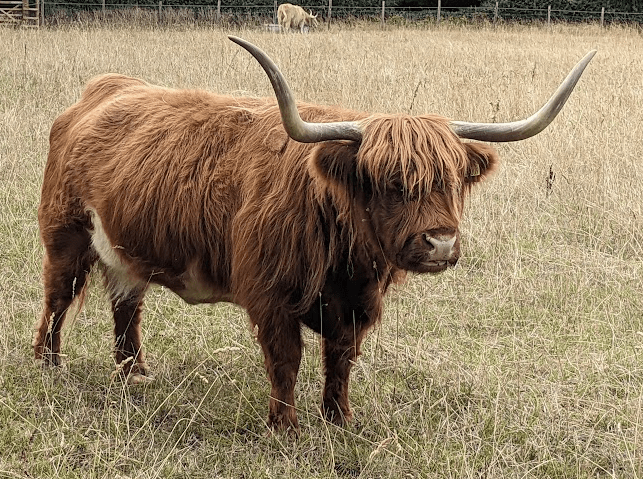
Highland Cattle:
Chip-stealing Herring Gulls (Larus argentatus) gather to mob their chosen victims! Port St. Mary, the Isle of Man.

Two photos of a zebra jumping spider (Salticus scenicus) eating a greenfly (species unidentified):

A large house spider, an Eratigena species:
A labyrinth spider (Agelena labyrinthica) in its funnel web with the remains of ladybird beetles (Coccinella septempunctata):

These photos taken in the environs of Cambridge the UK unless otherwise stated:
Bombylius majorThe Large Bee Fly with its large rigid proboscis for nectar feeding:

The delicate beginnings of a wasps’ nest:

A Steatoda nobilis (false widow spider) lifting a caught and wrapped bumble bee (likely Bombus pascuorum, the Carder Bee) to its lair.

An Araneus diadematus, the European garden spider, bites a wrapped and disabled bumble bee (likely Bombus pascuorum, the Carder Bee).

Araneus diadematus, the European garden spider:

An unidentified frog – Marrakech, Morocco:
An unidentified moth – Marrakech Morocco:

Readers’ wildlife photos

December 30, 2025 • 8:15 am

Scott Ritchie from Cairns has put up a set of 39 of his favorite photos from 2025, and I’ll show about a third of them today.  Scott’s captions and IDs are indented, and you can enlarge them by clicking on them. Scott’s Facebook page is here.

Here are some of my favourite pics from 2025. It was a big year, with trips to Florida, Costa Rica, Western Australia and Victoria/NSW. And I had a publication in Australian Birdlife showcasing the lovely Rainbow Bee-eaters at a local cemetery .
I hope you enjoy them.
Have a happy New Year all!


Rainbow Bee-eater [Merops ornatus] comes in for a landing on Angel boy statue, Cairns Cemetery. [This was the cover photo of Australian Birdlife mentioned above.]

A butterfly guided missile. The bee-eater positions a Pale Triangle butterfly for aerodynamic efficiency:

I posted this before, but not with a caption.

Bee-eaters work in family groups. Here a couple and maybe last year’s offspring help in the nesting duties:

Off to Florida. A Burrowing Owl [Athene cunicularia] in Marco Island, Florida surveys his patch. These owls dig nesting burrows in residential yards:

Here one flies to his nest burrow. I love the intensity of his eyes:

The original Woody Woodpecker. A Pileated Woodpecker [Dryocopus pileatus] looks for grubs in a Live Oak tree in Florida:

A Great Horned Owl [Bubo virginianus] fledgling stares me down in The Villages, Florida. Look at an earlier post. It’s amazing how I found these guys:

The St. Petersburg area was great for shorebirds. Hear a Grey Plover, a.k.a. Black-bellied Plover [Pluvialis squatarola], pulling a worm out of the sand. Eventually, the worm relented:

A Snowy Egret [Egretta thula] dances over the water in search of fish. St Petersburg, Florida:

Off to Costa Rica! I just love how you can just see the eye in this Scarlet Macaw [Ara macao], play fighting in Costa Rica:

A Collared Aracari [Pteroglossus torquatus] comes in for landing. I’ve tried to get more habitat in my bird shots, and I love the colorful rainforest trees in the background. A member of the toucan group. Costa Rica:

And here’s a full-blown toucan in full flight. Keel- billed Toucan [Ramphastos sulfuratus]. What a schnoz!:

I’ve shown this before, but I’ll dub it the Animal Photo of the Year for this site, even though I steal Scott’s photos (with his permission) from his FB page.

No trip to Costa Rica would be complete without seeing the Resplendent Quetzal [Pharomachrus mocinno]. A male brings in dinner to his chicks:

No readers’ wildlife photos today

December 27, 2025 • 8:15 am

This is very sad, as there will be no photos on the third day of Koynezaa. We are at rock bottom, kaput, tan muerto como una roca, mort et bien mort. I have none in the queue save a few singletons, and that bodes ill for the future of the feature.

BUT, if you have good wildlife photos, send them in pronto.

Here are a few penguin and landscape pictures I took in Antarctica in 2022, just so you’ll have something:

A chick: