Why Evolution is True is a blog written by Jerry Coyne, centered on evolution and biology but also dealing with diverse topics like politics, culture, and cats.
We have a few more batches in the queue now, but it’s never enough.
And today we’re featuring lovely bird photos from Ephraim Heller. I had no idea this gorgeous creature existed! Ephraim’s ID and captions are indented, and, as usual, you can enlarge the photos by clicking on them.
I never had a favorite bird. Oh, sure, I’ve seen plenty of bewitching bee-eaters, mesmerizing manakins and motmots and macaws, plummy pigeons, parrots and pheasants, and tangy toucans and tanagers, but they never held my attention.
In Trinidad I first met a tufted coquette (Lophornis ornatus):
My coquette is 6.6 centimeters (2.6 in) long and weighs just 2.3 grams (0.081 oz) – much smaller than my thumb! My coquette doesn’t eat at hummingbird feeders with the big boys – its bill is too short:
Its food is nectar, taken from a variety of flowers, and some small invertebrates. Across hummingbirds, specialization often involves bill length and curvature for particular flowers; my coquette is relatively unspecialized in bill morphology. My coquette often must sneak nectar from the territories of other hummingbirds. With its small size and steady flight, my coquette resembles a large bee as it moves from flower to flower:
Many hummingbird genera have territorial males, but the combination of extreme ornamentation, very small body size, and intense aggression is a hallmark of Lophornis.
There are 11 species in the genus Lophornis, all as beautiful as my coquette. The name Lophornis combines Greek for “crest” (lophos) and “bird” (ornis), calling out a shared trait of all the birds in this genus:
Per the Merriam-Webster dictionary, a coquette is “a woman who endeavors without sincere affection to gain the attention and admiration of men.” But I forgive my coquette. The females are more subdued than the males, but still marvelous:
In French my coquette is called “Coquette huppe-col,” which literally translates to “tufted collar coquette.” That sounds lovely in French. In German it is called “Schmuckelfe,” which combines the literal terms “jewelry or ornament” and “elf or fairy.” To my ear, “jeweled fairy” sounds more pleasant and less insulting than “schmuckelfe”:
Today we have some singletons, doubletons, and tripletons from readers: that is, miscellaneous photos. The IDs and captions are indented, and you can click on the photos to enlarge them.
From reader Jay, a photo from St. Augustine beach, Florida:
This photo shows two terns (possibly Royal Terns, Thalasseus maximus), in front of four Black Skimmers (Rynchops niger).
From Keira McKenzie:
These photos were taken on a warm afternoon in Hyde Park [Sydney, Australia], sitting beneath the plane trees at the eastern end of the park.
Here you have Australian WhiteIbis (Threskiornis molucca, commonly referred to as bin chickens here—which is a bit rude. In the second picture it’s with an Australian wood duck (Threskiornis molucca; there is quite the family here in all their regimental delight), both birds roosting on the island in the eastern pond in the park. While most of the undergrowth was cleared, these birds still manage to find somewhere to roost. The ibis lost their favourite tree in the clearing process, but they have found others. The wood ducks seem happy as well and I love watching the family being marshalled for the march up to the lawns to either graze or look for beetles or whatever. When they come back to the ponds, they fly in a ragged formation careless of persons what might be sitting there chatting and drinking coffee!
And the egret: it’s a Great Egret, either Ardea alba (the western Australian one) or the equally common Ardea modesta: the Eastern Great Egret (subspecies modesta) . The reason I can’t decide is their are supposed to have black legs, but my photos all have them having yellowish legs which doesn’t come up in any descriptions.
I’ve added a pic of the little Baba Yaga in her outside tiger pen just to make you smile (she is currently yelling at me to come to bed!)
And Daniel Baleckaitis, who works for both our department and Organismal Biology and Anatomy, sent three mallard pictures (Anas platyrhynchos)—taken in Botany Pond! I don’t know the ducks but the pictures are great (and clearly taken a few years back when the pond was full of vegetation):
This is the last full batch I have, though I’m saving singletons and the like for a melange post. But today is our first post (as I remember) that features carnivorous plants, from reader Jan Malik. Jan’s captions and IDs are indented, and you can enlarge the photos by clicking on them.
A few species of carnivorous plants grow in New York and New Jersey, primarily in swamps or bogs where it is difficult for plants to obtain nitrogen and phosphorus. Compounds of both elements are highly soluble in water and are poorly retained in waterlogged, low-pH soil. So far, I have found two species, each using a different strategy to catch its prey.
Sundew (likely Drosera intermedia).
“A small plant growing in the Pine Barrens of New Jersey. While there are other Drosera species in the Eastern USA, this one has leaves spaced along a short stem rather than a ground-hugging rosette. The plant must receive a rich payoff for the resources spent producing mucus and protease enzymes, as the remains of digested victims were obvious on many leaves. Research suggests that nitrogen from captured invertebrates can account for 30% to 70% of the plant’s total uptake, depending on prey density.”
The “Expensive” Glisten.
There must be something in the glistening droplets of mucilage on these tentacles that attracts insects. It looks like a lavish investment, but mucilage is mostly water with a small amount of polysaccharides to provide stickiness. The “expensive” enzymes are only produced after a victim is captured. I wonder if this secretion occurs only in the leaf where the victim is immobilized or systemically throughout the plant. In this shot, it even looks like the plant accidentally produced a web of sticky mucilage strands (on the right), mimicking a spiderweb.
Digestion in Progress.
An example of a fresh victim: a species of crane fly being digested. By plant standards, this process is quite fast; in a couple of days, little will remain except for fragments of chitin.
Purple Pitcher Plant (Sarracenia purpurea).
Photographed in the High Peaks region of the Adirondacks, NY, this species is a less “active” predator than the sundew. Both plants form traps from modified leaves, but pitcher plants form jugs that fill with rainwater. When small invertebrates (or occasionally small salamanders) fall in, they drown. Unlike the sundew, the pitcher plant generally doesn’t produce its own enzymes (except in very young pitchers); instead, it relies on a micro-ecosystem within the water—protozoa, mosquito larvae, and bacteria. These organisms decompose the victims, eventually releasing nitrogen and phosphorus for the plant to absorb through the leaf wall.
Carnivorous plants have a dilemma: how to capture invertebrates but let the pollinators live and do the job. The Purple pitcher plant soles it in the most logical way, by extending stems of its flowers so that they are far away from entrances to the pitchers. Apparently, that is the investment that pays off for the plant.
Durability vs. Chemistry.
Pitcher leaves are green in June but eventually turn deep purple. These plants are more cold-hardy than sundews and are likely the most northern-reaching carnivorous plants in North America. In the Adirondacks, they survive harsh winters buried under snow for half the year, and their leaves can remain active traps for several seasons. While Droserainvests in “biochemical weapons,” Sarraceniainvests in durable structures. Nutrient uptake is slower in pitchers but comes at a lower metabolic cost.
The Downward Path.
A close-up of the barbs on the lower lip of the pitcher trap. These guide victims downward, aided by scent and secreted nectar. Because they are downward-pointing, a victim has a difficult time climbing out, especially given the waxy, slippery surface of the leaf. Functionally, these barbs serve the same purpose as the sundew’s mucilage—preventing escape—but they are much “cheaper” energetically since they are part of the permanent leaf structure.
We’re back again with readers’ photos, but this is only one of two batches I have left. Please send ’em if you got good photos.
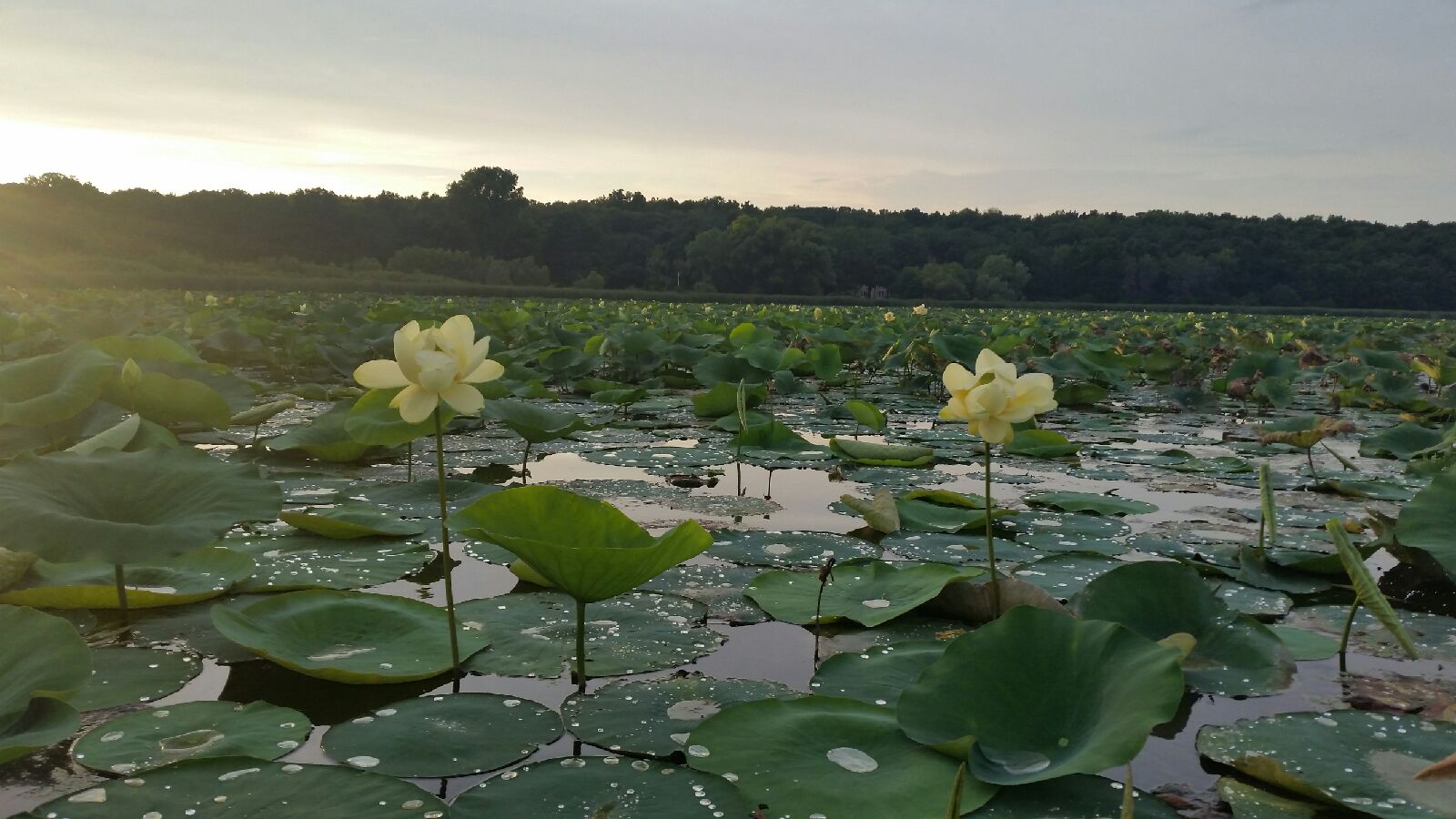
Today we have plants (and one video of flamingos), and different views of one species of plant from reader Eric Cabot. Eric’s captions are indented, and you can enlarge the photos by clicking on them. Following Wallace Stevens, I’d call this “Eleven Ways of Looking at a Lotus.”
Here is a series of photographs featuring the American Lotus (Nelumbo lutea), taken at a roadside pond in Middleton, Wisconsin, in mid-August, 2018 There are few things as comforting as a quiet boardwalk-stroll through a flotilla of this beautiful plant towards the end of a fine day.
I was unsure of the plants’ identity until I found this statement on an informative website (https://www.wisconsinwetlands.org/): Lotus leaves are circular but do not have a notch/sinus—they are continuous all the way around.
Unfortunately, the pond and the paths and boardwalks associated it were completely washed away by a deadly flash flood the following spring. The pond has since been rebuilt, but not the boardwalk. I haven’t gone back to see if the site has any lotuses. For now the images will have to do.
Here a video of pink flamingos the I recorded in “Cabo” a few years ago. [JAC: Keep watching for the displays and weird cries.]
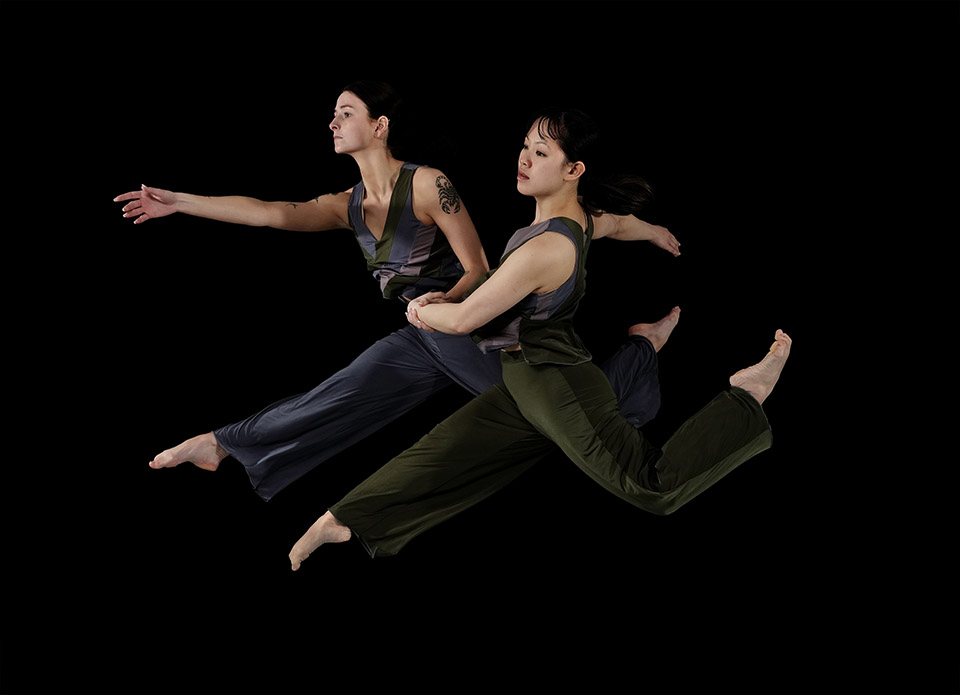
Doug Hayes of Richmond, Virginia, has sent some dance photos (H. sapiens in action). Doug’s captions are indented, and you can enlarge his photos by clicking on them.
The most recent photoshoot with Starr Foster Dance. The company is currently rehearsing new choreography for their upcoming show, “Shouting Distance” which will premiere April 9th – 12th at the Firehouse Theater. Once again, my friend Starrene Foster asked the dancers to perform several leaps, some derived from the choreography that will be performed during the show.
The core company members (L to R) Sarah Carrington, Roya Baker-Vahdani, Madison Ernstes, Molly Huey, Shannon Comerford:
A basic group jump. While it looks simple, it took a couple of tries to get everyone off the ground at the same time:
Roya, Molly and Shannon strike a dramatic pose:
Shannon, Roya and Molly:
Sarah and Madison defy gravity:
Madison makes it look effortless:
Another incredible leap by Madison:
Roya sitting on air:
An aerial split by Shannon:
Molly gives a new meaning to “high kick”:
Floating through air with the greatest of ease:
Molly does an easy leap:
Starr had an idea to photograph Shannon looking into a hallway. The door was featureless, painted dark gray and the floor where Shannon is standing was the same light gray as the hallway floor and walls. Starr asked if I could make the door look like an apartment door and make the floor hardwood. Rather than spend several hours looking for proper flooring and doors, then doing the tedious compositing in Photoshop, I turned to AI. Google’s Gemini AI has a photo editing feature called “Nano Banana” – I’m not making this up. Nano Banana is incorporated into the latest version of Adobe Photoshop, but one has to pay to use it when editing high resolution images. By logging into Gemini AI directly, Nano Banana is free to use unless you need to use some of the more advanced editing features. It only took two prompts to get the result I wanted and only about three minutes to get the final image. There is a second image featuring Shannon at the door, but the AI made two different-looking doors, and the hardwood floor was different in each. It took about three prompts to get Nano Banana to understand that the doors and floors should match, but it finally “understood” and gave me what I wanted. I have been using AI for the past few months to restore old faded and damaged photos. The results have been amazing and saved hours of tedious retouch work in Photoshop. While AI has gotten better, it still requires human input to correct some errors. In the photo of Shannon, the AI put a doorknob and deadbolt on the right side of the door. Sometimes I wonder if the computers are just screwing with us to see if we notice.
Photo information: Sony A1 II mirrorless camera body, Sony GM 24-70 zoom lens, Westcott 400 electronic flash units, Westcott wireless flash controller. Photos edited with Adobe Photoshop and Google’s Gemini AI. The electronic flash units have a “freeze” mode which fires the flash in sync with the camera which is in burst mode – about 15 frames per second or the equivalent of a 1/10,000 of a second shutter speed. ISO 1250.
Sadly, the tank has run dry. To proffer some content today, I’ve dug into my personal photo bank and will post a few miscellaneous shots with brief captions. Click to enlarge the photos
Woman collecting land snails for dinner, São Tomé, 2004:
BBQ dinner at City Market, Luling, Texas, 2004. Brisket, sausage, and the trimmings (beans, potato salad, and the mandatory white bread):
Death Valley and a rare post-rain desert bloom, 2005. Where do the insects come from since these blooms occur only about once a decade? (If you can ID the lepidopteran, do so.)
Usually there is only saltbush and creosote growing on the land, but in a bloom all sorts of flowers emerge from dormant seeds:
A rare Jewish cowboy, photo in the Eastern California Museum in Independence. The last time I went the photo was gone and nobody knew about it or even remembered it. I’d kill to have it:
Doing flies, 2005. This is what I spent most of my time doing before I retired.
Flying onto a glacier at Denali (Mt. McKinley). They were dropping off two climbers in a four-seater bush plane, and I hitched a ride there and back. I got to sit next to the woman pilot. From Talkeetna, Alaska. The peak in the center is Denali.
After we landed on the snow-covered glacier, the pilot had to make a runway to take off from, going back and forth on the snow about ten times to pack it down:
The famous polymorphism of color and banding within the snail Cepaea nemoralis, studied intensively by evolutionary geneticists for years. Despite that work and subsequent population-genetic analysis, we still don’t understand the significance of the variation. For some reason the field was covered with snails; these were on a fencepost. Dorset, England, 2006:
The cottage where poet and author Thomas Hardy was born in 1840 and grew up. Upper Brockhampton, Dorset, 2006.
When Hardy became famous and wealthy, he moved to a house he designed (also in Dorset), Max Gate, where he lived from 1885 until he died in 1928. In the garden by the house are the burial sites of his beloved dogs and cats. Here are two graves of his cats, Snowdove and Kitsy; I was told that they were inscribed by Hardy himself, who had worked as a stonemason when younger, but I can’t vouch for that story:
A draft manuscript of the famous novel Tess of the d’Urbervilles in Hardy’s hand (taken at the local museum):
T. E. Lawrence‘s (1888-1935) final residence the cottage called Clouds Hill. He lived here after he gave up his fame as “Lawrence of Arabia” and served in the RAF under the pseudonym “T. E. Shaw” beginning in 1935, commuting back and forth to the airbase on his motorcycle. The cottage was very spartan, and had no electricity. As Wikipedia notes,
In a 1934 letter to Francis Rodd, Lawrence (who had changed his surname to Shaw) described his home thus:[5]
“The cottage has two rooms, one, upstairs, for music (a gramophone and records) and one downstairs for books. There is a bath in a demi-cupboard. For food one goes a mile, to Bovington (near the Tank Corps Depot) and at sleep time I take a great sleeping bag… and spread it on what seems the nicest floor… The cottage looks simple outside, and does no hurt to its setting which is twenty miles of broken heath and a river valley filled with rhododendrons run wild. I think everything, inside and outside my place, approaches perfection… Yours ever, T. E. Shaw”
Lawrence had an education in the classics, and is one of my heroes as he was both a man of action and a man of learning. Here’s the inscription in Greek over the door above: οὐ φροντὶς (“why worry”), taken from Hippoclides.
Lawrence’s bathtub and shaving mirror:
Lawrence died in a motorcycle crash on May 13, 1935, soon after leaving the RAF. Heading home on his motorcycle, he didn’t see two boys on bicycles ahead of him because of a dip in the road. Swerving to avoid them at the last moment, he crashed his bike, sustained a serious head injury, and died six days later. A study of his death by a neurosurgeon who tended the dying Lawrence eventually led to the use of helmets by motorcyclists.
The crash site is a km or two from Clouds Hill, and my friend and I scoured the road on foot looking for the crash site, now marked by a memorial (I saw no dip in the road). We finally found the stone:
Ironically, there had been a car crash at the site right before we found the memorial:
When he crashed, Lawrence was riding aBrough Superior SS100 motorcycle. Here’s a picture of him from Wikipedia riding one (clearly not the death vehicle) that he called “George V”. If you go to Clouds Hill, you’ll see several of his motorcycles in a small garage.
Lawrence on George V, Wikimedia Commons, author unknown
Plant lovers and botanists will be especially pleased by today’s selection of lovely photos from Thomas Webber. Thomas’s captions and IDs are indented, and you can enlarge the photos by clicking on them (recommended).
The theme for today’s installment is Gone to Seed. Here are a few north-Florida flowers shown in their prime and afterward, when their glamor parts had been replaced by seed enclosures, bare seeds, or merely the dried remains of the flower bases. All of them grew within Gainesville’s city limits, at sites from semi-pruned to semi-wild. I think I’ve identified them all correctly to species this time, but I invite corrections.
Frostweed, Verbesina virginica. Individual flowers 1 cm. Native:
These bracts, called phyllaries, surround the bases of the flowers. In late February a few of their papery remnants are still aloft on their brittle four-foot stalks:
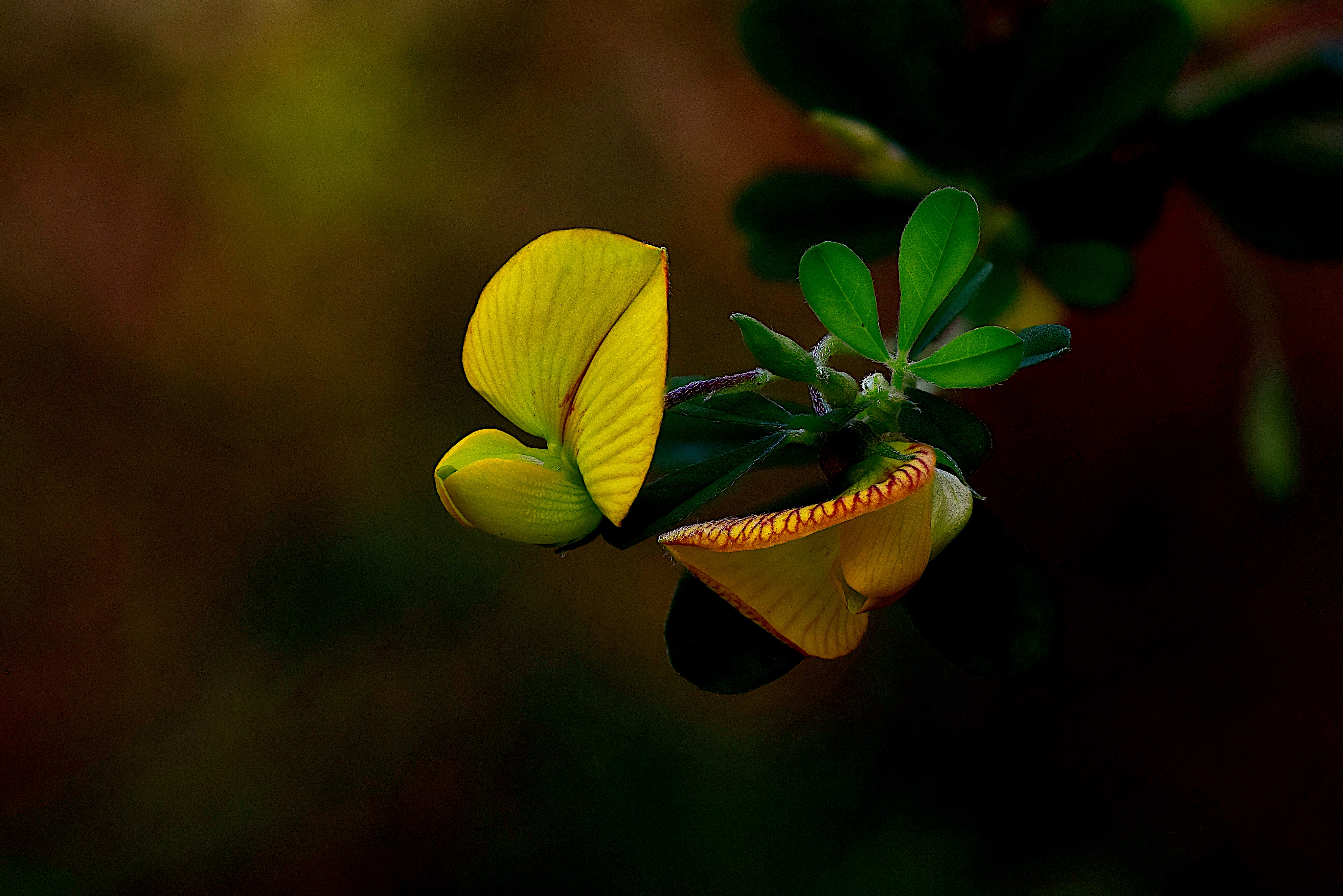
Showy rattlebox. C. spectabilis. 3.5 cm across. Native to southern and southeast Asia, now widely naturalized in southeastern North America:
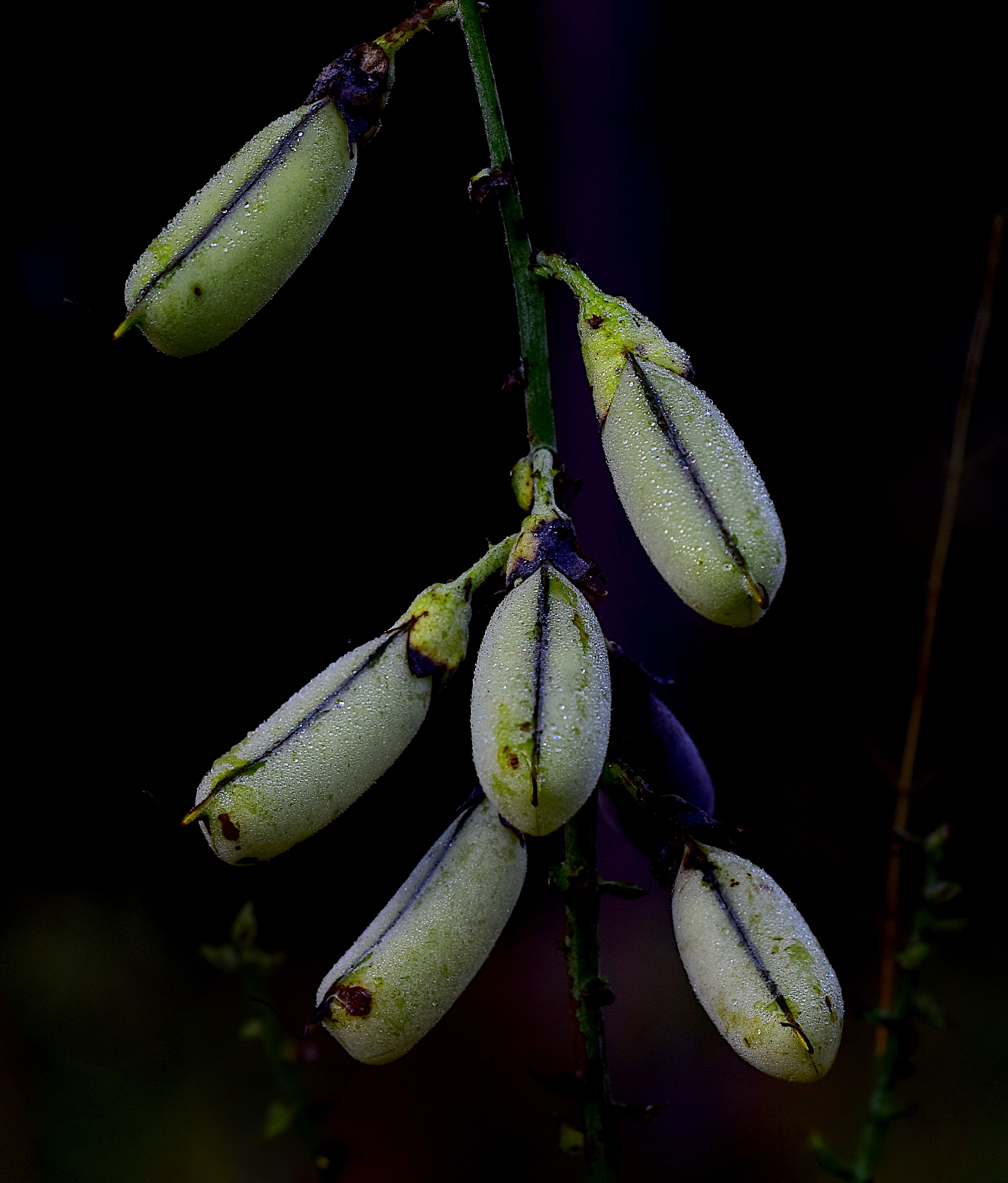
C. spectabilis seed pods. 4 cm long. The pods of C. pumila look similar but are smaller. Crotalaria, and especially their seeds, are laden with toxic alkaloids. Larvae of the rattlebox moth, Utetheisa ornatrix, bore through the walls of the pods and feed on the seeds. Somehow the caterpillars manage to detoxify the alkaloids enough so they aren’t poisoned, while remaining poisonous enough to deter most animals that might try to eat them. The larvae retain the toxins into the flying-moth stage, and at both stages their distinctive vivid color pattern warns predators to leave them alone.
A rattlebox-moth caterpillar. About 3 cm. I doubt that I could have found any of these if I’d gone looking for them, but this one crawled right in front of me while I tried to get a picture of the low rattlebox. It held fairly steady for a few seconds, letting me capture enough detail to identify it. I didn’t have my choice of background:
Tropical sage, Salvia coccinea. 3 cm. Native. At this latitude these remain at their peak through late December:
All that’s left in late February are these cones called calyces, which are fused sepals:
Spanish needles, Bidens alba. 2.5 cm. Native. This is the king weed of these parts, growing everywhere and sometimes in great masses; one dense bunch covers an acre of a low damp lot in the middle of Gainesville:
Seeds of Spanish needles. 1 cm long. The name of the genus, meaning two-teeth, derives from the forks at the tips of the seeds. The barbs on these projections are part of an impressive example of convergent biological and cultural evolution, and have turned out to be just the thing for attaching the seeds to socks and shoelaces:
Dotted horsemint, Monarda punctata. Whole flower head 2.5 cm wide. Native. The most complicated flowers I find around here:
All of that elaborate presentation goes to produce seeds 1 mm in diameter, too small to show well with my basic macro gear. At this stage you can still shake a few of them from the calyces. Thanks to Mark Frank of the Florida Museum of Natural History herbarium for a remedial lesson in the difference between calyces and phyllaries:
Beggarweed, Desmodiumincanum. 1 cm across. Native to Central- and South America, naturalized in the southeastern U.S. This year, by means unknown, a few of them showed up for the first time in what passes for my lawn:
Morning-glory seed pods, 7 mm. The hard little capsules cleave along their sutures and split open to release black seeds the shape of orange sections, exposing the translucent porcelain-like septa that divided them: