Readers’ wildlife photos

September 10, 2025 • 9:00 am

Well, we’ve pretty much run out of contributions with multiple photos, but we have a few good contributions with smaller numbers of photos. I’ll put a few of them together here, but we’re gonna go dry after tomorrow unless someone steps up.  Thanks.

All readers’ narratives or IDs are indented, and you can enlarge the photos by clicking on them:

From Rachel Sperling:

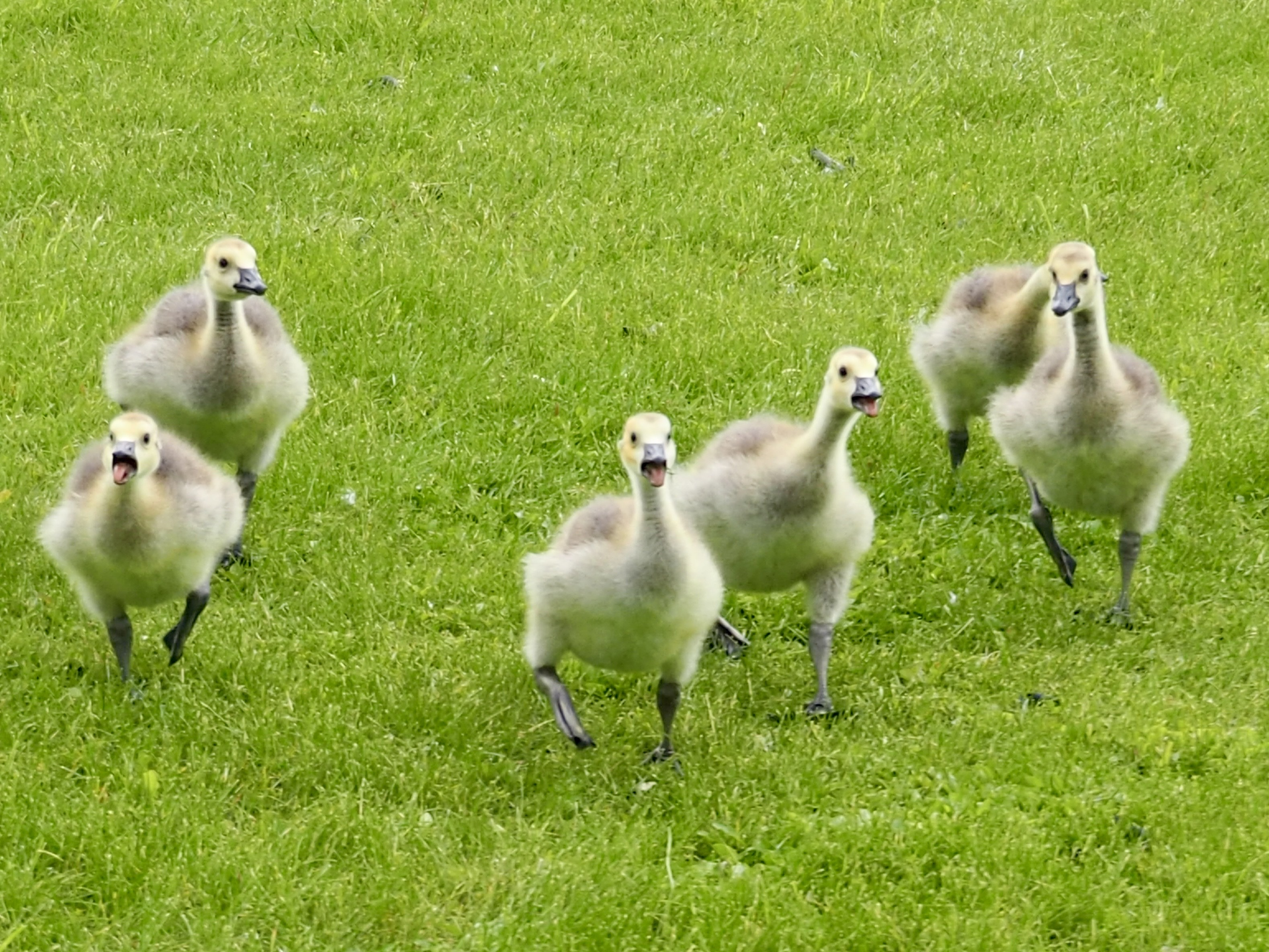
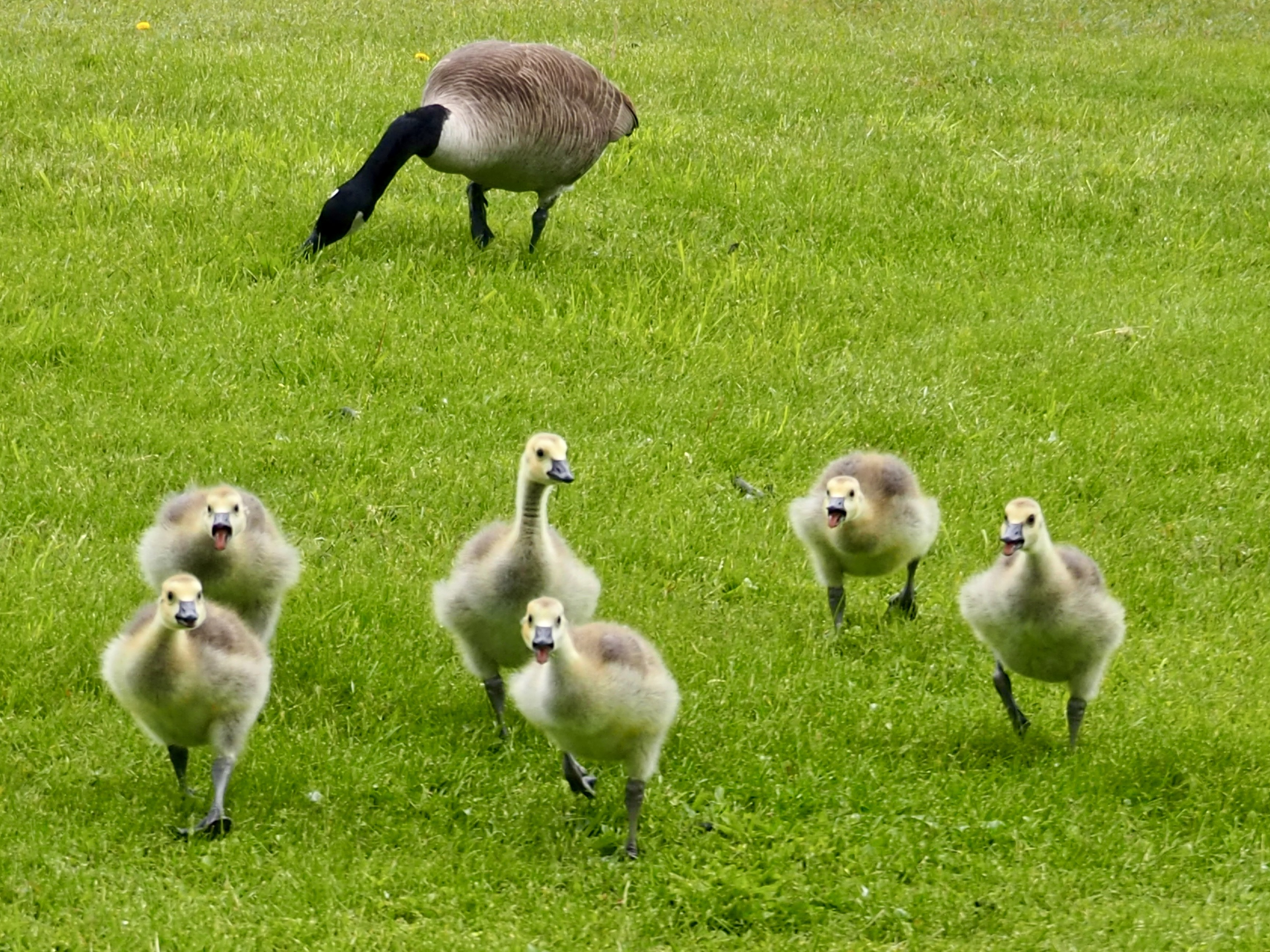
I’m sorry these photos aren’t higher quality but the subjects refused to stand still. Back in May a friend and I were hiking the Appalachian Trail in New Jersey when we came upon a family of Canada geese (Branta canadensis) by a pond close to Highpoint State Park. I thought we were at a respectful distance, but apparently the goslings thought otherwise because they charged. The parents just stood back and let their kids handle things (which is good parenting, I guess). Anyway, we backed away quickly but for a few moments it seemed we were in some very cute danger. Actually, we were more afraid the goslings would run into the nearby street but they stopped once we were in retreat.

Rabbits from reader Bryan Lepore, Eastern cottontails (Sylvilagus floridanus)

These little ones are in mid-ish Massachusetts in my backyard.  Cottontail are in the genus Sylvilagus, which is in the family Leporidae. I should have been more exited – Lepore!

First photo June 26; second photo June 29 [2025]

From Paul T.:

At or near my house.  West side of Madison WI. Just taken with my phone.  Three white-tailed deer (Odocoileus virginianus) last winter and sandhill cranes (Antigone canadensis) last spring.  Last month’s wild turkeys (Meleagris gallopavo)—four strutting their stuff, and one outside my window.

And some bald eagles (Haliaeetus leucocephalus) from Christopher Moss:

Not terribly good, as they are cropped to the centre of the original, despite using a 750mm lens. I had noticed something black on the frozen pond, and when the eagle landed to investigate I realised something had died there. The crows were squawking a lot and I wondered if it was one of their number.

Readers’ wildlife photos

September 6, 2025 • 8:15 am

We’re running low on photos, folks, and I know some of you out there are hoarding them.  Send ’em in, please!

Today we have some boids (and one fish and one mammal) from reader Susan Harrison, an ecologist at UC Davis who is having entirely too much fun. Susan’s IDs and captions are indented, and you can enlarge her photos by clicking on them.

Albatrosses and more

Pelagic seabirds are those that forage across the oceans and seldom either stand or sit still, approach the shore, or even flap their wings.  Albatrosses, to take one of the most spectacular examples, soar hundreds of miles a day with barely a wingbeat. Petrels, Storm-petrels, Jaegers and Shearwaters are similarly long-winged wanderers of the wide blue spaces.  To see these birds, one takes a boat trip to a productive marine area such as the upwelling zones just off the California Coast.  It helps if there are experts on the boat, for ‘pelagics’ are often seen from far away and don’t sport many colors beyond the black-gray-brown-white range.  And it also helps to be seasickness-resistant, which I’m not.

Nonetheless, in August 2025 I joined a trip with Noyo Pelagics out of Fort Bragg, California headed for the underwater Noyo Canyon six miles offshore.  Our boat, the fifty-foot Kraken, was absolutely loaded with seabird experts.  So loaded, in fact, that I had to pick one spot to stand for most of the ten-hour trip. Luckily, my spot was clinging to the stern rail right between “the guy who wrote The Book” and who was generous in helping novices, and the deckhand who was tossing chum overboard to attract birds.  The stern rail was also the right place for me for other reasons, but enough said.

It was a sunny and windy day with six- to 12-foot swells most of the time.  My success in even raising my camera to my face was relatively low.  If it’s any consolation, the handful of species I managed to photograph gives a fairly full sense of the range of phenotypic variation.

We were delighted to see a couple of Laysan Albatross (Phoebastria immutabilis), which nest on tropical Pacific islands and wander across the entire Pacific to feed.

Laysan Albatross: [JAC: Note that the oldest known wild bird is a Laysan Albatross named “Wisdom”, who is 73 or 74 years old, breeds on Midway Atoll, and has had about three dozen chicks.]

Another source of excitement was a South Polar Skua (Stercorarius maccormicki), which breed in Antarctica further south than almost any other bird, and range across all of the world’s oceans. They are known for a bad habit of eating penguin chicks. They love their own kids, though, so if you approach their nests (according to ornithologists) “They will pound on you. They will hit you right in the face.”

South Polar Skua:

A fun non-bird sighting was an Ocean Sunfish (Mola mola), one of the world’s largest fishes, reaching 250- 1,000 kg.  The common English name refers to its habit of sunbathing at the surface, but other names allude to its weird shape:  “moon fish” in many European languages, “swimming head” or “only head” in German and Polish, “lump fish” in the Nordic languages, and best of all “toppled wheel fish” in Chinese. The Latin epithet mola means “millstone”.  It’s in the order Tetraodontiformes along with pufferfish, porcupinefish, and filefish, which all have beaks formed from four fused teeth.

Ocean Sunfish:

We saw a Hawaiian Petrel (Pterodroma sandwichensis), a Manx Shearwater (Puffinus puffinus), Ashy Storm-Petrels (Hydrobates homochroa), and multiple other Petrels, Jaegers, and Shearwaters, but I was unable to take decent photos of them.  Toward midafternoon we entered calmer conditions where I took many photos of Black-footed Albatrosses (Phoebastria nigripes).  These delightful, ravenous piscivores with their permanent smiles are long-lived (60 years), monogamous, and famous for elaborate mating dances.  They are “tubenosed” seabirds, with nasal labyrinths allowing them to scent seafood from enormous distances, and with special glands above the eyes for excreting salt.  Most endearingly, they run awkwardly on the water to take off and land, and seem to love riding the waves.

Black-footed Albatrosses going for the chum:

Black-footed Albatrosses running on the water:

Black-footed Albatrosses surfing:

Black-footed Albatrosses at rest:

California Sea Lions (Zalophus californianus) on buoys were a welcome sign that the harbor was just ahead:

Readers’ wildlife photos

August 27, 2025 • 8:15 am

Today’s photos come from reader Kevin Krebs, who sent in photos from a trip in British Columbia (part 1 is at the first link below). Kevin’s captions and IDs are indented, and you can enlarge his photos by clicking on them.

The Crowsnest to Osoyoos – Part 2

Princeton to Osoyoos

My previous post left off with a photo of the incredible geology around Hedley, BC on the way to Osoyoos.

Before we get back on the road, let’s talk a little about Osoyoos and why I am drawn to it as a destination every spring.

When most people think of British Columbia, they envision old-growth forests, our rugged coast, and our mountains (and, of course, the incredible Burgess Shale!). Many people, even British Columbians, are unaware we have a xeric shrubland biome only a few hours drive away.

I love the coast — it’s where I cut my teeth as a birder—but the antelope and sagebrush grasslands in the southern BC interior are akin to visiting another country. The flora and fauna are so different that I’m engulfed in a nebula of discovery and confusion. Maybe it’s a way of meditating, of striving to see and hear and smell what is really there.

Grasslands are one of the most threatened ecosystems on our planet, yet receive scant attention: old-growth forests are easy to comprehend, but few of us think about old-growth grasslands. Our primate brains and maniacal culture see only empty fields to be cleared for parking lots and big-box stores. As a result, grassland birds have seen terrible declines for decades, as I’m sure other grassland species have as well.

With that scene set, let’s continue our excursion…

The next stop on the route is the village of Keremeos, the “fruit stand capital of Canada,” where I can find several families of (ridiculously cute) California Quail (Callipepla californica). This male was perched on a branch to keep a keen eye on me.

On the outskirts of Osoyoos is the incredible Nighthawk Hill Grasslands. This year was the first time I explored it. I often return there in my mind when I’m stuck on a crowded bus.

While there, I was lucky to spot three birds I rarely see…

A Brewer’s Sparrow (Spizella breweri) — unfairly described as a “small, drab sparrow” (ok… maybe it’s true, but I always find myself annoyed by our human judgments of other beings) with a complex song. Named after Tomas Brewer, a 19th-century naturist and ornithologist.

Here’s a Lark Sparrow (Chondestes grammacus) that I also spotted at Nighthawk Hill Grasslands. A larger, beautiful sparrow that is the only species in the genus Chondestes. It also has a distinctive song.

A Clark’s Nutcracker (Nucifraga columbiana)! I was absolutely elated to find this bird — I’d never found it before, and it was one of the species I hoped to see on this trip. Closely related to crows and jays, these birds are the primary seed disperser for whitebark pine (Pinus albicaulis). Not a great photo, but it was the best I got without disturbing the bird too much.

This was the second year I saw a Blacked-backed Woodpecker (Picoides arcticus) while visiting Kilpoola Lake Road just outside of Osoyoos. These woodpeckers specialize in foraging in recently burnt forests and bogs with dead trees — their black back helping to camouflage them against the burned trunks.

Uncommon on the coast, Red-naped Sapsuckers (Sphyrapicus nuchalis) are somewhat more common in the interior of British Columbia. Unlike more well-known woodpeckers, sapsuckers drill rows of holes into trees, feeding primarily on the sap that is exuded by the tree in defense.

Continuing with woodpeckers, I was pleased to spend some time with this Hairy Woodpecker (Dryobates villosus). While easy to confuse with the smaller Downy Woodpecker (Dryobates pubescens), a close look at the size of the bill will help pick them apart.

A Calliope Hummingbird (Selasphorus calliope) — the smallest bird native to North America, weighing 2-3 grams (0.071 to 0.106 oz) and measuring 7-10cm (2.8–3.9 in) in length. Breeding from British Columbia to Colorado, they migrate to southern Mexico for the winter.

Simultaneously curious and suspicious, this Yellow-pine Chipmunk (Neotamias amoenus) spent a while checking in on me as I rested by the side of the path.

Another bird that was on my wish-list: a Pygmy Nuthatch (Sitta pygmaea). A small and ridiculously cute bird.

And last, a weirdo bird — the Yellow-breasted Chat (Icteria virens). While quite widespread across North America, Yellow-breasted Chats tend to be shy and difficult to spot. Once thought to be a type of warbler, as of 2017 it was moved to the monotypic family Icteriidae .

That wraps up this post. I hope you enjoyed it, and with a little luck maybe I’ve inspired you to travel somewhere new and to care about landscapes and ecosystems that have been ignored by too many of us.

Readers’ wildlife photos

August 22, 2025 • 8:15 am

Today I’m assembling photos from readers who sent in a small number.  Their captions are indented, and you can enlarge the photos by clicking on them.  I’m assuming all ducks are mallards (Anas platyrhynchos).

DUCKS from Peter Fisher:

I came across this family of ducks in a rather lovely setting in Rydal Water in the English Lake District. Mum is clearly keeping watch. There were six ducklings, (one must have escaped the frame).

From Christopher Moss:

Some more for your stash. I received the 2x teleconverter today, so these were taken with the full frame equivalent of a 1200mm lens! I need to practice some more with it, as it is prone to camera shake, but there is promise there.

Blue Jay (Cyanocitta cristata), Muskrat (Ondatra zibethicus) and a damselfly (probably an Eastern Red Damsel, Amphiagrion saucium)


From Richard Kleinknecht:

THE HUNGRY AMERICAN BULLFROG (Lithobates catesbeianus)


 The California Department of Fish and Wildlife writes (click here)

Adult American bullfrogs have voracious appetites and will eat anything they can fit into their mouths, including invertebrates, birds, bats, rodents, frogs, newts, lizards, snakes, and turtles.  Bullfrog tadpoles mainly eat algae, aquatic plant material, and invertebrates, but they will also eat the tadpoles of other frog species.  As a result of these feeding behaviors, all life stages of bullfrogs prey upon and are able to out-compete native frogs and other aquatic species.  Additionally, bullfrogs are a known carrier of chytrid fungus, which causes the potentially fatal skin disease in frogs called chytridiomycosis.  Chytridomycosis is believed to be a leading cause of the decline of native amphibian populations all over the world and responsible for the extinction of over 100 species since the 1970s.”.

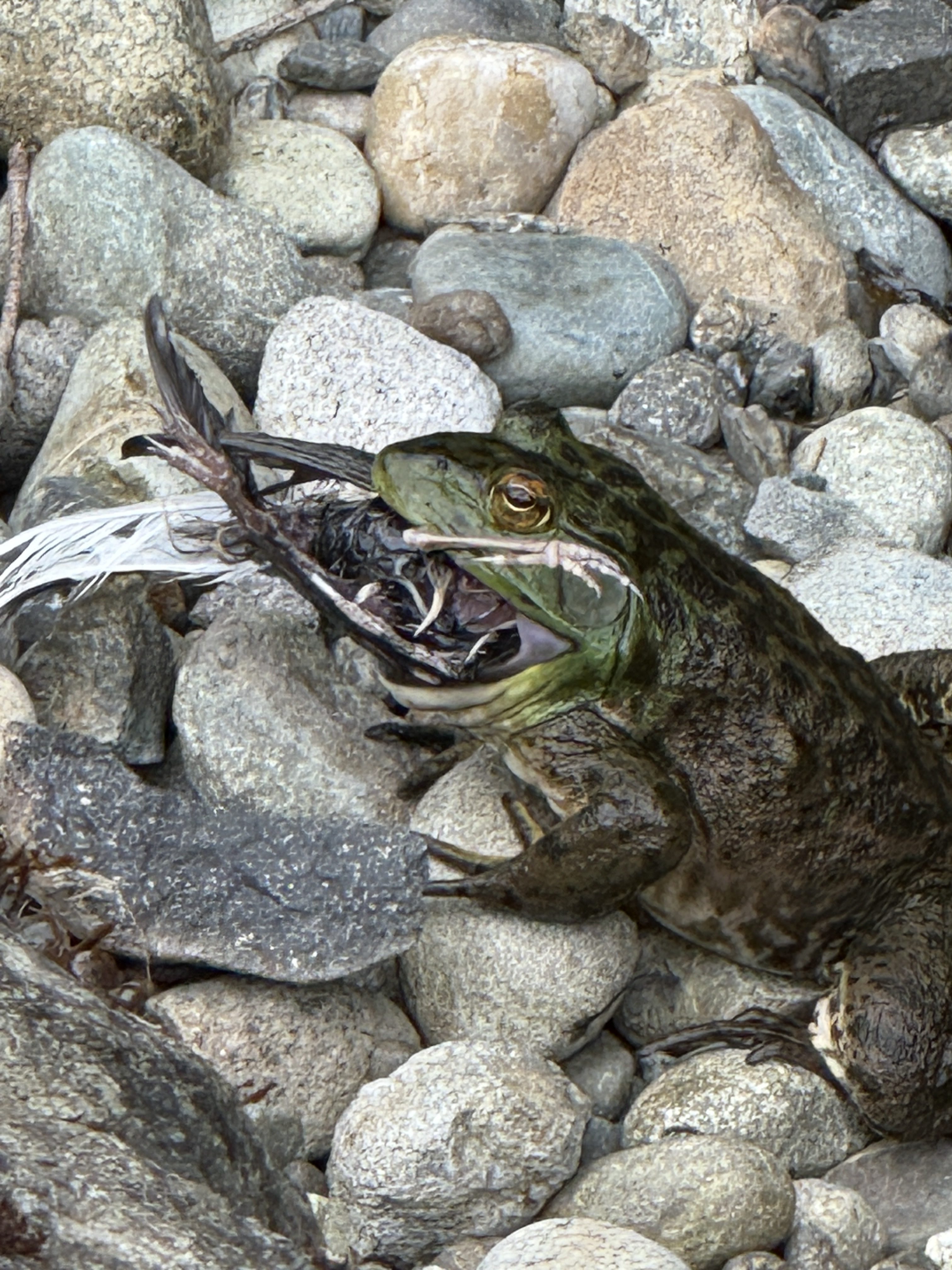
Apparently, the American bullfrog will, or will try to, eat anything that won’t eat it first.  My extended family member, Eleanor, knew that bullfrogs had exterminated her singing chorus frogs, (genus Pseudacris, multiple species) and was not terribly surprised when she came upon this bullfrog attempting to swallow a pre-deceased adult bird, one that ultimately proved to be too large for consumption – but the frog came very close to swallowing something nearly as large as itself!

From Sharon Diehl:

Bald Eagle (Haliaeetus leucocephalus) pair atop Transform Tower #199, Wally Toevs Pond, Walden Wildlife Habitat, Boulder, Colorado. I have photographed this mated pair for years at Walden Wildlife Habitat, where they hang out atop the transform towers that overlook Wally Toevs Pond. They aren’t always successful breeders, but they keep at it, together year after year.

Red-tailed Hawk (Buteo jamaicensis) hunting at my backyard bird feeders–where, alas, it caught a bird–at least it was a Starling. I know the raptors have to eat, too:

Downy Woodpecker (Dryobates pubescens), on the Hornbeam tree I believe, waiting for the flicker to leave the suet feeder–my backyard, Boulder, Colorado.

Osprey (Pandion haliaetus) in a tree, overlooking a lake in East Boulder Community Park, Boulder Colorado.

. . . and more DUCKS from reader A. C. Harper:

Two ducks making the most of pondweed on water at Fairhaven near the Norfolk Broads. Pictures taken on holiday at South Walsham July 2025.

Readers’ wildlife photos

August 19, 2025 • 8:15 am

Today’s photos come from reader Ephraim Heller, who took them in Brazil. Ephraim’s text and captions are indented, and you can enlarge his photos by clicking on them.

A Spurious Tale

It was a typical birding day, squatting beside a water hyacinth-choked waste lagoon at a cattle ranch in Brazil’s Pantanal watching giant rodents and caimans slither in the muck and waiting for something to happen involving birds.

A capybara (Hydrochoerus hydrochaeris), the largest living rodent, surfaces amongst the water hyacinth in a sewage lagoon:

I noticed southern lapwings and wattled jacanas squabbling along the shore. These are common birds but of interest to me because I have never been able to capture decent flight photos: they have evolved the ability to always fly directly away from the photographer. I slowly squat-walked along the banks and they allowed me to approach as they bickered and fought. I started snapping close-up photos with my big 540mm lens when I suddenly stopped dead in my tracks: that lapwing has nipples.

A  southern lapwing (Vanellus chilensis) displaying its “nipples:”

I got an A in my last biology class (AP high school bio in 1980) so I immediately grasped that the stale scientific consensus about the differences between birds and mammals was wrong. I guardedly approached Fito, our guide. Fito is one of the top 5 birding guides in all of Latin America and I had already established my credibility when I hired him and explained that my wife is a birder, but I just want to photograph the colorful and pretty ones. I showed him my photo and, in a tone as nonchalant as I could muster, asked “What are those?”

“Wing spurs,” said Fito.

“Wing spurs,” I sagely repeated. I had no idea what he was talking about.

I went back to my station beside the sewage lagoon and began shooting again. Further photographic analysis reveals two important observations that could potentially cast doubt on my nipple theory: “wing spurs” indeed emanate from the lapwings’ wings and they are retractable:

I turned my attention to the wattled jacanas (Jacana jacana) as a bully mercilessly chased away another jacana every time it landed. They ignored me as I shot. My shutter speed of 1/2500 sec froze the action. I paused to check that my images looked all right when I make yet another discovery – wattled jacanas also have wing spurs:

I shuffle back to Fito.

“Fito, are lapwings and jacanas closely related?”

“No.”

I walk over to my wife and show her my photos.

“Remember what I told you about hoatzins?” she asks. We had seen lots of hoatzins the previous week in Brazil’s Amazon. I remember that years ago my wife had told me about these strange birds that are born with claws on their wings. Before they can fly, they evade predators by dropping from their perches on branches overhanging the water, swim away from the danger, and then use their claws to climb back up a tree. As they mature their wing claws disappear.

Adult hoatzin (Opisthocomus hoazin) – no visible claws on their wings:

“Isn’t this an interesting example of convergent evolution?” I say.

“Maybe it’s not convergent evolution. Maybe it’s an atavistic trait. From the dinos.”

While I hate it when my wife one-ups me on speculative nature theories, I have to admit that now I’m intrigued. Do wing spurs represent a cool example of convergent evolution or an even cooler trait left over from the dinos?

I do a quick internet search on wing spurs. Another bird we have just seen in Brazil also has wing spurs. Behold the southern screamer, presumably with its wing spurs retracted:

Now I was getting suspicious. My generation remembers the warning from James Bond’s archenemy Auric Goldfinger in the Ian Fleming novel and 1964 movie Goldfinger: “Once is happenstance. Twice is coincidence. The third time it’s enemy action.” Lapwings, jacanas, hoatzin, and now screamers. What would Auric say?

Herewith everything I’ve subsequently learned about wing spurs.

Wing spurs are structurally distinct from talons or claws. Spurs usually project from the carpometacarpus, are covered by a keratin sheath, and are not used for perching or seizing prey. Unlike digit claws, which develop from the terminal phalanges, spurs are fixed, weapon-like appendages.

Wing spurs are present in several bird orders but are relatively uncommon overall. Wing spurs seem to have evolved independently in several modern bird families. These include some species of screamers, steamer ducks, spur-winged geese, lapwings, jacanas, stone-curlews / thick-knees, and swamphens present in the new world, old world, and Australia. These families are only distantly related: lapwings, jacanas, and screamer clades all diverged at least 50 million years ago.

Across taxa, wing spurs are primarily used as weapons—employed in intraspecific combat, territorial defense, or predator deterrence.

L. Rand published a detailed account of wing spurs in 1954 (available at: https://digitalcommons.usf.edu/wilson_bulletin/vol66/iss2/8). He observes that “spurs are projecting bony cores with an outer layer of horn, similar to the horns of cattle” and, surprisingly, that “the horny covering of the wing spur, in some species, undergoes molt.” He provides the following diagram of wing spurs in: (F) African jacana (Actophilornis africanus); (G1 and G2) northern jacana (Jacana spinosa); (H) southern lapwing (Vanellus chilensis); and (I) Rodrigues solitaire (Pezophaps solitaria).


In contrast to the wing spurs of modern birds, many basal avian dinosaurs, including Archaeopteryx and Anchiornis, had clawed fingers on their wings. These claws are homologous to the finger bones in modern birds, and in rare cases such as the hoatzin, vestigial claws are still present in juveniles. These are not carpal spurs, but true digit claws, aiding chicks in climbing until they fledge, when the claws are resorbed. The hoatzin lineage is highly divergent; molecular estimates suggest a split from other birds at least 64–70 million years ago, possibly earlier.

Most importantly, both my wife and I were correct: hoatzin claws may be an atavistic trait related to the dinosaurs, while the wing spurs of other birds represent convergent evolution. How cool is that!

Readers’ wildlife photos

August 18, 2025 • 8:15 am

Thanks to the readers who sent in wildlife photos.  Today we have the first part of a two-part series from Kevin Krebs taken in British Columbia. Kevin’s notes and IDs are indented, and you can enlarge the photos by clicking on them.

The Crowsnest to Osoyoos – Part 1

Vancouver to Princeton

Each spring I make a pilgrimage from my home in Vancouver to Osoyoos in south-central British Columbia. Birds are what drew me there initially, but over the years the ecology and geology have cast a spell on me.

After roughly 2½ hours of driving on the Crowsnest Highway, E.C. Manning Provincial Park is my first stop. Located in the North Cascades, the area is densely forested with coniferous trees, and even in late May you can expect to find some patches of snow.

Every year without fail I’m greeted by numerous Columbian Ground Squirrels (Urocitellus columbianus). They hibernate for up to 8 months of the year, and this population has probably been active for only a few weeks when I visit.

I don’t have to go much further than the parking lot to find flocks of Chipping sparrows (Spizella passerina).

Venturing further into the park, I almost always find a few Townsend’s Warblers (Setophaga townsendi).

This year I felt especially lucky — a pair of American Three-toed Woodpeckers (Picoides dorsalis) appeared out of nowhere just as I was about to leave.

Princeton is my next stop, and where the transition from the forests to semi-arid climate begins to become apparent. According to Wikipedia, “Princeton is one of the sunniest places in British Columbia with 2,088 hours of sunshine annually”.

My destination is Swan Lake Wildlife Refuge, located just north of the city that is always replete with swallows, waterfowl, and many other surprises.

A Common Raven (Corvus corax) keeping watch from a fence post.

New World Sparrows (Family Passerellidae) don’t get a lot of love and it’s not uncommon to hear them derided as LBJs (Little Brown Jobs). I think many birders do themselves a disservice by not paying attention to sparrows and other ‘common’ birds. Here’s a beautiful Vesper Sparrow (Pooecetes gramineus) posing on a branch.

American Kestral (Falco sparverius) are the smallest and most widespread North American falcon with distinctive sexual dimorphism. This male was waiting out a sudden rain shower:

Another photo of the American Kestral (Falco sparverius) being scolded by a Western Meadowlark (Sturnella neglecta) who was very unhappy with his presence:

The bluest of bluebirds — this male Mountain Bluebird (Sialia currucoides) was quite shy, but let me get a decent photograph before it fled my primate curiosity.

A mediocre photo of a Lewis’s Woodpecker (Melanerpes lewis) — a large, oddball woodpecker which is still somewhat enigmatic.

On the route to Osoyoos, I pass through the small town of Hedley, once the site of a gold mine (confusingly named the Nickel Plate Mine). The geology is striking — uplifted Triassic sedimentary rocks of the Nicola Formation.

Readers’ wildlife photos

August 15, 2025 • 8:15 am

Today we have photos from Montana taken by Gregory Zolnerowich (there are two exceptions; see below). Gregory’s captions are indented, and you can enlarge the photos by clicking on them.

I recently spent 10 days in Livingston, Montana, visiting a friend and meeting some fellow Kansans for a bit of rafting and camping on the Yellowstone River south of Livingston. Attached are some wildlife photos that might be suitable for WEIT. Another person in our group took the photos of the bald eagle and sandhill cranes but I have permission to share them.

The marvelous scenery of the Paradise Valleyl; the Yellowstone River flows north through it. We camped one night alongside this small side branch of the river. There were small American black bear (Ursus americanus) tracks in the mud so we had to store our food away from the tents:

Hello, do you have a minute to hear about the good news from our lord and savior, Bambi?:

This is the same mule deer (Odocoileus hemionus) as in the previous photo. I stepped out on the deck and it was quite unafraid of me. The friend I was visiting has a number of raised garden beds and grows a variety of vegetables. Her active gardens have deer fencing around them to protect the plants. Possibly the same deer would come around in the early evening and eat apples that had fallen from her apple tree:

This is probably a mountain cottontail (Sylvilagus nuttallii): there were many of these around our cabin. They are the real marauders of the garden and will chew through the plastic deer fencing to graze and raze the garden veggies:

Montana has at least four species of chipmunks. I think this is the least chipmunk (Neotamias minimus). It would skitter and scurry about and was entertaining to watch:

We watched this bald eagle (Haliaeetus leucocephalus) glide in and land on the shore acrossfrom our campsite. It then waded into the water, caught a fish, and flew away. I’ve never seen a bald eagle do that:

Sandhill cranes (Antigone canadensis) are large and majestic. We could hear them calling during the early evening. Their call is quite unique:

Along with bald eagles, ospreys (Pandion haliaetus) also were abundant. We floated right under this one, I was surprised it did not fly off. Look at that hooked beak!:

There are a number of ready-made nesting platforms along the river to keep the ospreys and eagles from nesting on the power poles. This one has ospreys but sometimes we would see an eagle using the platforms:

I was suprised to see this caterpillar out and about on a chilly morning. It appears to be Glover’s silkmothHyalophora gloveri (Saturniidae):

The closest ID I’ll give for this caterpillar is perhaps Arctiinae: