Why Evolution is True is a blog written by Jerry Coyne, centered on evolution and biology but also dealing with diverse topics like politics, culture, and cats.
Welcome to December 25, 2025, and of course it’s not only Christmas, but the first day of Koynezaa, my personal holiday extending from today until my birthday (December 30).
We’re at the end of another year, and it was almost sixteen years ago that this website started, first simply as a way to promote my book Why Evolution is True. But then it grew into a monster, chronicling many of the things I was thinking about, and, to my surprise, people wanted to read about more than vestigial organs and island biogeography.
Well, I’m still here for the nonce, and greatly appreciate the readers, including those who send me links, tips, and especially wildlife photos. (It’s time to send more in!) 2025 pretty much sucked, both personally and worldwide, and so let me leave you with hopes that 2026 will be brighter. Of course we’ll have more bad news, but remember that life is short, that it’s is a gift (from your parents and the Universe, not from God), and that you’re not going to be moaning about Trump on your deathbed. Eat, drink, be merry, tell your friends you love them, and read good books.
Best holiday wishes from Professor Ceiling Cat (Emeritus)!
I’ll proffer just a few holiday-related items before we get to our most awesome Readers’ Cats Parade. It’ll be posted at 9 a.m. Chicago time.
*If you need Jesus today Department: If there’s any doubt that the Free Press is going way soft on faith, doubtlessly via orders from above, here are two headlines on today’s front page. First, a list of eleven books from religionists to fill that GOD-SIZED HOLE IN YOUR HEART. (You do have one, don’t you? My latest echocardiogram didn’t show one, but perhaps others have one.) Click headline to read.
Here’s the intro from the editors, all of whom have the Big Lacuna:
Between the rush of travel, hosting, and endless to-do lists, the Christmas and New Year season can easily become a frenzy—leaving little space for what the holidays are truly about: rest, connection, and spiritual renewal.
But as the year winds down, there’s no better moment to pause, reflect, and rediscover meaning. Sometimes, that pause begins with something as simple, and as powerful, as a book.
To that end, we turned to three of our friends from different religious traditions and asked them to recommend titles that nourish the spirit, and may bring readers closer to God. Rabbi David Wolpe, Timothy Cardinal Dolan, and Eboo Patel, the Muslim founder of Interfaith America, made some wonderful—and surprising—selections. Together, they form a rich reading list for 2026. Enjoy! —The Editors
Here are a handful of the eleven books they’re pressing upon us this Christmas, saying that they’ll “bring us closer to God.”
From a master theologian and an exquisitely gifted writer (working in English, a language he only learned as an adult) comes a tone poem that explores the place of time and space in our lives. Heschel helps us understand the ways each day can be sanctified.
One of the great evangelical Catholics of modern times, Sheen here vividly retells the “greatest story ever told.” There is no better book for those seeking to discover the message of Jesus Christ.
The book that inspired my commitment to interfaith work. Eck’s memoir of deepening her Christian faith by engaging with Hindus on her various visits to India demonstrates the importance of religious pluralism.
Of the many works I have read on the Prophet Muhammad and Islam, this is the most moving. I can think of no better book for making the beauty and mercy that are central to Islam accessible to American readers.
—EP
Shoot me now. . . I am reading Matthew’s new biography of Crick, which is terrific. Crick had no truck at all with religion, and refused an appointment as a fellow at a Cambridge University college because it wanted to build a chapel for worship.
Another headline:
This is the story of Martin Shaw, a writer who went into the woods seeking to fill that hole in his heart. And then, just like Francis Collins saw a frozen waterfall that turned him to Jesus, Shaw saw a falling star. That astronomical phenomenon somehow made him realize and accept the whole truth of the Christian story:
The falling star, the nine words, now the dreams. With my 50th year now only days away, I submitted to the reality of what now seemed screamingly apparent. God, the Ancient of Days, was announcing himself. For decades, myths had told me all about life, but this myth, crashing like that January arrow into human time, told me how to live that life.
On October 21, 2021, I became a Christian. Or, more likely, I realized I was a Christian. Just not a very good one. A little out of focus. Praying on a hill doesn’t make you a Christian, and I wouldn’t have thought myself as one during the vigil. But on that October evening, I finally verbalized quite what had happened.
. . . I’ve kept my attention on the particular mysteries of the Christian tradition rather than taking an endless à la carteapproach to myth. What you lose in variety, you gain in absorption. “Falling into the mind of Christ” is how the Apostle Paul would put it. Life is generally much quieter now. I watch the skies hopefully, but I suspect I’ve had my Bethlehem moment.
Amen, ladies and gentlement, brothers and sisters, friends and comrades.
*Matthew says that Bob Dylan of all people, born a Jew, has released a Christmas album. And he did—in 2009. This is apparently one of the songs on it, with a lively polka beat. “Must Be Santa” was not written by Dylan, but by Hal Moore and Bill Fredericks.
From Wikipedia:
In November 2009, Bob Dylan released a version of the song in a polka-meets-klezmer style (based on an arrangement by Brave Combo, whose version he had played on Theme Time Radio Hour) for his Christmas album, Christmas in the Heart. The New York Daily News described Dylan’s version as such: “It’s sort of unclear if Dylan (…) was aiming to celebrate the holiday, or gently poke fun at the music’s Norman Rockwell-esque simplicity”.[6] Following Brave Combo’s lead, the lyrics in Dylan’s version mix in the names of several United States presidents with a list of Santa’s reindeer (e.g., “Dasher, Dancer, Prancer, Vixen / Carter, Reagan, Bush, and Clinton”). Eleven years after its release, “Must Be Santa” placed 24th in a Rolling Stone article about the “25 Best Bob Dylan Songs of the 21st Century” where critic Amanda Martoccio called the song “zany” and the “centerpiece” of Christmas in the Heart.
Nash Edgerton directed an official music video for “Must Be Santa”, described as “bonkers” by Martoccio, in which Dylan lip synchs the song at a raucous Christmas house party with other holiday revelers. Count Smokula makes an unexpected appearance as an accordion player, miming the accordion part that David Hidalgo played on the actual recording. As of Christmas 2024, the video had been viewed over 8 million times on YouTube, significantly more times than the next most popular versions of the song (i.e., those recorded by Mitch Miller, Raffi and Brave Combo). “Must Be Santa” was also released as a music video ecard and a 7″ single, the b-side of which is a recording of Dylan reading ‘Twas the Night Before Christmas that was first broadcast on Theme Time Radio Hour
I have to say that this is better than most latter-day Dylan songs. He appears in a bowler hat and wig throughout the video, and, at the end, in s Santa hat.
Meanwhile in Dobrzyn, Hili is recalibrating
Andrzej: Are you asleep?
Hili: Nope, I’m rescheduling every problem for next year.
In Polish:
Ja: Śpisz?
Hili: Nie, odkładam wszystkie problemy na przyszły rok.
From Larry the Cat; a post and a video (h/t Simon)
. . . and a video:
‘Twas the night before Christmas and all through the house,
a creature was stirring in search of a mouse.
Merry Christmas ya all and Larry. pic.twitter.com/KS87YJPt9p
J. K. Rowling’s charm bracelet (shown below) is apparently of significance to her. (“Strike” is a series of crime novels written by Rowling under her pen name. I haven’t read any of them.)
🎄My new heading is an early Christmas present to Strike fans. (The clues are in the charms, there’s no new bracelet in #9!)🎄
Merry Christmas everyone. Particularly the amazing volunteers and charity workers who are helping human & nonhuman animals today & all year round. pic.twitter.com/SPZNn8aJ8X
I’ve often argued that the Free Press is soft on religion, even more so than its MSM equivalent, the New York Times. The editor of the FP, Bari Weiss, is Jewish, and although it’s not clear to me exactly what she believes (is there a God?), you’ll never see her criticizing religion. Her partner, Nellie Bowles, converted to Judaism, (I believe you have to espouse belief for that–a double entendre), and I can’t remember ever reading anything antireligious or pro-atheism on the site. (I may have missed something.) And now the editors have recruited at least four more religionists as part of a long series about religion celebrating America’s 250th anniversary.
There will be monthly paeans to religion for a year, and it may already have been going for a while. One of the paeans is below: a long, tedious piece about how American required not only the Bible to attain equality of its citizens, but the Old Testament. It’s no accident, of course, that the author, Meir Yaakov Soloveichik, is an Orthodox rabbi. (More rabbis to come!) The American experiment, he avers, involved the replacement of an earthly king with a heavenly one: God (Yahweh in his case). Well, maybe he was right, but in the end there’s no evidence for a God who makes us all equal. And religion, despite the rabbi’s claim, is waning in America, but the idea of equality remains.
Here’s the editors’ intro to the piece (bolding is mine):
Of all the radical ideas at the heart of the American founding, freedom of religion stands apart. Rarely in human history has a nascent nation rejected religious uniformity and bet instead on liberty, trusting that faiths can live side by side, peacefully and equally. In doing so, America didn’t banish faith, but made room for it to thrive in all its depth and diversity.
For this month’s installment of our America at 250 series, a yearlong celebration of the country’s big birthday, we’re spotlighting faith and how it helped build our nation. You’ll hear from Catholic magazine editor R. R. Reno on how his marriage to a Jewish woman drew him closer to God; from David Wolpe on two towering prophets of history; from Matthew Walther on the kaleidoscope of American religious life; and more.
Today, we kick things off with the great Rabbi Meir Soloveichik, who explains why the flourishing of biblical faith in the new country provided the basis for American equality. For, he writes, “In rejecting monarchy, Americans were not insisting that they had no king, but that their king was God.”—The Editors
If you subscribe, click below to read what the sweating rabbi is trying to say. If you don’t subscribe, well, you have an extra hour to do something fun:
The piece is not particularly well written, and I don’t think it makes its case, but I don’t want to waste time doing an exegesis of this. I just want to show how the Free Press keeps highlighting the benefits of faith—in this case historical ones—over and over again. And I’ll omit all the well-known stuff about the role of religion in the Continental Congress (objections to prayers, etc.) But here’s what the piece says about the Jewish foundation of Americ (all quotes are indented).
John Adams wrote that evening [in 1771] to his wife: “I never saw a greater Effect upon an Audience. It seemed as if Heaven had ordained that Psalm to be read on that Morning. I must beg you to read that Psalm.” A passage from the Hebrew Bible, describing a divine defense from one’s enemies, so united the members of the new Congress that it seemed heaven-sent.
For the Catholic philosopher Michael Novak, this anecdote highlights the prominent role played by the stories, imagery, and ideas of Hebrew scripture in the American revolution. In contrast to Christian texts, which are devoted to describing a kingdom that is “not of this earth,” the tale of biblical Israel is all about a polity that is very earthly indeed. Thus, as Novak noted in On Two Wings, his account of the role of faith in the American founding, “practically all American Christians erected their main arguments about political life from materials in the Jewish Testament.” The story of the Jews offered early Americans a tale from which they could find inspiration in their own crisis.
It also offered another advantage. Focusing on Judaic texts allowed the revolutionaries to avoid exegetical issues pertaining to Christian theology. “Lest their speech be taken as partisan,” Novak added, “Christian leaders usually avoided the idioms of rival denominations—Puritan, Quaker, Congregationalist, Episcopal, Unitarian, Methodist, and Universalist. The idiom of Abraham, Isaac, and Jacob was a religious lingua franca for the founding generation.” As a means of uniting the diverse group, Novak continues, “the language of Judaism came to be the central language of the American metaphysic—the unspoken background to a special American vision of nature, history, and the destiny of the human race.” Psalm 35 would serve as a symbol of the fact that patriots across America could indeed pray together.
Here it’s not just religion that was the bedrock foundation of America, but Old Testament Judaism. Of course, the vast majority of Americans when the country was founded were Christians, and presumably accepted the Jesus stories, but this shows how historians can emphasize some stuff as opposed to other stuff to make their case
And here’s how Thomas Paine, himself an atheist, nevertheless foisted “belief in belief” on Americans in his influential pamphlet Common Sense. “Belief in belief”—the view that it’s good for the “little people” (Americans) to believe in God even if the intellectuals don’t—seems to be the point of view pushed by the Free Press, and, to me, explains why they don’t publish articles that dismantle belief. But I digress.
Paine privately denied the reality of revelation and scorned scripture as fantasy. (He would later voice his views on religion in The Age of Reason, ruining his reputation in America.) But America was a biblically literate land, and with Benjamin Rush’s help, Paine wrote for his audience in Common Sense. The pamphlet—probably the most influential published polemic in the history of the world—changed the way in which Americans regarded their king and monarchy in general.
The essence of Paine’s argument is easy to miss today. In rejecting monarchy, Americans were not insisting that they had no king, but that their king was God. “But where, says some, is the King of America?” Paine asks in Common Sense; “I’ll tell you Friend, he reigns above, and doth not make havoc of mankind like the Royal Brute of Britain.” Not all patriots approved of the pamphlet; John Adams thought its arguments overwrought and exaggerated. But Paine spoke for the many whose own sentiments were evolving. Subjects who had once revered their king were beginning to conclude that the texts of ancient Israel pointed to a new way of seeing themselves.
The tale of America is not merely that of a break with Britain; it is equally a tale of a group of colonists who came to conclude that their equality derived from the monarchy of the Almighty.
There’s more:
But the fact remains that shorn of biblical faith, no cogent explanation can be given for the doctrine of equality that lies at the heart of the American creed. Indeed, the other sources of antiquity to which the Founders turned for inspiration—the philosophers of Greece and the statesmen of Rome—denied human equality and held a worldview that there were those destined to rule and others born to serve. As the Yale legal scholar Stephen L. Carter reflected in Civility: Manners, Morals, and the Etiquette of Democracy, to this day “faith in God provides a justification for the equality that liberal philosophy assumes and cherishes but is often unable to defend.”
This is bushwah. Of course a cogent nonreligious argument can be given for the doctrine of equality that lies at the heart of the American creed. Read any ethical philosopher (John Rawls is one example), or read the article on “Eauality” in the Stanford Encyclopedia of Philosophy, where the word “God” appears precisely once, and only in a discussion of how Christianity espoused an equality of humans before God.
But even if this historical interpretation be true, as Americans become more and more either atheists or “nones” (those not affiliated with a specific church or faith), the rationale for equality would seem to have disappeared. It hasn’t, because we now base it on humanism, not religion. If you stopped someone in the street and asked Americans why all people are equal before the law, I doubt they say “because that’s what the Old Testament dictates.” They may mutter something about all men being created equal from the Declaration of Independence, but philosophers who give us a rational basis for equality rely not on Divine Command but on secular arguments.
At the end, Rabbi Soloveichik raises the new canard that the waning of religion in America has slowed. They make a great deal about the plateau shown below:
Europeans may wonder at the way our politics is consumed by a culture war that is linked to differences regarding religion, but these debates endure in America because, unlike the largely secular continent across the ocean that was once the cradle of Christendom, faith continues to matter to so many millions of Americans. Even the much-discussed contemporary phenomenon known as the rise of the “nones”—Americans who do not belong to a faith at all—seems to have slowed. Few Americans today know the final lyrics of “My Country ’Tis of Thee,” but when God is invoked in our public life, it is meant to remind us of the unique way equality emerged in America, the way religion impacted how Americans came to see themselves.
As we mark America’s 250th anniversary, it is impossible to know with any certainty what the next decades will bring for our country. But looking back on the past, one prediction can be safely made. Religion in America has always defied the predictions of its demise, and on the 300th birthday of the United States, there will be citizens of this country who will rejoice in their equality—and thank the almighty monarch of America for it.
Mind you, religiosity hasn’t reversed its long-term trend of decreasing; it just has hit a plateau. Here’s a graph from the Pew article cited by the rabbi:
BUT that goes back to only 2007, and deals only with Christianity. (I bet Islam would show growth.) Let’s take a longer view, looking at Pew data from 1972 to about 2021. Christianity has fallen nearly 30%, and if you looked way back to the turn of the 20th century, I bet you’d see a much bigger decline. The “plateau” touted above—believers never mention the long term—is just a small segment of the graph, and while religion may increase or remain static, that’s not the long-term trend. In the meantime, “nones” have increased nearly sixfold, and other religions just a tad. Nope, the rabbi’s huzzahs ring hollow.
Look again at the last sentence:
But looking back on the past, one prediction can be safely made. Religion in America has always defied the predictions of its demise, and on the 300th birthday of the United States, there will be citizens of this country who will rejoice in their equality—and thank the almighty monarch of America for it.
That’s bogus. There are two predictions that can be made. The first is the rabbi’s obvious one: America will always have some religious people. Yes, faith is sadly still alive, and we’ll have to wait a few centuries until we become like Sweden or Iceland. But the more important prediction is that faith is waning. It ain’t dead yet, but it’s dying. Even so, Americans still espouse equality.
It’s time for the Free Press to publish some stuff about unbelief, its increase over time, and the reasons for it.
I couldn’t help myself. I asked ChatGPT to illustrate some early Americans worshipping God as a king. Not bad, eh?
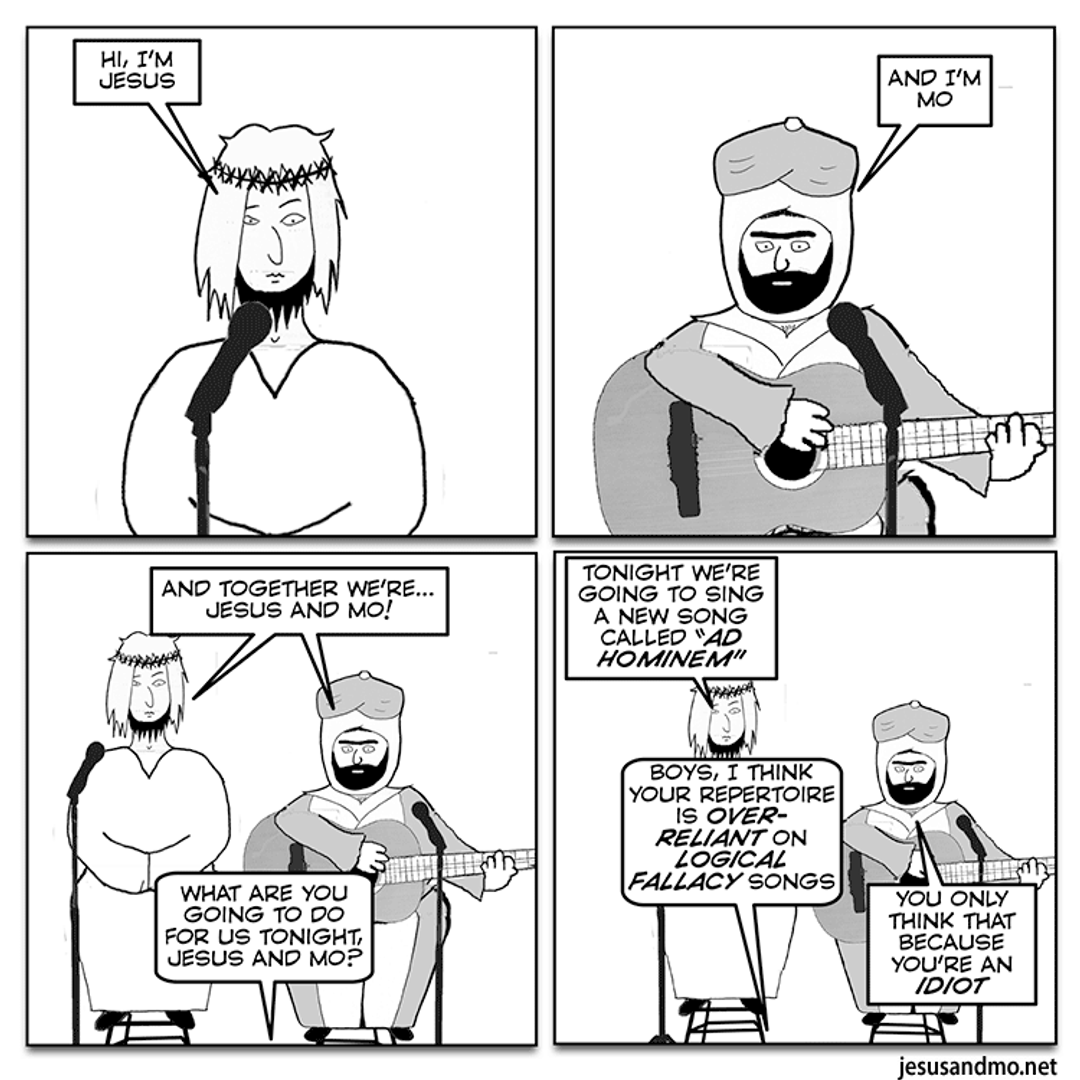
Today’s Jesus and Mo strip, called “repertoire”, shows the boys onstage, and once again Mo shows his characteristic flaw: behaving exactly in the ways he’s criticizing.
There’s a message on the site: “Merry Xmas from the boys.”
This is the penultimate of the two batches I have, so why not get your wildlife photos together instead of snoozing after that big Christmas feast? Today we have the final installment of Holiday Mushroom photos by reader Rik Gern from Austin, Texas. Rik’s captions are indented, and you can enlarge his photos by clicking on them.
Here is the final batch of mushroom pictures taken in northern Wisconsin last September.
I saved this batch for last and am a bit chagrined to send them because most of these pictures are of species I was unable to identify. I’ve been using iNaturalist, but it jammed up a few times. It would seem to identify the genus and species, but then I would get the infamous spinning wheel, which would persist until I exited the application. I thought it was recording the data, but later discovered that it wasn’t. I hope you will be willing to let your more knowledgeable readers weigh in on the species identification. [JAC: yes, please, if you know the species, do weigh in]
The cap on this mushroom has a woody look. This was the only example I ran across.
This one has nice, delicate looking gills. I think it might be a Destroying Angel (Amanita bisporigera), but the pictures I saw showed some kind of flap on the stem which this specimen lacks.
Whatever this is, the small cap looks like a cookie dusted with cinnamon.
Something sure found this mushroom tasty!
This mushroom is in an intense tug of war with a thick spider web!
You can see from this image that the web is layered in three sheets.
I’ve see time lapse films of orb weavers weaving their webs, but I can’t imagine how this web was constructed.
Mushrooms are so often associated with psychedelia that I couldn’t resist closing this series by playing with a closeup image of the pores on the underside of the Chicken fat mushroom (Suillus americanus) to give it a trippy psychedelic feel.
Just as an interest in Photoshop led to an interest in photography, the thrill of having pictures on whyevolutionistrue alongside those of learned naturalists and scholars has piqued my interest in learning more about the world of fungi. I’ve been asking friends to recommend books that give a broad overview of fungi. Guide books only make my eyes glaze over and tie my brain in knots, as I don’t seem to have a good mind for that kind of detail, but I can grok the big picture when it’s presented well. There’s a book coming out in May called The Complete Fungi: Evolution, Diversity and Ecology by David S. Hibbit that looks fantastic. I have pre-ordered it, and thought some of your readers might be interested as well, so here is a link.
This will be the final reminder to send in your photo of cats with a Christmas theme, a holiday them, or a or Hanukkah theme (we now have many Jewish cats). The instructions are here and we have now acquired more than 65 photos for posting. (Note: do not send AI pictures like the one I made below.)
Remember, one photo per submission, please! It should be holiday-themed and have a few words about the moggy, including its name. Also your name of pseudonym. (No videos, please, as I can’t embed them.)
I’ll move the deadline forward to 11 a.m. Chicago time TODAY; Christmas Eve and Koynezaa Eve. Sorry, but I can’t accept late entries.
The cats will be posted on Christmas Day—tomorrow morning. It’s a great panoply of furballs!
Welcome to Christmas Eve and a Hump Day (“कूबड़ दिवस” in Hindi): it’s Wednesday, December 24, and also National Eggnog Day. Frankly, I can’t abide the stuff, and never had a glass I liked. But here’s one form that might be palatable. From Wikipedia:
“Tom and Jerry is a form of hot eggnog [cocktail] that was once popular.” The Tom and Jerry was invented by British journalist Pierce Egan in the 1820s, using brandy and rum added to eggnog and served hot, usually in a mug or a bowl. It is a traditional Christmastimecocktail in the United States.
Citizen dj at English Wikipedia, CC0, via Wikimedia Commons
It’s also the Feast of the Seven Fishes , a Catholic tradition that I’ll eschew as I’m not a piscivore.
I saw a squirrel with a golden tail in the Quad two days ago as I was feeding walnuts to these rodents. I’m wondering if it’s a harbinger for a good 2026? (I have seen several such squirrels on campus and suspect it’s a mutation.) What do you think?
Readers are welcome to mark notable events, births, or deaths on this day by consulting the December 1 Wikipedia page. Note that today is Christmas Eve, so posting with be light tomorrow, probably limited to the Christmas Cats post.
Three days after releasing a large tranche of Jeffrey Epstein documents that contained few mentions of President Donald Trump, the Justice Department disclosed thousands more files that included wide-ranging references to the president.
The documents show that a subpoena was sent to Mar-a-Lago in 2021 for records that pertained to the government’s case against Ghislaine Maxwell, Epstein’s accomplice in sex trafficking. They include notes from an assistant U.S. attorney in New York about the number of times Trump flew on Epstein’s plane, including one flight that included just Trump, Epstein and a 20-year-old woman, according to the notes.
The newly released documents also include several tips that were collected by the FBI about Trump’s involvement with Epstein and parties at their properties in the early 2000s. The documents do not show whether any follow-up investigations took place or whether any of the tips were corroborated.
In a statement Tuesday morning, the Justice Department said: “Some of these documents contain untrue and sensationalist claims made against President Trump” that it characterized as “unfounded and false.”
“Nevertheless, out of our commitment to the law and transparency, the DOJ is releasing these documents with the legally required protections for Epstein’s victims,” the statement said.
The documents were available for several hours Monday afternoon and evening on the Justice Department website but appeared to have been taken down around 8 p.m. The Washington Post downloaded the full set of files while they were accessible. The department reposted the files on its website shortly before midnight Monday night. It was not immediately clear whether officials had done any further redactions of the documents before posting.
The department did not immediately respond to questions about why the documents had been posted and then apparently removed. The White House also did not respond to requests for comment about the newly released documents.
Being mentioned in a mass trove of investigatory documents does not demonstrate criminal wrongdoing. Trump has not been accused of being involved in Epstein’s criminal activities. It has long been known that Trump had a years-long friendship with Epstein that ended in the early 2000s.
Although, given Trump’s history, I would not doubt that he would “indulge” in some of Epstein’s offerings, we must presume the man innocent unless there is evidence against him. I still wonder why they removed the pictures from the website, though.
This, for example, is new: the show apparently HAD comments from the government:
CBS News had sought—and received—responses from the Department of Homeland Security, the White House and the State Department, according to people familiar with the matter. The segment, which was available to some viewers in Canada and seen by the Journal, didn’t include the fresh comments those agencies provided.
A person close to the show said the administration’s point of view was represented six times in the segment, including prior public comments from White House press secretary Karoline Leavitt about the deportees and that DHS had declined a request for an interview.
. . .“60 Minutes” stories are typically screened for producers and editors ahead of publication.
Weiss couldn’t make a Thursday afternoon screening, according to a transcript of the meeting, held by Simon. She reviewed it later that night and sent people working on it notes that they tried to address, Simon said during the meeting.
CBS advertised “INSIDE CECOT” on Friday, teasing Alfonsi’s interviews with some of the deported migrants who had since been released from the megaprison and described harsh conditions.
Weiss was concerned about the quality of the reporting and the comment-seeking process, and pressed the team to make further efforts to reach the administration, people familiar with the matter said.
Alfonsi was told Saturday that the story wouldn’t run as planned.
. . .Weiss said in her Sunday email that she thought the story needed to advance the narrative beyond what other publications had reported in prior months. She also sought more analysis on whether President Trump exceeded his legal authority with the deportations and stressed the importance of reaching the key stakeholders in the story directly to get them on the record.
Weiss said in a statement to the Journal Sunday that newsrooms regularly hold stories that aren’t ready for publication and that she plans to run the piece when it is complete.
Well, that would be useful information as well, but to me not sufficient reason to pull the story. Others might disagree. After all, there wasn’t much new in the “60 Minutes” piece, was there? On the other hand, how many Americans–the kind of people who watch the show–would know much about CECOT?
Now would the comments that 60 Minutes apparently had change the tenor of the story? I don’t see how it would. But if they had them and didn’t use them, well, they should have used at least one or two. The mystery deepens.
CBS News remained roiled on Monday by fallout from the decision by its new editor in chief, Bari Weiss, to abruptly postpone a segment of Sunday’s episode of “60 Minutes” that was critical of the Trump administration.
Amid a swirl of questions within her newsroom, Ms. Weiss was adamant that the segment, which featured the stories of Venezuelan men deported by the United States to a prison in El Salvador, was flawed and required more reporting.
“I held that story because it was not ready,” Ms. Weiss, who joined CBS News in October, told colleagues at the top of a 9 a.m. editorial call with the newsroom, according to a recording of her remarks. She said that while the testimony of the imprisoned men was “very powerful,” other news organizations had already reported their basic story.
“The public knows that Venezuelans have been subjected to horrific treatment in this prison,” Ms. Weiss said, adding that if “60 Minutes” wanted to feature the story, “we simply need to do more.”
That viewpoint found little sympathy within “60 Minutes.” The show’s staff and correspondents convened for a somber Monday afternoon meeting, where the correspondent Scott Pelley expressed frustration at Ms. Weiss’s handling of the situation and raised questions about her management style. He asked why she had weighed in at the last minute after not attending five screenings of the segment as it was being completed.
“It’s not a part-time job,” Mr. Pelley said, according to four people familiar with the discussion who requested anonymity to describe a private exchange.
Pelley’s opinion is not to be ignored. He’s a seasoned reporter, anchored the CBS News for 6 years, and Wikipedia notes this among his many other honors:
“It’s not a part-time job,” Mr. Pelley said, according to four people familiar with the discussion who requested anonymity to describe a private exchange.
. . . .That the pulled segment was critical of the Trump administration has added to the turmoil.
Ms. Weiss reports directly to David Ellison, the head of CBS’s parent company, Paramount Skydance, who is making a multibillion-dollar hostile bid for Warner Bros. Discovery, the outcome of which Mr. Trump has said he’ll be “involved in.” On Monday, Mr. Ellison’s father, Larry, the billionaire co-founder of Oracle, announced that he would personally guarantee $40.4 billion in equity as part of the bid.
Ms. Weiss’s allies say she makes editorial decisions without regard to the views of Mr. Ellison. She had also expressed her concern over the weekend that the “60 Minutes” segment did not advance the story, in an internal email reviewed by The New York Times.
Allies of Ms. Weiss argue that as editor in chief, she has a clear prerogative to weigh in on any of the journalism produced by her newsroom. Still, even some of her supporters privately conceded on Monday that she was still learning the ropes of broadcast journalism and that she had mishandled the timing of her feedback.
But look at this:
The segment, reported by the correspondent Sharyn Alfonsi, was first screened for CBS journalists on Dec. 12; Ms. Weiss did not attend that screening or four others over the next week, a person with direct knowledge of the screenings said. She watched a video of the segment on Thursday night and offered suggestions, which producers integrated into the script. By Friday afternoon, “60 Minutes” had given CBS management the green light to announce and promote the segment to viewers.
. . . Then, around midnight at the end of Friday, less than 48 hours before the segment was set to air, Ms. Weiss weighed in again, this time with more substantial requests. She asked producers to add a last-minute interview with Stephen Miller, the White House deputy chief of staff — a relatively straightforward task for a print journalist who needs to only make a phone call, but a logistically difficult one in TV news, where a camera and lighting crew is often required.
. . .Frustration with Ms. Weiss spilled out at the show’s Monday staff meeting, the four people familiar with the conversation said.
Mr. Pelley said that if Ms. Weiss planned to be more involved with editing “60 Minutes” stories, she should attend the early screenings and communicate directly with correspondents. “She needs to take her job a little bit more seriously,” he said.
Tanya Simon, the “60 Minutes” executive producer, told her staff that she and Ms. Weiss “had a good working relationship” and that she did not want “to ascribe motive and place blame” for the weekend’s events. She told the staff that she stood “100 percent behind Sharyn and her story,” and she referred to the segment as “thoroughly reported.”
Looks like Weiss had second thoughts, but they were too late. But what about those comments that the show already had, at least as reported by the WSJ? There are still questions to be answered. But given that Weiss had seen the final segment, and that what she asked too late what might have been impossible, she had, in my view, no right to pull the segment. She may well lose some of the good reporters behind 60 Minutes: these people are not slouches!
*The WSJ also has an op-ed by David Mamet called “Jews face horrors with humor,” and it contains a couple of good Jewish jokes. One of my theories of why comedians are so disproportionately Jewish is that it’s a way to defuse the constant anxiety that many of us experience, a cultural trait that might have been adaptive back in the days (and maybe now!) when pogroms could have been right around the corner.
Much Jewish humor is set in the face of horror. An old Israeli joke: “Why did Hitler kill himself? He got his gas bill.” And a favorite: “Jews of Auschwitz, good news and bad news. Tonight you will be traveling on the Trans-Orient Express, the most luxurious of trains. Now the bad news: You will be going as soap.”
Two years before my birth, Germans were murdering Jewish babies, an exercise latterly taken up by Palestinians. It is challenging for a majoritarian (that is, not directly concerned) populace to digest today’s antisemitic horrors without, to some extent, unconsciously or not, indicting the victims. For if Jew-murder and Jew-hatred aren’t inspired by some actual acts of Jews (“a Jew doesn’t tip”), the onlookers are faced with the absolute horror of our human condition.
For Jews, the stultifying fact to be faced is that antisemitism has nothing to do with Jews.
Reform and assimilated Jews have changed names, traditional clothes and religious practices (among other things), celebrating intermittent acceptance of our charade as “progress.” That is, we were “getting there” (the old African-American equivalent being “whiter and whiter in every generation”).
The essence of our assimilationist mindset is seen in “outreach,” “interfaith” programs and pleas to entertainment and journalism to “change the narrative.” These efforts define the Jews in terms of others and attempt to change the others’ minds. Why? To convince them that we “really are human.”
But we don’t believe it. What actual human being, assured of his right to live, would set about begging his oppressors to accept the sacrifice of his identity?
It is a heartbreaking but understandable Jewish fantasy that antisemitism can be addressed by changing others’ opinions or our own behavior. Which is to say, by becoming more understanding of our oppressor’s need to be placated.
Jew-hatred exploded after the Oct. 7 massacre in response to Israeli “forgetfulness” of our historic status as beggars—existing only on the gracious sufferance of others. (Note that even the supposedly humane term “tolerance” means the ability to abide the noxious.)
. . . . Antisemitism has nothing to do with Jews. It is equivalent to child sacrifice: the offering to pagan gods of the lives of the unprotected. It emerges, historically, when a sufficient mass of the populace has become terrified into unreason and ceded control into the hands of the evil but assured. Pagan societies fearing the wrath of unknowable gods fed them innocent lives. The fearful of our age, unsettled by unassimilable change, seek security in mass thought and relief in violence. That’s all.
How can we know that one thing is truer than another? If it is sadder. I conclude not with a joke but with a proverb at the essence of most Jewish jokes: What is as whole as a Jew with a broken heart?
Oy vey! There are a few more Jewish jokes, but I am not sure this squeezes as much of of the topic that there is. I’ll add one more joke at the article’s beginning.
Q. What’s the difference between a Jew and a canoe?
A. A canoe tips.
This passes, just under the wire, as humor because of the rhyme. “A Jew doesn’t tip” on its own legs isn’t funny. It’s also untrue. You may take it from a longtime member of the entry-level positions: Jews are good tippers.
But I know a lot more than these. And I don’t agree that antisemitism has nothing to do with Jews, for there are other minority groups that could become scapegoats for “the fearful”, but none have–at least not over 2,000 years.
*John McWhorter has a newsletter that apparently doesn’t appear in the NYT but is sent out by it. The one I got yesterday was called “The words and phrases of 2025,” in which he presents “the seven words and phrases that, to me, most closely represent the past year of our lives.” I can’t link to it since it isn’t online, but I’ll give them and a few words by McWhorter on each one (indented):
1. Groyper. Followers of the archconservative, openly racist and antisemitic, recreationally combative commentator Nick Fuentes take their name — or did they give it? — from a sourish, homely cartoon froglike figure that they treat as their avatar.
2. No Kings. When President Trump took to social media and declared “Long Live the King,” and the White House upped the ante with an image of Trump wearing a crown, organizers on the left offered a devastatingly simple response: No. No King Trump, no King Anyone Else, no kings.
3. 6-7. You know I had to mention this one, right? “6-7,” the thing kids insist on articulating — with a knowing giggle — every time the two digits appear in that order, has been a subject of ongoing confusion by adults. For kids, that’s half the fun. Eventually those adults started consoling one another with the explanation that the expression has no meaning at all. That’s wrong, a mistake based on the false belief that all language serves to communicate facts. Language — starting with plain old “please” and “hello” — also serves social functions. Did “6-7” emerge from a line in a rap song that refers to the height of a basketball player? It’s almost irrelevant. For Gen Alpha folks, the phrase is a form of group identification: You have to be a teen or tween to get it.
4. It’s the phones. 2025 wasn’t the first time anyone lamented the influence of ubiquitous cellphones on our kids and our culture, but it was the year that this three-word declaration became the go-to formulation. Today it’s less a sentence one composes word by word than a set expression, a short, handy reference to a larger argument, advanced by, among others, the psychologists Jonathan Haidt and Jean Twenge, that smartphones are transforming children’s lives and brains for the worse.
5. The price of eggs. This humble home economics phrase became a stand-in for inflation but also for more than that — its rise and fall, the effect on consumers’ lives, the way that effect is influencing our nation’s politics and the discourse that has arisen to explain that influence.
6. Giving. Don’t groan. I know that the expression — as in “That song is giving Taylor Swift” or “That dress is giving old lady”— has been around for a while, originating in Black gay and ballroom culture, along with “slay” and “serve.” But 2025 is the year that “giving” became what linguists refer to as entrenched, meaning it’s no longer a dash of wit, color or attitude; it’s just normal everyday speech.
I still don’t know what it means. And, finally:
7. He and she. I’ve been saying for a while that the gender-neutral “they/them” was going to become even more widespread. As a linguist who studies the ways language changes, I noted the rise in people resisting the gender binary and got caught up in — and perhaps even biased toward — what I processed as a pronominal revolution. But surveys show that the number of young people identifying as nonbinary has decreased considerably over the past two years. Binary genders are on the rise again, and therefore so are the pronouns most closely associated with them.
So it goes. I still don’t know what “giving” means.
Meanwhile in Dobrzyn, Hili is anticipating Christmas! But this is a hard one, and I asked Andrzej to explain it to me. Here’s what he wrote:
It’s not that hard – it’s not just Abbas and his entourage claiming that Jesus was a Palestinian. Quite a few fools in the West twist themselves into knots trying to prove Jesus was Palestinian. How come? Well, he was born in Palestine. And if he was Jewish? Then surely he must have been a decent guy, not some Zionist. You’ve really never seen stuff like this? And he sent a drawing of Jesus in a keffiyeh.
No, I haven’t see such palaver, thank Ceiling Cat! But on to the dialogue.
Hili: I’m watching to see whether it’s going to be Jesus-the-Palestinian or yet another Zionist. Andrzej: And?
Hili: For now, all you can hear are the groans of labor pains.
In Polish:
Hili: Patrzę, czy narodzi się Jezus-Palestyńczyk, czy kolejny syjonista.
Ja: I co?
Hili: Chwilowo słychać tylko jęki spowodowane bólami porodowymi.
In the Islamic Republic, women do not have the right to sing. In a country where Qamar al-Moluks, Googooshes, Haydehs, Mahastis, and Marzieh’s have sung and song has found meaning through women, now women are deprived of singing.
We all remember Mehrnoosh Sohaili, the Iranian female artist and singer, for that beautiful song “You, whose eyes are so beautiful.”
Now, in protest against this gender apartheid that considers singing a right only for men, she addresses male artists and singers: Isn’t it time to stand by women’s side? Isn’t it time to say “Never without women”?
You too can amplify this voice and this request Join along, dear Don’t stay alone in pain This shared pain Will never be healed Separately!
You too can amplify this voice and this request Join along, dear Don’t stay alone in pain This shared pain Will never be healed Separately!
در جمهوری اسلامی زنان حق خواندن ندارند. در کشوری که قمرالملوکها، گوگوشها، هایدهها، مهستیها، مرضیهها خواندهاند و آواز با زنان معنا یافته است، حالا زنان محروم از خواندن هستند.
مهرنوش سهیلی هنرمند و خواننده زن ایرانی را همه با آن ترانه زیبای «تو که جشمات خیلی قشنگه» به یاد… pic.twitter.com/J97jqCUbsH
One from my feed. Unless my guess, this piece shows not anti-Zionism but antisemitism. Israel didn’t even exist when Anne Frank was alive, and I don’t think she expression any Zionistic tendencies.
An artwork by Italian artist Constantino Ciervo depicting Anne Frank wearing a keffiyeh has sparked outrage for desecrating Holocaust memory.
Both the artist and the museum dismissed accusations of antisemitism, claiming: “This work is about Israeli actions, not Judaism.”
A Belgian Jewish boy was gassed to death as soon as he arrived in Auschwitz. He was two years old. Had he lived, he’d be 86 today. https://t.co/fjUP0QGI3W
And two posts from Dr. Cobb. Watch the video with sound up. A werewolf! A werewolf!
A male rock ptarmigan (Lagopus muta) in winter plumage.Ptarmigan is from Gaelic 'tarmachan' meaning "croaker". The p- was added when people mistakenly assumed it was a Greek word.A bird forever warning people: "A werewolf!" (just in case of werewolves).
As Matthew says, “There are some sensible answers in the comments.”
my modest collection of flies with WIDE heads 🙇a hammer-headed Richardia (Ecuador), a stalk-eyed Chaetodiopsis (Mozambique), a pointy-eyed Ophthalmoptera (Colombia), and an antlered Richardia (Colombia)why though? male-male competition? sexual selection? chime-in if you know!