Another government-funded organization encourages staff to chant Māori prayers

July 19, 2024 • 9:30 am

Some of you may be wondering why I persistently post on the efforts of New Zealand to interpolate local superstitions and lore into science classes and other government endeavors.  This is not because I hate New Zealand, but because I love it.  I hate to see the country brought down, especially scientifically, by sacralizing the superstitions of the indigenous population. Yes, I admit that the local “way of knowing,” Mātauranga Māori (MM), does contain some empirical trial-and-error knowledge, though most of that knowledge should be conveyed in anthropology and sociology classes. But what’s going on in the country now is the world’s most pervasive form of “wokeness,” though it’s not purely performative because it actually damages the country. And the authorities have ensured that no objection to this ideological capture will be tolerated.

So my occasional reports about New Zealand on this site are meant to let Kiwis know what’s really going on in their country in the hopes that rationality and science won’t be held hostage to the 1840 Treaty of Waitangi. Many residents know already, but many also send me documents that can’t be criticized publicly because the sacralization of the oppressed has reached the point where New Zealanders who criticize the intrusion of legend, superstition, and local religion into the workplace are liable to be fired or punished.  I can’t tell you the number of emails I get from Kiwis urging me on, but saying that I can’t publish their names for fear of reprisal.  But since I’m in the U.S., I can at least mention this foolishness without fear of retribution. That’s why some NZ outlets, like this one, simply reproduce the posts I’ve written about what seems to be the world’s worst and most dictatorial form of DEI.

So here is yet another email from a New Zealander wanting me to report on this mishigass, but asking to remain anonymous.  So be it.  The other day I reported how the staff at some locations of Health New Zealand, a government health-promoting agency, were encouraged to say Māori prayers or chants (“karakia“) daily. This practice was originally reported on a NZ website, but the link was sent to me anonymously. The author, A. E. Thompson, noted that “voluntary” prayers aren’t really that voluntary if you’re pressured to say them:

Sure, the email to health staff only used the word “encourage” but really, when your employer issues an email saying that, you know it will be expected and that ignoring or opposing it will be held against you and may cost you your job.

Pressuring state employees and even private company employees to participate in karakia sets a dangerous precedent in eroding separation between state and religion. As we speak, Muslim immigrants in Europe are deliberately imposing their religious practices on non-Muslim populations by having their distorting loudspeakers call dozens or hundreds of faithful to prostrate themselves in prayer on public footpaths and roadways (even though nearby mosques are plentiful). The practice reflects their belief that Islam is so important that everyone either needs to convert to it or be discriminated against or killed.

This is why, in the U.S., “voluntary” prayers are banned in school. This not only violates the First Amendment, but pressures kids to conform to public prayers lest they be ostracized.

Well, now New Zealand has done it again, this time in a hospice largely funded by the government, and in the southern part of the country. The hospice even suggests some prayers, which seem to be Māori.  This was sent to me by someone who requests anonymity for fear of losing their job.

Note that this was sent to the staff of a hospice, not to the residents, and, as usual, it’s full of Māori words (I’ve bolded them) that are there simply as a performative act, since they impede understanding (everyone speaks English, but few, even Māori people, speak the indigenous language). In this case, most have already been translated into English. You can look the words and pharses up in the Maori dictionary, but karakia I’ll define for you (here’s part of it):

incantation, ritual chant, chant, intoned incantation, charm, spell – a set form of words to state or make effective a ritual activity. Karakia are recited rapidly using traditional language, symbols and structures.

It can also refer to Christian prayers, but note in the second paragraph that this effort is being guided by a Māori advisory group. Note as well that the introduction of the karakia are being timed to coincide with the new Moon (the phases of the moon have great significance for Māori life).

The email:


Kia ora team,

I’m emailing you all ahead of a change in the way we manage karakia for our IDT hui/meetings.

I want to acknowledge that karakia to begin and end our IDT hui/meetings started quite abruptly to begin with, and it is my hope, and that of the Māori Advisory Group (MAG), to provide some context and to guide this part of our day in a way that is supportive and makes sense.

Firstly I’ll speak to why work places might look to introduce karakia into everyday activities, such as the IDT meeting. Karakia are an integral part of te ao Māori (the Māori world).

On a functional level karakia:

– Provide a predictable structure to everyday interactions i.e. beginning, middle, end;

– Enable the everyday exchange of whanaungatanga (managing relationships/relationship building) and manaakitanga (hospitality).

– Support the normalisation of te reo me ngā tikanga Māori (Māori language and customs), which I believe in turn lends to:

— The development of skills that enhance our capacity to provide culturally safe care to Aotearoa New Zealand’s indigenous people.

— The development of perspectives that foster cultural humility in our engagements with all.

On a deeper level karakia:

– Support us to collectively connect with and focus in on the context (kaupapa) of the interaction;

– Navigate tapu and noa (separate but corresponding states of being within te ao Māori. Inappropriate association between things that are tapu and noa can impact all dimensions of wellbeing) safely.

– Fortify our holistic wellbeing by engaging with Te Taha Wairua (the spiritual dimension of wellbeing).

Making space for karakia within our workplace is particularly important given the intensity of the mahi (work) we are engaged with as individual clinicians, and as a collective. Our mahi straddles the ordinary and the extraordinary: we support patients, whānau and caregivers as they navigate the threshold between life and death, and support each other to provide this care.

We are going to begin refreshing the IDT karakia (or whakataukī – proverb) in concordance with Whio – the New Moon – as an opportunity to consider and acknowledge both the maramataka (Māori lunar calendar) and pūrākau (stories/legends/myths) inherently relevant to our work at the hospice.

 Our hope is that incorporating such an initiative into OCH processes will support us to:

·        Normalise the use of te reo Māori.

·        Enable the everyday exchange of whanaungatanga and manaakitanga.

·        Grow in our personal and organisational understanding of Māori world views within the palliative context.

·        Equip the team with knowledge that may support us to be more culturally responsive.

·        Foster a sense of interest/curiosity in learning more.

So, with this in mind, and given that the next new moon is July 6th, we will be setting this new initiative in motion on the next working day which is Monday 8th July. On the 8th I’ll speak to the initiative briefly, and then provide some context regarding the new karakia or whakataukī, and we’ll go from there. For those that feel comfortable joining in with reciting the karakia – please feel free to join in – otherwise, please feel free to sit back, relax and tune in to the kupu (words) and the kaupapa of the karakia, kei a koutou (its up to you)!

You will find copies of the karakia or whakataukī we are going to use for the next month attached to this email for your reference.

If you are curious about learning more please check out the piece I have contributed to this months OCHeye coming out soon!


The two karakia enclosed are both Māiru incantations: here’s a screenshot of one:


Yes, these are non-religious and could be considered as Māori haiku, but the point is that these are “suggested” incantations, and they are Māori.  Note that these are being introduced to the hospice to bring it into “the Māori world”, and one of the stated reasons for the introduction is “The development of skills that enhance our capacity to provide culturally safe care to Aotearoa New Zealand’s indigenous people” and to ·       “Grow in our personal and organisational understanding of Māori world views within the palliative context.”  Now of course one must be sensitive to the culture of hospice patients, and not insult or agitate them, but prayers aren’t the way—they should use Måori healers or spiritual leaders to do this—and I doubt that everybody in the hospice is of indigenous ancestry.

This is in fact one attempt to indoctrinate the staff with the spiritual aspects of Māori culture. Yes, the prayers are “optional”, but you know what that means, and woe to the person who writes to the boss to object to this effort! What is this doing in a hospice? Are there any atheists or Christians there? In the U.S., this kind of effort would be prohibited as discriminatory and perhaps a violation of the First Amendment. Chaplains are allowed to visit hospitals and say prayers with the patients, but hospital staff are not given “suggestions” to say prayers. But this admixture of superstition and government-funded institutions is not prohibited in New Zealand. Many residents object to it, but they’re so cowed that they can’t even voice their objections for fear of punishment. All over the country, speech has been chilled.

So it goes. I hate to think of what New Zealand will look like in thirty years, when this kind of ideological capture has become the norm.

******

I’ll add that in 2021 the leadership of the University of Auckland, Vice Chancellor Dawn Freshwater, promised that there would be seminars, panels and debates on the virtues of teaching MM as coequal to modern science in university science classes.  That was three years ago, and absolutely nothing has transpired. I’m told that the Māori moiety of the administration has prevented any such debate, but I don’t know for sure. All I know is that when I wrote Dr. Freshwater reminding her of her promises, and asking when this important debate would take place, I got no reply.

Readers’ wildlife photos

July 19, 2024 • 8:15 am

Saved by the bell, I have two or three batches of photos left. Today we have arthropod photos from one of our most regular contributors, Mark Sturtevant. Mark’s captions and IDs are indented, and you can enlarge his photos by clicking on them.

Here are more pictures of arthropods from the previous summer. They were taken from the area where I live: in eastern Michigan.

I regularly check out our “sun garden” in the backyard to see what is going on, and there I commonly find small herds of Boxelder Bugs (Boisea trivittata) as shown with this group of nymphs. Boxelder Bugs feed on the developing seeds of various trees, not just Boxelder trees, and their bright colors are a signal that they are chemically protected. The winged adults will seek shelter for the winter, and this will include peoples’ homes, so during the winter they will turn up in the house along with overwintering stink bugs and ladybird beetles. But I don’t mind buggy visitors during the long winters:

Next up is a Caddisfly. Caddisflies are a sister taxon to Lepidoptera, but their larvae are usually aquatic. They can be hard to identify, and so I can suggest only that this is in the genus Banksiola because it sure does look like it. This won’t be the only time that my IDs’are uncertain here:

The next two pictures show Wooly Aphids, aphids that secrete a waxy floof for protection. I have no idea about their identity, although it would help if I remembered their host plant. The colony picture shows nymphs, winged males, and wingless females. It was rather disgusting:

We come next to a kind of beetle that has become a bit of an obsession. This is one of the species of gold Tortoise Beetles, so-named for its lovely metallic gold color. The particular species here is Deloyala guttata.  There is a similar one that I also find that can be pretty much all gold but when even slightly disturbed it rapidly turns a plain orange color so that it resembles a toxic ladybug.  This picture also marks a first attempt to add some digital brush work and other enhancements to the surroundings during post-processing. I commonly see this sort of thing in the hobby, and I would now like to dabble in this trickery from time to time:

Both of our local species of gold Tortoise Beetle feed on the leaves of Morning Glory plants and related species. As lovely as the beetles can be, their larvae and pupae are decidedly the opposite. Next is a picture of one of the pupae, and the larvae are similar. One of course notes the icky mass that is held over the back. That is a repellant collection of their poo and cast skins, and is called a “fecal shield”. If you want to find golden Tortoise Beetles, look on Morning Glories or on related plants like Bindweed. Swiss-cheese holes in the leaves are a sign of the larvae, and there is a fair chance that a sparkly adult or two is hiding under a leaf. But be quick, as the adults are very shy.

Next up is a tiny weevil, which I believe to be Conotrachelus sp. It just sat there, locked in this pose, while did a focus stack:

The wasp shown in the next picture is a parasitic Ichneumon wasp, Therion sp. I don’t know what hosts are used by this one, but I do know that a related species will parasitize caterpillars:

If I have a special treat, I like to put it in last and so here it comes. Besides tortoise beetles, I have lately become very interested in the little cobweb building comb-footed spiders (family Theridiidae), especially because their habits are greater than what I had supposed. Familiar examples of spiders in this family include what we call House Spiders in the U.S., and then there are the Widows. As you all know, these more familiar species favor dark places where they sit and wait to ensnare prey that encounter their tangled-looking cobwebs (although their webs actually have some clever designs to them). But the family is large, and Theridiids don’t all lurk in dark places, nor do they all simply stay in a web to wait for prey to come to them.

See this little spider? Rather pretty, isn’t it? This is the Candy-striped spider (Enoplognatha ovata). The picture is a staged manual focus stack of a spider that had wandered on its own onto our back porch. The “sky” is really a paint swatch. The 2nd picture shows a male in our sun garden:

Well, this little spider is a notable marauder of diurnal (daytime active) insects, and it uses different strategies to hunt prey. Candy-striped spiders make small tangled webs near the tops of plants in gardens and fields, and there they aggressively go after insects that so much as touch their web. More recently, I got to watch one of these spiders, lurking below a flower, attack a much larger bee that happened to be foraging on the flower above. The bee had no chance as the spider steadily thrusted loop after loop of silk up from between the petals of the flower, pinning the bees’ feet down. I have pictures to show later – they are still in the camera.

It doesn’t stop there, though. According to this beautifully done research paper, and summarized further in this article, the spiders become even more pro-active hunters under the cover of night. Diurnal insects often sleep up on plants at night, and that is when the little spiders can venture out and blindly explore the plants around them in order to murder insects in their sleep and eat them. It is through this active hunting that a high percentage of their prey are bees and wasps, and the size of the insect affords them no protection. The research paper has a fabulous picture that made the journal cover that conveys the carnage rather well. Y’all really should zoom in on that journal picture to appreciate the horror of it.

So now I am regularly examining the foliage around plants, looking for small, innocent-looking cobwebs. Just this morning I found another one of these spiders sitting on top of a daisy in the sun garden, eating a Hemipteran –like flower crab spiders do. Last summer and again this summer, I am finding hints that at least a couple other Theridiid species may use similar sneak-outside-of-their-web strategies. In iNaturalist there are quite a few pictures of brightly colored spiders in this family that are just sitting around in the open, without tangled webs. So what are they up to? And here is this little Theridiid (Theridion frondeum) in a park near Detroit. She was tucked away in a leaf, and no web was nearby. So how did this nearly blind spider bring down this big fly? As always, there are more questions:

Friday: Hili dialogue

July 19, 2024 • 6:45 am

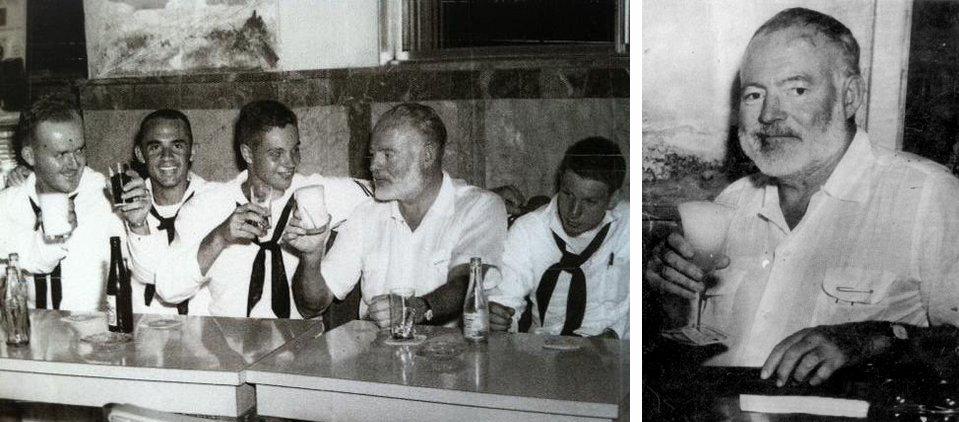
Welcome to Friday July 19, 2024, and National Daiquiri Day, one of Hemingway’s favorite drinks when he stayed in Cuba.  Here are two pictures of Hem in Cuba with his drink (daiquiri on right), taken from the from the Post Prohibition site. It gives a bit of background (below), and includes (not shown) a recipe for Hemingway’s daiquiris.

In the moments he took a break from writing, Hemingway whiled away much of the 30s and 40s sitting at the bar of the famous Cuban haunt El Floridita, where they fixed his preferred drink, El Papa Doble, one after another. The Doble is a large drink, and Hemingway was quick to brag that he could put back quite a few. And by a few.. I mean many. Hemingway is famously known to have consumed six of his namesake Daiquiris on the average afternoon, but as many as twelve Papa Dobles in one sitting when he was really looking to let loose. A Papa Doble was compounded of two and a half jiggers [or 3 3/4 ounces] of Bacardi White Label Rum, the juice of two limes and half a grapefruit, and six drops of maraschino, all placed in an electric mixer over shaved ice, whirled vigorously and served foaming in large goblets. Hemingway said these drinks “had no taste of alcohol and felt, as you drank them, the way downhill glacier skiing feels running through powder snow.”

It’s also National Raspberry Cake Day, National Flitch Day (celebrating bacon), and Stick Out Your Tongue Day.  Here’s a famous example of lingual extrusion: 

Readers are welcome to mark notable events, births, or deaths on this day by consulting the July 19 Wikipedia page.

Da Nooz:

*Obituaries first: Beloved comedian Bob Newhart died at the ripe old age of 94.  Variety reports:

Bob Newhart, the genteel but sharply satirical comic whose TV series “The Bob Newhart Show” and “Newhart” were huge hits throughout the 1970s and ’80s, died Thursday in Los Angeles. He was 94.

Newhart’s publicist Jerry Digney said he died after a series of short illnesses.

Newhart was also known to younger audiences as Papa Elf in the 2003 Christmas classic “Elf,” his guest spots on “The Big Bang Theory” (for which he won his only Emmy, as a guest star in 2013) and most recently appeared in three episodes of “Young Sheldon.”

Before his TV success, Newhart’s comedy albums were wildly popular for their at-the-time new approach of observational humor. He ruled TV for the better part of two decades, first with “The Bob Newhart Show” as a befuddled Chicago psychologist and then on “Newhart” as an equally at-a-loss New England innkeeper. He drew Emmy nominations for actor in a comedy three years running from 1985-87. Both shows were major successes for CBS, and they ran for a total of 16 years between 1972 and 1990.

Perhaps if you’re of a certain age you’ll remember the last episode of “Newhart”,  when he wakes up next to his wife (Suzanne Pleshette) from his first series to realize that the entire second series was all a dream. Most of us who watched both series recognized the bedroom immediately. It was the greatest ending ever for an American sitcom. Here’s that scene:

*The NYT reports that Biden is becoming more receptive to people telling him that he should step down as the Democratic Presidential candidate:

President Biden has become more receptive in the last several days to hearing arguments about why he should drop his re-election bid, Democrats briefed on his conversations said on Wednesday, after his party’s two top leaders in Congress privately told him they were deeply concerned about his prospects.

Mr. Biden has not given any indication that he is changing his mind about staying in the race, the Democrats said, but has been willing to listen to rundowns of new and worrying polling data and has asked questions about how Vice President Kamala Harris could win.

The accounts suggest that Mr. Biden, privately at least, is striking a more open-minded posture than he did last week when he lashed out at a number of House Democrats who pressed him to step aside.

One person close to the president said that it would be wrong to call him receptive to the idea of dropping out but that he “is willing to listen.” But this person emphasized there was no sign that Mr. Biden was changing course at this point.

The descriptions emerged after Senator Chuck Schumer and Representative Hakeem Jeffries, the two top Democrats in Congress, each told Mr. Biden privately over the past week that their members were deeply concerned about his chances in November and the fates of House and Senate candidates should he remain at the top of the ticket, according to two people briefed on the conversations.

The separate exchanges between Mr. Biden and the congressional leaders, described on the condition of anonymity because they were confidential discussions on an exceedingly sensitive topic, came to light as Democrats’ rebellion against Mr. Biden intensified on Wednesday.

Mr. Schumer and Mr. Jeffries, both of New York, privately prevailed upon party officials to delay the start of Mr. Biden’s nomination by a week, prolonging the debate over the viability of his candidacy.

. . .Democratic leaders have come to their conversations with Mr. Biden armed with grim new data. According to a poll from Blue Rose Research, a firm that formed from but is no longer affiliated with Future Forward, the super PAC supporting Mr. Biden, just 18 percent of voters and only 36 percent of people who voted for Mr. Biden in 2020 believe he is mentally fit and up to the job of being president.

Mr. Schumer, according to the Democrat close to him, was also given data from a leading Democratic super PAC showing Mr. Biden’s deficit growing to 5 percentage points or more in the must-win states of Pennsylvania, Michigan and Wisconsin, and his deficit in three other key states — Nevada, Georgia and Arizona — outside the margin of sampling error.

Check the polls here at FiveThirtyEight. Of 28 polls pitting Biden against Trump, Trump was the winner in all but one, which was dead even.  Of 12 polls pitting Harris against Trump, Trump won 11, and the other was dead even. But even looking at other candidates like Newsom, Whitmer (my favorite), and even Michelle Obma, Trump takes all of them. Well, the non-candidates haven’t yet been introduced to the public, so we can still hope. . .

*According to the WaPo, even former President Obama has lost enthusiasm for Biden.

Former president Barack Obama has told allies in recent days that President Biden’s path to victory has greatly diminished and he thinks the president needs to seriously consider the viability of his candidacy, according to multiple people briefed on his thinking.

Obama has spoken with Biden only once since the debate, and he has been clear in his conversations with others that the future of Biden’s candidacy is a decision for the president to make. He has emphasized that his concern is protecting Biden and his legacy, and has pushed back against the idea that he alone can influence Biden’s decision-making process.

Behind the scenes, Obama has been deeply engaged in conversations about the future of Biden’s campaign, taking calls from many anxious Democrats, including former House speaker Nancy Pelosi (D-Calif.), and has shared his views about the president’s challenges, according to people with knowledge of the calls, who spoke on the condition of anonymity to discuss private conversations.

A spokesperson for Obama declined to comment.

When you’ve lost Barack, you’ve lost America. I should add that the AP reports that Nancy Pelosi warned Biden in private that if he didn’t withdraw, Democrats could lose the House. It’s pretty much over for Joe now, though he had a good run.

*The AP, however, says that Trump is exaggerating when he claims he’s been “totally exonerated” by the courts.

Former President Donald Trump on Tuesday misrepresented in a social media post what the U.S. Supreme Court’s Monday ruling on presidential immunity means for his civil and criminal cases.

“TOTAL EXONERATION!” he wrote in the post on his Truth Social platform. “It is clear that the Supreme Court’s Brilliantly Written and Historic Decision ENDS all of Crooked Joe Biden’s Witch Hunts against me, including the WHITE HOUSE AND DOJ INSPIRED CIVIL HOAXES in New York.”

But none of Trump’s pending cases have been dismissed as a result of the ruling, nor have the verdicts already reached against him been overturned. The ruling does amount to a major victory for the presumptive Republican presidential nominee, whose legal strategy has focused on delaying court proceedings until after the 2024 election.

CLAIM: The Supreme Court’s ruling that former presidents have broad immunity from prosecution means “total exoneration” for former President Donald Trump.

THE FACTS: Although the historic 6-3 ruling is a win for Trump, he has not been exonerated and his legal troubles are far from over. A delay of his Washington trial on charges of election interference has been indefinitely extended as a result. Also, he still faces charges in two other criminal cases, and the verdicts already reached against him in a criminal and a civil case have not been overturned.

Barbara McQuade, a law professor at the University of Michigan and former U.S. attorney for the state’s Eastern District, told The Associated Press that Trump’s claim is “inaccurate for a number of reasons.”

“The court found immunity from prosecution, not exoneration,” she wrote in an email. “The court did not say that Trump’s conduct did not amount to criminal behavior. Just that prosecutors are not allowed to prosecute him for it because of the special role of a president and the need to permit him to make ‘bold’ and ‘fearless’ decisions without concern for criminal consequences.”

McQuade wrote that Trump’s case over classified documents found at his Mar-a-Lago estate won’t be affected, as it arose from conduct committed after he left the White House. She added that any impact on his New York hush money trial “seems unlikely” since the crimes were committed in a personal capacity.

“In addition, the Court’s opinion is solely focused on immunity for criminal conduct,” McQuade continued, explaining that it will not protect him from civil liability in his cases regarding defamatory statements about advice columnist E. Jean Carroll or fraudulent business practices conducted at the Trump Organization.

As for the January 6 case:

The case has not been dismissed. It was instead sent back to U.S. District Judge Tanya Chutkan, who must now “carefully analyze” whether other allegations involve official conduct for which the president would be immune from prosecution. The trial was supposed to have begun in March, but has been on hold since December to allow Trump to pursue his Supreme Court appeal.

However, the justices did knock out one aspect of the indictment, finding that Trump is “absolutely immune” from prosecution for alleged conduct involving discussions with the Justice Department.

The opinion also stated that Trump is “at least presumptively immune” from allegations that he tried to pressure Vice President Mike Pence on Jan. 6, 2021, to reject certification of Democrat Joe Biden’s electoral vote win. But prosecutors can try to make the case that Trump’s pressure on Pence can still be part of the case against him, Chief Justice John Roberts wrote.

It is all but certain that the ruling means Trump will not face trial in Washington ahead of the 2024 election, as the need for further analysis is expected to tie up the case for months with legal wrangling over whether actions in the indictment were official or unofficial, the AP has reported.

The man has luck, I tell you. I wonder if he could really shoot somebody in the middle of Fifth Avenue and not lose any support. His lawyers would probably find a way to show that that was part of his official duty as President. . .

*The Knesset (the parliament of Israel) has voted overwhelmingly against giving Palestinians their own state.

The Knesset early Thursday voted overwhelmingly to pass a resolution rejecting the establishment of a Palestinian state.

The resolution was co-sponsored by parties in Prime Minister Benjamin Netanyahu’s coalition together with right-wing parties from the opposition and even received support from Benny Gantz’s centrist National Unity party.

Lawmakers from Opposition Leader Yair Lapid’s center-left Yesh Atid party left the plenum to avoid backing the measure, even though he has spoken in favor of a two-state solution. The only ones to oppose the resolution were lawmakers from the Labor, Ra’am and Hadash-Ta’al parties.

The initiative was passed just days before Netanyahu’s visit to the US to address a joint session of Congress and meet with President Joe Biden at the White House. The move was likely to further irk Democrats uncomfortable with embracing an Israeli government that increasingly rejects a two-state solution.

Already in February, the Knesset passed a resolution sponsored by Netanyahu rejecting the establishment of a Palestinian state, but that motion specifically addressed the unilateral establishment of such a state amid reports that countries abroad were considering recognizing a Palestinian state absent a peace agreement with Israel.

This resolution — passed 68-9 — altogether rejects the establishment of a Palestinian state, even as part of a negotiated settlement with Israel.

“The Knesset of Israel firmly opposes the establishment of a Palestinian state west of Jordan. The establishment of a Palestinian state in the heart of the Land of Israel will pose an existential danger to the State of Israel and its citizens, perpetuate the Israeli-Palestinian conflict and destabilize the region,” the resolution stated.

“It will only be a matter of a short time until Hamas takes over the Palestinian state and turns it into a radical Islamic terror base, working in coordination with the Iranian-led axis to eliminate the State of Israel,” it continued. “Promoting the idea of ​​a Palestinian state at this time will be a reward for terrorism and will only encourage Hamas and its supporters to see this as a victory, thanks to the massacre of October 7, 2023, and a prelude to the takeover of jihadist Islam in the Middle East.”

Given that the proportion of both women and blacks have increased substantially at the company since 2019, it’s not clear why they’re deep-sixing the program.  Could it be legal issues? Regardless, it now seems that DEI is withering almost everywhere, including academia.  I’m wondering again whether fears of lawsuits is the reason. Note, though, that the first two companies to deep-six DEI were tractor companies: companies squarely representing Middle America.

Meanwhile in Dobrzyn, Hili got scared—by gentle Szaron!

Hili: You frightened me.
Szaron: Sorry, I didn’t mean to.
In Polish:
Hili: Wystraszyłeś mnie.
Szaron: Przepraszam, nie chciałem.

*******************

From Cat Memes (how true!):

A badly affixed sticker from Jesus of the Day. What do you think the name is?

From Strange, Stupid, or Silly Signs, a mean store:

From Masih: a woman speaks who is about to go to prison for 6 years. The video shows women burning their hijabs while crying “Woman, life, freedom!”

From my feed: kitten versus duck. I give duckling the edge:

Marmots from Malcolm. Is this two males battling over an observing female?

This is the last scene from Ricky Gervais’s fantastic series “After Life”, and to my mind is the best series ending ever. But it’s ineffably sad and always makes me tear up.

From Pinkah, pointing out an excellent piece, with a good lesson, by Sally Satel in the Washington Monthly. Read at the link.

From the Auschwitz Memorial, one that I retweeted:

Two tweets from Doctor Cobb. Look at those names! Raygun Steele, Cash Sweat, and so on. One might almost think they were made up. . .

And Republicans are wearing ear bandages! The reference on the right is to a related scene in The Life of Brian (see video here):

Today’s wildlife post misposted

July 18, 2024 • 10:15 am

This morning something got screwed up with the wildlife post, and so it was posted by accident when it was only partially written.  That means that the email went out with about 15% of the post included. If you read posts on the emails, then, I urge you to go back to Bruce Lyon’s original post, which has three videos and many photos of adorable Arctic fox cubs, at the new site.

I have no idea what happened, but it was a pain to restore the post. It is, however, well worth perusing, as those cubs are somethin

Repost with evidence: Health New Zealand “encourages” its employees to say Māori prayers daily

July 18, 2024 • 9:30 am

NOTE:  I put this post up the other day, but then got a very irate email from a Kiwi saying that no, I was WRONG: Health New Zealand, he asserted, never sent around any notice to employees encouraging them to say spiritual prayers (karakia) during the day: a Māori custom.  I objected to this as a mixing of religion and government (governmental health efforts), as well as a partial sacralization of indigenous practices. Because of the correspondent’s objection, and because I had no original evidence for such a notice being sent out—just a reader’s assertion—I pulled the post. I also informed a NZ outlet, which had asked to republish my post, to hold off until they could get evidence that such a notice about karakia was indeed circulated.

The organization in NZ has now procured such evidence, so I’m reposting what I took down, but have added the notice (with a link) verifying the government’s urging employees to pray.  And to the person who told me in very strong terms that no such notice existed, well, this is a family site and I won’t tell him what to do—but you can guess.

My post, now with the notice and a link to it:


This item, from the Breaking Views website in New Zealand, is one of the rare cases of a Kiwi speaking up against forcible adherence to Māori customs on the job—in this case, saying Māori prayers. First, “Health New Zealand,” the organization in question, is a government agency that, according to its own description:

. . . . will manage all health services, including hospital and specialist services, and primary and community care. Hospital and specialist services will be planned nationally and delivered more consistently across the country. Primary and community services will be commissioned through four regional divisions, each of which will network with a range of district offices (Population Health and Wellbeing Networks) who will develop and implement locality plans to improve the health and wellbeing of communities.

And the author of this short plaint, A. E. Thompson, is described as “a working, tax-paying New Zealander who speaks up about threats to our hard-fought rights, liberties, egalitarian values, rational thinking and fair treatment by the state.”  He or she is also courageous! (It’s not clear whether Thompson is employed by Health New Zealand; if so, that won’t be for long!)

The beef is that the government sent out a notice to Health New Zealand’s staff encouraging them to say Māori prayers daily.  From the site:

I was made aware that Health New Zealand recently sent an email to its staff as follows:

“We encourage everyone to incorporate karakia daily. To help support you with this we have created some pre-recorded videos to learn karakia. Our resource is designed to give you some options that will enable you to learn and develop your confidence and skills. Note over time we will be adding more recordings for you to choose from.”

The word ‘karakia’ surely must be a Maorified way of saying ‘prayer’, but it seems very difficult and may be impossible to determine whether the term was used before Europeans arrived or if there were other terms that iwi used for their incantations, chants and verbal offerings of respect to their various spiritual entities. Regardless, karakia almost always involve references to supernatural forces whether they be Christian (in practice, they usually end with ‘amine’), pagan or spiritualist. They often involve communication intended for (usually unspecified) long-dead ancestors.

Massey University assistant lecturer Te Rā Moriarty was quoted as saying: “Karakia allow us to continue an ancestral practice of acknowledging orally the divine forces that we, as Māori, understand as the sources of our natural environment. We call these forces atua. So, it is a way to connect through the words of our tūpuna to the world that we live.”

Here’s the notice that the NZ news site that was going to publish my post eventually found. And yes, it is real, and came with a note:

NAME REDACTED tells me she has been advised that an email was sent to employees and invited them to view the message in their browser.

Click the notice to see the announcement—on a Health New Zealand website. The “you can read more” link doesn’t work for me; it apparently requires credentials to access. But the notice says exactly what my informant claimed.  Yes, the New Zealand government is urging some of its employees to pray daily.

In the Māori dictionary, “karakia” is defined this way:

(noun) incantation, ritual chant, chant, intoned incantation, charm, spell – a set form of words to state or make effective a ritual activity. Karakia are recited rapidly using traditional language, symbols and structures. Traditionally correct delivery of the karakia was essential: mispronunciation, hesitation or omissions courted disaster. . . . .

So what we have is a government agency “encouraging” its staff to chant to supernatural powers in hope of connecting to one’s ancestors (tūpuna). This encouragement, of course, violates the separation of church and state, and is an unwarranted sop to the indigenous people. (New Zealand, of course, doesn’t have a First Amendment.)  It’s one more sign of how the sacralization of the oppressed is spreading in New Zealand.  Of course these prayers have no effect, and encouraging the descendants of “colonists” to say them is to force one’s beliefs on others who may not share them.

Thompson has a few words about this:

We can choose not to attend places where the religious practices feel offensive or intolerant to us, and the hosts in those places can exercise similar choice about visiting our spaces.

However, when we are employed and rely upon that employment for our survival, we don’t have the choice to avoid our place of employment. Being employed in a state service under a secular government, workers should have choice over whether they participate even passively in practices involving claimed spiritual entities or supernatural beliefs. Expecting employees to participate denies their right to choose to follow their own religion or philosophical belief and not other people’s, a characteristic of totalitarian rule.

This is especially true in New Zealand, where refusal to sacralize the presumed “oppressed” is sometimes punished severely, with threats of losing one’s job. Thompson’s piece continues:

Sure, the email to health staff only used the word “encourage” but really, when your employer issues an email saying that, you know it will be expected and that ignoring or opposing it will be held against you and may cost you your job.

Pressuring state employees and even private company employees to participate in karakia sets a dangerous precedent in eroding separation between state and religion. As we speak, Muslim immigrants in Europe are deliberately imposing their religious practices on non-Muslim populations by having their distorting loudspeakers call dozens or hundreds of faithful to prostrate themselves in prayer on public footpaths and roadways (even though nearby mosques are plentiful). The practice reflects their belief that Islam is so important that everyone either needs to convert to it or be discriminated against or killed.

As usual, I was sent this with the assumption that the sender would remain anonymous. Thompson, however, clearly has some guts, for even if he/she doesn’t work for Health New Zealand, it’s a huge risk to publish something like this anywhere.

Readers’ wildlife photos and videos (adorable Arctic fox cubs)

July 18, 2024 • 8:15 am

After a long break doing field work, Bruce Lyon of UC Santa Cruz, now in Alaska working on birds, sent some photos of bonus mammals: cute Arctic foxed with added VIDEOS. His captions and IDs are indented, and you can enlarge his photos by clicking on them. His intro:

Since foxes are honorary cats on WEIT, I thought people would enjoy some photos and videos of an arctic fox (Vulpes lagopus) family on St Paul Island, Alaska, where I have spent the summer studying birds. There is a fox den in the boulders next to the beach near my lodging and the pair has a whopping nine pups! The other day all nine adorable fuzzballs were playing out in the open on the beach and I was able to watch and photograph their antics. There were lots of playfights, chases and pounces, tossing bits of dried fish into the air, chewing and attacking a piece of driftwood on the beach, and leaping up and pirouetting in the air.

Arctic foxes are native to St Paul Island and virtually all individuals are blue morph rather than white morph foxes. Occasionally, white morph individuals do get here by crossing the winter sea ice. The morphs are apparently produced by a single Mendelian gene (the MC1R gene). However, three of the pups have white feet, so perhaps the coat color is mostly but not entirely determined by the MC1R gene.

JAC: Here’s the location of St. Paul Island in the Priblofs (from Wikipedia):

A video best shows how adorable these fuzzballs are. Seven of the nine pups are in view:

Another video—the pups having fun with their driftwood toy:

One last video—a sibling’s tail makes for a great toy:

The fox playground. The pup on the right is in pounce mode and pounced on its sib just after I took the photograph:

A pup inspects a fish head. Someone from the local fish processing plant may have dumped a bunch of fish on the beach for the foxes but it is also possible that the parents dragged the fish here from wherever the fish scraps are dumped:

A chase:

These guys took a break from playfighting but then the one on the right batted its sib and in the process lost its balance and toppled over (the following photo):

Next few photos: Mom’s home!  The adult female showed up and the pups mobbed her. They were so excited to see her—lots of bouncing and tail-wagging. She nursed them for a bit (I think they had to take turns; too many to fit at one time) but she soon decided she had had enough and nipped at the kids to chase them off:

A pup checks me out:

Thursday: Hili dialogue

July 18, 2024 • 6:45 am

Welcome to Thursday July 18, 2024, and National Tropical Fruit Day, of which the tastiest representative is the mango.  I learned in India how to cut and eat one (always eat in the hand); here’s the method I use, though I just eat the cubes off the skin (see at 2:20) and gnaw around the seed. Some day I must go to India during mango season, when dozens of varieties are available, but that’s the summer when it’s bloody hot. 


It’s also National Sour Candy Day, National Caviar Day, National Dole Whip Day (it’s a soft-serve fruit-flavored dessert), and Nelson Mandela International Day, celebrating the day he was born in 1918 (I’m going to visit his prison cell when I go to South Africa in two weeks). 

Readers are welcome to mark notable events, births, or deaths on this day by consulting the July 18 Wikipedia page.

Da Nooz:

*President Biden has announced that his administration will pursue major changes to the Supreme Court, including term limits and a more stringent ethics code for the justices.

President Biden is finalizing plans to endorse major changes to the Supreme Court in the coming weeks, including proposals for legislation to establish term limits for the justices and an enforceable ethics code, according to two people briefed on the plans.

He is also weighing whether to call for a constitutional amendment to eliminate broad immunity for presidents and other constitutional officeholders, the people said, speaking on the condition of anonymity to discuss private deliberations.

The announcement would mark a major shift for Biden, a former chair of the Senate Judiciary Committee, who has long resisted calls to make substantive changes to the high court. The potential changes come in response to growing outrage among his supporters about recent ethics scandals surrounding Justice Clarence Thomas and decisions by the new court majority that have changed legal precedent on issues including abortion and federal regulatory powers.

Biden previewed the shift in a Zoom call Saturday with the Congressional Progressive Caucus.

“I’m going to need your help on the Supreme Court, because I’m about to come out — I don’t want to prematurely announce it — but I’m about to come out with a major initiative on limiting the court. … I’ve been working with constitutional scholars for the last three months, and I need some help,” Biden said, according to a transcript of the call obtained by The Washington Post.

Term limits and an ethics code would be subject to congressional approval, which would face long odds in the Republican-controlled House and a slim Democratic majority in the Senate. Under current rules, passage in the Senate would require 60 votes. A constitutional amendment requires even more hurdles, including two-thirds support of both chambers, or by a convention of two-thirds of the states, and then approval by three-fourths of state legislatures.

Why is he doing this? He surely doesn’t like the Court’s decisions, but this is not a way to get Democratic votes, since Democrats are already in the chorus.  And the fact that Supreme Court Justices, like all federal judges, have lifetime appointments, a provision enshrined in the Constitution, makes eliminating that almost impossible. For curtailing appointments requires not only approval of both houses of Congress, but ratification by 3/4 of the states. How likely is THAT?  I tell you: probability zero given American politics. For crying out loud the Equal Rights Amendment hasn’t even been ratified!  As for Congressional passage of ethics laws and getting rid of immunity, well, yes, those are great ideas, but again have no probability of passing in a Congress that’s almost certain to have at least one house (and maybe now the Senate) as majority Republican.  Biden may be counting on being re-elected, but I’m not confident.

*From the Free Press, an article that made my stomach drop, “The end of Joe Biden—and the Democratic establishment.” But when I read it I found it was pretty biased.

The resilience of the Democratic establishment under present-day conditions makes for a remarkable story, one that speaks to the growing fondness of progressives for conservative and even reactionary structures. After co-opting Obama into the fold, this establishment has done everything that can be expected of it—which is mostly fixing things. It fixed the rules so that Clinton would get the nomination over Sanders in 2016. It did much the same for Biden in 2020 and 2024, going so far as to hinder debates in the 2024 primaries, a decision with profound if unintended consequences.

Democratic submission to hierarchy is astonishing. Biden has been in physical and mental decline for years. Gavin Newsom, governor of California, almost indecently lusts after the presidency. Yet Newsom must genuflect before the president and pledge allegiance to his cause. In name at least, Biden is boss. The rules of the game must be adhered to, without exception.

With Biden, the establishment was presented with a difficult challenge: it was reality itself that needed fixing. The president, we have seen, is an inarticulate speaker, has a bizarre personality, is notoriously thin-skinned and lacks humor and charm as a public person. Furthermore, his administration has been responsible for one disaster after another, at home and abroad. All that had to be fixed. The fictional replica of Biden required an equally fictional—and magnificent—record of achievement.

In an effort that has to be unparalleled in our history, every American institution, from the prestige press to the digital platforms, from academia to the entertainment world and very much including the federal bureaucracy, was recruited to portray President Biden as the second coming of Abraham Lincoln. He was said to be caring, empathetic, a totally normal Everyday Joe who bonded easily with racial minorities—but also serious about his duties, the dignified adult in the room, a reliable ally who would never be manipulated by Vladimir Putin. His administration had defeated the pandemic, saved the economy, embraced migrants of all races, ended a forever war in Afghanistan, and somehow protected Ukraine, Israel, and Hamas simultaneously. As for the president’s age, he was old but wise, sharp in private though a stutterer in public and surrounded by the best and brightest in any case.

Nothing like this had been seen before. For the Democrats in power to spin the truth was predictable. For the institutions of information and knowledge to debase themselves so completely on behalf of a political nonentity added to their crisis of authority by precipitating a depressing meltdown of integrity.

And Repubicans don’t spin the truth? If they are going to slander Biden this way, well, Trump is even riper for slander. I do, however, think that the Democrats are in tatters. Led by a President who should resign, with only cartographer Kamala “I can read maps” Harris as a likely replacement, and dragged down by the “progressive” Left, which most of America dislikes, the Party lacks unity. So yes, the Dems don’t look good, and that makes me feel constantly queasy. But the article is grossly exaggerated and neglects the many flaws of Republicans, who happen to have united around a megalomaniac.  I hope the Free Press isn’t going to endorse Trump! If they presume to be rational and thoughtful, and if they don’t like Biden (or whoever replaces him) it’s best not to endorse anyone!

*The BBC reports that Human Rights Watch, which has long been anti-Israel, has finally  admitted that, yes, war crimes by Hamas took place on October 7.  DUHHH! (h/t Malgorzata, Jinny)

Hamas and at least four other Palestinian armed groups committed numerous war crimes and crimes against humanity against civilians during the 7 October attack on southern Israel, the campaign group Human Rights Watch says.

A new report accuses the hundreds of gunmen who breached the Gaza border fence of violations including deliberate and indiscriminate attacks on civilians, wilful killing of persons in custody, sexual and gender-based violence, hostage-taking, mutilation of bodies and looting.

It also found the killing of civilians and hostage-taking were “central aims of the planned attack” and not an “afterthought”.

Hamas angrily rejected what it called HRW’s “lies” and demanded an apology.

About 1,200 Israelis and foreigners – mostly civilians – were killed and 251 others were taken as hostages when more than Israeli communities and towns, as well as number of military bases, two music festivals and a beach party were attacked nine months ago.

Israel responded by launching a military campaign in Gaza with the aims of destroying Hamas and freeing the hostages.

More than 38,790 people have been killed in Gaza since then, according to the territory’s Hamas-run health ministry, whose figures do not differentiate between civilians and combatants.

HRW’s report does not cover alleged violations of the laws of war by Israeli forces and Palestinian groups in the conflict that was triggered by the 7 October attack.

The report released by HRW on Wednesday is based on interviews with 144 people, including witnesses to the 7 October attack, as well as analysis of more than 280 photographs and videos posted on social media or shared with the group’s researchers.

This is important because HRW has been a constant critic of Israel, writing incessantly about its war crimes, but (as far as I know) has never written anything substantial, or anything at all, indicting Hamas for war crimes. It’s a bit late, but better late than never.  And for Hamas to deny that it committed war crimes on October 7? Well, we know that the terrorist group lies like a rug.  I’m hoping this marks a sea change so that these “rights” groups, almost uniformly opposed to Israel, start being more objective, but I’ve been around long enough to know that that hope is pretty futile. Here’s a tweet  thread (h/t Malgorzata) about HRW when it was blatantly anti-Israel:

*On his Substack site Singal-Minded, Jesse Singal said, “I watched Biden’s NAACP so you don’t have to, unless you did, in which case I am so sorry.” That’s the subtitle of his critique, which is titled, “This is no longer remotely tenable.”  Note: I didn’t watch the speech, but I’ve put it below. It’s half an hour long. (I watched snippets and got freaked out.)

Singal:

No, I’m not deliberately overdoing the criticisms of Biden: have a look at the front page or op-eds of the NYT to see how many people are desperately calling on Biden to step down. And maybe he will: the NYT reports that “President Biden said in an interview released on Wednesday that he would re-evaluate whether to stay in the presidential race if a doctor told him directly that he had a medical condition that made that necessary.”  But many of us centrist Democrats feel like we’re about to get sick, for our party can’t seem to do anything to defeat The Orange Demagogue. I keep telling myself, “Well, if he’s elected, it’s only four more years, then it’s over.” But I also tell myself, “I may die when Trump is President.”

*An article by Martin Gurri I couldn’t resist from the NYT: “Cowboy boots are the great American icebreaker.

I don’t often have opportunities to find things in common with most strangers in general, but especially in rural Nevada. Coming from a bicoastal Black family, possessing no love for sport, or business, I find most of my conversations center on topics like art and history and human rights, or some hodgepodge of the three. My interests make it hard, on the surface, to relate to a rural Mormon. (A snap judgment, I know.) But to my surprise, Ed and I have more things to talk about. We’re well versed in the region’s botany (including the Great Basin’s sagebrush and juniper trees). We also understand ranching practices (my family owns 200 acres of meadow and forest near the Colorado River in Egypt, Texas, and Ed learned what he knows from a lifetime of experience in Alamo, Nev.). That initial conversation about my boots led to many more. It strikes me that we have, in the most tacit of senses, become friends thanks to my footwear.

My boots are composed of stacked leather, and are lavishly embellished with romantic stitching. Cowboy boots are a coalition of several cultures. The riding boot dates back to the Mongol Empire. Mongol riding boots and cowboy boots look like cousins down to the pointed toe, but the former model is much smaller and doesn’t have a prominent heel. The direct progenitors of our modest spur-sporters are the British Wellington and the Spanish riding boot, shoes created for military action and ranching respectively. According to legend, the design was altered around the 1870s to sport a scalloped top, which provided ease of access and removal. The design of the boot is thick enough to repel chafing, scrub brush and ornery varmints; stalwart as to endure difficult working conditions; nimble and supportive for fast action; and still powerful and noble-looking after a shine.

The cowboy boot is innately American, shoe as nationalist symbol. The more normalized depiction of Black cowboys in recent popular culture (see: Beyoncé’s album “Cowboy Carter,” Lil Nas X’s “Old Town Road,” the brilliant Dom Flemons’s music, the Bill Pickett Invitational Rodeo) might prompt more people of color to purchase a pair, identifying with an essential aspect of Americana from which we have so often been excluded. The cowboy boot and its legacy are complex, but it may be the gear we need right now. Americans can’t agree on much these days, but if we can come to a consensus on the cowboy boot, we might be able to find other things we have in common.

Back in Las Vegas, I’m getting my tire changed. I use my local llantera religiously for this ever-necessary maintenance. Jerry, the man who runs the shop, approaches me during this rotation, declaring: “I’ve got a great pair of ropers! Maaaaan, I love to take them dancing.” I’ve been coming to his shop for seven years, and this is the first thing he’s said to me that wasn’t related to auto repair. I’m wearing a new burgundy pair of boots, and maybe the color caught his eye. We go on for the next 20 minutes about his love of cowboy boots, his collection, his kids and mine and how we dress them in a Western style for important events. I’m once again astonished at how my shoes have expanded a relationship I had only superficially engaged.

It’s all true! Men’s footwear, save cowboy boots, is UGLY: we have far fewer choices than women. Boots are cool, and I even got Steve Pinker onto them, so he now wears them constantly. I can always start a conversation with someone if I see them wearing boots, as I know a lot about cowboy boots given my large collection. (Sadly, I haven’t worn them much lately.) I met Elizabeth Weiss at a Stanford meeting, for instance, because I noticed she was wearing boots and remarked on them. Now we are e-friends.  They are far more comfortable than most people realize, and can be worn either with a suit (as does Steve) or with jeans (as do I). Try them!

Meanwhile in Dobrzyn, Hili notes the many uncollected fallen apples:

Hili: You have to collect these apples.
A: I don’t have time.
Hili: You always have excuses.
In Polish:
Hili: Musisz pozbierać te jabłka.
Ja: Nie mam czasu.
Hili: Zawsze masz jakieś wykręty.

And a photo of Baby Kulka:

*******************

From Cat Memes:

From America’s Cultural Decline Into Idiocy via Antonio Maches:

From Strange, Silly, or Stupid Signs via John Grant:

From Masih, a clever tweet. The implication, trained dogs have more control than many Muslim men, who apparently cannot be trained!

From Simon, who proffers this in a time when he doesn’t find very much funny (join the club!):

From my feed, which is usually full of heartwarming stuff and animals:

From Malcolm, whose comment is “insane”.  Or very, very skillful!

The wonders of AI:

From the Auschwitz Memorial, one I retweeted:

Two tweets from Dr. Cobb. First, a cat losing his flour before he can make biscuits:

I’d argue that the others have some claim, and “H is for Hawk” is as much autobiography as a work of science,  But still, five science-related books out of 100 is pathetic!