Why Evolution is True is a blog written by Jerry Coyne, centered on evolution and biology but also dealing with diverse topics like politics, culture, and cats.
Reader Joe Dickson sent me many batches of pictures, and here’s one with diverse wildlife. His notes are indented.
First, the “teaser”:
We returned just today from a trip to the Sacramento National Wildlife Refuge complex, about 200 miles north of this pair. I have about 1500 photos, so it will take a couple of weeks to select, sort (mostly delete) and edit the new set. Meanwhile, attached is a teaser – geese flying into the refuge just at sunrise so they appear illuminated from below.
Here are shots from a December trip primarily to see wintering waterfowl in the Merced and San Louis National Wildlife Refuges over in the California Central Valley, with some nice non-waterfowl bonuses. The most striking concentrations were Ross’s goose (Chen rossii) and snow goose (Chen caerulescens), often in mixed flocks and difficult to distinguish at a distance.
Although more dispersed, ducks were also present in the thousands, mostly northern shoveler (Anas clypeata), cinnamon teal (Anas cyanoptera) and northern pintail (Anas acuta) pictured in that order below.
The most common wader was the black-necked stilt (Himantopus mexicanus).
Large flocks of geese flew out from the wetlands early in the morning, only to be found foraging in nearby fields. All those I got close to seem to be Ross’s.
It wasn’t all waterfowl and waders. Here is a nice red-tailed hawk (Buteo jamaicensis).
And a Black-tailed deer (a subspecies of mule deer, Odocoileus hemionus columbianus).
Finally, we did not see sandhill cranes (Grus canadensis) on the ground this time but did catch them flying from farm fields back into the refuge in the evening.
Well, a reader showed in an email that that the hearts in the illusion below really were very slightly different colors due to the compression algorithms used in making the image. (However, those slight differences do not account for the striking perceptual effect). The reader who demonstrated this anomaly won an autographed book from Matthew.
There appear to be greenish hearts and bluish ones, though they are the same color. pic.twitter.com/NachmY6y37
HOWEVER, reader Mel made his own illusion, so we know that here the colors of the squares really are identical. His notes:
To demonstrate the phenomenon a bit more cleanly I constructed the following image using a spreadsheet. I used very small cells (0.3 cm x 0.3 cm) and filled them with various colors and then took a screenshot. The image still shows the illusion and only three colors were used in constructing the image (magenta, orange, blue-green).
And another demonstration using magic markers. I think the efficacy of the lines in fooling viewers about the color has been shown. We’ll now leave this illusion behind and move on.
Good morning on Sunday, February 18, 2018. It’s It’s National “Drink Wine” Day (why the scare quotes?), which I commemorated yesterday but was wrong. That day is today, so drink some wine.
I have little to say about this day because I prepared a dialogue yesterday and the events all turned out to be on NOVEMBER 18. For some reason I can’t fathom, I’m always confusing November and February (perhaps I have a mirror image of the year). So here are a few events as I recoup:
On this day in 1885, Mark Twain (Samuel Clemens) published the Adventures of Huckleberry Finn in the U.S. Now schools are busy banning it. As Wikipedia notes, on February 18, 1911, “The first official flight with airmail takes place from Allahabad, United Provinces, British India (now India), when Henri Pequet, a 23-year-old pilot, delivers 6,500 letters to Naini, about 10 kilometres (6.2 mi) away.” Why they would use a plane to fly 6500 letters only 10 km, unless it was an experiment, is a mystery to me. On this day in 1930, Pluto was discovered by astronomer Clyde Tombaugh while studying photos taken the previous month. It’s now classified not as a planet, but as a “dwarf planet.” I reject that classification. There are nine planets in our solar system: the first is Mercury and the last is Pluto. (Do not attempt to argue with me.) On this day in 1954, the first Church of Scientology opened in Los Angeles. To see what that “faith” does to people, watch the following video featuring Tom Cruise and David Miscavage. It includes Cruises’ famous Scientology meltdown and clips of him receiving an award from Miscavage at the Scientology convention in 2004.
On this day in 1970, the Chicago Seven were found not guilty of inciting riots during the 1968 Democratic Convention in Chicago. (The more of them you can name, the older you are! I came up with five.) On this day in 2010, WikiLeaks published the first of a gazillion classified documents disclosed by the soldier now called Chelsea Manning. Finally, on February 18, 2013, the Great Diamond Theft occurred at the Brussels Airport, with thieves taking $50 million worth of diamonds. 31 people were arrested for this in May of that year, and some (but not all) of the diamonds were recovered.
Notables born on this day include Wallace Stegner (1909), Helen Gurley Brown (1922), Yoko Ono (1933; she’s 85 today), Cybill Shepherd (1950), John Travolta (1954), Vanna White (1957), and Molly Ringwald (1968). Those who breathed their last on February 18 include Fra Angelico (1455), Michelangelo (1564), J. Robert Oppenheimer (1967), Harry Caray (1998, who now consorts with real Holy Cows), and Dale Earnhardt (2001). As far as I can see, Michelangelo never drew a cat, but many have been created under his inspiration, like these:
Meanwhile in Dobrzyn, Hili smells something odd:
Hili: Facinating!
A: What?
Hili: Exactly—what?
In Polish:
Hili: Fascynujące!
Ja: Co?
Hili: No właśnie, co?
Here’s a tweet found by Matthew, which pretty much holds for all pet cats:
Cat's busy #Caturday schedule: -breakfast -post-breakfast prowl -2nd breakfast -pre-sleep snooze -Main Sleep -plotting -another snooze -global domination -snooze -harrass human for supper -feign death from starvation -turn up nose at supper -flounce off in huff -eat supper -bed pic.twitter.com/CV0tdgQv4n
— Have yourself a merry little Katemas (@katebevan) February 17, 2018
And there was a big catfight on Downing Street yesterday between Larry, the Official Mouser to the Cabinet Office, and Palmerston, the Foreign Office cat. Larry (left) clearly lost; he’s always been a wuss, and can’t even mouse properly!
Drama at Downing Street this morning – Larry the cat has a face off with Palmerston from the Foreign Office. Fur and collar ripped off in the cat fight. @GMBpic.twitter.com/xGWUwZwlmO
My youngest has had my old phone for a couple of years. Just for games, which I download for her before disconnecting the internet. Still has my old contacts though & it turns out she’s been messaging my dad, who died 5 years ago. I may have something in my eye. pic.twitter.com/RZ5ZTgGbnk
In my dotage I’ve decided to cut back on work on Saturday, and I’m sure readers will forgive me if I take a weekly break (that means lighter posting, not no posting). So let’s end Professor Ceiling Cat’s writing day with a simple series of photographs of “Tail pulling” given on The Corvid Blog.
Corvids are species in the family Corvidae, and include crows, ravens, rooks, and jackdaws, magpies, jays, and sundry other species (120 species total). They’re known for their intelligence, and I’ve posted about them fairly often (see here). As Wikipedia notes,
Corvids display remarkable intelligence for animals of their size and are among the most intelligent birds thus far studied. Specifically, members of the family have demonstrated self-awareness in mirror tests (European magpies) and tool-making ability (crows, rooks), skills which until recently were thought to be possessed only by humans and a few other higher mammals. Their total brain-to-body mass ratio is equal to that of great apes and cetaceans, and only slightly lower than in humans.
You can see how smart they are by clicking on the last link above. But they’re mischievous, too! Here are corvids pulling tails, including each other’s:
A quote from the Blog’s piece:
This behavior is so common it’s noted in many scientific papers, with a nice summary from Lawrence Kilham in his 1989 book The American Crow and the Common Raven, page 34-35:
“Tail pulling is a habit common to a number of corvids (Goodwin 1976). The crow that robbed the otter by pulling its tail could have done so by happenstance or as a deliberate piece of strategy. It is hard to know. The crows had pulled the otters’ tails many times before, to no seeming purpose except an urge, shared by Black-Billed Magpies (Lorenz 1970) and Common Ravens, to provoke animals larger than themselves, whether there is any immediate advantage to doing so or not. Bent (1946) reported three Common Ravens robbing a dog of a bone, one bird pulling the dog’s tail while others stood by its head. It is conceivable that crows, like ravens, are capable after trial and error of seizing upon the right movement for pulling a tail to advantage. Another use of tail pulling can be to get a larger bird or mammal to move from a carcass, as I describe later for Common Ravens contending with Turkey Vultures and as Hewson (1981) did for Hooded Crows contending with a Buzzard. Goodwin (1976) described crows and magpies pulling the tails of mobbing predators.
The behavior appears to be innate, for one of my hand-raised crows pulled a sheep’s tail and a hand-raised raven a cat’s tail when they were less than three months of age.”
Today’s Wall Street Journal contains another tale of university censorship, in this case involving Amy Wax, the Mundlein Professor of Law at the University of Pennsylvania Law School in Philadelphia. The screenshot links to the essay, but it’s mostly paywalled, though judicious inquiry might yield you a copy. The article also notes that “This essay, adapted from a speech that she delivered in December, is reprinted by permission of Imprimis, a publication of Hillsdale College.”
Wax recounts one of those authoritarian horror stories that makes me glad that, when I was teaching, I was at the University of Chicago, which would never pull a stunt like Penn did on Wax.
It started when Wax and Larry Alexander (a professor at the University of San Diego law school, a private Catholic-affiliated university) wrote a joint op-ed in the Philadelphia Inquirer last August. Click on the screenshot to see it (it’s free). The title and photo of John Wayne alone tell you that Wax and Alexander were in for trouble.
It’s a conservative editorial decrying the breakdown of bourgeois values that America had in the 1950’s, and here’s some of the stuff that angered Wax’s liberal colleagues and many students:
That culture laid out the script we all were supposed to follow: Get married before you have children and strive to stay married for their sake. Get the education you need for gainful employment, work hard, and avoid idleness. Go the extra mile for your employer or client. Be a patriot, ready to serve the country. Be neighborly, civic-minded, and charitable. Avoid coarse language in public. Be respectful of authority. Eschew substance abuse and crime.
These basic cultural precepts reigned from the late 1940s to the mid-1960s. They could be followed by people of all backgrounds and abilities, especially when backed up by almost universal endorsement. Adherence was a major contributor to the productivity, educational gains, and social coherence of that period.
Did everyone abide by those precepts? Of course not. There are always rebels — and hypocrites, those who publicly endorse the norms but transgress them. But as the saying goes, hypocrisy is the homage vice pays to virtue. Even the deviants rarely disavowed or openly disparaged the prevailing expectations.
Was everything perfect during the period of bourgeois cultural hegemony? Of course not. There was racial discrimination, limited sex roles, and pockets of anti-Semitism. However, steady improvements for women and minorities were underway even when bourgeois norms reigned. Banishing discrimination and expanding opportunity does not require the demise of bourgeois culture. Quite the opposite: The loss of bourgeois habits seriously impeded the progress of disadvantaged groups. That trend also accelerated the destructive consequences of the growing welfare state, which, by taking over financial support of families, reduced the need for two parents. A strong pro-marriage norm might have blunted this effect. Instead, the number of single parents grew astronomically, producing children more prone to academic failure, addiction, idleness, crime, and poverty.
And you can tell that this paragraph was going to offend many people. By criticizing the cultures of Native Americans, working-class whites, inner-city blacks, and Hispanics, Wax ensured that a tsunami of offense would follow.
All cultures are not equal. Or at least they are not equal in preparing people to be productive in an advanced economy. The culture of the Plains Indians was designed for nomadic hunters, but is not suited to a First World, 21st-century environment. Nor are the single-parent, antisocial habits, prevalent among some working-class whites; the anti-“acting white” rap culture of inner-city blacks; the anti-assimilation ideas gaining ground among some Hispanic immigrants. These cultural orientations are not only incompatible with what an advanced free-market economy and a viable democracy require, they are also destructive of a sense of solidarity and reciprocity among Americans. If the bourgeois cultural script — which the upper-middle class still largely observes but now hesitates to preach — cannot be widely reinstated, things are likely to get worse for us all.
You can judge for yourself whether this is racist or bigoted. It does criticize practices of different cultures, holding up the non working-class white culture as an implicit “model culture”, but it also makes empirically testable statements (e.g., working-class whites have a higher frequency of single-parent families and “anti-social habits”); and it also makes some value judgments that can be questioned (e.g. patriotism is good; “anti-assimilation” culture, a slippery notion, is bad for the U.S.) The essay doesn’t really strike me as particularly thoughtful, but may have some useful points, though they’ve been made many times before. For example, perhaps we should strive to somehow reduce the incidence of single-parent families, though I don’t know how to do that.
At any rate, Wax and Alexander’s (W&A’s) essay deserves discussion, not banning, and those who take issue with W&A’s claims should have attacked those claims, not Wax. One person who responded properly was Wax’s Penn law colleague Jonathan Click, in an essay at Heterodox Academy called “I don’t care if Amy Wax is politically incorrect; I do care that she’s empirically incorrect.” Click addresses and attempts to rebut some of W&A’s assertions, such as the statement that “Everyone wants to go to countries ruled by white Europeans.” Have a look at Click’s essay as well as the comments.
That’s the way to deal with speech you find either incorrect or offensive: argue the facts, point out which claims are based on preferences, and so on. But do not call the writers names or try to shut them down or get them fired.
But the latter is what Wax experienced at Penn. As she states in the WSJ:
So what happened after our op-ed was published last August? A raft of letters, statements and petitions from students and professors at my university and elsewhere condemned the piece as hate speech—racist, white supremacist, xenophobic, “heteropatriarchial,” etc. There were demands that I be removed from the classroom and from academic committees. None of these demands even purported to address our arguments in any serious or systematic way.
A response published in the Daily Pennsylvanian, our school newspaper, and signed by five of my Penn Law School colleagues, charged us with the sin of praising the 1950s—a decade when racial discrimination was openly practiced and opportunities for women were limited. I do not agree with the contention that because a past era is marked by benighted attitudes and practices—attitudes and practices we had acknowledged in our op-ed—it has nothing to teach us. But at least this response attempted to make an argument.
. . . Not so an open letter published in the Daily Pennsylvanian and signed by 33 of my colleagues. This letter quoted random passages from the op-ed and from a subsequent interview I gave to the school newspaper, condemned both and categorically rejected all of my views. It then invited students, in effect, to monitor me and to report any “stereotyping and bias” they might experience or perceive. This letter contained no argument, no substance, no reasoning, no explanation whatsoever as to how our op-ed was in error.
Do read that short open letter. It rejects W&A’s claims without giving reasons, and does implicitly urge students to report any further “transgressions”.
Wax reports that another colleague accused her of using “code words for Nazism”. She also quotes Jon Haidt who, in defending some of her claims and her right to speak without bullying, wrote this at the Heterodox Academy:
I said earlier that I think it is important for the academic community to reflect on this case. In the coming academic year, many of us will receive multiple emails from students and friends asking us to sign open letters and petitions denouncing each other. My advice is to delete them all. We already have bureaucratic procedures for investigating charges of professional misconduct. If you think that a professor has said or done something wrong then write an article or blog post explaining your reasons. But every open letter you sign to condemn a colleague for his or her words brings us closer to a world in which academic disagreements are resolved by social force and political power, not by argumentation and persuasion.
Finally, two of the most odious attempts to shut Wax up. First, a deputy dean told her that the open letter was “needed” to get her attention so that she “would rethink what [she] had written and understand the hurt [she] had inflicted and the damage she had done, so that [she] wouldn’t do it again.”
Second, and worse, her own dean at the Penn Law School asked her to take a year’s leave of absence and stop teaching her required first-year course so that the controversy would die down. In response to Wax’s counterargument that he shouldn’t be caving in to the protestors, the dean said that he was a “pluralistic dean” who had to listen and satisfy “all sides.”
No, deans don’t need to be pluralistic in that way. W&A’s editorial in the Inquirer was free speech. It was not “hate” speech, but conservative speech that decried intra-American cultural relativism. If it hurt people, it hurt only their feelings, and, as we know, nobody has a right to not have their feeling hurt by speech. The way to answer Wax was to write counterarticles and take issue with her arguments, not to shut her up and ask her to leave the law school till the dust clears.
She will be a pariah forever now, and that’s a shame. Her message needs to be heard, and her opponents need to muster their arguments. If they can’t do that, they better start thinking hard, for hard thinking and not name-calling is the response that we need, and is what our democracy is supposed to rest on.
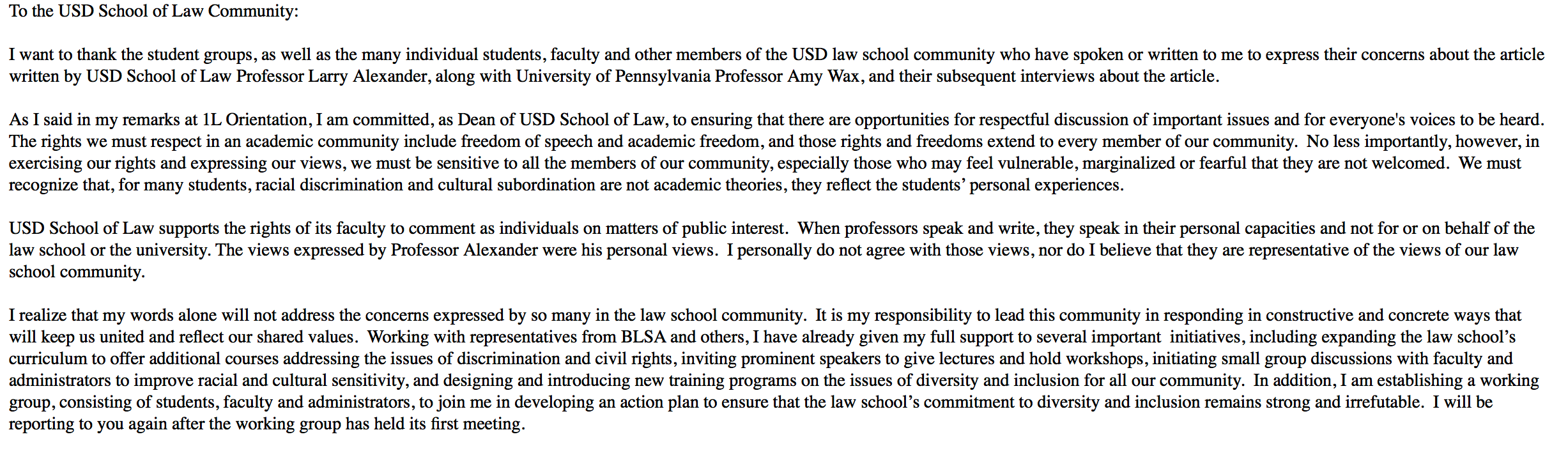
Addendum: Above the Law, a law-school news site, reports that University of San Diego law students have asked their school to ban Alexander from teaching first-year students. (It apparently doesn’t matter what he says in the classroom; he’s been permanently declared an Unperson for that editorial). The Dean of the Law school has issued a statement that, while meekly admitting that Alexander had a right to write the op-ed, genuflects obsequiously to those who objected. The proper response would be like the one my University issued in response to calls to ban Steve Bannon’s upcoming talk. Short and sweet, it basically said that “Every faculty has the right to invite anyone to speak, and we defend that right.”
This all depresses me deeply. Are we really living in this kind of Orwellian world now: a world in which you’re no longer supposed to teach first-year students if you write an op-ed they don’t like? I urge you to read the W&A piece and judge if its authors deserve that fate.
*******
Here’s Wax talking about the controversy. This is not the speech she delivered in December, but it must be pretty similar. This one was given in October of last year at Penn’s Federalist Society.
Reader Kevin called my attention to West Coast Weathervanes, which sells the eponymous product in custom designs. What’s nice about the place is that many of its weathervanes are shaped like cats, and they also have a page of cats who live in the shop or who have visited the shop. The page is called “Shop cats and friends“. Here are two screenshots of the page; they even had a visiting bobcat!
And they make the loveliest copper “Cats and kittens weathervanes“, which you can see at the link. If you’re in the market, how can you pass up one of these? (There are several others, including a bobcat.)
*********
There’s a big kerfuffle in Scotland, as the students at Aberdeen University have seriously nominated a white cat, Buttons, to be the University’s rector. But they won’t allow him because of speciesism. Since the rector, I’m told, doesn’t have any real duties except to preside over meetings, it seems to me a cat could do the job well. The Herald of Scotland has the story (click on the screenshot):
Some of the story:
HUNDREDS are protesting a ban over a cat becoming a candidate in a new University of Aberdeen Rector election.
A group of sixty students signed a rectorial nomination form supporting Buttons the campus moggie’s bid to become the new Rector in the wake of disillusionment with the election process.
The bid has already been officially rejected by the election co-ordinator because the cat was not human.
Now hundreds have supported an online campaign to have Buttons reinstated as a runner in the race to become Rector.
Here’s a poster for Buttons:
More news (my emphasis):
It comes just two months after the University was at the centre of an “abuse of power” row as it ratified a decision to scrap the Rector election over allegations of “dirty tricks” by the campaign for Maggie Chapman, the co-convenor of the Scottish Greens.
. . . The nomination explains that Buttons is a white cat who lives on campus and that campaigners decided that he is the “right individual to represent the interests of the student body”.
They said the reasons to vote for Buttons were that he lived locally, engages with the student daily, is a political and “is fluffy and friendly”.
“Buttons is a chance for the student population to truly stand up and have their say after such an unfortunate election last year. Buttons stands for change,” says the campaign group.
“Vote for Cats not Bureaucrats!”
But Phil Hannaford, the election returning officer has ruled that Buttons does not meet the requirements under the Office of the Scottish Charity Regulator Guidelines to being a charity trustee.
Election co-ordinator Nicholas Edwards told the campaigners: “Both the returning officer and I appreciate Buttons’ interest in the role and wish him well in his future endeavours.”
What a patronizing answer! It’s time to stop this prejudice against felines holding positions for which they’re perfectly qualified.
Here’s the Change.org petition for his nomination. I think we readers can put it over the top—only 101 to go! Professor Ceiling Cat would be so pleased if it exceeded 500! (Of course this is just for the record; the University will not bend to their ridiculous stipulation that the Rector be a human). Click on the screenshot to sign (I have):
*********
Finally cats and their staff review a laser toy—unfavorably. I’m told you shouldn’t use lasers as toys since the cats never get the satisfaction of a capture.



 A quote from the Blog’s piece: