Readers’ wildlife photos

April 6, 2026 • 8:15 am

Today’s photo come from reader Jan Malik, who took them in New Jersay. Jan’s captions are indented, and you can enlarge the photos by clicking on them.

As an appendix to the earlier Tree Swallow pictures, here are a few more from the New Jersey Botanical Garden. A walk in that park on the first day of spring is a ritual of mine—to ensure all observable phenomena related to spring are happening again and that the thermal death of the Universe is postponed for yet another year.

Red-bellied Woodpecker (Melanerpes carolinus) pausing mid-search for food. This is a female; in this species, the red plumage is restricted to the nape and the area above the bill, whereas males sport a continuous red cap:

Spring Snowflake (Leucojum vernum, possibly var. carpathicum), a Eurasian transplant. It looks succulent, but this perennial defends itself against mammalian browsing by producing bitter, poisonous alkaloids:

Eastern Cottontail (Sylvilagus floridanus) hiding in bearberry brambles. Against this notorious garden destroyer, only the Holy Hand Grenade of Antioch offers a true degree of protection:

Forsythia (Genus Forsythia) in bloom—the unmistakable sign that spring has arrived:

White-breasted Nuthatch (Sitta carolinensis). Like the woodpecker, it is a connoisseur of arthropods hiding in bark. however, by being equally adept at feeding head-down or head-up, it finds insects that a woodpecker might miss:

Common Water Strider (likely Aquarius remigis) emerged from its winter hiding. These are predators and scavengers of insects trapped on the surface of slow-flowing streams. As a “true bug,” it has evolved to exploit surface tension. However, surface tension alone doesn’t keep it dry; the secret lies in the dense, hydrophobic hairs on its tarsi. These trap air to act as tiny “dinghies,” preventing the legs from being wetted by capillary action:

Crocus flower (likely a Woodland Crocus, Crocus tommasinianus). The flowers emerge before the leaves, which then die back in late spring after accumulating enough biomass for the year. This adaptation to montane meadows and early forests allows them to bloom early, while withdrawing underground provides a defense against browsing:

Northern Mockingbird (Mimus polyglottos) picking bittersweet fruit (likely the introduced Oriental Bittersweet, Celastrus orbiculatus). The fruit is indeed slightly sweet—a fact I confirmed before spitting it out, as they are reportedly toxic to humans. As they say: don’t try this at home; try it in nature instead:

After the meal, the mockingbird sits quietly in a nearby bush. They mimic other birds’ calls, possibly to fool rivals into thinking a territory is already occupied. It doesn’t work on me, though—I can always tell the original bird from the imitation:

Snowdrop (Genus Galanthus), another Eurasian immigrant. Most of the plants in these pictures were introduced from Eurasia to the Americas; however, with the exception of the Bittersweet, they are generally not considered invasive:

A Jumping Spider. I can’t vouch for the exact ID, but it resembles Phidippus princeps. While not my best shot, it’s worth noting that, like all others in this series, it was taken with a single lens (Canon RF 100-500mm)—a blessing for a lazy photographer.

An Eastern Gray Squirrel (Sciurus carolinensis), looking lean after winter and digging for roots and grubs in the lawn. This species is an unwelcome sight in Europe, where its introduction is displacing the native Red Squirrel. But can we really blame them? They are simply good at being squirrels. It is entirely a human fault that geographical barriers are collapsing. In this “Homogecene” era of a connected world, the total number of species will inevitably decline:

Readers’ wildlife photos

April 4, 2026 • 8:40 am

Send in your photos if you got ’em!

We have a batch of lovely hummingbird photos today sent in by Ephraim Heller, including a hummer in her nest. His captions and IDs are indented, and you can enlarge the photos by clicking on them.

On my February visit to Trinidad and Tobago I managed to photograph 13 of the 18 hummingbirds that are sometimes present on the islands. A previous post was devoted entirely to my new favorite bird, the tufted coquette. Today’s post contains photos of six other species; a subsequent post will cover the remainder. The species that I did not photograph either do not visit feeders or are only present seasonally in the country.

Trinidad and Tobago sits at the junction of South America and the Caribbean, and its unusual diversity of hummingbird species is due to its recent geological separation from the Venezuelan coast and the diversity of habitats it retains. Both Trinidad and Tobago are fragments of the South American continental shelf that were once connected to the mainland and later became isolated as sea levels and tectonics changed. Trinidad was connected to South America via a land bridge during the last glacial maximum, 10,000-12,000 years ago. The white-chested emerald population restricted to Trinidad and the white-tailed sabrewing restricted to Tobago show that measurable biological divergence can occur over relatively short timescales once island populations are isolated.

Hermits (subfamily Phaethornithinae) diverged from all other hummingbirds early enough in the family’s evolutionary history that they are sometimes described as a parallel radiation. They share several features that distinguish them from typical hummingbirds: bills that are long and strongly curved (matching the curved tubular flowers they prefer, particularly Heliconia), plumage that is brown or green rather than iridescent, and a foraging strategy — trap-lining — in which each individual follows a memorized route through the forest, visiting widely spaced flowers in sequence rather than defending a single patch. Because trap-liners visit many individual plants across a large area, they tend to carry pollen between plants that are far apart, making them important cross-pollinators over distances that territorial hummingbirds rarely cover. Male hermits do not defend territories at all; instead, they gather in loose groups (leks), where each male sings from a fixed perch to attract females. Females select mates and then nest and raise young entirely on their own.

Green Hermit (Phaethornis guy):

Little Hermit (Phaethornis longuemareus):

Rufous-breasted Hermit (Glaucis hirsutus):

The rufous-breasted hermit is the primary and perhaps the unique pollinator of the deer meat (Centropogon cornutus) flower:

Here is a rufous-breasted hermit on its nest, built under the leaf of a Heliconius:

Now moving on from the hermits (subfamily Phaethornithinae), the rest of my photos are of species of typical hummingbirds (subfamily Trochilinae).

The white-necked jacobin (Florisuga mellivora) has been studied extensively because a proportion of adult females look like males. In most hummingbirds, the two sexes are clearly different in appearance, with males being more colorful. In the jacobin, all juveniles of both sexes bear the same ornamented, male-like plumage. As they mature, about 80% of females change to the typical muted female pattern, but roughly 20% retain the male-like appearance into adulthood. The leading hypothesis is that this reduces harassment by territorial males: for reasons I do not understand, male jacobins tend to aggressively harass and drive off female jacobins during feeding, while ignoring other males.  What makes this interesting for biologists is that it demonstrates that colorful, male-like ornamentation in females can arise through means other than sexual selection.

[JAC: I bet some chowderhead would say this bird has three sexes because of the dimorphism in females]

Male pattern white-necked jacobin:

Female pattern white-necked jacobin:

Long-billed Starthroat (Heliomaster longirostris):

The white-tailed sabrewing (Campylopterus ensipennis) occurs only on Tobago and in a small area of northeastern Venezuela. When Hurricane Flora hit Tobago in September 1963, it destroyed much of the Main Ridge Forest Reserve; the sabrewing population appeared to have been eliminated entirely and the species was presumed locally extinct for eleven years, until individuals were confirmed to have survived in 1974. Current estimates for the Tobago population range from several hundred to over 1,000 birds.

White-tailed Sabrewing male:

White-tailed Sabrewing female:

Readers’ wildlife photos: a paucity

April 2, 2026 • 8:15 am

I have enough photos for about 1½ wildlife posts, the half-post being a collection of singletons.  I’m saving all these to fill in lacunae, but as you see there’s a need for more photos. There was a time when I didn’t have to beg for photos, but since people haven’t sent many in, yes, I’m on my knees. At any rate, if you have good photos, of the quality normally posted here, by all means send them in.

Thank you!

Readers’ wildlife photos

March 30, 2026 • 8:15 am

I’m pretty much out of photos, so please send some in. Thanks!

Today’s photos comr from Jan Malik and were taken in New Jersey. Jan’s captions and IDs are indented, and you can enlarge the photos by clicking on them.

Here are a few pictures from my walk on the first day of spring in the New Jersey Botanical Garden in Ringwood, NJ. The quality isn’t the best (long distance, heavy cropping, fast‑moving subjects, and, let’s be honest, a mediocre photographer), but the series gives a sense of what early spring feels like for the birds.

Tree Swallows (Tachycineta bicolor) have arrived in the Northeast from their wintering grounds in the Caribbean. The first task for the males is to secure a nesting site. A natural tree cavity will do well, but those are scarce, so human‑made nest boxes are highly prized:

There are no property rights in the swallow world. A box is yours only if you can defend it, and a challenger usually appears sooner rather than later:

Both birds are males, judging by their metallic blue sheen and their persistence in aerial combat;

Outside the breeding season, Tree Swallows can be quite social, but securing a nesting site takes precedence over chivalry. No swallow lady is going to elope with a nestless beau:

Nest boxes are fitted with metal predator guards meant to deter squirrels and rat snakes. This one, however, wouldn’t slow down a determined squirrel for long:

Sometimes these fights end badly. Not because one bird actually kills the other, but because a damaged wing is effectively a death sentence:

The combat pauses briefly when a Red‑shouldered Hawk (Buteo lineatus) appears, circling in the thermals to gain altitude on its northward migration. Both swallows take shelter in a nearby tree until the danger passes:

Once the hawk moves on, the duel resumes, with both birds circling around the prize they’re fighting for:

Their Latin name suits them well — they are indeed “fast‑moving, two‑colored” birds. Their high airspeed is a challenge for inexperienced photographers. It doesn’t help that they’re smaller than an average sparrow and weigh only about 20 grams. No way they could tow a coconut, even in tandem:

I’ve had better luck photographing them during nesting season, when they fly more predictably while hunting insects on the wing. In this aerial melee, though, their flight is wildly erratic:

Eventually, the winner of this round inspects his real estate. The duel lasted a little under an hour, with both birds spending most of that time in the air and burning a lot of energy:

Readers’ wildlife photos

March 29, 2026 • 8:15 am

Abby Thompson of UC Davis has sent in some pictures of California tidepool organisms, as well as a video. Abby’s captions are indented and you can enlarge her photos by clicking on them.

Late January-early March tidepools, plus an octopus.

Bryozoans:

Lepas anatifera (pelagic gooseneck barnacle).   Usually found clinging to something drifting around in the open ocean (the “pelagic” part of their name), these were on a large log washed up on shore:

Intertidal zones, illustrated.    A well-placed vertical rock face, like this one, exhibits the idea of the different intertidal “zones”, each of which has its own specific collection of inhabitants.  You can see mussels and barnacles clustered at the top (in the “high intertidal”), exposed to the air as soon as the tide goes out even a little. There are smaller colonial anemones next, beneath them the orange and purple ochre stars, and below those, arriving at the low intertidal level, some giant green anemones.   If you peer into the water under the open giant green anemone, you’ll see a crab, probably a rock crab.   There’s some back and forth- there are a few giant green anemones pretty high up in this photo- but the general idea holds.

This reflects each animal’s differing tolerance for specific conditions- time out of the water as the tide goes out, harshness of wave actions, etc.      The nudibranchs (next few pictures) are usually in the very low intertidal:

Orienthella piunca (nudibranch):

Hermissenda opalescens (nudibranch):

Doto amyra (nudibranch).  Visible through the translucent skin on its back are lobules of the “ovotestis” (thanks inaturalist expert! ).   From google AI: “Ovotestes in nudibranchs are specialized, hermaphroditic reproductive glands that produce both male (sperm) and female (oocytes/eggs) gametes simultaneously”:

More eggs, this time from a snail in the genus Amphissa. I like the pointy egg casings, like wizards’ hats:

And here’s an adult of the genus- almost certainly Amphissa versicolor, but it’s an unusual color (they’re usually shades of orange or brown/tan):

In honor of Ghost the octopus, and also because I’ve finally figured out how to include videos, below is a clip from 2021 of an East Pacific red octopus (Octopus rubescens), cruising around the rocks (out of the water!) at low tide.  I’ve only seen one twice, probably because they’re too cleverly camouflaged (possibly just too clever) for me to spot.    This guy was about the size of a human hand, a miniature compared to the 50 pound Ghost.

Point Reyes peninsula at sunset:

Camera: Olympus TG-7.

Reader’s wildlife photos

March 28, 2026 • 8:50 am

Today Athayde Tonhasca Júnior is back with one of his patented text-and-photo posts, which have always been very informative. Today he talks about palms and their pollinators in one area of Brazil.  Athayde’s captions are indented, and you can enlarge his photos by clicking on them.

Beneficial saboteurs

It’s approaching midday somewhere in the caatinga, northeastern Brazil’s hinterland, and the temperature will soon hit the 40o C mark. All is quiet, as most animals are sensibly sheltering from the sizzling sun. The vegetation looks dead and stunted, but it is in fact quiescent, in a state of dormancy that helps plants endure the heat and drought until the rainy season arrives.

Fig.1.  The caatinga vegetation in northeastern Brazil looks dead during dry season, but palm trees are green year round:

One palm tree, however, known locally as licuri (Syagrus coronata), doesn’t seem bothered by the harsh climate; it is verdant and in full bloom. The plant is monoecious, that is, it produces separate male and female flowers in the same individual. Male flowers grow at the end of large (~90 cm long) inflorescences, while the female flowers are at the base. Anthesis (the stage at which a flower is open and functional) is asynchronous: male flowers open first, releasing pollen and scent for 7 to 10 days. These flowers then shrivel and fall off. In about two weeks, it’s the female flowers’ turn; they are open for 10 to 15 days. Plants also bloom asynchronously, so at any given time of the year there are licuri flowers.

Fig.2. Licuri inflorescences © Drumond, 2007:

These flowery details may seem like too much information, but they are important for understanding the plant’s relationship with one of its most important flower visitors, the weevil Anchylorhynchus trapezicollis.

Like the overwhelming majority of the ~83.000 known species of weevil (family Curculionidae), A. trapezicollis feeds on plant tissues. Attracted by the scent of male flowers, a beetle uses its big schnozzle (in fact its rostrum, the snout-like projection from the head) to pry flowers open and take their pollen. While feeding, the beetle ends up with pollen grains attached to its body. As male flowers open at different times, there’s isn’t much food to be consumed in one sitting. The beetle is then encouraged to move to another plant, taking with it pollen that will result in cross pollination if the insect lands on a receptive female flower.

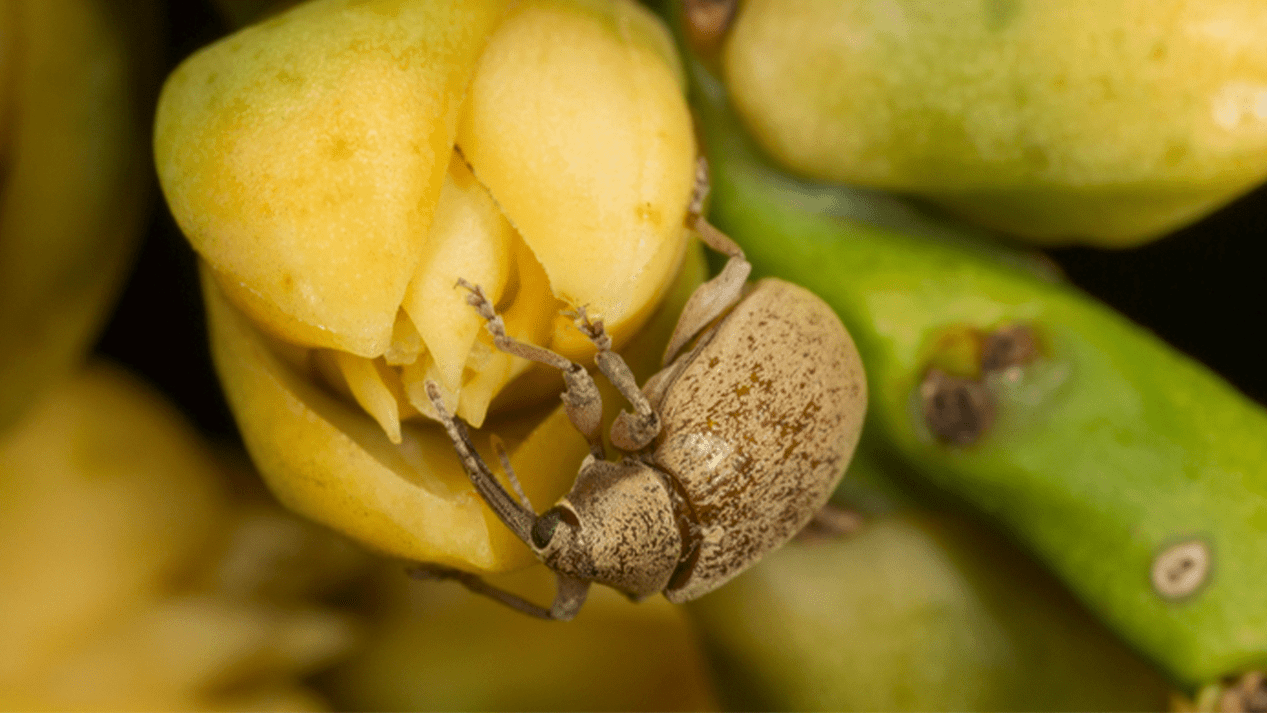
Fig.3. An A. trapezicollis in action on a licuri flower © Bruno de Medeiros, iNaturalist.Lu:

After feeding, a female beetle looks for female flowers to lay her eggs between the petals and sepals. The resulting larvae are cannibals: one larva will eat any competitor in the same flower. As they grow older, the little darlings shift their attention to developing fruits, which are aborted and fall off. Because it destroys forming fruits to complete its life cycle, A. trapezicollis is a seed predator. But for the cost of a portion of its fruits, the licuri palm is pollinated. This form of mutualism is known as brood-site pollination or nursery pollination, a trade-off association that has evolved for the yucca and the yucca moth, figs and fig wasps, and several other plant-insect partnerships.

Fig. 4. The licuri‘s trunk ends in a distinct crown of slightly arched leaves, a feature that inspired its specific epithet coronata (crowned) © Kelen P. Soares, Flora e Funga do Brasil:

Other weevils and bees also pollinate licuri, but A. trapezicollis seems to be the most important agent (Medeiros et al., 2019). This tight relationship has profound ecological consequences.

It is said that everything from a pig can be used except the oink, but licuri is not far behind in relation to its usefulness to humans. Its apical meristem (palm heart) is edible; the leaves are the source of a high quality wax, building materials, hats, baskets, sleeping mats and other handicrafts; ground-up leaves are fed to livestock in times of food scarcity; the tasty seeds (endosperm or nuts) are eaten raw or roasted, or added to confectionery and local dishes; oil extracted from seeds is used for lighting and the manufacture of soap, perfumes and other products.

Fig.5. The greenish pulp (mesocarp), brown hard shell (endocarp) and the nutritious white nut (kernel) of a licuri fruit © B. Phalan, Wikimedia Commons:

Humans are not the only creatures to benefit from licuri: many animals take the wholesome fruits. Among them, the Lear’s macaw (Anodorhynchus leari), an endemic and endangered species, for which licuri nuts represent the bulk of its nutrition.

Fig.6. Lear’s macaws, big fans of licuri nuts © João Quental, Wikimedia Commons:

There you have it: a palm tree of unordinary value, from people’s welfare and economy to endangered macaws and wildlife in general, is greatly dependent on pollination provided by unassuming weevils. And this is not an isolated case. More than 200 palm species (family Arecaceae) are pollinated by weevils, and so are many other plants from different lineages (Haran et al., 2023). The ‘million dollar weevil’ (Elaeidobius kamerunicus) illustrates well the relevance of these insects as pollinators. This beetle was introduced from Africa to Asia to help improve pollination of cultivated African oil palm (Elaeis guineensis), resulting in considerable increase in yields.

When we think of pollinators, bees, flies and moths are most likely to come to mind, as they contribute to the reproduction of crops and wildflowers familiar to us. Adding weevils to this select club may sound peculiar: after all, many weevils are pests capable of inflicting enormous damage on cultivated plants, trees and stored products (you may have had your pantry invaded by weevils). But that would be a parochial view. For millions of people in tropical and subtropical regions, palm trees are more than props in holiday brochures: they are crucial for wildlife food chains, human nutrition, building materials and commodities such as medicines, industrial products and fibre. A great deal of these benefits depends on a range of poorly known, frequently dismissed and often vilified weevils.

Fig.7. Six species of weevil known to be involved in brood-site pollination © Haran et al., 2023:


References

Drumond, M.A. 2007. Documentos, 199. Embrapa Semi-Árido.

Haran, J. et al. 2023. Most diverse, most neglected: weevils (Coleoptera: Curculionoidea) are ubiquitous specialized brood-site pollinators of tropical flora. Peer Community Journal 3: e49.

Medeiros, B.A.S. et al. 2019. Flower visitors of the licuri palm (Syagrus coronata): brood pollinators coexist with a diverse community of antagonists and mutualists. Biological Journal of the Linnean Society 126: 666-687.


Readers’ wildlife photos

March 26, 2026 • 8:15 am

In the absence of much of a backlog, I’ve stolen some gorgeous photos from reader Scott Ritchie of Cairns, Australia (his FB page is here).  Scott’s captions and IDs are indented, and you can enlarge his photos by clicking on them.

Recently I visited my friends, Karen and David Young in the Crater Lake cabins near Lake Eacham, Atherton Tablelands, west of Cairns. This area is a mega for birds and they did not disappoint. In particular, we got great up close and personal views of our local bird of paradise, bird of prayer, paradise, the Victoria rifle bird.

The male of the species has jet black feathers. However, in just the right light you get a lovely iridescent reflection. The other thing these birds do is dance. It’s an amazing shuffling of the wings while top of stump while throwing their head out and flashing your lovely iridescent blue throat. The immature riflebird is a beautiful brown/rufous color, and they can’t help to practice their dance moves. And of course dad’s gotta come along and join in the festivities.

Also, here’s a few photos of some other creatures that I saw on my little five hour trip to the table lands. I hope you enjoy them.

Male Victoria’s Riflebird (Ptiloris victoriae),in full dance pose. Note the jet black feathers:

Swishes wings sideways, like a flying saucer. Peering above the wings:

But in the right light, iridescent rainbows appear:

I love the cooper and purple sheen on his back:

Meanwhile, youngster, an immature male, practices his dance moves. He leans back, showing off his wild yellow throat:

“Peek-a-boo”
Stands up, and swishes his wings back and forth, hiding his head behind them:

Then stands proud:

And then the adult male shows up. I’ll show you who’s boss:

Has he lost his mind?

I’m definitely King of the Stump:

Off youngster goes, only to be replaced by another male!:

And a few other local birds made an appearance. Pacific Emerald Dove (Chalcophaps longirostris):

Macleay’s Honeyeater (Xanthotis macleayanus):

Grey-headed Robin (Heteromyias cinereifrons):

And the musky rat-kangaroo (Hypsiprymnodon moschatus), our smallest proper roo!:

And the Boyd’s Forest Dragon (Lophosaurus boydii) appeared for the lizard and snake lovers: