Readers’ wildlife photos

February 6, 2024 • 8:45 am

Mark Sturtevant has contributed another batch of insect photos today. I’ve indented his captions and IDs, and you can enlarge the photos by clicking on them.

Here are more arthropod pictures, and this should complete the set from two summers ago. I am always behind in sharing these to various online sites since I go out a lot to the woods and fields of Michigan, where I live.

One of our larger Caddisflies is the Northern Caddisfly (Pycnopsyche sp.). Caddisflies are related to butterflies and moths, and they can look a lot like moths, but there are differences such as having hairs on their wings rather than scales. Caddisfly larvae are sort of like caterpillars, but they are aquatic and most species carry around a protective case made from either plant matter or pebbles, woven together with silk. Larvae from this genus mainly fasten together a bundle of twigs to use as a portable home.

Here is a short video about the larvae, showing that they can be quite artful in making their cases, and that their use of sticky silk under water is actually very remarkable.

Next up is a Locust Borer (Megacyllene robiniae). These wasp-mimicking beetles are common visitors on goldenrods in late summer, and their larvae tunnel into black locust trees. Since we have both in the yard, I always see these around.

Next is a European Praying Mantis (Mantis religiosa), photographed from a stage on our dining room table. Nothing too special here, but this was done for the purpose of photographing a nerdy detail about Mantids. Unfortunately, the Mantid that I found was a male, and that meant he would be a complete pain in the a** because males constantly want to move around to hunt for lady Mantids. This one frequently flew off from the dining room table, and I’d have to go chase it down. Nevertheless, the nerdy detail was eventually photographed.

Here is that detail – a specialized patch of bristles on the inside of their front femur. Mantids regularly groom themselves, and they even have a special structure on their front legs just for cleaning their large compound eyes. This has been an item of considerable discussion on one of the macrophotography web sites, and the subject has even led to a couple Facebook memes. The internet is weird that way.

Here is a video of a grooming mantis. The moment it uses its eye brush starts at 35 seconds in. It’s not that dramatic, but I geek out on it.

Moving on, here is a large Nursery Web Spider (Pisaurina mira), so-named because females build a web nursery at the tops of plants for their young. I was trying to photograph the spider with my wide-angle macro lens, but at that moment it decided to surprise me by suddenly clambering up onto the camera. I like the result.

As this set was done very late in the season, with fall moving in, there are now other late-season subjects to share. Around the yard at that time there will always be several Very Gravid Orbweavers in their webs. A couple different species are possible, but I think this one is the Shamrock Orbweaver (Araneus trifolium). I also took this one indoors to do a manual focus stack portrait by using the amazing Venus 2.5-5x super macro lens.

Here are Yellow Jackets on wind-fallen apples in the backyard– another sign that the season was ending (*sniff*). On the left is an Eastern Yellowjacket (Vespula maculifrons), and on the right is a German Yellowjacket (Vespula germanica). As is pretty common, the two species soon begin to fight over the same apple, even though there are dozens of the damn fruits on the ground that I will have to pick up later. These contests look rather dramatic, but their stingers never come out.

And finally, here is a focus stacked wide angle macro picture of autumn trees. The perspective shot is done by leaning against a tree and shooting straight up while nudging the focus a little each time. The set of pictures — maybe 8 or so, are then merged with software to give this deep focus picture.”

Readers’ wildlife photos

January 10, 2024 • 8:15 am

Thanks to the half-dozen readers who responded to my call for photos; our tank is now somewhat replenished and I can keep this going for a while. But please think of this site if you have good wildlife photos.

Today’s photos come from Jim Blilie of Washington State, but were taken by his son Jamie.  Jim’s captions are indented, and you can enlarge Jamie’s photos by clicking on them.

Jamie is now a freshman at Washington State University (WSU) at Pullman Washington. He is thriving there.  We love WSU.  It’s very welcoming and is focused on student success. Jamie is studying engineering.  Some of these photos were taken during backpacking trips he has taken to Idaho through the WSU Outdoor Recreation Center, a wonderful service WSU provides. Jamie is the wildlife photographer of the family, though has become a good landscape photographer as well.

Jamie did not identify this bird, photo taken a few feet from our house in Klickitat County, Washington; but I think it is a Western Kingbird (Tyrannus verticalis).  Any help with a positive ID would be welcome:

Bumblebee, species uncertain.  Taken on the trail to Lookout Mountain, Oregon, east of Mt. Hood:

Red-breasted nuthatch (Sitta canadensis) and an unknown species of flying ant, taken on Lookout Mountain, Oregon, east of Mt. Hood:

Golden Mantled Ground Squirrel (Callospermophilus lateralis), also taken on Lookout Mountain, Oregon, east of Mt. Hood:

A similar looking rodent:  Based on his location in the mountains of the Idaho panhandle, I think this is a Red-tailed Chipmunk (Tamias ruficaudus), although the eponymous part is not visible in the photo.  Jamie took this photo on one of his backpacking trips in northern Idaho:

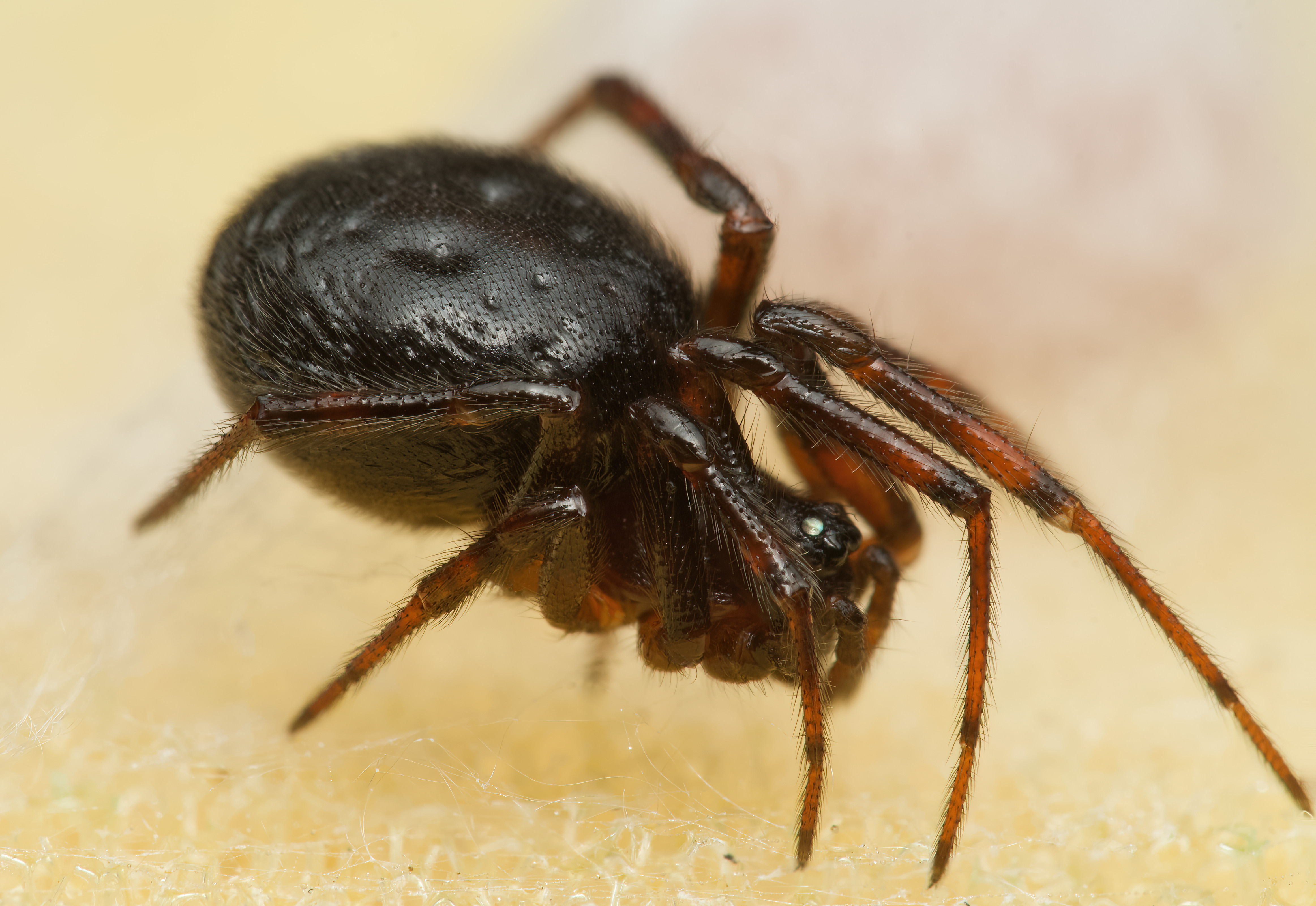
Also taken on one of his backpacking trips to Idaho (Selkirk Range, close to Upper Priest Lake):  A very small brown spider (note the size of the adjacent moss).  We were unsuccessful in identifying this spider:

A Steller’s Jay (Cyanocitta stelleri), taken on our place.  We love the beautiful blue and black plumage of these jays.  These are very common here in winter.  In summer they seem to move to higher elevations (we are at 2000 feet (610m) above sea level) and then the Scrub Jays (Aphelocoma californica) move in for the summer.  The Steller’s Jays can make a pretty good mimic call of the Red-tailed Hawk’s scream (Buteo jamaicensis):

My favorite of the bunch:  A coyote (Canis latrans) in a snowstorm, taken from our back deck.  The coyote was perhaps 100 yards away:

A  beetle at 5600 feet (1707m) elevation in Oregon, taken on the Flag Point Lookout Tower.  Also unable to identify this beetle:

A Cyanide Millipede (Harpaphe haydeniana).  This millipede can exude hydrogen cyanide gas as a defense!  The photo was taken on the hike to the former fire lookout site, Sleeping Beauty, Skamania County, Washington.  This is a favorite hike (though unrelentingly steep) because of the very good views of Mount Adams from the top:

Finally, a ringer:  Jamie and me on top of Lookout Mountain with Mount Hood behind, just a day or so before he headed off to university:

Equipment:

Nikon D5600 (1.5 crop factor)
Nikkor AF-P DX 18-55mm f/3.5-5.6 G VR lens
Nikkor AF-P DX 70-300mm f/4.5-6.3 G ED lens
Sigma 150-600mm f/5.0-6.3 DG OS HSM lens
Canon PowerShot SX530

Readers’ wildlife photos

January 2, 2024 • 8:15 am

Please send in your good photos. Tony Eales from Australia heeded my call, and here are some of his pictures. Tony’s captions and IDs are indented, and you can enlarge the photos by clicking on them.

Here’s are a few recent observations of interest.

Perhaps only the photographers will be able to tell but I’ve had a laptop breakdown and am using an ancient laptop with an even more ancient version of Photoshop. Hence a lot of these images aren’t up to my usual mid-tier quality.

Firstly some mimicry. I did a quick trip back up to Queensland in mid-December and photographed what I was pretty certain was an Ichneumonid wasp. Turns out it is a fly in the soldier fly family, Stratiomyidae, which includes a number of wasp mimics. Turns out this one was a rarely seen species and mine is possibly the first photograph of a living specimen. The fly is called Elissoma danielsi.

Offhand I can’t think of a specific model. Ichneumonid wasps are extremely varied and colourful and it may be that this fly is just mimicking the general form of this wasp family, rather than a specific species.

Here is a somewhat similar Ichneumonid photographed at the same location for comparison:

Soldier beetles, in the family Cantharidae, are relatively soft bodied for a beetle and rely more on their distastefulness to protect themselves from predators. One very common small soldier beetle genus is Heteromastix. The genus is in desperate need of revision so I can’t say what species this is, but they are all around 4-6mm long and look basically like this:

And naturally this colour and form is widely mimicked. Here’s a mating pair of Oedemeridae, probably Dohrnia simplex:

And this little guy totally had me fooled at first. I knew the antenna and pronotum didn’t look right for Heteromastix but I couldn’t think what else it could be. It had the experts on the Australasian Beetles Facebook page stumped too. In the end it turned out to be the first live photograph of Xylophilostenus octophyllus from one of the smaller families (Scraptiidae) in the darkling beetle superfamily, Tenebrionoidea. As far as I can tell the only record of this little beetle was the type specimen collected in Tasmania in 1917:

I also found my first true Blister Beetle, family Meloidae. It too was a mimic, this time of the nasty tasting Lycid beetles. I believe it’s Palaestra rufipennis, but there are other Lycid-mimicking blister beetles in Australia.

In the realm of camouflage, rather than mimicry, I found a species of Ceraon, a type of treehopper that has a variety of horn-like ornaments, making them look like a node on a twig when resting.

Other notable finds, an undescribed shield bug, Anischys sp., that seems to live in the mountains of southeastern Australia, known as the Australian Alps.

A hanging fly, probably Harpobitticus australis, with another hanging fly as prey. I wonder if it was an attempted mating gone wrong. The males supposedly bring ‘nuptial gifts’ of a recently captured prey item for the female to snack on while getting the deed done. I couldn’t see any gifts so perhaps he turned up empty handed and was rewarded appropriately:

And a spider I have been wanting to find for a while. They are small and not common, living in leaf litter and similarly overlooked habitats. It’s in the family Orsolobidae or Giant Goblin Spiders. Okay, it’s giant for a Goblin Spider but hardly giant for a spider. Anyway the peculiar six-eye arrangement was the key to its identity. Probably Tasmanoonops sp.:

And finally, I, along with some other citizen scientists, were mentioned in dispatches. Researchers Aiden Webb at The University of Melbourne, Joanne Birch and Russell Barrett described a new species of Grass-lily from South East Queensland. They were alerted to the fact that there appeared to be a difference in the SEQ population using photos uploaded to iNaturalist  by myself and two other citizen scientist observers. These differences in habit and colour would not be at all obvious from dried preserved specimens but the difference was plain in the live photos. Here’s the newly described flower, Caesia walalbai:

An a link to the paper https://openjournals.library.sydney.edu.au/TEL/article/view/17346

Readers’ wildlife photos

December 15, 2023 • 8:15 am

Today’s photos come from our intrepid regular, Mark Sturtevant. Mark’s text and IDs are indented, and you can enlarge his photos by clicking on them:

In a recent post, I shared some pictures of arthropods taken the previous summer on a trip to my home state of Iowa. Here are more pictures that came out of that trip.

To begin, readers may recall that the previous set included pictures of a large wolf spider (Tigrosa aspersa). To jog your memory, here is another picture of her:

One thing about wolf spiders is that their eyes produce a lot of eyeshine when you put a light on them at night. Like cats, these nocturnal spiders have a reflective layer in their eyes, and so a simple walk outside with a flashlight can reveal many glowing eyes of these spiders. Strangely, the internet does not offer very detailed pictures of this phenomenon, so I decided to take the spider home to give the internet a real close look at wolf spider eyeshine. Back at home, I put her in a bucket of sand that was topped with a glass box that I had made from thin picture glass. The photographs below were taken from long exposures with a pinhole flashlight, in a dark basement, while the camera was fixed on a tripod. Getting eyeshine from a distance is super easy. But I found that when working up close, the angle between the light and the camera lens had to be very exact to get much of anything.

I soon learned that she liked to hide in a burrow, and so here she is glaring up at me from a tunnel that I made for her. The radiant pattern of light is a cool camera artifact that lights and reflections can have when a lens aperture is stopped way down. I am here reminded of Shelob, the giant spider in The Lord of the Rings – “an evil thing in spider form”.

The remaining pictures were taken while still back in Iowa. All but the first were taken over a couple nights while staking out my brothers’ porch lights. The family is quite accustomed to this sort of thing, of course.

A recently emerged Annual CicadaNeotibicen sp.:

Adult Antlion, I think Myrmeleon immaculatusThis species is a considerably bigger than the Antlions back home! :

Tachinid Fly, either Leskia or Genea sp. One has to peer at hairs on wing veins to tell the genera apart:

Ragweed Flower Moth Schinia rivulosa:

The final pictures are various Geometrid moths. First, a lovely Chickweed Geometer (Haematopsis grataria):

Next is a Crocus GeometerXanthotype sospeta:

And finally, here is a Large Maple Spanworm (Prochoerodes lineola). Can you imagine a Spot the Moth game with this on a pile of dead leaves?:

Readers’ wildlife photos

November 22, 2023 • 8:15 am

I’m still in dire need of photos, though a few kind readers have saved my onions by sending in wildlife pix. But please send in what you have: wouldn’t the Thanksgiving break be a good time to gather up your photos.

One regular who filled the gap was the reliable and skillful Mark Sturtevant, who sent in spider photos. His captions are indented, and you can enlarge the photos by clicking on them.

There will probably be no photos tomorrow as it’s a holiday and even PCC(E) needs a break. We shall see.  Now, from Mark:

This set of pictures is dedicated to spiders that I found over a year ago.

First is a Parson Spider (Herpyllus ecclesiasticus), a running spider that commonly turns up in peoples’ houses. That is where I found this one. They are named after their white markings which are similar to the old style clergyman cravat.

We did some traveling in the summer to visit family here and there. On a trip to New Jersey, I found this Spotted Orbweaver (Neoscona domiciliorum). This was a new species for me.

We stopped off at Niagara Falls on our drive back home. Lovely water and all that, but what about the critters? There were orb webs everywhere, and here is one of the spiders. To get the view in the first picture, I am lying on my back looking straight up. Spiders in this genus (Araneus) can be challenging to identify, but based on the markings on the underside I believe this is a Marbled OrbweaverA. marmoreus.

On a later trip to Iowa to visit my side of the family, there was this strikingly different spider, and yet it too is probably a Marbled Orbweaver, again based on critical markings. This species is highly variable, and to me some variations can even make one species look like a member of a different species.

Lets’ stay in Iowa for the next pictures. There were many Wolf Spiders around my brother’s house, and this very large and boldly marked one came up onto the porch one night. Here, I had encouraged it to come inside the house for pictures, lest it escape. This is Tigrosa aspersaand you can see its size from the link (I would not pick one of these up, though!). I later took this lady back home in order to photograph wolf spider eye shine (they are famous for that). That will be a subject in a later post.

In the next picture is a dramatic scene where a male of the same species of Wolf Spider is being dragged away by a Rusty Spider Wasp (Tachypompilus ferrugineus). This picture was taken in haste just before they disappeared under a shed. There the wasp will lay an egg on her paralyzed prey, and the spider will be eaten alive.

Back in Michigan, I made an interesting find while looking for subjects to photograph at night. This little spider could not be identified, but the good folks at BugGuide leapt into action and managed to narrow down the ID to be a cobweb spider in the genus Theridion. Its victim appears to be a Cellar Spider.

The next spider is the Spined Micrathena (Micrathena gracilis). In some woods they can be seen hanging from their orb webs every few feet, so one may forget just how weird they are. With their top-heavy weight distribution, they practically helpless when forced to leave their web. But while in their orb web they are surprisingly nimble.

The last picture is a portrait of our lovely Striped Lynx Spider (Oxyopes salticus). These ambush spiders wait at the tops of plants for prey to come to them. This one provided some amusement during the staged session for this manually focus stacked picture, since it would at times take off to go boinging around on the dining room table like a little jumping bean.

Readers’ wildlife photos

October 24, 2023 • 8:15 am

Today our stalwart regular, Mark Sturtevant, returns with a batch of insect photos.  His captions and notes are indented, and you can enlarge the photos by clicking on them.

This is part 2 from a trip to a few parks in Ohio a year ago.

Along one forest trail I came across this female Firefly and recognized it as a rather special one. This belongs to the genus Photuris, and they are the famous “femme fatale” group of species where females use their flash to mimic the call-sign of a female of a different species of Firefly (usually Photinus). When the hopeful male of that species comes calling, it is promptly eaten. The large compound eyes are all the better to see you with. The link goes to an interesting video that reveals various details that I did not know about in this classical story.

Next up is a Tumbling Flower BeetleYakuhananomia bidentata. These beetles, commonly found on flowers, belong to their own obscure family:

One of highlights for the entire Ohio trip was the orb weaver spider shown in the next two pictures. This is the legendary Arrowshaped Micrathena (Micrathena sagittata). I had no idea they were so close! I found several, and I am fairly giddy about that. It is odd how such an awkwardly shaped spider can nimbly build a beautiful orb web in the dark of night:

The last several pictures tell the tale about a caterpillar that I had been hunting since my early times in this hobby, all because I wanted to get its portrait. One of the most common of all butterflies in the U.S. is the Hackberry Emperor (Asterocampa celtis).

Do you think Cabbage Butterflies are common? You might not think so along forest margins, where Hackberry Emperors can gather in impressive swarms as they flit about around their host Hackberry trees. The adult butterfly is rather plain, but the caterpillar has a very interesting face, and so for years I have been searching for them. Just one would do, but for some reason the caterpillars are very difficult to find. Some caterpillar species are good at hiding during the day, and perhaps this species is one of those. But in Ohio I quickly found two of the caterpillars (but only after scouring a couple hundred trees), but at last the drought was over!

Here is the caterpillar. The head is toward the right:

The next pictures show the long-desired portraits of one that I brought home with me. That headgear is amazing! The backgrounds are paint swatches that were requisitioned from a local hardware store:

The caterpillar later formed a chrysalis, and that too turned out to be interesting:

And here is the adult shortly after it emerged and expanded its wings. My little friend who freed me from my prolong task sat just long enough for this picture, and then it zipped away to make more Hackberry Emperors:

Spider sprays strands of silk

September 26, 2023 • 1:15 pm

I’m itching to do biology posts, and have at least one or two papers on my desk, but of course those are the hardest posts of all and get few comments. Nevertheless, I’m proceeding, but every day I get about eight or none political posts that are less work.  Well, I do my best.

In lieu of a real science post, here’s some natural history by David Attenborough, showing a spider that can put a web 2 meters across hung 25 meters across a river.  (Rivers, of course, are good places to catch insects. What always amazes me about spiders is that their brains are so small yet are complex enough to encode very sophisticated behaviors, including weaving webs of intricate and reproducible shape.

This spider has a different skill set, but still as amazing.