Why Evolution is True is a blog written by Jerry Coyne, centered on evolution and biology but also dealing with diverse topics like politics, culture, and cats.
This is it, folks: the end of the photo line—unless some readers step up to send in good wildlife pictures.
Today we have a diverse batch of photos from Richard Pieniakowski, but not much information about them though I suspect they’re from British Columbia. Richard’s short captions and IDs are indented (I found the binomials), and you can enlarge the photos by clicking on them.
I have written a piece that will be published shortly on another site; it’s largely about whether academic disciplines, including the arts, can produce “propositional truths”, that is, declarative statements about the world that are deemed “true” because they give an accurate description of something in the world or universe. Examples are “Jerry has five fingers on each hand”, “Sheila plays the violin in an orchestra,” or “humans and other apes shared a common ancestor.” The reason I was concerned with propositional truths is that it’s often said that the search, production, preservation, and promulgation of such truths is the primary purpose of universities. Is it? Read my piece, which will be out next week, to see. I’ll post a link when it’s up.
I won’t give my thesis here about truth and the various academic disciplines, as that’s in the other article, but in my piece I omitted two areas: mathematics and philosophy. That’s because there’s a big controversy about whether these disciplines do produce propositional truths or, alternatively (and in my view), give only the logical consequences of assumptions that are assumed to be true.
For example, a “truth” of mathematics is that 16 divided by 2 equals eight. More complex is the Pythagorean theorem: in a right triangle, the square of the length of the hypotenuse is the sum of the squares of the other two sides. This is “true”, but only in Euclidean geometry. It is not true if you’re looking at triangles on a curved surface. The “truth” is seen only within a system of certain assumptions: geometry that follows Euclid’s axioms, including being planar. All mathematical “truths” are of this type.
What about philosophy? Truths in that field are things that follow logically. Here is a famous one:
All men are mortal
Socrates is a man;
Therefore Socrates is mortal.
Well, yes, that’s true, but it’s true not just because of logic, but because empirical observations for the first two statements show they are propositional truths! If they weren’t true, the third “truth” (which was tested and verified via hemlock) would be meaningless.
Here’s another of a similar nature that came from a friend:
“All As are B; x is an A; therefore x is B—doesn’t depend on the content of A and B: it’s a *logical truth*.”
Again, the statement is indeed a logical truth, but not a propositional truth because it cannot be tested to see if it’s true or false. Nor, without specifying exactly what A and B is, can the empirical truth of this statement be judged. I claim that all philosophical “truths”—logical truths without empirical input—are of this type.
When I told my friend this, I got the reply, “This is analytic philosophy. The people who do it work in philosophy departments and call themselves philosophers: and most philosophy BA and PhD programs require a lot of it. I’m sure any of our competent philosophers would be happy to supply hundreds of propositional truths that are philosophical.” The friend clearly disagreed with my claim that philosophy can’t by itself produce propositional truths. Insofar as philosophy is an important area of academia, then, I am not sure that it’s discipline engaged in producing or preserving truth.
Two caveats are in order. First, this is not meant to demean philosophy or argue that it doesn’t belong in a liberal education. It certainly does! Philosophy, like mathematics, are tools for finding truths, and indispensable tools. Philosophical training helps you think more clearly Unlike many scientists, I see philosophy as a crucial component of science, one that is used every day. Hypotheses that follow logically from observations, as in making predictions from observations (e.g., Chargaff’s observation, before the structure of DNA was elucidated, that in organisms that amount of A equals the amount of T, and the amount of G equals the amount of C), are somewhat philosophical, and certainly logical. Dan Dennett is a good example of how one can learn (and teach others) to think more clearly about science with a background in philosophy.
Second, I do not feel strongly about what I said above. I am willing to be convinced that mathematics (but not necessarily philosophy) gives us propositional truths. There is, for example, a school of philosophers who accept “mathematical realism,” defined this way in Routledge’s Encyclopedia of Philosophy:
Mathematical realism is the view that the truths of mathematics are objective, which is to say that they are true independently of any human activities, beliefs or capacities. As the realist sees it, mathematics is the study of a body of necessary and unchanging facts, which it is the mathematician’s task to discover, not to create. These form the subject matter of mathematical discourse: a mathematical statement is true just in case it accurately describes the mathematical facts.
An important form of mathematical realism is mathematical Platonism, the view that mathematics is about a collection of independently existing mathematical objects. Platonism is to be distinguished from the more general thesis of realism, since the objectivity of mathematical truth does not, at least not obviously, require the existence of distinctively mathematical objects.
A corollary of this is my own claim (which is mine) that although the objects and “truths” of mathematics and philosophy are inapplicable to all species outside of our own, as only Homo sapiens can grasp, discover, and use them. The earth spins for all creatures and plants upon it, but the integers and prime numbers are “real” only for us. (Do not lecture me that crows can count!).
I have read some of this controversy about mathematics, but it rapidly becomes abstruse and tedious, and so I’m proffering the view of a biologist, not a professional philosopher. I am more open to the idea of mathematics producing truths than philosophy, simply because, as one reader once commented, “You can’t find out what’s true by sitting in an armchair and thinking.”
So it’s clear I’m soliciting readers’ views here to help clarify my own thinking. Comment away!
Well, we’ve pretty much run out of contributions with multiple photos, but we have a few good contributions with smaller numbers of photos. I’ll put a few of them together here, but we’re gonna go dry after tomorrow unless someone steps up. Thanks.
All readers’ narratives or IDs are indented, and you can enlarge the photos by clicking on them:
From Rachel Sperling:
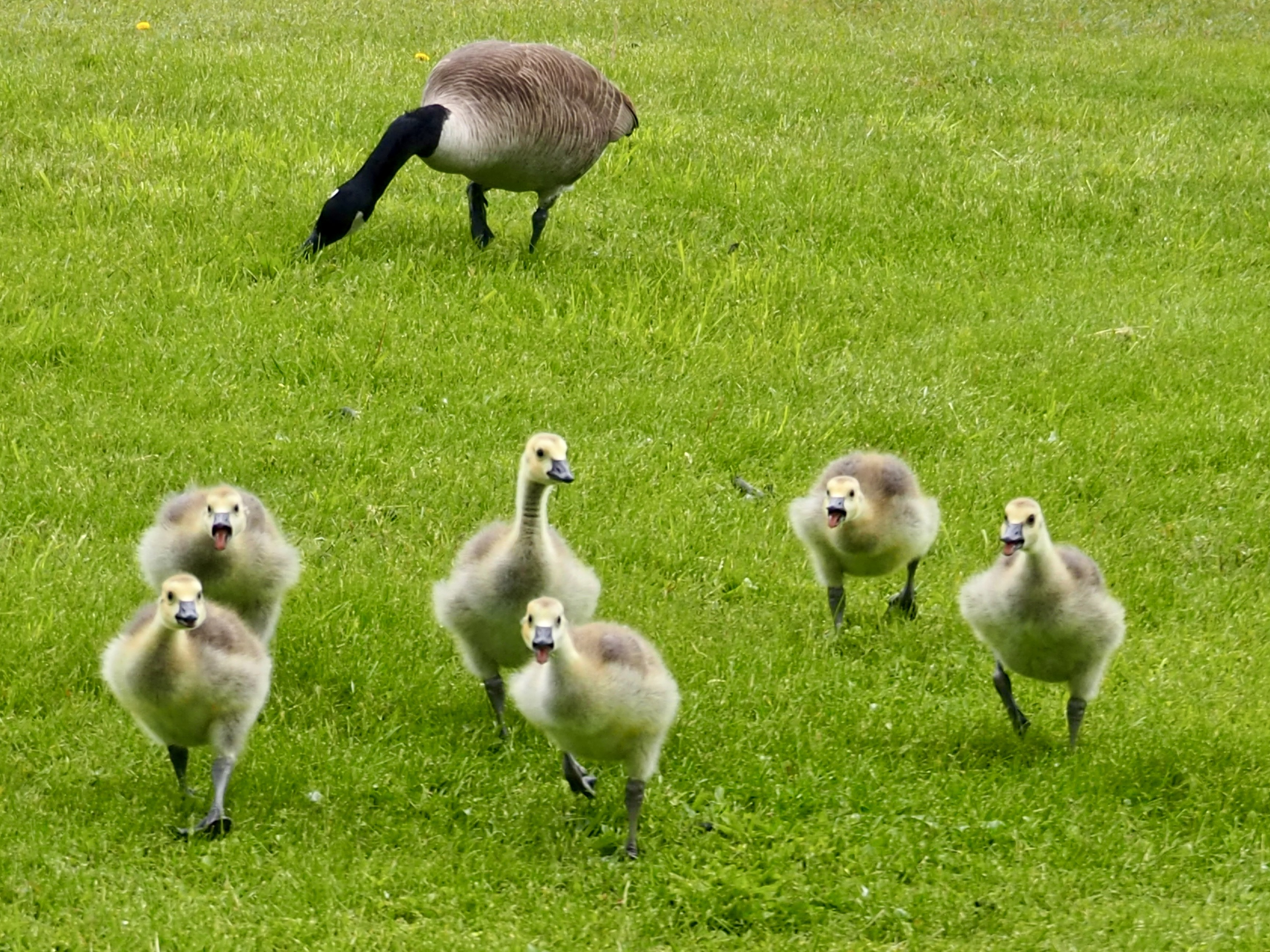
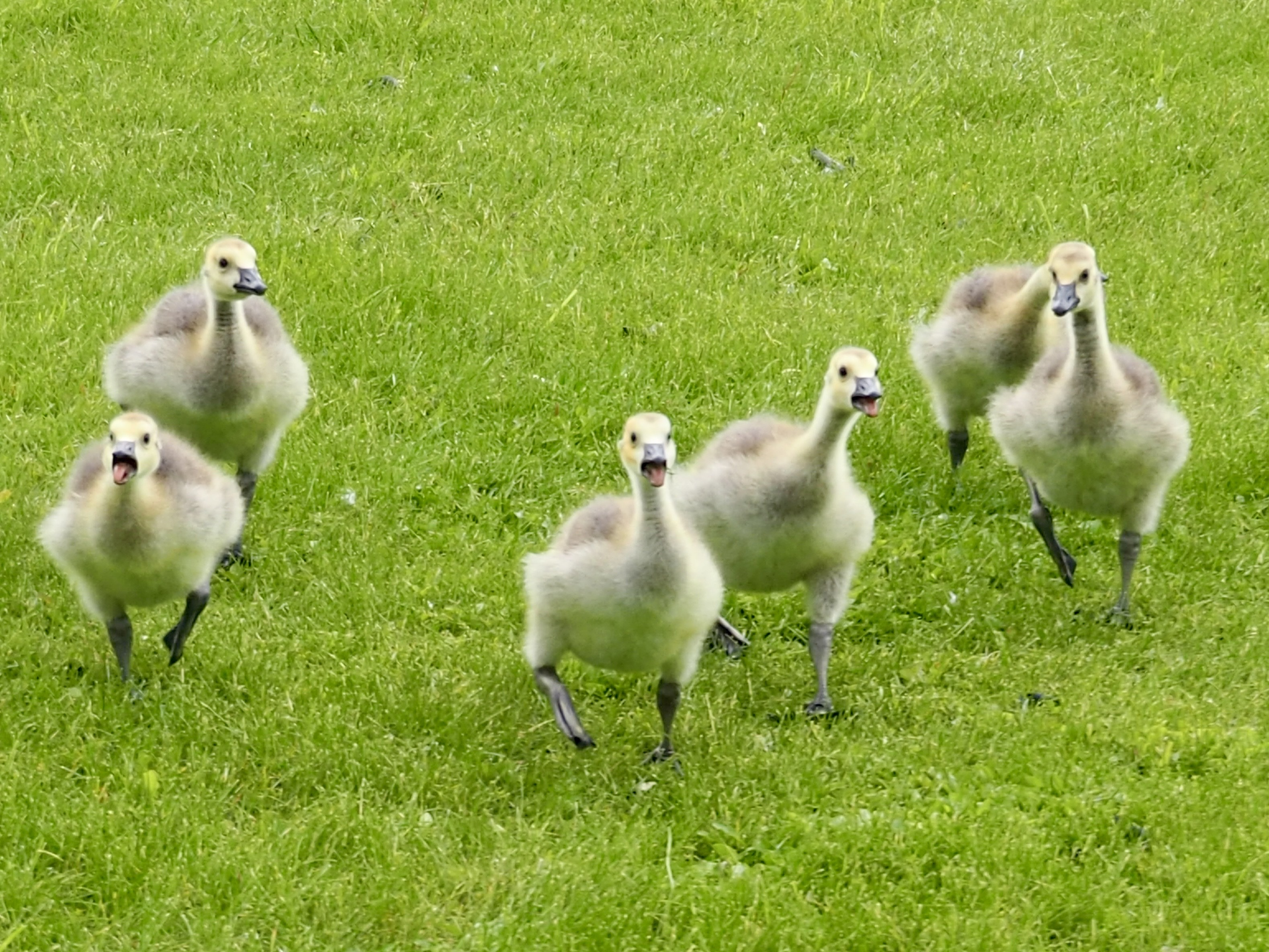
I’m sorry these photos aren’t higher quality but the subjects refused to stand still. Back in May a friend and I were hiking the Appalachian Trail in New Jersey when we came upon a family of Canada geese (Branta canadensis) by a pond close to Highpoint State Park. I thought we were at a respectful distance, but apparently the goslings thought otherwise because they charged. The parents just stood back and let their kids handle things (which is good parenting, I guess). Anyway, we backed away quickly but for a few moments it seemed we were in some very cute danger. Actually, we were more afraid the goslings would run into the nearby street but they stopped once we were in retreat.
These little ones are in mid-ish Massachusetts in my backyard. Cottontail are in the genus Sylvilagus, which is in the family Leporidae. I should have been more exited – Lepore!
First photo June 26; second photo June 29 [2025]
From Paul T.:
At or near my house. West side of Madison WI. Just taken with my phone. Three white-tailed deer (Odocoileus virginianus) last winter and sandhill cranes (Antigone canadensis) last spring. Last month’s wild turkeys (Meleagris gallopavo)—four strutting their stuff, and one outside my window.
And some bald eagles (Haliaeetus leucocephalus) from Christopher Moss:
Not terribly good, as they are cropped to the centre of the original, despite using a 750mm lens. I had noticed something black on the frozen pond, and when the eagle landed to investigate I realised something had died there. The crows were squawking a lot and I wondered if it was one of their number.
Today ecologist Susan Harrison has kindly provided another photo installment. Susan’s captions and IDs are indented, and you can enlarge the photos by clicking on them.
An Oriole helper at an unusual nest
In Ashland, Oregon in late May, some Bullock’s Orioles (Icterus bullocki) were tending their young in a beautifully woven nest along Bear Creek. Unlike normal Oriole nests I’d seen nearby in the past, which were suspended from branches of tall Fremont cottonwoods (Populus fremontii), this one was nestled in the foliage of a small Oregon oak (Quercus garryana) only 10 feet or so above a well-used bike and footpath. (See here for a lovely article about how Bullock’s Orioles weave their nests.) The unusual positioning of this nest made it easy to photograph, but I sure hoped it was safe from predators.
Here’s the adult male, feeding the chicks with a parental dedication not always seen in gorgeous male birds:
He also took time off periodically to sing his territorial song:
As unusual as the nest location was that a second male helped feed the chicks. While observing, I mistook this bird for the female, but later realized his pale orange coloring and faint black markings were those of an incompletely mature male.
The male helper:
“Helpers at the nest” in many bird species are young adult offspring who may opt to stay around the nest and assist their parents in raising their next brood, while learning how to parent and waiting for a future year with better breeding opportunities. Nest helping is not a widely observed behavior of Bullock’s Orioles, though. The only reference I could find to a similar observation suggested that the female of the pair might have died. Alarmed by this possibility, I raced back to the nest and was relieved to find the female present.
Here’s mom:
The lucky chicks, who will spend 2 weeks in their woven home, were being tended by three adults!
My speculation is that when the terrible Almeda fire of 2020 burned several towns and miles of riparian forest along Bear Creek, in addition to displacing thousands of people, it created a shortage of Bullock’s Oriole nesting sites — thus leading to both the unusually-placed nest and the young male helping his parents rather than breeding.
The next photo shows the burned riparian forest in the general location of the nest. Most of the fire-killed trees are Fremont cottonwoods. I took the photo because of the Canada Geese (Branta canadensis) artfully posed on a fire-killed Ponderosa Pine (Pinus ponderosa).
The Naturalistic Fallacy, which most of you surely know, it the erroneous equation of what does exist with what should exist. Discussed extensively by Hume, it is the false equation of “is” with “ought”. In biology, it takes the form of observing some behavior in animals that is similar to a behavior in humans, and then justifying or saying the human behavior “natural” or “good” because we see it in other species.
But this is a bad argument, for it cuts both ways. After all, animals show a lot of behavior that would be considered reprehensible or even immoral in humans. In fact, Joan Roughgarden wrote a book, Evolution’s Rainbow, which describes sex and gender diversity in nature as an explicit way of justifying similar behaviors in humans as good—because they are natural. I reviewed the book for TLS and wrote this bit (review no longer online but I can send a copy).
Coyne, J. A. 2004. Charm schools. (Review of Evolution’s Rainbow, by Joan Roughgarden). Times Literary Supplement, London. July 30, 2004 (No. 5287), p. 5.
But regardless of the truth of Darwin’s theory, should we consult nature to determine which of our behaviours are to be considered normal or moral? Homosexuality may indeed occur in species other than our own, but so do infanticide, robbery and extra-pair copulation. If the gay cause is somehow boosted by parallels from nature, then so are the causes of child-killers, thieves and adulterers. And given the cultural milieu in which human sexuality and gender are expressed, how closely can we compare ourselves to other species? In what sense does a fish who changes sex resemble a transgendered person? The fish presumably experiences neither distressing feelings about inhabiting the wrong body, nor ostracism by other fish. In some baboons, the only males who show homosexual behaviour are those denied access to females by more dominant males. How can this possibly be equated to human homosexuality?
The step from “natural” to “ethical” is even riskier. As the philosopher G. E. Moore argued, identifying what is good or right by using any natural property is committing the “naturalistic fallacy”: there is no valid way to deduce “ought” from “is”. If no animals showed homosexual behaviour, would discrimination against gay humans be more justified? Certainly not. Roughgarden’s philosophical strategy is as problematic as her biological one.
Now a 2022 paper in Nature Communications had the potential to demonstrate the same fallacy, but fortunately the authors went to great lengths to avoid that The same, however, is not true of a new take on this paper in a new article in ZME Science, which gave a précis of the paper and stepped on the Fallacy’s tail.
First the Nature paper itself, which you can access by clicking on the article below, or by reading the pdf here.
It’s a good paper on the evolution and phylogeny of “same-sex sexual behavior” in mammals, which they define as “transient courtship or mating interactions between members of the same sex“.
Note that it’s “transient,” which explicitly excludes homosexuality, most notably in humans, which is a persistent sexual attraction to members of one’s own biological sex. This form of transient sexual interaction is surprisingly common—a conservative estimate is 4% of all animal species, and, as the authors say, [includes] “all main groups from invertebrates such as insects, spiders, echinoderms, and nematodes, to vertebrates such as fish, amphibians, reptiles, birds, and mammals.”
Now there are two ways to explain a behavior that seems on its face maladaptive. Why would you engage in sexual behavior that doesn’t involve passing on your genes? One hypothesis is that it’s just a nonadaptive byproduct of other behaviors: a general drive to mate when the appropriate mates aren’t available, or simply mistaken identity. But the authors investigate two hypotheses that it is adaptive, and give some tentative evidence for that.
First, the results:
The authors did a comprehensive survey of same-sex behavior (defined above) in 2546 species of mammals, and superimposed species with and without such behavior on their phylogenetic tree. The object was to see how many times the behavior evolved independently, and whether it was present in the common ancestor of a group (and thus could be passed along to its descendants). Here’s one of those phylogenies with the caption. (You needn’t worry about the details or summary, as I’ll give it below).
(from paper) Phylogenetic distribution of the presence of same-sex sexual behaviour in males and females in the subset III (see methods). The state of the mammalian ancestral nodes was assessed using maximum likelihood estimation (black: same-sex sexual behaviour displayed by females; yellow: same-sex sexual behaviour displayed by males; purple: same-sex sexual behaviour displayed by both sexes). The silhouettes of representative mammals (downloaded from http://www.phylopic.org) illustrate the main mammalian clades. They have a Public Domain license without copyright (http://creativecommons.org/licenses/by/3.0).
A summary:
The behavior was reported in 261 mammalian species
Same-sex sexual behavior appears to be equally common in males and females, and the behavior in both sexes tends to be correlated across groups. That is, male and female same-sex behavior is more likely to both appear in the same species than if it either were distributed randomly among groups.
It was not possible tell, using phylogenetic analysis, whether same-sex behavior was likely to be a trait in the ancestor of all mammals, but was NOT likely to be a trait in the ancestor of all placental mammals.
The behavior seems to have evolved independently in many lineages, so same-sex sexual behavior seems to be a case of “convergent evolution.”
The behavior is correlated with whether or not a species is social. If it is social, there’s a significantly higher probability of same-sex sexual behavior. (Remember that this is a correlation and doesn’t imply that sociality prompts the evolution of such behavior. The behavior could simply result from iondividuals in social species being closer to other individuals than those in non-social species.)
The common ancestor of all primates does seem to have possessed same-sex sexual behavior.
The association of same-sex sexual behavior with sociality leads the authors to conclude that the behavior evolved by natural selection as a way to enforce inter-individual harmony required by sociality. They mention two such advantages:
1.) Same-sex sexual behavior is a way of creating and maintaining social bonds between individuals in a group; it’s a bonding mechanism.
2.) The behavior could also help prevent or resolve conflicts between members of a group, allowing a hierarchy to develop without injury of death to group members.
The authors mention that these effects have been demonstrated in some species like bottlenose dolphins and American bison, but I’m not familiar with this work, and such conclusions seem to me to be extraordinarily difficult to arrive at. However, I’ll take the authors’ word for it.
The authors are, to be sure, careful in their conclusions. First, they note that nonadaptive hypotheses, like “mistaken identity” could also contribute to the behavior.
Second, and the big one, they note that the behavior they studied is not the same as homosexual behavior like we find in humans. They do add, however, that it humans do show same-sex sexual behavior in humans (I presume they’re referring to “bisexual” people who have sex with both males and females). From the paper:
However, same-sex sexual behaviour is operationally defined here as any temporary sexual contact between members of the same sex2. This behaviour should be distinguished from homosexuality as a more permanent same sex preference, as found in humans. For this reason, our findings cannot be used to infer the evolution of sexual orientation, identity, and preference or the prevalence of homosexuality as categories of sexual beings Nevertheless, even taking into account this cautionary note, by using phylogenetic inference, our study may provide a potential explanation on the evolutionary history of the occurrence of same-sex sexual behaviour in humans.
They may be right, but I think they should have added that even if same-sex sexual behavior was rare or nonexistent in mammals, its existence in humans is not made “ethical” or “natural” in our species. That would be an example of the naturalistic fallacy, and I emphasize that they do not commit it. I’d would also emphasize, as I did above, that any sexual behavior between consenting human adults is not for us to judge, regardless of whether or not other species show it, and that such behaviors are fine so long as they’re legal. We don’t need to justify same-sex sexual behavior in humans by seeing it elsewhere in nature. But perhaps this stuff doesn’t belong in a scientific paper. But I want to emphasize it here, as I did in my review of Roughgarden’s book.
As I said, the authors don’t commit the naturalistic fallacy, but the new ZME Science paper below comes close to it. Click headline to read:
Up until the end, this article is okay, but then it can’t resist diving into our own species (bolding is mine).
However, the researchers distinguish between SSSB and sexual orientation. While SSSB involves occasional same-sex interactions, sexual orientation encompasses consistent patterns of attraction and identity, particularly prominent in humans.
While SSSB in animals supports the naturalness of such behaviors, human experiences of sexuality include layers of identity, culture, and personal meaning that go beyond biological explanations. Homosexuality in humans often involves stable sexual orientations and relationships, distinct from the transient or context-dependent SSSB observed in some animal species.
Ultimately, the widespread occurrence of SSSB in mammals, especially primates, strongly suggests that such behaviors are natural and adaptive. Normalizing same-sex behavior as a part of this spectrum aligns with both biological evidence and a broader understanding of human social and emotional complexity.
The last paragraph explicitly says that the results show that homosexuality (one of “such behaviors”) is “natural and adaptive”, as are all “same-sex behaviors” in humans. The Nature paper says nothing of the sort. The authors of the Nature paper explicitly exclude homosexuality as not a behavior they studied, but ZME Science lumps it in with other same-sex sexual behaviors, dwspite homosexuality being very different from SSSB.
Again, you do NOT need to justify same-sex sexual behavior, whether it be transient or permanent, by finding examples in the natural world. If we didn’t find any other species with homosexual behavior, would that make it wrong or bad in humans? Of course not! “Is” does not equal “ought,” and I’ll add the corollary that “not is” does not equal “not ought”. The Nature paper is valuable it looking at the evolution of a behavior and testing hypotheses about its adaptiveness, but of course adaptiveness or evolution has nothing to do with the ethics of behaviors between consenting human adults.
Here’s survey I’m taking to see whether a theory I have, which is mine, bears any resemblance to reality. Here are two questions I’d like readers to answer in the comments. Here we go:
If a friend asked you these questions, how would you answer them?
1.) What do you consider the purpose of your life?
2.) What do you see as the meaning of your life?
There was general agreement that the meaning and purpose of life is self-made: there was no intrinsic meaning or purpose. Only religious people think there’s a pre-made meaning and purpose, and it’s always to follow the dictates of one’s god or faith. And there aren’t too many believers around here.
Now the Guardian has an article posing the same question, but asking 15 different people, many of them notables. The answers vary, and I’ll give a few (click the screenshot below to see the article). As Reader Alan remarked after reading the Guardian piece and sending me the link, “No one mentions God and none seem to have a God shaped hole in their lives.”
So much for Ross Douthat and what I call “The New Believers” to go along with “The New Atheists.” The New Believers I see as smart people who have thrown in their lot with superstition and unevidenced faith; they include Doubthat, Ayaan Hirsi Ali, Jordan Peterson, and, apparently, the staff of The Free Press.
Bailey’s intro:
Like any millennial, I turned to Google for the answers. I trawled through essays, newspaper articles, countless YouTube videos, various dictionary definitions and numerous references to the number 42, before I discovered an intriguing project carried out by the philosopher Will Durant during the 1930s. Durant had written to Ivy League presidents, Nobel prize winners, psychologists, novelists, professors, poets, scientists, artists and athletes to ask for their take on the meaning of life. His findings were collated in the book On the Meaning of Life, published in 1932.
I decided that I should recreate Durant’s experiment and seek my own answers. I scoured websites searching for contact details, and spent hours carefully writing the letters, neatly sealing them inside envelopes and licking the stamps. Then I dropped them all into the postbox and waited …
Days, and then weeks, passed with no responses. I began to worry that I’d blown what little money I had on stamps and stationery. Surely, at least one person would respond?
. . . . . What follows is a small selection of the responses, from philosophers to politicians, prisoners to playwrights. Some were handwritten, some typed, some emailed. Some were scrawled on scrap paper, some on parchment. Some are pithy one-liners, some are lengthy memoirs. I sincerely hope you can take something from these letters, just as I did.
And his question:
I am currently replicating Durant’s study, and I’d be most appreciative if you could tell me what you think the meaning of life is, and how you find meaning, purpose and fulfilment in your own life?
A selection of my favorites:
Hillary Mantel, author (I’m reading her Wolf Hall at the moment; it won the Booker Prize):
I’ve had your letter for a fortnight, but I had to think about it a bit. You use two terms interchangeably: “meaning” and “purpose”. I don’t think they’re the same. I’m not sure life has a meaning, in the abstract. But it can have a definite purpose if you decide so – and the carrying through, the effort to realise the purpose, makes the meaning for you.
It’s like alchemy. The alchemists were on a futile quest, we think. There wasn’t a philosopher’s stone, and they couldn’t make gold. But after many years of patience exercised, the alchemist saw he had developed tenacity, vision, patience, hope, precision – a range of subtle virtues. He had the spiritual gold, and he understood his life in the light of it. Meaning had emerged.
I’m not sure that many people decide to have a purpose, with the meaning emerging later, but some do. A doctor or nurse, for example, might see their purpose to save lives or help the ill. I suppose I could say my purpose was to “do science,” but that’s only because that’s what I enjoyed, and I didn’t see doing evolutionary genetics it as a “purpose.”
Kathryn Mannix, palliative care specialist. I always like to see what those who take care of the dying say about their patients, as I think I could learn about how to live from those at the end of their lives. Sadly, the lesson is always the same: “Live life to the fullest.” That is not so easy to do! Her words:
Every moment is precious – even the terrible moments. That’s what I’ve learned from spending 40 years caring for people with incurable illnesses, gleaning insights into what gives our lives meaning. Watching people living their dying has been an enormous privilege, especially as it’s shown me that it isn’t until we really grasp the truth of our own mortality that we awaken to the preciousness of being alive.
Every life is a journey from innocence to wisdom. Fairy stories and folk myths, philosophers and poets all tell us this. Our innocence is chipped away, often gently but sometimes brutally, by what happens to us. Gradually, innocence is transformed to experience, and we begin to understand who we are, how the world is, and what matters most to us.
The threat of having our very existence taken away by death brings a mighty focus to the idea of what matters most to us. I’ve seen it so many times, and even though it’s unique for everyone, there are some universal patterns. What matters most isn’t success, or wealth, or stuff. It’s connection and relationships and love. Reaching an understanding like this is the beginning of wisdom: a wisdom that recognises the pricelessness of this moment. Instead of yearning for the lost past, or leaning in to the unguaranteed future, we are most truly alive when we give our full attention to what is here, right now.
Whatever is happening, experiencing it fully means both being present and being aware of being present. The only moment in our lives that we can ever have any choice about is this one. Even then, we cannot choose our circumstances, but we can choose how we respond: we can rejoice in the good things, relax into the delightful, be intrigued by the unexpected, and we can inhabit our own emotions, from joy to fear to sorrow, as part of our experience of being fully alive.
I’ve observed that serenity is both precious and evanescent. It’s a state of flow that comes from relaxing into what is, without becoming distracted by what might follow. It’s a state of mind that rests in appreciation of what we have, rather than resisting it or disparaging it. The wisest people I have met have often been those who live the most simply, whose serenity radiates loving kindness to those around them, who have understood that all they have is this present moment.
That’s what I’ve learned so far, but it’s still a work in progress. Because it turns out that every moment of our lives is still a work in progress, right to our final breath.
This is more or less what Sam Harris has to say in many of his meditation “moments.” Sadly, living each day to the fullest is hard to do, at least for me.
Gretchen Rubin, author and happiness expert. She’s written and studied a lot about happiness, so she should know:
In my study of happiness and human nature, and in my own experiences, I have found that the meaning of life comes through love. In the end, it is love – all kinds of love – that makes meaning.
In my own life, I find meaning, purpose and fulfilment by connecting to other people – my family, my friends, my community, the world. In some cases, I make these connections face-to-face, and in others, I do it through reading. Reading is my cubicle and my treehouse; reading allows me better to understand both myself and other people.
I agree with her 100% on reading, and there are many times that I’d rather be curled up with a good book than socializing. However, we evolved in small groups of people and clearly are meant to be comfortable in these groups and bereft without them. Though we can overcome that, evolution tells us a bit about what kinds of things we should find fulfilling.
There never has been and never will be a scientific discovery as surprising, unexpected and significant as that which happened on 28 February 1953 in Cambridge, when James Watson and Francis Crick found the double-helix structure of DNA and realised that the secret of life is actually a very simple thing: it’s infinite possibilities of information spelled out in a four-letter alphabet in a form that copies itself.
I think he fluffed the question, which is given above. He says nothing about how he finds meaning, fulfillment, and purpose in his own life. Nothing!
What is the meaning of life? I can honestly say: I have no idea. But I write this in London, where I am visiting with my wife and two boys. And they are healthy and safe, and (mostly) happy, and there’s joy in watching their delights: a clothing stall with a jacket they’ve long wanted; the way the double-decker bus carries us above the fray; a monument to scientific discoveries beside a flower garden and goats.
I’m surrounded by evidence – of the blitz, D-day, colonies despoiled, JFK and MLK and 9/11 – that all could be otherwise. I hear about bombs falling on innocents, an uncertain election, a faltering climate, and many of us lacking the will (or charity) to change.
Yet still I marvel that we flew here in under 12 hours – while my ancestors required months and tragedies to transit in reverse – and that I will send this note simply by hitting a button, and we can love whomever we want, and see and speak to them at any hour, and a pandemic did not end my life, did not kill my children’s dreams, did not make society selfish and cruel.
And, for now, that’s enough. I do not need to know the meaning of life. I do not need to know the purpose of it all. Simply breathing while healthy and safe, and (mostly) happy is such a surprising, awe-inducing, humbling gift that I have no right to question it. I won’t tempt fate. I won’t look that gift horse in the mouth. I’ll simply hope my good fortune continues, work hard to share it with others, and pray I will remember this day, this moment, if my luck fades .
As I mentioned in the last post, after our discussion at the University of Amsterdam was canceled on grounds of Maarten Boudry’s and my sympathies for Israel, the sponsors who brought us to Amsterdam kindly had the discussion restaged in an empty room and professionally filmed. I haven’t listened to the whole 80-minute discussion as I can’t stand to see and hear myself, but as I recall it went smoothly, even without an audience.
The filming and appended notes on the screen are due to videographer David Stam, who did a great and professional job, clarifying any references that aren’t spelled out.
To reiterate, the subject of the discussion was a paper by myself and Luana Maroja published in the Skeptical Inquirer, “The ideological subversion of biology.” If you watch the video, you’ll see that the topic of the war and Israel wasn’t even raised. We did range beyond the ambit of the paper, for we talked about biology, philosophy, and other topics, but you’ll see that we were deplatformed for something we didn’t even intend to mention.
Here are David’s notes on the video:.
Welcome to an eye-opening discussion on “The Ideological Subversion of Science” featuring evolutionary biologist Jerry Coyne, philosopher of science Maarten Boudry, and embryologist Michael Richardson. In this thought-provoking video, our distinguished panel delves into the growing influence of ideology on scientific research and education. They explore how societal pressures and cultural trends can distort scientific integrity, the implications for scientific progress, and the importance of safeguarding objectivity in the pursuit of knowledge. Join us for a conversation that champions the true spirit of scientific inquiry.
Em. Prof. Dr. Jerry Coyne, Evolutionary Biology at University of Chicago
Dr. Maarten Boudry, Philosopher of Science at University of Ghent
Prof Dr. Michael Richardson, Evolutionary Developmental Zoology at University of Leiden
The moderator, who did an superb job of keeping the discussion going, is Gert Jan van ‘t Land.