Readers’ wildlife photos

July 9, 2024 • 8:35 am

As usual, we’re running low, so send in your good wildlife photos.

Today’s selection comes from reader Ruth Berger. Her ID’s and captions are indented, and you can enlarge her photos by clicking on them:

Here is a jumble of pictures taken with a little automatic camera with an 28mm lens in wild-growing greenery in and around industrial areas in Frankfurt, Germany.

My first is of a creature much beloved by me, Trichius cf. gallicus, an unusual-looking beetle:

Trichius spp. belong to the Scarabaeidae whose European members really like Rosaceae plants (but also Asteraceae and many others), so it’s no coincidence I caught this specimen sitting on a Rubus flower. Here is another, better known beetle of the same group, the beautiful and bigger Cetonia aurata, called rose chafer in English; I think the plant is meadowsweet (Filipendula cf. ulmaria), again from the Rosaceae group.

And here are two rose chafers copulating in a hawthorn tree (also a Rosaceae plant). On this very hawthorn tree, about a hundred beetles from several Scarabaeidae species were milling about on that day, while all the other hawthorn trees in the vicinity and in the wider area were blooming away with hardly any visitors. I returned to that same tree a few days later, and again it was buzzing with beetles, as if it had been designated an official meeting point. Do any of the other insect lovers among the readers have any comments about this phenomenon?

Here is a smaller and more homely beetle from the same tree, a male Valgus hemipteruscalled stumbling beetle in German. On its left is the backside of a bee, on which more below:

The bee half visible in the previous picture must be some Andrena (mining bee) spp., and here is one of the species it might be (not at all sure about that), a female Andrena haemorrhoa, with its characteristic red thorax plus a fringe of red hair on the end of the abdomen, feeding on a daisy at one of the places where the municipal greenery crew likes to mow whenever a blooming plant other than a daisy opens its petals”

Many Andrena are very versatile and survive that kind of treatment, other genera, not so much. There used to be Ceratina and Hylaeus species on this site, among others, and they are all gone solely due to needless destruction of either their brood or their feeding plants or both over several years.

And now to something completely different, a bumble bee supposedly very frequent but which I see only rarely, Bombus pratorum, the early bumblebee. From both the Latin and the German name (Wiesenhummel), this should be a meadow species, but I saw this one in wooded terrain:

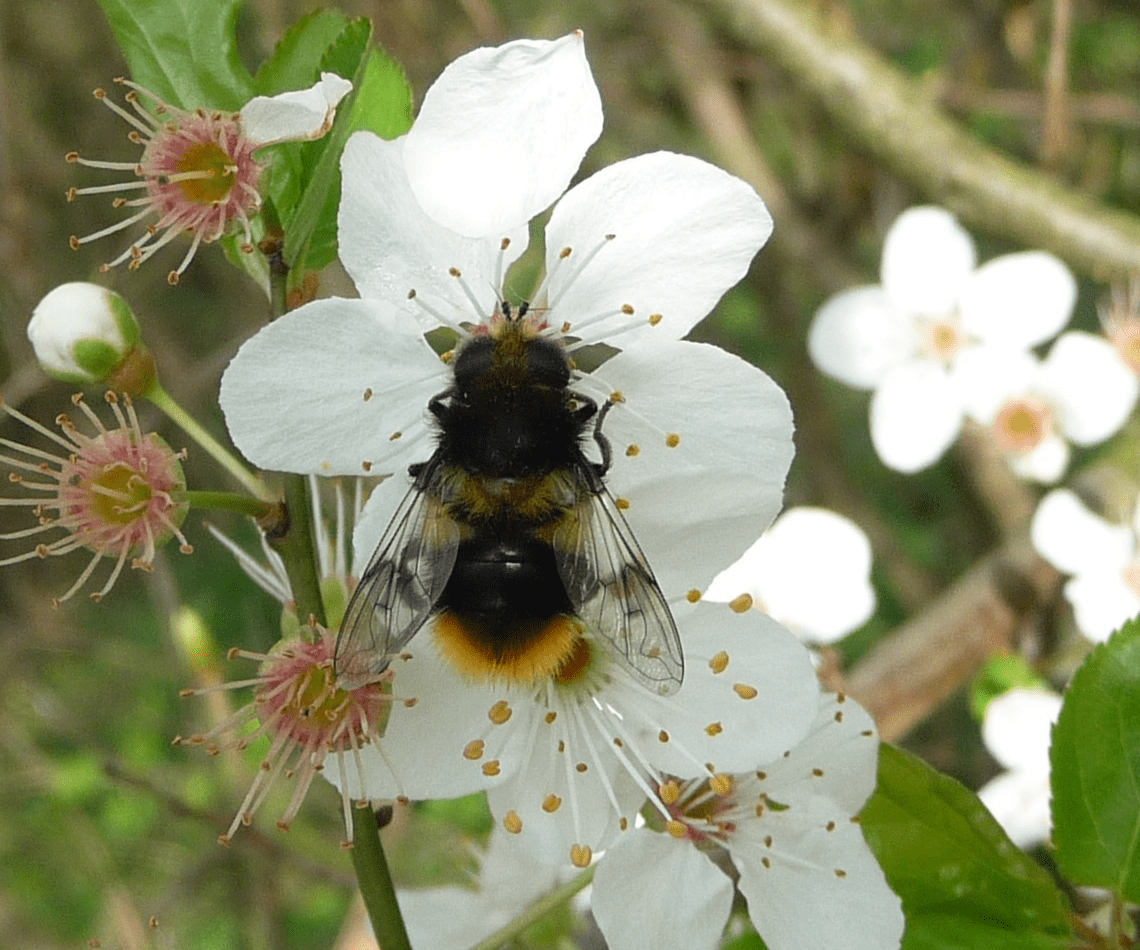
The following is a rare species (“endangered“ according to the German local red list), Mallota fuciformis, a hoverfly posing as a bumble bee, with some similarities to the early bumble bee shown above:

Many hoverflies have obvious mimicry elements in their looks, and one, the hornet mimicry hoverfly, Volucella zonaria, even in behavior: They show the same darting movements as a hornet on the prowl. In flight, they are hard to distinguish from a hornet. Here is a hornet mimicry hoverfly, sitting on the backside of the fence of a garden plot used to raise geese:

Does anyone know the reason why mimicry evolved in hoverflies, but not (to my knowledge) in other families of flies? Here is another hoverfly, Heliophilus trivittatus, a big species I find beautiful (I love the light pastel yellow), sitting on a widow flower, Knautia arvensis, near a river. Heliophilus spp. like it wet. This river meadow was full of widow flowers last year when I took the picture; this year, there isn’t a single one, but lots of clover instead:

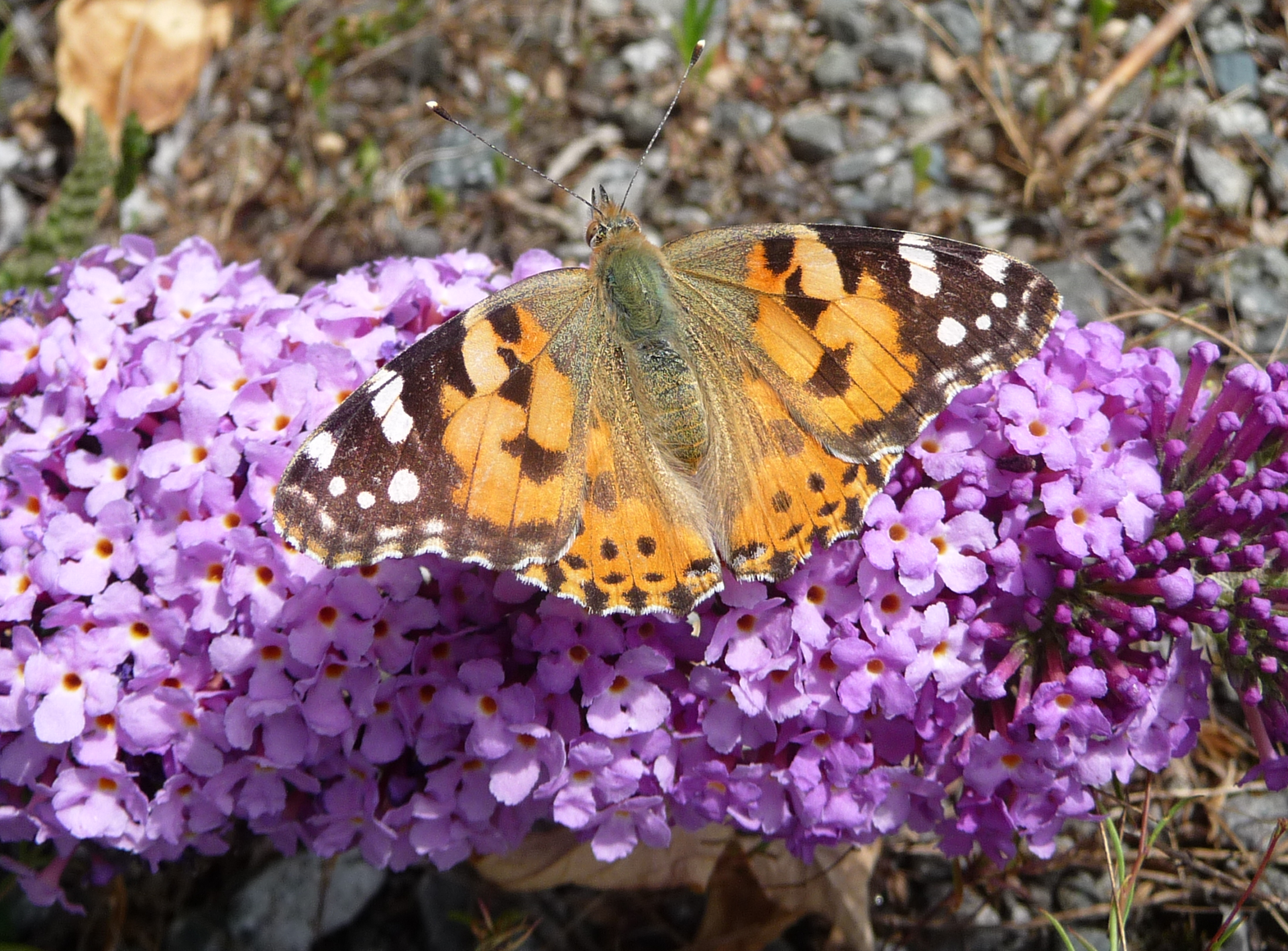
As we were recently talking about Vanessa cardui, the Atlantic-crossing painted lady, I herewith present the only semi-decent picture I have of the species (which isn’t that frequent locally), showing it sitting on Buddleja davidii, a plant that is colloquially called butterfly bush because of its attraction to butterflies, although many other pollinating insects love it just as much:

Here is a small tortoiseshell (Aglais urticae) that was right beside it:

The butterfly bush is a neophyte from East Asia that is said to provide only nectar and no pollen, and it isn’t a typical feeding plant for caterpillars either, so it’s considered an invasive pest, although I personally don’t have the impression that it’s outcompeting indigenous flowering plants where I live. Here, it was part of a late-stage ruderal vegetation.

The next picture shows another plant non-native to central Europe (or Britain), the poppy. For reasons unclear to me, poppy flowers seem to be a favorite perching place for larvae stages of long-horned grasshoppers (Tettigoniidae). The one you see here I’d guess is Tettigonia spp. cf. viridissima. The blurry thing on the left is a hoverfly, Episyrphus balteatus, visible in flight towards the poppy.

Poppies are considered archaeophytes in Central Europe (and by extension also Britain and France), as they arrived 8000 years ago with the first farmers who had poppy mixed with their cereal seed. But despite their long presence here, and despite being part of lots commercial flowerseed mixes, they never really went native, or at least that’s my impression: The poppy in the photo grew at the edge of a rapeseed field, and most of the places where I see poppies are either fields and their close vicinity or plots that were used as fields or gardens in the past.

Readers’ wildlife photos

July 3, 2024 • 8:15 am

Today we have a large batch of photos from neuroscientist Mayaan Levy, who documented her travels to the isle of Skye. Her captions are indented, and you can enlarge the photos by clicking on them.

“Over the sea to Skye”

Skye makes you believe in Faeries. You may find yourself gazing at the clouds and storms come and go at the whim of the Cailleach. You might avoid stepping into the swamps by Loch Coruisk worrying the Kelpie will snatch you. The Isle takes you back in time to when folks believed in magic, and for the duration of your stay, you’re allowed to give in, throw any logic or contemporary science to the bitter island wind, and indulge in this quaint fantasy.

We visited in late May 2023. I’ve been a low-key Scotophile for a while before, drawing on Hume, Robert Louie Stevenson, Braveheart, the Hogwarts express, and more recently Outlander (which is my guilty pleasure. Guilty as charged). After Skye, my Scotophilia worsened and is now considered incurable.

Skye (“The Island of the Clouds”, was connected to the Scottish mainland only in 1995 with the construction of the bridge. The only way on or off before, was by sea. The photos are from our north-bound hike on the Skye trail, spanning 80 miles, plus a Loch Coruisk circuit, totaling at about 100 miles. We took 6 days, but I wish we have had double, or even triple that time.

The ocean meets the mountains and the clouds. Taken right before Torrin.

Skye has way more sheep than people. A fun pastime while hiking was to try to guess by how much, and upon getting signal we have discovered that both of us grossly underestimated. The answer is 10-fold more sheep than people! In the 21st century! Some sheep are marked in different colors (for different owners), and they graze / sit on / sleep on the tall and steep cliffs. Throughout the Island you can see old stone walls the crofters have erected ages ago.

Elgol is famous today due to its role in politics back in the 18th century, and this role was just to be a clandestine location, in the middle of nowhere and difficult to approach. The site in question is Bonnie Prince Charlie’s cave, where he hid from British government forces after the defeat of the Jacobite army in Culloden (1745).

Elgol Beach – it took scaling some class 3 sea cliffs to get here:

Beadlet Anemones (Actinia equina) – if I wasn’t in Neuroscience I would be a Marine Biologist. These creatures have 192 tentacles (so cool!), and they are sort of immortal (please weigh in on this) or at least have extremely long lives:

Elgol beach is rich in fossils. I have no clue what left this impression fossil:

One of my favorite areas was hidden Loch Coruisk and the Black Cuillin – a semi-circle of pitch black, ominous mountains. Multiple legends and myths surround the Cuillin, and I’m afraid I can’t do them justice. If you’re interested, some can be found here.

A view southwest of Loch Coruisk and the sea:

The peaks of the Black Cuillin tower in the distance over Sligachan 19th century bridge:

Our next stop was Portree (probably from “Port of the king” port + re as in many Latin languages), the capital of Skye, where there are more people than sheep but fewer residents than tourists. We were hungry, and luckily Portree is the place to get authentic fish and chips. Now, by fish I don’t mean small mackerels in newspaper, I mean a foot long, deep fried haddock. Chips are similar to what Americans call fries, except the Scottish ones tend to be very soggy as opposed to crispy. To each their own (ugh).

Is it a phone booth? Is it a library? (on the outskirts of Portree):

Portree harbor:

Fish farming just north of Portree. Perhaps this was home to our lunch not so long ago:

From Portree we hit the woods. There aren’t many trees on Skye, and it’s not clear to me exactly why. The island is at the mercy of the elements, with strong winds even in the summer which naturally will strip the land. But it may also be the case that humans deforested the isle to raise livestock.

I told you Faeries live here:

Small emperor moth (Saturnia pavonia) – common throughout Europe but is actually the only one from this family to inhabit the British Isles:

Now we start climbing for an epic stretch starting at the Storr, walking on the cliff edges of the Trotternish ridge. The ridge, including the Old man of Storr, was created when lava erupted from beneath, causing the softer rock to slide down about 60 million years ago. Skye’s geological origins are partially volcanic; Land that was to become the British Isles was once upon a time landlocked in pretty much the middle of Pangea. When the super-continent split and multiple fault lines were created, heat generated beneath led to a series of mini volcanic eruptions. Indeed, these events were part of a period of increased volcanic activity all over Earth, which some hypothesize might have been the true cause of the K-Pg extinction (aka the Deccan Traps theory). Disclaimer: not my field, and I have no skin in this game, but the so called “Dinosaur wars” have been fascinating from a history and sociology of Science perspective.

I can’t go to Skye and not have a photo of this landmark: Ladies and Gentlemen, the Old man of Storr. On the right side of the photo is the Storr itself – the tallest formation on the ridge. On the left side of the photo you can see that there are several steps or levels of cliffs until the final drop to the ocean:

The north-most point of the Trotternish ridge, looking south:

Volcanic sea cliffs:

Setting up camp for the final night on Skye. We’ll be back:


First evidence for insects crossing the ocean

June 26, 2024 • 11:15 am

A NYT “Trilobites” article by Monique Brouillette drew my attention to a new paper in Nature Communications documenting, with a variety of evidence, what is the first known flight of any insect across a big ocean. In this case the insect was the ubiquitous Painted Lady Butterfly (Vanessa cardui), the most widespread of all butterflies, and the ocean was the South Atlantic Ocean.

Tomasz Suchan et al. found Painted Ladies on the coast of French Guiana, and, using four different methods, suggest that their most likely origin was West Africa or Europe.  This means that they flew, over a period of 5-8 days, a distance bertween 4200 km (2600 miles) and 7000 sm (4350 miles).  It’s amazing, as butterflies can’t have done that without help: in this case, the wind.

Here’s a Painted Lady (upper side):

Jean-Pol GRANDMONT, CC BY 3.0, via Wikimedia Commons

I worked on long-distance insect movement for several years as a postdoc and young professor, but we marked our Drosophila flies with fluorescent dust and never even tried to find any movement this long.  Click on the screenshot below to go to the Nature paper, or find the pdf here.

First: the discovery (indented sections are from the paper), a group of exhausted Painted Lady butterflies on the coast of South America, found 11 years ago.

Three of about ten observed individuals were captured alive on the beach at ~6:00 am on the 28th of October 2013, apparently arriving after a vigorous flight across the ocean, judging from their damaged wings and resting behavior on the sand. Painted ladies are strong migrators, known for their recurrent trans-Saharan flights and a multigenerational cycle spanning ca. 15,000 km between the Afrotropical and the Palearctic regions. V. cardui is nearly cosmopolitan, but stable populations have not been recorded from South America. The individuals found on the coast of French Guiana should therefore have originated from populations in North America, Europe or Africa.

Thus there was more than one individual, suggesting that they stayed together during the long-distance migration, which is hard to understand.  We can rule out a South American origin of these butterflies simply because stable populations of the butterfly aren’t found on that continent.

Then Suchan et al. used four methods, all of which suggested that the butterflies had a West African or European origin (or both: hatched in Europe, migrated to West Africa, and then crossed the ocean). This means, since they were crossing water, that they had to move long distances without refueling. Although they can cross the Sahara, they can also refuel when doing so.

Here are the methods the authors used:

1.)  Wind.  Apparently wind data (speed and direction) are available for different altitudes from the National Oceanic and Atmospheric Administration. The winds at various altitudes up to 2000 m were inconsistent in direction for the five days before Oct. 26 and the three days after the capture data (Oct. 28-31), but were consistent in direction (east to west) on the 2 days before the capture, which the authors say is “exceptionally favorable for the butterflies to disperse across the Atlantic from West Africa, assisted by winds.

The wind assistance, then, would have been operative for only 2 days, but could have helped on the other days of the 5- 8-day journey if the insects had been at altitudes with the right winds. Is that feasible? They also must have used their own flapping power, but they could not have had the fuel to fly consistently for that entire period on their own.

2.) Genetic affinity.Using RAD-assisted mapping of DNA variation, the authors found that African + European populations, which are similar to each other, were both distinctly different from those of North America.  And the exhausted Painted Ladies found in South America clearly were genetically related to the African + European ones and not to the North American ones, implying that yes, they had crossed the ocean from either Europe or North America.  (It’s also known that October is when Painted Ladies are a high densities in these areas.) Below you can see the genetic clustering. As the key shows, the green butterflies, found on the beach, clearly clustered with both African and European butterflies (red and orangish respectively), but were distinctly different from North American butterflies (blue dots). This is strong evidence that the butterflies found in French Guiana came from across the Atlantic Ocean:

(from the paper): A Principal Component Analysis (PCA) using SNPs with less than 10% missing data per sample and pruned for LD (13 206 SNPs), the variances explained by the two first axes are 6.26% and 5.21%;

3.) Pollen carried by the butterflies. This was a clever idea: the authors did a DNA sequence of the pollen grains found on the bodies of the beach-captured butterflies. (Butterflies pick up pollen when sipping nectar from flowers.) Most of the species found weren’t informative as they couldn’t be classified or represented widely-distributed Neotropical species, but they also found grains from two plant species endemic to the Sahel region of Africa: a narrow biogeographic swath across the subsaharan region. The plants were the Senegal Tea Plant, Guiera senegalensis, and Christ’s thorn jujube, Ziziphus spina-christi, both flowering shrubs, and both found only in the Sahel. They’re in yellow on the bar chart below, both in the bar graphs of pollen frequency and geographic distribution. G. senegalensis was especially highly represented on the butterflies, far more numerous than the pollen of any other species.

Both species were flowering at the time the butterflies were found (flowering season is Aug.-November), also supporting an African origin of the butterflies.

(from the paper) Classification of the obtained ITS2 metabarcoding sequences processed using a denoising pipeline (see Methods), and blasted on curated databases from A PLANiTS83 and B Sickel et al.82 using the SINTAX classifier. In addition to plants present in French Guiana or widely distributed (green bars), two Sahelian endemic plants (yellow bars) were found among the pollen recovered from the bodies of the painted lady butterflies in South America: Guiera senegalensis and Ziziphus spina-christi, the former being especially common. Source Data is available in Supplementary Table S3.

One thing that puzzles me is the existence of “Neotropical pollen grains”. Those would be from the South American tropics, and how did they get on the butterflies? Did they nosh on South American plants after they crossed the ocean? The authors don’t discuss this.

4.) Isotope analysis. I was unfamiliar with this method, but apparently the ratio of isotopes of two elements, strontium and hydrogen, are indicative of the “reproductive habitats” of different areas of the world, and the ratios found in the butterflies’ wings had the highest probability of coming from West Africa and/or Western Europe (Portugal, France, Ireland, and the UK). This also raises the possibility that these butterflies were on their regular migration from Europe across the Sahara, and then were blown off course by the wind. Lacking any direction-finding ability when off course (we also found that this was true of Drosophila), they just kept flapping until they made land in South America. Almost surely most of them would die along the way.

But could they really make it, even if assisted by wind? The authors suggest that they could. Even though they couldn’t flap continuously for 5 to 8 days, they could also glide:

We assessed the feasibility of a transatlantic crossing by estimating energetic requirements and dispersal duration of V. cardui when using different flight strategies.. In the absence of wind-assistance, we estimate that painted ladies could travel a maximum of ~780 km without refueling, far less than the 4200 km distance across the Atlantic. Therefore, the painted ladies must have relied on the easterly trade winds that were present preceding the capture date. Furthermore, even with wind-assistance, painted ladies using an exclusively active flight strategy would travel a maximum of ~1900 km before depleting their energy reserves. Therefore, painted ladies must be using an alternating strategy of active flight and minimum-effort flight (i.e. flapping only to stay aloft and gliding), a behavior that is known from monarchs and other butterflies. Assuming that painted ladies use the same alternating flight strategy as monarchs (with a 15:85 proportion of active:minimum-effort flight) and with the assistance of wind (average windspeed of 7.47 m/s based on trajectories starting 26–28th of October), the painted ladies we captured in French Guiana could have crossed the Atlantic from West Africa in 5–8 days, but only if their starting fat reserves were at least as high as 13.70% of their body mass.

Of course the trade winds blew in a consistent direction only for two days during the crossing, not the 5-8 days suggested by the authors.  And even if the butterflies were loaded with fuel, it’s hard to see how they could make it. But the other evidence convinces me that these individuals did have an African origin, and maybe hatched in Europe. The authors suggest that gliding was important, but I don’t know if it’s been seen in this species of butterfly. And how do butterflies glide, anyway?

The authors suggest that these butterflies hatched in Europe, and give this schematic of their journey (Europe gets a nod since the isotope ratios there are closer than African ones to what was found in the butterflies’ wings):

(From the paper): C  Infographic summarizing the possible natal grounds and dispersal pathway of a flock of V. cardui butterflies across the Atlantic from West Africa to South America, through a non-stop flight of a minimum of 4200 km during 5–8 days. The total flight distance for these individuals could be as long as 7000 km if they developed in Western Europe. Source Data can be obtained online using the provided code (see code availability). Butterfly illustrations by Blanca Martí.

Now the authors note other cases long-distance migration of insects, even one across the Indian Ocean. But most of the other long-distance migration of insects involves en route refueling (except for the dragonfly, and although they don’t give the overwater migration distance for it, Wikipedia says 2500 km).  This butterfly beats the dragonfly by 1700 km.

For example, the dragonfly Pantala flavescens apparently migrates annually across the Indian Ocean. The monarch butterfly (Danaus plexippus) also annually migrates between Canada and Mexico, and tagged individuals have demonstrated flights as long as 4635 km (2880 miles). Recent work using light aircraft and individual radio tracking of death head’s hawkmoths (Acherontia atropos) recorded a remarkable maximum ground speed of 69.7 km/hour (19.4 m/s). These scattered reports of individual feats of migration both in terms of distance covered and flight speed are important: collectively they indicate that trans-oceanic LDD events may be sufficiently frequent to have played an underestimated role in biogeographic dispersal over time (cf. panbiogeography).

The upshot:  Although the evidence varies in strength, the genetic evidence and the pollen-grain evidence alone are pretty convincing that these butterflies came from Africa, and perhaps originally from Europe.  I’m not sure whether they’d be able to colonize South America, as they were exhausted, probably not capable of reproducing, and Painted Ladies aren’t found in South America.

There are still puzzling things about the hypothesis, including where the Neotropical pollen grains came from on the butterflies, and whether Painted Ladies are actually capable of gliding. But the evidence suggests that this kind of long-distance nonstop movement is possible in butterflies, and without refueling. (Painted Ladies are already known to fly long distances when they can refuel.) There’s surely enough data here for lepidopterists to start combing the beaches of eastern South America during October and November!

Readers’ wildlife photos

June 13, 2024 • 8:15 am

Mark Sturtevant has returned with some lovely insect photos. His captions and ID’s are indented (he also provided links, as he always does), and you can enlarge the photos by clicking on them.

I took these pictures of local insects from various locations last summer, either in area parks or in a staged setting.

First are a pair of Buffalo Treehoppers, beginning with Stictocephala sp., followed by Stictocephala diceros:

Next up is another treehopper, Telamona sp. As a group, treehoppers are of course distinctive with that enlarged “helmut’ that covers much of the body. There had been some debate about the homology of this novel structure to the general insect body plan, with the rather exciting interpretation that the helmet is serially homologous to insect wings, only they are considerably re-purposed in treehoppers. But that view has been largely discarded now. The helmet is as it seems — a very expanded part of the first thoracic segment:

The small moth shown next is one of the plume moths, which is a large family of cryptic moths with wings that are deeply split into feathery plumes. This can be better seen here. The one I show here is the Rose Plume mothCnaemidophorus rhododactyla:

Next up is our Red Admiral ButterflyVanessa atalanta. These butterflies are exceedingly common, but they are super wary and so I find them to be difficult to photograph. This one was surprisingly calm, though, as it sunned itself on my shed. So the laws of physics made me trot back to the house to get the long lens:

While visiting an area park, I was a little surprised to see this Northern Paper wasp nest (Polistes fuscatus) in a bush. Aren’t these supposed to be attached to human structures?:

I was quite happy to find this interesting beetle, which has the ghastly name of Twice-stabbed Lady Beetle Chilocorus stigma. All readers will be more familiar with the Asian Lady Beetle — which is the ubiquitous orange and black species that was introduced into Europe and North America. I bring this up because the Asian Lady Beetle comes in different color morphs, and surprisingly one of the variants is a close match to the Twice-stabbed species, as shown here.  I have no idea why:

Lastly, I was pretty darn ecstatic to find several large Cecropia Moth (Hyalophora cecropia) caterpillars that were stripping down some snowberry bushes at a park. Not quite fully grown here, they will soon grow up into a bratwurst-sized caterpillar before spinning cocoons, and this season, the survivors will emerge as our largest moth. I took one caterpillar home to raise up, and the last picture shows it in its grumpy “Harrumph” pose, being annoyed that I had briefly stopped it from feeding. The cocoon had over-wintered with me, and it is now sitting where I can keep an eye on it. The adult will be released after the necessary pictures, of course. An enjoyable video showing the adult is at the link:

Readers’ wildlife photos

May 30, 2024 • 8:15 am

Please send in your good wildlife photos; there’s always a need, and it’s beginning to press. . . .

Today’s photos come from our most regular regular, Mark Sturtevant, insect photographer par excellence. Mark’s captions and narrative are indented, and you can enlarge the photos by clicking on them.

Here are more pictures of insects (and one spider) from last summer. All were taken near where I live which is in eastern Michigan. I shoot with Canon cameras, mostly with the manual Laowa 2.5-5x super macro, and the Canon 100mm f/2.8L macro (often with a Raynox diopter to boost the mag). All but the last of these pictures are focus stacks, as I have become addicted to additional post-processing.

Let’s start with ants. We have a large Cottonwood tree in our backyard that is steadily infested with black Carpenter Ants. One day I saw that there was a small swarm of these smaller red ants carrying pupae, larvae, and eggs INTO the tree as well. Perhaps they were moving to higher ground after being flooded out. I am not good with ant identification, but at this time the good folks at BugGuide had tentatively identified them as being Aphaenogaster sp. Despite the some-what controlled conditions of a staged setting (a dish of water that prevented the ants from running off) I needed to take about 200 pictures to get a few keepers. Ants hard!:

Next up is one of the Soldier Flies, Solva pallipes. Soldier flies visit flowers and seem to mimic wasps. The description in Wikipedia mentions that they are rather inactive, and come to think of it, that is true. This is once again from a staged setting, but the fly just sat there:

Here is an exceptionally poofy moth that came to the porch light. Although I often ignore plain-looking moths, this one was such a floof that it had to be photographed. It turns out to have an odd name: the Arcane Grass Tubeworm MothAcrolophus arcanella. The group gets their name because the larvae live in leaf litter, where they hide in silken tubes:

The small beetle shown in the next picture was a bit of a puzzle in that I really had no idea what family it belonged to, but I would see a lot of them. One day, by chance I stumbled upon its ID. So this is one of the Soldier Beetles, and in particular it is Trypherus frosoni. I suppose its colors are a warning that it is toxic. Soldier beetles are herbivores, and many species stay on flowers where they eat pollen. But I see this species only sitting out on leaves. Interesting that its forewings are shortened but the hind wings are not.

Next up is a large Ground Beetle which I think is Scarites vicinus, although it could be a couple other species. I am going with some tiny details like the length/width ratio of antennal segments. Ground Beetles are predatory, as one might guess with those jaws. I just had a neighbor stop by to show me one of the same beetles that they had squished (I am known in the ‘hood as the person to go to for bug information), so I gave her admonishments about how they are beneficial:

It’s time for some dragonflies. First up is one of our Baskettail Dragonflies, Epitheca sp. One cannot easily identify these to species except after very close inspection of genitalia.

Next is a nearly-new species for me because it’s been about 7 years since I’ve seen one. This is a Four-spotted SkimmerLibellula quadrimaculata. Occasional vagrants do appear in my area, but they normally range farther south, which is where this picture was taken:

One of the most common of our dragonflies is the Twelve-spotted SkimmerLibellula pulchella. Males like this one develop white spotting as they age:

An always exciting find is the DragonhunterHagenius brevistylus, what is pretty much our largest dragonfly in the area and as far as I know they are the largest of the Clubtail dragonflies anywhere. With a length up to 90mm (~ 3.5 inches)  and those extra heavy legs, they are not dragonflies that are “good for controlling mosquitoes!”  Their common name refers to their well-above-average interest in eating other dragonflies. This female is as I usually see them, weighing down their favorite twig as they face out over the water:

An unusual spider wraps up this set. This is our Featherlegged OrbweaverUloborus glomosus. There are several different spider families that spin orb webs, with the most familiar being spiders in the family Araneidae. But there are other spider families that also practice this craft, and I don’t know if this is a case of convergent evolution or what. But here we have an orb-weaver spider from one of the “other” families, Uloboreidae, and they are a bit different for a couple reasons. One is that they don’t produce sticky silk but instead use finely meshed silk that entangles prey. Another little detail about these spiders is that they have no venom. This one is eating an unidentifiable prey, and the mass to her rear is an egg sac. This is focus stacked while I was sitting somewhere deep in the woods:

Readers’ wildlife photos

May 25, 2024 • 8:15 am

We’re running out of photos again, so I plead with and importune you to send in your good wildlife photos.

We have just a few photos today, and the first batch, from reader Steve Pollard, is salacious: LOCKED FOXES. As always, the contributor’s captions are indented and you can enlarge the photos by clicking on them.

I attach three photos taken a couple of months ago of a pair of locked American Red Foxes (Vulpes vulpes fulva) in our garden. They were taken with a phone camera at extreme range, so they are not the greatest, but it’s not something I’ve seen before.
From the magazine Wildlife Online:”Copulation lasts only a few seconds and, following ejaculation, the pair are locked together—a copulatory lock—for up to 90 minutes, owing to contraction of the vixen’s vagina and the swelling of the bulbus glandis tissue at the tip of the dog fox’s baculum”.
As the photos indicate, the lock can result in some awkward positions! In this case, the vixen tried several times to get free, twisting and even biting at the dog. The lock lasted for over 20 minutes. The cub from a previous engagement took quite an interest in proceedings.

From Florian Maderspacher, a marsh fritillary (Euphydryas aurinia), which, he says, “goes by the much nicer German name of Skabiosen-Scheckenfalter“.

From Lee Jussim.

Northern elephant seals (Mirounga angustirostris)  in California:

American robin‘s eggs (Turdus migratorius), New Jersey

Hatched eggs:

Swans and babies (Cygnus sp., also New Jersey):

Readers’ wildlife photos

April 23, 2024 • 8:15 am

If you got ’em, send ’em in, please!

Today we have photos by Dean Graetz of Australia. His captions are indented, and you can enlarge his photos by clicking on them. Aussie backyards have some cool stuff, especially the birds!

A Southern Hemisphere Backyard

Here is a sample of the inhabitants of our backyard in Canberra, Australia.  Mid-March, at latitude 35°S, is a time of rapidly shortening daylength, and of harvesting the fruits of a coolish Summer.  Our non-native garden shrubs (Buddleia davidii, aka ‘Butterfly Bush’) are popular attracting this new and hard to identify, visitor.  We think it is a ‘Brown’, or Heteronympha species:

A large butterfly with a 10 cm wingspan, this female Orchard Swallowtail (Papilio aegeus), is always eye-catching, and always harassed by ever-present Cabbage White butterflies:

The common Meadow Argus (Junonia villida) which, after enjoying a nectar feed, often unhurriedly suns itself on our warm garden pathways, adding colour in two places:

The also common, and charmingly named, an Australian Painted Lady (Vanessa kershawi) choosing feed on a desert wildflower (Xerochrysum sp.) which we also grow as another inducement for butterflies.  All the butterfly photos were shot from a 3-5m distance with zoom lenses:

A pair of aged adult Crimson Rosellas (Platycercus elegans) feeding on our neighbour’s tall shrub.  These parrots are everyday sightings in Canberra gardens that are not far from surrounding native woodlands where they breed as hollow nesters:

A juvenile Crimson Rosella in the process of changing its dull green plumage to the bright reds and blues of the sexually mature adult.  The coloured feather contrasting patches are so sharp that these birds enjoy the common name of ‘Patchworks’:

An adult Satin Bowerbird (Ptilonorhyncus violaceus), sex not obvious, having enjoyed a vigorous bath now eyeing the photographer.  At age 7 years, a male bird will change from this khaki plumage to a brilliant blue-black glossy version, build a bower in a grassy woodland, decorate it with blue objects (same colour as its eyes), such as flowers, clothes pegs, bottle tops.  The purpose is to attract, court and mate with numerous females.  Hard to believe?  Go here to watch:

A juvenile Kookaburra (Dacelo novaeguineae) now regularly arrives and sits patiently surveying our back yard for any living food items, such as lizards, mice, or snakes.  These birds readily habituate to hand feeding by the lonely to become a mendicant friend for life:

An adult male Australian King Parrot (Alisterus scapularis) enjoying the last of an unripe pomegranate in a neighbour’s tree.  The dark lower beak is staining.  These are frequent visitors to Canberra at this time of the year.  Being predominantly fruit eaters – their favourite is cherries – has required nearby fruit growers to cover their entire orchards with parrot (and hail) proof tents:

Close by, and part of a family flock, was this juvenile female King-Parrot, elegantly holding an unripe olive with toe and beak.  They skillfully rotate each olive with their blunt tongue to flense off all the edible flesh.  To us, hard green olives are unappealing, but this female ate steadily for about 15 minutes before flying off with a noticeably full crop: