First evidence for insects crossing the ocean

June 26, 2024 • 11:15 am

A NYT “Trilobites” article by Monique Brouillette drew my attention to a new paper in Nature Communications documenting, with a variety of evidence, what is the first known flight of any insect across a big ocean. In this case the insect was the ubiquitous Painted Lady Butterfly (Vanessa cardui), the most widespread of all butterflies, and the ocean was the South Atlantic Ocean.

Tomasz Suchan et al. found Painted Ladies on the coast of French Guiana, and, using four different methods, suggest that their most likely origin was West Africa or Europe.  This means that they flew, over a period of 5-8 days, a distance bertween 4200 km (2600 miles) and 7000 sm (4350 miles).  It’s amazing, as butterflies can’t have done that without help: in this case, the wind.

Here’s a Painted Lady (upper side):

Jean-Pol GRANDMONT, CC BY 3.0, via Wikimedia Commons

I worked on long-distance insect movement for several years as a postdoc and young professor, but we marked our Drosophila flies with fluorescent dust and never even tried to find any movement this long.  Click on the screenshot below to go to the Nature paper, or find the pdf here.

First: the discovery (indented sections are from the paper), a group of exhausted Painted Lady butterflies on the coast of South America, found 11 years ago.

Three of about ten observed individuals were captured alive on the beach at ~6:00 am on the 28th of October 2013, apparently arriving after a vigorous flight across the ocean, judging from their damaged wings and resting behavior on the sand. Painted ladies are strong migrators, known for their recurrent trans-Saharan flights and a multigenerational cycle spanning ca. 15,000 km between the Afrotropical and the Palearctic regions. V. cardui is nearly cosmopolitan, but stable populations have not been recorded from South America. The individuals found on the coast of French Guiana should therefore have originated from populations in North America, Europe or Africa.

Thus there was more than one individual, suggesting that they stayed together during the long-distance migration, which is hard to understand.  We can rule out a South American origin of these butterflies simply because stable populations of the butterfly aren’t found on that continent.

Then Suchan et al. used four methods, all of which suggested that the butterflies had a West African or European origin (or both: hatched in Europe, migrated to West Africa, and then crossed the ocean). This means, since they were crossing water, that they had to move long distances without refueling. Although they can cross the Sahara, they can also refuel when doing so.

Here are the methods the authors used:

1.)  Wind.  Apparently wind data (speed and direction) are available for different altitudes from the National Oceanic and Atmospheric Administration. The winds at various altitudes up to 2000 m were inconsistent in direction for the five days before Oct. 26 and the three days after the capture data (Oct. 28-31), but were consistent in direction (east to west) on the 2 days before the capture, which the authors say is “exceptionally favorable for the butterflies to disperse across the Atlantic from West Africa, assisted by winds.

The wind assistance, then, would have been operative for only 2 days, but could have helped on the other days of the 5- 8-day journey if the insects had been at altitudes with the right winds. Is that feasible? They also must have used their own flapping power, but they could not have had the fuel to fly consistently for that entire period on their own.

2.) Genetic affinity.Using RAD-assisted mapping of DNA variation, the authors found that African + European populations, which are similar to each other, were both distinctly different from those of North America.  And the exhausted Painted Ladies found in South America clearly were genetically related to the African + European ones and not to the North American ones, implying that yes, they had crossed the ocean from either Europe or North America.  (It’s also known that October is when Painted Ladies are a high densities in these areas.) Below you can see the genetic clustering. As the key shows, the green butterflies, found on the beach, clearly clustered with both African and European butterflies (red and orangish respectively), but were distinctly different from North American butterflies (blue dots). This is strong evidence that the butterflies found in French Guiana came from across the Atlantic Ocean:

(from the paper): A Principal Component Analysis (PCA) using SNPs with less than 10% missing data per sample and pruned for LD (13 206 SNPs), the variances explained by the two first axes are 6.26% and 5.21%;

3.) Pollen carried by the butterflies. This was a clever idea: the authors did a DNA sequence of the pollen grains found on the bodies of the beach-captured butterflies. (Butterflies pick up pollen when sipping nectar from flowers.) Most of the species found weren’t informative as they couldn’t be classified or represented widely-distributed Neotropical species, but they also found grains from two plant species endemic to the Sahel region of Africa: a narrow biogeographic swath across the subsaharan region. The plants were the Senegal Tea Plant, Guiera senegalensis, and Christ’s thorn jujube, Ziziphus spina-christi, both flowering shrubs, and both found only in the Sahel. They’re in yellow on the bar chart below, both in the bar graphs of pollen frequency and geographic distribution. G. senegalensis was especially highly represented on the butterflies, far more numerous than the pollen of any other species.

Both species were flowering at the time the butterflies were found (flowering season is Aug.-November), also supporting an African origin of the butterflies.

(from the paper) Classification of the obtained ITS2 metabarcoding sequences processed using a denoising pipeline (see Methods), and blasted on curated databases from A PLANiTS83 and B Sickel et al.82 using the SINTAX classifier. In addition to plants present in French Guiana or widely distributed (green bars), two Sahelian endemic plants (yellow bars) were found among the pollen recovered from the bodies of the painted lady butterflies in South America: Guiera senegalensis and Ziziphus spina-christi, the former being especially common. Source Data is available in Supplementary Table S3.

One thing that puzzles me is the existence of “Neotropical pollen grains”. Those would be from the South American tropics, and how did they get on the butterflies? Did they nosh on South American plants after they crossed the ocean? The authors don’t discuss this.

4.) Isotope analysis. I was unfamiliar with this method, but apparently the ratio of isotopes of two elements, strontium and hydrogen, are indicative of the “reproductive habitats” of different areas of the world, and the ratios found in the butterflies’ wings had the highest probability of coming from West Africa and/or Western Europe (Portugal, France, Ireland, and the UK). This also raises the possibility that these butterflies were on their regular migration from Europe across the Sahara, and then were blown off course by the wind. Lacking any direction-finding ability when off course (we also found that this was true of Drosophila), they just kept flapping until they made land in South America. Almost surely most of them would die along the way.

But could they really make it, even if assisted by wind? The authors suggest that they could. Even though they couldn’t flap continuously for 5 to 8 days, they could also glide:

We assessed the feasibility of a transatlantic crossing by estimating energetic requirements and dispersal duration of V. cardui when using different flight strategies.. In the absence of wind-assistance, we estimate that painted ladies could travel a maximum of ~780 km without refueling, far less than the 4200 km distance across the Atlantic. Therefore, the painted ladies must have relied on the easterly trade winds that were present preceding the capture date. Furthermore, even with wind-assistance, painted ladies using an exclusively active flight strategy would travel a maximum of ~1900 km before depleting their energy reserves. Therefore, painted ladies must be using an alternating strategy of active flight and minimum-effort flight (i.e. flapping only to stay aloft and gliding), a behavior that is known from monarchs and other butterflies. Assuming that painted ladies use the same alternating flight strategy as monarchs (with a 15:85 proportion of active:minimum-effort flight) and with the assistance of wind (average windspeed of 7.47 m/s based on trajectories starting 26–28th of October), the painted ladies we captured in French Guiana could have crossed the Atlantic from West Africa in 5–8 days, but only if their starting fat reserves were at least as high as 13.70% of their body mass.

Of course the trade winds blew in a consistent direction only for two days during the crossing, not the 5-8 days suggested by the authors.  And even if the butterflies were loaded with fuel, it’s hard to see how they could make it. But the other evidence convinces me that these individuals did have an African origin, and maybe hatched in Europe. The authors suggest that gliding was important, but I don’t know if it’s been seen in this species of butterfly. And how do butterflies glide, anyway?

The authors suggest that these butterflies hatched in Europe, and give this schematic of their journey (Europe gets a nod since the isotope ratios there are closer than African ones to what was found in the butterflies’ wings):

(From the paper): C  Infographic summarizing the possible natal grounds and dispersal pathway of a flock of V. cardui butterflies across the Atlantic from West Africa to South America, through a non-stop flight of a minimum of 4200 km during 5–8 days. The total flight distance for these individuals could be as long as 7000 km if they developed in Western Europe. Source Data can be obtained online using the provided code (see code availability). Butterfly illustrations by Blanca Martí.

Now the authors note other cases long-distance migration of insects, even one across the Indian Ocean. But most of the other long-distance migration of insects involves en route refueling (except for the dragonfly, and although they don’t give the overwater migration distance for it, Wikipedia says 2500 km).  This butterfly beats the dragonfly by 1700 km.

For example, the dragonfly Pantala flavescens apparently migrates annually across the Indian Ocean. The monarch butterfly (Danaus plexippus) also annually migrates between Canada and Mexico, and tagged individuals have demonstrated flights as long as 4635 km (2880 miles). Recent work using light aircraft and individual radio tracking of death head’s hawkmoths (Acherontia atropos) recorded a remarkable maximum ground speed of 69.7 km/hour (19.4 m/s). These scattered reports of individual feats of migration both in terms of distance covered and flight speed are important: collectively they indicate that trans-oceanic LDD events may be sufficiently frequent to have played an underestimated role in biogeographic dispersal over time (cf. panbiogeography).

The upshot:  Although the evidence varies in strength, the genetic evidence and the pollen-grain evidence alone are pretty convincing that these butterflies came from Africa, and perhaps originally from Europe.  I’m not sure whether they’d be able to colonize South America, as they were exhausted, probably not capable of reproducing, and Painted Ladies aren’t found in South America.

There are still puzzling things about the hypothesis, including where the Neotropical pollen grains came from on the butterflies, and whether Painted Ladies are actually capable of gliding. But the evidence suggests that this kind of long-distance nonstop movement is possible in butterflies, and without refueling. (Painted Ladies are already known to fly long distances when they can refuel.) There’s surely enough data here for lepidopterists to start combing the beaches of eastern South America during October and November!

Readers’ wildlife photos

June 13, 2024 • 8:15 am

Mark Sturtevant has returned with some lovely insect photos. His captions and ID’s are indented (he also provided links, as he always does), and you can enlarge the photos by clicking on them.

I took these pictures of local insects from various locations last summer, either in area parks or in a staged setting.

First are a pair of Buffalo Treehoppers, beginning with Stictocephala sp., followed by Stictocephala diceros:

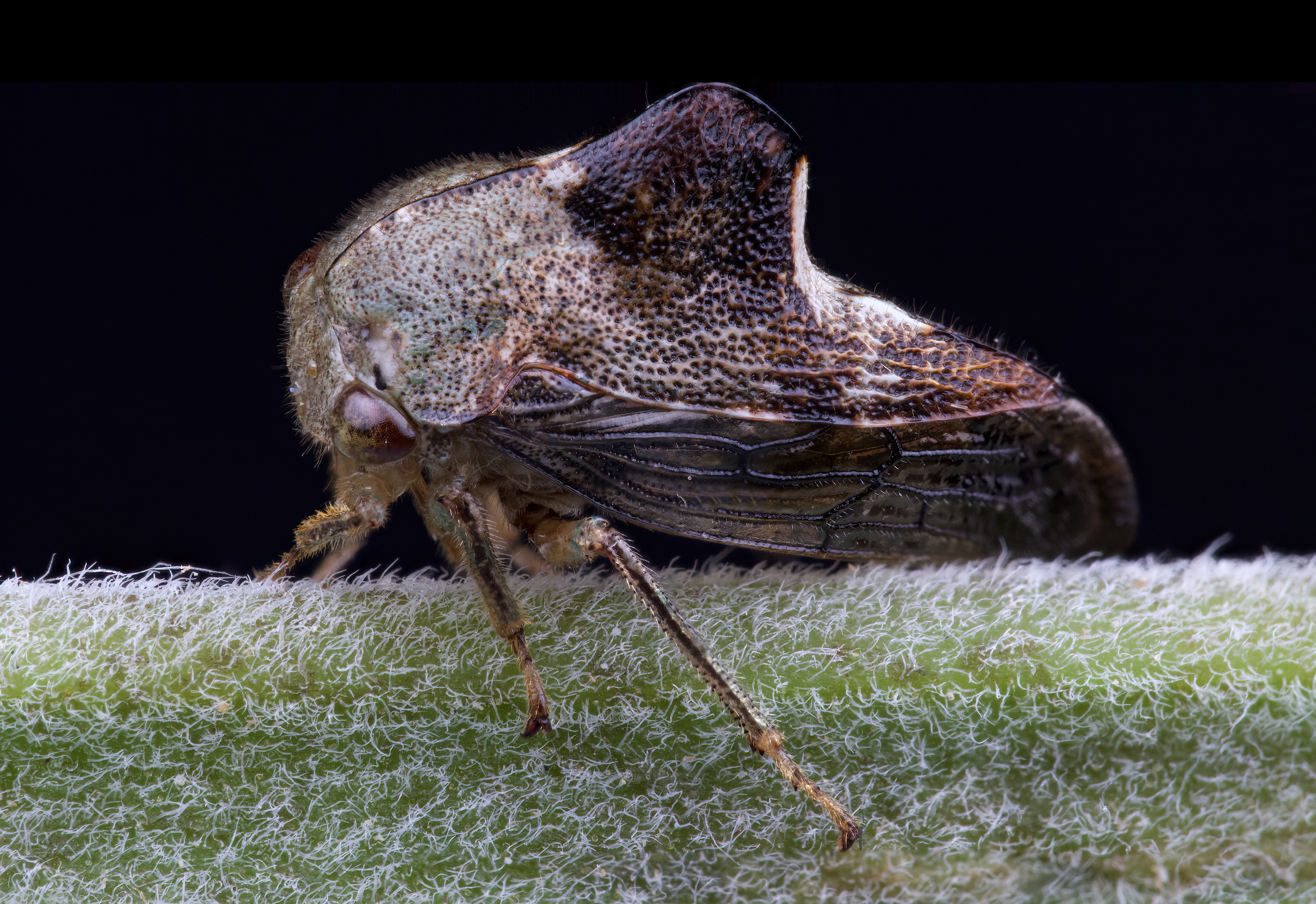
Next up is another treehopper, Telamona sp. As a group, treehoppers are of course distinctive with that enlarged “helmut’ that covers much of the body. There had been some debate about the homology of this novel structure to the general insect body plan, with the rather exciting interpretation that the helmet is serially homologous to insect wings, only they are considerably re-purposed in treehoppers. But that view has been largely discarded now. The helmet is as it seems — a very expanded part of the first thoracic segment:

The small moth shown next is one of the plume moths, which is a large family of cryptic moths with wings that are deeply split into feathery plumes. This can be better seen here. The one I show here is the Rose Plume moth, Cnaemidophorus rhododactyla:

Next up is our Red Admiral Butterfly, Vanessa atalanta. These butterflies are exceedingly common, but they are super wary and so I find them to be difficult to photograph. This one was surprisingly calm, though, as it sunned itself on my shed. So the laws of physics made me trot back to the house to get the long lens:

While visiting an area park, I was a little surprised to see this Northern Paper wasp nest (Polistes fuscatus) in a bush. Aren’t these supposed to be attached to human structures?:

I was quite happy to find this interesting beetle, which has the ghastly name of Twice-stabbed Lady Beetle Chilocorus stigma. All readers will be more familiar with the Asian Lady Beetle — which is the ubiquitous orange and black species that was introduced into Europe and North America. I bring this up because the Asian Lady Beetle comes in different color morphs, and surprisingly one of the variants is a close match to the Twice-stabbed species, as shown here.  I have no idea why:

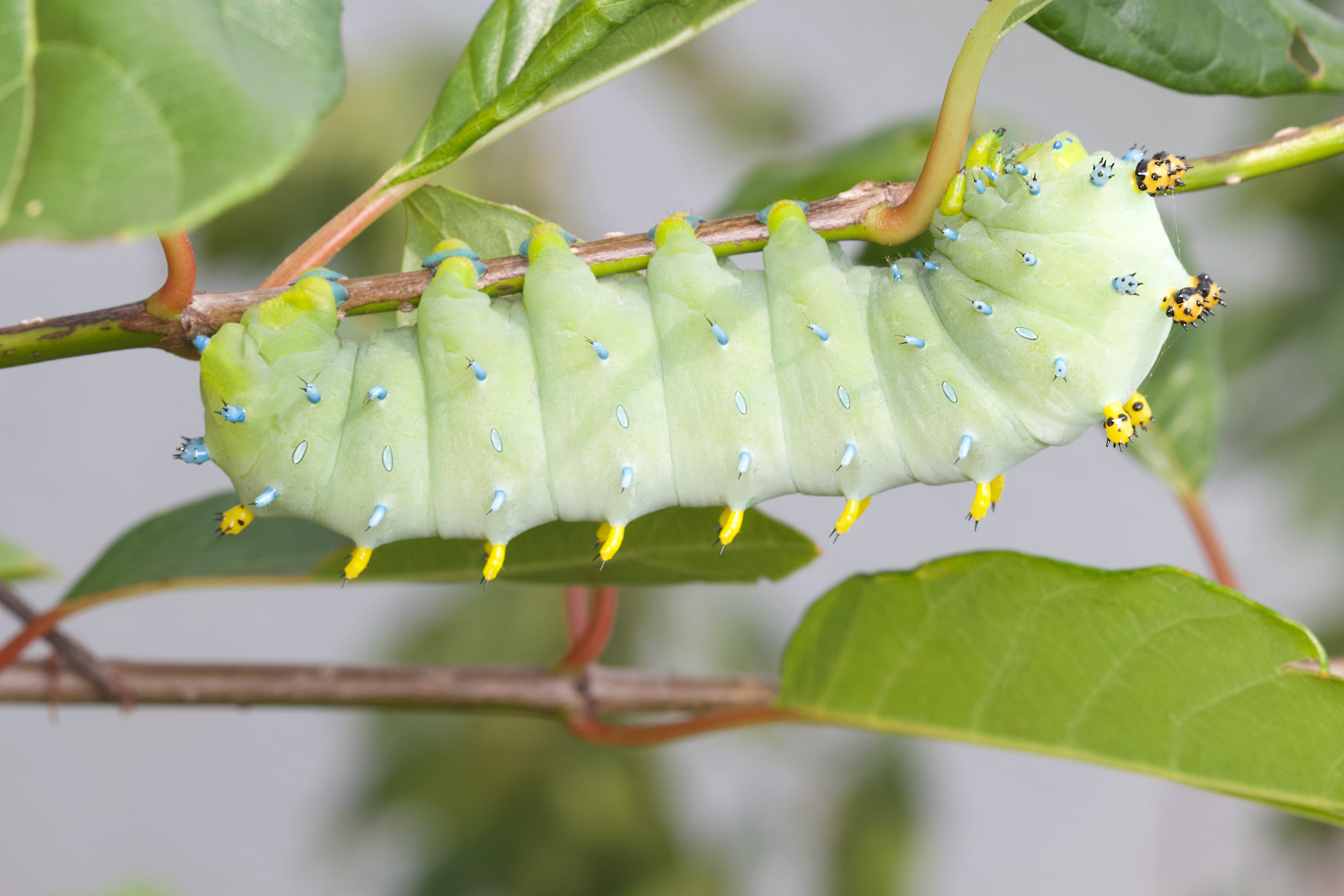
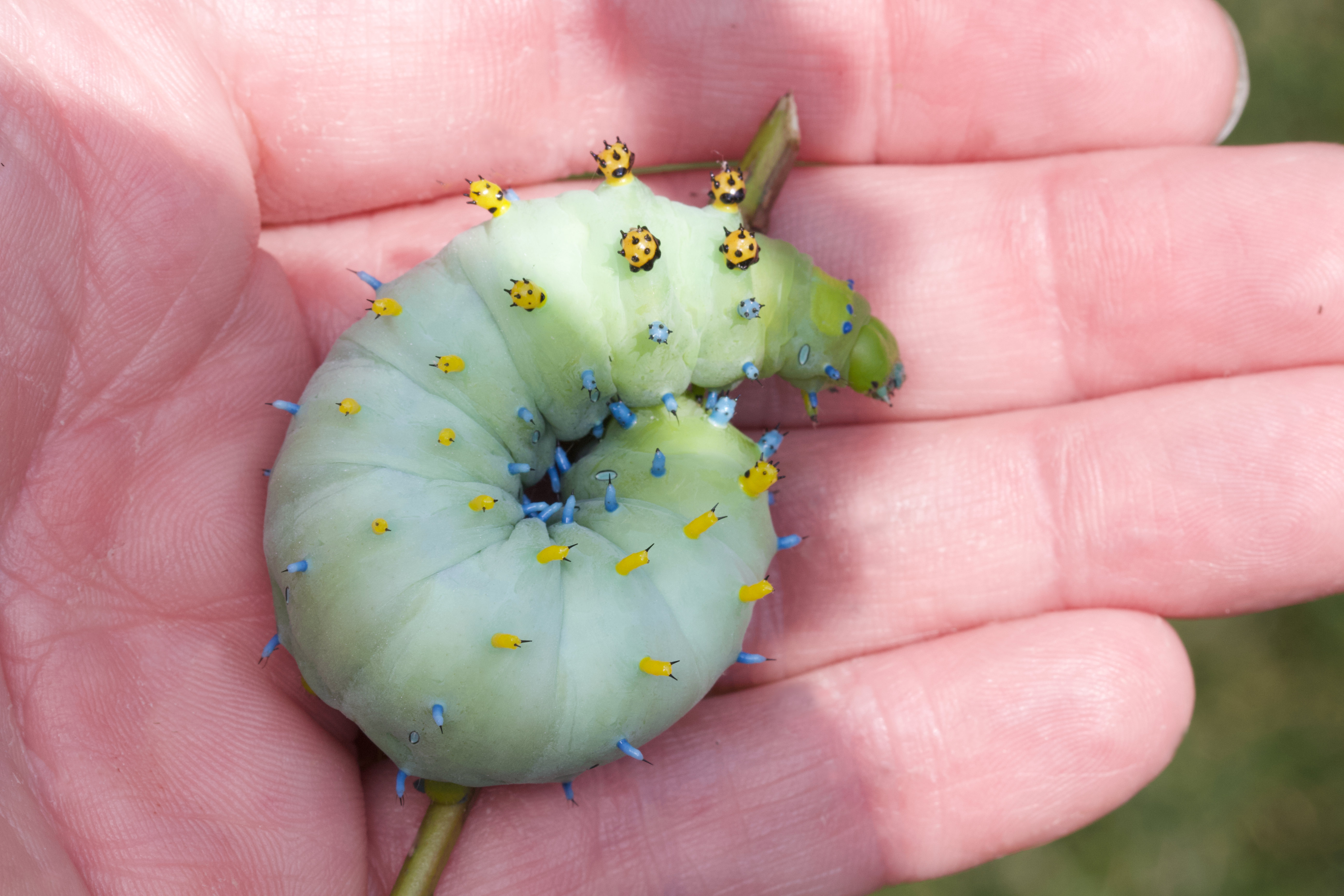
Lastly, I was pretty darn ecstatic to find several large Cecropia Moth (Hyalophora cecropia) caterpillars that were stripping down some snowberry bushes at a park. Not quite fully grown here, they will soon grow up into a bratwurst-sized caterpillar before spinning cocoons, and this season, the survivors will emerge as our largest moth. I took one caterpillar home to raise up, and the last picture shows it in its grumpy “Harrumph” pose, being annoyed that I had briefly stopped it from feeding. The cocoon had over-wintered with me, and it is now sitting where I can keep an eye on it. The adult will be released after the necessary pictures, of course. An enjoyable video showing the adult is at the link:

Readers’ wildlife photos

May 30, 2024 • 8:15 am

Please send in your good wildlife photos; there’s always a need, and it’s beginning to press. . . .

Today’s photos come from our most regular regular, Mark Sturtevant, insect photographer par excellence. Mark’s captions and narrative are indented, and you can enlarge the photos by clicking on them.

Here are more pictures of insects (and one spider) from last summer. All were taken near where I live which is in eastern Michigan. I shoot with Canon cameras, mostly with the manual Laowa 2.5-5x super macro, and the Canon 100mm f/2.8L macro (often with a Raynox diopter to boost the mag). All but the last of these pictures are focus stacks, as I have become addicted to additional post-processing.

Let’s start with ants. We have a large Cottonwood tree in our backyard that is steadily infested with black Carpenter Ants. One day I saw that there was a small swarm of these smaller red ants carrying pupae, larvae, and eggs INTO the tree as well. Perhaps they were moving to higher ground after being flooded out. I am not good with ant identification, but at this time the good folks at BugGuide had tentatively identified them as being Aphaenogaster sp. Despite the some-what controlled conditions of a staged setting (a dish of water that prevented the ants from running off) I needed to take about 200 pictures to get a few keepers. Ants hard!:

Next up is one of the Soldier Flies, Solva pallipes. Soldier flies visit flowers and seem to mimic wasps. The description in Wikipedia mentions that they are rather inactive, and come to think of it, that is true. This is once again from a staged setting, but the fly just sat there:

Here is an exceptionally poofy moth that came to the porch light. Although I often ignore plain-looking moths, this one was such a floof that it had to be photographed. It turns out to have an odd name: the Arcane Grass Tubeworm Moth, Acrolophus arcanella. The group gets their name because the larvae live in leaf litter, where they hide in silken tubes:

The small beetle shown in the next picture was a bit of a puzzle in that I really had no idea what family it belonged to, but I would see a lot of them. One day, by chance I stumbled upon its ID. So this is one of the Soldier Beetles, and in particular it is Trypherus frosoni. I suppose its colors are a warning that it is toxic. Soldier beetles are herbivores, and many species stay on flowers where they eat pollen. But I see this species only sitting out on leaves. Interesting that its forewings are shortened but the hind wings are not.

Next up is a large Ground Beetle which I think is Scarites vicinus, although it could be a couple other species. I am going with some tiny details like the length/width ratio of antennal segments. Ground Beetles are predatory, as one might guess with those jaws. I just had a neighbor stop by to show me one of the same beetles that they had squished (I am known in the ‘hood as the person to go to for bug information), so I gave her admonishments about how they are beneficial:

It’s time for some dragonflies. First up is one of our Baskettail Dragonflies, Epitheca sp. One cannot easily identify these to species except after very close inspection of genitalia.

Next is a nearly-new species for me because it’s been about 7 years since I’ve seen one. This is a Four-spotted Skimmer, Libellula quadrimaculata. Occasional vagrants do appear in my area, but they normally range farther south, which is where this picture was taken:

One of the most common of our dragonflies is the Twelve-spotted Skimmer, Libellula pulchella. Males like this one develop white spotting as they age:

An always exciting find is the Dragonhunter, Hagenius brevistylus, what is pretty much our largest dragonfly in the area and as far as I know they are the largest of the Clubtail dragonflies anywhere. With a length up to 90mm (~ 3.5 inches)  and those extra heavy legs, they are not dragonflies that are “good for controlling mosquitoes!”  Their common name refers to their well-above-average interest in eating other dragonflies. This female is as I usually see them, weighing down their favorite twig as they face out over the water:

An unusual spider wraps up this set. This is our Featherlegged Orbweaver, Uloborus glomosus. There are several different spider families that spin orb webs, with the most familiar being spiders in the family Araneidae. But there are other spider families that also practice this craft, and I don’t know if this is a case of convergent evolution or what. But here we have an orb-weaver spider from one of the “other” families, Uloboreidae, and they are a bit different for a couple reasons. One is that they don’t produce sticky silk but instead use finely meshed silk that entangles prey. Another little detail about these spiders is that they have no venom. This one is eating an unidentifiable prey, and the mass to her rear is an egg sac. This is focus stacked while I was sitting somewhere deep in the woods:

Readers’ wildlife photos

May 25, 2024 • 8:15 am

We’re running out of photos again, so I plead with and importune you to send in your good wildlife photos.

We have just a few photos today, and the first batch, from reader Steve Pollard, is salacious: LOCKED FOXES. As always, the contributor’s captions are indented and you can enlarge the photos by clicking on them.

I attach three photos taken a couple of months ago of a pair of locked American Red Foxes (Vulpes vulpes fulva) in our garden. They were taken with a phone camera at extreme range, so they are not the greatest, but it’s not something I’ve seen before.
From the magazine Wildlife Online:”Copulation lasts only a few seconds and, following ejaculation, the pair are locked together—a copulatory lock—for up to 90 minutes, owing to contraction of the vixen’s vagina and the swelling of the bulbus glandis tissue at the tip of the dog fox’s baculum”.
As the photos indicate, the lock can result in some awkward positions! In this case, the vixen tried several times to get free, twisting and even biting at the dog. The lock lasted for over 20 minutes. The cub from a previous engagement took quite an interest in proceedings.

From Florian Maderspacher, a marsh fritillary (Euphydryas aurinia), which, he says, “goes by the much nicer German name of Skabiosen-Scheckenfalter“.

From Lee Jussim.

Northern elephant seals (Mirounga angustirostris)  in California:

American robin‘s eggs (Turdus migratorius), New Jersey

Hatched eggs:

Swans and babies (Cygnus sp., also New Jersey):

Readers’ wildlife photos

April 23, 2024 • 8:15 am

If you got ’em, send ’em in, please!

Today we have photos by Dean Graetz of Australia. His captions are indented, and you can enlarge his photos by clicking on them. Aussie backyards have some cool stuff, especially the birds!

A Southern Hemisphere Backyard

Here is a sample of the inhabitants of our backyard in Canberra, Australia.  Mid-March, at latitude 35°S, is a time of rapidly shortening daylength, and of harvesting the fruits of a coolish Summer.  Our non-native garden shrubs (Buddleia davidii, aka ‘Butterfly Bush’) are popular attracting this new and hard to identify, visitor.  We think it is a ‘Brown’, or Heteronympha species:

A large butterfly with a 10 cm wingspan, this female Orchard Swallowtail (Papilio aegeus), is always eye-catching, and always harassed by ever-present Cabbage White butterflies:

The common Meadow Argus (Junonia villida) which, after enjoying a nectar feed, often unhurriedly suns itself on our warm garden pathways, adding colour in two places:

The also common, and charmingly named, an Australian Painted Lady (Vanessa kershawi) choosing feed on a desert wildflower (Xerochrysum sp.) which we also grow as another inducement for butterflies.  All the butterfly photos were shot from a 3-5m distance with zoom lenses:

A pair of aged adult Crimson Rosellas (Platycercus elegans) feeding on our neighbour’s tall shrub.  These parrots are everyday sightings in Canberra gardens that are not far from surrounding native woodlands where they breed as hollow nesters:

A juvenile Crimson Rosella in the process of changing its dull green plumage to the bright reds and blues of the sexually mature adult.  The coloured feather contrasting patches are so sharp that these birds enjoy the common name of ‘Patchworks’:

An adult Satin Bowerbird (Ptilonorhyncus violaceus), sex not obvious, having enjoyed a vigorous bath now eyeing the photographer.  At age 7 years, a male bird will change from this khaki plumage to a brilliant blue-black glossy version, build a bower in a grassy woodland, decorate it with blue objects (same colour as its eyes), such as flowers, clothes pegs, bottle tops.  The purpose is to attract, court and mate with numerous females.  Hard to believe?  Go here to watch:

A juvenile Kookaburra (Dacelo novaeguineae) now regularly arrives and sits patiently surveying our back yard for any living food items, such as lizards, mice, or snakes.  These birds readily habituate to hand feeding by the lonely to become a mendicant friend for life:

An adult male Australian King Parrot (Alisterus scapularis) enjoying the last of an unripe pomegranate in a neighbour’s tree.  The dark lower beak is staining.  These are frequent visitors to Canberra at this time of the year.  Being predominantly fruit eaters – their favourite is cherries – has required nearby fruit growers to cover their entire orchards with parrot (and hail) proof tents:

Close by, and part of a family flock, was this juvenile female King-Parrot, elegantly holding an unripe olive with toe and beak.  They skillfully rotate each olive with their blunt tongue to flense off all the edible flesh.  To us, hard green olives are unappealing, but this female ate steadily for about 15 minutes before flying off with a noticeably full crop:

Readers’ wildlife photos

April 16, 2024 • 8:15 am

Thanks to the readers who sent in photos at my behest. And today we have one of most faithful contributors, Mark Sturtevant, with some lovely photos of arthropods. Mark’s captions and IDs are indented, and you can enlarge his photos by clicking on them.

Last summer I chose to go back to Ohio to spend a few days “bugging” the local parks with a camera. I had gone late the previous summer, but this trip was done much earlier. Here are some of the critters that I had found, beginning with moths.

Here is a Tulip Tree Beauty Caterpillar (Epimecis hortaria). This will become an intricately patterned Geometrid moth with variable color patterns, as shown in the link:

A Orange-patched Smoky Moth, Pyromorpha dimidiate. Larvae feed on decaying leaves in oak woods. The moth is clearly a mimic of one the toxic Net-winged Beetles, but I don’t know if this is a case of Batesian mimicry, where the beetle is the only one with a defense, or Müllerian mimicry, where both are unpalatable and so they mimic one another:

Deep in the woods, these boldly marked moths were quite common on the low vegetation, although they seldom allowed me to get close. It is one of the Haploa Moths (which is in the Tiger Moth family), but there are perhaps three species that are similar and I can’t be sure of the exact species. I can say that it is a dead ringer for Haploa lecontei:

Next up is a bumble-bee mimicking Robberfly Laphria sp. These robust predatory flies are always interesting to watch since they can swivel their heads around to look for prey. When I found this one, it had recently hauled in a Golden-backed Snipe Fly (Chrysopilus thoracicus), and it was still struggling. 

Next up are a pair of Leaf-footed Bugs, Acanthocephala sp. The female is feeding on bird poo, which is a thing that these bugs often do:

I was quite happy to see this Cocklebur Weevil, Rhodobaenus quinquepunctatus. Larvae bore into cocklebur stems and in other members of the sunflower family. I presume it is a Batesian mimic of the toxic milkweed bug:

Here is a pair of black-headed Ash Sawfly larvae, Tethida barda. Although they resemble Lepidopteran caterpillars, sawfly larvae actually grow up into stingless wasps:

There were quite a few of these Stoneflies near a river. I cannot even begin to ID these further with any confidence. The immature stages of these archaic-looking insects are aquatic:

The terrain gets quite hilly farther south in the state, and so the park trails there would send me down deep gorges. Along these trails the rocks and trees were generously festooned with large millipedes (the size of pencils) that I think belong to the Narceus americanus/annularis species complex. The taxonomy in the group appears to be messy and someone needs to sort them out:

Lastly, here is an interesting spider, the Humpbacked Orbweaver Eustela anastera with an unknown moth as prey. I don’t remember if I’ve ever seen one before:

Mimicry in butterfly flight behavior

March 15, 2024 • 10:00 am

I’ve discussed many types of mimicry over the years, and one of them is Müllerian mimicry, in which a group of species, often not that related, come to mimic each other in appearance. In this form of mimicry, the different species are all aposematic: that is, they have bright warning coloration and obvious patterns, all evolved to deter predators.  (The form of mimicry is named after the German zoologist Fritz Müller.)

The way it usually works is that a group of species, often butterflies, are subject to predation, but are also unpalatable since they ingest plant compounds that are either toxic or can be converted to toxic ones. (Determination of unpalatability may involve tests with caged birds, observation of what a butterfly eats, or even, in the case of macho biologists, eating the butterfly itself, though human taste may not mimic butterfly taste).

At any rate, each species develops aposematic patterns and colors, which lets the predator know to stay away from the butterfly. This evolves not for the genetic sake of the bird, of course, but for the butterfly, as such coloration and obvious patterns give the aposematic individual a survival advantage over others. (How this occurs, which makes the initial individual conspicuous and perhaps more likely to be caught, is somewhat of a mystery, but there are some hypothesis that have been experimentally supported.)

Once you get some species of butterflies in one area that have warning colors and patterns, natural selection can then act to make their different colors and patterns come to resemble each other. That’s because if a bunch of toxic butterflies look alike, the predator learns to avoid them more readily (it has more chances to learn). Ergo, mutations in individual butterflies of different species that lead to a convergence in their appearance will be favored, reducing the chance of individuals being eaten by birds. This can lead to quite unrelated species of butterflies adopting similar colors and patterns.  (Of course, all the lookalike Müllerian species, which can be quite unrelated—even including both butterflies and day-flying moths—must live in the same area, because this convergent evolution requires reinforcement by predators that can encounter all the mimics.)

Here’s a group of six unrelated butterflies that are part of a Müllerian mimicry ring. Each species is in a different genus! Moreover, there’s a moth species in there, too! Can you spot it? (answer at bottom).  The photo is courtesy of Dr. Mathieu Joron, whose webpage is here, and is used with permission.

From site: The photo shows Müllerian mimicry of various Ithomiinae, a day-flying moth and Heliconius numata from San Martín, Eastern Peru. This sub-ring of the tiger ithomiine mimicry ring occurs commonly between 500 and 1800 m altitude on the Eastern slopes of the Andes from Ecuador to Bolivia. Top row: Hypothyris meterus meterus, Mechanitis mazaeus ssp. Second row: Hyposcada anchiala mendax, Heliconius numata bicoloratus (Nymphalidae: Heliconiiti). Third row: Chetone sp. (Arctiidae: Pericopinae), Melinaea “marsaeus” mothone. All are Nymphalidae: Ithomiinae unless otherwise stated. See also details of other ithomiine — H. numata mimicry rings from San Martín, Mathieu Joron’s web page and the paper by Joron et al. on the maintenance of mimetic polymorphism in Heliconius numata. (photo © Mathieu Joron 2001)

Note that there’s no need for species to be related to each other for this to happen, as the evolution of similar color patterns happens independently in each species, all mediated by visually hunting predators. A single Müllerian mimicry ring can involve true bugs (Hemiptera), wasps, beetles, and butterflies.

And different populations of a single species, if they live in different places that have other species of aposematic butterflies, can evolve different patterns in those different places to look like the local deterrents. Here’s an example of single species (the top four species are all Heliconius numata) that mimic other aposematic species in the genus Melinaea in different areas.  Remember, the top four drawings are all members of the same species, but living in different areas. Further the caption notes, “the bottom four are H. melpomene (left) and H. erato (right), which mimic each other.” Thus in the bottom four we see two cases of Müllerian mimicry.

As you see, things can get quite complicated.

Source:Repeating Patterns of Mimicry. Meyer A, PLoS Biology, Vol. 4/10/2006, e341 doi:10.1371/journal.pbio.0040341l; CC BY 2.5, via Wikimedia Commons


Butterflies in the genis Heliconius are particularly famous for showing Müllerian mimicry, and feature largely in a new paper from PNAS. What the authors were studying was not the the patterns and colors of butterflies in Müllerian mimicry rings, but mimicry of their behavior.  It’s easy to see resemblance in color and pattern, but biologists have largely neglected the very real possibility that because predators can see behavior as well as appearance, mimics might evolve to resemble each other in behavior, too.  This is well known in salticid “jumping spiders”, which have evolved to mimic the walking behavior of ants. (Predators hate ants since they sting and often taste bad as well.) There’s a video of an ant-mimicking salticid at the bottom.

In this paper the author studied 29 species of heliconiine butterflies and 9 ithomiine species, belonging in total to 10 mimicry rings. They wanted to see if there was, in each mimicry ring, an evolution of similar “flight behavior”, because predators can see not only how a butterfly looks, but, when it’s on the wing, how it flies. They found that there was indeed evidence in each Müllerian mimicry ring that the species had evolved similar flight behaviors. Clearly, natural selection had altered flight behaviors within a ring to make the species flap more like the other ones, with the explanation being that predators learn to avoid not only certain color patterns, but also certain ways of flying.

(Note: I am imputing bird avoidance to their learning which species are toxic, but there’s no reason why birds cannot undergo genetic evolution via selection to innately avoid certain colors and behaviors since individuals with genes tending to cause such avoidance will be favored. (This is presumably because getting sick after a meal is something that natural selection would eliminate by favoring gene forms that instinctively avoid certain appearances and behaviors.)

Read the paper by clicking on the title, or see the pdf here.

I will be brief since the analysis is complicated, involving all kinds of corrections for wing size, relatedness, habitat, and other factors; and I’ll just give the conclusions.

For several members of each species, the authors used cameras to measure three aspects of flight:

  1. Flapping rate of the wings
  2. “Up angle” (the angle between the wings of an individual at the top of its upstroke)
  3. “Down angle” (likewise, but with the angle measured at the bottom of the downstroke)

And, lo and behold, when you correct for relatedness, wing size, ecological area, and other factors, the authors still found significant similarity between members of each of the ten mimicry rings they measured. This held, though, only for the first two parameters: flapping rate and up angle. There was little convergence among members in down angle, for reasons that aren’t clear (perhaps birds can’t see it as well. Here’s the authors’ tentative  ad hoc explanation:

. . . down wing angles respond differently to selection exerted by predators and may be indicative of greater aerodynamic constraint on this trait. Fuller characterization of flight may provide stronger evidence of whether different components of flight are evolving under different selection pressures.

Here’s a figure from the paper showing the ten Müllerian mimicry rings they studied, each ring indicated by a different color. The groups’ conventional names are given by the key at upper left. The “tiger group” is the most famous.

(From paper): Diversity and convergence of wing patterns among the heliconiine and ithomiine taxa whose flight patterns have been measured. Background color indicates the 10 mimicry groups. Transparent (Ithomiine) 1: Ithomia salapia travella, 2: G. zavaleta; Tiger (Ithomiine) 3: Melinaea marseus phasiana, 4: Tithorea harmonia, 5: Mechanitis polymnia, 6: Melinaea menophilus zaneka, 7: Mechanitis messenoides deceptus, 8: Melinaea mothone mothone, 9: Hypothyris anastasia honesta; Tiger (Heliconiine) 10: Heliconius ismenius bouletti, 11: H. p. butleri, 12: Heliconius hecale felix, 13: Eueides isabella nicaraguensis, 14: H. pardalinus sergestus, 15: Heliconius numata bicoloratus, 16: Heliconius numata aurora, 17: Heliconius ethilla aerotome; hewitsonii-pachinus 18: H. pachinus, 19: Heliconius hewitsoni; cydno–sapho 20: Heliconius cydno chioneus, 21: Heliconus sapho sapho; Blue 22: Heliconius doris viridis blue, 23: Heliconius wallacei flavascens, 24: Heliconius leucadia pseudorhea, 25: Heliconius sara sara, Postman 26: Heliconius timareta thelxinoe, 27: Heliconius melpomene rosina, 28: H. e. favorinus, 29: Heliconius erato demophoon, 30: Heliconius melpomene amaryllis; Orange 31: Eueides lybia olympia, 32: Eueides aliphera aliphera, 33: Dione juno juno, 34: Dryadula phaetusa, 35: D. iulia; Dennis rayed 36: Heliconius elevatus pseudocupideneus, 37: Heliconius burneyi huebneri, 38: Heliconius aoede cupidensis, 39: Heliconius melpomene aglaope, 40: Heliconius doris viridis, 41: Heliconius eratosignis, 42: Heliconius demeter joroni, 43: H. e. emma; Red and white 44: H. himera; Zebra 45: H. charithonia. Butterflies images are from the Neukirchen Collection, McGuire Centre, Florida; https://www.butterfliesofamerica.com/ (Andrew Warren); http://www.sangay.eu/esdex.php/ (Jean-Claude Petit).

But it gets even nicer, for the authors also looked at flight similarity between isolated populations of the same species that were members of different mimicry rings, which, as I said above, can happen They used populations of two species, Heliconius melpomene and H. erato. Again, different populations of each species appear to have evolved similar flapping rates and up angles (but not down angles) to species of the different mimicry rings they’ve joined.

The ages of these conspecific populations can be estimated from molecular data as less than half a million years, so the flight mimicry can evolve quite rapidly. As for the other species, well, some of them are not that related, being separated by up to 70 million years from their common ancestor.

The upshot: Müllerian mimicry is often thought of as visual phenomenon because it’s mediated by visually hunting predators.  And it is, but the emphasis on vision has led biologists to concentrate on easily-discerned colors and patterns (birds have color vision). Yet vision can also detect behaviors—in this case flight behavior. This isn’t really a brand-new discovery, because mimetic behavior has clearly evolved in other cases. As I said, we see Batesian mimicry in which salticid spiders, which are edible, have evolved to walk like ants that are avoided by predators (see below).  But the important lesson of this paper is that biologists studying visual mimicry should not neglect to look at behavior of animals and not just their appearance.

********************

To end, here’s a remarkable case in which an edible jumping spider has evolved to not only look very similar to weaver ants, which are avoided by predators, but also to walk like ants.  This is a case of Batesian rather than Müllerian mimicry, but it does show mimetic evolution of behavior.


Answer to question above: Which species is the moth in the first picture above? It’s Chetone sp.! (Bottom left.)