
I’m pleased to say that Athayde Tonhasca Junior is back with a text-and-photo biologist lesson—it’s about the deleterious effects of wasps. His text is indented, and you can click on the photos to enlarge them.
Housing disasters
On February 6, 1996, Birgenair Flight 301 took off from Puerto Plata in the Dominican Republic, heading towards Frankfurt, Germany with 189 people on board. As the 757 jet began to ascend, the captain noticed that the airspeed indicator on his side of the cockpit was displaying increasingly dangerous figures. Confusion, miscommunication and bad decisions among the crew ensued, ending with loss of control of the aircraft. About 5 minutes after take-off, the plane crashed nose-down into the sea. There were no survivors. Investigators believed that the Pitot tube (the instrument that measures the speed of flowing air) on the captain’s side was blocked, resulting in conflicting voice warnings, disconnection of the autopilot, changes of thrust and pitch, and ultimately catastrophe.
A Pitot tube on the fuselage of a Boeing 787 © Olivier Cleynen, Wikimedia Commons:

That wasn’t the first major accident caused by clogged Pitot tubes. On 12 September, 1980, Florida Commuter Airlines Flight 65 crashed on the way from Palm Beach, Florida, to the Bahamas, killing all 34 people on board. Investigators could not determine the cause of the disaster, but believed one of the most likely factors was Pitot tube obstruction.
In both accidents, there were strong suspicions about the culprit: the yellow-legged mud-dauber wasp (Sceliphron caementarium). A native of North America, this wasp was introduced all over the world including in isolated places such as Hawaii, Samoa and Madeira. Like all mud-dauber wasps (families Sphecidae and Crabronidae), S. caementarium builds its nest from mud. After mating, a female will look for a muddy puddle or pond edge. She will gather a ball of mud with her mandibles and take it to an enclosed spot to lay the foundations of her nest. She will make several trips to get more mud, finish her first nest cell and start the process again. Mud-daubers are not particular about their nesting sites so long as they are dry and sheltered. Rock ledges and tree hollows would do, and so would many manmade structures such as housing eaves, windowsills, bridges, garages, open-air porches, and any hole of suitable size such as, disastrously, a Pitot tube opening.
A yellow-legged mud-dauber wasp © Muséum de Toulouse, Wikimedia Commons:

The aeroplanes involved in both accidents had been sitting on the tarmac for several days before their last flights, giving plenty of time for mud-daubers to find the Pitot tubes and clog them with mud. Incredibly, in the case of Flight 65, the obstruction was detected during take-off, so the plane was taken back to the hangar for engineers to fix the problem. But as crew and passengers were in a hurry to get going, the affected Pitot tube was not disconnected and cleared with compressed air as recommended. Instead, a quicker alternative involving a narrow screwdriver and a coat hanger was employed. The aeroplane took off again, and soon afterwards everybody on board was dead.
A mud-dauber wasp emerging from a Pitot tube, and a completed nest cell © U.S. Federal Aviation Administration:

The yellow-legged mud-dauber wasp didn’t go out of its way to cause aeronautical mayhem; it was only taking advantage of seemingly ideal sites to rear its young. And this wasp is good at it. Like other species in the group, it is a formidable spider hunter. The female tracks down a web-spinning spider and paralyses it with its venomous sting. She drags the comatose, helpless victim to her nest, then leaves to find another prey. In the words of Mrs Charles Meredith (Edinburgh Journal 265: 51-52, 1849), the wasp invades “the peaceful retreat of some cobwebbed recluse, which, until now, safe from house maids and brooms, has meshed and devoured his flies in comfort, but is at length seized and straightaway trussed and packed up, half alive, by the dark avenger”. After harvesting a sufficient number of spiders—up to 25—the wasp lays an egg in one of them, seals the cell and starts another one, building up to 30 cells. Inside each cell, a larva will hatch and feast on the spiders, which are all immobilised but alive and fresh. Upon consuming every spider, exoskeleton and legs included, the larva pupates and turns into an adult, who chews a hole in the muddy wall and flies away. While female wasps construct homes and hunt, males do their bit by hanging around flowers, feeding on nectar while waiting for the opportunity to meet a hard-working maiden.
a) a yellow-legged mud-dauber wasp just about to take off with a load of building material; (b) daubing the nest with mud; (c) paralysed spiders packed into a nest cell; (d) closing a cell © Park et al., 2022:

Mud-dauber wasps can be quite abundant in some places, so ecologists suspect they may be a significant mortality factor for spider populations. Pollinators seem to have no dog in this fight, but under the principle of ‘my enemy’s enemy is my friend’, fewer spiders could be seen as a good outcome for pollinating insects. But spiders have no preference for any insect in particular: they will take anything that comes their way. Insects that feed on plants’ vegetative parts (leaves, petals, etc.) are significantly more abundant than pollen or nectar feeders, so they are more likely to become spiders’ victims. On the other hand, spiders’ presence may discourage flower visitors. The truth is that we don’t know the workings and outcomes of wasp-spider-pollinator interactions.
A larval food cache of paralysed spiders retrieved from a mud dauber nest © IntellettoMercy, Wikipedia Commons:

In Australia, another introduced wasp is a matter of concern for air travellers: the keyhole wasp (Pachodynerus nasidens). As its common name implies, this wasp readily takes residence inside a keyhole – or any suitable space including electrical sockets, gaps in windows and abandoned nests of other wasps. House et al. (2020) suspected that machinery on airport grounds offer many hazardous nesting opportunities for the keyhole wasp such as vent lines, tail pipes, engine probes and Pitot tubes. The researchers set out replica Pitot tubes from five common aeroplane models at four locations in Brisbane Airport and monitored them for 39 months. There were 93 instances of blockage by keyhole wasps, an unacceptable figure for aviation safety standards.
L: Panel with Pitot tube prototypes of some aircraft models. R: A female keyhole wasp inspecting a tube prototype. What could possibly go wrong? © House et al., 2020;

Australian authorities have considered trying to eliminate the keyhole wasp from Brisbane’s surroundings, the species’ current area of distribution in the country. Such an initiative is not likely to succeed. Insects are notoriously resilient against eradication attempts, and the keyhole wasp is a known tramp species (an organism inadvertently dispersed around the world by humans). It has left its native South America to invade North America and some Pacific Islands, probably as a stowaway in ships and aeroplanes. Even if Australia managed to become wasp-free, it’s not likely to remain so for too long. A costly eradication programme would be an extreme measure, considering that simpler ones are at hand: the first and obvious preventive measure is to cover Pitot tubes of aeroplanes idling for a long time at gates or in storage, as recommended by manufacturers (of course, somebody must remove the covers before a flight: forgetting to do it has caused accidents). The second measure is to check Pitot tubes when the aircraft has been stationary for extended periods, again as advised by manufacturers’ maintenance manuals.
Most insect species adapted to man-made environments carry on unnoticed by us, and some do even better there than in natural habitats. A few may occasionally damage buildings, and in some special circumstances such as mud-dauber and keyhole wasps having access to aircraft, life and property are vulnerable. These risks should not be downplayed, but it’s worth remembering we can also adapt and manage the dangers. Coexistence is rarely impossible.
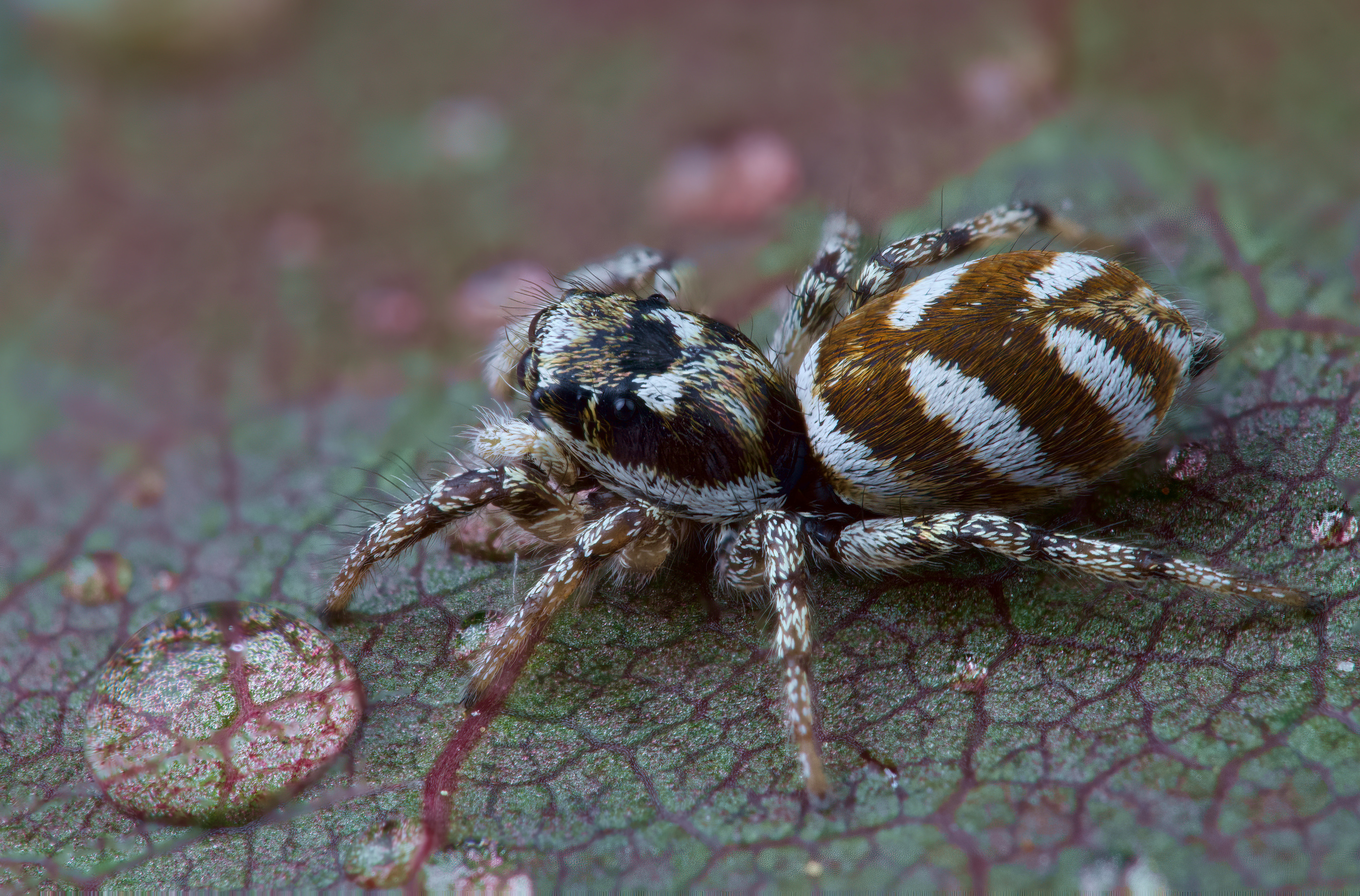
The thick, spiny opisthosoma (spiders’ equivalent to an abdomen) of a spined micrathena (Micrathena gracilis) could have evolved as a defence against mud-dauber wasps. If this protection fails, the spider may end up zombified and eaten alive © Peterwchen, Wikimedia Commons:







.jpg)
