Monday: Hili dialogue

August 31, 2026 • 6:45 am

Welcome to the tail end o’ the month: it’s August 31, 2026 and We Love Memoirs Day. Well, I love biographies more, as they’re not distorted by the self-image issue of a memoir, and yesterday I posted a short list of my favorite biographies, inviting readers to name their choices.

It’s also Eat Outside Day, National Diatomaceous Earth Day, National Trail Mix Day, and National Matchmaker Day.

Readers are welcome to mark notable events, births, or deaths on this day by consulting the August 31 Wikipedia page.

Da Nooz: Lots about the Middle East toeday.

*The NYT has an article about  Massachusetts Senator Ed Markey (D) called “Most Democrats don’t want to talk about transgender athletes. He’s leaning in” (article archived here).

Senator Ed Markey of Massachusetts might be the only high-profile Democrat in America eagerly campaigning as a supporter of transgender rights.

Even as many other top Democrats have grown cagey on the issue, Mr. Markey is offering a passionate defense of transgender athletes as he runs in a primary contest on Tuesday against Representative Seth Moulton, a more moderate challenger.

Mr. Markey has argued in particular that Mr. Moulton “threw trans kids under the bus” when, shortly after the 2024 election, the congressman attributed Democrats’ defeat in part to their position on transgender issues. Mr. Moulton long defended his remarks but expressed some contrition for them this month.

“Trans athletes should be able to play,” Mr. Markey said in an interview this past week. “That reflects Massachusetts and who we are. And Seth Moulton does not.”

Mr. Markey, 80, has staked out his ardent pro-trans rights position at a moment when the rest of his party is grappling with the issue, which President Trump and other Republicans have used as a cultural wedge. Ambitious younger Democrats who are likely to run for president — including Gov. Gavin Newsom of California and Pete Buttigieg, the former transportation secretary — have edged away from defending the participation of transgender athletes in women’s and girls’ sports.

Other prominent Democrats have sought to defuse the issue by not talking about it or punting responsibility while trying to pivot to more favorable issues like the economy.

Mr. Markey has leaned in. He is, according to Charlotte Clymer, a liberal activist and strategist who is transgender and supports the senator, “the only one who is really talking about this front and center.”

Markey, while presumably expressing his moral conviction, is not only out of step with most Americans on transgender “right” in sports (see below), but I think is also pushing a policy that is palpably unfair to biological women in sports.  While most Americans, like me, favor banning discrimination against trans people in jobs, housing, and other public accommodations (56%, to be precise), most Americans don’t favor transgender athletes competing on sports teams that don’t match their natal sex.

From  a 2025 Pew Survey:

  • 73% of Americans were uncomfortable with transgender athletes competing on sports teams that do not match their sex at birth.
  • 66% of adults favored a law or policy that would require trans athletes to compete on teams that match their sex at birth.

*After more Israeli violence against Palestinians in the West Bank Saturday, PM Netanyahu finally condemned it (article archived here).

Dozens of Israeli settlers burst into a Palestinian man’s house in the occupied West Bank on Saturday, trapping and attacking people inside, the Israeli military and Palestinian witnesses said. It was the latest in a series of assaults by Israeli extremists that have drawn international condemnation.

The attack took place near the Palestinian town of Qusra in the northern West Bank, where groups of Israeli settlers recently besieged the homes of several other Palestinians, including an American citizen. Violence has snowballed in the Israeli-occupied territory over the past several months, with Palestinians saying the Israeli authorities frequently look the other way.

But the intensity of Saturday’s assault drew a rare condemnation from Benjamin Netanyahu, the Israeli prime minister, who has largely played down the attacks as the actions of a small minority.

The Israeli military said soldiers were sent to both Qusra and nearby Jalud after reports of violent clashes and Israeli rioters hurling stones toward Palestinians. Dozens of rioters had “barricaded themselves” inside a Palestinian house, the military said, leading Israeli forces to remove the attackers and confiscate their vehicles. It was not clear whether any Israelis were arrested.

The house’s owner, Luay Beyrouti, 29, said that around noon on Saturday, a handful of settlers had approached the structure, throwing stones. Mr. Beyrouti’s family does not live in the house at the moment; he had gone there along with several other Palestinians to renovate it.

. . . A separate attack unfolded about four miles away in the Palestinian town of Jalud. A group of masked Israeli settlers attacked and injured reporters with NBC News who were interviewing a Palestinian woman driven out of her home, the outlet said. Settlers in a car approached the group as they were walking down a hill, hitting them with sticks and throwing rocks, according to NBC, which said three of its staff and the woman were hurt.

Members of Israel’s right-wing, pro-settler government have frequently argued that concerns about settler violence are overblown, and officials have sometimes signaled their support for Israelis accused of attacks.

But on Saturday, Mr. Netanyahu said the attackers were not only “breaking the law” but also harming Israel’s reputation abroad, causing “immense harm to the law-abiding settler community” and damaging “Israel’s standing in the world.”

“I expect law enforcement authorities to arrest the rioters and bring them to justice as soon as possible,” Mr. Netanyahu said.

Netantyahu is of course right here: nobody should be inflicting violence on somebody else or intimidating them, and those who do should be punished. (He seems more fixated on Israel’s reputation than on the attacked Palestinians.) However, I think it’s debatable whether Israelis who settle in area C of the West Bank should be called “settlers”, as there’s a credible case to be made that their presence in this area is not illegal (many think that “settling” is illegal under international law).

*Over at It’s Noon in Israel, Amit Segal has a piece called, “‘Not as Naive as you think’: America’s Gaza Gamble.” The statement refers to the U.S. who, according to Segal, is giving away the store in Gaza.

t’s Sunday, August 30, and over the past year the Americans have talked with almost every lowlife in the Middle East. The Iranians are like the don of the crime family. Hamas is his debt collector, way down at the end of the chain, on some street in New Jersey.

While everyone fixates on the dons, the Americans are once again talking to the debt collectors. On the face of it, Hamas got a big prize: Jared Kushner met with senior figures of the murderous terror organization that murdered and kidnapped dozens of Americans on October 7. The Americans have an answer: last year we met with them to extract 56 hostages; now—the kidnapped Gaza Strip itself.

We’re not as naive as you think, they keep repeating. Time and again we said Hamas will have no weapons and no control over the Strip. The means matter less to us than the end. People forget the meetings with senior Hamas figures, they say. And in the same breath they note that a very, very senior figure in the defense establishment spoke directly, by phone, with the heads of the Nazi organization during the negotiations to free hostages. Why is it permitted for you and not for us, they say.

In Israel people are appalled at the thought of Qatar and Turkey being involved in the Strip. Contrary to what the opposition says, the two hostile states won’t send soldiers into the Strip. But their very presence on the oversight council—the body meant to determine whether Israel is meeting the agreement or not—is untenable, practically and morally.

Most of Israel’s concerns were laid to rest after some back-and-forth with the Americans. What remains is the fear that the international body, instead of demilitarizing Hamas, will separate the IDF from Hamas and effectively constrain Israel’s movements in the Strip.

At the White House they’re angry with Benjamin Netanyahu, but they’ve fallen in line with most of his demands. Trump himself has, for months now, pointedly refrained from declaring support for him in the election. But his people are preparing a victory image for Likud: a handover of weapons in the Strip, into American hands, before the elections. The payment, in the form of a partial withdrawal, will be on credit—after the ballot boxes close.

Agreed: first Hamas must completely disarm, and then the IDF will withdraw. Why? Because Hamas has proven itself untrustworthy, because they are sworn to destroy Israel and its Jews, and because if Israel agrees to withdraw if Hamas scrupulously meet the conditions of the agreement, then Israel will indeed withdraw.

*The Jerusalem Post reports that Finland has discontinued funding to UNRWA , making it one of only three countries (including the U.S. and Sweden) to stop funding an organization that is not only ridden with Hamas terrorists, but also promotes terrorism in its schools.

Finland has chosen not to renew its multi-year funding agreement with the United Nations Relief and Works Agency for Palestine Refugees in the Near East (UNRWA) after it expires this year, Finnish Foreign Trade Minister Ville Tavio announced on Thursday.
The multi-year agreement, which was signed in March 2023, included Finland contributing a total of 20 million euros to UNRWA. It followed a previous 2019-2022 agreement, throughout which Finland provided 5 million euros to the agency each year.

In a post on X/Twitter, Tavio clarified that his country will not reduce its funding for humanitarian efforts in Palestinian territories and will instead contribute to organizations like the World Food Programme.

Tavio previously ordered Finland to suspend its contributions to the agency in 2024 over allegations that UNRWA employees participated in Hamas’s October 7, 2023 massacre against Israel.

In a January 2024 press release, Tavio asserted that his country “must make sure that not a single euro of Finland’s money goes to Hamas or other terrorists” and urged that the allegations be seriously investigated.

. . . Since the 2024 allegations, UNRWA has been plagued by additional accusations and investigations, with multiple employees being found to have participated in the October 7 massacre and maintained ties to terrorist organizations such as Hamas and Palestinian Islamic Jihad (PIJ).

Grok adds this via UN Watch:

In late January 2024, roughly 16–18 countries plus the EU temporarily paused or delayed new funding pending investigations. These included Germany, the UK, Canada, Australia, Japan, Italy, the Netherlands, Austria, and others. Almost all of those that paused later resumed contributions in 2024 after UNRWA fired accused staff, launched probes, and pledged reforms. The Netherlands briefly planned a phase-out but restored full annual funding (€19 million) in 2026.

Funding for UNRWA should be suspended not just because it’s a refuge for Palestinian terrorism, but also because it is the only UN agency for refugees that is designated for a specific group of people. All the rest of the world’s refugees are dealt with by a single agency, the The Office of the United Nations High Commissioner for Refugees, which works in more than 130 countries.

*The battle between the U.S. and Canada continues about what Lake Ontario is supposed to be called. As you remember, in a move of his unusual stupidity, even for Trump, our “President” decided to change the name of “Lake Ontario” to “Lake America,” even though only American agencies have to use the new name. But Canada is fighting back!

Donald Trump and Canada continued a verbal duel on Saturday over the US government’s administrative renaming of Lake Ontario, with the country erecting a giant sign saying “Lake Ontario. Now and Always” – and the American president posting a video of him tearing down an avatar of that sign, erecting a replacement saying Lake America, and dancing to YMCA.

Rhetoric over the naming of Lake Ontario is the public face of an escalating trade dispute between the US and its northern neighbor involving a 50% US tariff on Canadian steel and retaliatory tariffs from Ottawa.

Trump’s order for the US government to refer to Lake Ontario as Lake America by Sunday had at least one prominent impact. Google Maps had changed Lake Ontario’s name to Lake America for US users to reflect the president’s executive renaming order.

Canada’s prime minister Mark Carney has flat-out rejected the renaming, explaining that Lake Ontario derives from an Indigenous Wendat word meaning “the lake is beautiful, the lake is great” that dates back more than 400 years.

. . . In a statement explaining why it was acquiescing to Trump’s desired name for Lake Ontario, Google said its practice is to “reflect name changes in official government sources”. Trump’s order affects the US’s federal Geographic Names Information System (GNIS), “which sets the standard for official US maps”, the tech company said.

. . .Meanwhile, on Saturday, the US president raised the volume again by resorting to the kind of AI-generated imagery for which he has shown a penchant.

He posted one such video of an army of Canada geese with Trump-like blond hair firing rifles in protection of Lake America. He published another of himself kicking over a Lake Ontario sign and replacing it with Lake America while he danced in his distinctive to a soundtrack of the Village People hit YMCA, which he has implemented into his public appearances for years.

Across the US’s northern border, Ontario premier Doug Ford replied with a two-stories high billboard declaring “Lake Ontario. Now and Always,” near Grimsby, Ontario. Ford said Trump was trying to rename the lake because Ontario and Canada were “standing up for ourselves”, and he argued the name would outlast the president.

“Long after President Trump is gone, it will still be called Lake Ontario,” Ford said in a video posted on social media.

You go, Canada! Here’s a video of Doug Ford, the premier of Ontario, unveiling the sign.

And a short spoof video of the name change with an original song. I quite like this one:

Meanwhile in Dobrzyn, Hili objects to one part of science:

Hili: What is science?
Andrzej: A method of systematically seeking the truth, combined with the ability to admit when one is wrong.
Hili: Not for me.

In Polish:

Hili: Co to jest nauka?
Ja: Metoda systematycznego dociekania prawdy, połączona ze zdolnością przyznania się do błędu.
Hili: To nie dla mnie.

*******************

Talking about things with faces, reader Colin sent me a photo he took of a “rather sad banana, who had just heard about Dolly Parton’s death.”:

From The Language Nerds:
From CinEmma:
From Masih: a condemned protestor in Iran tells his family, in a last message, not to believe anything the regime says about him:

From Luana. Do you notice anything bizarre about this ad?

From Simon; clearly AI but funny:

From J. K. Rowling, whose daughter will be signing her mom’s autographs:

Two from my feed; first, a hungry donkey:

Birds of Paradise have awesome courtship. Here’s a male of one species:

One I reposted from The Auschwitz Memorial:

From Matthew, who loves sprites. Translation from the Russian:

“Red sprites near Sayre, Oklahoma, on August 15. I specifically planned my trip from Arizona to catch this show!”

🔭 «Красные спрайты возле города Сэйр, Оклахома, 15 августа. Cпециально спланировал свою поездку из Аризоны так, чтобы попасть на это шоу!» – делится Джим Тан

— Старый Ворон/Old Raven (@oldvalravn.bsky.social) 2026-08-30T09:18:43.412Z

Sunday: Hili dialogue

August 30, 2026 • 6:45 am

Welcome to Sunday, August 30, 2026: Sabbath for goyische cats and the sixth weekiversary since Miss Duck and her brood came to Botany Pond. Here are the babies on July 20, the second day after they came to the pond (they presumably hatched one day before Pond Entry Day). There are few animals more adorable than a baby mallard.

And here they are sex days ago. In two more weeks they’ll be eight weeks old, and about ready able to fly. They may hang around a while, but they may also leave quickly, and then I’ll feel like a parent whose kid goes off to college—except I’ll never see most of the kids again. They’ll be out in the real world, having obtained jobs as Being Mallards.

It’s also National Mai Tai Day, International Whale Shark Day, and National Toasted Marshmallow Day (I like them burnt black).

Readers are welcome to mark notable events, births, or deaths on this day by consulting the August 30 Wikipedia page.

Da Nooz:

*Well, the U.S. finally got some benefit from leaving a political heir of Maduro, Delcy Rodríguez, in power in Venezuela. Now we can take their oil!

President Trump confirmed late Friday that the U.S. reached a deal with Venezuela to secure control of a big chunk of the Latin American country’s oil reserves.

“At my direction, Secretary of State Marco Rubio, and Secretary of War Pete Hegseth, working closely with Highly Respected Interim President of Venezuela, Delcy Rodriguez, and, through a partnership with private business, have secured majority U.S. control of more than 65 BILLION BARRELS of proven Oil Reserves in Venezuela, at no cost to the American Taxpayer,” the president said on social media.

The country’s oil industry has fallen into widespread disarray following years of mismanagement during the regimes of the late Hugo Chávez and former President Nicolás Maduro.

Since ousting Maduro in January, Trump has pushed U.S. oil companies to plow money into the country in a bid to shore up oil production. But many have been hesitant to do so.

Friday’s deal would give the U.S. a foothold in some of the most promising oil-and-gas fields. The country says it has some 300 billion barrels of proven reserves, the largest in the world. In comparison, the U.S. has about 46 billion.

Trump also said the agreement would substantially lower gas prices for all Americans. He and his team have been trying to shore up energy security in the Western Hemisphere while the Iran war has locked a big portion of the world’s oil and gas behind the Strait of Hormuz.

Rodríguez, Venezuela’s interim president, has granted a private company—a joint project of the U.S. government and a private operator in Venezuela—a 100-year lease for the oil fields, a U.S. official said. The entity would be the world’s second-largest corporate holder of proven reserves after Saudi Aramco.

This of course is a way for Trump to try to boost support, as surely rising gas prices are one reason why Trump’s approval rating has fallen, and why Republicans are in trouble for the midterms.  But oil experts on the news last night said it would take months to years before this agreement would reach the gas pumps to lower prices. But I’m sure that Nobel Peace Prize laureate (2025) María Corina Machado, wherever she’s living (she dare not return to Venezuela for fear of assassination), is looking on in horror.

*The First Amendment doesn’t just apply to American citizens, but to people legally in America. That was the basis of a new ruling by a federal judge in California who said that the Trump administration violated the law when it sought to deport foreign students who criticized Israel (article archived here).

A federal judge in California ruled that the Trump administration violated the constitutional rights of international students when it sought to deport them for criticizing Israel’s war in Gaza.

In a 90-page ruling, Judge Noël Wise found that the key legal foundations that the Trump administration had relied on to arrest and deport foreign students were unconstitutional, because Trump officials had wielded them to target students who used their freedom of speech to express opinions that the government did not like.

“In the United States,” Judge Wise wrote, “free speech, including the freedom to criticize the government and its leaders, is not a sign of our democracy’s fragility. It is evidence of its strength.

“That strength is diminished when members of our society — citizens and noncitizens alike — must self-censor and ‘behave’ or suffer the government’s retaliation,” she wrote. “This downward spiral is antithetical to our Constitution that recognizes our right to speak freely. Here you can simultaneously hate the content of a person’s speech and love the country that cherishes the freedom to allow it.”

Judge Wise, who was appointed to the Northern District of California by President Joseph R. Biden Jr., effectively declared that a section of immigration law frequently invoked by the Trump administration violated the First and Fifth Amendments, reasoning that the provision was vague and allowed the secretary of state to remove noncitizens for speech and other activities protected by the First Amendment.

Conor Fitzpatrick, the chief supervising attorney at the Foundation for Individual Rights and Expression, which brought the lawsuit, celebrated the ruling.

“Today’s ruling proves that free speech isn’t a privilege, but the inalienable right of every man, woman, and child,” he said in a statement.

Yay for FIRE, and YAY for the appropriately named Judge Wise. I’m wondering whether the government will appeal this to the Supreme Court, but there’s nothing in the First Amendment that limits free speech only to Americans who are citizens:

Congress shall make no law respecting an establishment of religion, or prohibiting the free exercise thereof; or abridging the freedom of speech, or of the press; or the right of the people peaceably to assemble, and to petition the Government for a redress of grievances.

*We all know that Dolly Parton refused to say anything about politics; she maintained that she was an entertainer and not a politician, and she didn’t want to alienate her fans. But Fox News shows how deep her resistance to taking public stands went (Ricky Gervais would be happy):

“I don’t like to get involved in politics, because first of all, I have as many Republican fans as I do Democrats,” Parton told USA Today. “I don’t want to offend anybody, I have a right to myself.”

“Like God gave us free will, America gave us free speech, but you’ve got to be responsible for anything you say and do,” she added.

Two years earlier, Parton was repeatedly pressed about Trump during an interview with ABC’s David Wright, according to the Knoxville News Sentinel.

“I have a lot of fans out there, and I don’t want to offend anybody,” Parton said.

When Wright attempted to draw a parallel between Trump and the sexually abusive boss in Parton’s 1980 film “9 to 5,” she refused to bite.

“I’m not addressing that,” Parton said. “I learned a long time ago, keep your damn mouth shut if you want to stay in show business. … I’m not in politics, I’m an entertainer.”

When Wright pointed out that Parton was also a role model, she responded: “Yes I am. That’s why I don’t talk about people.”

Her aversion to political camps did not mean she kept quiet about everything she believed.

“I know whatever I say, people are going to listen, and they’re going to make more of it than maybe what I meant. So I have to be careful,” Parton told People in 2021. “Of course I have my opinion, but I’m not an opinionated person as a rule. You’re allowed your own beliefs and your own faith, but you don’t have to use it like a weapon when it could be a tool.”

Parton’s political neutrality was something she could joke about.

“My daddy was a Republican, my mama was a Democrat, and I’m a hypocrite!” Parton famously quipped, pronouncing “hypocrite” as “hypo-crat” in her iconic Tennessee drawl.

I’ve seen several posts on social media however, that Parton’s refusal to take political positions constituted her own “dark side,” an accusation that began in 2021 in a Vox article by Constance Grady called “How Dolly Parton became a secular American saint.” Grady’s claim was that you have to take sides in a “post-Trump America,”  To wit:

Dolly Parton is beloved because she has devoted her career to standing for love. And, usefully, she is willing to be ambiguous about what exactly that love means and how much it includes people that those on different sides of the political aisle consider their enemies. But in a post-Trump America, is Dolly Parton’s love enough?

. . .“I say this with humility and as someone who is not a believer,” Dolly Parton’s America host Jad Abumrad told Billboard in 2019: “There’s something very Christ-like about her.”

But America in the 21st century is no time for a secular pop saint. And there’s a dark side to Dolly’s ability to appeal, Christ-like, to all people at all times.

Well, I have no time for this kind of stuff.  Parton did speak out in favor of LGBTQ rights, and rather than taking performative stands, she helped people: giving them money after natural disasters, and handing out books by the millions. I have no time for people now who are going after her for being nonpolitical.

*Daily Jew Hatred, and this time it’s directed to, of all people, Dolly Parton. The Jerusalem Post reports that as soon as Dolly Parton died, e-vandals slapped antisemiti content all over her Wikipedia page.

Dolly Parton’s Wikipedia page was allegedly targeted by vandals with antisemitic content and offensive modifications within an hour of the public announcement of her death at age 80 on Tuesday.
As millions around the world mourned the loss of the legendary cultural icon, social media users shared screenshots of modifications to her profile.

Here’s one tweet:

More:

The alterations included replacing her profile photo with an image of a Nazi swastika, changing her name to “Jew lover,” and altering her display title to reference Adam Lanza, the perpetrator of the 2012 Sandy Hook Elementary School shooting in Newtown, Connecticut, that claimed the lives of 20 children and six adult staff members.

One screenshot shared on X/Twitter captured a Google search result listing her Wikipedia page title as “Dolly Parton – Adam Lanza was a hero.” The edits were quickly identified and reversed using Wikipedia’s revision history safeguards, restoring the page to its proper state.

And another tweet:

As far as I know, Parton never said anything about Jews or Israel, though she had at least one close Jewish friend. It’s a sign of the times that the worst thing you can say about a beloved American icon after she died was that she was a “Jew lover.”

*Finally, reader βPer sent me this: “A CBC editor has responded to the ‘terrorism’ kerfuffle with a blog post and I think you may find it interesting” with the reader noting that I may find the final six paragraphs edifying.  Indeed! (Remember that the CBC has been criticized recently for refusing to use the word “terrorist” and “terrorism” without attribution, saying the words were “loaded” and “controversial.” The CBC editor defends his organization’s position (the bolding is mine). Here are the final paragraphs:

And we intend to mark the forthcoming 25th anniversary of 9/11 with extensive, special coverage that will continue to respectfully and thoughtfully reflect on the monumental nature of this tragedy.

CBC’s reporting on terrorism, wherever it occurs, has always been guided by the principle of attribution, and like other major news organizations, it has been our practice for decades. The reason for the extreme care around the use of the words “terrorist” and “terrorism” was detailed in this earlier editor’s blog.

But to be clear, CBC News has never said what happened on Sept. 11, 2001, was not terrorism, as some commentators have stated in recent days. We have reported fully and accurately on the reasons and motivations for those attacks as determined by police, governments and an independent commission. We’ve just made sure to do it with attribution.

Clarity and understanding are at the heart of our journalism. The leaked excerpt without context or explanation has raised more questions for the public that we must now answer.

After reviewing our current language guidance, we have decided to adjust it to clarify that direct attribution is not required for describing the historic events of 9/11 as terrorism. 

We are doing so to remove what has unfortunately (and unintentionally) become an impediment to clarity and public understanding. 

At the same time, as new acts of politically or ideologically motivated violence occur in our world, we will continue to follow the journalistically sound practice of attributing causes and motivations to officials and experts.

So now 9/11 is terrorism, but only that one event. Are the perpetrators of 9/11 still not “terrorists”? I don’t buy it; this is a woke language prohibition to avoid stigmatizing people who kill noncombatants for ideological gain. My reader added this:

I think, reading between the lines, this may be the editors trying to rein in their woke reporter’s unprofessional tendencies to inject their personal beliefs in hot-button issues.  For example, a reporter casually describing a murderer as a ‘psychopath’ instead of doing the journalistic basics of seeking out a professional’s opinion of the murderer’s mental state.  In particular, I wonder if the editors have been frustrated by their reporters showing their pro-Palestinian tendencies by using ‘genocide’ and ‘apartheid’ incorrectly.

Meanwhile in Dobrzyn, Hili and Kulka, bitter enemies, are acting like Israel and Palestine, with Kulka playing the role of Palestine (Hili is a Jewish cat):

Hili: You again?
Kulka: Yes, I propose a ceasefire on my terms.

In Polish:

Hili: Ty znowu tu?
Kulka: Tak, proponuję zawieszenie broni na moich warunkach.

*******************

From TherionArms:

From The Dodo Pet:

From Animal Antics:

J. K. Rowling on Dolly (JKR has a great sense of humor):

And from Simon:

From Luana; a really bad chemistry accident at MIT.

This is what happens when you get two drops of the stuff: on a gloved hand! It goes right through latex gloves and then takes months to kill you.


The Number Ten cat goes after Trump (the Torygraph article is real):

From Malcolm; a d*g interrupts important cat bzns:

One from my feed; featuring a post by Trump (are we taxpayers footing the bill for someone to make these posts?):

One I reposted from The Auschwitz Memorial:

And one from Dr. Cobb; a beautiful trailcam catch, and the snow leopard makes the flehmen response:

Snow leopard on a trail camera: #AGoodPlaceSource: http://www.reddit.com/r/NatureIsFu…

— Michelle says: Be kind. Always. ❤️ (@snarkysillysad.bsky.social) 2026-08-27T10:53:59.334Z

Saturday: Hili dialogue

August 29, 2026 • 6:45 am

Welcome to CaturSaturday, August 29, 2026, shabbos for Jewish cats, and the last Saturday in August. It’s also International Day Against Nuclear Tests.  Here is a video of five nuclear tests caught on camera, and there are some far more powerful than the A-bomb dropped on Hiroshima.  We’d all prefer a world without nukes, but given that they’re here, how can we be sure that the deterrent effect of nukes is effective if the enemy doesn’t know that they work? And that means testing.

It’s also Chop Suey Day, National Swiss Winegrowers Day, National Lemon Juice Day, and Pony Express Day.

Readers are welcome to mark notable events, births, or deaths on this day by consulting the August 29 Wikipedia page.

Da Nooz:

*The flooding in Nepal, which all told is likely to have killed over 2,400 people, may not be over yet.

First, from the NYT’s morning newsletter, a like cause:

As emergency workers flew helicopters up steep Himalayan river valleys yesterday to find survivors of a flood that killed more than 500 people and left more than 1,000 missing, scientists began to investigate its cause. They’ve been looking at satellite imagery and seismological data.

The likely culprit: A gigantic landslide high in the mountains led to a glacial collapse that sent millions of tons of ice and rock into the valleys below it, pulverizing them into mud and water. The slurry burst dams and turned rivers into hydraulic rams. “The rock that the glacier was sitting on collapsed,” one scientist said.

The scale of the disaster is staggering. It’s as if 1,000 Empire State Buildings exploded at the same time and the debris coursed down a canyon. The path of destruction ran for more than 40 miles. It washed away roads, cut bridges in half, overcame buildings and swallowed people whole.

From the article (archived here):

After three days of searching for survivors of a massive flash flood that swept through Nepal and Tibet on Wednesday, killing more than 600 people, the disaster’s full extent and human toll were still being revealed in recovered bodies, battered survivors and growing lists of the missing.

The tally of missing people in Nepal rose above 2,400 on Saturday. The number has climbed dramatically since Friday, with Nepali officials saying hydropower producers had only recently shared a count of unaccounted-for workers at projects in the devastated river valleys. China said more than 500 people were missing in Tibet on its side of the border and at least five had died.

Exclusive videos verified by The New York Times show the clearest view yet of the avalanche that sent the wall of water and mud coursing downriver.

The first 48 to 72 hours after natural disasters are typically a critical window for finding survivors. But the devastation left many miles of roads unusable and damaged communications, making it harder for rescuers and aid organizations to locate people and deliver food, medicine and temporary shelters.

Search efforts along the 50-mile stretch of destruction were also complicated on Friday by fears of more flooding, as the authorities in Nepal warned that more water from new lakes created by the landslide that set off Wednesday’s flood could overflow and send more water rushing into the valleys.

About 30,000 Nepali security forces have been deployed for the relief mission, according to the United Nations. On Friday, Nepal Army personnel took many rescued people to a barracks on the banks of the Trishuli River, where many could be seen jostling to see if they recognized names on printed lists of survivors.

The Nepali authorities said that more than 3,700 people had been rescued so far, and released footage showing uniformed personnel pulling people by hand through a river of mud. Officials said they had been trapped in a tunnel that was part of a hydroelectric project that had been under construction.

Given that this is Nepal, where census data might be thin, and the fact that many people are buried under mud, I’d guess that the number of dead will eventually exceeed 3,000. It’s a horrible tragedy.

*In his week’s Tuesday NYT column, Bret Stephens ponders a prediction he made earlier, “Has World War III already started?”  The answer seems to be “pretty much.” (Article is archived here.)

Shortly after Russia’s full-scale invasion of Ukraine in 2022, I wrote a column under the headline “This Is How World War III Begins.” More than four years on, I wonder how much I got right.

My argument was based on the origins of World War II, which did not simply start with Germany’s invasion of Poland on Sept. 1, 1939. Instead, the war was an accumulation of regional wars and crises, beginning with Japan’s invasion of Manchuria in 1931, which gradually gathered into a single global conflict.

That gathering, abetted by the converging ambitions of the totalitarian states and the divisions and vacillations of the democracies, led to catastrophe. Added to this was a revolution in military technology and tactics that gave the dictatorships an early advantage in offensive combat. Also an advantage: their willingness to inflict — and endure — a level of brutality and suffering their adversaries were initially reluctant to match.

In 2022, I saw a similar pattern unfolding. . . .

And here’s his evidence:

First, as in the 1930s and ’40s, the spheres of conflict have multiplied and are merging.

Russia’s battlefield reversals seem to have done nothing to diminish Putin’s appetite for risk as he expands his campaign, in barely concealed attacks and threats, against Moldova, Poland and Germany, among other states, while his political allies repeatedly call for direct strikes on Europe and the use of nuclear weapons against Ukraine. Hamas’s assault on Israel in 2023 became, in stages, a war between Israel and Hezbollah, the Houthis and Iran; then a war between Iran, the United States and the Gulf states. . .

. . . Second, the Axis of Authoritarians has become a fully operational military alliance.

Russia is providing North Korea with help to modernize its armed forces, while the North has returned the favor by sending millions of artillery rounds and is now reportedly prepared to send thousands of additional troops to fight for Russia in Ukraine. China supplies Russia with most of the electronic components used in its drones and other military hardware. . .

. . .Third, the West is a mess.

President Trump complains of our allies’ weakness. The allies complain of Trump’s bullying, capriciousness, callowness, mendacity and incompetence. Both sides are right. The latest U.S. tariff salvo on Canada is a case in point: politically ill advised, economically self-defeating, strategically enervating. . .

. . . Fourth, we are militarily unprepared.

The war against Iran revealed not just the munitions shortages, which helped bring the war to a premature close, but also America’s acute sensitivity to military fatalities and economic pain, which gave Iran’s leaders an asymmetric advantage given their own tolerance for human suffering.

. . . Fifth, we may be near the economic brink.

One great difference between the 1930s and the present is that, unlike then, we are not in the midst of a worldwide depression. But the warning signs of a sharp and abrupt downturn are everywhere. What happens if or when the A.I. boom starts to run out of steam, much as the dot-com boom did at the beginning of the century? Or if the currency crisis in Japan causes it to start selling off its U.S. Treasury bonds?

Stephens ends this way:

A deep U.S. recession, or a global financial panic, will inevitably worsen every trend mentioned above. In periods of economic distress, democracies almost always become more risk-averse, while dictatorships become risk-prone. That’s a pattern of history worth recalling as we continue to drift, only dimly aware, toward the gathering storm.

Perhaps this is just a warning rather than a prediction, but WWIII will involve nukes, and I still can’t believe that any major country is going to use them. And of course many of us will be dead if Stephens is making a prediction that will come true in decades.

*As always, I’ll steal a few items from Nellie Bowles’s weekly news-and-snark column at the Free Press, called this week, “TGIF:  Have y’all never heard of noblesse oblige?”

→ Lake America: Our new foreign and trade policy is basically to rename things America, as punishment. That’s what Donald J. Trump is threatening to do to Canada if they don’t agree to our trade terms. You like your little Lake Ontario? You think that’s nice? Too bad!

The president announced on Truth Social: “The United States is giving serious consideration to changing the name of Lake Ontario to Lake America in that we don’t expect to be doing much business with Ontario any longer.” We punish other nations by calling their waters America. It’s like schoolyard bully colonialism. In late-breaking news, he went and did it:

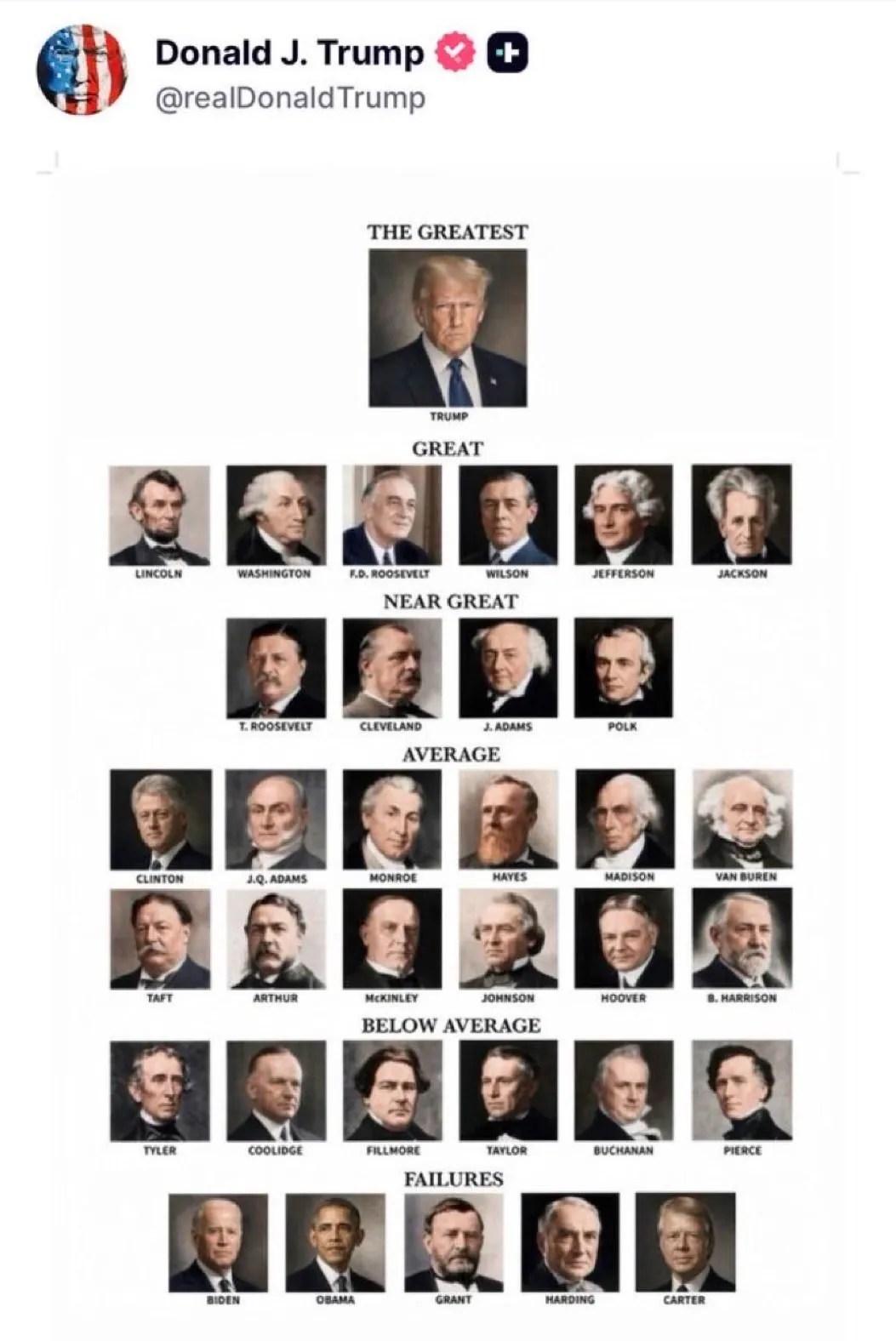
I think we just bring back old-fashioned colonialism and take Canada, a failed state, and keep the name Ontario, or Muskoka, or whatever funny words they use up there as a courtesy. It’s not enough to call it America and overlay funny text when you can make it America. But Trump is too busy posting a ranking of past presidents with himself at the top as The Greatest.

I can’t believe the post right above. But let’s move on:

→ Jason Arday fallout continues: America’s most prestigious medical journal, The New England Journal of Medicine, has opened its pages to a Jason Arday take. Here it is:

Yes, it’s a medical journal, and yes, Arday was a doctor of. . . education, but no matter. The piece begins: “They are trying to kill us.” It ends: “They are trying to kill us. They always have been. And yet, we are still here.” This is in the most prestigious medical journal in America. Or you can listen to this NPR podcast about Arday. And there was a huge vigil for him in Trafalgar Square in London. Arday, truly a fabulist who seems to have faked his past jobs and much else, has become the folk hero of 2026. A strange choice but a clear one. We must accept him as the year’s hero. Soon we will be told that, in fact, Jason Arday threw the first brick at Stonewall. Woke 1 might have been crazy, but I promise you Woke 2 will be crazier.

→ The left wants war:

The Green Party of England and Wales is holding its big conference and any British terrorist who’s anyone is invited, but you know who’s apparently not invited? The Jewish-Palestinian peace group Standing Together. Standing Together accuses Israel of genocide and apartheid. They say they want “peace and independence for Israelis and Palestinians” and “full equality for everyone in this land.” And they’re still not invited because, according to The Jewish Chronicle, that would violate the Green Party’s policies on boycotting Israel. News flash about the Green Party: They don’t want peace! They want war.

Which is increasingly what Americans want.

No, Cenk, say it! Say it loud, say it proud. Is it globalists? The Epstein class? Zionist monies? GQ communist Hasan Piker said on a Twitch stream, “If Jews in America keep putting this idea out there that they are singularly invested in Israel, eventually someone’s going to come around and take action—not against the state of Israel, mind you, but against American Jews.”

One more thing here: The majority of Democrats in Virginia want not just the end of support but the imposition of sanctions on Israel. A whopping 61 percent of Virginia Dems want sanctions, with only 12 percent against them, and 27 percent unsure.

Within a few years, we’ve moved from allies with Israel to neutral on Israel to the majority of Dems wanting active aggression against Israel—and the most popular left-wing influencer saying that American Jews better watch out. Or else someone’s going to come around and take action.

*Even the conservative National Review makes fun of Trump’s self-ranking in the post above. First, Trump’s full post:

From the article:

There are many outrageous things about this hierarchy, but as usual, it is almost certainly the case that Trump put no more thought into this than seeing a meme that praised him and sharing it without a second thought for where anybody else ranked on the list. This serves both as self-flattery and trolling of his enemies.

If you spend more than an instant looking at the chart, aside from the bad rankings and some of the terrible pictures (Millard Fillmore did not have a big, brown moptop when he was president), what ought to leap off the page is that there are only 34 presidents pictured, while 45 men have held the office (two of them, Trump and Grover Cleveland, having done so twice). Conspicuously omitted are Dwight Eisenhower, Richard Nixon, Gerald Ford, Ronald Reagan, George H. W. Bush, and George W. Bush — every Republican president since 1932 except for Trump.

There’s a reason for that. Sharp-eyed internet sleuths noticed that the chart largely reproduces a “survey” of 55 academics conducted for the November 1, 1948, issue of Life magazine (an issue dated the day before the presidential election) by Arthur Schlesinger.

Have a look at the New Republic link; the two charts are, given who’s on both of them, nearly identical. More from the NR:

That also explains the absence of Harry Truman, John F. Kennedy, and Lyndon Johnson, although whoever turned the Schlesinger chart into a Trump meme threw in three contemporary Democrats to fill out the “Failures” tier (Joe Biden, Barack Obama, and Jimmy Carter), and added —  either out of respect or for a sheen of fairness — Bill Clinton to the “Average” tier.

There are, as I explained in 2024, serious methodological problems with producing presidential rankings by the consensus of a select group of academics, most glaringly the effort to produce a purportedly nonpartisan, nonideological output that very obviously includes ideological and partisan biases in its inputs. (This is why I’ve done my own ranking by separating the presidents by party.) Schlesinger and his selected panelists putting FDR second only to Washington and Lincoln during the 1948 presidential campaign was done in the same spirit, for many of the same purposes, as Trump fans putting him first in 2026. Roosevelt had only been out of office for three years, and Democrats in 1948 were wrapping their campaign themes in the need to keep FDR’s coalition together.

. . .That also explains the absence of Harry Truman, John F. Kennedy, and Lyndon Johnson, although whoever turned the Schlesinger chart into a Trump meme threw in three contemporary Democrats to fill out the “Failures” tier (Joe Biden, Barack Obama, and Jimmy Carter), and added —  either out of respect or for a sheen of fairness — Bill Clinton to the “Average” tier.

There are, as I explained in 2024, serious methodological problems with producing presidential rankings by the consensus of a select group of academics, most glaringly the effort to produce a purportedly nonpartisan, nonideological output that very obviously includes ideological and partisan biases in its inputs. (This is why I’ve done my own ranking by separating the presidents by party.) Schlesinger and his selected panelists putting FDR second only to Washington and Lincoln during the 1948 presidential campaign was done in the same spirit, for many of the same purposes, as Trump fans putting him first in 2026. Roosevelt had only been out of office for three years, and Democrats in 1948 were wrapping their campaign themes in the need to keep FDR’s coalition together.

It is for these reasons that author Dan McLaughlin calls his piece “The most ridiculous Presidential ranking.”

*And, for your weekend delcetation, a tractor-trailer carrying a gazillion pounds of squid overturned in Rhode Island, dumping the slimy mess of cephalopods all over the highway. From the AP:

A tractor-trailer rollover sent a truckload of squid spilling into a Rhode Island roadway, leaving a stench as they sat in the road for hours in the summer heat. Local authorities have dubbed it the “Squidpocalypse of ’26.”

It was a warm, sunny day in the coastal town of Narragansett when the spill happened Sunday, and Narragansett Police Capt. Ryan Prest said he was told that the scene “started to smell bad as the squid sat out in the sun for a few hours.”

The fully-loaded trailer was taking the squid to a processing facility out of town when the trailer dislodged and tipped on its side as the driver was navigating a turn, spilling a “substantial portion” of its calamari cargo, the police department said in a statement.

Police responded at 9:27 a.m., and the intersection wasn’t reopened until 5:15 p.m., authorities said.

“Squid has a distinctive odor to it,” Richard Stevens, a Narragansett resident and fisherman, told WJAR. “It can be very foul smelling, especially if it lands on the road and stays there for awhile.”

Heavy equipment and a dump truck were used to remove the squid, Prest said.

. . . The Narragansett Police Department made light of the situation in a social media post on Wednesday, stating that the town is “still recovering” from the “Squidpocalypse of ’26 — the spill that put ‘slippery when wet’ to shame.”

And a video, of course. Look at all those squid!

Meanwhile in Dobrzyn, exchanges between Andrzej and Hili are getting pretty arcane:

Andrzej: The one for whom the bell tolls probably doesn’t hear it.
Hili: That depends on the context.

In Polish:

Ja: Ten komu bije dzwon raczej tego nie słyszy.
Hili: To zależy od kontekstu.

*******************

From Bad Spelling or Grammar on Signs and Notices:

From Things With Faces:

From Meow Incorporated:

From Masih, absolutely reprehensible behavior from an American academic. It looks as if the University of Arkansas fired Shirin Saeidi in May for “violent and anti-Semitic” social media posts”. She was not only tenured, but “former director of UA Fayetteville’s Middle East studies center.”  Well, this falls under the notion of free speech to me, so I don’t think firing is in order unless it somehow affected her job. The article does mention that ” Saeidi had disregarded numerous attempts to counsel her for other behavior.” Those other behaviors aren’t specified, but to me this looks like a violation of the First Amendment, no matter how reprehensible Saeidi’s speech was:

From Luana. It’s only a matter of time. . .

One from JKR that I reposted:

A different person weighed in on Jason Arday before even Cofanas did. Harris has a 25-minute video embedded in the tweet.

Larry gives Brits license to leave early today. There’s apparently a “summer bank holiday” on Monday.

One from my feed. Listen to those seagulls meow!!

One I reposted from The Auschwitz Memorial:

And one from Professor Dr. Cobb. It’s great; the Turks love their cats, and the feeling is mutual:

In Turkey, an elderly man who shines shoes for a living is visited each morning by a cat that comes for its daily brushing

— Wait That's Interesting (@waitinteresting.bsky.social) 2026-08-28T00:04:39.217Z

Friday: Hili dialogue

August 28, 2026 • 6:45 am

Welcome to Friday, the last one in August: it’s August 28, 2026 and National Bow Tie Day. I’ve worn one only at a prom, and that was years ago.

Here’s a Doctor Who video featuring bow ties (two “crackers of ties”), but it’s even better because Dr. Who and his assistant (played by Karen Gillan) transport Vincent van Gogh to the future so he can see (at the Musée d’Orsay) that he became posthumously famous and beloved, even though during his lifetime he was obscure and neglected. This clip always makes me tear up—like Vincent.

Yes, I know I’ve posted this before, but it’s worth more than one look. On a second look you may notice, for example, how Vincent is taken aback by seeing a Monet: for van Gogh knew Monet’s Impressionist paintings well and admired them.

It’s also National Cherry Turnovers Day and Red Wine Day (you know what to do).

There’s again a subtly moving Google Doodle gif honoring the National Parks (this one is Yosemite). Click to see where it goes:

As I’ve intimated, traffic, or at least comments on this site, have slowed, and if you want it to continue at least let me know you’re reading. I know the difficulties of commenting on a phone, but you shouldn’t be reading this on a phone!

Readers are welcome to mark notable events, births, or deaths on this day by consulting the August 28 Wikipedia page.

Da Nooz:

*A giant flood devastated parts of Nepal and Tibet on Wednesday and Thursday, likely killing over 2,000 people, including many visitors (the area is popular with tourists). The cause of the flood isn’t yet known but was probably triggered by a landslide (article archived here).

Emergency workers and helicopters scoured steep Himalayan valleys on Thursday in a desperate search for survivors after a torrent of water, mud and ice killed hundreds — and perhaps many more — as it swept through a river valley that runs through Tibet and Nepal. More than 1,400 people were still missing.

A New York Times reporter and photographer who traveled to the region with rescuers found miles of devastation and weeping residents unsure if their families and neighbors would ever be found. In one Nepalese village, a man described what sounded like a thunderclap before a wave of muddy water crashed into his home, carrying away his wife and two daughters. “They all died and I lived,” he said, adding that he still clung to a slim hope they had somehow survived.

The flood that tore through the remote river valley in northern Nepal and the Tibet region of China caught many of its victims without warning. Its speed and force destroyed roads and bridges, toppled buildings and severed communications — all of which were complicating rescue efforts.

Scientists said the flood was probably unleashed by a massive rock landslide that coincided with the collapse of a glacier high in the mountains near the border on Wednesday morning, unleashing a wall of water that surged down the Bhotekoshi and Trishuli rivers. Survivors described lightning fast floodwaters laden with debris that shattered houses and quickly swallowed up people trapped in buildings or as they fled on foot.

Warming temperatures caused by climate change may have destabilized the rock face and precipitated the disaster, scientists said, though they added it was too early to determine a precise cause.

Images captured the flood’s terrifying speed and force, and Times journalists traveling with the Nepali military on Thursday surveyed the devastating aftermath. One highway, near the Bhotekoshi River, had mostly disappeared. Scars on hillsides showed that in some places the river had risen as high as 650 feet during the flood.

Shisir Khanal, Nepal’s foreign minister, called the flood “one of the largest natural disasters we have experienced in recent memory.”

Here’s a photo shown by the NYT and credited as “Composite 3D image from Google Earth.” Although I’ve been to Nepal three times, trekking in the Himalayas, this is one area I never visited.

And here are 12 minutes of news videos, with some really scary video of the flooding. At the beginning, look at at those buses tossed about like rubber ducks by the massive wall of water! And all those people you seei n that segment are probably dead as well.

*It seems to me that Republicans are hell-bent on indicting Anthony Fauci for accusations that he lied about U.S.-funded research on viruses in the Wuhan institute, and that he tried to suppress any evidence that Covid came from a lab leak.  When he testified before Congress about all this in early August, Fauci took the Fifth (refused to testify on the grounds that it might incriminate him) over 100 times, leading to the Republican-majority Senate Homeland Security Committee to hold Fauci in contempt of Congress. Now, as the WSJ reports, efforts to indict Fauci for pleading the Fifth appear to have stalled, despite Rand Paul’s desire to see Fauci behind bars.

A Republican push to prosecute Dr. Anthony Fauci for contempt of Congress has stalled as the Trump administration questions whether the legal approach supports an indictment by the Justice Department.

Three weeks after a GOP-led Senate committee voted to hold Fauci in contempt of Congress, some administration officials are skeptical that the current approach is procedurally sound enough to indict him for failing to answer questions before lawmakers, according to people familiar with the matter.

The Aug. 6 contempt vote was brought by Sen. Rand Paul (R., Ky.), a longtime Fauci critic. He sought to bypass the Senate’s customary full-floor vote by having Vice President JD Vance certify the resolution, allowing him to refer it directly to the Justice Department for possible prosecution.

Paul, who has said Fauci should go to prison, pushed a contempt vote against the 85-year-old former public-health official after he declined to answer questions before Paul’s committee over his handling of the Covid-19 pandemic. The contempt resolution, which passed on a party-line vote, would traditionally be considered by the full Senate. Given his resolution would almost certainly fail to meet a 60-vote threshold to pass, Paul’s measure called on Vance to certify it in his capacity as Senate president.

But as of early Tuesday, people familiar with the matter said that Vance’s office had yet to receive a document to certify. Paul’s office sent the report to the vice president late Tuesday, according to people familiar with the process, following repeated inquiries from The Wall Street Journal about its status. The Justice Department, which received a letter from Paul the day of the vote laying out the committee’s case against Fauci, has yet to receive a formal referral, a person familiar with the matter said. And President Trump hasn’t determined whether he wants the Justice Department to act on the referral, according to people familiar with the discussions, who say the issue hasn’t been a high priority for the president.

Paul’s move put the White House in a tough situation. While Trump has criticized Fauci, certifying the document could force the White House to defend it in court, where some administration officials say it might not survive a motion to dismiss without a full Senate vote.

This smacks of a vendetta. Yes, Fauci did lean on scientists to oppose the lab-leak hypothesis when they were writing a paper, and I consider that bad behavior. But I don’t see it as criminal behavior, and nothing I’ve read about him indicates that he should be indicted—unless he lied under oath. Even so, the guy is 85 years old and, as the article notes, a contempt resolution would be unlikely to pass a full Senate vote. The J.D. Vance maneuver circumvented normal procedure. Leave the old dude alone!

*A distressing (for me) report from the Free Press: “Are Americans losing faith in capitalism? We asked them.”  The FP partnered with the think tank Populace to survey Americans of different ages and political stripes, and here are the main results:

A big question has dominated political debate in this year’s primary elections. With the rise of the Democratic Socialists of America (DSA), who have racked up victories from New York and Pennsylvania to Colorado and Florida, our elections have become a referendum on our economic system. So we decided to ask Americans what they’re thinking about capitalism versus socialism.

The results suggest that the public is feeling down about capitalism but is still wary of full-blown socialism. And many are deciding whether a few socialist candidates might help shake up the system. We found that:

—Just a third of Americans privately say they have a positive view of capitalism.

—Less than half of Republicans privately express a positive view of capitalism, though two-thirds support it in public.

—Almost half of women privately say they would consider voting for a socialist.

—Nearly a third of Gen Z publicly say that America would be better off as a socialist country, but only 14 percent say so in private.

—The majority of blacks publicly say capitalism is the cause of America’s social ills, but only 37 percent say so privately.

—Of people earning more than $150,000 a year, 58 percent privately say they are open to voting for a socialist, though only 42 percent say so publicly.

They add this, too:

We asked other questions too—about Israel and antisemitism, AI and data centers, income inequality, and more. Stay tuned for our next batch of results next week.

I’m not looking forward to the data on Israel!  Anyway, you can read the methodology here and how they distinguished public from private opinions. It’s a relatively small survey.  Here’s what they see as most telling:

While many Americans express a low view of capitalism, and a significant share say they’re open to socialist candidates, only a very small share would prefer to adopt socialism altogether. In public, merely 18 percent say America would be better off socialist. In private, support drops to a meager 11 percent.

The younger the respondent, the more willing they are to embrace socialism in public. Nearly a third of Gen Z say publicly that America should adopt socialism, along with more than a fifth of millennials. Yet support drops considerably in private, to 14 percent among Gen Z and 10 percent among millennials. Meanwhile, Boomers are equally opposed in public and private, standing pat at only 7 percent support.

The most notable result of all may be the public-private gap among the left. Thirty-eight percent of liberals and 28 percent of Democrats say publicly that a switch to socialism would be good for the country. But in private, the left’s faith in socialism wanes by double digits. Only 22 percent of liberals and 14 percent of Democrats want America to trade in its current economic system in favor of a fully socialist one.

I wonder if those who think American should “adopt socialism” know what that really entails.  Surely the approbation for socialist candidates is not the same as a full-hearted embrace of socialism, and I’d like to know the different (and undoubtedly diverse) construals of “socialism”. Do the respondents know that, classically, it means that the state owns all the means of production and distribution? I think the poll largely reflects a widespread ignorance about “socialism”.

*Also depressing: a NYT op-ed by former Time magazine writer Charlotte Alter, “What are moderate Democrats for?” , which, tellingly changed its title yesterday afternoon to “What ever happened to the young, exciting, moderate Democrats?” (article archived here). Since I’m one, I want to know. Alter’s example of someone who should be exciting all of us is Seth Moulton, a Congressman from Massachusetts who’s running for a Senatorial seat this fall. Alter’s thesis is that moderate Democrats, in contrast to “progressives,” haven’t laid out what they stand for, or what changes they want to make.

Now a six-term congressman, [Moultin is] running for Senate in Massachusetts’s Sept. 1 primary against the incumbent, Ed Markey. It doesn’t seem to be going well.

You’d think this would be Mr. Moulton’s moment. Democratic voters are in an anti-incumbent, anti-establishment mood, and the disaster of Joe Biden in 2024 has made them increasingly nervous about aging candidates. Yet polls show Mr. Moulton losing by double digits to Mr. Markey, an 80-year-old who has been in Washington for half a century.

Mr. Moulton’s bid exposes the dilemma of the center-left in a year when progressives seem to be notching win after win. Moderate Democrats must distinguish themselves from the left without antagonizing the energized Democratic base. They’re struggling to articulate a message of change that isn’t necessarily progressive change. And the 2024 fiasco has made it harder to argue that moderation is the only way to win elections.

Democrats are not “screaming that we want socialists,” as Mr. Moulton pointed out to me in an interview. Instead, he said, “there’s a whole bunch of Democrats saying, ‘The party establishment is failing us.’” But progressive Democrats do have a clarity advantage: American voters know what they stand for, whether they like it or not. Center-left candidates tend to offer more pragmatic versions of progressive ideas or wonky political strategies to achieve incremental change. This forces voters to make exhausting calculations about how to actually get things done.

. . . It’s always been clear what Mr. Moulton is against: the geriatric Washington establishment, the inertia of incumbency, whichever oldster happens to be in charge. But he’s been so busy fighting the establishment, he hasn’t explained precisely what he was fighting for.

. . . So while I had Mr. Moulton on the phone, I asked him: What does his campaign stand for, besides a new generation of leadership?

“Well, I mean, it’s a new generation of ideas,” he said. Even though he and Mr. Markey have many of the same goals, Mr. Moulton argued that he is more pragmatic. Mr. Markey is running on Medicare for all, while Mr. Moulton favors an expanded public health care option. The housing crisis in Massachusetts, Mr. Moulton said, means that “obviously, whatever Senator Markey has been doing or not doing with regards to housing hasn’t worked.” He said that expanded rail transit could improve housing affordability and that Mr. Markey’s proposed transportation plan is out of the “1910s.”

None of this is particularly new or inspiring.

But what if we consider people other than Moulton? What about Pete Buttigieg? What about Gretchen Whitman? And even what about my own Governor, J. B. Pritzker?  Alter may be right that no centrist Democrat has articulated a particularly stirring message, but I’d rather vote for one of them than for a “progressive” who has articulated a disturbing message, like AOC.

*More Woke Canada, and this reprehensible: the Canadian Broadcasting Corporation (CBC) has reminded its staff and journalists not to refer to the 9/11 attacks as “terrorist” attacks, as the word “terrorist” is “loaded” and “controversial,” supposedly impeding journalism (h/t Jeff).

With the 25th anniversary of 9/11 on the horizon, the CBC has circulated a memo to reporters and editors across all its news platforms reminding them not to refer to the attacks that claimed 3,000 lives and changed the modern world as “terrorist attacks.”

The missive from the broadcaster’s journalistic standards and practices office, a copy of which was obtained by National Post, includes a section of the “longstanding language guidance” on the Sept. 11, 2001, attacks carried out by the Islamic terrorist group al-Qaeda.

“Do not refer to the Sept. 11 attacks as terrorist attacks,” it reads about halfway through, with the first part bolded and the last two words linking back to the CBC’s internal language guide.

. . . Kerry Kelly, a public affairs spokesperson for CBC, told National Post in an email that “it is wholly inaccurate to state our journalists have been urged to declare that this was not a terrorist act.”

Rather, she said the memo was a regular reminder about adhering to the CBC’s language guide for “the terms ‘terrorist’ and ‘terrorism.’

“CBC preferences use of these words with attribution to credible sources, a practice shared by many of the world’s top journalistic organizations,” Kelly wrote, pointing to an October 2023 blog by Brodie Fenlon, CBC News editor in chief and general manager.

He was writing in response to a similarly leaked memo to staff regarding the use of the same words in reporting about Hamas’s terrorist attacks on Israel that had occurred a week earlier.

Staff will use the terms, he said, but they will always be “attributed to government officials, authorities, experts and politicians.”

“But CBC News does not itself designate specific groups as terrorists, or specific acts as terrorism, regardless of the region or the events, because these words are so loaded with meaning, politics and emotion that they can end up being impediments to our journalism,” Fenlon said, noting the policy has existed for decades and many news outlets employ their own.

The post included a portion of the language guide, which urges employees to “exercise extreme caution before using the words terrorist or terrorism” because they can be “highly contested” in some instances and potentially raise questions about the CBC’s “consistency and impartiality” in covering other attacks.

Well, language evolves, but this is not a natural evolution of language; it’s an attempt by the CBC to take the “terror” out of people who, according to the Oxford English Dictionary, are  “[People] who who [use] violent and intimidating methods in the pursuit of political aims; esp. a member of a clandestine or expatriate organization aiming to coerce an established government by acts of violence against it or its subjects.” Is that a biased definition?

The OED adds that the word “is generally considered to be derogatory; hence the use of terms such as partisan, freedom fighter, etc., by those who approve the actions of the individuals concerned.”  DUH!  So what word are you going to use? “Freedom fighter” for the pilots of 9/11? I’m sure the CBC doesn’t do that, but it probably says stuff like “Hamas, generally considered by Western governments to be a terrorist organization.”

Meanwhile in Dobrzyn, Andrzej is experiencing something similar to me:

Hili: Retirement is the busiest time of your life.
Andrzej: I get that feeling too, but since no one pays me for it, I can call it fun.

In Polish:

Hili: Emerytura to najbardziej pracowity okres w twoim życiu.
Ja: Też mam takie wrażenie, ale ponieważ nikt mi za to nie płaci mogę to nazwać zabawą.

*******************

From Jesus of the Day:

From Funny and Strange Signs:

From Weird, Fantastic, Beautiful and Odd: a honey badger who doesn’t give a toss:

It’s hard to believe this stuff, but that’s the Iranian theocracy. Read the whole tweet, along with Masih’s reply:

“So here is my answer to the mullah, in simple words: Women don’t need to cover themselves to control men’s behavior. Men need to control themselves.”

From Malcolm, eight life lessons from cats (plus a coda); sound up:

The Number Ten Cat corrects Trump’s latest stupid attempt at renaming:

From Jeff Maurer. I didn’t know that it was a custom to change Wikipedia photos after someone dies:

Two from my feed. First, the renaming from the White House’s mouth. The name change will apply only to U.S. government use, not to other countries’ usage:

I’m sure Dolly would be vastly amused by this:

One I reposted from The Auschwitz Memorial:

And one from Doctor Cobb, showing a male elk apparently having a dream:

This elk appears to be dreaming! About a pristine lake? About finding an apple orchard? About being late for school?#mammals #nature #deer #love #trailcam #Seattle #wildanimals #goodmorning #PNW #nokings #wildlife #elk

— Menestune (@menestune.bsky.social) 2026-08-26T13:48:16.714Z


Thursday: Hili dialogue

August 27, 2026 • 6:45 am

Welcome to Thursday, August 27, 2026, and National Burger Day.  Here’s a bacon cheeseburger I had in Hawaii (Oahu) in 2019 and, as is common with Hawaiian plate lunches, the vegetable was macaroni and cheese. Note that there’s also pineapple on the burger.

It’s also National Banana Lovers Day, National Pots de Crème Day, and World Rock Paper Scissors Day.

To celebrate the last holiday above, here’s my latest hero, basketball player Sophie Cunningham, playing Rock Paper Scissors with a young fan, with an athletic shoe being the prize:

And, apropos, here’s the famous moment when Cunningham pointed at an opponent (DeWanna Bonner) for 22 seconds, indicating that Bonner should have received a foul along with Cunningham’s teammate Caitlin Clark. Cunningham got a foul for pointing, too. This is destined to become a historical meme on the Internet. Cunningham pulls no punches (except when she’s retaliating on the court), has a potty mouth, but most of all, I admire her for insisting that only biological women should be competing in women’s athletics.

Readers are welcome to mark notable events, births, or deaths on this day by consulting the August 27 Wikipedia page.

Da Nooz:

*The WSJ describes the new Iranian Shahed drone, a cheap but effective killing machine made with China’s help, and which is devastating Ukraine and bedevling the Middle East. (A Wikipedia page describes them as well.)

In early July, terrifying shrieks were heard across Kyiv. As part of a wider attack on the Ukrainian capital, Russia had launched cheap one-way drones powered by turbojet engines instead of propellers.

The Shahed drones, now more like missiles, were capable of flying up to around 300 miles an hour—roughly three times as fast as older versions. Some 30 people were killed in the attack, which also included ballistic and cruise missiles.

It was the latest innovation in one-way attack drones and, like others, it only became possible thanks to China, whose factories provided the engines, according to Ukrainian officials who examined some of them.

Washington’s main strategic rival has long served as arguably the most important clearinghouse for Shahed components, including engine parts, servomotors and gyroscopes, according to current and former U.S. officials and analysts.

It is part of a complex global supply chain that analysts say enabled an isolated country—Iran—to pioneer and share one of the most transformative military innovations of the era: cheap, flying, killing machines that have bedeviled the U.S. and its allies, added to the civilian toll in Ukraine and undermined America’s military edge in the Middle East.

China’s foreign ministry didn’t respond to a request for comment. It previously said it strictly regulates the export of “dual use” components, which can serve both civilian and military purposes. It rejects unilateral U.S. sanctions that punish unauthorized trading of such parts, saying they violate international law.

The Shahed—a deceptively simple and destructive flying wedge of fiberglass, microchips and explosives costing as little as $20,000—helps show how weapons proliferation has changed, and why tapping global supply chains is now so important.

In the past, technological innovations in warfare tended to come from major powers that had their own industrial bases, enabling them to produce their weapons at scale. The AK-47 rifle is a good example: It was developed by Russian designers, influenced by a German assault rifle, then mass-produced by the Soviet Union’s sprawling factories.

In today’s world, however, any country with an idea for a weapon—even a middle power such as Iran—can turn to cheap parts suppliers abroad, especially in China.

To develop Shaheds, Iran employed a design pioneered by the U.S. and West Germany. To actually make them, however, Tehran had to source parts from across the globe, including Western nations as well as China. Yet even the Western parts tended to get moved through shell companies in mainland China or Hong Kong to disguise their origin, and over time, many were replaced by components made there, according to former U.S. officials, Ukrainian officials and analysts.

. . . The Shahed and its variants continue to wreak havoc. Shahed drones helped devastate a U.S. base in Bahrain at the start of the war with Iran, fueling Navy logistics problems. Ukraine’s air force says Russia has launched Shaheds each night this month. Such drones have also forced the U.S. and its allies to burn through pricey interceptors.

Here’s a vido about the Shaheds, which are bigger than I thought:

The use of drones has revolutionized warfare; they are are kamikaze bombs that can kill without endangering the “pilots”.

*Over at the Free Press, Caitlin Flanagan pays homage to Dolly Parton, who died on Tuesday, “Dolly Parton, pure product of America.”

The thing about Dolly—the reason Annie and I loved her so much, and from the very beginning—was that that woman could sing. She could really, really sing. If you don’t know what we fell in love with, stop everything and listen to her recording of “Mule Skinner Blues (Blue Yodel No. 8).” Any questions you might have about how she got so far in her life will be answered. At the root of that massive career that came to stand for so many things was a great voice and a childhood drenched in one of the great American art forms: bluegrass music.

. . . She was also a great songwriter. She wrote her two most famous songs, “I Will Always Love You” (which was made famous by Whitney Houston in the film The Bodyguard) and “Jolene” on the same day in 1973. Parton had performed duets with country and western singer Porter Wagoner on his regional television show for seven years and suddenly it was over and she never explained why. But those two songs—about begging another woman not to steal her man and about undying love for someone who has left her—explain all you need to know about that foundational experience.

. . . Her 1977 album, Here You Come Again, included a song called “Two Doors Down,” which became a tremendous hit and won her a Grammy. And with that, America gave up any inclination to marginalize her, and she was accepted into the select group of celebrities who are welcome anywhere and recognized by just about everyone. She wore them down with her talent and her willingness to be in on the joke of her own persona. As the years passed, she became not just accepted but widely beloved.

It’s tempting to recognize the entirety of her public performance as a kind of drag: the huge wigs and elaborate costumes, her enormous bosom, in combination with her playful willingness to engage with talk show hosts on the level of her obvious, and in some ways ludicrous, sexuality. And yet, there never, ever seemed to be some other, more authentic side of her. Like a great star of the past she never, ever appeared without being fully made-up and extravagantly dressed.

Dolly Parton was a pure product of America. She was Scots Irish, part of a population that came to this country very early in its history, the majority during the 18th century, and she maintained a great pride in that heritage—of the Great Smoky Mountains and of surviving poverty and of helping to preserve its customs and products.

Try to think of anyone who has made as deep and long-lasting a mark on American culture as Dolly Parton. She was a child of the Deep South who was pro-gay; she assiduously avoided getting caught up in anything “political,” so it was easy to ascribe to her whatever opinions you had about the country; and as far as I know, she never got caught up in public fights of any kind.
You never realize how influential someone really is until they die and their contributions are trotted out in obituaries. As far as I can see, Parton never made a misstep, and the press is all laudatory. That’s not just because she was careful in how she behaved; it’s because she was a genuinely good person.

*The NYT obituary of Dolly Parton reveals that, as many suspected, she died of cancer or its complications (article archived here). I’ve put in a few bits from the (very good) obituary, clearly prepared in advance, that might be new to you, as they were to me:

Dolly Parton, a rags-to-rhinestones daughter of Appalachia who for six decades ruled country music and beyond with an outsize personality and down-home wit that enshrined her as one of America’s most cherished originals, died on Tuesday in Nashville. She was 80.

Her death was announced by her family. A spokesman said that she died after a brief battle with cancer and that she had been admitted to the Vanderbilt-Ingram Cancer Center in Nashville on Friday. Concerns about Ms. Parton’s health arose last year when she postponed a Las Vegas residency, and intensified to the point that she took to social media in October to announce, “I ain’t dead yet.” This May, she canceled the residency but said that she had responded well to treatment after her immune and digestive systems had, as she put it, “got all out of whack” in recent years.

And, like Brian Wilson, she simply had to write, and was doing it constantly:

“Writing’s just as natural to me as getting up and cooking breakfast,” she told The Times in 2002. “I ain’t never far away from a pencil and paper or a tape recorder. I write every day, even when I’m on a plane, in the tub or on the bus. It burns in me.”

She continued: “Songwriting is my way of channeling my feelings and my thoughts. Not just mine, but the things I see, the people I care about. My head would explode if I didn’t get some of that stuff out. Not everything I write is good, but it’s all good for me — like therapy.”

. . .The Partons were so poor that Dolly’s father had to pay the doctor who attended her birth with a sack of cornmeal. Ms. Parton may have grown up without plumbing, heat, electricity and other modern conveniences, but she always insisted that she also grew up happy, and that music offered her a refuge from want.

. . . When she was 5 or so, she wrote her first song, a ditty about a corncob doll with corn-silk hair called “Little Tiny Tasseltop.” She started singing on radio and on TV at 10, on the “Cas Walker Farm and Home Hour” in Knoxville, securing bookings with the help of her uncle Bill Owens, who also bought her her first guitar. The two would go on to write many songs together.

. . . Endowed with a surfeit of creativity and an unflagging work ethic, Ms. Parton admitted in interviews to sleeping as few as three hours a night. She was nominated for more than 50 Grammy Awards, 10 of which she won, along with being recognized for lifetime achievement by the Recording Academy in 2011. A show about her life, “Dolly: A True Original Musical,” is scheduled to open on Broadway in early 2027.

There are nearly four thousand comments on her obituary, and the NYT even posted a few at the end of her obituary:

The NYT also lists 15 “essential songs of Dolly Parton,” and it’s a pretty good list (archived here).

The Yiddish word “mensch” has no gender, and Dolly surely was one.

*The Washington Post asked five writers to describe what medical innovation inspires them most (the article was apparently prompted by the new “personalized” cancer vaccine that attacks melanoma). Here are the answers (article archived here):

Robert Gebelhoff: Stem cell research

If only humans were more like starfish. Oyster farmers learned the hard way that if you slice up one of these ocean dwellers, some of the pieces will regenerate into entirely new animals. Imagine harnessing that superpower to regrow diseased or injured body parts at will. This is not entirely in the realm of science fiction. Scientists have already made extraordinary progress in manufacturing tissue for medical purposes. I’d put money down on this frontier producing multiple breakthroughs in the next decade.

Damir Marusic: Advances in robotics

While many of the headline-grabbing medical stories recently have focused on artificial intelligence, I’m more intrigued by the strides being made in robotics — particularly the prospect that machines might soon be aiding us both inside and outside our bodies.

Stanford researchers are developing a millimeter-scale micro-robot that could be injected into the bloodstream, swim through arteries and treat strokes. Guided magnetically, the prototype can compress clots down to a fraction of their original size, potentially bringing a lifesaving treatment to hospitals that lack specialized stroke surgeons. Meanwhile, robotic exoskeletons are becoming lighter and cheaper. Originally built mainly for rehabilitation, they could eventually help people with paralysis, weakened muscles or simply aging knees move more naturally and independently.

Jim Geraghty: T cell immunotherapy

Back in 2025, the Nobel Prize in Physiology or Medicine was awarded to three scientists for their work in identifying and defining regulatory T cells. Those are white blood cells within your immune system that control your body’s response to foreign substances; the Nobel committee summarized T cells as your “immune system’s security guards.” If you have high-functioning T cells, your body does a good job of identifying cells that are potentially harmful, and you tend to not get cancer and live for a long time, even past 100 years.

. . . But this summer, the U.S. Food and Drug Administration approved Orca-T, the first immunotherapy based on regulatory T cells, to treat adults with certain high-risk blood cancers. If we can harness the power of these high-functioning T cells, everyone could have a healthy immune system.

Leana S. Wen: GLP-1 drugs

It’s impossible to have a conversation about transformative health innovations without mentioning GLP-1 drugs. They have already revolutionized the treatment of diabetes and obesity, which is no small feat considering that about 40 percent of American adults have obesity, a condition that increases

But what excites me most is that we are still at the beginning of understanding what these drugs can do. Researchers are studying their potential to treat conditions ranging from addiction to neurodegenerative diseases. And their success is catalyzing conversations about optimizing health as we age so that people don’t just live longer but extend the years they can live well.

Dominic Pino: Investment in future breakthroughs

I am excited not just by Moderna’s melanoma vaccine, which looks like it could save lives, but also by last week’s enormous surge in Moderna shareholders’ wealth. Hear me out.

The pharmaceutical company’s stock price more than doubled on the news that the vaccine had succeeded in a clinical trial. That should encourage other companies to develop even more cures and medical breakthroughs going forward.

Pino’s isn’t really a medical breakthrough, but to him it disproves the notion that “big pharma” doesn’t really want to develop cures because it makes more dosh selling treatments. I suppose for my part I’d add mRNA vaccines.

*The Atlantic has an article (free link) on a bizarre phenomenon in American life: delayed toilet training.  While the norm now is two years old, it’s increasing, and a large number of kids aren’t toilet-trained when the enter public schools in the U.S. or U.K. (roughly agess 4-6). What’s going on?

The time has come to admit it: The United States has a potty-training problem. In Utah, a law came into effect last year mandating that, with some exceptions, children will not be allowed to enroll in public school without first being toilet trained. Kansas lawmakers introduced a similar bill in January, and at least one district in Florida is considering a policy change that could force kindergartners to stay home until they are out of diapers.

These directives have come about because growing numbers of children are showing up to school unprepared to use the toilet. And U.S. schools aren’t the only ones confronting this issue. In the United Kingdom, the nationally representative School Readiness Survey found that last year, more than a quarter of children were not toilet trained when they began primary school (which most children do the September after they turn 4). Felicity Gillespie, the chief executive of Kindred Squared, the organization that commissions the annual survey, told me this means that teachers “can never really get into the curriculum, because they’re constantly having to take kids out and change their nappies.”

. . . The shift toward delayed potty training, I learned while reporting this article, has been under way for quite a long time. And the sources I spoke with pointed to a few factors driving it. One is that easy access to disposable diapers—which reduce the mess involved in having a child who can’t reliably make it to the toilet—has made the need for training less pressing. Another is that many families with working parents are short on the considerable time needed for monitoring trips to the bathroom. But from Gillespie’s perspective, the root of the issue is that parents are taking a child-led approach to what should be a “100 percent parent-led activity,” she said. “You don’t sit and wait for a child to say, ‘Do you know what? I think I’d like to try wearing pants today.’”

A desire to empower children as decision makers in their own lives, as well as an underlying wariness about parental authority, manifests in many trending parenting philosophies—and is perhaps most recognizable in “gentle” or “respectful” parenting, which emphasizes guidance and persuasion over rules and instruction. Broadly, this approach is rooted in an admirable desire to respect children as humans. The author of The Sovereign Child, a 2025 book that advocates for rules-free parenting, describes a general philosophy of “taking children seriously.” What it amounts to, though, is going to great lengths to avoid just telling your kid what to do.

Potty training offers a strong case study in how easily the child-led approach can break down amid the realities of modern life.

The rest of this scatological explains a rising philosophy of letting the kid tell you when it’s ready to use the toilet: “child-led toilet training”. This is the result:

According to data from the 1950s, a large majority of kids, 80 percent, had completed bowel training by 24 months; only 5 percent were still bowel training after 34 months. Even within a sample of 1950s children whose parents were advised by Brazelton to use his child-oriented approach, 98 percent were daytime potty trained by age 3. Over the next few decades, this timeline was pushed back. A 2001 study found that close to zero percent of kids had completed potty training by 24 months, and only about half had done so by 36 months. Still, that study found that almost all kids had started training before their third birthday. These days, only 21 percent of kids begin potty training before they hit 2—and about a quarter do not begin until after they turn 3.

I can’t remember when I was “bowel trained”, and my parents aren’t around to ask.

Meanwhile in Dobrzyn, Hili’s in the way:

Andrzej: Darling, you’re blocking my view of the calendar.
Hili: And what about it?

In Polish:

Ja: Kochanie, zasłaniasz mi kalendarz.
Hili: I co z tego?

*******************

From Cats That Have Had Enough of Your Shit:

From CinEmma:

From Bad Spelling or Grammar on Signs and Notices:

From Masih. Let’s be clear, she has no beef with Iranians cutting their hair in grief, as this woman does. Masih just doesn’t like performative Western feminism around Iran:

From Luana, who sees Islamism as one of the biggest threats to the West. A man goes undercover as a Muslim to interview Muslims:

From Melissa Chen:

From Malcolm; zenlike cats. I especially like the last one:

The Number Ten Cat is still in mourning for Dolly Parton:

One from my feed. Do they want their mail?

One I reposted from The Auschwitz Memorial:

Finally, one from Doctor Cobb; a storm, a sunrise, and an aurora from the ISS (you can see a longer version here). Click on the screenshot to see the video tweet, as I can’t embed it:


Wednesday: Hili dialogue

August 26, 2026 • 6:45 am

Welcome to a Hump Day (“Аҳамп амш” in Abkhaz): Wednesday August 26, 2026 and Women’s Equality Day, which, as the site says (my bolding)

. . . commemorates the adoption of the Nineteenth Amendment, which prohibits denying the right to vote to citizens of the United States on the basis of sex. Prior to its adoption, women were not guaranteed the right to vote on the national level. The first time an amendment dedicated to women’s suffrage was introduced was in 1878, and similar amendments were introduced numerous times over the next 41 years until the House and Senate both approved the amendment in 1919. Then it needed to be approved by two-thirds of the states, and it was lobbied for by suffragists. On August 24, 1920, Tennessee became the 36th state—and final state needed—to ratify it. On August 26, 1920, Secretary of State Bainbridge Colby signed a proclamation that added the Nineteenth Amendment to the Constitution.

You can see the time line for this amendment, beginning in 1848 with the women’s rights convention at Seneca Falls, here.  And here are the signers of the Declaration of Sentiments that came from that convention, with the prime movers among “ladies” listed first:

https://pbs.twimg.com/media/CKXzBSKWwAEzQT8.jpg, CC BY-SA 4.0, via Wikimedia Commons

It’s also National Cherry Popsicle Day, National McChicken Day (I’ve never had one), National Toilet Paper Day, and National D*g Day. (I thought the dog days ran from July 3 to August 11)

The Google Doodle is again a subtle gif about the national parks of America; click image to see where it goes:

Readers are welcome to mark notable events, births, or deaths on this day by consulting the August 26 Wikipedia page.

Da Nooz:

*An intriguing title at the Washington Post, “I was a U.S. diplomat for 20 years. Now I see how the war in Iran could be won.” The author is Ludovic Hood, identified as “a former U.S. diplomat and a senior fellow at the Hudson Institute,” and the article is archived here.

Twenty years of experience as an American diplomat has made me realize that no amount of diplomatic ingenuity can contain Iran. The United States should keep pushing until it gets the best outcome for American interests, the region and the Iranian people: the shattering of the illegitimate regime in Tehran.

Earlier in my career, in 2008, Saudi Arabia’s King Abdullah urged U.S. officials to “cut off the head of the snake” by attacking Iran’s nuclear program. The more I learned about the region, the more I agreed with the king’s characterization: The regime in Tehran bears overwhelming responsibility for the mayhem and misery in the Middle East since 1979, and its hold on power is a dire threat to regional stability.

. . .During my next assignment as the “Iran watcher” in Paris, I was privy to the Obama administration’s determined — and at times desperate — effort to sign a nuclear accord with Tehran. Iran’s negotiators were (and remain) savvy and cunning interlocutors who extracted U.S. concessions that concerned our French counterparts. My experiences in Paris and the Persian Gulf made me see the logic of Trump’s exit from the nuclear agreement and, during postings in Qatar and in the White House on the staff of Vice President Mike Pence, I witnessed the benefits of the president’s “maximum pressure” campaign. However, a variety of diplomatic considerations tempered the efficacy of the campaign, and the policy failed to yield to new talks, let alone a comprehensive deal. Uranium enrichment and missile production carried on.

Iran continued to sow havoc in the region. The mullahs might not have orchestrated Hamas’s Oct. 7, 2023, attacks, but IRGC know-how and hundreds of millions of dollars of funding over two decades enabled the rampage across southern Israel that killed more than 1,200 people, including 46 Americans. The Hamas attack marked an inflection point in the Middle East’s evolution: It ended tentative moves by Saudi Arabia, Turkey and others to improve relations with Israel, and it transformed long-standing tensions in the Levant and Persian Gulf into inexorable and overlapping cycles of violence.

. . . The current showdown in the region is an inevitable result of the Iranian regime’s efforts to dominate the region through bullying, blackmail and terror. Iran’s rulers have shown time and again they will not accede to an arrangement that constrains their hegemonic aspirations.

The best outcome for the region — and for core U.S. interests — is the regime’s collapse. The Islamic republic is in terminal decline: Iran’s economy is in free fall, its leadership is in disarray, and the government does not have legitimacy with the people. A patient, sustained campaign of economic and military pressure, coupled with hard-nosed diplomacy supported by our regional partners, can strike a mortal blow to a regime that grows more brittle with each passing day.

But the American people don’t want a “patient, sustained campaign of economic and military pressure,” nor do our regional partners agree even with the diplomacy we’re supposedly exercising. The problems with this op-ed are twofold. First the American people don’t want a strategy like this and Trump doesn’t either given its effect on the midterms. Second, how do we exercise “military pressure”? Boots on the ground? That won’t work, so an important way of exerting leverage is out. Yes, I think this is a just war, but the U.S. strategy appears to do things that help Trump rather than bring down the Iranian theocracy and free its people.

*A group of grocers has sued New York City over Mamdani’s plan of low-price city-subsidized grocery stores, saying that it will actually hurt an important group of relatively poor people:

A local business group sued New York City and Mayor Zohran Mamdani on Monday over the mayor’s plan to open five government-owned grocery stores around the city.

The Multicultural Business Coalition, a nonprofit that represents supermarkets, grocery stores and bodegas, filed the lawsuit in the New York County Supreme Court, arguing that the plan would introduce unfair competition to a struggling local industry already dealing with slim profit margins. The coalition says that the plan will particularly harm immigrant- and minority-owned businesses.

Many members of the coalition “cannot compete with the municipal grocery stores, and therefore, will be put out of business,” the complaint reads.

At a news conference, the mayor said the subsidized stores reflect a cost-of-living crisis that has seen grocery prices increase by about 30% over the past few years.

“I am confident both in the legality of this, that it will stand up in court, and the importance of delivering it,” Mamdani said.

Mamdani floated the stores on the campaign trail as a part of his affordability agenda, arguing that subsidized supermarkets focused on cheap, healthy foods would help New Yorkers adapt to rapidly rising food costs. The stores, run by external operators but overseen by the city, would offer a core basket of staples at a 30% discount to market rates. Operators would get free rent and subsidies.

“For many, that 30% discount is the difference between an evening spent around the dinner table with family or working another double shift to make ends meet,” Mamdani said last month as officials announced the details of the proposal.

The mayor has allocated $70 million toward the stores. The city’s Economic Development Corporation says the city has roughly 1.5 square feet of grocery space per capita, compared with roughly 5-10 square feet elsewhere in the country. Mamdani says the plan might save New Yorkers $1,000 a year.

The plan has drawn a stream of criticism as concerns mount over the mayor’s relationship with the business world.

Officials are soliciting proposals from operators willing to run the stores. Applications are due in October, and the city has been leading tours of the facilities.

This is not good optics for Mayor Mamdani, what with the reasonable claim that they are going to put minority-run grocery stores out of business. What he is proposing is a form of grocery socialism, and he has not responded convincingly to that claim.

*In a Quillette article called “The beautiful and banned,” Josh Allen points out the difference between “the banned books promoted by celebrities and genuinely transgressive and provocative writing.” The celebrity he has in mind is singer/songwriter ua_Lipa.

. . . According to the American Library Association, “A book is banned when it is entirely removed from a collection in response to a formal or informal challenge.” The trouble with this definition is that it is generously inclusive; all it takes for a book to be classified a victim of institutional censorship—and for pundits across the world to raise a chorus of condemnation—is for it to be removed from one school library, as we saw in the case of a secondary school in Manchester late last year. The ALA definition does not include texts that booksellers refuse to stock, or the publication of which has been halted or made impossible by social pressures. Nor does it account for all the bold, daring, “unborn books” that will never see the light of day owing to the risk-averse—if not outright censorious—nature of modern publishing. In reality, book-banning in schools is generally an (ill-judged) attempt at safeguarding, not dissimilar to age-gating films, video games, or social media. That is very different to making a book unavailable to adults and children alike. By shifting the blame on to governments and educational authorities, publishers and bookshops are deflecting from their own role in narrowing the range of “acceptable” literature.

Dua Lipa’s latest project, the Manifesto Library, appears to perpetuate a similar misunderstanding of “banned books.” The collection is a partnership between Service95, Lipa’s online book club, and Livraria Lello, the bookshop in Porto where a hundred selected books will be displayed and sold. The Manifesto Library is described as:

[A] space that brings together titles that have been subject to public debate, some that take censorship itself as their subject and others that have provoked sustained, uncomfortable debate about race, gender, identity and political power.

Banned books are only one part of the collection, but the definition of a banned book manages to be at once hopelessly expansive and conveniently restrictive, including books that “have been prohibited from publication, stripped from school curricula or removed from library systems in an attempt to stop someone, somewhere from reading them”. So while One Hundred Years of Solitude has sold over 50 million copies and been translated into forty languages, its removal from a handful of libraries in America earns it the status of a “banned book.” The same goes for The Catcher in the Rye (65 million copies), Animal Farm (twenty million copies), and The Handmaid’s Tale (eight million copies), all of which were once banned by someone somewhere but are now taught on school syllabi and sit atop bestseller lists.

Have a look at the books at the link, many of which I’ve read, and they simply don’t fall into the class of books that have been widely banned and removed from many libraries.  At the Quillette link, there’s a photo of Dua Lipa looking like a cat that swallowed a canary (and making a “fish face”), holding up a copy of Atwood’s The Handmaid’s Tale  (go see for yourself).

Did I really expect to see Dua Lipa pose for a selfie with The Camp of the Saints clutched in her hand? Or Renaud Camus’s Le Grand Remplacement? Or William Powell’s The Anarchist Cookbook? I didn’t, no. I would be surprised to see books like these within a mile of an anodyne collection like this one, compiled for casual readers and pop aficionados. The problem is not that Lipa is not promoting genuinely subversive material; it is that she is claiming to. The publishing world has always been proscriptive, as Vladimir Nabokov, D.H. Lawrence, and Henry Miller—all absent from Lipa’s list—would attest. The difference today is that it likes to pretend it isn’t.

Now this may be making a mountain out of a molehill, but I think the author has a point.  What banned books should represent is a widespread violation of the First Amendment: prohibition of books because they say something that “offends” people.  The bestsellers above can hardly be said to fall in that class.

*At least two of my friends will no longer watch professional football because they consider it too brutal. And it is, especially with the new announcement that at least a quarter of NFL players get CTE, Chronic Traumatic Encephalopathy: a progressive degenerative brain disease (article archived here).

Since the degenerative brain disease known as C.T.E. was first scientifically linked to football about 20 years ago, and as hundreds of former professional football players have been diagnosed with the disease after their deaths, a haunting question has lingered:

Just how many N.F.L. players will end up with C.T.E.?

New data provides a sobering indication: At least one in four of all the people who have played in the N.F.L. might expect to end up with chronic traumatic encephalopathy, according to a study of hundreds of cases over a recent six-year period.

Researchers considered every former N.F.L. player who died from 2016 to 2021. There were 878. Some died in their 20s, some in their 80s, most in between.

The study’s main finding was simple math: At least 215 of those 878 former players — 24.5 percent — had C.T.E.

The actual prevalence could be far higher. The roughly 25 percent rate does not consider the 643 brains that were not examined. Some of those, maybe many of them, likely had C.T.E. too.

C.T.E. is a progressive neurological disease caused by repeated impacts to the head. It can be definitively diagnosed only by examining the brain after death.

Studies have shown that the rate of C.T.E. in people who have not sustained repeated impacts to the head is nearly zero.

If the new study’s statistics were applied to today’s players — 1,696 on the league’s 32 regular-season rosters, not including more than 500 members of practice squads and those ineligible due to injury — at least 400 of them would be diagnosed with C.T.E.

. . .“We know what’s causing it,” said Dr. Daniel Daneshvar, the lead author of the study, the chief of brain injury rehabilitation at Spaulding Rehabilitation Hospital and an associate professor at Harvard Medical School. “It’s a neurodegenerative disease where we know and have complete control over the risk. And understanding the extent of that risk is one of the steps into making sure that we can mitigate and decrease that risk.”

Dr. Daneshvar said that the biggest predictor of C.T.E. is the cumulative force of hits to a head over a lifetime — including those sustained before reaching the N.F.L.

“We can change that cumulative force without changing the game of football,” he said, suggesting that children refrain from playing tackle football and that teams at all levels eliminate hits during practices.

I don’t know how they can change the cumulative force unless they eliminate head hits during games, not just in practice. Better helmet? Perhaps, but I don’t know which ones. Sadly, players now know the risk but go ahead and play, as many love the game and all love the money in the NFL. (It’s also a problem in rugby.) What’s the solution to the deadly side effects of a game that many Americans love to watch? I don’t know.

Meanwhile in Dobrzyn, Hili is serving as a reminder:

Hili: Don’t forget that you have to be at the doctor’s.
Andrzej: Okay, remind me tomorrow.

In Polish:

Hili: Nie zapomnij, że masz być u lekarza.
Ja: Dobrze, przypomnij mi o tym jutro.

*******************

From Stacy:

From The Dodo Pet:

From Give Me a Sign:

Dolly Parton’s nephew announces her death:

From Masih, two Kurdish women flogged and imprisoned for protesting:

From Larry the Cat, a sequel to “Hello, Dolly”:

From Malcolm, an AI video that people love. I don’t get all the cultural references, so perhaps someone can explain a few to me. (I know the Titanic ones.)

Jeff Maurer on the new White House bunker:

One from my feed; Dolly on Johnny Carson’s show singing an appropriate song:

One I reposted from The Auschwitz Memorial:

And one from Doctor Cobb; a crazy snake. Who knew?

HahahahahahaThe small end is the headThese sea snakes poke around crevices in reefs so their pinheads are excellent for getting at hiding fish. But they also look ridiculous.Hydrophos melanocephalus📷 Arne Redsted Rasmussen

— Krista Koeller (@kristalerista.bsky.social) 2026-08-23T20:11:21.906Z

Tuesday: Hili dialogue

August 25, 2026 • 6:45 am

Welcome to The Cruelest Day: Tuesday, August 25, 2026, and it’s Back to School Time. I’m already in school, but no longer filled with dread in this season like I was all the way through college. It’s National Banana Split Day,  celebrating a huge treat from my youth and available in Chicago at the old-time Margie’s Candies, still serving great ice cream after 105 years (the Beatles ate there). If you come to Chicago, you must go. The banana split is huge and comes with homemade hot fudge topping, or try their famous Turtle Sundae. The place is about as old time-y as you can get.

@justasksara

Our family favorite for the best old fashioned banana splits with homemade hot fudge is Margie’s Candies in Chicago. You feel like you are transported in time. Have your kids bring in their report card and if they have an A they get a free cone, if they have a C and bring it up to an A they get free Junior banana split #icecream #oldschool #bananasplit #chicagotiktok #supportsmallbusiness

♬ Isn’t She Lovely – Stevie Wonder

It’s also National Whiskey Sour Day, an estimable drink, but that’s all for national days today.

Readers are welcome to mark notable events, births, or deaths on this day by consulting the August 25 Wikipedia page.

Da Nooz:

*Trump has defending his demolition of the White House’s East Wing and putting a ballroom in its place on the grounds that below the ballroom would be a nuclear bomb-proof facility, essential for national security. But the WaPo points out that—and you might have guess thid—the White House already has one! (Article is archived here.)

President Donald Trump has claimed that the White House needs a massive new ballroom because it would provide him and future presidents with a secure, hardened facility. But former officials say the argument fails to acknowledge that the presidential complex already has one.

More than a decade ago, federal officials built a highly protected bunker, embedded deep underground, that can shelter the president and his top aides in a national security emergency, according to three former officials.

The facility, which was secretly completed during the Obama administration, can house dozens of people for up to multiple weeks, two former officials said. It’s buried more than60 feet underneath the White House complex and built to withstand a nuclear blast, two of the officials said, ensuring the president and his team have a secure command center to run the country in times of extreme duress.

The bunker’s existence, the former officials said, undercuts the Trump administration’s emerging legal argument in the ongoing lawsuit over the $600 millionballroom complex’s construction: that the facility must be completed due to its significance for U.S. national security.

The people spoke on the condition of anonymity to discuss elements of the secretive facility, some of which have not been previously reported.

The Washington Post is withholding some details of the bunker and its construction in order to not compromise sensitive White House security protocols.

. . .Asked about Trump’s assertions about the need for a new military complex, the White House defended the project and criticized past officials for discussing existing security structures.

“The East Wing Modernization Project is inextricably tied to the security of the President, the White House grounds and the certain security infrastructure assets,” said White House spokesman Davis Ingle in a statement.

Well, now we ‘ll have TWO secure facilities in the White House. One for Trump, one for Vance. As you remember, the Supreme Court is weighing an appeal asking construction to stop, all the while allowing them to continue working on the new facility. I wondered why there wasn’t such a facility before when Trump said he was building one, and now it turns out there is.  Perhaps all that money, which has got to be more for the underground bunker than for the ballroom, is being wasted.

*In an op-ed in the NYT (archived here), “Let Iran control the Strait of Hormuz,” Rosemary Kelanic (identified as “the director of the Middle East program at Defense Priorities) argues that it’s in the best interests of the U.S. to allow Iran to charge tolls for ships transiting the Strait of Hormuz.

When President Trump isn’t threatening to make the Strait of Hormuz a U.S. territory, his administration is demanding that the strait revert to being a free international passageway for the world’s oil supply. The president needs to face reality: Neither of these things is going to happen. The strait needs to be reopened, even if that means Iran tolls transit through it.

This outcome would be a defeat for the United States. But, at this point, it is the least bad option.

The war with Iran has revealed two things: Iran cannot completely close the Strait of Hormuz, and the United States cannot completely open it. Despite months of pummeling from American bombs and missiles, Tehran has shown it can still discourage tanker traffic in the strait, through which a fifth of the world’s oil supply transited before Mr. Trump attacked Iran in February.

. . . Long-term, American-led operations to sneak oil through Hormuz would risk U.S. casualties and burden American taxpayers. The U.S. public would be rightly skeptical about bankrolling free access to countries unwilling to help open the strait, when those countries could pay their own way through tolls.

Financially, transit fees are a better deal for the United States and the world than a prolonged semiclosure of the strait. While the recent resilience of world oil markets has surprised many, the daily supply deficit of up to 14 million barrels per day at the war’s height has cut deeply into global crude and product inventories. This has slowly exhausted the buffers that have kept oil prices only modestly elevated over prewar days. If the Hormuz standoff causes oil prices to spike, the economic damage could be severe, especially for the United States, whose economy is far more oil-intensive than those of other great powers like Russia and China.

As embarrassing as Hormuz taxes would be for the United States and for Mr. Trump personally, monetizing safe passage would encourage Iran to allow through as many ships as possible so it can collect more tolls. And if Iran grows dependent on revenue from administering the strait, closing it in the future for political reasons becomes more difficult.

More justification:

Iran is already in talks with Oman about the strait’s future. Joint custodianship of the waterway could foster regional cooperation and spur Iran to demonstrate responsibility by mellowing its rhetoric and behavior. It could eventually allow Iran to rejoin the international community, conferring recognition that would make it easier for Iran to surrender its nuclear program, which functions as an alternative source of prestige.

Charging tolls would benefit Iran financially, but even high-end revenue estimates would leave Iran behind given the $270 billion in war damages it has suffered. If Iran collects $6 billion to $14 billion in transit fees annually, as some estimates suggest, it could take nearly 20 years for Iran to break even on the war. Over that span, market adjustment would diminish the importance of Hormuz, as regional exporters constructed bypass pipelines and the switch to electric vehicles reduced oil demand.

. . .None of this is optimal for the United States. But the sooner we accept this new reality, the better for consumers, the world economy and regional stability. Perhaps the consequences of lasting Iranian authority over the Strait of Hormuz will even dissuade future U.S. presidents — or Mr. Trump — from launching risky and unnecessary wars.

Give me a break! Since Iran will not give up its quest for nukes, allowing them to control the Strait means we lose everything Trump declared we’d win  “Not optimal” is an understatement, and as for the war being “risky and unnecessary,” well Iran is the main exporter of terror in the Middle East, and all wars are “risky.” But of course the NYT has always been rooting for Iran to win this war; of that I’m sure.

*Over at the Free Press, Olivia Reingold analyzes data from a new UNICEF-led study of Gaza suggesting that claims of widespread famine and starvation were exaggerated, based on erroneous measures of “starvation” (there are several articles walking back the famine claim, including this video discussion by Natasha Hausdorff). Indeed, Gaza seems to be experiencing a wave of childhood obesity.

n July 22, a UNICEF-led team measuring hunger in Gaza uploaded a presentation containing its most comprehensive analysis since war broke out nearly three years ago.

The report, titled “Gaza Nutrition SMART Survey Result,” revealed a stark reversal from the declarations made almost exactly a year ago that a dire famine was ravaging the war-torn territory.

“Wasting,” the report said, using a term for extreme thinness, “is low across all domains, suggesting no widespread acute malnutrition at population level.”

At the rate of 0.5 percent, Gaza has one of the lowest rates of acute child malnutrition in the region, according to an analysis by The Free Press of data from the World Bank and the Integrated Food Security Phase Classification (IPC), a UN–affiliated hunger-monitoring system. The researchers also concluded that about 12 percent of children in Gaza had stunting, or impaired growth and development that is the result of poor nutrition. That is less than half of the region’s 26 percent stunting rate, according to the latest report on child malnutrition by UNICEF, the World Health Organization, and the World Bank.

“I thought it would be much higher, to be honest,” said Elena Naumova, a Tufts University professor of nutrition epidemiology and data science, about the stunting rate in Gaza.

The UNICEF-led team’s presentation also revealed that Gaza now faces a new challenge: obesity and excess weight, which affect a combined 4 percent of children under the age of 5.

The July analysis was even more valuable because for the first time since October 7, 2023, researchers relied on the gold standard for measuring malnutrition: weight-for-height z-scores, which compares a child’s weight and height with the norm for their peer group. Researchers said they had “repeatedly failed” to gather similar data in the past due to “escalating conflict,” forcing them to use a different type of measurement.

A year ago, the picture could hardly have looked more different. On August 22, 2025, the IPC declared a famine in one section of Gaza. More than half a million Palestinians were “facing catastrophic conditions characterized by starvation, destitution, and death,” the IPC said. It also warned that Gaza was in “a race against time,” and that the only way to prevent famine from spreading further was for an immediate ceasefire to take hold.

How did Gaza go from being officially classified as famine-stricken to having—in less than a year—one of the region’s lowest levels of severe child malnutrition? Humanitarian agencies have failed so far to answer that fundamental question, and one major organization is still fundraising on the claim that starvation rages on in Gaza.

The latest findings do not conclude that no one in Gaza went hungry, nor do they diminish the suffering endured by Palestinians in Gaza or ongoing health concerns. But the stark reversal documented in the July report demands a closer examination of how a famine was declared in the first place.

Now of course some children and adults in Gaza could have indeed suffered from insufficient food, but the use of pictures of children with wasting diseases like cystic fibrosis to document “hunger” was deeply suspicious. This report doesn’t surprise me, for it was in the interests of Hamas and their sympathizers to claims endemic starvation in Gaza.  And now that food is pouring into Gaza, as it has been for some time, much of it coming from Israel. That does not support claims of an Israeli “genocide” of Palestinians.

*Peter Singer sings his swan song in the Guardian, looking back on his career and deciding, mirabile dictu, that capitalism is the best of all existing economic systems.

Peter Singer misses the beach. After two decades working in the US the world-renowned moral philosopher returned not to his old haunt of bayside Melbourne but its urban centre. He has made do with a “fairly natural” scrubby bushland walking track along the city’s Merri Creek. “I think they’ve done a pretty good job here,” he says approvingly.

Singer’s manner is dry with a hint of bemusement, still with that same flat Australian accent. He discusses mind bending ethical dilemmas with a pragmatic delivery that’s almost disarmingly casual but softens when he briefly explains why he’s left the bay behind. “Our kids live near here,” he says – “and they wouldn’t move to us!” Ranging in ages from 12 to 20, his grandchildren are “now all in this same little pocket, and they come for dinner usually once a week.”

After calling time on his stint as professor of bioethics at Princeton’s University Center for Human Values, Singer delivered a final lecture at the end of 2023. His PowerPoint presentation began by quoting the horrified reaction to his controversial appointment in 1999 (a former alumni likened it to a sign of the “decline of western civilisation”). This was, after all, the man once dubbed the “most dangerous man on Earth” by critics for his views on issues such as voluntary euthanasia, abortion and advocating for parents’ right to selective euthanasia of their disabled newborn babies.

The presentation touched on his 2021 launch of the Journal of Controversial Ideas, the “sad” demise of disgraced crypto billionaire and proponent of effective altruism Sam Bankman-Fried(with a slide entitled “Be good but don’t be sketchy!”) before plugging his website and ending with a disarmingly casual line, “OK, that’s about it guys …” The final slide featured a photo of Singer in a wetsuit, board under one arm and the caption: “Bye, I’ve gone surfing.”

. . . The 80-year-old might have stopped teaching but is not exactly retired (in the last few years he has launched a podcast, a global alliance for corporate philanthropy and an AI version of himself). But he does have a favourite break at a beach south-west of Melbourne. “I like being out there in the ocean and waiting for the right wave,” he says. “Looking at where it’s going to keep breaking and trying to get there.”

I’m a big admirer of Singer, whose book Animal Liberation was enormously influential, and his effective altruism activities have made me revise my will, giving most of the money to charities that Singer says produce the most bang for the buck.  At 80, having done all that and more, he well deserves a rest.

*And, for fun, here’s a headline from Oregon Live that’s real clickbait. But it’s true, though they don’t spell out what bad words the crow said.  Youo can go to the archived version by clicking on the headline below:

A friendly, if somewhat foul-mouthed, crow became a temporary mascot at Allen Dale Elementary School in November when the bird took up residence at the Grants Pass school.

“This crow showed up at our school just out of the blue one morning,” said Naomi Imel, an education assistant at Allen Dale, over the phone on Thursday.

It began looking into classrooms, Imel said, and pecking on doors. At one point, it made its way into a fifth-grade classroom where it “helped itself to some snacks,” she said.

Imel said the bird wasn’t aggressive at all and seemed to love the kids.

“It landed on some people’s heads,” she said.

And, she added, it spoke. The bird could say, “What’s up?” and “I’m fine” and “a lot of swear words.”

. . . Still, because it was a wild animal that wouldn’t leave, the school called animal control.

Still, because it was a wild animal that wouldn’t leave, the school called animal control.

They were unable to capture the crow.

It turns out, talking crows aren’t just something out of an Edgar Allan Poe poem. And this crow, or possibly and more in line with Poe, raven, knows at least 40 words.

“He knows a lot of words, I’m not going to lie,” said Daphnie Colpron on Thursday. “His vocabulary has expanded quite a bit in the last few weeks.”

Yeah, and I wonder who taught it!!? It turns out this is, of course, a tame crow.

Colpron knows a good deal about the crow, or possibly, raven — who also may be female — because her mother rescued the bird about two years ago when it was a baby, bringing it home to the family’s farm in Williams from a shelter and naming it “Cosmo.”

And this is all the article says about its “foul mouth”:

“Sometimes he does use profanity,” Colpron added.

Cosmo’s story is convoluted, as he was originally captured and taken to a rehab facility who, now realizing he was semi-tame, released him. That was when Cosmo went to the school and, by coincidence, one of the students knew the “owner.”

“We don’t want people making pets out of wild animals,” said OSP spokesperson Stephanie Bigman. “If they had contained this bird, it would have been a wildlife offense.”

For now though, Cosmo is free and back home, and the children of Allen Dale have a story to tell this holiday season that no one is going to believe.

BUT WHAT DID THE CROW SAY?  It is clearly Mrs. Colpron or her family who taught him, as Daphne Colpron already knew that Cosmo used profanity.

Meanwhile in Dobrzyn, Hili has a pressing question:

Hili: Should I wash my left ear first, or my right?
Andrzej: Given the political situation, I suggest starting with the left one.

In Polish:

Hili: Czy najpierw umyć lewe ucho, czy prawe?
Ja: Ze względu na sytuację polityczną proponuję najpierw to lewe.

*******************

Now That’s Wild:

From Give Me a Sign:

From Cats Doing Cat Stuff:

From Masih: brave Iranian women buck the theocracy:

Pinker on Arday:

From Luana. I haven’t tried this but you can:

From Malcolm. Sound up, but I’m not sure about the accuracy of all its claims:

One from my feed. What a fantastic boat trip!

One I reposted from The Auschwitz Memorial:

And two from Doctor Cobb, beavering a way on his latest book. First, interspecific friends:

Finnish nature photographer Lassi Rautiainen followed a female grey wolf (Canis lupus) & a male brown bear (Ursos arctos) for 10 days.They played together, shared meals, napped together. Both were young adults.They appeared to be… friends?(📷: Lassi Rautiainen, http://www.wildfinland.org)

— c0nc0rdance (@c0nc0rdance.bsky.social) 2026-08-22T15:31:47.461Z

There are other “predicted” species, but none I know based on biogeography (look up Darwin’s orchid and its predicted pollinator):

Very excited to learn about the Predicted Antwren, a bird that scientists figured out *should exist* based on the biogeography of a specific part of the Amazon and then went out to find it and did. en.wikipedia.org/wiki/Predict…

— ~daniel_barker~ (@daniel-barker.bsky.social) 2026-08-23T20:04:20.700Z