
Welcome to a Hump Day (“Аҳамп амш” in Abkhaz): Wednesday August 26, 2026 and Women’s Equality Day, which, as the site says (my bolding)
. . . commemorates the adoption of the Nineteenth Amendment, which prohibits denying the right to vote to citizens of the United States on the basis of sex. Prior to its adoption, women were not guaranteed the right to vote on the national level. The first time an amendment dedicated to women’s suffrage was introduced was in 1878, and similar amendments were introduced numerous times over the next 41 years until the House and Senate both approved the amendment in 1919. Then it needed to be approved by two-thirds of the states, and it was lobbied for by suffragists. On August 24, 1920, Tennessee became the 36th state—and final state needed—to ratify it. On August 26, 1920, Secretary of State Bainbridge Colby signed a proclamation that added the Nineteenth Amendment to the Constitution.
You can see the time line for this amendment, beginning in 1848 with the women’s rights convention at Seneca Falls, here. And here are the signers of the Declaration of Sentiments that came from that convention, with the prime movers among “ladies” listed first:


It’s also National Cherry Popsicle Day, National McChicken Day (I’ve never had one), National Toilet Paper Day, and National D*g Day. (I thought the dog days ran from July 3 to August 11)
The Google Doodle is again a subtle gif about the national parks of America; click image to see where it goes:

Readers are welcome to mark notable events, births, or deaths on this day by consulting the August 26 Wikipedia page.
Da Nooz:
*An intriguing title at the Washington Post, “I was a U.S. diplomat for 20 years. Now I see how the war in Iran could be won.” The author is Ludovic Hood, identified as “a former U.S. diplomat and a senior fellow at the Hudson Institute,” and the article is archived here.
Twenty years of experience as an American diplomat has made me realize that no amount of diplomatic ingenuity can contain Iran. The United States should keep pushing until it gets the best outcome for American interests, the region and the Iranian people: the shattering of the illegitimate regime in Tehran.
Earlier in my career, in 2008, Saudi Arabia’s King Abdullah urged U.S. officials to “cut off the head of the snake” by attacking Iran’s nuclear program. The more I learned about the region, the more I agreed with the king’s characterization: The regime in Tehran bears overwhelming responsibility for the mayhem and misery in the Middle East since 1979, and its hold on power is a dire threat to regional stability.
. . .During my next assignment as the “Iran watcher” in Paris, I was privy to the Obama administration’s determined — and at times desperate — effort to sign a nuclear accord with Tehran. Iran’s negotiators were (and remain) savvy and cunning interlocutors who extracted U.S. concessions that concerned our French counterparts. My experiences in Paris and the Persian Gulf made me see the logic of Trump’s exit from the nuclear agreement and, during postings in Qatar and in the White House on the staff of Vice President Mike Pence, I witnessed the benefits of the president’s “maximum pressure” campaign. However, a variety of diplomatic considerations tempered the efficacy of the campaign, and the policy failed to yield to new talks, let alone a comprehensive deal. Uranium enrichment and missile production carried on.
Iran continued to sow havoc in the region. The mullahs might not have orchestrated Hamas’s Oct. 7, 2023, attacks, but IRGC know-how and hundreds of millions of dollars of funding over two decades enabled the rampage across southern Israel that killed more than 1,200 people, including 46 Americans. The Hamas attack marked an inflection point in the Middle East’s evolution: It ended tentative moves by Saudi Arabia, Turkey and others to improve relations with Israel, and it transformed long-standing tensions in the Levant and Persian Gulf into inexorable and overlapping cycles of violence.
. . . The current showdown in the region is an inevitable result of the Iranian regime’s efforts to dominate the region through bullying, blackmail and terror. Iran’s rulers have shown time and again they will not accede to an arrangement that constrains their hegemonic aspirations.
The best outcome for the region — and for core U.S. interests — is the regime’s collapse. The Islamic republic is in terminal decline: Iran’s economy is in free fall, its leadership is in disarray, and the government does not have legitimacy with the people. A patient, sustained campaign of economic and military pressure, coupled with hard-nosed diplomacy supported by our regional partners, can strike a mortal blow to a regime that grows more brittle with each passing day.
But the American people don’t want a “patient, sustained campaign of economic and military pressure,” nor do our regional partners agree even with the diplomacy we’re supposedly exercising. The problems with this op-ed are twofold. First the American people don’t want a strategy like this and Trump doesn’t either given its effect on the midterms. Second, how do we exercise “military pressure”? Boots on the ground? That won’t work, so an important way of exerting leverage is out. Yes, I think this is a just war, but the U.S. strategy appears to do things that help Trump rather than bring down the Iranian theocracy and free its people.
*A group of grocers has sued New York City over Mamdani’s plan of low-price city-subsidized grocery stores, saying that it will actually hurt an important group of relatively poor people:
A local business group sued New York City and Mayor Zohran Mamdani on Monday over the mayor’s plan to open five government-owned grocery stores around the city.
The Multicultural Business Coalition, a nonprofit that represents supermarkets, grocery stores and bodegas, filed the lawsuit in the New York County Supreme Court, arguing that the plan would introduce unfair competition to a struggling local industry already dealing with slim profit margins. The coalition says that the plan will particularly harm immigrant- and minority-owned businesses.
Many members of the coalition “cannot compete with the municipal grocery stores, and therefore, will be put out of business,” the complaint reads.
At a news conference, the mayor said the subsidized stores reflect a cost-of-living crisis that has seen grocery prices increase by about 30% over the past few years.
“I am confident both in the legality of this, that it will stand up in court, and the importance of delivering it,” Mamdani said.
Mamdani floated the stores on the campaign trail as a part of his affordability agenda, arguing that subsidized supermarkets focused on cheap, healthy foods would help New Yorkers adapt to rapidly rising food costs. The stores, run by external operators but overseen by the city, would offer a core basket of staples at a 30% discount to market rates. Operators would get free rent and subsidies.
“For many, that 30% discount is the difference between an evening spent around the dinner table with family or working another double shift to make ends meet,” Mamdani said last month as officials announced the details of the proposal.
The mayor has allocated $70 million toward the stores. The city’s Economic Development Corporation says the city has roughly 1.5 square feet of grocery space per capita, compared with roughly 5-10 square feet elsewhere in the country. Mamdani says the plan might save New Yorkers $1,000 a year.
The plan has drawn a stream of criticism as concerns mount over the mayor’s relationship with the business world.
Officials are soliciting proposals from operators willing to run the stores. Applications are due in October, and the city has been leading tours of the facilities.
This is not good optics for Mayor Mamdani, what with the reasonable claim that they are going to put minority-run grocery stores out of business. What he is proposing is a form of grocery socialism, and he has not responded convincingly to that claim.
*In a Quillette article called “The beautiful and banned,” Josh Allen points out the difference between “the banned books promoted by celebrities and genuinely transgressive and provocative writing.” The celebrity he has in mind is singer/songwriter ua_Lipa.
. . . According to the American Library Association, “A book is banned when it is entirely removed from a collection in response to a formal or informal challenge.” The trouble with this definition is that it is generously inclusive; all it takes for a book to be classified a victim of institutional censorship—and for pundits across the world to raise a chorus of condemnation—is for it to be removed from one school library, as we saw in the case of a secondary school in Manchester late last year. The ALA definition does not include texts that booksellers refuse to stock, or the publication of which has been halted or made impossible by social pressures. Nor does it account for all the bold, daring, “unborn books” that will never see the light of day owing to the risk-averse—if not outright censorious—nature of modern publishing. In reality, book-banning in schools is generally an (ill-judged) attempt at safeguarding, not dissimilar to age-gating films, video games, or social media. That is very different to making a book unavailable to adults and children alike. By shifting the blame on to governments and educational authorities, publishers and bookshops are deflecting from their own role in narrowing the range of “acceptable” literature.
Dua Lipa’s latest project, the Manifesto Library, appears to perpetuate a similar misunderstanding of “banned books.” The collection is a partnership between Service95, Lipa’s online book club, and Livraria Lello, the bookshop in Porto where a hundred selected books will be displayed and sold. The Manifesto Library is described as:
[A] space that brings together titles that have been subject to public debate, some that take censorship itself as their subject and others that have provoked sustained, uncomfortable debate about race, gender, identity and political power.
Banned books are only one part of the collection, but the definition of a banned book manages to be at once hopelessly expansive and conveniently restrictive, including books that “have been prohibited from publication, stripped from school curricula or removed from library systems in an attempt to stop someone, somewhere from reading them”. So while One Hundred Years of Solitude has sold over 50 million copies and been translated into forty languages, its removal from a handful of libraries in America earns it the status of a “banned book.” The same goes for The Catcher in the Rye (65 million copies), Animal Farm (twenty million copies), and The Handmaid’s Tale (eight million copies), all of which were once banned by someone somewhere but are now taught on school syllabi and sit atop bestseller lists.
Have a look at the books at the link, many of which I’ve read, and they simply don’t fall into the class of books that have been widely banned and removed from many libraries. At the Quillette link, there’s a photo of Dua Lipa looking like a cat that swallowed a canary (and making a “fish face”), holding up a copy of Atwood’s The Handmaid’s Tale (go see for yourself).
Did I really expect to see Dua Lipa pose for a selfie with The Camp of the Saints clutched in her hand? Or Renaud Camus’s Le Grand Remplacement? Or William Powell’s The Anarchist Cookbook? I didn’t, no. I would be surprised to see books like these within a mile of an anodyne collection like this one, compiled for casual readers and pop aficionados. The problem is not that Lipa is not promoting genuinely subversive material; it is that she is claiming to. The publishing world has always been proscriptive, as Vladimir Nabokov, D.H. Lawrence, and Henry Miller—all absent from Lipa’s list—would attest. The difference today is that it likes to pretend it isn’t.
Now this may be making a mountain out of a molehill, but I think the author has a point. What banned books should represent is a widespread violation of the First Amendment: prohibition of books because they say something that “offends” people. The bestsellers above can hardly be said to fall in that class.
*At least two of my friends will no longer watch professional football because they consider it too brutal. And it is, especially with the new announcement that at least a quarter of NFL players get CTE, Chronic Traumatic Encephalopathy: a progressive degenerative brain disease (article archived here).
Since the degenerative brain disease known as C.T.E. was first scientifically linked to football about 20 years ago, and as hundreds of former professional football players have been diagnosed with the disease after their deaths, a haunting question has lingered:
Just how many N.F.L. players will end up with C.T.E.?
New data provides a sobering indication: At least one in four of all the people who have played in the N.F.L. might expect to end up with chronic traumatic encephalopathy, according to a study of hundreds of cases over a recent six-year period.
Researchers considered every former N.F.L. player who died from 2016 to 2021. There were 878. Some died in their 20s, some in their 80s, most in between.
The study’s main finding was simple math: At least 215 of those 878 former players — 24.5 percent — had C.T.E.
The actual prevalence could be far higher. The roughly 25 percent rate does not consider the 643 brains that were not examined. Some of those, maybe many of them, likely had C.T.E. too.
C.T.E. is a progressive neurological disease caused by repeated impacts to the head. It can be definitively diagnosed only by examining the brain after death.
Studies have shown that the rate of C.T.E. in people who have not sustained repeated impacts to the head is nearly zero.
If the new study’s statistics were applied to today’s players — 1,696 on the league’s 32 regular-season rosters, not including more than 500 members of practice squads and those ineligible due to injury — at least 400 of them would be diagnosed with C.T.E.
. . .“We know what’s causing it,” said Dr. Daniel Daneshvar, the lead author of the study, the chief of brain injury rehabilitation at Spaulding Rehabilitation Hospital and an associate professor at Harvard Medical School. “It’s a neurodegenerative disease where we know and have complete control over the risk. And understanding the extent of that risk is one of the steps into making sure that we can mitigate and decrease that risk.”
Dr. Daneshvar said that the biggest predictor of C.T.E. is the cumulative force of hits to a head over a lifetime — including those sustained before reaching the N.F.L.
“We can change that cumulative force without changing the game of football,” he said, suggesting that children refrain from playing tackle football and that teams at all levels eliminate hits during practices.
I don’t know how they can change the cumulative force unless they eliminate head hits during games, not just in practice. Better helmet? Perhaps, but I don’t know which ones. Sadly, players now know the risk but go ahead and play, as many love the game and all love the money in the NFL. (It’s also a problem in rugby.) What’s the solution to the deadly side effects of a game that many Americans love to watch? I don’t know.
Meanwhile in Dobrzyn, Hili is serving as a reminder:
Hili: Don’t forget that you have to be at the doctor’s.
Andrzej: Okay, remind me tomorrow.

In Polish:
Hili: Nie zapomnij, że masz być u lekarza.
Ja: Dobrze, przypomnij mi o tym jutro.
*******************
From Stacy:
From The Dodo Pet:

From Give Me a Sign:

Dolly Parton’s nephew announces her death:
A message from the family of Dolly Parton. pic.twitter.com/9DNRgRx0uH
— Dolly Parton (@DollyParton) August 25, 2026
From Masih, two Kurdish women flogged and imprisoned for protesting:
Heartbreaking news from Iran.
TWO KURDISH WOMEN FLOGGED AND IMPRISONED IN IRAN
Two Kurdish women, Neda Dadejani and Setayesh Sarabi, detained during Iran’s January 2026 nationwide protests, have now been flogged and sent to prison.
According to reports, the women were summoned… pic.twitter.com/nAiN3XzsrO
— Masih Alinejad (@AlinejadMasih) August 25, 2026
From Larry the Cat, a sequel to “Hello, Dolly”:
Farewell, Dolly x pic.twitter.com/GyQOZDWaoS
— Larry the Cat (@Number10cat) August 25, 2026
From Malcolm, an AI video that people love. I don’t get all the cultural references, so perhaps someone can explain a few to me. (I know the Titanic ones.)
The best use of AI I have seen so far…! Damn this is so funny. pic.twitter.com/OYwZANdzyp
— Harsh Hada (@MasculineM7) August 4, 2026
Jeff Maurer on the new White House bunker:
Well if we KNOW about the secret White House bunker, then obviously we need a SECOND one that nobody knows about. And since we’re talking about the second one: Draw up plans for a third. pic.twitter.com/QQUoKRYvtB
— Jeff Maurer (@JeffMightBWrong) August 24, 2026
One from my feed; Dolly on Johnny Carson’s show singing an appropriate song:
My favorite clip of Dolly. pic.twitter.com/rVGpPMRZWm
— Mark (@lebatardshowfan) August 25, 2026
One I reposted from The Auschwitz Memorial:
This Dutch Jewish boy was gassed to death as soon as he arrived in Auschwitz. He was four years old. https://t.co/Wc9fXaJBvz
— Jerry Coyne (@Evolutionistrue) August 26, 2026
And one from Doctor Cobb; a crazy snake. Who knew?
HahahahahahaThe small end is the headThese sea snakes poke around crevices in reefs so their pinheads are excellent for getting at hiding fish. But they also look ridiculous.Hydrophos melanocephalus📷 Arne Redsted Rasmussen
— Krista Koeller (@kristalerista.bsky.social) 2026-08-23T20:11:21.906Z
Band Books :
Hammer of the Gods: The Led Zeppelin Saga
Stephen Davis
William Morrow & Co
1985
Come as You Are: The Story of Nirvana
Michael Azerrad
Doubleday
1993
Brothers
Alex Van Halen
Harper Collins Publishers
2024
Inside Out: A Personal History of Pink Floyd
Nick Mason
2004
The Beatles Illustrated Lyrics
Houghton Mifflin Macdonald
1969
You forgot This Wheel’s on Fire by Levon Helm, the original Band book.
Man, ain’t it typical. Take an idea (cheaper food bills) without any idea of how to implement it.. and hurt the very people you are trying to help. (That is assuming that the goal mis really to help people, and not just a publicity stunt.)
One of the nice things about much of NYC is that you can go down to the neighborhood bodega and get anything from a sandwich to a six-pack to a carton of milk to some smokes..whatever. And it might just be that if the owner knows you well enough, he can put it on your tab if you are a little short. All great for those having a bit of trouble making it through the month or if a working mother needs something essential and sends her teenage child to the market. But what would Mamdani, the caviar socialist or the rest of the homogeneous liberals in the current administration know about that? so they have no problem cutting into the profits of these places with unfair competition—and anyone who has ever run a grocery of any type knows that profit margins are very low—cut into them and you are killing the business. Of well, when the bodegas close, you can always blame the Zionists:Boycott Israel!
Having done a bit of work on neurodegenerative disease, I can tell you that the estimated frequency of CTE is almost always going to be an underestimate—as many cases go undiagnosed (as mentioned), and we only know of their existence because of brain bank donations. One can find cases of people diagnosed with dementia, and when one examines them, undiagnosed evidence of brain trauma is found. So we know that brain trauma is not only bad in and of itself: it increases vulnerability to other diseases such as Parkinson’s and Alzheimer’s. Brain insults increase risks for harm from other brain insults. Some friends and I are currently working on a statistical model for risks based on multiple sources of information, including studies from brain banks, and working backward to identify previously unknown types of risk. All of us alte kockers need something to do in our retirement.
If I may make a suggestion, the book “In Defense of Free Speech: the University as Censor by James Flynn is timely, especially with regard to the Cofnas brouhaha. It was scheduled for publication and then refused. One can find mention of the story in the Quillette article.
Unrelated to that, a reviewer of one of Tom Robbins’ books wrote: “Tom Robbins writes like Dolly Parton looks”. It was, of course, regarded as a good review. Goodbye, Dolly.
You’re 100% on NYC delis/bodegas. MANY are run by (uptown more) Dominicans downtown more Yemenis (mine). They are essential to our lives here, not only foodstuffs but socially.
Dolly was a champ: rare we can all agree on a Top Quality Person as her.
From my hobby of brain science (amateur) I think you’re right about the under diagnosis of CTE.
But what you gonna do? People like sports which is fair enough: I suppose the best thing is to keep people appraised of the real risks.
best to you Starwolf,
D.A.
NYC
I recently read somewhere (sorry, forget where) that even shooting rifles is detrimental to the brain.
There was also a recent NYT article about coast guard personnel getting wave-pummeled, especially during training, that caused significant brain trauma.
Seems we’re finding out the brain is quite susceptible to damage by external forces, even “small” forces like the recoil of a rifle.
Good luck on your brain-trauma endeavors; sounds like quite the “hobby” for a retiree. lol!
I notice Frederick Douglass’ name under the list of gentlemen. This would have been just a year after returning to America after his emancipation was bought in England. I highly recommend Douglass’ 1855 book, “My Bondage and My Freedom” as required reading in K-12 (and also by adults in general). Though I do not know if the book will have the same impact on today’s young people as it had on me just a few years ago, my having grown up in the still de facto segregated South of the 1950’s and 60’s.
We watch a lot of NFL games. The NFL has worked to reduce the frequency of C.T.E. by re-designing helmets, offering padded helmets (they look silly but there are always players with them), having more rules about how to hit people, and enforcing some sort of required medical assessment if a player gets his bell rung. That must certainly face a lot of pressure to get a star player back out on the field, though. I don’t know if these efforts will reduce the problem, but of course it isn’t going to disappear.
I have wondered about Rugby. That seems like an even more brutal sport.
In Virginia, all school districts are encouraged to have Certified Athletic Trainers (CAT) at each school sporting event. A CAT generally has a 5-yr BS or an MS in Athletic training/sports medicine, is state licensed as a CAT health care professional, and has passed the National Certification exam. All the districts in my area employ CAT’s, usually under contract with one of the healthcare or hospital systems. One of my grand daughters who has a competitive background in gymnastics and field hockey is a CAT and she has always impressed me with their sensitivity to head insults and concussion protocols. They are independent of and their recommendations supercede the coach of a team. It does not get rid of the cause but at least limits the overall damage in my opinion.
One thing I notice is scooters, Jim. When we were kids, me in the 1970s and you, I believe in the 1800s (hhehehe), scooters and bikes were just that: you’d just jump on ’em and GO! Head injuries were part of the fun.
Now all kids wear helmets on those little scooters they ride. All of them. Surely a better system now.
keep well,
D.A.
NYC
Rugby is less brutal owing to the lack of protective gear. The protective gear just means that players can hit each other harder. In the same way, in boxing, boxing gloves result in more brain damage (in bare-knuckles fighting you can’t hit as hard else you break bones in your fingers).
Also, in rugby these days, you may not deliberately contact an opponent’s head or neck; you may not lead with the shoulder, you may only attempt to engage an opponent with open-arm postures and with open hands, and your tackle must be attempted below the opponent’s shoulder line.
At the top level the players also wear gum shields containing accelerometers. If they record a force above a limit, the player is automatically pulled from the game to be assessed by a doctor. The doctors are independent of the teams, so are not under pressure to return the player to the field.
Interesting, counter intuitive facts, Coel.
Thanks v. much.
D.A.
NYC
The video of ”The best use of AI so far” (by Harsh Hada, above): I don’t understand any of it! I do get the reference to the Titanic, and I saw the Incredible Hulk (I think) at one point, but that’s it. I must have checked completely out of society a very long time ago, as I don’t get any of the references. Yet I still feel like I’ve lived a full life—so far.
I agree with Ludovic Hood that “A patient, sustained campaign of economic and military pressure, coupled with hard-nosed diplomacy supported by our regional partners, can strike a mortal blow to a regime that grows more brittle with each passing day.” We’re on the right path, but staying on the path seems like a very fragile prospect—thanks to the impatience of the American people and that of the President. I also doubt that most Americans appreciate how dangerous Iran is. To most, the Iran crisis just more noise the Middle East—a place that is a long way away.
Regarding the video: I got ALL of the references, which is mildly surprising, and found it mildly amusing, but I didn’t really go beyond a slightly smile here and there. I certainly wouldn’t call it “so funny”. But it is an amusing use of AI. I suppose.
But what is a “sustained campaign of … military pressure” supposed to mean? As Jerry queries, “boots on the ground”? A never-ending bombing campaign? Oft repeated nasty threats?
I suspect clumsy phrasing and that Mr. Hood wants a “sustained campaign” of pressure rather than unceasing military strikes. The kind of U.S. “boots on the ground” invasion some envision to topple the regime is not militarily feasible given the size of the country and the terrain. (It has nothing to do with whether Trump or any other president has the will to order it.) After Schwarzkopf got off the TV screen in the first Gulf War and the American public largely stopped paying attention, we struck Hussein repeatedly from the air over the next decade before the ill-considered decision to invade Iraq. Most Americans remained blissfully unaware.
Military operations against Iran are ongoing. But just like most pro sports, spectators like flashy offense and can otherwise get bored. If the Administration is to be believed, the Strait is now clear of mines. The blockade, ship escorts, intelligence collection continue. Periodic strikes are degrading Iran’s ability to “see” the Strait and execute effectively. This is all necessary but unglamorous work.
I wish I had more visibility on potential munitions shortfalls, particularly of defensive interceptors. We were having this damned discussion even 25 years ago about how technological advances could eventually tilt the battlespace in favor of low-cost, high inventory, rapidly manufactured weapons (like drones and some missiles) over high-cost systems with short inventory, lengthy manufacturing timelines, and extensive training and maintenance requirements. We are now watching that play out in real time, both in Ukraine and Iran.
I don’t share Mr. Hood’s optimism about dealing a mortal blow to Iran via airpower and economic coercion. Possible? Perhaps, but unlikely. I’ll be happy with keeping the nuke material buried so that we don’t need to use tactical nukes to destroy it. If Iran falls, it will likely be because the fathers of the Revolution die out without passing on the fervor to the grandsons. Ask the Puritans and any number of business tycoons how that third generation thing works out.
This is a long game. It is unclear whether our country is capable any longer of unified, sustained, and effective focus.
Your last sentence is interesting. I first thought, perhaps not since WW2. And that war came externally and everyone understood the common enemy. It seems the Civil war produced the gumption you cite, but it came from both sides. All the “wars” we have started since WW2 have ended…don’t know the word…ambiguously, needs further study, but in general, poorly. We still haven’t ended the Korean war.
Perhaps it’s almost impossible for a country so large to stay unified and focused on any war when the stakes are very low for the average citizen. Lack of conscription will cause that.
I think American’s of all stripes are beyond impatient with the ME insanity that has been going on since most people can remember. It’s a zeitgeist of fatigue at the moment and I don’t see an off-ramp. A bit scary, to be sure.
I also think we’re far beyond the “third generation” gambit. Islam is different like that.
Mark, I agree with the general direction of each sentiment save one. We already have ample evidence that revolutionary fervor has declined significantly among younger Iranians. I wouldn’t bet the house on this effect, but it is worth substantial investment.
To your World War II example, I will add two with widespread support: 1) the initial operations in Afghanistan. We should have left after three or four weeks instead of indulging the wet dreams of academicians who design new polities on paper, and 2) the Cold War (aside from when it went hot in Korea and Vietnam). That was a cross-generational, bipartisan effort waged with strategic seriousness despite some tragic missteps.
I’m ambivalent about the all-volunteer force. We have created a professional military caste that excels in high-tech combat, but it has become largely a family and regional affair. Others outsource their risk and pay it little notice until the discomfort of military operations—both the necessary and the misguided—strikes close to home. It is unfortunate that the perception of high prices at the gas pump seems to have more effect on public opinion than do body bags at Dover, but one might as well rail against thunderstorms and house flies.
Interesting. Thanks for your thoughts.
Curious, has C.T.E. been studied in boxers? I do not watch boxing or cage fights or any of that stuff because of the brutality, but not sure I can give up the family pro football betting league.
Yes. There are a number of cases of identified CTE in boxers—and, as in other sports, even more that are suspected. In addition, many investigators do not believe that cases of Parkinson’s Disease and other neurodegenerative diseases are unrelated to brain insult.
Even soccer—I do not believe that it is a good thing to encourage people to hit balls with their heads.
The famous boxer, Muhammad Ali (died in 2016) suffered from Parkinson’s.
Tim Curry has died. RIP.
https://www.independent.co.uk/arts-entertainment/films/news/tim-curry-death-age-b2481612.html
I have only seen green herons in the “head with wings and legs” configuration—I had no idea their necks were so long.
When I was a kid, I spent a lot of time in our local library. The librarian would remove pages or sometimes just photos from magazines that she deemed inappropriate. I noticed this while doing research for a school report looking through old Nat Geo magazines – there would be captions like “local native women carrying water back to their tribe” but the photo would be cut out. I then noticed that when new magazines arrived that she would sit at her desk with her scissors cutting out the offensive content. I wonder if this would be considered censorship today.
I see no problem for schools to not provide certain books in their libraries. I don’t consider this to be “banning”. Same goes for book stores – they can decide what they want to carry, so if a customer wants to buy “The Art of The Deal” and my local store loses a customer because they choose not to carry it, then the chips fall as they do. I also have no issue with age-related sales restrictions based on content (such as pornography), and some content is just plain illegal.
My definition of banning or censorship is when the government steps in to decide that a book cannot be published or must be pulled even though it would be allowed under the 1st Amendment. I laugh when I walk by the banned books table at Barnes and Noble.
I agree that a school library can decide what content is appropriate given the age of the kids. But school librarians tend to be uber-woke, and this results in rampant political bias.
For example (according to an analysis I read) school libraries in some regions are about 30 times more likely to stock a book by Kamala Harris than a book by JD Vance. Since schools have a responsibility to their kids, they should instead strive for political neutrality.
Thanks Coel, that’s a great point. Maybe I should have stated my case to be that school libraries can adopt age-appropriateness as a guideline but should not apply other restrictions.
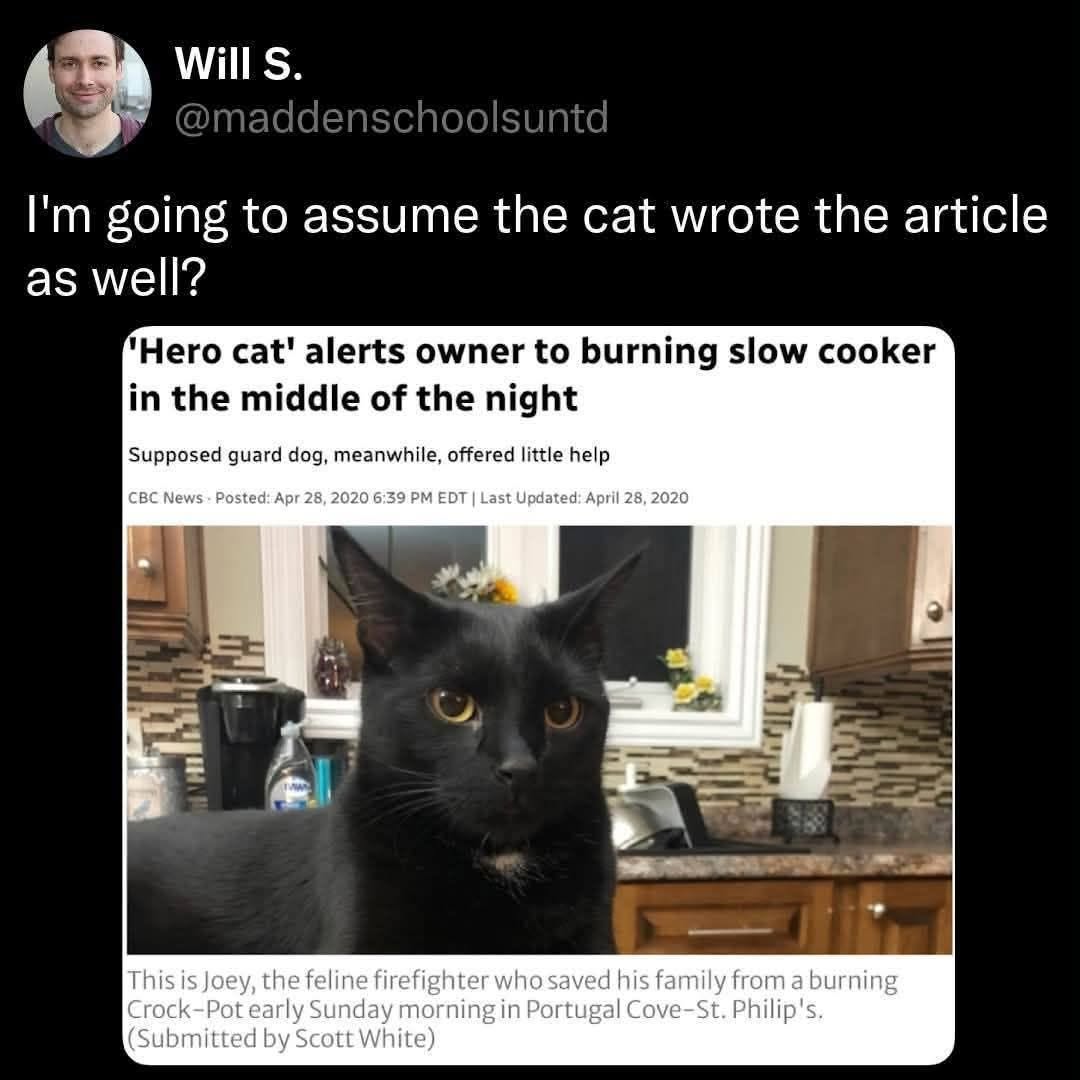
The hero cat looks rather annoyed in that photo!
Best I can do on the video where movie characters are being “helped” is this:
Titanic, ?, Titanic, Lord of the Rings: Return of the King, Avatar, [A Star Wars movie?], ?, ?, ?, Titanic, The Ring, Incredible Hulk, Thor, The Matrix, It, Titanic, ?, ?, ?
I’ll add a Harry Potter movie (Ralph Fiennes as Voldemort [guy with no nose]); Men in Black (Will Smith having his sunglasses stolen); Squid Games (Asian men sitting on floor).