Tuesday: Hili dialogue

August 25, 2026 • 6:45 am

Welcome to The Cruelest Day: Tuesday, August 25, 2026, and it’s Back to School Time. I’m already in school, but no longer filled with dread in this season like I was all the way through college. It’s National Banana Split Day,  celebrating a huge treat from my youth and available in Chicago at the old-time Margie’s Candies, still serving great ice cream after 105 years (the Beatles ate there). If you come to Chicago, you must go. The banana split is huge and comes with homemade hot fudge topping, or try their famous Turtle Sundae. The place is about as old time-y as you can get.

@justasksara

Our family favorite for the best old fashioned banana splits with homemade hot fudge is Margie’s Candies in Chicago. You feel like you are transported in time. Have your kids bring in their report card and if they have an A they get a free cone, if they have a C and bring it up to an A they get free Junior banana split #icecream #oldschool #bananasplit #chicagotiktok #supportsmallbusiness

♬ Isn’t She Lovely – Stevie Wonder

It’s also National Whiskey Sour Day, an estimable drink, but that’s all for national days today.

Readers are welcome to mark notable events, births, or deaths on this day by consulting the August 25 Wikipedia page.

Da Nooz:

*Trump has defending his demolition of the White House’s East Wing and putting a ballroom in its place on the grounds that below the ballroom would be a nuclear bomb-proof facility, essential for national security. But the WaPo points out that—and you might have guess thid—the White House already has one! (Article is archived here.)

President Donald Trump has claimed that the White House needs a massive new ballroom because it would provide him and future presidents with a secure, hardened facility. But former officials say the argument fails to acknowledge that the presidential complex already has one.

More than a decade ago, federal officials built a highly protected bunker, embedded deep underground, that can shelter the president and his top aides in a national security emergency, according to three former officials.

The facility, which was secretly completed during the Obama administration, can house dozens of people for up to multiple weeks, two former officials said. It’s buried more than60 feet underneath the White House complex and built to withstand a nuclear blast, two of the officials said, ensuring the president and his team have a secure command center to run the country in times of extreme duress.

The bunker’s existence, the former officials said, undercuts the Trump administration’s emerging legal argument in the ongoing lawsuit over the $600 millionballroom complex’s construction: that the facility must be completed due to its significance for U.S. national security.

The people spoke on the condition of anonymity to discuss elements of the secretive facility, some of which have not been previously reported.

The Washington Post is withholding some details of the bunker and its construction in order to not compromise sensitive White House security protocols.

. . .Asked about Trump’s assertions about the need for a new military complex, the White House defended the project and criticized past officials for discussing existing security structures.

“The East Wing Modernization Project is inextricably tied to the security of the President, the White House grounds and the certain security infrastructure assets,” said White House spokesman Davis Ingle in a statement.

Well, now we ‘ll have TWO secure facilities in the White House. One for Trump, one for Vance. As you remember, the Supreme Court is weighing an appeal asking construction to stop, all the while allowing them to continue working on the new facility. I wondered why there wasn’t such a facility before when Trump said he was building one, and now it turns out there is.  Perhaps all that money, which has got to be more for the underground bunker than for the ballroom, is being wasted.

*In an op-ed in the NYT (archived here), “Let Iran control the Strait of Hormuz,” Rosemary Kelanic (identified as “the director of the Middle East program at Defense Priorities) argues that it’s in the best interests of the U.S. to allow Iran to charge tolls for ships transiting the Strait of Hormuz.

When President Trump isn’t threatening to make the Strait of Hormuz a U.S. territory, his administration is demanding that the strait revert to being a free international passageway for the world’s oil supply. The president needs to face reality: Neither of these things is going to happen. The strait needs to be reopened, even if that means Iran tolls transit through it.

This outcome would be a defeat for the United States. But, at this point, it is the least bad option.

The war with Iran has revealed two things: Iran cannot completely close the Strait of Hormuz, and the United States cannot completely open it. Despite months of pummeling from American bombs and missiles, Tehran has shown it can still discourage tanker traffic in the strait, through which a fifth of the world’s oil supply transited before Mr. Trump attacked Iran in February.

. . . Long-term, American-led operations to sneak oil through Hormuz would risk U.S. casualties and burden American taxpayers. The U.S. public would be rightly skeptical about bankrolling free access to countries unwilling to help open the strait, when those countries could pay their own way through tolls.

Financially, transit fees are a better deal for the United States and the world than a prolonged semiclosure of the strait. While the recent resilience of world oil markets has surprised many, the daily supply deficit of up to 14 million barrels per day at the war’s height has cut deeply into global crude and product inventories. This has slowly exhausted the buffers that have kept oil prices only modestly elevated over prewar days. If the Hormuz standoff causes oil prices to spike, the economic damage could be severe, especially for the United States, whose economy is far more oil-intensive than those of other great powers like Russia and China.

As embarrassing as Hormuz taxes would be for the United States and for Mr. Trump personally, monetizing safe passage would encourage Iran to allow through as many ships as possible so it can collect more tolls. And if Iran grows dependent on revenue from administering the strait, closing it in the future for political reasons becomes more difficult.

More justification:

Iran is already in talks with Oman about the strait’s future. Joint custodianship of the waterway could foster regional cooperation and spur Iran to demonstrate responsibility by mellowing its rhetoric and behavior. It could eventually allow Iran to rejoin the international community, conferring recognition that would make it easier for Iran to surrender its nuclear program, which functions as an alternative source of prestige.

Charging tolls would benefit Iran financially, but even high-end revenue estimates would leave Iran behind given the $270 billion in war damages it has suffered. If Iran collects $6 billion to $14 billion in transit fees annually, as some estimates suggest, it could take nearly 20 years for Iran to break even on the war. Over that span, market adjustment would diminish the importance of Hormuz, as regional exporters constructed bypass pipelines and the switch to electric vehicles reduced oil demand.

. . .None of this is optimal for the United States. But the sooner we accept this new reality, the better for consumers, the world economy and regional stability. Perhaps the consequences of lasting Iranian authority over the Strait of Hormuz will even dissuade future U.S. presidents — or Mr. Trump — from launching risky and unnecessary wars.

Give me a break! Since Iran will not give up its quest for nukes, allowing them to control the Strait means we lose everything Trump declared we’d win  “Not optimal” is an understatement, and as for the war being “risky and unnecessary,” well Iran is the main exporter of terror in the Middle East, and all wars are “risky.” But of course the NYT has always been rooting for Iran to win this war; of that I’m sure.

*Over at the Free Press, Olivia Reingold analyzes data from a new UNICEF-led study of Gaza suggesting that claims of widespread famine and starvation were exaggerated, based on erroneous measures of “starvation” (there are several articles walking back the famine claim, including this video discussion by Natasha Hausdorff). Indeed, Gaza seems to be experiencing a wave of childhood obesity.

n July 22, a UNICEF-led team measuring hunger in Gaza uploaded a presentation containing its most comprehensive analysis since war broke out nearly three years ago.

The report, titled “Gaza Nutrition SMART Survey Result,” revealed a stark reversal from the declarations made almost exactly a year ago that a dire famine was ravaging the war-torn territory.

“Wasting,” the report said, using a term for extreme thinness, “is low across all domains, suggesting no widespread acute malnutrition at population level.”

At the rate of 0.5 percent, Gaza has one of the lowest rates of acute child malnutrition in the region, according to an analysis by The Free Press of data from the World Bank and the Integrated Food Security Phase Classification (IPC), a UN–affiliated hunger-monitoring system. The researchers also concluded that about 12 percent of children in Gaza had stunting, or impaired growth and development that is the result of poor nutrition. That is less than half of the region’s 26 percent stunting rate, according to the latest report on child malnutrition by UNICEF, the World Health Organization, and the World Bank.

“I thought it would be much higher, to be honest,” said Elena Naumova, a Tufts University professor of nutrition epidemiology and data science, about the stunting rate in Gaza.

The UNICEF-led team’s presentation also revealed that Gaza now faces a new challenge: obesity and excess weight, which affect a combined 4 percent of children under the age of 5.

The July analysis was even more valuable because for the first time since October 7, 2023, researchers relied on the gold standard for measuring malnutrition: weight-for-height z-scores, which compares a child’s weight and height with the norm for their peer group. Researchers said they had “repeatedly failed” to gather similar data in the past due to “escalating conflict,” forcing them to use a different type of measurement.

A year ago, the picture could hardly have looked more different. On August 22, 2025, the IPC declared a famine in one section of Gaza. More than half a million Palestinians were “facing catastrophic conditions characterized by starvation, destitution, and death,” the IPC said. It also warned that Gaza was in “a race against time,” and that the only way to prevent famine from spreading further was for an immediate ceasefire to take hold.

How did Gaza go from being officially classified as famine-stricken to having—in less than a year—one of the region’s lowest levels of severe child malnutrition? Humanitarian agencies have failed so far to answer that fundamental question, and one major organization is still fundraising on the claim that starvation rages on in Gaza.

The latest findings do not conclude that no one in Gaza went hungry, nor do they diminish the suffering endured by Palestinians in Gaza or ongoing health concerns. But the stark reversal documented in the July report demands a closer examination of how a famine was declared in the first place.

Now of course some children and adults in Gaza could have indeed suffered from insufficient food, but the use of pictures of children with wasting diseases like cystic fibrosis to document “hunger” was deeply suspicious. This report doesn’t surprise me, for it was in the interests of Hamas and their sympathizers to claims endemic starvation in Gaza.  And now that food is pouring into Gaza, as it has been for some time, much of it coming from Israel. That does not support claims of an Israeli “genocide” of Palestinians.

*Peter Singer sings his swan song in the Guardian, looking back on his career and deciding, mirabile dictu, that capitalism is the best of all existing economic systems.

Peter Singer misses the beach. After two decades working in the US the world-renowned moral philosopher returned not to his old haunt of bayside Melbourne but its urban centre. He has made do with a “fairly natural” scrubby bushland walking track along the city’s Merri Creek. “I think they’ve done a pretty good job here,” he says approvingly.

Singer’s manner is dry with a hint of bemusement, still with that same flat Australian accent. He discusses mind bending ethical dilemmas with a pragmatic delivery that’s almost disarmingly casual but softens when he briefly explains why he’s left the bay behind. “Our kids live near here,” he says – “and they wouldn’t move to us!” Ranging in ages from 12 to 20, his grandchildren are “now all in this same little pocket, and they come for dinner usually once a week.”

After calling time on his stint as professor of bioethics at Princeton’s University Center for Human Values, Singer delivered a final lecture at the end of 2023. His PowerPoint presentation began by quoting the horrified reaction to his controversial appointment in 1999 (a former alumni likened it to a sign of the “decline of western civilisation”). This was, after all, the man once dubbed the “most dangerous man on Earth” by critics for his views on issues such as voluntary euthanasia, abortion and advocating for parents’ right to selective euthanasia of their disabled newborn babies.

The presentation touched on his 2021 launch of the Journal of Controversial Ideas, the “sad” demise of disgraced crypto billionaire and proponent of effective altruism Sam Bankman-Fried(with a slide entitled “Be good but don’t be sketchy!”) before plugging his website and ending with a disarmingly casual line, “OK, that’s about it guys …” The final slide featured a photo of Singer in a wetsuit, board under one arm and the caption: “Bye, I’ve gone surfing.”

. . . The 80-year-old might have stopped teaching but is not exactly retired (in the last few years he has launched a podcast, a global alliance for corporate philanthropy and an AI version of himself). But he does have a favourite break at a beach south-west of Melbourne. “I like being out there in the ocean and waiting for the right wave,” he says. “Looking at where it’s going to keep breaking and trying to get there.”

I’m a big admirer of Singer, whose book Animal Liberation was enormously influential, and his effective altruism activities have made me revise my will, giving most of the money to charities that Singer says produce the most bang for the buck.  At 80, having done all that and more, he well deserves a rest.

*And, for fun, here’s a headline from Oregon Live that’s real clickbait. But it’s true, though they don’t spell out what bad words the crow said.  Youo can go to the archived version by clicking on the headline below:

A friendly, if somewhat foul-mouthed, crow became a temporary mascot at Allen Dale Elementary School in November when the bird took up residence at the Grants Pass school.

“This crow showed up at our school just out of the blue one morning,” said Naomi Imel, an education assistant at Allen Dale, over the phone on Thursday.

It began looking into classrooms, Imel said, and pecking on doors. At one point, it made its way into a fifth-grade classroom where it “helped itself to some snacks,” she said.

Imel said the bird wasn’t aggressive at all and seemed to love the kids.

“It landed on some people’s heads,” she said.

And, she added, it spoke. The bird could say, “What’s up?” and “I’m fine” and “a lot of swear words.”

. . . Still, because it was a wild animal that wouldn’t leave, the school called animal control.

Still, because it was a wild animal that wouldn’t leave, the school called animal control.

They were unable to capture the crow.

It turns out, talking crows aren’t just something out of an Edgar Allan Poe poem. And this crow, or possibly and more in line with Poe, raven, knows at least 40 words.

“He knows a lot of words, I’m not going to lie,” said Daphnie Colpron on Thursday. “His vocabulary has expanded quite a bit in the last few weeks.”

Yeah, and I wonder who taught it!!? It turns out this is, of course, a tame crow.

Colpron knows a good deal about the crow, or possibly, raven — who also may be female — because her mother rescued the bird about two years ago when it was a baby, bringing it home to the family’s farm in Williams from a shelter and naming it “Cosmo.”

And this is all the article says about its “foul mouth”:

“Sometimes he does use profanity,” Colpron added.

Cosmo’s story is convoluted, as he was originally captured and taken to a rehab facility who, now realizing he was semi-tame, released him. That was when Cosmo went to the school and, by coincidence, one of the students knew the “owner.”

“We don’t want people making pets out of wild animals,” said OSP spokesperson Stephanie Bigman. “If they had contained this bird, it would have been a wildlife offense.”

For now though, Cosmo is free and back home, and the children of Allen Dale have a story to tell this holiday season that no one is going to believe.

BUT WHAT DID THE CROW SAY?  It is clearly Mrs. Colpron or her family who taught him, as Daphne Colpron already knew that Cosmo used profanity.

Meanwhile in Dobrzyn, Hili has a pressing question:

Hili: Should I wash my left ear first, or my right?
Andrzej: Given the political situation, I suggest starting with the left one.

In Polish:

Hili: Czy najpierw umyć lewe ucho, czy prawe?
Ja: Ze względu na sytuację polityczną proponuję najpierw to lewe.

*******************

Now That’s Wild:

From Give Me a Sign:

From Cats Doing Cat Stuff:

From Masih: brave Iranian women buck the theocracy:

Pinker on Arday:

From Luana. I haven’t tried this but you can:

From Malcolm. Sound up, but I’m not sure about the accuracy of all its claims:

One from my feed. What a fantastic boat trip!

One I reposted from The Auschwitz Memorial:

And two from Doctor Cobb, beavering a way on his latest book. First, interspecific friends:

Finnish nature photographer Lassi Rautiainen followed a female grey wolf (Canis lupus) & a male brown bear (Ursos arctos) for 10 days.They played together, shared meals, napped together. Both were young adults.They appeared to be… friends?(📷: Lassi Rautiainen, http://www.wildfinland.org)

— c0nc0rdance (@c0nc0rdance.bsky.social) 2026-08-22T15:31:47.461Z

There are other “predicted” species, but none I know based on biogeography (look up Darwin’s orchid and its predicted pollinator):

Very excited to learn about the Predicted Antwren, a bird that scientists figured out *should exist* based on the biogeography of a specific part of the Amazon and then went out to find it and did. en.wikipedia.org/wiki/Predict…

— ~daniel_barker~ (@daniel-barker.bsky.social) 2026-08-23T20:04:20.700Z

Monday: Hili dialogue

August 24, 2026 • 6:45 am

Welcome to the beginning of the “work” week: it’s Monday, August 24, 2026, and National Waffle Day. To celebrate, watch this clip of Anthony Bourdain being converted to the humble Waffle House restaurant by chef Sean Brock. This one is in Charleston, South Carolina.  Hungry?

It’s also National Peach Pie Day and Pluto Demoted Day, the latter marking that dreadful day in 2006 when, as the site notes:

. . . . the International Astronomical Union (IAU) demoted Pluto from planetary status and designated it as a dwarf planet. At the time, new rules said in order for a celestial body to be a planet it must orbit around the Sun, have a nearly round shape, and “clear the neighborhood around its orbit.” Pluto doesn’t meet the third criteria because its orbit overlaps that of Neptune for about 20 years of its 248-year orbit. For that period of time, it is closer to the Sun than Neptune is. Being that Neptune is much larger, it still is considered to be a planet.

The “overlap” criterion is bogus; Pluto is a damn planet! It can’t be a planet some times and a nonplanet at others.

Readers are welcome to mark notable events, births, or deaths on this day by consulting the August 26 Wikipedia page.

Da Nooz:

*Canadian Prime Minister Mark Carney has declared that, after Trump is putting big tariffs on Canadian goods, his country is “at war” with the United States, and that Canada is reluctantly cooling its relationship with America (article archived here).

An excerpt:

On Friday night, Prime Minister Mark Carney of Canada did something that few other world leaders before him have dared to do.

After days of intense trade negotiations with the United States, with less than an hour to go on a midnight deadline for a new round of tariffs from the Trump administration, Mr. Carney instructed his negotiators to walk away.

Then, he announced that once 50 percent tariffs came into effect on $20 billion worth of Canadian goods, he would order retaliatory tariffs on the United States “dollar for dollar.”

Then on Saturday, in a lengthy televised address to Canadians, Mr. Carney brought fighting words to Canada’s act of defiance.

“Last spring, I warned that America is trying to break us so that they can own us. And I promised: ‘That will never, ever happen.’ We are keeping that promise,” Mr. Carney said somberly, before reporters in Ottawa.

“Canada is becoming stronger and less dependent on America. We are already giving ourselves more than they can take away. And we are just getting started,” he added.

By walking away, Mr. Carney chose a road that no major U.S. ally has taken: With his country’s economy on the line, he stood up to President Trump and refused to accept the administration’s offer of a new trade relationship with tariffs permanently baked in. Britain, the European Union and other major U.S. trading partners have agreed to smaller deals that have been volatile and often left them worse off.

As I’ve maintained before, tariffs are never good for anybody, the ultimate victim here being not just consumers, but also the amicable relationship that the U.S. used to have with Canada. Canadians will pay higher prices, Americans will pay higher prices for goods made in Canada, and our norther neighbors are angry at is—and rightfully so. Here’s Carney announcing the rupture. (It upsets me that he refers to “America has changed” when it’s really Trump behind this, not all Americans.)

*Amit Segal, writing at “It’s Noon in Israel,” wonders whether the U.S. has “secretly won the battle of Hormuz“. Segal also attacks the press for “running with the Iranian line”:

What if Iran is the same way [as the Soviet Union in the late 1940s]—weaker than anyone thought, its post-war signs of stability in fact masking a steadily cracking foundation?

Many read the 13 days of U.S. strikes on Iran in late July as loud, inconclusive and ultimately swallowed by another round of deal rumors. Channel 14’s Tamir Morag reads them differently. The absence of strikes on the high-value sites deep inside Iran wasn’t hesitation—it was a choice to spend the campaign dismantling the radars and sensors that let Iran control the strait.

The conventional wisdom dictated that since a single IRGC survivor with one remaining drone is sufficient to make global shipping sailing the opposite direction, nothing short of convoys, and perhaps not even that, could reopen the strait. But a blind attacker is almost as harmless as a disarmed one, so CENTCOM went after the network of radars, cameras and sensors.

The radars went first. Iran had meant to protect them with mobility—a radar truck rolls out, paints the strait for a few minutes, finds a tanker, and folds back into hiding. The trouble is that a radar, the moment it switches on, becomes the most conspicuous thing over the water, and a missile rides its own beam back to the truck.

The cameras were the harder half. Electro-optical and infrared sensors don’t emit “kill me” signals, and the islands in the strait lent the Iranians a perch from which they could track a tanker without announcing themselves. According to Morag, there was no shortcut against passive sensors, only the slow work of finding them by eye and taking them out one at a time, until the whole network, radars included, was significantly degraded.

Despite being blinded, the regime is still selling the myth of control because the strait constitutes most of its leverage at the negotiating table. A press that wanted the story to be one of Trump’s failure is still running with the Iranian line.

. . .Today, Treasury Secretary Scott Bessent is expected to announce the opening salvo against any country that provides “any type of lifeline to Iran” as part of Trump’s newly declared economic war. According to the secretary, the sanctions will “collapse this regime”—perhaps overly ambitious, but I’m glad to see regime change set as a goal, even if only in an economic capacity.

But as George Kennan said of the Soviet Union, “it cannot be easily defeated or discouraged by a single victory on the part of its opponents.” It will take “patient persistence” to bring down the enemy.

Forty-four years passed from the writing of his article to the collapse of the Soviet Union. If Trump can show the same moral and institutional persistence against Iran as the best-remembered of U.S. presidents did against the Soviet Union, I highly doubt it will take that long.

But Trump has never been one of “moral and institutional persistence,” for crying out loud, yet Segal seems to be counting on that. True, the traffic through the Strait of Hormuz has picked up a bit, but it’s not nearly what it was before the war. As far as I can see, this is still a war of attrition on both sides: attrition of U.S. weaponry and reputation against attrition of Iran’s economy and well-being.  But of course I’m not a pundit.

*Now that people are using AI-generated tweaks and prompts on their prose, should you disclose that? In an essay in Quillette, “Show us the prompts,” Belgian philosopher Maarten Boudry answers “yes.” Remember that the rector at his former University (Ghent), who suspended Nathan Cofnas, “decided to outsource her inaugural address to AI” and also used AI to write her letter informing Cofnas he’d been suspended.  And this stuff is spreading:

My former rector is not the only person to have been embarrassed by a digital ghostwriter. In March, the former academic turned Reform UK candidate Matt Goodwin published a book littered with fabricated quotations and non-existent references, which earned him the nickname “MattGPT.” In a case of cosmic karma, Steven Rosenbaum’s The Future of Truth: How AI Reshapes Reality turned out to contain half a dozen fake or misattributed quotes. Governments and consultancy firms have written expensive reports citing studies and papers that do not exist. An online database now lists more than 1,800 cases of AI hallucinations in court filings.

The good news for anyone recruiting an AI ghostwriter is that the odds of public mortification are falling. Fabricated quotes and references are just about the only way to catch a lazy author out, since there is virtually no innocent explanation for them. But as Large Language Models have improved, hallucinations like these have grown rarer. And without those dead giveaways, we are left with AI detection tools, which are irreducibly probabilistic. The best of them is Pangram, which boasts a false-positive rate of one in 10,000, given a long enough chunk of text and some reasonable assumptions. Writers accused of AI plagiarism routinely deny it, and there is no way to prove the charge conclusively.

. . . But something bugs me about all this. As a writer and non-native speaker of English, I am grateful for Claude’s proofreading help when I am drafting an essay. And as a reader, I have come across AI-generated poems, short stories, andjokes that I have really enjoyed— sometimes I knew their provenance from the start, sometimes I discovered it only later. Far from diminishing my enjoyment, this realisation often heightens it, out of sheer fascination with the technology. But argumentative non-fiction feels different. For some reason, I resent belatedly discovering that an essay that tries to persuade me of something was machine-written, and I lose interest at once. Why is this?

Here’s why Boudry disdains AI-written text, along with his solution to these difficulties:

Interpretive charity is also what makes LLM prose so compelling. There is no actual train of thought behind it—just extraordinarily complex statistical patterns emulating human text, which passes for the real thing under the ordinary application of charity. In many contexts, we have no reason to care. So long as the output is indistinguishable from what an actual expert with a real train of thought would have produced, it serves its purpose. That, after all, is what allowed me to ditch my proofreader, along with my accountant and my legal advisor.

Because of our interpretive charity, however, we tend to attribute meaning and coherence to text that has neither. Human slop is not that hard to spot, unless you are very insecure or too deeply sunk in your own intellectual investment. AI slop is far subtler, and far harder to distinguish from actual thought. Before ChatGPT, things were simple. If a text looked coherent and comprehensible, you could safely assume there was a thought process to reconstruct, belonging to an actual thinking person—there was no other way to produce coherent prose. That is the world in which our interpretive charity evolved, and that is the world to which it is calibrated. Today, AI writing can be so slick and polished that it takes far longer to notice you are not following a train of thought but a stream of superficially plausible verbiage. You have to slow down and read each sentence with care to catch your charity being hoodwinked. What a waste of time.

. . .There is nothing wrong with using AI to generate text per se, and I do it myself if I am drafting a reference letter, writing a legal defence, or answering a long email. The prompt is usually based on a short list of bullet points and instructions, or on things I have written before. LLMs are extremely good at catching your drift, especially when they have been trained on your earlier writing. It is fine, too, wherever the pleasure is in the artefact rather than the argument: jokes, poetry, perhaps some kinds of fiction.

But if you ask AI to compose an entire argument, then sign it with your name and send it to the Guardian, it behoves you to disclose it and leave your readers to decide whether or not they are still interested. That hardly any writer does this, unlike many creators of AI images and video, suggests a degree of guilty conscience. These people want to preserve the illusion that an actual person produced the text, because they rightly suspect that we would stop reading if we knew the truth.

. . . To my knowledge, of all the writers accused of AI plagiarism by Pangram, not a single one has done so. If you have nothing to hide, and you’re happy to let a machine ventriloquise you, why not just show us the damn prompts?

I agree 100% with this, except I am loath to use AI to write anything I’ve put under my name, and have never done so. When I use it to look up stuff, I simply quote it verbatim and note where it comes from. I treat it like a quotation from a source, which is what it is (Grok, my main source, always gives references that you can check).

By the way, Maarten uses Pangram to detect AI-written content, and you can use it on a limited basis for free, though I haven’t done so.

*A clickbait title for me from the WSJ: “Why Democrats still have a shot at winning the Senate.”

Democrats fighting to win back the Senate from the Republicans spent their summer sweating out a last-minute candidate switch in Maine and the emergence of an antiestablishment progressive in swing-state Michigan.

The two races remain central to Democrats’ hopes of winning back Senate control in the November elections as they try to navigate a narrow pathway to the majority. But even as flipping Maine and retaining Michigan look challenging, Democrats have made headway in defending Georgia, capturing North Carolina and competing in redder states including Alaska, Ohio, Iowa and Texas.

“We have a very good chance to take the majority back,” said Senate Minority Leader Chuck Schumer (D., N.Y.). He said Democrats had “expanded the map and have the strongest map we’ve had in years where many states that are purple or even red are now poised to go into the Democratic column.”

Here’s the WSJ figure, credited to Kara Dapena. As you see, flipping only three seats creates a 50/50 situation, though J. D. Vance can break the tie in favor of Republicans. Four seats will do it for Democrats, and you see that four states are tossups (but “leaners” could also go Democratic):

More:

Still, the developments in Maine and Michigan have added some uncertainty to Democrats’ plans. A loss in Maine by replacement candidate Troy Jackson against GOP Sen. Susan Collins, long an elusive target for Democrats, would represent another missed opportunity in a state that then-Vice President Kamala Harris carried by seven points in 2024. If Democrat Abdul El-Sayed loses the race for the Senate seat in Michigan, it would force the party to flip multiple seats in Donald Trump country.

“Michigan is clearly the No. 1 pickup for Republicans, and that would really throw a wrench into Democrats’ math,” said Jessica Taylor, a Senate analyst for the Cook Political Report.

Republicans hold a 53-47 majority in the Senate, meaning Democrats must gain a net pickup of four seats to win back power during President Trump’s final two years in office. The president’s party typically suffers losses in midterm elections, and Republicans concede their candidates are facing a difficult environment, marked by high fuel prices, the war with Iran and Trump’s poor approval ratings. Prediction markets see the odds for control as about even.

Surveys show Democratic voters are more enthusiastic about voting in the midterms than Republicans. GOP candidates won’t have the benefit of Trump generating higher turnout among infrequent voters when he leads the ticket. And party insiders wonder how Trump might deploy roughly $400 million in his MAGA Inc. super PAC.

“We’ve got political headwinds at us, there’s no question about it, some frankly economic headwinds too that we’re facing,” Senate Majority Leader John Thune (R., S.D.) recently told reporters in South Dakota. “So it’s not going to be an easy cycle. But we’ve got really high-quality candidates. They will be well-resourced.”

So far Democrats have raised more money for Senate races than Republicans, but that will certainly narrow as the midterms approach. It’s stressful to see all the polling and speculation about these races.

*In an unusual murder trial, Lindsay Clancy, a Massachusetts mother who killed her three young children after apparently seeking treatment for postpartum psychosis, has pleaded not guilty and is being supported by hundreds of other women (article archived here).

Lindsay Clancy, a Massachusetts mother, is standing trial on murder charges in the deaths of her three children. The weekslong trial in the high-profile case has included testimony from her ex-husband, medical professionals and other people who were close to Ms. Clancy in the months before the killings.

On Jan. 24, 2023, Ms. Clancy’s husband, Patrick Clancy, returned home from picking up the family’s dinner to find the couple’s children — Cora, 5, Dawson, 3, and Callan, 8 months — in the basement choked by exercise bands, he told investigators. Cora and Dawson were dead; Callan would die days later.

The horrific deaths at the family’s home in Duxbury, Mass., an affluent suburb south of Boston, have revived a long-running debate about how the legal system should treat mentally ill mothers who kill their children.

The trial has been emotional, punctuated by testimony from Mr. Clancy and audio from his 9-1-1 call, during which he found his children in the basement. Ms. Clancy has frequently broken down crying in the courtroom, and some jurors have shown emotion as well.

Closing arguments are expected to begin this week, as early as Monday.

Ms. Clancy’s lawyers rested their case on Friday. The defense presented witnesses who described her struggles with mental health, providing the most detailed description yet of her state of mind before and after the killings.

Medical professionals described months of severe postpartum depression symptoms, saying Ms. Clancy made two calls to a suicide hotline before the killings. Afterward, she repeatedly described a voice commanding her to kill the children and then herself, a forensic psychologist and a hospital chaplain said.

Ms. Clancy, who has pleaded not guilty to three counts of first-degree murder, faces a sentence of life in prison without parole if convicted. If found not guilty by reason of insanity, she would very likely be committed to a secure state psychiatric facility.

This is a tough one. As noted below, Clancy tried to kill herself after the murders by jumping from a window, paralyzing herself from the waist down. That suggests some severe mental disruption. And yes, if Clancy did have postpartum psychosis, and her murderous impulses came from a given situation, but if she is forbidden to have children (is that possible?) this wouldn’t recur.  How much time, then, should she get if found “not guilty by reason of insanity”? Do you think she should go to jail? If so, for what reason? One could argue that she’s suffered enough, having lost her children and now in a state of paralysis for life.

Here’s an informative CBS News report explaining why Clancy didn’t take the stand in her own defense.

Meanwhile in Dobrzyn, Hili and Andrzej are into a deep discussion of theology:

Hili: Was there really a word in the beginning?
Andrzej: It was probably just a sneeze.
Hili: And then?
Andrzej: Nothing terrible, cosmic entropy began.

In Polish:

Hili: Czy na początku rzeczywiście było słowo?
Ja: Prawdopodobnie było to tylko kichnięcie.
Hili: I co?
Ja: Nic strasznego, zaczęła się kosmiczna entropia.

*******************

From CinEmma:

From Funny and Strange Signs:

From Nicole:

Masih mourns another protestor who was hanged yesterday:

The Number Ten Cat was falsely reported as dead!:

J. K. Rowling defines “female”:

Richard Dawkins cites the scholarly achievements of the University of Cambridge—for obvious reasons.

Two from my feed.  First, a lovely squirrel post (squirrels are seriously underappreciated). Sound up:

Translated from the French, here’s the English:

I am sincerely sorry to share such images with you on a Sunday, but as the back-to-school season approaches, people need to know what is still happening on the beaches in terms of organized extortion.

One I reposted from The Auschwitz Memorial:

And one from Doctor Cobb, showing George Herriman, a favorite cartoonist of Matthew and mine, and creator of the great Krazy Kat cartoons.

Oh my gosh today is George Herriman's birthday!

— Benjamin Dreyer (@bcdreyer.social) 2026-08-22T20:18:15.698Z


Sunday: Hili dialogue

August 23, 2026 • 6:45 am

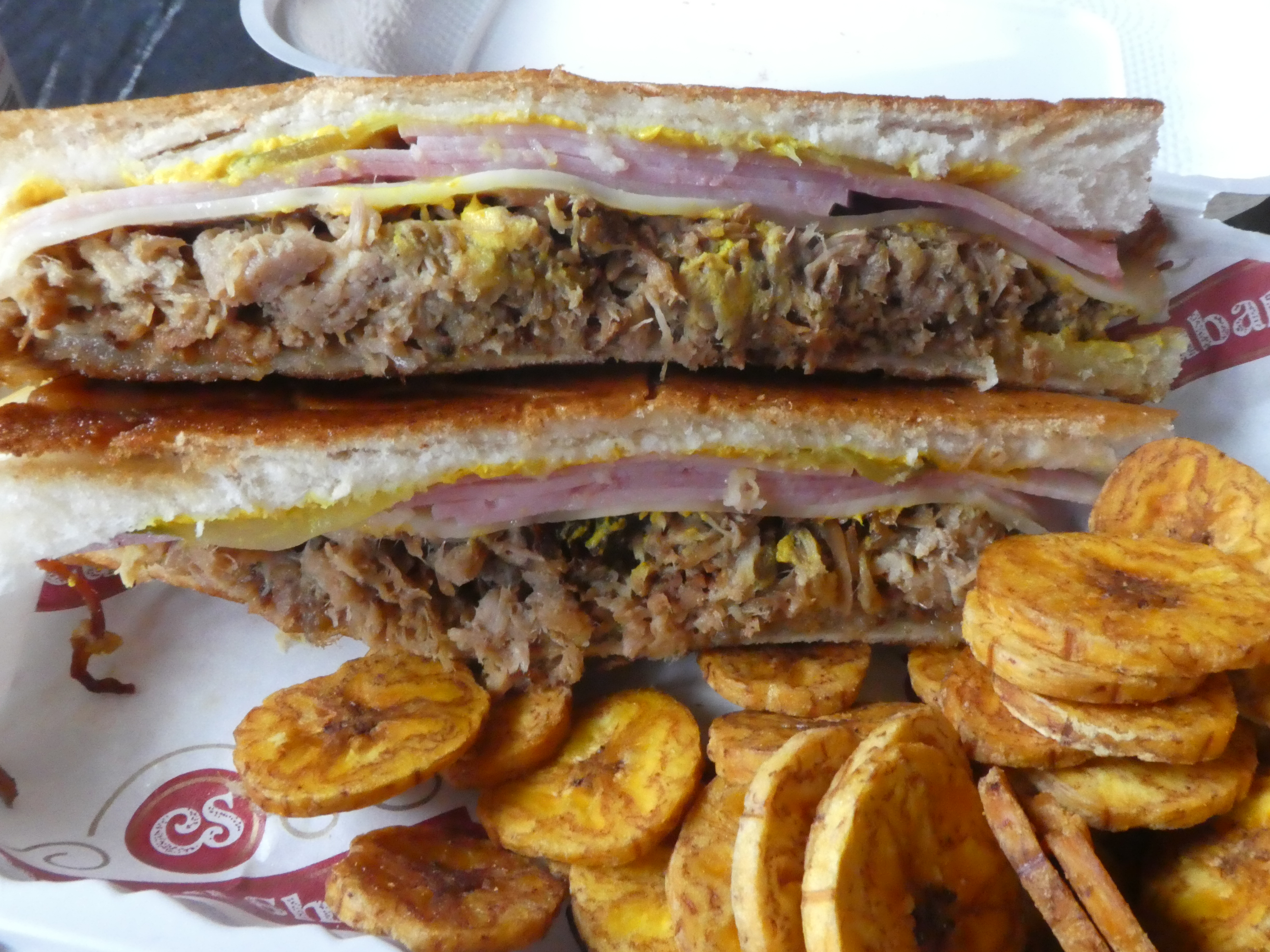
Welcome to Sunday, August 23: the Sabbath made for goyische cats and National Cuban Sandwich Day.  Here’s what Wikipedia has to say about this American-Cuban delicacy:

A Cuban sandwich (Spanish: Sándwich cubano) is a variation of a ham and cheese sandwich that likely originated before the turn of the 20th century in cafes catering to Cuban workers in Tampa or Key West, two early Cuban immigrant communities in Florida, United States, centered on the cigar industry. Later on, Cuban exiles and expatriates brought it to Miami, where it is also very popular. The sandwich is made with ham, roast pork, Swiss cheese, pickles, mustard, and sometimes salami on Cuban bread. Salami is included in Tampa, but is not usually included in South Florida.

Here’s one I got at a Cuban joint in Brooklyn at the Heterodox Academy meetings in June of last year. That was the meeting where Louis Menand argued with me about whether art conveyed truth, leading me to write this essay for Quillette.)  But about the sandwich: as Hemingway would say, “It was good”.  Note that the pork is chopped. There are platanos maduros on the side. If you have a layover in the Miami airport, there’s a Cuban joint there where you can try one. (Don’t forget the plantains!)

It’s also Buttered Corn Day (I had some last night), National Sponge Cake Day, and Valentino Day, celebrating the short life of silent-movie star Rudolph Valentino, who died on this day in 1926 at only 31 years of age. (cause of death, peritonitis and septic endocarditis).

Here’s a very famous scene from a restored version of the 1921 film “Four Horsemen of the Apocalypse“, with the music and sound added recently. As Wikipedia notes, this movie (and this scene in particular) helped create the tango craze in the U.S.:

Often regarded as one of the first anti-war films, it had a huge cultural impact and became the top-grossing film of 1921 by beating out Charlie Chaplin’s The Kid. The film turned the little-known actor Rudolph Valentino into a superstar and associated him with the image of the Latin lover. The film also inspired a tango craze and such fashion fads as gaucho pants.

H. L. Mencken wrote a good short essay on Valentino that you can read here.

There’s a Google gif today highlighting the U.S. national parks. Click below to go to its destination (the movement in the gif is subtle):

Readers are welcome to mark notable events, births, or deaths on this day by consulting the August 23 Wikipedia page.

Da Nooz:

*The WSJ reports that Iran’s top politicans (note, not the theocrats) are urging their country to end the war with America. 

Iran’s top politicians said the country needs to focus on ending the war and shoring up its crippled economy, pushing back publicly against hardliners who are taking a more defiant approach in the six-month-old conflict.

The comments by Iranian President Masoud Pezeshkian and parliamentary speaker Mohammad Bagher Ghalibaf come as the diplomatic track remains stalled and the Trump administration has shifted to a policy of ratcheting up economic pressure via sanctions and the naval blockade of Iran’s ports.

The war and the economic strictures have piled pressure on Iran’s already spiraling economy, further sinking its currency and making it hard for Iranians to afford their daily needs. Tehran’s more moderate leaders worry the pressure will eventually undermine the country’s stability.

It is unclear, however, whether hardliners who recently levied tough new demands for reopening the Strait of Hormuz or the Trump administration, which is demanding deep concessions and called again this week for the regime’s collapse, can come to an agreement.

“The war must come to an end at some point,” Pezeshkian said Friday in comments reported by Iranian media. “It is better that we demonstrate our strength and dignity today and tell the world that we have won and that we are ending the war.”

Ghalibaf was less direct but said there will be no security if the country ignores its economic crisis.

“No matter how much military power we have, if our people are struggling and the country lacks financial circulation and economic growth, we will not achieve progress,” the parliamentary speaker said. “As someone who has experienced war, we understand the true value of peace.”

. . .Analysts saw the comments as notable expressions of Iran’s economic distress but said that further rounds of escalation are more likely than an end to the war given the current lack of viable parameters for a deal.

Iranian hardliners have a deep distrust of the U.S. administration and have taken the lull in the conflict to prepare for more rounds of fighting.

As you might have guessed, these “top politicians” have little power compared to Iran’s theocrats and the possibly dead Ayatollah Mojtaba Khamenei, who hasn’t been seen in ages. But it’s still the religious “politicans” who decide what to do, and we just heard yesterday that economic warfare by the U.S. is not likely to bring an end to the war.

*The U.S. Supreme Court has ruled that, for now, Trump can continue building his useless ballroom on the former site of the White House’s East Wing, though the Court is considering the issue further because of an emergency appeal.

Supreme Court Chief Justice John G. Roberts Jr. on Friday allowed work to continue on the White House ballroom in the short term, issuing a stay that gives the court time to weigh an emergency appeal in a lawsuit challenging the project.

The action pauses a Friday deadline imposed by an appeals court to halt construction while the court challenge plays out. The appeals court concluded earlier this month that the controversial 90,000-square-foot addition to the executive mansion probably requires congressional approval to continue.

It’s unclear how long Roberts’s administrative stay will last, but typically such holds remain in effect for amatter of daysto give the court time to fully consider the appeal.

President Donald Trump praised the decision Friday on Truth Social, saying he was “grateful.”

“The Military/Ballroom Complex being built on the hallowed grounds of the White House, which is so vital for National Security, will be THE GREATEST OF ITS KIND!” Trump said.

The Trump administration has argued that ballroom construction must go on for the safety of the president and national security.

The ballroom construction is intertwined with work on a five-story underground military complex that will feature shelters, a hospital and more to protect the president and senior officials in an emergency, the administration said in court filings. The overall project is estimated to cost $600 million, according to contracting documents obtained by The Washington Post.

Administration officials said the ballroom, which will be hardened with missile-resistant columns and a drone-proof roof, will act as a shield for the military complex and the rest of the White House more generally.

It’s not clear from this article whether there was a  published vote on the ruling, or what it was. The appeal may be from The National Trust for Historic Preservation, but that’s not clear either from this poorly written article. What is clear is that construction is continuing as the case wends its way through the courts, and what will happen if the Supremes rules that construction will have to stop? It’s apparently close to completion! The only reasonable thing to do is stop construction until there’s a court ruling, but for some reason that’s no deemed a proper ruling. But we all know that Trump will eventually get his ballroom.

*I haven’t written much lately on the big fracas in New Zealand about indigenous “knowledge” versus modern science, but it’s continuing, and may get worse under the latest government.  The latest mishigass, which I’ve heard of from several correspondents, is summarized in this Retraction Watch article, “A New Zealand journal deleted a paper for potential harm to Māori months after publishing it” (h/t Bill)

When Arna Mitchell submitted her article critiquing a proposal for different standards of practice for Māori and non-Māori clients in clinical psychology, she thought it would be too controversial to publish because it challenged views becoming influential among professional and academic circles.

But the Journal of the New Zealand College of Clinical Psychologists (JNZCCP) had the paper peer-reviewed and published it in August 2025. And then, 10 months later, they deleted the article, after deciding the work could perpetuate harm to Māori, the indigenous people of New Zealand, and that it conflicted with the college’s values.

The college defended the deletion by arguing the journal is not an independent, indexed academic journal. But the decision has caused members to quit the college and has drawn criticism from the field, including from a former editor of the journal.

“I have not been shown how my ideas are wrong or inaccurate. I have not been shown how my ideas are not aligned with my professional ethics,” Mitchell told Retraction Watch. “The ideas in my article challenged the dominant narrative in our psychology institutions and were politically and ideologically inconvenient for some of our professional leaders. In my opinion, those are reasons for more robust discussions, not censorship.”

As you see from the abstract (below) of the paper that is still online (here), the paper criticized a report that claimed that science and Māori “ways of knowing” (Mātauranga Māori)are different, and in psychology their claims should be given equal weight, even when there is no empirical support for Māori-based knowledge claims. As you see, the author is criticizing, among other things, that “science is a social construct of white Europeans” which is misguided in several ways (e.g., scientific methods have developed because they help us find the truth).


It’s worth mentioning that the author, Arna Mitchell, is of Māori descent.

From the canceled paper (my emphasis):

In principle, there is no reason why mātauranga Māori should not be widely accepted and implemented within the profession, provided rigorous research demonstrates its effectiveness relative to other approaches in applied psychology settings. If some Indigenous practitioners want psychologists in New Zealand to be required to widely incorporate mātauranga Māori practices, they should be required to follow our profession’s established scientific validation processes and not be permitted to influence practice without a sufficient empirical evidence base. In lieu of scientific evidence, these changes are being made with rules and regulations decided on by highly select reference groups and with oversight from current members of our statutory authority, the NZPB.

A bit more from Retraction Watch:

The journal published it in August 2025 as a viewpoint — a label Mitchell believes was later used to undermine the article and dismiss her opinions. In a letter published in the same issue as the article, Donkin and two associate editors, Paul Skirrow and Zara Mansoor, defended open debate. It began with a Māori proverb: “What is the food of chiefs? It is discussion, discussion, discussion.” They wrote: “academic freedom and professional critique are not threats to our cohesion,” and that “if an article challenges your perspective, we encourage you to sit with that discomfort.”

The president of the NZCCP said they would not be commenting on our questions, the editors of the journal have not responded to our emails.

The editors are blockheads, I’m afraid to say. They are simply canceling views calling for adherence to science and empiricism because that method doesn’t comport with “indigenous ways of knowing.” And the retraction does not comport with scientific principles. From RW:

COPE guidelines state a retraction notice should be freely accessible to all readers and should link to the retracted article. Retraction with removal of an article is a “rare” case when an article “violates personal privacy, is the subject of a court order, or could have a serious health risk to the general public or the environment,” the guidelines state. In these circumstances, the notice “should clearly state why the content of the article has been removed.” There is no retraction notice on the journal’s website, and the article is no longer accessible. It was also removed from third-party platform Zenodo in late July, where it had accumulated more than 9,000 views.

In a statement to media at the time, the NZCCP executive said the journal “is not an independent, indexed academic journal, and editorial decisions must be considered within the context of the College’s governance, values, and constitutional commitments.”

The journal had always been presented as a scientific journal, said Helen Buckland-Wright, a clinical psychologist and former member of the NZCCP who also ran for an executive position alongside Mitchell. If it was a magazine, she said, “why have a peer review? Why have editors who are academics and go through an academic process?”

I had hoped that this scienceis-as-valid-as-mythology nonsense would end when the uber-woke Jacinda Ardern was replaced as NZ ‘sPrime Minister by Chris Hipkins and now by Christopher Luxon, who is more conservative. But it persists, and I still hear complaints about this kind of stuff from many Kiwis.  Apparently these complaints are not unfounded, and this mess with the Journal of the New Zealand College of Clinical Psychologists is one more example.  New Zealand must rival Canada as the most woke country in the world (and by “woke” I mean “engaged in performative virtue signaling that doesn’t improve society”).

*Matt Calkins, a sports writer for the Seattle Times for 11 years, just resigned, and explains why in a Substack post (it’s about biological men in women’s sports).

I really wanted the column to run. I didn’t think it would, but I felt obligated to try to get it in.

Toward the end of last month, before the Seattle Storm hosted the Indiana Fever, I spoke to people attending a rally in support of Sophie Cunningham outside Climate Pledge Arena. The Fever guard had recently taken a stance against biological males competing in women’s/girls sports, and a few dozen folks showed up to express their gratitude for her position.

One of them was 16-year-old Ahnaleigh Wilson, who’d lost to a biological male in a track and field race in eighth grade and was holding a sign reading “Thank You Sophie for Speaking up for Girls!”

I didn’t know if I was going to write something at that point, but after she allegedly got cussed out by a Storm co-owner during the game, I felt like I had to weigh in.

One thing Wilson emphasized to me at the rally was that she wasn’t anti-trans. Another student-athlete named Frances Staudt — who said she’s endured daily verbal abuse after refusing to play against a biological boy in a basketball game — echoed Wilson’s sentiment.

So that was the thesis of my column (which you can read here) — that supporting the separation of biological females and males doesn’t automatically make you transphobic, so let’s stop throwing those labels around.

I sent a draft after talking to my editor the morning of Friday, July 31, telling him there was no rush to run it. He told me later that day that he and others were looking at it, but that it wouldn’t be ready for Sunday’s paper. Monday night, I got an email saying that his boss was hoping to talk to the top two newsroom editors about it on Wednesday. No feedback had been given to me. Thursday afternoon, my editor informed me that it wasn’t going to run because I didn’t tell him I was doing this in advance. I didn’t buy this reasoning. If that were the case, the piece would have been killed on the spot, not passed through the hands of multiple editors over several days.

My response? To resign on the spot.

. . .I’ve always thought that it was a columnist’s duty to generate discussion on the most hot-button issues. To avoid such topics was to leave the reader shortchanged. I guess in the end, I just didn’t feel like I could do my job properly anymore.

Right now, I’m in the tenuous position of trying to defend my resignation without sounding like a malcontent. So let me say — I’m very grateful for the 11 years I had at the Seattle Times. The talent there is immense, and the editors let me have a lot of fun with other stories. I also realize where the brass is coming from. The mob is frightening and does not forget. Lots of seemingly brave souls have submitted once activists got their hooks in them. If I had more people depending on me, perhaps I’d act similarly.

But in thinking about this decision, I kept going back to an Albus Dumbledore line: “We must all face the choice between what is right and what is easy.”

And Calkins’s last paragraph:

All that’s certain is that I’m done holding back. The best things in life are free — speech being at the top of the list.

Of course there is no First Amendment for columnists, but the fact is that a hefty majority of Americans (see Pew data below) disfavor or are not comfortable with trans-identified males (aka “trans females”) competing in women’s sports, and a column was spiked that aligned with these sentiments.

*The Duke and Duchess of Sussex (Harry and Meghan) have decided to move back to England after a failed attempt to become American Hollywood royalty, and the NYT has three whole articles about it on the front page (the paper is getting more “People Magazine-y” all the time). Still, I have followed this saga though I’m not obsessed with royalty. What does the NYT say?

It began with such high hopes.

The Duke and Duchess of Sussex landed in Hollywood in 2020, flush with a multimillion-dollar Netflix deal and a promise that the duo, scorned by the royal family, would make a slew of inspirational programming.

Two years later, “Harry & Meghan” the Netflix six-part docuseries on the couple’s departure from Britain, generated 23.4 million views in its initial release, immediately topping the company’s charts as the most watched ever for the first four days of a documentary. In total, the program has garnered 70 million views since its debut.

Nothing else Prince Harry and his wife, Meghan, ever made for the service — whether it was “Live to Lead,” a seven-episode interview show with world leaders, or “Polo,” a docuseries about the sport — reached such heights.

In 2025, the Netflix deal was not renewed. A similarly lofty agreement at Spotify also fell short of expectations.

And as Americans asked this week why the couple was leaving their West Coast idyll, Hollywood observers pointed to one of the most enduring themes in the history of Southern California: show business aspirations that failed.

“There has always been this aura here, this magical thinking,” said Leo Braudy, a Los Angeles cultural historian and the author of “The Frenzy of Renown: Fame and Its History.” “Everybody thinks, ‘I’m beautiful,’ or ‘I’m handsome.’ Everybody thinks, ‘If those people can make it in Hollywood, so can I.’”

But most people don’t make it, he said, and throughout history, even otherwise wealthy and powerful people have mistakenly imagined that success in other fields would automatically translate to show business glory.

And that’s all I want to say about these ex-Royals. They irritate me because their ambition to “make it in Hollywood” was so nakedly clear. They have tons of money, but they want fame too. That’s not necessarily bad, but they were ROYALS, for crying out loud. They don’t have to do the jobs of royals, but they don’t have the talent to make it without that cachet. In fact, even in Hollywood they could not make it with that cachet.  Stay tuned as the sparks fly as they interact with the other royals after they return to England.

Meanwhile in Dobrzyn, Hili proves herself a Luddite:

Me: I’m too old for all these new things.
Hili: What happened?
Me: I can’t handle technology.
Hili: Use a hammer.

In Polish:

Ja: Jestem już za stary na te wszystkie nowości.
Hili: Co się stało?
Ja: Nie radzę sobie z techniką.
Hiloi: Użyj młotka.

*******************

From Cats Doing Cat Stuff:

From Give Me a Sign:

From Now That’s Wild: (note: should be “lying”):


From Masih; Iranian morality police (the women in black) keeping the beaches properly Islamic:

From Maarten. You can read about Dylan Evans here.

From Luana; the U.S. ambassador to Belgium objects to Ghent University’s treatment of Nathan Cofnas. It may not change anything, but thee rector of Ghent should pay attention.

From Malcolm; a maze for kitties:

A comment from Larry the cat on a very old woman who just passed away:

One from my feed; crow wins!

And one I reposted from The Auschwitz Memorial:

Finally, one from Matthew (buy his audiobook!); interspecific pals:

Finnish nature photographer Lassi Rautiainen followed a female grey wolf (Canis lupus) & a male brown bear (Ursos arctos) for 10 days.They played together, shared meals, napped together. Both were young adults.They appeared to be… friends?(📷: Lassi Rautiainen, http://www.wildfinland.org)

— c0nc0rdance (@c0nc0rdance.bsky.social) 2026-08-22T15:31:47.461Z

Saturday: Hili dialogue

August 22, 2026 • 6:45 am

Welcome to CaturSaturday, August 22, 2026, shabbos for Jewish cats, and National Eat a Peach Day. Although the day is designed to promote the consumption of peaches, it always makes me think of this iconic Allman Brothers album cover from 1972. The album was called “Eat a Peach”:

Wikipedia’s explanation of the title:

At the time the artwork was finalized, Duane Allman was still alive and the title had not been finalized. As a result, the album lacks a title on the cover, which was an unusual approach for bands at the time. Powell later said, “When we showed it to someone at the label, he said, ‘They are so hot right now, we could sell it in a brown paper bag'”. Atlantic initially intended to title the album The Kind We Grow in Dixie, the label of the postcard series Powell had seen in Athens,but the band refused. Trucks suggested they name the album Eat a Peach for Peace, after a quote from Duane Allman. When the writer Ellen Mandel asked him what he was doing to help the revolution, he replied:

I’m hitting a lick for peace—and every time I’m in Georgia, I eat a peach for peace. But you can’t help the revolution, because there’s just evolution. I understand the need for a lot of changes in the country, but I believe that as soon as everybody can just see a little bit better, and get a little hipper to what’s going on, they’re going to change it. Everybody will—not just the young people. Everybody is going to say, ‘Man, this stinks. I cannot tolerate the smell of this thing anymore. Let’s eliminate it and get straight with ourselves.’ I believe if everybody does it for themselves, it’ll take care of itself.

Drummer Butch Trucks considered Allman’s comment a sly reference to the poem “The Love Song of J. Alfred Prufrock” by T. S. Eliot, one of Allman’s favorite poets. An untrue story persisted for many years after the album’s release that it was named after the truck Allman crashed into, purported to be a peach truck.  The album art was later selected by Rolling Stone magazine in 1991 as one of the 100 greatest album covers of all time.

You might be surprised to know that Duane Allman (who died in a motorcycle accident before the album was released) was not just a Georgia redneck rock musician, but liked T. S. Eliot. And you might remember that Eliot’s Prufrock contains these lines:

Shall I part my hair behind?   Do I dare to eat a peach?
I shall wear white flannel trousers, and walk upon the beach.
I have heard the mermaids singing, each to each.
I do not think that they will sing to me.
To honor Eat a Peach Day, here’s a song from the album, which contains several classics. Duane Allman was dead by the time of this performance, but Dickey Betts and Greg Allman played. Both are now gone as well. (Their recorded version of  the blues classic”One Way Out” is here.)

It’s also National Bao Day, National Pecan Torte Day, and World Plant Milk Day. I don’t impugn those who drink oat milk, soy milk, or the like, but I once had a latte with soy milk, which I drank because I lost a bet. I will never have another.

Readers are welcome to mark notable events, births, or deaths on this day by consulting the August 22 Wikipedia page.

Da Nooz:

*The NYT argues, probably correctly, that Trump’s declaration of “economic warfare” against Iran means that he doesn’t want to resume military action (article archived here).

Treasury Secretary Scott Bessent tried to reassure investors worried about the pressure campaign on Iran on Thursday, declaring that a resumption of “large-scale” fighting was unlikely.

The problem for the Trump administration is that Iran was also listening.

President Trump this week promised an “economic D-Day” against Iran, a “crushing” operation to “cripple” Iran. The U.S. clampdown is formidable, a combination of wartime destruction, a naval blockade and sanctions that have already put the Iranian economy under more pressure than its regime has experienced in decades.

But between the lines of the administration’s threats was a signal that Mr. Bessent made as clear as ever on Thursday: Mr. Trump does not want to go back to war right now. The president is waging an economic campaign against Iran having already spent weeks bombing the country earlier this year, and having stepped back from multiple threats since then to resume the violence.

As a result, experts say, Mr. Trump is stuck in a conflict with limited leverage, a demonstrated vulnerability and an emboldened adversary. Even as Iran reels from shortages and inflation, Mr. Trump is likely to increasingly feel the pressure of the approaching midterm elections in the shadow of an unpopular war and high gas prices. It is a dangerous combination, experts say, that could prompt Iran to sense American weakness and lash out.

“They read him now as not wanting to escalate militarily,” Dennis B. Ross, a former Middle East negotiator for presidents of both parties, said of Iran’s leaders. “That creates an incentive for them to show that they may escalate militarily.”

. . .As a result, experts say, Mr. Trump is stuck in a conflict with limited leverage, a demonstrated vulnerability and an emboldened adversary. Even as Iran reels from shortages and inflation, Mr. Trump is likely to increasingly feel the pressure of the approaching midterm elections in the shadow of an unpopular war and high gas prices. It is a dangerous combination, experts say, that could prompt Iran to sense American weakness and lash out.

“They read him now as not wanting to escalate militarily,” Dennis B. Ross, a former Middle East negotiator for presidents of both parties, said of Iran’s leaders. “That creates an incentive for them to show that they may escalate militarily.”

The way out, according to the article, lies in the U.S. somehow forging an alliance with China, which absorbs most of Iran’s oil. But that’s unlikely. And, worse, an emboldened Iran could start attacking the U.S. and its allies again, which will trigger U.S. military action. The fact is that economic warfare won’t work, and it’s simply ludicrous to think that this kind of pressure will make Iran abandon its quest for nuclear weapons.

*Here’s a clickbait headline by “author and investor” Zachary Karabell in The Washington Post: “Donald Trump is bad for America. But he might be good for the world.” But you can predict what it says:

t has not been a banner summer for the United States. The country is mired in a war with Iran with no graceful exit opportunities; a new round of tariffs threatens to further disrupt fragile global trade relations; and the domestic economy faces inflation combined with paltry growth. President Donald Trump has not been a positive force for the U.S. this year, and many of his administration’s policies don’t bode well for the future. But by weakening America, Trump may strengthen the rest of the world.

Take military alliances — Trump is forcing U.S. allies to become more self-reliant. The war in Iran was supposed to cement U.S. leadership in the Persian Gulf and hasten the expansion of the Abraham Accords between Israel and its Arab neighbors. Instead, the conflict has put distance between Americaand its regional partners, especially Saudi Arabia. In late July, the Trump administration signed a deal with the kingdom for civilian development of nuclear energy. Then, a day later, the administration said that the deal was actually contingent on Saudi Arabia joining the Abraham Accords, which it had no immediate intention of doing. Within weeks of the agreement falling apart, Saudi Arabia signed a NATO-like defense pact with Turkey and Pakistan that bypasses the U.S. and makes any agreement with Israel unlikely. Trump’s threat on Monday to bomb Oman if it interferes with negotiations with Iran is even more likely to hurt U.S. standing in the region.

Other countries are also pivoting away from the U.S. as it becomes a more inconsistent ally. Trump’s on-again, off-again threats to annex Greenland have led European nations to rely increasingly on their own defense capabilities and non-U.S. alliances. Although Europe still needs some U.S. support, popular opinion has flipped from seeing the U.S. as a valuable partner to viewing Europe as independent and responsible for its own defense.

Similar trends are evident among Asian nations hoping to counter China’s power. Instead of leaning on American defense, countries such as Japan and the Philippines are looking more to each other and enhancing their military capabilities. While this is not yet sufficient to replace reliance on the U.S., these countries are leagues ahead of where they were even a decade ago. Trump’s decision to reduce U.S. military cooperation with South Korea, citing his “very good” relationship with North Korean dictator Kim Jong Un, could also accelerate this move away from the U.S.

And, of course, allies are becoming more independent from the U.S. economy. Countries around the world are finding new trading partners and trying to limit their dependence on the dollar as the sole vehicle of international commerce. . .

I’m not so jingoistic about the U.S., but the article largely fails to show how these changes are, in sum, will be better off for the world than if countries remained closer to the U.S. Perhaps that’s true under Trump, but he won’t be President forever, and future administrations will be faced with repairing any damage done by this realignment—if that damage can be repaired.

*As always, I’ll steal a few items from Nellie Bowles’s news-and-snark column in the Free Press (she’s back this week), called “TGIF: Give us your pee.”

→ I love the DSA leadership: Gustavo Gordillo, co-chair of the New York City chapter of the Democratic Socialists of America, who’s always going on TV to tell people to stop opening businesses, lives in a $1.5 million Brooklyn home that his parents bought for him. I love that. He’s got a degree from Yale, a house from Mom and Dad, and enough hair to do a hipster bun. That’s the 2026 dream, right there. He says things like: “We don’t think that anybody should have the constitutional right to double-digit returns on their investment.” Which is exactly what you say when your hardworking immigrant father is sweating for those double-digit returns (good for you, Mr. Gordillo, the elder one!). I love this logic, by the way, that the Constitution never says specifically that you should see a big return on your investment, so actually it’s illegal.

Anyway, the elder Gordillo went on the record with the New York Post to confirm the arrangement. He’s proud of his economic success, as he should be. You gotta love humans. We achieve freedom and pleasure of untold scale and then one generation later we get a degree from Yale and decide it totally sucks here, man. If you think Gordillo the Younger is an aberration, I present to you:

→ Arday’s Law: The strange, sad saga of Jason Arday continues. This is the professor who seemed to have lied about his credentials in obvious and silly ways, was accused of extensive plagiarism in his research, and was also hoisted up as the youngest black professor in Cambridge history who also happened to be, according to his boss, “the best in the world in terms of the research that you do.” Okay!

When Jason Arday’s story unraveled, he killed himself. It’s a tragedy. But one we will learn from. I’m sure the academy over there is taking a long, sober look at themselves in the mirror and figuring out how to deal with their complicity in this whole affair so it doesn’t happen again. Just kidding! The British are responding in the only way they know how: censorship. Vast, draconian censorship. A popular petition, supported in a statement from the (formerly) venerable Amnesty International, is calling for a new law—Arday’s Law—to limit how many articles can be written about someone in a defined time period. A joint statement at Amnesty UK’s website called the investigation into Arday a “brutal, racist witch hunt”! The proposal for Arday’s Law reads:

This petition calls for legislative action to impose limitations on the number of news articles published about a single individual within a defined time frame. By doing so, we can ensure that individuals are not subjected to undue public pressure and potential mental anguish caused by excessive media coverage.

JAC: That’s totally insane.

→ University of California refuses to bring back the SAT: The University of California Regents say they need more time to review the SAT and whether it has a place in their admissions process, but won’t consider recommendations until next year. So for now, the school is letting kids in on vibes. The results are predictable.

The statistician Nate Silver put it well this week: “I don’t think elite higher ed is going to become irrelevant but it’s probably tracking to become ~50% less relevant in the new steady state, and that’s probably a good recalibration.” He went on: “Fewer and fewer interesting ideas come out of elite higher ed. Close to totally irrelevant on AI.” It’s sad but true that no one’s Ivy League degrees were worth much after I got mine.

Smart, hardworking people paid for all these fancy buildings and then let a tiny activist cohort fill them with fools. As though the magic-endowed bricks of Berkeley would make a kid who can’t do math suddenly a math genius. The magic dining hall could make anyone a brilliant writer; you just have to get them in there. It’s a sweet idea, isn’t it? I honestly wish it were true. But it’s not. So sorry!

*As a reader pointed out, the WSJ has a new piece about Nathan Cofnas, with a telling comment by Steve Pinker that I’ll put below.

A few weeks after that initial email, Cofnas published a post on Substack under the title “DEI Fraud and Cover-Up at Cambridge,” in which he cast doubt on the academic integrity of Arday. The English academic had been named Cambridge’s youngest-ever Black professor a few years previously and had since become a minor U.K. media celebrity.

The Substack post showed that Arday’s Ph.D. included numerous passages lifted directly from another thesis and questioned the autistic professor’s claim that he was mute until the age of 11 and once ran 30 marathons in 35 days. Cofnas’s takeaway: Arday was both a fraud and the tip of a woke iceberg. Across Western institutions, he concluded, there are thousands of Jason Ardays, promoted because of what they represent rather than their ability.

The story became a social-media sensation, seized on by the right as an example of the quest for diversity corroding academic integrity and by the left as a racist attempt to hound a successful man because he was Black. The British press went to town with tale after tale, which gradually picked apart Arday’s at times fantastical back story.

. . .Cofnas, speaking from Belgium in one of his first interviews since Arday’s death, said he doesn’t regret publishing his Substack post. But he also said Arday was unfairly hounded by the press and let down by Cambridge University, which overpromoted him and then abandoned him when under scrutiny. Cambridge said it provided Arday with mental-health support, and has launched an investigation into its hiring practices.

“I was part of a series of causes that led to that outcome,” but “you have to be allowed to criticize powerful people,” Cofnas said of Arday and his death. “The British media published 249 articles about Arday in a 22-day period. I published one article, which was 100% factual,” he said.

. . .Cofnas argues that hereditarianism isn’t about skin color per se. He has written that in the U.S., for instance, “rednecks” are likely to have lower IQs than other American whites. He points out that Blacks who migrated to the U.K. on average perform better in school than British whites.

“I think he’s dangerously tactless in a radioactive topic” and “should exercise more caution,” Steven Pinker, author and Harvard University evolutionary psychologist, said of Cofnas’s rhetoric on genetics’ role in intelligence. Pinker said examining potential racial discrepancies in intelligence “could cause harm to African Americans” and lead to discrimination against them. “There’s times in science where the best policy is don’t go there,” he said.

I’ve discussed this with Pinker and am not sure I agree with him. Although I wouldn’t do such research, as it doesn’t interest me, and many people involved in it do seem to be obsessed with the topic (I consider obsession with it to be a red flag for of racism), but the taboo presumes certain outcomes that we just don’t know. (Note that Pinker doesn’t say that the research could cause harm to Caucasians if they’re found to have genetically lower IQs than blacks or Asians.) Finally, as Luana and I argue in our Skeptical Inquirer paper:

It should be clear from this example that the reasons for studying genetic differences between ethnic groups is to boost the success of individuals whose DNA is known, not to rank different groups for one trait or another. But to do this boosting, we must first understand the nature of genetic differences among groups. Many objections to this kind of work vanish when you realize that while the focus is on population-specific DNA segments associated with achievement, the ultimate goal is to help each person do their best.

In our view, then, research on cognition or educational attainment within and between groups should not be demonized, banned, or automatically denied publication, and the data should be publicly available. It goes without saying that scientists should be cautious about such research and vigilant against its misuse or misrepresentation. But in the end, it’s hard to argue with the idea that the more we understand—and that includes genetics—the more success we’ll have with social policies. Indeed, there are good arguments suggesting that stifling research on IQ, or equating this research with racism, will cause more harm than good. After all, political equality should be a moral imperative, not an empirical hypothesis, and ultimately the value of a human being does not and should not depend on their IQ or years of schooling.

*A court has slashed one of the many huge monetary fines against Alex Jones for denying that the Sandy Hook school shooting took place (it did, in 20212, and killed 26 people). But Jones is still on the hook for over a billion dollars.

A Texas court on Friday slashed a $50 million judgment to $1.5 million against Infowars founder Alex Jones after he falsely claimed the 2012 Sandy Hook elementary school mass shooting was a hoax.

The ruling does not affect a $1.25 billion judgment against Jones in Connecticut, but is a legal victory for him after he and his company, Free Speech Systems, were found liable for damages for claiming the mass shooting didn’t happen.

Despite the multiple financial judgments against him in Connecticut and Texas, Jones has yet to make any payments as he appeals the amounts and the attempt to liquidate his company.

The unanimous opinion by the Texas Third Court of Appeals found that Sandy Hook parents Neil Heslin and Scarlett Lewis did not show evidence that harassment inflamed by Jones’ hoax claims rose to a level that would allow them to exceed the state’s $750,000 cap on damages for each plaintiff.

Heslin and Lewis’s 6-year-old son Jesse Lewis was among 20 children and six educators killed in the attack in Newtown, Connecticut. The lawsuit and the 2022 verdict against Jones marked the first time he was held financially liable for peddling lies about the massacre, claiming it was faked by the government to tighten gun laws.

Jones, who portrayed the lawsuit as an attack on his First Amendment rights, conceded during the trial that the attack was “100% real” and that he was wrong to have lied about it.

However, on his streaming show Friday, he called the Texas ruling “a gigantic victory for the First Amendment,” and said he will continue to appeal the case to the state Supreme Court to get the remaining damages thrown out.

“I got lawyers who are good constitutional lawyers and they are not backing down,” Jones said.

Mark Bankston, an attorney for Heslin and Lewis in Texas, shrugged off the appeals court ruling as “irrelevant” given that Jones still faces massive financial judgments.

. . .Jones and his company have filed for bankruptcy, and those legal proceedings continue. The satirical website The Onion also moved to take over Jones’ Infowars platforms and turn his bullhorn of conspiracy theories into parody sites.

Jones gave up the Infowars brand in April and moved to a new location, switching his shows to new websites and posting them on his personal X account. The Onion, meanwhile, has set up its own Infowars webpage on its website, running videos of shows parodying Jones.

I can see that the Sandy Hook parents would be so incensed at Jones’s denialism that they’d go for the big bucks, and so far they’ve won. But the chance that Jones will become depauperate is about nil. And, at The Onion, I’ve found an Inforwars page, but it doesn’t amount to much. There’s a Wikipedia page on plans for the retooled site, but it appears to be just getting underway, and I think it will eventionally disappear.

Meanwhile in Dobrzyn, Hili and Andrzej discuss Latin binomials:

Hili: Who coined that stupid term Homo sapiens?
Andrzej: Linnaeus, a Swede. He couldn’t stand being criticized.
Hili: That explains a lot.

In Polish:

Hili: Kto wymyślił to głupie określenie Homo sapiens?
Ja: Linneusz, Szwed, nie znosił krytyki.
Hili: To wiele wyjaśnia.

*******************

From Funny and Strange Signs:

From Cats that Have Had Enough of Your Shit:

From Cheryl’s Amazingly Positive, No Politics Allowed, Interesting People Group:

From Masih, who reports that Portugal has banned burqas in public places, which is where they’re worn:

From several people, more disturbing behavior at Ghent University courtesy of Maarten Boudry.  This is hardly an objective investigation; it has a pre-specified end.

From Simon. I just listened to Dickey Betts (see above), and I swear this is a Bettsian lick:

It’s a traditional Japanese instrument called shamisen. It has only three strings. 🤯🎸🎶🎵

— 🍁🇨🇦Team Canada Forever🇨🇦🍁 (@teamcanadaforever.bsky.social) 2026-08-21T03:14:39.727Z

From Malcolm: cats’ naptime interrupted, one strikes back at the d*g (sound up):

From Jeff Maurer; the DSA criticizes AOC for insufficient antisemitism:

One from my feed; I can’t help it, but I prefer van Gogh:

One I reposted from The Auschwitz Memorial:

And one from Dr. Cobb; a beautiful moth—or rather, two beautiful moths:

North America's largest moth, Hyalophora cecropia: #AGoodPlaceSource: http://www.reddit.com/r/BeAmazed/s…

— Michelle says: Be kind. Always. ❤️ (@snarkysillysad.bsky.social) 2026-08-19T18:04:53.470Z

Friday: Hili dialogue

August 21, 2026 • 6:45 am

Welcome to the tail end o’ the week, for it’s Friday, August 21, 2026, and National Senior Citizen’s Day.

Below you can see a senior citizen spending the night with an orphan duckling in 2022, as the rehab people couldn’t take the duckling until the morning.  I couldn’t put it in a box with food and water as when I did that it peeped constantly for its mother, so I spent a sleepless night with the duckling on my chest (I covered it with my hand as that resembled a mother’s wing) or in my armpit.  And of course I got no sleep because I was afraid of crushing it. This is a selfie, and I’m exhausted, unshaven, and need a haircut. (Duck tending is an exhausting and dangerous job.)

VIOLATION: Baby duck brought to office!

And here are my ducks (or rather Miss Duck and her brood) yesterday morning, waiting for a senior citizen to feed them. Look at them! Four weeks ago they looked just like the duckling above. They are now no longer ducklings, but adolescent ducks:

It’s also National Kool-Aid Day (originally called Fruit Smack, it was put in powder form in 1927) National Spumoni Day, National Men’s Grooming Day (see above to learn what to avoid), National Sweet Tea Day, and National Brazilian Blowout Day, which is this:

The process involves washing hair with a clarifying shampoo to remove buildup, applying product, blow drying hair, and sealing the product with a flat iron. By doing this, a protective protein layer covers the shafts of hair and amino acids help repair damage. The whole process takes about ninety minutes to complete.

There’s even a Wikipedia page on the process, also called “Brazilian Hair Straightening”.

This is post #32,000 on this site, as when I tweaked the draft this morning, I noticed this on my dashboard:

Readers are welcome to mark notable events, births, or deaths on this day by consulting the August 26 Wikipedia page.

Da Nooz:

*Over at It’s Noon in Israel, Amit Segal discusses the threat Syria and Turkey now pose to Israel, and one that Israel has begun addressing with weapons.

For the first time since March, Israeli jets struck deep inside Syria on Tuesday, cratering the Abu al-Duhur airbase to head off a Turkish deployment. Israel and Turkey had reached an understanding in Azerbaijan, drawing a line—physical and qualitative—past which Turkey wouldn’t move its forces. When Turkey looked set to cross it, Netanyahu says he sent Damascus a one-word message: “Don’t.” Unlike Biden, who aimed the word at Iran and watched it ignored, Israel attached consequences.

. . . . Both strikes hit two Islamists with one bomb. When Assad fell in December 2024, Israel was wary of the former al-Qaida member’s connections to Turkey, and of al-Qaida itself. The bombing campaign and the expansion of the security zone that followed were intended to blunt the capabilities of any future force on the northern border, Turkish or Syrian.

Neither has given much reason for confidence since. Just this week, Syrian army soldiers assembled outside the historic Damascus Citadel were filmed chanting: “I am coming for you, Jew … I will make your blood flow in rivers.” Not encouraging—and it overlapped with the first flight of Syrian fighter jets earlier this month. This is to be expected from a military built out of former terror-group members and foreign fighters, many of whom took part in the massacres of minority populations in 2025. Al-Sharaa has tried to balance his radical elements with a moderate face and integration into the international system. Whether his heart bleeds for a new, less radical Syria, or it is simply cover for the restoration of a caliphate, varies from pundit to pundit.

A similar situation holds in Turkey, whose President Recep Tayyip Erdoğan has been calling for the liberation of Jerusalem, accusing Israel of multiple genocides, and was reportedly on the verge of joining Operation Epic Fury on the side of Iran before Donald Trump talked him down. Turkey is determined to maintain a long-term presence in Syria. It is the primary engine rebuilding the Syrian army—reportedly set to supply UAVs, air defense systems and training—all the while inching closer and closer to Israeli territory.

Al-Sharaa said last month that Damascus is “actively working to reach a security agreement with Israel,” with several countries involved, and hopes it could be a gateway to comprehensive peace. Those talks are likely ongoing—but they have a silent third party: Turkey. U.S. envoy Tom Barrack has signaled he is working on a Turkey-Syria-Israel deconfliction framework, and while that is a start, a hotline to abort an unnecessary confrontation doesn’t change the facts on the ground. Israel will not allow Turkey to restrict its freedom of action; Turkey wants very much to do exactly that. There is no framework that easily squares those two.

George Bush famously said that after meeting Putin he had “looked the man in the eye. I found him very straightforward and trustworthy … I was able to get a sense of his soul.” He was wrong, but Israel does not run a similar risk with al-Sharaa or Erdoğan. It is not interested in parsing the souls of its enemies, only in what is in their hands. So long as new and dangerous capabilities arise on the northern border, the proxy war in Syria will continue. Israel’s geography guarantees that the threats you don’t deal with abroad, you will soon be fighting at home.

I have no idea why we seem to regard Turkey as an ally, or why it is still in NATO. It is becoming more and more an Islamist state, and though it does control vital routes (the Bosphorus and Dardanelles), it refused to help the U.S. in the war against Iran. And many, including me, don’t trust Erdogan at all.

*The Washington Post reports on how secularism and nonbelief are growing in Congress (h/t Andrew;’article archived here). It’s pretty good news:

When Rep. Jared Huffman came out publicly in 2017 as a “nonbeliever,” he was only the second member of Congress in modern times to do so — even though a quarter of U.S. residents identified as nonreligious.

Things have changed since for the secular cause on Capitol Hill.

The Freethought Caucus, which Huffman launched in 2018 to promote church-state separation, has grown to 37 members — more House lawmakers than the uber-conservative Freedom Caucus (32) or the Congressional Prayer Caucus (34), according to the platform LegiStorm.

And the percent of lawmakers who choose not to give a religious affiliation or say the unspecific “other” has more than doubled in the past decade, from 16 to 40.

Along the way Huffman, a Northern California Democrat who is a Humanist, has become a kind of national spokesperson for promoting a secular government. And as some data shows many Americans increasingly displeased with the way religion and politics are mixing, he sees an opportunity for his cause, and for his party.

“I think the game has changed,” Huffman said. “Republicans have made a losing bet. Democrats need to understand that and be ready to connect.”

The data is somewhat more complex. Chip Rotolo, senior researcher at Pew Research, said growing majorities of Americans want congregations and pastors to stay out of partisan politics but also approve of some unspecific religiosity having influence in public life.

“It does seem people are more reluctant to see [organized religion] engaging with politics.” Rotolo said. “But at a national level they’d like to see ‘religious values,’ broadly spoken, incorporated.”

But incorporated in what? If it’s in any arm of the government, it’s a violation of the First Amendment, which privileges nonbelief as much as any specific belief. I was happy to see, though, that there is a Freethought Caucus in the House, though that’s only 8½ percent: a third of the percentage of Americans who are “nones.” As always, it doesn’t help politicians to declare that they’re atheists; better to say you “don’t have a religious affiliation.”  Although Trump pretends to be religious, I bet dollars to wafers he’s really an atheist.

*Bret Stephens at the NYT has an op-ed column called “Yes, Woke 1.0 was crazy. Now where’s the accountability?” (article archived here). What kind of accountability is he talking about. He explains:

“Woke 1.0 was crazy,” Alexandria Ocasio-Cortez said this month, quoting a far-left New York City councilman. Given the congresswoman’s own record — she previously insisted that some groups “have no choice but to riot,” called for defunding the police and “prison abolition” and used the demeaning term “menstruating person” to describe a woman — the crazy that she speaks of was also her own.

Good for A.O.C. for acknowledging mistakes. Now can we have some accountability for the vast damage that Woke 1.0 did, not to mention the damage that Woke 2.0 continues to do?

“Mistakes”?  AOC’s “mistakes” were about as real as a convicted criminal trying to get a lighter sentence by admitting he made a “mistake.” AOC (see below) is trying to get more popular support because she’s ambitious. But I digress. Here’s some of the damage and the reparations that Stephens wants:

Wokeness, as it commonly came to be known at the start of this decade, wasn’t just an Orwellian linguistic fad or a tedious set of corporate training sessions in cultural sensitivity or wacky policy ideas about addressing racial and socioeconomic inequities. As it was experienced by those on the wrong end of it, it was a system of enforced ideological conformity, policed by social bullying and institutional coercion (or cravenness), which damaged and sometimes even ended reputations, careers and at least one man’s life.

Restitution, if only in the form of honest contrition and perhaps even a public apology, is in order.

I’ll give two examples where Stephens thinks restitution is in order, but the article is archived and you can read all of them at the link above:

Restitution for authors, like my friend Richard North Patterson, who has 16 New York Times best sellers to his name. When he wrote a novel that dealt with racial discrimination and had a Black woman as a leading (and wholly sympathetic) character, roughly 20 major imprints rejected it, with several making it clear it was because he was white. Restitution for every aspiring young fiction writer with the misfortune of being white and male and therefore quietly but efficiently cut out of the game of literary prizes and publication opportunities. As Jacob Savage noted last year in Compact magazine, his research found that at the time, “not a single white American man born after 1984 has published a work of literary fiction in The New Yorker.”

Remember that my children’s book, Mr. Das and His Fifty Cats, wasn’t even shown by my agent to publishers because she decided that a non-Indian guy like me had no business writing a book about India, though it was definitely positive about India. (Is there a publisher out there?) More:
Restitution, also, in academia.

For Jason Kilborn, a University of Illinois, Chicago, law professor, who was barred from campus and placed on administrative leave after he had used the first letter of two slurs in his civil procedure exam, an affront the Black Law Students Association described as “mental terrorism.” For Ilya Shapiro, a legal scholar about to start a position at Georgetown Law School, who had to endure a 122-day university inquest for the crime of a clumsy tweet betraying a conservative worldview. For Carole Hooven, who was railroaded out of Harvard after a TV appearance in which she said that the terms “male” and “female” were scientifically essential even as she insisted that “facts about biology” shouldn’t “prevent us from treating people with respect.”

As noted above, Stephens doesn’t suggest monetary compensation, which would be impossible to determine, but “honest contrition and perhaps even a public apology.” Wokesters don’t have honest contrition, but at least can tender a public apology. Here’s how Stephens winds up his op-ed:

If liberals want to be serious about standing up for liberty, they have a particular obligation to acknowledge and reject the illiberalism that swept so much of the left in recent years. Any politics of moral certitude and promiscuous demonization — whether it comes from MAGA on the right or wokeness on the left — isn’t just unfit for a free society.

He’s right about that, and, if wokeness really is disappearing (I’m dubious), it’s time for people to apologize, and not in the dishonest, careerist manner of AOC.

*Speaking of which, this goes in the category of Articles That Should Not be Written as They Could Cause Substantial Harm. It’s from Mark Halperin at the Free Press, and is called “How AOC could win the Presidential nomination.”

For some time now, the smart money has said that Congresswoman Alexandria Ocasio-Cortez will pass on a White House run in 2028. Chuck Schumer’s Senate seat will beckon in two years, but the 36-year-old AOC, with a millennial’s ingrained desire for a proper work-life balance, may sit that one out too. It would be understandable, even rational, for her to wait another quadrennial cycle to make her next big move.

But in a Democratic field that lacks a front-runner—a field that might not settle on a favorite until late winter 2028—there is now a useful exercise to game out: What would a successful run for the Democratic nomination look like for this massive political talent?

Two mistakes right there, one in each paragraph.  Just because AOC froze her eggs doesn’t mean she has an ingrained desire now for a proper work=life balance. In fact, the longer she waits to unfreeze them, the less chance they will produce a fetus, and the more need there will be for a surrogate mother. Second, how on earth can AOC be deemed a “massive political talent”. Her talent lies in self-promotion via social media, and she’s accomplished little in Congress and completely lacks foreigh-policy experience. But again I digress. Here is Halperin’s “advice”:

Add to the mix the updated nomination calendar, the rise of the democratic socialists, the likely lineup of Democratic candidates, and AOC’s own recent professional and personal moves, and voilà—Ocasio-Cortez might have the cleanest and clearest path to the nomination of any Democrat. That’s in no small part because of a twin reality: Even as the super progressive wing of the party is ascendant and powerful, it paradoxically lacks an obvious presidential candidate to carry the banner. Besides AOC, the other two prospects are 84-year-old Bernie Sanders, viewed by most as too old to be a viable candidate, and California’s Ro Khanna, a House member with some appeal and a penchant for making news, but nothing like Ocasio-Cortez’s dazzling charisma and national following.

Let’s stop right there. AOC does not have dazzling charisma. Or rather, she may have it when she’s speaking from a script, but not when thinking on her feet or answering reporters’ questions:

AOC boasts three indispensable factors for a successful presidential race: national name recognition, the capacity to raise tens or hundreds of millions of dollars, and insatiable media interest. Many other Democrats are so daunted by these needs that they decline to run or drop out early when they fail to achieve them. Kamala Harris and Gavin Newsom are two potential candidates who have these advantages as well, but almost no one else in the field has even a single one. AOC would arrive at the starting gate with all three assets already in hand.

. . .AOC’s pragmatism has extended to a subtle retooling and refinement of her brand facade. She has dropped some of her more polarizing and outdated affectations, including the pronouns on her X account bio and her previous support for defunding the police. She tried to clear the decks with her recent merry catchall denigration of political correctness by characterizing “Woke 1” as “crazy,” casually shucking off a once-trendy and defining mantle that now has become constrictive and démodé.

I can barely manage to copy and paste this stuff. I see her behavior not as “pragmatism” but “careerism.” I’ll reproduce a bit more and quit:

This is where the AOC proposition gets much more complicated. Ocasio-Cortez has a set of principles, a political identity, established positions and passions. What she has not yet demonstrated is a theory of presidential leadership. Barack Obama had one. Bill Clinton had one. Ronald Reagan had one. Donald Trump has one. What AOC has so far is slogans: economic populism, generational change, and breaking the power of entrenched institutions. That is a pretty good basis for a symbolic movement, but not necessarily for a governing philosophy and the enactment of national laws and global decisions. Or for convincing fellow Democrats you are up to the task.

AOC’s recent “Woke 1 was crazy” comment revealed this flaw. Lightly dismissing woke as “crazy,” as if she vaguely observed the movement occurring far away on another planet, does not erase the truth. She was one of the most prominent political figures of the era. If some of those ideas were crazy, when did she decide that? Why? What did she learn? Which of her old positions does she still believe? Which ones doesn’t she? Those are not gotcha questions. They are questions voters will want to know the answers to.

The danger for Ocasio-Cortez is if her answers reveal that she is a more conventional politician than the AOC brand suggests—that, for instance, she is simply someone with a knack for pinpointing where spectacle and trends are in her party, and moves there with them. Authenticity is AOC’s main currency. She can’t afford to have it dented.

Now Halperin is on the rails, but he errs in thinking that AOC differs from being a “conventional politician”, someone able to morph into the flavor du jour. She has always been a conventional politician, but one dedicated to Democratic Socialism and able to wield social media. And that’s exactly what we’re seeing now. Trued, we should not totally dismiss AOC given the disasters being elected as Democratic candidates in other places, but read the comments on this FP article to see what people think about the piece (answer: not much).

*Two former NBA (National Basketball Association, a men’s league) have declared that they are women and want to be eligible for the draft of the WNBA: the Woman’s National Basketball Association. This is clearly a stunt to test the WNBA’s nonexistent definition of a “women” in the stipulation that “only women are allowed to play in the WNBA”, and the failure of the WNBA to come up with clarification at a recent meeting. (That failure is not surprising given public ignorance and the annoying tendency of the Left to characterize sex as a “spectrum.”)Over at his Substack Reality’s Last Stand, Colin Wright discusses this in a piece called, “Can the WNBA define a woman?”

What’s going on with women’s basketball?

Within the span of about a day, two former NBA players announced that they intend to enter the 2027 WNBA draft. Yes, the “W” NBA, where the W stands for “Women’s.” The first to announce his intentions was Enes Kanter Freedom, a 6-foot-10, 250-pound center who played in the NBA for 11 seasons and averaged 11.2 points and 7.8 rebounds per game. Then, on the heels of Freedom’s announcement, Royce White, a 6-foot-8, 270-pound former Houston Rockets first-round pick, announced similar plans.

Were these men struggling internally for years before feeling safe enough to announce their true female identities? Pride Month in June would have been an optimal time to do that. No, these men are instead making a timely political point. Freedom, in a video posted on X, said that after reviewing the eligibility guidelines, he was declaring himself a WNBA draft prospect. White was even more explicit, telling Fox News, “I’m just having a blast in my feminine era.”

The WNBA fracas was exacerbated by the Indiana Fever’s Sophie Cunningham, whose honesty (and bravery) I admire:

. . . By then, ESPN had already interviewed Cunningham for a lengthy feature. The viral finger-pointing episode had elevated her profile and turned her into one of the WNBA’s most recognizable personalities. The interview was released on July 21 and included Cunningham’s never-before-known views on males who identify as women competing in women’s sports. Cunningham wanted to “protect young girls” who should not be forced to compete against “biological men.” She harbored no hatred of transgender people, she said, but believed we can treat people with kindness while still being honest about sex differences. The following day, after her response had been officially drafted into the culture war, reporters gave her an opportunity to walk back or soften her remarks. “I said what I said,” she told them, while adding that her position was “common sense.”

Indeed, and a big majority of Americans agree with her. But journalists and academics (and apparently the WNBA) don’t want to say it out loud.  Ergo Royce and Freedom are going to test the system. In response, the WNBA must have a definition of “woman.”

Cunningham immediately transformed into one of the most prominent athletes calling to protect women’s sports. Her remarks set off a fight that the WNBA had mostly managed to avoid.

And the “stunt”, which is useful in this case:

All of this led to enhanced scrutiny over the WNBA’s eligibility criteria. Many sports organizations such as the International Olympic Committee, World Athletics, and World Rugby have tightened up their rules with explicit language after experiencing significant controversy with male athletes vying for inclusion. The WNBA is, obviously, supposed to be a women’s league. Its collective-bargaining agreement says that “players who are women” are eligible, though it contains no additional language about whether “women” refers to sex, gender identity, or a natural or medicalized physiological state. This is likely because the WNBA has yet to face a serious test case—until now.

On declaring himself eligible for the 2027 WNBA draft, Enes Kanter Freedom said, “If simply declaring who you are is all that’s required, then I meet every single requirement necessary to compete in the WNBA.” Royce White, since his announcement, has been describing himself as a “sometimes identifying transgender woman” and even a “Black trans lesbian with a penile aesthetic.”

It’s easy to call for inclusion, or feign ignorance about what a woman is, or claim not to know the purpose of women’s sports when presented with abstract hypotheticals. But the WNBA has just been presented with two very real, very large, and very male test cases.

Their declarations have been dismissed by many as “stunts.” And in one sense, of course, they are stunts. Neither Freedom nor White genuinely believes he is a woman with sudden desires to come out of retirement and play professional women’s basketball. They are deliberately creating a spectacle.

But stunts can be effective in highlighting absurdity and forcing clarity—in this case, about where the WNBA truly stands on transgender inclusion. Either the league blocks these men from playing, revealing that it understands what a woman is and why excluding males is necessary, or it lets them in, likely prompting a backlash so extreme that indifference on the “What is a woman?” question won’t be sustainable.

. . .In response to the announcements by Freedom and White, WNBA Commissioner Cathy Engelbert convened a task force of team presidents and general managers to discuss eligibility rules on August 12. The meeting apparently did not produce any clarification; discussions will continue over the “coming weeks and months,” the league says. However long that may take, the WNBA can no longer respond to concerns by asserting that only women are allowed to play in the women’s league. Everyone knows what the W stands for. The question—for some people, anyway—is how to define “woman.”

Most of us already know the answer. We’ll wait to see if the WNBA does.

If, as Kat Grant asserted on an FFRF essay, “A woman is whoever she says she is”, then how are they going to stop these men, clearly athletically qualified to play in the WNBA, from playing?

Here’s Cunningham, speaking intelligently and bravely about this “controversy”. Her remarks start one minute in:

And here’s Royce White advertising his new feminine side:

*Finally, contrary to my expectation, Jason Arday’s autobiography Great and Unfortunate Things , published postmortem by Simon and Schuster on August 11, is neither selling that well nor is getting high ratings.  As of yesterday morning it ranked 2,704 among all books, which is hardly a best-seller, and the spectrum of reviews is below.

Meanwhile in Dobrzyn, Hili claims to be working “at home”:

Hili: I love working remotely.
Andrzej: I can see that.

In Polish:

Hili: Uwielbiam pracę zdalną.
Ja: Właśnie widzę.

*******************

From Stacy, a useful figure:

From Cats Doing Cat Stuff:

From Give Me a Sign:

From Masih, who points out the difference between nuns and women who “choose” to wear the hijab (really under compulsion):

From Luana: Ghent University (where Cofnas, who revealed Arday’s plagiarism, moved to after leaving Cambridge) is investigating him for “discrimination.”

And Maarten’s sarcastic response (Boudry used to be at the University of Ghent):

And again from Luana

From Larry, who’s actually jealous of this skillful cat:

One from Malcolm. Sound up for this lovely, three-minute video:

One from my feed; I’m not sure why the crow would want to turn the water off after drinking, but perhaps it thinks that turning off is part of the whole process necessary to get water.

English translation of the French:

Crows are excellent at associating a specific action with a useful result. Once they discover that the movement of a handle produces water, they can remember the mechanism and repeat the behavior later. This crow even remembered the final step: turning it off when it was done.

And one I reposted from The Auschwitz Memorial:

Finally, one from Dr. Cobb, beavering away on his next book; flying peacocks:

Just some pretty peacocks to brighten your day: #AGoodPlaceSource: http://www.reddit.com/r/NatureIsFu…

— Michelle says: Be kind. Always. ❤️ (@snarkysillysad.bsky.social) 2026-08-20T15:11:03.307Z

Thursday: Hili dialogue

August 20, 2026 • 6:45 am

Welcome to Thursday, August 20, 2026, and National Bacon Lover’s Day (note the misplaced apostrophe, implying that only one bacon lover is being fêted).  Who is it? Anyway, here’s a maple and bacon donut I ate in January, 2025 at Blinkie’s  Donuts in California (h/t Michelle). It was terrific!

And here’s a slightly salacious joke about bacon:

A priest and a rabbi were sitting next to each other on an airplane.
After a while the priest turned to the rabbi and asked, “Is it still a requirement of your faith that you not eat bacon?”
The rabbi responded, “Yes, that is still one of our laws. We cannot eat pork.”
The priest then asked, “Have you ever eaten bacon?”
“Yes, on one occasion I did succumb to temptation and ate a bacon sandwich.”
The priest nodded in understanding and went on with his reading.
A while later the rabbi spoke up and asked, “Father, is it still a requirement of your church that you remain celibate?”
The priest replied, “Yes, that is still very much a part of our faith.”}
The rabbi then asked him, “Father, have you ever fallen to the temptations of the flesh?”
The priest replied, “Yes, Rabbi, on one occasion I was weak and broke the pledge of my faith.”
The rabbi nodded understandingly and remained silent for several minutes.
Finally the rabbi quietly observed, “It beats the hell out of bacon, doesn’t it?”

It’s also International Hawaiian Pizza Day (I love it though the ham-and-pineapple-topped pie is very controversial), National Chocolate Pecan Pie Day, National Hazy IPA Day (like all IPAs it should be avoided), National Lemonade Day, and World Mosquito Day.

Readers are welcome to mark notable events, births, or deaths on this day by consulting the August 20 Wikipedia page.

Da Nooz:

*Once again, a %&$^%# Democratic Socialist “progressive” won the party’s nomination for a Senate seat, this time in Florida, beating a moderate Democrat (article archived here).

A democratic socialist pulled off a stunning upset in Florida’s Democratic primary for a U.S. Senate seat Tuesday, defeating her better-funded opponent with a strong showing in communities where progressives usually struggle.

State Rep. Angie Nixon’s victory over retired Lt. Col. Alexander Vindman was powered by voters in Florida’s lowest-income and least-college-educated counties, as well as the ones with the most Black voters, according to a Washington Post analysis of election and demographic data.

That coalition built by Nixon, who joined the Democratic Socialists of America a few weeks ago, defies the traditional voting bloc for left-wing candidates who have won primaries this year.

Nixon was the clear underdog headed into Tuesday’s contest. The two-term lawmaker from Jacksonville raised just under $1 million since entering the race this year, compared with the $16 million Vindman raised nationally from Democrats drawn to his history as a key witness in President Donald Trump’s first impeachment trial. Nixon’s 12-percentage-point victory was among the biggest primary shockers this year and the latest example of a left-wing insurgent toppling a favorite of the Democratic establishment.

“We definitely knew we were going to win. We just didn’t know we were going to win by that much,” Nixon told The Post on Wednesday, hours after her race was called.

Nixon, however, distinguished her victory from the slate of democratic socialists who have scored upset victories in Democratic primaries nationwide. While she ran on progressive policies such as universal child care and Medicare-for-all, she said she did not agree with the DSA on all issues and believed her campaign, not a national organization, allowed her to build a coalition that looked different from other democratic-socialist wins.

. . .Nixon, 42, was not endorsed by the DSA or any of its local chapters in Florida, so she was less tied to the group’s brand, and she said she also joined the Working Families Party, another progressive entity. Moderates prevailed elsewhere in primaries: David Jolly, a former Republican congressman turned Trump critic, handily won the Democratic nomination for governor, and Rep. Jared Moskowitz (D) easily fended off a democratic socialist primary challenger.

But Richie Floyd, a DSA member and St. Petersburg City Council member, said her victory still represents a win for the broader progressive movement, which is aligned on issues such as Medicare-for-all and the rights of Palestinians.

Well, Ms. Nixon may differ from the policies of the DSA (she apparently joined during the campaign), and Grok tells me that she does not support abolishing prisons, defunding the police, or fully opening American borders. At least she’s sane to some extent, but woe be to Jews and supporters of Israel if Democrats take over Congress at the midterms.

*According to Adam Jentleson in the NYT, “The Democrats can’t fix this mess without a supermajority.” (The “mess” is the one created by Republicans.) The article is archived here.

The narrow majorities to which we’ve become accustomed will never be enough to restore a pluralistic democracy and defeat the rise of right-wing authoritarianism. Democrats face structural disadvantages based on political geography, gerrymandered districts and anti-majoritarian institutions like the Senate. With razor-thin wins, a Democratic president risks handing control of his or her agenda back to Republicans in the first midterm, as happened with Joe Biden. We need to win enough power to enact not just an ambitious policy agenda but also the structural reforms necessary to make it stick.

We can’t do this from the safety of blue states; we must expand into red territory. It’s time to shift our focus to building a supermajority.

This requires rallying behind a theory of politics that unites our unruly coalition under a big tent, rejecting calls for rigidity whether they come from the left, right or center. It means embracing the heterodoxy that governs how swing voters think — and that has inspired the periods of progressive change in American history.

. . . This theory of power runs through the Senate. Simply put, we must win enough Senate seats by 2029 to control it beyond the first midterm of a new Democratic president. Every piece of legislation, every structural reform and every judicial nomination must pass through the upper chamber. Even assuming we reform or abolish the filibuster, as we should, the courts will be waiting to strike down our agenda. We should pass court reform, but even then, we will need to replace conservative Supreme Court justices with liberals, a process that will probably take years.

. . . To house everyone from a megachurch pastor like Adam Hamilton, who is running for Senate in Kansas, to the progressive Dr. Abdul El-Sayed in Michigan, the Democratic Party must embrace a philosophy in which all are welcome and encouraged to say what they think. It is not up to party leaders or the Democratic National Committee to litigate whether a candidate’s views are acceptable; the voters of a state or district decide. The coalition that passed the New Deal included everyone from a Communist sympathizer to self-avowed white supremacists, putting the compromises asked of us today in perspective.

. . . We can make Roosevelt’s promise a reality through a comprehensive program I’ve called the American Security Guarantee, a set of ambitious goals that would eliminate the precarity defining Americans’ lives and ensure that everyone enjoys the economic security that right now feels out of reach. We start by guaranteeing every American access to affordable health care, through their choice of a government or private plan. To fulfill Roosevelt’s vision of a lifelong system of social insurance, we pursue a new economic security agenda. It includes a new federal wage insurance program to help workers maintain their salary levels if they are forced to take positions that pay less, a community-focused job assistance program and a one-stop-shop portal where Americans can check their eligibility across all benefit programs. The goal is to show Americans what they are getting from their government in return for their hard work — and to get higher wages and concrete benefits in the hands of working people, to ensure that in the richest country in the world, nobody falls through the cracks.

But “progressives” want more than this, and moderates like me do not favor the abolition of jails, open borders,defunding the police, or abolishing the Senate (which of course is part of the DSA platform). As for Israel, I don’t know if I can hold my nose and vote for someone like Rashida Tlaib or Zohran Mamdani. Fortunately, I don’t have to, living in Democratic Illinois. The American Security Guarantee sounds okay, but, as always, the devil’s in the details.

*Tara Tanaka (a frequent contributor of wildlife videos here) and her husband Jim Stevenson are featured in an article in the Economic Times for expanding their wetland property and turning it into a wildlife sanctuary.  (h/t Robert)

When Jim Stevenson and Tara Tanaka looked at a 45-acre cypress swamp beside their home in Tallahassee, Florida, they saw something far more valuable than land waiting to be developed. They saw a wildlife habitat worth protecting.

In 2007, the couple bought the adjoining swamp after becoming concerned that the wetland could be cleared. What began as a personal conservation effort gradually turned the property into a thriving wildlife sanctuary, complete with a large wood stork rookery.

By 2022, the US Fish and Wildlife Service (USFWS) reported that 275 wood storks were nesting on the property, alongside herons, egrets, ducks, alligators, otters, beavers, foxes and several other species.

Stevenson and Tanaka had already been living on the edge of the wetlands for years when they became worried that the cypress swamp could eventually be cleared for development.

Rather than watch the habitat disappear, they decided to purchase the 45-acre property in 2007 and manage it as a wildlife sanctuary.

According to WFSU, Stevenson is a retired state park biologist who understood the ecological importance of the swamp, while Tanaka became an accomplished wildlife photographer and videographer who documented the animals living around their home.

The USFWS later highlighted their property as an example of how private landowners can contribute to wildlife conservation. The agency noted that private landowners control a substantial share of land in North America and can therefore play an important role in restoring and protecting habitat.

The most remarkable residents of the sanctuary are its wood storks.
The USFWS reported that the property was home to 275 nesting wood storks, making the privately owned swamp an important rookery.

But the storks are far from the only wildlife found there.

Great blue herons, great egrets, little blue herons and green herons use the wetland, while anhingas, common gallinules, wood ducks and black-bellied whistling ducks also nest there. Roseate spoonbills have been spotted visiting the property.

The sanctuary is also home to mammals and reptiles including bobcats, raccoons, red and grey foxes, otters, beavers, coyotes, marsh rabbits and alligators.

Kudos to Tara and Jim, and stay tuned here for more of Tara’s videos.

*Moderna and Merck have apparently produced an mRNA-based vaccine that’s quite efficacious in treatment of melanoma, impeding tumor growth and metastasis, and the preliminary data are sufficiently good to have made Modern stock skyrocket.

An experimental mRNA-based vaccine succeeded in preventing cancer from coming back or spreading in a study of high-risk melanoma patients, Moderna and its partner Merck said Wednesday, paving the way for a potentially new life-extending treatment for the thousands of people diagnosed with the deadly skin cancer each year.

Moderna shares more than doubled midmorning Wednesday, while Merck’s stock gained more than 10%. The companies were on track to add more than $50 billion in market capitalization combined.

The study looked at people who had surgery to remove a melanoma—the point of the treatment was to reduce the risk of it coming back.

The companies said the late-stage study, which tested the personalized cancer vaccine intismeran in combination with Merck’s blockbuster cancer immunotherapy Keytruda, met its main goal of extending the time before cancer returns in high-risk patients. The study also met a secondary goal of preventing the disease from spreading to different organs.

“I have a feeling that this is just the beginning of a new field,” said Jane Healy, a vice president of oncology at Merck, adding the goal for patients is “to give them longer without having to worry about treatments for cancer.”

The companies didn’t provide specific details about how long patients taking the Moderna-Merck combination lived without their cancer progressing or how long they lived on average. The companies will present more details at a medical conference later this year.

If you don’t remember how mRNA vaccines work, like the Pfizer and Modern shots used to protect against Covid, refresh yourself, as it’s one of the greatest triumphs of modern medicine.

Oh, and here’s Moderna’s stock price going stratospheric on the news (note that the WSJ puts this in the second paeragraph!):

*Finally, the fastest-moving star in our galaxy:

A telescope has spied the fastest known star in our galaxy, racing around the supermassive black hole at the center of the Milky Way.

The star is zipping around the black hole, reaching speeds of about 15,534 miles per second (25,000 kilometers per second). That’s 100,000 times faster than a commercial plane.

“That star is really, extremely fast,” said astronomer Stefan Gillessen with the Max Planck Institute for Extraterrestrial Physics.

Now that is an understatement!

The newly discovered star also orbits the black hole at closer range than scientists have ever seen before, taking just 8.7 years to complete a revolution. It harnesses the black hole’s gravity to fly faster without falling in.

Gillessen and colleagues uncovered the star in data collected by the European Southern Observatory’s Very Large Telescope in Chile’s Atacama Desert. Their findings were published Wednesday in the journal Nature.

There are several hundred stars that closely orbit this giant black hole and are sensitive to its gravity. Scientists have mapped the orbits of around 50 of them. The new star is 10 times closer than the previous record holder, meaning that it also feels the effects of the black hole’s rotation.

There are supermassive black holes lurking in the center of almost every large galaxy. But nothing can escape them — not even light — so it’s notoriously difficult for scientists to figure out what’s going on inside.

This video shows a fast-moving star that is similar in speed, and in our galaxy, but I don’t know if it’s the same star described above:

Meanwhile in Dobrzyn, Hili and Szaron are worried about the despised Kulka stealing their food (Hili really hates her):

Szaron: Are you leaving Kulka alone in the kitchen?
Hili: There’s only water left in there now.

In Polish:

Szaron: Zostawiasz Kulkę samą w kuchni?
Hili: Tam jest już tylko woda.

*******************

From Meow Incorporated:

From Things with Faces; a pear that resembles a chihuahua:

From Bad Spelling or Grammar on Signs and Notices:

Lagniappe from Mark Sturtevant:

From Masih, showing her hugging her mother. The Iranian regime tried to force her mother to disown her, and when mom refused, they arrested Masih’s brother. Will she ever see them again?

Dawkins on Arday:

Trump falls asleep. I heard that the woman’s job is to wake him up when he nods off, but I’m not sure. Larry is amused:

From Malcolm; bad cat moms (sound up). “Except” should be “accept.”

Two from my feed. First, a crow having a blast:

One I reposted from The Auschwitz Memorial:

And one from Doctor Cobb, who noticed that an exploding star resembles an eye:

When you stare into the exploding star, the star stares back.

— Matthew Cobb (@matthewcobb.bsky.social) 2026-08-15T13:13:51.299Z

Tuesday: Hili dialogue

August 18, 2026 • 7:00 am

Welcome to The Cruelest Day: Tuesday, August 18, 2026, and it’s National Bad Poetry Day. Finding horrible verse is a hobby of mine, but two names stand out; William McGonagall and Julia A. Moore, the former a Brit and the latter American.  Here in its entirety is Moore’s “Little Libbie” Moore was sometimes called “The Sweet Singer of Michigan”:

Little Libbie


Julia A. Moore

One more little spirit to Heaven has flown,
To dwell in that mansion above,
Where dear little angels, together roam,
In God’s everlasting love.

One little flower has withered and died,
A bud near ready to bloom,
Its life on earth is marked with pride;
Oh, sad it should die so soon.

Sweet little Libbie, that precious flower
Was a pride in her parents’ home,
They miss their little girl every hour,
Those friends that are left to mourn.

Her sweet silvery voice no more is heard
In the home where she once roamed;
Her place is vacant around the hearth,
Where her friends are mourning lone.

They are mourning the loss of a little girl,
With black eyes and auburn hair,
She was a treasure to them in this world,
This beautiful child so fair.

One morning in April, a short time ago,
Libbie was active and gay;
Her Saviour called her, she had to go,
E’re the close of that pleasant day.

While eating dinner, this dear little child
Was choked on a piece of beef.
Doctors came, tried their skill awhile,
But none could give relief.

She was ten years of age, I am told,
And in school stood very high.
Her little form now the earth enfolds,
In her embrace it must ever lie.

Her friends and schoolmates will not forget
Little Libbie that is no more;
She is waiting on the shining step,
To welcome home friends once more.

It’s also Helium Discovery Day; as the site notes:

 In 1868, French astronomer Pierre Jules César Janssen went to Guntoor, India, to watch an eclipse in hopes of studying the sun’s composition. On August 18, using a prism, he found a yellow light that appeared to be sodium, but found out that it didn’t have the same wavelength as that element. It turns out what he had discovered was helium!

Finally, it’s National Fajita Day, National Ice Cream Pie Day, and Pinot Noir Day.

Readers are welcome to mark notable events, births, or deaths on this day by consulting the August 18 Wikipedia page.

Da Nooz:

*Well, the 60-day deadline the U.S. and Iran agreed to for settling the cease-fire agreement has come and gone—sans agreement (article archived here).

The United States and Iran on Monday missed their 60-day deadline to reach a deal to curtail Iran’s nuclear program under the terms of the cease-fire they agreed to in June, underlining the breakdown of a truce that President Trump promised would end the war.

Mr. Trump had announced the so-called memorandum of understanding between the two countries with great fanfare two months ago. But the short-lived agreement failed to reopen the Strait of Hormuz, which Iran effectively blockaded after Israel and the United States attacked in late February, or end a conflict that has entered its sixth month.

The expiration of the deadline is largely symbolic, as both Mr. Trump and Iran’s leaders have said in recent weeks that the deal is basically dead. The original deal also provided for the 60-day period to be extended if necessary, which would have been likely given the sensitive and complex nature of the negotiations.

But the milestone nonetheless shows how Mr. Trump has struggled to achieve his war aims — like forcing Iran to curtail its nuclear ambitions — and how emboldened the Iranian government feels, with the two countries at risk of further military conflict.

The president said on Monday that preventing Iran from obtaining a nuclear weapon was still his main objective. “The number one Goal is, and always will be, that Iran cannot have, in any way, shape, or form, a Nuclear Weapon,” he said on social media.

Esmail Baghaei, the Iranian foreign ministry spokesman, had told reporters earlier that the negotiations on the nuclear deal “never began,” adding that the 60-day period was “fundamentally no longer relevant.”

There have been no publicly reported U.S. strikes on Iranian targets since late July. But the United States and Iran appear to be gearing up for a protracted campaign of economic attrition that could easily tip over into renewed warfare, analysts said. Iran is wielding its control of the Strait of Hormuz, a critical waterway for oil and gas shipping, to choke global energy markets, raising pressure on Mr. Trump to reach a deal.

It has, then, become an economic war and, as Amit Segal prophesied, the war will be about who blinks first, economics-wise.

*Speaking of that agreement, the WSJ reports that even as it was signed, Iran had a secret plan to escalate the war, and is carrying it out.

After President Trump signed a memorandum of understanding with Iran in mid-June, administration officials fanned out to build support for an agreement they hoped would reopen the Strait of Hormuz and start winding down the war.

Iran’s hard-line leaders huddled in Tehran and came up with a different plan, according to Iranian and Arab officials. In their view the pact was likely just an attempt by the U.S. and Israel to take pressure off the global economy and buy time for a bigger attack down the road. Instead of putting faith in talks, they took the past two months to prepare for a bigger fight.

Their efforts include giving the powerful Islamic Revolutionary Guard Corps more control of the country’s regular army, appointing hardened veterans of the war with Iraq and past internal crackdowns to key posts, expanding domestic counterintelligence operations and ramping up production of missiles and drones. The leadership quickly seized the initiative, attacking ships to tighten Iran’s grip on Hormuz and expanding the battlefield to the Red Sea, which Saudi Arabia has used to get around Iran’s chokehold on the Persian Gulf.

. . .Arab intelligence officials have picked up evidence—including communications between Iran and militia allies in countries such as Yemen and Iraq—of a strategic shift inside the country’s hard-line leadership to get their forces ready to widen the war and raise the costs for the U.S., officials familiar with the findings say. Alarming weaker Gulf countries like Kuwait, Iran’s leaders are increasingly talking about offensive operations on enemy territory.

Their overriding goal is to inflict enough pain to ensure the kind of attacks Iran has endured with the 12-day war last year and the continuing conflict aren’t repeated.

“There is also a widespread view in Iran that the main war has not yet begun,” said Mohammad Hassan Sangtarash, a Tehran-based defense analyst close to the Iranian government. “What we have seen so far is increasingly interpreted through the lens of ‘salami-slicing’ tactics—limited, incremental escalation designed to weaken capabilities before a larger confrontation.”

The Iranian preparations point to an enormous gulf between how Washington and Tehran are perceiving this stage of the war. The divergence has driven a hard-line negotiating stance and reluctance to close deals by Iran’s leaders that has persistently flummoxed Trump, who has called them crazy and accused them of lying.

. . . Iran’s readiness to fight also highlights a deep lack of trust that is likely to keep the two sides from reaching a durable deal to end the conflict any time soon.

. . .People close to Iran’s top negotiators have warned peace talks could be just an interlude before more conflict. Mehdi Mohammadi, a strategic adviser to chief Iranian negotiator Mohammad Bagher Ghalibaf, described the current stalemate Tuesday as the calm before the storm.

In an earlier social-media post, Mohammadi said the drivers of continued conflict include a “generational project for blood vengeance” for the killing of Supreme Leader Ali Khamenei, Mojtaba’s father, in the opening strikes of the war.

“The Iranian nation still has much unfinished business with Trump,” said Mohammadi, who is also a member of Iran’s negotiating team. “Iran is prepared for the great confrontation.”

If all this is true, it looks as if the war is going to go on for a long time, or at least until we have a new administration. If Democrats win the Presidency, we can expect an American pullout tout suite.

*In these days of consumer-oriented college, when students are loath to read even a single book in a course, Matt. Dinan, identified as “the director of the Great Books program at St. Thomas University in New Brunswick, Canada” and author of the newsletter Prefaces,  tells professors how to get their students to actually love learning.  Dinan begins by saying that, mirabile dictu, he got his students to not only read the 1000-page Brothers Karamazov, but also to love it. How did he do that? For one thing, Dinan lost interest in his “devices” in the face of Dostoevsky’s genius. And then the prof added passion to his teaching:

 . . . When I’d enter our seminar room, I’d hear my students chattering excitedly about Dmitry Karamazov’s wild love life and self-destructive partying as if he lived in the dorm with them; there were debates — wrongheaded, in my view, but sincere — about which books might help the obdurate intellectual brother, Ivan, overcome his despair.

That my students — regular 20-somethings at a public college in one of Canada’s poorest provinces — fell in love with Fyodor Dostoyevsky’s strange little town might look like a miracle from the outside, but as the narrator of “The Brothers Karamazov” puts it: “Miracles never bother a realist.” To be a realist about higher education is to acknowledge that the challenge of our moment is not primarily intellectual, but sentimental — spiritual, if you will. In the algorithmic age, effective teaching is affective teaching.

Today’s educational problems are often attributed to a deficit of focus or attention, but attention is an anemic way to understand what allows education to transform people. We’re really talking about passion, inconvenient and unfashionable as that is to acknowledge. Passion creates a unity of purpose and urgency that is the antidote to the feckless, superficial distraction of the algorithmic age. Lots of us pay very close attention to our phones, but what we lack is the sustaining passion that endures difficulty and shapes a life.

. . .When I asked my students why they thought Dostoyevsky was such a hit, they routinely said two things. First, they were moved by the passions of the characters in the novel. As one student put it to me, the characters in “The Brothers Karamazov”approach life “head first, heels last”; they dash to extremity, grab what’s there, and bring it back to this otherwise insignificant village, where it explodes into fierce little human dramas that take on cosmic significance. The novel is an extravagant convergence of form and content in this sense: It shows us what real, life-shaping passion looks like, but also awakens something similar in its readers.

Second, the students explained that my own enthusiasm helped stoke theirs. When I asked how they were managing to keep up with the brisk pace of the reading assignments, one of them candidly said: “Well, it really helps that you’re so into it.” Since Alan knew much more about the novel than I did and mostly led discussions, I had the pleasure of becoming a student myself, proposing thrilling but wildly unscholarly theories about the ultimate fate of Father Zosima, or the motivations of the novel’s mysterious narrator.

And the secret:

Over the course of last semester, I became convinced there is a way out of this moribund strategy: We teachers must remain students — and model what we want to see. We need to recover the passion that drove us to our books, to the lab. We need to embody love of learning for its own sake against the pervasive message that higher education should be vocational, and we need to clarify the basic questions that make our subjects worth studying.

I have three responses. First, based on my own experience, he’s right. The classes I learned the most from were the ones with passionate professors. Since William and Mary was a teaching school, not one in which professors were expected to do a ton of research, they were hired and retained largely on teaching ability. And I still remember the professors who most inspired me: Garnett Brooks and Bruce Grant (biology), Charles Davidson (English, Old English), Alan Fuchs (philosophy), Lew Leadbeater (classics), and so on.  Their passion inspired me. Second, the passion has to be internalized at some point so that you continue to learn and want to learn after you leave school. Third: the prescription is easier given than ingested! As I learned, it’s hard to inspire students who don’t want to learn, like those pre-meds required to take evolution but who thought the subject was irrelevant to a medical career.

*Several sources (this one’s the New Republic) note Donald Trump’s recent and very foolish overtures to North Korea, exemplified in this message he posted on Truth Social:

President Trump on Sunday said he ordered the Pentagon to “significantly” reduce the amount of joint military exercises with South Korea, due to his “very good relationship” with North Korean Supreme Leader Kim Jong Un.

His statement:

Oy gewalt! There’s something wrong with anybody who wants to have a good relationship with the brutal dictator and criminal Kim Jong Un. But. there’s more. Trump is punishing South Korea, as you can see for the next-to-last sentence. More:

Nonetheless, Trump is spiting South Korea, a longtime ally, for not helping bail him out in Iran while also making a clear overture to the one country it has the most hostile and adversarial relationship with.

“Trump’s description of the D.P.R.K. as ‘unthreatening and respectful’ is alarming to allies, who have watched the regime steadily improve its missile and nuclear capabilities, while also gaining an additional patron in Russia for its support in the war on Ukraine,” Asia Society Policy Institute Deputy Director Emma Chanlett-Avery told The New York Times.

This is just the latest example of the deteriorating U.S.-South Korea relationship under Trump. South Korea has been hit by U.S. tariffs, had hundreds of its citizens (with valid work visas) detained in an immigration raid, and now has lost access to joint military exercizes—all while Trump praises Kim Jong Un and North Korea continues to expand its military capabilities.

. . .“For 70 years, America has held these joint exercises to train AND reassure its Asia-Pacific allies. Furthermore, North Korea’s Kim Jong Un is NOT respectful of the USA, now or ever. In the past few months, he has blatantly said NoKo is and always will be a nuclear power, specifically to ward off any hostile action, like America and Israel’s war on Iran,” CNN’s Christiane Amanpour mused Monday on X.

“He already has dozens of nukes, and in June, called for an ‘exponential’ expansion of Pyongyang’s arsenal. They’d already ramped up dramatically since Trump’s failed Hanoi summit with Kim in 2019, which I covered,” she continued. “Since then, Kim has ramped up missile testing, while his soldiers now have real battlefield experience since fighting for Russia against Ukraine. Respectful?”

How dumb can a President be? Wait—don’t answer that.

*AOC announced publicly (with videos) that she was freezing her eggs.  I don’t care whether or not she does, but I did look up egg freezing and discovered that it’s both expensive and not covered by many health insurance plans.

So-called elective egg freezing has become more common as women delay motherhood to focus on their education and careers, studies show. Ocasio-Cortez, who is 36, recently said on ABC’s “This Week” that she hasn’t ruled out a future presidential and U.S. Senate campaign.

However, the expense of egg freezing — compounded by a widespread lack of insurance coverage — remains an obstacle for many women.

“A single egg freezing cycle in the United States typically costs $10,000 to $20,000,” said Dr. Stephanie Kuku, a former gynecologist and senior adviser to the World Health Organization. The total tab can be much higher if multiple cycles are needed, and after factoring in additional costs such as storage and implantation.

Kuku, who also has worked with several tech firms on projects related to IVF accessibility, has found in her new research that reducing fertility treatment costs increases birth rates.

For comparison, in France, elective egg freezing is fully covered by the country’s public health insurance.

Egg freezing is framed mostly as a technology that gives women “more reproductive choice,” said Natalie Lampert, the author of “The Big Freeze.”

“But that choice is still disproportionately available to people who can afford it or have good fertility benefits,” Lampert said.

It gets more expensive, as “many women need to undergo multiple cycles to get their desired egg count, said Dr. Marcelle Cedars, a professor and director at the University of California, San Francisco’s Center for Reproductive Health. Ideally, women under the age of 35 will freeze at least 20 eggs, Cedars said. Women over that age typically need a higher number.”

Here’s an estimate for the procedure in NYC at different ages from CNBC:

Indeed, health insurance coverage for elective egg freezing is still the exception rather than the rule, Melfi said. Though she added: “Where we are seeing meaningful growth is through workplace benefits.”

Around 22% of employers with 500 or more workers provided coverage for elective egg freezing in 2025, up from 5% in 2015, according to Mercer. Among companies with over 5,000 employees, 40% offered the benefit last year, compared with only 8% a decade earlier.

Even among companies that cover egg freezing, a maximum lifetime benefit of around $20,000 is common, Mercer found.

Finally, you can add another $2000-$5000 to store the eggs for five years.  I’m not sure whether medical insurance should cover it. If you are doing it to put fertility on hold for your career, that seems to be a “luxury” decision. On the other hand, there are times when storing eggs is medically necessary, as with a woman who will undergo chemotherapy or a hysterectomy and wants to have children afterwards (remember, frozen eggs can be inseminated and then carried in a surrogate mother; they will still have the genes of the biological mother.) In the latter cases, egg-freezing should be covered for sure.

Meanwhile in Dobrzyn, Andrzej is becoming a Stoic:

Hili: Everything’s changed around here.
Andrzej: We have to accept it.

In Polish:

Hili: Wszystko się tu pozmieniało.
Ja: Trzeba się z tym pogodzić.

*******************

From Cinemma:

From Things With Faces:

From The Foundation for Homeless Cats:

From Masih. If this report from Iran is true, it’s heinous.  Putting someone in jail for feeding stray dogs?!

Speaking of AOC, here’s Jeff Maurer touting 20 minutes of a longer podcast (here) called “The environmental movement was a casualty of Woke 1”

This appears to be true, and while it may be a stunt, it will indeed test the WNBA’s policies. This is supported by Caitlyn Jenner, who, trans herself, wants to keep trans-identified men out of women’s sports.

Caitlyn Jenner is having her say in the ongoing transgender athlete conversations that have been flooding the WNBA as of late.

The 76-year-old, who transitioned in 2015 and is a former Olympic gold medalist, has thrown her support behind the two former NBA players — Enes Kanter Freedom and Royce White — who have both claimed to be interested in entering the WNBA draft in 2027 in an effort to test the league’s policies.

“They’re showing the hypocrisy of what’s going on out there in the WNBA,” Jenner told Fox News of Kanter and White. “The WNBA had their meetings on this issue and Cathy (Engelbert), the head, says, ‘We talked about the trans issue but we just haven’t come up with a conclusion at this point. We will continue the conversation.’ Cathy, XX, you’re in. XY you’re out. It’s that simple.

“And both these guys, I think, are doing a good job just to show the WNBA the hypocrisy that’s going on here. We have to protect women’s sports … I want to protect women’s sports. Title IX was one of the greatest legislations for women’s equality – that happened to be in sports.”

From Malcolm: a cat argument. Sound up!

One from my feed. You can read about Elissa Zakaria Khoury here.

One I reposted from The Auschwitz Memorial:

From Matthew. Translation: “It is a well-known fact that if you cut all the stamens of a red tulip before they release their dust, and that you powder the stigmas of this plant with the stamens of a white tulip, the seeds of the red tulip produce some plants with red flowers, others with white, and others again white and red.”

Way before Mendel, too! As for genetics of tulip color, well, it’s complicated.

Here's a riddle for you, or rather for the French horticulturalist Jean-Paul d’Ardène in his 1760 book Traité des tulipes. Translation and source in alt. He couldn't figure it out, and neither could anyone else for a century.

— Matthew Cobb (@matthewcobb.bsky.social) 2026-08-17T10:49:06.649Z

A cat guarding cheese!

This cat guarding the cheeses in Paris in 1918 (BnF)🗃️

— Briony Neilson (@brionyneilson.bsky.social) 2026-08-17T04:42:19.216Z