Drat! Foiled again!

August 12, 2025 • 9:15 am

Every few days I read the food news and cat news that appears on my computer on the news app, and yesterday was intrigued to see this headline under the allrecipes logo. I’m a member of Costco and, in fact, planned to go to Costco this coming weekend. So I was eager to see this new “bakery item”:

What was it?

Sadly, here’s what it turned out to be:

There’s more about the abomination at Southern Living.

Shoot me now! Another inappropriate use of rhubarb. I’ve had plenty of strawberry pie in my life, including the small one below, and they are fantastic.  Why would somebody ruin this by putting rhubarb in it?

Yes, yes, I know people will rush to comment, “I love rhubarb!”  But consider this. Suppose you were writing on your website and said, “I love the Beatles’ songs” (which happens to be true). Then you’re swarmed by people saying, “Well, I don’t like the Beatles.” (This happened many times.) Given that these things are a matter of taste, both literally and figuratively, what does it add to the discourse to say that you have a different taste?

For those of you with a cardboard palate:

@costcoguide

New strawberry rhubarb pastries in the Costco bakery. All butter pastry filled with strawberry rhubarb and a crystallized sugar crust. A good balance of tart and sweet. The crunch of the sugar on top is a nice touch too! #costco #foodies #costcoguide #snacks #breakfast

♬ original sound – Costco Guide

Lunch!

July 16, 2025 • 10:45 am

Readers have clamored for photos of the food aboard, so I made a special trip to the Bistro, the fancy “real” restaurant aboard, instead of the bistro, which is smaller, has almost all the same stuff, and has better views.  (I almost always eat at the bistro.) So here is the selection from the “Balena” restaurant on Deck 5. I haven’t cropped the photos, so they’re a bit rough—not to mention that I was holding a plate in one hand and my Panasonic Lumix in the other.

First, the two menus you can peruse before you enter (click to enlarge). Note that there are two pages. And yes, they have everything that’s mentioned, and the menu changes with every meal (though breakfast varies little).

Note that burgers and hotdogs are always available, presumably for the Yanks, though we do have 28 nationalities on board if one includes the crew.

One difference between the Balena and the informal bistro is that the former always has a special “exotic food” station. Below is today’s, making shawarma to your taste. I avoid these as the food isn’t as good as the regular stuff, and the lines are long:

The first station is for salads; the bowl of lettuce is out of sight to the right, but you can see all the things you can put on top. There are always three kinds of dressings as well, and you can see trays of cold cuts, which often include lox.

Croque-monsieurs (toasted ham and cheese sandwiches) and chicken picatta. I don’t know what the latter is, but I got both of these, as well as a dollop of mashed potatoes (upper right).

Stuffed peppers. I probably should have gotten one of these instead of the chicken and sandwich, but it was too late; there was no more room on my plate.  If you are reading this (especially Alice Dreger), note that I LOVE stuffed peppers.  My mom used to make them, as well as stuffed cabbage.

What you’ve been waiting for: the first part of the dessert table, with superfluous fruits flanking the good stuff. There are always three small pastries, and they are always good.

More of the dessert table. There are always three flavors of ice cream in the Balena. The choices today were (l to r) strawberry, mango, and melon vegan ice cream, the latter properly known as “melon sorbet”. Naturally, I got mango, my favorite fruit:

And how could I resist hot cherry cobbler with a custard sauce?

I wasn’t that hungry at lunch (mirabile dictu, I skipped it yesterday), so I had the items noted above as well as salad.  I almost never drink when I’m traveling; for some reason I lose all desire for alcohol on trips. I had a diet Coke.

. . . and only two desserts: the mango ice cream, which was great, and the cherry cobbler with custard sauce, also great.

All three daily meals on offer are equally copious, so you have to be careful, especially if you’re landing and hiking after breakfast or lunch.  But I have seen people of size with plates loaded to the ceiling.

If you have questions, please put them in the comments.

Sweets at sea

July 14, 2025 • 9:49 am

We finally emerged from the Great Northern Zone of No Internet, and I finally attained email, which isn’t necessarily a boon. I’m pretty sure I can post more regularly now, and larger photos, too. But I won’t tempt fate.

And, as it’s late in the day (we land at Jan Mayen tomorrow after two days at sea), I’ll just put up the desserts I had in the last day. I swear, the food is very good here, and I try to eat fairly healthy main courses (always with a salad), but the desserts, which are copious and scrumptious, will be the death of me. It’s a good thing the voyage and its meals are time-limited.

Here, enjoy, and of course I’ll have a full account of the trip later, complete with photos. Remember, I limit myself to three small dessert items out of a selection of seven or eight. I will call that “abstemious.”

Dessert at yesterday’s lunch: some kind of trifle with fruit (a BIG dessert) and a small thick vanilla custard with cherries:

Dessert at yesterday’s dinner: a different kind of trifle with raspberry, peach, and cranberry layers, along with tarte citron with a candied lemon slice on top:

On sea days they have teatime in the bistro at 4 pm, and since I deliberately skipped lunch today (yes, food fatigue can set in), I went for tea. Along with the pastry selection, there were cucumber sandwiches, and tuna sandwiches. I had the latter, along with a small piece of pineapple cake and a rather large bowl of chocolate ice cream topped with warm cherries jubilee.

You will be banned for food-shaming, as I always say when I travel. I never eat like this at home, having a latte in the morning, no lunch, a moderate dinner, and NO dessert.

Note: they don’t have desserts at breakfast, but you can still get your load of fat and sugar there should you so desire.

p.s. I repeat: NO FOOD SHAMING!


Sunday lunch

June 22, 2025 • 1:16 pm

There is no conference yet (registration is tomorrow), I cannot brain, and so ye shall have food photos.  People do seem to want to know what I eat on the road.

Googling the restaurants around my hotel, I found there was a surfeit of ones that sounded good and got high ratings, ranging all the way from the upscale and famous Gage & Tollner, where I will likely splurge on lunch in the next few days, to Dave’s Hot Chicken, only a 2-minute walk from the hotel. (Confession: I’ve never had “hot chicken”, a spicy subspecies of fried chicken that is a specialty of Nashville.)

One of the ethnic restaurants that got good good reviews was the Cuban Shack, only a 12-minute walk from where I’m staying (menu here and also pictured below).  Since I adore Cuban food (in truth, the only ethnic cuisine that I find blah is Jewish!), I decided to make my way there. And I had a lovely and authentic lunch.

Well, I don’t know if the famous “Cuban sandwich” that I had is really eaten in Cuba, but it’s ubiquitous in Cuban areas of Florida, and Wikipedia says this:

Cuban sandwich (Spanish: Sándwich cubano) is a variation of a ham and cheese sandwich that likely originated before the turn of the 20th century in cafes catering to Cuban workers in Tampa or Key West, two early Cuban immigrant communities in Florida centered on the cigar industry. Later on, Cuban exiles and expatriates brought it to Miami, where it is also very popular. The sandwich is made with ham, mojo, roasted pork, Swiss cheese, pickles, mustard, and sometimes salami on Cuban bread

Mine had all the ingredients above (the pork was chopped) save salami, which is superfluous.  It came with plantain chips and garlic sauce for dipping, but I decided to order a side dish of fried plantains (they come sweet or green, but they had only sweet), a dish I love, and is usually on tap only in Cuban places.

Here is the inside of the Cuban Shack, which is unprepossessing, but that means nothing when it comes to food.

And my lunch. The portion of fried plantains was huge, and I had to bring half of them back to my room (in fact, I’m snacking on them now).

A close-up of the layered sandwich, with chopped, roasted pork, ham, Swiss cheese, very thinly sliced pickle, and mustard. One might think this a weird combination, but the flavors meld wonderfully, which is why the sandwich is so popular. The only off-note was that the cheese could have been melted a bit more. Still, I loved it:

The menu (click to enlarge):

Here’s the part of Brooklyn where I am, and of course since I rarely ventured outside of Manhattan when I lived in NYC, I don’t recognize anything. Perhaps some readers do. There is a sign right outside that says “Last left turn before the Brooklyn Bridge,” so I must be close to the East River and The World’s Most Beautiful Bridge. But I am ignorant, and only the dead know Brooklyn.

What every American President liked to eat

May 26, 2025 • 11:00 am

More video today!  This one, of course, was suggested to me by YouTube, since I watch a lot of food videos as well as history videos. And it’s exactly the kind of video that I would have to click on, as it lists the favorite foods of every American President.

Here are the Presidents who, in my view, had the best taste (you’ll have to watch to see their favorites):

Thomas Jefferson
James Madison
James Monroe
John Tyler
James K. Polk
Abraham Lincoln
Ulysses S. Grant
Teddy Roosevelt
William Howard Taft
Woodrow Wilson
Lyndon Johnson***
Jimmy Carter

LBJ gets the kudos for liking the best dish, and, looking over the list, I see that it’s weighted with Presidents who liked Southern food. No surprise, as it’s America’s best regional cuisine.  They do mention a McDonald’s Filet O’ Fish as Trump’s favorite, but I thought he liked Big Macs better. Either way, he doesn’t make the list.

Readers’ wildlife photos

February 11, 2025 • 8:30 am

Today we have another photo-plus-text contribution from Athayde Tonhasca Júnior; the subject is mangoes, my favorite fruit (and flies, my favorite group of insects). Athayde’s text is indented, and you can click on the photos to enlarge them.

The king and its flies

Germany has its Pumpkin Festival, Canada celebrates a Cranberry Festival, Spaniards go wild hurling over-ripe tomatoes at each other at the Tomato Festival, while Italians savour their winemaking heritage during the Marino Grape Festival. But among the many fruit- and produce-themed events around the world, few have the cultural magnitude of The International Mango Festival, held annually in Delhi.

Delhi’s mango festival: activities include mango eating competitions, mango quizzes and slogan-writing, mango carving, mango tasting and varieties contests, dances, plays and crafts © India’s Ministry of Tourism.

Mango (Mangifera indica) has been a cultural and religious symbol in India for millennia: grown for over 4,000 years, its earliest references date back to around 2,000 BC from ancient texts and scriptures. The fruit is associated with fertility, prosperity and devotion in Hindu and Buddhist mythologies and traditions. Mangoes symbolise the arrival of summer, appearing in folk songs, literature and art, and are used in religious ceremonies and offerings to the gods. When summer comes, Indians give mangoes to family, friends, customers and employees. The fruit’s flavours, juiciness and texture make it an effective tool for diplomatic relations: mangoes have been routinely offered to foreign dignitaries and were sent as gifts for the coronation of George VI.

The mango is more than an Indian icon: it is one of the most important fruits in tropical and subtropical areas around the world. Mangoes are a main source of vitamin A in Africa and Asia, and the tree’s bark and leaves have been used in folk remedies for centuries. The fruit is mainly eaten in natura, green or ripe, but is also liberally used in chutneys, pickles, curries, preserves, juices, ice-creams and a variety of dishes throughout Asia and Central and South America. Mangoes are grown commercially in more than 100 countries, and 65 of them produce over 1,000 million tonnes each a year. And there’s no problem selling all those fruits: mangoes are rapidly gaining in popularity in temperate countries, so demand is increasing. The cultural, nutritional and economic importance of the mango more than justify its title of ‘the king of fruits’.

The king of fruits. Mangoes sold in Britain don’t do justice to the fruit’s flavours © Obsidian Soul, Wikimedia Commons:

Mango trees produce panicles (branched inflorescences) bearing tiny flowers – and lots of them. A mature tree may have 200 to 3,000 panicles, each with 500 to 10,000 flowers. This abundance may suggest ample opportunities for pollination, but that’s not so. Depending on growing conditions and crop variety, 30 to 80% of flowers are staminate, that is, they lack functional pistils. These flowers are functionally male, therefore incapable of being fertilized. The remaining fertile flowers are vulnerable to a range of environmental stresses such as excessive rain and extremes of temperature that prevent fertilisation. To make things worse, each flower produces little nectar, relatively few pollen grains (200-300), and its stigma (the part that receives the pollen) is too small to be of great efficiency. As a result, up to 60% of the flowers receive no pollen, and a panicle may produce up to three fruits at most.

A mango panicle © Delince, Wikimedia Commons:

A single mango flower is not particularly rewarding, but massive numbers of them entice lots of non-specialised visitors. A range of flies, bees, wasps, butterflies, moths, beetles, ants, bugs and bats drop by for a small sip of nectar from each flower. By hopping from flower to flower, visitors greatly increase the chances of cross pollination – although the wind also plays a part.

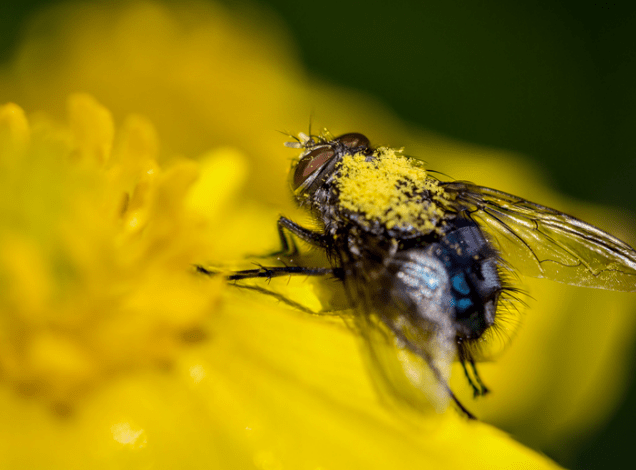
Among all the flower visitors, one group makes up some of most efficient pollinators of mango varieties grown around the world: flies, especially blowflies, carrion flies, bluebottles (family Calliphoridae), flesh flies (family Sarcophagidae), hover flies (family Syrphidae), and the house fly (Musca domestica). Except for hover flies, they are not seen in a good light by the public. That’s understandable, since most of what we know about them relates to their roles as agricultural pests and vectors of human and animal diseases. But that’s a narrow take on their comings and goings. These flies, often categorised as “filth flies”, are enormously important as decomposers and recyclers, and are vital for food chains: numerous birds, bats and fish depend on them. Another role is becoming increasingly understood: their contribution to myiophily (or myophily), that is, pollination by flies (Orford et al., 2015).

The unappealingly named oriental latrine fly (Chrysomya megacephala) is an important mango pollinator © portioid, iNaturalist:

Blowflies, flesh flies and the like are relatively large and their bodies are covered with ‘hairs’ (setae), which are important pollen-carrying structures. These flies are abundant and persistent flower visitors throughout the blooming season, all desirable qualities for efficient pollination. Besides mango, blow flies, flesh flies and the house fly are known or suspected to pollinate avocado, blueberry, Brussels sprout, carrot, leek, macadamia, onion and strawberry (Cook et al., 2020). The common greenbottle (Lucilia sericata) and the bluebottle (Calliphora vomitoria) are reared commercially for the pollination of seed crops and vegetable crops, respectively (L. sericata is also reared for medical uses: because their maggots preferentially eat dead tissue, they have been used for the treatment of diabetic ulcers, bedsores and other chronic wounds).

A fly with pollen attached to its back © ninfaj, Maryland Agronomy News:

Mango farmers in Northern Australia hold blow flies in such esteem that some growers have installed ‘stink stations’ in their orchards, a practice also used by avocado farmers in Peru. Each station consists of a plastic container filled with fish or chicken carcasses, a concoction guaranteed to attract flies. It’s not clear whether these contraptions improve yields (Finch et al., 2023), but at any rate, farmers see foul-smelling orchards as a small price to pay for the possibility of bumper crops of juicy, fragrant and profitable mangoes.

‘Stink stations’ used by mango growers in the Northern Territory, Australia © Finch et al., 2023:

The mango is a case study of the ‘other’ pollinators, that is, those outside the better known and celebrated club of bees, hover flies and moths. We may be unenthusiastic about flies that are the happiest on carrion and dung, but that’s a reflection of our aesthetic prejudices. Farmers around the world who deal with the mango’s finicky floral biology are very grateful for those unloved insects that help them produce better and more of the king of fruits.

The Guimaras Mango Festival in the Philippines wouldn’t be so lavish without the contribution of some flies of ill repute © Ranieljosecastaneda, Wikimedia Commons:

What do your favorite foods say about your social class?

December 20, 2024 • 10:00 am

It’s another slow day as the year creeps snailwise to its end, and I’m feeling dolorous and had another bad bout of insomnia last night. The good news is that there’s nothing intellectual afoot that I feel compelled to write about.  The other good news is that you get to take a QUIZ, one pointed out in the NYT but located another site that’s free.  Here’s what the NYT says (archived here):

Now, from IDR Labs, comes the social media-friendly Food Social Class Test, a casual online survey based on a data-driven academic report published in 2020 by Silvia Bellezza and Jonah Berger at the University of Pennsylvania. That work was broadly derived from research into the connections between social class and the things we choose to put in our mouths — a link explored in the early 1980s by the French academic and intellectual Pierre Bourdieu.

Mr. Bourdieu’s work sharply skewered myths of social mobility in a postindustrial society. He found, unsurprisingly, that in many ways those at the top of the capitalist food chain go to considerable lengths to safeguard and maintain social privilege and generational wealth.

Which brings us to the twice-baked potato topped with melted Cheddar and bacon bits: Reader, I took the test.

In it, each of the 35 menu options is offered as a silhouetted photo with a bar beneath it for rating a selection. Users are encouraged to rate such things as a Cheddar-topped baked potato by indicating the degree to which they “agree” or “disagree” with it. Though there are plenty of things with which this reporter quibbles on a daily basis, seldom has a baked potato provoked him to argument.

. . .Simply select menu items with caloric values in the low triple digits and you are quickly aligned with high-class culinary ways. If it is true that you can never be too rich or too thin, as the Duchess of Windsor is believed to have remarked, it goes without saying that you cannot achieve the latter benchmark by scarfing down Sloppy Joes. We live, after all, in an Ozempic era.

So never mind the fried fish sticks, the potato chips, the defrosted pizza, the chicken nuggets, or the hot dog with all the trimmings. Forget the Mac ’n Cheese or even the Truffle Mac ’n Cheese, presumably featured on the survey as a snob trap. Adding two small discs of fragrant fungus to a dish that is otherwise a gloppy, glutinous cholesterol nightmare does not significantly elevate it on the class scale.

That seems rather snobbish to me; I just like food that tastes good, and that’s how I rated them.

Here’s the site and the first example. Click on the “Food Test” icon below to take the quiz (and you know you will!):

One example: here’s the first of 35 items I chose. You have five choices for each item: really bad, bad, so-so (leave it in the middle), tasty, and REALLY tasty. Just move the cursor to one of the four spaces or leave it in the middle:

And here’s my result: I have “upper middle class” food choices. I don’t know what to think about that (I added the arrow).

In truth, I liked nearly everything, but somethings more than others (I wasn’t keen on the truffle mac ‘n’ cheese, which is like putting a pig in a fur coat, or on the tuna tartare tacos, a bad concept). Take it yourself and let us know how you did in the comments below. I wonder if anybody will come out “lower class”.  I urge readers to take the test because I want to know how people do!