Readers’ wildlife photos

April 7, 2026 • 9:15 am

Today we have a potpourri of photos from several readers. Their captions are indented, and you can enlarge the photos by clicking on them.

From Robert Lang:

Every few days I drive up to Altadena to check on the progress of our rebuild. Now, 14 months after the fires of January 2025, the neighborhoods are starting to come back to life again with the sounds of hammering and sawing, but the animals that had come down from the hills still consider the area to be their own. This bobcat (Lynx rufus) wandered into the empty lot next door while I was checking on our own home’s progress:

Although our metal mailbox survived the fire, we’ve redirected all mail to our temporary home for the time being. Nevertheless, people occasionally stuff their own junk flyers into the mailbox. To help dissuade them from their paper spam, this  Western black widow (Latrodectus hesperus) has taken up residence on the front of the mailbox. When disturbed, she retreats to her cozy cubbyhole under the handle, which is right where you’d put your fingers if you were going to open the mailbox to stuff something inside:

Seeing eye to eye: this California Ground Squirrel (Otospermophilus beecheyi) and Western Fence Lizard (Sceloporus occidentalis) are trying to decide who gets the top of the rock. Photograph by Merrilee Fellows.

From Todd Martin; a photo taken in, I believe, the Yucatan:

We encountered the ocellated turkey,  (Meleagris ocellata), appropriately enough, on Thanksgiving day, I had no idea what it was though and took it for a brightly colored pheasant. It wasn’t posing as nicely, but this picture gives a better sense of the iridescent feathers:

And from Keira McKenzie in Perth, Australia, we have three shots of the willie wagtail (Rhipidura leucophrys):

The first is taken at a neighbour’s place. She feeds him so he comes every morning:

The other two are taken at Hyde Park.

They are called Djiji Djiji in Nhe Noongar language,  which is much like the chittering it makes when cross or wary. The Latin name is Rhipidura leucophrys/

Despite being known for their chittering, they are also incredibly melodic. They wag their tails from side to side, but are actually the largest of the fantails.

They are known for their outrageous courage and will take on anything – cats, eagles, hawks, people – and win! Every time 😀

They are an utter delight and common all over Australia (though the ones in my neighbourhood have gone along with the trees – the increasing heat has caused them to stop nesting in my front yard).

And they are tiny. Tiny and mighty 🙂

They are very cute. And fierce with their white eyebrows over their bright black eyes 🙂

From Mark Gregor-Pearse in Texas:

This Great Egret (Ardea alba) was photographed on March 9, 2026, at the Puente Río Cuale in Puerto Vallarta, Mexico, with an iPhone 17 Pro. These large wading birds hunt by remaining perfectly still before striking with lightning speed to spear fish, frogs, and other small aquatic prey. Males and females look nearly identical, so it is difficult to determine the sex from a photo. In the early 1900s, Great Egrets were nearly driven to extinction because their delicate breeding plumes were prized for women’s hats. Public outrage over the slaughter helped launch the modern bird conservation movement:

And a cat from Pratyaydipta Rudra:

I am hoping to send some photos for readers’ wildlife when I get some time. Meanwhile I thought you may enjoy this photo of a stray cat from India (a friend sent it to me). It really wants to experience the “magic”, but alas! It’s too expensive. 

Readers’ wildlife photos

March 22, 2026 • 8:15 am

Today we have some travel and wildlife photos from reader Jan Malik.  Jan’s captions are indented, and you can enlarge the photos by clicking on them. (Don’t miss the Taiwan barbet!)

Here are a few pictures I took during my short stay in Taipei, Taiwan (Republic of China) in 2016. Business trips usually allow very little time for sightseeing — the familiar, morbid cycle of airport → hotel → conference room → hotel → airport — but on this occasion I had a few free hours in the afternoon. Naturally, I decided to explore the nearby Taipei Botanical Garden with a birding lens that mysteriously strayed into my suitcase:

On my way to the Botanical Garden, I visited the National Chiang Kai-shek Memorial Park and Hall, the latter built in the late 1970s after the President’s death. I include it here for documentary reasons — who knows how long it is going to survive, given the volatile political situation.

Inside stands a larger‑than‑life sculpture of the Generalissimo. Taiwan’s history is typical of right‑wing dictatorships which, like South Korea, Spain, or Portugal, began as oppressive authoritarian regimes and then evolved into genuine democracies. Conversely, left‑wing dictatorships typically resist fundamental change and persist until their eventual collapse:

Onward to wildlife. The entrance to the Mausoleum was guarded by a lion (Panthera leo var. lapideus):

Already in the Botanical Garden, I encountered a cat, doing what cats do best – contemplating:

In one of the alleys I came upon a sizable crowd — people were observing local celebrities, a pair of nesting Oriental magpie‑robins (Copsychus saularis). The birds seemed completely unfazed by the attention, the male singing and standing guard at the nest;

These birds are bold and well adapted to human habitats. The female does most of the feeding; here she brings an unidentified moth to her chicks in a rotted‑out branch stump:

At a nearby pond I spotted a duck. It was likely a domestic bird, possibly with a dash of wild Mallard  (Anas platyrhynchos) ancestry:

The pond was full of lotus plants, which provided excellent habitat for the Common moorhen (Gallinula chloropus). Like all rails, these birds have relatively small wings and strong feet, well suited to foraging on land as well as in water. They swim well despite lacking webbing between their toes. These traits help explain why, when rails successfully colonize remote predator‑free islands, they often evolve reduced flight or complete flightlessness;

Moving further along the park alleys, I spotted a Taiwan barbet (Psilopogon nuchalis) looking out of its nest cavity. As an endemic species, it was a special find for me. Barbets vary widely in sexual dimorphism — in the Taiwan barbet the sexes are practically indistinguishable, in others (like the Coppersmith barbet) the differences are subtle, and in still others (such as the Red‑and‑yellow barbet) they are striking. I wonder why, in this species, bright coloration in females is not maladaptive. Perhaps the fact that they are obligate cavity nesters shields incubating females from predators. The same logic applies to woodpeckers, whose sexes are also similar aside from modest red patches in males:

Shortly after the barbet, I hit another jackpot in my endemics count — the Taiwan blue magpie (Urocissa caerulea). Like other corvids, it is social and omnivorous, and like Taiwanese barbets, it is sexually monomorphic. Corvids also evolved cooperative breeding: fledglings often remain with their parents and help raise the next brood. This likely evolved through kin selection. Why does it work so well in corvids and not in most other birds? Perhaps in environments with limited resources, young birds have better reproductive success by helping relatives than by attempting to breed independently?:

Having spent some time observing the magpie, I moved on — my remaining time before the flight was getting short. Soon I saw another first for me, though a common sight in Southeast Asia: the light‑vented bulbul (Pycnonotus sinensis). An omnivorous bird, here it was about to snatch a ripe fig:

Moving on, I photographed a dragonfly, which I believe is a male Crimson Marsh Glider (Trithemis aurora). These insects are sexually dimorphic, with olive‑colored females. This male appears to be orienting its abdomen toward the sun to reduce the surface area exposed to solar radiation and prevent overheating — a behavior known as “obelisking”:

Near the Botanical Garden exit I saw the last animal in this series, the Eurasian tree sparrow (Passer montanus). They always bring a smile to my face. Unlike many other sparrows, the sexes are alike. In 1958 they were targeted during China’s “Four Pests” campaign, a fine example of how ideology can override basic biological understanding:

While driving toward the airport that evening, I saw a Buddhist temple by the roadside, adorned with a symbol that, in European cultural circles, evokes entirely non‑religious sentiments. It was adopted in the 1920s by the National‑Socialist German Workers’ Party, but in Asia it is an ancient religious emblem. It is not identical to the Hakenkreuz — it “rotates” counterclockwise — and its meaning here is entirely benign:


Readers’ wildlife photos

March 9, 2026 • 8:15 am

I have a few batches now, so I’m complacent (never happy!). Today’s photos of Costa Rica come from reader Rachel Sperling.  Her captions and IDs are indented, and you can enlarge the photos by clicking on them.

In January I took my first (of many, I hope) trip to Costa Rica. We spent about a week in Manuel Antonio, on the Pacific Ocean side. We took a couple of nature walks in and around Manuel Antonio National Park, and we saw plenty of wildlife. One of these days I’m going to treat myself to a really good camera, but these were all taken with either my mirrorless Olympus or my iPhone camera, which are light and easy to stash in a backpack. I did see a couple of sloths – both three-toed (Bradypus variegatus) and Hoffman’s two-toed (Choloepus hoffmanni), but they were high up in the trees, so I wasn’t able to get a good photo of them.  These are the photos I was able to capture:

On the drive from San Jose to Manuel Antonio, we stopped at a creek to view some American crocodiles (Crocodylus acutus):

We saw a number of Central American Squirrel monkeys (Saimiri oerstedii), which were incredibly cute:

Then there were these little beasts: the Costa Rican mafia, aka the Panamanian/Central American White-faced capuchin (Cebus imitator). According to our guide, these monkeys can be pretty vicious with animals their own size, and they’ll just riffle through your backpack if you’re not watchful. Someone had to be on guard whenever we went to the beach.

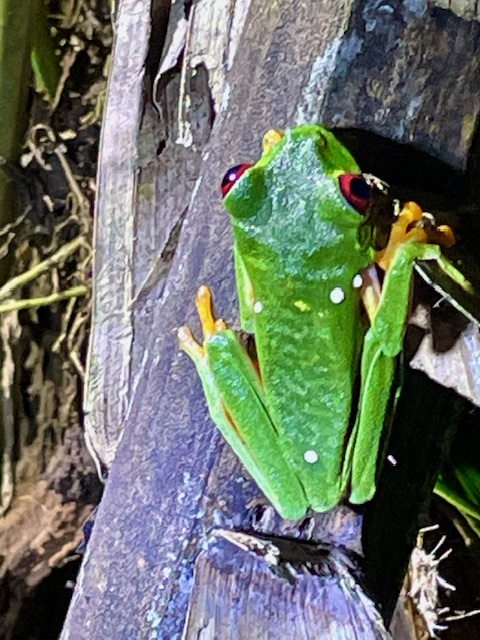
We went on a nature walk in the rainforest at night (with a guide), which gave us the opportunity to see a lot of nocturnal animals. Among them was the Red-eyed tree frog (Agalychnis callidryas):

Masked tree frog/New Granada cross-banded tree frog (Smilisca phaeota) in Manuel Antonio National Park. I’m sorry I’m not better at identifying plants, to the disappointment of my botany-teacher father:

Black iguana (Ctenosaura similis), at the beach at Manuel Antonio:

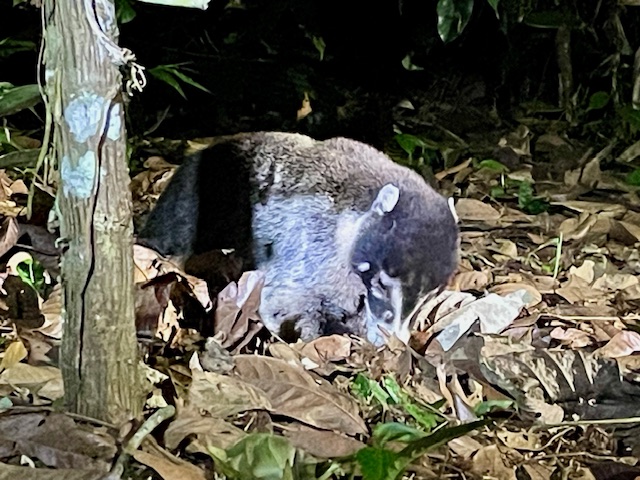
We also saw a coati (Nasua narica), which Wikipedia tells me are diurnal, but it was definitely after sunset and that is definitely a coati. They’re relatives of the raccoon, and our guide told us that a mature one can hold its own against a jaguar. This one wasn’t afraid of us, anyhow:

Back at our b&b, this Black-hooded antshrike (Thamnophilus bridgesi) came to visit me as I read on the veranda a few times. I think it’s a female, though the sexual dimorphism of this species doesn’t seem terribly dramatic. I did see her building a nest:

On my last day in Costa Rica, I heard a tremendous ruckus in the trees outside my hotel in San Jose. I looked and discovered that the trees (American oil palmsElaeis oleifera —I think) were full of Crimson-fronted parakeets (Psittacara finschi). They were LOUD and they were going to town on those trees. There were too many to count. Fortunately, they quieted down after sunset:

Manuel Antonio National Park from the water. These little islands are bird sanctuaries that tourists are not allowed to visit:

Sunset over the Pacific, near Manuel Antonio National Park:

Nauyaca Waterfalls, near Dominicalito, where we swam:

Finally, I thought you’d like these because they’re jaguar-inspired. We spent an afternoon at a village belonging to the Boruca, an indigenous tribe. They cooked us a delicious lunch, and showed us how they made dyes from local plants, and carved and painted balsa wood masks. The masks were first used to frighten the Conquistadores. Now you can buy them just about everywhere:

Readers’ wildlife photos

March 3, 2026 • 8:30 am

Today we have some singletons, doubletons, and tripletons from readers: that is, miscellaneous photos. The IDs and captions are indented, and you can click on the photos to enlarge them.

From reader Jay, a photo from St. Augustine beach, Florida:

This photo shows two terns (possibly Royal Terns, Thalasseus maximus), in front of four Black Skimmers (Rynchops niger).

From Keira McKenzie:

These photos were taken on a warm afternoon in Hyde Park [Sydney, Australia], sitting beneath the plane trees at the eastern end of the park.

Here you have Australian White Ibis (Threskiornis molucca,  commonly referred to as bin chickens here—which is a bit rude. In the second picture it’s with an Australian wood duck (Threskiornis molucca; there is quite the family here in all their regimental delight), both birds roosting on the island in the eastern pond in the park. While most of the undergrowth was cleared, these birds still manage to find somewhere to roost. The ibis lost their favourite tree in the clearing process, but they have found others. The wood ducks seem happy as well and I love watching the family being marshalled for the march up to the lawns to either graze or look for beetles or whatever. When they come back to the ponds, they fly in a ragged formation careless of persons what might be sitting there chatting and drinking coffee!

And the egret: it’s a Great Egret, either Ardea alba (the western Australian one) or the equally common Ardea modesta: the Eastern Great Egret (subspecies modesta) . The reason I can’t decide is their are supposed to have black legs, but my photos all have them having yellowish legs which doesn’t come up in any descriptions.

I’ve added a pic of the little Baba Yaga in her outside tiger pen just to make you smile (she is currently yelling at me to come to bed!)

And Daniel Baleckaitis, who works for both our department and Organismal Biology and Anatomy, sent three mallard pictures (Anas platyrhynchos)—taken in Botany Pond! I don’t know the ducks but the pictures are great (and clearly taken a few years back when the pond was full of vegetation):

Ducks in action:

Readers’ wildlife photos

February 14, 2026 • 8:30 am

These are the last photos I have, and I’ve gathered singletons in a potpourri of photos. Please send me any good wildlife photos you have—otherwise there will be a LACUNA tomorrow. Captions are indented, and you can enlarge the photos by clicking on them.

From Pratyaydipta Rudra in Oklahoma.

This is a Pine Squirrel [Tamiascirus sp.], photographed in Rocky Mountain National Park, CO.

From Adrian:

Here’s a picture of a European Pine Marten (Martes martes) from the shores of Loch Duich, near the Isle of Skye, Scotland:

From Guy:

Taken in Lake Saint Clair Metropark in Michigan a few years back by my 12 year old son Nolan at a bird-banding station where we volunteer. I think it’s a Blackpoll Warbler (Setophaga striata) with the image taken in the fall (so I don’t really know if it’s male or female):

From Robert Lang, whose house and studio burned to the ground during the California fires last year; both are being rebuilt:

Our gardener found this California native tarantula (Aphonopelma sp.) while clearing some fire debris at my former studio and, knowing that my wife had a pet tarantula and was helping the Eaton Canyon Nature Center in its fire recovery, he left it for us at our temporary home in a little plastic bottle. (Umm…the tarantula was in a little plastic bottle. Not our home.) After we determined that ECNC didn’t have a place for one yet, we released it locally, but I took this picture before it wandered away.
When we got home from the release, there was another plastic bottle on the porch with another tarantula inside.

A Hummingbird Moth (species unknown) from Marty Riddle:

The Hawk Moths, aka Hummingbird Moth, love the nectar in resident maintained gardens at Brooksby Village Peabody, Massachusetts:

And a cat/bird encounter from Barry Lyons:

For years now, I’ve had mourning doves  [Zenaida macroura] alight on my air conditioner. Some of them are regulars, and what interests me is that they haven’t taken the next obvious step: pecking at the window.
What I mean is that a dove arrives and then stares into my apartment, sometimes moving its head back and forth: “Are you in there? Ah, there you are!” And then I get up from my chair and go feed them.
But when will a dove start pecking at the window to alert me that he’s there? Why hasn’t it figured out that it’s something it can do? And at no cost to his safety because he can still fly away.
And look at this photo. The dove seems to understand windows. Every time a cat goes to the window (I don’t own a cat; I cat-sit) it flares its wings instead of flying off, as if to say, “Ha ha, you can’t get me. I’m out here, you idiot.”

Readers’ wildlife photos

February 13, 2026 • 8:15 am

Well, this is the last batch of photos I have, and it’s very sad that the tank is empty. Please send some in if you have them. Don’t make me beg!

Today we have photos of ducks—or rather, one female duck— rom Aussie reader Keira McKenzie in Perth. Keira’s captions are indented, and you can enlarge her photos by clicking on them.

Here is a series of photos I took of a lone Pacific Black Duck [Anas superciliosis] from this afternoon [Feb. 11] at the park. Since the islands in the ponds have been completely cleared of all vegetation (the western island) and all the undergrowth cleared from the eastern island (this is because of the devastation throughout Perth’s trees from the polyphagous shothole borer), moat of the waterbirds have left for areas where they can roost & nest. 

The photos are taken in Hyde Park, Perth, Western Australia, on a hot humid afternoon.

I am very fond of them. I rescued one when it flew into the electric wires on the other side of the road one night. I carried it back across the road and into the park, putting it near the water’s edge. It was a pond-smelling little bundle, seemed uninjured and was very calm, and waddled off into the water and sailed into the night.

What a beautiful hen! It makes me eager for Duck Season to arrive at Botany Pond. Keira also sent a picture of her cat:

I shall sign off with a pic of my little Baba (currently zooming around the place for no apparent reason) slothing in the armchair in the heat with one of her favourite toys (the other is a wombat).

Reader’s wildlife video

January 31, 2026 • 8:15 am

Praise Ceiling Cat: reader Tara Tanaka, photographer and videographer extrodinaire, has returned with an awesome video featuring both cats and d*gs (well, a bobcat and coyotes). Tara filmed it from her living room in Florida (Tara and her husband own a large tract of wetland).  Tara’s Flickr page is here and her Vimeo page is here.

Tara’s Vimeo notes, which assure us that this is genuine:

“A Bobcat’s Encounter with Two Coyotes (Not AI)”

We had seen one or two coyotes around 9:30 the last two mornings. Hoping they would return for a third day I got my camera ready in the living room to try to record them. About 9:00 my husband said he saw one, so I made some final adjustments for the lighting and began to search for something moving in the distance. When I finally centered the subject in the viewfinder, I said “I think I’m looking at a bobcat.” Almost immediately the cat stood up and as I panned with it I was shocked when two coyotes ran into the frame, one on each side of the cat. Enjoy the interactions between the two species and between the very bonded pair of coyotes. I believe the female is pregnant.

After I finished filming I just sat in disbelief that I had had the opportunity to record something so unique – and from my living room! I feel like I could have gone to Yellowstone and spent a month in the field and not witnessed an encounter like this. Because of the dramatic temperature difference between the thawing ground and the sun heating the brown grass, the waves of heat shimmer intensified as the sun got higher and you can see them rippling across the screen. Despite the extreme conditions, I was thrilled that I was able to record the interaction so clearly from 1000′ away, and through a double-paned window.

We should have a pond full of water with waders arriving to nest right now, however due to a severe drought that started over a year ago, the entire swamp is dry. Without water to allow our large alligators to patrol under the nests and protect them from predators, I’m afraid that our hundreds of waders that nest here every year will not feel safe and will likely nest elsewhere.

Filmed with a Panasonic GH6 + Nikon 500mm f2.8 lens. Since I filmed it from inside the house, I used the audio from a video I shot from the yard last year.

The bobcat and coyotes don’t seem to mind each other, though the bobcat eventually climbs partway up a tree. Be sure to enlarge the video and put the sound up to hear the birds singing.