Why Evolution is True is a blog written by Jerry Coyne, centered on evolution and biology but also dealing with diverse topics like politics, culture, and cats.
For many of you it’s been a three-day weekend; have you considered sending me photos? This is the last batch I have.
And today’s batch comes from reader Jan Malik. Jan’s captions and IDs are indented, and you can enlarge his photos by clicking on them.
My home state of New Jersey is, for the most part, nothing to write home about, but it does have a few redeeming features, and one of them is the spring migration of birds (the fall migration is also good). Cape May, on the Delaware Bay side of the peninsula, is a particularly good spot to observe birds migrating from far south toward the Arctic. During my visit at the end of May, I took a few pictures of common bird species. I did my best to identify them, but small shorebirds can be difficult to pin down exactly to a species.
First, a pair of Willets (Tringa semipalmata), which may not be migrating too far but are rather already on their nesting grounds—they breed in Atlantic coastal marshes. Their calls are quite similar to those of oystercatchers, but a little less piercing:
Next, a Dunlin (Calidris alpina) in breeding plumage. They are fairly widespread in North America and may fly as far as Greenland or Nunavut. The spring coloration is far more striking than it is in winter;
A Red Knot (Calidris canutus) with its unmistakable cinnamon-orange breast and belly. These are long-range migrants; American birds winter in Tierra del Fuego and fly up to 9,000 miles to breed in the High Arctic. A good portion of their lives is spent along migration routes:
This is what Cape May beaches can look like during the peak of Red Knot migration. I think I took this picture in 2013. There was a fear that Red Knot numbers would decrease drastically, even to zero by some extrapolations (meaning complete extinction). Lately, their numbers seem to have stabilized, but their future is not secure. They rely heavily on horseshoe crab eggs in the Delaware Bay area, and these interesting animals are also under a lot of pressure—a perfect example of the ecological dependence of one species on another:
A Ruddy Turnstone (Arenaria interpres) in full breeding plumage. They also travel to the High Arctic but winter closer to home, in South America or the southern US states:
A Semipalmated Sandpiper (Calidris pusilla). It is a small American bird that spends its winters primarily along the northern coast of South America, as well as the Caribbean:
A Sanderling (Calidris alba) in full breeding plumage. These are cosmopolitan birds, present everywhere except Antarctica:
I suspect this is also a Sanderling, but still in winter plumage. Transitional plumage is exactly what makes shorebird identification tricky:
Coastal marshes had several nesting Seaside Sparrows (Ammospiza maritima). I think I could only see the males, who were singing from conspicuous perches, while the females stayed low. I consider these sparrows to be honorary shorebirds—they also probe mud for invertebrates with their large, sharp bills:
Another local, a Laughing Gull (Leucophaeus atricilla), eating a cluster of horseshoe crab eggs (together with a few beach pebbles). These “crabs” play an oversized role in the New Jersey coastal ecosystem:
Here, I suspect a Short-billed Dowitcher (Limnodromus griseus), almost identical in bill length to its “long-billed” cousin. Their bills are sensitive and tactile, allowing them to probe mud and sand fast, relying entirely on the sense of touch and feeding even in darkness:
During the peak of the spring migration, the birds continue their flight well after sunset. Living in the ‘Armpit of America’ has its moments:
Welcome to Friday, June 19, 2026, and it happens to be Juneteenth, celebrating what’s considered to be the end of slavery in the U.S.:
Planters and other slaveholders from eastern states had migrated into Texas to escape the fighting, and many brought enslaved people with them, increasing by the thousands the enslaved population in the state at the end of the Civil War. Although most lived in rural areas, more than 1,000 resided in Galveston or Houston by 1860, with several hundred in other large towns. By 1865, there were an estimated 250,000 enslaved people in Texas.
Despite the surrender of Confederate General-in-Chief Robert E. Lee at Appomattox Court House on April 9, 1865, the western Confederate Army of the Trans-Mississippi did not formally surrender until June 2. On the morning of June 19, 1865, Union Major General Gordon Granger arrived on the island of Galveston to take command of the more than 2,000 federal troops recently landed in the department of Texas to enforce the emancipation of its enslaved population and oversee Reconstruction, nullifying all laws passed within Texas during the war by Confederate lawmakers. The order informed all Texans that, in accordance with a Proclamation from the Executive of the United States, all enslaved people were free.
The Emancipation Proclamation had been issued Jan. 1, 1863, and the Confederate Army surrendered on April 9, 1865, but people were still enslaved over two months later. Here’s a photo of a celebration in Texas 35 years later from the Smithsonian’s National Museum of African History and Culture with the caption, “Emancipation Day celebration, June 19, 1900 held in ‘East Wood’ on East 24th Street in Austin. Credit: Austin History Center.
There’s a Google Doodle for the holiday; click the screenshot below to see where it goes:
Jonathan David‘s hat trick propelled Canada to a historic 6-0 rout of Qatar in Vancouver on Thursday to go to the top of their World Cup group.
It was not only Canada’s first victory at a World Cup but also equaled the record margin of victory for a tournament host, matching the six-goal wins for Italy in 1934, Brazil in 1950 and Argentina in 1978.
Canada’s tally against Qatar also doubled the number of goals they had in their World Cup history coming into the game.
“No one will forget this, and no Canadian will forget this day,” said coach Jesse Marsch, who held up six fingers as he walked off the field. “It’s an incredibly seminal moment for everyone to understand that there’s talent in this country, that there’s mentality, that there’s desire, that there’s a lot of things that make this country special.”
The preliminary deal to end the war between the United States and Iran faced fresh challenges on Friday after Switzerland said the next phase of talks had been postponed and Israel launched new strikes in Lebanon.
Vice President JD Vance had been expected to fly to Switzerland for talks with Iranian officials but the White House said late Thursday that his trip had been delayed. The United States was looking forward “to beginning technical talks as soon as possible,” it said in a statement.
The preliminary U.S.-Iran deal, which President Trump and President Masoud Pezeshkian of Iran signed this week, has been strongly criticized by Israeli lawmakers in Israel as well as some Republicans, who argue that it gives Iran economic relief while punting more difficult negotiations, including on Tehran’s nuclear program, down the road.
It’s Thursday, June 18, and the official terms of the U.S. Memorandum of Understanding are out—and it’s worse than anticipated. The official signing ceremony isn’t until Friday, but the agreement was already signed digitally last night during a dinner at the Palace of Versailles. Anyone familiar with the palace’s history knows this makes the MOU the second great surrender signed at Versailles. Except this time, the U.S. is the one capitulating.
Here’s why it’s worse than we thought. As the details slowly leaked, it became clear that this agreement is not a pause—the status quo held in place while negotiations ran their course. It was a rewind, actively restoring the Islamic Republic. The only question left was how fast it would run, and according to these clauses, faster than we would like.
U.S. officials, including the vice president, previously assured reporters that the agreement provides a “dial,” with economic and sanctions relief increasing only as Iran demonstrates good behavior and compliance. The text is less specific. The clearest financial concession involves the issuance of oil waivers in Section 10, which on their own will return monthly revenue of $5 billion; meanwhile, Section 11 seems to imply that all of the regime’s assets will be made available immediately—best case, that remains credit the Islamic Republic can use only for humanitarian purchases; worst case, it is transferred to them directly. Either way, money is fungible, and besides, I’m not sure exactly what leverage the U.S. assumes it will retain once it has surrendered Iranian assets up front.
As has been clear for the past couple of months, two of the conflict’s four goals—the funding of proxies and the ending of the ballistic missile program—have been abandoned. In fact, Trump defended the omission. “If other countries have them, it’s a little bit unfair for them not to have some,” Trump said in France, where he held a press conference on the sidelines of a Group of Seven summit. “If Saudi Arabia and Qatar, and they all have some, I would say that in relative proportion, I think it’s okay” for Iran to have ballistic missiles as well. I haven’t seen Saudi Arabia firing those missiles at the U.S. recently, but I digress. The JCPOA famously made the same omission—but at least it didn’t promise the removal of all primary and secondary sanctions on the ballistic missile program and on terror sponsorship. Section 7 provides for the removal of all sanctions pending a final deal—so even if Trump somehow clutches victory from the claws of defeat and secures a strong nuclear deal, Iran’s other malign activities can continue without sanction. Indeed, Lebanese and regional sources told Reuters that Iran has promised to increase Hezbollah’s funding “as soon as possible” once the United States unfreezes Iranian assets. Chalk up a point for the JCPOA.
The third of the original four goals fares no better: the MOU codifies the abandonment of the protesters, enshrining noninterference in Iran’s “internal affairs”—those hoping for an uprising in the next 60 days are likely to be disappointed. That leaves only the nuclear front—the last remaining goal, and one whose outcome remains entirely unclear. Zero enrichment was already abandoned by Trump last week, but the MOU goes further, defining the new U.S. minimum not as exporting its enriched uranium, but as on-site down-blending under IAEA supervision. In the case of uranium, what goes down can also go up. Without the material in friendlier, less fanatical hands, “good” is not an applicable adjective for the deal.
Not only that, Clause 5 gift-wraps the regime’s trump card—the one it has played to such great effect against the U.S. Iran’s leverage over Gulf shipping was always its readiest threat, the valve it could squeeze whenever it needed the world’s attention. A serious agreement would have taken that card out of their hands. Instead, the MOU merely gestures at “negotiating the status” of the waterway with other states in the region—language that quietly abandons the prior baseline of freedom of the seas and hands the question to bilateral talks between Tehran and its neighbors. That is not a settlement; it is leaving the shopkeepers alone with the mob and telling them to work it out among themselves. The U.S. assiduously avoided the word “tolls,” so Iran rebranded them “service fees.” The honest term is protection money—and the only thing Iran is offering protection from is itself.
Clause 6, the reconstruction fund, must come as an even more bitter pill for the Gulf allies—particularly those who took the U.S. at its word two weeks ago, when it pledged to make “Iranian assets [available] to its Gulf allies to support, repair and mitigate future damage that Iran may cause.” That promise has been inverted. Rather than Iran paying for the damage it inflicts, the MOU drafts a Marshall Plan while the Nazis are still in power—and leaves France and Britain to foot the bill for German reconstruction.
The most immediate problem for Israel is the first clause: Lebanon, whose status is left unclear by the MOU. . .
Supposedly Iran has told Hezbollah that Israel will withdraw from Lebanon within two months, but of course Israel didn’t sign the agreement. In fact, I don’t see that the U.S. is guaranteed to get anything from Iran that we didn’t have before the war. The deal stinks, and even Trump’s Republican cronies know it. He just wanted to be rid of the war so he wouldn’t have to suffer from the economic repercussions of the fight, and so he gave away the shop. Unfortunately, the Democrats don’t seem to care about the terms of the deal save that a war they didn’t like will be over.
At present the Trump administration seems to have united its critics from left and right, foreign and domestic, over the deal to end current hostilities.
Three aspects of the deal symbolize the problem.
The first is that one of the initial steps in the process insists that the regime in Tehran allows the Strait of Hormuz to be open to international shipping and the free flow of oil carriers and other vessels through the region.
The trouble is that the Iranian regime has for decades used this strategic vantage point to blackmail the world.
Whenever the Iranian regime wanted to put pressure on other countries—for instance, to lift sanctions against the regime—the regime sent its vessels to go poaching in the straits. Even during President Donald Trump’s first term in office, Iranian military vessels repeatedly harassed and threatened American warships, flying drones at them and provoking them to fire warning shots at Iranian attack crafts.
. . . That’s what the Iranian regime was doing in relatively normal times. So why should anyone believe that after the past year of war they will start to be generous in their treatment of international waters?
The second aspect of the reported deal, which is surprising critics and supporters of Trump alike, is the suggestion that the agreement would allow a vast flow of cash to enter Iran. In a CBS interview on Monday morning, Vice President J.D. Vance seemed to confirm that Iran would get “access” to an inflow of funds worth somewhere in the region of $300 billion within months of the striking the deal. The vice president was at pains to say that this “reconstruction fund” would not come from American taxpayers but rather investments from various Gulf countries.
Whatever the source of the funds, payouts to Tehran have been tried before. The results were disastrous, which Trump knows very well. . .
. . . Thirdly, of course, there is the issue that kicked off this latest round of conflict in the first place: the Iranian regime’s nuclear ambitions.
Whatever the source of the funds, payouts to Tehran have been tried before. The results were disastrous, which Trump knows very well.
If the remainder of the Iranian regime has come to the negotiating table in order to give up their residual fissile material for good, then that would be one thing. The enriched uranium—which is believed to be buried deep underground at facilities in Isfahan, Fordow, and other sites—would need to be manually removed. If an agreement can be reached to extract that uranium in order to ensure that the sites do not leak and that the regime cannot restart its program at a later date, then Trump can boast of a victory.
But here is what is, for many observers, the most disturbing alleged part of the peace deal: the“promise” from the Iranian regime that they will not restart their nuclear weapons program. They have lied about their nuclear program for decades. And this lie started from the very top.
Those who claim that Iran has been abiding by its agreements should read about the Israeli capture of Iranian documents (another amazing feat of Israeli intelligence), which “showed beyond any doubt that Tehran had for years been hiding its nuclear weapons program and lying, dissimulating, and hiding that program from the international community.” This also covered the period when Obama was President.
. . .the issue with the present MOU is not whether the Iranians fear Trump. It is that they look set to receive the funds and freedom to survive and then weapons-develop another day. When Trump first sent the B-2 bombers to Iran, he was fulfilling a historic mission: to ensure not only that the Iranian regime could not create a nuclear weapon on his watch, but that they could not create such a weapon on any successor’s watch. After all, as the president knows, there can always be another Obama, Biden, or even Kamala Harris in the future.
That’s the good thing about agreements that aren’t worth the paper they’re not even written on. The Iranians won’t take it seriously. Neither should we. There is still time to correct this looming mistake.
Of course to “correct” this we have to start attacking Iran again, and does anybody but zealots like me have the stomach for anything like that? Finally, any Democratic administration could (and probably would) allow Iran to violate a nuclear agreement. (Note that Murray says “even Kamala Harris,” suggesting she would be the least likely to be a hard-liner on Iran, which is true.)
An Israeli flag was removed from a fan at a FIFA World Cup match between Iran and New Zealand while Palestinian flags nearby were reportedly left untouched, Hebrew media reported Wednesday.The incident, filmed inside the stadium and circulated on social media, showed stewards asking a fan to hand over an Israeli flag during Iran’s opening match of the 2026 World Cup, Israel Hayom reported. The fan pointed to Palestinian flags being held a few rows away and accused the stewards of applying the rules unevenly.
“Why don’t you tell them to take down their flag?” the fan said, according to Israel Hayom. “This feels like antisemitism. When you take that flag down, I’ll take mine down.”
The stewards reportedly told the fan the Israeli flag had to be removed for safety reasons and said the order did not come from them personally. Israel Hayom reported that the fan eventually handed over the flag after being told he would receive it back later. In another part of the video, a steward reportedly told him flags of teams playing in the match were allowed, a rule that would not explain why Palestinian flags were left visible.
I suppose that the Israeli flags were there displaying Israel’s solidarity with the people of Iran, though I don’t know for sure. It’s okay to ban all flags, or even to allow the flags of the two teams in the match, be selective enforcement of flags in this way is a no-no, “security” conditions or otherwise.
The coach of Iran’s World Cup team said it was ordered to leave the U.S. and return to its training base in Mexico only a few hours after opening its politically charged tournament by playing to a 2-2 draw with New Zealand on Monday night.
Coach Amir Ghalenoei didn’t say who ordered the Iranians to leave earlier than planned. The team had expected to spend the night in California to maximize the normal recovery process after its opening game, only to be told after the match that everyone must immediately get on a plane for the 140-mile trip back to Tijuana.
“They didn’t even give us time to recover,” Ghalenoei said through an interpreter. “After the game today, they said to us, ‘You have to leave immediately.’ It’s very important for us to have time for recovery, (but) we are asked to get on a plane and return to our camp in Tijuana, and we are really troubled by that.”
Speaking to CBS News on Monday, Andrew Giuliani, the executive director of the White House’s World Cup task force, said that Iran’s team would be allowed to enter the U.S. one day before each match, but would be required to leave on the evening of their matches.
I presume Iran agreed to go across the border for safety reasons; after all, we’re at war with them. But if they didn’t agree, then it’s American responsibility to keep its team safe in the U.S.. And ordering the Iranian team back to Tijuana prematurely is a no-no.
Former President Barack Obama, joined by three former presidents, celebrated the opening of his presidential museum in Chicago in an extraordinary event Thursday that brought together world leaders, A-list celebrities, athletes and other internationally known figures.
Bono, John Legend, Christina Aguilera, Marc Anthony and Eddie Vedder took turns on the stage ahead of planned performances by Bruce Springsteen and Stevie Wonder.
Obama and former first lady Michelle Obama and their daughters were seated on stage with former presidents Joe Biden, George W. Bush and Bill Clinton along with former first ladies Jill Biden, Laura Bush and Hillary Rodham Clinton. Former Vice President Kamala Harris was also in attendance.
President Donald Trump was not in attendance. He called the $850 million center a “total disaster” in a social media post in February.
. . . . Jennifer Hudson sang the national anthem and Aguilera delivered a rousing rendition of “What a Wonderful World.” Pearl Jam’s Vedder, joined by Chicago teenagers in the nonprofit Guitars Over Guns program, sang an original song called “Better Believe,” written just for the dedication.
Legend sang “Someday We’ll All Be Free” and was joined by the rapper Common and Uniting Voices Chicago for their Academy Award-winning song “Glory.”
Bono, who said he was there representing the Irish, joined with The Edge in singing the U2 song “City of Blinding Lights.” The Roots served as the house band.
Those at the event included California Gov. Gavin Newsom, a potential 2028 Democratic presidential candidate; civil rights leaders Andrew Young and Al Sharpton; Oprah Winfrey; comedians David Letterman, Conan O’Brien and Stephen Colbert; actor Tom Hanks; tennis legend Billie Jean King and Chicago Cubs Chairman Tom Ricketts.
Here’s a long video of the Grand Opening. Michelle Obama’s talk praising her husband starts at 2:25:40, and Barack wiped away a tear. I should add that the Center has a full-sized basketball court in honor of the ex-President’s favorite sport.
Meanwhile in Dobrzyn, Hili and Andrzej again discuss the Meaning of Life:
Hili: Everything has already happened. Andrzej: In a way, you’re right, but these are repetitions with variations.
In Polish:
Hili: Wszystko już było.
Ja: W pewnym sensie masz rację, ale to są powtórzenia z wariacjami.
As I expected, Masih doesn’t like the U.S./Iran “peace deal” very much.
President Biden replaced the Taliban with the Taliban in Afghanistan. Now President Trump is replacing the Islamic Republic with… the Islamic Republic.
From Luana. Eman Abdelhadi is an assistant professor in Chicago’s Department of Comparative Human Development, and appears to be here solely so she can indoctrinate our students. “F- the University of Chicago; it’s evil,” she starts. I don’t know squat about El-Sayed, but I see that he’s a “progressive” and shares some of his half-sister’s views. That doesn’t bode well for Democrats.
When @TradeUnionJake told me Michigan Senate candidate Abdul El-Sayed was the half-brother of the infamous Eman Abdelhadi, my jaw hit the floor.
I am so glad this article is finally live because this has been a wild secret to sit on.
Two from my feed. First the “new regime” in Iran is worse than the old regime, since it’s made up of hard-line Revolutionary Guards. And it’s still arresting women for singing:
The “new regime” in Iran that Trump claims is so much better than its predecessors just sentenced singer Parastoo Ahmadi and eight musicians to 74 lashes, a two-year travel ban, and a two-year ban on artistic activity.
— Navid Mohebbi نوید محبی (@navidmohebbi) June 17, 2026
I’ve seen this in Botany Pond. Note that the female is larger:
This turtle behavior, often called “claw fluttering,” is a courtship ritual where a male rapidly vibrates or waves his long front claws near a female’s face to attract her pic.twitter.com/1K8MGxHSQh
Homeopathy is one of the biggest scams I know of. The products have no curative properties and yet people spend billions on them. And, as Dara O’Briiain says in the bit below, “It’s JUST WATER.” (h/t Andrew Petto:
What do we know about the effectiveness of homeopathy?
There’s little evidence to support homeopathy as an effective treatment for any specific health condition.
What do we know about the safety of homeopathic products?
Some products labeled as homeopathic may contain substantial amounts of active ingredients and could cause side effects and drug interactions.
What Is Homeopathy?
Homeopathy, also known as homeopathic medicine, is a medical system that was developed in Germany more than 200 years ago. It’s based on two unconventional theories:
“Like cures like”—the notion that a disease can be cured by a substance that produces similar symptoms in healthy people.
“Law of minimum dose”—the notion that the lower the dose of the medication, the greater its effectiveness. Many homeopathic products are so diluted that no molecules of the original substance remain.
Homeopathic products come from plants (such as red onion, arnica [mountain herb], poison ivy, belladonna [deadly nightshade], and stinging nettle), minerals (such as white arsenic), or animals (such as crushed whole bees). Homeopathic products are often made as sugar pellets to be placed under the tongue; they may also be in other forms, such as ointments, gels, drops, creams, and tablets. Treatments are “individualized” or tailored to each person—it’s common for different people with the same condition to receive different treatments. Homeopathy uses a different diagnostic system for assigning treatments to individuals and recognizes clinical patterns of signs and symptoms that are different from those of conventional medicine.
There is no empirical basis for either of these two “theories”, and many homeopathic products are basically water, since the “like” substance has been eliminated through multiple dilutions (see below), and in principle can have no curative properties.
According to Grok (data from S&S insider), billions are spent on this scam, and the market is growing as people buy into “natural” remedies:
The U.S. Homeopathy Market was valued at approximately USD 4.12 Billion in 2025 and is expected to reach approximately USD 13.38 Billion by 2035, growing at a CAGR of 12.50%.
The U.S. is the second largest market for homeopathic drugs globally in terms of revenues. OTC homeopathic remedies for symptoms such as cough, cold, pain, sleep aid, and pediatric use can be found at major retail outlets like CVS, Walgreens, and Walmart as well as natural food stores. Hyland’s Homeopathic and Boiron are the leading brands. The FDA regulation of homeopathic products under the OTC drug paradigm has been increasingly progressive. The FDA’s risk-based regulatory strategy enhanced product regulation without taking out commercialized products from store shelves.
The world market for homeopathic remedies is $12-15 billion per year, but Americans spend more on this scam than any other nationality (India is second with about $1 billion/year). I’ve seen homeopathic remedies in most of the U.S. chains mentioned, and if you want to see the big array of homeopathic remedies in Whole Foods, go here. (You can go to any of the chains and simply insert “homeopathic” into their search function.)
It would be nice if the quacks health experts in the Trump administration would denounce these products as useless, but you know that ain’t gonna happen. In fact, people are still publishing papers touting homeopathic remedies, as recounted in the article below from the (usually) rational site Science Based Medicine (SBM). The author’s description shows he has cred:
The author is described in the article: “Mark Crislip, MD has been a practicing Infectious Disease specialist in Portland, Oregon, from 1990 to 2023. He has been voted a US News and World Report best US doctor, best ID doctor in Portland Magazine multiple times, has multiple teaching awards and, most importantly, the ‘Attending Most Likely To Tell It Like It Is’ by the medical residents at his hospital.”
His Wikipedia page also says that Crislip is a co-founder of SBM. Click headline to read:
It’s a bit of a strange article, disursive, and with the author bent on getting attachment to homeopathic remedies classified as a “delusional disorder.” It really is, but I doubt it would make the DSM given that many of us are subject to delusions like this. The problem is that this delusion involves not only a huge waste of money, but also potential damage to health. People should not be diagnosing themselves and buying nostrums when there are doctors around. And so Crislip reminds us again to stop using these fricking remedieds.
A few of the papers that Crislip mentions.
. . . . homeopathy continues to be inflicted on patients by homeopaths and naturopaths in lieu of useful therapy. Much to my ongoing wonder, research on the fiction continues with around 200 papers indexed on the PubMeds in the last year. Like my recent journey down the rat hole that is chiropractic, let’s see what those delusional homeopaths have been up to in the last year or so. Of course I am not going to discuss all 200 plus papers, just those of interest to me. You know, the crazy stuff.
And right of the chute, first reference, first paragraph, is gibberish in Homeopathy at a Turning Point [JAC: this is in the journal Homeopathy as a “letter to the editor” so it’s not a paper]:
In the Hippocratic conception, medicine is a synthesis of technique, philosophy and humanism, but in essence it is nothing more than the expression of the living being to counter predestination. Its foundation is the dose–response relationship that a living organism expresses when perturbed by an external agent. In practice, however, this interpretation is defined by the knowledge, thought, economic means, politics and religious sentiment of the community to which the organism belongs.
The author is out of Italy and perhaps this is the best translation ChatGPT could do, although the paper does not get much more coherent. For example, what to make of
These findings lead me to define a homeopathic remedy as a “clathrate of clathrates of gas molecules”, present as nanobubbles.
Well, I doubt that “peer review” in this journal means anything, though it looks as if the letter was reviewd, but the letter is long and typical of the word salad involved in defenses of homeopathy.
The Journal of Integrative and Complementary Medicine has a big summary of all the theoretical underpinnings of homeopathy:
Not everyone agrees that homeopathy is a “clathrate of clathrates of gas molecules”, present as nanobubbles and there have been numerous attempts to justify the delusion by a variety of mechanisms by which water could have a therapeutic effect. Some are summarized in Mapping the Theories and Models on the Mode of Action of Homeopathy: A Scoping Review and found 72 theoretical approaches to justify homeopathy but reduced them to 14 largely nonoverlapping frameworks. Those frameworks are water structures, general physics, nanostructures, mathematical models, chemistry, quantum physics, biochemistry, weak quantum theory, hormesis, quantum analogie, biophotons, complex systems, electrodynamics, and humanities.
Another tendentious paper from the journal Homeopathy. I quote the SBM article:
Why does homeopathy fail to show efficacy in clinical trials? Not because homeopathy doesn’t work, but that
In homeopathy, however, where treatment is individualised, past and present context-sensitive, and closely related to the therapeutic encounter, RCTs cannot readily capture the core principles of practice.
While it’s important for us to understand how homeopathy works, it’s equally important to demonstrate that homeopathy does work
This paper is a “special editorial”, and tries to dismiss randomized control trials as ways to test homeopathy. From the article (bolding is mine):
Reading these pages and having attended the recent congress of the Homeopathy Research Institute, I’ve been heartened to see an increasing quantity and quality of scientific research in homeopathy being conducted from around the world. While it’s important for us to understand how homeopathy works, it’s equally important to demonstrate that homeopathy does work and I would like to see more practice-related research submitted to Homeopathy.
As readers are well aware, clinical trials are regarded as the gold standard in medical evidence and randomised placebo-controlled trials (RCTs), in particular, are central to the concept of evidence-based medicine. In homeopathy, however, where treatment is individualised, past and present context-sensitive, and closely related to the therapeutic encounter, RCTs cannot readily capture the core principles of practice.
Indeed, the RCT model is built on assumptions that directly conflict with homeopathic principles, focusing on uniform interventions and outcomes, imposing strict eligibility criteria that exclude many potential beneficiaries, and minimising interaction between the patient and the practitioner. Such demands for homogeneity strip away the features that define homeopathy and create an artificial clinical environment for the sake of trial design,[1] a mismatch that helps explain why results from homeopathy RCTs are often equivocal or contradictory. Two systematic reviews led by this journal’s esteemed Editor found only limited convincing efficacy after methodological flaws were accounted for.[2] [3] Does this mean homeopathy is ineffective…or rather that the RCT method is an inadequate basis for forming such a conclusion?
Note the list of reasons why the “gold standard” of testing medicines cannot be used here (e.g., it “minimizes interaction between the patient and the practitioner”, which of course you want to do so there is no placebo effect). Indeed, the author (Lee Kayne) says that homeopathy has its own methods of demonstrating efficacy (they suggest case studies and “long-term cohort studies”. That, of course, is a red flag indicating quackery. From the paper:
Opponents argue the former and that, by virtue of our claim that homeopathy cannot be forced into a conventional trial framework that seeks to measure efficacy within tightly controlled parameters, we are admitting it does not work. Yet at the same time, they refuse to accept that alternative methods of investigation and reporting might better reflect the effectiveness of homeopathic practice and outcomes in the real world. So it’s not evidence unless it’s ‘their’ evidence? Except when their evidence does not produce the outcomes they desire – then they may fail to publish the results or simply note that “many RCTs can render…results of little relevance to clinical practice”.
To be sure, the journal does publish failures of the method. From the SBM article:
No specific effect of the Lumbar Vertebra LM2 biotherapic was demonstrated. Improvements are likely due to non-specific effects such as the therapeutic environment, patient expectations and placebo response.
Although I could not find what the standardized homeopathic biotherapic (Lumbar Vertebra, LM2 potency) was. I was curious what was used applying the so-called Law of Similars. How does one use, say, chopping wood (gives me low back pain) as a homeopathic remedy. Not out of the question for a delusion that can prescribe moonlight. And homeopaths want to be taken seriously.
Here’s one in which Crislip cites a paper in the Journal of Ayurveda and integrative Medicine. It’s a case study, of course:
I do not think homeopaths are intentionally funny, but you have to wonder with articles like
Following a thorough case evaluation, the patient was prescribed Ruta graveolens 200CH, followed by Thuja occidentalis 200CH. The anti-inflammatory, anti-tumor, and anti-cancer properties of both these medicines have been thoroughly demonstrated via many scientific experiments.
One invitro paper each, both evaluating actual chemicals, would be two, so technically many. And where is the like cures like in the treatment?
The paper above touts homeopathy as a cure for cancer, and I believe “200CH” means the “curative” substance is diluted 1:100, and this is done 200 times in succession. Nothing remains of the original “curative” substance. This is considered “high potency”! Be sure to look at the dilution factor if you are foolish enough to buy homeopathic remedies. Also be sure to see what else is in there.
Cancer and tuberculosis? No problem for homeopathy. The last quote from the SBM paper:
Some papers seem to be written to scare those attached to reality:
And that’s what I could suffer through, er, I mean, found for homeopathy in 2025.
I get angry when I see homeopathic “remedies” sold in presumably reputable stores, and think about the waste of money involved when poor suckers (and I include the ignorant) buy the stuff. And ignorance of science is no excuse, because it takes only a few minutes to find reputable sources online that tell you why homeopathy is worthless (e.g., here and here).
Welcome to Thursday, June 18, 2026, and National Cheesemakers Day. Bless them all! Here is a picture of the cheese platter in one of my erstwhile favorite restaurants in Paris (Astier), where you could have as much and as many cheeses as you wanted after dinner.
And one of my favorite cheese stores in Paris. This is a but a small part of the selection, with the goat cheeses on the bottom shelf. Choose three of these, a baguette, and a bottle of wine, and you’ll have the makings of a fine picnic:
There’s a World Cup Google Doodle today; click on the icon below to see where it goes:
Readers are welcome to mark notable events, births, or deaths on this day by consulting the June 18 Wikipedia page.
Da Nooz:
Footie news: England beat Croatia 4-2. From the BBC:
England made a winning start to their World Cup campaign as they overpowered Croatia in a thriller in Dallas.
Thomas Tuchel’s side demonstrated strength in attack and frailty in defence, but possessed the firepower to finally overcome Croatia and set the platform for progress in Group L.
Harry Kane put England ahead on 12 minutes with a twice taken spot-kick after Luka Modric fouled Noni Madueke, Croatia keeper Dominik Livakovic saving his first attempt but penalised for encroaching off his goalline.
Croatia, always dangerous opponents, were level after 36 minutes when Martin Baturina sent a powerful drive high past Jordan Pickford, who got a touch but could not keep the ball out.
Kane, inevitably, restored England’s lead three minutes before the break with a powerful header from Declan Rice’s corner, bringing him level with Gary Lineker on 10 World Cup goals, his 81st in 115 England appearances.
England, however, never looked at ease defensively, Croatia equalising again with a well-worked goal seconds before half-time, Petar Musa steering Ivan Perisic’s header beyond Pickford.
A video of the highlights (shorter videos aren’t available in the U.S.:
*The NYT has two views of the war, one from the U.S. side and the other from the Iranian. The U.S. article reports that Trump is in a bind because, to look good, he has to make a better deal with nukes than Obama did (article archived here).
Only minutes into a phone call to a New York Times reporter to explain the deal he had just agreed to with Iran, President Trump turned to an issue that clearly grates on him: the comparisons to the deal that President Barack Obama struck with Tehran in 2015.
The Obama deal, he said on Sunday evening, repeating a well-worn line, was “a disaster.”
“It was a road to a nuclear weapon and ours is a wall against a nuclear weapon in the truest sense of the word,” Mr. Trump said. “So let’s start there.”
Mr. Trump’s sensitivity is easy to understand. He campaigned against the Obama-era deal as far back as 2015, and ultimately killed it during his first term over the objections of many of his top national security aides. At the time, he had a long list of complaints about its failings. The 2015 accord “lifted crippling economic sanctions on Iran in exchange for very weak limits on the regime’s nuclear activity,” Mr. Trump said in a 2018 speech, and “no limits at all on its other malign behavior,” especially its support of terror activities around the Middle East.
. . .Now the moment of reckoning has come for Mr. Trump. He is caught in what could best be described as the Obama-deal bind.
The accord he described on Sunday is simply a cease-fire and an agreement to fully open the Strait of Hormuz for 60 days. It commits both sides to begin negotiating on the future of the nuclear program. So for now, there is no way to compare the old and new deals; they are completely different in nature.
Yet Mr. Trump clearly knows he must significantly improve upon Mr. Obama’s results in order to justify the huge human and economic cost of taking the United States to war over the past three months.
The 2015 deal resulted in shipping about 97 percent of Iran’s nuclear stockpile at the time out of the country. The fate of the current stockpile, a far more dangerous one, is undetermined, and Mr. Trump sounded on Tuesday as if he was in no rush to get the nuclear material out of Iranian territory. There is no resolution about how to deal with future nuclear research and enrichment activities inside Iran, or whether all of its major nuclear sites will be shut down. There is no discussion yet about limits on its missiles or of resumed support for what is left of militias it supports, such as Hamas, Hezbollah and the Houthis.
Trump is out of his depth here, and so am I. All I can say is that if Trump stops military activity now to negotiate for two months, it will be very hard for him to start military action again. Also, Iran always lies about its nuclear ambitions, and whatever deal is forged has to take that into account.
In the days after Iran and the United States reached a preliminary agreement to pause their war, Iranian politicians, generals, and clerics from a range of political factions described the deal as a victory that showed Tehran’s resilience against a far more powerful enemy.
That is the position Iran’s leaders are pushing even though the country lost a slew of its top political and military figures, suffered a battering to its stock of ballistic missiles and was left with an economy strained even further by a naval blockade.
As negotiators were nearing an agreement, Sadegh Amoli Larijani, chairman of a powerful appointed council that supervises the work of the government, wrote on social media on Saturday that Iranians had shown a “renewed spirit of resistance” and defeated U.S.-Israeli plans to overthrow the Islamic republic.
. . . . The style of Iran’s leadership has also changed as a result of the war. Some pragmatic figures, such as the national security official Ali Larijani, were killed, while the Islamic Revolutionary Guards Corps — the military force that defends Iran’s system of clerical rule — has consolidated power. The long-term impact of those changes is still to be seen, but the shifts raise the question of how willing the military, now even more powerful, will be to make serious concessions at the negotiating table.
Mr. Trump’s rhetoric also appears to be adding to Iranian leaders’ confident tone. The American president has publicly excoriated Prime Minister Benjamin Netanyahu of Israel for mounting attacks on Lebanon that nearly derailed the U.S.-Iran deal, and he has described Iran’s current leadership, including the supreme leader, Mojtaba Khamenei, as pragmatists.
On Tuesday, Mr. Trump said Iran’s leadership was now “rational,” compared to, in his view, the leaders who were killed at the outset of the war.
According to Mr. Trump’s account of the deal, Iran is to allow shipping through the Strait of Hormuz — a return to the status quo before the war. But in what is perhaps an indication of the leverage Iran feels it has, Tehran has indicated that it intends to charge ships for passing through the strait, which it did not do before the war.
“Iran is certain to be emboldened by this deal,” said Mehrzad Boroujerdi, an Iran expert at Missouri University of Science and Technology. “I cannot recall another instance in which Iran suffered such serious military setbacks yet emerged with what could be considered a diplomatic victory.”
What the deuce does Trump mean by saying that Iran’s leadership is “rational”? Of course it is; it’s getting what it wants. But it’s not rational in Trump’s sense, which means “seeing reason about nukes and terrorism.” I always entertained the hope that Trump was playing some kind of clever game, but now it’s clear that he didn’t know what he was doing.
1. The Islamic Republic of Iran and the United States, together with their allies in the current war, declare upon the signing of this Memorandum of Understanding an immediate and permanent end to the war on all fronts, including Lebanon, and undertake that from now on they will not launch any hostile action against each other, and will refrain from the threat or use of force against each other. The final agreement will confirm the provisions of this Article and the remaining Articles.
WSJ analysis The inclusion of Lebanon is highly controversial in Israel, which is fighting a war there with Hezbollah.
2. The Islamic Republic of Iran and the United States undertake to respect each other’s sovereignty and territorial integrity, and to refrain from interfering in each other’s internal affairs.
WSJ analysis President Trump and Israeli Prime Minister Benjamin Netanyahu began the war calling on Iranians to overthrow the regime, a goal that faded in Washington as the government in Tehran held firm.
4. Immediately upon the signing of this Memorandum of Understanding, the United States Lift the naval blockade and prevent any interference or obstruction against the Islamic Republic of Iran, and restore traffic within a maximum of 30 days to its full capacity; the traffic of ships shall be proportional to the pre-war volume of traffic on the part of the Islamic Republic of Iran. The United States also undertakes to withdraw its forces from the surrounding areas within 30 days after the final agreement.
WSJ analysis This is the meat of the initial deal, reopening the strategic Strait of Hormuz and winding down the war.
10. The United States undertakes that immediately after the signing of this Memorandum of Understanding, and until the date of the lifting of sanctions, the United States Treasury Department will issue waivers for exports of Iranian crude oil, petrochemical products and their derivatives, and all related services, including banking, insurance, transportation, and the like.
WSJ analysis A major upfront American concession freeing Iran to sell oil as it likes and reap the financial benefits.
13. Following the signing of this Memorandum of Understanding, and upon receipt of assurances regarding the commencement of implementation of Articles 4, 5, 10, and 11 of this Memorandum of Understanding, and the continued implementation of these steps, the Islamic Republic of Iran and the United States will enter into negotiations for a Final Agreement solely with respect to the remaining Articles.
WSJ analysis Limits the scope of discussion in the second phase, leaving out Iran’s ballistic missile program and its network of regional militias.
*Here’s Jonathan Conricus, who used to be the main spokesperson for the IDF but is now a non-IDF commenter, describing why the sentiment of the entire political spectrum in Israel is “bitterness towards Trump” and a feeling that the “evilian Iranian regime” has won at the negotiation table.
I write this as someone who supported the war from the outset and hoped to see Trump carry it through to a decisive result: if not regime change, then at least a deal in which Iran would be forced to relinquish all of its enrichment capabilities and access to the Strait was unfettered. Those goals were well within the president’s reach, particularly if he had continued to attack Iran’s military-industrial infrastructure until it agreed to terms, rather than conducting most of the negotiations after the fighting had mostly stopped.
Iran is surely happy that it seems to have driven a wedge between the U.S. and Israel. And it’s not just Netanyahu, either: any Israeli PM who tries to defend Israel against terrorism can expect little help from Trump, and even less help from any future Democratic President.
Williams College has developed a robust curriculum in what its more outspoken social justice warriors call Fat Studies. Regular offerings over the years have included a seminar titled Don’t Tell Me to Love My Body, a workshop on Fatphobia and Body Liberation, and sundry other learning opportunities where undergraduates could expand their consciousness to match their waistlines. A Williams biology professor, troubled by the assault on empirical science these events represent when it comes to health problems caused by obesity, recently published a careful and restrained account in Heterodox STEM, declining to name names out of professional courtesy.
The Babbling Beaver labors under no such compunctions.
Harrison’s thesis, stated without embarrassment, is that observing a person’s obesity is an act of racism; that medicine’s interest in weight loss is rooted in white supremacy; and that the entire edifice of nutritional science is a racial project dressed up in a lab coat. Cornell’s gender studies department arrived at similar conclusions and responded with pole dancing therapy.
Harrison made it clear: your scale is racist, your doctor is a Klansman, and the Cheetos are innocent. Corpulent Williams students in attendance, each paying $84,000 a year for the privilege, nodded gravely. One was overheard whispering that the buffet table at the reception was, itself, a form of reparations.
Williams is paying for this. We all may be laughing but Williams’ STEM professoriate is not.
Meanwhile in Dobrzyn, Andrzej is being the Jon Haidt of Poland:
Hili: Schools should bring back calligraphy lessons.
Andrzej: Why do you think that?
Hili:So children’s brains can take a break from clicking.
In Polish
Hili: Powinni w szkołach przywrócić lekcje kaligrafii.
Ja: Czemu tak sądzisz?
Hili: Żeby mózgi dzieci mogły odpocząć od klikania. So children’s brains can take a break from clicking.
*******************
Here’s the final iteration of a caricature of myself I made on ChatGPT. There are at least five changes from the previous version; can you spot them without looking back?
Two from my feed. I think this first experiment needs a control: a man making noise and calling the horses but not making music:
A man was singing out in a field when something truly beautiful happened. This is why music will always feel like a universal language of love for humans and animals 🥹 Via jumesofficial, Things You Didn’t Know, Axel Vasa pic.twitter.com/mdp82xZKdY
Two from Dr. Cobb. First, stabilizing sexual selection: a male changing his courtship won’t appeal to females. But female preferences may change more easily:
These dune flies perform 41 courtship moves, but isolated populations still kept nearly identical routines. Only the timing of one wing movement showed a hint of divergence. doi.org/cmdm6b
The other day I reported on the death of Marjane Satrapi, comic book creator (she preferred that term to “graphic novel”), film producer, and author. She was only 56, and her family reported that she became depressed and “died of sadness” about a year after her partner, Mattias Ripa, died of cancer. Wikipedia outlines her accomplishments, headed by the comic book Persepolis, which came in two volumes:
The success of Persepolis established Satrapi as one of the most widely read Iranian authors in the world, and her role in co-directing the film adaptation led to her becoming the first woman to be nominated for an Academy Award for Best Animated Feature.
Yesterday I finished the first volume of Persepolis, and was greatly moved by the illustrated account of Satrapi’s life in Iran, both under the Shah and thereafter. Her disillusionment with 1979 Iranian Revolution is the centerpiece, and the illustrations are instrumental in conveying her feelings.
Below, the volume I read; click to go to the Amazon link, where it’s only about eight bucks. The publisher’s website is here, where you can buy both volumes in hardback.
Since I started reading this book, which won many awards, I’ve been surprised at how many people also know of it and have read it. Besides Maus, which I thought was a masterpiece, and two volumes of The Rabbi’s Cat, which was also superb, this is the only “graphic novel” I’ve read. I recommend it highly, and have asked Interlibrary Loan at the University of Chicago for the second volume.
Here are two pages from the book as reproduced by Emma Knopik , who gave it a favorable review on Medium. Knopik’s explication of each page is indented:
I found page 43 particularly interesting. After a series of massacres and revolts, the Shah finally fled Iran and sought refuge with Anwar Al-Sadat in Egypt. Satrapi’s parents explain that although the Shah has left, people’s celebration will be ephemeral as long as the Middle East has oil. In this panel, her father’s expression shifts from his regular reassured, pleased look to a more cynical, concerned expression. Satrapi achieves this shift by raising his eyebrows, lowering his eyes and simplifying them, and turning his mustache downward as in a frown. The black background of the panel intensifies the unfortunate realization. Perhaps the most compelling panel on this page is the bottom left panel, that depicts Satrapi and her parents along with a dragon figure. The dragon represents the former Shah, and even though Satrapi’s parents are glad that the “devil” has left, this dragon figure exerts an invisible claw before the family. The dragon’s body acts to outline the panel, suggesting these figures unclenching control over Iranian’s lives.
This page below made a big impression on me. It depicts the death of many Iranian boys, age 14 and up, who were used as cannon fodder and trotted through minefields to find the mines (by being blown up, of course). Some of the boys were given plastic keys to wear around their necks, and assured that if they became “martyrs,” the key would let them into Paradise.
Knopik:
Additionally, page 102 illustrates the complex political situation in Iran that Satrapi was forced to process while also experiencing the staples of adolescence. The two panels on this page break from Satrapi’s smaller, more grid-like panelled pages. The top panel occupies a majority of the page, and it illustrates the young, impoverished children who were convinced to sacrifice their lives for religion. The figures are shown with the keys to paradise around their necks as they are dying in explosions. The figures are blurry and dark, with no distinguishing features, which illustrates the high degree to which they were robbed of their lives. The bottom panel depicts Satrapi going to a party and experimenting with a punk rock style that many teenagers cycle through. Unlike the children in the previous panel, Satrapi and her friends have distinguished facial features. Her friends’ poses while they dance mirror the children who are dying in the panel above.
The book is sad and moving in recounting Satrapi’s disillusionment with both the Shah and the mullahs, and the tales of her friends and relatives she lost who were tortured and executed. It’s a short read, and I recommend it highly.
Here’s Satrapi talking about Persepolis (she could speak six languages).
Although Satrapi was doubtful about whether her work could be made into an animated movie. In 2007 it was, directed and written by Satrapi and Vincent Paronnaud, and it’s supposed to be good. It certainly got a lot of awards and acclaim, including the Jury Prize (tied) at the Cannes Film Festival in 2007.
I understood that Trump was going to make public the “Memorandum of Understanding” (MoU) that laid out the framework for a peace deal between the U.S. and Iran, and was even going to read it aloud on television. That apparently didn’t happen, and if you look for the text of the MoU on the Internet, you see several versions. For example, the one I put below—the most comprehensive one I’ve seen—comes from Bloomberg News, but there are different versions at the NY Post and MEMRI.
Here’s from Bloomberg:
Below is the text of the 14-point draft memorandum, as seen by Bloomberg News.
The Islamic Republic of Iran and the United States, together with their allies in the current war, declare upon the signing of this Memorandum of Understanding an immediate and permanent end to the war on all fronts, including Lebanon, and undertake that from now on they will not launch any hostile action against each other, and will refrain from the threat or use of force against each other. The final agreement will confirm the provisions of this Article and the remaining Articles.
The Islamic Republic of Iran and the United States undertake to respect each other’s sovereignty and territorial integrity, and to refrain from interfering in each other’s internal affairs.
The Islamic Republic of Iran and the United States undertake to negotiate and reach a final agreement within a maximum period of 60 days, extendable by mutual consent.
Immediately upon the signing of this Memorandum of Understanding, the United States Lift the naval blockade and prevent any interference or obstruction against the Islamic Republic of Iran, and restore traffic within a maximum of 30 days to its full capacity; the traffic of ships shall be proportional to the pre-war volume of traffic on the part of the Islamic Republic of Iran. The United States also undertakes to withdraw its forces from the surrounding areas within 30 days after the final agreement.
Upon signing this Memorandum of Understanding, the Islamic Republic of Iran will immediately take steps to ensure that the movement of merchant ships from the Persian Gulf to the Sea of Oman and vice versa is resumed within 30 days to the pre-war volume, taking into account the need for the removal of technical obstacles and the neutralization of mines by Iran.
The United States undertakes, together with its regional partners, to create a comprehensive plan agreed upon by both parties for the rehabilitation and economic development of the Islamic Republic of Iran, While ensuring financing of at least $300 billion. The implementation mechanism of this plan, as part of the final agreement, will be formulated within 60 days.
The United States commits to ending, on a schedule to be agreed upon as part of the final agreement, all types of sanctions currently facing the Islamic Republic of Iran, including resolutions of the United Nations Security Council and the Board of Governors of the International Atomic Energy Agency (IAEA), and all unilateral U.S. sanctions, both primary and secondary.
The Islamic Republic of Iran reiterates that it will never produce nuclear weapons. The Islamic Republic of Iran and the United States have agreed that the fate of enriched material and the fate of all other mutually agreed nuclear-related issues, including Iran’s nuclear needs, will be adequately addressed in a final agreement; the final agreement will confirm the provisions of this Article.
The Islamic Republic of Iran and the United States agree that, pending a final agreement, they will maintain the status quo: Iran will maintain the status quo on its nuclear program, and the United States will not impose new sanctions on Iran or strengthen its forces in the region.
The United States undertakes that immediately after the signing of this Memorandum of Understanding, and until the date of the lifting of sanctions, the United States Treasury Department will issue waivers for exports of Iranian crude oil, petrochemical products and their derivatives, and all related services, including banking, insurance, transportation, and the like.
The United States undertakes that, in light of the progress of negotiations towards a final agreement, frozen or restricted funds and assets of the Islamic Republic of Iran will be released and made fully available. These funds, whether held in the master account or transferred, will be used for any final beneficiary payment determined by the Central Bank of the Islamic Republic of Iran and will be fully available for use. The United States undertakes to issue all necessary permits and licenses on this basis.
The Islamic Republic of Iran and the United States agree that an implementation mechanism will be established to oversee the successful implementation of and future commitment to the Final Agreement.
Following the signing of this Memorandum of Understanding, and upon receipt of assurances regarding the commencement of implementation of Articles 4, 5, 10, and 11 of this Memorandum of Understanding, and the continued implementation of these steps, the Islamic Republic of Iran and the United States will enter into negotiations for a Final Agreement solely with respect to the remaining Articles.
The final agreement will be approved through a binding resolution of the UN Security Council.
Note several things about this version:
a) It declares a cessation of hostilities in Lebanon (i.e., Israel and Hezbollah will stop fighting), though Israel did not sign on to this agreement.
b) A “final agreement” is to be signed within 60 days, and that doesn’t mean “final agreement about nuclear weapons,” but final about all stipulations
c) The Strait of Hormuz is to be reopened: “the Islamic Republic of Iran will immediately take steps to ensure that the movement of merchant ships from the Persian Gulf to the Sea of Oman and vice versa is resumed within 30 days to the pre-war volume.” It does not say that the movement will be unimpeded by fines or fees that could be charged by Iran
d) The agreement stipulates that Iran will “never produce nuclear weapons”, and the final agreement will address what will be done with enriched uranium.
e) The U.S. agreed that all “frozen or restricted funds and assets” of Iran will be unfrozen, though “in light of the progress of negotiations towards a final agreement”.
f) The final agreement must be ratified as binding by the UN Security Council.
The MoU as given by the NY Post: note that it differs in some respects from what’s above:
The following 12 points were first revealed by Axios reporter Barak Ravid, who also works for the Israeli channel. The document has previously been described as a 14-point agreement.
Iran, the US and their allies would stop fighting across the region — including in Lebanon.
Iran, Oman and Gulf states would negotiate new shipping and maritime security arrangements for the Gulf.
The last stipulation, according to the paper, means that Iran and Oman would charge for transit through the Strait of Hormuz—something that did not exist before the war and gives Iran a source of revenue it did not have.
To me, this is a U.S. loss: our efforts gained us nothing: not the cessation of terrorism, not the drive of Iran to produce a nuclear weapon (we all know they’ll continue trying), nt the freedom of the Iranian people or even a weakening of the hard-line Islamist regime, and we may have even lost the right of free (unpaid) passage through the Strait of Hormuz. Plus we’ll release the Iranian funds frozen by the U.S.
I’ve already noted that this is a terrible deal for the U.S., and, in his latest column, “Iran found Trump’s bone spur” (archived here). I quote from Stephens’s piece, and I’ve put a bit in bold, a bit that makes me both sad and angry:
Iran’s military leaders have greeted the cease-fire agreement with President Trump as a triumph, crowing that “through the imposition of their divine and iron will” they had “humiliated American and Zionist enemies.”
Mostly, they’re right.
Mostly, because it’s worth remembering that the current regime in Iran is far less formidable than it was before the Hamas assault on Israel on Oct. 7, 2023. Back then, Iran had potent allies and proxies in Syria, Lebanon, Gaza and Yemen. Its nuclear program was intact and steadily accumulating ever larger quantities of highly enriched uranium. It had a powerful military-industrial base, a weak but functional economy and a government that — for all its repressiveness — was internationally recognized as legitimate.
Today, much of that is either gone or diminished. Iran is no longer within sprinting distance of a bomb. Its ally in Syria was deposed. Hezbollah, Hamas and the Houthis have lost much of their fighting strength. The Iranian rial is the world’s most worthless currency. The leadership rules an unhappy population that — outside of die-hard loyalists — would almost certainly overthrow it if given the chance. Its latest ballistic missile salvo against Israel failed to land a serious single blow. Its blockade of the Strait of Hormuz strained, but did not strangle, the world’s energy markets.
Those are real achievements against an evil, ambitious regime. Yet the outcome of war rarely rests on a tally of relative strength. War is a contest of wills. And in that contest, the hard men of Tehran appear to have scored a decisive victory over the vain man of Washington.
I write this as someone who supported the war from the outset and hoped to see Trump carry it through to a decisive result: if not regime change, then at least a deal in which Iran would be forced to relinquish all of its enrichment capabilities and access to the Strait was unfettered. Those goals were well within the president’s reach, particularly if he had continued to attack Iran’s military-industrial infrastructure until it agreed to terms, rather than conducting most of the negotiations after the fighting had mostly stopped.
But Trump got spooked after the regime didn’t instantly crumble and energy prices shot up. He then effectively abandoned the war he had started after less than six weeks of sustained combat — combat in which the United States lost fewer service members than in the 1983 invasion of Grenada. He compounded the error with an almost comical succession of military threats and last-minute climb-downs, each of them signaling indecision and weakness to Iranian adversaries practiced in the study of weakness.
Though the details of the deal remain murky — a telling indicator of its likely shoddiness, since the administration would surely trumpet the terms of a strong agreement — it’s already clear that Trump has betrayed his promise to the Iranian people, after they were massacred in January to quell antigovernment protests, that “help is on its way.” As in Venezuela, to say nothing of China and Russia, this administration’s message to oppressed people everywhere is that their rights come last.
Trump is also on his way to betraying Israel, our principal ally in this fight, by pushing Jerusalem to stand down in its effort to stop Hezbollah’s attacks on its north, in that way handing Tehran the victory of creating a diplomatic linkage between Lebanon and Hormuz. If Iran is now allowed to extract some kind of service fee for permitting ships to transit the Strait, Trump will have also betrayed our allies in the Persian Gulf by giving Iran financial and strategic leverage to which it has no right, and which it didn’t previously have.
. . . There’s a word for this: debacle. Not because the war, for all its costs or errors of execution, was a mistake. It’s because this pretense of a peace is an act of geopolitical self-harm that will haunt our standing in the world for years to come.
It’s very sad. Please weigh in below, giving your thoughts and opinion whether this is a good deal for the U.S., a bad deal, or whether you have no opinion about it.
I don’t know how Trump can claim victory when he’s merely restored a somewhat less favorable status quo, but you can be sure he’ll be crowing himself.
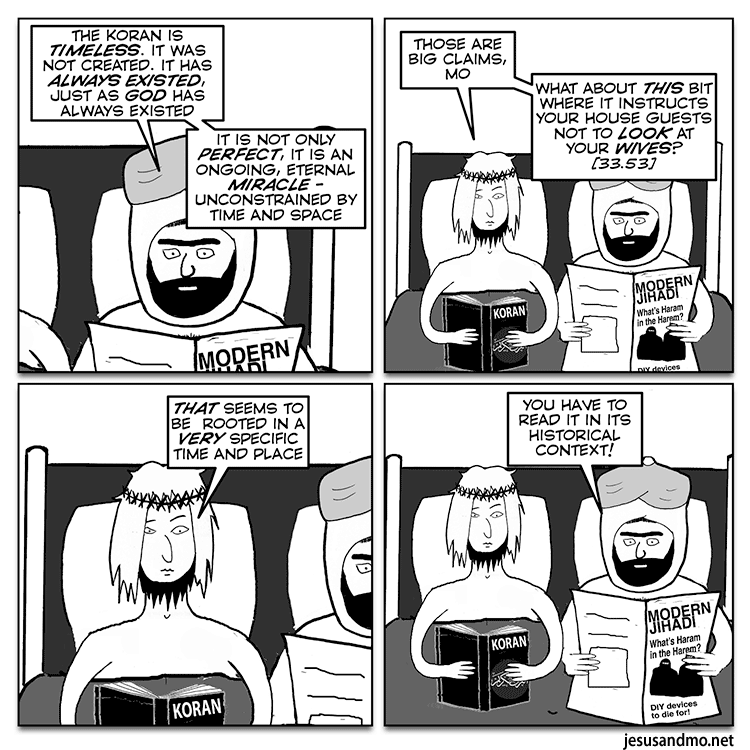
There’s a new Jesus and Mo comic, called “context,” which came with the note, “Another eternal, uncreated Jesus & Mo strip,” as well as this caption:
And it’s eternally important that you don’t hang around after dinner.
As I point out in my foreword to the latest J&M collection (see below), Mo always instantiates the very thing he’s criticizing. In this case, he overturns his own claims. The verse at hand is here (bolding is mine):
O believers! Do not enter the homes of the Prophet without permission ˹and if invited˺ for a meal, do not ˹come too early and˺ linger until the meal is ready. But if you are invited, then enter ˹on time˺. Once you have eaten, then go on your way, and do not stay for casual talk. Such behaviour is truly annoying to the Prophet, yet he is too shy to ask you to leave. But Allah is never shy of the truth. And when you ˹believers˺ ask his wives for something, ask them from behind a barrier. This is purer for your hearts and theirs. And it is not right for you to annoy the Messenger of Allah, nor ever marry his wives after him. This would certainly be a major offence in the sight of Allah.
This stuff is added, and you might want to throw some dosh the way of the artist (remember, his strips make fun of religion, and for that he has to be anonymous: