Readers’ wildlife photos

April 7, 2026 • 9:15 am

Today we have a potpourri of photos from several readers. Their captions are indented, and you can enlarge the photos by clicking on them.

From Robert Lang:

Every few days I drive up to Altadena to check on the progress of our rebuild. Now, 14 months after the fires of January 2025, the neighborhoods are starting to come back to life again with the sounds of hammering and sawing, but the animals that had come down from the hills still consider the area to be their own. This bobcat (Lynx rufus) wandered into the empty lot next door while I was checking on our own home’s progress:

Although our metal mailbox survived the fire, we’ve redirected all mail to our temporary home for the time being. Nevertheless, people occasionally stuff their own junk flyers into the mailbox. To help dissuade them from their paper spam, this  Western black widow (Latrodectus hesperus) has taken up residence on the front of the mailbox. When disturbed, she retreats to her cozy cubbyhole under the handle, which is right where you’d put your fingers if you were going to open the mailbox to stuff something inside:

Seeing eye to eye: this California Ground Squirrel (Otospermophilus beecheyi) and Western Fence Lizard (Sceloporus occidentalis) are trying to decide who gets the top of the rock. Photograph by Merrilee Fellows.

From Todd Martin; a photo taken in, I believe, the Yucatan:

We encountered the ocellated turkey,  (Meleagris ocellata), appropriately enough, on Thanksgiving day, I had no idea what it was though and took it for a brightly colored pheasant. It wasn’t posing as nicely, but this picture gives a better sense of the iridescent feathers:

And from Keira McKenzie in Perth, Australia, we have three shots of the willie wagtail (Rhipidura leucophrys):

The first is taken at a neighbour’s place. She feeds him so he comes every morning:

The other two are taken at Hyde Park.

They are called Djiji Djiji in Nhe Noongar language,  which is much like the chittering it makes when cross or wary. The Latin name is Rhipidura leucophrys/

Despite being known for their chittering, they are also incredibly melodic. They wag their tails from side to side, but are actually the largest of the fantails.

They are known for their outrageous courage and will take on anything – cats, eagles, hawks, people – and win! Every time 😀

They are an utter delight and common all over Australia (though the ones in my neighbourhood have gone along with the trees – the increasing heat has caused them to stop nesting in my front yard).

And they are tiny. Tiny and mighty 🙂

They are very cute. And fierce with their white eyebrows over their bright black eyes 🙂

From Mark Gregor-Pearse in Texas:

This Great Egret (Ardea alba) was photographed on March 9, 2026, at the Puente Río Cuale in Puerto Vallarta, Mexico, with an iPhone 17 Pro. These large wading birds hunt by remaining perfectly still before striking with lightning speed to spear fish, frogs, and other small aquatic prey. Males and females look nearly identical, so it is difficult to determine the sex from a photo. In the early 1900s, Great Egrets were nearly driven to extinction because their delicate breeding plumes were prized for women’s hats. Public outrage over the slaughter helped launch the modern bird conservation movement:

And a cat from Pratyaydipta Rudra:

I am hoping to send some photos for readers’ wildlife when I get some time. Meanwhile I thought you may enjoy this photo of a stray cat from India (a friend sent it to me). It really wants to experience the “magic”, but alas! It’s too expensive. 

Readers’ wildlife photos

April 6, 2026 • 8:15 am

Today’s photo come from reader Jan Malik, who took them in New Jersay. Jan’s captions are indented, and you can enlarge the photos by clicking on them.

As an appendix to the earlier Tree Swallow pictures, here are a few more from the New Jersey Botanical Garden. A walk in that park on the first day of spring is a ritual of mine—to ensure all observable phenomena related to spring are happening again and that the thermal death of the Universe is postponed for yet another year.

Red-bellied Woodpecker (Melanerpes carolinus) pausing mid-search for food. This is a female; in this species, the red plumage is restricted to the nape and the area above the bill, whereas males sport a continuous red cap:

Spring Snowflake (Leucojum vernum, possibly var. carpathicum), a Eurasian transplant. It looks succulent, but this perennial defends itself against mammalian browsing by producing bitter, poisonous alkaloids:

Eastern Cottontail (Sylvilagus floridanus) hiding in bearberry brambles. Against this notorious garden destroyer, only the Holy Hand Grenade of Antioch offers a true degree of protection:

Forsythia (Genus Forsythia) in bloom—the unmistakable sign that spring has arrived:

White-breasted Nuthatch (Sitta carolinensis). Like the woodpecker, it is a connoisseur of arthropods hiding in bark. however, by being equally adept at feeding head-down or head-up, it finds insects that a woodpecker might miss:

Common Water Strider (likely Aquarius remigis) emerged from its winter hiding. These are predators and scavengers of insects trapped on the surface of slow-flowing streams. As a “true bug,” it has evolved to exploit surface tension. However, surface tension alone doesn’t keep it dry; the secret lies in the dense, hydrophobic hairs on its tarsi. These trap air to act as tiny “dinghies,” preventing the legs from being wetted by capillary action:

Crocus flower (likely a Woodland Crocus, Crocus tommasinianus). The flowers emerge before the leaves, which then die back in late spring after accumulating enough biomass for the year. This adaptation to montane meadows and early forests allows them to bloom early, while withdrawing underground provides a defense against browsing:

Northern Mockingbird (Mimus polyglottos) picking bittersweet fruit (likely the introduced Oriental Bittersweet, Celastrus orbiculatus). The fruit is indeed slightly sweet—a fact I confirmed before spitting it out, as they are reportedly toxic to humans. As they say: don’t try this at home; try it in nature instead:

After the meal, the mockingbird sits quietly in a nearby bush. They mimic other birds’ calls, possibly to fool rivals into thinking a territory is already occupied. It doesn’t work on me, though—I can always tell the original bird from the imitation:

Snowdrop (Genus Galanthus), another Eurasian immigrant. Most of the plants in these pictures were introduced from Eurasia to the Americas; however, with the exception of the Bittersweet, they are generally not considered invasive:

A Jumping Spider. I can’t vouch for the exact ID, but it resembles Phidippus princeps. While not my best shot, it’s worth noting that, like all others in this series, it was taken with a single lens (Canon RF 100-500mm)—a blessing for a lazy photographer.

An Eastern Gray Squirrel (Sciurus carolinensis), looking lean after winter and digging for roots and grubs in the lawn. This species is an unwelcome sight in Europe, where its introduction is displacing the native Red Squirrel. But can we really blame them? They are simply good at being squirrels. It is entirely a human fault that geographical barriers are collapsing. In this “Homogecene” era of a connected world, the total number of species will inevitably decline:

Readers’ wildlife photos

March 26, 2026 • 8:15 am

In the absence of much of a backlog, I’ve stolen some gorgeous photos from reader Scott Ritchie of Cairns, Australia (his FB page is here).  Scott’s captions and IDs are indented, and you can enlarge his photos by clicking on them.

Recently I visited my friends, Karen and David Young in the Crater Lake cabins near Lake Eacham, Atherton Tablelands, west of Cairns. This area is a mega for birds and they did not disappoint. In particular, we got great up close and personal views of our local bird of paradise, bird of prayer, paradise, the Victoria rifle bird.

The male of the species has jet black feathers. However, in just the right light you get a lovely iridescent reflection. The other thing these birds do is dance. It’s an amazing shuffling of the wings while top of stump while throwing their head out and flashing your lovely iridescent blue throat. The immature riflebird is a beautiful brown/rufous color, and they can’t help to practice their dance moves. And of course dad’s gotta come along and join in the festivities.

Also, here’s a few photos of some other creatures that I saw on my little five hour trip to the table lands. I hope you enjoy them.

Male Victoria’s Riflebird (Ptiloris victoriae),in full dance pose. Note the jet black feathers:

Swishes wings sideways, like a flying saucer. Peering above the wings:

But in the right light, iridescent rainbows appear:

I love the cooper and purple sheen on his back:

Meanwhile, youngster, an immature male, practices his dance moves. He leans back, showing off his wild yellow throat:

“Peek-a-boo”
Stands up, and swishes his wings back and forth, hiding his head behind them:

Then stands proud:

And then the adult male shows up. I’ll show you who’s boss:

Has he lost his mind?

I’m definitely King of the Stump:

Off youngster goes, only to be replaced by another male!:

And a few other local birds made an appearance. Pacific Emerald Dove (Chalcophaps longirostris):

Macleay’s Honeyeater (Xanthotis macleayanus):

Grey-headed Robin (Heteromyias cinereifrons):

And the musky rat-kangaroo (Hypsiprymnodon moschatus), our smallest proper roo!:

And the Boyd’s Forest Dragon (Lophosaurus boydii) appeared for the lizard and snake lovers:

Readers’ wildlife photos

March 23, 2026 • 8:15 am

Send ’em in if you got ’em.  The photo situation is dire.

But today we have whale photos by reader Ephriam Heller. His captions and IDs are indented, and you can enlarge his photos by clicking on them.

The best whale watching I have experienced is observing gray whales (Eschrichtius robustus) in the San Ignacio Lagoon on the Pacific coast of the Baja peninsula in Mexico. These whales are curious and “friendly,” often swimming up to boats to observe their occupants and even allowing themselves to be touched. Here is an example of an interaction between two species that each appear to exhibit curiosity and intelligence:

This is what a gray whale looks like (Image courtesy of International Whaling Commission):

They engage in numerous photogenic behaviors, such as rolling, riding the surf, waving their flippers and flukes in the air, and spyhopping to observe their surroundings.

The gray whale has longitudinal double blowholes. People claim that they form a heart shape, but think a heart with this shape needs immediate treatment:

When the sunlight hits their spray just right, one sees “rainblows”:

The gray whale has the most parasites of any whale, carrying up to 180 kg. At birth, babies have no barnacles or sea lice, but quickly acquire them from their mothers. The older the whale, the more barnacles and lice they collect. The whales rub along the seabed and piers to try to rid themselves of the parasites.

The whales carry one species of barnacle and four species of whale lice. The barnacles are Cryptolepas rhachianecti (whale barnacles) which are specific to gray whale hosts (i.e., they rarely occur on any other species), and they die when the whale dies.

There are four species of “whale lice,” which are not true lice (which are insects) but are amphipods in family Cyamidae: Cyamus scammony (the most common), Cyamus kessleri, and Cyamus eschrichtii are all found only on gray whales. Cyamus ceti is found on gray and bowhead whales. These cause minor irritation to healthy whales. Researchers view cyamid coverage and distribution (e.g., heavy clusters near blowhole, mouthline, genital slit) as indicators of stress, nutritional status, and chronic skin disease rather than as a primary cause of these problems.

There are two populations. The larger Eastern North Pacific population migrates along the continental coast between its breeding grounds in Baja, Mexico and its feeding grounds in Alaska. The small Western North Pacific population migrates along the Pacific coast of Asia. Gray whales hold the record for the longest migration of any mammal, with typical round-trip distances of about 20,000 km annually (although this isn’t close to the 70,000 km migration of the arctic tern).

Whales fall into two suborders: baleen (Mysticeti) and toothed (Odontoceti). Gray whales are in Mysticeti and use their baleen to feed on amphipods and plankton on the seafloor. During the six month summer feeding season, adults consume over 1 ton of food per day. They then fast for the remainder of the year, including the migration and winter birthing / breeding season. They exhibit “handedness,” in that most gray whales feed by scooping up sediments from the seafloor with the right side of their heads, resulting in their right sides having fewer adhering barnacles and sea lice.

They live up to ~70 years. Biggs transient killer whales (orcas) kill up to 35% of the calf population annually. Based on scarring, researchers speculate that almost every gray whale has been attacked by orcas. Most attacks occur as the young calves migrate north through Monterey Bay, California and Unimak Pass, Alaska.

The Eastern North Pacific population dropped to ~1,000 individuals around 1885 due to whaling, but has since recovered to ~27,000 in 2015-2016. The Western North Pacific population is tiny, comprising just a few hundred individuals. North Atlantic populations were extirpated (perhaps by whaling at the end of the medieval warm period) on the European coast in the 12th to 14th centuries, and on the American and African Atlantic coasts around the late 17th to early 18th centuries. Remains of gray whales from the time of the Roman empire have been found in the Mediterranean Sea, and they are still rarely seen there in modern times.

The gray whale has a dark slate-gray color and is covered by characteristic gray-white patterns, which are scars left by parasites that drop off in its cold feeding grounds. Individuals can be identified by their pigmentation patterns and their scars. I got this great photo of a whale’s tail; but it was just a fluke:

In case you are the kind of person who is interested in this sort of thing, this is what it looks like when whales mate:

Anyone with a younger brother will recognize this as the “head butt” greeting, a conserved behavior across all mammal species:

And this is the view when you saddle up a gray whale (I use a western saddle):

The eyes of gray whales are unlike the eyes of any other mammal I have seen, with what appear to be tangled filaments. My AI friend assures me that this is not the case and that they do not have any “extra” organs in their eyes: “The ‘tangled filaments’ you’re seeing are structures in the gray whale’s iris and surrounding tissues that become visible because the eye is small, very dark, and strongly three‑dimensional, so you are effectively looking across folded, ridged iris and ciliary tissues rather than through a flat, open pupil as in most mammals you see up close.”

Readers’ wildlife photos

March 12, 2026 • 8:15 am

And we have more photos. Today’s come from Jan Malik, documenting the birds of Barnegut Inlet in New Jersey. Jan’s captions and IDs are indented, and you can enlarge the photos by clicking on them.

My previous batch from the Barnegat Inlet covered geese and ducks. It’s time for some of the other coastal birds now.

Immature Double-crested Cormorant (Nannopterum auritum). In contrast to diving ducks, these birds have no buoyancy problem and submerge easily.

Common Loon (Gavia immer). Judging by the slightly pinkish gape at the base of its bill and the fuzzy transition between black and white, this is an immature bird that stays on coastal bay waters before maturing and returning to quiet inland lakes to breed:

Another loon, this one with a mangled crustacean that I suspect is an Atlantic blue crab (Callinectes sapidus). I wonder if a diving loon preferentially picks a freshly molted crab the way we select ripe fruit:

Not a great loon picture, but we can see enough of the prey’s fins to identify the fish as an Oyster Toadfish (Opsanus tau), a species in which males provide parental care to eggs and young. The fish was big and bony, so the loon struggled a bit to swallow it. That fish would be a terrible choice for performing the Fish Slapping Dance. For the loon, it would be preferable to swallow its catch underwater, because at the surface it may be stolen by gulls, who know where a bird has dived and circle above waiting for it to reappear:

A couple of Savannah Sparrows were hopping on the rocks. I suspect that this pale bird with very little yellow in its brow is an Ipswich Sparrow, a subspecies (Passerculus sandwichensis princeps) that breeds on the sand spit of Sable Island off Nova Scotia:

Three species of shorebirds are common in winter at the Barnegat Inlet, all quite similar at first glance in size and plumage, but each occupying a different ecological niche. First, the Ruddy Turnstones (Arenaria interpres), here trying to sleep—probably using only one half of their brain to watch for predators, in unihemispheric slow-wave sleep. Their bills are short, stubby, and slightly upturned, adapted for—just as their name suggests—turning over beach debris to search for invertebrates hiding underneath:

Next, the Dunlins (Calidris alpina). They feed, roost, and migrate in large flocks. Unlike Turnstones, their bills are long, slender, and sensitive, used for probing tidal mudflats for worms and crustaceans:

Last, there are the Purple Sandpipers (Calidris maritima). Their bills are more “general purpose” than those of the other two species. Their covert feathers do show a purple sheen in the right light:

Purple Sandpipers and Dunlins are not very afraid of people on their wintering grounds; they may rest a few meters from a quiet observer. But the slightest hint of danger can trigger the whole flock to take flight in an instant—only to land nearby a moment later:

Purple Sandpipers are adapted to rocky coasts, where they feed on mussels exposed during low tides and on other invertebrates. The undersides of their feet must have a texture that allows them to walk sure‑footed on slime‑covered, slippery rocks:

 They have also evolved Silly Walks:

A distant Harbor Seal (Phoca vitulina), a frequent sight in the Inlet, always seems to look at the jetty with disappointment when it notices that this prime haul‑out spot is occupied by people:

As I was about to leave, the colors of the sunset behind a distant house caught my attention, so I took a picture, thinking little of it. Only back home—rather like the character in Antonioni’s Blowup—did I realize that the picture hides a predator the sleeping shorebirds must be on guard against. To be honest, I can’t be sure this was a flesh‑and‑blood predator and not one made of polystyrene, but the impression remains:

Readers’ wildlife photos

March 9, 2026 • 8:15 am

I have a few batches now, so I’m complacent (never happy!). Today’s photos of Costa Rica come from reader Rachel Sperling.  Her captions and IDs are indented, and you can enlarge the photos by clicking on them.

In January I took my first (of many, I hope) trip to Costa Rica. We spent about a week in Manuel Antonio, on the Pacific Ocean side. We took a couple of nature walks in and around Manuel Antonio National Park, and we saw plenty of wildlife. One of these days I’m going to treat myself to a really good camera, but these were all taken with either my mirrorless Olympus or my iPhone camera, which are light and easy to stash in a backpack. I did see a couple of sloths – both three-toed (Bradypus variegatus) and Hoffman’s two-toed (Choloepus hoffmanni), but they were high up in the trees, so I wasn’t able to get a good photo of them.  These are the photos I was able to capture:

On the drive from San Jose to Manuel Antonio, we stopped at a creek to view some American crocodiles (Crocodylus acutus):

We saw a number of Central American Squirrel monkeys (Saimiri oerstedii), which were incredibly cute:

Then there were these little beasts: the Costa Rican mafia, aka the Panamanian/Central American White-faced capuchin (Cebus imitator). According to our guide, these monkeys can be pretty vicious with animals their own size, and they’ll just riffle through your backpack if you’re not watchful. Someone had to be on guard whenever we went to the beach.

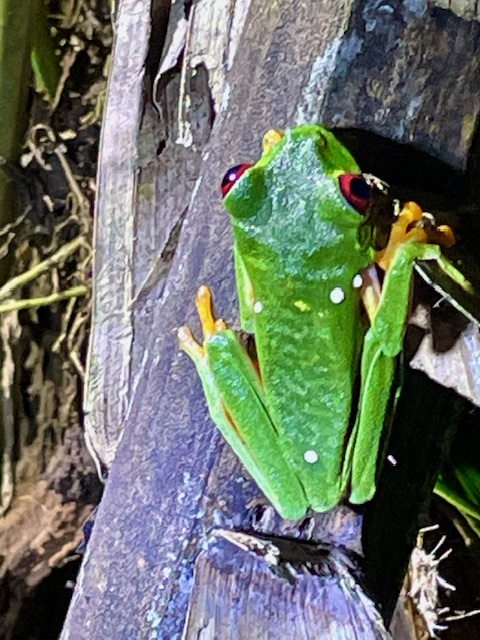
We went on a nature walk in the rainforest at night (with a guide), which gave us the opportunity to see a lot of nocturnal animals. Among them was the Red-eyed tree frog (Agalychnis callidryas):

Masked tree frog/New Granada cross-banded tree frog (Smilisca phaeota) in Manuel Antonio National Park. I’m sorry I’m not better at identifying plants, to the disappointment of my botany-teacher father:

Black iguana (Ctenosaura similis), at the beach at Manuel Antonio:

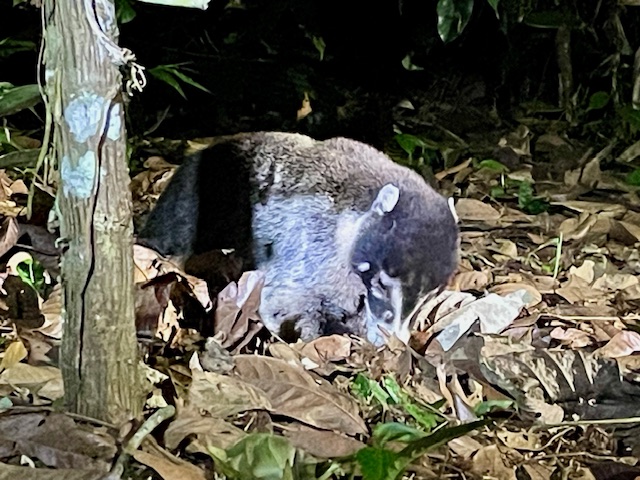
We also saw a coati (Nasua narica), which Wikipedia tells me are diurnal, but it was definitely after sunset and that is definitely a coati. They’re relatives of the raccoon, and our guide told us that a mature one can hold its own against a jaguar. This one wasn’t afraid of us, anyhow:

Back at our b&b, this Black-hooded antshrike (Thamnophilus bridgesi) came to visit me as I read on the veranda a few times. I think it’s a female, though the sexual dimorphism of this species doesn’t seem terribly dramatic. I did see her building a nest:

On my last day in Costa Rica, I heard a tremendous ruckus in the trees outside my hotel in San Jose. I looked and discovered that the trees (American oil palmsElaeis oleifera —I think) were full of Crimson-fronted parakeets (Psittacara finschi). They were LOUD and they were going to town on those trees. There were too many to count. Fortunately, they quieted down after sunset:

Manuel Antonio National Park from the water. These little islands are bird sanctuaries that tourists are not allowed to visit:

Sunset over the Pacific, near Manuel Antonio National Park:

Nauyaca Waterfalls, near Dominicalito, where we swam:

Finally, I thought you’d like these because they’re jaguar-inspired. We spent an afternoon at a village belonging to the Boruca, an indigenous tribe. They cooked us a delicious lunch, and showed us how they made dyes from local plants, and carved and painted balsa wood masks. The masks were first used to frighten the Conquistadores. Now you can buy them just about everywhere:

No readers’ wildlife today; instead, we have my own photos from 2004-2006

February 26, 2026 • 9:15 am

Sadly, the tank has run dry.  To proffer some content today, I’ve dug into my personal photo bank and will post a few miscellaneous shots with brief captions. Click to enlarge the photos

Galápagos marine iguana, Amblyrhynchus cristatus, 2010:

Same trip, baby Galápagos sea lion, Zalophus wollebaeki:

Woman collecting land snails for dinner, São Tomé, 2004:

BBQ dinner at City Market, Luling, Texas, 2004. Brisket, sausage, and the trimmings (beans, potato salad, and the mandatory white bread):

Death Valley and a rare post-rain desert bloom, 2005.  Where do the insects come from since these blooms occur only about once a decade?  (If you can ID the lepidopteran, do so.)

Usually there is only saltbush and creosote growing on the land, but in a bloom all sorts of flowers emerge from dormant seeds:

A rare Jewish cowboy, photo in the Eastern California Museum in Independence. The last time I went the photo was gone and nobody knew about it or even remembered it. I’d kill to have it:

Mugging in the Alabama Hills, California:

Doing flies, 2005. This is what I spent most of my time doing before I retired.

Flying onto a glacier at Denali (Mt. McKinley).  They were dropping off two climbers in a four-seater bush plane, and I hitched a ride there and back. I got to sit next to the woman pilot. From Talkeetna, Alaska. The peak in the center is Denali.

After we landed on the snow-covered glacier, the pilot had to make a runway to take off from, going back and forth on the snow about ten times to pack it down:

The famous polymorphism of color and banding within the snail Cepaea nemoralis, studied intensively by evolutionary geneticists for years. Despite that work and subsequent population-genetic analysis, we still don’t understand the significance of the variation. For some reason the field was covered with snails; these were on a fencepost. Dorset, England, 2006:

The cottage where poet and author Thomas Hardy was born in 1840 and grew up. Upper Brockhampton, Dorset, 2006.

When Hardy became famous and wealthy, he moved to a house he designed (also in Dorset), Max Gate, where he lived from 1885 until he died in 1928.  In the garden by the house are the burial sites of his beloved dogs and cats.  Here are two graves of his cats, Snowdove and Kitsy; I was told that they were inscribed by Hardy himself, who had worked as a stonemason when younger, but I can’t vouch for that story:

A draft manuscript of the famous novel Tess of the d’Urbervilles  in Hardy’s hand (taken at the local museum):

T. E. Lawrence‘s (1888-1935) final residence the cottage called Clouds Hill. He lived here after he gave up his fame as “Lawrence of Arabia” and served in the RAF under the pseudonym “T. E. Shaw” beginning in 1935, commuting back and forth to the airbase on his motorcycle.  The cottage was very spartan, and had no electricity. As Wikipedia notes,

In a 1934 letter to Francis Rodd, Lawrence (who had changed his surname to Shaw) described his home thus:[5]

“The cottage has two rooms, one, upstairs, for music (a gramophone and records) and one downstairs for books. There is a bath in a demi-cupboard. For food one goes a mile, to Bovington (near the Tank Corps Depot) and at sleep time I take a great sleeping bag… and spread it on what seems the nicest floor… The cottage looks simple outside, and does no hurt to its setting which is twenty miles of broken heath and a river valley filled with rhododendrons run wild. I think everything, inside and outside my place, approaches perfection… Yours ever, T. E. Shaw”

Lawrence had an education in the classics, and is one of my heroes as he was both a man of action and a man of learning. Here’s the inscription in Greek over the door above: οὐ φροντὶς (“why worry”), taken from Hippoclides.

Lawrence’s bathtub and shaving mirror:

Lawrence died in a motorcycle crash on May 13, 1935, soon after leaving the RAF. Heading home on his motorcycle, he didn’t see two boys on bicycles ahead of him because of a dip in the road. Swerving to avoid them at the last moment, he crashed his bike, sustained a serious head injury, and died six days later.  A study of his death by a neurosurgeon who tended the dying Lawrence eventually led to the use of helmets by motorcyclists.

The crash site is a km or two from Clouds Hill, and my friend and I scoured the road on foot looking for the crash site, now marked by a memorial (I saw no dip in the road). We finally found the stone:

Ironically, there had been a car crash at the site right before we found the memorial:

When he crashed, Lawrence was riding a Brough Superior SS100 motorcycle. Here’s a picture of him from Wikipedia riding one (clearly not the death vehicle) that he called “George V”. If you go to Clouds Hill, you’ll see several of his motorcycles in a small garage. 

Lawrence on George V, Wikimedia Commons, author unknown