Readers’ wildlife photos

April 3, 2026 • 8:15 am

Edmund Ault has sent us some photos of mallard (Anas platyrhynchos) ducklings, and you can never see too many of these.  (We should have some in Botany Pond by April 19.)  Edmund’s captions are indented, and you can enlarge the photos by clicking on them.

These ducklings are on the River Witham, in the centre of Grantham, Lincolnshire, and are the first I have seen this year. I regularly feed the ducks on this stretch of river, but I wasn’t aware that there was a nest until I saw the brood this morning; I think they must have hatched first thing this morning (31st March). And what a brood it is: 16 ducklings!

Most of the brood are sheltering under their mother:

More:


The mother duck led her brood for a walk away from the river; when she got back to the river she happily jumped off a small concrete wall (about 3 feet high) and expected her brood to follow suit – which all of them did, although reluctantly:

The brood moved upstream and tried to scale a weir; although the weir is only about a foot high the rush of water was far too great for them and eventually they turned around and went back:

Readers’ wildlife photos

March 26, 2026 • 8:15 am

In the absence of much of a backlog, I’ve stolen some gorgeous photos from reader Scott Ritchie of Cairns, Australia (his FB page is here).  Scott’s captions and IDs are indented, and you can enlarge his photos by clicking on them.

Recently I visited my friends, Karen and David Young in the Crater Lake cabins near Lake Eacham, Atherton Tablelands, west of Cairns. This area is a mega for birds and they did not disappoint. In particular, we got great up close and personal views of our local bird of paradise, bird of prayer, paradise, the Victoria rifle bird.

The male of the species has jet black feathers. However, in just the right light you get a lovely iridescent reflection. The other thing these birds do is dance. It’s an amazing shuffling of the wings while top of stump while throwing their head out and flashing your lovely iridescent blue throat. The immature riflebird is a beautiful brown/rufous color, and they can’t help to practice their dance moves. And of course dad’s gotta come along and join in the festivities.

Also, here’s a few photos of some other creatures that I saw on my little five hour trip to the table lands. I hope you enjoy them.

Male Victoria’s Riflebird (Ptiloris victoriae),in full dance pose. Note the jet black feathers:

Swishes wings sideways, like a flying saucer. Peering above the wings:

But in the right light, iridescent rainbows appear:

I love the cooper and purple sheen on his back:

Meanwhile, youngster, an immature male, practices his dance moves. He leans back, showing off his wild yellow throat:

“Peek-a-boo”
Stands up, and swishes his wings back and forth, hiding his head behind them:

Then stands proud:

And then the adult male shows up. I’ll show you who’s boss:

Has he lost his mind?

I’m definitely King of the Stump:

Off youngster goes, only to be replaced by another male!:

And a few other local birds made an appearance. Pacific Emerald Dove (Chalcophaps longirostris):

Macleay’s Honeyeater (Xanthotis macleayanus):

Grey-headed Robin (Heteromyias cinereifrons):

And the musky rat-kangaroo (Hypsiprymnodon moschatus), our smallest proper roo!:

And the Boyd’s Forest Dragon (Lophosaurus boydii) appeared for the lizard and snake lovers:

Readers’ wildlife photos

March 22, 2026 • 8:15 am

Today we have some travel and wildlife photos from reader Jan Malik.  Jan’s captions are indented, and you can enlarge the photos by clicking on them. (Don’t miss the Taiwan barbet!)

Here are a few pictures I took during my short stay in Taipei, Taiwan (Republic of China) in 2016. Business trips usually allow very little time for sightseeing — the familiar, morbid cycle of airport → hotel → conference room → hotel → airport — but on this occasion I had a few free hours in the afternoon. Naturally, I decided to explore the nearby Taipei Botanical Garden with a birding lens that mysteriously strayed into my suitcase:

On my way to the Botanical Garden, I visited the National Chiang Kai-shek Memorial Park and Hall, the latter built in the late 1970s after the President’s death. I include it here for documentary reasons — who knows how long it is going to survive, given the volatile political situation.

Inside stands a larger‑than‑life sculpture of the Generalissimo. Taiwan’s history is typical of right‑wing dictatorships which, like South Korea, Spain, or Portugal, began as oppressive authoritarian regimes and then evolved into genuine democracies. Conversely, left‑wing dictatorships typically resist fundamental change and persist until their eventual collapse:

Onward to wildlife. The entrance to the Mausoleum was guarded by a lion (Panthera leo var. lapideus):

Already in the Botanical Garden, I encountered a cat, doing what cats do best – contemplating:

In one of the alleys I came upon a sizable crowd — people were observing local celebrities, a pair of nesting Oriental magpie‑robins (Copsychus saularis). The birds seemed completely unfazed by the attention, the male singing and standing guard at the nest;

These birds are bold and well adapted to human habitats. The female does most of the feeding; here she brings an unidentified moth to her chicks in a rotted‑out branch stump:

At a nearby pond I spotted a duck. It was likely a domestic bird, possibly with a dash of wild Mallard  (Anas platyrhynchos) ancestry:

The pond was full of lotus plants, which provided excellent habitat for the Common moorhen (Gallinula chloropus). Like all rails, these birds have relatively small wings and strong feet, well suited to foraging on land as well as in water. They swim well despite lacking webbing between their toes. These traits help explain why, when rails successfully colonize remote predator‑free islands, they often evolve reduced flight or complete flightlessness;

Moving further along the park alleys, I spotted a Taiwan barbet (Psilopogon nuchalis) looking out of its nest cavity. As an endemic species, it was a special find for me. Barbets vary widely in sexual dimorphism — in the Taiwan barbet the sexes are practically indistinguishable, in others (like the Coppersmith barbet) the differences are subtle, and in still others (such as the Red‑and‑yellow barbet) they are striking. I wonder why, in this species, bright coloration in females is not maladaptive. Perhaps the fact that they are obligate cavity nesters shields incubating females from predators. The same logic applies to woodpeckers, whose sexes are also similar aside from modest red patches in males:

Shortly after the barbet, I hit another jackpot in my endemics count — the Taiwan blue magpie (Urocissa caerulea). Like other corvids, it is social and omnivorous, and like Taiwanese barbets, it is sexually monomorphic. Corvids also evolved cooperative breeding: fledglings often remain with their parents and help raise the next brood. This likely evolved through kin selection. Why does it work so well in corvids and not in most other birds? Perhaps in environments with limited resources, young birds have better reproductive success by helping relatives than by attempting to breed independently?:

Having spent some time observing the magpie, I moved on — my remaining time before the flight was getting short. Soon I saw another first for me, though a common sight in Southeast Asia: the light‑vented bulbul (Pycnonotus sinensis). An omnivorous bird, here it was about to snatch a ripe fig:

Moving on, I photographed a dragonfly, which I believe is a male Crimson Marsh Glider (Trithemis aurora). These insects are sexually dimorphic, with olive‑colored females. This male appears to be orienting its abdomen toward the sun to reduce the surface area exposed to solar radiation and prevent overheating — a behavior known as “obelisking”:

Near the Botanical Garden exit I saw the last animal in this series, the Eurasian tree sparrow (Passer montanus). They always bring a smile to my face. Unlike many other sparrows, the sexes are alike. In 1958 they were targeted during China’s “Four Pests” campaign, a fine example of how ideology can override basic biological understanding:

While driving toward the airport that evening, I saw a Buddhist temple by the roadside, adorned with a symbol that, in European cultural circles, evokes entirely non‑religious sentiments. It was adopted in the 1920s by the National‑Socialist German Workers’ Party, but in Asia it is an ancient religious emblem. It is not identical to the Hakenkreuz — it “rotates” counterclockwise — and its meaning here is entirely benign:


Kākāpō cam!

March 18, 2026 • 8:15 am

Today I’m putting up an animal cam in lieu of Readers’ Wildlife Photos because I need to conserve the latter: I have only about two batches left. If you have some, send them in!

But this is one of the best animal cams I have seen, for it shows in real time a very rare animal: a brooding female kākāpō and her chick (Strigops habroptilus). This is the world’s only flightless parrot, and is found in New Zealand, where it evolved in the absence of mammalian predators. Now it’s highly endangered, with only a few hundred individuals left, but an intensive conservation effort by New Zealand is bringing them back. This effort includes putting all kākāpōs onto islands where potential predators birds have been removed. As Wikipedia notes,

The kākāpō is critically endangered; the total known population of living individuals is 236 (as of 2026). Known individuals are named, tagged and confined to four small New Zealand islands, all of which are clear of predators; however, in 2023, a reintroduction to mainland New Zealand (Sanctuary Mountain Maungatautari) was accomplished.  Introduced mammalian predators, such as cats, rats, ferrets, and stoats almost wiped out the kākāpō. All conservation efforts were unsuccessful until the Kākāpō Recovery Programme began in 1995.

Newsweek, via reader Ginger K, offers us a link to a live kakapo cam. This is the only such bird ever to be livestreamed with a cam, and here’s some information about the video below from Newsweek. I find the feed mesmerizing, and watched the female sleep for a while last night (it was day in New Zealand), sitting on her fluffy white chick and occasionally grooming herself and the chick.

Newsweek:

A quiet underground nest on a remote island off New Zealand’s coast is captivating viewers around the globe as the world’s largest parrot species is livestreamed.

The YouTube livestream, Kākāpō Cam, offers a continuous view inside the nest of Rakiura, a 24-year-old female kākāpō—one of just 236 left worldwide. Rakiura has been living beneath a rātā tree on Codfish Island, also known as Whenua Hou, off the country’s southern coast, where she hatched two chicks this breeding season.

Since January, the footage has offered unpolished, intimate glimpses of the nocturnal, flightless parrot. Rakiura shuffles in the nest, preens her green feathers, settles her body protectively over her chick, and occasionally leaves under the cover of darkness to forage before returning to feed. At times, the screen shows little movement at all—just the soft rise and fall of a bird resting, giving viewers a rare, real‑time look at a species most will never see in person.

“This is the only camera in a kākāpō nest this season, and the only nest we’ve ever streamed live,” Deidre Vercoe, operations manager for Kākāpō at New Zealand’s Department of Conservation (DOC), told Newsweek. “Kākāpō Cam provides insights that help guide us to support their recovery, while also giving people around the world a chance to connect with this incredible species.”

. . .While most female kākāpō choose new nesting spots each breeding cycle, Vercoe said Rakiura has returned to the same site every season—allowing conservationists to reinforce the nest and carefully plan a reliable camera setup months in advance through the DOC’s Kākāpō Recovery team.

Hands‑on fieldwork began in October 2025 and will continue for most of the year, involving around 30 DOC staff, specialist support teams and 105 volunteers, each donating two weeks of their time.

The team also added drainage and a small access hatch to protect eggs and chicks without disturbing her natural behavior.

The camera was first trialed during the 2022 breeding season, but this year’s stream went live in time to capture egg‑laying and hatching for the first time.

Rakiura successfully hatched two genetically important chicks on February 24 and March 2, though the older one was later transferred to a foster mother so she could focus on raising the remaining chick, Nora‑A2‑2026, now the star of the livestream. The team will check on the chick every three days until it is one month old.

Okay, enough information. Watch below live NOW. If mother Rakiura is out, you’ll still see the chick. When I put this up at 8:15 a.m. Chicago time, it will be 2:15 a.m. in New Zealand, and it looks like mom is still sleeping.  Watch from time to time so you can see the chick. She’s very solicitous of it and grooms it often.

Lagniappe: a tweet on this season, a great one for baby parrots, from New Zealand Conservation

And one of the best animal videos ever: a male kākāpō, Sirocco, shagging biologist Mark Carwardine while Stephen Fry looks on and narrates. This was from the BBC show “Last Chance to See,” about endangered species:

When I went to New Zealand a while back, I really wanted to see these birds, but you really can’t: you need a good reason to get to the islands where kākāpō are kept. To do that, you have to be somehow involved in their conservation. You can volunteer to live on the island for several months and help monitor the birds, but that’s a big commitment just to see them. However, if you want to help save them, you can donate here.

Readers’ wildlife photos

March 17, 2026 • 8:15 am

Today we have some photos of New Zealand’s forest birds from reader David Riddell. David’s captions and IDs are indented (don’t miss the informative text!), and you can enlarge his photos by clicking on them.

In previous batches of images I’ve posted here I’ve focused mostly on New Zealand’s water birds, and particularly the oceanic birds which are such a significant part of our avifauna.  Compared to most similarly sized temperate countries New Zealand has relatively few indigenous land birds, partly a consequence of our isolation and partly due to the history of extinctions since these islands were first colonised by humans in the 13th century.  On the other hand a high proportion of those birds are endemic, often with no close relatives elsewhere.  Most of these photos are from a road trip our family did in October 2019, from our home in the central North Island down through the South Island to Stewart Island, the southernmost and by far the least modified of New Zealand’s main islands.

The first major destination on our trip was the Heaphy Track, in the north-west of the South Island, where we walked in to the first hut from the south-western end, and a short distance up the Heaphy River valley. The tui (Prosthemadera novaeseelandiae) is still quite common in many parts of the country, and in the last 15 years have re-established themselves in the area where I live in the rural, lowland Waikato region, but in the Heaphy we saw a flock of several dozen, which is still an unusual sight.  They’re one of two New Zealand members of the honeyeater family, which are much more diverse in Australia.  This one has a dusting of pollen on its face from feeding on New Zealand flax (Phormium tenax):

South Island tomtits (Petroica m. macrocephala) are a common and approachable bird throughout forested parts of the island and its outliers. Males have a yellow flush on the upper breast which the North Island subspecies lacks:

Weka (Gallirallus australis) are flightless rails about the size of a bantam hen, and are well-known for their bold and fearless nature – we often had them hassling us for food scraps as we went along the Heaphy Track. They seem able to handle most exotic mammalian predators, and are known to catch and eat rats, though they have disappeared from large areas of the country, possibly due to disease.  In some areas, however, they are making a comeback and expanding into new territory:

There is another flightless rail in New Zealand which is even larger – in fact it’s the largest rail in the world – the takahe (Porphyrio hochstetteri). Four individuals were sighted in the latter half of the 19th century – and promptly “collected” –  after which they were believed to be extinct, before being rediscovered in the remote south-west of the South Island in 1948.  Intensive management has seen numbers slowly rise to about 300, with a couple of new populations established on the South Island mainland, as well as others on predator-free islands.  These ones are on Kapiti Island, off the south-west coast of the North Island.  There was also a North Island takahe species (Porphyrio mantelli, also known as moho), which was very similar, though taller and more slender, but now extinct.  Both were originally classed in the genus Notornis, but molecular studies have revealed that they appear independently derived from flighted gallinules, known in New Zealand as pukeko (Porphyrio melanotus), colonising separately from Australia in a nice example of parallel evolution:

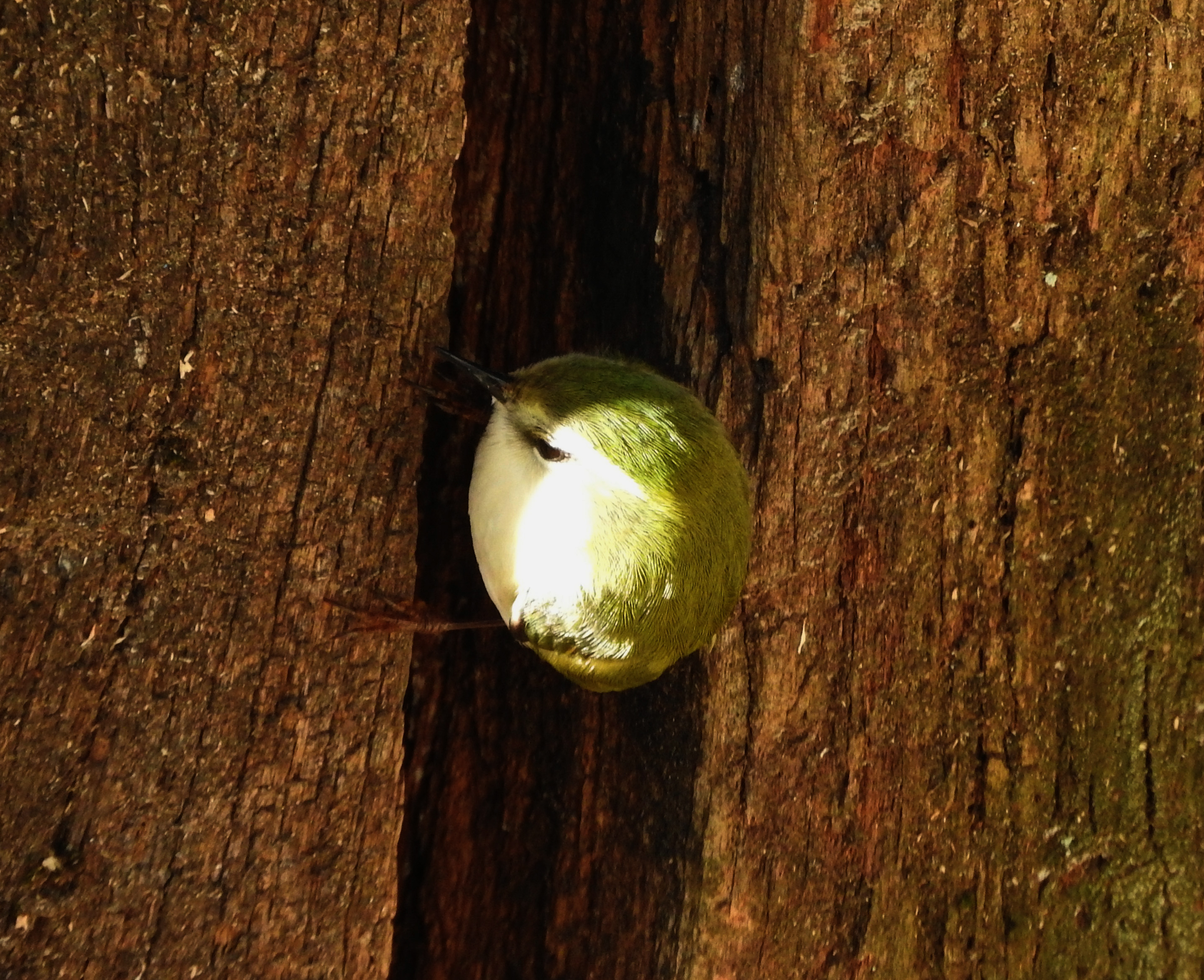
Our next stop after the Heaphy was Arthur’s Pass, one of the main routes across the Southern Alps which run along most of the length of the South Island. A special treat was the view we had out the kitchen window of our accommodation, where a pair of riflemen (Acanthisitta chloris) had their nest in a retaining wall just a few feet away.  This is the male; riflemen (named for their bright green “jackets”) are New Zealand’s smallest bird, weighing only 6 grammes, and have extremely short tails.  They’re reasonably common in larger, less disturbed forest areas, but always a delight to see.  Their call is so high-pitched that many people can’t hear it at all.  The family they belong to, the Acanthisittidae or New Zealand wrens, is the sister group of all other passerines, meaning they’re the most ancient of living families of perching birds:

Only one other New Zealand wren species remains extant, the rock wren (Xenicus gilviventris). It’s much rarer than the rifleman, and is mostly confined to alpine areas above the bushline, where it spends the winters among rocks and low vegetation covered by snow. This one was at the head of the Otira Valley in Arthur’s Pass.  The other four or five species in the family are now extinct; three are thought to have been flightless, an extremely unusual feature for passerines.  The only one of these to have survived into the period of European settlement, the so-called Stephens Island or Lyall’s wren (Traversia lyalli), is often said to have been wiped out by a single cat (in some recent tellings given the name “Tiddles” or “Tibbles”), belonging to the lighthouse keeper, Lyall.  In reality the island was overrun with feral cats (since eradicated), and the island’s population was a relict of a formerly widespread distribution throughout the country:

Most people think of parrots as warm climate birds, but one New Zealand species is quite at home in alpine areas, though it also occurs in lowland regions of the South Island. Kea (Nestor notabilis) are regularly seen around Arthur’s Pass, often scrounging for handouts, though feeding them is discouraged.  They’re regarded as one of the world’s most intelligent birds, and the rubbish bins at Arthur’s Pass have to have special kea-proof catches.  Some also figured out that they could hook their claws into the wool on sheep’s backs and peck at the fat around the kidneys, usually resulting in blood poisoning and the death of the sheep.  Consequently there was a bounty on them for many years, though they’ve been fully protected since 1986, and changes in management practices since then have reduced conflicts.  This one is looking rather bedraggled in the rain, about to turn to snow:

Kea have a close relative, the kaka (Nestor meridionalis) which is more common and widespread, though it has also declined significantly. On Stewart Island, where this one was, there are big numbers flying around Oban, the island’s only town (population c. 380).  The flowers it’s feeding on are from a New Zealand flax (Phormium tenax), the plant responsible for the orange dusting on the tui in the first photo.  It’s no relation of the plant that produces linen, but does produce a very coarse fibre which was once the basis for a substantial industry:

Last year we were delighted to have four kaka flying around our garden, an unusual sight in settled parts of the Waikato, though there seem to be more and more around here as the years go by. The tree it’s in is a kowhai (Sophora microphylla), whose flowering is a sure sign of the arrival of spring:

Perhaps not such a great picture, but this is completely unretouched! It’s a photo of an infra-red night vision viewer screen, pointed at a southern brown kiwi, or tokoeka (Apteryx australis).  It was wandering around my feet, hence the foreshortened appearance and apparently small legs; I think the “eye” is a raindrop on the screen (it was raining lightly at the time, as it often does on Stewart Island).  The photo was taken in pitch darkness at about 5.30 am on the rugby ground on the edge of the town.  It’s known as a good spot for kiwi, but when we tried the previous night there was no sign of them, just a dozen or so people wandering round with torches covered in red cellophane, the recommended way to look for kiwi.  On another evening we did see one wandering along the waterfront road under the streetlights, very close to our hotel:

Just off Stewart Island is Ulva Island, which was cleared of rats in 1997 (there have been occasional incursions since, but so far these have all been contained), and is now home to an excellent range of indigenous flora and fauna. Perhaps the most special is the South Island saddleback (Philesturnus carunculatus), which by the early 20th century was confined to a small island group off the southern end of Stewart Island.  In 1962 rats got ashore and rapidly began eating their way through everything on the islands.  An emergency rescue mission by the Wildlife Service captured 36 saddleback and relocated them to predator-free islands; without this action the species would certainly now be extinct.  Other species weren’t so lucky, including the last population of a third acanthisittid species, the bush wren (Xenicus longipes).  The South Island saddleback has a distinct juvenile phase, known as a jackbird, which is light brown, without the adults’ wattles, and no saddle.  Their North Island counterpart (Philesturnus rufusater), sometimes regarded as a subspecies, lacks the jackbird phase, has a narrow gold band along the front edge of the saddle, and has a more complex song repertoire.  In the final chapter of The Selfish Gene, Richard Dawkins uses the ability of saddleback individuals to learn new songs from each other as a non-human example of cultural (non-genetic) inheritance, a concept for which he coined the term “meme”:

Saddlebacks belong to an endemic family, the New Zealand wattlebirds, or Callaeidae. One species, the huia (Heteralocha acutirostris), is extinct, while another, the South Island kokako (Callaeas cinereus) may be, with the last probable sighting in 2007.  The North Island kokako (C. wilsoni) has a few secure populations on predator-free islands, and slowly increasing populations in several closely managed reserves in the northern North Island.  Ecologically they’re rather like squirrels (or perhaps flying squirrels), bounding through the trees on their long legs, eating mostly fruits and leaves, and flying very poorly.  Their song is hauntingly beautiful – I have it as the ringtone on my phone.  This individual, on Tiritiri Matangi Island, shows well the powerful legs and almost ridiculously small wings.  Note also the blue wattles – they’d be orange on a South Island kokako:

Back on Ulva Island, the Stewart Island robin (Petroica australis rakiura) often follows human visitors quite fearlessly, looking for insects they might disturb as they walk along. They’re smaller than the South Island subspecies (P. a. australis) and quite scarce on Stewart Island itself, due to the presence of rats and cats:

Ulva Island is one of the few places it’s possible to see two of New Zealand’s parakeet species together. This is a red-crowned parakeet (Cyanoramphus novaezelandiae), which is very rare on the mainland, though it has several secure island populations:

This one is a yellow-crowned parakeet (Cyanoramphus auriceps), photographed on Little Barrier Island (I didn’t get any pictures on Ulva). They’re slightly smaller than their red-crowned cousins, with paler, lime-green plumage, and a chattering call that’s more high-pitched.  They spend more time in trees and less on the ground, which makes them less vulnerable to mammalian predators and hence are more common on the mainland, though they require tall, well-established forests where predation is an issue:

Readers’ wildlife photos

March 12, 2026 • 8:15 am

And we have more photos. Today’s come from Jan Malik, documenting the birds of Barnegut Inlet in New Jersey. Jan’s captions and IDs are indented, and you can enlarge the photos by clicking on them.

My previous batch from the Barnegat Inlet covered geese and ducks. It’s time for some of the other coastal birds now.

Immature Double-crested Cormorant (Nannopterum auritum). In contrast to diving ducks, these birds have no buoyancy problem and submerge easily.

Common Loon (Gavia immer). Judging by the slightly pinkish gape at the base of its bill and the fuzzy transition between black and white, this is an immature bird that stays on coastal bay waters before maturing and returning to quiet inland lakes to breed:

Another loon, this one with a mangled crustacean that I suspect is an Atlantic blue crab (Callinectes sapidus). I wonder if a diving loon preferentially picks a freshly molted crab the way we select ripe fruit:

Not a great loon picture, but we can see enough of the prey’s fins to identify the fish as an Oyster Toadfish (Opsanus tau), a species in which males provide parental care to eggs and young. The fish was big and bony, so the loon struggled a bit to swallow it. That fish would be a terrible choice for performing the Fish Slapping Dance. For the loon, it would be preferable to swallow its catch underwater, because at the surface it may be stolen by gulls, who know where a bird has dived and circle above waiting for it to reappear:

A couple of Savannah Sparrows were hopping on the rocks. I suspect that this pale bird with very little yellow in its brow is an Ipswich Sparrow, a subspecies (Passerculus sandwichensis princeps) that breeds on the sand spit of Sable Island off Nova Scotia:

Three species of shorebirds are common in winter at the Barnegat Inlet, all quite similar at first glance in size and plumage, but each occupying a different ecological niche. First, the Ruddy Turnstones (Arenaria interpres), here trying to sleep—probably using only one half of their brain to watch for predators, in unihemispheric slow-wave sleep. Their bills are short, stubby, and slightly upturned, adapted for—just as their name suggests—turning over beach debris to search for invertebrates hiding underneath:

Next, the Dunlins (Calidris alpina). They feed, roost, and migrate in large flocks. Unlike Turnstones, their bills are long, slender, and sensitive, used for probing tidal mudflats for worms and crustaceans:

Last, there are the Purple Sandpipers (Calidris maritima). Their bills are more “general purpose” than those of the other two species. Their covert feathers do show a purple sheen in the right light:

Purple Sandpipers and Dunlins are not very afraid of people on their wintering grounds; they may rest a few meters from a quiet observer. But the slightest hint of danger can trigger the whole flock to take flight in an instant—only to land nearby a moment later:

Purple Sandpipers are adapted to rocky coasts, where they feed on mussels exposed during low tides and on other invertebrates. The undersides of their feet must have a texture that allows them to walk sure‑footed on slime‑covered, slippery rocks:

 They have also evolved Silly Walks:

A distant Harbor Seal (Phoca vitulina), a frequent sight in the Inlet, always seems to look at the jetty with disappointment when it notices that this prime haul‑out spot is occupied by people:

As I was about to leave, the colors of the sunset behind a distant house caught my attention, so I took a picture, thinking little of it. Only back home—rather like the character in Antonioni’s Blowup—did I realize that the picture hides a predator the sleeping shorebirds must be on guard against. To be honest, I can’t be sure this was a flesh‑and‑blood predator and not one made of polystyrene, but the impression remains:

Readers’ wildlife photos

March 11, 2026 • 8:30 am

Hooray! Two more groups of photos came in this morning and so we’re good through Friday (I have one in reserve and can cobble together a few others).

The regulars are pulling their weight, and here we have an informative text-and-photo educational post by regular Athayde Tonhasca Júnior. The subject is one of his favorites: bee behavior. You can enlarge Athayde’s photos by clicking on them, and his text is indented.

Witty impostors

On its release in 1956, Invasion of the Body Snatchers did not impress the critics. A spiel about alien plant spores growing into sociopathic duplicates of human beings was considered too outlandish. While the intelligentsia trashed the film, the producers laughed all the way to the bank because it was a commercial hit: the public loved it. One of the reasons for the film’s success was its ‘aliens among us’ theme. The idea of ill-intentioned beings circulating freely and unsuspectedly in the mist of our society is disturbing and gripping – especially during the McCarthy era, when Americans were inspecting their closets for hidden communists. ‘Enemies within’ inspired and inspires countless tales about spies, infiltrated assassins, covert extra-terrestrials, psycho cyborgs and zombified humans.

Fig 1. Invasion of the Body Snatchers received numerous accolades and is today considered a science-fiction/horror classic © Allied Artists, Wikimedia Commons:

Despite what assorted internet sages tell us, tales of aliens’ secret forays into world domination are entertaining fibs. But the natural world provides many real body snatching thrills such as parasitic flies that zombify their victims or induce them to dig their own graves, or wasps that make their hosts work for them. These cases involve species we may already suspect to be mischievous. That some bumble bees could play similar tricks may surprise many.

Superficially, cuckoo bumble bees, Bombus species of the subgenus Psithyrus, look like any of their social (non-parasitic) relatives. But a close inspection of a female’s hind leg shows no pollen basket (corbicula), which is a shallow cavity surrounded by a fringe of long hairs, a structure used to store pollen to be carried away.

Fig 2. Hind legs of a vestal cuckoo bumble bee (B. vestalis) on left, and a buff-tailed bumble bee (B. terrestris) © Alvesgaspar, Wikimedia Commons. [JAC: the buff-tailed bee has a pollen basket.]

She has no corbiculae because she gathers no pollen; cuckoo bumble bees do not found their own nests nor produce a worker caste: there are only male and female reproductive forms. Instead, a female invades the nest of a social bumble bee, lays her own eggs, which are cared for by her unsuspecting hosts. Raising the young at another species’ expenses is known as brood parasitism, a behaviour displayed by some cuckoo birds (order Cuculiformes) – hence Psithyrus bees’ common name.

Fig 3. A  common reed warbler (Acrocephalus scirpaceus) feeding a European cuckoo (Cuculus canorus) who has dispatched rival offspring by pushing them out of the nest © Per Harald Olsen, Wikimedia Commons:

Cuckoo bumble bees go beyond brood parasitism; they don’t just lay their eggs in a host’s nest and leave them to themselves like cuckoo birds do. These bees take over the victim’s colony, a form of exploitation known as social parasitism. Among insects, this strategy is employed mostly by bees, wasps and ants – of which slave-making ants are notorious – but also by other taxa such as the large blue butterfly (Phengaris arion). Once inside the host’s nest, the female cuckoo and her young live off pollen and nectar pilfered from their hosts, so they are also kleptoparasites – animals that steal food or prey from another animal.

We should pause to appreciate the challenges a cuckoo bumble bee faces. First, she has to locate the nest of a suitable host. She must then get in through a narrow entrance protected by a mob armed with poisonous stings and sharp mandibles. Once these defences have been overwhelmed, she must be able to usurp the colony from the host queen, lay her own eggs and induce the host workers to feed her and her developing brood. A tall order for any brood, social and klepto- parasite.

Fig 4. Cuckoo bumble bees coveting this tree bumble bee (B. hypnorum) nest must pass its sentries © Orangeaurochs, Wikimedia Commons:

Finding a nest is reasonably straightforward: like most social insects, cuckoo bumble bees rely on chemical signals from cuticular hydrocarbons to recognise nestmates, co-specific competitors and potential hosts. But locating a nest is just the start. It must be of suitable size: if too big, the defenders are likely to overwhelm and kill the trespasser; if too small, there will not be enough workers to care for her larvae. As an example, there’s a 100% survival for vestal cuckoo bumble bees invading buff-tailed bumble bee nests with five workers; survival drops to nil for colonies with fifty workers (Sramkova & Ayasse, 2009). To avoid disaster, the female cuckoo bumble bee assesses the size of the host colony possibly by their chemical signals and workers’ traffic (Lhomme & Hines, 2018).

After picking an appropriate target, the female cuckoo bumble bee must confront the residents, who understandably are not obliging. But the nest defenders face a formidable enemy: a cuckoo bumble bee is sturdier and better armed than her social counterparts. She has larger and stronger mandibles, more powerful sting muscles, an enlarged venom gland, and her ventral underside, a particularly vulnerable spot, is protected by thicker exoskeleton plates (sternites) (Richards, 1928). So, some cuckoo species use brute force: they bite, push and sting their way in.

Fig 5. Armed for breaking and entering: the variable cuckoo bumble bee (B. variabilis), a critically endangered North American species © USGS Bee Inventory and Monitoring Lab:

But violence is not always necessary. Some species are let in because they mimic their host’s chemical signs. Others have no chemical signatures and display no aggressive behaviours; the host bees are not aware an enemy has sneaked in. The cuckoo will hide in a corner of the nest for a few days, long enough to acquire the scents of her host and blend in (Dronnet et al., 2005).

Once inside, our intruder has to deal with the queen, the only egg-laying member of the colony and thus the mother of all other bees, whose activities are controlled by their mum’s pheromones. Most cuckoo bumble bees don’t beat about the bush; they kill the queen and eat her eggs. Some species spare the deposed monarch, who loses control of her colony for reasons not completely understood: probably the usurper’s pheromones and physical aggression assure her dominance over the queen.

Fig 6. A brown-belted bumble bee queen (B. griseocollis) is strong, but no match for a cuckoo bumble bee © USGS Bee Inventory and Monitoring Lab:

After sorting out the queen problem, the cuckoo bumble bee is free to lay her own eggs and induce the host workers to feed her and her developing young, although how this is done is largely unknown. The resulting male and female cuckoo bees will leave the nest by late summer and look for mating partners. Like most other bees, the male dies soon after intercourse, while the female will search for a safe spot underground to overwinter, just like her hosts. She will emerge from her slumber late, giving sufficient time for her hosts to establish their nests. The female cuckoo bee spends some time hopping from flower to flower, sipping nectar while her ovaries mature, so that she will be ready to find and conquer a bumble bee nest.

Of the 250 or so Bombus species, roughly 30 have evolved into parasitism. We have a poor grasp of cuckoo species’ biology and ecology, partly because they fly about for a relatively short time and their numbers are naturally low, since they don’t have a worker caste. Thus they are difficult to find and study. But the lack of information comes largely from prejudice. Parasites in general are not viewed sympathetically, especially those that target ‘cute and lovable’ victims such as bumble bees. As a result, cuckoo bumble bees are often absent from local species lists and conservation plans. But that’s a misguided view. Parasites and predators are integral components of ecosystems, preventing over-dominance of some species in favour of rarer ones (Frainer et al., 2018). Cuckoo species should be admired and valued for their physiological, morphological and behavioural adaptations that allow them to overcome the defences of highly organised colonies. These bees of ill-repute are in fact evolutionary marvels.

Fig 7. A female red-tailed cuckoo bumble bee (B. rupestris), a widespread European species and a parasite of the equally abundant red-tailed bumble bee (B. lapidarius) © Ivar Leidus, Wikimedia Commons:

References

Dronnet, S. et al. 2005. Bumblebee inquilinism in Bombus (Fernaldaepsithyrus) sylvestris (Hymenoptera, Apidae): behavioural and chemical analyses of host-parasite interactions. Apidologie 36: 59–70.

Frainer, A. et al. 2018. Parasitism and the biodiversity-functioning relationship. Trends in Ecology and Evolution 33: 260–268.

Lhomme, P. & Hines, H. 2018. Ecology and evolution of cuckoo bumble bees. Annals of the Entomological Society of America 112: 122–140.

Richards, O.W. 1928. A revision of the European bees allied to Psithyrus quadricolor Lepeletier (Hymenoptera, Bombidae). Transactions of the Entomological Society of London 76: 345–365.

Sramkova, A. & Ayasse, M. 2009. Chemical ecology involved in invasion success of the cuckoo bumblebee Psithyrus vestalis and in survival of workers of its host Bombus terrestris. Chemoecology 19: 55–62.